





Introduction
Tobacco and cannabis are two of the most commonly used recreational drugs worldwide. In 2019, approximately 1.14 billion adults globally had smoked tobacco regularly and an estimated 200 million people used cannabis in the last year (UNODC, 2021). Existing observational evidence demonstrates prospective associations between cannabis use, tobacco use, and mental illness; including depression, anxiety, and psychosis (e.g. Arango et al., Reference Arango, Dragioti, Solmi, Cortese, Domschke, Murray and Fusar-Poli2021; Chaiton, Cohen, O'Loughlin, & Rehm, Reference Chaiton, Cohen, O'Loughlin and Rehm2009; Chaplin et al., Reference Chaplin, Daniels, Ples, Anderson, Gregory-Jones, Jones and Khandaker2023; Esmaeelzadeh, Moraros, Thorpe, & Bird, Reference Esmaeelzadeh, Moraros, Thorpe and Bird2018; Farooqui et al., Reference Farooqui, Shoaib, Afaq, Quadri, Zaina, Baig and Younus2022; Fluharty, Taylor, Grabski, & Munafò, Reference Fluharty, Taylor, Grabski and Munafò2017; Garey et al., Reference Garey, Olofsson, Garza, Rogers, Kauffman and Zvolensky2020; Gobbi et al., Reference Gobbi, Atkin, Zytynski, Wang, Askari, Boruff and Mayo2019; Gurillo, Jauhar, Murray, & MacCabe, Reference Gurillo, Jauhar, Murray and MacCabe2015; Hunter, Murray, Asher, & Leonardi-Bee, Reference Hunter, Murray, Asher and Leonardi-Bee2020; Lev-Ran et al., Reference Lev-Ran, Roerecke, Le Foll, George, McKenzie and Rehm2014; Luger, Suls, & Vander Weg, Reference Luger, Suls and Vander Weg2014; Marconi, Di Forti, Lewis, Murray, & Vassos, Reference Marconi, Di Forti, Lewis, Murray and Vassos2016; Moore et al., Reference Moore, Zammit, Lingford-Hughes, Barnes, Jones, Burke and Lewis2007; Myles et al., Reference Myles, Newall, Curtis, Nielssen, Shiers and Large2012; Robinson et al., Reference Robinson, Ali, Easterbrook, Hall, Jutras-Aswad and Fischer2023; Stevenson, Miller, Martin, Mohammadi, & Lawn, Reference Stevenson, Miller, Martin, Mohammadi and Lawn2022; Zimmermann, Chong, Vechiu, & Papa, Reference Zimmermann, Chong, Vechiu and Papa2020). However, it remains unclear if the associations in question are causal or if they result from observational data biases (e.g. confounding, reverse causality; Hammerton & Munafò, Reference Hammerton and Munafò2021).
Confounding bias occurs when the effects of an exposure under study on a given outcome are ‘mixed in’ with effects of an additional factor, or set of factors, associated with the target exposure and outcome that results in a distortion of the true effect (Skelly, Dettori, & Brodt, Reference Skelly, Dettori and Brodt2012). Confounding bias can be reduced if appropriate controls are implemented (e.g. multivariable regression), but in practice it is difficult to measure all confounders and without error (Fewell, Davey Smith, & Sterne, Reference Fewell, Davey Smith and Sterne2007). Numerous reviews of these substances and mental illness highlight confounding bias as a key limitation (Chaplin et al., Reference Chaplin, Daniels, Ples, Anderson, Gregory-Jones, Jones and Khandaker2023; Garey et al., Reference Garey, Olofsson, Garza, Rogers, Kauffman and Zvolensky2020; Gobbi et al., Reference Gobbi, Atkin, Zytynski, Wang, Askari, Boruff and Mayo2019; Gurillo et al., Reference Gurillo, Jauhar, Murray and MacCabe2015; Hunter et al., Reference Hunter, Murray, Asher and Leonardi-Bee2020; Lev-Ran et al., Reference Lev-Ran, Roerecke, Le Foll, George, McKenzie and Rehm2014). However, no comprehensive assessment of the strength of potential confounding bias has been conducted.
In this review, confounding bias is evaluated using the confounder matrix (Petersen et al., Reference Petersen, Barrett, Ahrens, Murray, Bryant, Hogue and Trinquart2022) and E-values (VanderWeele & Ding, Reference VanderWeele and Ding2017). The confounder matrix is an approach for defining and summarizing adequate confounding control in systematic reviews (Petersen et al., Reference Petersen, Barrett, Ahrens, Murray, Bryant, Hogue and Trinquart2022). E-values are a quantitative approach to evaluate the sensitivity of estimates from an observational study to unmeasured confounding (D'Agostino McGowan, Reference D'Agostino McGowan2022; VanderWeele & Ding, Reference VanderWeele and Ding2017). Briefly, the E-value of an estimate represents the minimum strength of an association, on a risk ratio (RR) scale, that an unmeasured confounder would need to have with both the exposure and the outcome to reduce an observed effect estimate to the null (i.e. RR = 1), conditional on measured covariates (VanderWeele & Ding, Reference VanderWeele and Ding2017). Employed together, these tools provide a complementary and in-depth assessment of confounding bias.
A further difficulty is that co-use of cannabis and tobacco is highly common (Agrawal, Budney, & Lynskey, Reference Agrawal, Budney and Lynskey2012; Gravely et al., Reference Gravely, Driezen, Smith, Borland, Lindblom, Hammond and Fong2020; Hindocha & McClure, Reference Hindocha and McClure2020). Cannabis-tobacco co-use comprises concurrent use (i.e. use of both products in a pre-defined time period) and co-administration (i.e. simultaneous use within the same delivery method; Hindocha & McClure, Reference Hindocha and McClure2020). Considering the high co-occurrence and associations with mental illness, there has been debate as to which, if any, has a more important role to play in the development of subsequent mental illness (Fergusson, Hall, Boden, & Horwood, Reference Fergusson, Hall, Boden and Horwood2015; Gage & Munafò, Reference Gage and Munafò2015). To our knowledge, few reviews examining psychological outcomes have considered evidence for both substances independently (Esmaeelzadeh et al., Reference Esmaeelzadeh, Moraros, Thorpe and Bird2018) or jointly (Peters, Budney, & Carroll, Reference Peters, Budney and Carroll2012; Ramo, Liu, & Prochaska, Reference Ramo, Liu and Prochaska2012; Sabe, Zhao, & Kaiser, Reference Sabe, Zhao and Kaiser2020). These reviews have limitations such as synthesizing predominantly cross-sectional studies (Peters et al., Reference Peters, Budney and Carroll2012; Ramo et al., Reference Ramo, Liu and Prochaska2012), focusing on specific geographic regions or clinical populations (Esmaeelzadeh et al., Reference Esmaeelzadeh, Moraros, Thorpe and Bird2018; Sabe et al., Reference Sabe, Zhao and Kaiser2020) and lack of quality and confounding assessment (Peters et al., Reference Peters, Budney and Carroll2012; Sabe et al., Reference Sabe, Zhao and Kaiser2020).
As such, we aimed to synthesize longitudinal studies examining the association of cannabis and tobacco use with incident mental illness, with a focus on critically assessing biases that limit causal interpretation.
Methods
We pre-registered our protocol on PROSPERO (CRD42021243903) and the Open Science Framework (https://osf.io/5t2pu/). We have followed PRISMA (Page et al., Reference Page, Moher, Bossuyt, Boutron, Hoffmann, Mulrow and McKenzie2021) and MOOSE (Brooke, Schwartz, & Pawlik, Reference Brooke, Schwartz and Pawlik2021) reporting guidelines (online Supplementary eMethods 1), and described protocol changes in the online Supplementary materials (eMethods 2).
Search strategy
We searched CINAHL, Embase, MEDLINE, PsycINFO, and ProQuest Dissertation and Theses from inception to November 2022. Searches were conducted using MeSH headings and text words relating to exposures, outcomes, and study design (online Supplementary eMethods 3). Supplementary searches were performed via forward and backward citation chasing, using the package citationchaser (Haddaway, Grainger, & Gray, Reference Haddaway, Grainger and Gray2021), and contact with experts for unpublished data. Screening was completed independently by two authors (CB and AB/RL/KS). Discrepancies were resolved through discussion among the reviewers, or a third reviewer where necessary (GT).
Eligibility criteria
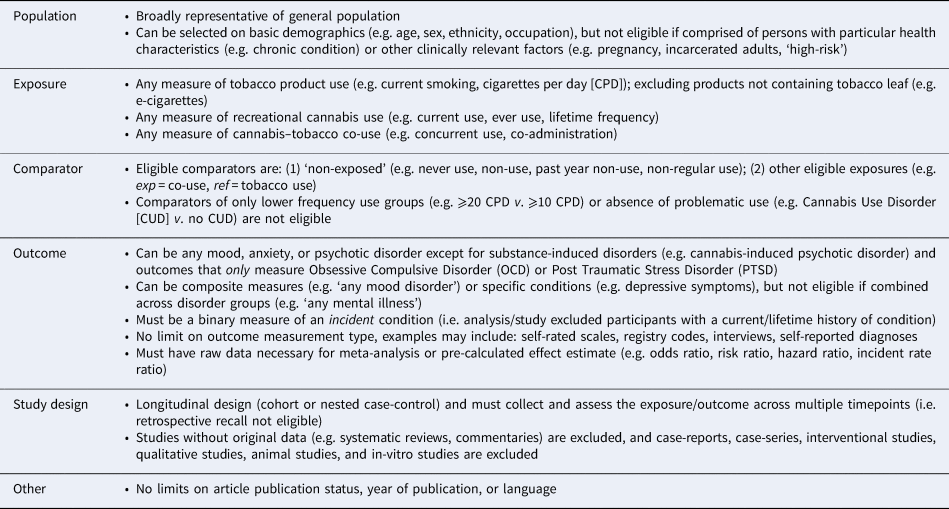
We included prospective longitudinal studies that (1) measured cannabis, tobacco, or co-use as an exposure, (2) used a ‘non-exposed’ comparator group, and (3) reported a relevant effect estimate (e.g. RR) and its variance, or necessary raw data. There were no restrictions on publication status, article language, or publication date. To minimize reverse causation bias we only included studies where participants with current indications (i.e. total incidence) and/or history (i.e. first incidence) of the outcome were excluded at baseline. Studies were also excluded if participants were selected on a specific health status (e.g. pregnancy), or other highly selected characteristics (e.g. incarcerated persons). Corresponding authors were contacted, where possible, to request missing effect estimates or information relating to study inclusion. Full details are given in Table 1.
PECOS inclusion/exclusion criteria
Data extraction
Standardized forms were used to extract study information by two independent reviewers (CB and JL). A modified Newcastle–Ottawa Scale (NOS) was used to evaluate study quality (Wells et al., Reference Wells, Shea, O'Connell, Peterson, Welch, Losos and Tugwell2013). The NOS evaluates studies across selection of study groups, comparability, and outcome ascertainment, awarding a total of nine stars. Studies were rated as ‘high’ quality if scoring: (i) maximum on items relating to comparability (i.e. confounding bias); (ii) maximum on items relating to attrition (i.e. selection bias); and (iii) only scoring less than one star on all other items (online Supplementary eMethods 4). A standardized assessment sheet was used (CB) and calibrated with a second-rater (JL) for ~20% of the included studies, and disagreements raised with a third reviewer (GT). If studies reported multiple estimates the following estimates were extracted: (i) longest follow-up length; (ii) highest frequency of use; and (iii) adjusted for most confounding variables.
Data synthesis
We used the RR and the corresponding 95% confidence intervals (95% CIs) as the summary estimate. Included studies presented varied effect estimates and approach for conversion to RR is described in the online Supplementary materials (eMethods 5). Adjusted and unadjusted/minimally adjusted (i.e. age and sex) effect estimates were pooled separately. Considering study heterogeneity, random-effects meta-analysis using generic inverse variance approach was conducted. Between-study heterogeneity was explored through visual inspection of forest plots and tau-squared (τ 2), and statistical inconsistency quantified using the I 2 statistics (Higgins et al., Reference Higgins, Thomas, Chandler, Cumpston, Li, Page and Welch2020). Prediction Intervals (PIs) were also calculated, i.e. 95% range of true effect estimates to be expected in exchangeable studies (IntHout, Ioannidis, Rovers, & Goeman, Reference IntHout, Ioannidis, Rovers and Goeman2016). Meta-analyses were conducted in R (v 4.4.1), using the ‘meta’ package (Schwarzer, Reference Schwarzer2022). Data and R scripts are available on GitHub (https://github.com/chloeeburke/tobcanmeta).
Subgroup and sensitivity analyses
A combination of approaches was used to explore the impact of bias due to unmeasured confounding. The E-value represents the minimum strength of association, on an RR scale, an unmeasured confounder would need to have to fully explain a specific exposure–outcome association (i.e. fully reducing an RR to 1; VanderWeele & Ding, Reference VanderWeele and Ding2017). E-value calculation is described in the online Supplementary materials (eMethods 6). If the strength of suspected unmeasured confounding is weaker than indicated by the E-value, this suggests the exposure–outcome association is robust to unmeasured confounding (VanderWeele & Ding, Reference VanderWeele and Ding2017; VanderWeele, Ding, & Mathur, Reference VanderWeele, Ding and Mathur2019). To assess the level of uncertainty associated with the effect, the E-value was also calculated for the CI closest to the null. There are no cut-offs for what constitutes a small or large E-value as it is context dependent, relative to the exposure, outcome, and measured covariates (VanderWeele et al., Reference VanderWeele, Ding and Mathur2019). Therefore, we used a ‘confounder matrix’ assessment to establish measured covariates.
The confounder matrix is an approach to summarizing adequate confounding control in reviews of observational studies (Petersen et al., Reference Petersen, Barrett, Ahrens, Murray, Bryant, Hogue and Trinquart2022), conducted in three steps: (1) expert consensus regarding necessary adjustment (e.g. constructs, measurement), (2) production of matrices to depict adjustment in each study, and (3) using assessment to inform quantitative synthesis (e.g. subgroup analyses). Based on a causal diagram (online Supplementary eMethods 7), studies in the primary meta-analyses were assessed on adjustment for seven constructs: co-use, other substance use, psychiatric comorbidity, socioeconomic status, sociodemographic factors, psychological factors, and other lifestyle factors. See online Supplementary eMethods 8 for description of constructs. The ‘E-Value’ online calculator (https://www.evalue-calculator.com/) and metaconfoundr package (Barrett, Petersen, & Trinquart, Reference Barrett, Petersen and Trinquart2022) were used.
Where ⩾10 studies were available, sources of heterogeneity in the primary analyses were explored through pre-planned subgroup analyses and meta-regressions (Higgins et al., Reference Higgins, Thomas, Chandler, Cumpston, Li, Page and Welch2020). Additional exploratory analyses were conducted through (i) excluding outliers, defined as point estimates where the 95% CI lies outside the 95% CI of the pooled effect, and (ii) subgroup analysis by rating on the confounder matrix assessment.
Potential small-study effects, such as publication bias, were examined using Doi plots and the Luis Furuya-Kanamori (LFK) index (Furuya-Kanamori, Barendregt, & Doi, Reference Furuya-Kanamori, Barendregt and Doi2018). Doi plots visualize treatment effects on the x-axis and a normal rank-based Z-score on the y-axis. LFK indices less than ±1, greater than ±1 but less than ±2, or greater than ±2 were considered to represent no, minor, or major asymmetry, respectively (Furuya-Kanamori et al., Reference Furuya-Kanamori, Barendregt and Doi2018).
Results
Search results
Of the 27789 records screened, 486 studies were retained for full-text screening (online Supplementary eFig. 1). Studies excluded at full-text stage are available in the online Supplementary materials (eTable 1). We identified 75 studies for inclusion (Albers & Biener, Reference Albers and Biener2002; Almeida et al., Reference Almeida, Hankey, Yeap, Golledge, McCaul and Flicker2013; An & Xiang, Reference An and Xiang2015; Armstrong et al., Reference Armstrong, Meoni, Carlson, Xue, Bandeen-Roche, Gallo and Gross2017; Bakhshaie, Zvolensky, & Goodwin, Reference Bakhshaie, Zvolensky and Goodwin2015; Beutel et al., Reference Beutel, Brähler, Wiltink, Kerahrodi, Burghardt, Michal and Tibubos2019; Bolstad et al., Reference Bolstad, Alakokkare, Bramness, Rognli, Levola, Mustonen and Niemelä2022; Borges, Benjet, Orozco, & Medina-Mora, Reference Borges, Benjet, Orozco and Medina-Mora2018; Bots, Tijhuis, Giampaoli, Kromhout, & Nissinen, Reference Bots, Tijhuis, Giampaoli, Kromhout and Nissinen2008; Breslau, Peterson, Schultz, Chilcoat, & Andreski, Reference Breslau, Peterson, Schultz, Chilcoat and Andreski1998; Brown, Lewinsohn, Seeley, & Wagner, Reference Brown, Lewinsohn, Seeley and Wagner1996; Cabello et al., Reference Cabello, Miret, Caballero, Chatterji, Naidoo, Kowal and Ayuso-Mateos2017; Chang, Pan, Kawachi, & Okereke, Reference Chang, Pan, Kawachi and Okereke2016; Chin, Wan, Choi, Chan, & Lam, Reference Chin, Wan, Choi, Chan and Lam2016; Chireh & D'Arcy, Reference Chireh and D'Arcy2019; Choi, Patten, Gillin, Kaplan, & Pierce, Reference Choi, Patten, Gillin, Kaplan and Pierce1997; Clark et al., Reference Clark, Haines, Head, Klineberg, Arephin, Viner and Stansfeld2007; Cougle, Hakes, Macatee, Chavarria, & Zvolensky, Reference Cougle, Hakes, Macatee, Chavarria and Zvolensky2015; Cuijpers, Smit, Ten Have, & De Graaf, Reference Cuijpers, Smit, Ten Have and De Graaf2007; Danielsson, Lundin, Agardh, Allebeck, & Forsell, Reference Danielsson, Lundin, Agardh, Allebeck and Forsell2016; do Nascimento et al., Reference do Nascimento, Pereira, Firmo, Lima-Costa, Diniz and Castro-Costa2015; Feingold, Weiser, Rehm, & Lev-Ran, Reference Feingold, Weiser, Rehm and Lev-Ran2015, Reference Feingold, Weiser, Rehm and Lev-Ran2016; Flensborg-Madsen et al., Reference Flensborg-Madsen, Bay von Scholten, Flachs, Mortensen, Prescott and Tolstrup2011; Fonseca et al., Reference Fonseca, Pereira, Rodrigues, Muraro, Andrade, Pereira and Ferreira2022; Ford et al., Reference Ford, Mead, Chang, Cooper-Patrick, Wang and Klag1998; Gage et al., Reference Gage, Hickman, Heron, Munafò, Lewis, Macleod and Zammit2015; Gentile, Bianco, Nordström, & Nordström, Reference Gentile, Bianco, Nordström and Nordström2021; Goodman & Capitman, Reference Goodman and Capitman2000; Goodwin et al., Reference Goodwin, Prescott, Tamburrino, Calabrese, Liberzon and Galea2013; Groffen et al., Reference Groffen, Koster, Bosma, van den Akker, Kempen, van Eijk and Kritchevsky2013; Hahad et al., Reference Hahad, Beutel, Gilan, Michal, Schulz, Pfeiffer and Münzel2022; Hiles et al., Reference Hiles, Baker, de Malmanche, McEvoy, Boyle and Attia2015; Hoveling, Liefbroer, Schweren, Bültmann, & Smidt, Reference Hoveling, Liefbroer, Schweren, Bültmann and Smidt2022; Isensee, Wittchen, Stein, Höfler, & Lieb, Reference Isensee, Wittchen, Stein, Höfler and Lieb2003; Jackson et al., Reference Jackson, Brown, Ussher, Shahab, Steptoe and Smith2019; Kang & Lee, Reference Kang and Lee2010; Kendler, Lönn, Sundquist, & Sundquist, Reference Kendler, Lönn, Sundquist and Sundquist2015; Kim, Kim, Lim, & Kim, Reference Kim, Kim, Lim and Kim2022; King, Jones, Petersen, Hamilton, & Nazareth, Reference King, Jones, Petersen, Hamilton and Nazareth2021; Korhonen, Ranjit, Tuulio-Henriksson, & Kaprio, Reference Korhonen, Ranjit, Tuulio-Henriksson and Kaprio2017; Lam et al., Reference Lam, Stewart, Ho, Lai, Mak, Chau and Salili2005; Leung, Gartner, Hall, Lucke, & Dobson, Reference Leung, Gartner, Hall, Lucke and Dobson2012; Luijendijk, Stricker, Hofman, Witteman, & Tiemeier, Reference Luijendijk, Stricker, Hofman, Witteman and Tiemeier2008; Manrique-Garcia, Zammit, Dalman, Hemmingsson, & Allebeck, Reference Manrique-Garcia, Zammit, Dalman, Hemmingsson and Allebeck2012; Meng et al., Reference Meng, Brunet, Turecki, Liu, D'Arcy and Caron2017; Monroe, McDowell, Kenny, & Herring, Reference Monroe, McDowell, Kenny and Herring2021; Monshouwer, ten Have, de Graaf, Blankers, & van Laar, Reference Monshouwer, ten Have, de Graaf, Blankers and van Laar2021; Murphy et al., Reference Murphy, Horton, Monson, Laird, Sobol and Leighton2003; Mustonen et al., Reference Mustonen, Ahokas, Nordström, Murray, Mäki, Jääskeläinen and Niemelä2018a, Reference Mustonen, Niemelä, Nordström, Murray, Mäki, Jääskeläinen and Miettunen2018b, Reference Mustonen, Hielscher, Miettunen, Denissoff, Alakokkare, Scott and Niemelä2021; Najafipour et al., Reference Najafipour, Shahrokhabadi, Banivaheb, Sabahi, Shadkam and Mirzazadeh2021; Okkenhaug, Tanem, Myklebust, Gjervan, & Johansen, Reference Okkenhaug, Tanem, Myklebust, Gjervan and Johansen2018; Park, Reference Park2009; Paton, Kessler, & Kandel, Reference Paton, Kessler and Kandel1977; Raffetti, Donato, Forsell, & Galanti, Reference Raffetti, Donato, Forsell and Galanti2019; Ren et al., Reference Ren, Wang, He, Lian, Lu, Gao and Wang2021; Rognli, Bramness, & von Soest, Reference Rognli, Bramness and von Soest2020; Rudaz et al., Reference Rudaz, Vandeleur, Gebreab, Gholam-Rezaee, Strippoli, Lasserre and Preisig2017; Sánchez-Villegas et al., Reference Sánchez-Villegas, Gea, Lahortiga-Ramos, Martínez-González, Molero and Martínez-González2021; Storeng, Sund, & Krokstad, Reference Storeng, Sund and Krokstad2020; Tanaka, Sasazawa, Suzuki, Nakazawa, & Koyama, Reference Tanaka, Sasazawa, Suzuki, Nakazawa and Koyama2011; Tomita & Manuel, Reference Tomita and Manuel2020; Tsai, Chi, & Wang, Reference Tsai, Chi and Wang2013; Van Laar, Van Dorsselaer, Monshouwer, & De Graaf, Reference Van Laar, Van Dorsselaer, Monshouwer and De Graaf2007; van Os et al., Reference van Os, Bak, Hanssen, Bijl, de Graaf and Verdoux2002; Weiser et al., Reference Weiser, Reichenberg, Grotto, Yasvitzky, Rabinowitz, Lubin and Davidson2004; Werneck et al., Reference Werneck, Vancampfort, Stubbs, Silva, Cucato, Christofaro and Bittencourt2022; Weyerer et al., Reference Weyerer, Eifflaender-Gorfer, Wiese, Luppa, Pentzek, Bickel and Riedel-Heller2013; Zammit, Allebeck, Andreasson, Lundberg, & Lewis, Reference Zammit, Allebeck, Andreasson, Lundberg and Lewis2002; Zammit et al., Reference Zammit, Allebeck, Dalman, Lundberg, Hemmingsson and Lewis2003; Zhang, Woud, Becker, & Margraf, Reference Zhang, Woud, Becker and Margraf2018; Zimmerman, Mast, Miles, & Markides, Reference Zimmerman, Mast, Miles and Markides2009; Zvolensky et al., Reference Zvolensky, Lewinsohn, Bernstein, Schmidt, Buckner, Seeley and Bonn-Miller2008) of which 59 were included in the primary meta-analyses of adjusted estimates. No eligible studies of cannabis-tobacco co-use were identified.
Study characteristics
Studies included in the primary meta-analyses consisted of 1 733 679 participants at risk of incident outcomes. Follow-up length ranged from 6 months to 63 years. Exposures were measured according to heaviness (e.g. cigarettes per day; k = 28) or status of use (e.g. current use; k = 31). Outcomes were assessed using symptom-based scales (k = 21), interviews (k = 18), registry codes (k = 14), self-reported treatment/diagnosis (k = 2), and composites (k = 4). Study characteristics are presented in the online Supplementary materials (eTables 2–7).
Meta-analysis
Tobacco use was associated with incident mood disorders (K = 43; RR: 1.39, 95% CI 1.30–1.47; I 2 = 61.2%; τ 2 = 0.014; PI: 1.08–1.77; Fig. 1) (Albers & Biener, Reference Albers and Biener2002; An & Xiang, Reference An and Xiang2015; Armstrong et al., Reference Armstrong, Meoni, Carlson, Xue, Bandeen-Roche, Gallo and Gross2017; Bakhshaie et al., Reference Bakhshaie, Zvolensky and Goodwin2015; Bolstad et al., Reference Bolstad, Alakokkare, Bramness, Rognli, Levola, Mustonen and Niemelä2022; Borges et al., Reference Borges, Benjet, Orozco and Medina-Mora2018; Breslau et al., Reference Breslau, Peterson, Schultz, Chilcoat and Andreski1998; Brown et al., Reference Brown, Lewinsohn, Seeley and Wagner1996; Cabello et al., Reference Cabello, Miret, Caballero, Chatterji, Naidoo, Kowal and Ayuso-Mateos2017; Chang et al., Reference Chang, Pan, Kawachi and Okereke2016; Chin et al., Reference Chin, Wan, Choi, Chan and Lam2016; Chireh & D'Arcy, Reference Chireh and D'Arcy2019; Choi et al., Reference Choi, Patten, Gillin, Kaplan and Pierce1997; Clark et al., Reference Clark, Haines, Head, Klineberg, Arephin, Viner and Stansfeld2007; Cougle et al., Reference Cougle, Hakes, Macatee, Chavarria and Zvolensky2015; Cuijpers et al., Reference Cuijpers, Smit, Ten Have and De Graaf2007; Flensborg-Madsen et al., Reference Flensborg-Madsen, Bay von Scholten, Flachs, Mortensen, Prescott and Tolstrup2011; Gage et al., Reference Gage, Hickman, Heron, Munafò, Lewis, Macleod and Zammit2015; Gentile et al., Reference Gentile, Bianco, Nordström and Nordström2021; Goodman & Capitman, Reference Goodman and Capitman2000; Groffen et al., Reference Groffen, Koster, Bosma, van den Akker, Kempen, van Eijk and Kritchevsky2013; Hahad et al., Reference Hahad, Beutel, Gilan, Michal, Schulz, Pfeiffer and Münzel2022; Hiles et al., Reference Hiles, Baker, de Malmanche, McEvoy, Boyle and Attia2015; Hoveling et al., Reference Hoveling, Liefbroer, Schweren, Bültmann and Smidt2022; Jackson et al., Reference Jackson, Brown, Ussher, Shahab, Steptoe and Smith2019; Kang & Lee, Reference Kang and Lee2010; Korhonen et al., Reference Korhonen, Ranjit, Tuulio-Henriksson and Kaprio2017; Leung et al., Reference Leung, Gartner, Hall, Lucke and Dobson2012; Luijendijk et al., Reference Luijendijk, Stricker, Hofman, Witteman and Tiemeier2008; Monroe et al., Reference Monroe, McDowell, Kenny and Herring2021; Monshouwer et al., Reference Monshouwer, ten Have, de Graaf, Blankers and van Laar2021; Park, Reference Park2009; Raffetti et al., Reference Raffetti, Donato, Forsell and Galanti2019; Ren et al., Reference Ren, Wang, He, Lian, Lu, Gao and Wang2021; Rudaz et al., Reference Rudaz, Vandeleur, Gebreab, Gholam-Rezaee, Strippoli, Lasserre and Preisig2017; Sánchez-Villegas et al., Reference Sánchez-Villegas, Gea, Lahortiga-Ramos, Martínez-González, Molero and Martínez-González2021; Storeng et al., Reference Storeng, Sund and Krokstad2020; Tanaka et al., Reference Tanaka, Sasazawa, Suzuki, Nakazawa and Koyama2011; Tomita & Manuel, Reference Tomita and Manuel2020; Tsai et al., Reference Tsai, Chi and Wang2013; Werneck et al., Reference Werneck, Vancampfort, Stubbs, Silva, Cucato, Christofaro and Bittencourt2022; Weyerer et al., Reference Weyerer, Eifflaender-Gorfer, Wiese, Luppa, Pentzek, Bickel and Riedel-Heller2013; Zhang et al., Reference Zhang, Woud, Becker and Margraf2018).
Meta-analysis of adjusted associations of tobacco use and mood disorders.
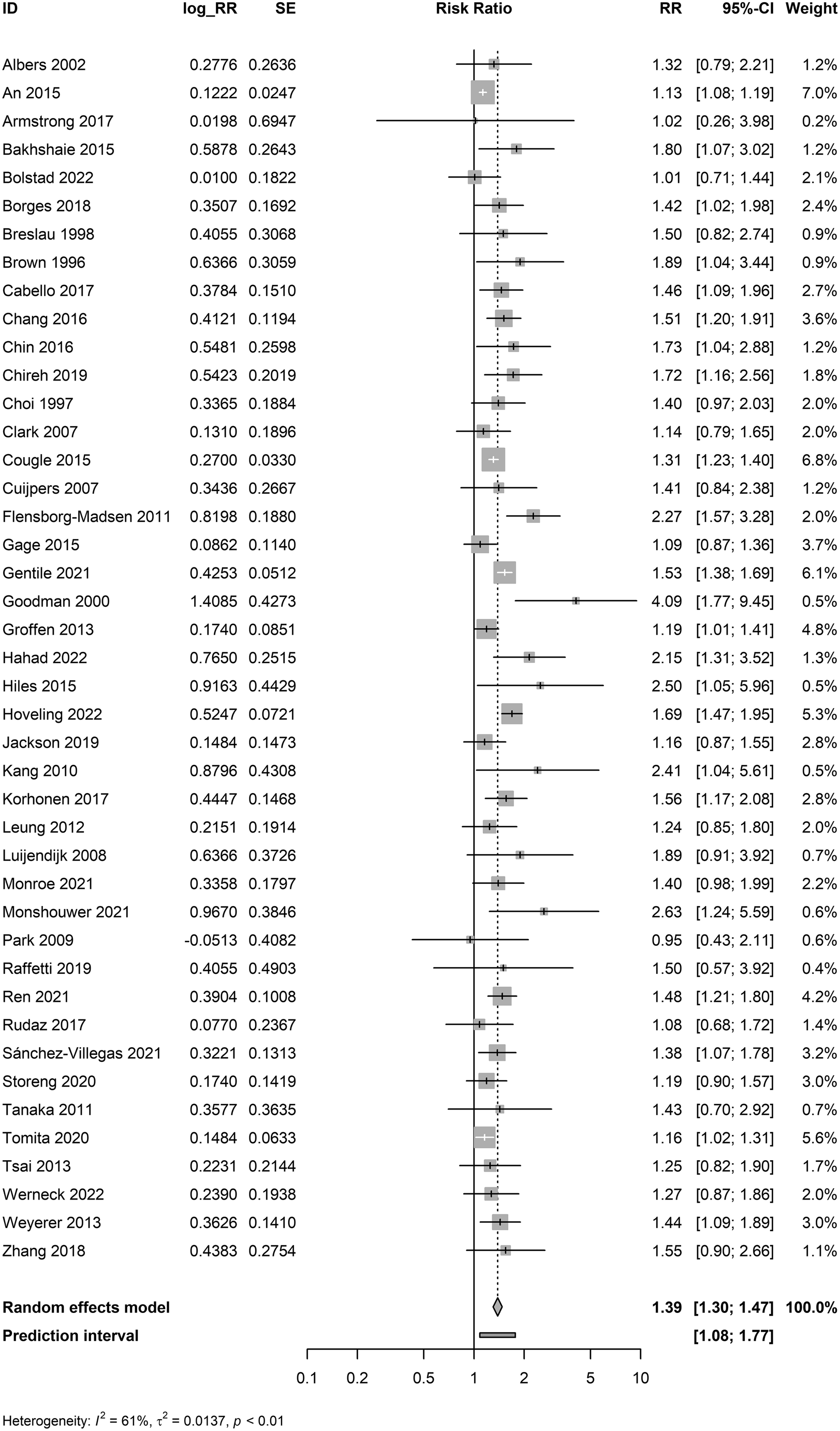
Exclusion of outliers (An & Xiang, Reference An and Xiang2015; Flensborg-Madsen et al., Reference Flensborg-Madsen, Bay von Scholten, Flachs, Mortensen, Prescott and Tolstrup2011; Goodman & Capitman, Reference Goodman and Capitman2000), produced similar results (K = 40; RR: 1.38, 95% CI 1.31–1.45). Pooled unadjusted studies yielded a larger estimate (K = 41; RR: 1.47, 95% CI 1.34–1.60; online Supplementary eFig. 2).
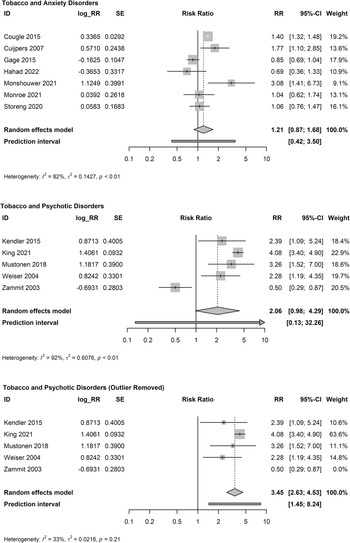
Tobacco use was not associated with incident anxiety disorders (K = 7; RR: 1.21, 95% CI 0.87–1.68; I 2 = 82.2%; τ 2 = 0.143; PI: 0.42–3.50; Fig. 2) (Cougle et al., Reference Cougle, Hakes, Macatee, Chavarria and Zvolensky2015; Cuijpers et al., Reference Cuijpers, Smit, Ten Have and De Graaf2007; Gage et al., Reference Gage, Hickman, Heron, Munafò, Lewis, Macleod and Zammit2015; Hahad et al., Reference Hahad, Beutel, Gilan, Michal, Schulz, Pfeiffer and Münzel2022; Monroe et al., Reference Monroe, McDowell, Kenny and Herring2021; Monshouwer et al., Reference Monshouwer, ten Have, de Graaf, Blankers and van Laar2021; Storeng et al., Reference Storeng, Sund and Krokstad2020). There were no identified outliers. Pooled unadjusted studies yielded a larger estimate (K = 8; RR: 1.60, 95% CI 1.10–2.32; online Supplementary eFig. 3).
Meta-analyses of adjusted associations of tobacco use and anxiety and psychotic disorders.
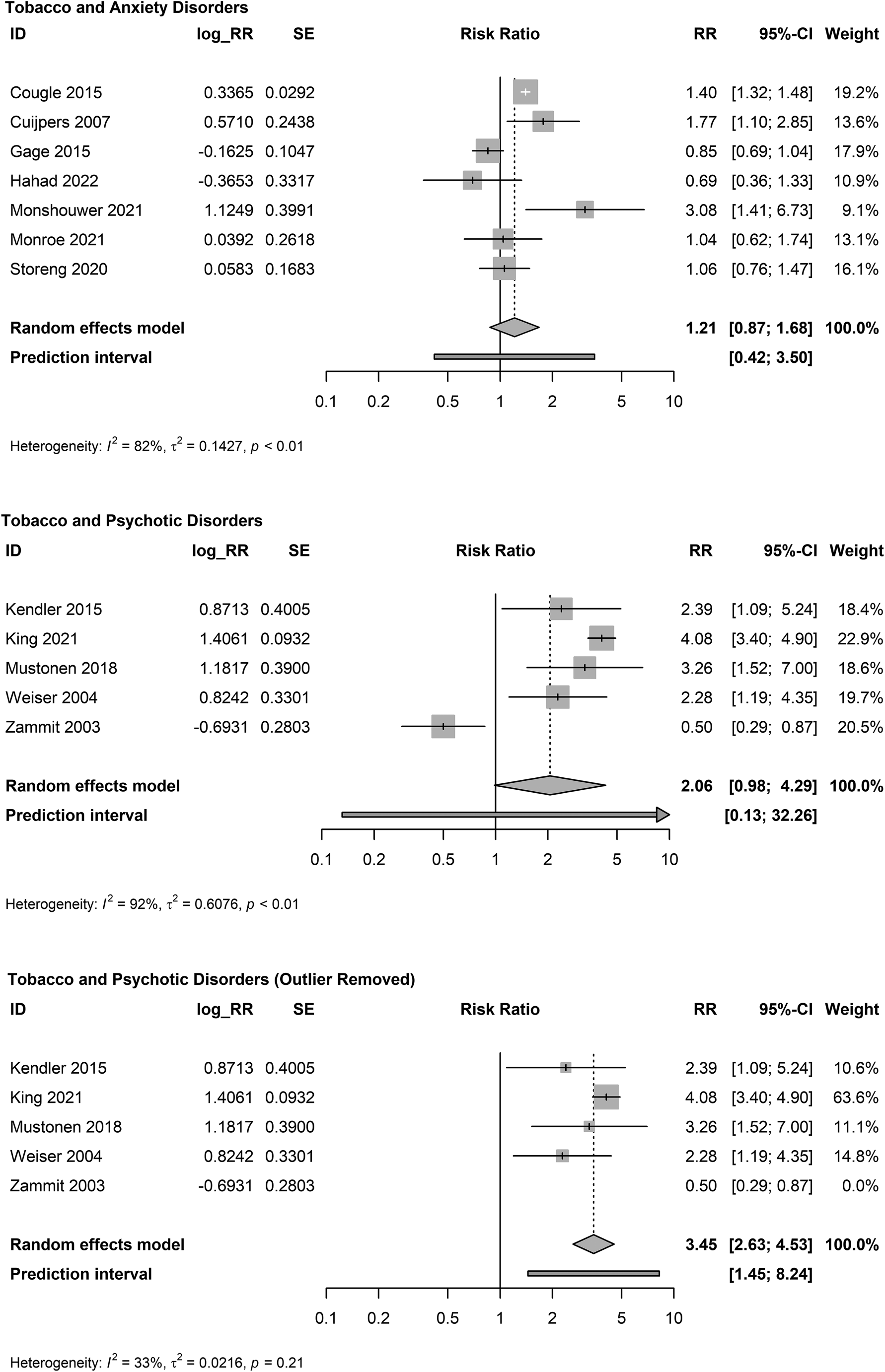
Tobacco use was not associated with incident psychotic disorders (K = 5; RR: 2.06, 95% CI 0.98–4.29; I 2 = 92.3%; τ 2 = 0.608; PI: 0.13–32.26 (Kendler et al., Reference Kendler, Lönn, Sundquist and Sundquist2015; King et al., Reference King, Jones, Petersen, Hamilton and Nazareth2021; Mustonen et al., Reference Mustonen, Ahokas, Nordström, Murray, Mäki, Jääskeläinen and Niemelä2018a; Weiser et al., Reference Weiser, Reichenberg, Grotto, Yasvitzky, Rabinowitz, Lubin and Davidson2004; Zammit et al., Reference Zammit, Allebeck, Dalman, Lundberg, Hemmingsson and Lewis2003). Exclusion of one outlier (Zammit et al., Reference Zammit, Allebeck, Dalman, Lundberg, Hemmingsson and Lewis2003) yielded a larger pooled estimate with CIs that did not include the null (K = 4; RR: 3.45, 95% CI 2.63–4.53). As outlier identification was exploratory, pooled results with and without the outlier excluded are presented (Fig. 2). Pooled unadjusted studies yielded a larger estimate (K = 5; RR: 3.12, 95% CI 1.67–5.81; online Supplementary eFig. 4).
Cannabis use was not associated with incident mood disorders (K = 7; RR: 1.31, 95% CI 0.92–1.86; I 2 = 77.0%; τ 2 = 0.164; PI: 0.42–4.09; Fig. 3) (Danielsson et al., Reference Danielsson, Lundin, Agardh, Allebeck and Forsell2016; Feingold et al., Reference Feingold, Weiser, Rehm and Lev-Ran2015; Gage et al., Reference Gage, Hickman, Heron, Munafò, Lewis, Macleod and Zammit2015; Manrique-Garcia et al., Reference Manrique-Garcia, Zammit, Dalman, Hemmingsson and Allebeck2012; Mustonen et al., Reference Mustonen, Hielscher, Miettunen, Denissoff, Alakokkare, Scott and Niemelä2021; Rognli et al., Reference Rognli, Bramness and von Soest2020; Van Laar et al., Reference Van Laar, Van Dorsselaer, Monshouwer and De Graaf2007). There were no identified outliers. Pooled unadjusted studies yielded a larger estimate (K = 7; RR: 1.47, 95% CI 1.19–1.81; online Supplementary eFig. 5).
Meta-analyses of adjusted associations of cannabis use and mood, anxiety and psychotic disorders.
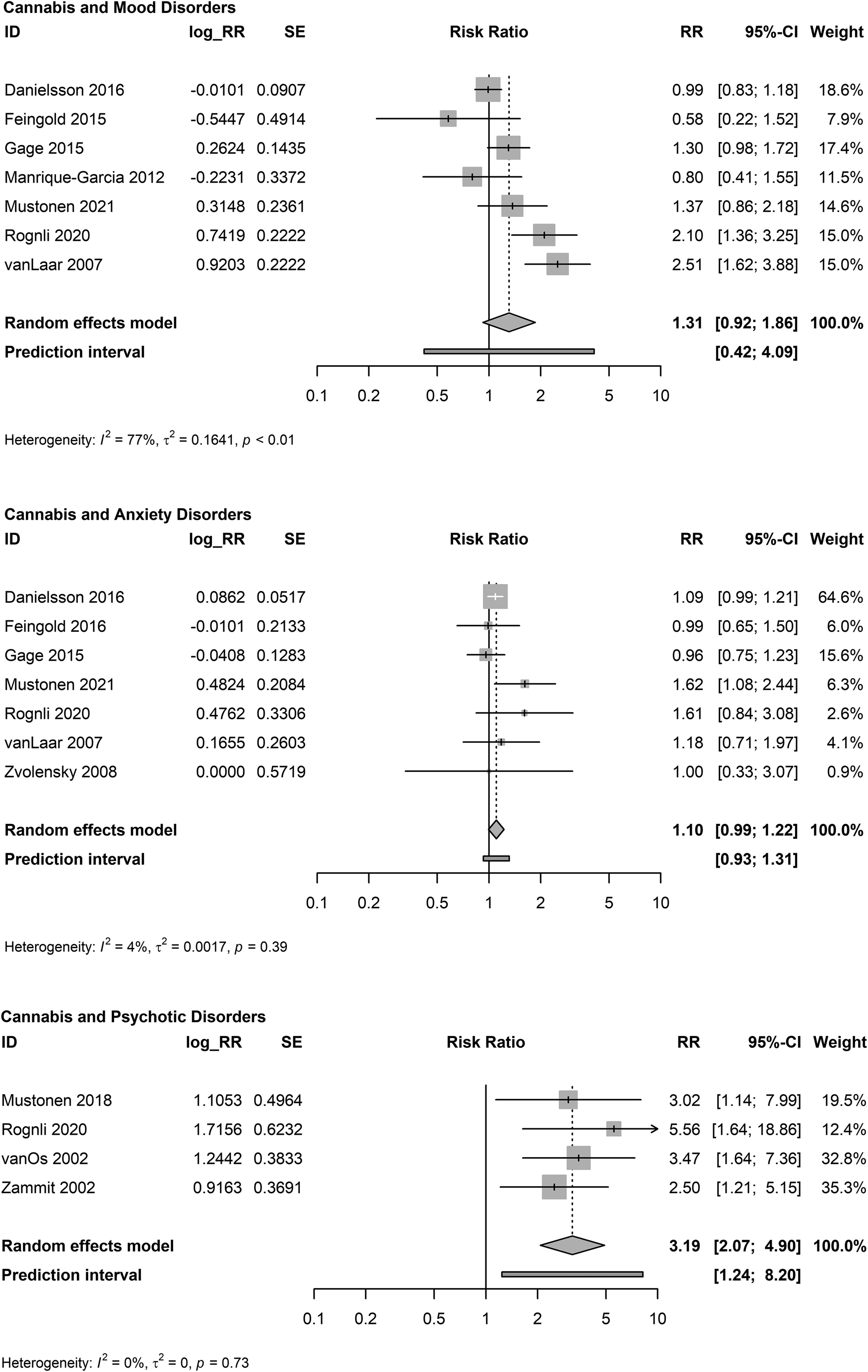
Cannabis use was not associated with incident anxiety disorders (K = 7; RR: 1.10, 95% CI 0.99–1.22; I 2 = 4.4%; τ 2 = 0.002; PI: 0.93–1.31; Fig. 3) (Danielsson et al., Reference Danielsson, Lundin, Agardh, Allebeck and Forsell2016; Feingold, Weiser, Rehm, & Lev-Ran, Reference Feingold, Weiser, Rehm and Lev-Ran2016; Gage et al., Reference Gage, Hickman, Heron, Munafò, Lewis, Macleod and Zammit2015; Mustonen et al., Reference Mustonen, Hielscher, Miettunen, Denissoff, Alakokkare, Scott and Niemelä2021; Rognli et al., Reference Rognli, Bramness and von Soest2020; Van Laar et al., Reference Van Laar, Van Dorsselaer, Monshouwer and De Graaf2007; Zvolensky et al., Reference Zvolensky, Lewinsohn, Bernstein, Schmidt, Buckner, Seeley and Bonn-Miller2008). There were no identified outliers. Pooled unadjusted studies yielded a larger estimate (K = 6; RR: 1.51, 95% CI 1.20–1.89; online Supplementary eFig. 6).
Cannabis use was associated with incident psychotic disorders (K = 4; RR: 3.19, 95% CI 2.07–4.90; I 2 = 0%; τ 2 = 0.00; PI: 1.24–8.20; Fig. 3) (Mustonen et al., Reference Mustonen, Niemelä, Nordström, Murray, Mäki, Jääskeläinen and Miettunen2018b; Rognli et al., Reference Rognli, Bramness and von Soest2020; van Os et al., Reference van Os, Bak, Hanssen, Bijl, de Graaf and Verdoux2002; Zammit et al., Reference Zammit, Allebeck, Andreasson, Lundberg and Lewis2002). There were no identified outliers. Pooled unadjusted studies yielded a larger estimate (K = 3; RR: 4.68, 95% CI 3.30–6.64; online Supplementary eFig. 7).
Quality assessment
Of the 59 studies included in the adjusted meta-analyses, roughly one-quarter of studies (27%) were rated as high quality (i.e. lower risk of bias; online Supplementary eTable 8), with an overall mean score of 7.35 (s.d. 1.01). The proportion of high-quality studies differed by analysis (online Supplementary eTable 9). Many studies (58%) were marked down due to high attrition or insufficient information about loss to follow-up (e.g. differential attrition), and 41% of studies were marked down for ‘comparability’ (i.e. confounding bias).
Subgroup and sensitivity analyses
Using the confounder matrix, most studies had multiple confounding constructs rated as inadequately adjusted for (Table 2, online Supplementary eTables 10–15, eFigs 8–13). Sociodemographic factors (e.g. age, sex) were generally well-adjusted for across all analyses. Psychological factors (e.g. loneliness, adverse childhood experiences [ACEs]) and psychiatric comorbidity were generally insufficiently controlled for with lower rates of adequate adjustment, particularly in tobacco and mood studies. There were differences in adjustment patterns across analyses, for example a higher proportion of cannabis studies (e.g. 100% of cannabis and mood studies) were rated as adequately adjusting for other substance use (i.e. alcohol use, illicit drug use), whereas co-use was more comprehensively adjusted for in tobacco studies as none of the included cannabis studies adjusted for confounding via co-administration of tobacco. Adjustment for other substance use by subconstructs (i.e. alcohol use, illicit drug use) is available in online Supplementary eTables 10–15. All cannabis studies were rated as inadequate adjustment for other lifestyle factors (e.g. physical activity, diet), with evidence of more adjustment in studies of tobacco and mood and anxiety disorders. Percentages of studies by adjustment rating for the different constructs are reported in Table 2, alongside median E-values for study point estimates and CIs. Median E-values for the point estimate ranged from 1.40 to 5.95.
E-value and confounder matrix summary
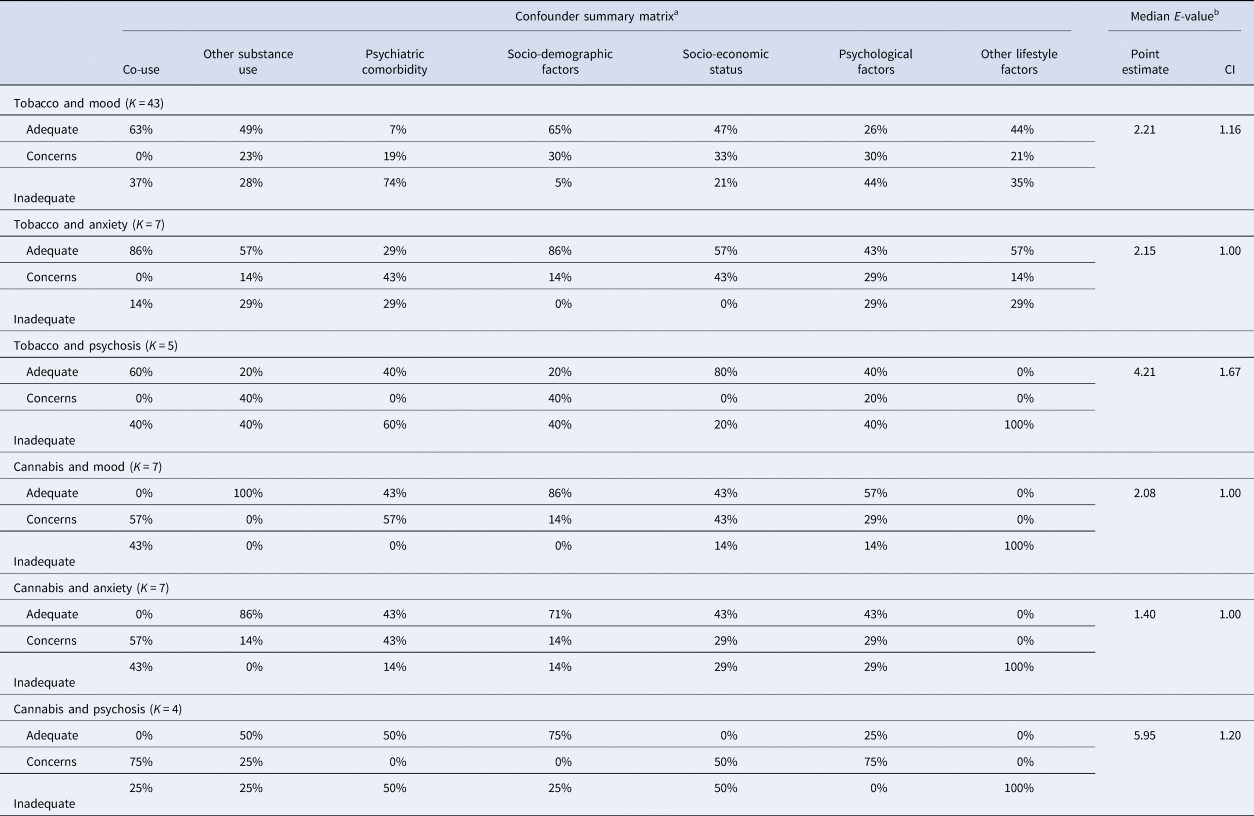
Note. aPercentages denote the proportion of studies in the adjusted meta-analyses that were rated as ‘adequate’, ‘some concerns’, or ‘inadequate’ for the different constructs and assessment criteria for different constructs is detailed in online Supplementary eMethods 8; briefly: co-use (i.e. adjustment for cannabis/tobacco use); other substance use (i.e. adjustment for alcohol use and illicit drug use); psychiatric comorbidity (i.e. adjustment for other mental health condition(s) at baseline); sociodemographic factors (i.e. adjustment for age, sex and ethnicity, urbanicity, or marital status); socioeconomic status (i.e. adjustment for combination of indicators like education and income, or index of socioeconomic status); psychological factors (i.e. adjustment for two factors from varied list including loneliness, adverse childhood experiences, IQ, and stressful life events); other lifestyle factors (i.e. adjustment for two factors from physical activity, health conditions, adiposity, and diet).
b The E-value represents the minimum strength of association, on the RR scale, that an unmeasured confounder would need to have with both the exposure and the outcome to fully explain away a specific exposure–outcome association, conditional on the measured covariates. This interpretation applies to the point estimate and the lower CI. Generally, a larger E-value implies that considerable unmeasured confounding would be needed to explain away an effect estimate. Generally, a smaller E-value implies little unmeasured confounding would be needed to explain away an effect estimate. For more information see online Supplementary eMethods 6.
As an example, the median E-value of the point estimate of the association of tobacco use and incident mood disorders was 2.21. This suggests if an omitted set of unmeasured confounders had an RR of 2.21 on both tobacco use and mood disorders, conditional on measured covariates, the association between tobacco use and mood disorders may be reduced to the null in half the studies. The same approach applies to the median E-value of the CI, i.e. if an omitted set of unmeasured confounders had an RR of 1.16 on both tobacco use and mood disorders, conditional on measured covariates, the association between tobacco use and mood disorders may be reduced to the null in half the studies.
Doi plots and LFK indices (online Supplementary eFigs 14–19) indicated major asymmetry in tobacco use and mood (LFK = 4.12) and psychotic disorders (LFK = −3.86). The remaining exposure–outcome analyses were indicated to have minor asymmetry (LFK = −1.68 to 1.89; Table 3), except for cannabis use and mood disorders (LFK = −0.59).
LFK index and asymmetry rating for primary meta-analyses
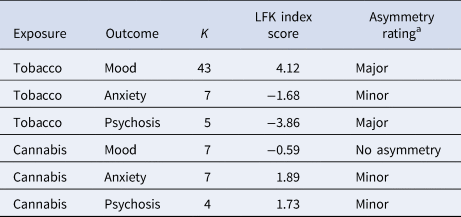
Note. K, number of studies included in meta-analysis.
a LFK index scores of ±1, between ±1 and ±2, or ±2 indicate ‘no asymmetry’, ‘minor asymmetry’, and ‘major asymmetry’ respectively.
Subgroup and meta-regression analyses were only performed for tobacco use and mood disorders due to low study numbers (K < 10) in other meta-analyses. Results were examined across age groups, follow-up length, sample size, study quality, confounding adjustment, and exposure/outcome types. The analyses did not support evidence of subgroup effects (online Supplementary eTables 16 and 17), including analyses by adequate adjustment for co-use and overall confounding adjustment. However, a far smaller number of studies contributed to some subgroups and there is substantial heterogeneity across the included studies, meaning results should be interpreted with caution (Richardson, Garner, & Donegan, Reference Richardson, Garner and Donegan2019).
Discussion
To our knowledge, this is the first systematic review and meta-analysis examining the association of tobacco use, cannabis use, and incident mental illness that has undertaken a comprehensive assessment of the influence of confounding bias. We found evidence for associations of tobacco and incident mood and psychotic disorders, and for cannabis and incident psychotic disorders. Our review includes the first meta-analysis of the longitudinal association between tobacco use and incident anxiety disorders and addresses limitations of previous reviews which have considered evidence for both substances and psychological outcomes.
Accurately understanding the causal effects of substance use on mental illness is crucial to informing effective evidence-based public health policies (Taylor & Treur, Reference Taylor and Treur2023). Results from this review are based on observational evidence and cannot in isolation be considered proof of causality. However, this study contributes toward a wider, growing body of evidence across multiple study designs (e.g. Mendelian randomization [MR], smoking cessation trials) that these substances have a causal role in development of psychotic disorders, and tobacco use in mood disorders (Firth, Wootton, Sawyer, & Taylor, Reference Firth, Wootton, Sawyer and Taylor2023; Ganesh & D'Souza, Reference Ganesh and D'Souza2022; Munafò, Reference Munafò2022).
We did not find compelling evidence to suggest tobacco use is associated with incident anxiety disorders. Previous narrative syntheses report mixed evidence of associations between tobacco use and later anxiety (Fluharty et al., Reference Fluharty, Taylor, Grabski and Munafò2017; Stevenson et al., Reference Stevenson, Miller, Martin, Mohammadi and Lawn2022). The effect size observed in the analysis of tobacco use and mood disorders is consistent with previous meta-analyses (Chaiton et al., Reference Chaiton, Cohen, O'Loughlin and Rehm2009; Chaplin et al., Reference Chaplin, Daniels, Ples, Anderson, Gregory-Jones, Jones and Khandaker2023; Esmaeelzadeh et al., Reference Esmaeelzadeh, Moraros, Thorpe and Bird2018; Luger et al., Reference Luger, Suls and Vander Weg2014). Although there was considerable methodological heterogeneity present across studies, tests for subgroup differences did not indicate any significant differences. Importantly, non-significant subgroup tests do not automatically imply equivalent results. If there is substantial between-study heterogeneity within the subgroup this will decrease the precision of the pooled effect, and mean CIs are more likely to overlap such that specific subgroup effects may be affected by other sources of heterogeneity across the review (Harrer, Cuijpers, Furukawa, & Ebert, Reference Harrer, Cuijpers, Furukawa and Ebert2021; Richardson et al., Reference Richardson, Garner and Donegan2019).
Our analyses of cannabis use and subsequent mood and anxiety disorders did not support evidence of an increased risk in the cannabis use v. non-use groups. Several previous meta-analyses have reported mixed evidence of associations between cannabis use and anxiety symptoms or disorder (Hall, Leung, & Lynskey, Reference Hall, Leung and Lynskey2020), and multiple meta-analyses of prospective studies report a modest association between cannabis use and depressive symptoms or disorder (Hall et al., Reference Hall, Leung and Lynskey2020). Three previous meta-analyses of prospective studies, adjusting for baseline depression, report modest associations (odds ratio [OR] range: 1.17–1.37; Esmaeelzadeh et al., Reference Esmaeelzadeh, Moraros, Thorpe and Bird2018; Gobbi et al., Reference Gobbi, Atkin, Zytynski, Wang, Askari, Boruff and Mayo2019; Lev-Ran et al., Reference Lev-Ran, Roerecke, Le Foll, George, McKenzie and Rehm2014) between cannabis use and subsequent depression. It is possible that examining incident outcomes (v. statistical adjustment) could explain the discrepancy in findings, but may also relate to other differences in review content (e.g. adolescents only, more studies). Recent reviews focusing on studies of cannabis frequency and potency suggest that more frequent use (Robinson et al., Reference Robinson, Ali, Easterbrook, Hall, Jutras-Aswad and Fischer2023) and higher-potency cannabis (Petrilli et al., Reference Petrilli, Ofori, Hines, Taylor, Adams and Freeman2022) poses greater risk. However, due to limited study numbers and measurements, it was not possible to investigate this.
In line with other meta-analyses, this study reported evidence of a strong association between both substances and psychotic disorders (Gurillo et al., Reference Gurillo, Jauhar, Murray and MacCabe2015; Hunter et al., Reference Hunter, Murray, Asher and Leonardi-Bee2020; Marconi et al., Reference Marconi, Di Forti, Lewis, Murray and Vassos2016; Moore et al., Reference Moore, Zammit, Lingford-Hughes, Barnes, Jones, Burke and Lewis2007; Myles et al., Reference Myles, Newall, Curtis, Nielssen, Shiers and Large2012; Robinson et al., Reference Robinson, Ali, Easterbrook, Hall, Jutras-Aswad and Fischer2023). Considerable uncertainty regarding the size of the association was indicated by CIs and PIs. ‘Noisy’ effect estimates are common in the case of rare outcomes, due to lower statistical power. Pooling these effects in a meta-analysis can yield more precise estimates, but this review included few studies. This is likely related to the exclusion of traditional case-control designs. Although well suited to the study of rare outcomes, they are at increased risk of recall bias and reverse causation (Rothman, Lash, VanderWeele, & Haneuse, Reference Rothman, Lash, VanderWeele and Haneuse2021). Lack of prospective research in this area has been highlighted (Quigley & MacCabe, Reference Quigley and MacCabe2019; Sideli, Quigley, La Cascia, & Murray, Reference Sideli, Quigley, La Cascia and Murray2020).
We did not identify any eligible studies of cannabis–tobacco co-use. Assuming causality, dual use may place consumers at a higher risk of developing a mental health condition than independent use of either substance. There is a handful of cross-sectional studies which indicate people who co-use have a higher prevalence of mental health disorders (Hindocha, Brose, Walsh, & Cheeseman, Reference Hindocha, Brose, Walsh and Cheeseman2020; Peters, Schwartz, Wang, O'Grady, & Blanco, Reference Peters, Schwartz, Wang, O'Grady and Blanco2014) and levels of psychological distress (Wang, Yao, Sung, & Max, Reference Wang, Yao, Sung and Max2022). Some longitudinal evidence suggests co-use is associated with greater mental health symptoms (Tucker et al., Reference Tucker, Rodriguez, Dunbar, Pedersen, Davis, Shih and D'Amico2019), but prospective evidence is lacking.
While adjustment for other substance use (i.e. alcohol use, illicit drug use) was often applied, adjustment for co-use was mixed and none of the included cannabis use studies measured or adjusted for tobacco co-administration. Although degree of confounding bias will differ at a population-level across countries due to international differences in co-administration prevalence (e.g. Europe v. America; Hindocha, Freeman, Ferris, Lynskey, & Winstock, Reference Hindocha, Freeman, Ferris, Lynskey and Winstock2016), this remains an important source of information to collect and adjust for within individual cohorts as people who co-administer cannabis with tobacco (e.g. blunts, spliffs) will frequently self-report to be non-smokers (Hindocha & McClure, Reference Hindocha and McClure2020).
Analyses of small-study effects suggested possible risk of publication bias, with evidence of asymmetry for most meta-analyses. As such, pooled estimates may misrepresent the ‘true’ association. However, asymmetry can be driven by multiple factors (e.g. methodological heterogeneity) and may not represent publication bias (Sterne & Harbord, Reference Sterne and Harbord2004). Furthermore, although Doi plots have advantages over traditional funnel plots in detecting asymmetry with few studies (K < 10), they may still misrepresent asymmetry (Furuya-Kanamori et al., Reference Furuya-Kanamori, Barendregt and Doi2018).
E-values and confounder matrix assessment suggested that many studies were at risk of confounding bias. Studies often inadequately adjusted for key confounding variables (e.g. ACEs). Previous reviews of these exposures have demonstrated moderate-strong adjusted associations with substance use and mental health outcomes (e.g. ACEs: ORSmoking 2.82, ORDepression 4.40; Hughes et al., Reference Hughes, Bellis, Hardcastle, Sethi, Butchart, Mikton and Dunne2017). Furthermore, none of the study estimates adjusted for genetic vulnerability which alternative study designs (e.g. familial-based designs) suggest may play a substantial role in the observed associations (Barkhuizen, Taylor, Freeman, & Ronald, Reference Barkhuizen, Taylor, Freeman and Ronald2019; Ranjit et al., Reference Ranjit, Korhonen, Buchwald, Heikkilä, Tuulio-Henriksson, Rose and Latvala2019; Schaefer et al., Reference Schaefer, Hamdi, Malone, Vrieze, Wilson, McGue and Iacono2021). E-values must be interpreted considering some key assumptions and limitations (VanderWeele, Reference VanderWeele2022; VanderWeele et al., Reference VanderWeele, Ding and Mathur2019). Importantly, adjustment for some measured covariates (e.g. socioeconomic status) likely reduces bias from some unmeasured confounding (e.g. ACEs) due to associations between these constructs. The E-value is also conservative (i.e. overestimates bias), insofar as it assumes the distribution of the unmeasured confounder(s) is as unfavorable as possible (VanderWeele et al., Reference VanderWeele, Ding and Mathur2019). Nonetheless, the smaller E-values observed for some estimates (i.e. tobacco/mood) in the presence of multiple unmeasured confounders suggests that the pooled estimates likely overestimate the effect size.
Although unmeasured confounding was a focus of this review, many studies were also limited by inadequate description of attrition or individual-level missing data and few used methods to account for this (e.g. multiple imputation). This contradicts recommendations by relevant reporting guidelines (e.g. STROBE; Vandenbroucke et al., Reference Vandenbroucke, von Elm, Altman, Gøtzsche, Mulrow, Pocock and Egger2007), and hinders assessment of selection bias. Future studies aiming to explore causal effects must provide more detailed descriptions of missing data and apply appropriate methods to reduce bias (VanderWeele, Reference VanderWeele2021). Furthermore, although we focused on incident outcomes in prospective studies this does not exclude risk of bias from reverse causation. Many mental disorders do not have discrete onsets, and there are challenges to accurately defining incidence including subthreshold or prodromal symptoms at baseline (Patten, Reference Patten2021) and diagnostic lag (e.g. in studies using registry data). As such, to support the identification of causal effects, there is the need for further research focusing on addressing and exploring the biases that arise in conventional observational studies.
MR is one such method, which uses genetic variation as an instrumental variable for an exposure to estimate causal effects that are more robust to reverse causality and confounding bias (Davies, Holmes, & Smith, Reference Davies, Holmes and Smith2018). Reviews of MR studies investigating substance use and mental health suggest evidence to support a bi-directional, increasing relationship between smoking and depression, bipolar disorder and schizophrenia (Treur, Munafò, Logtenberg, Wiers, & Verweij, Reference Treur, Munafò, Logtenberg, Wiers and Verweij2021). Evidence regarding cannabis use and mental health is less conclusive, which may relate to historical lack of frequency instruments (Hines, Treur, Jones, Sallis, & Munafò, Reference Hines, Treur, Jones, Sallis and Munafò2020; Treur et al., Reference Treur, Munafò, Logtenberg, Wiers and Verweij2021). However, MR is ‘far from a silver bullet’ (Wootton, Jones, & Sallis, Reference Wootton, Jones and Sallis2022) with limitations to be addressed through more advanced methods (e.g. multivariable MR), additional sensitivity tests (e.g. residual population stratification), and incorporation into planned triangulation frameworks (Hammerton & Munafò, Reference Hammerton and Munafò2021), including triangulation with carefully planned longitudinal cohort analyses (Hammerton & Munafò, Reference Hammerton and Munafò2021; Treur et al., Reference Treur, Munafò, Logtenberg, Wiers and Verweij2021). Widespread adoption of DAGs when selecting secondary data sources may yield insights as to whether research questions are feasibly explored within datasets (VanderWeele et al., Reference VanderWeele, Ding and Mathur2019). Alongside the need for well-controlled longitudinal studies, more evidence using alternative study designs is required as meta-analyses of the same study design may amplify inherent biases.
Limitations
Several important limitations need to be considered. All studies used self-report to define exposure status. This is not unusual in large, population-based cohort studies but will result in measurement error that can bias effect estimates in the case of both differential and non-differential misclassification. Similarly, we included studies which used symptom-based scales, self-reported diagnosis, and resource access (e.g. medication) which will introduce further measurement error. Most studies were based in high-income countries and to reduce sources of heterogeneity we restricted the review to include a specific type of study design (i.e. prospective, incident outcomes) conducted in general population samples. This does not capture all evidence regarding the link between substance use and mental illness, such as evidence that cannabis and tobacco use may impair treatment outcomes in people with mental health conditions (Asharani & Subramaniam, Reference Asharani, Subramaniam, Patel and Preedy2022; Reid & Bhattacharyya, Reference Reid and Bhattacharyya2019; Sideli et al., Reference Sideli, Quigley, La Cascia and Murray2020; Tourjman et al., Reference Tourjman, Buck, Jutras-Aswad, Khullar, McInerney, Saraf and Beaulieu2023) and increased risk in people with underlying risk factors (e.g. ultra-high risk for psychosis; Andreou et al., Reference Andreou, Eickhoff, Heide, de Bock, Obleser and Borgwardt2023). Understanding the causal effect of these substances on mental health in vulnerable groups is essential for designing targeted interventions and addressing existing health inequalities. The number of studies included in most meta-analyses was low and prevented planned explorations of heterogeneity, which is recommended for syntheses of non-randomized studies (Egger, Higgins, & Smith, Reference Egger, Higgins and Smith2022). Finally, analyzing overarching diagnostic groups (e.g. mood disorders) may overlook relevant differences for individual disorders (e.g. bipolar disorder) which will be important to consider in exploring possible causal mechanisms (e.g. neuroadaptations in nicotinic pathways; Firth et al., Reference Firth, Wootton, Sawyer and Taylor2023).
Conclusion
This review and meta-analysis presents evidence for longitudinal associations between both substances and incident psychotic disorders, and tobacco use and incident mood disorders. In contrast to previous meta-analyses, there was no clear evidence to support an association between cannabis use and incident mood or anxiety disorders. Existing evidence across all outcomes was limited by inadequate adjustment for potential confounders. Future research should prioritize approaches supporting stronger causal inference, such as evidence triangulation.
Supplementary material
The supplementary material for this article can be found at https://doi.org/10.1017/S0033291724002587.
Data availability statement
Data and R code for the analyses included in this study have been provided online at https://github.com/chloeeburke/tobcanmeta.
Acknowledgments
We thank the patient and public involvement (PPI) members that were involved in providing helpful feedback on the draft study protocol. The authors wish to thank J. Hartmann-Boyce for assistance provided in developing the study protocol.
Author contributions
C. B., T. P. F., H. S., R. E. W., and G. M. J. T. formulated the review protocol and search strategy. C. B. performed the database and supplementary searches. C. B., A. B., K. S., and R. L. independently screened and selected studies. C. B. and G. M. J. T. resolved any outstanding disagreements about eligibility of studies or study information. C. B. and J. L. independently performed data extraction, including risk of bias. C. B. drafted the manuscript, performed statistical analysis, and prepared figures and tables. C. B. and G. M. J. T. reviewed all data and statistical analyses. All authors reviewed the study findings, read, and approved the final version of the manuscript, and had the responsibility for the decision to submit the manuscript for publication.
Funding statement
This work was supported by a Ph.D. studentship awarded to C. B. by the Society for the Study of Addiction. The funder of the study had no role in study design, data collection, data analysis, data interpretation, writing of the report, or decision to submit the article for publication.
Competing interests
G. M. J. T. has previously received funding from Grand (Pfizer) for work not related to this project. C. B., H. S., and R. E. W. have completed paid consultancy work for Action on Smoking and Health (ASH) for work related to this project. The remaining authors have no relevant competing interests to declare.
Ethical standards
As this was a review paper, no ethical approval was required.




 Open access

