


There is substantial interest among legal scholars in exploring differences among US Supreme Court justices, especially in how they craft their opinions and how their opinions subsequently impact legal policy. Yet, as Lawrence Baum (Reference Baum2006) and Ryan Black and colleagues (Reference Black, Owens, Wedeking and Wohlfarth2016) note, when justices write, they have many audiences in mind, including external audiences such as the general public (for example, Caldeira and Gibson Reference Caldeira and Gibson1992; Mishler and Sheehan Reference Mishler and Sheehan1996), Congress (for example, Owens, Wedeking, and Wohlfarth Reference Owens, Wedeking and Wohlfarth2013), and the executive branch (for example, Yates and Whitford Reference Yates and Whitford1998; Carrubba and Zorn Reference Carrubba and Zorn2010). The internal audiences encompass lawyers and litigants (for example, McGuire Reference McGuire1995; Baird Reference Baird2007) and, most notably, the large number of judges on inferior courts at both the federal and state level (for example, Hettinger, Lindquist, and Martinek Reference Hettinger, Lindquist and Martinek2006; Bowie, Songer, and Szmer Reference Bowie, Songer and Szmer2014). Lower court judges have a particularly keen interest in examining and understanding US Supreme Court opinions so that they can implement the Supreme Court’s decisions within their own jurisdictions. Judges who ignore or incorrectly apply precedents can lead to potential sanctions from their judicial superiors on the US Supreme Court. More importantly, how inferior court judges respond to the Supreme Court’s decisions has profound implications for the development of law and policy.
Justices on the US Supreme Court, by virtue of their position, are uniquely able to influence the law through their written opinions. While it is well known that the justices desire to influence legal policy (see Maltzman, Spriggs, and Wahlbeck Reference Maltzman, Spriggs and Wahlbeck2000), Baum’s (Reference Baum2006) seminal work discusses the prospect that individual justices may have other goals as well. These include an array of interests, such as having their opinions widely discussed by the media, earning respect, gaining a strong reputation among other individuals within the judicial hierarchy, and maintaining collegiality among their peers within the Supreme Court (Black et al. Reference Black, Owens, Wedeking and Wohlfarth2016). While not all justices have identical goals, we assume that all Supreme Court justices desire influence. Based on this assumption, we theorize that all Supreme Court justices are interested in achieving high levels of adherence to their opinions within the judicial hierarchy—both for creating meaningful policy and crafting doctrine that influences a large number of judicial opinions. Since all Supreme Court doctrines are binding on lower courts, one may expect that lower court attentiveness to Supreme Court decisions authored by any one of the nine justices to be comparable over time. Our intuition is that this is not the case.
The goal of this study is to explain how US Supreme Court justices can increase the policy impact of their decisions within inferior courts. We derive empirical expectations from a framework in which the adherence of US Courts of Appeals to the Supreme Court’s decisions are influenced through justice opinion attributes, case characteristics, and circuit-level influences. More specifically, we theorize that specific tendencies in the writing style of individual justices—such as how they embed their opinions within existing doctrine—influence lower court attentiveness to the Supreme Court’s majority opinions. We test the predictions by exploring citation behavior within the US Court of Appeals. We present three major findings. First, the results demonstrate that certain justices' writing attributes positively influence lower court adoption of the Supreme Court’s majority opinions. Second, we find that citation frequency is strongly driven by judges that reside within the circuit from which the Supreme Court initially draws the case. Finally, our results show that ideological heterogeneity between the majority-opinion writer in the Supreme Court and the median member of the inferior court panel exerts an important conditional effect.
We begin with a discussion on the utility of a new approach to assess interactions between the US Supreme Court and the US Courts of Appeals by focusing on the impact of individual justices on circuit court adherence to precedents. We then advance a framework where inherent and systematic differences among the majority opinions of the individual justices, such as the embeddedness of an opinion in existing precedents impacts the degree to which the lower courts adopt the Supreme Court’s opinions within their own decisions. Next, we discuss the data collection and research design followed by the results. Briefly stated, we find that the justices vary in how they craft their opinions, which in turn leads to disparate levels of opinion adoption by the lower courts. We conclude by discussing the implications of the work that seeks to improve our understanding of judicial influence by focusing on the impact of individual justices in shaping opinion adoption and doctrinal development.
US SUPREME COURT JUSTICES AND THEIR INFLUENCE ON LOWER COURTS
An extensive literature examines the conditions under which lower courts are likely to adhere to the US Supreme Court’s precedents. While the findings over time are mixed, several general themes emerge. The first general theme is that lower courts almost always comply with, cite, and utilize Supreme Court opinions when they feel it is appropriate (see Songer and Sheehan Reference Songer and Sheehan1990; Klein Reference Klein2002; Luse et al. Reference Luse, McGovern, Martinek and Benesh2009; see also Comparato and McClurg 2007). Outright defiance is extremely rare, and lower court judges, by and large, will seldom negatively apply a precedent based on ideological reasons (see Benesh and Reddick Reference Benesh and Reddick2002). A second basic theme that emerges from the literature is the fact that lower courts, including judges on US courts of appeal and state high courts, respond differently to certain Supreme Court precedents based on certain factors. These factors include the strength of precedent (Hansford and Spriggs Reference Hansford and Spriggs2006; Corley Reference Corley2009; Wedeking Reference Wedeking2012) and the vote margin by which a Supreme Court case is decided (Corley Reference Corley2008; Corley and Wedeking Reference Corley and Wedeking2014). In addition, the issue area of the precedent (that is, criminal cases), the age of precedent (Black and Spriggs Reference Black and Spriggs2013), as well as how the precedents have been treated in the past by the lower courts (Westerland et al. Reference Westerland, Segal, Epstein, Cameron and Comparato2010; Hinkle Reference Hinkle2015, Reference Hinkle2016) also affect response patterns.Footnote 1 Likewise, for state high courts, studies show that state high courts respond to the US Supreme Court’s precedents differently, depending on the specifics of the precedent within each state high court (Fix, Kingsland, and Montgomery Reference Fix, Kingsland and Montgomery2017), the attributes of the opinion, and the way in which a precedent has been applied over time by the US Supreme Court (Kassow, Songer, and Fix Reference Kassow, Songer and Fix2012). Scholars also find that state court opinions are able to influence future state court decisions with similar mechanisms as the federal judiciary. This finding demonstrates that horizontal influences also play a key role in influencing state court application of the US Supreme Court’s precedents (Hinkle and Nelson Reference Hinkle and Nelson2016).
While institutional norms and influences matter, it is important to acknowledge the fact that judges also play a critical role in interpreting and applying law to future outcomes. In fact, a substantial amount of literature over the past two decades has examined how judges use the law and craft opinions to shape the law. While one cannot prove in any causal sense what the motives are of individual judges when using different types of languages in opinions, it seems rather likely that judges are writing opinions consciously in different styles with varying goals in mind. In particular, the literature explains that opinion-writing styles among justices, and among cases, may vary to a large extent. One area where a relatively large amount of literature exists is in understanding how variation in the degree of emotive content in court opinions may alter future citations and uses of that precedent. For example, Rachael Hinkle and Michael Nelson (2017) have found that those US Supreme Court dissenting opinions with a greater degree of emotive language and with more distinctive language tend to be cited more in the future by Supreme Court majority opinions. Similarly, Amanda Bryan and Eve Ringsmuth (Reference Bryan and Ringsmuth2016) have found that cases with increasingly negative dissents tend to attract media attention compared with cases with less emotive dissents. In addition, recent work by Pamela Corley and Artemus Ward (Reference Corley and Ward2020) has found strong evidence suggesting that certain types of dissenting opinions—those that are more persuasive—tend to elicit adjustments to the majority opinion in these dissents.
Regrettably, however, while all of these factors have been vetted within prior work, prior analyses largely neglect to consider how individual justices may influence the attentiveness to their opinions, both theoretically and empirically (but see Masood and Kassow Reference Masood and Kassow2020). Anecdotally, there is reason to believe that Supreme Court justices differ in their writing styles across several dimensions. We contend that such differences lead to discrepancies in how a given justice’s majority opinions are implemented by judges down the judicial hierarchy.
JUSTICE TENDENCIES, CASE CHARACTERISTICS, AND CIRCUIT INFLUENCES
We theorize that individual justices disparately impact lower court attentiveness to the US Supreme Court’s majority opinions. We argue that the writing tendencies of individual justices affect how lower court judges respond to a Supreme Court opinion. That is, we contend that the identity of each justice, as well as how each justice writes his or her opinion and where a given justice falls in an ideological perspective, all exert some influence on how lower court judges respond to Supreme Court opinions. We begin by addressing why differences among justices may affect the overall impact of their majority opinion on the courts below.
Justice Opinion Attributes
When considering the inclusion of US Supreme Court decisions within an opinion, the easiest way for lower judges to decide when it is appropriate to apply a specific majority opinion is to rely on the litigants and their briefs (McGuire Reference McGuire1995; Baird Reference Baird2007; Baird and Jacobi Reference Baird and Jacobi2009; Bowie, Songer, and Szmer Reference Bowie, Songer and Szmer2014). These studies suggest that judges are heavily reliant on litigants for information on legal arguments for a given side and for appropriate legal rules to use in adjudicating a case. Fortunately, US Court of Appeals judges also have clerks—almost always at least one and often two or more—who help with determining how to resolve legal disputes and for assessing the gravity with which to take the evidence provided by each side (Cohen Reference Cohen2002; Bowie, Songer, and Szmer Reference Bowie, Songer and Szmer2014). Still, clerks and judges have to decide on the applicability of a set of cases listed in the briefs, where litigants often employ a “kitchen sink” approach by citing many cases and leaving it up to the court to deem what may be applicable toward a given case.
From a theoretical perspective, inferior court judges must decide which precedents are most useful for them when writing their opinions. Given the myriad of precedents available in a given issue area, lower court judges often have the ability to choose from multiple sets of case law that are relevant, and they must decide which cases are most useful for rendering a legally sound decision. Given the heavy workloads that circuit judges face and the frequent need for judges to bargain with one another (Bowie, Songer, and Szmer Reference Bowie, Songer and Szmer2014), judges may face pressure to use the most legally defensible arguments possible in their opinions in order to handle a heavy workload as well as to make decisions that attorneys may cite in future cases and that allow a judge to build her reputation over time. At the same time, it seems likely to us that the factors that relate to a specific Court of Appeals panel discussing a precedent at one given moment also have a cumulative and annualized effect on how panels and circuits, as a whole, implement the US Supreme Court’s majority opinions. This cumulative effect allows for direct comparisons as to how Supreme Court majority opinions fare over time, especially as they relate to judges on US Courts of Appeals (see Hitt Reference Hitt2016, Reference Hitt2019). A second reason to rely on a yearly, circuit-wide approach is that patterns of majority opinion adoptions are partially self-perpetuating. Circuits that rely on specific Supreme Court decisions early on tend to rely on them to a greater degree compared with circuits that do not consider a given Supreme Court decision as often within their own opinions.
Varying tendencies in writing styles among US Supreme Court justices can potentially impact subsequent lower court adoption of Supreme Court decisions. One such difference is how individual justices rationalize their opinions using prior doctrine. Important work by James Fowler and colleagues (Reference Fowler, Johnson, Spriggs, Jeon and Wahlbeck2007) demonstrates that lower courts are significantly more likely to apply a Supreme Court precedent in subsequent cases if the precedent is embedded in a broad and endogenous network of Supreme Court decisions (see also Fowler and Jeon Reference Fowler and Jeon2008). Building on this work, we derive the expectation that the majority opinions crafted by individual justices will vary in what one may consider to be the “quality” of an opinion. The first aspect influencing opinion quality that we expect to systematically vary among justices is the degree to which a justice’s opinions are embedded in existing doctrine (Fowler et al. Reference Fowler, Johnson, Spriggs, Jeon and Wahlbeck2007). Prior work by Pamela Corley (Reference Corley, Epstein and Stefanie2017) demonstrates that opinions tend to be more embedded in precedent when they are controversial (that is, when they are split on ideological lines) and when there is an accompanying dissent. This work suggests that this is due to a majority opinion attempting to respond to a separate opinion. In a similar vein, Yonatan Lupu and James Fowler (Reference Lupu and Fowler2013) have found that, when there is increased ideological diversity on the court, majority opinion writers will tend to preemptively write opinions that are more embedded in precedent. Additional empirical work also demonstrates that opinions that are strongly embedded in precedent have a lower probability of being overruled by the Supreme Court in the future (Fowler and Jeon Reference Fowler and Jeon2008). Our theoretical expectation is that, upon controlling for a variety of factors that may lead to innately different degrees of opinion embeddedness, systematic differences among justices will result in certain justices more prominently embedding their majority opinions within existing precedent compared to others. As such, we expect Supreme Court justices who author majority opinions that are more strongly embedded in precedent to produce opinions that are more frequently adopted by judges on the US Courts of Appeals.
Case Characteristics
While we expect the direct influence of justices to have a strong effect on future patterns of lower court citation and positive treatment, we also expect differences at the case level to have an effect on the propensity with which the lower courts cite and positively treat the US Supreme Court’s precedents within their opinions. One key case characteristic is the “strength” of the precedent. As the Supreme Court applies its own precedent in certain ways, it is indirectly sending signals to a variety of legal actors, including lower court judges, as to the viability and utility of such a precedent. If the Supreme Court consistently erodes a precedent over time, lower courts will likely receive this information via litigants and clerks on the circuit that the Court has chipped away at such a precedent. However, when the court reinforces its own precedent, it is sending a signal that a given precedent is good law. In particular, precedents that have been treated more positively compared to the frequency of negative treatments of that same precedent are generally cited more often (Hansford and Spriggs Reference Hansford and Spriggs2006).Footnote 2 Therefore, we expect that, as the vitality of a Supreme Court opinion increases, adoption by the lower courts should also increase.
The question of how ideology influences judicial impact has been a long-standing debate in the literature. Many studies find that ideological differences between a circuit and the US Supreme Court affect judicial implementation broadly defined (Songer and Davis Reference Songer and Davis1990; Songer, Segal, and Cameron Reference Songer, Segal and Cameron1994; Cross Reference Cross2007; Posner Reference Posner2010), although the specific nature of how ideology operates varies, depending on the study. We argue that ideological differences between a Supreme Court opinion writer and a circuit may drive lower court responses to the court’s majority opinions. If decision-making preferences are truly sincere, we expect circuits that have relatively liberal panels, on average, will tend to adopt opinions written by liberal justices more often than opinions from conservative justices.Footnote 3 Similarly, according to a sincere judicial impact theory, circuits that are relatively conservative within our dataset—such as the Fourth and Fifth Circuits, due to sincere preferences among most of the judges on the circuit—will prefer to rely on precedents written by conservative justices more often than liberal justices, even after controlling for the directionality of the Supreme Court decision. According to this line of reasoning, as the ideological distance between the medians of a circuit and the Supreme Court increases, the frequency with which a circuit will apply a precedent to its own decision will decrease.
However, a strategic model of judicial impact may suggest some variability in lower court implementation depending on the identity of the opinion writer on the US Supreme Court. Since the Supreme Court was conservative for the duration of our study, if circuit judges fear reversal, we may see liberal lower court judges rely more heavily on precedents authored by conservative justices, while conservative lower court judges might not have much of an incentive to rely on precedents that are authored by liberal justices (Klein Reference Klein2002; Klein and Hume Reference Klein and Hume2003; Bowie and Songer Reference Bowie and Songer2009). According to this logic, we would expect that conservative judges will act in a sincere way, applying opinions authored by liberal justices less frequently compared to the majority opinions of conservative justices. However, we would expect that, for conservative opinion writers, ideological distance should not impact the frequency with which a circuit cites or positively treats a Supreme Court opinion.
Circuit-Level Influences
We believe that two main sources at the circuit level will condition how circuit court judges use US Supreme Court precedents (Hettinger, Lindquist, and Martinek Reference Hettinger, Lindquist and Martinek2003a, 2003b, 2006). Previous research suggests that prior application of precedent at the lower court level impacts the future propensity of lower courts to follow or to shirk from the Supreme Court’s precedents. In an important study, Chad Westerland and colleagues (Reference Westerland, Segal, Epstein, Cameron and Comparato2010) have found that circuit vitality has a substantial impact on subsequent positive and negative applications of Supreme Court precedents within the US Courts of Appeals. The intuition behind this expectation is that, when circuit judges positively or negatively apply a Supreme Court precedent, their action impacts circuit law and circuit judges will attempt to adhere to circuit norms.
The second source of horizontal influence on circuit courts is increasing attentiveness to the US Supreme Court’s opinions that relate to the jurisdiction from which a precedent originates. Because the Supreme Court in a given case is addressing one case from a specific circuit, only that circuit receives a remand from the Supreme Court. In the case of other circuits, judges will presumably find out that a new majority opinion related to a topic has come out, but the details on how other circuits learn about the Supreme Court’s majority opinions is less known. In some cases, circuit judges may find out about a new, relevant precedent from the parties’ merit briefs (Corley Reference Corley2008; Bowie, Songer, and Szmer Reference Bowie, Songer and Szmer2014), especially if it is a case that does not have a large degree of applicability to circuit courts or is in an area that might be relatively esoteric. Nevertheless, the strength of the signal from a litigant’s brief, no matter how well written, is likely to be weaker than that of a direct signal by the Supreme Court. The implication of this difference in how circuits learn about new Supreme Court opinions means that a circuit that receives a direct signal from the Supreme Court will more frequently tend to adopt a given Supreme Court majority opinion in the future. Therefore, if a precedent originates from the review of a specific circuit in the US Courts of Appeals, that circuit will more frequently cite and follow a given Supreme Court opinion compared to Supreme Court opinions that emerge from the review of other circuits.
DATA AND RESEARCH DESIGN I: VARIATION AMONG JUSTICES
To determine whether justices systematically vary in how they author opinions, we examined the population of signed US Supreme Court opinions between the 1990 and 1994 court terms.Footnote 4 We obtained these data from the US Supreme Court Database (Spaeth et al. Reference Spaeth, Lee Epstein, Ruger, Segal, Ruger and Benesh2017).Footnote 5 The dependent variable for the first set of analysis is based on James Fowler and colleagues’ (Reference Fowler, Johnson, Spriggs, Jeon and Wahlbeck2007) hub-based opinion centrality score, which measures the importance of precedents cited within the majority opinion. This measure, which is closely related to eigenvector centrality from network analyses, uses network data to symmetrically measure the number of cases that a Supreme Court opinion cites within it. This measure also simultaneously determines the importance of the cited opinion based on subsequent citations. Thus, a majority opinion with a relatively high hub score is one that cites a large number of precedents while also capturing opinions that have been cited more frequently in subsequent decisions. Given our earlier discussion of precedent embeddedness, which is fundamentally what opinion centrality is designed to measure, the use of this variable is appropriate for assessing our predictions on opinion centrality.
For the purposes of keeping variable construction in our analyses as consistent as possible, we dichotomize the hub scores determined by Fowler and colleagues (Reference Fowler, Johnson, Spriggs, Jeon and Wahlbeck2007) by comparing the opinion centrality score of each opinion to the mean opinion centrality score in our data. As such, we code all opinions with a hub score below the mean value with a 0 for this variable compared to a score of 1 if the opinion centrality of a given opinion is equal to, or higher than, the mean of the opinion centrality variable in our dataset. While this variable transformation suffers from the drawback of losing information, we have a compelling reason for transforming the opinion centrality scores in this way. Namely, for our coarsened exact matching (CEM) analyses that appear later in this article (associated with Table 3), we used this dichotomous form in the two CEM models. Unfortunately, there is substantial confusion and relatively little understanding of how to correctly estimate CEM models with a multi-category treatment variable in the political science literature (see Blackwell et al. Reference Blackwell, Iacus, King and Porro2009; Iacus, King, and Porro Reference Iacus, King and Porro2011). We assess the predictions by estimating CEM models with the traditional binary treatment variable discussed in Table 1.Footnote 6 All of our methodological choices are driven by a thorough review of the literature on CEM models, including works not cited here due to limitations of space. Ultimately, our modeling strategy is propagated by the state of the existing methodological literature with the central goal of attaining sound inferences in analyzing these data and interpreting the results.
Logistic regression of justice variation in centrality scores of majority opinions

Notes: The dependent variable is whether a justice writes an opinion that has a higher centrality score than the mean. Justice Stevens is the median justice in these data and is the baseline category for this analysis. Robust standard errors are in parentheses. * p < 0.05.
The explanatory variables of interest are justice-specific dummy variables for the opinion’s author. These are coded 0 or 1 for each corresponding author of the majority opinion. Justice John Paul Stevens serves as the baseline comparison for the other Supreme Court justices since he represents the median values for our data, including average majority opinion centrality. In addition, we exclude Justice Stephen Breyer from our analysis since he authored only eight opinions during the period that is the focus of this study.Footnote 7 We accounted for several confounding variables to mitigate concerns of spuriousness. First, given that the readability of majority opinions may represent a potential confound in terms of the effect of opinion centrality and the use of precedent, we included a variable to account for opinion readability based on the recent measure developed by Ryan Black and colleagues (Reference Black, Owens, Wedeking and Wohlfarth2016). This variable was generated from a combination of nineteen traditional readability and language complexity measures using principal component analysis to yield a single, composite score. This measure then relies on humans to verify that the resulting number indeed captures opinion readability.
Second, we included a variable to account for the vote margin by which a US Supreme Court case is decided. We constructed this variable by subtracting the number of justices in the minority from those in the majority. Thus, this variable ranges from 1 for a five-to-four split decision to 9 for a unanimous decision. We included a variable that captures the political salience of an opinion (Epstein and Segal Reference Epstein and Segal2000), based on whether an opinion was discussed on the front page of the New York Times. We included this variable as a control to account for the possibility that politically salient majority opinions, even controlling for the author and who is authoring salient opinions, are written differently from non-salient ones. We also included a measure of “altered precedent,” which captures whether an opinion formally alters (or overrules) existing precedent. Legal policies that reverse existing ones may be more carefully constructed because they are more controversial, which may affect the centrality or readability of an opinion. In addition, given the possibility that conservative opinions may share attributes that are different from liberal ones, we include a variable denoting the ideological direction of a Supreme Court opinion. Ideological direction is important to control for given that there may be issues of omitted variable bias if such a variable is not included. This variable is coded 1 for an opinion that is liberal and 0 if the opinion is conservative. Finally, we included a control for the term in which a majority opinion is released as opinions tend to be written differently in different time periods. Data for these variables were obtained from the US Supreme Court Database (Spaeth et al. Reference Spaeth, Lee Epstein, Ruger, Segal, Ruger and Benesh2017).
RESULTS 1: SYSTEMATIC VARIATION AMONG JUSTICES’ MAJORITY OPINIONS
We relied on a traditional mediation model format for setting up the analysis, as we were interested in: (1) whether justices vary in dimensions of opinion formulation and (2) whether the opinions of certain justices are systematically more influential among the lower courts compared to their peers. A traditional mediation model works in the following fashion: first, one must create a model that contains variables of interest—in this case, the identity of the justices as well as the hypothesized mediator variables that are affected by the justices—to determine whether the identity of the justices influences the mediator variables. The mediator variables include Fowler and colleagues’ (Reference Fowler, Johnson, Spriggs, Jeon and Wahlbeck2007) hub scores. Therefore, we included a model with hub scores as the dependent variable and included justice-specific dummies to capture their effect. We begin with a discussion on the first analysis that models potential differences among the justices’ majority opinions.Footnote 8
Table 1 presents the estimates of the model examining whether justices vary in their propensity to write an opinion that has a higher degree of opinion centrality than the average opinion. Our main area of interest is examining whether justices systematically vary in terms of this propensity.Footnote 9 In analyzing the results, we find compelling evidence that the justices systematically vary in their propensity to author majority opinions that have opinion centrality above the mean versus opinion centrality below the mean. More specifically, we find evidence that Justice Byron White and Chief Justice William Rehnquist author opinions that are more likely to rely on many, and more central, precedents (above the mean) compared to Justice Stevens, whereas the other justices do not systematically vary in this dimension.Footnote 10 While Justice Stevens, as the baseline, writes opinions that have a 0.10 probability of having a hub score that is higher than average, this baseline probability for Justice White more than doubles to 0.26, which represents a large increase. For Chief Justice Rehnquist, the difference is even more stark, with Justice Stevens again having a baseline probability of authoring a legal policy that has a hub score that is higher than the average of 0.10, whereas, for Chief Justice Rehnquist, this probability increases dramatically to 0.38, which is a substantively important difference. Some of this difference may be attributable to the fact that the chief justice has the ability to self-assign, assuming that the chief justice is in the majority.
These results demonstrate that the identity of the authoring justice exerts a meaningful effect in terms of opinion quality.Footnote 11 While the result concerning the chief justice may not be surprising, what is interesting is the lack of effect for either Justice Sandra Day O’Connor or Justice Anthony Kennedy, who were the swing justices for the duration of this analysis. Figure 1 illustrates these effects. There are several possible reasons for this lack of finding. Two immediate possibilities come to mind, both of which may relate to the types of cases that Justices O’Connor and Kennedy were authoring. First, it may be the case that Justices O’Connor and Kennedy were particularly adept at forming majority coalitions in difficult cases. A second possibility may be that Justices O’Connor and Kennedy were assigned cases—either by Chief Justice Rehnquist or by the senior associate justice in the majority—that were important legally but were highly political. One possibility as to what this could mean is that legally important, but relatively ideological, cases might be cited less frequently by lower courts compared with cases that are legally important and non-ideological.
Marginal effects for a one-unit change in each independent variable.

DATA AND RESEARCH DESIGN II: OPINION ADOPTION BY LOWER COURTS
To test whether there is systematic variation in the extent to which the lower courts adopt a Supreme Court justice’s majority opinions, we examined the population of US Supreme Court cases authored by a justice between the 1990 and 1994 terms. As part of this process, we collected data on the universe of responses by US Courts of Appeals to each Supreme Court justice’s majority opinions from the year in which the opinion originated through 2016.Footnote 12 More specifically, we examined circuit citations and positive treatments from the twelve regular circuits on the US Courts of Appeals.Footnote 13 Each observation contains the number of times a circuit cites or follows a particular Supreme Court opinion as a holding in the lower court opinion for each year of the analysis. These data start from the time when the Supreme Court majority opinion is released through to the end of 2016. The unit of analysis is the Supreme Court majority opinion circuit year, which yielded a full dataset of approximately 142,000 observations, prior to lagging some of the variables in the empirical models to avoid issues of simultaneity. The analyses in this section consist of count models of citation and positive treatment of the justices’ majority opinions by the US Courts of Appeals. In addition to the count models, we corroborated the interdependence of the linkages through a series of CEM models that were designed to improve causal identification of the underlying mechanisms (Iacus et al. Reference Iacus, King, Porro and Katz2012).Footnote 14 These additional models should provide readers with high confidence in the mechanisms at work and the robustness of the findings.
We test the predictions over two dependent variables. The first variable captured the number of courts of appeals citations, in a given year, to each justice who authored a majority opinion within our sample of precedents. The second dependent variable captured the number of positive treatments of a precedent, in a given year, to each justice’s majority opinions. We obtained the information for the dependent variables from Shepard’s Citations via LexisNexis for both citations and positive treatments.Footnote 15 Following the conventions in Shepard’s Citations, we counted the designation “Cited,” “Explained,” or “Harmonized” as well as any explicit positive application of a justice’s majority opinion in an appeals court citation.Footnote 16 We counted the designation that a circuit “Followed” a justice’s majority opinion as a positive treatment of the precedent.Footnote 17 Both dependent variables are counts with over-dispersion. Additionally, the structure of these data are such that the observations are nested. Since our unit of analysis is the Supreme Court majority opinion circuit dyad, it means that each observation is nested within a circuit and with reference to one specific majority opinion. This means that each response by a court of appeals to a justice’s majority opinion is nested within each circuit for each response year. Therefore, we estimated the influences on the dependent variables by estimating multilevel negative binomial regression models where lower citations and positive treatments (Level 1) are nested within each opinion-circuit combination (Level 2) with random intercepts.
Since our central claim concerns how justice opinion attributes and precedent characteristics impact the propensity with which the circuits cite and follow the justices’ majority opinions, we specify several explanatory variables along with the variables that control for a variety of factors that likely influence the frequency of citation and positive treatment. Our primary explanatory variable of interest for the second set of analyses was our opinion centrality variable, which we discussed in the previous analysis. This operationalization consists of dichotomizing the opinion centrality score. It is coded as a 0 if a particular centrality score observation is below the mean. It is coded as 1 if a particular centrality score observation is above the mean.
We now turn to variables that capture case characteristics. We included a variable that captures the effect of prior US Supreme Court interpretations of a majority opinion on future circuit treatments. This variable is based on the difference between the number of positive Supreme Court treatments of a majority opinion minus the negative treatments by the court (Hansford and Spriggs Reference Hansford and Spriggs2006). Positive values of the vitality variable indicate that the Supreme Court has applied a majority opinion more positively than negatively. Negative values of this variable indicate that the Supreme Court has applied a precedent more negatively than positively. Data for this variable are obtained via Shepard’s Citations. We follow Thomas Hansford and James Spriggs (Reference Hansford and Spriggs2006) where “Followed” Supreme Court treatments are coded as positive, while “Criticized,” “Distinguished,” “Limited,” “Overruled,” and “Questioned” treatments are coded as negative.Footnote 18 We lagged the vitality variable by one year to prevent issues of simultaneity. In addition, we included a variable to capture the difference between the ideological preferences at the Supreme Court and the circuit level. This variable accounts for the ideological distance between the median member of the enacting Supreme Court and the median of the responding circuit. The underlying ideology measure for each judge ranges from –1 (liberal) to 1 (conservative) and is based on the judicial common space (JCS) (Epstein et al. Reference Epstein, Martin, Segal and Westerland2007). The variable for the ideological distance between the Supreme Court median and the responding circuit median is the absolute value of the difference in JCS scores between the Supreme Court and circuit medians. This variable is negatively bounded at zero with higher values denoting greater levels of ideological heterogeneity.
To gauge the impact of circuit-level influences, we included a variable for circuit vitality that captures the difference between prior positive and negative circuit treatments of the justices’ majority opinions. This variable is based on the total number of prior positive interpretations in a given circuit minus the total number of prior negative interpretations within the same circuit for circuit and year in the sample. This variable was constructed similarly to the variable for Supreme Court vitality where “Followed” Supreme Court treatments are coded as positive, while “Criticized,” “Distinguished,” “Limited,” “Overruled,” and “Questioned” treatments are coded as negative. The data for the circuit vitality variable were obtained from Shepard’s Citations. Like opinion vitality, the circuit vitality variable was lagged by one year to mitigate simultaneity concerns.Footnote 19 Additionally, due to extremely high values of circuit vitality on a relatively small proportion of observations (< 1 percent), we rescaled the circuit vitality measure in the following manner. We gave a value of –1 to all observations with a negative value of circuit vitality, we assigned the actual observation of circuit vitality for all observations having a vitality between 0 and 9, and we assigned a circuit vitality score of 10 for all observations with a vitality score of 10 or higher. The reason that we used this specification is to account for the range of high values of circuit vitality and to prevent any outliers from exercising undue influence over the model. This method is preferable in our view to dropping the extreme values, and no logical transformation of circuit vitality exists for these specific data. The next circuit-level variable is an indicator variable that accounts for whether the circuit responding to a precedent is the originating circuit. In other words, this variable captures whether the circuit responding to a majority opinion is the same circuit that the Supreme Court reviewed in issuing the decision. Our expectation is that circuit judges within the originating circuit have a greater stake in Supreme Court opinions that emanate from the review of their circuit. We expect this variable to be positively signed.
Beyond the variables discussed above where we hypothesized likely effects a priori, we also accounted for a series of potential confounding variables. First, we controlled for the median ideology for each justice’s clerks for each term in the analysis. This variable was included to account for differing ideological perspectives that justices may rely on via their clerks over time. There is clear evidence that Supreme Court clerks are highly influential when it comes to the justices’ behavior and, more specifically, when it comes to the opinion-writing process (Ward and Weiden Reference Ward and Weiden2006; Kromphardt Reference Kromphardt2015, Reference Kromphardt2017; Black and Owens Reference Black and Owens2021). Accounting for Supreme Court clerks is also important if the justices change the types of clerks they hire, from an ideological perspective, over their tenure.
Second, we controlled for the US Supreme Court margin of an opinion, which ranges from 1 for a split decision to 9 for a unanimous decision. Prior work suggests that the size of the Supreme Court’s majority coalition may influence the propensity of lower court judges or the Supreme Court itself to rely on a given decision in future cases (Hansford and Spriggs Reference Hansford and Spriggs2006; Corley, Steigerwalt, and Ward Reference Corley, Steigerwalt and Ward2013; Corley and Wedeking Reference Corley and Wedeking2014). Our expectation is that greater unanimity compared to more contentious decisions provide more clarity to the lower courts and should, therefore, be adopted more often. In addition, more salient decisions are likely to garner greater attention and be frequently litigated within the lower courts. Therefore, we included an indicator variable to account for the salience of majority opinion from Lee Epstein and Jeffrey Segal’s (Reference Epstein and Segal2000) measure of whether a justice’s majority opinion is cited on the front page of the New York Times.
To mitigate any bias from the relatively large number of criminal cases that are litigated to the US Supreme Court, we included a variable for majority opinions dealing with criminal issue area cases as well as a variable for majority opinions dealing with economic cases, given the disparate nature and types of citations that these cases may elicit.Footnote 20 We also included a variable to account for the age of a justice’s majority opinion. This variable is a count of the number of years a precedent is in the dataset from the time a justice authors a majority opinion to correspond with each observation for the full duration of the circuit response data. We included this control to mitigate any potential censoring bias based on differences in the amount of time that each precedent exists in the data set. We also included the squared transformation of age to account for the potential curvilinear impact of age. Such a transformed operationalization of the age of precedent variable is effective at capturing the nature of systematic temporal variation. Similar to the first research design, we again included a series of dummy variables for each individual justice, with the exception of Justice Harry Blackmun, who is the median justice based on the outcome variables and serves as the baseline comparison for this set of analyses. Finally, we included dummy variables to capture the term in which a majority opinion is issued, given that treatments of opinions may vary depending on the year that they were authored.
For the final set of analyses, we specified a CEM algorithm, which is designed to increase the degree of balance in the data across the independent variables in the model (Iacus, King, and Porro Reference Iacus, King and Porro2011; Iacus et al. Reference Iacus, King, Porro and Katz2012). CEM allows us to pre-process data, mitigating the effects of statistical biases and reducing the degree of model dependency for the results (that is, it serves as a critical robustness check). Since the literature indicates that using a multilevel treatment variable can be problematic using CEM, we relied on a binary treatment variable. While this is admittedly not ideal, we believe that this is the most feasible option given the concerns about using coarsened exact matched data with non-dichotomous treatments.Footnote 21 To dichotomize the opinion centrality treatment variable, we defined an artificial cut point as being equal to the mean value of opinion centrality in our data. For all US Supreme Court opinions that have an opinion centrality measure that is lower than the mean, we coded the opinion centrality treatment measure as a 0. In contrast, for all Supreme Court opinions that have an opinion centrality measure that is equal to, or higher than, the mean value of opinion centrality, we coded the opinion centrality treatment measure as a 1. As one may expect with a large degree of imbalance in the data, our matching solution prunes a significant amount of the data in exchange for a 30 percent reduction in data imbalance.Footnote 22 Finally, we clustered the standard errors on each Supreme Court majority opinion and each circuit through a “majority opinion-circuit” combination variable.
RESULTS II: LOWER COURT ADOPTION OF JUSTICES’ MAJORITY OPINIONS
Table 2 presents the estimates of majority opinion adoption by the US Courts of Appeals.Footnote 23 Several interesting results are quickly apparent. First, compared to the baseline of Justice Blackmun, many of the justices have statistically significant differences in the frequency with which their opinions get discussed and relied on. In particular, the following justices stand out: Justice O’Connor and Justice Antonin Scalia have their majority opinions discussed more often compared to the baseline. On the other hand, the majority opinions of Justice Stevens and Justice Ruth Bader Ginsburg are discussed less frequently compared to the baseline. The results are extremely similar in the positive treatment model. Justices O’Connor and Scalia’s opinions are followed more frequently by the lower courts, while the majority opinions of Justices Stevens and Ginsburg are followed less frequently compared to the baseline.
Multilevel Negative binomial regression of US courts of appeals adoption of majority opinions

Notes: The dependent variables are the number of citations and positive treatments to Supreme Court precedent, respectively. Justice Blackmun is the median justice based on the values of the two outcome variables and is the baseline comparison. The estimates of the multilevel models are based on random intercepts for each precedent and each circuit within the US courts of appeals with the standard errors reported in parentheses. * p < 0.05; ** p < 0.01; *** p < 0.001.
Negative binomial models of US courts of appeals citations and positive treatments of supreme court opinions with coarsened exact matching on centrality
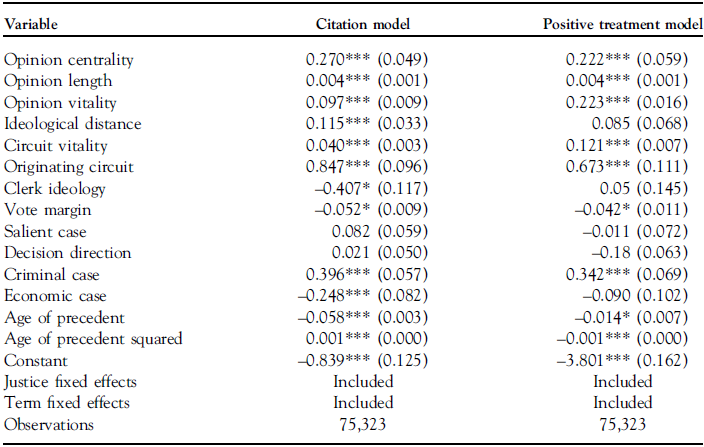
Notes: The dependent variables are the number of citations and positive treatments to Supreme Court precedent, respectively. Justice Blackmun is the median justice based on the values of the two outcome variables and is the baseline comparison. Random intercepts are used for the precedent-circuit combination. * p < 0.05; ** p < 0.01; *** p < 0.001.
The results in Table 2 highlight support for our main opinion-writing expectation, which is opinion centrality. Specifically, we find strong statistical support for opinion centrality being positively related to the frequency with which lower courts adopt the US Supreme Court’s majority opinions. Majority opinions that rely on more central precedents, as well as lengthier majority opinions, tend to receive a greater degree of discussion from the circuits compared with precedents that do not rely on precedents that are as central. The results demonstrate that the opinion centrality variable has a large relative effect on the number of citations to precedent by a circuit in a given year, produces a 0.15 unit increase in the number of citations in a given year (from 0.50 to 0.65, which represents a relative increase of about 30 percent). In fact, this effect size is larger than that of US Supreme Court vitality. This suggests that the types of precedents and number of precedents used in a Supreme Court opinion may have a substantial effect on how it is cited in the future. Over a twenty-year period, this has resulted in a cumulative increase of three citations per circuit or a cumulative effect of thirty-six citations across all circuits over a twenty-year period. The effect size for opinion length is slightly larger compared with the effect size of opinion centrality and going from an opinion that has a length of zero words to one with eight thousand words results in an annual increase of citations by approximately 0.23 (from 0.41 to 0.64). Over a twenty-year period, this result represents a cumulative increase of five citations per circuit. Its effect size is roughly comparable to that of lower court vitality.
In comparison, when going from a US Supreme Court vitality score of –2 to +2, the number of citations in a year increases by 0.09, which is a comparatively small effect compared with the effect of centrality, which is noted above. The effect of lower court vitality is meaningful with a lower court vitality of –1 associated with 0.48 citations in a given circuit per year, but with a lower court vitality of 9, this result increases to 0.73. Next, the effect of the originating circuit variable is relatively large. When a circuit is different from the originating circuit, such a circuit cites a majority opinion an average of 0.50 citations a year. However, if the circuit is the same as where a case originated from, the number of citations increases to 1.09. This finding suggests that the circuit that a case originated from is about twice as likely to cite a precedent in a given year compared with other circuits. While this finding may be expected, given the fact that the US Supreme Court will often take a case on certiorari from a circuit that it expects will end up losing, this does not occur on every occasion (see Masood, Kassow, and Songer Reference Masood, Kassow and Songer2017, Reference Masood, Kassow and Songer2019).
Regarding the justices’ identity, there is a large degree of separation in terms of how frequently circuit judges cite particular justices, and the effect of justice identity is meaningful.Footnote 24 For instance, when placing all variables at their mean or modal values, we find that Justice Scalia had a high citation rate of 0.86 citations per year, compared with Justice Blackmun, who had an average of 0.50.Footnote 25 To give another example, Justice Stevens had a relatively low rate of citation compared with Justice Blackmun. In fact, when setting all other variables at their median and mode, Justice Stevens was cited relatively infrequently (an average of 0.30 citations per circuit year), which means that Justice Scalia’s majority opinions were in fact cited more than twice as frequently compared with Justice Stevens (the least cited justice on average in our analyses), controlling for opinion attributes. This result indicates that the identity of the justice alone has an important impact on lower court attentiveness to majority opinions.
For positive treatments of majority opinions, the findings are similar to the results for the citation model. For opinion centrality, when going from cases that were below the mean opinion centrality to cases that were above the mean opinion centrality value, we find a 25 percent relative increase. The effect of opinion length is meaningful for opinions that are eight thousand words in length. For Supreme Court vitality of –1, the number of positive treatments in a given year is 0.05, which contrasts with a count of 0.067 for a Supreme Court vitality of 1. We also find that, when altering circuit vitality from –1 to +9, the count of positive treatments increases from 0.05 to 0.27, which represents a roughly 400 percent increase in the number of positive treatments in a given year. We again find that the circuit of origin variable has a large effect on the number of positive treatments. Overall, these results demonstrate that the way in which justices craft their majority opinions has a meaningful effect on adoption by lower courts.
Table 3 presents the results for the CEM models for opinion centrality, which are designed to improve the balance of the data and a reduction in the degree of model dependence for our empirical modeling (that is, we are less likely to find results by random chance). As we have noted earlier, we operationalized the hub score variable by converting it into a dichotomous variable, coded as a 0 if the hub score was below the mean and as a 1 if the hub score was above the mean.Footnote 26 We reoperationalized this variable in dichotomous form to allow the CEM algorithm to have a treatment effect variable that can be used reliably for empirical modeling. The purpose of including this model was to demonstrate the robustness of the findings under stricter conditions with more balance in the data.
Within the CEM citation model, we find support for both hypotheses that are included in our model: opinion centrality and majority opinion length. Specifically, we find that, for opinions that are less central than the mean, the average number of citations by a circuit in a given year is 0.37. However, opinions that are more central than the mean have an average number of citations by a circuit in a year of 0.48, which is approximately a 30 percent relative increase in the number of citations in a given year. Over twenty years, this would result in 2.4 additional citations in a circuit of a court opinion by a specific circuit. When examining opinion length, the effect is somewhat smaller compared with the effect of centrality. For a hypothetical opinion that is zero words in length, the average number of citations by a circuit in a year is 0.32. For an extremely long opinion that is eight thousand words in length, the average number of citations in a given year by a circuit increases to 0.41. This effect size is slightly smaller compared with the effect size of opinion centrality.Footnote 27
The results in the positive treatment CEM model are extremely similar to the citation model results. We again find support for both hypotheses based on writing style. Specifically, we find that a majority opinion with a hub score that is higher than the average has a greater average number of positive treatments per circuit in a given year of a precedent, compared with a majority opinion that has a hub score that is lower than the average. Several of our other control variables also reach statistical significance similar to the citation model results. In both CEM models, we find that the identity of the justice impacts lower court adoption of the Supreme Court’s opinions. Compared with Justice Blackmun as the baseline, Justices White, Rehnquist, O’Connor, Scalia, and Clarence Thomas are cited and followed more frequently, whereas Justice Ginsburg is relied on less frequently. Justices Thurgood Marshall, David Souter, and Anthony Kennedy’s citations and positive treatment patterns, by virtue of their identities, is not statistically significant when compared with Justice Blackmun’s. Similar to the earlier results, conservative justices seem to be cited and followed relatively often. Yet, interestingly, we controlled for the ideology of each Supreme Court justice’s clerks. To us, this suggests that something with the opinion-writing process that we are unable to control for may be impacting lower court adoption. Yet a second possibility may be that lower courts desire to adopt the opinions of conservative justices, all else being equal, knowing that a conservative majority on the Supreme Court may review their decision. This would be an interesting extension to our research.
These analyses provide broad-based evidence that both the identity of a justice as well as the manner in which they write affect how the lower courts respond to the US Supreme Court’s decisions. We find evidence suggesting that the identity of who the justice is strongly impacts how lower courts respond to particular opinions. We also find evidence that the differences in writing style impact lower court responses to particular opinions. Our results show consistent evidence that majority opinions that rely on more central precedents are especially likely to be adopted by the lower courts. Altogether, our analyses provide compelling evidence that justices systematically vary in how they craft their opinions and that these differences have real-world implications for how the Supreme Court’s opinions are adopted in decisions within the lower courts.
DISCUSSION AND CONCLUSION
Does the identity of an US Supreme Court justice authoring a majority opinion of the Supreme Court influence future citation and treatment within the US Courts of Appeals? The short answer is yes. We find that the identity of the justice has both a direct effect—by virtue of the identity of the justice—as well as an indirect effect—through the attributes of individual justices. Some of the results of justices’ identities are especially interesting, with a null result for Justices O’Connor and Kennedy. Given that they were the median justices ideologically for the duration of our study, this result might be surprising. The interesting finding on the median justices may relate to the difficulties in assembling a majority opinion given that they are often the authors in cases in complex areas of the law. Moreover, median justices tend to author a disproportionate number of cases that involve issues that are highly salient but infrequently appear before the lower courts. Yet, interestingly, the same is not true for Chief Justice Rehnquist, who also had a high share of salient decisions.
We have provided an account in which inferior court implementation of the US Supreme Court’s majority opinions are influenced through three broad set of factors: (1) justice-level attributes; (2) case characteristics; and (3) circuit-level influences. Our theory is premised on the notion that Supreme Court justices systematically vary in their ability to formulate the court’s majority opinion. We believe that such differences among individual justices ultimately affect circuit responses to the Supreme Court’s majority opinions. The results demonstrate that many of our predictions hold true in terms of the manner by which justice opinion attributes, case characteristics, and lower court-level factors impact patterns of adherence to Supreme Court decisions. We have found empirical support for our justice-level prediction that opinion centrality impacts lower court attentiveness to the justice’s opinions. That is, we have found that the majority opinions of Supreme Court justices that are more effectively embedded in the law tend to be cited and followed more frequently than the majority opinions of justices whose opinions are less embedded in the law. This new finding lends support to the claim that there is considerable variation in the ability of the justices to formulate the majority opinion of the High Court and that such differences can be a meaningful predictor of the broader impact of Supreme Court decisions based on the identity of the authoring justice. From a normative perspective, our findings suggest that it is necessary to look beyond the makeup of the coalition that issues a Supreme Court decision to a more acute focus on the identity of the justice to whom a majority opinion is assigned.
Our results demonstrate that the ideological extremity of the authoring justice impacts circuit citations and treatment. We have also found that opinion vitality exerts a meaningful impact on circuit adherence to the justices’ majority opinions and, moreover, that prior treatments at the circuit level are a key driver of future circuit citations and treatments. We have also uncovered evidence that the originating circuit cites and follows the justice’s opinions more so than non-originating circuits. Taken together, these findings indicate that key circuit-level influences strongly condition adherence and implementation by the US Courts of Appeals to the justices’ decisions. Finally, we have found strong evidence that the identity of a justice impacts how lower courts perceive particular opinions. In other words, an opinion by Justice Ginsburg is perceived differently by the lower courts from a hypothetically similar opinion by Justice Blackmun. While the results vary as to which justices are most influential under different circumstances, future work should explore the mechanisms behind identity effects among ideologically proximate justices.
Our work has important theoretical implications for the study of law and courts. Our findings suggest that differences among justices may significantly alter our understanding of judicial impact in that the majority opinions produced by individual justices seem to exert a varying impact on future adoption of the High Court’s precedents. Our approach of examining the impact of individual justices offers an important way forward to model judicial impact. This approach is likely useful in assessing the extent to which judicial decision makers in lower federal courts, state courts, and even courts in comparative environments rely on the precedents of the court of last resort. A promising extension of our framework is analysis of state and district court attentiveness to the majority opinions of the individual justices. For instance, do the US District Court judges and state supreme court justices cite and follow the precedents of certain justices more frequently than others? Given the larger number of cases adjudicated at lower levels of the judiciary, empirical studies on these courts may elucidate greater degrees of variation in the impact of the majority opinions authored by individual justices. Such analyses may be particularly insightful in refining strategic perspectives in explaining judicial interactions within the American courts.
This work also highlights the need for further theoretical development on how US Supreme Court justices may be able to influence legal policy over time through their opinions. If judicial scholars can successfully integrate justice opinion attributes within their analyses, in fact, we might get one step closer to understanding how judges behave (Baum Reference Baum1997; Epstein, Landes, and Posner Reference Epstein, Landes and Posner2013). Attention to justice-level influences may also contribute to our understanding of other aspects of judicial decision-making behavior, including how likely the Supreme Court is to overturn the opinions of a given justice and the willingness of the individual justices to bargain to discourage separate opinions, where certain justices may be more accommodating of the preferences of other justices within their majority opinions. A particularly promising area of future research is examining how the justices, individually, borrow from lower court opinions and whether language from certain justices is more likely to make its way within the opinions of inferior courts. In particular, using Herbert Kritzer and Mark Richards’s (Reference Kritzer and Richards2005) jurisprudential regimes framework to examine differences in opinion language and use of precedents may be fruitful for further examination of the influence of individual justices (Richards and Kritzer Reference Richards and Kritzer2002; Bartels and O’Geen Reference Bartels and O’Geen2015).
One way forward is to examine an area of the law where elements change substantially over time and where the US Supreme Court has discussed a particular issue relatively frequently—for instance, search and seizure cases or Establishment Clause cases. One more area that merits future research is the impact of who the opinion assigner is (that is, the chief justice or the senior-most associate justice in the majority) and how that may enhance or mitigate the impact of an individual opinion. Given that prior research finds that the manner in which opinions are assigned systematically varies depending on who is assigning a given majority opinion, we believe that such differences may also be useful in understanding how differences in opinion assignment strategy affect the long-term impact of a precedent within the judicial hierarchy. Finally, another interesting avenue for future research would be to examine how doctrines associated with particular justices get implemented within courts down the judicial hierarchy. Are such doctrines largely espoused within lower court majority opinions or also within concurring and dissenting opinions? Exploring these questions will undoubtedly improve our understanding of judicial behavior, learning, and doctrinal development.
Supplementary material
To view supplementary material for this article, please visit https://doi.org/10.1017/lsi.2022.33


 Open access

