





1. Introduction: sign language loci
There are many places in linguistic study where it is difficult to decide where the study of language ends and the study of other aspects of human cognition begins; put differently, sometimes understanding how language works requires understanding its relationship to other domains of human cognition. A particularly striking case can be found in sign language anaphora, where the association of different items in a discourse to different locations in space supports seemingly unbounded possibilities for disambiguation. Consider the example in Figure 1, glossed in 1, where the first sentence introduces a boy and a girl and uses an indexical point (IX) to associate the boy and the girl to two different areas of space, arbitrarily labeled a and b, respectively, which are commonly referred to as referential ‘loci’.Footnote 1
(1)
boy ix-locus
a girl ix-locus
b sit class ix-locus
a read
‘There’s this boy and this girl. They sit in class. That one [the boy] reads.’
(ASL)
‘There’s this boy and this girl. They sit in class. That one [the boy] reads.’ See example 1.

When areas of signing space are used as loci they seem to be able to participate in the most abstract aspects of a linguistic system, such as quantification and binding, while also capitalizing on obviously nonlinguistic systems of spatial cognition, depiction, and deixis. Understanding how these two pieces fit together thus provides a critical case of understanding the ways that our language module integrates nonlinguistic reasoning. In this article, we show that we gain new insight into both the linguistic and nonlinguistic cognitive aspects of loci by focusing on their formal pragmatic properties, namely, the pragmatic competition that expressions using loci enter into with other referential expressions in the language. We primarily focus on data from American Sign Language (ASL) as in the example in Figure 1, but this phenomenon has been widely reported across sign languages of Deaf communities around the world, including newly emerging sign languages such as Lengua de Señas Nicaragüense, also known as Nicaraguan Sign Language (Coppola & Senghas Reference Coppola, Senghas and Brentari2010, Kocab et al. Reference Kocab, Carner and Snedeker2024), and homesign systems (Coppola & So Reference Coppola and So2006, Goldin-Meadow Reference Goldin-Meadow, Gentner and Goldin-Meadow2003, Torigoe & Takei Reference Torigoe and Takei2002).
Traditionally, linguistic analysis of sign language loci has focused on two broad domains in which we see spatial loci integrating into the grammar: verbs and reference. In verbs, the starting locus and/or the final locus of the verb form changes to reflect thematic roles. For example, the verb help in ASL can be expressed with a primary/citation form without any loci, as in Figure 2, where there is a slight upward movement of the hands. But if the signer wants to express or clarify who helped whom, the form of help can be changed so that the dominant hand starts from the locus associated with the agent who helps and ends at the locus associated with the recipient, as in ‘I help you’ (beginning at the signer, ending at the interlocutor) or ‘She/he/they help her/him/them’ (beginning in one locus, ending at another). This is shown in Figure 3, glossed in 2, where subscripts represent the starting and ending points of the sign.
(2)
a.
help
2
b.
Ahelp
B
help-locus
2
locus
A-help-locus
b
‘I help you.’
‘She helps her.’
(ASL)
Citation form of help in ASL.

(a) ‘I help you.’ (b) ‘She helps her.’ (ASL) See example 2.

Loci on verbs can be related to physical locations of the relevant individuals present in the actual context or to abstract locations seemingly arbitrarily associated with relevant individuals. Thus, help can be modified so that it starts out at one location and is directed deictically, such as in the case of the signer and the interlocutor, or in the third-person case starts out directed toward an actually present entity sitting on the right side of the signer and moves to a location directed toward another present entity sitting on the left. However, as we see in 1, if referents are associated with abstract loci in the signing space, a sign can also start and end in those loci.
A second area of the grammar where loci are used is in the (pro)nominal domain. In referring to an individual, a signer can use the indexical handshape (IX) and point either to the actual referent or to an abstract location previously associated with that referent, the same duality we see in the verbal domain. For example, we can see in Figure 4 (glossed in 3), which is part of the dialogue in Figure 1, that pointing to an abstract location that was previously associated to some entity (a boy) seems to refer to that (and only that) entity as if it is a pronoun. These uses are often translated to English pronouns such as he, she, they (singular), and so forth.
(3)
ix-locus
a read
‘He reads.’
(ASL)
‘He reads’ (ASL). See example 3.

Linguistic approaches to sign language loci range from analyzing them as abstract linguistic mechanisms—such as syntactic agreement (Fischer & Gough Reference Fischer and Gough1978, Janis Reference Janis, Emmorey and Reilly1995, Lillo-Martin & Meier Reference Lillo-Martin and Meier2011, Meir Reference Meir1998, Neidle et al. Reference Neidle, Kegl, Bahan, MacLaughlin and Lee2000, Padden Reference Padden and Newmeyer1988, Quadros Reference Quadros2003, Sandler & Lillo-Martin Reference Sandler and Lillo-Martin2006, among others), clitics (Nevins Reference Nevins2011a), or semantic indices (Lillo-Martin & Klima Reference Lillo-Martin, Klima, Fischer and Siple1990, Schlenker Reference Schlenker2011, Steinbach & Onea Reference Steinbach and Onea2015, among others)—to analyzing them as nonlinguistic/gestural and spatial (Liddell Reference Liddell and Coulter1993, Reference Liddell2003). Building on these foundational works, more recent analyses have acknowledged the need for a close interface between grammar and deixis (Meir Reference Meir2002; see Mathur & Rathmann Reference Mathur, Rathmann and Brentari2010 and Lillo-Martin & Meier Reference Lillo-Martin and Meier2011 for more discussion), proposing that verbs that are locationally modified are a construction of morphemes and deictic gestures (Fenlon et al. Reference Fenlon, Schembri and Cormier2018, Liddell Reference Liddell, Emmorey and Reilly1995, Schembri et al. Reference Schembri, Cormier and Fenlon2018). In this article, we defend and elaborate on this last view: that the use of loci is both fundamentally linguistic (they are modifiers) and fundamentally spatial (they express an association with space), providing possible descriptive content in both the verbal domain and the nominal domain. Our idea is that the indexical handshape IX directed toward some location A (represented as ‘IXA’) is a predicate that relates an entity, individual or locational, to some abstract or physical locus (R(x,a)), so that IXA roughly translates as ‘associated with location A’. We further argue that referential expressions carrying these predicates can be incorporated into verbs like clitics, thus accounting for the use of loci in both nouns and verbs in a uniform manner.
One consequence of our view that a locus is a spatial modifier is that it should be subject to the same pragmatic constraints as other predicates that modify referential expressions. For example, a pronoun she, a short definite description that girl, and a longer definite description that girl with the sparkly glasses sitting on the couch may all refer to the same individual, but they are not interchangeable in discourse: we use increasing modifiers in cases that require increasing disambiguation in a way that is governed by well-known pragmatic principles. Here we highlight new empirical evidence which demonstrates that locus use is governed by these same principles in both verbal and nominal contexts, that is, that the use of loci is pragmatically conditioned. If loci are spatial modifiers, we can account for why they occur when other modifiers do.
The optionality and the distributive property of loci cannot be easily accounted for via existing analyses as verb agreement or as indices because neither verb agreement nor semantic indices should be subject to this kind of pragmatic competition. Under the analysis we propose, sign language loci also make use of familiar ingredients from spoken languages, namely modification, and simply are able to attribute spatial association to referents more easily than spoken languages can by virtue of the visual modality.
Pragmatics is at the heart of this overarching account of the use of spatial loci in sign languages. This allows sign language loci, as agreement markers, to be subsumed by more general accounts of reference resolution. Our analysis will be shown to solve several problems that have led to long-standing debates in the sign language literature: here, (i) verbal and nominal uses of loci are accommodated by a single unified analysis, (ii) the debate over identifying loci as gesture (locational) vs. linguistic (argument agreement) disappears because we argue that loci are both, (iii) the choice of label for ‘personal’ and ‘locational’ uses of loci is no longer needed, and (iv) optionality in the use of loci is explained by a predictable pragmatic mechanism.
The organization of the article is as follows. In the next section, we discuss the use of loci in the verbal domain and argue that analyzing them as clitics that contribute semantic restrictions can account for their optionality better than analyzing them as syntactic agreement. We argue that the full form that is cliticized onto the verb form is the nominal IX. In Section 3, we develop an analysis of the nominal IX as consisting of (i) a null pronoun (∅) and (ii) IX, which is analyzed as spatially derived content that can be utilized by both NPs and VPs. We lay out the predictions of our theory in Section 4 and test them in an experimental study. Section 5 concludes with a general discussion.
2. Locus use in the verbal domain
As we saw in Figure 3, verbs in ASL can change their form to reflect properties of their arguments, individual or locative, commonly beginning at the locus associated with the agent or the source and/or ending at the locus associated with the recipient, goal, or event (Fischer & Gough Reference Fischer and Gough1978, Friedman Reference Friedman1975, Meir Reference Meir1998, Reference Meir2002, Padden Reference Padden1983). While we focus mostly on the kind of verbs that associate loci to agent/patient arguments (and thus are less obviously locative), we discuss later in Section 3.5 verbs that take locative arguments like source and goal.
For an example of verbs conveying person information of their arguments with loci, consider the context in 4, where Jin is established in locus A, while Sol is established in locus B. If the signer starts the sign for help from locus A and ends it at locus B, then the interpretation is that Jin helped Sol. If, by contrast, the signer starts from B and ends at A, the interpretation is that Sol helped Jin.
(4)
[Context: Jin at locus A, Sol at locus B]
a.
Ahelp
B (locus
A-help-locus
B): ‘Jin helped Sol.’
b.
Bhelp
A (locus
B-help-locus
A): ‘Sol helped Jin.’
Labels for these verbs include directional verbs and indicating verbs, as well as agreement verbs and inflecting verbs. The latter two terms are based on a prominent line of analyses which argue that loci on these verbs either function as, or are directly related to, subject and object person-inflection (Mathur & Rathmann Reference Mathur, Rathmann, Pfau, Steinbach and Woll2012, Meier & Lillo-Martin Reference Meier and Lillo-Martin2013, Meir Reference Meir1998, Neidle et al. Reference Neidle, Kegl, Bahan, MacLaughlin and Lee2000, Padden Reference Padden and Newmeyer1988, Quadros Reference Quadros1999, Sandler & Lillo-Martin Reference Sandler and Lillo-Martin2006, among others). For example, in Mathur & Rathmann Reference Mathur, Rathmann, Pfau, Steinbach and Woll2012:137, verb agreement in sign language is described as a change in the orientation and direction of movement of a verb. Similarly, in Sandler & Lillo-Martin Reference Sandler and Lillo-Martin2006, verb agreement in ASL is described as consisting of (i) the sign beginning at the locus for the subject, (ii) the sign ending at the locus of the object, (iii) the hand moving from the locus of the subject to the locus of the object, and (iv) the direction of the hands facing the locus of the object.
Because only a subset of verbs show this kind of locational modification, and verbs differ on which of their arguments are marked in this way, Padden (Reference Padden1983) proposes a now-classic three-way distinction among sign language verbs: ‘agreeing’ verbs like help, ‘spatial’ verbs like put, and ‘plain’ verbs like dance. Spatial verbs like put differ from agreeing verbs in that they depict the spatial layout of the event rather than the participants. Plain verbs differ from agreeing and spatial verbs in that they are typically thought of as not changing their forms at all to indicate relevant arguments or the spatial layout.
Another name for agreeing verbs is ‘directional verbs’ because the movement or the orientation of the verbs is manipulated to indicate person or location information. While this term is generally used to refer to verbs that are modified to begin and/or end at specific loci, we do not use this term for two reasons. The first is that we assume, following Lourenço & Wilbur Reference Lourenço and Wilbur2018, that all verbs—not just verbs that have a movement component in their phonology, but also verbs that do not change their location—can make use of loci, if phonologically possible. For example, the verb dance in ASL does not show a movement from one location to another, but it can be signed in a locus associated with a referent when pragmatically licensed.Footnote 2 The term ‘directional verb’ suggests that the phonology of the verb has a direction, and thus is not naturally extended to cover this use of dance.
A second reason for avoiding the label ‘directional verbs’ is that this can imply that directional modification is obligatory for these verbs, while our data below highlight the optionality of this process. Crucially, if a verb is categorized as a directional verb, it is not the case that it is modified in every instance of use. For example, the verb help can also be signed in neutral space, without starting from the locus associated with the subject and ending at the locus associated with the object. Terms that categorize verbs into classes fail to make a distinction between instances where a verb is used in its citation form and instances where it is modified to show person information. Therefore, we describe an instance of a verb as being ‘locationally modified’ when it shows a locational association with certain loci. A locationally modified help would be the form of the verb whose movement starts and ends at different loci, while a locationally modified dance would be the form of the verb that is signed at a specific locus. Note that the modification of help resides in the phonology of the verb’s movement, and thus it is not naturally extended to dance, which does not have a movement that is directional. Thus, the term ‘locationally modified’ refers to two distinct mechanisms: in a directional verb, modification is in the internal phonology of the movement, while in a plain verb, modification is a change in the location of the entire sign.Footnote 3
2.1. Comparison to agreement, clitics, and gestures
As we noted above, one prominent view of verbs locationally modified to indicate person information is that they reflect verb agreement with the subject and/or object (Fischer & Gough Reference Fischer and Gough1978, Janis Reference Janis, Emmorey and Reilly1995, Lillo-Martin & Meier Reference Lillo-Martin and Meier2011, Meir Reference Meir1998, Reference Meir2002, Padden Reference Padden1983, Pfau et al. Reference Pfau, Salzmann and Steinbach2018). Descriptively, agreement can be said to involve a systematic covariance between a semantic or formal property of one element and a formal property of another (Steele Reference Steele, Greenberg, Ferguson and Moravcsik1978). English shows verb agreement with an inflection -s when the subject of a verb is third-person singular, as in 5. Spanish shows subject agreement, with, for example, the verb hablar ‘to speak’ ending with o for a first-person singular subject and with a for a third-person singular subject, as in 6.
(5)
Jin helps them every day.
(6)
{Hablo
/
Habla}
español.
speak.1sg
speak.3sg
Spanish
‘{I speak / she speaks} Spanish.’
(Spanish)
Under an analysis of locational modification as agreement, the modification of the initial and/or the final location within the movement of a verbal sign in ASL and other signed languages is equated to person inflections on the verb. The agreement analysis is supported by the observation that locational modification exhibits typologically common effects of verb agreement, such as argument drop and noncanonical word order. Specifically, overt modification of the verb allows word order to be noncanonical (Fischer Reference Fischer and Li1975, Quadros Reference Quadros1999) and licenses null arguments (Lillo-Martin Reference Lillo-Martin1986).
There are two alternatives to analyzing locational modification as agreement. Both are more semantically contentful than syntactic agreement, which is taken to be a reflection of features associated with syntactic positions, such as the subject or object position. The first alternative treats locational modification as personal (e.g. they/that) and/or locational (e.g. there) pronouns, which have simply been cliticized onto the verb (Koulidobrova Reference Koulidobrova2012, Nevins Reference Nevins2011b). The second alternative analyzes locational modification as gestures, that is, as incorporation of a pointing gesture into the form of the sign to signal an association with the referent, in the same way that a pointing gesture by a nonsigner would (Liddell Reference Liddell and Coulter1993, Reference Liddell2003). Specifically, Liddell (Reference Liddell, Emmorey and Reilly1995) argues that referents marked by locationally modified verbs should be seen as being present in some mental spatial representation (called ‘surrogate space’ or ‘token space’), where they are assumed to have topographic representation. The only difference between a token space and a mental representation of the real space of discourse is that the tokens are invisible. Thus, pointing in the token space should be considered to be identical to pointing to actual entities in the discourse context.
Motivations for these alternative analyses come from what Nevins (Reference Nevins2011b) calls ‘significant departures from agreement patterns’ in spoken languages (see Koulidobrova Reference Koulidobrova2012, Lillo-Martin & Meier Reference Lillo-Martin and Meier2011, Mathur & Rathmann Reference Mathur, Rathmann, Pfau, Steinbach and Woll2012, and Sandler & Lillo-Martin Reference Sandler and Lillo-Martin2006 for extensive discussion). Below, we focus in more closely on two of these differences.
2.1.1. Object primacy
The first difference involves what argument information is encoded in the verb form. Locational modification of sign language verbs shows an object primacy, where object information is marked on verbs more often than subject information and the marking of subjects is often optional (Lillo-Martin & Meier Reference Lillo-Martin and Meier2011, Meier Reference Meier1982, Padden Reference Padden and Newmeyer1988, Quadros & Lillo-Martin Reference Quadros and Lillo-Martin2007). This diverges from what we find in spoken languages, where obligatory subject agreement is found much more frequently across languages than obligatory object agreement.
Nevins (Reference Nevins2011b) notes that while optional marking of subjects is unexpected for agreement, it is crosslinguistically common for clitics. For example, subject clitics are optional in Gruyère, as shown in 7 from De Crousaz & Shlonsky Reference De Crousaz and Shlonsky2003.
(7)
Li
(i)
medzè
chin
ti
lé
dzoa.
she/he
(subj.cl)
eat.3sg
that
all
the
days
‘She/he eats that every day.’
(Gruyère; De Crousaz & Shlonsky Reference De Crousaz and Shlonsky2003, ex. 1c)
Thus, while the object primacy and optional subject agreement found in locationally modified verbs of sign languages are noncanonical when compared to verb agreement in spoken languages, they are expected if these verbs are appearing with cliticized pronouns.
2.1.2. Subset problem
The second difference is in the extent to which the phenomenon applies to verbs. In spoken languages, agreement between the verb and its arguments is typically seen as a syntactic parameter that applies to all verbs in the respective language. For example, Spanish verbs regardless of semantic category appear with person marking of the subject. In sign languages, however, there appears to be a much higher proportion of verbs that fail to exhibit locational modification. As discussed above, verbs in sign languages are generally categorized into three main classes, following Padden Reference Padden and Newmeyer1988, as summarized in 8.
(8)
ASL verb classes
a.
Inflecting/agreeing verbs: verbs that mark the person information of arguments
examples: blame, hate, give, tell, ask
b.
Spatial verbs: verbs that mark spatial locations
examples: move, put, carry
c.
Plain verbs: verbs that do not mark person or location information
examples: memorize, love, think, wonder
Which verbs fall into which category? Padden (Reference Padden and Newmeyer1988) argues that agreeing verbs and plain verbs are lexically specified. Rathmann and Mathur (Reference Rathmann, Mathur, Meier, Cormier and Quinto-Pozos2002) argue that animacy affects whether a verb is categorized as an agreement verb. Regardless of how the verb classes are determined, that only a subset of verbs mark person information has been pointed out as differing from verb agreement in spoken languages, which we call the ‘subset problem’ here. By contrast, clitics have been shown to be optional, as we saw with the Gruyère example in 7 above, and in other languages like Spanish (Torrego Reference Torrego1998). Based on this, Nevins (Reference Nevins2011b) argues that indicating verbs in sign languages share more in common with pronominal clitics (interpreted as arguments to the verb) than with verb agreement.
2.1.3. Solutions to the subset problem
At least two different solutions to the subset problem have been proposed in the literature. Meir (Reference Meir2002) proposes an analysis where agreement with arguments takes place not in the verbs directly but in a separate morpheme that only a subset of verbs carry lexically. According to this analysis, the verbs that show verbal agreement denote events of transfer and are morphologically complex, carrying a directional morpheme that indicates the path of transfer from source and goal. It is this directional morpheme that agrees with the source and the goal of the path, rather than the verb itself. Thus, the subset problem is reduced to variation in how verbs are decomposed and carry additional thematic information. Because verbs themselves do not agree with the arguments, there is no subset problem. Since verb agreement is analyzed in terms of a path from source to goal, this analysis has the benefit of unifying person agreement and spatial agreement.
Another solution to the subset problem is presented by Lourenço and Wilbur (Reference Lourenço and Wilbur2018), who emphasize that a sign language verb does not need to have directional movement in its phonology in order to exhibit morphological agreement. They point out that even plain verbs, which do not show movement, can be signed in a locus associated with an argument. On this basis, agreement is defined not by path or directionality but by co-location: the sharing of a locus between a nominal (subject or object) and the verb. With this updated definition, all verbs in Libras (Lingua Brasileira de Sinais, or Brazilian Sign Language) can show co-location unless phonologically restricted. Consequently, the traditional distinction between inflecting and plain verbs becomes less relevant, and the subset problem is neutralized, since all verbs have the potential to exhibit agreement.
The empirical picture thus is one that leaves the door open for a few different analyses, as discussed in Lillo-Martin & Meier Reference Lillo-Martin and Meier2011. We focus then on another kind of data that may bear on this question: the optionality of locational modification within the same verb, across different uses.
2.2. Optionality and its solution
Another important difference between verb agreement in spoken languages and locational modification in sign languages is that agreement is by definition obligatory in every instance of a particular verb, while we see in sign languages the same verb sometimes appearing with locational modification and sometimes without. In other words, while Lourenço and Wilbur (Reference Lourenço and Wilbur2018) argue that all verbs in Libras ‘can show co-location’ as an argument in favor of analogizing it to agreement, we note that verbs in a verb-agreement language must show agreement, irrespective of semantic/pragmatic factors.
Large-scale corpus studies have shown that directional modification in sign languages is far from obligatory. De Beuzeville et al. (Reference de Beuzeville, Johnston and Schembri2009) report that only 41% of inflecting verbs in Auslan (Australian Sign Language) were clearly modified, even for marking undergoer arguments. Similarly, Fenlon et al. (Reference Fenlon, Schembri and Cormier2018) examine 1,436 tokens of eighty-one inflecting verb types in British Sign Language (BSL) and, even under a generous coding of locational modification, find modification in only about 65% of tokens, with stricter assumptions yielding lower rates.Footnote 4 They identify numerous factors that condition modification, including person, thematic role, animacy, verb position, and constructed action. In particular, constructed action—where the signer adopts the perspective of a character—correlates with higher rates of patient modification, likely because the signer deictically points to imagined referents. They also note that verbs are more often modified following null arguments, suggesting that modification may serve as a communication strategy to maintain reference and ensure transparency of meaning. Beyond such global patterns, Schembri et al. (Reference Schembri, Cormier and Fenlon2018) emphasize idiosyncrasies that are argued to be unpredictable: while pay was modified in twenty of twenty-six tokens, push was modified in only five of twelve, supporting Liddell’s (Reference Liddell, Emmorey and Lane2000) proposal that directionality functions more like constructed action or gestural addition than like obligatory agreement.
While such corpus-based work highlights optionality, it often treats modification as unpredictable. By contrast, Kocab et al. (Reference Kocab, Ahn, Lund and Davidson2019) argue for systematic pragmatic conditioning. They suggest that the higher modification rate of pay relative to push arises from differences in argument reversibility: the inanimate patients of pay (e.g. a bank) can plausibly also be agents, whereas the inanimate patients of push (e.g. a wall) cannot. Thus, pay is more likely to be overtly modified to disambiguate the agent and patient roles.
Small-scale experimental evidence from ASL corroborates this view. In one set of contrasts with the verb dance, narratives with a single referent were judged natural when the final verb appeared without modification, as in 9, accepted by all three native ASL signers consulted by Kocab et al. (Reference Kocab, Ahn, Lund and Davidson2019), but narratives with two referents were degraded unless loci were established and the verb was signed at the agent’s locus, as shown by the contrast between 10a, accepted by only one signer, and 10b.
(9)
boy
enter
club.
music
on.
dance
boy
enter
club
music
on
dance
(3/3)
‘A boy entered a club. Music went on. He danced.’
(10)
a.
boy
enter
club.
music
on.
see
girl
read.
dance.
boy
enter
club
music
on
see
girl
read
dance
(1/3)
b.
boy
ix
A
enter
club.
see
girl
ix
B
read.
music
on.
boy
ix-locus
A
enter
club
see
girl
ix-locus
B
read
music
on
(ix
A)
dance
A
(3/3)
ix-locus
A
dance-locus
A
‘A boy
i entered a club. Music went on. He
i saw a girl
j reading. He
i danced.’
A second set of contrasts with push yielded similar results. When no loci were established, unmodified verbs were rejected, as in 11a; when loci were marked and the verb moved between them, sentences were judged acceptable, as in 11b. Crucially, when the surrounding context rendered the intended agent salient, the same unmodified verb from 11a was judged natural and clear, as in 11c (see also Neidle et al. Reference Neidle, Kegl, Bahan, MacLaughlin and Lee2000).
(11)
a.
*sue hang-out mary. push.
(0/3)
‘Sue and Mary were hanging out. Then, she pushed her.’
b.
sue
ix
A
hang-out
mary
ix
B.
(ix
A)
push
B
(ix
B).
(3/3)
Sue
ix-locus
A
hang-out
Mary
ix-locus
B
ix-locus
A
push-locus
B
ix-locus
‘Sue and Mary were hanging out. Then, she pushed her.’
c.
sue
hang-out
mary.
mary
say
something
bad.
sue
angry.
push.
(3/3)
Sue
hang-out
Mary
Mary
say
something
bad
Sue
angry
push
‘Sue was hanging out with Mary. Mary said something bad. Sue got angry. She pushed her.’
These results demonstrate that modification is not random but is systematically licensed by pragmatic need: it is required when roles are reversible or referentially ambiguous, but unnecessary when discourse context suffices.
In summary, converging findings show that locational modification on verbs is optional, in sharp contrast to obligatory agreement in spoken languages. At the same time, its distribution is not arbitrary: both corpus studies and experimental data reveal systematic conditioning by pragmatic factors such as disambiguation and discourse salience. This perspective aligns indicating verbs with pronominal elements, whose overt realization is likewise governed by discourse-pragmatic constraints (Ariel Reference Ariel, Barlow and Kemmer2000, Gundel et al. Reference Gundel, Hedberg and Zacharski1993, Nevins Reference Nevins2011b), rather than with morphosyntactically obligatory agreement.
2.3. Analysis: location incorporation
Motivated by optionality facts, we favor an analysis of locational modification that involves the notion of incorporation. We define incorporation in this context as a morphological process of combining different parameters of two signs, such as handshape, location, and movement, to form a new word (Liddell Reference Liddell1997, Valli et al. Reference Valli, Lucas, Mulrooney and Villanueva2011). For example, the ASL sign for six-months involves an incorporation of two signs, six and month, as shown in Figure 5. To incorporate the two signs, the handshape of the sign six is combined with the location, movement, and orientation of the sign month. So instead of the dominant hand forming the indexical handshape generally used for month, the dominant hand takes the shape of the sign six. This incorporation is productive up to ‘nine’, so if the dominant handshape is that of seven, the incorporated word means ‘seven months’, and so on.
The incorporation of the signs six and month in ASL involves the dominant handshape of six combined with the dominant hand orientation, nondominant handshape, movement, and location of month.

We argue that the locational modification of verbs is a kind of incorporation between a nominal element and the verb, aligned with the view put forward by Koulidobrova (Reference Koulidobrova2012) and Nevins (Reference Nevins2011b) and consistent with the idea in Liddell Reference Liddell, Emmorey and Reilly1995 that a locationally modified verb is composed of a grammatical verb and deixis. This view also maintains the intuition in Liddell Reference Liddell, Emmorey and Reilly1995 and Liddell Reference Liddell, Emmorey and Lane2000 that loci use is uniform across the nominal and verbal domains. The nominal element that gets incorporated into the verb is the indexical point (IX) directed to the relevant loci (such as A and B), represented as IXA and IXB.Footnote 5 To incorporate these into the verb, the start and end locations of the verb would be replaced with the location parameters of IXA and IXB, respectively, with the other parameters of the verb remaining. An example is shown with a locationally modified verb help in 12.
(12)
Ahelp
B, incorporation of:
a.
location: IXA, IXB
morphology
b.
handshape, movement: help
stem
The same analysis can apply to verbs that do not have a path component. A locationally modified verb dance is analyzed in 13 as having an overt IX in the underlying semantics. Here, too, we argue that the locational parameter of IXA is incorporated into the verb dance in the phonological production of the sentence.
(13)
dance
A, incorporation of:
a.
location: IXA
morphology
b.
handshape, orientation: dance
stem
Analyzing locationally modified verbs as verbs with incorporated IX has implications for the tripartite categorization of verbs in sign languages into ‘inflecting’, ‘spatial’, and ‘plain’ seen in 8 above. Because the referential expression (IX) can be incorporated into both an ‘inflecting’ verb and a ‘plain’ verb, the distinction between the two categories is removed.Footnote 6
Note that it is possible in ASL for the overt IX to cooccur with locationally modified verbs, as shown in 14.
(14)
ix
A
Ahelp
B
ix
B.
ix-locus
A
locus
A-help-locus
B
ix-locus
B
‘She
i helps her
j.’
This, however, does not pose a challenge to the incorporation analysis because clitic doubling—where overt referential expressions such as pronouns and names cooccur with cliticized pronouns—is commonly found across languages, and in fact is often first misanalyzed as agreement (Anagnostopoulou Reference Anagnostopoulou, Everaert and van Riemsdijk2006, Baker & Kramer Reference Baker and Kramer2018, Koulidobrova Reference Koulidobrova2012, Kramer Reference Kramer2014, Nevins Reference Nevins2011a).Footnote 7
2.4. Summary
In this section, we have examined how ASL verbs may be locationally modified to encode person information. While traditionally analyzed as agreement morphology, we have argued that such modification is better understood as the incorporation of a nominal element into the verb. This analysis captures the observed optionality of modification and its sensitivity to pragmatic factors, distinguishing it from obligatory agreement in spoken languages. Taken together, the data suggest that the typologically distinctive patterns of sign language verbs reduce to a general process of incorporation.
3. Locus use in the nominal domain
In the previous section, we argued that locationally modified verbs should be analyzed as involving indexicals (IX) incorporated into verbs like clitics. In this section, we present an analysis of the IX itself. While IX seems to be a nominal expression in examples of deictic pointing, as in 15, we argue that IX is actually a spatial modifier that accompanies a nominal element. In 15, all we see overtly is the modifier, because the pronoun is covert. In other words, IX in 15a corresponds to the ‘[pointing to Jane]’ that accompanyies she in 15b.
(15)
[Context: Jane and Jin sit in class.]
a.
ix
Jane dance.
b.
She [pointing to Jane] danced.
In addition to referring (in combination with a null nominal) deictically, IX can also associate abstract locations in the signing space with individuals. As illustrated in 16, an individual introduced in the first sentence is associated to locus A, and then a later point to the same locus unambiguously forces coreference to the antecedent in the same location. In the remainder of this article, we use the notation ‘IXLOC’ to refer to the use of IX in an abstract locus to distinguish IX used to refer to actual entities, including the conversation participants.
(16)
jane
ix
A
jin
ix
B
sit-in
class.
ix
A
dance.
Jane
ix
intro
-locus
A
Jin
ix
intro
-locus
B
sit
class
ix
ana
-locus
A
dance
‘Jane (associated with A) and Jin (associated with B) sat in class. The one associated with A danced.’ (ASL)
We call the first instance of IXLOC the ‘introducing use’, since it introduces a referent that will be associated with the locus. Subsequent instances of IXLOC indexed to the same locus are called ‘anaphoric uses’ because IXLOC anaphorically refers to the previously introduced entity. Note that in the introducing use, it is not always the case that IXLOC is fully produced phonologically. Instead, it is sufficient to sign a name or a noun that refers to an entity in some locus in order to associate that locus with the entity in question. This association can also be made through eye gaze to the locus while signing the name or noun at the same time. We assume that this is a form of incorporation, just like in verb modification: the locational information of IXLOC is incorporated into the signing of the name for pronunciation ease, although the interpretation is that of a full IXLOC. The introducing use and the anaphoric use of IXLOC differ in their discourse positions, in that the introducing use appears earlier in the discourse and the anaphoric use appears later. The two uses are otherwise similar phonologically, as they can both be produced either in full or reduced and incorporated into adjacent signs. Syntactically, the anaphoric use may appear without the nominal, while the introducing use requires it, given its function of associating an entity with a location.
Like locationally modified verbs, IXLOC and its deictic and abstract reference to entities established in loci have received significant attention in both syntactic and semantic sign language literature. Many sign language linguists take the deictic gestural use (as in 15) to be the primary explanation for loci, and take uses that extend to nonpresent referents (as in 16) to be a type of metaphorical extension, as if the referents were present within the mental representation of the actual signing space (Liddell Reference Liddell, Emmorey and Reilly1995, Reference Liddell2003). Others take the fundamental contribution of loci to be more abstract than spatial, while at the same time accounting for many spatial features through added iconic descriptions (Schlenker Reference Schlenker2018, Schlenker et al. Reference Schlenker, Lamberton and Santoro2013). For example, a vibrant line of research beginning with Lillo-Martin & Klima Reference Lillo-Martin, Klima, Fischer and Siple1990 takes this use of space to be a visible manifestation of the covert indices used in dynamic semantics (Barberà Altimira Reference Barberà Altimira2015, Quer Reference Quer2012, Schlenker Reference Schlenker2011, Reference Schlenker2016, Steinbach & Onea Reference Steinbach and Onea2015). In dynamic semantics, it is assumed that (indefinite) DPs introduce discourse referents with indices. When anaphoric expressions refer back to these discourse referents, coreference is established through coindexation, the sharing of the same index. The idea in this line of work is that sign language loci are overt instantiations of indices. Because indices are never visible in spoken languages, loci in sign languages have been considered to be a unique source of evidence for dynamic indices. There are also notable recent proposals that do not equate loci to indices: Kuhn (Reference Kuhn2016) follows Neidle et al. (Reference Neidle, Kegl, Bahan, MacLaughlin and Lee2000) in analyzing loci as syntactic features that trigger agreement, while many in the cognitive linguistic tradition emphasize the compelling similarities with pointing gestures outside of sign languages (Perniss & Özyürek Reference Perniss and Özyürek2015); but the loci view is especially influential within recent formal semantic approaches (see Kuhn Reference Kuhn, Quer, Pfau and Herrmann2021 for overview).
In this article, we present a proposal that preserves the fundamental idea that loci are spatial, thus related to the deictic uses of IX as well as to pointing that accompanies indexicals like demonstratives in spoken languages. In this respect, our proposal might be categorized as a ‘gestural’ view of IXLOC. However, we propose a formal, compositional way to view this gestural component of IXLOC that builds on previous formal accounts that have been proposed, combining different aspects of indices (Lillo-Martin & Klima Reference Lillo-Martin, Klima, Fischer and Siple1990, Schlenker Reference Schlenker2011, Steinbach & Onea Reference Steinbach and Onea2015, and many others) and features (Kuhn Reference Kuhn2016, Neidle et al. Reference Neidle, Kegl, Bahan, MacLaughlin and Lee2000).
3.1. Optionality and pragmatic conditioning of IX
As with loci in the verbal domain, one crucial but often overlooked property of IXLOC is its pragmatically conditioned optionality and its overall low frequency in natural ASL discourse. Production studies of ASL show that choices among referential expressions—null arguments, classifiers, IX, or overt nominals—reveal how discourse structure is organized (Czubek Reference Czubek2017, Frederiksen & Mayberry Reference Frederiksen and Mayberry2016). In Frederiksen & Mayberry Reference Frederiksen and Mayberry2016, twelve native signers were presented with a simple, six-panel picture depicting a story and were asked to retell the story. A number of different anaphoric expressions available in ASL—such as the null argument, classifiers, and IX—were counted in the collected corpus, focusing on those appearing in the subject position. In order to determine how referent status affects the choice of the anaphoric expression, Frederiksen and Mayberry adopt from Gullberg Reference Gullberg2006 a three-way distinction of referent status, shown in 17. These represent different statuses a referent can have in a narrative and have been shown to affect the kinds of referential expressions that spoken and sign languages use (Debreslioska et al. Reference Debreslioska, Özyürek, Gullberg and Perniss2013, Perniss & Özyürek Reference Perniss and Özyürek2015, among others).
(17)
a.
Introduced: first mention of a referent, independent of clause position
b.
Maintained: a referent appearing as subject, having appeared in the previous clause
c.
Reintroduced: a referent appearing as subject after one or more clauses without mention
In order to see how frequently a locus is used to refer to a familiar entity, we report Frederiksen and Mayberry’s (Reference Frederiksen and Mayberry2016) counts from the latter two categories in Table 1.
Kinds of anaphoric expressions (adapted from Frederiksen & Mayberry Reference Frederiksen and Mayberry2016:59, table 3).

Table 1. Long description
The first row lists maintained anaphora with nominal 0.07 (24), pronoun 0.01 (4), null argument 0.71 (219), classifier 0.20 (63), and total 310. The second row shows reintroduced anaphora with nominal 0.20 (10), pronoun 0 (0), null argument 0.68 (20), classifier 0 (0), and total 30. Columns are ordered as anaphora type, nominal, pronoun, null argument, classifier, and total. Proportions are followed by counts in parentheses.
The null argument is dominant in both categories of anaphoric reference, with around 70% of all anaphoric expressions being null. Overt nominals can be used in anaphora as well, especially when the definition of anaphora is broadened to include reintroduced referents. Within the nominal category, bare nouns are most frequent, as Table 2 shows.
Nominal anaphoric expressions (adapted from Frederiksen & Mayberry Reference Frederiksen and Mayberry2016:60, table 4).

Table 2. Long description
The table has two rows for anaphora types: maintained and reintroduced. There are five noun form groups, each with two columns: CL noun, finger-spell, I X noun, noun, and noun I X. For maintained anaphora, CL noun is 0.00 (0), finger-spell is 0.04 (1), I X noun is 0.04 (1), noun is 0.88 (21), and noun I X is 0.04 (1). For reintroduced anaphora, CL noun is 0 (0), finger-spell is 0 (0), I X noun is 0 (0), noun is 1 (10), and noun I X is 0 (0). Bold values indicate I X noun and noun I X columns.
Critically, IX rarely appears in this kind of production study. The prenominal and postnominal uses of IX occur only one time each in the whole set of data.
Czubek (Reference Czubek2017) replicates the investigation of referential expressions in Frederiksen & Mayberry Reference Frederiksen and Mayberry2016 and compares the simple production data to more elaborate, professionally produced ASL narratives. He notes that the more complex the narrative, the more frequent the use of IX. It is, however, not possible to determine whether the use of locus was increased systematically in more complex discourse because the count of locus use was separated into pronominal uses and adnominal uses in this study and conflated with bare nouns occurring without overt loci under the ‘definite description’ category. What is clear from these studies is that the use of IX is not especially frequent for anaphoric reference.
Elicitation data further show that IXLOC is not only optional but also systematically conditioned by pragmatic need, paralleling findings in the verbal domain. Ahn, Kocab, and Davidson (Reference Ahn, Kocab, Davidson and Cho2019) elicited judgments from three native ASL signers and found that IXLOC was preferred when disambiguation between potential antecedents was required, but was otherwise redundant. For example, with only one referent, both null arguments and bare nouns were judged acceptable, as in 18.Footnote 8
(18)
boy
enter
club.
music
on.
{∅ /
boy}
dance.
boy
enter
club
music
on
∅
boy
dance
(3/3)
‘A boy entered club. Music went on. He danced.’
Participants also accepted the locus-marked version in 19, but considered it redundant and thus dispreferred compared to the null.
(19)
boy
ix
A
enter
club.
music
on.
ix
A
dance.
boy
ix
intro
-locus
A
enter
club
music
on
ix
ana
-locus
A
dance
(3/3)
‘A boy entered club. Music went on. He danced.’
However, the preference for null arguments disappears when the context calls for disambiguation, as in 20. In 20, two referents are introduced, a boy and a girl. Two of the three signers rejected the sentences with a null argument, while all three accepted the bare noun boy.
(20)
boy
enter
club.
music
on.
see
girl
read.
{?∅
/ boy}
dance.
boy
enter
club
music
on
see
girl
read
?∅
/ boy
dance
intended: ‘A boy
i entered a club. Music went on. He
i saw a girl
j reading. He
i danced.’
All three signers readily accepted 21, which established the boy and the girl in different loci. Here there was no dispreference for marking the loci.
(21)
boy
ix
A
enter
club.
music
on.
see
girl
ix
B
read.
boy
ix
intro
-locus
A
enter
club
music
on
see
girl
ix
intro
-locus
B
read
ix
A
dance.
ix
ana
-locus
A
dance
intended: ‘A boy
i entered a club. Music went on. He
i saw a girl
j reading. He
i danced.’
These findings suggest that IXLOC behaves like marked referential expressions found across languages: it is licensed when disambiguation is necessary and dispreferred when the referent is unambiguous (Schlenker Reference Schlenker2005). This pattern parallels demonstratives (Ahn Reference Ahn2022, Hinterwimmer & Bosch Reference Hinterwimmer, Bosch, Patel-Grosz, Grosz and Zobel2018, Nowak Reference Nowak2019, Roberts Reference Roberts, van Deemter and Kibble2002, Wolter Reference Wolter2006), which Koulidobrova and Lillo-Martin (Reference Koulidobrova, Lillo-Martin, Grosz and Patel-Grosz2016) propose as the right comparison for IXLOC. Irani (Reference Irani2016) compares IXLOC to another ‘heavy’ referential expression, so-called ‘strong’ definites of the sort found in German (Schwarz Reference Schwarz2009). We argue that, minimally, IXLOC needs to be heavier in phonological and semantic content than other available anaphoric expressions (Ariel Reference Ariel, Sanders, Schilperoord and Spooren2001), and we propose such an analysis in the next section.
3.2. Analysis: IXLOC as a spatial modifier
We propose that indexical points (IX) to locations are predicates that locate entities in signing space, a function from <individual, location> pairs to truth values. We formalize this as an operator IXLOC which contributes a semantic restriction that relates an entity to a location. Here, locations are considered to be semantic primitives like entities. We could formalize them as entities, but entities that correspond to specific points or areas in the physical spatial layout of the discourse context. Just as the pronoun she picks out a single entity relevant in a given domain, locational demonstratives like here pick out a single location relevant in the domain. The location does not have to be a single point and can range over a larger area, as in a sentence such as We take cards here, where here refers to a store. While we do not cover loci use that ranges over an area, we refer interested readers to works such as Padden Reference Padden and Newmeyer1988 for a more comprehensive overview of how loci are used. For now, it is sufficient to think of location variables as picking out a specific point in the spatial layout. In this respect, we follow Liddell Reference Liddell, Emmorey and Reilly1995 and assume that locations should not be part of the grammar; that is, we are not arguing that different points in the spatial layout in front of the signer are represented in language. Rather, we are able to make use of the space around us readily and to identify different points and areas of the spatial layout, and language is sensitive to these distinctions in the same way it is sensitive to distinctions in entities. We also follow Padden Reference Padden and Newmeyer1988:234, where some uses of loci are analyzed as predicates marking locations of their arguments. Extending and formalizing these intuitions, we analyze IXA as a simple predicate taking an entity x as its argument and returning ‘true’ if and only if some relation holds between x and some location A. More generally, the function IXLOC takes a location variable o and an entity x as arguments, and returns ‘true’ if and only if some relation holds between x and o. The lexical entry for IXLOC is provided in 22a, and IX pointing specifically to a locus (A in this case; IXA) is shown in 22b. R(α,β) is true if some relation R holds between α and β. We are intentionally allowing for the relation expressed by R to be one that is entirely arbitrary, somewhat motivated, or completely iconically transparent, as in direct deixis.
(22)
a.
⟦IXLOC⟧ = λo. λx. R(x,o)
b.
⟦IXA⟧ = ⟦IXLOC⟧ (A) = [λo. λx. R(x,o)](a) = λx. R(x,a)
‘associated with location a’ (where a is the location represented by A)
3.2.1. Combining with a null demonstrative
This spatial predicate then composes with a null demonstrative to form a nominal argument. Consider Figure 6 as an example, which is translated as ‘she/he dances’ or ‘they(singular) dance’. Because in sign languages we see the indexical point used so frequently where we expect to see pronominal expressions, it is often taken to be equated to a pronoun or a demonstrative such as she or this person in English. However, we argue that all we see on the surface is the spatial predicate that accompanies a demonstrative.
‘They(singular)A dance’ (ASL).

We capitalize on the strong similarity between indexical pointing in both spoken and sign languages to motivate our analysis of the point to a location not as a nominal argument itself, but as a descriptive modifier that can accompany a (null) nominal head and a determiner to form a nominal argument, following the proposal in Ahn Reference Ahn2020. The idea is that in the underlying semantic representation of Figure 6, there is a covert demonstrative that takes IXLOC along with some available grammatical restriction, such as an NP, and returns an entity.
This is analogous to the composition of indexical pointing with a demonstrative description in English, as in 23. In 23, ‘+’ in ‘that+IXA’ represents a co-speech pointing to A that cooccurs with the utterance of ‘that’. Demonstratives are often analyzed as taking two arguments and returning the unique entity that meets both restrictions (Elbourne Reference Elbourne2008, King Reference King2001, Robinson Reference Robinson2005). We specifically follow Ahn Reference Ahn2022 in assuming that the demonstrative takes a spatial modifier like pointing and a nominal restriction and returns the unique entity that meets both properties. This is shown in 24. We represent it in our semantics as ι taking two restrictions, with ι giving rise to a presupposition that there exists a unique entity that meets the two restrictions.
(23)
⟦[that+IXA] girl⟧ = ιx. girl(x) & R(x,a)
(English)
(24)
⟦that⟧ = λR. λP. ιx. P(x) & R(x)
We further assume that the nominal restriction slot can contain not just full NPs but also ϕ-features (Ahn Reference Ahn2022). This allows pronominal demonstratives and pronouns to be analyzed in parallel, as shown in 26 for the pronoun she. Here, instead of a full NP restriction of being a girl, the nominal restriction contains only the ϕ-feature requirement of being female and returns the unique entity that is female and is associated with location a.
(25)
⟦she+IXA⟧ = ιx. fem(x) & R(x,a)
(English)
In Mandarin, where the pronoun ta can be used to refer to any animate or inanimate entity (see Sun Reference Sun2006), it simply refers to the unique entity that is associated with location a, as in 26. ASL IXA is analyzed in a parallel manner, except that the pronoun is null, as in 27.
(26)
⟦ta+IXA⟧ = ιx. entity(x) & R(x,a)
(Mandarin)
(27)
⟦∅+IXA⟧ = ιx. entity(x) & R(x,a)
(ASL)
We see motivation for this kind of analysis within sign languages, with deverbal anaphors identified in Coppola & Senghas Reference Coppola, Senghas and Brentari2010 and Senghas Reference Senghas1995. Senghas (Reference Senghas1995:139) observes that signers of Lengua de Señas Nicaragüense (LSN) produce what she calls a deverbal anaphor, ‘a reduced, truncated form of a recently-signed verb … to refer back to the referent in the narrative that last served as the most salient argument of that verb’.Footnote 9 An example of a deverbal anaphor from her work is shown in 28, where collect in the last line refers to ‘the one who collected’ (glossed as ‘the collector’ in Senghas Reference Senghas1995).
(28)
man fall-down-[iterative].
‘The man falls down head-over-heels.’
feather-pl float-down, man collect-pl.
‘Feathers float down and the man collects them.’
bird laugh.
‘The bird laughs.’
[collect]
N
look up.
‘The collector looks up.’
(NSL; Senghas Reference Senghas1995, ex. 16)
Kocab et al. (Reference Kocab, Senghas, Coppola and Snedeker2023) show that the modifiers used this way in LSN show prosodic reduction, which may suggest their status as a relative clause or a smaller clausal structure that acts as a modifier. The rough meaning of the deverbal anaphor in 28 could be ‘the unique entity that did the collecting’. The man was described in the previous discourse with the property of collecting, and that same property is being used to point out the intended referent. If this is analyzed as an anaphoric expression that has a null head and a restrictive relative clause, deverbal anaphors can be seen as parallel to the analysis of IXLOC presented here. Just as the deverbal anaphor refers to ‘the one who collected’, IXA refers to ‘the one associated with location A’.
3.2.2. IXLOC in the introducing use
IXLOC does not always appear with a null demonstrative. In the introducing use, we argue that the antecedent DP serves as the nominal head that combines with the predicate. We noted above that signers use IXLOC with an antecedent to associate the referent to an arbitrary location. The antecedent DP can be a proper name, an indefinite noun phrase, or a definite noun phrase. If IXLOC is a pronoun, it is difficult to explain the cooccurrence of the antecedent DP and the pronoun in a single argument slot. While an appositive structure is possible syntactically, the anaphoric nature of a pronoun is incompatible with the introducing of a new entity that could be indefinite. If it is a modifier, however, there is no such restriction, as modifiers can readily combine with nouns, definite or not. The introducing uses of IXA and IXB are shown in 29.
(29)
sol ix
A
jin
ix
B
attend
party.
ix
a
dance.
s-o-l ix
intro
-locus
A
j-i-n
ix
intro
-locus
B
attend
party
ix
ana
-locus
A
dance
‘Sol (who is associated with A) and Jin (who is associated with B) attended the party. The entity associated with A danced.’
In the underlined introducing use, IXA functions as a predicate that associates Sol to location a. This predicative information is (i) not restrictive (it is not contrasting Sol in location a vs. Sol in location b) and (ii) backgrounded (it cannot be overtly denied). In these respects, it is similar to other non-truth-conditional, not-at-issue content such as supplements, expressives, and honorifics (Potts Reference Potts2005). For example, consider the relative clause in 30 (Potts Reference Potts2005), which provides some additional, supplementary information about the speaker’s grandmother.
(30)
I spent part of every summer until I was ten with my grandmother, who lived in a working-class suburb of Boston. (Potts Reference Potts2005:6)
Analyses of not-at-issue content vary, but share differences arising in composition. For example, in Gutzmann Reference Gutzmann2012, truth-conditional meaning is separated from use-conditional meaning, such that truth-conditional meaning determines the truth value of the sentence, while use-conditional meaning determines the felicitousness of the sentence and consists of not-at-issue content such as supplements and expressives. The use-conditional meaning enters semantic derivations through lexical items at relevant internal constituents but does not compose further with the rest of the truth-conditional meaning. Instead, it is collected with the truth-conditional meaning at the matrix sentence in an ordered pair. In 30, the truth-conditional meaning would correspond to the worlds in which the speaker spent part of every summer until ten with her grandmother, while the use-conditional meaning would be that the speaker’s grandmother lived in a working-class suburb of Boston. Note that content from the use-conditional meaning can be picked up for subsequent anaphora. For example, the speaker can use the expression the Bostonian in subsequent discourse to refer to her grandmother.
Similarly, we treat IXA in the underlined part of 29 as not-at-issue, use-conditional content that simply adds to the context that Sol is associated with location a. This is not part of the truth-conditional content, so it cannot be directly negated with utterances like ‘That is not true’. However, the information can be available for anaphoric pickup in subsequent discourse, in the same way that the Bostonian can pick up the grandmother in 30. We represent the meaning of the first sentence of 29 as 31, where the first part of the ordered pair carries the truth-conditional meaning that Sol and Jin attended the party, and the second part carries the set of use-conditional content, namely, that Sol is associated with a and Jin is associated with b.
(31)
⟦sol IXA jin IXB attend party⟧
<attend(ιx.party(x))(s) ∧ attend(ιx.party(x))(j), {R(s,a), R(j,b)}>
Then, in the anaphoric use of IXA in 32, IXA combines with a null demonstrative to pick out the unique entity that is associated with a in the context, namely Sol. The ι comes with a presupposition that there is a unique entity that is associated with a, which can also be represented as use-conditional meaning.
(32)
⟦∅ IXA dance⟧
<dance(ιz.R(z,a)), ∃!z.R(z,a)>
a.
truth-conditional meaning: dance(ιz.R(z,a))
‘The unique entity z associated with location a danced.’
b.
use-conditional meaning: ∃!z.R(z,a)
‘There exists a unique z such that it is associated with location a.’
3.2.3. Parallels to labels in spoken languages
The spatial information serves as a label that can be used to pick out the relevant antecedent. Modifiers in spoken languages can also serve this purpose, as in 33. In spoken languages speakers often make use of abstract labels in an especially analogous way to loci, as in 34, in order to keep track of the different referents and disambiguate between them.
(33)
I saw this poet, who was from Pennsylvania, and this linguist, who was from New York, at the conference last night. My fellow Pennsylvanian greeted me kindly, but the New Yorker seemed upset about something.
(34)
I saw this poet, who I will call A, and this linguist, who I will call B, at the conference last night. A greeted me kindly, but B seemed upset about something.
Labeling information like from Pennsylvania, from New York, A, and B are supplements that the speaker adds, initially in a nonrestrictive way (and in the case of the labels A and B, without contributing much content of their own), but in subsequent uses these labels can have a restrictive function. A, for example, restricts and uniquely identifies the relevant person, namely ‘the one labeled A’. We draw a parallel between the mechanism of labeling, especially as used in 34, and the use of abstract loci in sign languages. Instead of abstract letters, signers make use of abstract loci. In the introducing use, the locational information is used supplementarily and is backgrounded. In the anaphoric use, the locational information is what restricts the set of potential antecedents to identify the intended referent.
Note that when the context allows for it, a spoken language like English can also use abstract loci (noted below as IXA and IXB) in disambiguating referents. For example, it is possible to minimally change the example in 34 to involve pointing to abstract loci, as in 35 (see Ebert Reference Ebert2019 for similar examples). The only difference is that there is an overt pronominal in place of a null determiner in English, as we saw in 25.
(35)
I saw a poet IXA and a linguist IXB at the conference last night. He IXA greeted me kindly, but he IXB seemed upset about something.
3.3. Advantages of analyzing IXLOC as a modifier
3.3.1. Predicative uses of IX
If we analyze IXLOC as a modifier, we can straightforwardly extend our analysis to predicative uses of IX where loci are used to describe a spatial layout.Footnote 10 In sign languages, spatial layouts of entities can be described by producing the sign for the entity and locating it by either pointing to a locus or producing a classifier that stands in for such items in that locus (Emmorey Reference Emmorey, Bloom, Garrett, Nadel and Peterson1996). For example, the sign for ‘dog’ followed by IX to locus A in 36 can be interpreted as the signer indicating that the dog is to her left if A is on the left side of the signer.
(36)
dog ix
A
‘The dog is there on my left.’
(ASL; adapted from Emmorey Reference Emmorey, Bloom, Garrett, Nadel and Peterson1996:174)
Pronominal analyses of IXA do not immediately account for the use of IXA in sentences like 36, which require a spatial predicate (e.g. is there). Under our account, however, IXA is a spatial predicate already. Thus, this proposition returns ‘true’ if and only if the relevant dog is in some relation to location a.
Emmorey (Reference Emmorey, Bloom, Garrett, Nadel and Peterson1996) also discusses cases where spatial layouts are described using classifiers that stand in for the different items. For example, consider 37. Here, the signer describes the layout of the room that he entered. He first signs the sign for ‘table’, followed by a classifier of handshape B for flat objects that is produced on the left side (represented as cl-b
A). Then, the sign for ‘TV’ is produced, followed by a classifier of handshape C for ‘bulky, box-like objects’ (Emmorey Reference Emmorey, Bloom, Garrett, Nadel and Peterson1996:176) signed on the far left (represented as cl-c
A’). Finally, the sign for ‘chair’ is produced, followed by a classifier with a bent V shape for ‘legged’ objects signed on the right.
(37)
ix
1 enter, table cl-b
A tv cl-c
A’ chair cl-chair
B.
‘I enter the room, there is a table to my left, a TV on the far side, and a chair to my right.’
(ASL; adapted from Emmorey Reference Emmorey, Bloom, Garrett, Nadel and Peterson1996:176)
For classifiers, we can also assume that there is a process of incorporation so that the classifiers incorporate the locational parameter of IXLOC. Thus, we have a straightforward way to account for how spatial layouts are described if uses of IXLOC are analyzed as spatial predicates.
3.3.2. Accounting for optionality
Analyzing loci as predicates also allows us to derive their optionality without additional stipulations. It is well known in formal pragmatics/discourse studies that more complex forms of referential expressions are licensed only when there is a need for them. Crosslinguistically, we observe that the complexity of a referential expression has a negative correlation with the saliency of the intended referent: the more accessible the referent, the simpler the expression (Ariel Reference Ariel, Sanders, Schilperoord and Spooren2001, Gundel et al. Reference Gundel, Hedberg and Zacharski1993). Similarly, psycholinguistic studies detect processing difficulties when a complex form is used when a simpler form is available. For example, in a context where a pronoun is sufficiently clear, speakers take longer to read a noun or a definite description (Gordon et al. Reference Gordon, Grosz and Gilliom1993, Gelormini-Lezama & Almor Reference Gelormini-Lezama and Almor2011, Van Gompel et al. Reference Van Gompel, Liversedge, Pearson, Carreiras and Clifton2004, among others). This interaction among expressions that differ only in relative complexity is derived in semantics literature with general economy principles based on the Gricean Maxim of Manner, specifically Be brief. The idea is that cooperative language users make their statements as brief as possible and avoid redundancy.
We can apply this principle to the use of labels in spoken languages. Adding a label to a referential expression suggests that the label is necessary to disambiguate the referent from other potential antecedents. If there is only one salient entity in the discourse, such labels would be deemed redundant and would be dispreferred by Be brief. Because IXLOC is analyzed as a modification that is taken as a restriction of a referential expression, the same principles that disprefer redundant modifiers and labels can apply directly to loci and explain why they would not be felicitous unless disambiguation is needed, consistent with the data presented in Kocab et al. Reference Kocab, Ahn, Lund and Davidson2019 and Ahn et al. Reference Ahn, Kocab, Davidson and Cho2019, where signers accepted ASL sentences without loci when the context made it clear who did what.
3.4. Extending to deictic uses
We analyze IXLOC as a spatial modifier that takes a location o and an entity x and returns ‘true’ if x holds some relation to o. We assume that this relation is essentially spatial in nature, meaning that the location variable o inherently comes with the mereological properties that all spatial locations have and that loci have also been noted to have (Schlenker et al. Reference Schlenker, Lamberton and Santoro2013). When the relation R is interpreted in its most direct, transparent form, it can represent a true spatial layout, where the referent is physically in the indicated location at the time of the discourse. This use would account for deictic uses of IXLOC where the referent is present in the signing context, as in 38.
(38)
⟦IXA⟧ = λx. R(x,o)
o: location of referent
R: association through being currently located there
Note that the association of actual entities in the signing context extends to the verbal domain, so that the verb seems to agree with the locations of the relevant entities in the actual context of discourse. Incorporation of transparent deixis is generally not found in any existing verb agreement system that we are aware of in spoken languages, but is naturally predicted under an account in which instances of IXLOC involving an actual location variable o are incorporated into the verbs, as we proposed in Section 2.
The relation between a referent and a location can be less deictic and more metaphorical, given that the location simply has to be associated with the intended referent. For example, a signer can point to an office and describe the occupant of that office as reading, as in 39.
(39)
⟦IXA⟧ = λx. R(x,o)
o: office
R: association through regular occupancy
Finally, an abstract locus use can be thought of as a further extension of this inherently deictic use. Instead of pointing directly to the referent or to an entity that is associated with the referent, the signer associates an arbitrary location in signing space with that referent and points to that location, as in Figure 7, represented in 40. Thus, the different uses of IXLOC fall onto a continuum, from a fully deictic reference to a real entity to an abstract association of a referent with an arbitrary space.
(40)
⟦IXA⟧ = λx. R(x,o)
o: area of signing space
R: arbitrary association by introduction
‘He reads’ (ASL). See example 40.

Note that this continuum from deixis to arbitrary association is found in spoken languages too. For example, a speaker can point to an actual entity in the discourse context, as in 41a, in which case R would simply be a relation of physical location. A speaker can also point to a location that is contextually associated with the intended referent, like the person’s office as in 41b, or to an arbitrary location they have assigned for the referent in an anaphoric use, as in 41c.
(41)
a.
She IXA looks happy.
[⟦IXA⟧ = λx. R(x,o); o: location of referent; R: located-at]
b.
She IXA is late.
[⟦IXA⟧ = λx. R(x,o); o: location of office; R: regular-occupant-of]
c.
I met a linguist IXA and a philosopher IXB. She IXA likes her IXB.
[⟦IXA⟧ = λx. R(x,o); o: arbitrary location; R: associated-with]
Our drawing a direct parallel between deictic and arbitrary uses of IXA may be surprising given that deictic and anaphoric expressions have long been assumed to differ fundamentally in the way they interact with the rest of the linguist content. Perhaps most famously, it has been known since Kaplan Reference Kaplan, Davidson and Hintikka1969 that deictic expressions like demonstratives have a rigid reference that is not compatible with variable-bound interpretations. Rigidity is defined in Kaplan Reference Kaplan, Almog, Perry and Wettstein1989 as having a fixed reference across different contexts of evaluation. For example, indexical expressions such as actually, here, and now in 42 refer only to a specific group of people who are actually in the utterance context, regardless of the temporal and locative displacement.
(42)
It is possible that in Pakistan, in five years, only those who are actually here now are envied.
(Kaplan Reference Kaplan, Almog, Perry and Wettstein1989, ex. 4)
Rigidity of deictic demonstratives is illustrated in 43: regardless of the fact that the speaker is supposing a hypothetical situation where Jin and Sol switched places, the use of a demonstrative description that person while pointing to Sol rigidly picks out Sol in the actual speech context. This is contrasted with a definite description, as in 44, where the referent of the person on the right shifts following the hypothetical context.
(43)
[Context: Jin is sitting on the left, and Sol is sitting on the right.]
If Jin and Sol switched seats, #[that person]→Sol would be Jin.
(44)
[Context: Jin is sitting on the left, and Sol is sitting on the right.]
If Jin and Sol switched seats, the person on the right would be Jin.
IXLOC across languages is known to allow bound-variable uses where it covaries in the scope of a quantifier (Kuhn Reference Kuhn2016, Schlenker Reference Schlenker2011, Steinbach & Onea Reference Steinbach and Onea2015, among others). For example, in 45 from Schlenker Reference Schlenker2011, IXA and IXB do not refer to specific entities, but covary with the context of evaluation.
(45)
each-time linguist
a psychologist
b the-three-a,b,1 together work, ix-a happy but ix-b happy not.
‘Whenever I work with a linguist and a psychologist, the linguist is happy but the psychologist is not happy.’ (Langue des Signes Française (LSF); Schlenker Reference Schlenker2011, ex. 17b)
If the abstract use of IXLOC is equated with deictically transparent uses, how can the bound-variable interpretation be derived? While it is true that bound-variable interpretations are generally not compatible with deictic expressions, we also observe that deixis can, in contrast to the classic generalization, be contextually restricted. Consider 46, where a speaker is describing a scene at a theme park, pointing to the addressee’s left arm (Paul Marty, p.c.). Here, despite the use of the demonstrative description and accompanying deictic gesture, the referent of this side is not fixed rigidly: the unrealistic interpretation where everyone got a stamp on the addressee’s left arm is not available. Instead, the relative side and location covaries with the individuals being quantified over.Footnote 11
(46)
Everyone got a stamp on [this side]→left-arm.
The interpretation of this side →left-arm as ‘the relevant person’s respective side’ can be applied to examples like 45, where the interpretation of IXA is not strictly ‘the person at location A in the discourse context’ but ‘the relevant person associated with A’.
Approaching the problem of deixis and loci from a more gestural/spatial angle, the overwhelming similarity between abstract and deictic uses of space in both the nominal and verbal domains in sign languages has not gone unnoticed, and in fact a continuum between these has been a large motivating factor for cognitive approaches to loci, such as Liddell Reference Liddell2003. We suspect that precisely such an approach to map space via analogy between mental representations is underlying the possible mappings for our relation R. In this, we agree completely with the goal as stated by Schlenker et al. (Reference Schlenker, Lamberton and Santoro2013), to marry a formal analysis of abstract loci with a cognitive linguistic approach to iconicity. We differ with that account on some of the details: the ‘iconic variables’ as modeled by Schlenker et al. (Reference Schlenker, Lamberton and Santoro2013) are essentially independent in the semantics they impose in being iconic and in being loci. In other words, in their system, presupposition failure in iconic loci is disjunctive: it can either arise via failure of the dynamic semantic assignment function to assign a referent to the variable (where the variable is made visible via the locus), or it can arise if there is not an available mapping between (aspects of) the form of the locus (say, its height) and (aspects of) the referent. By contrast, in our view there is a single relation in the semantics R between a location and an entity, and whether that relation itself is entirely arbitrary, somewhat motivated, or fully deictic is something that can vary continuously. One can imagine how gradience/continuity in iconicity could be derived in the system in Schlenker et al. Reference Schlenker, Lamberton and Santoro2013 too to some extent; that is, one can essentially have a very weak or nonexistent constraint on some mapping that might exist, but there the locus as variable still exists as an independent restriction. In our system where the locus instead contributes a predicative restriction via IXLOC, there is no independent restriction of being a locus, but rather an abstract locus is a special case of a particularly arbitrary relation, a relation that in other cases may be far more motivated.
3.5. Extending to locational loci and spatial verbs
So far we have looked at the use of a personal locus, namely IXLOC, that associates an entity with a location. This predicate combines with a null demonstrative to refer to an entity, and they get incorporated into ‘agreement’ and ‘plain’ verbs to mark person information. In this section, we show that this analysis extends to the third category of verbs identified in Padden Reference Padden1983, the ‘spatial’ verbs, which incorporate spatial information rather than person information.
The analysis of locational loci that mark spatial information makes use of the same analysis for IXLOC, where it is a predicate relating some entity to some location. This denotation from 22 is repeated in 47.
(47)
a.
⟦IXLOC⟧ = λo. λx. R(x,o)
b.
⟦IXA⟧ = ⟦IXLOC⟧ (A) = [λo. λx. R(x,o)](a) = λx. R(x,a)
‘associated with location a’ (where a is the location represented by A)
The only difference between personal loci and locational loci is what entity is associated with that location. Crucially, we assume that entities for which the spatial predicate is defined do not always have to be individuals but can also be locations. Individuals, events, and locations can all be involved in canonical semantic operations such as quantification, anaphora, and reference (and Schlenker (Reference Schlenker2013) observes that sign languages in particular quantify over these in similar ways). For example, just as we can anaphorically refer to entities (I met a person and liked her ), we can refer back to events (I danced yesterday and was happy about that ) or locations (I went to Boston yesterday and want to go there again). Given this parallel, we assume that x in 47 can pick out a location rather than an individual entity. Then, the contextually salient R variable that holds between x and o can be that of identity, physical containment, or some link between a mental representation and the actual physical location. Combining with a null demonstrative, the resulting meaning would correspond to expressions referring to locations, such as there or that location there.
Finally, we assume that spatial verbs differ from ‘agreement’ verbs only in their selectional properties, indicating locations such as source and goal as arguments (instead of e.g. agent/patient). Thus, a verb like move involves locational expressions such as here and that location, so that Amove B corresponds to an English sentence such as (I) moved from there to there. By extending our analysis to allow incorporation of locational expressions such as there and that location in addition to referential expressions such as the person at A, we can account for verbs that mark person information and spatial information uniformly in terms of argument incorporation. Note that this analysis aligns with the main intuition in Meir Reference Meir2002, where agreeing and spatial verbs are uniformly analyzed as carrying a directional morpheme that agrees with the source and the goal arguments. For spatial verbs, the source and the goal are locations, while for agreeing verbs, the source and the goal are entities. Our analysis is similar in that we can uniformly treat person and spatial modification, though our analysis relies on incorporated nominals that refer to entities or locations.
How is a correct interpretation of loci possible when personal and locational nominal heads are phonologically null and indistinguishable? We argue that verbs are lexically specified for the type of loci they incorporate: for example, help is specified to take personal loci, walk-to is specified to take locational loci, and put is specified take a personal locus for the subject and a locational one for the object. This lexical specification determines which nominal a verb selects and underlies the correct interpretation of loci.
The verb’s selectional properties can be formalized either syntactically (e.g. put selects for an NP and a PP) or semantically in terms of thematic roles (e.g. put selects for an agent, a patient, and a theme). Learning the argument structure of different verbs is a challenge in signed languages just as in spoken languages. Correct interpretation of loci is analogous to pro-drop in spoken languages: even when overt pronouns are absent, participants can identify the relevant arguments (animate, inanimate, or locational) based on the verb’s lexical specification. Additional, language-specific factors, such as agenthood and focus, may also influence which pronouns are marked overtly. Our analysis predicts parallel and expected patterns in how verbs select arguments, and how signers and speakers mark some pronouns overtly depending on context.
Under this proposal, we reduce the sign-specific stipulations of the three-way distinction argued for verbs in sign languages to a language-general problem of learning lexical-specific argument properties of verbs. Under this view, inflecting verbs select for animate entities, and spatial verbs select for animate and locational entities. Some plain verbs can also mark person or spatial information, as we do not restrict modification to verbs with a directional movement. This makes possible the generalization that all verbs in principle may allow incorporation of nominal arguments, which may be locational or personal. There are, of course, various constraints—including the phonology of the sign, the specific selectional properties, and the interpretation of the verbs—that may affect whether incorporation is possible.Footnote 12 Such idiosyncratic restrictions are common across lexical items, and we are not able to lay out the details in this article. However, we highlight that through this analysis, the unique three-way distinction of verbs in sign languages is reduced to the process of incorporation conditioned by selectional, pragmatic, and phonetic factors. Seen this way, verbs in sign language do not seem very different from verbs in spoken languages.
3.6. Nonmanual marking of loci
While we have focused on manual marking of loci with IX, loci can also be signaled through nonmanual signals such as eye gaze, head tilt, and body shifts (Aarons et al. Reference Aarons, Bahan, Kegl and Neidle1992, Bahan Reference Bahan1996, Neidle et al. Reference Neidle, Kegl, Bahan, MacLaughlin and Lee2000, Quadros Reference Quadros1999, among others). These interact with verb modification and word order (Quadros Reference Quadros2003). For example, in Brazilian Sign Language (Libras), nonmanual marking is optional with verb modification in SVO sentences, but becomes necessary in noncanonical orders. Quadros (Reference Quadros2003) shows that eye gaze (marked as ‘eg’) is optional with SVO (48a), while OSV requires eye gaze (48b) and OSV without eye gaze is degraded (48c).
(48)

Under our analysis, IXLOC is a modifier requiring an entity to be associated with a location. While this is often achieved via pointing, it extends naturally to nonmanuals such as eye gaze or head tilts, through which locations can be made salient. These location-associating nonmanual markers can also be analyzed as spatial predicates associating the given entity to a location.
This explains both the optionality of nonmanuals and their role in flexible word order. Note that in all of the examples in 48, directional modification of the verb is present, thus indicating the subject and object clearly. However, with noncanonical word order, there might be more need to mark the relevant entities overtly because the systematic correspondence between syntactic position and thematic roles is lacking. Thus, the need for disambiguation that licenses overt modification of verbs in ASL can be argued to play the same role in licensing eye gaze in Libras. This would also be compatible with the view that verb modification is a syntactic phenomenon that marks obligatory feature agreement in Libras (Lourenço & Wilbur Reference Lourenço and Wilbur2018, Quadros Reference Quadros1999) and that nonmanual markers are used to disambiguate potential referents in a pragmatically driven way.
3.7. Comparison with other accounts: indices and features
Although sharing many features of various analyses of sign language loci, our proposal differs from existing accounts on a few key points. We highlight these contrasts here and explain why we think a spatial modifier view has advantages. However, we see several ways in which the same insights involving pragmatic contrasts we have focused on here can be extended to other accounts, in many ways making them closer to each other and to the analysis that we have described.
First, our proposal contrasts in important ways with the view of loci in sign languages as equivalent to the indices used in assignment functions to keep track of variables in dynamic semantic accounts. If loci carry descriptive semantic content that is optional, then they can be subject to pragmatic considerations. This optionality and the markedness of loci are not easy to account for under an account where a direct parallel is drawn between sign language loci and covert indices assumed for anaphoric resolution in spoken languages. In semantic frameworks that make use of indices, every discourse referent is assumed to be assigned an index, and the index is what enables an anaphoric link between a pronominal element and its antecedent. If loci are overt manifestations of anaphoric indices, this would mean that every anaphoric relation will require loci to be present. While it is true that loci can be used in anaphoric contexts, as shown by many examples in this line of work, the optionality suggests that loci are not necessary in anaphoric relations.
This does not mean that we must rule out the index analysis altogether. In fact, the original proposal relating loci to indices in Lillo-Martin & Klima Reference Lillo-Martin, Klima, Fischer and Siple1990 builds this pragmatic optionality into the grammatical model. Unlike a traditional Y-model with Syntax feeding (separately) logical form (LF) and phonological form (PF), they argue that the level of discourse representation must take place in a third dimension that connects both logical representation and phonological representation, as well as syntactic and pragmatic representation. In our view, allowing the level of discourse representation realized by loci to have access to pragmatic representation makes Lillo-Martin and Klima’s index view quite different from some of the more recent adaptations of their work, such as Barberà & Zwets Reference Barberà and Zwets2013 and Schlenker Reference Schlenker2011, where loci are analyzed as strict counterparts to semantic indices.
In subsequent works, the notion of ‘loci as indices’ from Lillo-Martin & Klima Reference Lillo-Martin, Klima, Fischer and Siple1990 has been couched in semantic frameworks with assumptions that they are indeed strictly part of the LF. For example, Schlenker (Reference Schlenker2011, Reference Schlenker2016, Reference Schlenker2018) argues that the semantics of loci is given by an assignment function like logical indices in spoken languages and that loci are indices that can be bound dynamically as well. In analyzing IX used in Sign Language of the Netherlands (Nederlandse Gebarentaal; NGT), Barberà and Zwets (Reference Barberà and Zwets2013) adopt the File Change Semantics in Heim Reference Heim1982 and argue that IX occurring with a nominal that refers to a referent not previously mentioned introduces a discourse referent, like indefinite nouns do in spoken languages. In all of these studies, the underlying assumption is that loci are logical indices that are assumed in semantic frameworks that account for anaphora resolution in spoken languages. In other words, loci are assumed to play the critical role in anaphorically linking a pronominal element to its antecedent. We call this line of works the ‘strict index analysis’.
Steinbach and Onea (Reference Steinbach and Onea2015) preserve the pragmatical optionality built into Lillo-Martin & Klima Reference Lillo-Martin, Klima, Fischer and Siple1990 by separating the pragmatics of the phonological production of pointing from the semantic notion of indexing discourse referents. Semantically, every referent is assigned a locus through a default feature-assignment mechanism. When pragmatically appropriate, this locus can be phonologically marked with an overt IXLOC. Thus, their account differs from that of other works discussed here in that the overt use of loci is not directly associated with a logical, semantic indexing mechanism, but is used to restrict coreference.
Our proposal preserves the critical intuition in Lillo-Martin & Klima Reference Lillo-Martin, Klima, Fischer and Siple1990 and Steinbach & Onea Reference Steinbach and Onea2015 that the overt use of loci should be pragmatically conditioned, but with a slightly different implementation. Instead of arguing that loci are semantic indices that can be overtly produced when pragmatically licensed, we argue instead that they are inherently locational restrictions, and thus different from semantic indices.
However, if one is committed to the advantages of dynamic semantics and finds the use of loci to be a good candidate for an overt index in that system, there is a way to reconcile these views, namely, to treat the overt information as descriptive. In this case, one may prefer to phrase this content not so much as indicating a location but rather as equating with an index, and as long as this is considered descriptive content, our same reasoning will hold. Note that this alternative analysis may necessitate a different approach to indices in those views that do not treat indices as descriptive. For instance, in Schlenker Reference Schlenker2005, indices are ranked as being the least descriptive: DPs that carry only indices—pronouns in Schlenker’s account—are pragmatically less redundant than DPs that carry descriptions. This analysis of loci as indices predicts that the use of loci would be preferred over not using them, and that a DP without a locus would be deemed more redundant than a DP with one. This prediction seems less compatible with the empirical picture we have seen.
The second category of disadvantages of a treatment of loci as indices concerns their semantics. There are several places where loci do not parallel semantic indices as they are typically conceived. Consider, for example, the observation in Abner & Graf Reference Abner and Graf2012 and Graf & Abner Reference Graf and Abner2012 that loci do not participate in syntactic binding, based on their inability to appear under negative quantifiers, among other things. Here we see evidence against the use of loci for variable traces, which is one of the properties that makes indices potentially distinct from any other feature one would assign that would restrict coreference to pronouns.
Ultimately, we think that a semantics that involves actual location and gets the anaphoric use by metaphorical extension is to be preferred over a semantic content that simply predicates of a referent that it is associated to a locus A, but the two will be formally the same in terms of contrast and ability to restrict coreference. One may choose the more abstract or the more locative option as a preference or as other empirical or theoretical considerations come into play. Regarding the abstract anaphoric use of signing space as a metaphorical extension of topological space, we think this fits naturally with the idea that contextually given information is signed in the ‘nearby’/default space, to contrast with expanded contexts in more distal/higher space, another use of space motivated by metaphor that has become grammaticalized for anaphora in multiple sign languages (Barberà Reference Barberà2016, Davidson & Gagne Reference Davidson and Gagne2022), including here the metaphorical use of space via distance-as-difference.
An alternative proposal in formal linguistic approaches to loci is to take them to be (ϕ‑)features of the sort that trigger agreement. This naturally accounts for their behavior in both the nominal and verbal domains and for their ability to resolve co-reference. It also raises the question of the ‘interpretability’ of such features. While variable indices are by definition always arbitrary, features may convey (not-at-issue) semantic information: for example, gender in English personal pronouns contributes the information that the referent is of a particular gender (e.g. female), and proximal features on English demonstratives attribute a locational relation with respect to the speaker or some other center of evaluation, yet both are ignored/uninterpreted in focus-sensitive contexts such as under the focus operator only. For example, Kuhn (Reference Kuhn2016) points out that we can see in 49–50 that the alternatives negated by only do not consider the gender feature on the personal pronoun or the proximal feature on the demonstrative pronoun in constructing alternatives—they exclude everyone, not just the mothers of females in the first sentence, and not just the proximal sweaters in the second sentence—and that the same pattern holds in ASL loci as well, where the alternatives include entities that are not associated to the location a.
(49)
Only Mary
F loves her[+fem] mother.
(50)
Mary only loves this sweater.
(51)
ix
A john
a only-one see poss
–a mother.
‘Only John saw his mother.’ (like English, ambiguous between no other boy seeing John’s mother, and no other boy seeing his own mother) (ASL; Kuhn Reference Kuhn2016)
How do we square the fact that we ignore the gender restriction in 49, the proximal restriction in 50, and the spatial restriction in 51 with our emphasis throughout this article on the pragmatic contrasts that loci induce? The idea is simply that like any modifier, a locus can become ‘at issue’ and thus interpreted under focus, but that it is also able to be not-at-issue, as discussed at length across modalities by Esipova (Reference Esipova2018). We further note that ‘featural’ restrictions do not seem qualitatively different from any other content in anaphoric definite descriptions. For example, in 52, a speaker may choose to use a pronoun her or a full description the linguist to refer back to the antecedent. Neither the property of being female nor the property of being a linguist is interpreted under the focus operator ‘only’: 52 says that no one else, other than the said linguist, liked the book that was recommended to them by the philosopher.
(52)
Only the linguist liked the book that the philosopher recommended to {her/the linguist}.
In this respect, the restriction of a definite description does not seem to differ from the gender feature of pronouns, so we see analyzing IXLOC as a restriction as still compatible with examples like 51.
3.8. Summary
In this section, we have shown that the use of loci in the nominal domain is similar to that in the verbal domain in its sensitivity to pragmatic need for disambiguation: loci are dispreferred when reference is unambiguous, but licensed when disambiguation is required. Noting that these properties align IXLOC with marked referential expressions crosslinguistically, such as demonstratives and anaphoric definites, we analyze IXLOC as a spatial modifier that accompanies a covert demonstrative. The predicate locates entities in the signing space, just as pointing that accompanies demonstratives and pronouns in spoken languages does. We show that analyzing IXLOC as a spatial modifier allows us to (i) give a uniform account of IXLOC in its introducing and anaphoric uses, (ii) draw a parallel between the use of IXLOC and the use of abstract and deictic labels in spoken languages, (iii) provide a natural account of predicative uses of loci observed in descriptions of a spatial layout, and (iv) derive their optionality of use without additional stipulations.
We extend this analysis to locational loci, showing that the only difference between locational and personal loci is the type of entity the spatial predicate is defined for: a location and an entity, respectively. These form anaphoric expressions referring to locations (‘that location at A’) or people (‘that person at A’), which then can be selected by verbs. We argue that the selectional property of a verb is determined in the lexicon, so that a verb like help selects for two person entities, while a verb like move selects for two location entities. This allows for a consolidation of Padden’s (Reference Padden1983) three-way classification of verb types, at least with respect to the treatment of loci: agreement, spatial, and plain verbs can all be analyzed in terms of how they incorporate nominal material, with their differences stemming from their lexical, selectional properties.
4. Testing the pragmatic hypothesis
Our proposal that loci in sign languages arise via a spatial modifier IXLOC rests not only on its spatial properties (discussed above) but also on its modification-like properties: it is pragmatically conditioned in the same way as other modifiers in both the nominal and verbal domains. In this section we test this proposal quantitatively, asking whether the acceptability of IXLOC and locational verb modification is affected by pragmatic constraints observed in earlier consultant work (Ahn et al. Reference Ahn, Kocab, Davidson and Cho2019, Kocab et al. Reference Kocab, Ahn, Lund and Davidson2019). Our main hypothesis is given in 53.
(53)
Locus use in ASL (IXLOC and its incorporated forms, e.g. locationally modified verbs) is pragmatically licensed to disambiguate between potential antecedents.
We derive three subhypotheses, given in 54.
(54)
a.
Sentences without IXLOC will be more acceptable when semantic role assignment is unambiguous.
b.
Sentences without IXLOC will be less acceptable when semantic role assignment is ambiguous.
c.
Sentences with IXLOC will be generally acceptable in both contexts, though possibly redundant in unambiguous contexts.
ASL allows both bare nouns (Koulidobrova Reference Koulidobrova, Kiss, Pelletier and Husić2018) and null anaphora (Czubek Reference Czubek2017, Frederiksen & Mayberry Reference Frederiksen and Mayberry2016), so locus marking can be entirely absent, as in 55a, where neither nominals nor verbs are modified. By contrast, 55d shows maximal marking, with nominals assigned to distinct loci and verbs produced at those loci (e.g. ask moving from A to B to indicate that the girl, not the woman, is the asker). Intermediate variants are also possible: locus on nominals only (55b) or on verbs only (55c).
(55)
a.
girl travel. girl read. woman sit. ask direction.
b.
girl ix
A travel. ix
A read. woman ix
B sit. ix
A ask ix
B direction.
c.
girl ixA travel. ix
A read. woman ixB sit. Aask
B direction.
d.
girl ix
A travel. ix
A read. woman ix
B sit. ix
A Aask
B ix
B direction,
‘A girl went traveling. The girl was reading, and a woman was sitting. She asked her for directions.’
Our study focused on the clearest contrast, that between non-locus-marked sentences (55a) and maximally marked ones (55d). If 53 is correct, no locus marking would be needed when the context provides sufficient information to resolve reference. However, we expect non-locus-marked sentences to be judged ambiguous when the context is insufficient, while maximally marked sentences may be judged overly informative when context already provides clarity.
To test this, we designed an experiment manipulating locus marking ([±locus]) and presence of contextual support ([±context]). Contextual support was operationalized in three ways: number of referents, presence of a narrative, and animacy.
• Number of referents: With only one referent mentioned in the discourse, it would be clear that the main predicate of the last sentence would be predicated of that one referent. With two referents, the sentence may be ambiguous. Thus, [−locus] sentences should be less acceptable in the two-referent condition. Example stimuli and predictions are shown in Table 3.Footnote 13
• Narrative support: Consultant judgments suggested that narratives with supporting context reduce the need for locus use (Kocab et al. Reference Kocab, Ahn, Lund and Davidson2019). The four sentence contexts were formed by varying whether a narrative is provided in the discourse that can help identify relevant referents (narrative present vs. narrative absent) and whether the target sentence is locus-marked ([±locus]), as shown in Table 4.
• Animacy: Finally, we contrasted contexts with two animate referents vs. one animate and one inanimate referent. In the latter, only one potential referent can serve as the argument of the verb in the target sentence because the other referent is inanimate. We predicted that a context where only one of the potential referents is animate would provide sufficient information that the animate referent is the agent of the target verb. The four sentence contexts formed by varying the animacy of the competing referent (inanimate vs. animate) and whether the target sentence was locus-marked ([±locus]) are shown in Table 5.
Example stimuli and predictions for number of referents.

Table 3. Long description
Starting from the top row, the leftmost column lists locus conditions: minus locus and plus locus. For minus locus, the middle column (one referent, plus context) shows: ‘linda go-to beach.’, ‘linda walk near water.’, ‘fall.’, and ‘Prediction: acceptable.’ The right column (two referents, minus context) displays: ‘linda go-to beach.’, ‘will walk near water.’, ‘fall.’, and ‘Prediction: less acceptable.’ For plus locus, the middle column presents: ‘linda i x sub A go-to beach.’, ‘i x sub A walk near water.’, ‘i x sub A fall sub A.’, and ‘Prediction: acceptable.’ The right column shows: ‘linda i x sub A go-to beach.’, ‘will i x sub B walk near water.’, ‘i x sub A fall sub A.’, and ‘Prediction: acceptable.’ Each row aligns stimuli and predictions for referent number and locus condition.
Example stimuli and predictions for narrative support.

Table 4. Long description
The table has three columns: an unlabeled condition column on the left, ‘Narrative present’ in the middle, and ‘Narrative absent’ on the right. The first major row group is labeled minus locus. For minus locus, the narrative present and absent columns both list: ‘girl travel.’ The next row for narrative present is ‘girl lost. woman sit.’ while narrative absent is ‘girl read. woman sit.’ The next row for both columns is ‘ask direction.’ The final row for minus locus gives the prediction: ‘acceptable’ for narrative present and ‘less acceptable’ for narrative absent. The second major row group is labeled plus locus. For plus locus, both narrative present and absent columns list: ‘girl i x sub A travel.’ The next row for narrative present is ‘i x sub A lost. woman i x sub B sit.’ while narrative absent is ‘i x sub A read. woman i x sub B sit.’ The next row for both columns is ‘i x sub A A ask sub B i x sub B direction.’ The final row for plus locus gives the prediction: ‘acceptable’ for both narrative present and narrative absent.
Example stimuli and predictions for animacy.

Table 5. Long description
The table has three columns: the first lists locus conditions, the second shows inanimate context examples, and the third shows animate context examples. For minus locus, both contexts have: ‘mike enter living-room.’, then ‘mike see tv.’ for inanimate and ‘mike see bob.’ for animate, followed by ‘push.’ in both, with predictions ‘acceptable’ for inanimate and ‘less acceptable’ for animate. For plus locus, both contexts have: ‘mike i x sub A enter living-room.’, then ‘i x sub A see tv i x sub B.’ for inanimate and ‘i x sub A see bob i x sub B.’ for animate, then ‘i x sub A A push sub B i x sub B.’ in both, with predictions ‘acceptable’ for both inanimate and animate.
Across all conditions, we coded sentences based on whether the context provided enough evidence for reference resolution, meaning that having one referent, having narrative, and having just one animate referent were coded as [±context].
Note that in our stimuli, [±locus] is manipulated only by locus marking on the noun and the verb. It is well known that loci use very often occurs in ‘constellations’, produced along with various other sign-language mechanisms of narratives, such as classifiers and constructed action (Czubek Reference Czubek2017, Fenlon et al. Reference Fenlon, Schembri and Cormier2018, Frederiksen & Mayberry Reference Frederiksen and Mayberry2016, Quadros Reference Quadros1999). For example, Czubek (Reference Czubek2017) shows that in ASL narratives, the signer would often make use of her hands to stand for different referents while also making use of constructed action, so that the signer herself represents a character in the narrative. In our study, we controlled for the cooccurrence of other referent-tracking devices to make sure that our independent variable tracks only the presence and absence of loci in the nouns and the verbs.
4.1. Study design
The study used (i) three sentence conditions, each with two levels ([±context]), and (ii) manipulation of locus presence. A Latin square design created four lists of twelve sentences each, with one sentence per verb. For example, list A contained four sentences for the number-of-referents condition, each with a different verb: [1 referent, −locus, verb 1], [1 referent, +locus, verb 2], [2 referents, −locus, verb 3], [2 referents, +locus, verb 4], and so on for the other two conditions. Participants were randomly assigned to one list.
On each trial, participants viewed a short signed video of the target sentence, followed by a GIF with a question of the form ‘who [verb]?’, where the verb matched the trial. They answered by selecting one of two GIFs showing possible NP answers. The GIFs contained only bare, singular NPs. Afterward, participants rated the discourse’s naturalness on a slider from a sad face (left) to a smiley face (right).Footnote 14
4.1.1. Participants and procedure
Seventy-eight self-identified native ASL signers participated, recruited through social media posts linking to a Qualtrics-based online study (Qualtrics Labs 2016). After consenting by clicking ‘Start’, participants viewed an instruction video in ASL. The study was conducted entirely in ASL, except for the consent page and final compensation instructions.
Because this was an asynchronous online study, two checks ensured attention. First, participants who finished in under 120 seconds were excluded. Second, participants who answered comprehension questions incorrectly in the [−animate, +locus] or [1 referent, +locus] conditions were excluded. These questions were unambiguous and designed to confirm attention. For example, in 56 only Linda is a possible antecedent, and in 57 the TV cannot serve as the agent of push.
(56)
linda
ix
A
go-to
beach.
ix
A
walk
near
water.
l-i-n-d-a
ix
intro
-locus
A
go
beach
ix
ana
-locus
A
walk
near
water
ix
A
fall
A.
ix
ana
-locus
A
fall-locus
A
‘Linda went to the beach. She walked near the water. She fell.’
(57)
mike
ix
A
enter
living-room.
ix
A
see
tv
m-i-k-e
ix
intro
-locus
A
enter
living-room
ix
ana
-locus
A
see
tv
ix
B.
ix
A
Apush
B
ix
B.
ix
intro
-locus
B
ix
ana
-locus
A
locus
A-push-locus
B
ix
ana
-locus
B
‘Mike entered the living room. He saw a TV. He pushed it.’
Participants who selected an unmentioned referent in 57 or claimed the inanimate referent was the agent in 58 were excluded. No participants were excluded on the basis of naturalness ratings. A total of fifty-two participants were excluded by these checks, leaving twenty-six participants included in the analysis. We suspect that this high exclusion rate reflects challenges of online data collection with a small population. Our broad recruitment and open payment link (via PayPal) may have reached individuals who were not fluent in ASL or were inattentive. The final twenty-six participants all self-identified as Deaf signers with ASL as their primary language, answered comprehension questions correctly, and had reasonable completion times.
4.1.2. Coding and data analysis
Each of the three conditions had two levels: number of referents (one vs. two), narrative (present vs. absent), and animacy of competing referent (inanimate vs. animate). Levels were coded as 1 for [+context] (one referent, narrative present, inanimate) to indicate contextual support, and 0 for [−context] (two referents, narrative absent, animate) to indicate lack of contextual support. Responses were coded as 1 if the intended referent was chosen and 0 otherwise. Analyses were conducted in R using generalized linear mixed-effects models (GLMMs), with item and participant as random effects.
4.2. Results
We tested the effects of Number, Narrative, Animacy, presence of locus ([±locus]), and contextual support ([±context]). Figure 8 shows response accuracy, that is, the percentage of choosing the intended antecedent of the agent argument. Overall, we found a marginal main effect of condition (p = 0.097), significant main effects of locus (p < 0.001) and contextual support (p < 0.001), and a significant interaction between the two (p < 0.001). Participants were more likely to choose the intended referent when loci were present and when context made roles clear.
Percentage of intended referent choice by locus presence and context support. [−locus] (gray) and [+locus] (blue) represent the absence and presence of locus marking on nouns and verbs. ‘0’ and ‘1’ for context support represents the absence and presence of context support (one vs. two referents in ‘Number’; no narrative vs. narrative in ‘Narrative’; and two animate referents vs. one animate referent in ‘Animacy’).

Figure 8. Long description
The bar chart is organized horizontally with three main groups labeled Number, Narrative, and Animacy at the top. Each group contains two subgroups along the x-axis labeled 0 and 1 for context support. For each subgroup, there are two vertical bars: the left bar is gray for minus locus and the right bar is blue for plus locus. The y-axis shows percentage of correct choice from 0.00 to 1.00. In all three groups, plus locus bars are higher than minus locus bars. Within each group, context support 1 bars are higher than context support 0 bars. For Number and Animacy, plus locus with context support 1 reaches the maximum value of 1.00. Error bars are present on all bars. The legend on the right identifies gray as minus locus and blue as plus locus.
In the Number condition, there were significant main effects of locus (p < 0.001) and contextual support (p < 0.001), plus a significant interaction (p < 0.001). Correct responses were more likely when loci indicated roles or when only one entity was present. In the Narrative condition, locus had a significant effect (p = 0.002) and interacted with contextual support (p = 0.001), but contextual support itself was not significant (p = 0.318). Thus, loci increased accuracy regardless of narrative. In the Animacy condition, locus (p = 0.017) and contextual support (p < 0.001) both had significant main effects, as did their interaction (p < 0.001). Accuracy was higher with loci present or when the competing referent was inanimate.
At-ceiling responses in [clear, +locus] conditions for Animacy and Number reflect our screening procedure. Still, in both conditions participants were significantly less accurate when loci were absent or when context did not clarify roles; performance was lowest when both cues were missing. In the Narrative condition, overall accuracy was lower (31–81%), but the presence of loci still improved accuracy.
Figure 9 shows naturalness ratings with standard error bars (twenty-six responses per condition). A linear mixed-effects model (LMM) with participant and item as random effects revealed a marginal effect of contextual support (p = 0.026), a significant effect of locus (p < 0.001), and a significant interaction (p < 0.001). Sentences were rated more natural when loci were present or when context clarified roles.
Average rating of sentences by locus presence and context support. [−locus] (gray) and [+locus] (blue) represent the absence and presence of locus marking on nouns and verbs. ‘0’ and ‘1’ for context support represents the absence and presence of context support (one vs. two referents in ‘Number’; no narrative vs. narrative in ‘Narrative’; and two animate referents vs. one animate referent in ‘Animacy’).

Figure 9. Long description
The chart contains three grouped boxplots labeled Number, Narrative, and Animacy from left to right. Each group has two boxplots for context support 0 and 1, with 0 on the left and 1 on the right. Within each context support, minus locus is shown as a gray box and plus locus as a blue box. The y axis is labeled Average rating, ranging from 0.00 to 1.00. For all three groups, plus locus boxes are consistently higher than minus locus, indicating higher average ratings. Context support 1 boxes are generally higher than context support 0 within each group. Individual data points are plotted as black dots around each box. The legend at the right identifies gray as minus locus and blue as plus locus.
In the Number condition, contextual support (p = 0.034), locus (p < 0.001), and their interaction (p < 0.001) were significant; in [−locus] conditions, contextual support marginally increased ratings (p = 0.069). In the Narrative condition, locus (p < 0.001) and its interaction with contextual support (p < 0.001) were significant, but contextual support alone was not (p = 0.470). In the Animacy condition, locus had a significant effect (p = 0.028) and a marginal interaction with contextual support (p = 0.067), while contextual support was not significant (p = 0.476). In [−locus] conditions, ratings trended higher with contextual support, though not significantly (p = 0.350).
4.3. Discussion
Several observations emerge from the sentence ratings. First, [−locus] sentences were not rated at 0, indicating that signers accept sentences without locus marking in both nominal and verbal domains as natural ASL. This supports our claim that loci are optional modifiers used to disambiguate antecedents, not obligatory agreement markers. By contrast, an agreement-based account would predict rejection of sentences without a locus.
Second, ratings of [−locus] sentences improved with contextual support, most clearly in the number condition (significant) and marginally in the animacy condition (not significant). This aligns with our pragmatic account, where loci are licensed for disambiguation rather than agreement or anaphoric linkage.
Third, we do not see the pragmatic effect in the narrative condition. We hypothesize that this is because the Narrative condition did not in fact have the intended effect of disambiguation. This is indicated by the lower percentage of correct referent choice in the Narrative conditions.
Finally, Animacy sentences showed slightly lower ratings in [+locus, +context] (p = 0.906), possibly reflecting avoidance of loci on inanimates. Prior work (Ahn et al. Reference Ahn, Kocab, Davidson and Cho2019) reports degraded judgments for inanimate loci. While this could reflect redundancy, we do not conclude so for two reasons: (i) redundancy effects are absent in Number sentences, where locus use is also redundant, and (ii) redundancy is typically detected in on-line measures (e.g. the Repeated Noun Penalty: Gordon et al. Reference Gordon, Grosz and Gilliom1993, Gelormini-Lezama & Almor Reference Gelormini-Lezama and Almor2011, Song & Lee Reference Song and Lee2009, Van Gompel et al. Reference Van Gompel, Liversedge, Pearson, Carreiras and Clifton2004, Yang et al. Reference Yang, Gordon, Hendrick and Wu1999) rather than off-line ratings. Off-line tasks may mask processing costs (Law & Syrett Reference Law and Syrett2017, Syrett & Brasoveanu Reference Syrett and Brasoveanu2019). Thus, detecting degradation of [+locus, +context] cases likely requires on-line methods.
To summarize our results, we go back to the three subhypotheses presented in 54: (i) sentences without locus use are accepted if there is contextual support to indicate who did what, (ii) sentences without loci are rated lower if contextual support is not available, and (iii) potential redundancy of loci in unambiguous contexts was not detectable here and may require a different methodological approach. Overall, the findings converge with prior work and support the view that locus use is pragmatically licensed for disambiguation.
5. Conclusion
In this article, we propose that the use of loci in the nominal domain and the verbal domain are two instances of the same underlying phenomenon of pragmatic disambiguation that makes use of a more informative referential expression. Specifically, we argue that IXLOC is a spatial modifier that, like other modifiers, facilitates disambiguation, and that nominal arguments with IXLOC get incorporated into verbs when disambiguation is needed. The main novelty of this article is that we unify the two phenomena under the idea of reference resolution, where the pragmatic goal of disambiguating the discourse referent in discussion is what licenses the use of IXLOC, expressed as descriptive content in both the nominal and verbal domain.
5.1. Similarities to differential object marking
Our analysis aligns with other places in language use where pragmatics governs optionality.Footnote 15 One relevant phenomenon is Differential Object Marking (DOM; Aissen Reference Aissen2003, Bossong Reference Bossong, Wanner and Kibbee1991, Silverstein Reference Silverstein, Muysken and van Riemsdijk1986, Tal et al. Reference Tal, Smith, Culbertson, Grossman and Arnon2022). DOM involves an optional overt marking of direct objects observed across languages when the object takes on certain properties such as being definite, animate, and/or specific.
While the contexts that result in DOM vary across languages, the reasoning behind this generalization is often given in terms of pragmatics. For example, one reason suggested in the literature is that of disambiguation from subjects: when objects take on properties that make them look like subjects, overt marking is implemented to mark them as atypical (Aissen Reference Aissen2003). Tal et al. (Reference Tal, Smith, Culbertson, Grossman and Arnon2022) propose an alternative hypothesis, that DOM appears when the object takes on an atypical property such as being familiar or animate, regardless of ambiguity with the subject. Leaving the exact mechanism of DOM aside, we note that this push for an overt morphological marking, driven by the need to disambiguate from subjects or mark atypicality, echoes the pragmatic licensing of locus use in sign languages. DOM and loci use can be seen as mechanisms of economy, ‘facilitat[ing] comprehension where it is most needed’ (Aissen Reference Aissen2003:438), and in fact work by Börstell (Reference Börstell2019) explicitly draws this comparison between DOM in spoken and DOM in signed languages.
5.2. Implications
Under our account where IXLOC is a spatial modifier, sign languages do not look different from spoken languages at any level of semantic or pragmatic analysis, other than perhaps in the frequency of use of IXLOC and of metaphorical extensions of real/topological space to an abstract space within which discourse entities can be associated to locations. In both modalities, reference resolution requires anaphoric expressions to carry more information when disambiguation is required.
On a broader level, this study has implications for the lively discussion on whether sign languages are fundamentally different from spoken languages in how they encode meaning (Davidson Reference Davidson2018, Goldin-Meadow & Brentari Reference Goldin-Meadow and Brentari2017, Schlenker Reference Schlenker2018). The use of abstract locations in the signing space has come up often in such discussions because of its association with the visual-gestural modality and the way it seems to differ from how pronouns and agreement work in spoken languages. This study suggests that, upon closer look, the underlying mechanism and the pragmatic licensing of abstract loci use are not so different from what we find in spoken languages: in both modalities of language, additional information is provided when disambiguation is needed in reference. What is different is the kind of information that is added. But no sign-specific mechanism needs to be posited in this proposal to account for such differences.
Supplementary material
The supplementary material for this article can be found at http://doi.org/10.1017/S0097850725000025.
Data availability statement
None.
Acknowledgments
We thank the editor John Beavers and associate editor Diane Brentari as well as three anonymous referees for their helpful suggestions. We also thank our consultants Brittany Farr, Shana Gibbs, Karlee Gruetzner, and Jillian Gruetzner, and the participants in our experiment. We are also grateful for feedback from Diane Lillo-Martin, Andrew Nevins, Deanna Gagne, Jeremy Kuhn, and the Meaning and Modality Lab at Harvard. [Full editorial history: Received 24 November 2023; revision invited 05 August 2024; revision received 21 January 2025; revision invited 08 September 2025; revision received 08 October 2025; accepted pending revisions 08 November 2025; revision received 16 December 2025; accepted 20 December 2025.]
Funding disclosure
This work was supported by the NSF grant (NSF CAREER grant BCS-1844186).
Conflict of interest
The authors have no conflicts of interest to declare.
Ethics
This research involved human participants and conformed to international ethical and legal standards for research. The study was approved by the Harvard Committee on the Use of Human Subjects (IRB protocol IRB17-0250), with written (online) consent for data collection and analysis.
Appendix: Study materials
A1. Full study stimuli
Condition: number of referents
-
1. dance
[1, −locus] boy sit class. class finish, dance.
[1, +locus] boy ix a sit class. class finish, ix a dance a.
[2, −locus] boy sit class. girl read. class finish, dance.
[2, +locus] boy ix A sit-in class. girl ix B read. class finish, ix A dance.
-
2. fall
[1, −locus] linda go-to beach. linda walk near water. fall.
[1, +locus] linda ix A go-to beach. ix A walk near water. ix A fall A.
[2, −locus] linda go-to beach. will walk near water. fall.
[2, +locus] linda ix A go-to beach. will ix B walk near water. ix A fall A.
-
3. jump
[1, −locus] girl go-to mall. girl walk. jump.
[1, +locus] girl ix A go-to mall. ix A walk. ix A jump A.
[2, −locus] girl go-to mall. boy walk. jump.
[2, +locus] girl ix A go-to mall. boy ix B walk. ix A jump A.
-
4. run
[1, −locus] doctor go-to park. doctor drink water.
[1, +locus] doctor ix A go-to park. ix A drink water. ix A run A.
[2, −locus] doctor go-to park. police-officer drink water. run.
[2, +locus] doctor ix A go-to park. police-officer ix B drink water. ix A run A.
Condition: Narrative
-
5. visit
[+narr −locus] lisa go-to park. donna need help move couch. tomorrow visit.
[+narr +locus] lisa go-to park. donna read. tomorrow visit.
[−narr −locus] lisa ix A go-to park. donna ix B need help move couch. tomorrow ix A Avisit B ix B.
[−narr +locus] lisa ix A go-to park. donna ix B read. tomorrow ix A Avisit B ix B.
-
6. yell
[+narr −locus] sue go-to school. mary say something bad. yell.
[+narr +locus] sue ix A go-to school. mary ix B say something bad. ix A Ayell B ix B.
[−narr −locus] sue go-to school. mary read. yell.
[−narr +locus] sue ix A go-to school. mary ix B read. ix A Ayell B ix B.
-
7. help
[+narr −locus] james david go-to work. david need help lift heavy box. help.
[+narr +locus] james ix A david ix B go-to work. ix B need help lift heavy box. ix A Ahelp B ix B.
[−narr −locus] james david go-to work. help.
[−narr +locus] james ix A david ix B go-to work. ix A Ahelp B ix B.
-
8. ask direction
[+narr −locus] girl travel. girl lost. woman sit. ask direction.
[+narr +locus] girl ix A travel. ix A lost. woman ix B sit. ix A Aask B ix B direction.
[−narr −locus] girl travel. girl read. woman sit. ask direction.
[−narr +locus] girl ix A travel. ix A read. woman ix B sit. ix A Aask B ix B direction.
Condition: Animacy
-
9. punch
[−animate −locus] jane visit park. jane see tree. punch.
[−animate +locus] jane ix A visit park. ix A see tree ix B. ix A Apunch B ix B.
[+animate −locus] jane visit park. jane see ana. punch.
[+animate +locus] jane ix A visit park. ix A see ana ix B. ix A Apunch B ix B.
-
10. kick
[−animate −locus] john sit class. john see cabinet. class finish, kick.
[−animate +locus] john ix A sit class. ix A see cabinet ix B. class finish, ix A Akick B ix B.
[+animate −locus] john sit class. john see bill. class finish, kick.
[+animate +locus] john ix A sit class. ix A see bill ix B. class finish, ix A Akick B ix B.
-
11. push
[−animate −locus] mike enter living-room. mike see tv. push.
[−animate +locus] mike ix A enter living-room. ix A see tv ix B. ix A Apush B ix B.
[+animate −locus] mike enter living-room. mike see bob. push.
[+animate +locus] mike ix A enter living-room. ix A see bob ix B. ix A Apush B ix B.
-
12. take-pic
[−animate −locus] boy enter store. boy see flower. take picture.
[−animate +locus] boy ix A enter store. ix A see flower ix B. ix A Btake-picture A ix B.
[+animate −locus] boy enter store. boy see man. take-picture.
[+animate +locus] boy ix A enter store. ix A see man ix B. ix A Btake-picture A ix B.
A2. Sample trial
A sample trial, [+animate, +locus].

Figure A1. Long description
The top three rows show a person in black signing a narrative in American Sign Language, with each frame labeled: MIKE, I X sub A, ENTER, LIVING, ROOM; I X sub A, SEE, BOB, I X sub B; I X sub A, PUSH, I X sub B. Below, a person in blue signs WHO and PUSH, with two response options below: MIKE and BOB, each represented by the same person in blue pointing to themselves. At the bottom, a horizontal scale with a sad face on the left and a happy face on the right is shown, with a marker in the center.

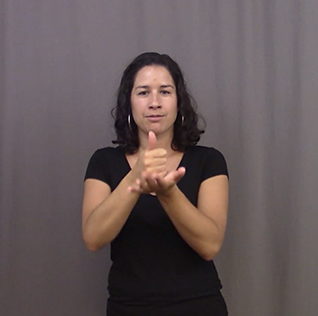

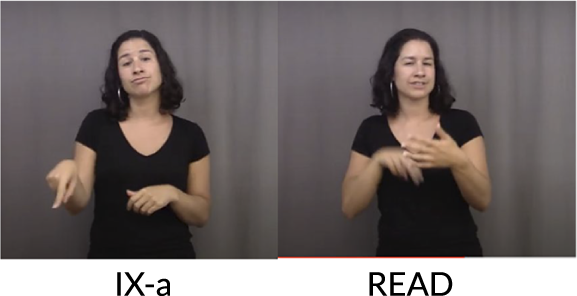



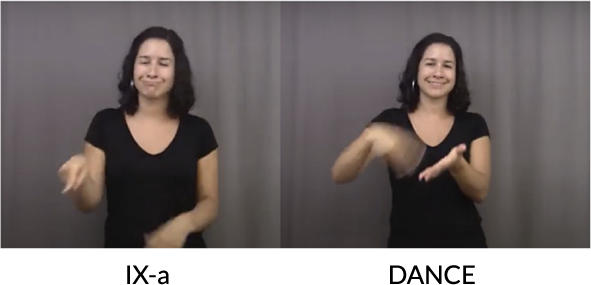
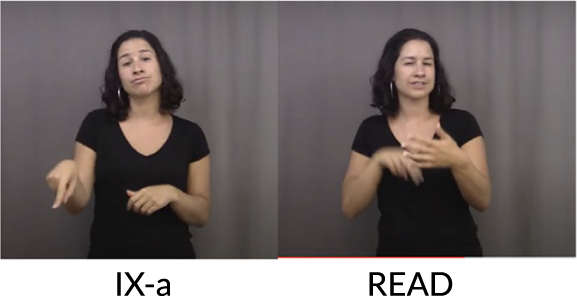
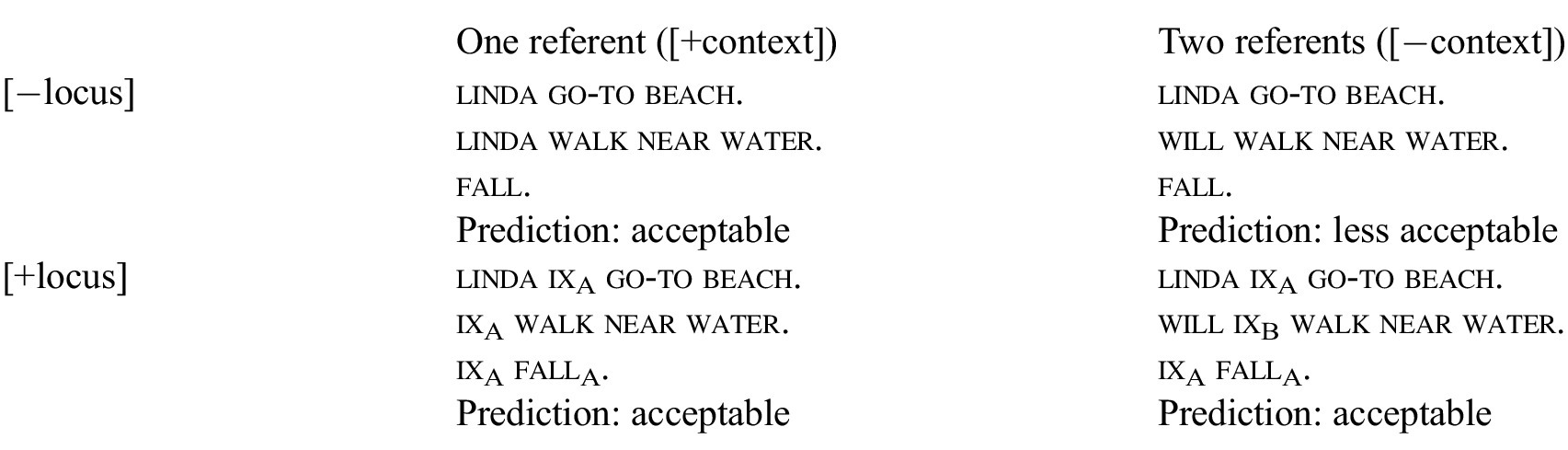
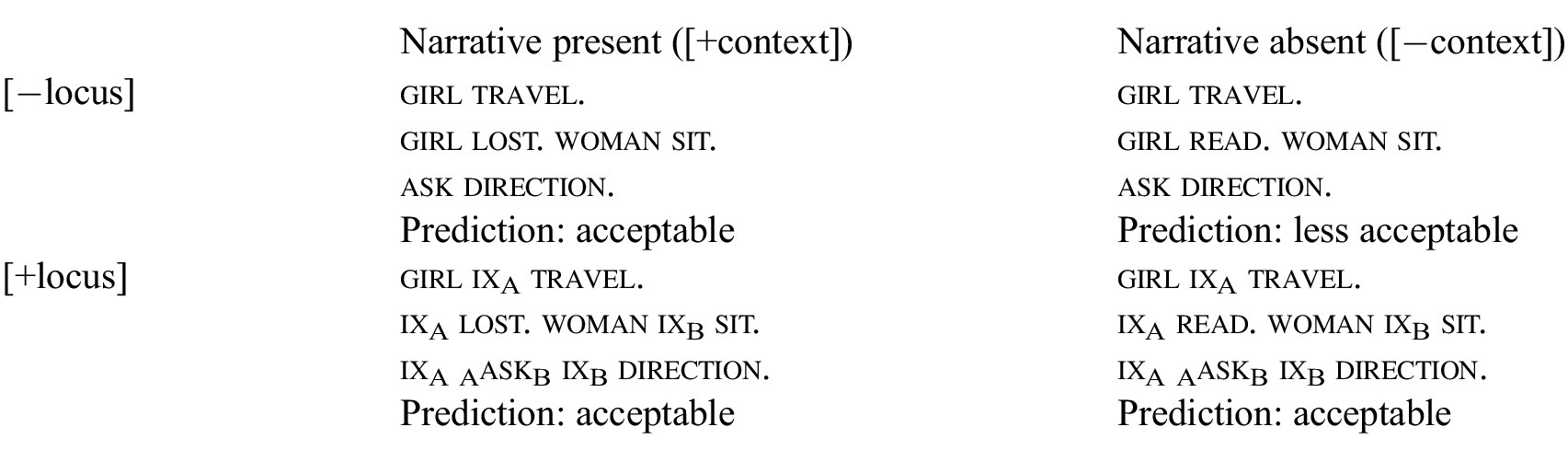
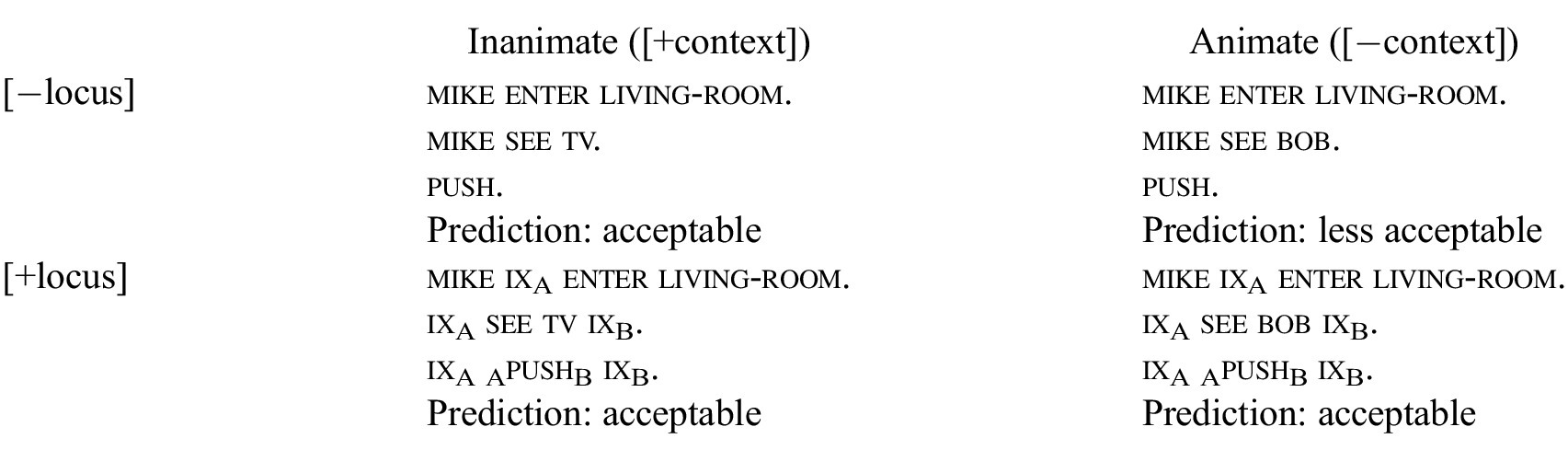
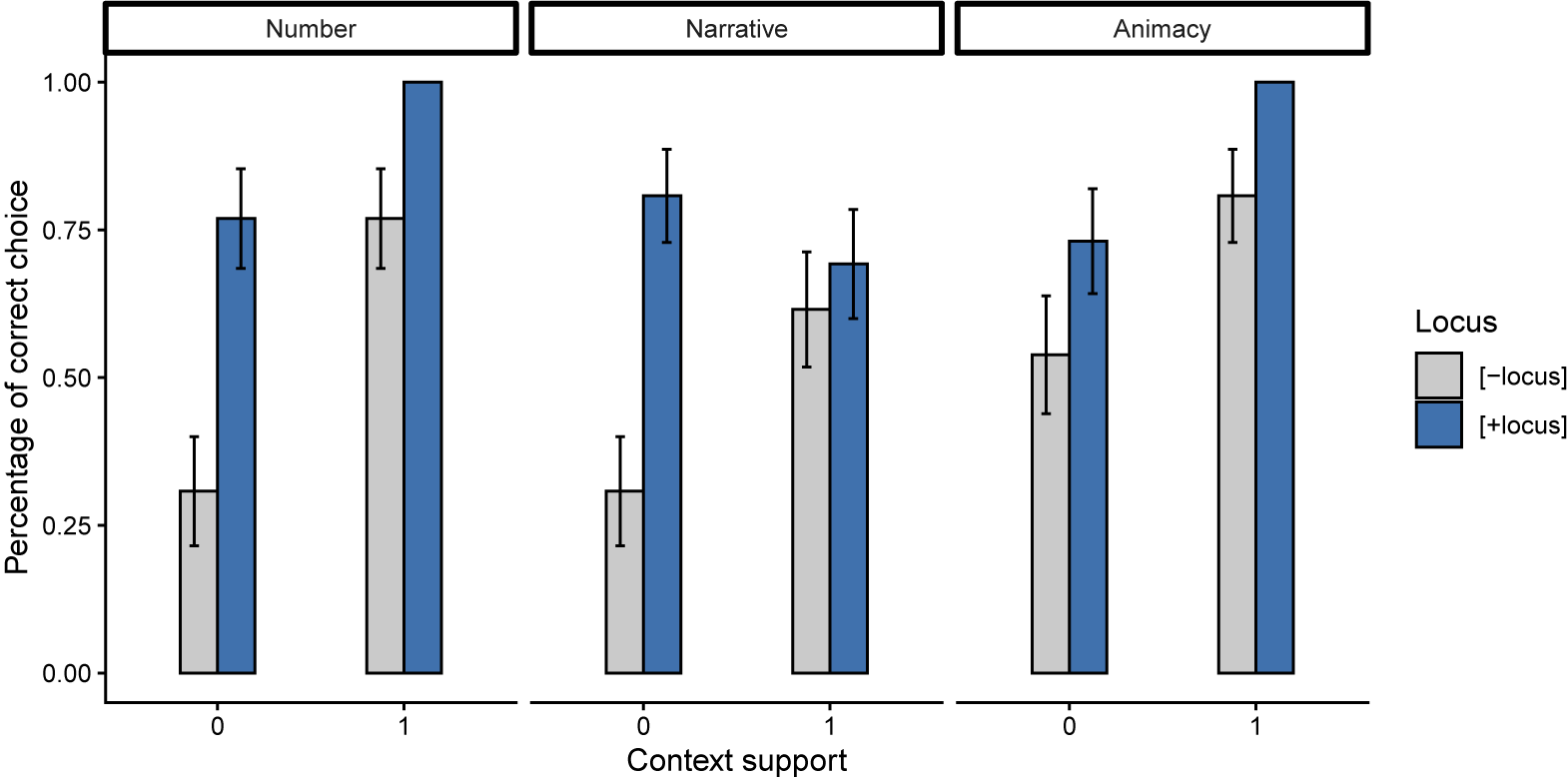
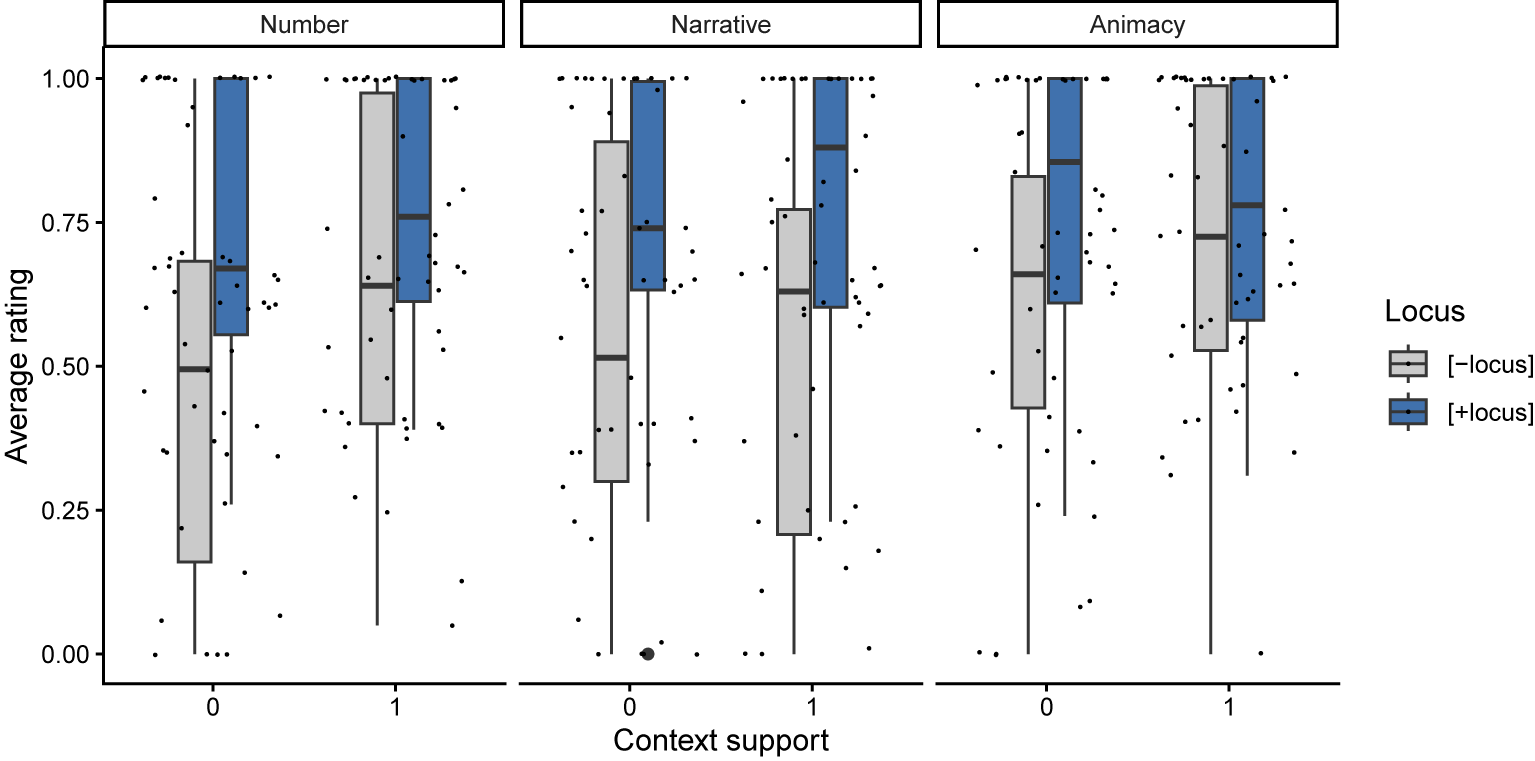


 Open access

