

Introduction
Each year, millions of patients are seen in emergency departments (EDs) globally with bacterial infections.Reference Goto, Yoshida, Tsugawa, Camargo and Hasegawa1,Reference Ikuta, Swetschinski and Aguilar2 Therefore, to prevent serious consequences such as sepsis, appropriate antimicrobials must be administered in a timely manner.Reference Sherwin, Winters, Vilke and Wardi3 Inappropriate use and over-prescribing of antimicrobials causes patient harm and may lead to increased antimicrobial resistance (AMR), which has serious consequences at an individual patient and on a population level. AMR puts at risk the ability to treat infections, resulting in prolonged illness, morbidity, and death, causing significant burden on the healthcare system.Reference Tornimbene, Eremin, Escher, Griskeviciene, Manglani and Pessoa-Silva4,5 Without initiating effective antimicrobial stewardship (AMS) strategies, it is estimated that by 2050, AMR could cause up to ten million deaths per year worldwide.6
EDs perform a vital role in the initiation of appropriate antimicrobials, as patients who initially receive antimicrobials in the ED are usually discharged back to the community or are admitted to an inpatient bed, commonly without alteration to their initially prescribed therapy.Reference O’Brien, Rawlins and Ingram7 However, there are significant barriers to appropriate antimicrobial prescribing in EDs, including time constraints, diagnostic uncertainty, and perceived patient preferences.Reference May, Gudger, Armstrong, Brooks, Hinds and Bhat8 Despite the challenge of the fast-paced environment of the ED, there is limited data on the antimicrobial prescribing quality in EDs at a national, or even multi-site level, which is required to identify areas for coordinated quality improvement initiatives.
The objective of this study was to evaluate the quality of antimicrobial prescribing within EDs across Australia by examining existing Hospital National Antimicrobial Prescribing Survey (Hospital NAPS) data that includes assessments of antimicrobial guideline compliance and appropriateness in relation to antimicrobials prescribed for specific indications. The aim is to identify areas of prescribing that require quality improvement to inform potential AMS strategies in the ED.
Methods
This study is a retrospective data analysis utilizing the Hospital NAPS database between 2013 and 2022. The Hospital NAPS is a standardized auditing tool utilized by hospitals to evaluate the quality of antimicrobial prescribing. The Hospital NAPS is voluntary and is conducted by public and private hospitals across Australia. Hospitals that participated in the Hospital NAPS were classified as major city, inner regional, outer regional, remote, or very remote, based on Australian Institute of Health and Welfare (AIHW) classifications.9 Hospitals classified as remote or very remote were grouped together as remote for this study.
Data collection and entry was performed by trained auditors from participating hospitals using a hospital-wide point prevalence or repeat point-prevalence survey methodology. Inclusion criteria were inpatients who had been prescribed antimicrobials at 8:00 a.m. on the day of the audit, including demographics, the prescribed antimicrobial, and the indication for prescription (Appendix A in supplementary material). Data was recorded for patients who were admitted to hospital and excludes patients who were prescribed antimicrobials on discharge from the ED.
The primary outcomes were guideline compliance, as assessed against either the nationally endorsed Therapeutic Guidelines10 (referred to as the national guidelines) or local endorsed guidelines, and appropriateness of the antimicrobial prescription, determined according to a structured assessment matrix (Appendix B in supplementary material). More comprehensive methods regarding data collection and antimicrobial appropriateness assessment can be found in the annual Hospital NAPS public reports.11
The twelve most commonly prescribed antimicrobials and the twelve most common indications from 2013 to 2022 were included for analysis. As referenced in the appropriateness assessment matrix, prescriptions assessed as optimal or adequate were classified as appropriate, and prescriptions assessed as suboptimal or inadequate were classified as inappropriate (Appendix B in supplementary material). Antimicrobials were categorized according to the Priority Antibacterial List (PAL) using the Access, Review, Curb, and Contain (ARCC) classification system12 (Appendix C in supplementary material). The reasons for inappropriateness of antimicrobial prescriptions were also identified. The data were presented descriptively and expressed as percentages. Data analysis for guideline compliance excluded prescriptions that were classified as directed therapy, where no guidelines were available, or were not assessable.
Results
From 2013 to 2022, there were 287,935 antimicrobial prescriptions included in the Hospital NAPS data set from 652 contributing hospitals throughout Australia. Of these, 3,098 antimicrobials (1.1%) were prescribed in EDs for 2,093 unique patients from 122 hospitals (each hospital may have contributed to the data set more than once over the period). The study population had a nearly equal distribution of sex; 50.0% male (n = 1,547), 49.5% female (n = 1,534), and 0.5% identifying as other (n = 17), with a median age of 63 years (range: 0–100 years).
Over half of prescriptions were from hospitals in major cities (54.8%, n = 1,699), a third were from inner regional EDs (33.2%, n = 1027), and only 58 prescriptions were from remote EDs (1.9%). When assessing guideline compliance in relation to remoteness classification, 2,813 prescriptions were included for analysis. Inner regional EDs had the highest rate of antimicrobial prescriptions that were compliant with local guidelines or the national guidelines10 (67.9%, n = 637) and major cities had the lowest rate of guideline compliance (60.2%, n = 943). Remote EDs had the highest rate of appropriateness (75.9%, n = 44), while outer regional EDs had the lowest rate of appropriateness (63.4%, n = 199).
When assessing guideline compliance, 2,813 prescriptions were included for analysis, excluding prescriptions that were directed therapy, where guideline compliance was not assessable, or there were no guidelines available. Out of these prescriptions, 213 (7.6%) were compliant with local guidelines, and 1,573 (55.9%) were compliant with the national guidelines,10 resulting in a rate of 63.5% (n = 1,786) guideline compliance overall.
Antimicrobial prescriptions in EDs had a lower rate of guideline compliance compared to all antimicrobial prescriptions documented in the Hospital NAPS from 2013 to 2022. Overall, 232,038 prescriptions from all departments were included for analysis of guideline compliance. Out of these prescriptions, 67.4% (n = 156,308) were deemed compliant with either local guidelines or the national guidelines.10
Antimicrobial prescribing quality
Appropriateness was assessed for all 3,098 prescriptions included in the analysis. Overall, 2,181 prescriptions (70.4%) were deemed appropriate, 797 (25.7%) were deemed inappropriate, and 120 (3.9%) were not assessable. Appropriateness in the ED was lower compared to overall appropriateness from all departments (72.7%, n = 209,416)
The twelve most commonly prescribed antimicrobials in EDs are presented in Figure 1. These account for 80.1% (n = 2,481) of all antimicrobial prescriptions in the ED. The most commonly prescribed antimicrobials were ceftriaxone (16.9%, n = 523), gentamicin (8.1%, n = 251), and flucloxacillin (6.7%, n = 207). The antimicrobials that were prescribed with low rates of appropriateness were amoxicillin-clavulanic acid (53.2%, n = 99), piperacillin-tazobactam (56.8%, n = 101), and ceftriaxone (62.3%, n = 326) (Figure 1).
Appropriateness of antimicrobial prescriptions for the 12 most commonly prescribed antimicrobials in emergency departments from 2013 to 2022.
*Antimicrobials were classified based on the Priority Antibacterial List Access, Review, Curb, and Contain classification system.12

Half of the most commonly prescribed antimicrobials were classified as “Access” antimicrobials (50%),12 which were generally prescribed appropriately (72.6% to 86.9%) compared to those classified as “Review: Curb” antimicrobials12 (53.2% to 73.0%) (Figure 1).
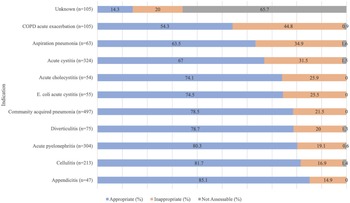
The eleven most common indications for antimicrobials in EDs are shown in Figure 2, accounting for 62.5% (n = 1,938) of all antimicrobial prescriptions in the ED. The most common indications were empiric prescribing for community-acquired pneumonia (CAP), (16.0%, n = 497), acute cystitis (10.5%, n = 324), and acute pyelonephritis (9.8%, n = 304).
Appropriateness of antimicrobial prescriptions for the eleven most common indications in emergency departments from 2013 to 2022.

The indications that had the lowest rate of appropriate antimicrobial prescriptions were acute exacerbations of chronic obstructive pulmonary disease (COPD) (54.3%, n = 57), aspiration pneumonia (63.5%, n = 40), and acute cystitis (67.0%, n = 217) (Figure 2). Ceftriaxone was the most frequent antimicrobial agent used inappropriately for COPD acute exacerbation (34.0%, n = 16), aspiration pneumonia (40.9%, n = 9), and empirically for acute cystitis (19.6%, n = 20).
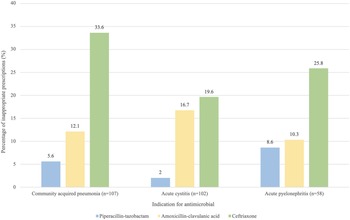
Figure 3 presents the antimicrobials prescribed with the highest rates of inappropriateness for the most common indications in EDs. CAP was the most common indication, with 107 prescriptions deemed inappropriate, of which ceftriaxone accounted for 33.6% of all inappropriate prescriptions (Figure 3). Ceftriaxone was also the most commonly prescribed antimicrobial deemed inappropriate for acute cystitis, and acute pyelonephritis (Figure 3). There was a broad variation in antimicrobials deemed inappropriate that were used for CAP (n = 10 different antimicrobials), acute cystitis (n = 8), and acute pyelonephritis (n = 9). These accounted for 36.3% (n = 1,125) of all antimicrobial prescriptions in ED, and of which one-fifth (23.7%, n = 267) were deemed inappropriate.
Proportion of inappropriate antimicrobials prescribed for the top three indications in emergency departments from 2013 to 2022 (n = 267).

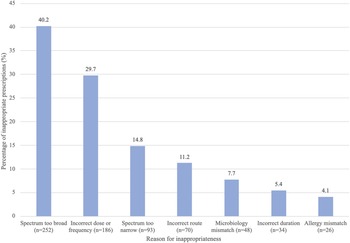
Each antimicrobial prescription deemed inappropriate could have more than one documented reason for inappropriateness. Of the 797 inappropriate prescriptions, 170 (21.3%) were prescriptions where the antimicrobial was not indicated. Of the remaining 627 inappropriate prescriptions which were indicated, there were 709 documented reasons for inappropriateness. The most common reasons for inappropriateness were where the antimicrobials spectrum was deemed too broad (40.2%, n = 252), incorrect dose or frequency (29.7%, n = 186), and where the spectrum was deemed too narrow (14.8%, n = 93) (Figure 4).
Reasons for inappropriateness for inappropriate antimicrobial prescriptions in emergency departments from 2013 to 2022 (n = 709).

The three most common documented reasons for inappropriateness for antimicrobial prescriptions deemed inappropriate are depicted in Table 1. The most common reason for inappropriateness for all three antimicrobials was spectrum too broad (59.8% for piperacillin-tazobactam, 54.4% for amoxicillin-clavulanic acid, and 41.3% for ceftriaxone) (Table 1). The most common documented reasons for inappropriateness per the common indications are similarly summarized in Appendix D in supplementary material.
Reasons for inappropriateness of antimicrobial prescriptions* deemed inappropriate in emergency departments from 2013 to 2022

*n = represents the number of inappropriate prescriptions where the antimicrobial was indicated. Inappropriate prescriptions may have more than one reason for inappropriateness.
The indication with the lowest rate of appropriateness was acute exacerbation of COPD, (Figure 2). Of the 57 inappropriate prescriptions for COPD acute exacerbation, 8 (14.0%) prescriptions were deemed inappropriate as the antimicrobial was not indicated. For the 49 other inappropriate prescriptions, there were 63 documented reasons for inappropriateness with the most common reason for inappropriateness being the spectrum was deemed too broad (41.3%, n = 26).
Discussion
This study is the first to evaluate antimicrobial prescribing quality in EDs on a national scale, where key areas that require quality improvement were determined. One area is the excessive and inappropriate use of ceftriaxone and other broad-spectrum antimicrobials, which is similar to findings from another study that evaluated antimicrobial prescribing quality in an ED in Queensland, Australia.Reference Denny, Gartside, Alcorn, Cross, Maloney and Keijzers13 A major finding of our study is that antimicrobials that have a high potential for resistance12 are commonly prescribed inappropriately, suggesting these antimicrobials a significant area to target for AMS strategies.
Ceftriaxone was the most commonly prescribed antimicrobial (16.9%, n = 523) and demonstrated one of the lowest rates of appropriateness (62.3%) in EDs. This is consistent with findings from various studies worldwide that evaluated ceftriaxone prescribing practices in EDs, which have determined appropriateness rates ranging from 47% to 62.4%.Reference Durham, Wingler and Eiland14–Reference Koh, Ambaras Khan, Tay, Gill, Wong and Zainuddin17 The Australian national guidelines10 indicate that ceftriaxone is not a first-line recommendation for any of the three most common indications in EDs. Specifically, ceftriaxone is not recommended for low- and moderate-severity CAP, as most cases of CAP in Australia are penicillin-susceptible.10 Additionally, the recommended empirical antimicrobials for low- and moderate-severity CAP and acute cystitis10 are part of the “Access” group antimicrobials, while ceftriaxone is listed in the “Review: Curb” group, meaning that the recommended antimicrobials have a lower potential for AMR than ceftriaxone.12
We postulate that ceftriaxone was commonly prescribed inappropriately for CAP and acute pyelonephritis because it was prescribed to patients with lower-severity disease. It would have been beneficial to analyze the differences in ceftriaxone prescribing based on severity of disease, however the data collected did not differentiate between severity. Despite the limitations of the data set in this study, it has previously been reported that prescribers in EDs over-estimate the severity of CAP, leading to inappropriate broad-spectrum antimicrobial therapy, such as ceftriaxone.Reference Yu, Wang, Davidson, Chow and Chiu16,Reference Almatar, Peterson, Thompson and Zaidi18 Yu et alReference Yu, Wang, Davidson, Chow and Chiu16 evaluated antibiotic usage for CAP over the course of twelve-months in a community hospital ED in Canada and concluded that ceftriaxone was the most commonly prescribed antimicrobial for low- and moderate-severity CAP. Ceftriaxone was also commonly prescribed inappropriately for COPD, which was the indication with the lowest rate of appropriateness (54.3% appropriate). According to the national guidelines,10 exacerbations of COPD only require antimicrobials when the exacerbation is severe enough to require admission to the intensive care unit, and ceftriaxone is not one of the recommended antimicrobial agents for any patient scenario. This suggests that management of COPD exacerbations is another area where AMS strategies should be implemented.
Inappropriate and excessive ceftriaxone use has significant long-term consequences for patients and potentially increases the development of AMR.12,Reference McKinnell, Kunz and Chamot19,Reference Meletiadis, Turlej-Rogacka, Lerner, Adler, Tacconelli and Mouton20 Firstly, bloodstream infections caused by vancomycin-resistance enterococci (VRE) is a life-threatening nosocomial infection that has been linked to the use of ceftriaxone.Reference McKinnell, Kunz and Chamot19 Additionally, Meletiadis et alReference Meletiadis, Turlej-Rogacka, Lerner, Adler, Tacconelli and Mouton20 determined that patients treated with ceftriaxone had significant amplification of AMR genes in their gastrointestinal (GI) tract flora. The potential consequences of inappropriate and excessive use of ceftriaxone are severe and AMS interventions should prioritize reducing the use of ceftriaxone in EDs.
Of the most commonly prescribed antimicrobials, those with high potential for resistance (“Review: Curb” category) were generally prescribed less appropriately (53.2% to 73.0%) than those that have low potential for resistance (“Access” category) (72.6% to 86.9%).12 “Review: Curb” category antimicrobials are indicated as first-line treatments for many indications in the Australian national guidelines,10 however, the PAL identifies these antimicrobials as high-risk for AMR and suggests that the use of these agents must be closely monitored and should only be used when specifically indicated.12 Our data indicates that these high-risk antimicrobials are frequently used when they are not indicated, which emphasizes the importance of educating ED prescribers about which antimicrobials should be used with extra caution.
There are current clinical care standards and protocols that exist to aid in appropriate antimicrobial prescribing in Australia. The clinical care standards for AMS provide clinicians with quality statements that describe the care they should provide to patients with infections.21 Statements that are especially relevant for ED clinicians include the prompt treatment of patients with life-threatening conditions such as sepsis, the correct use of the national guidelines,10 and microbiological testing and review of therapy once investigation results are received.21 Importantly, the standards advise that broad-spectrum antimicrobials must be de-escalated to a more narrow-spectrum agent to reduce the potential of developing AMR.Reference Losier, Ramsey, Wilby and Black23 This point is of particular concern, as many patients are discharged from ED or admitted to hospital from ED without a review or change to the antimicrobial that was initially prescribed.6 It would have been beneficial to analyze how often the prescribed broad-spectrum antimicrobials were changed to a more narrow-spectrum agent once culture results were reviewed. However, our data shows that there was consistently over-use of antimicrobials with too broad of a spectrum in the ED. This should be an area for future research, as the unnecessary use of broad-spectrum antimicrobials contributes significantly to AMR and causes adverse drug reactions, threatening patient safety.12,Reference McKinnell, Kunz and Chamot19,Reference Meletiadis, Turlej-Rogacka, Lerner, Adler, Tacconelli and Mouton20
Despite the existence of these care standards and protocols, our data shows that appropriateness of antimicrobial prescribing in EDs remains poor, especially involving the excessive and inappropriate use of antimicrobials with high potential for resistance.12 AMS programs have a vital role in improving the use of these antimicrobials, however the fast-paced setting of the ED makes the implementation of AMS programs more challenging.Reference May, Cosgrove and L’Archeveque22 To our knowledge, there have only been two systematic reviews that have evaluated AMS strategies in EDs, which have found that there are a lack of high-quality studies on AMS interventions in EDs.Reference Losier, Ramsey, Wilby and Black23,Reference May, Martín Quirós, Ten Oever, Hoogerwerf, Schoffelen and Schouten24 Losier et alReference Losier, Ramsey, Wilby and Black23 determined that AMS interventions may improve patient outcomes, including prospective audit and feedback, clinical guidelines, and the use of multidisciplinary teams, including pharmacists; however the optimal combination of interventions was unclear. Additionally, May et alReference May, Martín Quirós, Ten Oever, Hoogerwerf, Schoffelen and Schouten24 concluded that some strategies that may improve prescribing quality include multifaceted interventions, clinical guidelines, and behavioral approaches to target prescriber behavior. With the continual over-prescribing of broad-spectrum antimicrobials with high potentials for AMR in EDs, more high-quality studies that evaluate AMS interventions are required.
There are a few limitations of this study that should be considered when interpreting this data. Firstly, sampling and selection bias are limitations of the data collection as participation in the survey is voluntary, and findings may not be representative of all Australian EDs., Almost two thirds of all Australian hospitals contribute data to the program, with 122 including data from their EDs and provides a reasonable sample size. The point prevalence methodology allows for only inpatient prescriptions to be audited. This is a limitation when analyzing overall prescription quality in the ED as many antimicrobials are prescribed upon discharge and thus excluded from the NAPS program. Further research that comprehensively assesses all antimicrobial prescriptions within the ED is warranted to develop a greater understanding of the challenges and opportunities for AMS in the ED. Another important limitation is that assessments of appropriateness and guideline compliance have some level of subjectivity. To mitigate this, auditors receive training and are guided by a structured assessment matrix.11
In conclusion, this study demonstrates that antimicrobial prescribing quality in EDs is suboptimal. Analysis of the Hospital NAPS data set was useful in identifying areas to target AMS interventions to improve prescribing quality. We identified that ceftriaxone and other broad-spectrum antimicrobials were excessively and inappropriately prescribed, even though clinical care standards for AMS advise the use of the most effective narrow-spectrum antimicrobial.21 Additionally, it was determined that antimicrobials with a high potential for AMR were prescribed less appropriately than antimicrobials with a low potential. These are areas that should be targeted for AMS interventions. We recommend that further studies should evaluate how often antimicrobials are changed after review of microbiology testing. Future research is needed to determine which AMS interventions are optimal to improve prescribing practices in EDs to decrease AMR and improve patient safety.
Supplementary material
To view supplementary material for this article, please visit https://doi.org/10.1017/ash.2024.483
Data availability statement
Due to the nature of the research and due to ethical requirements, supporting data is not available.
Acknowledgments
We thank all auditors and contributors to the Hospital NAPS for their commitment to collecting quality data related to antimicrobial use. The NAPS program is coordinated by the Royal Melbourne Hospital Guidance Group and the National Centre for Antimicrobial Stewardship (NCAS).
Author contributions
-
• Lenna Zosky-Shiller: conceptualization, formal analysis, investigation, methodology, project administration, validation, visualization, writing—original draft, writing—review and editing.
-
• Karin Thursky: conceptualization, funding acquisition, resources, software, supervision, writing—review and editing.
-
• Sarah Park: conceptualization, writing—review and editing.
-
• Rodney James: conceptualization, investigation, methodology, resources, software, supervision, writing—review and editing.
-
• Lisa Hall: conceptualization, formal analysis, methodology, software, visualization, writing—review and editing.
-
• Caroline Chen: conceptualization, data curation, writing—review and editing.
-
• Courtney Ierano: conceptualization, data curation, formal analysis, investigation, methodology, supervision, validation, visualization, writing—review and editing.
Financial support
This research did not receive any specific grant from funding agencies in the public, commercial, or not-for-profit sectors.
Competing interests
This research did not receive any specific grant from funding agencies in the public, commercial, or not-for-profit sectors.



 Open access

