





The time has come to begin detailed discussions on how to address the impact and challenges that foreigners will have on society in the medium to long term…. The most critical issue is adjusting the speed and pace at which we accept foreign nationals. We must firmly apply the brakes before social friction exceeds acceptable levels…. Public anxiety over the increase in foreign residents is growing.
I was raised in the land of Yamato and will lay down my life to protect our ancient traditions. With the increase in foreigners, we are seeing situations that get on people’s nerves in terms of fairness and unfairness, justice and injustice.
Prime Minister Sanae Takaichi during the LDP Presidential Debate, 2025/09/22 (Japan News 2025d)
Introduction
In August 2025, Japanese Communist Party posters could be seen across Japan (Figure 1) with the slogan, “We will not allow discrimination against foreigners” (gaikokujin sabetsu wa yurushimasen). The text noted that “we must not tolerate anti-foreignism/xenophobia (haigaishugi), which views foreigners as enemies,” warning that history has shown that such attitudes “eventually turn against the country’s own citizens and lead to national ruin.” What prompted such strong language? Although no particular group is mentioned, the writing at the bottom—“there is no first or second among humans”—makes it very clear who the finger is being pointed at: the new political party known as Sanseito (literally, “Political Participation Party”).
Japanese Communist Party poster (August 2025).
Source: Photograph taken by author.

Figure 1: Long description
The poster displays a woman in a white jacket speaking into a microphone, with her right hand raised. The background features large Japanese text in blue and black, including phrases like ‘外国人差別は許しません’ and ‘日本共産党’. The text appears to address issues related to foreign discrimination and political stance.
Sanseito was founded in April 2020 by the current leader Sohei Kamiya and four others (Yomiuri Shimbun 2025d). Rooted in a YouTube channel featuring anti-vaccination and anti-globalist conspiracy theories, it won its first upper house seat in 2022 but really broke through in July 2025 when it secured 14 seats in the House of Councilors election with a “Japanese First” slogan centering on criticism of foreigners being given special treatment (Asahi Shimbun 2025d; CNN 2025). In interviews with 100 voters who stated they would vote for Sanseito during the election, the Tokyo Shimbun (2025) found that the “Japanese First” and foreigner policy—including issues related to “too many foreigners” and “foreigners receiving preferential treatment”—were the deciding factors behind their support. Indeed, the seven constituency seats that Sanseito won (Tokyo, Aichi, Fukuoka, Osaka, Saitama, Kanagawa, and Ibaraki) corresponded almost exactly to the prefectures with the highest number of foreigners (Japan Times 2025).
The election marked the first time that a clearly far-right party had secured more than 10% of the national vote (Higuchi and Koo Reference Higuchi and Koo2025). The fact that a leader modeling himself on Donald TrumpFootnote 1 and unashamedly aligning himself with far-right nationalist parties such as the German AfD and Britain’s Reform UK Party gained such popular support shook the establishment to the core, as evidenced by Prime Minister Ishiba’s sudden establishment—in the middle of the election—of a “command centre” or task force (shireitō, literally “control tower”) to address “concerns over foreigners” (Asahi Shimbun 2025f). This paper will explore why anti-foreigner populism—something previously considered taboo and relegated to fringe groups, as exemplified by the case of Zaitokukai—has suddenly exploded into the mainstream. After some background data (“Background: The growing number of foreign residents and tourists”), the paper starts with an analysis of the rise and fall of Zaitokukai (“2007–2017: The rise and fall of Zaitokukai, a new kind of right-wing group”). Thereafter, the paper examines how the pandemic triggered an increase in negative sentiment toward foreigners (“2020–2023: The COVID-19 pandemic and changing attitudes toward accepting foreign workers”) before detailing how the “birth” of populism in 2024 saw elites lose control of the migration narrative (“2024: The arrival of populism and the first year of SNS elections”). Finally, the Conclusion (“Why July 2025? The rising visibility of foreigners and perceived cultural threat”) explains how the rapid increase in the visibility of foreigners has created a perceived threat to identity and feelings of xenophobia.
Background: The growing number of foreign residents and tourists
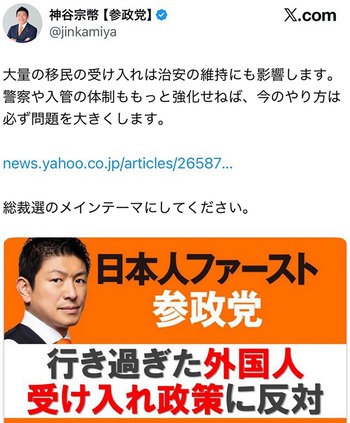
As Figure 2 illustrates, one of the key Sanseito policies, under the pillar “Protect Japan,” is opposition to the “excessive” acceptance of foreigners (ikisugita gaikokujin ukeire ni hantai) (Sanseito 2025a). “Japanese people feel unease and dissatisfaction,” said Kamiya in a June 22 news conference, “because there are no established rules for accepting foreigners” (Asahi Shimbun 2025c). Part of this “unease” may stem from a rapidly declining total population. Data for January 2025 revealed the largest decrease on record for Japanese living in Japan; at the same time, the number of foreign residents rose by 10.65% compared to the previous year, the highest since the Internal Affairs Ministry began keeping statistics (Japan News 2025b). The latest foreign resident figures as of the end of 2025 report a record high of 4.13 million, up 360,000 from the previous year and constituting roughly 3.35% of the total population (Japan Times 2026). This is not surprising given the government’s policies to accept more foreign workers to offset growing labor shortages, exemplified by the December 2018 revisions to Japan’s “Immigration” Control Act, which, for the first time in the postwar period, saw Japan officially accept blue-collar workers (Burgess Reference Burgess2020).
Post on X by Sohei Kamiya (@jinkamiya), September 20, 2025.
Source: (Kamiya Reference Kamiya2025).

Figure 2: Long description
A man in a suit appears on the left side of the image. The background is white. The text in Japanese reads: ‘大量の移民の受け入れは治安の維持にも影響します。警察や入管の体制ももっと強化せねば、今のやり方は必ず問題を大きくします。news.yahoo.co.jp/articles/26587... 総裁選のメインテーマにしてください。日本人ファースト参政党 行き過ぎた外国人 受け入れ政策に反対’.
The increase in foreign workers since the revision came into effect in April 2019 has been central to pushing the foreign population over 3%, a figure which recent discourse suggests has some psychological significance for the Japanese. This may seem like a significant percentage, but in comparison to other developed countries, especially G7 countries, the ratio of international migrants as a share of the total population in Japan remains extremely low (OECD 2024: 52). However, research on public opinion in Japan has shown that threat perception is not so much determined by the ratio of foreign residents as “the rate of immigrant increase relative to the existing immigrant population size” (Green Reference Green2017: 369). According to projections by the National Institute of Population and Social Security Research, the share of foreigners in the total population in Japan is expected to rise to 10.8% by 2070 (Saito Reference Saito2023). The 10% figure has become a key rallying point underlining fears that foreigners are increasing too quickly and rapid change poses a threat to Japanese identity.Footnote 2 Justice Minister Keisuke Suzuki, speaking soon after the election, claimed that if current trends continue, foreign residents could account for some 10% of the population much earlier, by 2040, describing it as a “national security” issue that could make citizens feel “anxiety or unfairness” (Sankei Shimbun 2025). Similarly, Kamiya (Guardian 2025) has said that, “if (migration) exceeds 10% of the total population, it will become a major problem.” “Looking at the situation in other countries,” he warns, “if we continue at the current rate, we’ll exceed 10% in about 10 years. That would be too sudden. I would be troubled if Japan became like America … if things continued like that, Japan would lose its originality and charm” (Guardian 2025).
One feature of the current debate is the failure to distinguish foreign residents from foreign tourists: all are lumped together as “foreigners.” As with foreign workers, the government has also been actively pursuing policies, such as relaxation of visa requirements, in order to increase the number of foreign tourists, with the most recent goal being to receive 40 million by 2020 and 60 million by 2030 (MOFA 2020: Chapter 4, Section 1). The first goal was achieved in 2025, when visitors reached 40 million, up 16% from the previous year, and breaking the previous record for the second consecutive year (Japan News 2026a). The downside is over-tourism, especially in places like Kyoto and central Tokyo, accompanied by stories about tourists behaving badly and being responsible for pushing up prices (Japan News 2023; Princeton Political Review 2025). In sum, it is ironic that record rises in foreign workers and tourists, driven by government policies focused on economic growth, may have proved fertile ground for Sanseito’s criticisms of “excessive acceptance of foreigners.” To understand why this resonated with many voters after years of disinterest, we will first look at the factors that kept popular discontent in check in the years preceding 2025.
2007–2017: The rise and fall of Zaitokukai, a new kind of right-wing group
Zaitokukai, a right-wing organization with online roots, was founded in 2007 by Makoto Sakurai (Reference Sakurai2014: 1). As the name of the group makes clear, its primary focus was protesting against “special privileges” (tokken) for resident Koreans, particularly those with Special Permanent Residence (Figure 3). Opposition to “special privileges” echoes the Sanseito claim that foreigners are being given favorable or preferential treatment (gaikokujin wa yūgū sareteiru) (Nihon Keizai Shimbun 2025). Another interesting parallel is that the trigger for the founding of Zaitokukai was anger over the issue of resident Koreans receiving national pensions without making premium payments (Sakurai Reference Sakurai2014: 159–60). This also corresponds with Sanseito’s complaints centering on supposed non-payment of social insurance premiums and medical bills by foreign nationals. Furthermore, Zaitokukai, like Sanseito, were social media savvy, uploading videos of their activities to platforms like YouTube (Yasuda Reference Yasuda2012: 14). Moreover, just as Zaitokukai was an association of citizens (shimin no kai) established at the grassroots level by people who felt that nobody in existing party politics shared their concerns, Sanseito (2025c) describes itself in similar terms as “established from scratch by voluntary members under a strong sense of crisis … ordinary citizens with the same mindset.” Finally, after Zaitokukai’s leader Sakurai stepped down in 2015, he established the Japan First Party (Nihon Dai’ittō) in 2016, predating Sanseito’s “Japanese First” slogan—though Sanseito uses the English for “first” rendered in katakana (Figure 4) while Sakurai favors Chinese characters (Yoon and Asahina Reference Yoon and Asahina2021: 25).
Summary of Zaitokukai official policies (2013).
Source: (Zaitokukai 2013) (no longer available).

Figure 3: Long description
The flyer features a title in bold, black text with a stylized design, followed by a URL. The main text is divided into sections with headings in bold. The first section discusses special permanent residency permits, highlighting that these permits are granted to specific foreign nationals and not to others, including Koreans and Chinese. The second section addresses financial support for schools in North Korea, mentioning that the Japanese government provides financial aid to North Korean schools and that some of this aid is misused. The third section talks about the life protection system, noting that it is intended to protect the lives of Japanese nationals but is also used by foreign residents, with a statistic that 70% of foreign life protection recipients are Zainichi Koreans. The fourth section discusses the real-name system, which requires all foreign residents to use their real names, and mentions that this system is used more frequently against Zainichi Koreans and Chinese. The flyer concludes with a statement about the need to continue advocating for these policies to protect Japan from specific foreign influences.

Figure 4: Long description
A man in a suit stands with a serious expression. Large Japanese text dominates the background, reading ‘日本ファースト’ (Japan First) and ‘参政党’ (Sanseito Party). The text outlines policies to protect and enrich Japanese people, including economic measures, food safety, and education. QR codes and additional text are visible on the right side.
Zaitokukai organized rallies throughout Japan, including Tsuruhashi, Osaka, and weekly protests in front of Shin-Okubo Station, Tokyo’s Korea town, from around 2009 (Yoon and Asahina Reference Yoon and Asahina2021: 22–4). The Ministry of Justice’s first-ever survey on hate speech found that 1,152 hate speech rallies were held between April 2012 and September 2015 (Daily Yomiuri 2016). Yasuda (Reference Yasuda2012: 20) notes that by 2012, Zaitokukai had become the largest of the many conservative and right-wing organizations, with a substantial (if mostly online) membership. Zaitokukai can be said to be the first (public) appearance of a hate group in postwar Japan; up to then, conventional radical right-wing activist groups had, for the most part, not adopted xenophobic and racist agendas (Shibuichi Reference Shibuichi2015: 715, 723). Yoon and Asahina (Reference Yoon and Asahina2021: 1–2) describe Zaitokukai as a new far-right group, distinct from the traditional right, which was able to popularize formerly stigmatized right-wing ideas and ultimately change the normative landscape of Japanese politics. In this way, Zaitokukai prepared the path for Sanseito. As we have seen, they shared similar beliefs: a conviction that foreigners were being given special treatment while ordinary Japanese struggled, resentment of the political elite, distrust toward the mass media, and anxiety over the future of Japan. But Zaitokukai were also an undisciplined, inexperienced citizens’ group rather than a well-organized political party, and their coarse racist rhetoric, harassment, including targeting of children, and sporadic violence brought them to the attention of fellow citizens, the police, and political leaders.
Prime Minister Abe, a right-wing nationalist, staunch conservative, and member of the Nippon Kaigi who campaigned under the slogan Nippon o Torimodosu (“Reclaim Japan”), was one of the leaders who spoke out against Zaitokukai. On May 6, 2013, Abe had said, during budget committee questions, that, “It is deeply regrettable that there are statements and actions that exclude certain countries or ethnic groups” (ichibu no kuni, minzoku o haijo suru gendō ga aru no wa kiwamete zannen na koto da) (HuRights Osaka 2013). A few days later, Justice Minister Tanigaki had called the events in Shin-Okubo and Tsuruhashi “completely contrary” to Japan’s goal of being a dignified and mature nation (HuRights Osaka 2013). For Rehm (Reference Rehm2026), the way the political elite managed and controlled the public narrative on foreigners was a key reason why migration was never a major topic driving public opinion—until this control slipped in the run-up to the 2025 Upper House election.
In sum, national leaders unwilling or unable to ignore the toxic rhetoric, together with outraged citizens organizing large counter protests, formed a bulwark or firewall against xenophobia and anti-foreigner sentiment. Thereafter, the passing of the first hate speech law in 2016, subsequent local ordinances against hate speech, and punitive lawsuits ushered in a sharp decline in Zaitokukai’s activities (Shibuichi Reference Shibuichi2016: 80–1; Yoon and Asahina Reference Yoon and Asahina2021: 24). But, as Yoon and Asahina (Reference Yoon and Asahina2021: 1) point out, by framing foreigners as “undeserving recipients” of government handouts, they had “mobilized perceptions of threat that has continued to powerfully influence public perceptions” of (in this case) Koreans even following the group’s organizational decline. “The social circumstances in Japan which spawned the resurgence of xenophobia and racism,” writes Shibuichi (Reference Shibuichi2015: 738), “are here to stay. Some people will continue to feel that the … preservation of the comforting assurance of supposed homogeneity or the maintenance of privileges for the dominant ethnic group, is being infringed.” Similarly, Yoon and Asahina (Reference Yoon and Asahina2021: 26) talk of Zaitokukai’s “ideological entrepreneurialism”, how they created an innovative new vocabulary “for articulating displaced feelings of threat and precariousness, transforming an old right-wing idea into one that resonated with ordinary Japanese who were formerly disinterested in politics.” In other words, Zaitokukai set the stage—created the template—for the anti-foreigner populism that (re)emerged in the form of (a much savvierFootnote 3 ) Sanseito; the important question is the timing—why “foreigner issues” became, for the first time, a major point of contention during the July 2025 House of Councilors election. The COVID-19 pandemic provides some important clues to answering this question.
2020–2023: The COVID-19 pandemic and changing attitudes toward accepting foreign workers
Migration researchers have long posited two models to explain attitudes toward migrants. The Intergroup Contact Theory (ICT) states that contact between migrants and host society members can lead to a reduction in prejudice and the growth of positive attitudes (Pettigrew and Tropp Reference Pettigrew and Tropp2006). At the same time, the Intergroup Threat Theory (ITT), sometimes called the Group Threat Theory, argues that perceived threats, both realistic (jobs, housing, safety) and symbolic (values, traditions, morals), can foster anti-immigrant attitudes (Esses Reference Esses2021; Nagayoshi Reference Nagayoshi2009). These are sometimes combined in the Threat Benefit Model (TBM) which shows how migrants can simultaneously be perceived as beneficial and threatening (Nshom et al. Reference Nshom, Khalimzoda, Sadaf and Shaymardanov2022). In Japan, for example, migrants are viewed simultaneously both as a threat to public safety and as a way to alleviate labor shortages (Japan News 2025f). In a study of the dynamics of immigration and anti-immigrant sentiment in Japan, Laurence et al. (Reference Laurence, Igarashi and Ishida2022: 369–70) describe these two competing processes as follows:
In higher immigrant share environments, perceived threat is higher, increasing anti-immigrant sentiment. However, concurrently, intergroup contact also increases in these environments, reducing anti-immigrant sentiment. Therefore, despite the overall negative relationship (driven primarily by perceived threat), rising contact exerts a countervailing positive effect as immigration increases
In terms of contact, quality of interaction is key: in particular, cooperating and working together in a meaningful way toward common goals, such as collaboration in the workplace and in community activities, can help mitigate cultural friction and reduce prejudice toward foreigners (Ohtake Reference Ohtake2025).
As Laurence et al. suggest, the balance between perceived threat and intergroup contact is not necessarily an equal one; while the latter can act as a brake on the former, holding anti-foreigner sentiment in check to an extent, perceived threat is generally the stronger of the two, at least while migrants remain below a certain ratio.Footnote 4 In the case of Japan, threat perception centering on identity-based concerns is strong (Davison and Peng Reference Davison and Peng2021), fueled by the ethno-nationalistic “homogenous people” discourse known as Nihonjinron, which is institutionalized in a “No-immigration” principle guiding policy at the national level; the result has been ad-hoc and underdeveloped multicultural support making it difficult for newcomers to socially integrate (Burgess Reference Burgess2020). The largest source of foreign labor, the “guest-worker” style Technical Intern Training Program (TITP), is a prime example: “The system is designed,” notes Morris (Reference Morris and Endoh2022: 117), “to prevent the trainees from building any meaningful social capital within Japan.”
Those Japanese who accept the need for foreign labor to alleviate labor shortages do not necessarily want to interact with migrants on a personal level. An NHK (2020) survey found that many of those who supported an increase in foreigners in Japan at the same time opposed an increase in foreigners in their own local area. This tallies with the World Values Survey (Vogt Reference Vogt2017: 93–5) in which 36.3% of Japanese polled said they didn’t want migrants or foreigners in their neighborhood and only 13.6% said that they trust people of other nationalities, by far the lowest figure among OECD nations. Green and Kadoya (Reference Green and Kadoya2015) found that even before the pandemic most Japanese did not have the opportunity—or perhaps the desire—for even superficial contact with foreigners. An NHK (2018) survey found that only 17% of Japanese had ever exchanged greetings with a foreigner in their neighborhood. Post-pandemic, despite a significant increase in the number and visibility of the foreign population, a similar question in an ISA (2024) survey found that only 16.3% of Japanese have or had interactions (tsukiai) with foreigners “that go as far as exchanging greetings.”
The pandemic upset what was already an uneven balance between intergroup contact vs. perceived threat in Japan, one that had managed to keep overtly xenophobic attitudes largely in check. While migrants everywhere were disproportionally affected by the pandemic in terms of mobility (movement restrictions), employment (loss of jobs), and health (high infection rates), Japan’s strict border and domestic controls were especially isolating for migrants already lacking connections, support networks, and social capital (Burgess Reference Burgess2021). Vogt and Qin (Reference Vogt and Qin2022) refer to Japan’s revived “isolationist strategy” as one of “pandemic Othering” which portrayed foreigners as a risk and used exclusion as a core element of its approach. Yamamura and Ohtake (Reference Yamamura and Ohtake2025) show that Japan’s pandemic-era restrictions resulted in significantly increased exclusionary attitudes toward foreign workers, heightening risk aversion and fostering a decline in support for immigration. Moreover, even post-pandemic they see no sign of recovery, arguing that the changes might represent a long-term shift in how the Japanese public perceives foreigners (Ohtake Reference Ohtake2025).
2024: The arrival of populism and the first year of SNS elections
Zaitokukai had shown how a new right-wing movement could use discontent over “special treatment” given to foreigners to capture the imagination of ordinary people disillusioned with the status quo. And the pandemic saw support for accepting foreign workers decline and exclusionist sentiment grow, perhaps for the long term. Nevertheless, the emergence of mainstream anti-foreigner populism during the July 2025 House of Councilors election seemed to take many by surprise. Coming into the election, Sanseito was very much a “fringe opposition party” with only one Upper House seat and just three seats in the more powerful Lower House (BBC 2025). Kamiya modeling himself on Trump didn’t seem to have much traction in a culture where the US President’s blustering, direct, and often offensive style was anathema. And migration has never been a significant political issue in a country with a strictly regulated “No-immigration” policy that still refuses to call foreign workers “migrants.”
But while it is true that anti-foreigner/migrant rhetoric was largely absent from mainstream political discourse before 2025, features of populism, such as growing dissatisfaction with traditional parties and distrust toward mainstream media, had been growing. For some time, Japan’s “big four” newspapers had been in “sharp decline” (Sawa and Saisho Reference Sawa and Saisho2025), and criticism of NHK, Japan’s flagship public media broadcaster, had been increasing, epitomized by the visibility of Takashi Tachibana’s populist right-wing YouTube-rooted anti-NHK party (Guerrera-Sapone Reference Guerrera-Sapone2021). A turning point came in 2024—dubbed by some as “the first year of SNS elections” (CFIEC 2025)—when the surprising success of two populist politicians prompted some to ask whether the “Age of Populism” had finally reached Japan (Japan Times 2024a). The first of these was the relatively unknown young newcomer Shinji Ishimaru, who came second in the July 2024 Tokyo gubernatorial election using an internet strategy to “appeal to voters fed up with politics,” pushing the well-known politician Renho into third place (Asahi Shimbun 2024b). The second was the successful re-election in November 2024 of Motohiko Saito, the young governor of Hyogo who, supported by Tachibana, spread false information refuting claims of power harassment (Asahi Shimbun 2025g). A post-election survey showed a correlation between a favorable impression of the governor and low trust in the legacy media by “ordinary people” distrustful of elites (Asahi Shimbun 2024a). Both candidates used social media extensively to canvass support and influence voting behavior, prompting much hand-wringing in the “old” media and by traditional politicians regarding the role of social media, how to deal with misinformation, and the future of democracy.
However, while populism was clearly making inroads in the Japanese political landscape, xenophobia was largely absent. It is difficult to discern any trigger at all for the sudden mainstream emergence of anti-foreigner rhetoric: there was no defining moment or threat like the 9/11 terrorist attack in the US or a heinous crime committed by a migrant. Indeed, foreign crime has remained largely unchanged and very low for years (MOJ 2025). And while negative media coverage—such as stories on Kurds in southern Saitama being noisy, throwing garbage out incorrectly, brawling, and driving recklessly—could be found, it never really gained much traction with statistics clearly showing “no significant surge in foreigner-related crimes” (Mainichi Shimbun 2025a). In sum, the overwhelming sense was that anti-foreigner populism was a foreign or fringe phenomenon, something Japan had long been resistant or immune to, and that there was no pressing reason or trigger to think it would emerge any time soon in Japan. Strausz’s (Reference Strausz2019: 143) argument was typical in stating that “a radical influx of immigration to Japan will not necessarily lead to the rise of the kind of anti-immigrant populism that brought us Donald Trump and Brexit.” However, since 2019, two key guardrails were removed: the pandemic had undermined the positive effects of contact, and the arrival of populism had caused the ruling coalition to lose control over the political narrative on migration (Rehm Reference Rehm2026). This set the stage for the issue of “dealing with foreigners” suddenly becoming a “hot-button issue” (Asahi Shimbun 2025e) in the July 2025 election. The final section details the final key factor—visibility—that lit the blue touch paper.
Why July 2025? The rising visibility of foreigners and perceived cultural threat
One common explanation often given for the success of Sanseito is that the decline in support for the LDP, driven by the 2023–2024 funding scandals, “created space for more extreme alternatives to attract right-leaning voters” (Higuchi and Koo Reference Higuchi and Koo2025). This is the political vacuum argument—“political homelessness” in Japan’s right wing following Abe’s assassination and the shift of the LDP to the center, as epitomized by Ishiba (Fahey and Marcantuoni Reference Fahey and Marcantuoni2025). Certainly, Ishiba was far more liberal than Abe, whom he was outspokenly critical of (Japan Times 2024b). The problem with this argument is that the LDP has been unpopular before, losing its majority both in 1994 and 2009; moreover, there have been a number of prime ministers more left-leaning than Ishiba, yet no anti-foreigner xenophobia emerged at those times. Moreover, Sanseito’s success in the February 2026 House of Representatives election—discussed in more detail in the Conclusion—despite a landslide victory for right-wing LDP leader Takaichi undermines the political vacuum argument. So, the question remains: why July 2025?
In contrast to the political argument, the economic explanation for the emergence of anti-foreignism is more persuasive. Since the 1990s, Japan has suffered from deflation and very low inflation; it is only recently that inflation has moved above 2%, and the government declared itself ready to officially declare an end to long-term price deflation (Reuters 2025). Price hikes and the economy were the top issues for voters in the July election, with the so-called cost-of-living crisis—the price of rice, for example, more than doubled during the period up to April 2025 compared to the previous year—“weighing heavily on voters” (NHK World 2025). Takahashi, writing in the Yomiuri Shimbun (2025b), argues that the government’s failure to implement effective countermeasures dealing with stagnant incomes and rising prices “may have contributed to directing discontent towards foreigners.” As seen earlier, Zaitokukai started with discontent over stories of resident Koreans receiving national pensions without making premium payments and other rumors over welfare fraud committed by foreigners, something that resonated with those who found themselves struggling economically (Shibuichi Reference Shibuichi2015: 721). Sanseito adopted this template, criticizing the supposed non-payment of social insurance premiums and medical bills by foreign nationals. Even though these claims were unproven and often nothing more than misinformation, a June 2025 poll by NHK found that 64% of respondents strongly or somewhat agreed with the statement that “foreigners are given preferential treatment beyond what is necessary in Japanese society” (NHK 2025). In other words, the number of people struggling financially, coupled with the increased spread of misinformation on social media, may have contributed to a perception that foreigners were given special or unfair treatment and were using tax money that should be spent on the Japanese.
But while some combination of economic distress and social media misinformation—something especially relevant to young people who make up Sanseito’s core base (Japan Wire 2025)—goes some way to explain anti-foreigner xenophobia bursting into the mainstream in July 2025, it doesn’t fully explain why Zaitokukai didn’t trigger this back in 2015. Strausz (Reference Strausz2019: 153), after a review of the public opinion literature such as Green (Reference Green2017) and Inglehart and Norris (Reference Inglehart and Norris2016), concludes that it is not economic concerns but cultural concerns—the perception that a rapid increase in immigrants poses a challenge or threat to people’s established worldview and identity (i.e. symbolic perceived threat)—that “are the primary drivers of anti-immigrant sentiment.”
Compared to 2015, foreigners are much more numerous and much more visibleFootnote 5 in Japan in daily life today, yet thanks to the pandemic, the quality of and opportunities for intergroup contact have stalled and even declined, weakening the countervailing positive effect that had kept perceived threat—xenophobia—in check. As detailed in the Background section, the year 2025 saw a record proportion of foreign residents (3.35%), almost double the 2015 figure. The ethnic diversification of these residents—more South and Southeast Asians who, unlike Koreans and Chinese, tend to be physically distinguishable from Japanese—has further contributed to the increased visibility (Rehm Reference Rehm2026). Moreover, as discussed in the same section, the figure of foreigners making up 10% of the total population in the future has been widely reported and spoken about. This section also detailed the record number of tourists in 2025—more than doubling since 2015—numbers which are only likely to increase with the new goal of 60 million foreign visitors by 2030. Finally, international students totaled 408,069 in 2025, up 71,361 from the previous year, already surpassing the government goal to raise the number to 400,000 by 2033 which was only set in 2023 (Japan News Reference News2026c).
These numbers are not just abstract figures: what they mean in practice is that foreigners are becoming impossible to ignore for ordinary people in daily life in Japan. From international students serving customers in convenience stores and restaurants to non-Japanese taxi and bus drivers,Footnote 6 from Filipino caregivers looking after elderly relatives to inbound tourists crowding out locals on public transport,Footnote 7 non-Japanese are hard to avoid in daily life. Meanwhile, on the roads there has been a significant increase in the number of foreign drivers causing accidents—a 30% increase over the last five years (Asahi Shimbun 2025a). In sum, there is a sense of having reached a saturation point, a sentiment captured by Sanseito’s “excessive acceptance of foreigners” catchphrase and its talk of a “silent invasion” (shizukanaru shintō) (Sanseito 2025b).Footnote 8
Unwittingly, right-wing nationalist and staunch conservative Abe played a part in raising visibility and creating this sentiment. “Sanseito’s surprising breakthrough may reflect a backlash against the Abe administration’s policies in the 2010s,” write Higuchi and Koo (Reference Higuchi and Koo2025), “particularly the push to recruit migrant workers and the promotion of international tourism.” Abe was particularly enthusiastic about boosting foreign tourism, establishing the Tourism Vision to Support the Future of Japan in March 2016, which set the goal of doubling international visitors to 40 million by 2020, as discussed earlier (Travel Voice 2016). Regarding migrant workers, the introduction of the Specified Skilled Worker (SSW) visa in 2019 was, as mentioned previously, the first time in the postwar period for Japan to officially accept blue-collar workers and also included a category allowing these workers to stay permanently and bring family (Burgess Reference Burgess2020). On this, Abe was reportedly less keen, the initiative for the revisions coming from then Chief Cabinet Secretary Suga; Abe only acquiesced on the condition that it would not be called an immigration policy and the workers “not immigrants” (imin dewa nai nara) (Yomiuri Shimbun 2018).
Before the 2019 reforms, opinion polls had tended to show growing support for accepting more foreign workers, against the background of a growing demographic and labor crisis. For example, a 2010 survey in the Asahi Shimbun (2010) found 65% against “accepting large-scale immigration in the interests of reviving Japan,” but this had dropped to 34% just five years later (Asahi Shimbun 2015). Similarly, the Yomiuri Shimbun (2019) found only 42% against in a 2019 poll compared with 61% against four years earlier (Yomiuri Shimbun 2015). However, the 2019 reforms, coupled with the COVID-19 pandemic, halted this trend toward acceptance: as the research of Yamamura and Ohtake (Reference Yamamura and Ohtake2025) quoted earlier demonstrated, support for immigration declined significantly during the pandemic, and never recovered. Indeed, a December 2025 Yomiuri poll revealed a large increase in people opposed to active acceptance of foreign workers at 59%, a dramatic shift from the previous year’s poll in which a majority still supported the policy (Japan News 2025f). In the same survey, the top answers on the impacts of an increase in foreigners living in Japan were “public safety will get worse” (68%) and “trouble will arise due to differences in language, culture, and customs” (63%). These figures were even higher for younger respondents; a majority of those aged 18–39 also replied that they sympathized with the “America First” movement, much higher than across all age groups, echoing youth support for Sanseito and its “Japanese First” philosophy.
The rapid increase in—that is, visibility of—foreigners in the post-pandemic period underlies this sudden uptick in anti-foreigner sentiment. The concept of perceived threat, discussed in the section on the pandemic helps to explain the mechanism. As previously mentioned, a growing foreign population is seen as introducing an incompatible worldview that could weaken or destroy the native group’s way of life. In the Japanese context, this involves the perceived weakening of the “boundary-maintaining mechanism” (Befu and Manabe Reference Befu, Manabe, Boscaro, Gatti and Raveri1990: 127), which in the postwar period functioned to make non-Japanese invisible by denying “the foreigner’s ability to assimilate into Japanese society, understand Japanese culture, and speak the language.” Shibuichi (Reference Shibuichi2015: 718–9), drawing on Andreas Wimmer, argues that this mechanism, rooted as it is in the dominant postwar discourse of Japan being a homogeneous nation—that is, the genetic Nihonjinron view of Japanese identity—has helped to mitigate xenophobia and racism in postwar Japan. “The pact of privileging the dominant group over minorities,” writes Shibuichi (Reference Shibuichi2015: 719), “could not be threatened in a seemingly homogeneous society where minorities seemingly did not exist.” However, as ethnic minorities and foreigners have become “cognitively visible” in everyday life, the image of Japan as a homogeneous nation has become untenable, and the Japanese have become more and more “confused about their national self-image” (Shibuichi Reference Shibuichi2015: 720–1).
Shibuichi’s hypothesis is similar to Yamamoto’s (Reference Yamamoto2012: 428), who, in a paper entitled “From Structured Invisibility to Visibility,” draws a link between a “shift away from the dominant postwar discourse of homogeneous nation to multicultural coexistence society” and the “backlash movement of entrenched nationalism.” While Yamamoto’s (Reference Yamamoto2012: 428–9) argument is based on the legal changes in immigration and other laws in 2012, something which she argues “profoundly alter official imaginings of the relationship between Japanese and non-Japanese residents and… signify a much-contested move forward in the creation of what the Japanese call a ‘multicultural coexistence society,’” these pale into comparison to the 2019 immigration reforms (as repeatedly noted, the first time blue-collar workers were officially accepted) and the 2020 revised national “Plan for the Promotion of Multicultural Community Building” (the first time that foreign residents were framed as active participants in local communities). “The changing view the Japanese have of their own society, from a homogeneous nation to a multicultural, multiethnic society,” concludes Shibuichi (Reference Shibuichi2015: 737), “has been accompanied by the unwelcome side effects of overt xenophobia and racism.”
In sum, the “cultural threat” or “threat perception” argument seems to offer the most convincing argument to explain why anti-migrant rhetoric and xenophobia have recently burst into the mainstream. In terms of the specific timing, the best answer is that the rapidly growing visibility of foreigners in Japanese society, against the background of a pandemic-induced weakening of the benefits of intergroup contact, coupled with an elite loss of control over the migrant narrative thanks to the rise of populism, created a tipping point that made maintaining the dominant postwar discourse of homogeneity untenable, threatening identity and causing anxiety.
Conclusion: Anti-foreigner populism and the opening of Pandora’s box
This paper explored the reasons why anti-foreigner populism—something previously considered taboo and relegated to fringe groups in Japan—suddenly exploded into the mainstream in July 2025. To understand this, it first described the rise and fall of Zaitokukai, a right-wing group founded in 2007 and peaking around 2012–2014, whose political rhetoric, especially complaints over “special treatment” for foreigners and canny use of the internet, created a template for Sanseito’s later success. The paper then discussed how the pandemic of 2020–2023 upset the balance between perceived threat (which tends to result in negative attitudes toward foreigners) and quality personal contacts (which tend to lead to positive attitudes) resulting in an increase in exclusionist sentiment toward foreigners. Post-pandemic, 2024 was seen as both the beginning of the age of populism in Japan and “the first year of SNS elections” as digital media came to dominate politics and ruling elites lost control of the narrative on migration. These broad changes in the social and political environment in Japan coupled with a rapid increase in foreigners—with the result that non-Japanese, both residents and tourists, have become much more “cognitively visible” in daily life—seem to have created an acute sense of anxiety and identity crisis among many in Japan which politicians have been unable to ignore and which groups like Sanseito have taken advantage of. As Igarashi (Reference Igarashi2025: 306) concludes, today in Japan the seeds of xenophobia are embedded in every aspect of daily life.
The spread of anti-foreigner populism since July 2025 has shown no sign of abating; if anything, it has accelerated. For example, the September 2025 LDP presidential race to succeed Ishiba dedicated an entire debate on “policies towards foreigners” (gaikokujin seisaku)Footnote 9 in stark contrast to previous races where the issue was almost wholly absent (Yomiuri Shimbun 2025c). The same month, false rumors on social media that Africans would be given visa-free rights to live in various Japanese localities triggered an unprecedented firestorm of criticism, including anti-immigrant graffiti, protest marches, and claims that local residents would “bear the burden of foreigners’ social security costs” (Japan News 2025e). Meanwhile, Sanseito’s electoral success continued, with a remarkable second-place finish in the Miyagi gubernatorial race in October 2025, and top finishes in municipal assembly elections in Katsushika (Tokyo), Nomi (Ishikawa), and Ise (Mie) (Asahi Shimbun 2025h). November saw the first meeting of the “Ministerial Council on Acceptance of Foreign Nationals and the Realization of an Orderly Coexisting Society” (外国人の受け入れ・秩序ある共生社会の実現に関する閣僚会議), a reorganization and expansion of Ishiba’s “command center” (Yomiuri Shimbun 2025e). Discussions were codified in a new basic policy package of measures regarding foreign nationals (gaikokujin seisaku no kihon hōshin) at the end of January 2026, which included stricter rules on naturalization and permanent residence, measures to prevent tax and social security evasion, and a cap of 1.23 million foreign workers by the end of March 2029 (Yomiuri Shimbun 2026a).
The momentum continued into February with the House of Representatives (Lower House) general election. Sanseito, running behind the (English) slogan “I am Japan” (Figure 5), and on a platform “vehemently opposing accepting foreigners” (Yomiuri Shimbun 2026b), increased the number of seats from 3 to 15, all in the proportional representation segment (Japan News 2026b). A key feature of this election was that “foreigner issues” became, for the first time, a key issue of importance for voters (Yomiuri Shimbun 2026c), in contrast to its total absence in surveys on the 2024 election (Yomiuri Shimbun 2024). Rehm (Reference Rehm2026) notes that Japanese voters did not care about migration prior to the 2025 Upper House election. Today though it is a real issue of interest for voters: an earlier poll from July 2025 found that two-thirds backed stricter regulations on issues such as immigration control and real estate acquisition by foreigners and 42.3% said they now considered each party’s policies on foreigners (Mainichi Shimbun 2025b).
Sanseito Election Poster February 2026.
Source: Photograph taken by author.

Figure 5: Long description
The poster promotes a candidate representing the Sanseito political party during Japan’s February 2026 general election campaign. A large portrait of the candidate occupies the central area of the poster. The candidate’s name, party affiliation, and campaign slogans are displayed prominently alongside election information. The design emphasizes party branding and voter recognition, using text and imagery intended to communicate the candidate’s political message and encourage electoral support. The poster forms part of the public election campaign materials displayed during the 2026 Japanese House of Representatives election.
That there has been a broad and unprecedented change in tone, attitude, and policy toward foreigners in Japan since July 2025 is undeniable. The pandemic clearly had a significant impact on fostering exclusionary attitudes; moreover, the growing visibility of a foreign population whose numbers have risen rapidly in recent years suggests Japan may have reached a psychological tipping or saturation point in terms of threat perception. It is important to stress that the argument contained here has not been so much about the popularity of a specific party but about a broad social change or shift in the environment; as Schäfer (Reference Schäfer2025) argues, like opening Pandora’s box, right-wing populism tends to be resilient once it has entered a nation’s political sphere, “even if parties like Sanseito were to vanish.” Nevertheless, in terms of future research it would certainly be useful to engage in more finely tuned empirical research exploring who votes for and supports Sanseito and why they have become sympathetic to the party—or other right-wing parties—including differences in regional and socioeconomic background. More research on the visibility of foreigners for Japanese in their daily lives and the type, degree, and frequency of contact would also strengthen the hypothesis developed here. “How increased visibility of foreigners affects public opinion in Japan,” writes Rehm (Reference Rehm2026), “is a trend worth monitoring moving forward.” Evaluating the social capital held—and lost—by non-Japanese would also be useful to test the claim that the pandemic had a long-term impact on how Japanese people perceive foreigners. Finally, as Igarashi (Reference Igarashi2025: 306) has noted, while it is clear that cultural threats are the root of the new xenophobic attitudes in Japan, the underlying dynamics—what specific cultural axes of conflict exist—remain unclear and require further investigation. Such research would deepen our understanding of why xenophobia has suddenly emerged into the mainstream and help to explain the dramatic negative shift in the discourse toward foreigners in Japan since the July 2025 election.
Author Biography
Chris Burgess took his PhD at Monash University, Melbourne. His thesis explored international marriage in Yamagata, Japan. He is currently Professor of Japanese Studies at Tsuda University, Tokyo, where he teaches Japanese Studies and Australian Studies. His research focuses on migration, multiculturalism, and identity in Japan and he also publishes a monthly blog on Japanese society (abritishprofinjapan.blogspot.com).



 Open access

