


It is well known that the landscape of musical production in thirteenth-century England is a largely anonymous one. Despite optimistic attempts to identify composers among the handful of names that appear in music manuscripts, or sometimes in other kinds of records relating to music, few reliable identifications have been made.Footnote 1 Besides composers, we know equally little about the broader group of people involved in music-making, whether they be singers, instrumentalists, patrons, scribes or others who helped to produce and distribute music manuscripts. In this context, our knowledge of ‘W. de Wycombe’ and his work as a music scribe and composer while resident at Leominster Priory, a dependency of Reading Abbey, in the 1240s, stands out starkly. Wycombe’s list of the books that he copied at Leominster, recently re-examined by Karen Desmond,Footnote 2 includes books of music and a music treatise, as well as an Office of St Margaret for which Wycombe composed the music.Footnote 3 Even more strikingly, Wycombe’s name appears – apparently as composer – in what seems to be the list of contents of a lost book of polyphony, found in the Reading manuscript London, British Library, Harley 978 (hereafter Harley 978), and a number of compositions sharing the same incipits, and which may indeed be the works listed, have since been discovered in another manuscript source. While Desmond rightly points out that ‘it is rare to have even this much information concerning the musical activities of an individual in medieval England’,Footnote 4 this article explores the activities of another set of musicians in thirteenth-century England, uncovering for the first time the careers of individuals (some of them named) who certainly made and transported music books, both within England and between England and Normandy, and who were probably also involved in the composition and performance of liturgical and non-liturgical music.
I examine evidence relating to music in the wider context of the circulation of people and books between the Norman abbey of Lyre and its dependent priories in England during the thirteenth century. Aspects of this evidence were first explored by Christopher Hohler in this journal in 1978, and have been alluded to in my own publications of 2006 (also in this journal), 2015 and 2017.Footnote 5 The present work offers new archival findings that enable a fuller account of musical and intellectual activity in this cross-Channel network to be made. It traces the careers of individual monks who moved between Lyre and England, and between Lyre’s various dependent priories within England, by piecing together dispersed references to them in various ecclesiastical archives. Two music manuscripts that belonged to this network are also examined in detail, with scribal, liturgical and contextual evidence examined for what it may reveal about the individuals and institutions that lay behind their production.Footnote 6 These manuscripts are significant not only because they preserve eighteen pieces of music between them, thirteen of which are unique to these sources, but also because the music scribe of one of them may be dated precisely and his career partially reconstructed. Lastly, a book list from one of the dependent priories provides further specific evidence of the ways in which such institutions acquired their books, and the roles played by named individuals in the sphere of book production.
The Norman abbey of Lyre and its dependent priories in England
The abbey of Notre Dame de Lyre, located in the Eure department of Normandy, was founded in 1046 by Guillaume Fitz Osbern (c.1027–71) and his wife Adelise. Along with other Norman abbeys, its links with England were established after the conquest of 1066, in which Guillaume, a cousin of William the Conqueror, played a significant role. Following the invasion, William divided his new English territories among the lords who had served him, granting to Guillaume the title of Earl of Hereford, along with lands across the west of England. Guillaume, in turn, donated many of his newly acquired lands to his monastic foundation at Lyre, placing Lyre among the Norman abbeys that were most richly endowed with English possessions, according to the Domesday Book. Further donations of English lands were made to Lyre in 1121 by a later benefactor, Robert le Bossu, Earl of Leicester.Footnote 7
A total of 147 separate possessions in England and Wales can be traced in the abbey’s records, including farms, hamlets and churches, which were obliged to pay tithes to Lyre.Footnote 8 The administration of these possessions could not be effectively carried out from Normandy, so in line with other Norman abbeys with possessions in England, Lyre established priories in England to take charge of the abbey’s affairs north of the Channel.Footnote 9 Five dependent priories of Lyre were founded during the later eleventh and twelfth centuries: at Carisbrooke (Isle of Wight), Hinckley (Leicestershire), Wareham (Dorset), Livers Ocle (Herefordshire) and Llangua (Monmouthshire). These priories were small establishments: the largest, Carisbrooke, was home to a prior and five monks in 1295; Hinckley and Wareham each had a prior and two or three monks; Livers Ocle and Llangua maintained just a prior, perhaps with a single accompanying monk in some years.Footnote 10 Despite the tiny size of these dependent priories of Lyre, there are several indications that monastic observance was maintained in at least some of them.Footnote 11 From Carisbrooke there survives a cartulary, giving plentiful evidence of the priory’s activities, and a book list (discussed further later), which between them furnish a clear sense that the prior and monks were living a monastic life.Footnote 12 Another item examined below is a liturgical book from Wareham, detailing the observances specifically carried out there; this shows beyond doubt that Wareham, too, was genuinely monastic. For Hinckley the evidence is less clear, although references to the prior and monks offering hospitality to guests in 1275, and continuing to perform the divine service in 1397, are strongly suggestive of a monastic life.Footnote 13 Livers Ocle and Llangua are very sparsely documented, and no evidence survives that could shed light on their inhabitants’ daily lives.
In addition to the priors of these five houses, the abbot appointed a procurator (or ‘proctor’) to act on his behalf in the abbey’s English affairs; in practice, the office of procurator was often held by the current prior of Carisbrooke or of Hinckley.Footnote 14 Overwhelmingly, the procurators, priors and monks of the dependent priories were sent from Lyre, and this created a situation in which people moved across the Channel and back again over the course of their careers. To cite two examples, Raoul de Romilly (‘Radulphus / Randulfus de Romilegio’), whose toponymic surname suggests a likely origin in the village of Romilly-la-Puthenaye, some 15 km from Lyre, had been a monk of Lyre from at least 1244, was prior of Carisbrooke some time before 1260, is mentioned as Lyre’s English procurator in 1260 and again in 1275 and became abbot of Lyre in 1282.Footnote 15 A move in the opposite direction was made by Walter of Hinckley (‘Gauthier de Hinkelai’), who clearly came from England but is recorded several times as a monk of Lyre, including witnessing a document in 1238.Footnote 16
It was not only monks but also books that made the journey between the mother house and its dependent priories.Footnote 17 The Lyre library catalogue, as well as the book list from Carisbrooke, examined further here, contains indications that books were carried between Lyre and its English priories,Footnote 18 evidence that concurs with Richard Sharpe’s findings that priories frequently borrowed books from their mother houses.Footnote 19 In the case of very small priories, such as Lyre’s dependencies, it would seem almost inevitable: such priories are unlikely to have had substantial book collections of their own, so arriving monks and priors would bring volumes with them to supply the community’s need for books, whether for study or devotion. This traffic of people and books may help to explain why a twelfth-century Gospel book that contains an ex libris of Lyre also includes a thirteenth-century note, ‘Iste liber constat Ric. Blacwylle’, suggesting possession by an Englishman.Footnote 20 It similarly provides context for the presence in another Lyre book of a scribal colophon naming the copyist as Ricardus Gauterius ‘Anglicus’.Footnote 21
A music book from Wareham
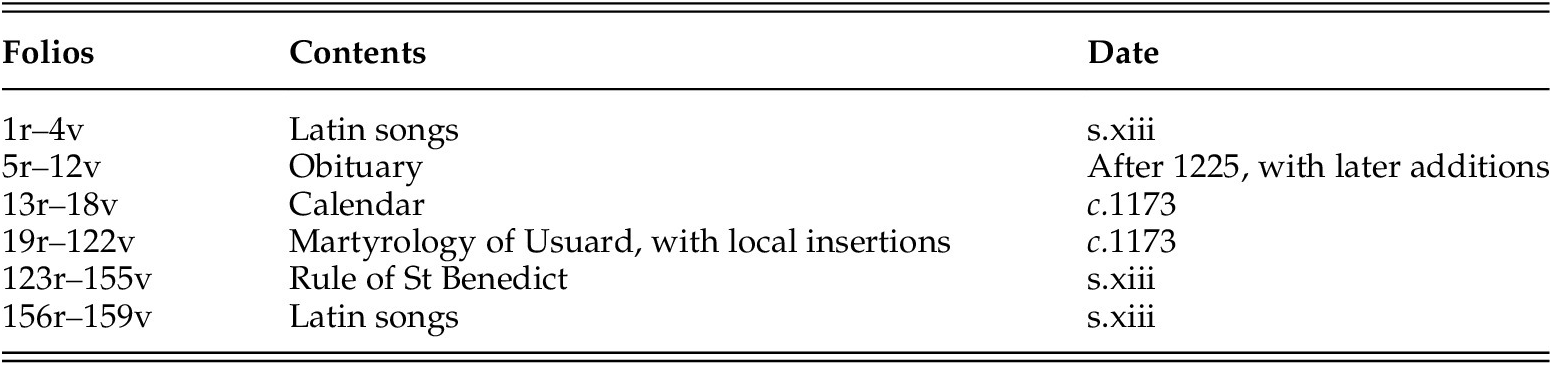
Most of the books that formed the library at Lyre Abbey were transferred, at its dissolution in 1790, to the Bibliothèque municipale (now the Bibliothèque patrimoniale) in Évreux.Footnote 22 Among the collection there is a manuscript of multiple sections – Évreux, Bibliothèque patrimoniale, lat. 17 (hereafter Évreux 17) – some dating from the twelfth century and others from the thirteenth, which demonstrates links to Wareham Priory; its contents are summarised in Table 1.
The sections of Évreux, Bibliothèque patrimoniale, lat. 17
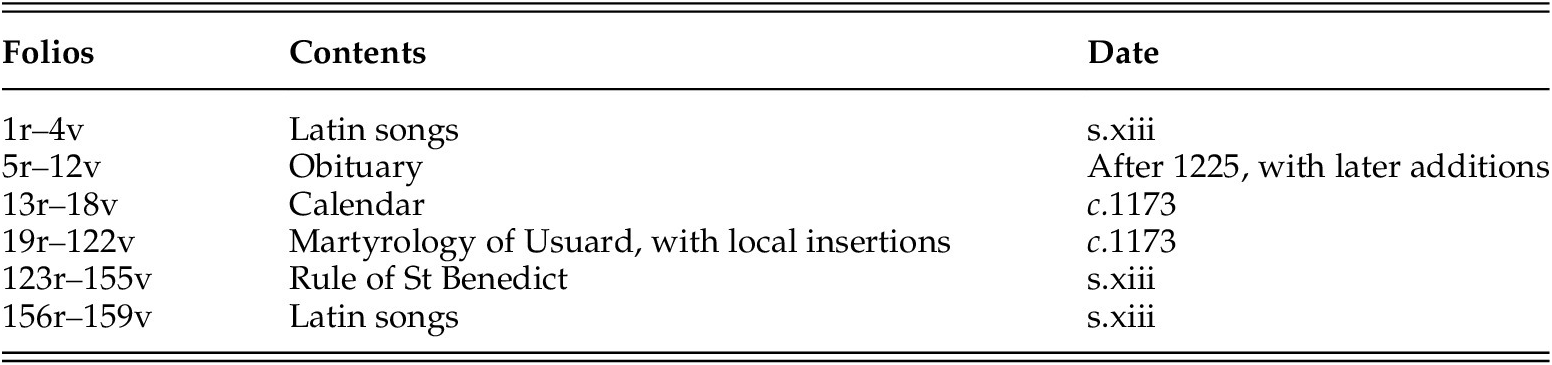
The earliest portions of the book consist of a calendar (fols. 13r–18v) and martyrology (fols. 19r–122v), both of which seem to have been copied before the canonisation of St Thomas Becket in 1173: the saint is absent from the first layer of copying, but has been added to both the calendar and martyrology in a hand of similar date.Footnote 23 This twelfth-century portion of the book has been described as ‘of the Use of the monastery of Wareham’, but the localisation of the book on the basis of the saints included in the calendar and martyrology turns out to be rather more complex than that judgement would suggest.Footnote 24 The base text for the martyrology is the second recension of the widely transmitted text of Usuard, but additional feasts – beyond those in Usuard’s text – have been included in Évreux 17, both incorporated into the main text (and thus indistinguishable in appearance from the Usuard base text), and inserted into the margins. All but one of the additional feasts incorporated into the main text are English saints, strongly implying that the martyrology was copied from an English exemplar, presumably with the intention of use at an English house.Footnote 25 Localising the martyrology more precisely is difficult: the most striking of the feasts incorporated into this layer is the 21 June feast of St Werburg, commemorating the saint’s translation from Hanbury to Chester, where a Benedictine abbey would later be dedicated to her.Footnote 26 This translation feast is rare, and occurs otherwise only in manuscripts linked to Chester, which may therefore have been the source of the exemplar for the Évreux 17 martyrology.
The marginal additions, however, tell a slightly different story. These commemorations revealingly include the dedication of the church of St Mary at Wareham (fol. 63v, 30 May) and a number of further English feasts (Thomas Becket and his translation, Ethelbert, Aldhelm), and also some Norman ones (Romanus of Rouen, Laudus of Coutances and the dedication of the church of Mont Saint-Michel). The most likely explanation for the specific nature of the Évreux 17 martyrology is that a book originally copied for the use of an English house with a particular connection to Werburg was somehow acquired by the monks of Wareham, and subsequently adapted for their use with marginal additions. These comprised feasts celebrated both locally and at the mother house of Lyre, generating a document that reflects the unique liturgy at an English dependent priory of a Norman abbey.
The calendar, another multi-layered compilation consisting of a twelfth-century original text with additions inserted over the following two centuries, also presents some difficulties of localisation. What can be said with certainty is that the calendar is Benedictine, and continued to be used in a monastic house, because Benedict is commemorated with his principal feast (21 March), his Translation feast (11 July) and its Octave (18 July); furthermore, among the later additions to the calendar are notes specifying twelve lessons for particular feasts. A number of English saints are present, among the more distinctive of whom are Chad (2 March) and both feasts of Werburg (3 February and the rare translation feast on 21 June, also found in the martyrology). Looking only at these distinctive English feasts, an initial assessment might point to a Benedictine house in Cheshire or the north-west more generally, as the calendar does not correspond in other respects with that of Chester Abbey.Footnote 27 However, the Évreux 17 calendar also includes some feasts which are rarely or never found in insular calendars, such as Benignus of Dijon (1 November) and Osmanna (16 August), whose cult seems to have been almost entirely limited to Saint-Denis.Footnote 28 Certain features of the calendar are aligned with commemorative practice at Lyre, though it is telling that two normative Lyre feasts (Sulpice, 17 January, and Vedast and Amandus, 6 February) were omitted from the original layer of the calendar, and had to be added later. Overall, this puzzling document may best be interpreted as a compilation drawing on sources from both England and Normandy, some of which contained feasts of specific relevance to their particular places of origin that were nonetheless copied verbatim into the Évreux 17 calendar. The calendar was subsequently updated to incorporate Lyre saints who had been omitted from the first layer, to append the number of lessons to feasts from January to March, and to add saints whose canonisation occurred after the original copying, but while the calendar was still in use (such as Francis, 4 October, canonised 1228).
In different ways, therefore, both twelfth-century portions of the manuscript contain indications that they continued in practical use during the thirteenth century, an impression that is reinforced by their amalgamation with further portions (fols. 1–12 and 123–159) that are also suggestive of practical functions. Once the Rule of St Benedict (fols. 123r–155v) and the obituary (fols. 5r–10v) had been added, the compilation took on the character of a chapter book, of the sort used daily by monks in chapter to guide and carry out their commemorative obligations.Footnote 29 That the monks in question were those of Wareham is proven decisively by the obituary, which can be localised very precisely.Footnote 30 Its base text is the obituary of Lyre Abbey, which includes – for example – the death dates of abbots and other members of the community, but the Évreux 17 text has been subject to continual updating, during the thirteenth and fourteenth centuries, with the names of Wareham priors, monks and local benefactors appearing prominently. Several members of the de Stokes family are mentioned, including Aalix (14 August) and Willelmus (24 March); the same two names occur in another entry (12 May), which records the gift by Willelmus Dil of land to the priory church for the salvation of his soul and those of his wife and parents, and of the souls of Willelmus de Stokes and Alicia, his wife. Thirteenth-century monuments to members of the de Stokes family (including one to a Sir William d’Estoke who died in 1294) are preserved in the priory church.Footnote 31 Other entries in the obituary refer to the Earls of Clare (‘Ricardus comes de Clare’, 22 July, ‘Gilebertus de Clare, comes’, 25 October), who had lordship of the town of Wareham after the death of King John; and to priors of the community, such as ‘Willelmus, prior h.l. [i.e. huius loci]’ (7 December) and ‘Radulfus, prior huius loci de Warham’ (2 November).
Further notes on obit requirements, detached from the calendar ordering of the obituary itself, have been entered in thirteenth- and fourteenth-century hands on the final pages of the obituary gathering. The most detailed such entry occurs on fol. 12r, in the form of a record of an agreement made between the prior and monks of Wareham and a visiting monk from nearby Abbotsbury:Footnote 32
anno domini mo. cco. lxii. vi idus iulii receperunt dominus / prior de Warham et monachi qui cum <eo> erant fratrem phil’/ de melkesham monachum de abbedesbyri concesse/runt ei participationem omnium bonorum spiritualium qui fient in ecclesia sua In perpetuum tam in vita quam / in morte et cum dies obitus ipsius ad illorum noticiam / pervenerit. memoria de eo fiet in ecclesia et in capitulo et / nomen eius in eorum martirologio annotari concesserunt. et ipse pro nobis et successoribus nostris <orabit>.
(The year of our Lord, 1262, 10 July, the lord Prior of Wareham and the monks who were with him received Brother Philip of Melksham, monk of Abbotsbury, and granted him participation in all spiritual gifts which will be made in their church for ever, both in his lifetime and after his death; and when the date of his death shall come to their notice, memorial will be made of it in the church and chapter, and they agreed to add his name to their martyrology. And he shall pray for us and for our successors.)
Just as the obituary makes clear that the dependent priory of Wareham interacted with its local community, receiving gifts in return for their prayers, this agreement indicates that the community at Wareham also maintained contact with fellow Benedictine houses in the area. The abbey of Abbotsbury – a much larger and wealthier house, some 40 km away – had the resources to undertake a major building campaign towards the end of the thirteenth century and may have supported the cultivation of polyphonic music and the production of an important music manuscript in the first half of the fourteenth.Footnote 33
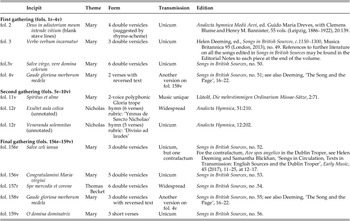
The preceding evidence points to the active use of the central sections of Évreux 17 – that is, the obituary, calendar, martyrology and Rule – at Wareham Priory during the thirteenth and fourteenth centuries. Yet can anything be said of when the outer gatherings (fols. 1r–4v and 156r–159v), consisting principally of Latin songs, came to be included in the collection? Three indications strongly suggest that these gatherings, too, formed part of the thirteenth-century book as it was owned and used at Wareham. First, the assorted notes of obit requirements jotted down on the leaves surrounding the obituary proper extend to the gathering that precedes it, implying that what are now the first and second gatherings of the manuscript were already united during the book’s period of active use as a record of commemorations.Footnote 34 Second, among the many jottings and pen trials in the final gathering are two English names on fol. 159r (‘Simon Cempton’ and ‘Wymundus Wynton’). Finally, the two outer gatherings plus the obituary gathering are linked by the presence of music in all of them (Table 2), music that – I will argue – may have had specific practical functions within the liturgy at Wareham Priory.Footnote 35 There is therefore good reason to suppose that these three gatherings were united soon after they were originally produced, and quickly joined with the Wareham chapter book, or even that they were produced at Wareham especially for the purpose of incorporation in the manuscript.Footnote 36
Music in Évreux, Bibliothèque patrimoniale, lat. 17
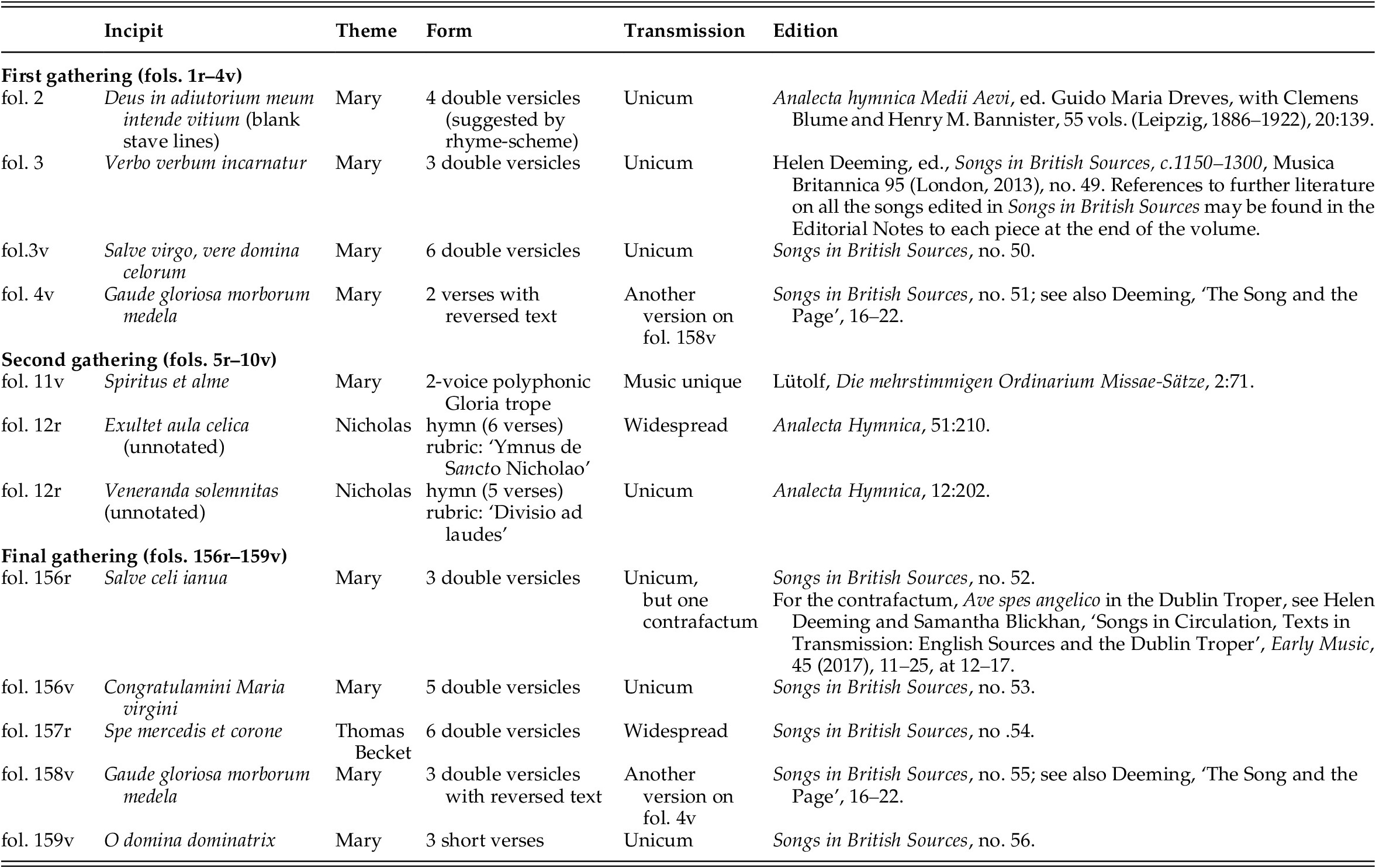
Several scribes were involved in the copying of the music across the three musical gatherings of Évreux 17, and there is evidence of some disruption to their work.Footnote 37 The text of the first musical item, Deus in adiutorium meum intende vitium, was copied below blank stave lines, as if someone intended, but never managed, to fill in the musical notation later. The rest of the music in this first gathering was inscribed by a single notator, although several text scribes supplied the underlaid texts. The first gathering as a whole is incomplete: the four surviving folios were originally the first half of a quaternion, but their partners on the other side of the centrefold have been cancelled and only stubs remain. Despite the use of a wide writing block, extending almost to the edge of the pages in some cases, the staves have been neatly ruled in brown ink, and adequate space was left between the staves for the underlaid text.
The neat layout of the first gathering is in contrast to the musical layout of the polyphonic Gloria trope, Spiritus et alme, in the obituary gathering. Here, the stave lines have been drawn freehand, and are unevenly spaced and not fully parallel. A lack of ruling for the left-hand margin has resulted in successive staves beginning increasingly close to the edge of the page; the stave-endings on the right edge are also uneven. Insufficient space was left below the lower stave on each system, so that the written text frequently interferes with notes on the stave below. Alignment lines have been drawn through each polyphonic part separately after each word or two of text; these help to compensate for the lack of vertical alignment of notes sounding simultaneously in the two voice-parts. No rhythmic indications are present in the notation, so the coordination of the voice-parts where they have different numbers of notes to be sung to the same syllable must have been left to the performers to work out for themselves. Apart from majuscule Ms for the three final phrases (‘Mariam sanctificans’, ‘Mariam gubernans’, ‘Mariam coronans’), no attempt has been made to indicate where the separate phrases of the trope begin and end, and therefore where phrases of chant from the Gloria must be inserted for a complete performance. The overall impression is of utility rather than elegance: this was a copy for use by a community familiar with the troped Gloria and how to perform it, and by singers accustomed to the challenges of rehearsing and singing unmeasured polyphony. The two hymns for St Nicholas are written neatly as prose, with no room left above the text for musical notation; blank spaces for decorated initials with cue letters in the margins, however, show that their copying was not fully completed.
The last gathering of the book, like the first, is dedicated almost entirely to music, and – again, like the first – its musical layout seems planned and neat. The musical pieces here are the work of at least three different notators and text scribes, some of them working in alternation, suggesting a collaboration between individuals that took place over time. Most of the pieces occupy one or more discrete folios; all the stave-lines are ruled, for two pieces in red ink, and the others in brown. The final verso of the gathering (and of the entire manuscript as it is now constituted), containing O domina dominatrix, is badly weathered, suggesting a spell spent unbound.
A number of conclusions may be drawn about the musicians involved in the music collection of Évreux 17 from these remarks on their work. First, several individuals capable of notating music were involved, some of them apparently collaborating over a period of time, others perhaps working separately from one another. Music-scribes and text-scribes likewise worked together, but in at least one case (Deus in adiutorium meum intende vitium), the writing of text and music was due to take place in two distinct phases, the second of which (the musical notation) was never initiated. One of the notators possessed sufficient knowledge of the notation of polyphony to write out the two-part Spiritus et alme at least adequately, if inelegantly. Most interesting of all is the re-working of the song Gaude gloriosa morborum medela, between its first version in the first gathering and its second version in the final one. As I have discussed in more detail elsewhere, the second version improves upon the first by correcting a number of errors and by making the mirrored text patterning much plainer by rearranging the phrases into three double-versicles, rather than two long stanzas.Footnote 38 Thus we have evidence of a musician with both the skill and the desire to revise an unsatisfactory piece and create something new from it.
It is probably no coincidence that this musician’s re-working converts a stanzaic song into a double-versicle sequence structure, and thereby brings the song into line with most of the other music in the manuscript. The preponderance of Marian sequences, nearly all of them unique to this manuscript, might imply a programme of local composition to supply a particular ritual purpose. Perhaps the most likely such purpose would be the Saturday Mass of the Virgin, at which various liturgical sources – including those of the diocese of Salisbury, in which Wareham was located – allowed a free choice of any sequence ‘de Sancta Maria’,Footnote 39 and for which collections of Marian sequences are sometimes found as appendices to liturgical manuscripts.Footnote 40 In Wareham, the priory church was dedicated to Mary, giving special significance to the weekly commemoration.
Looking more closely at the texts of these Marian sequences, a shared pastoral tone emerges. In referring to ‘the flock’ (Verbo verbum incarnatur, versicle 3a), and ‘all catholic people’ (Congratulamini Marie virgini, versicle 1a), the sequences reach beyond the immediate monastic community and speak to the day-to-day concerns of ordinary people. Those who are sick are mentioned specifically in Gaude gloriosa morborum medela, Salve celi ianua and Congratulamini Marie virgini, and the poor in Verbo verbum incarnatur and Salve celi ianua. In considering the nature of these songs, it may be significant that the Wareham monks shared their church with the local parish, and that their choir liturgies – perhaps especially the Saturday Mass of the Virgin – must frequently have been heard by the laity from the nave.Footnote 41 According to their obituary, the monks regularly prayed for local laypeople, some of whose tombs were located in the conventual parts of the church. The monuments to the de Stokes (or d’Estokes) family commemorated in the obituary were originally located in the chamber now known as St Edward’s Chapel on the south side of the building.Footnote 42 Archaeological investigation has revealed that this chamber once connected the priory buildings to the church, providing access for the monks directly from their living quarters to the choir.Footnote 43 In many other conventual churches of the period, a chamber in this location served as a chapter house, and this may likewise have been the case for St Edward’s Chapel in Wareham.Footnote 44
Another architectural feature of Wareham priory church that resonates with the contents of Évreux 17 is the Becket Chapel, added to the south-east corner of the chancel c.1325.Footnote 45 Although this construction work post-dates the creation of the manuscript by a considerable time, it may be telling that Évreux 17 bears witness to an early and comprehensive devotion to St Thomas Becket. His feasts were added promptly to the martyrology and calendar, and the sole musical piece not dedicated to Mary in the manuscript’s song collection is a sequence for him, Spe mercedis et corone. This sequence, the only one of the Évreux 17 set to be found in other sources, was widely transmitted in liturgical sources, where it was allocated to masses for the saint. If the music of Évreux 17 represents the gathering of materials useful for specific liturgical purposes, this may suggest that the monks copied Spe mercedis to sing during masses celebrated for Thomas in the church where later they would construct a chapel especially for his veneration.
A liturgical function is indisputable for the Gloria trope, Spiritus et alme. The polyphonic phrases as preserved in Évreux 17 only become performable when interleaved into the phrases of the Gloria chant, and in this form, the trope was widely sung across Europe in the thirteenth century at masses dedicated to the Virgin Mary, including the weekly Saturday Mass at Salisbury.Footnote 46 While the presence of polyphonic music in a community as tiny as that of Wareham might be surprising, it is worth noting that two-part unmeasured polyphony in a similar style occurs in a slightly later Lyre manuscript (London, British Library, add. MS 16975).Footnote 47 It is thus certainly possible that monks with an interest in and aptitude for polyphonic singing might have been among those who travelled between the mother house and its dependent priory.
The remaining musical items in Évreux 17 – certainly destined for singing, even though musical notation was not included in the manuscript – are hymns to St Nicholas, patron saint of travellers and sailors. Exultet aula celica is found in the Office of St Nicholas (at Vespers or at Matins) in many liturgical manuscripts; Veneranda solemnitas, on the other hand, is unique. The rubric between the two, ‘Divisio ad laudes’, may imply that the writer thought of these as a single hymn, to be divided between offices, presumably Matins and Lauds. The absence of a notated melody may suggest that the Exultet aula celica melody was well known (and could also be used for Veneranda solemnitas), or that a suitable melody could be supplied from among the many hymns that share its metrical structure. Particular devotion to St Nicholas at Wareham is suggested by the inclusion of his Translation feast (9 May) among the additions to the Évreux 17 martyrology, and this would not be surprising for a town located by the sea, with a busy port from which departing sailors, merchants and other travellers would hope for special protection from the saint.Footnote 48 Veneranda solemnitas specifically refers to St Nicholas calming the sea for sailors (stanza 3, line 1: ‘Nautis mare pacificat’) and protection for travellers is also sought in the text of Gaude gloriosa (‘Via inviando, viantes procura’, stanza 1, line 3 in the first version, versicle 1b in the second).
This examination of the music in Évreux 17 has proposed that it was very probably put to specific liturgical use in the priory church of Wareham. Many of the pieces suggest links to the lay community, who must frequently have listened to the monks’ liturgy from the nave of their shared church, and whose souls were remembered in the monks’ prayers. Both the monks themselves, whose journeys to and from the mother house at Lyre were conducted by sea, and many of the Wareham townspeople whose livelihoods depended on seafaring had particular reason to seek the protection of St Nicholas. The Saturday Mass of the Virgin, celebrated most assiduously in churches dedicated to her, would have been a ceremony of particular importance at Wareham, and one for which the unique sequences of Évreux 17 may have been newly composed.
A book list from Carisbrooke
Among the people whose obits are recorded in the second gathering of Évreux 17 are two individuals who can be shown to have moved between Lyre’s dependent priories in England. Nicholas Bynet, whose obit appears next to the date 26 September in the obituary, evidently had a long and distinguished career serving the abbey of Lyre in England. Prior of Hinckley in 1271,Footnote 49 he went on to become Lyre’s procurator by 1282,Footnote 50 and in 1297 was recorded as the prior of Wareham.Footnote 51 Richard de Préaux (‘Ricardus de Pratellis’), presumably originating in the village of that name in the Seine-Maritime department of Normandy, is described as ‘condam prior de Warham’ in the obituary next to the date 19 January, and occurs in 1279 as the prior of Carisbrooke.Footnote 52 Further evidence of how people – and especially books – circulated between Lyre and its dependent priories comes from a Carisbrooke book list dating from shortly before Richard de Préaux’s period as prior there.
The book list, now preserved in the Archives départementales in Évreux (fonds H 1746),Footnote 53 was initially written in the year 1260, when Robert de Saint-Pierre-sur-Dives (‘Robertus de Sancto Petro super Divam’) was prior of Carisbrooke.Footnote 54 Additions to the list were made during the priorate of André le Cornu (‘de Cornutis’) who had succeeded Robert as prior by 1264,Footnote 55 and was himself followed (after 1277) by Richard de Préaux.Footnote 56 Both parts of the list suggest a library whose collections were regularly supplemented by loans from the mother house, and by donations from individual monks. Item 2 on the list is the third part of Clement on the gospels; the writer notes that the other two parts were believed to be at Lyre.Footnote 57 Item 6 is described as ‘librum fratris Radulphi [de] Romileyo, quondam predicti loci prioris’; this must be the Raoul de Romilly mentioned earlier, who was by this time Lyre’s procurator in England, and is recorded at the start of the list among the monks present at Carisbrooke in 1260. Items 13 and 14 in the list were brought to Carisbrooke by André le Cornu, and items 15 and 18 were given by one Dominus Henricus.Footnote 58 The copying of several of the books is mentioned: brother Laurence de Caen (‘Laurentius de Cadomo’) is named as the scribe of item 5, while items 9–11 are followed by the description ‘isti libri scripti fuerunt in … domo’. No further references to brother Laurence de Caen have been uncovered,Footnote 59 but the second description strongly implies that books 9–11 were copied at Carisbrooke: it immediately follows a mention of ‘domus de Karebroc’ in the previous sentence.Footnote 60
In addition to the monks who brought books to the priory, a number of others are mentioned at the start of the book list: these were the monks who were living at the priory at the time of the list’s compilation in 1260. The then prior, Robert de Saint-Pierre-sur-Dives, and procurator, Raoul de Romilly, were accompanied by brothers Matthew de Wyciz,Footnote 61 Richard de Audreia, Thomas de Fécamp (‘de Physanno’) and Richard de Ferrières (‘de Ferraria’). Richard de Audreia later served as procurator of Lyre in 1264,Footnote 62 and by 1268 had become prior of another Lyre dependency, Hinckley Priory.Footnote 63 He resigned from this post in 1271 to join the Dominican friars, and was succeeded by Nicholas Bynet, the procurator of Lyre mentioned earlier, who went on to become prior of Wareham and features in its obituary.Footnote 64 Four of the other monks mentioned in the book list were already present in Carisbrooke three years earlier, when they witnessed a charter on 14 November 1257: on that date, Prior Robert, Procurator Raoul,Footnote 65 Thomas de Fécamp and Richard de Ferrières were accompanied by five other men, apparently not monks, including Hugh de Maneby (the constable of Carisbrooke Castle), Geoffrey the cook and Robert the scribe (‘Robertus scriptor’).Footnote 66 The presence of local laypeople in the Carisbrooke charters is an indicator of the monks’ integration into their community, and if, as the book list implies, books (as well as charters) were being produced at Carisbrooke, the presence of Robert the scribe may be especially significant.
Among the eighteen items in the book list – which equate to a slightly higher total number of books, since two listings refer to multiple books – several are compilations of multiple texts or excerpts.Footnote 67 Raoul de Romilly’s book contained extracts from various texts by Hugh de St Cher, along with a treatise on vices, which the writer of the list particularly commends for demonstrating the dangers of living a life of vice.Footnote 68 Item 12 is described as a book ‘in which many good things are contained, both in Latin and in French’,Footnote 69 whereas item 8 contained a Life of St Faith, Geoffrey of Monmouth’s Prophecies of Merlin, a sermon of St Gregory and a text in English.Footnote 70 Copious comments throughout the book list describe the merits of reading in general, and the benefits of the various texts in particular, giving the impression that the writer (at least) was a serious reader who made extensive use of the resources available to him at Carisbrooke. The selections of excerpts and compilations of short texts, and perhaps especially the presence of texts in French and English, may be suggestive of a scenario in which the priory’s monks gathered whichever written materials they could lay their hands on, in the absence of a more extensive reference library on which they could draw.Footnote 71
Musical traffic between England and Lyre
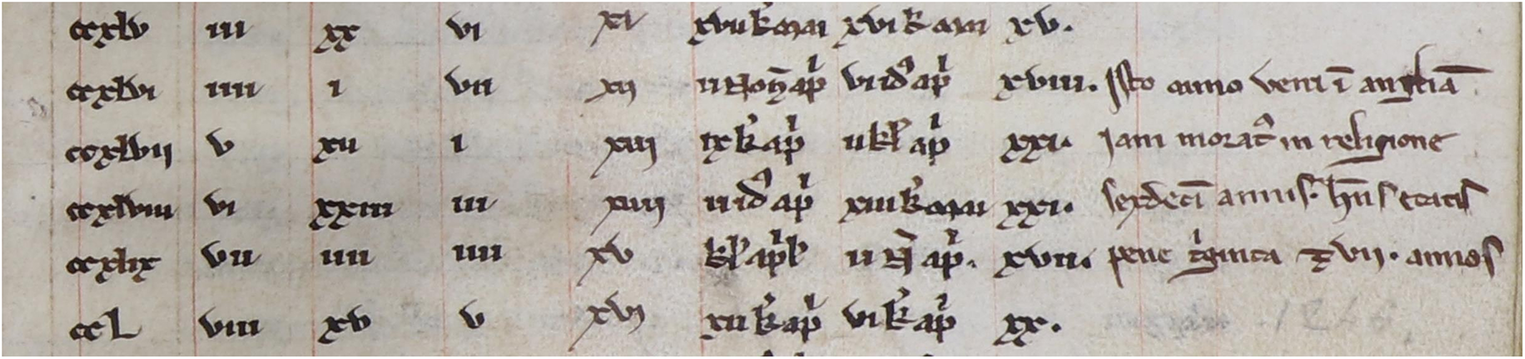
Item 3 on the Carisbrooke list is another volume containing multiple texts, among which are listed Gregory’s De cura pastorali, two texts by Augustine and a computation booklet (‘libellum compoti’), as well as ‘many [other] good things’.Footnote 72 A book with remarkably similar contents – distinctive because of its inclusion of a computation booklet alongside extracts from Gregory, Augustine and other authors – survives from among the collections of Lyre Abbey, now housed in Évreux. This manuscript, Évreux, Bibliothèque patrimoniale, lat. 2 (hereafter Évreux 2), is a compilation of several sections, involving different hands and sometimes different page layouts.Footnote 73 Marginal annotations are present throughout the book, consisting of subheadings and cross-references, as well as textual corrections: these occur especially often in the last seven gatherings (fols. 102–155), which are numbered I–VII on their final folios, perhaps suggesting that this part of the book had a separate existence before being joined with fols. 1–101.Footnote 74 Excerpts from Gregory’s De cura pastorali occur in this final section, as do extracts from Augustine: both authors also occur earlier in the manuscript (fols. 66–78). Though evidently the work of several scribes, the compilation as a whole has been described as a vade mecum of an individual monk, assembled for his own use.Footnote 75 One anonymous scribe, who wrote the computational materials and most of the other texts on fols. 1–12, added the following note to the margin of his computational table (on fol. 9r), next to the year 1246:Footnote 76
Isto anno veni in Angliam. Iam moratus in religione sexdecim annis. habens etatis pene triginta et vii. annos.
(In that year I came to England, by this time having been a monk for sixteen years, being nearly thirty-seven years old.)
While the description in the 1260 Carisbrooke book list is not sufficiently precise to enable a conclusive identification of the book as Évreux 2, it is certainly striking that a book of similar contents, which may well have made the journey from Lyre to England in 1246 in the hands of the monk who owned it and copied some of its contents, was preserved at Lyre.
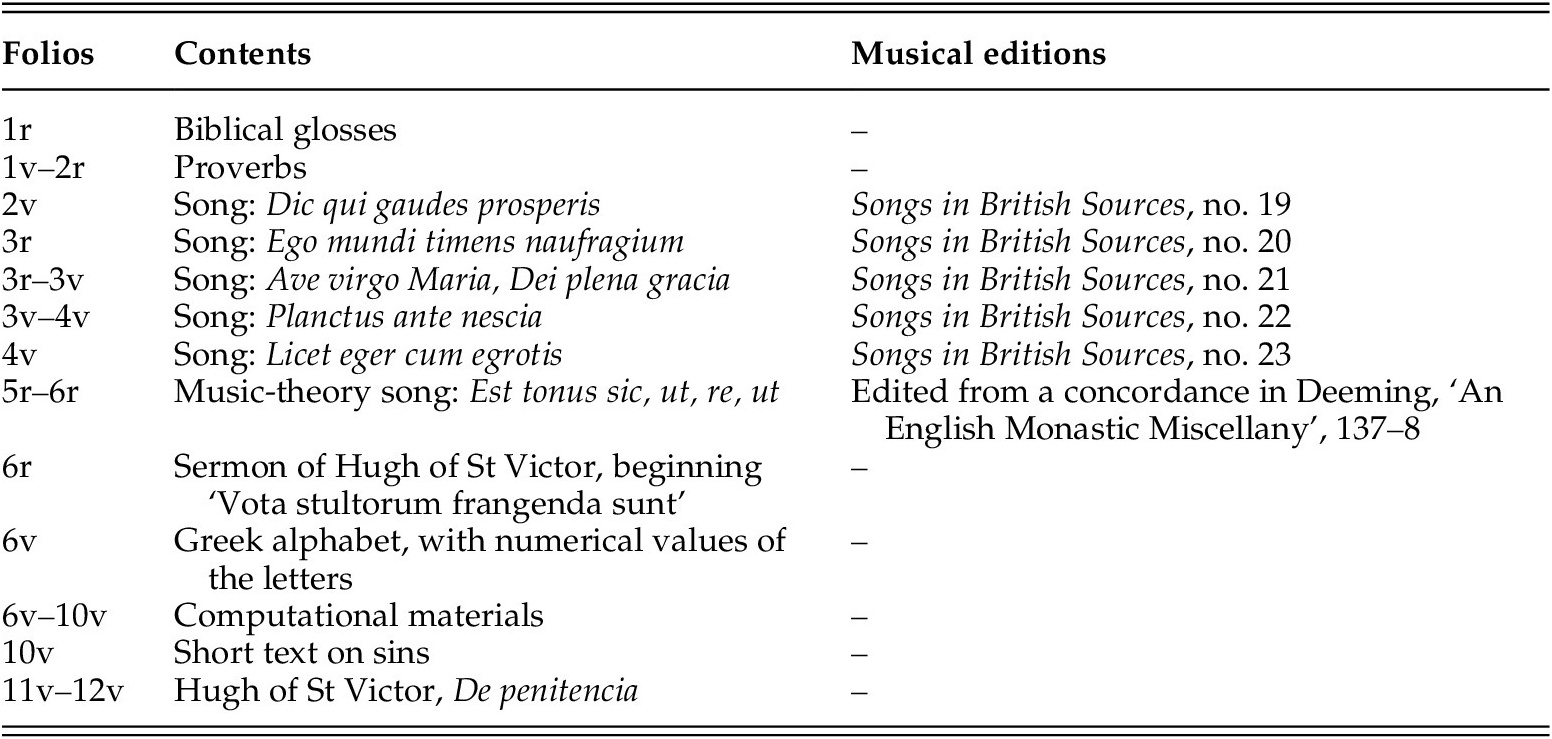
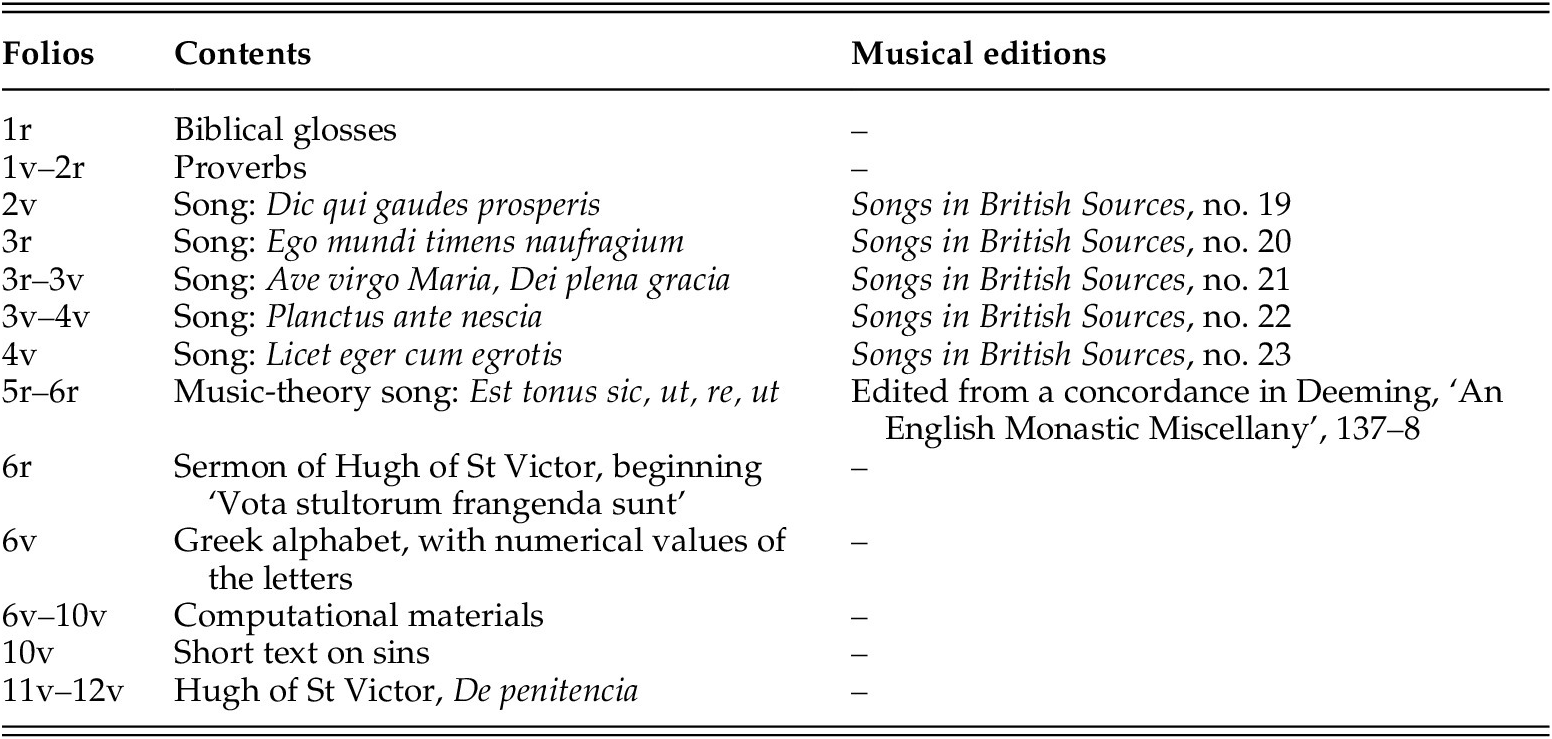
Even more interesting, from the perspective of the present article, is that the scribe who travelled to England in 1246 was a music scribe, who included six notated items within his book. Both the note concerning his journey and the musical pieces occur in the opening section of the manuscript, whose contents are found in Table 3.Footnote 77
The opening section of Évreux, Bibliothèque patrimoniale, lat. 2
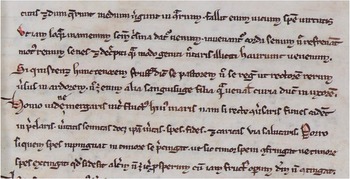
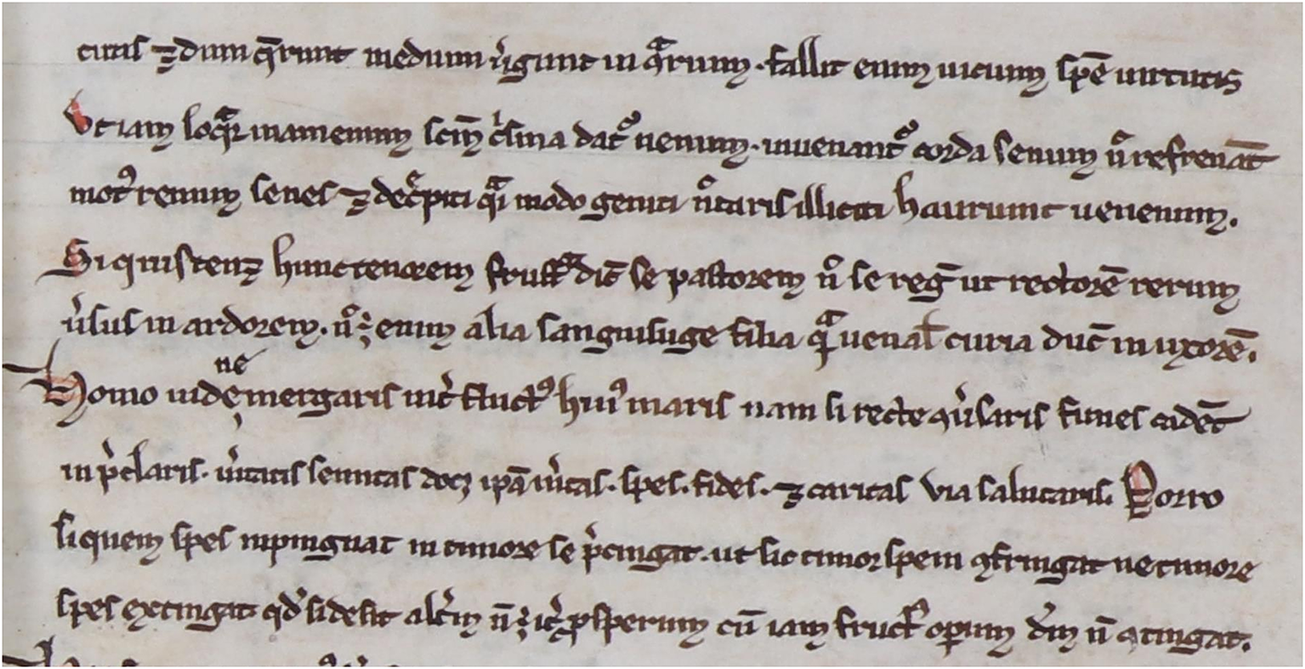
Figures 1–3 show examples of the scribe’s handwriting from the musical pieces on fol. 4r, fol. 5r and the note on fol. 9r. The scribe’s distinctive Tironian nota, and his v with the pronounced right-angled hook at the top of the ascender, are evident in these samples.
Évreux 2, fol. 4r, line 3: v of ‘verum’. Évreux, Bibliothèque patrimoniale, by permission.

Évreux 2, fol. 5r, line 7: Tironian nota and v of ‘via’. Évreux, Bibliothèque patrimoniale, by permission.
Évreux 2, fol. 9r, note in RH margin: Tironian nota and v of ‘veni’ and ‘vii’. Évreux, Bibliothèque patrimoniale, by permission.
Although the music scribe of Évreux 2 did not record his name, his testimony is nonetheless highly significant. It is unusual to be able to date a thirteenth-century music scribe precisely, and equally rare to know anything of their movements from place to place. Whether or not Évreux 2 is indeed the book catalogued as item 3 in the Carisbrooke book list, the evidence assembled in this article concerning the movement of people and books between Lyre and its dependent priories in England gives a concrete context for how a music scribe (and possibly his book) might have crossed the Channel in 1246.
The songs of Évreux 2 are of a completely different character from those of the Wareham book, Évreux 17. In the Wareham book, double-versicle forms predominate, and a thematic focus on the Blessed Virgin Mary prevails; in Évreux 2, by contrast, only one song has the double-versicle form (Planctus ante nescia), and this is a emotive lament, dramatising the words of Mary at the foot of the Cross, rather than a devotional song resembling a liturgical sequence.Footnote 78 Just one other of the songs focuses on Mary (Ave virgo Maria, Dei plena gracia); while half are songs of complaint and warning about the sins and corruption of the world, and the Church in particular (Dic qui gaudes prosperis, Ego mundi timens naufragium and Licet eger cum egrotis). The last, Est tonus sic, ut, re, ut, is a music-theory song, teaching the musical intervals by demonstration. The Évreux 2 songs thus represent a more eclectic selection than those of the Wareham book, and certainly lack their implied performance context as part of the liturgy. In this respect, both song collections are in keeping with the nature of the books in which they are found: while the Wareham book is one with a practical function in support of the liturgy, Évreux 2 is a book of miscellaneous materials for private study and contemplation.
The two song collections also differ in terms of their transmission histories. While all but one of the notated Wareham songs are unique to Évreux 17, several of the Évreux 2 songs are found elsewhere. Ave virgo Maria, Dei plena gracia and Ego mundi timens naufragium are unica, and Dic qui gaudes prosperis occurs only in another Lyre manuscript, Évreux, Bibliothèque patrimoniale, lat. 39. But the circulation of the other three songs seems to have been strongly tied to England. Though Planctus ante nescia was widely transmitted across Europe, and often attributed to Godefroy de Saint Victor,Footnote 79 it was evidently known in England, because two contrafacta of it (one in French, the other in English) are found in a manuscript compiled in London towards the end of the thirteenth century.Footnote 80 In his 1978 article, Christopher Hohler pointed out the English connections of the remaining two musical pieces in Évreux 2.Footnote 81 The text of Licet eger cum egrotis – for which Évreux 2 is the only witness to supply musical notation – is found in the somewhat ‘Later Cambridge Songs’, a late twelfth- or early thirteenth-century collection that has been linked to Leicester Abbey by John Stevens.Footnote 82 The only other medieval copy of Licet eger cum egrotis (again, lacking musical notation) is in the song collection in the South Tyrolean Codex Buranus.Footnote 83 The music-theory song Est tonus sic, ut, re, ut occurs in only two other sources before the fifteenth century, namely the English manuscripts Harley 978 (from Reading Abbey),Footnote 84 and – with the slightly different incipit Fit tonus sic – in the Hereford Breviary, Hereford, Cathedral Library, P.IX.7.Footnote 85 The music-theory song is not the only concordance between the Hereford Breviary and manuscripts from Lyre. Osbert of Clare’s Office for St Anne is found in both the Hereford source and a Lyre antiphoner, Évreux, Bibliothèque patrimoniale, lat. 89, to which they are the only thirteenth-century witnesses.Footnote 86 A possible context for these musical and liturgical links between Lyre Abbey and Hereford Cathedral exists in the form of long-standing affiliations between the two institutions. These included an agreement between the abbot of Lyre and the bishop of Hereford, granting the former the status of a canon at Hereford Cathedral and certain visiting rights.Footnote 87 The two houses also agreed to commemorate the obits of each other’s clerics, a prayer union that had been approved by Archbishop Stephen Langton,Footnote 88 and resembles, albeit on a larger scale, the agreement discussed earlier between the monks of Wareham Priory and Philip of Melksham.
No clear performance context for the songs of Évreux 2 suggests itself, as it does for those of the Wareham book. If the book were indeed at Carisbrooke, perhaps its songs of moral warning could have been sung at mealtimes or moments of leisure within the priory. Dependent priories had no novices to educate, so the purpose of a song teaching the rudiments of music in such a context is unclear. However, the English-centred transmission histories of half of the Évreux 2 songs might suggest that the compiler of the manuscript collected those songs while travelling around the networks that existed between Lyre and England, and noted them down for future use, perhaps back at the mother house. The manuscript as a whole is a miscellany representing the collecting efforts of compilers, who gathered short texts and excerpts from a wide variety of classical, patristic and more recent authors, as well as copious short items (such as the computational materials, proverbs and notes on the Greek alphabet). The songs likewise present themselves as a miscellaneous selection, whose assembly together may be the result not of a conscious effort of curation for a specific performance purpose, but of the more random accumulation of materials that interested the book’s compiler as he encountered them.
Conclusion
The networks of people and places explored in this article provide evidence of the ways in which texts and music circulated in and between medieval England and Normandy. Positive proof of books arriving at dependent priories in the hands of individual monks can be found in the books of Raoul de Romilly, André le Cornu and Dominus Henricus which had come to Carisbrooke by 1260; there is every reason to suppose that books also travelled around with individuals such as Nicholas Bynet, Richard de Préaux and Richard de Audreia, whose careers moving between Lyre’s dependencies of Carisbrooke, Wareham and Hinckley have been traced here. Évreux 2 (or parts thereof) may likewise have travelled to a Lyre dependency, possibly Carisbrooke, when its musician-owner crossed the Channel in 1246, and it is possible that the manuscript played some role in the transmission of songs from England to Normandy (or vice versa). In the same period the monks of Carisbrooke were producing their own charters and books, perhaps with the assistance of a local lay scribe, and those of Wareham were updating their chapter book (Évreux 17) and very likely adding music to it; both houses were integrated in their local communities, as well as maintaining contact with monasteries and clerics further afield. Considered collectively, a rich, though patchy, picture begins to emerge of these dependent priories: as locations where monastic life was observed, where books were acquired, produced and used, and where music was collected, copied and performed.
Complementing the picture of W. of Wycombe’s textual and musical activities at Leominster Priory, the history of Lyre’s English dependencies reinforces the importance of a proper consideration of small monastic institutions, including dependent priories, as potential locations for the exchange and production of books and music. The evidence considered here suggests that not only could such houses be locations for music copying and even composition – when monks with the relevant skills and interest happened to be present – but also that the conditions of such houses may have both encouraged and enabled the monks to collect materials wherever they could. Lacking an extensive library in situ, monks sought out materials to copy, including from the brothers who regularly travelled to and from the priories, bringing books with them. The situation of the priories seems also to have been an impetus to revise and rework what they already had, and even to create their own new music in response to local need. This observation has wider consequences for the study of medieval music manuscripts, since it calls into question the music-historian’s default tendency to search for large and wealthy religious houses when seeking places of origin for music manuscripts. The Anglo-Norman monastic network explored in this article formed only a single thread in a patchwork of dense and complicated relationships between religious houses in post-Conquest England and Normandy. Nevertheless, the fruitful musical exchange it brought about is highly suggestive of further productive musical connections that are yet to be uncovered.