





Introduction
Research on sentence processing during comprehension has often asked how language users integrate morphosyntactic cues in real time to compute a syntactic structure and a corresponding interpretation of incoming sentences. It is uncontroversial that adult speakers usually process grammatical cues rapidly and successfully in their first language (L1). Hence, they are also capable of correctly interpreting utterances that express unlikely or impossible events, such as that the cheese ate the mouse, not the other way round, in (1).

In a series of experiments with adult L1 speakers of English, Ferreira (Reference Ferreira2003) found that, as expected, comprehenders usually relied on the morphosyntactic properties of the verb forms in (1) to correctly interpret the sentence. However, in about a fifth of the cases, participants misunderstood sentences such as (1) to mean that, in this case, the mouse ate the cheese. Such errors have been explained by the use of heuristic processing strategies. For instance, a misinterpretation of (1) may be the result of an animacy-based strategy, assigning the agent role to an animate rather than an inanimate entity (MacWhinney & Bates, Reference MacWhinney and Bates1989), or an agent-first strategy, assigning the agent role to the first-mentioned entity (Bever, Reference Bever and Hayes1970). Sometimes, heuristic processing prevails over detailed grammatical processing, even in L1 speakers. Adult second language (L2) learners have been found to rely even more on heuristic processing. This has been captured by the Shallow Structure Hypothesis (Clahsen & Felser, Reference Clahsen and Felser2006, Reference Clahsen and Felser2018), which suggests that “unlike native speakers, even highly proficient L2 speakers tend to have problems building or manipulating abstract syntactic representations in real time and are guided more strongly than native speakers by semantic, pragmatic, probabilistic, or surface-level information” (Clahsen & Felser, Reference Clahsen and Felser2018, p. 694).
In sum, at least two ways of processing incoming strings have been distinguished. While terminologies differ (Ferreira, Reference Ferreira2003, distinguishes “heuristic” and “algorithmic” processing, while Clahsen & Felser, Reference Clahsen and Felser2006, distinguish “shallow” and “detailed” processing), the distinction that is made is a similar one: it is assumed that one way of processing is to assign a syntactic representation to the string that then informs its semantic interpretation. A second way is to forgo the construction of a detailed syntactic representation and to assign meaning to the incoming string by exploiting non-syntactic cues that can directly inform semantic interpretation. In the current paper, we will refer to the first type of processing as “detailed” processing, and to the second type as “heuristic” processing.
In studies on L1 sentence processing, the focus has clearly been on detailed processing, with a large number of studies aiming to determine how L1 speakers construct abstract syntactic representations in real time (see van Gompel, Reference van Gompel2013, for an overview). For L2 sentence processing research, a guiding question has been whether or under which conditions L2 learners are able to use detailed grammatical processing rather than heuristic processing in the same way as L1 speakers (see Roberts, Reference Roberts and van Gompel2013, and Hopp, Reference Hopp2022, for overviews). For both types of language users, much less attention has been paid to the flip side of the coin: The acquisition and use of heuristics has rarely been addressed as a topic in its own right, and there are few models of how heuristics are acquired, used and weighted in a language, across languages, and between different users (but see Kempe Reference Kempe1999; MacWhinney & Bates, Reference MacWhinney and Bates1989; MacWhinney et al., Reference MacWhinney, Kroll, De Groot, Kroll and De Groot2005).
Given the central role that heuristics are assumed to play in language processing, it is key to gain a better understanding of their acquisition and use. While it is well-established that heuristics play a greater role in L2 than in L1 processing, we do not know whether heuristic processing in itself is systematically different between L1 and L2 language users. On the one hand, it is possible that speakers fall back on the same heuristics in their L1 and their L2 (Kempe, Reference Kempe1999). On the other hand, it is also conceivable that L2 learners differ from L1 speakers in the heuristics they choose and how quickly they apply them during processing. Exploring such a potential L2-specific use of heuristics seems informative in its own right but may also provide a new and complementary perspective on language acquisition more generally. In particular, choosing and weighing heuristics during processing may be considered part of the linguistic knowledge that learners need to have, just as is knowledge of the target language syntactic structure. Moreover, heuristics could also help or hinder acquisition (Klein & Perdue, Reference Klein and Perdue1997; VanPatten, Reference VanPatten, VanPatten and Williams2007), such that gaining a better understanding of the use of heuristics in L2 processing could provide a more complete picture not only of the knowledge of a learner, that is the product of language acquisition, but also the process of language acquisition.
Against this backdrop, the current study examines the use of two heuristics, the agent-first heuristic and the animacy-based heuristic, in how learners assign thematic roles during the processing of wh-questions in adolescent L1 German and L2 English sentence processing. We study offline interpretations and online processing in the same individuals in both their L1 and L2 to control for potential individual differences in the use of heuristics. Crucially, the focus of our study is not on the widely studied question of whether comprehenders rely on detailed processing or on heuristic processing, but on examining the relative weight of the two heuristics in the L1 and the L2 during online processing and in final interpretations. We recruited low-intermediate instructed learners who have had a limited amount of exposure to the target language, because heuristics are assumed to play a particularly important role at lower levels of proficiency. In the following, we will briefly summarize existing models about the role of heuristics in L1 and L2 online and offline sentence comprehension, and we then turn in more detail to the available evidence from wh-questions in German and English.
Detailed and heuristic processing across types of language users and online and offline measures
Based on the evidence from misunderstandings of non-canonical sentences, Ferreira et al. (Reference Ferreira, Ferraro and Bailey2002) and Ferreira & Patson (Reference Ferreira and Patson2007) proposed that L1 speakers sometimes rely on “good-enough” processing to reach an interpretation of an incoming sentence, meaning that they would rely on heuristics to rapidly assign an interpretation (see also Christianson et al., Reference Christianson, Hollingworth, Halliwell and Ferreira2001; Townsend & Bever, Reference Townsend and Bever2001). Moreover, even when language users ultimately rely on detailed processing for sentence-final offline interpretations, they may have to overcome competing heuristic-based interpretations during real-time processing. This is particularly well-documented for the agent-first heuristic: Many studies have observed that L1 speakers are generally faster in processing sentences that are in line with the agent-first heuristic than non-canonical sentences where the agent-first heuristic would lead to an erroneous interpretation (e.g., Bader & Meng, Reference Bader and Meng1999; Haupt et al., Reference Haupt, Schlesewsky, Roehm, Friederici and Bornkessel-Schlesewsky2008; for an overview focusing on relative clauses, see Lau & Tanaka, 2021). These findings support the idea that processing heuristics compete with detailed grammatical processing during online language comprehension for L1 speakers, even if the use of heuristics is not always visible in final interpretations.
Heuristics are assumed to play a larger role for L2 learners, in particular those at initial stages of acquisition. Based on the assumption that processing heuristics are universal, Klein and Perdue (Reference Klein and Perdue1997) proposed that L2 learners rely exclusively on such strategies in production and comprehension until they have acquired the language-specific morphosyntactic system of the respective target language. From a different angle, VanPatten’s Input Processing (IP) model holds that learners initially apply universal processing heuristics, as well as, to a lesser degree, L1-based processing routines to establish form-meaning mappings (VanPatten Reference VanPatten, VanPatten and Williams2007, Reference VanPatten2015). While different models thus agree that heuristics play a role during L2 processing, they do not specify how and which heuristics are chosen. An exception to this is the Competition Model (MacWhinney & Bates, Reference MacWhinney and Bates1989; MacWhinney et al., Reference MacWhinney, Kroll, De Groot, Kroll and De Groot2005). This model does not make a principled difference between detailed and heuristic processing. Instead, it conceptualizes language processing in general as a competition of different local or distributed cues. Furthermore, it proposes that cues have different weights in different languages. The Competition Model predicts that the weight of cues such as linear order and animacy is initially transferred from L1 to L2 and will be gradually adapted when learners gain more target language knowledge (MacWhinney et al., Reference MacWhinney, Kroll, De Groot, Kroll and De Groot2005, see also Harrington, Reference Harrington1987). In sum, while different approaches to initial stages of L2 acquisition converge on the assumption that heuristic processing is often used by beginning L2 learners, specific predictions about the role of different heuristics are only made by the Competition Model, which posits a strong influence of the L1 choice and weighting of heuristics on the use of heuristics in a L2.
Turning to the case of L2 learners at more advanced proficiency levels, the Shallow Structure Hypothesis (SSH, Clahsen & Felser, Reference Clahsen and Felser2006, Reference Clahsen and Felser2018) proposes a dissociation between the role of heuristics during processing and in offline performance. It suggests that, for offline interpretations, advanced L2 learners may well be able to apply detailed grammatical knowledge. This knowledge would be less available during online processing, however, such that L2 learners would rely more often on heuristics. A large body of research has focused on evaluating this claim, looking at factors such as age of acquisition (Clahsen & Felser; Reference Clahsen and Felser2006; Veríssimo et al., Reference Veríssimo, Heyer, Jacob and Clahsen2018), the similarity of L1 and L2 morphosyntactic systems (Jiang, Reference Jiang2004), lexical knowledge (Hopp, Reference Hopp2018), or amount of exposure (Pliatsikas & Marinis, Reference Pliatsikas and Marinis2013). The resulting picture suggests that, in principle, both L1 and L2 speakers have access to detailed as well as heuristic processing strategies. L2 learners have been found to differ from L1 speakers in that they sometimes appear to transfer detailed processing strategies from their L1 to their L2 (Hopp, Reference Hopp2010; Roberts & Liszka, Reference Roberts and Liszka2013) and sometimes to over-rely on heuristic strategies (Jackson & Roberts, Reference Jackson and Roberts2010; Pan & Felser, Reference Pan and Felser2011; Roberts & Felser, Reference Roberts and Felser2011). Some approaches to L2 acquisition point out that one reason for these differences in processing patterns between L1 and L2 speakers may be that it is more difficult to rapidly integrate different sources of information in a L2 than in an L1 (Hopp, Reference Hopp2018; Sorace & Filiaci, Reference Sorace and Filiaci2006). This suggests, on the one hand, that L2 learners could rely on heuristic processing, particularly in situations where too many competing sources of information need to be integrated. On the other hand, it may also entail differences in the types of heuristic processing between L1 and L2 speakers. If L2 comprehenders have difficulties using multiple sources of information at once, they may be less able to use several heuristics at once. Relatedly, they may prioritize heuristics that have an extensive coverage or may be easier to compute over more specific ones, because doing so would entail less necessity to choose between heuristics.
To sum up, there is a general consensus that, both in a L1 and a L2, heuristics are more likely to be used during online processing than in final interpretations, and that heuristics play a greater role in L2 than in L1 processing. In the L2, heuristic processing is particularly evident at the initial stages of acquisition, but L2 learners sometimes fall back on it at later stages, especially when processing demands are high. Given the large role that heuristics play, we know surprisingly little about heuristic processing in its own right, going beyond the question of whether heuristics are used or not. In particular, there are few principled explanations as to how L1 and L2 users select and weigh different heuristics. For L2 processing, it is unknown whether comprehenders use the same heuristics in their L2 and their L1, or whether there are L2-specific principles in the selection of heuristics.
Wh-questions in German and English
Wh-questions in L1 German and L2 English present a suitable test case for heuristics in the processing of filler-gap dependencies (e.g., Chaves & Putnam, Reference Chaves and Putnam2020), since learners frequently encounter both subject and object questions in the input, in both German and English. Moreover, both the agent-first heuristic and an animacy-based heuristic have been found to be at play in prior studies on wh-questions. In both German and English, wh-questions are formed by general fronting of the wh-element, independently of its syntactic function. In the following, we will consider subject-initial (2) and object-initial (3) wh-questions.

As illustrated in these examples, the two languages use different morphosyntactic means to disambiguate the sentence to a subject- or object-initial reading. In German, syntactic functions are disambiguated via case marking. For NPs with masculine nouns, as the second NP in (2a) and (3a) (Pinguin, masc.), case marking on the article disambiguates the sentence towards a subject-initial or object-initial reading. For NPs with neuter or feminine nouns, such as the wh-phrase in (2a) and (3a) (Tier, neuter), case marking is ambiguous due to syncretism in the inflection paradigms of articles and question words. This means that depending on the grammatical gender of the involved nouns, German wh-questions may be disambiguated on the first nominal constituent, the second nominal constituent, or remain fully ambiguous. In English, by contrast, syntactic functions are always clearly marked by word order: in subject-initial orders (2b), the lexical verb precedes the second NP, while in object-initial orders (3b), the lexical verb follows the second NP.
The use of heuristics when processing wh-questions has been studied in both target languages. The agent-first heuristic should lead to quicker and more accurate processing of subject-initial compared to object-initial questions. In line with this, Schlesewsky et al. (Reference Schlesewsky, Fanselow, Kliegl, Krems, Hemforth and Konieczny2000) observed slower processing of object-initial than subject-initial unambiguous which-questions in a self-paced reading task with German adults. Schouwenaars et al. (Reference Schouwenaars, Hendriks and Ruigendijk2018) also tested unambiguous which-questions in German in a picture selection and visual world eye-tracking task with adults and 7- to 10-year-old children. In the offline task, adults were at ceiling in all conditions. Children, however, misinterpreted object-initial questions as subject-initial ones in about 15% of the cases. In visual world eye-tracking, both adults and children quickly started fixating on the target more than the competitor picture while listening to subject-initial questions. In contrast, for object-initial questions, both groups initially fixated the competitor more than the target picture before the amount of looks to the target picture started to increase. This online revision process was faster for adults than for children. These data suggest that detailed processing competes with the agent-first heuristic during online processing, which needs to be overcome to reach the correct interpretation for object-initial questions. Very similar evidence for English comes from a study by Contemori et al. (Reference Contemori, Carlson and Marinis2018), who tested adults and 5- to 7-year-old English-speaking children, using picture selection and the visual world paradigm. Again, adults were at ceiling during offline performance, while children had an accuracy of only about 75% for object-initial questions. Moreover, gaze data again showed an initial agent-first preference and hence delayed looks to the target picture for object-initial questions for both adults and children, with revision being slower in the child group. Note that in all of these studies, the stimulus sentences contained two full animate NPs, meaning that animacy was not manipulated and could not be used as a heuristic.
As for L2 processing, Roesch and Chondrogianni (Reference Roesch and Chondrogianni2016) compared 4- to 5-year-old monolingual German children as well as bilingual French-German children and early sequential L1 French-L2 German children in an offline picture selection study on German unambiguous which-questions. While there was a general advantage of subject-initial over object-initial questions in all three groups, the difference between these two sentence types was largest for L1 children. The sequential bilingual children had a lower accuracy on both subject- and object-initial questions overall and a relatively smaller subject advantage. This suggests that, at least in very young L2 learners, the agent-first heuristic is not the only strategy at play, as this should have led to a particularly strong subject-advantage. Instead, the data suggest that at least at a young age and at low levels of proficiency, children may also resort to a guessing strategy. As for L2 English, Pontikas (Reference Pontikas2019) looked at the processing and interpretation of English which-questions in adult monolingual and bilingual L1 speakers of English, adult proficient L2 learners of English of various first languages, as well as monolingual and bilingual 7- to 10-year-old children. The bilingual children had various ages of onset of English as a second L1 or an early L2. The design and stimuli of the study were similar to the ones used by Contemori et al. (Reference Contemori, Carlson and Marinis2018). For monolingual speakers, the study replicated the results by Contemori et al. (Reference Contemori, Carlson and Marinis2018). Bilingual children and adults showed higher rates of misinterpretation of object-initial questions as well as a slower convergence on target looks for object-initial questions, suggesting that the agent-first heuristic was relatively stronger in the bilingual groups.
Turning to studies on L1 German and L2 English, Hopp et al. (Reference Hopp, Steinlen, Schelletter and Piske2019) and Hopp and Thoma (Reference Hopp and Thoma2021) looked at subject- and object-initial which-questions in an offline picture selection task. Participants were around 250 9-to-10-year-old children per study who spoke German as their only or one of their first languages and who were learning English as an early foreign language either at regular German schools or at schools with an English immersion program. While interpretation accuracy was around 90% for subject-initial questions in all groups, children in regular German schools interpreted object-initial questions correctly in only about 20% of the cases, suggesting an overwhelmingly strong influence of the agent-first heuristic at this proficiency level and in this age group. Children with more exposure to English had higher rates of accuracy. Finally, Hopp (Reference Hopp2017) studied online and offline accuracy for subject- and object-initial which-questions in adult German learners of English at different levels of proficiency. While accuracy was at ceiling for subject-initial questions across all levels of proficiency, intermediate learners interpreted object-initial questions correctly in only about 63% of the cases, and high-intermediate learners in about 82% of the cases. Online, all groups showed evidence of competition between an agent-first heuristic and detailed processing that was overcome more quickly in the more proficient groups. In contrast, for advanced adult German learners of English, Rankin (Reference Rankin2014) observed higher accuracy for object-initial sentences of the type 3b (95% correct) than for subject-initial sentences of the type 2b (85% correct). The low accuracy level for subject-initial sentences in this study may be due to structural L1 transfer (see e.g., Kaan et al., Reference Kaan, Ballantyne and Wijnen2015). More precisely, a word-by-word translation of subject-initial sentences from English into German would lead to a sentence that is ambiguous between a subject- and an object-initial reading (Welches Tier jagt die Katze), which may have led to some erroneous interpretations of subject-initial sentences as object-initial ones in the L2 (see also Hopp & Grüter, Reference Hopp and Grüter2021, for similar evidence from online and offline data in German learners of English, and Grüter, Reference Grüter2006, Grüter & Conradie, Reference Grüter, Conradie, Slabakova, Montrul and Prévost2006, and Grüter & Hopp, Reference Grüter and Hopp2021, for evidence from English and Afrikaans learners of German).Footnote 1 To sum up, there is evidence of an agent-first strategy during the processing and interpretation of wh-questions in both L1 and L2 data. For unambiguous sentences, the strategy is confined to online processing in adult L1 speakers, but it appears both in online and offline data in L1 children and child and adult L2 learners of German and English. In L2 processing, its strength appears to vary across age and proficiency. In particular, the available data for L2 English suggest that it is strongest in low-proficient child and adult L2 learners (Hopp, Reference Hopp2017; Hopp et al., Reference Hopp, Steinlen, Schelletter and Piske2019; Hopp & Thoma, Reference Hopp and Thoma2021), while there is less evidence of it in more proficient adult learners (Hopp & Grüter, Reference Hopp and Grüter2021; Rankin, Reference Rankin2014), where structural L1-transfer may play a larger role.
As for the animacy-based heuristic, in the study by Rankin (Reference Rankin2014), animacy was manipulated by comparing interpretations for fully ambiguous questions starting with the phrase Welches Tier (which animal), as in (4), to fully ambiguous questions with the initial question word was (what), which tends to refer to an inanimate entity (5). Note that we use the label “inanimate NP” as shorthand for the question word in (5).

Based on the animacy information expressed by the two NPs, both referents could be the agent in sentence (4); yet the question word what makes the assignment of the agent role to this referent less likely, and in turn makes an object-initial interpretation of sentence (5) more likely. In Rankin (Reference Rankin2014), a control group of adult L1 speakers of German was asked to choose whether the sentence was compatible with a picture where the first NP was the agent, a picture where the first NP was the patient, or with both pictures. Participants showed a clear preference to interpret what-sentences as object-initial (54% object-initial interpretations, 19% subject-initial interpretations, 27% “both”-interpretations), while for which-animal-sentences, participants mostly chose “both pictures” (17% object-initial interpretations, 31% subject-initial interpretations, 52% “both”-interpretations). This suggests that participants made use of an animacy-based heuristic. Importantly, this effect was present even though all referents were visually depicted animals, which are clearly animate, suggesting that the effect arises from learnt associations with the question word itself. Converging evidence for the influence of animacy in German L1 speakers’ interpretations comes from Grüter (Reference Grüter2006) and Grüter and Hopp (Reference Grüter and Hopp2021), who presented German ambiguous what-questions to L1 speakers and English learners of German. For L1 speakers, the authors consistently found a preference for object-initial interpretations offline (Grüter, Reference Grüter2006; Grüter & Hopp, Reference Grüter and Hopp2021) and during online processing (Grüter & Hopp, Reference Grüter and Hopp2021). English learners of L2 German, however, had a preference for a subject-initial interpretation of present-tense questions starting with what, suggesting that word order transfer from L1 subject questions wins out over an animacy-based heuristic, as discussed above. As for advanced German learners of L2 English, Rankin (Reference Rankin2014) presented participants with English subject- and object-initial questions with either an animate or an inanimate first NP (6-9).

As per English word order, these questions are unambiguous, such that interpretations should be clear if learners relied on detailed morphosyntactic processing only. While accuracy was indeed 100% for sentences of type (9) (object-initial questions with an inanimate first NP), it was slightly lower (95%) for object-initial questions with an animate first NP (7), and markedly lower for subject-initial sentences (80% and 85% for (8) and (6), respectively). An interaction between the animacy of the first NP and word order suggests that learners used an animacy-based heuristic on top of detailed processing.
Taken together, both heuristics have been found for wh-questions in German and English. For L1 speakers, the agent-first heuristic has been documented in online processing data for unambiguous sentences (Contemori et al., Reference Contemori, Carlson and Marinis2018; Schouwenaars et al., Reference Schouwenaars, Hendriks and Ruigendijk2018), while the animacy-based heuristic has been found in online and offline interpretation data of fully ambiguous sentences in German (Grüter & Hopp, Reference Grüter and Hopp2021; Rankin, Reference Rankin2014). For L2 learners of English, evidence of the agent-first heuristic has been found online and offline (Hopp, Reference Hopp2017; Hopp & Thoma, Reference Hopp and Thoma2021; Hopp et al., Reference Hopp, Steinlen, Schelletter and Piske2019), and evidence of the animacy heuristic has been found offline (Rankin, Reference Rankin2014). To our knowledge, no study has yet directly compared the use of the two heuristics in L1 vs. L2 speakers or assessed their relative weights or time course of processing. Moreover, all studies have looked at either child learners or adult learners, with no study to date providing data from the intermediate age group of adolescent learners. Adolescent learners typically have a lower proficiency than adult learners but are cognitively more mature than child learners. Studying this group, therefore, allows for the examination of processing strategies at a low level of proficiency, when heuristic processing is likely, with a design that is comparable to studies used with adults. The current study therefore focuses on adolescent L1 German learners of L2 English, with the aim of directly comparing the use and weight of the two strategies, both during online processing and in offline judgments.
The current study
In the current study, we investigated the processing and interpretation of subject-initial and object-initial wh-questions with either animate or inanimate first NPs, like Rankin (Reference Rankin2014). Example sentences in (10–13) are presented for German (a) and English (b) (note that 10 and 11 are repetitions of the examples 2 and 3 above).

Data was collected with a picture selection task combined with visual world eye-tracking. The pictures displayed two interpretations of a reversible event involving two animals (e.g., a mouse hugging a penguin or a penguin hugging a mouse). All sentence stimuli were globally unambiguous, so that they could be fully resolved based on detailed grammatical processing. As the first NP (which animal/what) never identified the animal that the NP referred to, the point of referential disambiguation was the second noun in both languages. The structure of the German sentences was disambiguated via case marking on the second NP. We asked whether adolescent learners use either or both of the heuristics, what their relative weight and the time course of their application are, and whether heuristic processing is used in the same way in the L1 and in the L2. While some differences between data types and learner types can be expected, the study is exploratory, in particular, for processing in the L2, where prior evidence about the selection and weight of heuristics is scarce. When we make predictions, we base them on the results of prior studies. For the dominant L1 German, we expect detailed processing to prevail for offline data, but, based on ample evidence for the use of both heuristics in German (Rankin, Reference Rankin2014; Schouwenaars et al., Reference Schouwenaars, Hendriks and Ruigendijk2018), we expect both heuristics to be detectable during online processing. For L2 English, it is unclear whether an agent-first heuristic will be observed in online and offline data, as it has predominantly been found in less proficient child learners (Hopp & Thoma, Reference Hopp and Thoma2021; Hopp et al., Reference Hopp, Steinlen, Schelletter and Piske2019) but not in more proficient adult learners (Hopp & Grüter, Reference Hopp and Grüter2021). Whether and to which degree low-proficient adolescent learners will rely on this heuristic is thus an open exploratory question. The same holds for the use of animacy, as there is no prior offline evidence from adolescent learners and no prior online evidence at all.
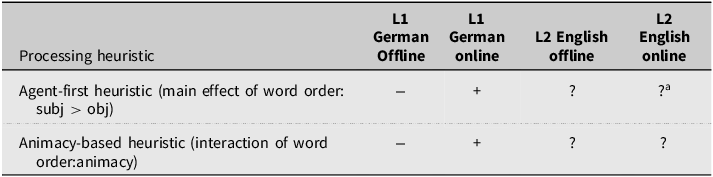
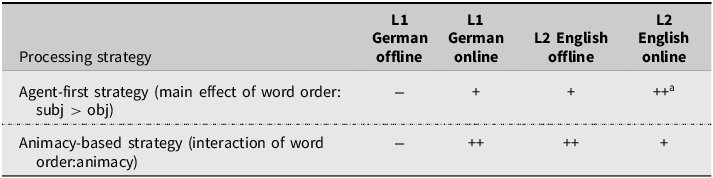
Table 1 summarizes the predictions and exploratory questions. Given our stimuli, an agent-first heuristic would be detectable as a main effect of word order, with subject-initial questions being processed faster and interpreted with a higher accuracy than object-initial questions, while the animacy-based heuristic would be reflected in an interaction between word order and animacy, similar to what was observed by Rankin (Reference Rankin2014). Note, however, that there is a caveat for the English gaze data: Due to the word order differences illustrated above, participants will have heard the lexical verb earlier for subject-initial questions, which may constitute an additional advantage for subject-initial questions during processing. In contrast, for object-initial questions, participants encounter the auxiliary verb “does” before the second noun. Although both verbs present a clear cue to syntactic structure, they differ in referential content, which may affect initial processing. For this reason, we will be careful to rely on evidence of the agent-first heuristic in English only when it is reflected in reaction times as well, because reaction times were measured from sentence offset and are thus not affected by this caveat. Moreover, note that this does not arise for German or for effects of animacy in either language, because the animacy-based heuristic is reflected in an interaction effect, which can be detected independently of the amount and origin of a difference between subject-initial and object-initial sentences.
Summary of predictions and exploratory questions

a Effects of the agent-first heuristic can be compounded by effects of the position of the lexical verb in the English gaze data.
Finally, note that there should be no effects of word order or of animacy if participants relied exclusively on detailed processing, which should lead to a high accuracy in all conditions alike.
Method
Participants
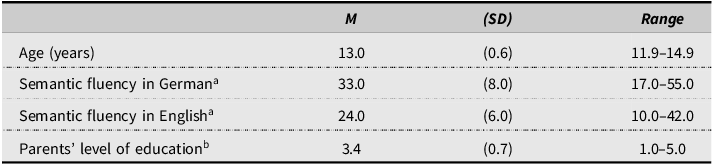
A total of 141 adolescent L1 German learners of L2 English attending grades 7-8 of German high schools in the German cities of Dortmund and Braunschweig took part in the study. They had all started learning English as a foreign language at elementary school between the ages of 6 and 8 years. Participation was voluntary, and participants received a compensation of €25. Eleven participants were excluded because of exposure to English at home, and 16 participants were excluded due to missing data. This left 114 participants for further analyses. The remaining participants (64 female, 50 male) were all learners of English as a L2 or, for learners raised bilingually with a language other than German or English, as a L3 (n = 34). Semantic fluency tasks in which participants named as many exemplars as possible within 60 seconds for categories in German (categories: “sports” and “things you can find in the kitchen”) and in English (categories: “food” and “things you can find in the classroom”) were used to assess proficiency (Bialystok et al., Reference Bialystok, Craik and Luk2008). Furthermore, parents and children completed a background questionnaire based on the Language and Social Background Questionnaire (LSBQ; Anderson et al., Reference Anderson, Mak, Keyvani Chahi and Bialystok2018). Additional tasks measuring individual differences in memory and executive function, as well as self-ratings of proficiency and an additional proficiency test in English, were administered but will not be presented or analyzed in this study (see Hopp et al., Reference Hopp, Schimke, Gastmann, Öwerdieck and Poarch2024). Participant information is summarized in Table 2. Ethical approval was granted by the Ethics Committee of the German Linguistic Society (DGfS, ethics vote no. 2020-20-210204), the study was approved by the regional school board, and the Declaration of Helsinki was followed. Informed consent was obtained and secured from parents and children.
Participant characteristics (n = 114)

a Raw scores of lexical items named within one minute collapsed across two semantic categories per language.
b Parents’ level of education as a proxy for socioeconomic status (SES) on a 5-point rank scale (1 = no school-leaving qualification, 2 = secondary school diploma, 3 = high school diploma, 4 = university degree, 5 = doctoral degree), collapsed across both parents.
Materials
We created 60 experimental items based on the names of 20 animals engaging in 10 different actions expressed by verbs. Each experimental sentence contained only one referential NP, always the second-mentioned. The same items were used for the German and English versions of the task, in that the items made reference to the same two animals and the same action, but the order of mention of the animals (e.g., which one was mentioned as the referential second-mentioned NP) was reversed between languages. For both languages, there were six different experimental conditions: Next to the four conditions illustrated in (10)-(13), participants were also presented with subject and object relative clauses, but these conditions will not be further examined in this paper (see Hopp et al., Reference Hopp, Schimke, Gastmann, Öwerdieck and Poarch2024, for an analysis).
Participants listened to the experimental stimuli while looking at two pictures on screen. Their task was to decide which of the two pictures matched the auditory stimulus by pressing one of two designated buttons. The pictures depicted two animals that were either the agent or the patient of a transitive event (e.g., hugging), and both pictures differed in displaying a reversed thematic structure. In each trial, one picture was the target image displaying the action that matched the auditorily presented sentence, and the other picture was the competitor image displaying the reversed structure (see also Figure 1). Visual stimuli by Kidd et al. (Reference Kidd, Chan and Chiu2015) and Schouwenaars (Reference Schouwenaars2018) served as a basis for the visual displays and were partially modified/amended. Auditory stimuli were recorded by a German-English bilingual female speaker, using neutral intonation and at a moderate pace.
Visual display.

The experimental stimuli were distributed across six lists, resulting in each participant hearing 60 sentences (10 sentences per condition: animate subject wh-question, animate object wh-question, inanimate subject wh-question, inanimate object wh-question, subject relative clause, and object relative clause) in each experiment. Additionally, 30 subject questions that disambiguated the picture display via the verb rather than the word order were presented as filler items. This resulted in 90 items presented in randomized order for each participant per experiment. The position of target and competitor pictures, as well as the position of the agent within each picture, were counterbalanced across lists.
Procedure
Testing took place in two laboratories at TU Dortmund University and at TU Braunschweig using the same equipment. To avoid carry-over effects from the dominant language, participants performed the English eye-tracking task before the German version. The experimental session started with an English proficiency task and then proceeded to the English eye-tracking task. After that, the semantic fluency (SF) tasks were administered. Participants also completed several working memory and cognitive control tasks. The session ended with the eye-tracking task in German, followed by the completion of the questionnaire.
The visual world experiments were programmed and run in Experiment Builder (SR Research Ltd., 2020) and displayed on a 16:10 screen. Participants’ eye movements were recorded with an EyeLink Portable Duo eye tracker with a tracking rate of 500 Hz. Participants sat at a distance of approximately 60 cm from the screen, and their right eye was tracked. Participants were instructed to decide which of the two pictures matched the auditory cue by pressing one of two buttons on a MilliKey MH-5 button box. For each participant, a 5-point calibration preceded the actual experiments. All trials were initiated with a manual drift correct item that was presented in the middle of the screen, which served as an additional calibration check and was followed by a 1500 ms picture preview. After this time had elapsed, a question was presented auditorily, and participants had 3000 ms time after the audio offset to make a decision by pressing a button. Participants were allowed to change their decision in the given time window as often as they wished to do so. After the entire time window had elapsed, the next trial was initiated with a drift correction. Participants were presented with 10 practice trials in the English task version and three practice trials in the German version to familiarize them with the task. Testing took place individually in a soundproof booth, and each eye-tracking experiment took approximately 20 minutes. In total, the entire testing session took around 120 minutes, with several options for participants to take breaks if needed.
Results
Dependent measures and data preprocessing
Results are presented and discussed separately for offline data (accuracy) and for measures of online processing, given that one main interest was in potential differences in the use of heuristics for final interpretation and during initial processing. For accuracy and reaction time data, only the first key press per participant and trial was analyzed.
As for online processing data, we analyzed eye gaze data to capture initial effects and the reaction times of the decision to assess overall processing difficulty. All analyses of processing measures were conducted on those trials where participants ultimately reached the correct interpretation, which led to the exclusion of 1641 trials (17.99%). This was done to avoid confounding measures of processing ease with measures of ultimately unsuccessful processing.
Concerning the eye gaze data, we analyzed the amount of looks to the correct picture relative to the incorrect one from the earliest possible point of referential disambiguation, that is, the onset of the second noun. As the first NP contained no referential information and the depicted action was the same in both pictures, there were no cues that could have favored looking at one or the other picture before this point. To analyze initial preferences, we zoomed in on the early time window between 250 ms following the onset of the second noun and the ensuing 500 ms, which means up to 750 ms after the onset of referential disambiguation. As the time for launching a saccade has to be taken into account (e.g., Matin et al., Reference Matin, Shao and Boff1993), no effects can be expected before this time window. As the second noun had a duration of around 500 ms, eye gaze during this window reflects processes that take place while participants hear this noun. For analysis, we excluded an additional 145 trials because no eye gaze to one of the two referents was detected (1.59%) during this window. We then computed the mean proportion of looks to the target picture per participant and trial. From this, we calculated the logarithm of the odds (elog) of looking at the target compared to the non-target picture (log[Prop/(1-Prop)], compare Hopp et al., Reference Hopp, Schimke, Gastmann, Öwerdieck and Poarch2024). Subsequently, we added a value of 0.05 to the numerator and the denominator to avoid values of exactly 0 or 1, which are undefined. Positive elog values indicate a higher chance of looking at the correct picture than the incorrect one, while negative values indicate the reverse. Second, we also measured the latencies of the final decisions from sentence offsets. Trials in which the decision was taken before audio offset (786 cases, that is 8.62%) or more than 2.5 seconds after sentence offset (125 cases, that is 1.37%) were excluded from this analysis to make sure that the data reflected processing of the whole sentence and did not include overly long reaction times that may be indicative of distraction.
For all dependent measures, we conducted analyses on joint data sets from both experiments and computed (generalized) linear mixed-effects models using the lme4 (Bates et al., Reference Bates, Mächler, Bolker and Walker2015) and lmertest package (Kuznetsova et al., Reference Kuznetsova, Brockhoff and Christensen2017) in R (version 4.2.2, R Core Team, 2022). We entered language, word order, and animacy, as well as their interactions, as fixed effects. All predictor variables were sum-coded (language: German = 1, English = −1, word order: subject = 1, object = −1, animacy: animate = 1, inanimate = −1). Furthermore, we used the buildmer package (Voeten, Reference Voeten2021) to identify the maximal random effects structure that converged, using the “order”-command. To explore interactions with Language, which were found in all models, we conducted further analyses separately for L1 German and L2 English. In these language-specific analyses, we added a proficiency measure (semantic fluency, SF) to the models to account for this factor.
Offline data: accuracy
Figure 2 displays the mean accuracy of the sentence-final decisions per condition and language. Overall, the proportion of correct answers for subject-initial questions was 0.90 (SD = 0.13) in L1 German and 0.79 (SD = 0.19) in L2 English. For object-initial questions, it was 0.90 (SD = 0.13) in L1 German and 0.70 (SD = 0.27) in L2 English. This overall high accuracy shows that, in most cases, participants ultimately relied on detailed processing both in the L1 and the L2.
Mean accuracy in proportion of correct responses per condition. Error bars represent 95% confidence intervals.

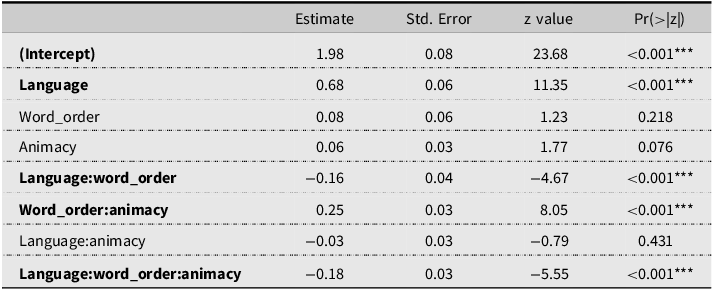
Table 3 summarizes the output of the generalized logistic mixed effects model that was fitted to these data.
Output of a generalized mixed effects model for accuracy.

Note: Significant effects in bold. * p < .05; ** p < .01; *** p < .001.
Formula: glmer(correct_Decision ∼ 1 + language + word_order + language:word_order + animacy + word_order:animacy + language:animacy + language:word_order:animacy + (1 + word_order + language | participant) + (1 + language + animacy | item)).
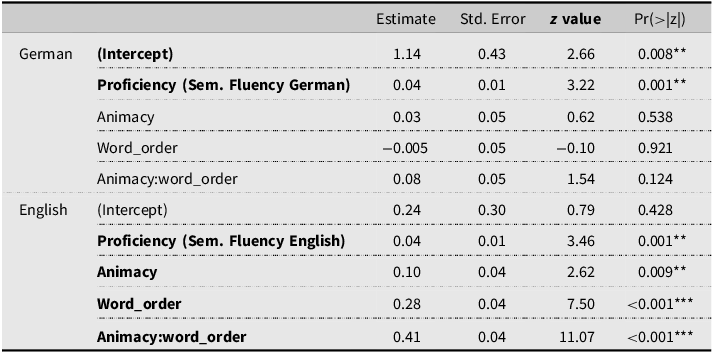
There was a main effect of language, with accuracy being overall higher in L1 German compared to L2 English. Furthermore, there were two-way interactions between language and word order, and word order and animacy, as well as a three-way interaction between language, word order, and animacy. In light of the interactions with language, we carried out separate analyses by language. Results of the subset models for each of the two languages are summarized in Table 4.
Outputs of generalized mixed effects models for accuracy, separately per language.

Note: Significant effects in bold. * p < .05; ** p < .01; *** p < .001.
Formula for the model for German: glmer(correct_Decision ∼ 1 + SF_DE + animacy + word_order + animacy:word_order + (1 | Participant) + (1 | item) + (0 + SF_DE | item)), Formula for the model for English: glmer(correct_Decision ∼ 1 + word_oder + SF_EN + animacy + word_order:animacy + (1 | Participant) + (1 | item)).
For L1 German, the absence of word order or animacy effects reflects the overall high accuracy across all conditions, which shows that participants successfully used case marking. Accuracy was affected by proficiency, in that participants who had a higher German semantic fluency score also had an even higher accuracy score than participants with lower German semantic fluency. There was no reliable evidence of an influence of either processing heuristics on top of this detailed processing. For L2 English, the overall accuracy was also modulated by proficiency, with higher accuracy for more proficient learners. Furthermore, there were main effects of animacy and word order. The main effect of word order is due to subject-initial questions being interpreted correctly more often than object-initial questions. This provides evidence of the use of the agent-first heuristic. However, this effect is modulated by animacy, as evidenced in the two-way interaction. For inanimate first nouns, accuracy was higher for object-initial than for subject-initial questions. The fact that the animacy of the first noun reversed the word order preferences suggests the influence of the animacy heuristic over and above the agent-first heuristic in these data. Before we discuss these patterns further, we turn to the online results.
Online data: eye gaze and decision latencies
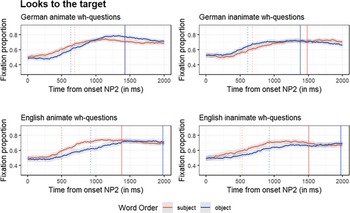
Figure 3 gives an overview of the unfolding online interpretation of the sentences by displaying the proportion of looks to the correct picture across time for all trials with correct answers in all conditions and for both experiments. Time is displayed on the x-axis, with 0 corresponding to the onset of the second noun. The proportion of looks to the correct picture out of all looks to either the correct or the incorrect picture is displayed on the y-axis. Dotted lines represent sentence offsets in the two conditions, and solid lines represent the average decision latencies. Note that because the graphs were normalized according to the referential disambiguation point, the decision latencies do not correspond directly to those analyzed below, which were normalized according to sentence offsets.
Time course of eye movements across experiments and conditions for trials with correct decisions only. Dotted lines represent sentence offsets, solid lines represent the average decision latencies (both relative to the onset of NP2). Note that average decision latencies did not differ between word order conditions for German animate questions.

These plots reveal different initial preferences in the two languages: in L1 German, there was an earlier rise in the proportion of target looks for subject-initial than for object-initial sentences for animate first NPs, but the reverse pattern held for inanimate first NPs, where the number of target looks started to rise earlier for object-initial than for subject-initial sentences. This points to the early use of an animacy-based strategy in the L1. By contrast, in L2 English, while the proportion of correct looks rose earlier for subject-initial than for object-initial sentences, this preference was not modulated by animacy.
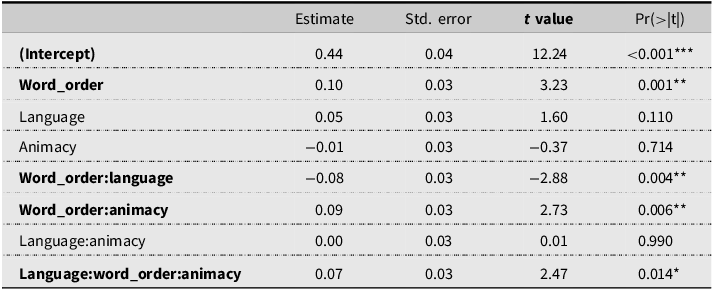
To analyze these initial preferences, Figure 4 displays the mean elog values in the 250–750 ms time window following the onset of the second noun across conditions and languages. The output of the inferential analysis is summarized in Table 5.
Mean elog values (logarithm of the odds of looking at the target picture relative to the competitor picture in a time window of 250–750 ms after onset of disambiguation for trials with correct decisions only). Error bars represent 95% confidence intervals.

Output of a mixed effects model for mean elog values in 250–750 ms after 2nd noun onset.

Note: Significant effects in bold. * p < .05; ** p < .01; *** p < .001.
Formula: lmer(Elog_250 ∼ 1 + word_order + language + word_order:language + animacy + word_order:animacy + language:animacy + word_order:language:animacy + (1 | participant) + (1 + word_order + language | item)).
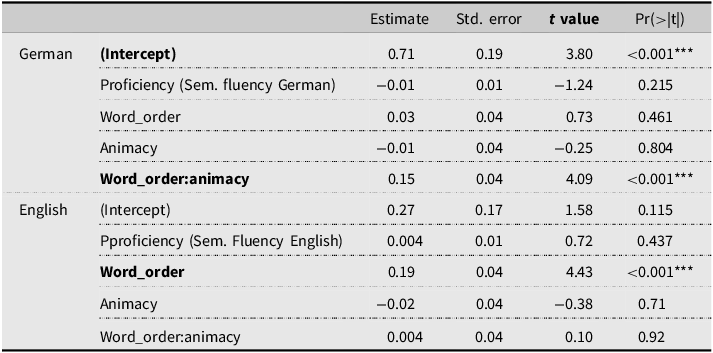
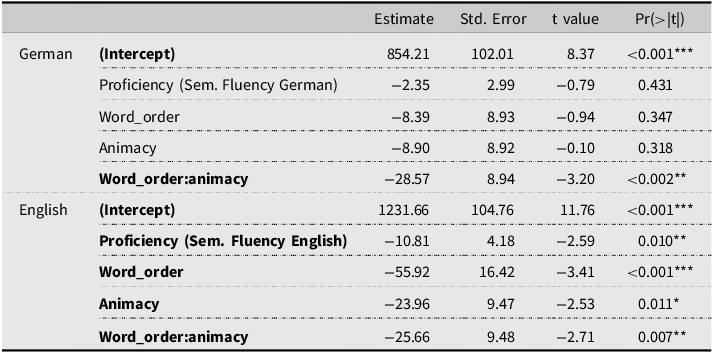
There was a main effect of word order, reflecting the application of an overall agent-first strategy, and an interaction between word order and animacy, reflecting the use of an overall animacy-based strategy. As these effects were further qualified by a two-way interaction between word order and language and a three-way interaction between language, word order, and animacy, we again ran subset models for the two experiments separately. The results are summarized in Table 6.
Outputs of mixed effects models for gaze behavior, separately per language.

Note: Significant effects in bold. * p < .05; ** p < .01; *** p < .001.
Formula for the model for German: Elog_250 ∼ 1 + SF_DE +word_order + animacy + word_order:animacy + (1 | Participant) + (1 | item) + (0 + subj_obj | item)), formula for the model for English: lmer(Elog_250 ∼ 1 + word_order + animacy + word_order:animacy + (1 | participant)).
These analyses show that participants used different processing heuristics in their two languages: In their L1 German, their initial processing was dominated by an animacy-based strategy—as seen in the interaction between word order and animacy. In their L2 English, there is no evidence of an animacy-based strategy. Instead, there was a main effect of word order, which suggests the use of the agent-first strategy.
Figure 5 displays the decision latencies. As shown in Table 7, the statistical model for decision latencies revealed a main effect of language, with overall shorter decision latencies in L1 than in L2. There were also main effects of word order and animacy, as well as significant two-way interactions between word order and animacy and between language and word order. The three-way interaction was not significant, likely due to the large differences in decision latencies between L1 and L2, which could overshadow the comparatively smaller effects of word order and animacy.
Mean decision latencies in milliseconds per condition and language. Error bars represent 95% confidence intervals.

Output of a mixed effects model for decision latencies.

Note: Significant effects in bold. * p < .05; ** p < .01; *** p < .001.
Formula: lmer(RT ∼ 1 + language + word_order + language:word_order + animacy + word_order:animacy + language:animacy + language:word_order:animacy + (1 + language + word_order + language:word_order | participant) + (1 + word_order + language + language:word_order | item)).
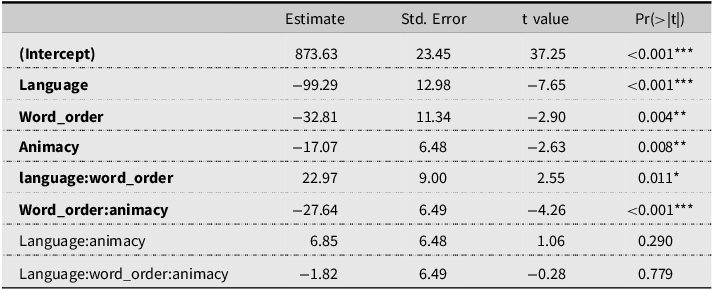
To break down the two-way interactions, we again conducted language-specific analyses, displayed in Table 8.
Output of mixed effects models for decision latencies, separately by language.

Note: Significant effects in bold. * p < .05; ** p < .01; *** p < .001.
Formula for German: lmer(RT ∼ 1 + word_order + animacy + word_order:animacy + SF_DE + (1 | Participant) + (1 | item)), Formula for English: lmer(RT ∼ 1 + word_order + animacy + word_order:animacy + SF_EN + (1 | Participant) + (1 | item) + (0 + subj_obj | item) + (0 + word_order | Participant)).
For L1 German, the interaction of word order and animacy and the absence of a main effect of word order provide clear evidence of an animacy-based heuristic. Accordingly, the agent-first heuristic seems to play a role only for the animate conditions, as animacy cannot account for the preference for subject-initial over object-initial sentences in these conditions. For L2 English, there is also evidence of both heuristics. The results for the inanimate first NP conditions allow for evaluating the weight of the two heuristics: given that subject-initial sentences were processed faster than object-initial ones even when the first NP was inanimate, we can conclude that the agent-first heuristic has more weight than the animacy-based heuristic, contrary to what we found in L1 and in the L2 offline decisions.Footnote 2 To sum up, in the online results from both measures, there was evidence of successful detailed processing in both languages in that target-like interpretations were mostly reached in offline and also during online processing. On top of this, there was evidence of the application of both processing heuristics, but not to the same degree in both experiments. In L1 German, the animacy-based heuristic was used both during initial and later stages of processing. The fact that, for animate first NPs, subject-initial questions were processed faster than object-initial ones in German constitutes evidence that the agent-first heuristic also played a role, albeit a less important one than the animacy-based heuristic. In contrast, in L2 English, there was clear evidence of an initially easier processing of subject-initial sentences, while the animacy heuristic did not surface in the gaze data and emerged only weakly in the decision latencies to then become manifest in comprehension accuracy.
Discussion
The current study found that adolescent language users ultimately relied mostly on detailed grammatical processing to interpret wh-questions in their sentence-final interpretation. In addition, we found evidence of both the animacy-based and the agent-first heuristic. The use and weight of the two heuristics were different between offline interpretations and online processing and between L1 and L2 processing. Table 9 presents an overview of the findings. We will discuss these first for offline interpretations and then for online processing.
Summary of findings

Note: When two strategies are present in the same column, the more dominant one is indicated by the symbol ++.
a Effects of the agent-first heuristic can be compounded by effects of the position of the lexical verb in the English gaze data.
Concerning sentence-final offline interpretations, as expected, there was no clear evidence of processing heuristics for unambiguous wh-questions in L1 German. This confirms the expectation that L1 speakers use detailed processing, in particular in situations without time or communicative pressure. In contrast, processing heuristics competed with target-like morphosyntactic processing in L2 English. We can assume that the participants had not yet reached stable target-like knowledge about word order constraints in the L2, and that this contributed to an influence of heuristics in offline interpretations. The dominant strategy was animacy-based, similar to what was observed in Rankin (Reference Rankin2014). Additionally, learners displayed a general subject-preference, thus, an agent-first heuristic,Footnote 3 which was visible mainly for the conditions with an animate first NP. Taken together, these offline results confirm that L2 learners often rely on heuristic processing and document that both heuristics are at play in this group and for these structures. It is possible that learners used these heuristics because they are L1-independent strategies in initial acquisition, as is assumed by some models (Klein & Perdue, Reference Klein and Perdue1997; VanPatten, Reference VanPatten, VanPatten and Williams2007, Reference VanPatten2015). It is also possible that learners transferred the heuristics from the L1. The agent-first heuristic has often been documented during processing in L1 German (Schlesewsky et al., Reference Schlesewsky, Fanselow, Kliegl, Krems, Hemforth and Konieczny2000; Schouwenaars et al., Reference Schouwenaars, Hendriks and Ruigendijk2018), and L1 speakers of German rely on animacy cues when interpreting globally ambiguous questions (Grüter & Hopp, Reference Grüter and Hopp2021; Rankin, Reference Rankin2014). Importantly, while the strategies as such may have been transferred from the L1, the findingthat they were evident not only during processing, but also in final judgments, is unique to the L2.
Concerning online processing, as expected, there was detailed morphosyntactic processing both in L1 and in L2. On top of this, participants used both heuristics in their L1 and their L2, but their weights and time courses were different: Whereas the animacy-based heuristic was dominant throughout in L1 German and only modulated by the agent-first heuristic in the animate conditions, effects of the animacy-based heuristic emerged much later in L2 English. In initial gaze data, subject-initial sentences led to more looks to the correct picture than object-initial sentences, and this preference was modulated by animacy only in the decision latency data. For processing in L1 German, this result extends the previous evidence of the importance of animacy for the processing of German wh-questions from offline to online data. For processing in the L2, the results confirm the expectation that heuristics play an important role during L2 processing. They do not confirm the more specific prediction made by the Competition Model (MacWhinney & Bates, Reference MacWhinney and Bates1989) that the selection and weight of heuristics in the L2 should be determined by those of the L1, in particular at low levels of proficiency. Instead, our results suggest that heuristic processing in L2 development has a unique profile and time course and is not comparable to heuristic processing for similar sentences in the L1. Specifically, our results suggest that the agent-first heuristic is dominant in early measures in L2 English and is only later modulated by the animacy-based heuristic, which raises the question of what may cause this difference.Footnote 4
One factor could be that participants reacted later to information that came in later. This does not seem plausible, however, because just as the agent-first heuristic can be applied from the start of a sentence in principle, animacy was signaled lexically on the first NP of the stimuli sentences, which should make this information easily available for further processing.Footnote 5 Nevertheless, there were as many looks to the picture corresponding to the subject-initial interpretation for sentences starting with an animate as for those starting with an inanimate NP in initial gaze data. This finding suggests that, even though animacy information was available at this point, it was used only later in processing, as reflected in the decision latencies and accuracies. In other words, the relevant cues for both heuristics were available early in the sentence, and both heuristics were used from the start during L1 processing (albeit with different weights); yet, they were not used simultaneously in the L2. This in turn suggests that L2 learners may need to prioritize heuristics. This observation complements suggestions from the literature on morphosyntactic processing, where delays in the use of information have been argued to reflect limitations in learners to integrate all available sources of information at once (Hopp, Reference Hopp2018; Sorace & Filiaci, Reference Sorace and Filiaci2006). The animacy-based heuristic may be comparatively less available, because it is informative only in cases where referents differ in animacy. This means that the agent-first heuristic has a broader range of application, and this may be a reason why learners seem to privilege it. In addition, the relatively rigid word order of the target language, English, may further support learners in using the agent-first heuristic. It is important to note that our data do not allow for distinguishing L2-specific effects from effects of English as a target language, because we did not include any other L2 in our study. While it seems unlikely that the overall higher use of heuristics in L2 compared to L1 is specific to English, it is of course possible that the comparatively lower weight that learners assigned to the animacy-based heuristic in processing the L2 compared to their processing of the L1 reflects effects of English in particular. Further studies with other language combinations are necessary to examine this possibility. In particular, future studies could look at target languages with less rigid word order, such as Turkish or Slavic languages.
To sum up, our findings confirm general assumptions about detailed processing and processing heuristics, in that detailed processing was more likely in L1 data and offline data, and heuristic processing was more likely in the L2 and during online processing. Importantly, we also made observations that may provide ideas as to what determines the choice and the weight of different heuristic strategies. In particular, we have suggested that comprehenders may be able to quickly apply more than one heuristic in a L1, but may have more difficulties doing so in a L2, in particular at low levels of proficiency. In our data, participants demonstrated a strong reliance on the agent-first heuristic during L2 processing, and integrated the animacy-based heuristic only later during processing. These observations suggest that the selection and time-course of heuristics may have a unique profile in L2 compared to L1 processing. Future studies could test how this profile manifests not only in different language combinations but also across different types of learners. The learners we studied were at a comparatively low level of proficiency, as suggested by the use of heuristics even in their offline decisions. Future studies could look at whether heuristic processing is different during L2 online processing even at stages at which learners have come to mostly rely on detailed processing for their offline judgments.Footnote 6 At the same time, knowing which heuristics learners apply under which conditions could also inform our knowledge not only of the outcome, but also the process of language acquisition, as heuristics often need to be overcome to successfully apply target-like grammatical knowledge (VanPatten, Reference VanPatten, VanPatten and Williams2007, Reference VanPatten2015). In all, a complete model of L2 acquisition should take both types of knowledge into account.
Finally, a more complete empirical picture of the use of heuristics both in L1 and in L2 processing could help in developing and testing theoretical proposals regarding the origin of heuristics. Heuristics have been assumed to be universal processing strategies by some (e.g., Klein & Perdue, Reference Klein and Perdue1997). In line with this assumption, Ferreira (Reference Ferreira2003) has shown that heuristic preferences cannot be reduced to strategies derived from frequency distributions. In any case, the frequencies of sentence types that conform to heuristics could equally be a cause or a result of the heuristic processing patterns attested. Nevertheless, future studies could deepen our understanding of heuristics by not only looking at more language combinations and learner types in experimental data, but also by taking corpus frequencies of the relevant constructions into account.
To conclude, we have found that while heuristics are used both in L1 and L2, they do not seem to be directly transferred or shared across languages. Beyond giving insights into the differential use of heuristics in L1 and L2, the present study highlights the importance of within-learner comparisons of sentence processing in their L1 and L2, which in and of themselves control for individual differences. At the same time, they allow us to chart individual learners’ knowledge states and developmental trajectories. This way, within-learner comparisons will be integral to our understanding of processing and acquisition.
Replication package
The materials, data, code and analyses for the results reported in the paper are available at: https://osf.io/5n49a.
Acknowledgements
We thank Damian Stier for his help with experiment creation, statistical analysis, and trouble-shooting as well as Sarina Langer, Josefin Lindgren, Miriam Brockmeyer-Koch and all research assistants at TU Braunschweig and TU Dortmund who were involved in data collection and preparation for analysis. Finally, we would like to thank the editor and the anonymous reviewers for Applied Psycholinguistics whose comments and suggestions helped us improve the manuscript.
Financial support
This work was supported by the German Research Foundation (DFG; grant no. 436221639) to Sarah Schimke, Gregory Poarch and Holger Hopp, and it was conducted while Freya Gastmann and Sarah Schimke were affiliated with TU Dortmund University.





 Open access

