


Introduction
Contingent valuation (CV) is widely used in various disciplines for its flexibility and capability of capturing both use and nonuse values. In recent years, Carson and Groves (Reference Carson and Groves2007) found that the referendum-style, single-bound CV is the only preference elicitation format that is incentive-compatible if survey respondents believe that their choices will have an impact on the outcome of the future policy, and they care about the outcome of such actions. This is referred to as consequentiality in the literature. Consequentiality is essentially the probability of the utility changing from the status quo level (utility without the proposed program or voting no) to the level with the proposed program if the program is implemented (utility of voting yes), as perceived by respondents. When respondents perceive CV as inconsequential, meaning the utility would stay at the status quo level regardless of the outcome of the survey, their choices in the referendum may be random. Consequently, the effects of consequentiality have been extensively examined in the empirical literature (e.g., Bulte et al. Reference Bulte, Gerking, List and de Zeeuw2005; Vossler and Evans Reference Vossler and Evans2009; Landry and List Reference Landry and List2007; Nepal et al. Reference Nepal, Berrens and Bohara2009; Broadbent, Grandy, and Berrens Reference Broadbent, Grandy and Berrens2010; Vossler, Doyon, and Rondeau Reference Vossler, Doyon and Rondeau2012; Hwang, Petrolia, and Interis Reference Hwang, Petrolia and Interis2014; Interis and Petrolia Reference Interis and Petrolia2016; Groothuis et al. Reference Groothuis and Whitehead2002; Zawojska, Bartczak, and Czajkowski Reference Zawojska, Bartczak and Czajkowski2019). However, consequentiality examined in the literature is mainly concerned with the perceived probability rather than the degree/magnitude of the change in utility. One may perceive that it is certain that their utility will change from status quo if the proposed program is implemented (consequential), but the degree of the change can be different from what the researcher intended to measure if they have subjective perceptions about benefit and cost levels that are different from what is specified in the survey. Champ et al. (Reference Champ, Flores, Brown and Chivers2002) tested how the payment mechanism affects subjective perceptions about the cost level. They included a survey question that asked whether the cost presented in the survey was what respondents thought they would actually pay. They included three payment mechanisms: (1) voluntary individual contribution to a trust fund set up for the program; (2) provision point mechanism involving voluntary contributions to a trust fund set up which specified that at least 30 percent of the households in the region would have to agree to pay for the program; and (3) one-time tax for residents based on the results of a referendum. They found that for the individual contribution mechanism, 37 percent of the respondents thought that the actual cost would be what was presented in the survey, 50 percent thought the actual cost would be higher, and 37 percent thought the actual cost would be lower. For the provision point mechanism, 52 percent of the respondents thought that the actual cost would be what was presented in the survey, 40 percent thought the actual cost would be higher, and 8 percent thought the actual cost would be lower. For the referendum, 58 percent of the respondents thought that the actual cost would be what was presented in the survey, 38 percent thought the actual cost would be higher, and 4 percent thought the actual cost would be lower. However, they did not utilize the measured perceptions in their willingness-to-pay (WTP) estimation. Flores and Strong (Reference Flores and Strong2007) theoretically showed that subjective perceptions regarding the actual cost of a proposed program result in biased WTP estimates. They found that when a respondent perceives that the actual cost will be higher (lower) than what is stated in the survey, the mean WTP estimate suffers from a downward (upward) bias. To my knowledge, there is no study in the literature that empirically tests effects of subjective perceptions about the actual cost or deviations from the cost level on WTP. Carson, Flores, and Meade (Reference Carson, Flores and Meade2001) and Carson and Groves (Reference Carson and Groves2007) argued that the payment mechanism in CV must be credible to respondents so that they believe that they will actually have to pay the cost presented in the referendum if it is implemented. This is often referred to as payment consequentiality in the literature (e.g., Zawojska, Bartczak, and Czajkowski Reference Zawojska, Bartczak and Czajkowski2019). Similar to consequentiality discussed earlier, payment consequentiality examined in the literature is mainly concerned with the probability/probability of payment rather than subjective perceptions about the cost amount. Vossler and Holladay (Reference Vossler and Holladay2018) showed that it is critical that the cost amount is described as uncertain in the valuation question in order to have incentive-compatible responses for open-ended or payment-card elicitation formats.
It is also possible that respondents perceive that the actual benefit level will be different than what is specified in the survey. Although there are studies that measured respondents’ confidence in agencies providing the benefit proposed in the survey (e.g., Petrolia, Interis, and Hwang Reference Petrolia, Interis and Hwang2014), to my knowledge, there is no study in the literature that examines subjective perceptions or deviations from the benefit level. The main contribution of this paper is to measure the subjective perceptions about the benefit and cost levels in terms of and empirically test their effects on WTP estimates.
Conceptual framework
For a referendum-style CV, utilities of voting yes and no for an individual i can be represented as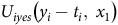 ${U_{iyes}}\left( {{y_i} - {t_i},\;{x_1}} \right)$
and
${U_{iyes}}\left( {{y_i} - {t_i},\;{x_1}} \right)$
and ${U_{ino}}\left( {{y_i},\;{x_0}} \right)$
, respectively, where
${U_{ino}}\left( {{y_i},\;{x_0}} \right)$
, respectively, where ${y_i}$
is income,
${y_i}$
is income, ${t_i}$
is the bid amount (cost) of the proposed program presented in the referendum,
${t_i}$
is the bid amount (cost) of the proposed program presented in the referendum, ${x_1}$
is the new level of quantity/quality of environmental goods/services of interest after the proposed program is implemented (benefit level), and
${x_1}$
is the new level of quantity/quality of environmental goods/services of interest after the proposed program is implemented (benefit level), and ${x_0}$
is the current level of quantity/quality of the environmental goods/service, say wetlands. It is assumed that respondents evaluate their options based on the benefit and cost levels presented in the referendum. However, if a respondent has subjective expectations/perceptions about benefit and cost levels that deviate from the levels specified by the researcher, the utility of voting yes becomes
${x_0}$
is the current level of quantity/quality of the environmental goods/service, say wetlands. It is assumed that respondents evaluate their options based on the benefit and cost levels presented in the referendum. However, if a respondent has subjective expectations/perceptions about benefit and cost levels that deviate from the levels specified by the researcher, the utility of voting yes becomes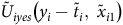 ${\tilde U_{iyes}}\left( {{y_i} - {{\tilde t}_i},\;{{\tilde x}_{i1}}} \right)$
. For such respondents, they evaluate their tradeoffs at
${\tilde U_{iyes}}\left( {{y_i} - {{\tilde t}_i},\;{{\tilde x}_{i1}}} \right)$
. For such respondents, they evaluate their tradeoffs at ${\tilde t_i}$
and
${\tilde t_i}$
and ${\tilde x_{i1}}$
rather than at
${\tilde x_{i1}}$
rather than at ${t_i}$
and
${t_i}$
and ${x_1}$
which implies that the preferences measured are different from what the researcher intended to measure. Therefore, there is a potential measurement error, and WTP estimates may be biased. If we assume
${x_1}$
which implies that the preferences measured are different from what the researcher intended to measure. Therefore, there is a potential measurement error, and WTP estimates may be biased. If we assume ${t_i} \gt {\tilde t_i}$
and
${t_i} \gt {\tilde t_i}$
and $\;{x_1} \lt {\tilde x_{i1}}$
are preferred (by respondents) to
$\;{x_1} \lt {\tilde x_{i1}}$
are preferred (by respondents) to ${t_i} = {\tilde t_i}$
and
${t_i} = {\tilde t_i}$
and $\;{x_1} = {\tilde x_{i1}}$
, respectively, and
$\;{x_1} = {\tilde x_{i1}}$
, respectively, and ${t_i} = {\tilde t_i}$
and
${t_i} = {\tilde t_i}$
and $\;{x_1} = {\tilde x_{i1}}$
are preferred to
$\;{x_1} = {\tilde x_{i1}}$
are preferred to ${t_i} \lt {\tilde t_i}$
and
${t_i} \lt {\tilde t_i}$
and $\;{x_1} \gt {\tilde x_{i1}}$
, respectively, we can predict the directions of the bias as follows:
$\;{x_1} \gt {\tilde x_{i1}}$
, respectively, we can predict the directions of the bias as follows:
-
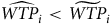
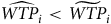
1) If ${t_i} \gt {\tilde t_i}$
,
${U_{iyes}} \lt {\tilde U_{iyes}}$
, and
$\widehat {WT{P_i}} \gt {\widetilde {WTP}_i}$
.
${t_i} \gt {\tilde t_i}$
,
${U_{iyes}} \lt {\tilde U_{iyes}}$
, and
$\widehat {WT{P_i}} \gt {\widetilde {WTP}_i}$
. -
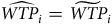
2) If
${t_i} = {\tilde t_i}$
,
${U_{iyes}} = {\tilde U_{iyes}}$
, and
$\widehat {WT{P_i}} = {\widetilde {WTP}_i}$
. -
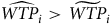
3) If
${t_i} \lt {\tilde t_i}$
,
${U_{iyes}} \gt {\tilde U_{iyes}}$
, and
$\widehat {WT{P_i}} \lt {\widetilde {WTP}_i}$
. -
4) If
${x_1} \gt {\tilde x_{i1}}$
,
${U_{iyes}} \gt {\tilde U_{iyes}}$
, and
$\widehat {WT{P_i}} \lt {\widetilde {WTP}_i}$
. -
5) If
${x_1} = {\tilde x_{i1}}$
,
${U_{iyes}} = {\tilde U_{iyes}}$
, and
$\widehat {WT{P_i}} = {\widetilde {WTP}_i}$
. -
6) If
${x_1} \lt {\tilde x_{i1}}$
,
${U_{iyes}} \lt {\tilde U_{iyes}}$
, and
$\widehat {WT{P_i}} \gt {\widetilde {WTP}_i}$
.


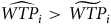


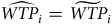








For example, if one perceived that the actual cost would be less than what was presented ( ${t_i} \gt {\tilde t_i}$
), the proposed scenario would be more appealing to them than what the researcher intended (
${t_i} \gt {\tilde t_i}$
), the proposed scenario would be more appealing to them than what the researcher intended ( ${U_{iyes}} \lt {\tilde U_{iyes}}$
,). If they voted yes, then the correct inference of their WTP would be
${U_{iyes}} \lt {\tilde U_{iyes}}$
,). If they voted yes, then the correct inference of their WTP would be ${\widetilde {WTP}_i} \ge {\tilde t_i}$
rather than
${\widetilde {WTP}_i} \ge {\tilde t_i}$
rather than $\widehat {WT{P_i}} \ge {t_i}$
. Therefore,
$\widehat {WT{P_i}} \ge {t_i}$
. Therefore,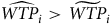 $\widehat {WT{P_i}} \gt {\widetilde {WTP}_i}$
. Based on the assumptions above, there are two cases where the WTP estimate is unbiased (2 and 5), two cases where the WTP estimate suffers from an upward bias (1 and 6), and two cases where the WTP estimate suffers from a downward bias (3 and 4). It is worth noting that it is less likely that respondents would perceive that more wetlands would be restored than what was proposed. Therefore, it is reasonable to suspect that Case 6 is less likely to occur or the proportion of respondents in the sample who fall under Case 6 is very small. Consequently, of the three remaining biased cases, two of them are biased downwards, and only one of them is biased upwards.
$\widehat {WT{P_i}} \gt {\widetilde {WTP}_i}$
. Based on the assumptions above, there are two cases where the WTP estimate is unbiased (2 and 5), two cases where the WTP estimate suffers from an upward bias (1 and 6), and two cases where the WTP estimate suffers from a downward bias (3 and 4). It is worth noting that it is less likely that respondents would perceive that more wetlands would be restored than what was proposed. Therefore, it is reasonable to suspect that Case 6 is less likely to occur or the proportion of respondents in the sample who fall under Case 6 is very small. Consequently, of the three remaining biased cases, two of them are biased downwards, and only one of them is biased upwards.
Since respondents are evaluating both benefit and cost of the proposed program simultaneously to determine which vote they cast, we need to consider ${\tilde t_i}$
and
${\tilde t_i}$
and ${\tilde x_i}$
together. Considering both
${\tilde x_i}$
together. Considering both ${\tilde t_i}$
and
${\tilde t_i}$
and ${\tilde x_i}$
together, we can predict directions of the bias as follows:
${\tilde x_i}$
together, we can predict directions of the bias as follows:
-
a) If
${t_i} \gt {\tilde t_i}$
and
$\;{x_1} = {\tilde x_{i1}}$
,
${U_{iyes}} \lt {\tilde U_{iyes}}$
, and
$\widehat {WT{P_i}} \gt {\widetilde {WTP}_i}$
. -
b) If
${t_i} \gt {\tilde t_i}$
and
$\;{x_1} \lt {\tilde x_{i1}}$
,
${U_{iyes}} \lt {\tilde U_{iyes}}$
, and
$\widehat {WT{P_i}} \gt {\widetilde {WTP}_i}$
. -
c) If
${t_i} = {\tilde t_i}$
and
$\;{x_1} \gt {\tilde x_{i1}}$
,
${U_{iyes}} \gt {\tilde U_{iyes}}$
, and
$\widehat {WT{P_i}} \lt {\widetilde {WTP}_i}$
. -
d) If
${t_i} = {\tilde t_i}$
and
$\;{x_1} = {\tilde x_{i1}}$
,
${U_{iyes}} = {\tilde U_{iyes}}$
, and
$\widehat {WT{P_i}} = {\widetilde {WTP}_i}$
. -
e) If
${t_i} = {\tilde t_i}$
and
$\;{x_1} \lt {\tilde x_{i1}}$
,
${U_{iyes}} \lt {\tilde U_{iyes}}$
, and
$\widehat {WT{P_i}} \gt {\widetilde {WTP}_i}$
. -
f) If
${t_i} \lt {\tilde t_i}$
and
$\;{x_1} \gt {\tilde x_{i1}}$
,
${U_{iyes}} \gt {\tilde U_{iyes}}$
, and
$\widehat {WT{P_i}} \lt {\widetilde {WTP}_i}$
. -
g) If
${t_i} \lt {\tilde t_i}$
and
$\;{x_1} = {\tilde x_{i1}}$
,
${U_{iyes}} \gt {\tilde U_{iyes}}$
, and
$\widehat {WT{P_i}} \lt {\widetilde {WTP}_i}$
.


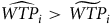


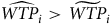


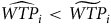


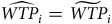


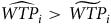


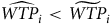


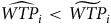
There is one case where the WTP estimate is unbiased (d), three cases where the WTP estimate is biased downwards (c, f, and g), and three cases where the WTP estimate is biased upwards (a, b, and e). In Case d, respondents evaluate the CV scenario at the benefit and cost levels specified by the researcher. In Case c, respondents evaluate the CV scenario at the cost level specified by the researcher but at a lower benefit level than what the researcher specified. In Case f, respondents not only perceive that the actual cost level would be higher but also the benefit level would be lower than what the researcher specified. Therefore, Case f is predicted to yield the lowest WTP estimate. In Case g, even though respondents evaluate the scenario at the given benefit level, they perceive that the actual amount would be higher than what is specified. Respondents in Case a perceive that the actual cost would be lower than the specified level even though they perceive that the benefit level does not deviate. Respondents in Case b are expected to yield the highest WTP estimate as not only do they perceive that the cost would be lower but also the benefit would be higher than what the scenario describes. Lastly, in Case e, respondents perceive that the actual benefit level would be higher than what the scenario describes even though the perceived cost does not deviate from the scenario. Note that if $({t_i} \gt {\tilde t_i}$
and
$({t_i} \gt {\tilde t_i}$
and $\;{x_1} \gt {\tilde x_{i1}})$
or
$\;{x_1} \gt {\tilde x_{i1}})$
or $({t_i} \lt {\tilde t_i}$
and
$({t_i} \lt {\tilde t_i}$
and $\;{x_1} \lt {\tilde x_{i1}})$
, the presence or the direction of bias is unclear. As discussed earlier,
$\;{x_1} \lt {\tilde x_{i1}})$
, the presence or the direction of bias is unclear. As discussed earlier, $\;{x_1} \lt {\tilde x_{i1}}$
is less likely to occur. Therefore, it is reasonable to suspect that Cases b and e are less likely to occur, or the proportion of respondents who fall under the two cases in the sample is very small. Of the remaining four cases with a bias, three of them are biased downwards, and only one of them is biased upwards. When
$\;{x_1} \lt {\tilde x_{i1}}$
is less likely to occur. Therefore, it is reasonable to suspect that Cases b and e are less likely to occur, or the proportion of respondents who fall under the two cases in the sample is very small. Of the remaining four cases with a bias, three of them are biased downwards, and only one of them is biased upwards. When ${\tilde t_i}$
and
${\tilde t_i}$
and ${\tilde x_i}$
are considered together, a downward bias becomes even more dominant compared to when
${\tilde x_i}$
are considered together, a downward bias becomes even more dominant compared to when ${\tilde t_i}$
and
${\tilde t_i}$
and ${\tilde x_i}$
are considered separately. Therefore, it can be concluded that without detecting subjective perceptions about the actual benefit and cost levels and without accounting for them, WTP may be generally underestimated. This finding contrasts with the upward bias that the literature generally finds and focuses on due to the hypothetical nature of CV – hypothetical bias (e.g., Champ and Bishop Reference Champ and Bishop2001; List Reference List2001; List and Gallet Reference List and Gallet2001; Aadland and Caplan Reference Aadland and Caplan2003; Brown, Ajzen, and Hrubes Reference Brown, Ajzen and Hrubes2003; Murphy et al. Reference Murphy, Allen, Stevens and Weatherhead2005; Hensher Reference Hensher2010; Loomis Reference Loomis2011; Penn and Hu Reference Penn and Hu2019; Schmidt and Bijmolt Reference Schmidt and Bijmolt2020).
${\tilde x_i}$
are considered separately. Therefore, it can be concluded that without detecting subjective perceptions about the actual benefit and cost levels and without accounting for them, WTP may be generally underestimated. This finding contrasts with the upward bias that the literature generally finds and focuses on due to the hypothetical nature of CV – hypothetical bias (e.g., Champ and Bishop Reference Champ and Bishop2001; List Reference List2001; List and Gallet Reference List and Gallet2001; Aadland and Caplan Reference Aadland and Caplan2003; Brown, Ajzen, and Hrubes Reference Brown, Ajzen and Hrubes2003; Murphy et al. Reference Murphy, Allen, Stevens and Weatherhead2005; Hensher Reference Hensher2010; Loomis Reference Loomis2011; Penn and Hu Reference Penn and Hu2019; Schmidt and Bijmolt Reference Schmidt and Bijmolt2020).
Data
Data used in this paper are from an online survey which was administered in 2020 by Qualtrics to its online panels with a goal to understand Floridians’ preferences for restoring coastal wetlands in Tampa Bay which is a large natural harbor and shallow estuary connected to the Gulf of Mexico on the west-central coast of Florida. A total of 7,483 Qualtrics panels were invited to take the survey, and 4,146 of them responded to the survey, yielding a response rate of 55.4 percent. After controlling for age, gender, race, education, and income to ensure the representativeness of the sample, 1,243 completed responses were provided by Qualtrics, yielding the incidence rate of 30 percent.
The survey instrument was largely adopted from Petrolia, Interis, and Hwang (Reference Petrolia, Interis and Hwang2014) and Interis and Petrolia (2016). The survey first provided detailed information about wetlands and ecosystem services provided by them such as wildlife habitats, fisheries support, storm surge protection, and improved water quality. The survey then provided information about how much wetlands have been lost in the area since 1900. The survey stated that policy makers are considering a project that will restore roughly 15,000 acres of wetlands back to the 1900 level. In the referendum-style valuation question, the cost of the proposed project was presented as a one-time payment that would be added to the 2021 federal income tax return. The cost was randomized from the following range: {$50, $300, $650, $950, $1,200}. The referendum question also included a budget constraint reminder and an option to opt-out (“I prefer not to vote”) as suggested by Arrow et al. (Reference Arrow, Solow, Portney, Leamer, Radner and Schumar1993). Figure 1 presents an example of the valuation question. Table 1 presents responses to the referendum at different bid levels. Overall, out of 1,243 responses, 798 voted yes (64.2 percent), 259 voted no (20.8 percent), and 186 (15.0 percent) opted out. After removing opt-out responses, 1,057 responses were used for the analysis.
Valuation question example.

Cross-tabulation between vote and bid in the referendum

In order to elicit respondents’ subjective perceptions about the benefit level of the project, the following question was included in the survey:
We wish to know if you had a different opinion about the acreage after the proposed restoration project. Which of the following statements best describes your opinion when you were voting?
-
1. If implemented, the project would restore wetlands to the proposed level.
-
2. If implemented, the project would restore wetlands but less than the proposed level.
-
3. If implemented, the project would restore more wetlands than the proposed level.
-
4. I don’t know.
Responses to the question are presented at the top of Table 2. About a half of the respondents (49.9 percent) perceived that the project would restore wetlands to the proposed level ( $\;{x_1} = {\tilde x_{i1}}$
), 30.8 percent perceived that the project would restore less wetlands than what was presented (
$\;{x_1} = {\tilde x_{i1}}$
), 30.8 percent perceived that the project would restore less wetlands than what was presented ( $\;{x_1} \gt {\tilde x_{i1}}$
), 7.3 percent perceived that the project would restore more wetlands than what was presented (
$\;{x_1} \gt {\tilde x_{i1}}$
), 7.3 percent perceived that the project would restore more wetlands than what was presented ( $\;{x_1} \lt {\tilde x_{i1}}$
), and 12.1 percent reported that they were uncertain about what the actual restoration level would be. As suspected, only a small proportion of the respondents perceived that more wetlands would be restored than what was proposed. Based on responses to the question, the following dummy variables were constructed to control for the subjective perceptions about the benefit level: “less benefit” (=1 if chose 2; =0 otherwise), “more benefit” (=1 if chose 3; =0 otherwise), and “DK benefit” (=1 if chose 4; =0 otherwise). Those who chose 1 served as the reference. It is hypothesized that
$\;{x_1} \lt {\tilde x_{i1}}$
), and 12.1 percent reported that they were uncertain about what the actual restoration level would be. As suspected, only a small proportion of the respondents perceived that more wetlands would be restored than what was proposed. Based on responses to the question, the following dummy variables were constructed to control for the subjective perceptions about the benefit level: “less benefit” (=1 if chose 2; =0 otherwise), “more benefit” (=1 if chose 3; =0 otherwise), and “DK benefit” (=1 if chose 4; =0 otherwise). Those who chose 1 served as the reference. It is hypothesized that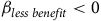 ${\beta _{less\;benefit}} \lt 0$
and
${\beta _{less\;benefit}} \lt 0$
and ${\beta _{more\;benefit}} \gt 0$
.
${\beta _{more\;benefit}} \gt 0$
.
Perceived benefit and cost levels

In order to elicit respondents’ subjective perceptions about the cost of the project, the following question was included in the survey:
We wish to know if you had a different opinion about the cost. Which of the following statements best describes your opinion when you were voting?
-
1. If implemented, I would pay the amount presented in the survey.
-
2. If implemented, the actual cost would be lower than the amount presented in the survey.
-
3. If implemented, the actual cost would be higher than the amount presented in the survey.
-
4. I don’t know.
Responses to the question are presented at the bottom of Table 2. Just over a third of the respondents (36.6 percent) perceived that the actual cost would be what was presented in the survey ( ${t_i} = {\tilde t_i}$
), 25.7 percent of the respondents perceived that the actual cost would be lower than what was presented (
${t_i} = {\tilde t_i}$
), 25.7 percent of the respondents perceived that the actual cost would be lower than what was presented ( ${t_i} \gt {\tilde t_i}$
), 15.4 percent of the respondents perceived that the actual cost would be higher than what was presented (
${t_i} \gt {\tilde t_i}$
), 15.4 percent of the respondents perceived that the actual cost would be higher than what was presented ( ${t_i} \lt {\tilde t_i}$
), and 22.2 percent of the respondents stated that they were uncertain about what the actual cost would be. Based on responses to the question, the following dummy variables were constructed to control for the subjective perceptions about cost: “less pay” (=1 if chose 2; =0 otherwise), “more pay” (=1 if chose 3; =0 otherwise), and “DK pay” (=1 if chose 4; =0 otherwise). Those who chose 1 served as the reference. It is hypothesized that
${t_i} \lt {\tilde t_i}$
), and 22.2 percent of the respondents stated that they were uncertain about what the actual cost would be. Based on responses to the question, the following dummy variables were constructed to control for the subjective perceptions about cost: “less pay” (=1 if chose 2; =0 otherwise), “more pay” (=1 if chose 3; =0 otherwise), and “DK pay” (=1 if chose 4; =0 otherwise). Those who chose 1 served as the reference. It is hypothesized that ${\beta _{less\;pay}} \gt 0$
and
${\beta _{less\;pay}} \gt 0$
and ${\beta _{more\;pay}} \lt 0$
. As for those who are uncertain about the actual benefit and cost levels, the sign of the coefficients is unclear.
${\beta _{more\;pay}} \lt 0$
. As for those who are uncertain about the actual benefit and cost levels, the sign of the coefficients is unclear.
Table 3 presents a cross-tabulation between the bid and perceived cost levels. The proportion of respondents who perceived that the actual cost would be what was presented in the survey ( ${t_i} = {\tilde t_i}$
) tended to decrease as the bid amount increased, and the proportion of “DK pay” tended to increase as the bid amount increased, but there were no clear patterns. Table 4 presents a cross-tabulation between the perceived benefit and cost levels. A large proportion of the sample believed that the actual benefit and cost levels would be what was presented in the survey (Case d) which is good, but the proportion was smaller than one third (27.4 percent) which is concerning because it implies that 72.6 percent the sample is potentially biased. Also, 10.5 percent, 7.4 percent, 6.7 percent, 3.6 percent, 2.6 percent, and 1.3 percent of the sample fell under Cases a, f, c, g, b, and e, respectively. In the conceptual framework, it was suspected that the Cases b and e would be less likely to occur. Data indicate that the Cases b and e indeed had the smallest proportions amongst all cases in the sample. Data also indicate that 17.7 percent of the sample is potentially biased downwards (c, f, and g), whereas 10.5 percent of the sample is potentially biased upwards (a). Therefore, data signals that the WTP estimate is likely to be biased downwards if the subjective perceptions are not accounted for, and the assumptions that
${t_i} = {\tilde t_i}$
) tended to decrease as the bid amount increased, and the proportion of “DK pay” tended to increase as the bid amount increased, but there were no clear patterns. Table 4 presents a cross-tabulation between the perceived benefit and cost levels. A large proportion of the sample believed that the actual benefit and cost levels would be what was presented in the survey (Case d) which is good, but the proportion was smaller than one third (27.4 percent) which is concerning because it implies that 72.6 percent the sample is potentially biased. Also, 10.5 percent, 7.4 percent, 6.7 percent, 3.6 percent, 2.6 percent, and 1.3 percent of the sample fell under Cases a, f, c, g, b, and e, respectively. In the conceptual framework, it was suspected that the Cases b and e would be less likely to occur. Data indicate that the Cases b and e indeed had the smallest proportions amongst all cases in the sample. Data also indicate that 17.7 percent of the sample is potentially biased downwards (c, f, and g), whereas 10.5 percent of the sample is potentially biased upwards (a). Therefore, data signals that the WTP estimate is likely to be biased downwards if the subjective perceptions are not accounted for, and the assumptions that ${t_i} \gt {\tilde t_i}$
and
${t_i} \gt {\tilde t_i}$
and $\;{x_1} \lt {\tilde x_{i1}}$
are preferred (by respondents) to
$\;{x_1} \lt {\tilde x_{i1}}$
are preferred (by respondents) to ${t_{}} = {\tilde t_i}$
and
${t_{}} = {\tilde t_i}$
and $\;{x_1} = {\tilde x_{i1}}$
, respectively, and
$\;{x_1} = {\tilde x_{i1}}$
, respectively, and ${t_i} = {\tilde t_i}$
and
${t_i} = {\tilde t_i}$
and $\;{x_1} = {\tilde x_{i1}}$
are preferred to
$\;{x_1} = {\tilde x_{i1}}$
are preferred to ${t_i} \lt {\tilde t_i}$
and
${t_i} \lt {\tilde t_i}$
and $\;{x_1} \gt {\tilde x_{i1}}$
, respectively, hold. Finally, it is worth noting that for 40.3 percent of the sample, the presence or the direction of a potential bias cannot be predicted (for those who are uncertain about the actual cost and benefit levels and those who fall under cases where [
$\;{x_1} \gt {\tilde x_{i1}}$
, respectively, hold. Finally, it is worth noting that for 40.3 percent of the sample, the presence or the direction of a potential bias cannot be predicted (for those who are uncertain about the actual cost and benefit levels and those who fall under cases where [ ${t_i} \gt {\tilde t_i}$
and
${t_i} \gt {\tilde t_i}$
and $\;{x_1} \gt {\tilde x_{i1}}$
] or
$\;{x_1} \gt {\tilde x_{i1}}$
] or $[{t_i} \lt {\tilde t_i}$
and
$[{t_i} \lt {\tilde t_i}$
and $\;{x_1} \lt {\tilde x_{i1}}$
]).
$\;{x_1} \lt {\tilde x_{i1}}$
]).
Cross-tabulation between bid and perceived cost levels

Cross-tabulation between perceived benefit and cost levels

Note: Percentages out of 1,057 are in the parentheses.
In addition to the dummy variables designed to control for subjective perceptions about the benefit and cost levels, other demographic variables such as “income” which is the annual household income with a range from 1 (less than $9,999) to 21 ($200,000 or more) with $10,000 increments, “white” (=1 if race is white; =0 otherwise), “employed” (=1 currently employed; =0 otherwise), and “college” (=1 if holds a bachelor’s degree or higher; =0 otherwise) were included in the regression model. Table 5 presents summary statistics of the variables used in the regression analysis.
Summary statistics

Econometric model
Following Greene (Reference Greene2012), responses to the referendum question can be modeled using the latent regression approach. A latent regression for the data can be specified as
 $${y^{\rm{*}}} = {\beta _0} + {\beta _1}Bid + {\boldsymbol{\beta}} _X^{'}{\boldsymbol{X}} + {\boldsymbol{\beta}} _T^{'}{\boldsymbol{T}} + {\boldsymbol{\beta}} _Z^{'}{\boldsymbol{Z}} + \varepsilon $$
where the observed counterpart to y* is y = 1 if and only if y* > 0; ${\boldsymbol{\beta}} _X^{'}$
and
${\boldsymbol{\beta}} _X^{'}$
and ${\boldsymbol{X}}$
are vectors of coefficients and the perceived benefit level variables;
${\boldsymbol{X}}$
are vectors of coefficients and the perceived benefit level variables; ${\boldsymbol{\beta}} _T^{'}$
and
${\boldsymbol{\beta}} _T^{'}$
and ${\boldsymbol{T}}$
are vectors of coefficients and the perceived cost level variables;
${\boldsymbol{T}}$
are vectors of coefficients and the perceived cost level variables; ${\boldsymbol{\beta}} _Z^{'}$
and
${\boldsymbol{\beta}} _Z^{'}$
and ${\boldsymbol{Z}}$
are vectors of coefficients and the other individual-specific variables, and
${\boldsymbol{Z}}$
are vectors of coefficients and the other individual-specific variables, and $\varepsilon $
is the error term. Further,
$\varepsilon $
is the error term. Further, ${\boldsymbol{\beta}} _X^{'}{\boldsymbol{X}}$
,
${\boldsymbol{\beta}} _X^{'}{\boldsymbol{X}}$
, ${\boldsymbol{\beta}} _T^{'}{\boldsymbol{T}}$
, and
${\boldsymbol{\beta}} _T^{'}{\boldsymbol{T}}$
, and ${\boldsymbol{\beta}} _Z^{'}{\boldsymbol{Z}}$
are specified as
${\boldsymbol{\beta}} _Z^{'}{\boldsymbol{Z}}$
are specified as
 $${\boldsymbol{\beta}} _X^{'}{\boldsymbol{X}} = {\beta _2}LessBenefit + {\beta _3}MoreBenefit + {\beta _4}DKBenefit$$
 $${\boldsymbol{\beta}} _T^{'}{\boldsymbol{T}} = {\beta _5}LessPay + {\beta _6}MorePay + {\beta _7}DKPay$$
 $${\boldsymbol{\beta}} _Z^{'}{\boldsymbol{Z}}{\rm{\;}} = {\beta _8}Income + {\beta _9}White + {\beta _{10}}Employed + {\beta _{11}}College$$
Note that those who perceived that the actual benefit and cost levels would be what was specified in the survey serve as the base category. Assuming that $\varepsilon $
is normally distributed, it can be estimated using the probit model.
$\varepsilon $
is normally distributed, it can be estimated using the probit model.
Following Haab and McConnell (Reference Haab and McConnell2002), the overall WTP is calculated as
 $$WT{P_{Overall}} = - { {\beta _0} + {\boldsymbol{\beta}} _X^{'}{\boldsymbol{\bar X}} + {\boldsymbol{\beta}} _T^{'}{\boldsymbol{\bar T}} + {\boldsymbol{\beta}} _Z^{'}{\boldsymbol{\bar Z}}\over{{{\beta _1}}}}$$
where ${\boldsymbol{\overline X}}$
,
${\boldsymbol{\overline X}}$
, ${\boldsymbol{\overline T}}$
, and
${\boldsymbol{\overline T}}$
, and ${\boldsymbol{\overline Z}}$
are vectors of the variables evaluated at their means. Separate WTPs based on the benefit and cost perceptions can be calculated as
${\boldsymbol{\overline Z}}$
are vectors of the variables evaluated at their means. Separate WTPs based on the benefit and cost perceptions can be calculated as
 $$WT{P_{{x_j},{t_k}}} = -{ {\beta _0} + {\beta _j} + {\beta _k} + {\boldsymbol{\beta}} _Z^{'}{\boldsymbol{\bar Z}}\over{{{\beta _1}}}{\rm{\;\;}}}$$
where ${\beta _j}$
is the coefficient of the corresponding perceived benefit level (j = 2, 3, 4), and
${\beta _j}$
is the coefficient of the corresponding perceived benefit level (j = 2, 3, 4), and ${\beta _k}$
is the coefficient of the corresponding perceived cost level (k = 5, 6, 7). For example, WTP for those who perceived that the actual benefit and cost levels would be higher than what was presented in the survey is
${\beta _k}$
is the coefficient of the corresponding perceived cost level (k = 5, 6, 7). For example, WTP for those who perceived that the actual benefit and cost levels would be higher than what was presented in the survey is
 $$WT{P_{{x_{more{\rm{\;}}benefit}},{t_{more{\rm{\;}}pay}}}} = -{ {\beta _0} + {\beta _3} + {\beta _6} + {\boldsymbol{\beta}} _Z^{'}{\boldsymbol{\bar Z}}\over{{{\beta _1}}}}$$
Results
Table 6 presents probit regression results. First and foremost, the coefficient for bid is statistically significant and negative as it should be. The coefficient for less benefit is statistically significant and negative, implying that respondents who perceived that the actual benefit level would be less than what was proposed are less likely to vote yes, as expected. The coefficient for more benefit is positive as expected but is not statistically significant. This is potentially due to the fact that only a small proportion of the sample (7 percent) indicated that they perceived that more wetlands than what was proposed would be restored. An alternative explanation could be the diminishing marginal utility. It is possible that the proposed level of improvement (roughly 15,000 acres) is sufficient such that believing that restoring more than the proposed level does not increase their utility. The coefficient for DK benefit is statistically significant and negative, implying those who were uncertain about the benefit level are less likely to vote yes. Although subjective perceptions about the benefit level and perceptions about consequentiality are different measures, this finding is similar to what Interis and Petrolia (Reference Interis and Petrolia2014) found; those who are uncertain about the consequentiality of the survey are less likely to vote yes.
Probit regression results (N=1,057)

Note: *** and ** indicate statistical significance at the p = 0.01 and 0.05 levels, respectively.
Turning to the perceived cost levels, the coefficient for more pay is statistically significant and negative, implying those who perceived that the actual cost would be higher than what was presented are less likely to vote yes, as expected. Interestingly, the coefficient for less pay is statistically significant but negative which is the opposite of what was hypothesized, and what Flores and Strong theoretically predicted, implying that those who perceived that the actual cost would be less than what was proposed are less likely to vote yes. This finding is also seemingly contradictory to Zawojska et al. (Reference Zawojska, Bartczak and Czajkowski2019) that found that WTP decreases as respondents perceive that they would actually have to pay the bid amount presented. The coefficient for DK pay is also statistically significant and negative implying those who were uncertain about the actual cost are less likely to vote yes. All the cost-related perception variables have negative coefficients, implying those who did not perceive that the cost presented in the referendum would be the actual cost are less likely to vote yes regardless of the direction of their subjective perceptions. Moreover, the magnitude of the coefficients for more pay and DK pay are larger than and statistically different from the coefficient for less pay ( ${\chi ^2}\left( 1 \right) = 9.60$
and
${\chi ^2}\left( 1 \right) = 9.60$
and ${\chi ^2}\left( 1 \right) = 9.16$
, respectively). Therefore, these results may be interpreted as those who did not perceive the cost of the proposed program “credible” are less likely to vote yes regardless of the direction of their subjective perceptions, but those who perceived that the actual cost would be less than what was proposed are more likely to vote yes than those who perceived that the actual cost would be higher or those who are uncertain about the actual cost.
${\chi ^2}\left( 1 \right) = 9.16$
, respectively). Therefore, these results may be interpreted as those who did not perceive the cost of the proposed program “credible” are less likely to vote yes regardless of the direction of their subjective perceptions, but those who perceived that the actual cost would be less than what was proposed are more likely to vote yes than those who perceived that the actual cost would be higher or those who are uncertain about the actual cost.
Table 7 presents WTP estimates. The overall WTP (when the explanatory variables are evaluated at their mean values) is $3,630.01. Looking at effects of the subjective perceptions on WTP, WTP from those who perceived that the presented cost would be the actual cost (i.e., those who evaluated the CV scenario at the cost level intended by the researcher) is $5,719.08. This finding indicates that the overall WTP suffers from a substantial downward bias. WTP from those who perceived that the actual cost would be less than what was presented is $3,307.04. WTP from those who perceived that the actual cost would be higher than what was presented is $1,761.96. WTP from those who were uncertain about the actual cost is $1,859.26.
WTP estimates

WTP from those who perceived that the proposed benefit level would be the actual benefit level (i.e., those who evaluated the CV scenario at the benefit level intended by the researcher) is $4,020.03. Given the coefficient for more benefit is not statistically significant, WTP from those who perceived that the actual benefit level would be higher than what was proposed does not change from $4,020.03. WTPs from those who perceived that the actual benefit level would be lower than what was proposed or those who were uncertain about the actual benefit level are $2,995.79 and $2,945.66, respectively.
Looking at effects of the subjective perceived benefit and cost levels on WTP together, the unbiased WTP which is from those who evaluated the CV scenario at the specified benefit and cost levels is $6,109.10. This finding implies that the overall WTP suffers from a substantial downward bias. In all cases, WTPs are lower than the unbiased case (as predicted by the negative coefficients for the related variables) ranging from $1,127.74 to $5,084.86 implying that any deviation from the specified benefit and cost levels results in underestimation of WTP.
Although the coefficient for bid is significant, its magnitude is rather small. This is perhaps because votes in the referendum were not sensitive to the bid level beyond $300. For comparison purposes, nonparametric Turnbull WTP estimates (for more details, see Turnbull Reference Turnbull1976; Haab and McConnell Reference Haab and McConnell2002) are also reported in Table 7. The lower-bound estimates pooled responses at $300, and the upper-bound estimates pooled responses at $1,200. Overall, the Turnbull estimators produced much smaller WTP estimates compared to that of the parametric method. Even the upper-bound estimates are substantially smaller than that of the parametric method. There are a few cases for the Turnbull upper-bound where WTP estimates remain unchanged when they do for the parametric and the lower-bound methods, but overall, the direction of changes in WTP due to the perceived benefit and cost levels is consistent across the methods.
Discussion
Champ et al. (Reference Champ, Flores, Brown and Chivers2002) appear to be the first to examine if survey respondents perceive that the actual cost would be what was presented in the survey, and Flores and Strong (Reference Flores and Strong2007) theoretically examined potential errors in estimated WTP for cases where (1) respondents perceive that the actual cost would be higher and (2) respondents perceive that the actual cost would be lower. However, to my knowledge, there is no study in the literature that empirically tests effects of deviations from the cost amount specified in the referendum. Moreover, given respondents are asked to evaluate benefits of a proposed scenario at a given cost in a referendum, deviations from both cost and benefit levels should be examined. This paper presents the first analysis in the literature that tests effects of deviations from both the benefit and cost levels on WTP estimates. Results indicate that WTP estimates are very sensitive to respondent perceptions regarding the actual benefit and cost levels. Depending on the direction of the deviations, WTP estimates fluctuate to up to +61 percent and −82 percent, compared to the estimate from those who evaluate the scenario at the presented levels. Results also indicate that any deviation from the cost amount leads to a lower WTP including those who perceived that the actual cost would be lower than what was presented. In the conceptual framework, it was predicted that WTP would be higher if they perceived the actual cost would be lower than what was presented, assuming ${t_i} \gt {\tilde t_i}$
is preferred to
${t_i} \gt {\tilde t_i}$
is preferred to ${t_i} = {\tilde t_i}.$
Therefore, the findings imply that the assumption may not hold. Respondents were more likely to vote for yes when they perceived that the actual cost would be the same as what was presented in the referendum. Future research is needed to understand why respondents are less likely to vote yes when they perceive that the actual cost would be lower than what was presented. Also, more empirical studies should measure deviations from the cost amount to understand if the finding can be generalized.
${t_i} = {\tilde t_i}.$
Therefore, the findings imply that the assumption may not hold. Respondents were more likely to vote for yes when they perceived that the actual cost would be the same as what was presented in the referendum. Future research is needed to understand why respondents are less likely to vote yes when they perceive that the actual cost would be lower than what was presented. Also, more empirical studies should measure deviations from the cost amount to understand if the finding can be generalized.
Even though Champ et al. (Reference Champ, Flores, Brown and Chivers2002) and Flores and Strong (Reference Flores and Strong2007) pioneered the issue of deviations from the cost amount, the focus in the literature has quickly shifted to understanding effects of respondent perceptions about the likelihood of the outcome of the survey having impacts on the future policy (policy consequentiality) and perceptions about the likelihood of them actually having to pay the cost specified in the referendum if the proposed program is implemented (payment consequentiality) since the Carson and Groves (Reference Carson and Groves2007) paper was published. However, both policy and payment consequentialities are centered around the perceived probability rather than the perceived benefit and cost levels to which respondents evaluate the presented scenario. Given the alarming findings in this paper, more attention should be given to deviations from the benefit and cost levels. Further, future research should address how the biases from deviating from the benefit and cost levels might interact with hypothetical bias.
It is also worth noting that the incidence of Case 6 ( ${x_1} \lt {\tilde x_{i1}}$
) may be a function of the benefit level specified in the survey. For example, the restoration project in this study proposed to restore the wetlands back to the 1900 level (full restoration), and therefore the proportion of the sample that falls under this category was small. It is possible that the proportion could have been bigger if the proposed benefit level was lower. Future research may explore how the perceived benefit levels might be affected by the proposed benefit at different levels. Also, results indicated that those who perceived that the actual cost would be lower than what was presented were less likely to vote yes in the referendum. One might suspect that respondents had subjective perceptions about the likelihood of the project successfully restoring wetlands in the area where such perceptions could be a function of funds raised for the project. However, such perceptions were not elicited in the survey instrument used in this paper. I acknowledge any potential errors in the analysis due to the omission of such perceptions. More research is needed to understand the incentive structure of respondents to explain the lower probability of voting yes when
${x_1} \lt {\tilde x_{i1}}$
) may be a function of the benefit level specified in the survey. For example, the restoration project in this study proposed to restore the wetlands back to the 1900 level (full restoration), and therefore the proportion of the sample that falls under this category was small. It is possible that the proportion could have been bigger if the proposed benefit level was lower. Future research may explore how the perceived benefit levels might be affected by the proposed benefit at different levels. Also, results indicated that those who perceived that the actual cost would be lower than what was presented were less likely to vote yes in the referendum. One might suspect that respondents had subjective perceptions about the likelihood of the project successfully restoring wetlands in the area where such perceptions could be a function of funds raised for the project. However, such perceptions were not elicited in the survey instrument used in this paper. I acknowledge any potential errors in the analysis due to the omission of such perceptions. More research is needed to understand the incentive structure of respondents to explain the lower probability of voting yes when ${t_i} \gt {\tilde t_i}$
. Finally, the referendum described the payment mechanism as a one-time payment which would be added to their tax return. Some respondents might have interpreted this as money that would be added to their tax refund and perceived that they would gain money by voting yes. This could potentially explain the large proportions of yes votes, but the survey instrument did not include a question to test how many respondents understood the payment mechanism correctly. I acknowledge any potential errors in the analysis due to the wording in the referendum.
${t_i} \gt {\tilde t_i}$
. Finally, the referendum described the payment mechanism as a one-time payment which would be added to their tax return. Some respondents might have interpreted this as money that would be added to their tax refund and perceived that they would gain money by voting yes. This could potentially explain the large proportions of yes votes, but the survey instrument did not include a question to test how many respondents understood the payment mechanism correctly. I acknowledge any potential errors in the analysis due to the wording in the referendum.
Data availability statement
The data set generated during and/or analyzed during the current study is available from the corresponding author upon reasonable request.
Funding statement
This research received no specific grant from any funding agency, commercial or not-for-profit sectors.
Competing Interests
The author has no relevant financial or non-financial interests to disclose.


 Open access

