


Introduction
A persistent critique of the national and international research enterprise is the slow and costly translation of basic discoveries into effective therapies [1–Reference Alberts4]. Patients with limited treatment options waiting for new therapies to be approved may succumb to their conditions in the interim. To address this problem, sponsors of biomedical research, such as the NIH National Center for Advancing Translational Sciences, have placed increasing emphasis on accelerating translational science, which provides funding for clinical and translational research and incentivizes research that includes interdisciplinary teams. However, this multidisciplinary paradigm represents a slowly morphing conceptual shift from the research specialization model that has been the foundation of faculty careers in academic medicine. Significant work has been done, especially across Clinical and Translational Science Award sites, to address this shift (discussed recently in [Reference Robinson5, Reference Nearing6]); however, it is essential that individual institutions continue to examine changing perceptions and to next steps both locally and as part of the national conversation. We describe here initial steps in the development of the Duke Multidisciplinary Education and Research in Translational Sciences (MERITS) Program, which serves to provide a platform for supporting existing and future translational scientists at Duke.
Creation of an effective translational science program requires an understanding of the barriers that currently hamper research initiatives. Stokols et al. [Reference Stokols7] examined factors that impede interdisciplinary efforts in research-intensive environments and identified numerous constraints ranging from “lack of adequate technical infrastructure” to “lack of training to enhance team members’ readiness for collaboration.” However, measurable barriers are still being defined, and specific inclusion criteria for translational science training and support at multiple career stages remain unclear [Reference Rubio8]. To optimize our program design, we sought to understand perceptions of translational science at Duke, as well as barriers and deficiencies that hinder interdisciplinary research efforts. We conducted focus group discussions with faculty at several different career stages and a group of graduate students and postdoctoral trainees.
Through these discussions, we gained insight into how scientists at different career stages view translational science. Our research highlighted areas where additional training and resources are needed and demonstrated areas where progress remains slow. The results from the focus groups informed the formation of the Duke MERITS program.
Methods
Recruitment
In total, 4 focus groups were conducted, one each for: early-career investigators (assistant professors and instructors); mid-career investigators (associate professors); senior investigators (Professors); and a fourth mixed career-stage group. Focus group participants were recruited via purposeful sampling through the Duke Office for Faculty Mentoring, which works with ~500 faculty members at various career stages who are interested in research mentorship, an element we felt was important for our MERITS program. Faculties were invited from a broad range of biomedical research specialties across the Duke School of Medicine. Participants were invited either via email or using the Duke communicator’s network, a collection of communication offices within departments from the School of Medicine. Invitations included a description of the focus group purpose, career stage options, and a request to register to participate. Student and postdoctoral trainees participated in a classroom setting (exempted under Duke University Health System Institutional Review Board Pro000080511).
Data Collection
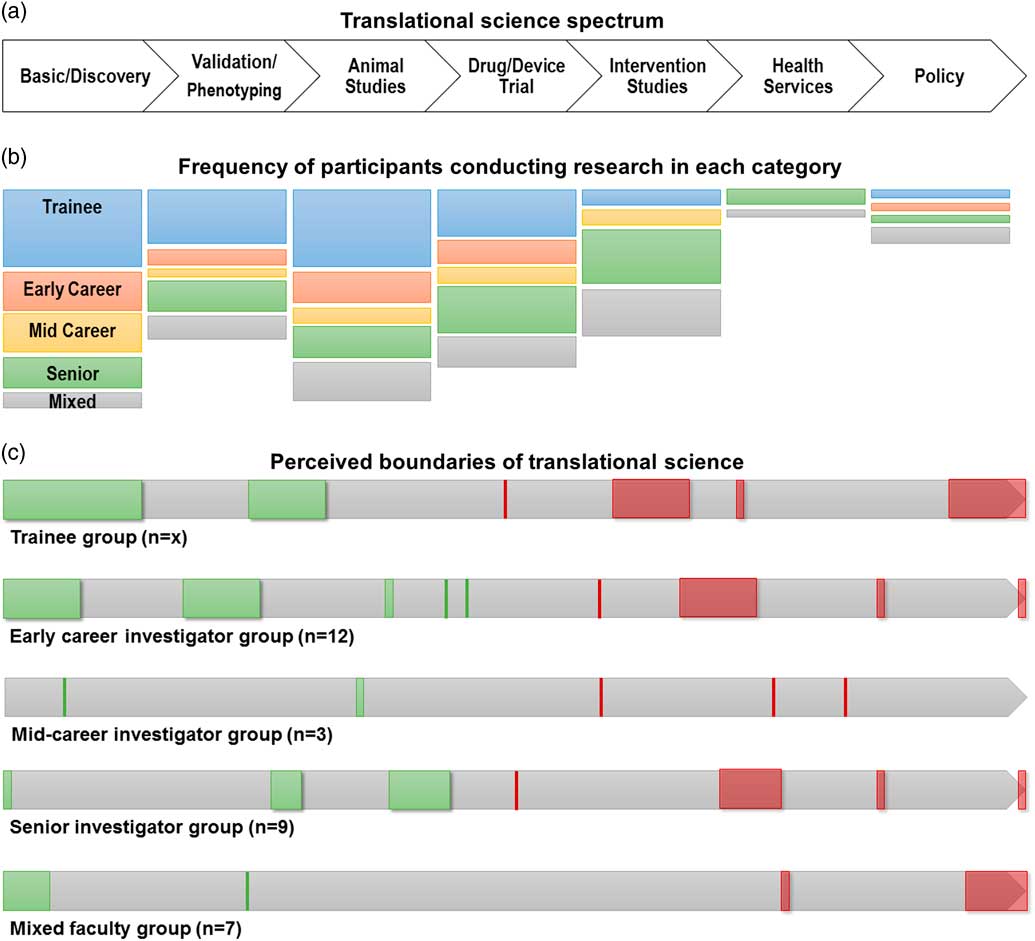
Focus group discussion highlighted the following areas: understanding of what translational science is and what it requires, as well as resources available or needed for investigators working in translational science. Participants joined in 3 activities to gather information on their understanding of translational science (online Supplementary Fig. S1). A facilitator from the Duke Office for Faculty Mentoring presented a schematic of broad research classifications (Fig. 1a ) and asked participants where their own research fit into the schema and where they thought “translational science” begins and ends. Next, the facilitator asked participants to identify and discuss key elements that define and are necessary for translational science. Groups were asked to create a list of both benefits and barriers to conducting translational science. Participants then identified existing resources that support translational science and gaps that limit our ability to conduct quality research.
Perceptions of translational science. (a) Graphic representation of research categories supplied to focus group participants for discussion. (b) Self-identification of research categories (as in a) represented by focus group attendees. (c) Boundaries of translational science as depicted by focus group attendees; Green bars (start of the translational science related research category) and red bars (end of the translational science related research category).
Data Analysis
Analysis incorporated data from multiple sources. An independent project manager from the Duke Clinical and Translational Science Institute captured detailed notes from each discussion. The facilitator and participants also captured notes on flip charts during the group activities. Data analysis was conducted by a faculty member from the Duke Behavioural Health and Survey Research Core who had not participated in the focus groups. This included thematic analysis of notes captured during the sessions and on flip charts, and from in-depth interviews of the group facilitator and project manager. All notes were entered into a word document. Coding of flip charts and word documents was performed using Atlas.ti (version 7, Scientific Development GmbH, Berlin, Germany).
Results
Participants
Participants were: 32 faculty members from both basic and clinical departments in the Duke School of Medicine; one staff educational designer; 16 trainees. Three groups comprised: junior investigators (n=13), mid-career investigators (n=3), and senior investigators (n=9). The fourth group was mixed (n=7). Demographics are shown in Table 1. When participants were asked where their own research fit into the scheme presented (Fig. 1a ), most investigators were comfortable fitting into the schema provided. A small number of investigators were unsure and described their research as being something other than what was listed or as covering a range of fields. The groups spanned the range of research areas provided with the heaviest concentrations falling between basic/discovery science and interventional studies. A few investigators in attendance identified themselves as health services or policy researchers. Some early-stage career investigators reported that translational science, though important, was conducted by other faculty, and that their research did not fit within the listed schema. This was most common among investigators who self-described as basic/discovery or policy researchers. Responses varied when participants were asked whether being recognized as a translational researcher was important, with some noting that it is important for obtaining research funding.
Participant demographics
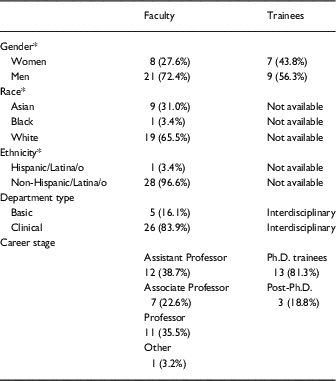
* Demographics available for 29 of 31 faculty participants.
Definition of Translational Science
Participants were asked to indicate the research stages included in translational science by placing a line where they considered to be the “beginning” of the process and another line on the “end” (Figs. 1b and c ). While most groups demonstrated some internal consensus regarding the boundaries of translational science, there was variation between groups. Mid-career investigators tended to be the least inclusive, with both boundaries more toward the center (less inclusive of discovery and preclinical sciences or health services and policy research) than early-stage or senior investigators. A few senior investigators and the mixed career group indicated that translational science included policy studies. Thus, perceptions of the types of research included in translational science ranged from all categories to only device/drug trials.
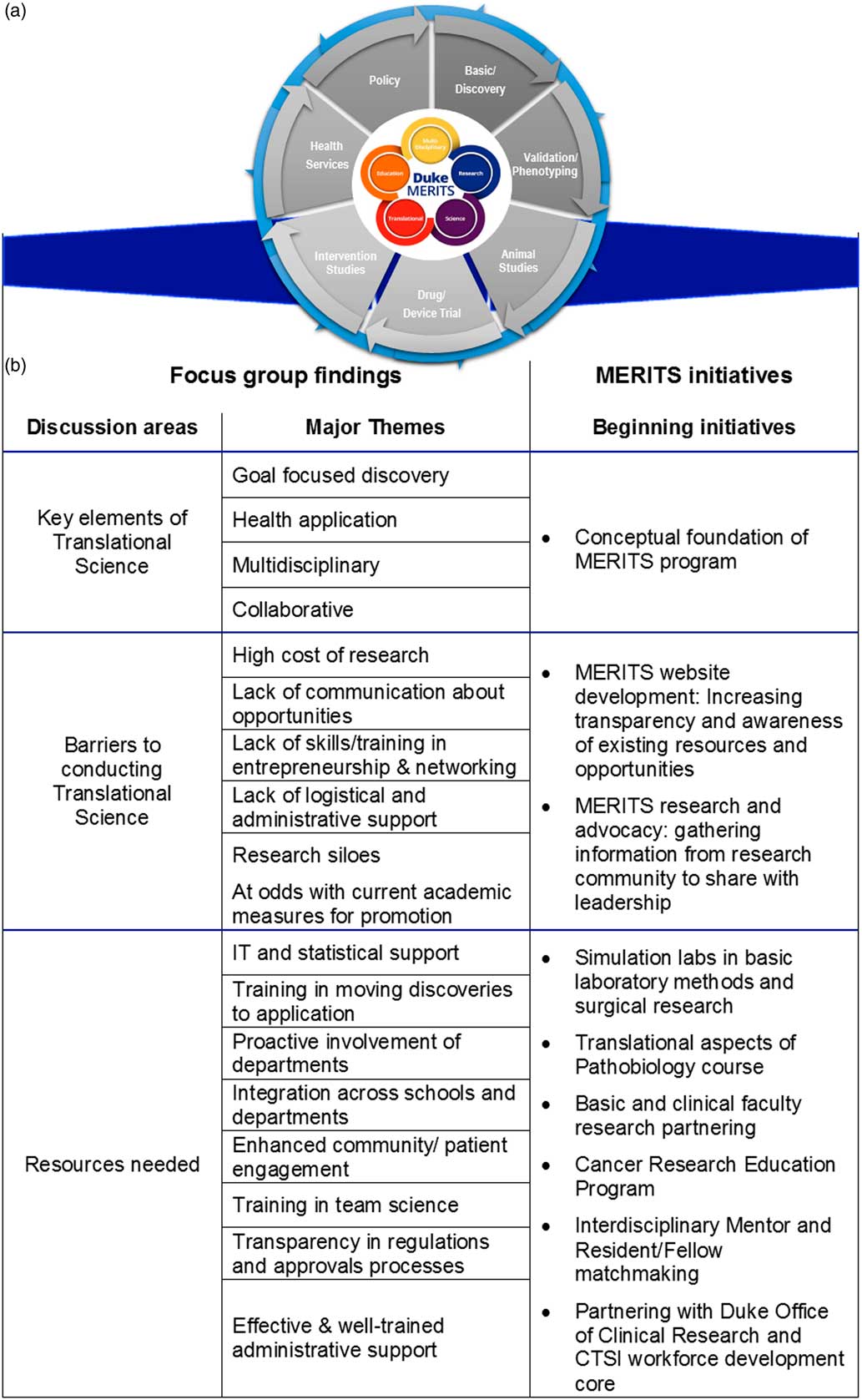
Importantly, participants from all focus groups indicated that translational science was the movement between research categories rather than a subset of the categories. For example, some investigators described translational science as a unidirectional transition between two categories on the continuum, while others described translational science as a multidirectional feedback loop with one research category informing another. Group discussions generally concurred with these assertions (Fig. 2a ). Some investigators felt translational science had a clear definition. A few reported it as only a buzzword for inclusion in grant applications. Trainees’ discussions and perceptions mirrored closely those of faculty, though trainees were more accepting of translational science as an established construct.
Facilitators and barriers of translational research. (a) Fluid, multidirectional model of translational science spectrum as defined by focus group participants. (b) Current Multidisciplinary Education and Research in Translational Sciences (MERITS) initiatives that were developed in response to specific focus group findings. CTSI, Clinical and Translational Sciences Institute; IT, information technology.
Key Elements of Translational Science
All groups identified similar key elements for effective translational science (Fig. 2b ), which were collaboration, movement from bench to bedside, and creation of a product that improves patient health. A general sense that translational science is an applied research process resulting in an end product was expressed in several ways. Collaboration was described as interdisciplinary and inclusive of diverse perspectives, and participants felt that translational science requires more infrastructure and administrative support than other types of research.
Early-career investigators and trainees placed emphasis on the team aspect of translational science, especially partnerships between Ph.D.s and M.D.s. More established investigators (mid-career and senior faculty) focused on entrepreneurship and stewardship of products across research stages toward market. Mid-career, senior, and mixed groups noted the business aspects of translational science, such as forming relationships with companies and product licensing and marketing, neither of which was indicated among the early-stage career or trainee groups.
Barriers to Translational Science
Generally, participants felt that translational science is important but felt they had a limited understanding of the process. Participants identified barriers related to logistics, information needs, communication, and faculty appointments and promotion (Fig. 2b ). Early-career investigators were more concerned with immediate issues, such as limited support for analyzing data, whereas more seasoned investigators appeared to be concerned with broader issues like lack of vision from institutional leadership. All groups identified research silos as a large impediment to conducting translational research. Senior investigators felt pressure from both funders and trainees to lead translational science. However, most senior investigators found it challenging to assume a leadership role with unclear parameters.
A number of investigators reported logistical barriers. For example, basic science researchers expressed unfamiliarity with the process of conducting research involving human subjects and working with the institutional review board. Mid- and senior-level investigators also reported limited understanding and support for navigating patent and legal issues related to moving a product to market.
Early-career investigators perceived translational science as competing with the Appointment, Promotion, and Tenure (APT) process. Investigators indicated difficulty in navigating issues such as authorship and PI roles in a team science environment; senior investigators also reported this from the mentoring perspective, noting the challenge in assisting early-career faculty in balancing team science with the APT process. Many suggested it would be critical to modify APT metrics to encourage and accommodate quantifiable efforts in team science and did not feel that enough had been done yet in this area. Senior faculty also expressed discomfort in being asked to mentor trainees and junior faculty in an area that was poorly defined or unfamiliar to them.
All groups reported concerns about funding for translational research, indicating a lack of institutional support to fund high-risk research and a lack of communication about internal funding opportunities. Facilitators noted that some of the described barriers may represent a lack of awareness for existing resources.
Needed Resources for Translational Science Research
Participants identified a number of resources to help support conduct of translational science (Fig. 2b ). All groups reported that institutional policy changes and communication are needed to support translational science. Discussions became emotional at times due to a high level of frustration. Faculty were clearly interested in translational science, but felt inhibited in effectively pursuing translational projects.
Discussion
Our study represents the first step in the development of the Duke MERITS program. Results from the focus groups have informed broad infrastructure of the MERITS program. A follow-up survey will dive deeper into the themes we discovered to provide additional insight into specific Duke MERITS initiatives.
While the phrase “translational science” has become commonplace, our study demonstrated that an agreed-upon understanding of translation science is lacking. The translational research model, a series of phases from T0 (discovery) to T4 (evaluation in large populations) (as discussed in [Reference Gannon9]), did not resonate with our participants. Instead, the prevailing notion was a model wherein any phase of research may inform another, and the definition itself included movement toward human health application. While many clinical/translational institutes and accompanying training programs are built on the T0-T4 model, the National Center for Advancing Translational Sciences has recently shifted to a more circular model that mirrors our participants’ perceptions [10, 11].
Despite concerted efforts on the part of the Clinical and Translational Science Award network, of which Duke is a member, our data suggest that individual investigators at Duke, and potentially other large academic research centers may struggle in their pursuit of translational science. Moreover, even with over a decade of targeted infrastructure development and national conversation to support and promote translational science, a unified idea of what the pursuit of translational science looks like is lacking. Thus, our results indicate that educational initiatives at Duke University should reflect a broad view of the translational science process. This must facilitate cross-disciplinary collaboration by training basic and clinical faculty in fundamental skills for translational science, preparing them to train the next generation of researchers. Important topic areas for educational initiatives include topics such as entrepreneurship and mentorship, and effective collaboration. This broad view of translational science is the foundation for the development of the Duke MERITS, which we feel can serve as a model structure for other academic research institutions. We have designed the Duke MERITS program to include 3 components: (1) a series to promote team science, improve didactic teaching, and incorporate innovative resources; (2) module-based, hands-on training sessions in bench-to-bedside research and grant writing to facilitate multidisciplinary research collaborations; and (3) metrics so faculty can track their progress and collaborative research impact.
Our study highlighted a number of commonalities that have informed the design and evaluation of our Duke MERITS program. Where early-career scientists felt compelled to work in diverse collaborative groups, more established investigators wanted to shepherd knowledge through its course until achieving application. Thus, our training paradigms must recognize these generational inclinations and provide opportunities to learn collaborative techniques, entrepreneurship, and clinical implementation. Teamwork and collaboration were resounding themes, thus training in establishing and managing collaborations between diverse scientists will be a central tenet of Duke MERITS.
Common barriers to be addressed by Duke MERITS include the confined scope and limited network of research silos. We will explore these notions in greater depth and regularly convene faculty and students to discuss translational science process. Thus, we will begin to develop a more common language around critical research elements. Duke MERITS is primarily an educational initiative; however, we will engage institutional leadership to work toward career advancement (APT) processes that recognize collaborative contribution.
Critical resource needs that represent training opportunities include regulatory processes required for research with vertebrate animals, human subjects, and specimens, as well as marketing and commercialization, community outreach, and research participant engagement. One important observation from our discussion of both barriers and resource needs was a limited recognition of the resources that are currently available at Duke. As part of our program, we will raise awareness of existing resources and training to help students and faculty pursue translational research.
Ultimately, we learned that translational research is highly valued yet enigmatic. At this time, little training exists at Duke that specifically addresses the unique aspects of translational research and researchers are largely unaware of the training and resources that are available to them. By creating a multigenerational, multidisciplinary education, and research program, we will address the most pressing needs of the translational research community and begin a sustainable path forward for the next generation of scientists.
Supplementary material
To view supplementary material for this article, please visit https://doi.org/10.1017/cts.2018.17
Acknowledgments
The authors would like to thank Amanda McMillan at Duke Clinical and Translational Sciences Institute for focus group data collection, Dede Crosmer for demographic data collection, Mark James and Ebony Burns for focus group data transcription, and Donna Crabtree and Holly Hough for editorial help. This study was funded by an education grant award from Duke AHEAD/Duke Academy for Health Professions Education and Academic Development (G.R.D.) and in part by Department of Surgery (G.R.D., R.S.) and Duke Clinical and Translational Science Award: UL1TR001117 (S.A.F.). Data analysis was done by the Behavioral Health and Survey Research Core with support from the developmental funds of the Duke Cancer Institute as part of the P30-CA014236 (Office of Cancer Centers, NCI).
Disclosures
The authors have no conflicts of interest to declare.


 Open access

