


Introduction
The composition of legislative bodies in virtually all modern democracies remains strikingly homogeneous in sociodemographic terms, and historically excluded groups such as the working class continue to be underrepresented (Best, Reference Best2007; Carnes and Lupu, Reference Carnes, Lupu, Lupu and Pontusson2023). The numerical underrepresentation of these groups affects the substantive representation of their interests. Empirical evidence suggests that the interests and needs of the economically disadvantaged and the working class are frequently overlooked in policymaking and legislation (Bartels, Reference Bartels2016; Elsässer et al., Reference Elsässer2018; Schakel, Reference Schakel2019). Legislators from a working-class background can help counteract this bias, as they are more likely to advocate policies aligned with working-class interests (Alexiadou, Reference Alexiadou2022; Carnes, Reference Carnes2012; Carnes and Lupu, Reference Carnes and Lupu2015; Micozzi, Reference Micozzi2018). Furthermore, including marginalized groups in legislative bodies not only enhances the substantive representation of the interests of these groups but also carries symbolic and normative importance. As Phillips asserts, “Including those previously excluded matters even if it proves to have no discernible consequences for the policies that may be adopted” (1995, p. 80; emphasis in original).
Pitkin’s (Reference Pitkin1972) typology of political representation—descriptive, substantive, and symbolic—offers a framework to examine these dimensions and their interrelations. She distinguishes between representation in the sense of “descriptive or symbolic standing for something or someone” and substantive “acting for” another (p. 59). Descriptive representation reflects the extent to which the sociodemographic composition of the legislature—for example, the share of working-class representatives—mirrors that of the population. At an individual level, it reflects the extent to which representatives resemble their constituents in terms of salient sociodemographic characteristics. Substantive representation focuses on whether representatives “act for” their constituents, respond to their interests, and translate these interests into policy outcomes. Finally, symbolic representation refers to the belief in, or acceptance of, objects or people as symbols that “stand for” something or someone. For example, a flag or an anthem can stand for a nation. These symbols not only represent something but also have the “power to evoke feelings or attitudes” (p. 97), for example, the patriotic feelings evoked by a national flag. In relation to politicians, symbolic representation refers to “a ‘standing for’; so long as people accept or believe, the political leader represents them, by definition” (p. 102). Symbolic representation is thus rooted in perception and emotion, rather than in political action or descriptive similarity.
Building on studies linking descriptive and symbolic representation in the context of gender and race (Hayes and Hibbing, Reference Hayes and Hibbing2017; Schwindt-Bayer and Mishler, Reference Schwindt-Bayer and Mishler2005), I argue that descriptive likeness can evoke feelings of symbolic representation. Particularly given the historical marginalization of the working class, politicians with a working-class background may be seen as signaling more inclusive policymaking and greater accessibility, especially to working-class citizens.
Initially, calls for descriptive representation focused on women and ethnic or racial minorities. In the 1990s, leading proponents of the descriptive representation of marginalized groups explicitly rejected the extension of this argument to the working class (Phillips, Reference Phillips1995, pp. 171–178; Williams, Reference Williams1998, p. 201), largely because class issues had long been central to political agendas. Influential political actors such as labor unions and social democratic parties have traditionally been vocal advocates of the working class (Best, Reference Best2007; Lipset, Reference Lipset1981). Thus, working-class interests were assumed to be firmly integrated in the political process and represented by numerous political actors, often with great representational clout. However, the political landscape has changed in the past three decades. Socioeconomic issues have lost some of their dominance in political discourse, while new cultural issues such as minority rights, migration, or environmental protection have come to the fore (Dassonneville et al., Reference Dassonneville2024). At the same time, social democratic parties have distanced themselves from their working-class roots, moving toward the political center (Evans and Tilley, Reference Evans and Tilley2012). This transformation has created a representational void. Empirical evidence increasingly points to the political marginalization of the working class, as evidenced by higher abstention rates in national elections (Armingeon and Schädel, Reference Armingeon and Schädel2015; Evans and Tilley, Reference Evans and Tilley2017) and a persistent gap between working-class preferences and policy outcomes (Elsässer and Schäfer, Reference Elsässer and Schäfer2022). These developments call for renewed discussion of the descriptive representation of the working class. In the present study, I respond to this call by investigating the impact of descriptive representation of the working class on its symbolic representation. Specifically, I examine whether political candidates with working-class affiliations are perceived as better able to represent citizens’ interests and as more accessible and trustworthy—especially among the working-class population.
To address this research question, I conduct a factorial survey experiment using an online access panel in Germany. The study was preregistered on the Open Science Framework (OSF) platform before data collection.Footnote 1 In the experiment, respondents are presented with different profiles of hypothetical political candidates. These profiles vary randomly along several sociodemographic characteristics—most notably, the candidates’ class affiliation, but also political markers such as party affiliation. Respondents are then asked to rate each profile based on the extent to which they believe the candidate would represent their interests, how accessible they perceive the candidate to be, and how much they would trust the candidate.
I expect that respondents will evaluate political candidates with a working-class affiliation more favorably. Because of their lived experience, working-class politicians can more convincingly argue that they understand the interests and demands of ordinary people and are not driven by corporate or elite interests. This self-portrayal should resonate with the broader population. In addition, social identity theory (Tajfel and Turner, Reference Tajfel, Turner, Worchel and Austin1986), which posits that individuals tend to attribute more favorable traits to themselves and other members of their in-group, and descriptive-representation arguments suggest that the favorable evaluation of working-class politicians will be most pronounced among the working-class population.
The present study breaks new ground by (1) employing a multifaceted approach to measuring social class affiliation and (2) focusing on symbolic representation. In addition to an objective measure of class affiliation based on respondents’ occupations, I incorporate a subjective class identification measure to determine whether respondents see themselves as working class and feel close to that group. Group identity is an important prerequisite for the perception of shared underrepresentation and the recognition of in-group politicians as legitimate representatives of shared interests.
Furthermore, I examine the symbolic value of including more working-class representatives in legislative bodies. Unlike existing conjoint or factorial survey experiments analyzing how class or occupation affects the evaluation of political candidates, the present study is novel in that it links descriptive representation to its impact on symbolic representation for the working class. While earlier research has focused on voting behavior or on a broader set of evaluation criteria, including, for example, the perceived warmth or competence of politicians (R. Campbell and Cowley, Reference Campbell and Cowley2014a, Reference Campbell and Cowley2014b; Carnes and Lupu, Reference Carnes and Lupu2016; Pedersen et al., Reference Pedersen2019), it has often neglected the role of respondents’ own class backgrounds (but see Vivyan et al., Reference Vivyan2020). By contrast, in this study I examine the impact of candidates’ occupational class and family class background separately for working-class respondents and respondents from higher social classes. I also focus on different facets of symbolic representation—namely, perceived accessibility, trustworthiness, and capacity to represent respondents’ interests—which scholars argue emerge from the inclusion of marginalized groups. I expect these effects to be strongest among working-class respondents.
Thus, this article offers new insights into the meaning of class in the political realm—both in terms of its normative value as opposed to substantive policy outcomes and through a broader conceptualization of class. The findings suggest that political candidates with vocational training qualifications or a working-class family background are generally rated more favorably than candidates from higher social classes in terms of perceived trustworthiness, accessibility, and capacity to represent respondents’ interests. However, while university-educated candidates receive the lowest ratings, candidates with working-class occupations are not rated more favorably than those with intermediate occupations. Positive evaluations of candidates with working-class affiliations are particularly pronounced among those who self-identify as working class, while respondents’ objective class status shows no significant effects.
Theoretical background
In everyday life, people often rely on heuristic cues—that is, stereotypes and shortcuts—to simplify decision-making by not having to engage in extensive research or complex analysis (Tversky and Kahneman, Reference Tversky and Kahneman1974). When evaluating political candidates or making voting choices, individuals typically rely on easily accessible information such as party affiliation rather than examining political platforms or analyzing candidates’ past political activities. Sociodemographic factors, for example, a candidate’s social class, can also influence perceptions, with working-class candidates potentially being viewed more positively in certain respects. As they lack elite networks commonly built through prestigious university education or corporate ties, working-class politicians are less likely to be suspected of corruption or of being controlled by elite interests. Accordingly, Barnes and Saxton (Reference Barnes and Saxton2019) find that citizens’ trust and satisfaction with legislatures increase with greater working-class representation. Voters also perceive working-class candidates as warmer (Pedersen et al., Reference Pedersen2019), while the wealthy may be perceived as disconnected and aloof (Carnes and Lupu, Reference Carnes and Lupu2016; Fiske et al., Reference Fiske1999). Furthermore, working-class candidates may be perceived as more deserving and hard-working, as they have earned their place at the table through their own efforts and commitment rather than through personal connections or a privileged upbringing. Moreover, voters also infer policy stances from sociodemographic traits (Popkin, Reference Popkin1994), often perceiving working-class politicians as more economically progressive (Arnesen et al., Reference Arnesen2019; Carnes and Lupu, Reference Carnes and Lupu2016; Pedersen et al., Reference Pedersen2019). This aligns with citizens’ economic policy preferences, which tend to be more left-leaning than those of elected officials (Rosset and Stecker, Reference Rosset and Stecker2019). However, research also shows that low education or vocational training qualifications can signal lower political competence (Carnes and Lupu, Reference Carnes and Lupu2016; Pedersen et al., Reference Pedersen2019). Accordingly, examining vote propensity in the Swiss case, Wüest and Pontusson (Reference Wüest and Pontusson2022) identify a bias among middle-class individuals against “routine” (i.e., unskilled, low-income) working-class candidates. However, as the present study focuses on symbolic representation—specifically, the extent to which political candidates are perceived by respondents as accessible, trustworthy, and able to represent their interests—emotional connection may outweigh perceptions of competence. Therefore, my first hypothesisFootnote 2 states:
H1: Working-class politicians evoke stronger feelings of symbolic representation compared with politicians who belong to a higher social class.
The latter hypothesis posits that working-class politicians are more favorably evaluated in the general population in terms of their capacity for symbolic representation. However, this effect may be most pronounced among the working class. Social similarity stereotypes suggest that people evaluate others more favorably when they share similar characteristics (Roßteutscher et al., Reference Roßteutscher2017). Research on shared identification shows that racial and ethnic minorities evaluate political candidates more positively when they share the same race or ethnicity (for a review, see Van Oosten et al., Reference Van Oosten2024). Research further indicates that women show stronger support for female candidates (Schwarz and Coppock, Reference Schwarz and Coppock2022). Similarly, working-class individuals may evaluate working-class politicians more favorably than do individuals from higher social classes. They may do so for several reasons, namely, (1) in-group favoritism, (2) historical mistrust of elites, or (3) perceptions of shared interests.
Regarding the first reason, social identity theory posits that people achieve a positive self-image by attributing positive traits to their own group (Tajfel and Turner, Reference Tajfel, Turner, Worchel and Austin1986). This “in-group favoritism” (p. 14), or in-group bias, leads people to favor other members of their own group over individuals who belong to an out-group. Thus, working-class individuals are likely to prefer politicians from the same social class.
Regarding the second reason, the historical mistrust of elites, marginalized groups’ mistrust of dominant out-groups stems from their historical social exclusion. Mansbridge (Reference Mansbridge1999, p. 641) notes that this history of subordination fosters skepticism toward elites, while “shared membership in a subordinate group can forge bonds of trust” (see also Williams, Reference Williams1998, pp. 149–175). Accordingly, Gay (Reference Gay2002) finds that Black constituents represented by a Black legislator are more likely to contact their representative than are Black constituents represented by a White legislator, and Noordzij (Reference Noordzij2021, p. 566) shows that less-educated citizens perceive politicians to be “insensitive to the lived experience of the ‘common’ people” and to signal superiority.
Finally, regarding the third reason, perceptions of shared interests, a shared working-class affiliation signal common interests between politicians and citizens and can be a reliable guarantee of mutual policy concerns. Given that politicians and citizens belonging to the same marginalized group have experienced similar living situations and discrimination, politicians from marginalized backgrounds are better positioned to understand and advocate for their communities (Mansbridge, Reference Mansbridge1999; Phillips, Reference Phillips1995; Williams, Reference Williams1998). Accordingly, empirical evidence supports the assumption that working-class politicians are more responsive to working-class concerns (Alexiadou, Reference Alexiadou2022; Carnes, Reference Carnes2012; Carnes and Lupu, Reference Carnes and Lupu2015; Micozzi, Reference Micozzi2018). Thus, working-class politicians can effectively convey to the working class that they share and represent their interests.
Consistent with the above rationale, previous studies show that, in particular, working-class respondents prefer candidates with modest class roots (Vivyan et al., Reference Vivyan2020) and perceive wealthy candidates as less accessible (R. Campbell and Cowley, Reference Campbell and Cowley2014a). Moreover, working-class voters rate candidates more favorably when they rhetorically appeal to the working class (Robison et al., Reference Robison2021).
Building on this theoretical and empirical foundation, I expect that—compared with individuals from higher social classes—working-class individuals will perceive working-class politicians as more trustworthy, accessible, and better able to represent their interests. Hence, I postulate:
H2: Working-class politicians evoke stronger feelings of symbolic representation among members of the working class than among members of higher social classes.
The academic literature offers various conceptions of social class based on objective criteria such as occupation, qualification, education, and income (e.g., E. O. Wright, Reference Wright2005). However, self-categorization into a social class is often an ambiguous task for the general public. Unlike visible identities such as race or gender, class is less readily perceived, and objective classifications may not align with self-identification. In addition, the continuing relevance of class as a social identity affecting political behavior is contested (Clark et al., Reference Clark1993). Multiple and more individualistic identities have, to some extent, replaced the previously predominant class identity (Pakulski, Reference Pakulski and Wright2005). Yet, occupational roles influence personal identity, and most people can correctly place themselves within the class structure (Bornschier et al., Reference Bornschier2021; Robison and Stubager, Reference Robison and Stubager2018). However, class identity varies in strength, and objective assignment to the working class does not necessarily mean that people so assigned identify with this category or that it is relevant for their behavior. Therefore, self-identification may play a crucial role in understanding how class affiliation affects candidate evaluation.
As noted earlier, social identity theory (Tajfel and Turner, Reference Tajfel, Turner, Worchel and Austin1986) posits that people favor members of their own group over members of other groups. However, to engage in such in-group favoritism, individuals must feel a sense of attachment to or at least acknowledge their membership of that group (Tajfel and Turner, Reference Tajfel, Turner, Worchel and Austin1986). Following this rationale, Huddy (Reference Huddy, Scott, Kosslyn and Buchmann2015) emphasizes the significance of social identity in understanding political beliefs and behaviors. For example, empirical evidence shows the importance of social identity in predicting collective action (Van Zomeren et al., Reference Van Zomeren2008). Studies on voting behavior similarly show that class identity increases the likelihood of voting in line with class interests (Campbell et al., Reference Campbell1980; Weakliem and Heath, Reference Weakliem and Heath1994). Thus, individuals may be more likely to use class as a heuristic cue when they identify with a particular class. Accordingly, stronger identification with the working class should enhance working-class politicians’ perceived capacity for symbolic representation. As I examine in the present study both objective class membership, based on occupation and employment status, and subjective class identification, I propose the following hypothesis:
H3: The relationship between a politician’s class affiliation and their perceived capacity for symbolic representation strengthens the more a person subjectively identifies with the working class.
Research strategy
Data and operationalization
To test my hypotheses, I conducted a factorial survey experiment as part of an online access panel surveyFootnote 3 carried out in Germany in June and July 2021. Participants were recruited by email via the online panel provider, respondi (since rebranded as Bilendi), and selected using quotas based on age, gender, and education to reflect the German population aged 18 years and older. A total of 1,033 respondents completed the survey and are included in the analysis.Footnote 4
Factorial survey experiments or conjoint experiments are a research method where respondents evaluate hypothetical individuals or scenarios that vary systematically along randomly assigned attributes (factors). They are increasingly used to study citizens’ evaluations of politicians. Prior research has employed this method to explore how sociodemographic characteristics (R. Campbell and Cowley, Reference Campbell and Cowley2014a, Reference Carnes and Lupu2016b; Carnes and Lupu, Reference Carnes and Lupu2016; Hainmueller et al., Reference Hainmueller2014; Vivyan et al., Reference Vivyan2020) and political preferences (Arnesen et al., Reference Arnesen2019; Pedersen et al., Reference Pedersen2019) shape candidate evaluations and vote choices. In the present study, respondents assess five hypothetical political candidates who are presented in vignettes as continuous text (see Figure 1). Candidates’ profiles vary randomly along five characteristics, each with between two and six possible attributes (see Table B1 in online Appendix B).
Vignette question. The characteristics in brackets are experimentally varied (see attributes in Table B1 in Appendix B).

After reviewing each profile, respondents are instructed to rate the political candidate presented. While such factorial survey or conjoint experiments often focus on vote choice, the present study addresses symbolic representation—defined as the emotional belief that one would be represented by a political candidate. To capture symbolic representation, respondents are asked three questions. First: “To what extent do you think this candidate would represent you when holding political office? Scholars of descriptive representation argue for the symbolic value of including marginalized groups in the political process, as their presence can promote greater trust in these politicians (Williams, Reference Williams1998, pp. 149–175), and marginalized groups feel more confident in approaching them (Mansbridge, Reference Mansbridge1999). To test this assumption, respondents are also asked to evaluate politicians in terms of their perceived accessibility (“How approachable and available do you think the politician is?”) and their trustworthiness (“And in general, how much would you trust the politician overall?”). The different aspects of symbolic representation captured with these three questions function as dependent variables in the study. Each dependent variable is measured on a scale of 0 to 10, with 0 representing the lowest rating of perceived accessibility, trustworthiness, or capacity to represent the respondent’s interests and 10 representing the highest.
Case
The present factorial survey experiment is conducted in Germany. As in all modern democracies, the German legislature is characterized by a significant descriptive underrepresentation of the working class. Although 55% of the German labor force is working class, only 6% of legislators in the German Bundestag are from the working class (Carnes and Lupu, Reference Carnes, Lupu, Lupu and Pontusson2023).
Germany is an appropriate case due to its mixed-member proportional (MMP) electoral system, which gives voters two votes: one for a direct candidate in the local constituency and the other for a party’s Land list. Most voters do not have comprehensive information about the policy competencies and political positions of these candidates but rather use information given on campaign posters and the ballot paper as cues to inform their voting decisions. Accordingly, assessing candidates based on a few concisely presented attributes reflects voting decisions in Germany and thereby enhances the external validity of the survey experiment. The MMP system also allows voters to distinguish between party and candidate preferences. Thus, they can support their preferred party with their second vote while choosing a candidate from another party with their first vote. In the 2021 German Bundestag election, almost 25% of voters split their votes (The Federal Returning Officer, 2023). Vote splitting may be strategic, to avoid wasting votes or to influence coalitions (Gschwend, Reference Gschwend2007), or it may be used to support a specific candidate regardless of party preference. Roßteutscher et al. (Reference Roßteutscher2017) show that especially among voters without strong party affiliations, candidate evaluations are influenced by social similarity, thus favoring those candidates who share attributes such as gender, immigrant background, or social class. Consequently, candidate characteristics may play a particularly pivotal role in the German context.
Germany is also a useful case study regarding the recent developments in its party system, which reflect those in other European democracies. The Social Democratic Party (SPD), once the primary voice of the working class, has moved toward the political center, distancing itself from its traditional base (Elff and Rossteutscher, Reference Elff and Rossteutscher2011). This gap has recently been filled by the rising right-wing populist party Alternative for Germany (AfD), which has seen an influx of working-class voters (Oesch and Rennwald, Reference Oesch and Rennwald2018). A recurrent strategy employed by right-wing populist parties is to proclaim the existence of a social divide between the people and a corrupt elite. Repeating this view in public debates may raise awareness of the issue among the general population and make it more prominent in people’s perceptions.
Candidate characteristics
The key characteristic of interest in the present study is the hypothetical candidate’s class affiliation. To specify candidates’ occupational class, the hypothetical profiles include each candidate’s vocational training/academic qualifications and occupation. The selected occupations cover a wide range of classes, including higher-grade professionals with university degrees, intermediate occupations, and working-class occupations. They distinguish between white-collar and blue-collar occupations and reflect typical and well-known occupations represented in the German Bundestag (19th parliamentary term 2017–2021). Each occupation and qualification is associated with a social class defined by the European Socio-economic Classification (ESeC; Rose and Harrison, Reference Rose and Harrison2007). For the analysis, the occupations are aggregated into three broader classes—the salariat, intermediate employees, and the working class—following suggested combinations of the nine ESeC classes, and these broader classes are included as dummy variables. The salariat combines higher- and lower-grade professionals, administrative, and managerial occupations; it includes the vignette occupations of a chemist with a university degree and a managing director and owner of a business consultancy with 15 employees who has a university degree in economics. The intermediate employee class comprises higher-grade white- and blue-collar workers. This class includes the vignette occupations of insurance specialist with vocational training and an additional qualification and master motor vehicle technician with vocational training and master craftsman training. The working class includes lower-grade white- and blue-collar workers and those without formal qualifications, represented by the vignette occupations retail salesperson with three years of vocational training and industrial mechanic with three years of vocational training.Footnote 5
In addition to the hypothetical political candidates’ own class affiliations, their profiles also specify their class origins, indicating whether the candidate comes from a working-class or an upper-middle-class family. Having a working-class background may both sensitize politicians to the concerns of ordinary people and signal to voters that these politicians understand people’s everyday problems. Previous findings suggest that the general population—and the working class in particular—view political candidates from a working-class background more favorably (Vivyan et al., Reference Vivyan2020).
The hypothetical candidate profiles also include non-class-related characteristics displayed on German ballot papers for direct candidates, namely, party affiliation, age, and political experience. Although the ballot paper indicates whether a candidate is already a member of the German Bundestag, it does not provide information on the length of membership.
Candidates’ party labels serve as the strongest heuristic shortcut and an important cue in candidate evaluation and voting decisions (Popkin, Reference Popkin1994), allowing voters to infer ideology and issue positions. Accordingly, there is evidence that party information (Kirkland and Coppock, Reference Kirkland and Coppock2018) or policy cues (Arnesen et al., Reference Arnesen2019; Pedersen et al., Reference Pedersen2019) can crowd out the effects of other information. However, if party affiliation is not explicitly mentioned, respondents might infer it from candidates’ occupations, making it difficult to separate class-based from party-based evaluations. The vignettes include all parties represented in the German Bundestag in the 19th parliamentary term. In addition, the hypothetical profiles indicate whether the candidate has never been elected to the German Bundestag, has been a member of the German Bundestag for one term (since 2017), or has been a member of the German Bundestag for three terms (since 2009). Prior evidence suggests that political experience signals competence and leads to more favorable evaluations (Kirkland and Coppock, Reference Kirkland and Coppock2018). On the other hand, being a long-term member of the German Bundestag may conversely imply that political candidates belong to a distinct political class with little connection to their social class roots, potentially resulting in more negative evaluations, especially among working-class respondents (Allen and Cairney, Reference Allen and Cairney2017).
The age of the hypothetical candidates varies across profiles (35, 50, or 65 years), as age may influence candidate evaluations (R. Campbell and Cowley, Reference Campbell and Cowley2014b; Hainmueller et al., Reference Hainmueller2014), with older candidates possibly perceived as more credible class representatives due to greater work experience. The gender of the politicians in the vignettes is held constant at “male.” Examining the evaluation of politicians by class and also considering the gender of politicians, Vivyan et al. (Reference Vivyan2020) find no significant difference in the class effect between male and female MPs.Footnote 6
Respondent characteristics
While previous factorial survey experiments have considered occupation as an attribute of hypothetical politicians and as a predictor at the respondent level, the present study goes further by measuring respondents’ class affiliations in greater detail, distinguishing between objective attribution (class membership) and subjective attribution (class identification). Class membership is based on objective characteristics and measured using the ESeC, which incorporates respondents’ occupation based on the International Standard Classification of Occupations 2008 (ISCO-08), employment status (self-employed, supervisor, employee), and organization size. For the present analysis, the 9-class ESeC model is collapsed into four aggregated dummy variables: the salariat, intermediate employees, self-employed, and working class.
Prior research shows that class origins influence political preferences and values independently of current class membership (Helgason and Rehm, Reference Helgason and Rehm2025). This suggests that, similarly to the impact of current class membership, respondents’ class origins may shape evaluations of political candidates conditional upon their social class. For economic reasons, the survey includes only questions on respondents’ current class affiliation, making it a rigorous test of the impact of class on the evaluation of politicians.
In addition to objective class measures, the analysis includes subjective class ascriptions, namely, class identification. Following Tajfel (Reference Tajfel1981, p. 255), social identity refers to “that part of an individual’s self-concept which derives from his knowledge of his membership of a social group (or groups) together with the emotional significance attached to that membership.” Class identity thus reflects both awareness of and emotional attachment to one’s membership of a social class. The survey captures class identity by asking respondents, “Which class would you say you belong to?” The following analysis uses four dummy variables to capture class identity: no class, lower/working class, middle class, and upper middle/upper class, with the latter being the reference category. The survey also includes a follow-up question asking respondents how close they feel to this group. For analysis, a new variable combines these two items to measure the intensity of identification with the working class on a scale from 0 (no or different class identity) to 5 (strong identification with the working class). While subjective class can also include class consciousness—for example, perceived power imbalance or systemic disadvantage (Miller et al., Reference Miller1981) or political action orientations (Gurin et al., Reference Gurin1980)—these politicized components primarily predict political behavior such as engaging in various forms of participation (Stubager, Reference Stubager2009). As the focus of the present study is on candidate evaluations rather than political action, it concentrates on class identity as a respondent-level predictor.Footnote 7
Figure 2 depicts the relationship between the objective and subjective class measures. It shows that while there is a clear relationship between respondents’ objective and subjective class ascriptions, that relationship is far from unambiguous: 57% of respondents in working-class occupations identify as lower or working class, 39% as middle class, and 3% as upper middle/upper class. Among the salariat, 27% identify as upper middle/upper class, 60% as middle class, and 10% as lower or working class. For intermediate occupations and the self-employed, 35% and 31%, respectively, identify as lower or working class; 53% and 58%, respectively, as middle class; and 9% and 8%, respectively, as upper middle/upper class. Overall, most respondents can still position themselves somewhere within the class structure, which speaks to the continued relevance of the concept of class today.
Subjective class identity (ID) by objective class membership.

In addition to measures of social class affiliation, the analysis includes respondents’ party identification and ideological orientation. Respondents are asked whether they feel closer to a particular party, and, if so, which one. Using this question, I generate a variable indicating whether the respondent’s party identification matches the party affiliation of each hypothetical political candidate. The survey also captures respondents’ left–right self-placement on a scale from 0 (left) to 10 (right). To compute an ideological congruence measure, I match these responses with each candidate’s party position, which I derived from the 2019 Chapel Hill expert survey (Jolly et al., Reference Jolly2022). Continuous variables for working-class identification intensity and ideological congruence are normalized to range from 0 to 1. Consistent with the candidate profiles, the analysis further includes sociodemographic controls (education, gender, and age). Table A1 in online Appendix A provides summary statistics and frequencies of all respondent variables included in the subsequent analysis.
Results
In keeping with the design of factorial survey experiments, respondents were presented with five different vignettes (profiles) of hypothetical political candidates to be rated on a scale from 0 (not at all) to 10 (completely). Therefore, vignettes are clustered within respondents, resulting in a hierarchical data structure. To account for this data structure, I use hierarchical linear regression models with random intercepts where vignettes are nested within respondents. A total of 1,033 respondents and 5,163 vignette evaluations are included in the following analysis.
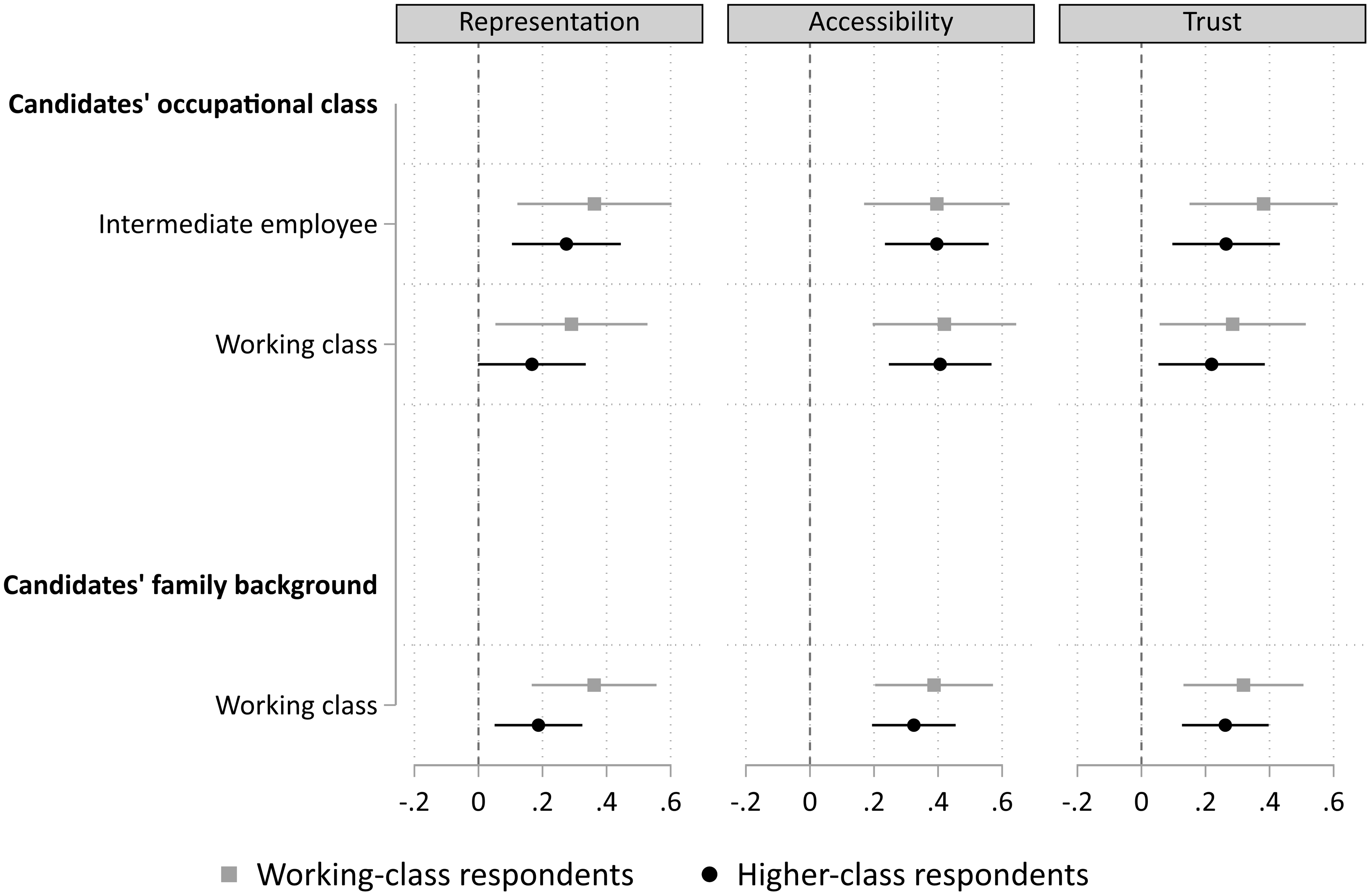
Figure 3 displays differences in the candidates’ perceived accessibility, trustworthiness, and capacity to represent respondents’ interests, based on their occupational class and family-class background. The results for each dependent variable are based on two models. The first includes only working-class respondents; the second includes all other respondents from higher social classes and excludes working-class respondents.
Difference in evaluations of candidates’ accessibility, trustworthiness, and capacity to represent respondents’ interests, based on their occupational class (reference category: salariat) and family class background (reference category: upper middle class) by respondents’ social class. Markers provide unstandardized regression coefficients with 95% confidence intervals. Evaluations of political candidates are measured on an 11-point scale ranging from 0 (not at all) to 10 (completely’). All results are based on hierarchical linear regression models estimated with full maximum likelihood and include all vignette and respondent characteristics. The figure shows results for separate models that include either working-class respondents only or all other respondents from higher classes. See Table C1 in Appendix C for full model results.

The results indicate that respondents’ evaluations are significantly influenced by the social class of political candidates, even after controlling for party identification and ideological congruence (see Tables C1.1 to C1.6 in online Appendix C for more detailed results of a stepwise analysis). In general, respondents tend to rate candidates who belong to the working class or are intermediate employees and candidates with a working-class family background as better able to represent their interests, more accessible, and more trustworthy than candidates from the salariat with a university degree or an upper-middle-class family background. Working-class respondents perceive candidates from their own social class as better able to represent their interests (+0.29 points), more accessible (+0.42 points), and more trustworthy (+0.29 points) than candidates from the salariat. Working-class respondents also rate candidates depicted as intermediate employees higher than candidates from the salariat, with the former being rated 0.36 points higher on perceived capacity to represent their interests, 0.40 points higher on accessibility, and 0.38 points higher on trustworthiness. Similarly, the results from all other respondents from higher social classes indicate that they too attribute greater accessibility, trustworthiness, and capacity for representation to candidates from the working class (+0.41, +0.22, and +0.17 points, respectively) or with intermediate jobs (+0.40, +0.26, and +0.28 points, respectively) compared with candidates from the salariat. Only the more positive effect of candidates’ working-class affiliation on their perceived capacity for representation is statistically insignificant. Therefore, working-class candidates overall receive a more positive rating from all respondents, regardless of the respondents’ own class affiliation, compared with candidates from the salariat. However, candidates presented as intermediate employees receive an even slightly better rating than working-class candidates regarding perceived trustworthiness and capacity for representation, while working-class candidates score highest on perceived accessibility. Finally, both working-class respondents and respondents from higher classes rate candidates with a working-class family background higher than candidates with an upper-middle-class family background: working-class respondents rate working-class candidates’ capacity to represent their interests 0.36 points higher, their accessibility 0.39 points higher, and their trustworthiness 0.32 points higher, while respondents from higher social classes rate their capacity for representation 0.19 points higher, their accessibility 0.32 points higher, and their trustworthiness 0.26 points higher. These results partially confirm hypothesis H1, as they indicate that working-class candidates evoke stronger feelings of symbolic representation—particularly in terms of perceived accessibility—compared with candidates from higher social classes. However, candidates with intermediate occupations receive slightly more positive evaluations than working-class candidates on perceived trustworthiness and capacity for representation.
While similar results are observed among working-class respondents and respondents from higher social classes, the effect sizes tend to be more pronounced among the former. To assess whether positive ratings of candidates from lower social classes are amplified among working-class respondents, the following models include interaction terms between candidates’ class affiliation and respondents’ objective class membership and subjective class identity, respectively. Three aspects of candidates’ class affiliation are analyzed: current/former occupation affiliated with the salariat (vs. intermediate and working-class jobs), current/former occupation affiliated with the working class (vs. salariat and intermediate jobs), and family class background.
Figure 4 illustrates the adjusted predictions of perceived accessibility, trustworthiness, and capacity for representation by the political candidate’s class affiliation and the respondent’s objective class membership (i.e., the respondent’s occupation and employment status). Compared with respondents from a higher class, working-class respondents rate candidates from the salariat less favorably than candidates who have (or had) intermediate or working-class jobs, and they rate candidates with a working-class family background more favorably than candidates with an upper-middle-class family background. However, the effect sizes are small and statistically non-significant.Footnote 8 Looking at the ratings of candidates with a working-class occupation versus those of candidates from the salariat or intermediate occupations, the differences in ratings between working-class respondents and respondents from a higher social class are minimal and inconsistent.
Predicted evaluations of political candidates’ trustworthiness, accessibility, and capacity for representation among working-class respondents and respondents from a higher class (objective class membership) by candidates’ class affiliation. Markers provide adjusted predictions with 95% confidence intervals. Evaluations of political candidates are measured on a 11-point scale from 0 (not at all) to 10 (completely). For interaction models, see Table C2 in Appendix C.

More pronounced effects are observed for subjective class identity. As shown in Figure 5, respondents self-identifying as working class rate candidates from the salariat 0.50 points lower on capacity to represent their interests than candidates from lower classes. Among respondents self-identifying as members of a higher social class or of no class, this difference is −0.23 points, resulting in a 0.27-point gap between class-identity groups. Furthermore, respondents with a working-class identity rate political candidates from the salariat 0.33 points more negatively on trustworthiness compared with respondents who self-identify as members of a higher social class or of no social class. Similarly, for respondents self-identifying as working class or lower class, political candidates’ working-class family background has a more positive effect on perceived capacity for representation (+0.33 points) and perceived trustworthiness (+0.30 points). Irrespective of their own class identity, respondents tend to rate candidates from the salariat and candidates with an upper-middle-class family background as less likely to represent their interests and less trustworthy compared with candidates from a lower social class. However, the effect sizes are stronger for respondents self-identifying as working class or lower class. By contrast, no statistically significant differences are observed between respondents with different class identities in their ratings of candidates’ accessibility based on their class affiliation. Furthermore, no statistically significant results emerge when looking at the ratings of candidates with a working-class occupation. While candidates from the salariat are rated statistically significantly worst, working-class candidates do not appear to evoke stronger feelings of symbolic representation compared with candidates who are intermediate employees—even among working-class respondents. In sum, hypothesis H2 is partially supported: While no statistically significant differences emerge based on respondents’ objective class membership, respondents identifying as working class evaluate salariat candidates more negatively and candidates with a working-class family background more positively than do other respondents. However, working-class candidates are not rated statistically significantly better than those from higher classes.
Predicted evaluations of political candidates’ trustworthiness, accessibility, and capacity for representation among respondents with a working-class identity (ID) and respondents with another or no class identity (subjective class identity) by candidates’ class affiliations. Markers provide adjusted predictions with 95% confidence intervals. Evaluations of political candidates are measured on a 11-point scale from 0 (not at all) to 10 (completely). For interaction models, see Table C2 in Appendix C.

To further examine whether working-class respondents evaluate working-class candidates more positively depending on the intensity of their (i.e., the respondents’) identification with the working class, and to test hypothesis H3, I conducted a subgroup analysis including only respondents classified as working class based on their current or last occupation. This analysis comprised 331 respondents and 1,652 vignette evaluations. Figure 6 shows the marginal effects of candidates’ affiliation with the salariat and the working class, as well as their working-class family background, contingent upon the intensity of respondents’ subjective working-class identification—that is, the extent to which they identify with and feel close to the working class.
Marginal effect of political candidates’ class affiliation on their perceived accessibility, trustworthiness, and capacity for representation by the intensity of respondents’ working-class identification (ID), with 95% confidence intervals (CIs). Evaluations of political candidates are measured on a 11-point scale from 0 (not at all) to 10 (completely). The intensity of working-class identification is measured on a scale from 0 to 5, where 0 indicates that respondents have a different or no class identity, and 5 indicates that they have a working/lower-class identity and feel extremely close to that class. Predictions are based on a subgroup analysis of respondents classified into the European Socio-economic Classification (ESeC) working class according to their current or last occupation (see Table C4 in Appendix C).

The results of the subgroup analysis indicate that candidates’ membership of the salariat is associated with more negative ratings, while candidates’ membership of the working class and their working-class family background are associated with more positive ratings the more respondents identify with the working class. However, the effects remain statistically nonsignificant, and thus hypothesis H3 is not confirmed. Nonetheless, the main analysis supports the role of class identity: positive ratings of working-class candidates increase when respondents identify with the working class, and this effect is more pronounced than that of objective class membership. The absence of statistically significant findings may reflect limited statistical power due to the small size of the subgroup sample.
Discussion and conclusion
This study has sought to investigate whether the occupational class affiliation and class origins of political candidates affect how they are viewed by the population and what kind of emotional response class affiliation elicits. The results show that class matters. When presented with several hypothetical candidates, respondents tend to perceive candidates with intermediate- and working-class occupations and without a university degree or candidates with a working-class family background as better able to represent their interests, more accessible, and more trustworthy.
However, candidates’ working-class occupations and vocational training qualifications are not consistently perceived as more favorable. Candidates from the salariat—for example, chemists or CEOs with a university degree—tend to receive lower ratings than those with vocational training qualifications. Yet, candidates who have (or had) working-class occupations do not receive more favorable ratings than those who have (or had) intermediate occupations. These findings suggest a general aversion toward upper-middle-class/upper-class politicians, while distinctions between working- and middle-class candidates are less pronounced. Politicians are often perceived as elitist and disconnected from everyday life (Allen and Cairney, Reference Allen and Cairney2017; T. Wright, Reference Wright2013). This negative assessment might be especially salient when politicians are depicted as being from upper-middle-class families or belonging to the salariat. People apply moral criteria when evaluating others, and to affirm their own self-worth, members of the working class, for example, may view the upper class as lacking integrity (Lamont, Reference Lamont2009). Thus, politicians may improve their public image and foster trust by demonstrating ties to ordinary people—through class background, education, or career.
In addition, differences in the evaluation of politicians based on their class affiliation appear to hinge largely on their educational background—specifically, whether they have a vocational training qualification or a university degree. That this distinction centers on academic credentials supports the argument that education creates a new social divide, shaping identity (Stubager, Reference Stubager2009) and dividing the population, for example, in terms of their attitudes and political preferences (Bovens and Wille, Reference Bovens and Wille2017). While, in principle, no formal education is required to run for or hold office, representatives in Germany and other modern democracies are predominantly university graduates. This divide is mirrored in the present findings on respondents’ educational attainment: Even when controlling for social class, those respondents with a high level of education attribute statistically significantly higher levels of accessibility, trustworthiness, and capacity for representation to the hypothetical candidates than do those with a lower educational level (see Table C1 in online Appendix C).
In addition, the results support Hypothesis H1, as they indicate that political candidates from working-class backgrounds or with vocational training qualifications are generally evaluated more favorably, regardless of the respondent’s own class affiliation. As discussed in the “Theoretical background” section of this article, this may stem from perceptions of such candidates as more hardworking and deserving and less aligned with elite interests. However, the finding that even individuals from higher social classes evaluate working-class candidates more positively appears to contradict the assumptions of social identity theory (Tajfel and Turner, Reference Tajfel, Turner, Worchel and Austin1986). This contradiction can be reconciled by acknowledging that individuals hold multiple, intersecting identities. The results suggest that when assessing politicians, respondents from higher social classes place less emphasis on shared class background, instead drawing a broader distinction between “us” (the general population) and “them” (the political elite).
The results also show more favorable evaluations of political candidates with a working-class family background. As shown in previous studies, early socialization plays a critical role in shaping political attitudes, beliefs, and behaviors (Langsæther et al., Reference Langsæther2022). This influence extends beyond the general population to politicians themselves, with class origins exerting a stronger effect on political views and decision-making than current educational qualifications or occupational status (Bortun et al., Reference Bortun2025). The present findings thus contribute to the existing literature by highlighting the perceived importance of family background in shaping public perceptions of politicians. While earlier research has emphasized how politicians view class origins as central to their political orientation, the current results suggest that the public similarly considers family background more relevant than occupation in shaping a politician’s accessibility, trustworthiness, and ability to represent constituents.
Finally, the results demonstrate the necessity of considering the role of class identity when discussing working-class representation: While respondents objectively classified as working class rate political candidates from the lower classes more favorably, the differences between their evaluations and those of respondents from higher social classes are rather small and mostly negligible. More pronounced differences appear when looking at the respondents’ subjective class identity. This finding emphasizes the importance of taking subjective class attributions into account when analyzing the effects of working-class affiliation. As Williams (Reference Williams1998, p. 201) points out, “the subjective sense of group identity [is] necessary to sustain a relationship of accountability between representative and constituents.” Thus, a sense of working-class membership and attachment is necessary to accept working-class political candidates as advocates and spokespersons for the working class as a whole.
Although this study focuses on Germany, the findings align with patterns observed in other European countries and the United States. Previous research has primarily examined contexts such as the United States and the United Kingdom, where inequality is more pronounced, or Scandinavia, where robust welfare systems mitigate income disparities. Positioned between these extremes, Germany is experiencing growing inequality, while its redistributive policies are becoming less effective in counteracting income differences (Lupu and Pontusson, Reference Lupu, Pontusson, Lupu and Pontusson2023), thereby potentially reinforcing class divisions.
Regarding the broader implications of the present findings, the favorable evaluations of candidates with a working-class family background or with vocational training qualifications refer only to their perceived accessibility, trustworthiness, and capacity to represent respondents’ interests. These perceptions do not necessarily translate into electoral support. Prior research indicates no general bias against working-class candidates in vote choice when assessed through survey experiments (Carnes and Lupu, Reference Carnes and Lupu2016; Pedersen et al., Reference Pedersen2019). However, while these studies are based mainly on results from conjoint experiments, Matthews and Kerevel (Reference Matthews and Kerevel2022), analyzing actual electoral outcomes in German regional elections, find that working-class candidates are less likely to win. This suggests that despite positive perceptions, these candidates may encounter additional barriers in real-world electoral contexts. Nevertheless, political parties may still benefit from prominently featuring working-class candidates on their party lists, as this could enhance the party’s image as being trustworthy, accessible, and connected to the general public. In addition, for the working-class population, the presence of working-class representatives in the political process could help mitigate feelings of political alienation and make them feel heard.
This study contributes to a growing body of research on the consequences of political underrepresentation. Prior studies have linked underrepresentation to lower satisfaction with democracy (Reher, Reference Reher2016; Stecker and Tausendpfund, Reference Stecker and Tausendpfund2016), withdrawal from political participation (Rosset, Reference Rosset2023), and increased support for populist parties (Feitosa et al., Reference Feitosa2025). The present findings suggest that such feelings of underrepresentation and perceptions of politicians as inaccessible and untrustworthy may be mitigated by increasing the number of representatives from modest family backgrounds or with vocational training qualifications. Overall, the results of the study provide further support for the working class’s claim to descriptive representation.
Supplementary material
The supplementary material for this article can be found at https://doi.org/10.1017/S1755773925100192.
Data availability statement
Data collected for this study are openly available at GESIS. DOI: https://doi.org/10.7802/2823.
Acknowledgements
An earlier version of this paper was presented at the Fall Academy “Challenging Inequalities II” (University of Konstanz, 2023). I am grateful to the participants and the discussant for their insightful comments and constructive feedback, and I thank the anonymous reviewers for their valuable suggestions.
Funding statement
The online survey was conducted with the financial support of the Department of Data and Research on Society (DRS) of the GESIS - Leibniz Institute for the Social Sciences.
Competing interests
The author declares no potential conflicts of interest with respect to the research, authorship, and/or publication of this article.




 Open access

