

En junio de 2022, Ecuador vivió un levantamiento indígena que culminó con la paralización de la capital, Quito, y de las principales ciudades del país. Fueron dieciocho días de tensión, violencia, represión, solidaridad, desabastecimiento de las ciudades, de viejos prejuicios reeditados y de lenguajes de protesta-negociación confrontados entre el Gobierno y las organizaciones convocantes, con la Confederación de Nacionalidades Indígenas del Ecuador (CONAIE) a la cabeza. El objetivo principal del levantamiento era revertir las medidas económicas de corte neoliberal impulsadas por el Gobierno. Para ello, se desplegaron estrategias de movilización orientadas a visibilizar los problemas de las poblaciones subalternas y, a la vez, reforzar su papel como actores políticos. Como en ocasiones anteriores, las tácticas implementadas fueron básicamente tres: el bloqueo de la red vial nacional, organizado en buena medida desde las comunidades rurales cercanas a cada carretera; el despliegue de piquetes para interrumpir la actividad comercial —cierre de tiendas, mercados, industrias y minas—; y la marcha de grandes masas hacia Quito para ocupar calles y cercar los edificios gubernamentales más emblemáticos. Salvo el único y notorio precedente de las movilizaciones de octubre de 2019, que estuvieron cronológicamente ligadas con las de Bolivia y Chile, una protesta de tal magnitud no acontecía con tanta fuerza desde inicios de la década del 2000.Footnote 1
A tenor de esa experiencia, en este artículo quiero reflexionar sobre los laberintos de la identidad, las luces y sombras de su relación con la política y los desafíos que ello plantea en la región andina. Debo advertir que se trata de una reflexión fundamentada en la observación del devenir de los acontecimientos en la ciudad de Quito, donde me encontré atrapado y donde las circunstancias me facilitaron tener una mirada de primera mano y una interlocución privilegiada con numerosos protagonistas —algunos personajes públicos, aunque en su mayoría participantes anónimos—, lo que me brindó una panorámica amplia de la complejidad y la profundidad del fenómeno que sacudió al país entre el 13 y el 30 de junio de ese año.Footnote 2 En particular, y a partir de unas reflexiones introductorias sobre el sentido y alcance del contexto —en perspectiva histórica— y los procesos de protesta articulados por las plataformas etnoidentitarias, quiero analizar algunos aspectos observables durante ese episodio contestatario. Entre ellos, la impronta de un relevo generacional en las dirigencias de las organizaciones; la conformación, como consecuencia de lo anterior, de un entramado interrelacionado de discursos y demandas que amplió el alcance social de la protesta; la activación de redes solidarias que trascendieron el espectro indígena; y, relacionado con ello, la naturaleza resiliente de las economías populares —particularmente aquellas aún vinculadas, digámoslo así, a formas campesinas de producción y reproducción— en cuanto a la prolongación y retroalimentación de las medidas se refiere.
El contexto en perspectiva
Numerosos estudios han analizado los factores que, en determinadas coyunturas, favorecen la activación de la etnicidad como elemento vehiculador de la acción colectiva de los sectores subalternos, un fenómeno particularmente notorio en América Latina durante las últimas décadas del siglo XX (Yashar Reference Yashar2005). En la región andina, esto se materializó en países como Ecuador y Bolivia con la consolidación de plataformas y organizaciones políticas de carácter etnoidentitario, dotadas de una notable capacidad de interpelación a los poderes públicos (Van Cott Reference Van and Lee2008; Madrid Reference Madrid2012). En ambos países, el vigor de los movimientos indígenas fue tal que, como es bien sabido, ocuparon democráticamente numerosos espacios de los poderes locales y regionales (Cameron Reference Cameron2009), alcanzado incluso las más altas magistraturas del Estado durante los primeros años del 2000: formaron parte del Gobierno en Ecuador, aunque de manera efímera, al inicio del mandato de Lucio Gutiérrez en 2003 (García Reference García2021); y conquistaron la Presidencia de la República en Bolivia tras la fulgurante victoria electoral de Evo Morales en 2005 (Postero Reference Postero2010). A pesar de sus trayectorias divergentes, uno de los legados más importantes de su paso e influencia por la política es, sin duda, la aprobación de sendas constituciones —en 2008 en Ecuador y 2009 en Bolivia— que, con sus dificultades a la hora de concretarse en medidas sustantivas, son todavía las más progresistas del continente en materia de derechos de los pueblos y nacionalidades indígenas.
El caso ecuatoriano es uno de los ejemplos más destacados a escala continental sobre las potencialidades, dificultades y límites de los movimientos étnicos en los escenarios de la política formal. Desde el primer gran levantamiento liderado por la CONAIE en 1990, el país ha vivido un extenso ciclo de movilizaciones que han sacudido los cimientos de la arquitectura republicana en aras de la demanda de la construcción de un Estado realmente plurinacional e inclusivo.Footnote 3 En todas estas movilizaciones, la idea de levantamiento ha sido un eje central en el repertorio de las protestas. Para quienes no estén familiarizados con el alcance de esta expresión, cabe aclarar que levantamiento alude a una movilización masiva, multitudinaria, coordinada por las organizaciones étnicas con el objetivo de paralizar el país. Dentro de su liturgia, la “toma de Quito” desempeña un papel crucial, pues implica la ocupación —física, ritual y simbólica— del centro colonial de la ciudad, el lugar donde se ubica el Palacio de Carondelet, sede de la Presidencia de la República. La cosa no es para menos, pues representa la apropiación del espacio ciudadano —tradicionalmente blanco-mestizo en una sociedad racializada como la ecuatoriana— por parte de quienes históricamente han sido considerados los sujetos subalternos. Andrés Guerrero lo describía de manera muy gráfica a tenor del icónico levantamiento de 1990:
El 6 de junio de 1990 por la mañana, un quiteño de clase media y en el umbral de los 50 años enciende su televisor mientras, como de costumbre, se sienta a tomar su humeante café con leche; entre sorbo y sorbo sigue de reojo los informativos televisados, como todos los días. Pero esa mañana sucede algo imprevisto; sorprendido no puede sacar los ojos de la pantalla; queda absorto y pensativo…
Descubre un hecho social inimaginable para la opinión pública ciudadana: grupos, multitudes de mujeres, hombres y niños vestidos de poncho y anaco invaden la carretera panamericana y levantan barricadas; cierran la entrada de varias ciudades; recorren sus calles y plazas: exigen la presencia de las autoridades del Estado para que les escuchen y negocien. Son indios. Se cuentan en cientos de miles, un millón, quizás más; se manifiestan en los espacios públicos: hablan.
Días después, encuentro a mi amigo quiteño todavía inquieto por las imágenes que descubrió en su televisor aquella mañana; me confía: “figúrate, yo que daba por supuesto que ya no quedaban indios en el país, descubro en la televisión que hay millones; salen de todas partes; viven en la miseria”. (Guerrero Reference Guerrero1997, 98)
Casi treinta y dos años después, el 25 de mayo de 2022, Leonidas Iza Salazar, presidente de la CONAIE, avisó de la inminencia de un paro nacional que, por sus características, sería de alcance similar al de 1990, el cual marcó el inicio de los levantamientos contemporáneos. Al igual que en la década de los noventa, tal anuncio respondía al hastío de las bases del movimiento y los sectores populares ante la adopción de un esquema fondomonetarista por parte del Gobierno, en respuesta a la acuciante crisis económica que arrastraba el país desde la caída del precio de las materias primas, iniciada abruptamente a mediados de la década anterior (Dávalos Reference Dávalos2022).
La revuelta de junio de 2022 fue, como señalé al inicio, mucho más larga e intensa de lo habitual. Al igual que las ciudades más importantes del país (Guayaquil, Cuenca, Riobamba), Quito estuvo tomada durante casi tres semanas por miles de indígenas en algunas zonas, mientras que otras fueron ocupadas por el Ejército. La CONAIE sintetizó sus reivindicaciones en diez puntos: (1) reducir y estabilizar el precio de los combustibles; (2) renegociar y aliviar las deudas contraídas por más de cuatro millones de familias de bajos ingresos; (3) garantizar precios justos a los productos generados por la agricultura campesina; (4) frenar la precarización laboral; (5) desistir de ampliar la frontera extractiva (minera y petrolera) sobre fuentes de agua, territorios y ecosistemas frágiles; (6) garantizar los derechos colectivos de pueblos y nacionalidades indígenas sancionados en la Constitución; (7) detener la privatización de sectores estratégicos en manos del Estado; (8) fortalecer el depauperado sistema público de salud; (9) garantizar el acceso a la educación de la juventud; y, (10) impulsar políticas públicas para aplacar la ola de violencia que, vinculada al narcotráfico, azota al Ecuador.
Para entender el sentido de esas reivindicaciones, es necesario considerar las particularidades del mundo indígena ecuatoriano. La primera es que su grueso demográfico se encuentra en los Andes: se trata de una gran población (que puede llegar hasta el 40 por ciento en provincias como Chimborazo, Cotopaxi o Imbabura) de origen campesino, mayoritariamente de habla kichwa, que está articulada y presente en las ciudades a causa de los flujos migratorios de las últimas décadas, y que todavía producen alimentos básicos que abastecen a una parte importante de los mercados regionales.Footnote 4 Ellos y ellas han sido históricamente la columna vertebral del movimiento indígena, desde la época de la lucha en favor de la reforma agraria —en los años 60 y 70 del siglo pasado— hasta la eclosión de las plataformas étnicas de los 80 en adelante. Junto a ellos, están los pueblos y nacionalidades amazónicas, con una historia de inserción en el Estado nación muy diferente (y reciente), demográficamente menos importantes, y con unas demandas más orientadas hacia la territorialidad y el ambientalismo. Por razones obvias, su capacidad de incidencia sobre la economía nacional (en términos de abastecimiento a las ciudades y de bloqueo de vías y carreteras), aunque importante, es menor que la de los pueblos andinos, que además cuentan con una tradición mucho más gregaria desde tiempos prehispánicos.
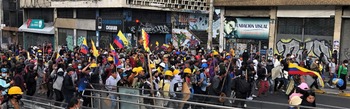
A diferencia de otros levantamientos capitaneados por el movimiento indígena, en esta ocasión las organizaciones étnicas tuvieron la destreza de entretejer un discurso transversal, más allá de lo identitario, con capacidad de atracción para los sectores subalternos golpeados por la crisis (desempleados, jóvenes sin un futuro claro, lumpemproletariado diverso, moradores de periferias urbanas insalubres e invivibles), e incluso para fracciones de clases medias en proceso de pauperización tras el fin del espejismo desarrollista de la década correísta (Ospina Reference Ospina2022) (Figura 1). Junto a la CONAIE, la organización etnopolítica más grande, participaba en el paro la Federación Nacional de Organizaciones Campesinas, Indígenas y Negras del Ecuador (FENOCIN), tradicionalmente con un discurso más clasista que la CONAIE, y la Federación de Indígenas Evangélicos del Ecuador (FEINE), que agrupa exclusivamente a población indígena de esos credos religiosos. Un aspecto relevante de esta última movilización fue, precisamente, la unidad de acción de esas tres plataformas, que en tiempos anteriores se habían enfrentado debido a sus diferentes orientaciones programáticas.
Marcha indígena y popular hacia el centro histórico de Quito, 25 de junio de 2022. Foto del autor.

Por el lado del Gobierno y de los sectores hegemónicos, sin embargo, proliferaron los discursos xenófobos y criminalizadores de la protesta, como encarnando los prejuicios racializados de antaño que las políticas multiculturales de los últimos decenios habían conseguido acallar. Fue todo muy intenso, violento y con tintes épicos, con momentos en que lo mejor y lo peor de las personas salió a flote. Al final, de manera sorpresiva, el Gobierno cedió ante las reivindicaciones del movimiento indígena, abriendo unas mesas de negociaciones que, intermediadas por la Iglesia católica, no se sabía a dónde podrían llegar, pero que, coyunturalmente, dieron sosiego al día a día del país. Una movilización de esa magnitud no es sostenible ad eternum, ni puede ser convocada con una frecuencia que comprometa su seguimiento por parte de las bases interpeladas. En este punto, merece la pena advertir que la capacidad de aguante es muy superior por parte de los levantados que por la de las autoridades. Digo esto porque es importante no perder de vista, como se señalará más adelante, que el carácter campesino de una parte importante de las bases del movimiento indígena garantiza el abastecimiento alimentario de los participantes en las marchas y la ocupación de Quito, facilitando la prolongación de las mismas más allá de los límites razonables para el Gobierno nacional, que difícilmente puede aguantar la presión de una paralización de las actividades económicas a nivel nacional como la que genera la prolongación de las medidas de hecho por tantos días ininterrumpidos.
En otro orden de cosas, conviene recordar que Ecuador atravesó por un período de extraordinaria inestabilidad política, entre 1996 y 2006, dominada por frágiles gobiernos neoliberales que se toparon con una gran contestación social liderada, casi siempre, por el movimiento indígena. Posteriormente, entre 2007 y 2017, el presidente Rafael Correa impulsó un periodo de fortalecimiento del Estado, denominado por él mismo como “Revolución Ciudadana”, enmarcado en el auge de las izquierdas en América Latina. Hasta 2014, el país experimentó una etapa de bonanza económica sin precedentes recientes —salvo, tal vez, el boom petrolero de los años setenta—, impulsada por el incremento del precio de las materias primas. Ese escenario redujo significativamente el margen para protestas masivas, pese a que temas como la minería mantuvieron una capacidad considerable de movilización, aunque alejada de la intensidad de los grandes levantamientos de los años noventa. Durante el último trienio correísta, la política económica nacional fue reorientándose hacia la austeridad y la reducción del gasto público, agudizándose la tendencia genuinamente neoliberal bajo los mandatos de los presidentes Lenin Moreno (2017–2021), Guillermo Lasso (2021–2023) y Daniel Noboa (en el cargo desde noviembre de 2023).
Este giro es relevante porque, como han señalado diversos estudios, desde finales de los años noventa, la CONAIE había quedado atrapada en una retórica que limitó su capacidad para tender puentes con sectores subalternos no-indígenas.Footnote 5 El movimiento indígena, en efecto, inició una era de protestas con la gran movilización de 1990, seguida de varios levantamientos multitudinarios en 1994 y 2000, que pusieron en jaque la agenda neoliberal de los distintos gobiernos. Sin embargo, su capacidad de canalizar el descontento social se vio progresivamente debilitada por discrepancias internas y, durante el gobierno de Correa, por la fragmentación del movimiento entre sectores afines y opositores a la Revolución Ciudadana.Footnote 6
Esa dinámica cambió con el estallido social de octubre de 2019, cuando la dirigencia indígena logró reagrupar el descontento en torno a la CONAIE frente a la agenda desreguladora del primer gobierno poscorreísta. Este proceso pareció fortalecerse aún más con el levantamiento de 2022. De ahí el interés de este ensayo: más que relatar los acontecimientos o enmarcarlos en una línea continuidad con los anteriores alzamientos, mi planteamiento es que, tras el agotamiento del ciclo de movilizaciones iniciado en 1990 —el cual culminó, en mi opinión, con la llegada al Gobierno en 2003 de connotados líderes y lideresas del movimiento indígenaFootnote 7 —, podríamos estar asistiendo a un nuevo tiempo político. Este estaría liderado por una generación diferente de dirigentes, con inventarios de protesta más inclusivos y donde el etnopopulismo que marcó los límites del ciclo anterior parece haber dado paso a una nueva estrategia capaz, una vez más, de articular vastos sectores de la población ecuatoriana en torno a una agenda amplia y plural. De ahí la metáfora del Ave Fénix: una imagen que ilustra la capacidad de las organizaciones étnicas para, dadas las circunstancias oportunas, renacer de sus crisis de representación para resignificarse, rearticularse y proyectar nuevos imaginarios y aspiraciones de mejora en las condiciones de vida de la población, trascendiendo las adscripciones etnoidentitarias tradicionales.
Nuevas dirigencias, nuevos imaginarios
Uno de los aspectos que más llama la atención en la conformación histórica del movimiento indígena es la articulación de sus dirigencias. En el caso andino, este proceso hunde sus raíces en la estructura de dominación terrateniente. Debemos tener presente que se trató de un proceso sorprendente en tanto desafiaba el sentido común y los habitus destilados a lo largo del dilatado período de hegemonía de dicho sistema de poder. Este sistema, identificado como “gamonalismo” en términos de Mariátegui (Reference Mariátegui1928 [1994]), ha sido interpretado como parte de un longevo régimen de opresión de corte hegemónico (Bretón Reference Bretón2012), un mecanismo de gobierno de poblaciones-otras (Guerrero Reference Guerrero2010) y, desde perspectivas foucaultianas, como dispositivo de ejercicio de biopoder sobre sectores subalternos racializados (Kaltmeier Reference Kaltmeier2007).Footnote 8 Desde esta óptica, me parece que lo más sorprendente de lo que aconteció en el medio andino durante los años más agudos de la lucha por la tierra en el Ecuador —particularmente durante las décadas marcadas por las leyes de reforma agraria de 1964 y 1973— no fue tanto el volumen de superficies transferidas a los campesinos, ni necesariamente el elenco de estrategias desplegadas por los patrones para conservar y capitalizar las partes más productivas de sus fundos, sino la consolidación de una generación de dirigentes —hombres y mujeres— que imaginaron la posibilidad de construir un mañana sin haciendas ni gamonales, sin mayordomos ni precaristas. Esta cohorte emergió como un sector de intelectuales orgánicos —en el sentido gramsciano del término— que entretejió la urdimbre de asociaciones que terminó por concretarse en las plataformas organizativas que protagonizaron el ciclo de movilizaciones de los años del cambio de siglo.
Sabemos que el desmoronamiento del orden terrateniente impulsó una mayor movilidad social, intensificó los flujos migratorios de las comunidades campesinas a pueblos y ciudades y, poco a poco, pero de manera imparable, diluyó las fronteras culturales, económicas y sociales entre lo rural y lo urbano (Kingman y Bretón (Reference Kingman and Bretón2016). Aunque limitada, la reforma agraria implicó el fin de un sistema, la ampliación del acceso a la educación y la llegada masiva de agencias de desarrollo de diversa índole (públicas, privadas, laicas y religiosas). La interacción desigual con todos estos nuevos actores coadyuvó la conformación nuevas dirigencias, distintas a los liderazgos campesinos tradicionales del gamonalismo (Guerrero Reference Guerrero1995). No obstante, una mirada más cercana a estos procesos revela que, en muchas ocasiones, las transformaciones aceleraron dinámicas de diferenciación al interior del propio mundo indígena-campesino, influyendo profundamente en la composición social de estas primeras generaciones de intelectuales orgánicos étnicos.
Puede parecer una simplificación, pero consideremos el siguiente razonamiento: ¿quiénes estaban en condiciones de dialogar con las diferentes instancias del aparato del desarrollo que fueron llegando a las comunidades andinas (activistas de izquierda, tecnócratas del Estado, miembros de ONG, funcionarios de agencias multilaterales, sacerdotes o pastores de diferentes credos religiosos)? ¿Quiénes estaban en condiciones de mediar, gracias al manejo —por precario que fuera— del español, la lengua que trascendía el mundo kichwa? ¿Quiénes acumulaban el capital simbólico en las comunidades por haber ocupado cargos como kipukamayos de hacienda,Footnote 9 regidores y alcaldes de anejos libres? La respuesta apunta, inevitablemente, a aquellos que ya detentaban ciertas posiciones de poder —relativo, pero poder al fin— dentro de sus comunidades de origen. Es importante recordar que el mundo indígena siempre fue un universo complejo, estratificado y atravesado por innumerables juegos de poder a su interior. Desde ese punto de vista, no cuesta mucho imaginar cómo su apertura al desarrollo —como convencionalmente es entendido— y la mercantilización-capitalización de sus economías y sus estrategias de vida, beneficiaron, en mayor medida, a quienes ya partían de una mejor posición relativa.
El caso del actual presidente de la CONAIE es un excelente ejemplo de esta dinámica. Leonidas Iza Salazar proviene de una familia de origen campesino de Toacazo, en la provincia de Cotopaxi. Sus antepasados fueron peones precaristas en las haciendas de la Curia Metropolitana ubicadas en las partes más altas de la parroquia. Con la reforma agraria —en su caso, una privatización de tierras eclesiásticas en el contexto de la Teología de la Liberación—, su familia se convirtió en beneficiaria de un modelo farmer financiado y tutelado por la cooperación internacional. Esto permitió a los Iza sobresalir como una de las familias más importantes de la provincia, no solo por haber constituido la punta de lanza de una élite campesina exitosamente capitalizada, sino, sobre todo, porque desde esa posición privilegiada controlaron —junto a pocas familias más, de la misma zona— los hilos de la intermediación de los campesinos-indígenas de Toacazo con las ONG y el Estado; proyectando después su influencia a escala regional a través del Movimiento Indígena y Campesino de Cotopaxi (MICC) y comandando la CONAIE en dos ocasiones, con Leonidas Iza Quinatoa primero (2000–2004), y con su primo Leonidas Iza Salazar desde 2021. Todo empezó con la Central de Servicios Agrícolas, agencia campesinista fuertemente vinculada a la Iglesia progresista, quien apostó durante dos décadas (1972–1992) por constituir un núcleo de prósperos agricultores familiares alrededor del poblado de Planchaloma, una localidad establecida con ese propósito en las tierras altas de Toacazo.Footnote 10
De ahí emergió la familia Iza, directamente favorecida por toda esa experiencia. De tal manera que, tras el éxito de esa experiencia piloto, miembros destacables de la siguiente generación jugaron un rol cada vez más prominente: Leonidas Iza Quinatoa fue el primer diputado indígena de la provincia (1996), antes de acceder a la presidencia de la CONAIE en 2000; Olmedo Iza, su hermano, fue director del Banco del Estado en tiempos de la alianza del movimiento indígena con Lucio Gutiérrez en 2003; y su hermana Dioselinda Iza, además de ser una de las fundadoras y lideresas de la principal organización kichwa de mujeres del país, ocupó la presidencia del MICC en 2009, sucediendo a Jorge Herrera (por cierto, delegado provincial del Ministerio de Agricultura también en la época de Gutiérrez), asimismo originario de Planchaloma y favorecido por el mismo proceso. Sin embargo, este modelo no benefició a todos por igual. Las comunidades situadas en las zonas altas, con tierras de escasa vocación agrícola, quedaron al margen de estos procesos y, cuando tuvieron acceso a proyectos asistencialistas, lo hicieron siempre bajo la mediación de las élites de Planchaloma. Como reza el refrán “no todo el monte es orégano”: en el mundo organizativo indígena, las solidaridades etnoidentitarias no eliminan las fracturas de clase y estatus, que se ensanchan aún más bajo la mano invisible del mercado. Máxime cuando esta opera bajo intervenciones territoriales que favorecen a unos —los viables—, en detrimento de otros —los marginales o, más aún, los doblemente marginalizados.
El caso de Iza es emblemático, no solo porque un miembro de esta ilustre familia lideraba la CONAIE durante el levantamiento de 2022 y se convirtió en la cara visible de la protesta ante los medios —siempre acompañado por los demás responsables de las otras plataformas étnicas— sino porque ilustra una tendencia más amplia dentro del movimiento indígena. Me atrevería a aseverar, que un rastreo en profundidad a través de las historias familiares evidenciaría la relación entre los procesos de diferenciación interna, el ensanchamiento de la brecha entre incluidos y excluidos de la mano del modelo de acumulación hegemónico, y la consolidación de determinadas élites dirigentes en los intersticios abiertos dentro de la estructura del Estado neoliberal.Footnote 11 El caso de Iza Salazar también ilustra otra arista del fenómeno: la del relevo generacional. Aunque, ciertamente, la articulación del movimiento indígena en los Andes arranca de la cuestión agraria, lo cierto es que las dirigencias de hoy, encarnadas en la figura del presidente de la CONAIE, ya no conocieron directamente el mundo de la hacienda, ni participaron de las tomas de tierras, ni tuvieron que aprender a hablar por sí mismos —sin necesidad de mediadores o ventrílocuos— porque esas batallas ya habían sido ganadas por las generaciones precedentes. Hoy, los dirigentes son mayoritariamente urbanos, están plenamente inmersos en el uso cotidiano de las redes sociales y las nuevas tecnologías de la comunicación, interactúan con personajes públicos (étnicos o no) allende las fronteras nacionales, han viajado y, en muchos casos, cuentan con formación universitaria. Todo ello se evidencia en la vestimenta, la gestualidad, las formas de expresión —oral y escrita—, así como en su articulación con determinados discursos de corte ideológico que pretenden, y en el caso de Iza eso es muy notorio, trascender lo estrictamente étnico para, recuperando la dimensión clasista de la dominación, articular narrativas más inclusivas en aras de ensanchar las bases sociales del movimiento.Footnote 12
El desafío es enorme, considerando la naturaleza fragmentada y fragmentaria del movimiento indígena. Fragmentada porque se articula a través de diferentes organizaciones, tanto en alcance territorial (comunas, cooperativas, federaciones de segundo grado, plataformas regionales) como en orientación adscriptiva (FEINE, CONAIE, FENOCIN). Fragmentaria por incompleta, pues son todos los que están, pero no están todos los que potencialmente podrían ser, lo que se evidenció durante el período de pérdida de representatividad en la primera década de este siglo XXI. Esta complejidad se agrava por la heterogeneidad de los individuos y los colectivos integrantes del poroso universo indígena: si por un lado están, como hemos visto, los ganadores y los perdedores de la modernidad capitalista, por el otro está la reconfiguración operada en estas últimas décadas en los espacios comunitarios, muy vinculada a la aludida difuminación de las fronteras entre el campo y la ciudad, así como a la incidencia de los media, las redes sociales y el consumo masivo de artefactos culturales circulantes por los mercados globales. Así, más allá de las advertencias sobre la descomunalización del mundo andino desde la década de 1980, me parece que es ineludible repensar la comunidad en el contexto de la globalización.
La comunidad de hoy no es, con certeza, la comuna campesina de antaño regida por un conjunto de lógicas de producción-reproducción de corte más o menos chayanoviano. Lo que encontramos en territorios como Chimborazo o Cotopaxi, que he tenido ocasión de etnografiar, son escenarios en los que los flujos migratorios a las ciudades —en el país y fuera de él—, las facilidades de cara al mantenimiento del contacto y la comunicación brindadas por la tecnología, así como la recurrencia de hábitos comunitarios que tienen que ver con determinadas prácticas de reciprocidad en diferentes ámbitos de la vida, obligan a aprehender la comunidad hoy más bien como una red social a través de la cual circula todo tipo de recursos, materiales y simbólicos, además de como un espacio de sociabilidad y de cimentación de las identidades y las solidaridades primordiales.Footnote 13 Todo esto converge en la conformación de la generación de dirigentes que estuvo al frente del paro nacional de 2022; un levantamiento que, junto con el de 2019, podría marcar un nuevo ciclo en las formas y en los repertorios de protesta en el futuro.
A vueltas con Mariátegui
Martín Pallares es un analista ecuatoriano que, en un medio digital, publicó un interesante análisis del proceso electoral de la CONAIE que llevó a la presidencia a Leonidas Iza Salazar en junio de 202l. Pallares explica la estrategia a partir de la cual un selecto grupo de dirigentes se hizo con el control de la organización; un grupo al que califica como adepto al “radicalismo mariateguista” y cuyo objetivo no sería otro que “iniciar el proceso de desestabilización del sistema democrático” (Pallares Reference Pallares2021). En un video que también circulaba entonces por internet, el propio Iza recocía su admiración por el pensamiento de Mariátegui y asumía tres de las tesis que ese autor planteó a tenor de la cuestión indígena en sus célebres Siete ensayos de interpretación de la realidad peruana: que el problema indígena tiene su origen en el acceso desigual a los recursos (en aquel tiempo, la tierra), la necesidad de una representación política autónoma e independiente de esos sectores subalternos ante los poderes del Estado y el desvelamiento del carácter desvirtuado de la república en la medida en que esta fue históricamente instrumentalizada en favor de los intereses de los grupos hegemónicos y oligárquicos.Footnote 14 El propio Leonidas Iza, en colaboración con Andrés Tapia y Andrés Madrid, dos intelectuales-activistas mariateguistas, publicó en 2020 Estallido, la rebelión de octubre en Ecuador, libro en el que hacen su propia interpretación del indigenismo, del marxismo y de la lucha de clases contra el capitalismo en Ecuador. Me quedo, por el momento, con las siguientes afirmaciones de sus conclusiones:
Marx advertía que “no se puede pinchar con alfileres lo que se debe demoler a mazazos”. La crisis no será superada mediante los alfileres de la izquierda institucional, que pinchan al capitalismo neoliberal mientras acarician al estatista. Más allá de sus matices, el modo de producción y la civilización burguesa engendran muerte, al igual que su hijo pródigo, el Estado nación, indistintamente de si es dirigido o desregulado, monetarista o bienestarista, fascista o multicultural, liberal o republicano, representativo o participativo, mono-nacional o plurinacional, demócrata o policíaco. Cualquiera de sus modalidades son llagas que contienen el mismo pus. […] La luz al final del túnel proviene de la afirmación creída, buscada e impostergable: Comunismo indoamericano o barbarie. (Iza et al. Reference Iza, Tapia and Madrid2020, 306)
Inquietante, muy inquietante. Para empezar, por su lectura de lo que llaman la “izquierda institucional” (toda la que no es anticapitalista o revolucionaria) como funcional a la reproducción del statu quo. Da igual enfrentar un régimen neoliberal o neodesarrollista de corte estatalista; es irrelevante un modelo keynesiano, socialdemócrata o fascista. No importa el reconocimiento de la plurinacionalidad del Estado ni su ordenamiento interno en forma federal o centralizada. Solo existe un camino y este transita por un incorpóreo y vaporoso comunismo indoamericano. ¿Alguien da más?
Con toda la heterogeneidad que le caracteriza, el movimiento indígena parece estar liderado, a tenor de estas consideraciones, por una camarilla de corte radical, probablemente dominada —al menos en el caso de la CONAIE— por ese círculo mariateguista. Se señala que este grupo llevaba tiempo trabajando con comunidades indígenas (algunos afirman que más de una década), preparando el terreno para cuando llegara el momento. Parece haber un cierto consenso entre quienes conocen el perfil intelectual de ese colectivo en que actuaban con la lógica de los grupúsculos de extrema izquierda de la Guerra Fría, como esperando la maduración de las condiciones objetivas, y con un cierto sentido leninista de la política. Me refiero, por ejemplo, a la concepción piramidal de la organización, a la idea de que esta es un instrumento en pos de un objetivo político más amplio y a que la conquista de la plataforma obedece a un trabajo largo, de muchos años, con bases indígenas y populares diversas.Footnote 15 Para los autores de Estallido, de hecho, es ya imperiosa “la necesidad de que una corriente anticapitalista se imponga por sobre la tendencia socialdemócrata y de izquierda institucional” dado el servilismo y la inoperancia de estas. Afirmaciones como “la definición de aquello que es justo o injusto, acto violento o legítimo está condicionada por una determinada interpretación ideológica correspondiente a un interés específico de clase” (Iza et al. Reference Iza, Tapia and Madrid2020, 262, 273), han generado gran controversia al interior del movimiento indígena. Como ya he reiterado en páginas precedentes, es de dominio público la existencia de importantes fisuras de diferenciación, no solo entre dirigentes y comuneros de a pie, sino también, de manera transversal, dentro de los pueblos y nacionalidades que integran la CONAIE.Footnote 16 Esta misma ha devenido en el campo, el escenario y objeto de un combate por su control en el que, por el momento, se han impuesto los representantes de un discurso más escorado hacia lo clasista y alejado de la línea identitaria dominante al menos desde el cambio de siglo.Footnote 17
Una mirada sobre la participación y las redes de solidaridad
De todos modos, una cosa son los planteamientos ideológicos de la cúpula dirigente de la CONAIE —la organización convocante más importante del paro, sin duda, pero no la única— y otra, muy distinta, las razones que llevaron a personas de diversas procedencias a solidarizarse con el mismo, a participar en marchas, ocupaciones y acampadas, o a implicarse en las tareas de soporte logístico indispensables para garantizar su éxito. Uno de los fenómenos más impresionantes de aquellos días fue, sin duda, la oleada de solidaridad que desató entre sectores sociales muy heterogéneos. Además de la propia población indígena urbana, y de aquella otra de origen indígena que ya no necesariamente se identifica como tal, pero que se sumó masivamente al levantamiento, el paro de 2022 levantó un torrente de empatía entre sectores sociales de clase media como estudiantes, jóvenes e intelectuales.Footnote 18
Destacó especialmente el apoyo brindado por las autoridades académicas de instituciones como la Universidad Politécnica Salesiana y la Universidad Central del Ecuador, entre otras. Tuve ocasión de estar en el campus de esta última el día 24 de junio, en pleno apogeo de su apertura al aluvión de personas que llegaban a Quito de comunidades indígenas serranas —mayoritariamente del centro-norte del país— y de enclaves amazónicos de las provincias de Pastaza, Orellana y Sucumbíos, principalmente. Desde que el rector decidió abrir las puertas de la institución, pocos días antes, sus amplias y ajardinadas instalaciones se convirtieron en una suerte de campo de refugiados. Los responsables de cada escuela y facultad decidieron si cedían o no sus espacios (la mayor parte lo hizo) y, de ese modo, se fue estableciendo una organización complejísima. En un gran centro de acopio se concentraban las donaciones solidarias de alimentos, mantas, colchones, material sanitario y médico, entre muchos otros insumos. Desde allí se distribuían según las necesidades de cada centro de acogida.Footnote 19 Esto implicaba organizar en cada uno de ellos la logística de las comidas, los aseos y los espacios de socialización, además de la conversión de salones y pasillos en dormitorios comunitarios. La labor de profesores, estudiantes, voluntarios médicos y cooperantes, todos y todas gratia et amorem, fue encomiable. “Digan y expliquen al mundo que esto es un espacio de paz”, insistía la joven que coordinaba las instalaciones de la Facultad de Bellas Artes en proceso de conversión en centro de acogida.
Uno de los lugares más impresionantes era la wawa wasi (guardería), donde habían llegado a concentrar hasta trescientos niños y niñas, dándoles alimentación, atención médica —tuvieron que enfrentar incluso varios partos prematuros—, salón de juegos, etc. La responsable del centro lidiaba admirablemente con las condiciones difíciles en que llegaban las madres con sus hijos e hijas, la dificultad de trabajar con un contingente en permanente movimiento: cada día se registraban entre treinta y cincuenta ingresos y salidas. En estas movilizaciones, familias enteras se desplazaban por turnos para luego ser reemplazadas por otros miembros de la comunidad que habían quedado en su territorio. La persistencia de esas economías campesinas en la sierra garantizaba el flujo de alimentos básicos que llegaban a los centros de acogida, a través de esas redes comunitarias. Como señalé más arriba, ellos y ellas pueden resistir —llevan siglos haciéndolo—; el Gobierno, en cambio, no podía permitirse tal lujo.Footnote 20
Estas tácticas de resistencia, en efecto, solo son sostenibles debido a la estructura económica de la mayor parte de la población kichwa de la zona rural andina. Se trata de unidades de producción conectadas al mercado, ya sea como parte de la fuerza de trabajo asalariada o como proveedores de bienes y servicios. Sin embargo, en su mayoría, también son pequeños agricultores (Martínez Valle Reference Martínez Valle2013). Su producción agropecuaria es diversificada, y está destinada principalmente a cubrir las necesidades básicas de la familia, vendiendo los excedentes disponibles en el mercado local. De ahí la capacidad de esos hogares rurales para soportar la escasez del mercado, el aumento de los precios —consecuencia de la especulación— y la paralización de diferentes sectores económicos durante el levantamiento. No en vano, en pleno bloqueo, las carreteras permanecían abiertas para los convoyes de camiones que transportaban a las familias desde sus comunidades a Quito, junto con productos básicos para mantener su estadía en la ciudad (Ulloa y Baquero Reference Ulloa, Baquero, Haro, Ulloa and Quito2022).Footnote 21
Otra dimensión clave de las redes solidarias que emergieron durante el levantamiento fueron las cocinas clandestinas que se organizaban en barrios populares para garantizar la logística alimentaria diaria. Se trataba, en su mayoría, de grupos de jóvenes —muchos de clase acomodada— que, de manera altruista, veían en las reivindicaciones del paro nacional la encarnación de buena parte de su descontento generacional: desempleo, inestabilidad laboral y una sensación generalizada de falta de futuro.Footnote 22 Este fenómeno de movilización juvenil es común en el Norte global, pero aquí resultaba especialmente llamativo, dada la enorme disparidad social y la reducida clase media. En cualquier caso, impresionaba la eficiencia con la que se organizaban: los acopios de verduras llegaban constantemente, y los voluntarios se organizaban en turnos para pelar y trocear papas, zanahorias, cebollas y hortalizas, cocinar una nutritiva sopa espesa, distribuirla en envases individuales de plástico y llevarla a la Casa de la Cultura o a la Universidad Central para alimentar a las personas refugiadas.Footnote 23
Tras la tormenta
Las negociaciones entre el Gobierno y las organizaciones convocantes de la movilización fueron largas, contradictorias y muy tediosas. Mediadas por la Iglesia católica, sorprendía la descoordinación en el lenguaje, la gestualidad y los modos de comunicación entre el presidente Lasso y las dirigencias étnicas (Figura 2). Estas últimas, presentes en la mesa de negociación, frente a frente con los ministros del ejecutivo, pero con la ausencia —clamorosa— del presidente de la república, algo insólito en la resolución de este tipo de conflictos.Footnote 24 A pesar de las idas y venidas, el día 30 de junio se alcanzó finalmente un acuerdo entre las partes fundamentado en la aceptación de un paquete de medidas que cubrían buena parte de las demandas que dieron origen al paro: reducción moderada del precio de los combustibles (15 centavos por galón) y estudio de un proceso de focalización para los sectores necesitados de más subsidios (campesinos, transportistas, pescadores); limitación de la minería en áreas protegidas y territorios ancestrales, zonas arqueológicas y áreas de protección hídrica; garantía de consulta previa, libre e informada a las comunidades afectadas eventualmente por el extractivismo; implementación de mecanismos de control de precios para productos de primera necesidad; declaración de emergencia en el sistema de salud pública; incremento del Bono de Desarrollo Humano de 50 a 55 dólares; subsidios a fertilizantes, reducción de tasas de interés y condonación de créditos vencidos a pequeños campesinos y microempresarios; entre otras. Las organizaciones convocantes señalaron, enfáticas: “No renunciamos al derecho a la resistencia. Si no cumplen volveremos millones”. Para garantizar el cumplimiento de los compromisos adquiridos, ambas partes acordaron la creación de una mesa técnica de diálogo —bajo la mediación de la Iglesia— “para dar seguimiento a los acuerdos y resolución de los temas pendientes de la agenda nacional de 10 puntos”, según el comunicado oficial de la CONAIE que marcó el final del paro.
Primera reunión entre las organizaciones étnicas y el Gobierno nacional. Fuente: https://quenoticias.com/noticias/dialogo-con-el-presidente-y-la-conaie.

Aviso a navegantes. Este podría ser el mensaje explícito de esta experiencia capitaneada por la CONAIE y amparada por la unidad de acción con las otras plataformas sociales, más allá incluso de sus resultados sustantivos. En cualquier caso, creo que se puede comenzar a esbozar una hipótesis sobre la relación entre la articulación de un discurso más incluyente —de clase, en términos coloquiales— por parte de una generación joven de dirigentes ideologizados y la creciente capacidad de la organización para aglutinar a sectores subalternos no necesariamente indígenas en las movilizaciones. Es lo que me parece que se vio en las marchas de este último levantamiento: una amalgama de actores movilizados —indígenas, sí, pero también pobladores urbanos mestizos o desindianizados, así como jóvenes que en otras ocasiones no se sentían atraídos por el discurso étnico predominante en el pasado. En lugar de la abundancia de wipalas, (la bandera del arcoíris, antes omnipresente en marchas y manifestaciones), esta vez fueron muchas las enseñas ecuatorianas que ondearon en las protestas.Footnote 25 Esta diversidad de actores refuerza la tesis sobre los límites de las políticas multiculturales en un momento histórico en el que aquellas parecen tambalearse ante las tensiones de clase que, sentidas como tales, adquieren una transversalidad que permite el desbordamiento social y la contestación frontal al poder establecido.Footnote 26
Es interesante pensar cómo todos estos elementos fueron convergiendo en un espacio y una coyuntura determinada, alimentando el éxito de la movilización contra Lasso. Sin embargo, es crucial diferenciar entre el perfil ideológico de las dirigencias —por más orgánicas y coherentes que sean— y el conjunto de motivaciones, muchas de ellas pragmáticas, que llevan a colectivos e individuos a sumarse a un paro en determinadas circunstancias. Lo que quede de todo esto y lo que pueda llegar a acontecer a largo plazo es otro tema, máxime a partir de la oleada de violencia por la que atraviesa el país a resultas de la penetración del narcotráfico en el tejido social. Por el momento, la tormenta de junio de 2022 —que dejó seis personas fallecidas y más de quinientas heridas— ha dado paso a una relativa calma en el horizonte, al menos en lo que respecta a la confrontación de las plataformas étnicas. Una calma, no obstante, que por la naturaleza abrupta de los Andes y los vientos que los surcan, bien podría detonar, más pronto que tarde, en nuevas tempestades de intensidad variable y consecuencias imprevisibles. Así son los ríos profundos que surcan, parafraseando a Arguedas, la historia agrietada, dramática y viva de estas tierras tan fascinantes y ricas en utopías y deseos.
Agradecimientos
El autor quiere agradecer a los tres evaluadores anónimos de LARR por las sugerencias que plantearon y que permitieron matizar, enriquecer y mejorar el contenido del artículo.


 Open access

