




Over the past several decades, scholars of African studies have produced numerous case studies detailing how domestic migrants, across a range of time periods, have become assimilated into host communities (Boni Reference Boni, Kuba and Lentz2006; Chauveau Reference Chauveau, Kuba and Lentz2006; Kopytoff Reference Kopytoff and Kopytoff1987; Kuba Reference Kuba, Kuba, Lentz and Nurukyor Somda2003; Lentz Reference Lentz and Lentz2006a; Reference Lentz and Lentz2006b; Reference Lentz2013). This literature, in conversation with critical scholarship on the constructed nature of ethnic categories and, to a lesser extent, the legacy of slavery and servitude, has revealed how, in agricultural societies, the strategy of ‘autochthonization through incorporation’ allowed migrants to gain access to the land (Lentz Reference Lentz and Lentz2006b: 37; cf. Kuba and Lentz Reference Kuba and Lentz2002; cf. Isumonah Reference Isumonah2003: 4–5). As anthropologist Carola Lentz (Reference Lentz and Lentz2006a: 2) has effectively argued, the process whereby ethnic outsiders are absorbed into those populations understood to be autochthonous ‘can work in both directions, with immigrants or “strangers” using all available avenues to gain access to land in order to become “sons of the soil” and with locals struggling to exclude newcomers for fuller control over the land’.
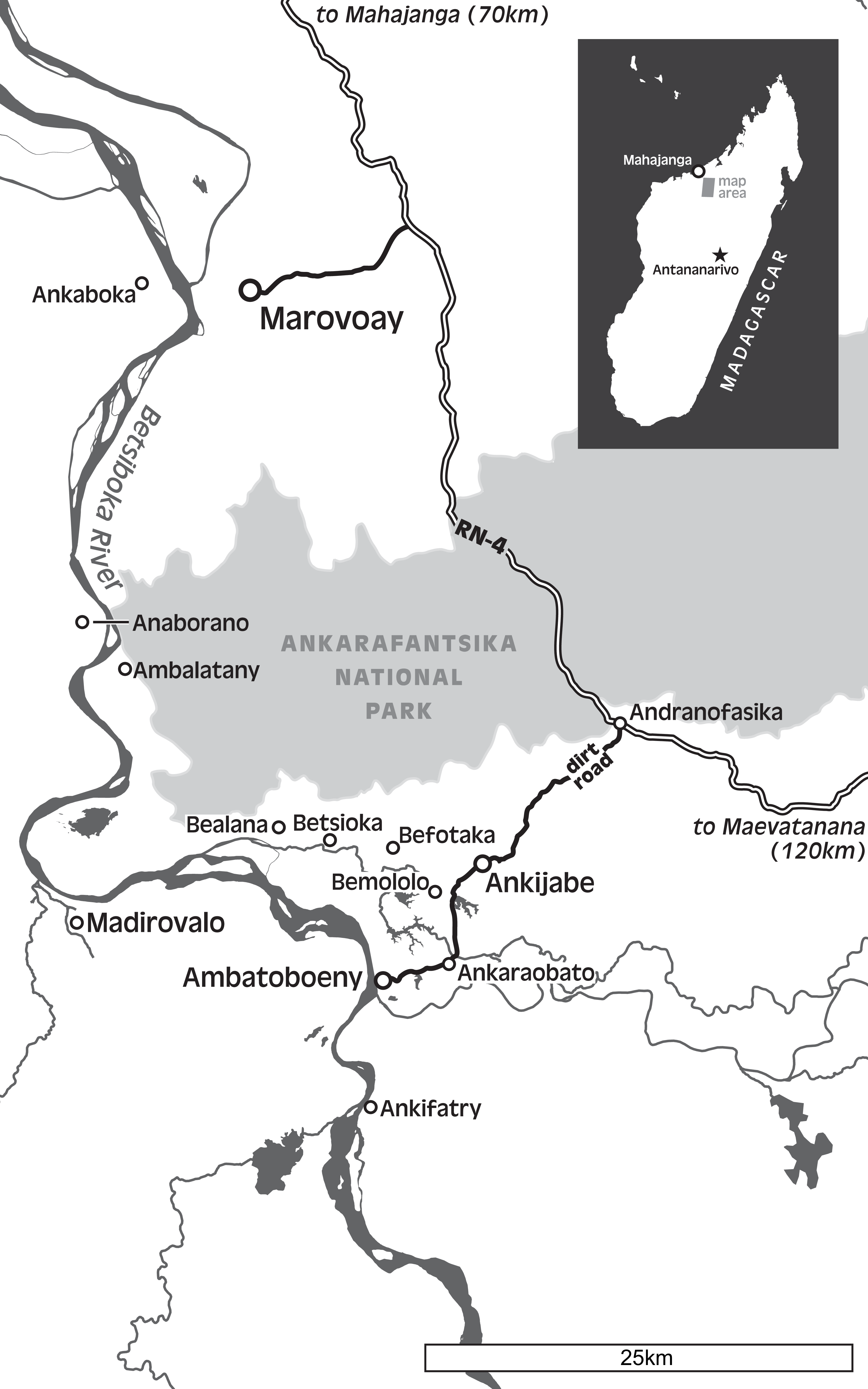
This article, on the other hand, examines how Merina mainty (‘black’ Merina) migrants gradually achieved symbolic and political ascendancy – a process I describe broadly as ‘allochthonous dominance’ – over the local Sakalava, the ethnopolitical identity widely recognized to be indigenous to Besakoa.Footnote 1 Besakoa lies along Betsiboka River in the rural, agricultural district of Ambatoboeny, north-western Madagascar (see Figure 1). Rather than incorporating themselves into the community of autochthonous Sakalava ‘masters of the land’ (tompontany), to employ the local idiom, these ‘black’ Merina migrants instead came to absorb some Sakalava into their fold.
Select towns, villages and shrines across the Betsiboka valley. Map by Tim Stallman with site location assistance by the author.

In what follows, I trace this process of allochthonous dominance, beginning with a general ethnographic description of these migrant families and their livelihoods and continuing with an historical examination of migration into the Betsiboka valley. Next, the article examines the ritual and kinship techniques through which disempowered ‘black’ Merina in Besakoa asserted their symbolic authority over the alluvial landscape and in turn over the local population. These practices, I argue, challenge prevailing assumptions in Madagascar regarding the directionality of assimilation and belonging among domestic migrants. Lastly, the article considers the rumours of enslaved ancestry that hovered over these migrants and how their families reimagined narratives of homeland and origin in Sakalava country.
Rumours of enslavement and ‘black’ Merina identity in Sakalava country
I began to learn more about these ‘black’ Merina families on a sunny afternoon in July 2022, when Edmond slowly guided me through Besakoa. I had arrived by canoe from the nearby administrative town of the same name, Ambatoboeny, hereafter referred to as ‘Ambato town’. During this time of the year, at the height of the dry season, cash flow into the village reaches its annual apex. Besakoa was relatively animated as we manoeuvred around oxcarts loaded with polypropylene gunny sacks of harvested crops, children at play, and a cluster of cattle, their herders armed with bovine vaccines. Edmond identified his kin’s homesteads and fields, as well as the crumbling foundation of what was once a bustling tobacco warehouse.
Edmond, who was of Merina ethnicity and born in 1940, was a respected elder, the father of fifteen children, village president (chef de fokontany), and a thoughtful interlocutor who patiently entertained my questions on the history of Besakoa and its inhabitants. Edmond’s parents and maternal grandmother had moved to the village in the 1920s from Tsarafeno,Footnote 2 a town 35 kilometres north-west of the capital city, Antananarivo.Footnote 3 They were in search of wage labour and had heard that there was work to be found at one of the French-owned plantations in the district of Ambatoboeny. At the time of my visit, the main cash crops in Besakoa were black-eyed peas and mung beans, although many families were still growing the older cash crops of tobacco and peanuts, just as their ancestors had a century before.
Given its location in the Betsiboka valley, Besakoa is firmly situated in the heartland of the southern Bemihisatra line of the Sakalava monarchy. Sakalava ethnopolitical claims to autochthony in the Betsiboka valley derive from oral histories describing the arrival of royal parties from the south-west around the turn of the eighteenth century (Kneitz Reference Kneitz2014; Lambek Reference Lambek2002: 84). Royal cemeteries and other sacred sites (doany) located throughout the valley comprise an expansive system of monarchical locales which pilgrims regularly visit, and which house the remains of local royalty. Sakalava occupy a privileged position of authority over the soil given that they are recognized as the rightful ‘masters of the land’ (tompontany) by their fellow inhabitants. Edmond’s parents were considered ‘migrants’ (mpiavy) or ‘guests/strangers’ (vahiny), as all non-Sakalava migrants are.
On this and subsequent visits to Besakoa, I discussed with Edmond the decision that he and his extended family had made to build a new family tomb in Sakalava country, which meant that they no longer needed to ‘lift’ (miakatra) the bones of deceased kin to tombs in the highlands, from where their ancestors were purported to have originated. This decision was noteworthy given that ethnic Merina like Edmond are expected to be buried in familial tombs in the highlands upon death. Highlanders from the central region of the island (including those of Merina and Betsileo ethnicity) associate their ancestral homeland with the placement of familial tombs; patria and place of entombment determine descent groups and the informal land rights of descendants.
Traditionally, the remains of those who have ventured far from ‘the land of the ancestors’ are returned to the tomb of their choosing, even if it takes years for the family to gather the necessary funds to unbury their loved one from the temporary tomb and transport the corpse to its final resting place (Bloch Reference Bloch1971a: 111–22, 140; Sharp Reference Sharp1996: 95–6; Regnier Reference Regnier, Gervais-Lambony, Hurlet and Rivoal2017: 121–8). Instead, Edmond and his family transported their ancestral bones from the old tomb in Tsarafeno to the valley upon the completion of their new tomb in 2001. In constructing new tombs in the valley, migrant families like Edmond’s challenged the cultural ideal of bodily repatriation to ancestral homeland – an ideal regularly reproduced in interlocutors’ depictions of Merina ‘custom’ (fomba) and continually repeated in the ethnographic canon (Bloch Reference Bloch1971a; Graeber Reference Graeber and Middleton1999: 322).
Edmond, his kin, and most other residents of Besakoa were not just Merina, however; more specifically, they were ‘black’ (mainty) Merina. At risk of oversimplification, Merina society is composed of ‘black’ and ‘white’ (fotsy) racialized statuses, the latter of which derives from historically endogamous descent groups. Maurice Bloch (Reference Bloch1971a) has referred to the endogamous descent groups of ‘white’ Merina as ‘demes’, for they have traditionally been connected to a specific ancestral territory marked by the presence of a stone tomb.
Over time, I came to learn that other Ambato town residents, from different ethnic backgrounds, circulated rumours that the families of Besakoa were of enslaved ancestry. Several individuals from these ‘black’ Merina families would later identify themselves to me as having ancestors who were ‘lost people’ (olo very), a colloquialism used across the island to describe the violent dis-anchoring wrought by enslavement (Graeber Reference Graeber2007). Identified as ‘black’ Merina, Edmond and his kin were implicitly understood by ‘white’ Merina residents of Ambato town – who differentiated themselves from their ‘black’ counterparts – to have descended from persons kidnapped and captured through raids during the expansion of the Merina empire. From roughly the late eighteenth century to the mid-nineteenth century, thousands of Malagasy were kidnapped and brought to the highlands. Although enslaved status was never connected to any phenotypic feature, the majority of those enslaved were darker skinned compared with their ‘white’ Merina counterparts (Campbell Reference Campbell2005: 113–19; Larson Reference Larson2000; Bloch Reference Bloch1971b: 165–6; Evers Reference Evers and Middleton1999: 260).
Historically, mainty (black) was not a euphemism for enslaved status. Persons of any background, including ‘white’ Merina of free or noble origin, could be enslaved (Razafindralambo Reference Razafindralambo, Rakoto and Urfer2014: 96). Yet despite the historical presence of free ‘black’ status groups, and the fact that persons of free descent with phenotypic features associated with ‘black’ Merina also migrated to the highlands, ‘black’ Merina came to be amalgamated into the same social category as those persons of enslaved descent, just as ‘white’ Merina groups rose to power (Razafindralambo Reference Razafindralambo, Rakoto and Urfer2014: 98; Ramanantsoa Ramarcel Reference Ramanantsoa Ramarcel and Rakoto1997).
Over time, this led to the racialization of status distinctions in the highlands, where phenotypic features became iconic of the reified differences between those of enslaved and free ancestries. The assumed racialized link between ‘black’ Merina identity and enslaved ancestry has been noted by ethnographers of the Malagasy highlands (Gardini Reference Gardini2020: 267; Bloch Reference Bloch1968: 102; Reference Bloch1971b: 165–6; Graeber Reference Graeber2007: 1–2). I found that the assumed fungibility of ‘black’ Merina identity and enslaved ancestry extended well beyond the highlands during participant observation in the Betsiboka valley, where ‘white’ Merina and non-Merina migrants alike assumed that ‘black’ identity and enslaved ancestry were synonymous.
Since the early 1800s – roughly during the height of the domestic slave trade – free Merina preferred burial in expansive familial tombs. As historian Pier Larson (Reference Larson2000: 183–91) argued, most tombs in Imerina prior to 1800 were small, inconspicuous and organized by household or even by individual. After 1800, as the practice of enslavement intensified, tombs became increasingly grandiose and organized by kin-based lineages. Remains from older tombs were brought to the new tombs, initiating a renaissance in the ritual of exhumation and rewrapping of ancestral remains (famadihana). According to the hegemonic cultural script promoted by ‘white’ Merina, failure to be placed in a large, permanent ancestral stone tomb was a sign of being a ‘lost person’, for enslaved persons did not have that privilege and were instead buried in simple earthen graves (Bloch Reference Bloch and Watson1980: 108–9; Crossland Reference Crossland2014: 38; Graeber Reference Graeber and Middleton1999: 321–2; Regnier and Somda Reference Regnier, Somda, Falola, Parrott and Sanchez2019: 357–8; Razafindralambo Reference Razafindralambo, Rakoto and Urfer2014: 102).
By interviewing both ‘black’ Merina and their neighbours, I initially aimed to better understand the rumours that circulated about their origin stories. I entered into dialogue with these families of Besakoa as a foreign researcher during eighteen months of holistic ethnographic dissertation research in 2014–15 on sex/gender diversity and religiosity; for roughly twelve months of this period I resided in the home of one of their extended kin in Ambato town. Later, in 2022, I returned to Besakoa to conduct in-depth interviews with these families and their neighbouring community members over a period of several weeks. My participant observation among those rumoured to be the ‘lost people’ of Besakoa (and surrounding villages) was primarily facilitated by my host ‘mother’, whose mother-in-law had descended from the ‘black’ Merina families of Besakoa. Edmond, in fact, was the uncle of my host mother’s deceased husband. Given that respected elders in Besakoa and surrounding villages recalled my residence in 2014–15 with their kin, they seemed relatively at ease about discussing issues with me that were otherwise left unspoken.
Although several family members privately told me that they were of enslaved ancestry, I found that it remains ultimately impossible to definitively determine whether the ‘black’ Merina migrants of Besakoa were in fact of enslaved origins. Instead, following Sandra Evers (Reference Evers and Middleton1999) and Dominique Somda (Reference Somda2009), who also studied rumours of enslaved ancestry in Madagascar, I focus on perceived or claimed ancestry – both the objects of rumour and the subjects who reproduced them – since the social consequences of such rumours persist regardless of their historical accuracy.
I quickly became interested in understanding how these Merina-identified families narrated their ethnic ancestry in the valley, far away from the central highlands where the afterlives of enslavement and its accompanying social stigma, silences and historical erasures are particularly palpable (Regnier and Somda Reference Regnier, Somda, Falola, Parrott and Sanchez2019; Freeman Reference Freeman2013). The physical and temporal distance between these families’ experiences in the valley and their ancestors’ subjection in the highlands allowed them to agentively recraft themselves and their descendants as empowered, rather than disenfranchised, ‘black’ Merina.
In addition, their relative economic and professional success helped them move past the lowly status embodied in their humble background. Descendants of the ‘black’ Merina families of Besakoa secured employment as doctors, teachers and government officials; those who did not complete university studies led quiet yet productive lives as farmers on their families’ land. In addition to novel tomb construction, by marrying local Sakalava women and encouraging their descendants to take up Merina ritual practices on Sakalava territory, these ‘black’ Merina families cemented their allochthonous dominance in the valley. They complicated the commonly held assumption that ethnic outsider migrants gradually adapt to Sakalava custom and are slowly absorbed into the first-comer community.
The ethnographic case study presented here occurred outside of conflict between autochthonous and allochthonous communities’ access to arable land and outside waves of nativist sentiment animating citizenship claims between host and stranger communities. These themes have shaped the scholarly literature in African studies on in-migration and allodial land titles in recent years, much of which is based in West and Central Africa, where access to unclaimed arable land has been more limited than in Sakalava country (Boone Reference Boone2017; Chauveau Reference Chauveau2000; Geschiere and Nyamnjoh Reference Geschiere and Nyamnjoh2000; Isumonah Reference Isumonah2003; Lentz Reference Lentz and Lentz2006b; Reference Lentz2013).
Some of this scholarship has explored how the practice of cash crop agriculture, when combined with increasing land scarcity (whether real or perceived), often leads to the ‘hardening of boundaries of belonging’, particularly as it relates to autochthonous ethnic identity and access to fecund soil (Boni Reference Boni, Kuba and Lentz2006: 183; Lentz Reference Lentz and Lentz2006a; Chauveau Reference Chauveau, Kuba and Lentz2006; Konings Reference Konings, de Bruijn, van Dijk and Foeken2001). ‘Black’ Merina participation in the cash crop economy, and indigenous Sakalava withdrawal from these labour regimes established during the construction of French plantations, resulted in the migrants’ gradual and relatively uncontested occupation of the fertile floodplains.
The occupation of these floodplains by these families of purportedly enslaved origins was also supported through novel tomb construction (see, for example, Evers Reference Evers2005). While literature on African societies has often recognized the importance of burial places in the production of nationalist and lineage-based notions of ancestral belonging (Moyo et al. Reference Moyo, Núñez, Leuta, Wilhelm-Solomon, Núñez, Kankonde Bukasa and Malcomess2016), it has less often explicitly recognized how interment sites often act as ‘tools of territoriality, and anchors of being’ in agrarian contexts, as anthropologist Parker Shipton (Reference Shipton2009: 96) has noted in Luo communities in Kenya, where population growth has intensified competition for arable land. Symbolic power over the land in the Betsiboka valley and Madagascar more generally is often expressed through the construction of permanent familial tombs. This contrasts with much of the scholarship on land claims among expansionist African migrant groups, which has focused primarily on earth shrines and their priests (Colson Reference Colson and Turner1971; Kuba and Lentz Reference Kuba and Lentz2002; Kuba Reference Kuba2000).
Through the quintessentially Malagasy material symbol of the familial tomb, interethnic marital alliance and the uptake of Christian ritual practice, the ‘black’ Merina of Besakoa solidified their mastery over new land far from the highlands. While most interlocutors acknowledged that only Sakalava are the ‘masters of the land’, some ‘black’ Merina boldly contended that the Betsiboka valley is now their new ‘land of the ancestors’, successfully folding themselves into the local Merina political hegemony, as described below, and challenging longstanding ideas of autochthony (itself a contested process and identity), ‘landedness’, soil and belonging that are inextricably interwoven in the valley. The following section explores the historical origins of this long process of allochthonous dominance.
Migration histories and ideologies of belonging in the Betsiboka valley
Highlanders’ domestic migration into the Betsiboka valley began in the 1820s under the Merina king Radama I’s military takeover of the Boeny region. The monarch’s imperial ambitions were supported by British officials who promised to aid Radama I in his pursuit to occupy the entire island, following in the footsteps of his father, Andrianampoinimerina (Campbell Reference Campbell1987). The Merina administration constructed garrisons in newly conquered territories, including throughout the Betsiboka valley. Merina imperial forces then dispatched civilian colonists under military protection to engage in agricultural and economic development around these provincial strongholds. Alongside officers and soldiers from the Merina army, enslaved persons from Mozambique (makoa) lived in these forts and worked on the plantations that developed from them (Rasoamiaramanana Reference Rasoamiaramanana1989).
Historical records indicate that other highlanders of varying degrees of servitude moved to these military encampments in the valley. Capitan E. Defoort, who was stationed in Ambato town and wrote a report on the region shortly after French occupation, noted that, prior to colonial incursion, Merina officers had already brought enslaved Betsileo with them to military posts, including at Mahatombo (Defoort Reference Defoort1907: 14–15; Rasoamiaramanana Reference Rasoamiaramanana1989: 67; Ballarin Reference Ballarin2000: 190). By the mid- to late nineteenth century, the valley became heavily populated with migrants from the central highlands, including those who increasingly self-identified as Merina (Larson Reference Larson2000).
Shortly after annexation, colonial officials handpicked the Betsiboka valley as a possible future breadbasket of the colony, despite what they saw as the continual labour shortage there. Speaking of the region, in 1902 French scientist Dr d’Anfreville de la Salle (Reference d’Anfreville de la Salle1902: 22) wrote: ‘[W]e can foresee … the time when its vast lower basin … will provide a huge quantity of agricultural produce for export. There are thousands of square kilometres of good, perfectly irrigable land, almost literally empty of inhabitants.’ ‘The sector is rich,’ Capitan Defoort (Reference Defoort1907: 41) wrote several years later. ‘All it needs is a workforce to become one of Madagascar’s richest regions.’ French colonial administrators including Defoort saw the highlanders’ domestic migration into the valley as an effective strategy to deal with the labour shortage. They warmly welcomed Merina and Betsileo settlement based on their own pseudoscientific and racist impressions of the Malagasy population, according to which the (typically lighter-skinned) Merina and Betsileo, who had engaged in rice cultivation, were more industrious than their ‘lazy’, pastoralist Sakalava counterparts (Lambek Reference Lambek2002: 100; Feeley-Harnik Reference Feeley-Harnik1991: 132; Sharp Reference Sharp1996: 50, 162).
During the early twentieth century, domestic migration into the valley included the arrival of a second wave of highlanders, including formerly enslaved ‘black’ Merina and their descendants. This migration out of the highlands to the north and west had increased after abolition (1896), when the newly liberated searched for empty land from which to start life anew (Bloch Reference Bloch1971a: 33–4; Reference Bloch1971b: 166; Reference Bloch and Watson1980: 114; Freeman Reference Freeman2013: 604; Graeber Reference Graeber and Middleton1999: 322; for comparative context, see also Rodet Reference Rodet2015; Rossi Reference Rossi2014; Bellagamba et al. Reference Bellagamba, Greene and Klein2013: 10). Migrants from the highlands, alongside labourers from the south-east, had arrived in search of wage labour on French-owned rice, tobacco and peanut plantations.
These labour migration patterns were corroborated in oral histories I conducted, which revealed that most early settlers had arrived in Besakoa ‘in search of income’ (mitady ravinahitra). They were responding to the increasing demand for agricultural labourers necessitated by the introduction of two firms, the Compagnie Franco-Malgache d’Enterprises and the Compagnie Lyonnaise, which both operated in the region during the colonial period. Others arrived as forced labourers during the construction of a modern road connecting Mahajanga to the capital, Antananarivo (Jacquier-Dubourdieu Reference Jacquier-Dubourdieu, Raison-Jourde and Randriana2002: 294–5; Deschamps Reference Deschamps1959: 187–92; Yves and Raymond Reference Yves and Raymond1948: 11–17).
This migratory trend, in which newcomers from other regions of the island arrive in the valley seeking a better life, has continued into the present. Since independence, citizens have been able to purchase unclaimed land from the Malagasy state. However, Sakalava have no preferential advantage to the land, as Malagasy law does not consider ethnic affiliation in land ownership claims. Despite decentralization reforms and increased local oversight over agricultural land, in this rural region only a small percentage of the land has been registered and titled. Bureaucratic procedures required to achieve a land title are lengthy, complicated and exorbitantly expensive for many farmers. As of 2005, only about 10 per cent of eligible land in Madagascar had been titled (Widman Reference Widman2014).
Official land records at the regional office in Mahajanga corroborated interlocutors’ claims that the land surrounding Besakoa had not yet been officially purchased or titled, but nor had there ever been contested ownership claims between the migrant families and their Sakalava neighbours. Descendants of the ‘black’ Merina settlers informally divided their land, using features of the physical landscape, such as trees or human-made dirt mounds, to mark the limits of land tracts. The riverine district continues to provide, quite literally, fertile terrain for newly arrived migrants who, in turn, negotiate their sense of belonging in relation to the Sakalava ‘masters of the land’.
Unlike in Merina and Betsileo country, where the self-professed autochthonous population maintains political dominance, in the rural Betsiboka valley, Sakalava are disenfranchised. This differs, too, from the fertile Sambirano valley in Sakalava country to the north, which avoided the earlier period of intensive Merina military expansion in the 1820s and where Sakalava maintained land ownership and initial economic dominance over migrant newcomers (Sharp Reference Sharp1996: 42–4). Much literature on customary land law on the African continent shows that populations recognized as autochthonous were more likely to have gained ownership of agricultural terrain (Chauveau Reference Chauveau, Kuba and Lentz2006). Instead, in the Betsiboka valley, the naturalized link between Sakalava ethnicity and local, ancestral sovereignty did not translate to economic power, for most fecund fields were claimed or purchased by ‘guests’, including those who traced their ancestry to the central highlands (Jacquier-Dubourdieu Reference Jacquier-Dubourdieu1986; Reference Jacquier-Dubourdieu, Raison-Jourde and Randriana2002; Deschamps Reference Deschamps1959: 191).
Sakalava in the Betsiboka valley thus occupy a paradoxical position, for while they enjoy ideological authority over migrant guests, they are not part of the economic and political elite. Politicians representing the district have tended to be the mixed descendants of highland migrants and French or Greek colonizers. During my ethnographic fieldwork in the 2010s and 2020s, non-Sakalava migrant guests regularly claimed that ‘there are no longer hardly any “masters of the land”’ left. Rather than describing a decreasing Sakalava population, speakers referenced the number of Sakalava who either had intermarried with migrants from other regions of the island or lived a stereotypically traditional Sakalava lifestyle, marked by residence in small hamlets, particularly those near royal cemeteries (doany), far away from the administrative centre of Ambato town, which remains economically dominated by ‘guests’. In other words, this was a migrant guest commentary on the loss of Sakalava ethnic purity and the Sakalava act of social retreat from sites of state power in the valley (Lambek Reference Lambek2002: 101).
The terrain around Ambatoboeny proved particularly fertile for the two most prosperous men in Ambato town in the 2010s and 2020s, both buyers and sellers of local cash crops, but neither of whom were Sakalava. One, a ‘black’ Merina from Besakoa, and the other, a Betsileo, both owned multiple homes in different cities and their children studied at elite private schools in the capital. One of the two now represents the district in the National Assembly. Residents clamoured that these men were the reason why ‘the road leading in and out of Ambato town to the national highway isn’t finished’, for they believed that the two big men were in cahoots with local government officials. Improving the severely dilapidated road would lead to a more open and competitive market, according to these townspeople. These businessmen knew that a better route into town would ultimately hurt their stranglehold on economic power, and their success became the most salient piece of anecdotal evidence to support the widely cited claim that ‘Sakalava are the masters of the land, but it is the guests who are rich’, as several interlocutors explained to me.
Malagasy speakers within and beyond the Betsiboka valley regularly employ a variety of idioms to index landedness, autochthony and affinity, drawing from tany – a morpheme that occupies a wide semantic field, from the physical terrain and its soil, to acreage, nation and kingdom (Evers et al. Reference Evers, Campbell, Lambek, Evers, Campbell and Lambek2013; Rijke-Epstein Reference Rijke-Epstein2024). This indexical relationship between soil and belonging is embodied in a rich lexicon of compound words, including tompontany (‘masters of the land’) and zanatany (‘children of the land’). The latter of the two, in the valley (and contrary to other regions of the island), describes both non-Sakalava Malagasy and foreigners who were born and raised on local soil, or perhaps arrived there during infancy, established kin networks, and continue to respect local customs into the present (Jacquier-Dubourdieu Reference Jacquier-Dubourdieu, Raison-Jourde and Randriana2002: 293; cf. Rijke-Epstein Reference Rijke-Epstein2023). The ‘black’ Merina of Besakoa are thus considered ‘children of the land’. More specifically, however, they identify as valovotaka, a status that refers to domestic migrants (but especially highlanders) who have permanently settled in the valley with no plans to return to their ancestral homeland.
Interlocutors of varying ethnic identities regularly cited a particular proverb when unstructured interviews veered into the topics of ethnic identity, domestic migration, resettlement, belonging and homeland (tanindrazana, literally ‘soil of the ancestors’). In the proverb, a dusty tenrec, a brown hedgehog-like animal, becomes rust-coloured once covered in the Malagasy soil (trandraka an-tanimena, volon’tany no arahina). This popular Malagasy expression effortlessly embodies the widely held narrative that domestic migrants from other regions of the island will assimilate to the ancestral customs of the autochthonous population. Just like the tenrec, who comes to eventually blend in with its environment, they perform a kind of cultural camouflage hoping that they may be welcomed by, and perhaps later integrated into, those networks that undergird local Sakalava socio-political institutions.
And while some ‘black’ Merina migrants in Besakoa took up Sakalava customs, many more complicated this narrative, doubling down on their ethnic difference and reinforcing claims to belonging by absorbing non-Merina into their kin groups. The following section outlines several ritual techniques that these migrants employed to assert their allochthonous dominance in the valley.
Allochthonous dominance and anchoring through ritual
Marital alliance and religious practice
As these ‘black’ Merina settlers created a life in the valley, many of the men entered romantic unions with Sakalava and non-Merina migrant women. Edmond voiced the above-mentioned, oft-repeated statement that there are fewer and fewer Sakalava, but according to him it was because ‘they have married Merina’ (fa manambady Merina), a point that was corroborated by the genealogies of several elders that I collected. He added that ‘half of the Sakalava have become Merina’ (sasany Sakalava efa lasa Merina). Given the patrilineal bias in Malagasy kinship, mixed descendants of Merina-identified men typically identified as Merina as well.
Many settlers, like the ‘black’ Merina families of Besakoa, understand the process of becoming valovotaka as directly referring to the process of losing ethnic purity, based on widely held essentialist notions of ethnicity. When I solicited interpretations of the origins of the term valovotaka, interlocutors commonly responded that it was related to valo ila, a phrase that refers to the eight great-grandparents that any one person descends from. The idea of ethnic mix among cognatic kin was central to notions of being valovotaka. Thus, just as extended residence in the valley can produce valovotaka status, so too can it produce mixed heritage. ‘We are all mixed’ (efa mifapidipiditra), another ‘black’ Merina elder recounted, acknowledging that, despite their Merina identities, many community members also had ancestors of other ethnic backgrounds. Compared with the endogamous marital alliances maintained by noble ‘white’ Merina of free descent, ‘black’ Merina have historically been more inclined to engage in interethnic exogamous unions (Bloch Reference Bloch1971b).
Seated outside her home, in the shade, I learned much about interethnic Merina–Sakalava relations from Rapety, a Sakalava woman who had married a Merina man from Besakoa. Surrounded by her grandchildren, we chatted while she sewed – a skill that is more commonly practised among Merina women than Sakalava women in this region. All but one of her adult children were off working in the fields. ‘We practise Merina custom all the time,’ she insisted, adding that she is Christian and attends the Malagasy Church of Jesus Christ (Fiangonana Jesosy Kristy eto Madagasikara) in Besakoa. Migrants from the highlands are more likely than the local Sakalava to identify as Christian and receive a secondary education, in part a legacy of the fact that the central highlands were the most heavily missionized part of the island. Merina migrant soldiers and the London Missionary Society brought the Christian tradition, including religious education, with them to the valley, beginning with Radama I’s military expedition (Chandon-Moёt Reference Chandon-Moёt1984).
Merina custom, as understood by residents in the valley, is decidedly Christian, as articulated in the comment of a young ‘black’ Merina man who overheard our conversation and added: ‘One should not practise the customs of one’s ancestors but, rather, the customs of Jesus’ (tsy tokony manao fomban’drazana fa manao fomban’ Jesosa). Rapety said that her Sakalava father was a diviner (mpisikidy) and spirit medium, but she then went on to say that tromba spirits of Sakalava royalty that possess or ‘sit upon’ (mipetraka) their human mediums are ‘devils’ (devoly) who have no other purpose than that of simply ‘bothering humans’.
While some local Merina took up the practice of Sakalava spirit mediumship, the opposite was largely the case in Besakoa, where those who married into the Merina families, like Rapety, quickly adopted Merina custom. On that point, Dominique, a respected and retired schoolteacher who descended from ‘black’ Merina families, reminded me that ‘the Sakalava [in Besakoa] have already switched over [to Merina custom]; they no longer practise their ancestral taboos’. Dominique’s parents were both mixed Merina–Sakalava, and her maternal and paternal grandfathers were men from the highlands who partnered with local Sakalava women. She said that Sakalava women who married into Merina families at Besakoa broke with their ancestral taboos (fady), such as the common Sakalava prohibition against the consumption of pork; notably, Rapety raised pigs. To explain this gendered practice of custom uptake, residents noted that ‘men are strong’ (lehilahy mahery), meaning that the husband’s customs prevail (just as a wife is often buried alongside her husband in his paternal tomb). Given this patrilineal bias and predominant gendered interethnic marital pattern in Besakoa, Merina custom has dominated over all others, despite unfolding on Sakalava soil.
‘Black’ Merina drew upon a range of strategies to authenticate and reproduce their Merina ethnicity, including encouraging their children to attend church and school, dropping taboos associated with non-Merina peoples, and encouraging their spouses, even if non-Merina migrants or Sakalava, to do all the above as well. Notably, they also built new tombs and practised Merina-style burials in Besakoa.
New tombs
In addition to the previously mentioned idiomatic references to soil, landed forms of belonging are also reinforced through material practices carried out below and above it in the form of tombs. These ideas are not unique to the Malagasy context; autochthonous notions of belonging, Peter Geschiere (Reference Geschiere, Das and Fassin2021: 87) broadly notes, are often indexed cross-culturally in funerals and ‘linked to heavy ritual in which the earth plays a key role’. In constructing new tombs in Besakoa, these ‘black’ Merina families were making a bold statement about their new homeland, drawing upon this essentialized connection between ancestral land and burial.
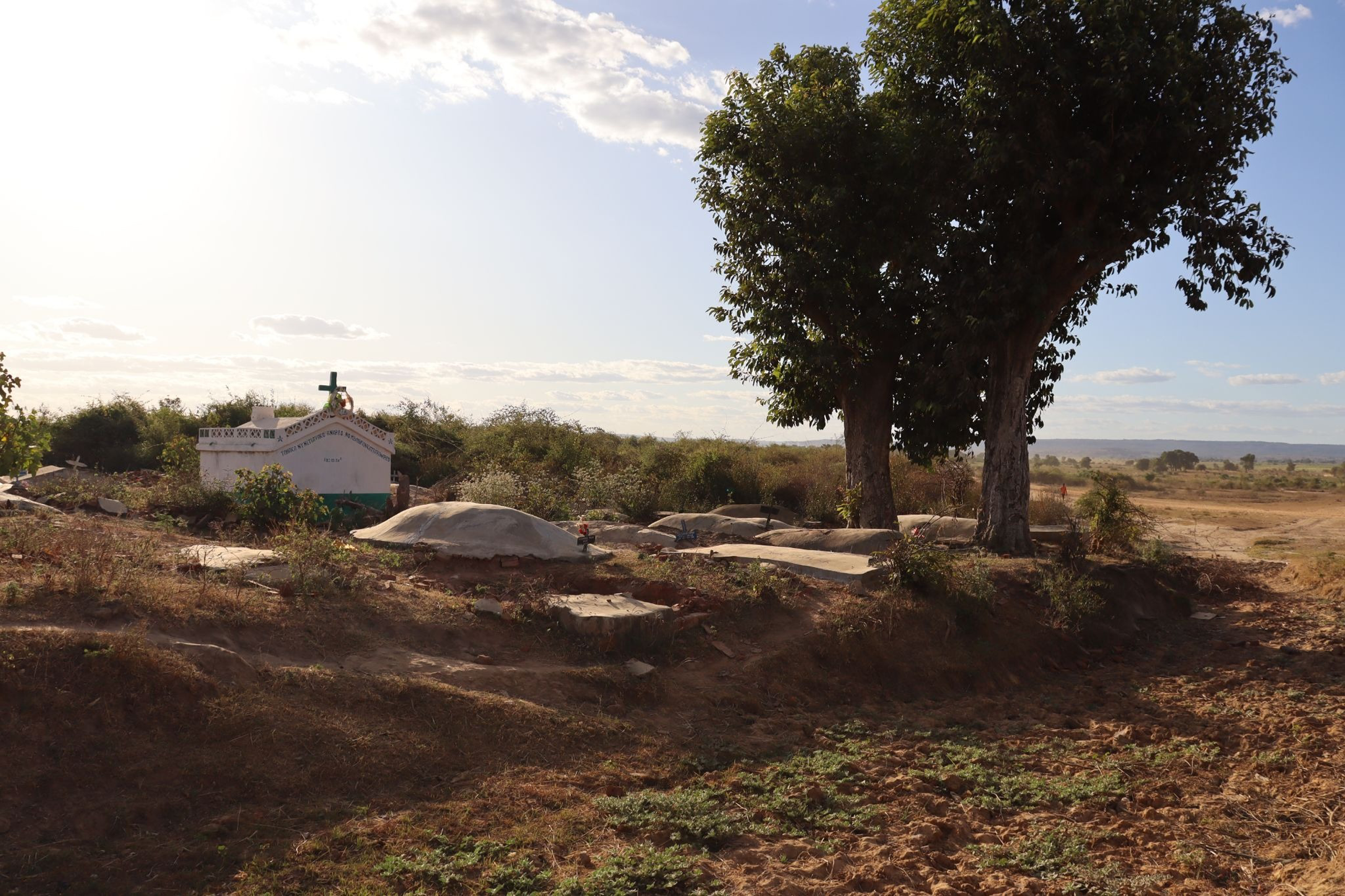
During the dry season in Ambatoboeny, highlanders of means return their loved ones’ remains to ancestral tombs upcountry. Prior to the repatriation of their kin’s remains via bush taxi, large extended families will festively parade through the streets of Ambato town in matching T-shirts or fabric wraps, accompanied by musicians and carrying a photograph of their deceased relative. Rapety noted that the funerary rituals for ‘black’ Merina held in Besakoa, which do not necessitate repatriation, still follow Merina custom: for example, unlike Sakalava ritual, which forbids parading an image of the deceased, the ‘children of Besakoa’ always march with a photograph of the ancestor. Prior to this point, the deceased are temporarily entombed in the ‘guest cemetery’ (fasana vahiny) (see Figure 2), which, as the name suggests, is primarily used by non-Sakalava migrants and located at the liminal position of the town’s edge. Families then save up for the expenses required to repatriate a corpse to the highlands and perform a return famadihana (Bloch Reference Bloch1971a: 146).
Guest tombs (fasana vahiny) in Ambato town, July 2022.

‘White’ Merina migrants who consign their ancestors to perpetual limbo in the aforementioned guest cemetery or even halt their participation in the ritual of returning ancestral remains to the highlands altogether may also eventually experience a rupturing of homeland-based kinship ties (Bloch Reference Bloch1971a: 146; Graeber Reference Graeber1995: 263–7). The fissioning of kinship groups through new tomb production, including that by migrants, occurs throughout Madagascar and across ethnic groups. Within the highlands, growing land scarcity over recent decades has led people of free origin to fragment kin groups by establishing new ancestral tombs. This process reconfigures understandings of descent and access to land. But whereas those ‘white’ Merina and Betsileo families of free descent in Ambato town who had not already completed a return burial to the ancestral tomb continued to express an aspiration to do so, the ‘black’ Merina were exceptional insofar as they rejected this cultural ideal. At times, some ‘white’ Merina interlocutors expressed condescending attitudes towards those highlanders who no longer ‘lifted’ their deceased loved ones to familial tombs upcountry, describing them as ‘lost’ (very).
The aspiration to repatriate kin was reproduced in interlocutors’ lamentations over the graves of foreigners ‘lost’ (very) to the surrounding countryside. A simple tomb near Ambato town marked the burial place of a Frenchman who died in a tragic plane crash, while another housed the remains of a Frenchman who passed away from an unknown disease on his farm. In both cases, interlocutors told me that the foreigners’ kin had not returned their remains to France; rather, they left them to be ‘lost’, entombed in soil far from that which their ancestors knew.
Because ancestry is partially determined by one’s burial placement, tomb selection is a centrally important decision that has wide-reaching and cross-generational consequences, as has been well documented in the ethnographic literature. There is no straightforward determination as to where an individual will be buried after death. ‘That depends on each individual’s choice’ (arakarakan’ny safidin’indray), interlocutors told me. Nevertheless, due to patrilineal bias within Merina heterosexual alliances, typically husbands are buried in their father’s family’s tomb and wives are buried alongside their husband or their father. It is common for individuals to make burial choices that diverge from this cultural script, however, depending on relationships with particular kin, divorce or separation, practical questions linked to finance and tomb distance, and, on rare occasions, refusal or rejection from familial tombs (possibly the consequence of ‘mismarriage’ with a slave descendant, or for an individual with transgressive gender or sexuality).
I spent a great deal of time questioning members of these ‘black’ Merina families about why they decided to build new tombs in the valley. At first, Edmond relayed that the family constructed a new tomb because the remaining ‘family in Besakoa was all women’. Since women tend to be buried alongside either a husband or a father, the implication was that the patriline was dying off. Upon further questioning, however, Edmond admitted that the decision to create a new tomb was also linked to the family’s fourteen hectares of arable land near Besakoa. ‘It was already very valuable,’ he added. Edmond’s descendants thus had access to a considerable amount of land, and their new tomb in the valley further solidified – even symbolically justified – their attachment to that land.
Edmond later told me that the family in Tsarafeno had been ‘sly’ (fetsy), having sold off rice fields that should have been left in the family inheritance. This same adjective was used by another Besakoa elder to describe the actions of the relatives in Tsarafeno when they, in her words, ‘gave away our inheritance’. When I asked her for details, her nephew changed the uncomfortable subject; similarly, Edmond also shifted the topic of conversation when I asked him about this seemingly controversial decision. His daughter-in-law, a woman from Tsarafeno who had only recently arrived in the valley, backed up his story but was not comfortable sharing the details. Given that land ownership is deeply symbolic of one’s ties to the ancestral village, and given that migrants long provided resources to distant kin in the hopes of maintaining access to this land, it is perhaps not surprising that ‘black’ Merina families of Besakoa were angered when their ancestral land was sold off (Bloch Reference Bloch1971a: 128–9; Rakotonarivo Reference Rakotonarivo2011). As one interlocutor bluntly stated: ‘There is no longer one single, real family any more … The family has been separated.’
Residents of Besakoa were hesitant at first to acknowledge the economic reasons for deciding not to return their deceased kin to tombs in the highlands, although these reasons were some of the most compelling. After extensive conversation, interlocutors eventually complained about the increasing cost of living and the burden of financial contributions for ancestral ritual in the highlands. Repatriation of the deceased was exorbitantly expensive due to transportation costs, which required renting an entire bush taxi, on top of other expenses. Some admitted that kin in Tsarafeno expressed frustration over what they saw as their Besakoa descendants’ mediocre monetary contributions. My host mother, who had married into one of the ‘black’ Merina families in Besakoa, interpreted her husband’s family’s decision to relocate the tomb as a practical response to the mounting financial obligations that distant kin in Tsarafeno expected from those in Besakoa. According to Edmond and a few other interlocutors, however, due to their relative financial success they in fact provided extensive material support for tomb upkeep and funerary rituals back in Tsarafeno. They seemed to suggest that they were more economically successful than their kin. Despite a brief research trip to Tsarafeno, I was never able to confirm this.
Dubious ancestry, lingering doubts, and gossip about a ‘lost people’
Despite their relative financial success, the ‘black’ Merina families’ decisions to construct new tombs were much commented upon in whispered tones among their neighbours, including Faniry, a middle-aged woman whose parents were labour migrants from the faraway south-eastern region of the island and whose extended kin had married a ‘black’ Merina from Besakoa.
Speaking privately, she described this in-law using a highly charged and stigmatizing epithet – andevo – which refers to the descendants of enslaved persons. She asserted that the people of Besakoa had been kidnapped and brought to Tsarafeno from an unknown homeland; they later relocated to the valley in search of employment. The farming families in Besakoa had decided to move their familial tomb from Tsarafeno to Besakoa and to no longer return their loved ones’ remains to Tsarafeno, Faniry noted, after they reflected upon the fact that Tsarafeno was not their place of origin anyway. They had descended from displaced and enslaved persons who originated from a place that they no longer knew. Other residents (incorrectly) asserted that the people of Besakoa had decided to no longer return their loved ones to tombs in the highlands because they had lost all contact with their families there. Outsider narratives collectively painted a picture of these valovotaka as ‘lost people’.
In no longer ‘lifting’ their dead kin to the highlands, these ‘black’ Merina had effectively sundered relations with remaining kin in Tsarafeno (see, for example, Regnier Reference Regnier, Gervais-Lambony, Hurlet and Rivoal2017). In defence of his family’s move to craft a new tomb, Edmond stated, ‘When you’re dead, you’re dead’ (rehefa maty, dia maty), drawing upon the same phrase habitually employed by charismatic and Pentecostal Malagasy Christians who argue against the continuance of ancestral funerary practices such as the exhumation ritual (famadiahana), in which Edmond’s family participates (Tilghman Reference Tilghman2020). Nevertheless, Edmond’s claim that burial placement was irrelevant rang hollow given the import afforded to it by most Malagasy speakers and the gossip that sprang from the mouths of community members in the face of new tomb construction. Their acts of ancestral veneration, reproduced through funerary ritual, thus unfolded in the uncomfortable social context of origins that were simultaneously silenced and contested.
At moments when historical events were unclear, or perhaps too difficult to recount, residents of Besakoa noted that several generations have passed since intensive migration to the valley began. ‘The history [of our ancestors] is lost,’ interlocutors claimed, employing the same adjective, ‘lost’, that they used to describe those foreigners buried in Malagasy soil or ‘children of Besakoa’ rumoured to be ‘lost people’. While ‘black’ Merina publicly narrated their ethnogenesis as Merina, some privately acknowledged that this differed from an earlier ethnic identity that their ancestors held prior to their arrival in the highlands.
Edmond asserted that he knew little about his family history because ‘our parents didn’t tell these histories’ (mbola tsy nitantara ny ray-amendreny). Interlocutors often lamented to me, during fieldwork, that the few elders who understood their family histories had recently passed away. Wondering to what extent these stories had either disappeared or were actively silenced, I broached the topic of ancestry and social status with Edmond, whose paternal grandparents were from Tsarafeno and whose mother was a Betsileo woman from Fianarantsoa.Footnote 4 Feigning ignorance, I asked Edmond if his family was ‘“white” Merina or “black” Merina’. Edmond lowered his voice. ‘We are not “white” Merina but “black” Merina,’ he stated, before clarifying that they were ‘Merina ambaniandro’ – a term that refers to all non-royal subjects of the Merina kingdom. In using this term, Edmond deployed a more neutral term that encompasses both those of the free, middle class (hova) and those of the formerly enslaved, lowest status group (andevo).
Another descendant recounted the family legend of her ‘black’ Merina elder who travelled to Ambato town from Besakoa to seek midwifery services. The midwife, it turned out, was also a migrant from Tsarafeno, and inquired into her patient’s family origins. After that interaction, the ‘black’ Merina woman vowed never to return to Ambato town; one possible interpretation of the story is the stigma attached to enslaved ancestry, although the interlocutor did not directly offer that analysis.
Those who married into ‘black’ Merina families were more likely to acknowledge these lineages’ enslaved ancestry. Like Faniry, Noro was born in the valley but her parents had migrated from the south-eastern region of the island. She quickly scoffed at my suggestion that her ex-husband, from Besakoa, was of Merina ethnicity. ‘“Black” Merina,’ she corrected me. When I suggested that his people were a ‘lost people’ she excitedly, but quietly, responded, ‘That’s it! You understand well.’ Noro said that her husband’s ancestors may have been of Bara or Betsimisaraka ethnicity, implying that they had been captured and enslaved before being brought to Tsarafeno. However, Noro – like other non-Merina, including Sakalava, who married into ‘black’ Merina families, and unlike most highlanders – did not consider her partner’s enslaved ancestry as a determining factor for marriage candidacy, as most ‘white’ Merina in Ambato town would have done.
Several days after conversing with Noro, I spoke to Rakoto, an elder and member of this ‘black’ lineage who recounted his knowledge of local history before several male peers and myself. They confirmed his account that the area was founded by a Betsimisaraka couple. Rakoto admitted that ‘we no longer know where they came from’, before adding that ‘yes, they were “lost people”’ who had eventually made their way to the valley. Although their grave has long since flooded, they were buried outside Besakoa in a collective tomb. Historically, enslaved persons were not buried in familial tombs, but in Besakoa, after their passing, Rakoto noted that ‘everyone earned the right to be buried in their tomb’ (jiaby nahazo nalevana anatin’ny fasana), even if they were not related to this founding couple.
Other residents of Besakoa traced their ancestry to one of several Merina founders who settled local hamlets, but their narratives became increasingly complex when considering ancestries prior to their arrival at Besakoa. Some descendants claimed that their ancestors were Betsileo royalty from Fianarantsoa. After having lost a dispute with another branch of the Betsileo monarchy, they fled to Tsarafeno – or, more likely, were kidnapped, enslaved and brought to Tsarafeno. Oral histories from the highlands reveal that many Betsileo were captured by Merina soldiers under King Andrianampoinimerina, and some descendants of enslaved persons in Merina country have professed to be of royal Betsileo background (Graeber Reference Graeber and Middleton1999).
Still other ‘children of Besakoa’ asserted that their origins were farther afield. A prominent descendant of the ‘black’ Merina families of Besakoa, who has since gone on to become a university administrator, contended that their ancestors were Antaimoro, hailing instead from the south-eastern coast of the island. He maintained that their ancestors were enslaved and brought to Fianarantsoa; they eventually took on Betsileo identity before they were once again brought to Tsarafeno, in Merina country. Aside from this prominent descendant, relatively few ‘black’ Merina of Besakoa boldly and publicly acknowledged their ‘lost’ origins. The ‘real’ origins of the ‘black’ Merina families of Besakoa were thus questioned among themselves and their neighbours, and were variously described as Betsileo royalty or enslaved persons from the east or south-east, depending on the source. But by all accounts, their ancestors had gone through a process of re-anchoring themselves as Merina subjects in the Betsiboka valley.
‘It’s already here’: a reimagined homeland
In doubling down on their Merina ethnicity (refraining from specifying their ‘black’ lineage, unless directly questioned), and transforming their identity, as best they could, to be identified first and foremost as simply ‘Merina’, these families illustrate how ethnicity in Madagascar is continuously (re)produced through techniques that dis-anchor and then re-anchor an individual and their descendants to specific ethnonyms and, in the case of these migrant ‘black’ Merina, to new homelands (Cole and Somda Reference Cole and Somda2024).
As scholars of enslaved descent and labour migration in Africa have noted elsewhere, for those who descended from enslaved persons, their lineages experienced a double rupture (Rossi Reference Rossi2014; Rodet Reference Rodet2015). The ancestors of the ‘black’ Merina may first have experienced a rupture as ‘lost’ individuals enslaved and brought to towns in the highlands such as Tsarafeno, and then again in the valley as migrants disembedded themselves from their kin in the highlands. Like other Malagasy peasants, the ‘black’ Merina of Besakoa thus likely underwent multiple rounds of dispossession and dis-anchoring before relocating to the valley.
In Besakoa, ‘black’ Merina families, like some Charismatic Christians in town, were exceptional in that they broke the social script zealously promoted by prominent ‘white’ Merina families in Ambato town who favoured a traditional ancestral return to a highland tomb. These ‘black’ Merina slowly disembedded themselves, over several generations, from social obligations to kin in the highlands, including the expectation to return loved ones to the ancestral tomb there. Undoubtedly this process was made easier by younger family members’ unfamiliarity with their distant kin, and by the disappointing aftermath of disputes over familial land in Tsarafeno, which had left some interlocutors feeling resentful.
They later affirmed their authority over the land there through intermarriage with non-Merina Malagasy – especially between Merina men and Sakalava women – and by constructing familial tombs. These powerful new material ‘symbols of permanence’ drew upon the literal and metaphorical role of soil in Malagasy idioms of autochthony (Bloch Reference Bloch and Watson1980: 108). They forged a firm, essentialized Merina ethnic identity within their community despite ongoing rumours that they were a ‘lost people’ and despite these families’ own private, multiple and competing local origin stories.
In the valley, the process of becoming a migrant settler who no longer returns loved ones to ancestral homelands affords its claimants a stronger status of belonging to the land than other migrant guests. For the ‘black’ Merina of Besakoa, this was critical given that their implicit life work has been to actively reverse their ancestors’ lowly status through property accumulation in the probable aftermath of enslavement and forced assimilation into Merina society. While these families acknowledged that they were not in the same position as the Sakalava ‘masters of the land’, by constructing permanent familial tombs in the valley they mastered the land in a way that most highlander migrant settlers who return their dead to tombs in the highlands could not. Given that famadihana is a process of ‘ancestralization’ through which the ancestors are authenticated, appeased and affirmed, ‘black’ Merina families who engaged in this practice in the valley reproduced ancestrality in a place where their ancestrality previously never existed (Razafindralambo Reference Razafindralambo2005).
When I asked Edmond’s first wife’s younger sister in Besakoa where her family’s ancestral homeland was located, she replied, unflinchingly, ‘It’s already here.’ There was no mention of Tsarafeno. She was one of the few ‘black’ Merina interlocutors who dramatically claimed Besakoa as the ‘land of [her] ancestors’, thereby discursively erasing her previous ancestral land in the highlands (Evers Reference Evers and Middleton1999: 272). ‘We work the land here, so here it is,’ she noted, adding that ‘our descendants are here’ as well. Settling and working the land in agricultural endeavours, alongside these ritual engagements, were seen as evidence of valid claims to belonging in the valley as ethnic outsiders, not as indigenized or Sakalava-ized migrants. This was not a case of ‘autochthonization through incorporation’, in which first-comer autochthones hold the upper hand over their migrant neighbours and tenants. Instead, agrarian productivity and Lockean notions of property rights and citizenship have not only become legible in the Betsiboka valley, but, in this cash crop economy, they have started to challenge longstanding ties between land and ethnopolitical notions of belonging.
Her response illustrates the legacy of cash crop agriculture in cementing notions of liberal, individualist, natural rights of property ownership and ancestral homeland; under this formation, agrarian production and property development, just as much as indigenous ethnic identity, are justifications for land claims and evidence of righteous belonging (Lentz Reference Lentz and Lentz2006a: 51). This principle is supported by Malagasy law, which allows for a citizen to claim ownership of otherwise unoccupied land they have resided upon and enhanced (mise en valeur) through crop production.
By embracing labour opportunities on French colonial concessions that most of their Sakalava neighbours initially shied away from and, later, by engaging in cash crop farming and the broader capitalist economy, these strangers experienced distinct political and economic benefits (Sharp Reference Sharp1996: 53–4). Sakalava communities near Besakoa underwent a slow but steady Merina-ization and incorporation into the cash crop-driven capitalist system, just as French administrators had initially intended.
Through cash crop agriculture and by crafting local ancestral ties to soil in the valley, ‘black’ Merina families dis-anchored themselves from ancestral veneration on highland grounds that were otherwise associated with their ethnicity. Many refused to take up Sakalava ritual practice and instead re-anchored their lineages in the valley by reproducing Merina custom. These settlers sought to achieve a new-found sense of homeland – a feeling that is often defined in vague and immaterial terms – by, perhaps unsurprisingly, turning towards the concreteness of the generative red soil, crops, and stone tombs that now mark the Besakoa landscape.
Seth Palmer is Assistant Professor of Anthropology at Christopher Newport University. Their research focuses on religious publics, emergent political imaginaries, HIV/AIDS and LGBTQ activism, and Christian nationalism in Madagascar and has been published in Transgender Studies Quarterly, GLQ: A Journal of Lesbian and Gay Studies and the Journal of Religion in Africa.

 Open access

