


1 Introduction
Heuristics are meant to reduce effort. Indeed, without the issues of processing effort or information search costs, there would be little need for examining fewer cues, reducing the difficulty of storing and/or retrieving cue values, simplifying weighting principles for cues, or integrating less information — all of which characterize heuristic strategies (Reference Shah and OppenheimerShah & Oppenheimer, 2008). Following the pioneering work of Herbert Simon (e.g., 1956, 1990), most approaches to judgment and decision making dealing with heuristic processing specifically emphasize its simplifying properties (Reference Gigerenzer, Koehler and HarveyGigerenzer, 2004; Reference Payne, Bettman and JohnsonPayne, Bettman, & Johnson, 1993) — though there is some discourse as to whether heuristics are generally less accurate than complex strategies. However, despite such disagreements, many would concur that heuristics render judgments and decisions easier in one way or another.
How does heuristic processing relate to the concept of intuitive thinking? To answer this question — which is treated differently in the literature — one must first specify the characteristics of intuition. Herein, like many others, we define intuitive thinking as automatic, fast, effortless, unconscious, and based on vast amounts of prior experience (Reference Hammond, Hamm, Grassia and PearsonHammond, Hamm, Grassia, & Pearson, 1987; Reference HogarthHogarth, 2001; Reference Seligman and KahanaSeligman & Kahana, 2009). Moreover, intuition is usually deemed to involve the integration of multiple pieces of information in a weighted additive manner (Reference Glöckner, Plessner, Betsch and BetschGlöckner, 2007; Reference HogarthHogarth, 2001). As such, intuitive “processes have little or no information-processing costs” (Reference Hogarth and KarelaiaHogarth & Karelaia, 2007, p. 751) and “enable individuals to quickly integrate multiple reasons in their decisions in a compensatory way” (Reference Glöckner and BetschGlöckner & Betsch, 2008b, p. 1055). Finally, intuition is typically contrasted with deliberation which describes slow, effortful, stepwise, and mostly rule-governed processes (e.g., Evans, 2008; Reference Horstmann, Ahlgrimm and GlöcknerHorstmann, Ahlgrimm, & Glöckner, 2009; Reference Sloman, Gilovich, Griffin and KahnemanSloman, 2002). In sum, Reference Alter, Oppenheimer, Epley and EyreAlter, Oppenheimer, Epley, and Eyre (2007) stated that thinking “involves two distinct processing systems: one that is quick, effortless, associative, and intuitive and another that is slow, effortful, analytic, and deliberate” (p. 569). Note however, that it is not entirely clear whether intuitive and deliberative thinking actually represent two qualitatively different modes of thinking or rather end points of the same dimension (Reference Horstmann, Ahlgrimm and GlöcknerHorstmann et al., 2009).
If one accepts these two basic notions, namely (a) that one central appeal of heuristics lies in their effort-reducing properties and (b) that intuitive thinking is more effortless than deliberation (thus rendering effort-reduction less appealing), the following conjecture seems straightforward: Deliberation will increase the “need” for heuristic processing. Stated differently, heuristics should be much more helpful when judgments and decisions are performed in a slow, stepwise, and effortful manner, that is, under conditions of deliberation. In such a situation, heuristics may significantly relieve the mind of burdensome computations — without necessarily leading to reduced accuracy (Reference GigerenzerGigerenzer, 2008). Intuitive thinking, however, will comprise “automatic information integration, which makes simplification partially obsolete” (Reference Glöckner, Plessner, Betsch and BetschGlöckner, 2007, p. 321). Note, again, that this hypothesis need not imply that intuition and deliberation are completely different manners of thinking — so long as more intuitive thinking is accepted to be less effortful than more deliberative thinking, our conjecture should hold.
As indicated above, our view that intuition should actually reduce reliance on heuristics is not consistently echoed in the literature. Indeed, some have considered heuristic processing in the sense of attribute substitution as the result of intuitive thinking (e.g., Kahneman, 2003), though they acknowledge that “attribute substitution can also be a deliberate […] strategy” (Reference Kahneman, Frederick, Augier and MarchKahneman & Frederick, 2004, p. 421). Also, although focusing on single-cue mechanisms rather than on attribute substitution, Gigerenzer (2008) stated that “heuristics can be used with and without awareness. In the latter case, each provides a potential mechanism of intuition”. Similarly, Gigerenzer (2007) seems to advocate that the fast-and-frugal heuristics of his adaptive toolbox approach are intuitive mechanisms: “… intuitions ignore information. Gut feelings spring from rules of thumb that extract only a few pieces of information […] and ignore the rest” (p. 38).
However, neither the fast-and-frugal heuristics approach nor other related notions (e.g., Payne et al., 1993) per se, seem to make strong claims about the extent to which use of heuristics is a mark of intuitive thinking. From these theoretical positions, it seems to be a largely open question. Nonetheless, intuition and reliance on heuristics have often been equated in the past (for an overview see Glöckner & Witteman, 2010). By contrast, we propose a clear difference between intuitive thinking and heuristics — especially those put forward as part of the adaptive toolbox: As outlined above, intuition is characterized by speedy integration of multiple pieces of information. Heuristics, by contrast, ignore information.
Indeed, previous empirical findings are consistent with our conjecture. For example, Glöckner and Betsch (2008b) showed that individuals are capable of integrating complex information within a surprisingly short time frame. Measuring the reliance on more consciously controlled processes rather than automatic first impressions in risky choices using the Cognitive Reflection Test (Reference FrederickFrederick, 2002b), Cokely and Kelly (2009) showed that more reflective thinking is characterized by more heuristic search processes. Similarly, Frederick (2002a) proposed that choice heuristics result from more deliberate cognitive processes (e.g., elimination-by-aspects), but can become automated when affective responses are rapidly generated (e.g., choosing-by-liking).
Other studies, directly inducing intuitive vs. deliberative thinking, revealed that heuristics are more likely applied in deliberate rather than in intuitive judgments. For example, asking participants to think carefully increased reliance on the anchoring heuristic. By contrast, those instructed to answer spontaneously relied on their experiences with the judgmental object rather than on experimentally provided anchors (Reference Plessner, Czenna, Plessner, Betsch and BetschPlessner & Czenna, 2008). Similar results have been reported for frequency judgments (Reference Haberstroh, Plessner, Betsch and BetschHaberstroh, 2008; Reference Haberstroh, Betsch, Sedlmeier and BetschHaberstroh & Betsch, 2002), basketball predictions (Reference Halberstadt and LevineHalberstadt & Levine, 1999), and judgments of randomness (Reference Czenna and PlessnerCzenna & Plessner, 2008). Note, however, that some prior experience with judgment objects is a vital precondition for intuitive judgments which integrate information rather than relying on single cues.
1.1 The recognition heuristic
One judgment mechanism which ignores information is the recognition heuristic (RH; Reference Goldstein, Gigerenzer and GigerenzerGoldstein & Gigerenzer, 1999, 2002). Originally put forward as the first step of the take-the-best algorithm (Reference EvansGigerenzer & Goldstein, 1996), it proposes: “if one of two objects is recognized and the other is not, then infer that the recognized object has the higher value [and therefore chose it]” (Reference Goldstein, Gigerenzer and GigerenzerGoldstein & Gigerenzer, 1999, p. 41). The assumption behind this rule is that object recognition — or lack thereof — is systematically related to judgment criteria in many domains and thus often represents a valid cue. More importantly, “[t]he recognition heuristic is a non-compensatory strategy: If one object is recognized and the other is not, then the inference is determined; no other information about the recognized object is searched for and, therefore, no other information can reverse the choice determined by recognition” (Reference FrederickGoldstein & Gigerenzer, 2002, p. 82). Although recent evidence suggests that knowledge beyond recognition is not generally ignored (e.g., Bröder & Eichler, 2006; Hilbig, Pohl, & Bröder, 2009; Reference Glöckner and BetschNewell & Fernandez, 2006; Pohl, 2006; for an overview see Hilbig, in press) and that alternative models provide a more comprehensive explanation of process data (Reference Glöckner and BröderGlöckner & Bröder, in press; Reference Hilbig, Pohl and BröderHilbig & Pohl, 2009), we will herein limit our considerations to the question under which conditions the RH is more or less likely to be used. That is, we will focus on the probability with which choices follow the recognition cue in a non-compensatory fashion.
Clearly, the RH represents a quintessential instance of effort-reduction: It considers only one single, easily accessible cue (recognition) and simplifies cue weighting principles (see Reference Shah and OppenheimerShah & Oppenheimer, 2008, Table 1). The RH should thus be especially attractive whenever resources are sparse — in line with the assumption of adaptive strategy selection (Reference Payne, Bettman and JohnsonPayne, Bettman, & Johnson, 1988; Reference Rieskamp and HoffrageRieskamp & Hoffrage, 2008). However, as reasoned above, the effort-reducing characteristics of heuristics, and thus the RH, may yield little additional benefit whenever judgments can be made intuitively. Assuming that intuition allows for fast and effortless information integration, there appears to be reduced need for a one-cue, non-compensatory mechanism. Note, however, this will only hold to the degree that decision makers possess sufficient expertise, that is, an adequately large body of implicit knowledge acquired from experience (Reference HogarthHogarth, 2001; Reference Plessner, Czenna, Plessner, Betsch and BetschPlessner & Czenna, 2008).
1.2 Methodological preliminaries
In what follows, we report two experiments to substantiate the claim that use of the RH should be more likely under conditions of deliberation rather than intuition. The principal logic of both experiments was the same: We experimentally induced deliberative versus intuitive thinking by means of instruction. This method has been repeatedly and successfully used in the literature (for an overview of different methods see Reference Horstmann, Hausmann, Ryf, Glöckner and WittemanHorstmann, Hausmann, & Ryf, 2010), albeit with different twists.
Importantly, since recognition and further knowledge are, by definition, confounded, the mere adherence rate (proportion of choices in line with the RH) is an invalid measure of RH-use (Reference Gigerenzer, Koehler and HarveyHilbig & Pohl, 2008). Indeed, adherence rates are generally problematic when studying non-compensatory strategies (Reference ChechileBröder & Schiffer, 2003; Reference HilbigHilbig, 2008b). Unfortunately, enhanced measures of RH-use, such as Pachur and Hertwig’s (2006) d’ and the highly similar discrimination index (Reference HilbigHilbig, 2008a; Reference Gigerenzer, Koehler and HarveyHilbig & Pohl, 2008), do not provide a directly interpretable estimate of the proportion of choices in which recognition was considered in isolation. They are thus ill-tailored to comparing different experimental conditions which are hypothesized to affect the overall likelihood of RH-use.
To overcome these limitations, a formal measurement model of the RH, named r-model, was recently proposed (Reference Hilbig, Erdfelder and PohlHilbig, Erdfelder, & Pohl, 2010): This multinomial processing tree model (Reference Batchelder and RieferBatchelder & Riefer, 1999; Reference Erdfelder, Auer, Hilbig, Aßfalg, Moshagen and NadarevicErdfelder et al., 2009) comprises a model parameter (r) which specifically denotes the probability of considering the recognition cue only, while ignoring any further knowledge, that is, using the RH. From aggregate choice frequencies, the model generates maximum-likelihood parameter estimates for r as well as three further parameters: the recognition validity (parameter a), the knowledge validity (parameter b), and the probability of correct guesses (parameter g). For definitions of the recognition and knowledge validity, respectively, see Reference FrederickGoldstein and Gigerenzer (2002). Details on the r-model and a graphical representation can be found in the Appendix. The r-model has been shown to fit empirical choice data very well and several successful experimental validations of the psychological meaning of the r parameter have been reported (Reference Hilbig, Erdfelder and PohlHilbig et al., 2010). Also, it could be shown through simulations, that the r-model provides the most reliable and unbiased measure of RH-use currently available (Reference Hilbig, Erdfelder and PohlHilbig, 2010).
As stated above, the r parameter denotes the probability of following the recognition cue in a non-compensatory fashion and thus RH-use. It should be noted, however, that this can result from different underlying processes: either by considering the recognition cue in isolation (i.e. ignoring the values of other cues) or by considering further cues but attaching a non-compensatory weight to the recognition cue (such that all other cues are overruled). It is important to point out this second route to choices which resemble RH-use, because it allows for alternative process assumptions. Specifically, it is compatible with the notion that the underlying process is one of compensatory information integration (Reference Hilbig, Pohl and BröderHilbig & Pohl, 2009). Similar arguments have been put forward for other heuristics (Reference GlöcknerGlöckner, 2009; Reference Glöckner and BetschGlöckner & Betsch, 2008b; Reference Glöckner and HilbigGlöckner & Hilbig, 2010).
2 Methods
Since design, materials, and analyses of the two experiments were almost exactly the same, we will report both experiments together. In both experiments, pairs of cities were presented on a computer screen in random order and participants indicated their judgments by pressing one of two keys. Choices and response latencies were recorded. This two-alternative forced choice task differed between the two experiments only in one way: In Experiment 1, participants were asked to select the more populous, “larger” city; by contrast, participants in Experiment 2 were instructed to point out the less populous, “smaller” city in each pair. As such, the prediction of the RH is reversed in the latter experiment, that is, participants should generally choose unrecognized cities over recognized ones (Reference Frosch, Beaman and McCloyFrosch, Beaman, & McCloy, 2007). This second experiment served as a test whether the results would be robust against different directions of the correlation between recognition and the to-be-inferred criterion, city-size. Naturally, in analyzing the latter experiment, we considered choice of the unrecognized object as adherence to the RH and accordingly modified the r-model. So, in the second experiment the parameter rdenotes the probability of selecting the unrecognized of two objects without considering any further knowledge (about the recognized object).
Before the paired-comparison judgment task, participants in both experiments were either instructed to “think carefully about each choice” (deliberation) or “decide spontaneously and according to gut feelings” (intuition). We thus used a typical manipulation to induce deliberation versus intuition (Reference Horstmann, Hausmann, Ryf, Glöckner and WittemanHorstmann et al., 2010). Participants were randomly assigned to one of these two conditions.
The 16 most populous cities of Canada served as materials in both experiments. These were exhaustively paired, resulting in 120 pairs for the comparative judgment task. After performing the according 120 judgments, participants were again shown the 16 cities in randomized order and asked to indicate for each city whether they had never heard of it before or recognized its name and, if so, possessed any further knowledge about it (cf. Reference Hilbig, Pohl and BröderHilbig & Pohl, 2009). However, for the current investigation, only the distinction between unrecognized and recognized objects was relevant. In this recognition task, there was no manipulation of intuitive vs. deliberative thinking.
We recruited German students from the University of Mannheim as participants. There were 19 participants (16 female; aged 18 to 25 years, M = 20.7, SD = 1.7) and 37 participants (19 female; aged 18 to 38 years, M = 22.3, SD = 3.9) in Experiments 1 and 2, respectively. All were fully debriefed and paid for their participation.
3 Results
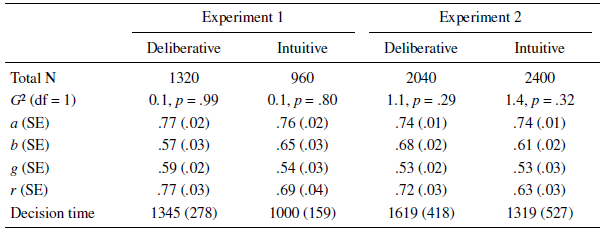
To ensure that the experimental manipulation was successful, we first analyzed participants’ response latencies in the judgment task, that is, decision times (Reference Horstmann, Hausmann, Ryf, Glöckner and WittemanHorstmann et al., 2010). The according descriptive statistics for both experiments can be found in the bottom row of Table 1. As can be seen, participants in the intuitive condition had shorter decision times as compared to those in the deliberative condition; to test these differences for statistical significance, we log-transformed all decision times before computing the mean (across all 120 choices) for each participant. The differences between experimental conditions were significant with t(17) = 3.9, p = .001, d = 1.8 and t(35) = 3.0, p = .006, d = 1.0, for Experiments 1 and 2, respectively. As such, the manipulation check was successful. Note that, in addition, choices were made faster in Experiment 1 in which participants had been asked to indicate the larger object as compared to Experiment 2 in which they indicated the smaller one; though this is not of direct importance to the current research question, we suspect that it is a typical end-effect (e.g., Reference Birnbaum and JouBirnbaum & Jou, 1990): Selecting the larger of two objects in a set of generally large objects yields faster decisions than selecting the smaller.
Next, data for each experimental condition were analyzed with the r-model using the multiTree software tool (Reference MoshagenMoshagen, 2010), estimating the four model parameters (a, b, g, and r) from aggregate choice frequencies, as is typically the case in multinomial modeling (Reference Erdfelder, Auer, Hilbig, Aßfalg, Moshagen and NadarevicErdfelder et al., 2009) and methodologically reasonable (Reference ChechileChechile, 2009). Model fits were tested by means of the log-likelihood goodness-of-fit statistic G² with df = 1. Differences between experimental conditions were analyzed by fixing the to-be-tested parameters across conditions and then testing the resulting decrement in model fit (Δ G²) for statistical significance.Footnote 1
Table 1 provides goodness-of-fit statistics and the parameter estimates for the two experimental conditions in each of the experiments. As can be seen, the model fit the empirical data well in each of the four data sets. Even though the power of this χ2-goodness-of-fit test with df = 1 is not very large given the current sample sizes (cf. Hilbig et al., 2010), it does rule out severe misfit. Importantly, as the estimates of the parameter a show, the recognition validity did not differ between experimental conditions in either of the experiments. So, any results concerning use of the RH (r) cannot be attributed to differences in recognition validity. Moreover, there were no differences in the number of objects participants reported to recognize or the number of recognized objects they reported to have further knowledge about between the two experimental conditions in either of the experiments.
To test our main hypothesis that use of the RH — in the sense of non-compensatory reliance on the recognition cue — would be more likely when thinking deliberatively, we compared estimates of the r parameter. As Table 1 reveals, r was larger in the deliberative condition in each of the two experiments. Figure 1 displays the corresponding results graphically.
Probability of non-compensatory reliance on the recognition cue, as measured by the r parameter, for the deliberative versus intuitive condition in Experiments 1 and 2, respectively. Error bars represent one standard error of the r parameter estimate.
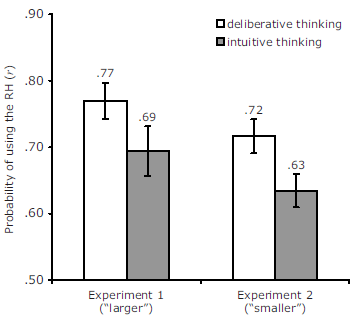
In Experiment 1, the according difference in r between the deliberative versus intuitive condition was almost significant (Δ G²(1) = 2.7, p = .10) due to the small sample size; by contrast, the decrement in model fit was unequivocal in Experiment 2 (Δ G²(1) = 7.1, p = .01), suggesting a significantly larger r in the deliberative condition.Footnote 2 The results are thus in line with the hypothesis: In each of the experiments, use of the RH was generally more likely when decisions were to be made based on deliberation rather than intuition.
To rule out that participants in the intuitive condition more often resorted to guessing as a global strategy — which would produce choices more inconsistent with the RH — we additionally analyzed participants’ overall accuracy. In Experiment 1, participants achieved M = .65 (SE=.02) and M = .66 (SE = .02) correct choices in the deliberative and intuitive condition, respectively. In Experiment 2 the according proportions of correct choices were M = .66 (SE = .02) and M = .63 (SE = .02), respectively. In neither of the experiments a noteworthy difference in overall accuracy was obtained (both p > .40 and d < .30). Thus, differences in RH-use could not be attributed to increased guessing in the intuitive condition.
Note that, although we had no specific hypothesis about this, there was also a trend towards less use of the RH in Experiment 2 as compared to Experiment 1. That is, in each of the conditions (deliberative and intuitive), participants were more likely to rely on recognition alone when the cue-criterion relation was positive. We conjecture that this is due to higher subjective recognition validity. That is, a positive cue-criterion correlation may increase the weight attached to the recognition cue. However, the findings are marred by the caveats inherent in cross-experimental comparisons and were also non-significant in either of the conditions, Δ G²(1) = 1.9, p = .17, and Δ G²(1) = 1.7, p = .19, for the deliberative and intuitive conditions, respectively.
4 Discussion
The well-accepted notion of adaptive strategy selection in judgment and decision making (e.g., Payne, 1982; Reference Payne, Bettman and JohnsonPayne et al., 1993; Reference Rieskamp and HoffrageRieskamp & Hoffrage, 2008), encompasses the central assumption that heuristics reduce effort. They simplify a given problem (Reference Shah and OppenheimerShah & Oppenheimer, 2008) and function with speed and frugality (Reference Gigerenzer, Koehler and HarveyGigerenzer, 2004). However, it is not clear whether heuristic processing should be considered tantamount to “intuitive” thinking. Classically, this link has often been implied (Reference Glöckner and WittemanGlöckner & Witteman, 2010) and reiterated recently (e.g., Gigerenzer, 2007; Reference Kahneman, Frederick, Augier and MarchKahneman & Frederick, 2004); however, concerning the fast and frugal heuristics approach, few strong claims about such a link have been made; indeed, the question of how heuristics relate to intuition has been considered an open one (Reference GigerenzerGigerenzer, 2008).
In the current work, we have reasoned for a clear distinction: In line with many commonly stated definitions, we consider intuition to yield fast, automatic, and effortless information integration based on prior experience (Reference Glöckner, Plessner, Betsch and BetschGlöckner, 2007; Reference Hammond, Hamm, Grassia and PearsonHammond et al., 1987; Reference HogarthHogarth, 2001; Reference Horstmann, Ahlgrimm and GlöcknerHorstmann et al., 2009; Reference Seligman and KahanaSeligman & Kahana, 2009). As such, we argue, it reduces the need for effort-reducing, single-cue heuristics. Deliberative thinking, on the other hand, should be slower, more rule-based, and effortful — thus rendering effort-reducing heuristic mechanisms more attractive.
To test this conjecture, we studied the impact of deliberation versus intuition on use of the recognition heuristic (RH; Reference FrederickGoldstein & Gigerenzer, 2002) — hypothesizing that it would be more often relied on under deliberation. Specifically, in two experiments, we manipulated the instructions given to participants (Reference Horstmann, Hausmann, Ryf, Glöckner and WittemanHorstmann et al., 2010), thus inducing more intuitive or more deliberative thinking during the comparative judgments task. In line with expectations, the results showed that use of the RH was more likely under deliberation. Fast and intuitive judgments, by contrast, were less often based on recognition alone. At the same time, they were comparable in accuracy, thus ruling out that participants simply abandoned any decision strategy and resorted to guessing instead. This pattern of results is well-aligned with the argument that intuitive thinking lessens the need for effort-reduction without necessarily sacrificing accuracy.
However, the effect of deliberation versus intuition on RH-use leaves an open question: Does intuition reduce non-compensatory reliance on recognition or does deliberation intensify it? Bearing in mind the dangers of comparing data across different studies, some preliminary answers may be obtained by evaluating the estimates of the r parameter in Experiment 1 against according estimates from other studies. In fact, the mean r estimate across all eight comparableFootnote 3 data sets analyzed by Hilbig et al. (2010) was .68 and thus very close to the estimate obtained in the intuitive condition of Experiment 1 (.69). The estimate of r found in the deliberative condition, by contrast, was notably larger (.77). So, potentially, the instruction to think carefully increased RH-use. However, replication of our experiments including a control condition without any additional instruction related to intuitive or deliberate thinking would be necessary for a more conclusive answer.
Given our argument that intuitive thinking renders effort-reduction less necessary, one might also ask why the probability of using the RH remained substantial in the intuitive condition. As outlined above, integration of further information beyond recognition (non-use of the RH) critically depends on the availability of information. Indeed, previous research has shown that use of knowledge beyond recognition is more likely whenever more (valid) knowledge is available (Reference Hilbig, Erdfelder and PohlHilbig et al., 2010; Reference Gigerenzer, Koehler and HarveyHilbig & Pohl, 2008). However, as the existence and accessibility of further knowledge beyond recognition is certainly limited in the current judgment domain (Canadian cities judged by German participants), the integration of further cues — which, moreover, would need to overrule recognition — cannot be expected to occur pervasively. From this conjecture it may then be hypothesized that the effect reported herein would actually intensify in domains in which participants possess more prior experience for recognized objects.
Similarly, it is important to note that alternative process models assuming intuitive and automatic information integration (e.g., Glöckner & Betsch, 2008a, 2008b) do not rule out that (potentially many) choices represent non-compensatory reliance on recognition – simply because other cues would need sufficient (subjective) validity to overrule recognition (for a similar notion, see Reference Lee and CumminsLee & Cummins, 2004). From this point of view, one could thus propose an alternative interpretation of our findings: Possibly, decision makers do not use the RH more or less in the sense of a strategy shift or a switch in actual underlying processes. Rather, they may simply attach different weights to cues while the actual information integration process remains unchanged. Specifically, it is conceivable that they attach greater weight to the recognition cue in the deliberative condition — in which the instruction to think carefully could make participants more cautious about cues. That is, yes/no recognition may often feel more certain than the values of other cues do; for example, participants may be highly confident that they recognize Montréal but feel rather unsure about whether it is a state capitol. As a consequence, the recognition cue may receive a higher weight which, in turn, increases the probability of non-compensatory reliance on this cue — even in a process of information integration. This latter explanation is further supported by the fact that decision time differences between the deliberative and intuitive condition were, in absolute terms, quite small in both experiments (~300ms). Also, it could explain why the estimated probability of RH-use only changes by about 10 percentage points. However, further research disentangling shifts in choice patterns from actual strategy shifts (switches in underlying processes) would be necessary to test this alternative view (Reference GlöcknerGlöckner, 2009; Reference Glöckner and HilbigGlöckner & Hilbig, 2010).
Finally, we wish to stress that neither our main arguments nor our findings imply a complete dissociation between intuition and use of the RH. Indeed, it is both possible and plausible that intuition plays a major role in determining the subjective recognition validity in a given domain which, in turn, is a central precondition for RH-use. Specifically, it has been shown that decision makers are sensitive to experimental manipulations of the recognition validity (Reference Hilbig, Erdfelder and PohlHilbig et al., 2010; Reference Goldstein and GigerenzerPohl, 2006) — how else could this be achieved if not through fast consideration of meta-knowledge based on prior experience? Determining whether and how strongly to rely on the recognition cue in a given task may, per se, represent an intuitive judgment. This is well in line with previous assertions that the RH may be “intuitively initiated” but deliberately applied (Reference Kahneman, Frederick, Augier and MarchKahneman & Frederick, 2004).
In sum, we hope to have shed some further light on the determinants (Reference Goldstein, Gigerenzer and GigerenzerPachur & Hertwig, 2006) of reliance on fast-and-frugal judgments based on recognition: Just as a central aspect of heuristics is effort-reduction (Reference Shah and OppenheimerShah & Oppenheimer, 2008), the RH is more often relied on when choices are made in a more serial, demanding, and effortful manner — that is, the “think” rather than the “blink” of judgment and decision making.
Appendix
Summary of the r-model
The r-model considers the aggregate choice frequencies across a series of paired-comparisons. These observable choices are explained through four latent parameters in order to disentangle RH-use from reliance on additional knowledge. Each observable choice can belong to one of eight categories: Choices are differentiated depending on whether the participant recognized exactly one of the two objects (recognition case), both (knowledge case), or neither (guessing case). In all cases, a correct or false judgment can occur. Finally, in recognition cases, the recognized (adherence to RH) or unrecognized (non-adherence to RH) object may have been chosen. The model is depicted in Figure A.
The eight outcome categories are explained by the r-model in the following way: If a participant recognizes both objects, she will make a correct choice with probability b (denoting the knowledge validity). If she recognizes neither, a correct choice will occur with probability g. If, most importantly, exactly one object is recognized, she can either use the recognition heuristic (probability r) or consider additional knowledge or information (probability 1–r). If the participant uses the recognition heuristic and thus chooses the recognized object, her judgment will be correct with probability a, i.e. the recognition validity. If she considers additional knowledge, her judgment will be correct with probability b. In that case, valid knowledge will lead to a correct choice which can, in fact, either mean choosing the recognized or the unrecognized of the two objects — depending on which represents a correct judgment in the current pair.
Note that, like all other measures of RH-use proposed so far, the r-model takes participants recognition judgments as input. That is, it considers the output of the memory process of “recognition” (determining whether one has encountered an instance before) and does not make any assumptions about this process. Of course, taking this output to be binary (yes/no recognition) is a simplification (Reference FrederickGoldstein & Gigerenzer, 2002) – indeed, an oversimplification (Reference Glöckner and BetschNewell & Fernandez, 2006). However, there is no formal measurement model of RH-use available yet which has relaxed this assumption — though promising starting points do exist (Reference Erdfelder, Küpper-Tetzel and MatternErdfelder, Küpper-Tetzel, & Mattern, 2010).
The r-model depicted as processing trees depending on whether both objects are recognized (topmost tree), neither is recognized (middle tree), or exactly one is recognized (bottom tree). The parameter a represents the recognition validity (probability of the recognized object representing the correct choice), b stands for the knowledge validity (probability of valid knowledge), g is the probability of a correct guess and, most importantly, r denotes the probability of applying the RH (non-compensatory reliance on the recognition cue).


 Open access

