

Introduction
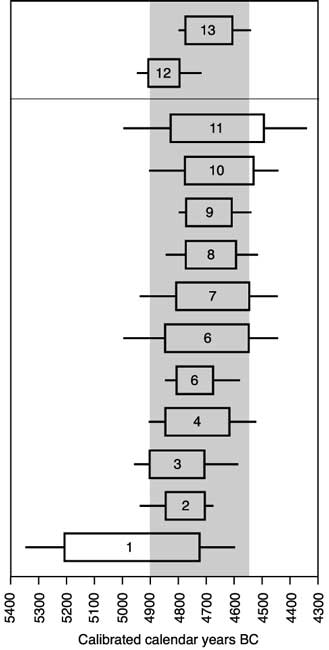
Calibrated age-ranges of the dates included in Table 1, and those reported by Crombé et al. (2002). Boxes show the 1σ (68% probability) range, and whiskers the 2σ (95%) range, calculated using OxCal (Bronk-Ramsey, 1995; 2001) from data in Stuiver et al. (1998). Numbers 1-11 refer to table 1, numbers 12 and 13 are the determinations from Crombé et al. 2002.

New evidence from the Belgian coastal lowlands presented by Crombé et al. (2002) indicates that key changes in microlithic armature technology coincided with the adoption of early ceramics by final Mesolithic hunter-gatherers at the site of Doel in the lower Schelde valley. These lithic changes are sufficiently diagnostic to differentiate the Doel assemblage from previous Late Mesolithic assemblages. No indications of economic activity other than that of hunter-gatherer type were associated with these finds, however, with no signs of domestication or cultivation. The final Mesolithic data from Doel were interpreted as evidence of indigenous late hunter-gatherers changing in response to contact with the earliest elements of neolithicization, well before the arrival of the fully Neolithic local Michelsberg culture. Crombé et al. (2002) compare the changes in the lithic tradition with similar final Mesolithic lithic changes elsewhere along the north-west European seaboard and consider them, together with early ceramic use, to be part of the first influence of Neolithic culture and the beginning of the Mesolithic-Neolithic transition in this part of north-west Europe. Two radiocarbon dates for this changing final Mesolithic of 5980±35BP and 5835±35BP (uncalibrated) give a time context for this culture change and Crombé et al. (2002) draw attention to research in other coastal regions of the Baltic and North Sea which suggests that a similar shift in culture occurred within the same time period over much of the coastal lowlands of the region. They also suggest that acculturation of local hunter-gatherer groups was the main process in this change, through contact with and influence from more neolithicized communities.
Palynological data
That the period between 6000 and 5800 radiocarbon years BP might be the critical time when the start of neolithicization began to cause cultural and technological changes among Mesolithic people in north-west Europe makes it worthy of particular scrutiny from other perspectives. In particular, although no indications were found at Doel, environmental evidence may be forthcoming in support of the archaeological data, as changes in ecological and economic impacts may well accompany significant culture change. That domestic type cattle bone has been reported from a coastal site in western Ireland dated before 5800BP (Woodman 2000) suggests possibilities in that direction. In this note, however, we wish to draw attention to the palynological data for the start of the Mesolithic-Neolithic transition in the north-west Europe area. Although requiring careful interpretation, pollen assemblages can be a sensitive record of past land-use change as it influences vegetation communities. In particular, cereal-type pollen may be interpreted as an indicator of early Neolithic cultivation and many examples have been reported from well before 5000BP (Edwards & Hirons 1984), by which time fully Neolithic economies were well established in north-west Europe (Price 2000).
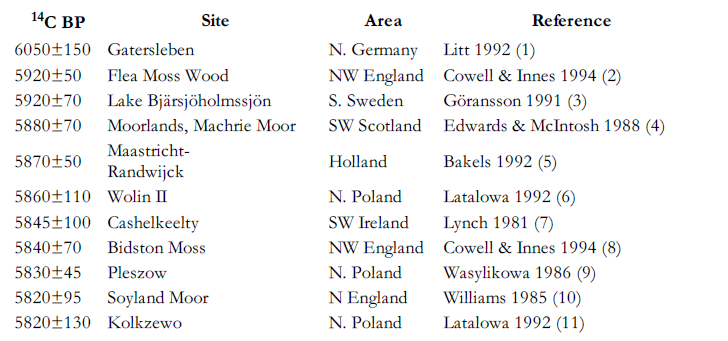
c.6000-5800BP cereal-type pollen 14C dates in the British Isles and Northern Europe.

Numbers refer to Figure 1.
Difficulties remain regarding the secure identification of cereal pollen, however. Uncultivated grasses with similarities to cereal pollen occur in steppe and coastal environments and some sites have yielded pollen of cereal type at much too early a date to be a feasible record of cultivation (O'Connell 1987). Caution is therefore needed before using cereal type pollen grains as a marker of cereal growing, especially during critical periods such as the very start of the Neolithic. However, if only those finds of cereal-type pollen which occur within a well established phase of forest disturbance and accompanied by other land-use indicators are considered, a reliable data set is obtained with which to assess the start of cereal cultivation in a particular area. Through examination of the data from the British Isles, North Sea coast and Baltic region of north-west Europe, it is possible to list the earliest radiocarbon dated cereal-type pollen evidence which is lent credence by its occurrence within a context of an ecologically convincing episode with other pollen evidence of forest disturbance. Table 1 contains a list of the sites and radiocarbon dates for several parts of this region which fall within the critical time period between 6000 and 5800BP which workers using other forms of evidence are beginning to recognise as the start of the regional Mesolithic-Neolithic transition (Persson 1999, Crombé et al. 2002). Figure 1 shows that the calibrated age-ranges of the radiocarbon estimates are sometimes broad. The apparent coincidence of early cereal finds remains valid, but over a wider calendar-year time-span. Even after calibration, however, there is agreement between the ages of first cereal detection between 4550 and 4900 BC (calibrated)- a range including the Doel dates. The possibility that the coincidence of dates could be due to a radiocarbon plateau can be refuted by the raw atmospheric data of Stuiver et al. (1998). These show a series of three oscillations between 4900 and 4700 BC, between which times precise dating will be difficult without wiggle-matching, but show a generally consistent calibration curve without significant plateaux between 5100 and 4480 BC.
The sites included in Table 1 and Figure 1 are a selection of those which have their first acceptable cereal type pollen records in the relevant time period. They are sufficient to suggest, however, that if the period between 6000 and 5800BP was indeed the start of the adoption of neolithic traits by local hunter-gatherers and the transition to Neolithic culture in north-west Europe, then cereal cultivation may have been a part of this first phase of culture change. Its use within a forested environment alongside more traditional hunter-gatherer economic resources as incipient forest farming (Göransson 1982, Edwards 1989, 1993) may have accompanied other aspects of culture change arising from contact with neolithic groups. Certainly there is enough radiocarbon dated palynological evidence to support the findings of Crombé et al. (2002) regarding the importance of the 6000-5800BP period in this regional Mesolithic-Neolithic transition. Palynological research should form a part of future work directed at this critical period.