


Among the social groups most at risk of developing mental health problems, people living in poverty or extreme poverty are particularly vulnerable.Reference Das, Do, Friedman, McKenzie and Scott1 Although the realities may be very different between low- and middle-income countries (LMICs) and high-income countries, when poor people are asked to describe their situation, they always speak of great distress.Reference Mills2 Grief, sadness, anger, fear, bitterness, frustration, discontent, anxiety, and emotional damage consisting of low mood and depression, fatigue, hypersensitivity, sleep difficulties and physical pain are part of the distress reported by people whose basic needs are not being met.Reference Mills2 Described in this way, the situation of these individuals can quickly lead to the psychiatrization of poverty.Reference Mills2 The purpose of this article is not to psychiatrize poverty. Conversely, the article prompts changes by raising awareness and understanding of the links between, and underlying mechanisms of, socioeconomic inequities and the mental health of populations, using the Mental Health Centre at Morne Pelé (MHCMP) in Northern Haiti as an example.
Poverty and mental health
Research has consistently established links between poverty and mental health problems in LMICs.Reference Lund, De Silva, Plagerson, Cooper, Chisholm and Das3,Reference Lund4 Such a linkage consists of a vicious cycle that is self-perpetuating in the sense that socioeconomic precariousness feeds mental health problems, which, in turn, hinder the socioeconomic development of both individuals and communities.Reference Das, Do, Friedman, McKenzie and Scott1,Reference Lund, De Silva, Plagerson, Cooper, Chisholm and Das3,Reference Lund4 Additionally, the stigma associated with mental health problems,Reference Lund, Breen, Flisher, Kakuma, Corrigall and Joska5,Reference Thornicroft6 limited access to care, precarious family situations, job loss and lack of health insurance are some of the factors that push people in LMICs into greater socioeconomic insecurity when they face mental health problems.Reference Dixon, McDaid, Knapp and Curran7 Research has also shown that programmes aimed at improving the mental health of individuals also have positive economic effects on populations.Reference Barlow, Bergman, Kornør, Wei and Bennett8 Similarly, programmes that aimed to improve the socioeconomic conditions of communities also improved their mental health.Reference Barlow, Bergman, Kornør, Wei and Bennett8 Thus, mental health in LMICs, besides being a public health emergency, is also necessary for their socioeconomic development.Reference Lund, De Silva, Plagerson, Cooper, Chisholm and Das3
Haiti was the second country to become independent of the American continent.Reference Dupuy9 Nonetheless, over decades, Haiti's economic development has been shaky;Reference Dupuy9 thus, it is currently among the poorest countries,Reference Galvin and Michel10 with a healthcare system that is completely outdated and can no longer meet the needs of the population.Reference Alfred11,12 Specifically, Haiti faces increasing poverty,Reference Dupuy9 and the latest estimates from 2012 indicated that nearly 60% of the population were living in poverty and more than a quarter were living in extreme poverty.Reference Galvin and Michel10 Moreover, 45% of Haitian workers were living in poverty, earning <$1.25 a day in 2012.Reference Galvin and Michel10 The national currency, the gourde, has lost more than half of its value, wages have not increased, many people have lost their jobs, social and economic realities have contributed to a higher number of Haitians living in poverty and the situation has worsened since 2017.Reference Galvin and Michel10 Furthermore, in Haiti, free access to healthcare is not guaranteed by public health institutions, and <10% of the population has access to an insurance system. Concerning mental health care, the public health system only has 138 beds and the country has <40 psychiatrists, 200 psychologists and <300 social workers for a population of >11 million. Although the capital region (Port-au-Prince) is home to about 35% of the population, it contains >50% of the health infrastructure and all of the 138 psychiatric beds available in the country.Reference Galvin and Michel10 Until 2016, Haiti's North Department, with a population of 1.07 million, had no mental healthcare facilities.Reference Galvin and Michel10
The MHCMP: providing mental health care in poverty
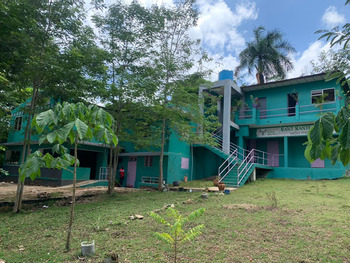
Founded in 2016, the MHCMP (see Fig. 1) is the first and only mental health centre in the North Department. The centre uses the World Health Organization's Mental Health Gap Action Programme (mhGAP), adapting it to the real needs of the communities through services tailored to the local harsh living conditions.Reference Galvin and Michel10 The MHCMP welcomes all age groups and opens its doors 5 days a week to people in great distress and with various disorders, including anxiety, post-traumatic stress disorder, depression, psychosis and bipolar disorder.
The Mental Health Centre at Morne Pelé. Photograph taken by G.M.

The course of healthcare at the MHCMP consists of seeing a nurse, an initial psychological assessment with a psychologist, seeing a family doctor with mental health training (there is no psychiatrist for the 1.07 million inhabitants of Haiti's North Department) and then going through the pharmacy as required. Thus, the centre pursues an approach based on four pillars: ensuring the physical safety of the patient and healthcare staff (families often wait until the patient is in crisis to bring them to the centre, sometimes in chains); providing mental healthcare according to the needs of the patient, as well as ruling out physical illness; providing adequate mental healthcare, taking into account social, community and cultural factors; and following up with patients in terms of medication and psychotherapy.
Additionally, an emphasis is placed on psychoeducation, building on what is done at the beginning of culturally adapted cognitive–behavioural therapy, to ensure that the intervention is well-understood by the patient and/or family. Cultural adaptation is an essential and humanistic approach when caring for people with a precarious socioeconomic situation, often with a low level of education and in a culture where mental health is often stigmatised.Reference Cénat13
Providing and maintaining quality mental healthcare in LMICs poses various challenges. For example, the MHCMP works with minimal means and is mostly self-financed by tending to people who can pay for the care they receive, providing laboratory services and selling medication through its pharmacy. However, the centre also receives many people who cannot pay for care and would benefit from financial assistance. Thus, although some medications are provided (i.e. donated by Partners in Health), the majority of people who should be receiving follow-up care do not receive it. The centre can only provide psychotherapy sessions to fewer than half of the people received. The remainder are unable to reach follow-up care because they are unable to pay for the care or live too far away and are not able to afford the transportation costs. Between the opening of the centre in October 2016 and September 2019, it has received 842 individual patients aged between 3 and 93 years, with various mental health problems. Over the past year, the centre has seen an average of 262 people per month, with three to four new patients per day. Because of the lack of resources, the centre can only receive a part of the clientele (<30%).
Moreover, the centre receives an increasing number of people from other departments, including some from Port-au-Prince, the capital, which is >240 km away. A further challenge faced by the MHCMP is that the majority of people with mental health problems attribute them to mystical origins, witchcraft or curses. To face this challenge, the MHCMP is playing an important role in raising awareness of mental health issues in the Northern Haiti. Its work has increased the number of pastors and priests, including Voodoo priests, who have referred people with mental health problems to the centre.
Four lessons from the experience of the MHCMP
Being the first and only mental health centre in Haiti's North Department, and situated in one of the most disadvantaged regions in the country, the MHCMP offers a unique opportunity to explore the relationship between poverty and mental health. Several lessons have been highlighted through the experience of the MHCMP. First, the quick overburdening of providers at the centre emphasises the urgent need for mental health services in impoverished populations. Second, those most in need of care are also those with the least resources to access medication and psychotherapy, thus limiting the effects of treatment. This reality highlights the importance of considering methods to target those who are poorest, and to prioritise their access to comprehensive mental health services. Particular attention should be given to known vulnerable populations, including children, adolescents, women, those living with disabilities and older adults. As such, innovative approaches should be developed to provide appropriate mental healthcare for these populations; for example, by expediting the process of training mental health professionals. Training should also be extended to a greater variety of professionals, including general practitioners, nurses, educators and other professionals, to create more access points to care and increase human resources for service delivery. Third, the MHCMP example demonstrates that several structural factors contribute to poor mental health in these populations, including unaddressed basic needs, financial strain and lack of access to sanitation, transportation, education and healthcare. To this end, professionals should aim to adopt an ecosystemic approach that integrates social, economic, community and cultural factors, to avoid further psychiatrizing poverty. Finally, the MHCMP example shows that meeting healthcare needs is compromised by financial vulnerability. As such, there is a need for financial support from national and international actors, to ensure the sustainability of initiatives such as the MHCMP.
Conclusions
This scholarly discourse underscores that mental health is not simply an individual matter, as it can hinder the socioeconomic development of countries, and thus should be considered as a potential threat to the sustainable development when elaborating a country's comprehensive development plan. This article helps to illuminate the paradox wherein those in poverty are the most at risk of suffering from mental health problems, yet also face the most barriers to accessing care. These barriers are systemic, and involve unaddressed basic needs, lack of transportation, education and financial resources. The synchronistic relationship between the improved mental health of individuals and the resulting socioeconomic functioning of the greater society is an avenue that merits further study. The MHCMP's efforts in providing holistic and humanistic mental healthcare services may serve as an example for developing and sustaining mental health services in other LMICs.
Finally, the MHCMP demonstrates the way to policy makers on how to develop cost-effective structures that offer evidence-based care in a community-based and culturally sensitive approach. The MHCMP highlights that, instead of opting for cumbersome, costly and centralised mental health structures, policy makers should develop a structure per municipality. To make them more effective, these structures can share regional resources, including training of mental health professionals and data collection. These structures can also play a major role in promoting campaigns to destigmatise mental health problems in Haitian society.
Author contributions
J.M.C., B.H., S.E.M. and R.D.D. conducted the literature search. J.M.C., R.D.D. and G.M. conducted the contextual search in Haiti. G.M. provided details on the Mental Health Centre at Morne Pelé. J.M.C., B.H., S.E.M., S.H., J.N.M. and R.D.D. wrote the manuscript. J.M.C., R.D.D. and G.M. revised the manuscript.
Funding
This research received no specific grant from any funding agency, commercial or not-for-profit sectors.
Declaration of interest
None.

 Open access


eLetters
No eLetters have been published for this article.