




1. Introduction
Market frictions and behavioral biases challenge individuals striving to achieve their long-term goals. To overcome these obstacles, a common strategy is to alter an individual’s choice architecture – the environment in which they make decisions. Changing default decisions, sending electronic messages, and running information campaigns are examples of ‘nudges’ that increase the likelihood of program take-up or other perceived positive choices.
Nudges are often cost-effective, not because effects are large but because costs are small. An evaluation of 126 randomized controlled trials conducted by policy ‘Nudge Units’ found that nudges increased individuals’ take-up of vaccinations, bill payments, scheduled home nursing visits, and other target behaviors by only 1.4 percentage points, on average (DellaVigna & Linos, Reference DellaVigna and Linos2022). While nudges can induce one-time or short-term actions, they fail to address the deeper motivational and social factors that underpin day-to-day actions and routine behavior. Nudges are thus not likely to have large aggregate long-term benefits.
Meanwhile, several recent studies have found that more intensive interventions that emphasize personal and social connection have generated impressive results. High school and college support programs that provide students with regular advising, tutoring, and group activities consistently generate large increases in academic performance, educational attainment, and adult earnings (Cook et al., Reference Cook, Dodge, Farkas, Fryer, Guryan, Ludwig, Mayer, Pollack and Steinberg2014; Guryan et al., Reference Guryan, Ludwig, Bhatt, Cook, Davis, Dodge and Stoddard2023; Lavecchia et al., Reference Lavecchia, Oreopoulos and Brown2020; Oreopoulos et al., Reference Oreopoulos, Brown and Lavecchia2017; Resnjanskij et al., Reference Resnjanskij, Ruhose, Wiederhold, Woessmann and Wedel2024; Scrivener et al., Reference Scrivener, Weiss, Ratledge, Rudd, Sommo and Fresques2015; van der Steeg et al., Reference van der Steeg, van Elk and Webbink2015). Intensive tutoring, in particular, has consistently been found to be a highly impactful educational intervention (Fryer, Reference Fryer2017; Nickow et al., Reference Nickow, Oreopoulos and Quan2024). These interactive programs ‘move the dial’ in terms of improving students’ outcomes at scale. Evidence increasingly suggests that to meaningfully change life trajectories, interventions must target motivation, habits, and identity by leveraging the power of social connections and personal assistance.
Examples of the importance of personal assistance abound in human development. Consider a child learning the violin. Even if she has the potential to be the next Mozart, she will not pursue this activity on her own. Young children, whose brains are not yet fully developed, often struggle to consider the long-term benefits of immediate actions. To truly reap the cumulative benefits of learning the violin, daily practice needs to become a routine part of the child’s life. She needs a helping hand – daily encouragement, advice, and instruction. As she matures, her need for support will not disappear. Even with a more developed brain capable of controlling impulses, she is still subject to internal and external distractions. Present bias and distractions can prevent her from realizing her long-term goals. While reminders, information, schedules, incentives, and punishments may help, they do not necessarily cultivate a child’s long-term intrinsic motivation to practice or equip her to handle emerging challenges and obstacles as her skills evolve. She needs someone to nurture the development of this intrinsic motivation into her identity, teach her good practice habits, offer her targeted instruction based on her level of ability, and exert a long-term influence that extends beyond the moments when they are actively interacting.
In this paper, we argue that while low-touch nudges may be cost-effective, interventions with personal assistance are often critical to successfully implementing public policy. We position these two types of interventions as complements rather than substitutes, with typically lower-cost, lighter-touch nudges being useful for addressing specific actions and more intensive personal assistance for significant longer-term change.
The remainder of the paper proceeds as follows: in Section 2, we define personal assistance relative to nudging and then outline the conceptual benefits of incorporating personal assistance into interventions. In Section 3, we highlight several examples of recent studies in which impacts are substantially boosted with the incorporation of personal assistance. We conclude in Section 4 with a discussion of implications for policy and for future research.
2. Conceptual framework
2.1. Definitions
Nudges refer to subtle modifications in an individual’s environment that steer them toward a more desirable outcome without significantly altering their options or costs (Oreopoulos, Reference Oreopoulos2020; Thaler & Sunstein, Reference Thaler and Sunstein2008). Nudges make the desired action easier to accomplish. Examples of nudges include setting default options, delivering information through messages or videos, using visual prompts, sending reminders, simplifying choices, and gamifying mundane tasks. An alternative approach to nudging is shoving. Unlike a nudge, a ‘shove’ restricts an individual’s set of options, compelling them toward more desirable outcomes. Requiring someone who is unemployed to participate in a government job search program to receive benefits is a shove because no opt-out option exists. Requiring students to attend school is a shove, as is banning cellphones at school or setting a class curriculum.
Personal assistance involves a nudge or shove that includes social interaction. One individual (the ‘personal assistant’) provides interactive guidance, support, or motivation to another (the ‘client’ or ‘subject’). This interaction may range from brief encounters, such as a single phone call, to more extended and regular sessions, like weekly tutoring or coaching. Ideally, personal assistance involves trust and expertise. Individuals are more likely to respond well when interacting with someone they trust or with someone they believe has the experience to guide them toward better outcomes.
Compared to impersonal signage, texts, or emails, a personal assistant can express empathy, respond to questions, and use body language or facial expressions to communicate. Personal assistance can take the form of a nudge, where the client retains the option to avoid or ignore the advice, or a shove. Requiring students to meet with a guidance counselor is an example of a shove with personal assistance.
Researchers sometimes distinguish ‘high-touch’ and ‘low-touch’ behavioral interventions based on cost. The distinction also usually involves comparing whether an intervention employs personal assistance or not. Thus, we will sometimes refer to behavioral interventions with personal assistance as ‘high-touch’ nudges or shoves. Not all researchers would consider personal assistance a behavioral intervention, though we believe it is helpful to view it as such for comparison because all nudges and shoves aim to lower behavioral barriers and influence individuals toward more desirable behavior. In any case, the need to treat personal assistance as only a nudge or shove is not critical for this essay – the emphasis on the importance of social interaction in policy interventions to improve long-run outcomes is what matters most to this discussion.
2.2. Low-touch interventions, personal assistance, and the process of human capital development
It may be helpful to frame the significance of personal assistance and low-touch interventions within the classic model of Cunha and Heckman (Reference Cunha and Heckman2007). Consider the skill production function:
 \begin{equation*}{S_{i,t}} = F\left( {{S_{i,t - 1}},\,{I_{i,t}}} \right),\end{equation*}
where Si,t is a vector of current skills for student i at time t; Si,t-1 is a vector of earlier skills for student i at time t-1; and Ii,t represents skill investment by individual i in time t. In this model, skill begets skill, and depends on earlier investment.
Skill investment is often described in terms of money or parental time. Here we want to emphasize how these kinds of investments lead to brain activity necessary for skill development. The individual themselves must apply effort, time, and focus to develop skill. We define this kind of investment as practice. Think of practice as the individual mental performance for skill development – such as concentration, thinking, or even exercising. Practice is independent of social interaction because it occurs internally. Also key for this discussion is to recognize the role that new information plays in skill development. Without it, the individual would have difficulty knowing what to practice. New information usually comes from outside support (e.g., from a teacher, parent, peer, or tutor). Think of support as the source of knowledge for choosing how to practice. Support is influenced from social interaction, such as through listening to a teacher, talking to a coach, or sharing experiences with friends. Skills develop from the interaction of both practice and support.
Behavioral biases such as present and salience bias affect individual practice without altering support. Present bias, for example, may lead to an over-emphasis of upfront costs from practice, causing less effort or study time. Salience bias may cause students to rely too much on routine and ignore new actions that could improve skill development. Parents and policy makers can encourage better practice by targeting these kinds of biases with low-touch nudges. Restricting cell phone use, sending reminders, and rewarding good performance are examples of low-touch interventions that can help children make better decisions about their skill investments. High touch interventions with personal assistance, in contrast, have the potential to influence both practice and support.
2.3. Conceptual benefits of personal assistance relative to nudging
Both high-touch and low-touch behavioral interventions can help address skill development. However, whereas low-touch interventions are appropriate and cost-effective for helping to encourage one-time actions, like remembering to attend a tutorial or completing a college financial aid application, there are several reasons why high-touch interventions that use personal assistance are better suited for facilitating long-run behavioral change.
First, personal assistance interventions are more able to obtain detailed information about individual needs and are more able to tailor advice to those needs. Personal assistants often acquire rich data on their clients. By contrast, low-touch nudges and shoves typically obtain little, if any, information about subjects. Having more information allows personal assistants to appropriately tailor their advice or instruction to their clients’ needs or ability level. Appropriate tailoring is crucial for an intervention’s long-term success, given the dynamic nature of human capital formation. Support must evolve over time. Whereas personal assistants are easily able to adjust to their client’s changing needs and to avoid biases related to the reliance on routines, low-touch interventions are often designed as short-term treatments that have little capacity for adaptation. Information tailoring is also crucial for helping clients navigate complex processes, as informational nudges can typically offer only generic advice for the most common challenges that arise. Biases due to information overload can be addressed more efficiently when a personal assistant selects the more relevant information for advancing though the process, thus reducing effort costs for the client.
Second, personal assistance, with its capacity for initiating and sustaining interactions, is better positioned to deliver proactive support. Personal assistants often have the latitude to proactively assist clients; in contrast, nudges like text-messaging campaigns commonly just provide nudges at regularly scheduled intervals. By proactively engaging with clients, personal assistants can identify and address potential problems before they escalate (before the effort costs of addressing a problem become unmanageable). Many people, especially students, are reluctant to seek help for fear of being a burden or being perceived as incapable. Proactive assistance mitigates this fear and ensures subjects get the help they need before it is too late. By anticipating challenges and providing support ahead of time, the personal assistant can prevent deeper issues from arising in the first place, which allows them to have a greater long-term impact than a non-proactive nudging intervention. Furthermore, receiving proactive assistance makes a person feel valued, seen, and supported. This positive relationship can boost engagement and motivation, build identity, and reduce stress and anxiety.Footnote 1 These are key ingredients for lasting success.
Third, personal assistance interventions provide socio-emotional support for clients, whereas low-touch interventions typically do not. Intensive personal assistance interventions can foster a positive, potentially long-term social connection that nudge interventions cannot replicate. This relationship can serve as a source of socio-emotional support, contributing to improved mental well-being. When individuals feel emotionally supported, they are better equipped to manage stress, anxiety, and other emotional challenges, allowing them to focus on their personal growth. Personal assistance also provides individuals with someone to whom they can be accountable, further enhancing their commitment to skill development. People struggling with a negative identity can have a positive identity made more salient to them by a personal assistant who serves as a role model. Personal assistants can enhance intrinsic motivation toward a task. Research in social psychology has consistently found that social contexts that ‘support perceptions of autonomy and feelings of competence’ increase intrinsic motivation, while ‘feelings of relational security’ are especially important in nurturing curiosity and motivation among children (Ryan & Deci, Reference Ryan and Deci2017). Even less-intensive personal assistance interventions provide short-term socio-emotional benefits that translate into better outcomes. Specifically, tasks that are frustrating, stressful, or boring are made less unpleasant by the presence of a friendly personal assistant; this can reduce present bias by lowering the up-front costs of investing in human capital.
A personal assistant may continue to influence a client long after they stop meeting. Research from developmental psychology suggests that people who have had significant personal interactions retain and reference these experiences well into the future (Bronfenbrenner, Reference Bronfenbrenner1979). Advice or motivation provided by a mentor in the past can resurface years later as individuals make important life decisions. Grossman and Tierney (Reference Grossman and Tierney1998) argue that this phenomenon motivates the Big Brothers Big Sisters Program.
Note that it has not been established empirically which of the three factors discussed above are most important in generating the beneficial effects of personal assistance. In the applied examples discussed below, we highlight what researchers have found when they try to disentangle these mechanisms. The importance of a personal assistant’s proactivity is consistent across several studies (Bergman et al., Reference Bergman, Chetty, DeLuca, Hendren, Katz and Palmer2024; Carrell & Sacerdote, Reference Carrell and Sacerdote2017; Oreopoulos & Petronijevic, Reference Oreopoulos and Petronijevic2018). Information tailoring and socio-emotional support are found to be important in one case (Bergman et al., Reference Bergman, Chetty, DeLuca, Hendren, Katz and Palmer2024), but not in another (Carrell & Sacerdote, Reference Carrell and Sacerdote2017). Meanwhile, Guryan et al. (Reference Guryan, Ludwig, Bhatt, Cook, Davis, Dodge and Stoddard2023) find evidence that the personalization of instruction – a form of information tailoring – contributes to the effects of tutoring, but do not find evidence suggesting the importance of a ‘mentoring effect’ – a form of socio-emotional support.Footnote 2
3. Personal assistance in action
In this section, we highlight studies in which personal assistance interventions greatly outperform lower-touch nudges. We trace these examples through developmental stages, from early childhood to adolescence to adulthood.
3.1. Parenting young children
List et al. (Reference List, Pernaudet and Suskind2021) test two interventions aimed at shifting parental beliefs about the importance of early parental investments. In their first experiment, parents of newborns are provided a short educational video during four pediatrician visits. The videos emphasized benefits of increased parental interaction with very young children, and offered practical tips for increasing and improving the quality of interaction. In the second experiment, parents of toddlers received twelve home visits from professionals, emphasizing a similar message. The home visitor would ‘first show parents a video that covered a specific development topic (e.g., linguistic interactions, encouragement, incorporation of math into everyday routines) and would then do an activity with the caregiver to demonstrate how to put the concepts covered in the video into practice.’ Then, based on recordings of the child’s home environment, the home visitor would provide feedback to the parent and would set goals for the next visit.
The researchers find that both programs affected parental beliefs, but only the home visiting experiment had lasting effects on child outcomes. The second experiment improved children’s vocabulary, math, and socio-emotional skills, whereas the first experiment had no significant impact on vocabulary, the only skill measured. The researchers also find that the quality of parent-child interactions improved more from the home visiting experiment than from the informational video experiment. They conclude that ‘simple educational policies may not be sufficient to induce robust behavioral changes and child outcome improvements.’
The researchers do not attempt to isolate why their second experiment was more effective than their first. However, the first conceptual benefit of personal assistance discussed in Section 2 may be particularly relevant. Home visitors had a far greater ability to tailor information and advice to the parent they were working with relative to the video treatment, which did not uncover any information about parents and simply presented the same information to every parent, regardless of individual relevance. Information tailoring likely reduced the effort costs of implementing optimal parenting practices. The other two benefits of personal assistance may also be relevant: home visits allowed for proactive engagement and sustained interaction with parents, while also fostering accountability through the process of goal-setting for subsequent sessions.
3.2. Moving children to better neighborhoods
Bergman et al. (Reference Bergman, Chetty, DeLuca, Hendren, Katz and Palmer2024) conduct a two-phase experiment to try to improve housing voucher utilization. In the first phase, they offer a bundle of resources to facilitate moves to neighbourhoods with high upward mobility, including information about high-opportunity areas, short-term financial aid, intensive customized housing search assistance, and landlord connections. They label this the Creating Moves to Opportunity (CMTO) program. In the second phase, to understand underlying mechanisms, they run another experiment with three treatment arms: (A) information and financial aid only; (B) limited personal support services, plus information and financial assistance; and (C) full personal support services, mirroring the treatment in the first phase of the experiment.
In the first phase, the proportion of families moving to high upward-mobility areas rose from 15% in the control group to 53% in the CMTO group. In the second phase, the information only treatment yielded an 8.9 percentage point effect; the limited personal assistance treatment yielded a 13.8 percentage point effect, and the full package yield a 40.8 percentage point effect, aligning with the bundled treatment in the first phase. These findings suggest that while information or financial services alone have a modest impact, the program’s more substantial effect is tied to the comprehensive package, which includes personal assistance. The authors also report long-run effects of the CMTO treatment, with treatment effects decreasing only by 4.9 percentage points three years after implementation.
A survey applied to a representative sample of those in the bundled treatment identified five key ways the program assisted them in moving to better neighborhoods: (i) provision of emotional support and communication; (ii) enhancing motivation to move by making such a move seem more attainable; (iii) streamlining the search process with help in preparing rental applications and résumés; (iv) offering brokerage services and landlord representation; and (v) providing financial assistance.
The authors conduct interviews with families who moved to high-opportunity areas with the help of CMTO to better understand why it was effective. Before asking specific questions about program features, the authors asked interviewees to speak about their general experiences with CMTO and recorded emergent themes. The most commonly mentioned CMTO feature was its short-term financial assistance (mentioned by 81% of respondents), which is clearly not related to personal assistance. However, the next two most commonly mentioned mechanisms were ‘streamlining the search process with help in preparing rental applications’ (73%) and ‘provision of emotional support and communication’ (61%). These mechanisms show how personal assistance can reduce upfront effort costs. Meanwhile, 31% of respondents mentioned that the CMTO program increased their motivation to move to a high-opportunity area by making such a move seem more attainable, aligning with findings from social psychology research that social contexts that induce feelings of competence can also increase intrinsic motivation (Ryan & Deci, Reference Ryan and Deci2017). This mechanism shows that personal assistance can also make longer-term benefits more salient. The open-ended survey responses highlight the important roles that information tailoring and socio-emotional support played in the success of the CMTO program. The authors do not highlight proactive outreach explicitly as a mechanism, but they do report that ‘many families noted that the CMTO navigators’ consistent communication and support were critical for keeping them motivated throughout the search process.’ One respondent appreciated that the program was ‘with you at all times.’
Overall, Bergman et al’s (Reference Bergman, Chetty, DeLuca, Hendren, Katz and Palmer2024) findings align with the conceptual arguments presented in Section 2: although information and financial help increase moves to more upwardly mobile neighborhoods, more personalized assistance (in conjunction with information and financial services) has a much greater effect on mobility. Survey respondents’ answers support several conceptual benefits detailed in Section 2, including the importance of tailoring, providing help at various stages throughout a complex process, reducing upfront effort costs, and supplying human emotional support.
3.3. Parenting school-age children
Bergman et al. (Reference Bergman, Edmond-Verley and Notario-Risk2018) investigate low and high-touch interventions to increase middle school and high school performance at low-performing schools. In one intervention, text messages are sent to parents once every two weeks outlining the child’s grades, absences, and missed assignments. In another intervention, the same text messages were sent, plus professional staff visited homes up to three times to instruct parents how to interpret the messages and offer suggestions for creating better home learning environments. The home visitors also discussed high-school graduation and college readiness with parents, encouraging them to focus not just on their child’s present academic performance, but the long-term implications of that performance.
The text-only treatment had no significant impact on grades, whereas the home-visit intervention increased math and reading scores by 0.12 SDs. The authors conclude that ‘information alone may be insufficient to improve a broad array of outcomes in schools with high rates of suspensions and very poor transcript grades; in these contexts home visits may be a particularly important complement.’ Home visitors’ ability to tailor information and provide proactive support likely contributed to their success.
3.4. Transitioning to post-secondary education
Bettinger et al. (Reference Bettinger, Long, Oreopoulos and Sanbonmatsu2012) provided a group of low-income parents of high school seniors visiting a tax-preparation company with accurate estimates of their child’s potential eligibility for post-secondary financial aid, along with information about how to apply. This information intervention had no impact on post-secondary enrollment. However, in another treatment arm, parents were invited to stay an additional 10 minutes with their tax assistant to help complete their child’s actual application. For this treatment arm, post-secondary enrollment increased by 8 percentage points. This result illustrates the considerable impact that targeted personal assistance can have. The effect is consistent with the idea presented in Section 2 that having a personal assistant guide an individual through an unfamiliar task can make all the difference to some in whether that task is completed.
Carrell and Sacerdote (Reference Carrell and Sacerdote2017) find that assigning high school seniors an undergraduate mentor who assists them weekly until their college applications are filed, while also providing a $100 bonus in cash for completing the program, increases post-secondary enrollment.Footnote 3 Offering the cash bonus alone does not yield statistically significant effects, nor does sending students personalized letters of encouragement. The authors ‘do not find evidence that the [mentorship] treatment effect derives from simple behavioral mistakes, student disorganization, or a lack of easily obtained information.’ Thus, information tailoring does not seem to be driving treatment effects here. The authors test whether mentors are especially effective in helping students with low self-esteem, but do not find evidence of this, suggesting that this particular dimension of socio-emotional support is not a key mechanism. The authors do, however, find evidence suggestive of the specific role of social interactions. They conclude that ‘…our mentoring program appears to substitute for the potentially expensive and often missing ingredient of skilled parental or teacher time and encouragement.’ This highlights the value of socio-emotional support provided by personal assistants. Evidence in this paper also supports the proactivity feature of personal assistance. The authors find that treatment is ‘ineffective for students who like to meet new people or enjoy amusement rides,’ and suggest that it could be the case that ‘outgoing or more adventurous students may be able to find their own sources of help on college applications.’ This would suggest that mentoring is effective on average because proactive mentors nudge their mentees toward completing the enrollment process. The authors conclude that ‘direct in-person help and hand holding’ is required to substantially increase college enrollment rates among marginal students. They note that their treatment is cost-effective, with estimated benefits far outweighing costs.
Holzman et al. (Reference Holzman, Chukhray and Thrash2023) compare the effectiveness of regular intensive personal assistance from college advising program staffFootnote 4 to a low-touch information intervention (packets with tips on SAT prep and college applications). They find that the former treatment increases the likelihood of applying to and enrolling in a selective college by roughly 0.40 SDs, while the latter has no statistically significant effect. They write that the personal assistance treatment addresses ‘the information barriers and unfamiliarity navigating the complex college application process that socioeconomically marginalized students and families face,’ indicating the importance of an adaptable and interactive source of information in this context.
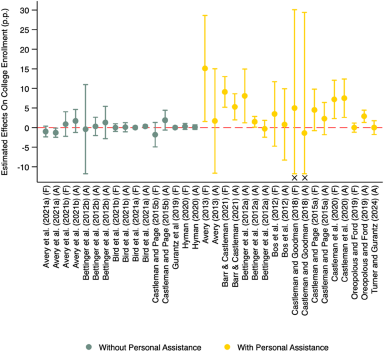
The complexity of and informational frictions involved in the post-secondary application process has made this domain a popular testing ground for both low-touch nudge interventions and more intensive interventions incorporating personal assistance. To go beyond the single-study examples presented above, we collected treatment effect estimates from all known randomized controlled trials on this topic.Footnote 5 Fig. 1 displays 34 estimated program effects (against a control group) on the fraction enrolled in a 4-year or overall college, from a total of 18 studies. Appendix Table A1 provides more details around the specifics of these effects and studies. Effects from low-touch interventions without personal assistance are displayed in green. These programs utilize text messages, pamphlets, social media, mailings, or emails to encourage college or financial aid applications. The average of the 16 effects is a 0.15 percentage point increase, with no positive estimates being statistically significant. By contrast, effects from high-touch interventions with some type of personal assistance are shown in yellow. The average program effect across these 18 estimates is an increase in enrollment of 4.05 percentage points, with 8 positive estimates being statistically significant at the 95% level and 10 at the 90% level. The contrast displayed here is stark – at least some type of personal assistance is necessary for significantly increasing college enrollment.
Estimated effect sizes on college enrollment (in percentage points) of various interventions across studies

3.5. Succeeding in post-secondary education
Beyond just helping students enroll in post-secondary education, personal assistance interventions may also be able to improve students’ academic performance once enrolled. Oreopoulos and Petronijevic (Reference Oreopoulos and Petronijevic2018) studied whether low-cost behavioral nudges can improve course grades and GPA among first-year university students as much as one-on-one coaching can. They randomized 4,000 students into either a control group or various treatment groups. One treatment group participated in a one-time online exercise that asked them to think about their future. Another received this exercise plus text and email messages providing studying tips, available resource information, and general encouragement. A third group received one-on-one proactive coaching from an upper-year student throughout the year.
The authors find that none of the low-cost nudge treatments affect academic outcomes. Conversely, one-on-one coaching generated large positive improvements to GPA. These results ‘suggest that the benefits of personal coaching are not easily replicated by low-cost interventions using technology.’ The authors posit two reasons as to why the coaching intervention was so much more effective than the text-message campaign. First, ‘coaches proactively initiated discussion with students about their problems.’ Second, coaches ‘could establish relationships based on trust in which students felt comfortable to discuss their issues openly.’ Whereas the text-messaging campaign could provide only canned tips and encouragement, coaches proactively checked in on students’ well-being and academic status and offered targeted assistance with challenges students were facing (e.g., applying for scholarships). The authors note that a previous coaching experiment they conducted at the same campus yielded negligible effects, and attribute the difference in results to the proactivity of the coaches. In the earlier experiment, coaches only emailed students once a week, whereas the later experiment saw coaches ‘aggressively initiate contact and build trust with students over time.’ Later related research by these authors finds additional evidence that various low-cost nudge interventions do not impact post-secondary student academic performance, while personalized assistance also reduces stress and improves mental health (Dobronyi et al., Reference Dobronyi, Oreopoulos and Petronijevic2019; Oreopoulos et al., Reference Oreopoulos, Patterson, Petronijevic and Pope2022).
3.6. Personal assistance at work
Recent research demonstrates how programs incorporating personal assistance can also be impactful in adulthood. Bobonis et al. (Reference Bobonis, Bonikowska, Oreopoulos, Riddell and Ryan2022) study the long-run effects of the Canada Self-Sufficiency Project program that targets single parents on social assistance, providing them with large temporary subsidies if they committed to full-time work. The objective was to determine if the initial wage doubling would motivate single parents on welfare to re-enter the workforce and remain employed, even after the removal of the subsidy three years later. The results indicate that while those who received the subsidy returned to work more quickly than the comparison group who received no subsidy, there were no long-term differences between the two groups after five years.
However, a second group within the study that received personal assistance demonstrated significant and enduring benefits. Each single parent in this group was assigned a coach who proactively aided in job searching and job retention for up to five years. For this group, average earnings were 21–27% higher than the comparison group over a 20-year period (approximately 26,000 CAD in present discounted real 2010 terms).
These findings provide more evidence for the efficacy of personal assistance. The core difference between the ‘coached’ group and the ‘subsidy only’ group was having access to someone who cared and offered support, making the program recipients feel more motivated, empowered, and confident, while replacing their self-perceived negative identity with a more positive one. Testimonials from participants highlight the value of this support: ‘The job leads – when you’re alone and looking for work, you can get awfully depressed, and there’s no one to talk to … These people, they’re there … They brought the more positive [me] out.’ Framing this statement in terms of economics costs and benefits, we see how personal assistants can improve self-perception, which in turn may increase an individual’s ‘effort budget.’
This study emphasizes the potential long-term benefits of integrating personal assistance not just into educational interventions, but also into social programs, suggesting that its incorporation can facilitate sustained changes in behavior, financial stability, and personal empowerment. Furthermore, labor market success is influenced by non-cognitive skills (Deming, Reference Deming2017; Heckman et al., Reference Heckman, Stixrud and Urzua2006), which personal assistants may have greater capacity to influence than low-touch nudges.
4. Conclusions
This paper argues that while low-touch behavioral nudges may provide cost-effective ways to improve human capital, more intensive interventions involving personal assistance are often required to meaningfully alter life trajectories. Generating substantial improvements to well-being is the ultimate goal of policy-making, and thus personal assistance interventions should not be systematically ignored in favor of lower-cost nudges. While hiring qualified coaches, mentors, social workers, or home visitors to build personal relationships with each target subject may be expensive, policies involving social interaction may be necessary for large-scale improvement. Despite higher costs, the examples presented throughout this paper show that there are many cases in which the inclusion of personal assistance in policy initiatives is a worthwhile investment. Several of the papers highlighted include cost-benefit analyses that show that high-cost programs can be cost-effective (Bergman et al., Reference Bergman, Chetty, DeLuca, Hendren, Katz and Palmer2024, Reference Bergman, Edmond-Verley and Notario-Risk2018; Bobonis et al., Reference Bobonis, Bonikowska, Oreopoulos, Riddell and Ryan2022; Carrell & Sacerdote, Reference Carrell and Sacerdote2017).
That said, significant obstacles remain for scaling personal assistance interventions. For example, Guryan et al. (Reference Guryan, Ludwig, Bhatt, Cook, Davis, Dodge and Stoddard2023) study a paraprofessional tutoring program that costs $3,500 per pupil. While effect sizes indicate that the program is cost-effective in the long-run, many schools or districts would struggle to pay the upfront costs of such a program. Beyond labour costs, (high-quality) labour supply is another challenge. As personal assistance programs scale up, they may have to be less selective in hiring workers, especially if wages stay fixed and the program is not in a large labour market. If the identity of personal assistants matters, there may be some groups for which the supply of assistants is especially limited. Scaled-up personal assistance interventions may also fail to achieve the same effect sizes as those found in studies of smaller programs implemented under optimal conditions, perhaps with a specifically targeted group of participants most in-need or most likely to benefit from assistance. There is a potential risk of dependency, moral hazard, and reduced autonomy produced when personal assistance is not appropriately implemented. Personal assistance can also face logistical challenges, such as scheduling conflicts and availability issues. Personal assistance interventions may not be suitable for all individuals, particularly those who prefer more privacy or are uncomfortable with intensive personal interactions. Finally, programs that rely on public resources may attract greater scrutiny as they grow and may be increasingly expected to deliver immediate results.Footnote 6
Technology can mitigate some of these concerns. Offering personal assistance over the internet, for example, reduces transportation and inconvenience costs. Both personal assistants and individuals meeting with personal assistants may find it easier to meet online. Personal assistants can be hired across a wider regional market. Some recent research on the impacts of online and telephone tutoring during the COVID pandemic indicates that personal assistance can yield robust effects in those environments (Angrist, Reference Angrist2023; Carlana & La Ferrara, Reference Carlana and La Ferrara2024), though more study is needed here. Personal assistance and technological solutions can also be used side by side. In a follow up study to Guryan et al. (Reference Guryan, Ludwig, Bhatt, Cook, Davis, Dodge and Stoddard2023), Bhatt et al. (Reference Bhatt, Guryan, Khan, LaForest-Tucker and Mishra2024) study whether tutoring students in groups of four, ‘with two students working with an in-person tutor while the other two worked on [a computer assisted learning (CAL) platform], alternating every other day’ was as effective as their prior 2-on-1 no-CAL platform. They find that the tutor + CAL treatment is almost as effective as the tutor-only treatment, while having 30% lower costs per pupil.
With the development of natural language processing tools like ChatGPT, an artificial form of personal assistance may soon be possible without human assistants. These language models allow for customized interaction to produce tailored advice, sustain conversations, and respond to specific questions. Artificial personal assistance could greatly reduce costs in many areas, such as help with finding work, choosing courses, obtaining parenting advice, and completing application forms.
While technological solutions are promising, they do risk straying too far from the features that make personal assistance interventions effective. For example, simply providing students with access to a CAL platform or other online tools will not impart the motivation to study. Beg et al. (Reference Beg, Halim, Lucas and Saif2022) find, in this vein, that integrating ‘expert-led, curriculum-based’ videos into classrooms improve test scores, but simply providing the videos to students without engaging teachersFootnote 7 had a negative effect on scores. Blending human personal assistance with technological approaches may be the optimal compromise. Oreopoulos et al. (Reference Oreopoulos, Gibbs, Jensen and Price2024) find that training teachers how to best use CAL in their classrooms generates meaningful improvements in math test scores. The authors write that ‘the approach is highly scalable, leveraging mostly existing resources and the school curriculum and helping motivate students to practice,’ with training costs being one-time costs. Future research should develop and evaluate other approaches for integrating personal assistance with scalable technology.
Other topics of further research for understanding potential benefits of personal assistance include possible identity-interactions between assistant and client. Do female tutors have more of an effect on female students than male tutors do? Do Black home visitors have more of an effect on the parenting investments of Black parents than White visitors do? Kosse et al. (Reference Kosse, Deckers, Pinger, Schildberg-Hörisch and Falk2020) present evidence that matching mentors and mentees based on gender and socio-economic factors leads to improved outcomes in a mentorship program designed to enhance prosocial behavior in Germany, but Carlana and La Ferrara (Reference Carlana and La Ferrara2024) do not find that gender matching affects the effects of online tutoring.
It is also of interest whether peer or volunteer personal assistants are as effective as highly-trained professional personal assistants; if this is the case, it could present a viable option for increasing the cost-effectiveness of personal assistant interventions. Nickow et al. (Reference Nickow, Oreopoulos and Quan2024) find that volunteer and parent tutors can improve learning outcomes, though not by quite as much as professional tutors. Training methods may be important here. Agostinelli et al. (Reference Agostinelli, Avitabile and Bobba2023) examine a change in the training of mentors within a school program in Mexico. Their findings reveal that enhanced training led to a significant improvement in children’s outcomes, moving from a null effect in the original program to significant impacts on test scores and school attendance.
Future research that disentangles the mechanisms through which personal assistance is effective could also be useful in designing more cost-effective interventions. If we better understand the contexts in which information tailoring, socio-emotional support, and proactive outreach are most important, program designers may be able to replicate those features at a lower cost and achieve similar results. However, it may be the case that these features are complementary and need to be present together in the form of a true personal assistant.
Personal assistants are crucial in enhancing human capital and societal well-being. While cost-effective low-touch nudges have their place, the transformative potential of personal connections should not be underemphasized. The conceptual framework and examples presented in the paper suggest areas where personal assistance could have significant effects. Personal assistance interventions at critical stages (e.g., early years, transitions between educational levels) for specific groups (e.g., individuals with low support and social interactions) show promise relative to low-touch nudges. This is especially true when complexity and proactivity are necessary (e.g., navigating complex application processes, adapting to non-routine contexts when starting new educational levels). In cases where labour costs are palatable, qualified labour supply is available, and there is willingness to patiently wait for long-term benefits, the payoffs of personal assistance interventions are substantial enough to more than justify higher up-front expenses. In cases where these conditions are not met, policy makers should consider blending personal assistance with technological solutions or, in some cases, using volunteer or peer personal assistants. Further research into the effectiveness of different types of personal assistants, the potential for technology to support personal assistants, and the mechanisms underlying successful personal assistance interventions will allow for intervention design that more closely captures the benefits of personal assistance in a cost-effective manner.

 Open access

