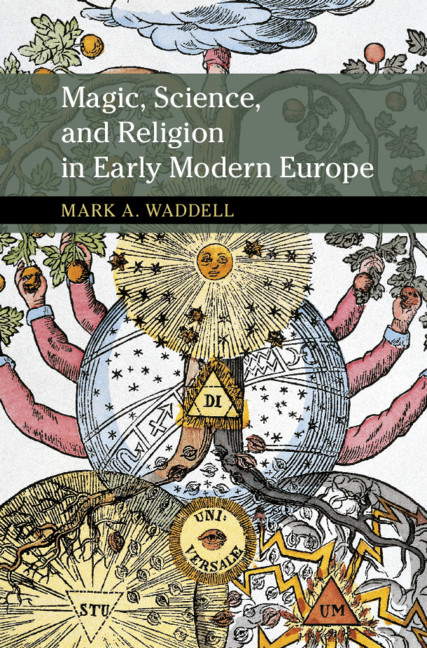

From the recovery of ancient ritual magic at the height of the Renaissance to the ignominious demise of alchemy at the dawn of the Enlightenment, Mark A. Waddell explores the rich and complex ways that premodern people made sense of their world. He describes a time when witches flew through the dark of night to feast on the flesh of unbaptized infants, magicians conversed with angels or struck pacts with demons, and astrologers cast the horoscopes of royalty. Ground-breaking discoveries changed the way that people understood the universe while, in laboratories and coffee houses, philosophers discussed how to reconcile the scientific method with the veneration of God. This engaging, illustrated new study introduces readers to the vibrant history behind the emergence of the modern world.
‘An enchanting, yet eminently accessible, tour of the magical and mysterious in European thought from the Renaissance to the Enlightenment. The real wizardry is how Waddell masterfully explains the uniqueness of early modern views of magic, religion and nature, while emphasizing the profound links between this past and our present.'
Matthew James Crawford - Kent State University
‘Waddell provides a superb review of the intersections among belief systems and underlines the great extent to which they determined early modern lived experience. Magic, Science, and Religion in Early Modern Europe is deftly written and invites the reader to imagine as well as learn, to engage curiosity and passion as well as intellect. It is a triumph in the genre.'
Allison Kavey - CUNY John Jay College and CUNY Graduate Center
‘Waddell’s book is a brilliant work of synthesis and, in effect, he performs his own kind of alchemy, transforming heavyweight theories in the history and philosophy of science into crystal clear, accessible prose, creating a rich summary of his topic in just over 200 pages. Magic, Science, and Religion in Early Modern Europe will be a staple on student reading lists for years to come.’
Ross MacFarlane Source: Fortean Times
‘... a very helpful bibliographical essay offering suggestions for further reading.’
José Manuel Lozano-Gotor Source: ESSSAT News & Reviews
‘This fascinating and detailed study enables a deeper understanding of the dynamics and development of modernity and makes a valuable contribution to European history …’
Nicole Maria Bauer Source: Religious Studies Review
'This book is suitable for an undergraduate course in the history of science … A person with no background in the subject would also find this an accessible entry point into the subject …'
Jason M. Rampelt Source: Perspectives on Science and Christian Faith
Loading metrics...
* Views captured on Cambridge Core between #date#. This data will be updated every 24 hours.
Usage data cannot currently be displayed.
This section outlines the accessibility features of this content - including support for screen readers, full keyboard navigation and high-contrast display options. This may not be relevant for you.
Accessibility compliance for the PDF of this book is currently unknown and may be updated in the future.
