

“We cannot seek achievement for ourselves and forget about progress and prosperity for our community … Our ambitions must be broad enough to include the aspirations and needs of others, for their sakes and for our own.”

3.1 Introduction
Presentations at scientific conferences and publications in journals are traditional ways of sharing your ideas and results with your peers. If you are lucky, many of the relevant people will come to listen to your presentations, meet you at your posters, and read your published papers. They may then start adopting your ideas, using your results, citing your papers, and even inviting you to collaborate in research projects and seeking funding for them. Your personal reputation, or “brand identity,” is starting to pay off: your “research business” is growing and may reach higher levels. It’s no wonder that publication and presentation lists make up an important part of curriculum vitae (CVs) and play an important role in career progression and promotion.
But there is more to personal branding than using traditional strategies. Communication and collaboration practices are changing rapidly. The internet and social media now allow you to share ideas and results instantly: there’s no need to wait for the next conference or for the final paper to be published – and there’s an unprecedented audience, not just the limited number of peers attending a conference or reading a certain journal. Anyone with a computer and access to the internet can now read open access material, learn from your ideas, praise them, give critique and contribute further ideas, or add new data that you could not have obtained otherwise. Effectively, you can have access to unsolicited extra brainpower and personnel. Communication can be open (e.g., a blog, open groups on LinkedIn) or closed (e.g., email, closed groups on Facebook). Anything that is open can be counted (e.g., number of downloads, tweets, or likes) and can affect your scientific reputation (both positively and negatively).
These new media can boost the outreach of your research business to unprecedented levels. However, this also applies to your peers and certainly to science in general. Fast knowledge dissemination accelerates validation of recent results and knowledge development, leads to earlier adoption by practitioners and society, and alerts funding agencies and aspiring students and employees to what you are working on. What else could you and the scientific community wish for?
The next four sections cover various ways of reaching out to people in society, from peers to the general public.
Open science. Is there only one dominant flavor of openness, or are there more to consider? Can the “ownership” or “authorship” of your data, texts, figures, and more be protected well when you engage in open access? Should you formally license your work to others, and what do green, gold, and diamond licensing models mean?
Citizen science. Who wants or needs to learn about the results of your research? Could their interest be so strong that they may even want to contribute to your research in some way? Will taxpayers want a say about your research?
Media. What’s the key message you want to share? Who is in the audience? Why do they want or need to hear your story? What would be the best medium to use to reach out to them? Can a newspaper or radio journalist become an ambassador for your message? Should you use the power of social media?
Web profile. Everyone uses Google, so what will they find if they look for you or for your topic? Is your personal website popping up first, and does it offer inspiring and complete information for people from peers to the general public? Do you come across well as a team leader? What happens with your personal website and email account if it is maintained by your employer and you move from one employer to the next?
3.2 Open Science
As a scientist, you are generating a gradually growing stream of output, such as:
Scientific and popular articles
Monographs and textbooks
Material for courses
Instruction and lecture videos
Raw and processed scientific data
Software for data analysis and visualization
Materials, tools, and other concrete products
New methods, processes, protocols, etc.
Any such outreach that is clearly labeled as yours can boost your research and career in many ways. It is likely to bring you:
Invitations to speak at conferences
New, useful collaborators
People soliciting for jobs at your lab
Revenue and new funding to continue your research
Increased chances for promotion to full professor
And so on …
Results should spread like oil, quickly and widely, to as many of the potential beneficiaries as possible. This also serves your PhD candidates and postdocs who need items on their CVs to help them obtain a next job. See the anecdote at the end of this section for an example of combining fast blogging with the normally slow article submission.
Copyright licenses
Copyright protects your texts, photos, videos, etc. but not the ideas expressed therein (see Section 2.4). In a copyright license, you specify what other people can do with the resource (Figure 3.1 shows a license logo). Table 3.1 shows five different ways of licensing your work to others. Apart from the zero option, though, they all require that you are recognized and properly acknowledged as the author.

3.1a The main Creative Commons license options
| Zero |  | |
| BY | “Made by me” |  |
| SA | Share alike |  |
| NC | Noncommercial |  |
| ND | No derivatives |  |
Note: CC is a nonprofit organization that has released widely adopted copyright licenses known as “Creative Commons licenses” (www.creativecommons.org).
| Zero | To copy, modify, distribute, and perform the work, even for commercial purposes, all without asking permission. |
| BY or SA | Share – copy and redistribute the material in any medium or format. |
| Adapt – remix, transform, and build on the material for any purpose, even commercially. | |
| NC | Share – copy and redistribute the material in any medium or format, but not commercially. |
| Adapt – remix, transform, and build on the material, but not commercially. | |
| ND | Share – copy and redistribute the material in any medium or format for any purpose, even commercially. |
| Zero | When using or citing the work, user should not imply endorsement by the author or the affirmer. |
| BY | User must give appropriate credit, provide a link to the license, and indicate whether changes were made. User may do so in any reasonable manner, but not in any way that suggests the licensor endorses the user or users’ use. |
| SA | If the user remixes, transforms, or builds on the material, he or she must distribute his or her contributions under the same license as the original. |
| NC | User may not use the material for commercial purposes. |
| ND | If user remixes, transforms, or builds on the material, user may not distribute the modified material. |
You can, and should, check publishers’ guidelines – before submitting your manuscript – and analyze their licensing models in detail. But there is also a classification system to help you: the green, gold, and diamond models (although there are more colors in use). See Table 3.2.
| Open access model | Review process | License model | Fees to be paid |
|---|---|---|---|
| Green | Maybe | NO license or “BY license” without time delay. | Neither author nor user pays. |
| Gold | Yes | BY license for final version of the work only, sometimes with serious time delays. | Author or institution pays, but no user fee. |
| Diamond | Yes | BY license for final version of work only, without time delay. | Neither author nor user pays. |
Academic articles
We typically submit our papers to conferences and/or scientific or academic journals, and after one or more rounds of peer review, we hope that the paper gets published in a conference proceedings or in a decent scientific journal. It is time for a celebratory coffee and cake once it has been accepted! However, we may be more concerned about the high impact or other status of the conference or journal than about the licensing model used by that same organization.
So … is the paper now freely available to anyone interested or only to a restricted set of (fee-paying) people?
Are you, as an author or coauthor, allowed to post your text version (or even the journal’s final, copyedited and typeset version) on your own or your university’s website?
Is access open without delay or only after, say, an embargo of a year or more?
What do you have to pay to gain open access? (There are different levels of this.)
Is there open access without review, or before, during, or only after (peer) review?
Are all versions of the manuscript open and/or are the reviews open?
What would be a suitable license model for your scientific papers? Probably you agree it is a license of the type CC-BY (see Table 3.1): peers are free to share and build on your publication, but only if they properly cite your work and, if they use CC-BY themselves, should they opt to distribute their derived work. BY requires proper reference of your paper, i.e., names of authors, article title, journal title, year of publication, and page numbers, with possibly a URL or DOI. You may want to add SA, i.e., choose the license option CC-BY-SA, which makes commercial distribution of a derived work harder because buyers of that derived work are free to build on it too (or to copy and redistribute it).
An example of BY in the green model is arXiv.org. This is a repository with 1 million prints and preprints in the exact sciences (from physics to quantitative biology to finance). Researchers can post and instantly share their manuscripts at no cost and read and cite manuscripts posted by their peers. ArXiv holds the nonexclusive, irrevocable right to distribute all these manuscripts. The green model allows you to post your print or preprint immediately on your own website or in your university’s repository (or in commercial repositories such as ResearchGate and AcademiaNet; see Section 3.4) or to submit your preprint to a scientific journal. Some manuscripts shared via arXiv have never been published elsewhere and yet become very influential in their field. More recently, other repositories have been launched, e.g., for the biosciences domain (bioRxiv.org) and psychology domain (psyArXiv.com). Some scientific journals even upload all submitted manuscripts automatically to the corresponding Arxiv.org (e.g., PLOS submissions appear as preprints on bioRxiv, and comments posted to bioRxiv can be used in the PLOS review process). Reviews and manuscript revisions can be made available with open access as well. With version control, the manuscript can become a “living document” that may be improved over time.
Academic books
Books can also be published with open access. Electronic versions can take the form of a single, downloadable PDF file of the entire book, a collection of PDF files (one for each chapter), or an eBook version that can be uploaded to an eReader. Costs for editing, design, marketing, printing, and distributing books can still be significant and might be covered by traditional sales of paperback or hardback copies and sales of eBooks to individuals and university or public libraries. Open access can effectively help market your book: people will share, tweet, or blog that there is a free book out. Even free open access can stimulate sales because some readers and probably more libraries will still want eBooks in their systems or physical copies on their shelves. Whether open access sales would be better than traditional sales channels is a function of the number of people who get to know about your book and the proportion of them who want to buy it. The time and cost to market a book may be considerable, too. Revenues may come in only after quite a delay. Several institutional or national initiatives allow authors and publishers to achieve upfront funding (e.g., oapen.org library). You can consult your librarian for advice. The agency funding your project may also cover the costs needed to produce your book – therefore, you should budget the open access costs in your grant application.
Printed papers and books are static, whereas digital publications are easy to correct, extend, and revise, and it is easy to use social media or email to alert potentially interested people. Digital work can even become a community effort – Wikipedia is a typical example. So these may be additional arguments for you to consider open access publication.
Further considerations are the total publication costs and how these could be reduced by open access; the quality of review processes conducted by open access journals – and the price of that quality; and the risk that a publisher goes bankrupt, in which case access to existing papers (including yours) may cease (websites become unavailable and who knows who owns the copyrights of your papers now?).
Data and metadata
Funding agencies have invested large amounts of money in your project, and although you have probably done great work (published in the relevant journals, obtained patents), their investments are at risk if crucial original and processed data and metainformation on that data are lost when the PhD candidate or postdoc leaves your group for a new job elsewhere. Think of information on the design of experiments, questionnaires, notes in lab notebooks, preprocessing and processing methods, and software in all its versions, for example. Any result from your project that can be digitalized can be stored and shared. Other researchers can redo analyses, but more important, they can combine your information with other data and solve bigger puzzles with the help of big data infrastructure and experts.Footnote 1 The agency’s investment in your project can have a more lasting and greater effect. With a CC-BY license for access to your information, this may also increase your bibliography or other metrics as a positive side effect. Many researchers believe that open access sharing of data and metadata is an important condition for transparency, reproducibility, and integrity in research. Not all data can be shared: a “privacy impact assessment” (PIA) may be needed to ensure compliance with general data-protection regulations (e.g., by pseudonymization). The library and/or information technology (IT) experts from your data management center can help you develop a professional information management plan (see Table 3.3) and implement it.
Dataverse. The Dataverse project (powered by Harvard University) is one example of an open source web application to share, preserve, cite, explore, and analyze research data and metadata (www.dataverse.org). You can install it locally and display it on your own website. But your IT office may arrange for you to have a Dataverse account as part of a larger Dataverse repository. Users of your data can, and should, cite it using the digital object identifier (DOI) for your data.
GitHub. The GitHub project is an example of an open source web application to collaboratively develop research software, maintain its full history (versions), and share it with the outside world. DOIs to your software (versions) can be obtained via www.zenodo.org (powered by CERN Data Centre), which is integrated with GitHub (e.g., http://zenodo.org/record/13200). You can also create a personal website to your repositories (https:/github/yourname).
Notebooks. You can describe all metadata in the old-fashioned way – writing in a bound paper notebook or using a modern electronic notebook or lab journal. Keep track of how your idea and its implementation develop on a daily basis. Notebooks also serve as the archived memory of all relevant research details that may otherwise be easily lost (e.g., due to staff leaving); a skilled reader should be able to fully understand and replicate what has been done. In a paper notebook, you can paste in relevant graphics, photos, and images and add a summary description plus ID numbers and a secure storage location for any external information that is relevant but cannot be included in a paper notebook (e.g., digital data on a data storage server or biological samples in a population bank freezer). In an e-notebook, you should include accurate links to everything. Other researchers can then replicate your work and combine your information with their own and others for meta-analyses. Notebooks therefore may be crucial for “open research” – to reach further and achieve a meaningful return on (public) investments in past projects.
| General | Example from plant biology |
|---|---|
| Owner | PI Dr. X; PhD candidate Y |
| Describe research | DOI for the publication |
| Study design | |
|---|---|
| Types of data | Genotypes, phenotypes, software |
| Experimental design | Randomized block design |
| Data production methods | Genotyping arrays, carbohydrate profiling |
| Computational analysis pipeline | Preprocessing, analysis, postprocessing methods/software |
| Data archiving | |
|---|---|
| Data standard | MIAME |
| Version | DOI Dataverse, DOI GitHub |
| Size | 100 GB |
| Metadata | DOI notebook |
| Costs | Covered by university for first 10 years |
| Data access | |
|---|---|
| License model | CC-BY after end of project |
| Privacy impact assessment (PIA) | No opt out for open access (no data privacy issues) |
Note: These elements comply with FAIR (findable, accessible, interoperable, reusable) data principles (Wilkinson et al. Reference Wilkinson, Dumontier and Aalbersberg2016).
For free or not for free?
Professional users may benefit from paying for your resources. For example, if you sell them software or access to software, you can potentially hire a software engineer, maintain a professional website and hardware for running the software, offer support and online information on FAQs, develop further releases with new features, and so on. You may want to grant nonacademic users a nonexclusive and nontransferable CC-BY-ND license: they can use the software, make profits, but cannot transfer or sell the software or any derivative. You may grant them the right to use the software “just like a book”; it may be freely moved from one computer to another, but only one person can use it at a time. You may offer more expensive licenses for multiple users. At the same time, you may grant your peers a CC-BY-SA license; they don’t pay you and can share derivatives if they use the same licensing conditions as you. Or you can grant them a nonexclusive and nontransferable paid license CC-BY-NC-ND and make your endeavor into a small spinoff business (but first check your job contract and/or university rules about where any proceeds should go).
Patenting may also be an option. You license the patent to one or more other parties for royalties or simply sell it to an industrial or commercial company for a good price. Or you can start your own spinoff company. Unfortunately, the patent application and/or restrictive licensing may (dramatically) slow down the wider uptake of your invention and reduce the return to taxpayers or benefit to humankind. This would be a real pity if your invention could actually be made quickly applicable by other researchers or be useful to industry or other parties without further investments.
With “serving humankind” as a guiding academic principle, you can chose for “open science” as the way to proceed. For example, promptly and openly share your new vaccine against a disease; then it can be manufactured quickly at the lowest cost.
Tweet speed
“Funding agency discriminates against female researchers.” This message was published in a prestigious scientific journal. The media jumped on it with bold headlines, politics, and hot debate. I looked at the paper the day it was published and found it wasn’t discrimination, but bad statistics. A letter to the editor would take at least two months to get published – if ever. I decided to write a blog immediately and to tweet to some influential people who would retweet the blog. My blog is public and quickly attracted thousands of readers. But that’s not where it ended – media attention in national newspapers, highlights in Nature and Science, a live interview on BBC radio, and finally, a peer-reviewed letter published in the same prestigious journal 10 weeks after the original article. To date, the story is still running: journalists now call me to comment on the statistics in all kinds of other news. Imagine what my CV section for “public engagement” looks like! All thanks to my writing one blog.

The Creative Commons (CC) website offers a wizard for choosing a license and creating html code to add to your document and/or website: http://creativecommons.org/choose/.
Use Google Images and filter for those you can use without a fee but with proper credits.
Check the publisher’s copyright and self-archiving policies: www.sherpa.ac.uk/romeo/. Fill in the journal title or publisher’s name, and check whether the publisher publishes green and gold journals and books.
Find your data management office, and ask how it supports data and metadata archiving and sharing.
Check for data standards and software in your field. What do you need to do to comply with them?
A figure can tell more than a thousand words. If you have made such a figure, make it citable with a DOI (see Section 3.5), and include the figure in a paper with the DOI in the reference list.
3.3 Citizen Science
Engage citizens
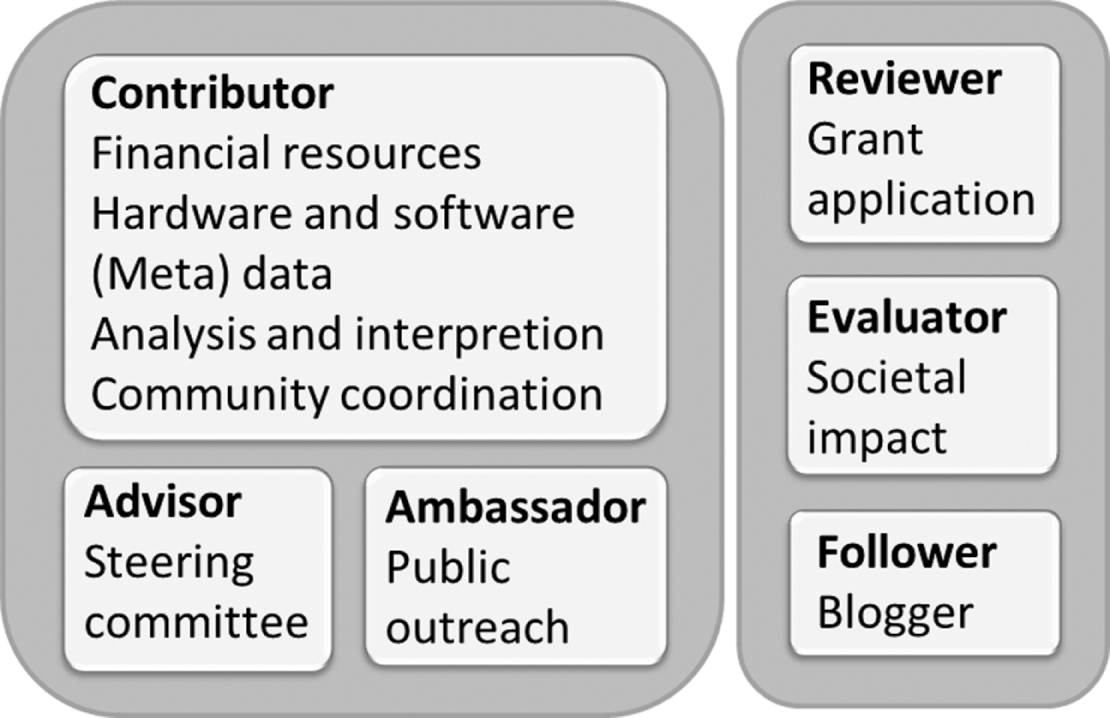
There are seven billion people on Earth, so there must be people who can help you with your research in one way or another – be it in cash, in kind, or otherwise (Figure 3.2). Engaging just a tiny fraction of this huge “crowd” could make a big difference to you and your research. The terms “crowdfunding” and “crowdsourcing” refer to this enormous new potential arising from engaging this extra people resource.
Citizens can play various roles in your projects: some participate in the project (left), while others judge the merits of your project without participating (right).
Citizens may contribute
You can beg for a financial donation, and more money will certainly help you run your research or business faster and perhaps better. You can also consider going beyond (passive) donors and donations. Allow people to participate and contribute in other ways: use other people’s talents, brains, energy, equipment, personal networks, organizing capacities, ideas, knowledge, solutions, and so on, and surprise yourself and others with results that could not have been achieved otherwise, or at least not at the same pace. Take Wikipedia – we all know this and other examples – where projects were run on a more open basis with remarkable results. Will this be on the horizon for your research, too? Unexpected opportunities may come your way. If only you knew where to find these potential contributors and how to contact them.
The internet, powerful search engines, and social networking sites have revolutionized access to information and people. Anyone can now initiate a community with similar interests or can connect to a community initiated by someone else. Worldwide, people with access to the internet can read about the community and decide to join in. You can find them too. Search for the key players in that community, and get in touch with them.
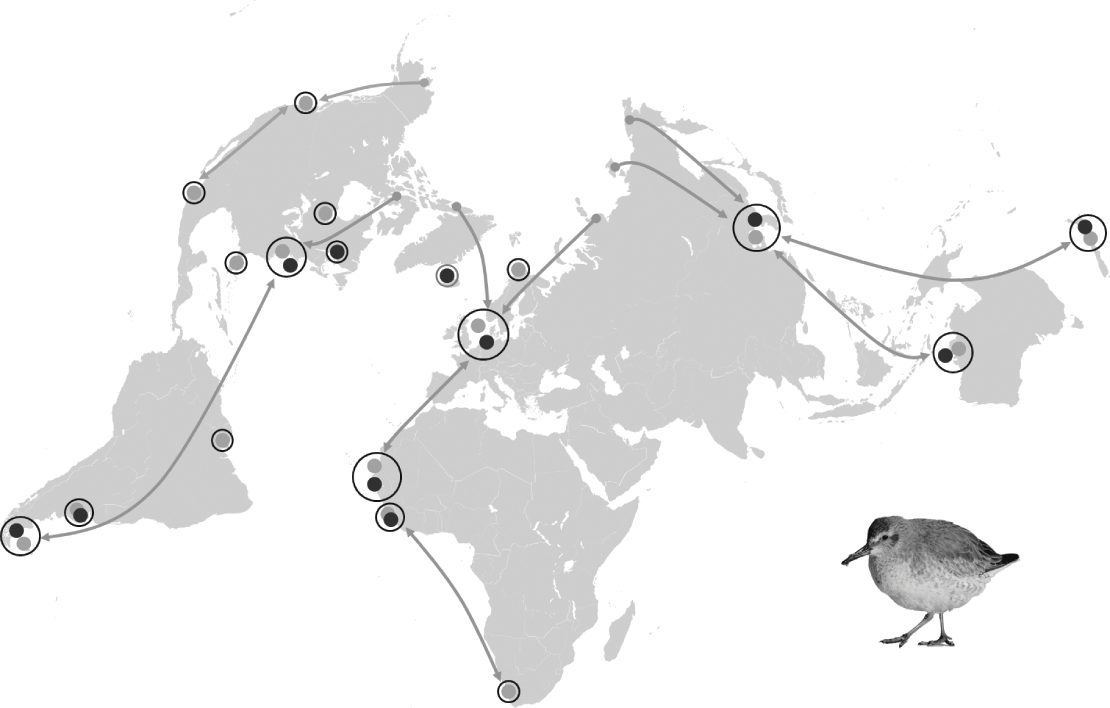
People from communities are much more likely to react and contribute than random people from a crowd. For example, if you are researching the long-distance migration of a bird, say the red knot or Artic tern, then local communities of bird watchers or wildlife protection activists may be very interested. Some people live in Finland where the birds breed, others live in China where the birds stop to feed during their migration, and yet others live in New Zealand where the birds retreat during the northern winter (Figure 3.3). These people may volunteer to record the colored rings on the birds’ legs and thus provide important data for you at hardly any cost. They are emotionally attached to these long-distance migrating birds and believe that the birds deserve better protection in a changing world. Being part of your story may have a real value for them (Table 3.4).
Citizens help scientists monitor red knots along their global flight paths (“flyways”). Red knots breed in the northern hemisphere and then use different flyways to reach the southern hemisphere. Circles indicate stopover sites for feeding, and black and gray circles indicate locations of two global communities of bird watchers.
| Citizen group makeup |
|---|
| >7,000 citizens. |
| 3,200 belong to one of 20 organized communities. |
| 3,800 are “loners,” individuals not associated to any organization. |
| >51 countries, covering all continents. |
| How scientists meet citizens |
|---|
| People walk up to scientists when they’re doing field work. |
| People find websites developed by enthusiastic volunteers who collect and offer data for research (e.g., www.cr-birding.org). |
| People are members of associated communities (e.g., www.waderstudygroup.org). |
| How citizens’ contributions are appraised |
|---|
| Always reply to all incoming emails: 5,000 per year. |
| Inform people by email about the life stories of “their” birds. |
| Send regular newsletters to inform all involved about progress. |
| Accept invitations to speak at meetings of the communities involved. |
| Invite top contributors to join you for research expeditions. |
| Acknowledge their efforts in 200 research and 50 outreach articles. |
Crowdsourcing and crowdfunding initiatives may also be published on dedicated web platforms. For example, some universities already have a website to post and manage crowdfunding initiatives set up by their own researchers (see, e.g., www.rugsteunt.nl for the Ubbo Emmius Fund, University of Groningen, The Netherlands). There are also commercial platforms, and publishing your project on a dedicated platform may help you reach out to large, enthusiastic crowds. For example, Harvard University demonstrated that a computational biology problem could be solved much better, cheaper, and faster via a dedicated platform with 450,000 IT specialists than would have been possible via the traditional way of writing a grant and then recruiting one postdoc: in only two weeks, 122 different individuals submitted viable solutions, 16 of which outperformed existing software; the top five solutions were made available under an open source license afterwards.Footnote 2
There are some other platforms that can be used to get something done for a fixed price. The first person to finish the task will win the proclaimed award; all the other people working on the problem are too late, won’t make any money, but hopefully enjoyed working on the assignment, learning about the winning solution, and being part of a competition.
Citizens may advise, review, or evaluate
Citizens may donate to patient or special-interest societies and other communities – your research may be funded from these public or semipublic resources. You can invite volunteers from public or semipublic bodies to play a role as an advisor/ambassador for your project. Funding agencies may ask you to include several citizen stakeholders – users and end users of your project outcomes – as members of an official steering committee. The funding agency may also recruit citizen stakeholders as volunteers to provide a nonexpert review (Table 3.5). Decisions on funding will be based on normal peer reviews and these nonexpert reviews. The same citizens may also be asked to evaluate the progress, impact, and outreach of funded projects. Do try to value the experience and expertise of citizens, and certainly don’t underestimate them: they can be extremely knowledgeable. Some are professors or retired professionals who may have a specific interest in your project (e.g., because they or their relatives suffer from the disease you’re investigating).
| Relevance for patients |
|---|
| Does it improve patient health? |
| Does it account for diversity between patients? |
| Do patients want or need this? |
| Participation |
|---|
| Are patients’ experiences used in addition to scientific expertise? |
| Is a patient representative of a community or an official member of the project committee? |
| Do patients help in developing the research question, plan, etc.? |
| Information and communication |
|---|
| Will patients and their organizations be fully informed about the results? |
| Are the communications understandable for patients? |
| Ethics and safety |
|---|
| Are values and norms of patients respected? |
| Are all professional codes of conduct, guidelines, and policies satisfied? |
Other people who don’t participate in or contribute to your project may still follow you and give unsolicited opinions to influence the public debate and political decisions, for example. They may do this by writing blogs or comments on social media, which can be positive but also may be highly critical (see also Section 3.4).
Engaged alumni
Your university alumni are a special category of citizens: they already have a bond with your university, their alma mater, and they may feel indebted for the training and advancement that helped them develop their own careers. To show their gratitude, they may be willing to make a donation more readily than nonalumni. For example, a researcher who contributed to an archeological exhibition was allowed to advertise at the exhibition for crowdfunding for her next pilot study. The exhibition had two opening days especially for alumni, during which the crowdfunding target of $15,000 was easily reached. The key to this success was the lectures given by the researcher and the pride of the alumni in being part of this special exhibition and a new research study. In her next grant application, the researcher mentioned the crowdfunding and results of the pilot project – which definitely helped her to obtain this new major grant!
Some alumni may be very happy to share their current expertise and experience for free or to introduce you to their professional network and help you get new commercial collaborators. If they are wealthy, they might offer your university philanthropic funding for specific researchers or for research projects, for which you and/or your team members may be eligible. Do get to know your university’s alumni officers, and see what they can do for you.
Develop your strategy
What you need is a marketing strategy and plan – as concrete as possible – outlining how you could get citizens involved. This includes thinking about these four “what” and four “how” questions (4W4H):
What are the results of your project?
Who wants or needs these results?
Why do they want or need these results?
Where can you find these people?
How will you present the project and results to them?
How can they contribute to your project?
How will you reward them for their contribution?
How can all of this be organized?
Crowdsourcing and crowdfunding may arise naturally and for a relatively low organizational cost. Nevertheless, you need to deal with the social contract between you and your crowd properly.
People contribute to a person: you!
Manage their expectations well.
Don’t promise more than you can really make happen.
Be open and transparent.
Involve them in formulating the research questions.
Share the work plan, timetable, and budget.
Regularly update them about progress.
Welcome their perspectives and perceptions.
Show them that you’re listening.
Be responsible and trustworthy – from the start to the end.
Reward them by expressing your gratitude – and do more where possible.
Reward them by participation whenever possible.
Make the rewards proportional to the contributions.
Tell them that small contributions are very valuable too.
Work closely with an influential community member whose advice and reputation will help you maximize your outreach into the community.
Citizens can actively contribute to your science, although there are some issues that you should consider and need to control. For example, some volunteers may deliver low-quality data or fabricate data to get a reward from you. Also, you should clarify any financial issues (will you reimburse specific costs?) and legal issues (confidentiality, copyright, intellectual property, data sharing, privacy protection).
Input of citizens in open science
Open access to the output of science projects is necessary for science to be open, but it is not sufficient. There also needs to be an opportunity for input from the general public and societal groups. If we haven’t listened to them right from the conception of our research agendas to understand what really ticks or bothers them, and if we haven’t consulted them during the course of the projects to hear their perspectives, any lack of their applause at the end should not surprise us (see next section for worse reactions). There is even a threat of coming across as arrogant, patronizing, or focusing on personal interests (the academic in his or her ivory tower). Indeed, because of a skewed incentive and award system in academia, questions that are important to the general public may have been ignored over those that yielded higher “internal” academic esteem.Footnote 3 Scientists need to earn the esteem and trust of the general public (or research budgets may be cut), show great respect for them, involve them not only at the end but also before the start of new research. This includes engaging with the public, listening to them, framing their issues both rationally and emotionally, finding out what they are really after and what eventual solutions might look like, and getting a two-sided and continuous commitment for our projects.Footnote 4
The moderating mother
I am not on Facebook, and I don’t want to be. Let me put it more strongly: I shouldn’t be, at least not for my research. Still, my research benefits a lot from Facebook. How come?
As a medical researcher, I see patients. And once in a while a patient with a really rare disease walks into my office. It’s unlikely I will ever see a second patient with this disease. Nevertheless, I want to do all I can to help this individual. For one person with a rare disease, with probably only a few hundred affected (young) people worldwide, Facebook changed everything. It connected my own patient with similar patient and families from all over the world: Brazil, Saudi Arabia, the United States, and further afield. These people had set up a Facebook community themselves. The mother of one of the patients went on to play an extremely important role in setting up my research project: I wrote a short piece about what I could do for such patients, and she advised me on sensitive issues because she knew much better than I did how people would react. She posted the piece about my plan on Facebook, as well as a flyer about my group, my research work, and an email address at which to contact me. What would happen? Would people read it and respond?
The results were astonishing. In no time at all, parents of patients started to email me, sent signed forms of consent and filled-out questionnaires, and delivered other high-quality clinically relevant information. My study went from one patient to 77 in no time, and I had more detailed and useful information than I would typically have obtained directly from their doctors. Suddenly I had a solid basis for doing research on this rare disease. But with so much data, I needed a person to analyze it properly. This is costly, and I wrote a proposal for a grant (which was awarded!). But guess what? Parents of patients started to organize fund-raising marathons and other activities for my research. Wow! So Facebook made my life as a researcher easy?
Well, no. “Easy” is not the right word. This is a serious business for these families. My team and I generate hope in the hearts of these families, and we feel highly responsible for managing their expectations well, for updating them with regular newsletters about progress, for keeping the contact alive for as long as needed by demonstrating that we deserve their trust in as many ways as possible. Working with a parent as a moderator between us and the Facebook group was (and is) probably the key to our success.
Analysis
Define types of communities that could show an interest in your research.
Check websites, Facebook groups, and so on for existing communities.
Search for peers who may already work with these communities (you don’t want to compete unnecessarily).
Identify key players in each community.
Define the unique opportunities you can offer each community.
Define rewards for donations in cash or in kind for each community.
Make a community-specific research plan including a budget and timeline to share with them.
Contact the key players and ask them for their opinion and feedback.
Marketing
Think up a unique selling name for the project, and use it consistently throughout your marketing.
Set up a project website with an email address, with their names reflecting the name of the project.
Set up social media accounts: URLs for Facebook, Twitter, YouTube (see Section 3.4 on media).
Write a short, intriguing, and compelling story about you and your project.
Make a video (see Section 3.4).
Write a (regular) newsletter (see Section 3.4).
Always ask the key people in the communities for feedback before you publish the newsletter. Or let them publish it!
Consider contacting local newspapers and radio and television stations first, and scale up later to national newspapers or magazines.
Add URLs to all your email communications, personal website, blogs, your contributions to other people’s blogs, and so on.
Stimulate people to spread your information.
Wrapping up
Do you now have answers to all the 4W4H questions?
| What are the results of your project? | |
| Who wants these results? | |
| Why do they want these results? | |
| Where can you find these people? | |
| How can they contribute to your project? | |
| How will you reward them for their contributions? | |
| How can all this be organized? |
Responsible university and team
Science has been dominated by white men from Europe and North America. For example, scientists have traditionally studied health far more in men than in women. They have studied questions that are simply irrelevant to people who take a different view of nature and the environment (such as Native Americans, Aborigines, and the Maori). What is your university doing to counteract such a bias, and what does it expect you to do (e.g., courses for students and staff on inclusiveness)? What can you do to raise your team members’ awareness?
Climate crises, banking crises, biodiversity crises – does your university see it as its obligation to take on the most urgent global challenges? The United Nations adopted goals to end poverty, protect the planet, and ensure prosperity for all: “for the goals to be reached, everyone needs to do their part.” Is your university taking responsibility for bringing about change, and what does it expect you and your team to do? In what ways can you educate your team members to be responsible citizens and scientists? See www.un.org/sustainabledevelopment/sustainable-development-goals/.
3.4 Media
The media landscape is changing rapidly. Traditional media are slow and serve a one-to-many communication channel. For example, a journalist interviews you and prepares the content for a printed newspaper or radio or TV program. In contrast, modern social media offer rapid one-to-many and many-to-many communication. Using web technologies, anyone can become a reporter and prepare, share, add to, revise, or sometimes delete content, and anyone else can join in and express appreciation or dislike or contribute more detail. Of course, mainstream journalism has gone online too and mixes traditional with modern media.
Media connect people. If you don’t know the other people well, your message may be ill-phrased or go over their heads. If you don’t know yourself well, your message may easily harm your own and your university’s reputations. Therefore:
1. Get to know your target group. Of course you can’t shake hands with all your potential readers and listeners and ask about their knowledge and perception of science in general and of your topic specifically. But it is essential that you know what you are targeting: which national newspaper, popular science magazine, radio program, TV talk show, alumni magazine, secondary school newsletter, or social media network are you dealing with? Take your time, do your homework, and study a couple of issues or broadcasts for format, focus, and style. Go for it if you think you have a strong story to offer in the language of the target audience – photos and videos included. Identify a number of people from the target audience, and test your message out on them in a pilot study to smooth out any problems.
But there are more people involved than just the target audience, particularly in traditional media, the journalist who will write about you and may interview you is an important person.
2. Get to know the journalist(s). In most cases, the journalists will be on your side. They need a good story as much – if not more so – than you do. Consider dropping a journalist a short email or try to call him or her if you have a story to pitch, especially if you have read a nice news item in the science pages of a national newspaper written by this journalist. It may pay off immediately or a bit later. Find the journalist on LinkedIn, search the internet to learn more, find an icebreaker topic, and use it to connect as human beings by asking about the journalist’s education, interests, preferences, and contributions to the news media. Once you start to work with a journalist, discuss what he or she is aiming for and assess who else he or she could interview. Ask whether you can check the final report for inaccuracies in content and in your quotes, but be aware that their timelines can be very tight. Be cautious if there is a preference for hype or scandal – don’t say anything you don’t want to be quoted. Once you have built up a good relationship with a journalist, you can drop him or her an email once in a while if you have an exciting new story. The journalist may also start calling you for your commentary on breaking news in your area of expertise.
You may be a first-timer in “media land,” and there is a risk of learning the hard way the “it didn’t work out well” lessons. So there is yet another important person who should be involved in your communication: the university’s communication and media officer, who is the expert on press communications and/or has access to a team of in-house or external experts to support you.
3. Get to know the university communication and media officers. These officers have built up crucial experience with researchers and journalists, so they can assist you and a journalist to find common ground. Above all, their role is to establish and protect the university’s public reputation in the news media. They have a large network of journalists to work with, and some will be favorite journalists whom they know personally. They will also have their favorite news channels and can open doors for you. They will want to write the press releases for you because they know better than you how such pieces should be written. They can pitch you for radio or TV programs that might be looking for scientists with media appeal. Your press officers will offer you tips and tricks and media training for conducting radio and TV interviews. They will use social media to increase attention and know which platforms are most influential. They are extremely important if things “turn rough” or (better) can teach you how to avoid such risks. The press officers are also responsible for building the university’s strong branding: the public needs to see where their tax money goes, what sort of research is being carried out, what the societal implications are, and so on. You are just a tiny part of a larger branding effort. Make sure that they have your cell phone number, and be available after a press release or for a media performance.
Dazzled as you may be with adrenaline and the excitement of getting media exposure for your work, you may easily forget that there are yet more people in the communication chain: those who should be credited, have interests to be protected, and are entitled to limit or object to your media performance.
4. Get to know who else has an interest. This group definitely includes the publisher of your upcoming article. The publisher may inform the press, and you can prepare for media exposure under embargo until the journal’s press release is out. If the media attention is related to a running or finished project, then you have to check the contract between you and your funding agency: it may specify obligations concerning dissemination. Most likely you will have to acknowledge the agency properly in all your dissemination activities, but maybe you also have to inform them beforehand so that they can also prepare a press release as part of their own branding. If the media attention relates to outreach for a collaborative project, you should also check the consortium agreement for obligations: inform collaborators beforehand, properly credit the consortium and any individuals who contributed. Of course, you should also seriously consider whether you are actually the best person to represent the consortium in the media: don’t be selfish, but hand over to the consortium leader or another collaborator if he or she is in a better position to deal with the media. What holds for collaborators also holds for coauthors if the media attention relates to a multiauthor publication. If you are spotted by journalists for developing new intellectual property (IP), you will need to be extra careful not to infringe on ongoing procedures to protect that IP. So ask your legal affairs and/or knowledge transfer officers, check agreements with (industrial/commercial) partners, and together set the boundaries between what can and cannot be disclosed at this point. Also check whether there are any IP issues with photos and/or videos that will be used by the media.
The most important person in communication is the most knowledgeable (in terms of the science), but he or she can be the weakest link in the chain if unprepared or inexperienced in media performances:
5. Get to know yourself. The very first question to consider in any request for a media performance is “am I really the right person for this?.” Be prepared to say no and kindly decline the invitation if the topic is outside your field of expertise. Never let yourself be enticed into making statements that you cannot back up with scientific literature. You may be tempted to express your personal opinion, but you simply cannot do this when representing the university! A second question to consider is: “what do I need to do or learn to prepare for this media performance (see Table 3.6)?.” Ask for and accept support with writing a “teaser” or a press release. Discuss tips for a one-on-one interview by a journalist, and check what other people’s experiences are with the journalist if his or her name is known beforehand. Prepare your key messages, and practice hard for any radio or TV performance. If you are called for a live radio interview, check whether there is time to prepare yourself, and ask them to call back later – or say no. Otherwise, your audience may remember you well – but for something other than the message you wanted to communicate. Finally, check your internet presence. Is it up-to-date? Your tweets, LinkedIn profile, and personal or university webpages may all pop up, especially if the journalist is seeking ways to include stories relating to the human side of your work.
| Seven factors for SUCCESS in the mediaFootnote 6 |
|---|
| Story, Unexpected, Credible, Concrete, Enthusiastic, Short, Simple |
Engaging with journalists
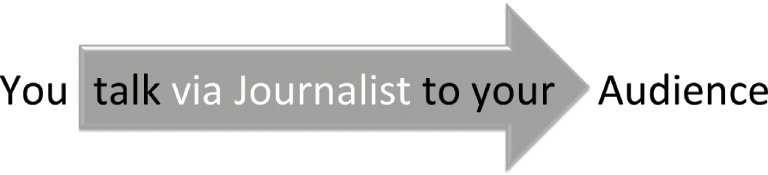
You talk – via the journalist – to your audience (Figure 3.4). Use the journalist’s questions as entry points into your story, as starting points to share your key message(s). Play with the questions; take the lead. Your audience should see you as competent, reliable, and credible, and therefore you can share your knowledge, but more important, you can explain its implications and its added or emotional value. Someone listening is looking for “what’s in it for me?” or “how is this going to affect me?” Why do they want – or need – to know your story?
The who, what, and how of communication. Who are they, the people in your audience? Do you know their knowledge level, as well as their interests, opinions, worries, and emotions? Why do they want or need to know or learn from you? What do you want to share with your audience? Do you really have hot news to share? Is there one key message they should remember above all? Don’t try to be complete on all the details. How will you inform and engage them? Sharing knowledge and facts will make you look competent, reliable, and credible; showing vision, passion, and empathy and sharing human interest anecdotes about successes and failures and metaphors, pictures, or videos will engage them. How will you play the game with the journalist and make him or her your enthusiastic ambassador?
A journalist’s role is to report on novel developments but also to check whether public money has been well spent. Journalists do their homework and try to uncover any hidden issues. If you need to control damage, for whatever reason, make your story short and dull (repeat the key message + too dull to make it into the wider media).
Stop your reply to a question promptly; avoid droning on. The most important punctuation mark in interviews is therefore the full stop (”period”). Newspaper journalists in particular take plenty of time for an interview, and you may become talkative and fail to recognize their dashed questions (Figure 3.5). Examples of dashed questions are the “what if …” that challenges you to speculate and the “if … then …” that is both directive and suggestive. Refuse to answer these questions, but you could offer the journalist a perspective (e.g., the name of a person who could perhaps answer the question), or you can promise to investigate the issue and indicate that the journalist can call you later. If you feel that your answers are going in the wrong direction, simply say, “I’m sorry, that was incorrect, I meant …” and start again with a different answer.
The interview pitfall. You prepared key messages (inner circle) and know the boundaries of your expertise (outer circle). A journalist asks questions (dots), and you reply (story lines). Be particularly cautious with questions at the boundary (dashed dots): the journalist may challenge you to answer them and subsequently fire off further compromising questions (black dots); you will later seriously regret your answers. Therefore, build a wall so strong that a journalist can’t break through it (thick black circle, not partly but completely surrounding the outer circle). Then the interview will be your opportunity to convey your key messages to your target group.
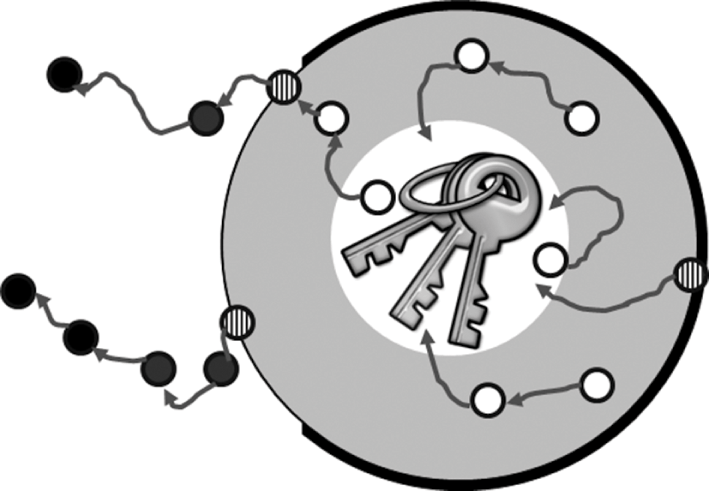
Anything you say before or after an interview could be used by the journalist; some will continue to audio record or keep a video running after the official interview has finished. There is no “off-the-record” conversation with a journalist; the interview is only over when you or the journalist has left. You can also audio or video record the interview yourself, which can help stop journalists from asking dashed or black (misleading) questions (see Figure 3.5).
Be totally clear to the journalist that you won’t accept a press release or news article that is not truthful, complete, and clear. Agree that you can read the article before it is published, and correct phrases that are wrong. Be particularly careful with headlines because they may not be conceived by the journalist but by a different person. You don’t want your story to be misread, hyped, or dramatized as media channels are prone to do.Footnote 5
Which social media to use – if any?
Are social media worth the extra time investment when you’re already so busy running your research project?
You’re a nonuser. You’re already overloaded with work. If there was anything exciting to report about your project, the university communication officer would probably prepare and post a message somewhere. You prefer to ignore the social media (hype) and use your precious time wisely. Well, read on; perhaps you will become convinced that it’s worth becoming socially engaged.
You’re a consumer. You know that your peers, the traditional scientific publishers, and the funding agencies have adopted social media. Automatic alerts help you keep an eye on their messages. You don’t post any messages yourself, but you use tools and mine sources that can help you. For example, you’re alerted when new papers come out or when a new call for grant proposals opens, and your political antennas are alert for changing governmental or societal trends in science and concerning scientists. Perhaps, from time to time, you could start contributing yourself; see Tables 3.7, 3.8, and 3.9 for suggestions.
You’re an active contributor. You’re excited by the opportunity to share project progress and receive feedback from anyone who is serious about your topic during all the stages of your project. You use social media to discuss hot topics and recently published articles. You enjoy it and are prepared to invest the extra time to educate the general public. See Table 3.10 for some etiquette rules.
No matter how much you like or dislike the role of social media in academia, it’s very likely to play a growing role. The number of times your article has popped up in social media will be counted and converted to a score (e.g., Altmetric) and serve in evaluations of your impact and performance, in job and grant applications, and for promotions, awards, and prestigious memberships (although media attention is no guarantee of quality or impact). It’s certainly no longer the traditional “publish or perish” or “get cited or perish” world, based only on scientific articles that are cited in other scientific articles.
Social media can be classified into two main categories: those supporting traditional one-to-many communication but now with you in the role of the reporter and those supporting many-to-many communication in social networks. Some are specialized in only one type of digital information (text, photo, audio, or video), whereas others allow for uploading multiple types. Joining networks of people may require registration, creating a personal profile/account, and acceptance by a moderator, after which you can connect with the group and may receive automatic, profile-based suggestions for people with whom to connect. Social media tools can also be effective in scouting for candidates for your research vacancies (see Section 1.2 and its anecdote). Sadly, social media tools can turn out to be disruptive when sensitive personal data are collected and abused, such as in the recent case of Facebook and the company Cambridge Analytica. General data protection regulations (GDPRs) need to be improved and enforced more than ever before.
| Microblog (e.g., Twitter) |
|---|
| Stay informed on upcoming calls and other news by following a funding agency’s microblog. |
| Stay informed on opinions of important researchers by following them. |
| Ask a question or make a comment during a scientific conference or even during a presentation. |
| Share a newly published article with peers. |
| Blog (e.g., your Wordpress blog, PubPeer, Wikipedia) |
|---|
| Read postpublication reviews of scientific articles, e.g., to see whether people have reported flaws. |
| Add your knowledge to a free encyclopedia, and provide links to papers, including your own. |
| Write and publish your review of a science article or book. |
| Social network (e.g., Whatsapp, Facebook, Skype) |
|---|
| Tune in with your group members who are dispersed over different hotel/conference rooms or at home/office (e.g., Whatsapp group). |
| Connect patients to your project, join and share information with their community, and ask for feedback. |
| Announce on a student network site that you have great Master’s thesis projects, and call for candidates. |
| Discuss project tasks and progress with dispersed collaborators through video conferencing. |
| Professional networks (e.g., LinkedIn, Google Scholar, ResearchGate) |
|---|
| Before you meet a potential collaborator, see whether they are linked to someone else from your institute. |
| Follow the careers of your former students and staff. |
| Help academics to find you and your papers easily. |
| Focus on your niche. |
| Engage followers by linking to extra content. |
| Use a URL shortener (i.e., bit.ly/ow.ly) for links. |
| Put the link halfway through the tweet. |
| Label relevant words with a #hashtag. |
| Monitor tweets carrying your #keywords. |
| Include a person (nonprivate) by adding @username to a tweet. |
| No more than one to three tweets per day. |
| Be generous and retweet items of interest. |
| Check other options, e.g., photos, videos, private (group) tweets. |
| Video/Vlog purpose | Target group |
|---|---|
| Show your facilities | Grant reviewers |
| Interview on your new book | Potential readers |
| Tutorial on a new method | Peers |
| (Animated) lecture slides | Peers/students |
| Trailer to promote a conference | Peers/public |
| MOOC or SPOC | Public/private student group |
| Short documentary | Public |
| Use a name that represents you well. |
| Be identifiable; use your real name and a photo. |
| Separate personal and professional social media. |
| Don’t upload anything that you don’t want your peers or boss to see, even to a closed group. |
| Don’t irritate strangers by asking to connect with them without explaining why. |
| Always remain civil and respectful. |
| Never post when you are angry, busy, or tired. |
| Check for spelling mistakes (or worse), especially if you use speech recognition and auto correction. |
| Respect the conditions for using a specific social media service (e.g., concerning conflicts of interest). |
With a video, you can go way beyond text and images, which opens up many exciting opportunities for dynamically engaging with your target audience (see Table 3.9).
Smartphone. Today’s smartphones can generate good-quality videos. Just record and check whether sound (background noise), light (contrast), and stability (wobbling) are okay, and if not, remake the video. Use free or commercial software tools to edit the video (e.g., Adobe Premiere Elements). If you have multiple messages to share, split the video into a series of smaller clips.
PowerPoint. You can use your existing PowerPoint presentations, add animations and transitions between slides, add voice-over and/or music, and save this as your video: no filming needed, although you can, of course, insert videos, and they will work after saving the PowerPoint as a video, whatever device on which the user runs the video.
Professional films. Your university is likely to have a studio, equipment, and experts to help you produce a professional video. They’ll help you create a “storyboard” to previsualize the story as a series of cartoons with precise instructions for each cartoon on what, who, how, and where to film. They’ll film the material and style it into a corporate movie by adding advanced animations and/or professional voice-over or subtitling, for example. And they can help you set up a “short private online course” (SPOC) or a “massive open online course” (MOOC) if that is your goal.
If you film other people, you will need their written consent before you can use and/or distribute the video. Do realize that you are vulnerable and may receive critical reactions and thumbs down. Are you ready for this? And if you have filmed other people, are they ready too? If you made your videos for internal use only, say in a SPOC, you may need them to sign a nondisclosure agreement that forbids external distribution. These are pretty obvious issues, but they are important to consider in good time.
Pitfalls in dealing with media
Imagine that you haven’t been very explicit to a journalist that your work is only a first step and that its translation into a practical application will really take years. Soon after publication of the journalist’s article, you may be bombarded with phone calls, emails, tweets, and more from people asking for the application (e.g., the treatment of a particular disease). Manage expectations well beforehand.
Although traditional and social media can be beneficial for your research and recognition (see, e.g., the anecdote in Section 3.3), it is important to understand the potential negative consequences as well, in particular, if you break the etiquette rules (see Table 3.10). Even if your etiquette is correct, be prepared for consequences such as heated debates, which may harm your self-confidence if not your public reputation. For example, in 2016, a leading national newspaper published an appeal signed by 180 humanities professors to open European borders for refugees. Within hours the blog thread exploded with, for example, severe criticism of the “philosophical and historical naivety of these professors in their ivory towers,” while the authors had probably hoped for an endorsement of their appeal. The anecdote at the end of this section is another example of how interactions can quickly become heated and dangerous.
The media treat scandals mercilessly. They can damage your reputation and future if they detect or suspect you are not declaring a conflict of interest (collegial, commercial, or other), tweaking or fabricating data, twisting the scientific truth, not properly crediting peers or students, using your power to claim authorship on papers to which you have made no real contribution, or breaching scientific integrity in any way. For example, a professor was found to have fabricated data and had to retract several papers: it was big news, and he got fired. When he later contributed to a blog on Retraction Watch under a false name and posted blogs defending himself, the moderators became suspicious and forced him to declare his real name. The next day he was hot news (again) in many media.
Heated and fired?
My recent blog post on the banking crisis has been read and liked over 10,000 times. However, one person started offending me, and I posted why I thought it was inappropriate. Some more people started harassing me on Twitter, and things went crazy. Those few people accused me of all sorts of things, going well into the range of libel and slander. I’d had enough. The same people went to my personal Facebook page and infiltrated streams of comments. I had to remove these by hand. It was not a good idea, but I told a few of them in private messages to f*** off. Someone then copied this private message to the president of my university. I now feel I am in a rather Kafkaesque situation where I am accused of “absurd behavior against citizens” and I am required to defend myself to “resolve” this matter. What will it take? Will it have implications for my job? Of course I need to take this situation seriously and banish my impulsive behavior in future situations.
Prepare for an interview (e.g., for a local or national newspaper, radio, or TV program, internal or external university newsletter) or for posting on social media (e.g., blog, microblog).
1. Who. Step into the shoes of your audience.
Educational level(s) Why they want or need to know about your work Recent media attention on your topic Recent letters to editor on your topic Perceptions and emotions with regard to your topic Google the journalist or influencers and communities on social media 2. What. Define the information you want to share with your audience.
Your main key message (the title of the story, a catchy one-liner) Other key messages (major story elements) 3. How. Prepare the story telling.
Examples (to make the story more concrete) Anecdotes (to make the story more lively) Metaphors (to clarify by similarity) Quotes (what other people have said and when) Supplementary items, pictures, videos (to visualize your story elements) 4. Nasty questions. The questions you don’t want to be asked but may have to answer. Label them as questions related to your key messages (k), ones related to your expertise (e), ones on the edge of your expertise (b), or ones you should politely refuse to answer (r).
Question Answer 1 What if … What I find important is … 2 If … then … What matters most is … 3 4 5 6 7 8 9 10
Find the names of science journalists of major (national) newspapers and google them; where do they show up, and can you meet them and get to know them?
Study Wikipedia rules for adding information about your research to existing Wikipedia pages, or add a Wikipedia page about yourself.
Google yourself. What shows up? This information is available for future collaborators, employers, journalists, and citizens. What is good, bad, or even ugly? Is your online identity professional, powerful, complete, up-to-date, and visible? Should some of your online accounts be deleted? Should that you improve your style of communication? Is it urgently time to update your web profile?
If you are a nonuser of social media, try to become a consumer, and analyze who the influential people, communities, or organizations are on Twitter or other media and consider who you could follow. If you are a consumer, try to become an active user (e.g., microblog or blog about your most recent papers; see Table 3.7).
Use a social media search engine (e.g., Socialmention.com) to find blogs, microblogs, images, and videos that mention your keywords of interest.
3.5 Web Profile
Read what the Nobel Prize Committee writes to those who are invited to nominate a candidate:
There is no need to submit CV, publication list, reprints or other material easily obtained from the internet.
In science, a personal website and a personal email address are your two most important “electronic representations.”
Want to know more about me? Check my personal website. Want to contact me? Send me an email.
A professional scientist nowadays needs a professional profile and website more than ever before. Your university probably provides you with a personal page on its website and an email account. These are very useful. But what happens if you move? Do you and your team members actually need a personal website for life and an email address for life? You’re likely to move from an undergraduate course at one university to a graduate course somewhere else, and from there to a first and second postdoc position elsewhere, and maybe on to a fixed-term or permanent position, and maybe work in several more places before you retire. So the answer is, yes, scientists nowadays may want a website and email address for life.
Website content
On your personal webpages you brand and market yourself and your research business. It’s the first place where people may learn about your past performance and what you have to offer, whether it is:
A future employer checking your application letter
A headhunter matching their job requirements with your web profile
A reviewer checking the web link from your grant proposal
A student who searched the web and who is considering working with you
A scientist in need of partners on a grant application
A member of a prize committee who might nominate you or one of your team members
A journalist searching for an expert in your field.
You can provide information on yourself, such as contact information, a description of your research topics, and your CV (Table 3.11a). As soon as you have started your own group, you can scale up and include information on your team and its dynamics. Remember that a (first) impression of your website may feed other people’s opinion of your qualities, e.g., the reviewer of your application for a $1 million grant may search for clear proof of your leadership skills and may form an opinion about your personality – all from your website! Does your website profile indeed support your statements about your leadership skills made in the grant application? Can they trust that such a large sum of money will be in good hands? Soft information matters too (e.g., add photos of your team members and social events to demonstrate that you know how much the human aspects of science matter). Provide hard and soft information on your research and yourself as researcher (Table 3.11b), your impact on the field (Table 3.11c), your ability to attract, train and mentor students and early-career researchers (Table 3.11d), how you share results (Table 3.11e), and a list of your interests (Table 3.11f).
| Research | ||
|---|---|---|
| Three to five main scientific achievements | Three to five best publications | All publications |
| Finished projects | Running projects | Highlighted publications |
| ORCID Reseacher ID | Link to your Google Scholar account | Altmetrics |
| Researcher | ||
|---|---|---|
| Invited lectures | Prizes | Prestigious memberships |
| Prestigious grants | Grants as PIa | Grants as co-PI |
| Conference organizer | Session chair | Collaborators |
a Principal Investigator, meaning you’re in charge (and fully responsible).
| Valorization | ||
|---|---|---|
| Patents | Licenses | Spinoff business |
| Impact | ||
|---|---|---|
| New consumer products | Improved health outcomes | Policy changes |
| Engagement | ||
|---|---|---|
| User involvement | End-user involvement | Citizen science |
| Press clippings | TV/radio | Social media |
| Newspaper items | Public lectures | Popular science articles or books |
| Team | ||
|---|---|---|
| Current people on team | Alumni within/outside academia | Support staff |
| Visiting scientists | Students/interns | Study with us! |
| Team seminars | Social events | Retreats |
| Grants awarded to (former) students/team members | Prizes awarded to (former) students/team members | Work with us! Vacancies and statement on inclusiveness |
| Downloadable | ||
|---|---|---|
| Articles | Presentations | Videos |
| Books | Illustrations | Manuals |
| Software | Data | Metadata |
| Additional activities | ||
|---|---|---|
| Journal editor | Commission member | Board member |
| Ancillary activities | ||
|---|---|---|
| Consultant | Advisor | Company owner/shareholder |
| Third parties | ||
|---|---|---|
| Your collaborations with third parties | Your financial interests in third parties | Your political interests in third parties |
If allowed, include a proper reference to your university webpage and include the university’s logo on your personal website – the prestige and reputation of the university are now stretching out to you. Moreover, this demonstrates that you are a good employee: you wish to serve and promote your university (your alma mater, i.e., “nourishing mother”), too. Upload as much well-ordered information as possible onto your university pages, and add a link to your personal website for life. University webpages are often optimized for search engines: it may be the first hit on the list if someone is searching for (“googling”) you.
You can copy any link to external information into your website (e.g., a published paper), and you can add links to your website content (e.g., a video, your public outreach webpage) in a grant proposal; on a poster, a flyer, or your business card; in social media; and so on. Shorten the URL if it has become too long.
Short URL. The Uniform Resource Locator (URL) is a web link. One way of dealing with a long web link is to shorten it. There are free tools into which you can insert your web link and receive a short code in return (e.g., bitly.com or tinyurl.com). This is achieved by using a short redirect on the domain, which links to your webpage with the long URL. Information contained in the URL name is lost, but the short URL is economical for social media, e.g., Twitter, where there is a limit on the number of characters.
DOI. A Digital Object Identifier (DOI) is frequently used by scientific publishers to identify articles. For example, in doi:10.1038/nbt.3240, the prefix 1038 refers to the registrant – Nature Publishing Group – and the suffix refers to article 3240 in the journal Nature Biotechnology (NBT). The DOI links to the URL of the article. The URL can be changed behind the scenes if this be required in the future, whereas the DOI remains the same. DOIs can also refer to a page, table, or figure in an article or to any other digital object. You can only generate DOI codes if you or your university have registered on the DOI system and paid the fee. You could use services provided by CERN to create a DOI yourself (zenodo.org). Tools exist to convert a DOI to other articles IDs such as PubMed’s PMID (or from another ID to DOI).
DAI. A Digital Author Identifier (DAI) is increasingly used by scientific publishers, funding agencies, and other organizations to identify researchers. It makes it easy to collect all your publications. It distinguishes you from peers with the same name (e.g., there are many researchers named Li Y). It solves problems with difficult or composite last names (e.g., De Jong may sometimes be written as DeJong and Gonzalo-Morgado as Gonzalo). Get a persistent digital identifier: register at orcid.org to receive your Open Researcher and Contributor ID, and include it when you submit articles, grants, etc. ORCID is nonprofit and supported by many stakeholders. Other IDs, such as ResearcherID and ScopusID, are commercial.
QR code. The Quick Response Code (QR Code) is a two-dimensional barcode for digital information of limited size, e.g., up to 7,000 characters. Users can scan the QR Code with their smartphone, which may then show other relevant information stored in the code, or if it encodes a URL, it will automatically open a website, start a video, and so on. You can add the image of a QR Code to any document. For example, add it to your grant proposal, and panel members and reviewers may scan it to see a short video in which you show them your facilities or briefly pitch your project idea. Add it to your conference poster, and conference participants can easily open your website with further information on your research. Scanning a QR image is much easier than typing a long URL into your smartphone’s browser. There are several free and paid websites and apps to generate QR Codes (e.g., Google). Smartphones have built-in apps for scanning QR Codes, or they can be freely downloaded.
Email has become a dominant medium for communication in science, and on a daily basis you (and your team members) send and receive many emails. Your email address is also shown on published scientific articles (readers can contact you with queries), on your scientific posters, on the participant lists of conferences, on your business card, on the university’s website and your personal page, and so on. Additional information may be attached to the email or via links to websites. Consequently, your email boxes serve as an important electronic archive for your research business, and there is little need to delete emails nowadays. Set an automatic forward from your university email account to your personal account. Note: Your university may well have a system for backing up sent and received email and for recovering deleted emails or folders; other providers may not provide this backup, and you must arrange it yourself. But once you move, your university archive may be closed and deleted.
Sensitive personal issues should not be discussed by email; rather, use the phone or go to speak directly to your team member, director, or collaborator. You don’t want to risk the recipient misunderstanding your message or – worse – that he or she shares it with other people or – even worst – uses it in court. Opt for direct face-to-face or ear-to-ear contact, in which misunderstandings can be detected and ironed out immediately. Much of human communication is not in the words themselves but in the tone, timbre, and speed of voice and all the other body language signals that you miss in a written email but should observe to become a (more) effective team leader. In some cases, you may, however, prefer to use email so that you have time to think about and fine-tune your message. Let it rest for a few hours, and read your draft email again as if you are the recipient, and only then send it. And be careful with “Reply to all,” especially when it regards a heated debate.
Busy people such as directors or deans may receive hundreds of emails per day, and if they don’t recognize your name, they may not even open the email. Therefore, it is extremely important to choose the right subject line for your email. It should be informative and catchy enough to raise curiosity to open your email first. The first two or three sentences should be strong and convince the reader to read more. Emails to busy people should be simple and short with a transparent layout. Actually, we’re all pretty busy, so why not discuss expectations on internal email behavior (Table 3.12)?
| Sender/receiver | Avoid massive emailing. Send fewer emails. Use “cc” and “Reply to all” sparsely. Don’t email information that should be saved for meetings. |
| Date/time | Reply within two working days. In the exceptional case that one needs a quicker reply, begin the subject line with “URGENT.” |
| Subject line | Use strong keywords. A receiver can then decide to read now or to retrieve it later when the time is right. Instruct senders to use, e.g., “report-week3.” |
| Email body | Make it easy to read. Describe the main purpose of the email in the first three lines. Structure your message. Use headings, short paragraphs, blank lines, bullets, bold, underline, and/or italic. End with a short informative signature. |
| Email body (reply) | Make it easy to read. Edit a reply email such that it can be read top down; e.g., first their question, thereafter your answer. Remove signatures and other irrelevant context from the original email. |
| Attachments | Use informative file names. A receiver can save such files without renaming. Instruct senders to use, e.g., “report3-their-name.doc.” Don’t attach a logo or signature. |
Your emails can really look like webpages: a nice layout, hyperlinks to your and other people’s websites, with photos, pictures, and icons for social media. This type of enhanced email is especially appropriate for newsletters or event announcements. You can spread the word about your research group or about the conference you’re organizing in a catchy format to a dedicated group of people. Good HTML email templates that work for many types of displays are freely available. It is best to also include a normal text version in your newsletter for those who can’t receive or view the HTML version (many email servers do this automatically for you) and to offer them a link to the website where they can open and view the content in their internet browser (you have to add this link to the HTML version). Special mailing list software is needed if you want to fully or partially automate sending emails to a list of receivers (e.g., MailChimp). This software uses a “reflector” email address: you send your email to this reflector email address to distribute it to all the addresses on the corresponding emailing list – the recipients will only see the reflector email address and not the addresses of the other recipients. For a newsletter, users may subscribe or unsubscribe through a web-based interface or by sending an email to a special email address.
There are two ways to protect the privacy of your email communication if necessary.
Add a disclaimer. Before you know it, you’ve selected the wrong address from a dropdown list. At a minimum, you can attach a (link to a) disclaimer to important emails explicitly instructing an unintended receiver to ignore the email (see Table 3.13). Disclaimers have a legal status.
Seal your email. At the push of your “Send” button, your text is transferred from your computer via a set of computer nodes to the inbox of the receiver – just as with ordinary mail – and unless carefully sealed, all information can be read like the back of a traditional postcard. We all know that companies such as Google and government agencies such as the CIA can monitor your emails and perhaps even read your texts. So, too, may other parties. You can encode your information by encryption, which requires the sender and receiver to collaborate on sending public and private keys.
| The contents of this message are confidential and only intended for the eyes of the addressee(s). Others than the addressee(s) are not allowed to use this message, to make it public, or to distribute or multiply this message in any way. The University of XXX cannot be held responsible for incomplete reception or delay of this transferred message. |
| The information transmitted, including attachments, is intended only for the person(s) or entity to which it is addressed and may contain confidential and/or privileged material. Any review, transmission, dissemination, or other use of, or taking any action in reliance on, this information by persons or entities other than the intended recipient is prohibited. If you received this in error, please contact the sender and destroy any copies of this information. |
| The information contained in this communication is confidential and may be legally privileged. It is intended solely for the use of the individual or entity to whom it is addressed and others authorized to receive it. If you are not the intended recipient, you are hereby notified that any disclosure, copying, distribution, or taking any action in reliance of the contents of this information is strictly prohibited and may be unlawful. If you have received this message in error, please contact the sender immediately by return email. University of XXX is neither liable for the proper or complete transmission of the information contained in this communication nor for any delay in its receipt. University of XXX has taken every reasonable precaution to ensure that any attachment to this email has been swept for viruses. However, we cannot accept liability for any damage sustained as a result of software viruses and would advise that you carry out your own virus checks before opening any attachment. This email is meant to communicate company-related materials only. Non-business-related opinions expressed by the author of this email are solely his/her own. University of XXX will not be liable for such opinions expressed in this email. |
Use existing web platforms?
Several commercial parties now offer platforms for sharing professional/research profiles, for example, LinkedIn, Wordpress, ResearchGate, Academia.edu, and Mendeley.com. You can get your publications online easily. It’s probably wise to use one or more of these academic platforms because it increases the chance of being found, cited, invited, scouted, and so on. However, open science conflicts with such commerce and the associated lack of transparency and accountability on associated metrics. Commercial parties need to make a profit at some point, just like the companies that see academic publishing as a highly profitable market. Moreover, companies can change their policies and strategies, can be sold, or can even go bankrupt: academia should not become dependent on them. In contrast, universities are the most stable of institutions, some are centuries old. Your university – or a consortium of universities – could potentially provide you with a stable system with a lifetime website and email address.
Webpages for support staff?
Should key support staff provide personal pages of their own and at a level and style similar to those of scientists? It might help us understand how serious we all are about making science our business. So the answer is, “yes they should.” Their intranet webpage can show clear evidence of their quality of work. Also, the support department’s intranet should show concrete information about what services are offered, what impact on research and researchers these services have had previously, and how confident the researchers were (Figure 3.6).
Pre- and postaward services provided by a center for information technology. “We have helped dozens of researchers with writing grant applications and running awarded projects.”
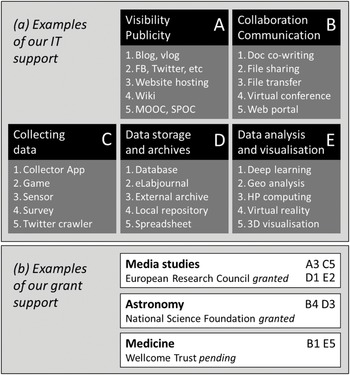
Sh*t happens
I was expecting emails with information needed to finalize a grant proposal with multiple partners. I was also organizing a conference and expected emails from the speakers with their abstracts. This is the usual type of stuff we’re often involved in. Nothing special.
My university used email software produced and delivered by one of the global players in the field. This was very reassuring. From time to time, upgrades were needed, and sometimes they were major. Well, we’re one of many clients, so why should that be a problem?
And so, on the announced date, the system was upgraded. And then the trouble started. At first, people logging on were connected to other people’s email boxes. Then the incoming emails were bounced. And finally, the whole system broke down. Not just for an hour, nor for a day, but for an entire week! Without any information about when or whether it would be fixed.
Without email, the university was lost; it simply couldn’t function anymore. The crisis had begun, although not for all of us. Some – including me – were having their emails forwarded automatically to a second, independent account, and luckily, the forwarding still worked even after the system crashed. Hurray. And so, although far from ideal, this backup system helped me to access my email and survive while other colleagues continued to suffer.
Such crises happen, but are we ready for them? Do we rely too heavily on companies such as Google or Microsoft, who can drastically change their terms and conditions – or even fall apart? Can we resist distributed denial of service (DDoS) attacks on our institution? What else should we be prepared for in these high-tech social networking days? Attacks such as in June 2017 on Rotterdam harbor (NL) and the National Health Service NHS (UK) make the threat very concrete.
Website
The Uniform Resource Locator (URL) is the address of your website. It should be informative about the content of the website and at the same time be short to type and simple to memorize. Create a unique selling URL for your website for life, and check whether it is still free (use a search engine). It consists of three parts: www.name.extension. For the name part, you may want to use your own name, e.g., “smithlab” or “anthonysmith,” or a short text pitching your niche, e.g., “lawcasestudies” or “lawcasesportal” (although an addition such as “portal” may suggest that it’s the entrance site to this whole field). Extensions can be “edu,” “org,” “com,” “info,” or the abbreviation for your country (e.g., “eu” or “uk”).
Develop a homepage and subpages structure.
Write quality content for each page.
Create a brief title for each page (<20 words).
Write an accurate summary for each page (<30 words).
Think of the best search terms to add to your webpage (search engine optimization [SEO]).
Decide to ask experienced support staff about examples of previous work, timeframes, and costs. Or decide to do it yourself and search for “free website hosting” and “free website tools.” For example, Wordpress is a content management system (CMS) with ready-to-use templates for academic websites that is free to use under a CC-BY license.
Check the result a couple of weeks after the website has gone online: does your site pop up well on search engine lists for relevant queries? Check several different search engines on different computers (otherwise, your search history influences what pops up).
Check the other statistics after some time: (a) how many people visit your site, from which links do they access it, where do they land, and how long do they stay?; (b) how many external sites link to yours?; and (c) what queries drive people to your site? Your provider and search engines (e.g., Google Analytics) can provide these statistics.
Universities may have licenses on advanced reporting systems (e.g., PURE) that can produce all kinds of reports (e.g., list of publications) and place them on your webpage on the university’s website.
Create your email address for life, perhaps one derived from the URL of your website for life. The provider hosting your personal website will usually also offer one or more email addresses. See Table 3.14 (the email address also consists of three parts: localname@name.extension).
Develop a short and catchy signature for your emails. Include essential web links and information on your recent successes.
Do you need to include a disclaimer (or link to a disclaimer) in your email? Prepare one, and discuss it with your legal affairs officer.
“Sensitive personal issues should not be discussed by email; rather, use the phone or go to speak directly to your team member, director, or collaborator.” Check your recent email history. How often did you email while using the phone or speaking fact-to-face would have been more appropriate?
| info@smithlab.org | May end up in spam folders |
| anthony@smithlab.org | More specific and personal |
| courses@smithlab.org | Use more than one local name |
| smithlab@gmail.com | If you want to use Google |
| amsmith@gmail.com | Using initials and surname |
| amsmith2019@gmail.com | Add year to reduce spam |
Wikipedia
Read the “professor test” criteria in Wikipedia’s guidelines for academic subjects or biographic articles to see if you can be included on Wikipedia: https://en.wikipedia.org/wiki/Wikipedia:Notability_%28academics%29.
Read Wikipedia’s conflict-of-interest policy: when to refrain from contributing/editing Wikipedia content: http://en.wikipedia.org/wiki/Conflict-of-interest_editing_on_Wikipedia.
Are your research field, your research (articles), and/or your personal information covered in Wikipedia? Should you consider contributing yourself?


 Open access