


Introduction
Clinical trials often encounter challenges meeting their recruitment and enrollment goals due to a myriad of reasons[Reference Briel, Olu and von Elm1]. A comprehensive, multi-pronged approach to recruitment is necessary to address and ameliorate such challenges[Reference Cook, Kennedy and Boone2–Reference Klompstra, Strömberg, Jaarsma and Hendriks4]. Social media, an increasingly popular recruitment channel, offers research teams new opportunities for outreach, focused messaging, and the ability to reach a larger audience of potential participants[Reference Topolovec-Vranic and Natarajan5,Reference Darmawan, Bakker, Brockman, Patten and Eder6]. It is estimated that 70% of the U.S. population actively uses social media[7], though social media usage patterns and platforms vary significantly by demographics[8]. Recent research also indicates a growing interest in and use of social media as a recruitment strategy among health researchers[Reference Darko, Kleib and Olson9]. With the ever-evolving nature of social media[Reference Appel, Grewal, Hadi and Stephen10] and gaps in available guidance[Reference Darko, Kleib and Olson9], research teams would benefit from resources and tools to optimally use social media to recruit participants for their clinical trials. This paper details the creation and contents of a new community-informed toolkit from the Recruitment Innovation Center (RIC) on using social media to support participant awareness of and recruitment for clinical trials.
The Recruitment Innovation Center
The Recruitment Innovation Center[Reference Wilkins, Edwards and Stroud11], a part of the Trial Innovation Network (TIN)[Reference Bernard, Harris and Pulley12], is an evidence-based research center focused on innovative methods, tools, and strategies to enhance clinical trial recruitment and retention. The RIC is a national resource and works primarily with Clinical and Translational Science Award (CTSA) hubs and their researchers to develop, test, and disseminate a range of innovations, resources, and tools to support studies’ recruitment and retention needs[Reference Cook, Kennedy and Boone2]. The RIC’s Recruitment and Retention Materials resource line provides study teams with custom designed clinician- and participant-facing recruitment and retention materials. This includes print materials, websites, logos, mobile study applications, and social media. In addition to offering study-specific support, the RIC has developed and disseminated several free, publicly available, community-informed toolkits for investigators and study teams to use when developing recruitment strategies and materials for their trials[Reference Kennedy, Dunagan and Boone13,Reference Mayers, Cook and Rantala14].
The RIC also maintains a longstanding Community Advisory Board (CAB) comprised of patient and community advocates and thought leaders from across the U.S. with a wide range of backgrounds and lived experiences. The CAB provides guidance to the RIC on creating innovative strategies and materials that reflect the needs, priorities, and values of the broader community.
Overview and development of toolkit
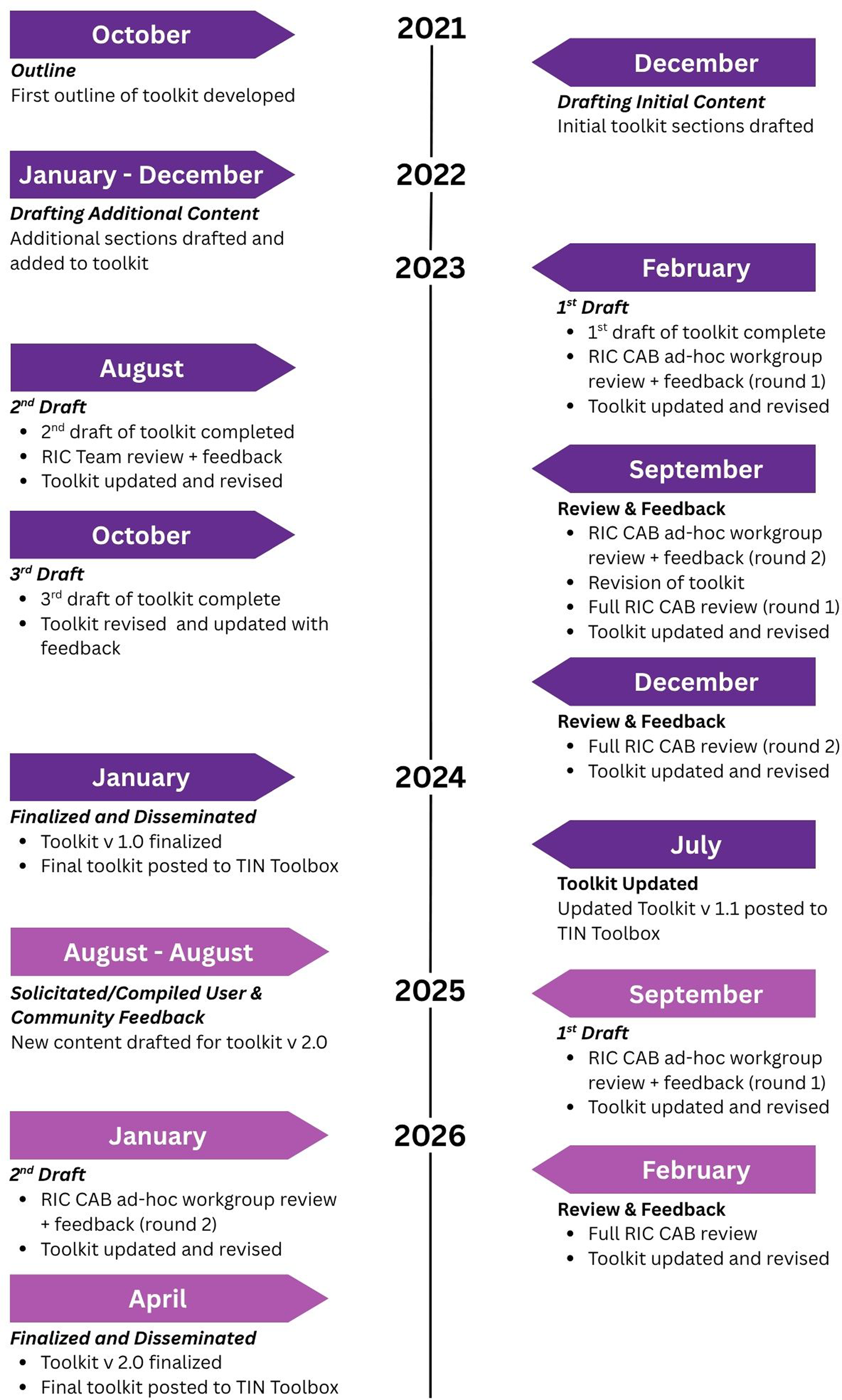
The RIC Social Media Outreach & Recruitment Toolkit was created as an extension of the original RIC Recruitment & Retention Materials Content + Design Toolkit, released in April 2022[Reference Mayers, Cook and Rantala14]. Initial ideation and drafting of the social media toolkit began in April 2021 and included multiple rounds of review, revisions, and drafts before it was finalized and released in January 2024 (v 1.0). A second, updated version (v 2.0) was released in April 2026 that incorporated new content and additional community feedback (see Figure 1).
Toolkit timeline.
Note: The Recruitment Innovation Center (RIC) Community Advisory Board (CAB) ad-hoc workgroup review involved one member of the RIC CAB providing in-depth review and feedback on version 1 (v 1.0), and three members providing review and feedback on version 2 (v 2.0); full RIC CAB review involved the entire RIC CAB reviewing and providing feedback. RIC = Recruitment Innovation Center; CAB = Community Advisory Board; TIN = Trial Innovation Network; v 1.0, v 1.1, and v 2.0 = toolkit version 1.0, 1.1, and 2.0 respectively.

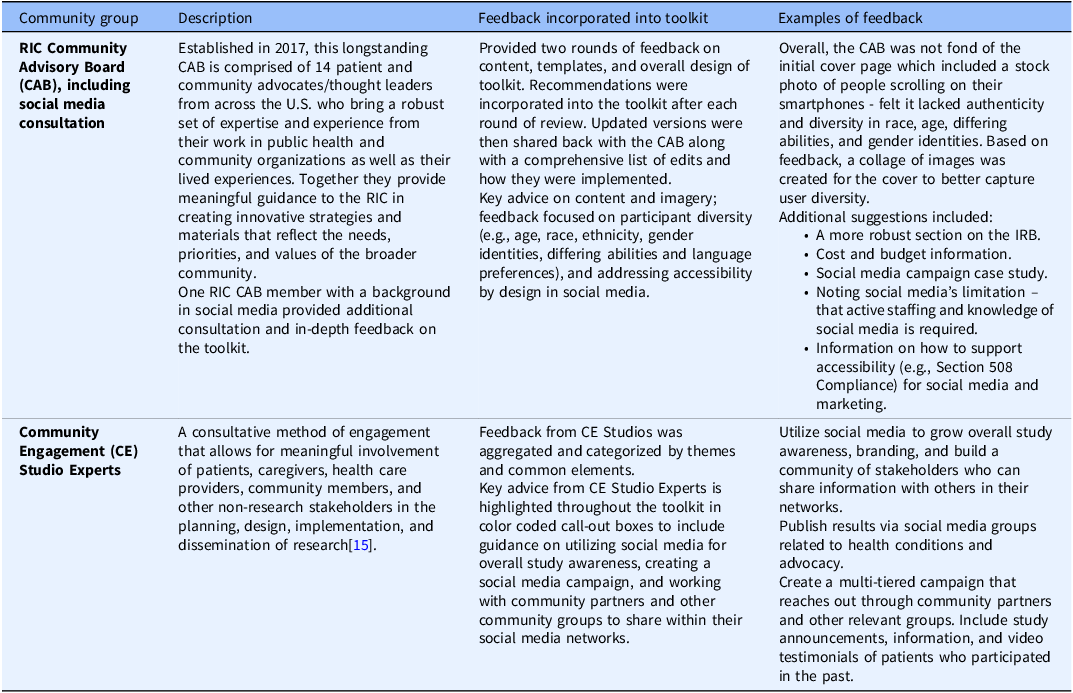
The RIC Social Media Outreach & Recruitment Toolkit was created to inform research teams about the benefits of social media for research recruitment and provide actionable guidance for incorporating social media as a part of their multi-pronged recruitment strategy. It offers community-informed insights on social media from the RIC CAB[Reference Wilkins, Edwards and Stroud11] and Community Engagement (CE) Studio experts[Reference Joosten, Israel and Head15]. Table 1 provides a description of each of these community stakeholder groups and how their feedback shaped the content and development of the original (v 1.0) toolkit.
Community input incorporated in the original (v 1.0) RIC Social Media Outreach & Recruitment Toolkit

RIC = Recruitment Innovation Center; CAB = Community Advisory Board; IRB = Institutional Review Board; CE = community engagement.
Toolkit contents
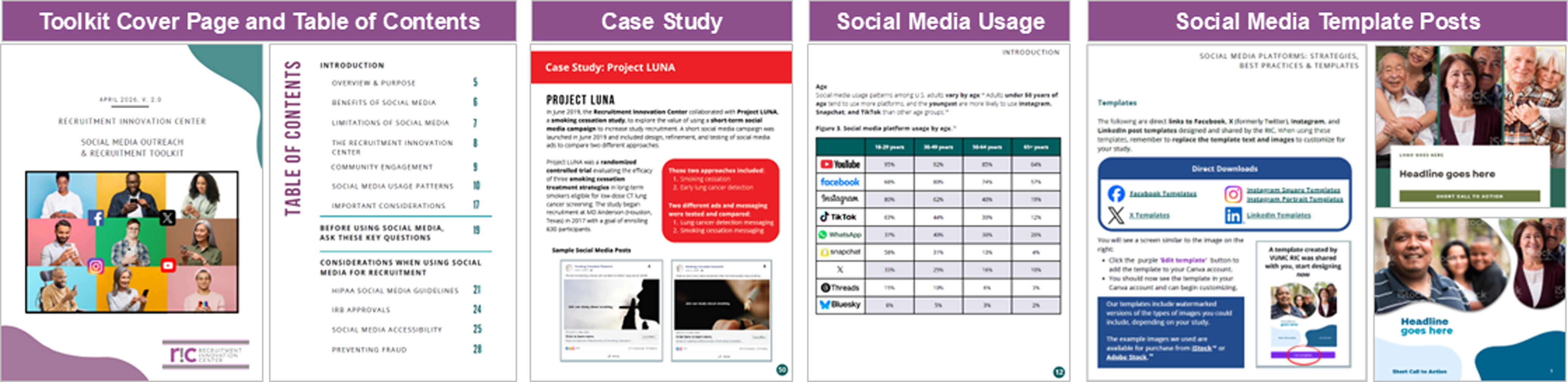
The updated toolkit is organized into seven main sections as outlined and summarized below. In all sections, call-out boxes are woven throughout and categorized according to the following themes: Notes, tips, and recommendations with guidance on content and design; Community expert advice includes relevant advice and recommendations from CE Studio Experts; Articles & resources link to external resources that address health literacy, readability, accessibility, and diversity; and Video tutorials & webinars offer step-by-step instructions and additional insights into social media and its uses (Figure 2).
A snapshot of toolkit contents. Note: Snapshots of toolkit contents including cover page, table of contents, case study, social media usage patterns, and social media templates.

Figure 2. Long description
Panel A: The cover page of the toolkit titled Recruitment Innovation Center Social Media Outreach and Recruitment Toolkit, dated April 2022. The cover features a photo of a diverse group of people. Panel B: The table of contents page listing sections such as Introduction, Benefits of Social Media, Social Media User Patterns, and Social Media Templates. Panel C: A case study page titled Project LUNA, detailing the use of social media in a recruitment project. Panel D: A page showing social media usage patterns with a table comparing different platforms like Facebook, X, and Instagram. Panel E: A page with social media template posts for Facebook, Instagram, and LinkedIn, including placeholders for headlines and images.
-
• Introduction: The toolkit opens with an overview and important considerations when developing social media content. It explains how communities were engaged in the development of the toolkit and emphasizes knowing the needs and preferences of a study’s primary audience. It includes a summary of social media usage patterns and how use varies across different social media channels by key demographics such as race and ethnicity, age, gender, community type, education, and income. It also discusses key benefits of social media – increased awareness, easier monitoring and evaluation, and real-time feedback from participants – as well as some of its limitations, like varied results, the need for active and knowledgeable staff, and privacy concerns.
-
• Key questions to ask before using social media: Lists important questions study teams should ask before utilizing social media, such as making sure to review institution-specific guidelines around the use of social media, assessing team capacity to manage a social media campaign, and confirming the intended audience can be reached via social media – and provides advice from community experts as well as links to external sources with additional insight.
-
• Considerations when using social media for recruitment: Includes important social media guidelines to help ensure study teams are both HIPAA-compliant and approved by their Institutional Review Boards (IRBs). It also provides guidance around accessibility to ensure a team’s social media strategy and designs which are inclusive of individuals with reduced vision, reduced hearing, or limited dexterity. This includes adding alternative text, using captions for videos, and ensuring an appropriate contrast ratio on images and text to enhance readability. Additionally, this section provides guidance, strategies, and resources for mitigating fraudulent behavior on social media, including utilizing CAPTCHA, using rigorous screening protocols, ensuring adequate time is allocated for vetting potential participants, and collaborating with trusted organizations to help promote the research study.
-
• Setting up for success: Includes general best practices in using and managing a social media presence and breaks down three primary methods for sharing social media content: organic posting, paid advertising, and outreach. For each method, tips, recommendations, accessibility guidelines, and tools are offered, including example materials and communications. This section also includes guidance on evaluating the use and effectiveness of social media campaigns for recruitment, as well as tools and resources for calculating advertising costs across different platforms to plan an advertising budget. Additionally, it provides guidance on when to make use of organic posting and how this can be utilized to engage and retain a study’s current audience.
-
• Case studies: Three real-world examples of clinical trials using social media to recruit from different populations are presented. These share information about each study’s social media strategy, including the ads and messaging used and lessons learned and recommendations that can be broadly applied and generalized to other studies.
-
• Case Study 1: Project LUNA engaged in a successful, short-term paid Facebook campaign to improve recruitment of long-term tobacco users in a smoking cessation clinical trial around Houston, TX[Reference Cook, Jerome and Dunagan16]. A detailed breakdown of overall performance, associated costs, and impacts on recruitment and enrollment are presented.
-
• Case Study 2: PRESENCE collaborated with community partners to help promote this study on Facebook and Instagram to recruit individuals with sickle cell disease and chronic pain. Several sample social media posts are shared as examples.
-
• Case Study 3: New IDEAS launched a social media campaign to boost study awareness and enrollment of older Black/African American and Hispanic/Latino adults across four major U.S. metropolitan areas.
-
-
• Strategies, best practices, and templates: Platform-specific strategies and best practices are provided for Facebook, X, Instagram, YouTube, WhatsApp, Snapchat, Threads, Bluesky, LinkedIn, and TikTok. Easy-to-use, customizable templates designed in Canva[17] – a free graphic design platform used to create visual content – are included in this section. The templates are designed for use on some of the more widely used platforms, with dimensions and layouts tailored for Facebook, X, Instagram, and LinkedIn posts.
-
• Community outreach & engagement: This section describes the importance of building partnerships with community stakeholders, organizations, and groups and offers methods and strategies to engage with them. Successful social media campaigns depend on maximizing reach and visibility, and this section includes insights and advice on fostering relationships with community groups to better ensure a study’s messaging is trustworthy and reaches the intended audiences.
Toolkit dissemination
The original RIC Social Media Outreach & Recruitment Toolkit was finalized in January 2024 and added to the Trial Innovation Network’s Toolbox ( trialinnovationnetwork.org/tin-toolbox/ )[18], a publicly accessible forum for sharing free resources from CTSAs and reputable community health partners.
In order to promote and raise awareness of the toolkit, it was also initially disseminated through other channels such as posting on the RIC Community of Practice forum, conducting various presentations and webinars, and a poster presentation to broadly share this resource across the CTSA consortium. The toolkit is also routinely recommended for use during relevant TIN consultations[Reference Harris, Wilkins and Lane19]. A user feedback survey was sent to presentation and webinar attendees to assess utilization and satisfaction with the toolkit. Preliminary feedback (n = 9 responses) indicated the guidance and recommendations in the toolkit were helpful, easy to understand, and provided a basic understanding of how to use social media as a recruitment tool. As of March 2026, the original toolkit (v 1.0) had been viewed 549 times (total views). The updated second version of the toolkit (v 2.0) was released in April 2026.
Discussion
The RIC’s Social Media Outreach & Recruitment Toolkit provides research teams with a robust, comprehensive resource for utilizing social media as part of their study’s recruitment strategy. Insights from various community groups informed the development and subsequent update of the toolkit, which includes platform-specific advice, resources for engaging with community and advocacy groups, accessibility guidelines, and general considerations for social media use in research recruitment. The utilization of community input and engagement, a key guiding principle of the RIC, offers research teams a unique perspective from community members and leaders with a wide range of lived and professional experience. Their recommendations and guidance help ensure the toolkit addresses the needs, priorities, and values of the broader community and has real-world relevance and applicability to study teams and the intended audiences of social media recruitment campaigns.
This toolkit also contains multiple customizable, professionally designed templates to use and adapt across multiple different social media platforms. Each template is designed within recommended dimensions and image resolutions for each platform, and they incorporate principles of accessible design[20,21] to be readable and understandable to users with a range of abilities. They were designed and formatted to ensure they are easy to read and navigate, such as including high color contrast and left-justified text. These templates, along with the guidance and resources included in the toolkit, provide research teams with a helpful starting point when creating social media ads and posts without having to “start from scratch.”
Additionally, the detailed case studies included in the toolkit offer real-world examples of using social media for recruitment in different clinical trials, including associated costs, engagement metrics, and impact on study recruitment. They include varied study populations, settings, and contexts, along with recommendations that are generalizable to other studies and teams looking to use social media for recruitment.
While other social media toolkits and guidance documents exist[Reference Darko, Kleib and Olson9,22,23], to our knowledge, this toolkit is among the most extensive, community-informed, and specific to clinical trial recruitment. Its contents include descriptions of ten different social media platforms, their individual cultures, and how to best use them for clinical trial recruitment, providing study teams with a strong foundation for creating and managing social media campaigns across various platforms.
Limitations
One unavoidable limitation of this toolkit is being able to fully address the dynamic nature of social media. Algorithms and user interfaces constantly change in response to technological advancements, competition from other platforms, and user engagement. As such, this toolkit can quickly become outdated or not fully reflect the current state of the social media environment. However, regular reviews and updates to the toolkit are planned. Second, this toolkit is also not an exhaustive manual on how to use social media for clinical research outreach and recruitment. The guidelines and suggestions provided in this toolkit are based on a few use cases and pilot studies as well as the expertise and experience of RIC staff and affiliates. Additionally, there are inherent challenges with rigorously evaluating the strategies included in this toolkit, as other studies have previously reported on[Reference Darmawan, Bakker, Brockman, Patten and Eder6], and embedding and randomizing within a clinical trial’s recruitment plan. Lastly, policies regarding the use of social media as a recruitment tool vary across institutions. Research teams are encouraged to use this toolkit as a starting point for their social media outreach but also to familiarize themselves with their own institution’s policies, procedures, and IRB regulations for appropriate study-specific customization.
Future directions
We plan to continue to leverage our collaborations with the RIC Community of Practice and Hub Liaison Teams to disseminate this updated resource across the CTSA and look for ways to test and embed the toolkit within TIN consultations.
Conclusion
Social media has the potential to offer clinical trial teams a powerful mechanism for broad outreach, participant recruitment, and access to the communities they serve. This new, no-cost toolkit contains considerations when using social media for recruitment, platform-specific guidelines, recommendations and resources for engaging and partnering with community and advocacy groups, and professionally designed customizable templates to use across multiple social media platforms.
Acknowledgements
The authors would like to thank those who contributed to the development of this toolkit, including our Recruitment Innovation Center (RIC) colleagues, the Community Engagement Studio Experts, and the RIC Community Advisory Board (CAB) for their critical review and feedback. A special thank you to Jessica Gryphon and Chien-Chi Huang for their thoughtful, extensive feedback on v 2.0 of the toolkit. We would also like to acknowledge and thank the many individuals who have accessed the toolkit and provided feedback and suggestions for future improvements.
Author contributions
Sarah Cook: Conceptualization, Data curation, Methodology, Project administration, Writing – original draft, Writing – review & editing; Stephanie Mayers: Project administration, Writing – original draft, Writing – review & editing; Matt Schorr: Project administration, Visualization, Writing – original draft, Writing – review & editing; Caitlin Rantala: Visualization, Writing – original draft; Sophia Gomez: Writing – original draft, Writing – review & editing; Meghan Vance: Writing – original draft, Writing – review & editing; Danielle Pardue: Writing – review & editing; Terri L. Edwards: Funding acquisition, Writing – review & editing; Mary Stroud: Funding acquisition, Writing – review & editing; Paul A. Harris: Funding acquisition, Investigation, Supervision, Writing – review & editing; Consuelo Wilkins: Funding acquisition, Investigation, Supervision, Writing – review & editing.
Funding statement
This project was supported by the National Institutes of Health (NIH)/National Center for Advancing Translational Sciences (NCATS) (Vanderbilt Institute for Clinical and Translational Research, awards number UL1 TR002243), (The Recruitment Innovation Center, award number U24TR001579). Its contents are solely the responsibility of the authors and do not necessarily represent official views of NCATS or the NIH.
Competing interests
The authors have no conflicts of interest to report.

 Open access

