

Introduction
Specific phobia of vomiting (SPOV), or emetophobia, is a marked and persistent fear of oneself or others vomiting (American Psychiatric Association, 2013). It has an early onset and follows a chronic course (Lipsitz et al., Reference Lipsitz, Fyer, Paterniti and Klein2001; Veale and Lambrou, Reference Veale and Lambrou2006). The prevalence of the disorder has been estimated to be 0.1% (Becker et al., Reference Becker, Rinck, Türke, Kause, Goodwin, Neumer and Margraf2007) but may have been underrated due to shared symptoms with other disorders (Boschen, Reference Boschen2007). In a Dutch community sample, 8.8% of participants considered themselves afraid of vomiting, but all may not have fulfilled diagnostic criteria for SPOV (van Hout and Bouman, Reference van Hout and Bouman2012).
The large majority of sufferers from SPOV are women (van Hout and Bouman, Reference van Hout and Bouman2012; Veale and Lambrou, Reference Veale and Lambrou2006) and according to one study nearly half of the women had avoided pregnancies and 5% had ended them prematurely due to the phobic disorder (Veale and Lambrou, Reference Veale and Lambrou2006). SPOV can thus have profound consequences and in some cases lead to malnourishment due to avoidance of certain food types or the amount of food eaten (Veale et al., Reference Veale, Costa, Murphy and Ellison2012). People’s lives are taken over by ways of avoiding illness and many sufferers from SPOV engage in excessive hand-washing and use of hand sanitizers, repeatedly checking the expiration dates of food, etc.
Due to the repetitive behaviour of many sufferers from SPOV, it has been proposed that the disorder be conceptualized as obsessive-compulsive disorder (OCD), at least in severe cases with repetitive behaviours (Veale et al., Reference Veale, Hennig and Gledhill2015). Thoughts of falling ill are prevalent and roughly 80% have intrusive images of vomiting (Price et al., Reference Price, Veale and Brewin2012). It is not always clear what the central fear is, as is sometimes the case with OCD, although fears of losing control, becoming very ill, choking, dying, fainting, and being perceived repulsive by others are common (Veale and Lambrou, Reference Veale and Lambrou2006). Veale and Lambrou (Reference Veale and Lambrou2006) have highlighted SPOV’s similarities with panic disorder and health anxiety in the vigilance of, and catastrophic misinterpretation of, physical sensations. Individuals with SPOV seem to be more sensitive to interoceptive cues than sufferers from most other forms of specific phobias (Boschen, Reference Boschen2007). Disgust proneness also seems to be associated with the fear of vomiting and the factor disgust sensitivity may be predictive of avoidance of SPOV stimuli (van Overveld et al., Reference van Overveld, Jong and Peters2010). There is some research suggesting that slower extinction of disgust reactions may require either more intensive treatment or a different treatment approach for patients characterized with heightened disgust proneness (Knowles et al., Reference Knowles, Jessup and Olatunji2018). These findings may have relevance for the disorder’s management.
Very few studies have been published on the treatment of SPOV. Åhlén et al. (Reference Åhlén, Edberg, Di Schiena and Bergström2015) carried out an open study where 23 patients received 10 sessions of CBT in three separate groups. The treatment consisted of psychoeducation, exposure, and maintenance strategies. Of the 21 patients completing treatment, 10 (48%) recovered, four (19%) improved and seven (33%) were unchanged at 3-month follow-up. Riddle-Walker et al. (Reference Riddle-Walker, Veale, Chapman, Ogle, Rosko, Najmi, Walker, Maceachern and Hicks2016) conducted a randomized controlled trial where 24 participants were allocated to either 12 sessions of CBT or a wait list control group. CBT was significantly more efficacious than the wait list and six (50%) of the participants receiving CBT obtained clinically significant change compared with two (16%) on the wait list. The authors concluded that SPOV was a treatable condition but that some patients might need a more intensive program with greater therapy assisted exposure similar to stepped care in OCD (Veale et al., Reference Veale, Naismith, Miles, Childs, Ball, Muccio and Darnley2016). Subsequently, Keyes et al. (Reference Keyes, Deale, Foster and Veale2020) published a study where intensive CBT was delivered individually to a group of eight participants. The treatment consisted of six weekly sessions of up to 90 minutes, and two intensive sessions up to 4 hours each. Five of the eight participants (62.5%) achieved clinically significant change and seven (87.5%) achieved reliable improvement at 6-month follow-up. These studies indicate that between 48 and 63% of patients obtain clinically significant change by means of CBT, and that intensive treatment formats may be the most promising.
Within the field of CBT, treatment formats for anxiety problems have become more efficient and intensive due to the influence of one session treatment (OST) for specific phobias (Öst, Reference Öst1989). OST has proven to be comparable, or even superior, to other behavioural therapies delivered over considerably more sessions for patients with animal, dental and situational phobias (Odgers et al., Reference Odgers, Kershaw, Li and Graham2022; Zlomke and Davis, Reference Zlomke and Davis2008). The Bergen 4-day treatment (B4DT), inspired by OST, is a particularly concentrated format of exposure and response prevention, originally developed for OCD. It is delivered over four consecutive days in groups of 3–6 patients with an equal number of therapists (for a detailed description, see Havnen et al., Reference Havnen, Hansen, Haug, Prescott and Kvale2013). The treatment has proven to be effective for OCD, with the proportion of patients fulfilling the strict international consensus criteria for remission being 74% post-treatment and 69% at 4-year follow-up (Hansen et al., Reference Hansen, Kvale, Hagen, Havnen and Öst.2019). A recent study also reported on B4DT’s effectiveness for panic disorder (Eide et al., Reference Eide, Hjelle, Sætre, Solem, Olsen, Sköld, Kvale, Hansen and Hagen2023).
It is an intriguing question whether B4DT might be effective for SPOV, as it involves more therapy assisted exposure than weekly CBT and has little or no drop-out from treatment (Hansen et al., Reference Hansen, Kvale, Hagen, Havnen and Öst.2019). Moreover, the B4DT is a treatment based on exposure, and according to a meta-analysis of randomized treatment studies of specific phobias in general, in vivo exposure outperformed alternative treatment approaches (Wolitzky-Taylor et al., Reference Wolitzky-Taylor, Horowitz, Powers and Telch2008). However, these analyses did not include trials with SPOV and such generic protocols for exposure in SPOV might need to be modified to include the repetitive and obsessive-like behaviours that can occur in SPOV (Veale et al., Reference Veale, Ellison, Boschen, Costa, Whelan, Muccio and Henry2013). The B4DT includes this potentially important element. Finally, such an approach would provide a highly time effective treatment option where patients are treated in merely four consecutive days.
The aim of the present study was to evaluate the feasibility and preliminary effectiveness of the B4DT treatment for five women suffering from SPOV. It was hypothesized that they would report decreased symptoms of SPOV post-treatment as measured by the Specific Phobia of Vomiting Questionnaire (Veale et al., Reference Veale, Ellison, Boschen, Costa, Whelan, Muccio and Henry2013) and Emetophobia Questionnaire-13 (Boschen et al., Reference Boschen, Veale, Ellison and Reddell2013). It was also hypothesized that they would manage to watch a video portraying vomit-related stimuli for a longer duration and be less distressed by it at post-treatment assessment.
Method
Design
The current study utilized measurements at pre-treatment, post-treatment and at 3- and 6-month follow-up. There were two pre-test assessments: first, when participants came for the diagnostic interview, which was at different time points, on average 4 weeks before the treatment; and the second pre-test assessment was done half an hour before the start of treatment. The purpose of the second pre-test assessment was to ascertain that the SPOV symptoms were still debilitating by the beginning of treatment, so that possible changes during treatment were likely to be due to the treatment and not some other reasons. Questionnaires were thus administered at: T1, at the time of the diagnostic interview; T2, just before the beginning of the group treatment; T3, post-treatment (1 week after the last treatment day); T4, 3 months post-treatment; and T5, 6 months post-treatment. A video portraying vomit-related stimuli was administered at time points T2–T5. It was only administered once pre-treatment as watching it more times might induce a habituation to its material.
Participants
The study was advertised on social media, including an announcement on an Icelandic SPOV self-help Facebook page. A total of 11 patients enquired about the study from May to August 2022, or were referred to the Icelandic Anxiety Centre Kvíðameðferðarstöðin by other professionals. These were offered an initial session with one of the psychologists at the SPOV team, during which information on onset, manifestation and duration of the problem was obtained along with demographic data such as age, occupation, and education level. Questionnaires were administered as well as the Mini International Neuropsychiatric Interview (M.I.N.I.) and the specific phobia part of M.I.N.I. Plus (Sheehan et al., Reference Sheehan, Lecrubier, Sheehan, Amorim, Janavs, Weiller, Hergueta, Baker and Dunbar1998), with the questions of the latter adapted by authors to SPOV. For patients to be included in the study, they needed to (a) meet DSM-5 criteria for specific phobia of vomiting, (b) be 18 years or older, (c) speak Icelandic, (d) if taking psychotropic medication be on a stable dosage for a duration of at least 4 weeks pre-treatment, and (e) have no plans of changing the dose or initiating psychotropic medication. Exclusion criteria were: (a) suffering from an eating disorder, (b) alcohol or substance dependence, (c) psychotic symptoms, (d) manic symptoms, (e) at suicidal risk, and (f) suffering from avoidance restrictive food intake disorder. The participants financed the treatment to a large extent themselves as the B4DT is a not financed by public psychiatric care in Iceland. For the purpose of the study, the cost of the treatment was reduced by 30%.
Eight participants met DSM-5 criteria for specific phobia of vomiting and were offered a second interview where the SPOV was evaluated, the participant’s expectations and suitability for treatment determined, the treatment study introduced, and informed consent form signed. The participants were informed that they could withdraw from the study at any point, and it would not affect their treatment at the clinic. A total of eight patients were offered to participate but one was going abroad at the time of the treatment, one preferred to work on other problems, and one accepted to participate but never attended any treatment sessions. All five participants initiating treatment completed it.
In the second interview participants were shown two videos presenting the outline and content of the treatment. After watching the videos, the participants’ expectation of treatment outcome as well as their evaluation of the treatment credibility was assessed with an adapted version of the Borkovec and Nau (Reference Borkovec and Nau1972) Reaction to Treatment Scale, in which four aspects of expectancy and credibility were evaluated on a 0–100% scale, with higher values indicating more positive evaluations. If participants reported an expectancy or credibility score below 70%, this was taken as an opportunity to clarify possible misunderstandings regarding the treatment.
Clinical features
The clinical features of the participants can be seen in Table 1. The participants were all Caucasian women of low to medium income, all feared themselves and others vomiting, three had co-morbid disorders and had previous experience with CBT but not specifically for SPOV. Three of the participants used psychotropic medication for anxiety and/or depression but had all been on a stable dose for at least 6 weeks. Four of the participants had suffered from SPOV since childhood.
Demographic characteristics of the participants
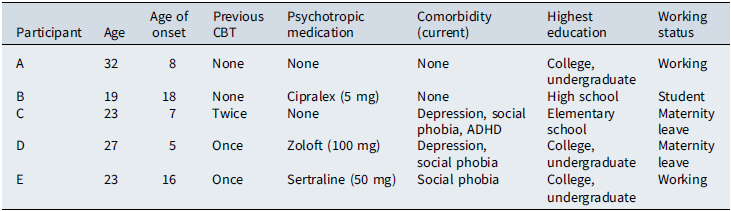
CBT, cognitive behaviour therapy; ADHD, attention deficit hyperactivity disorder.
Assessments
The Mini International Neuropsychiatric Interview (M.I.N.I.; Sheehan et al., Reference Sheehan, Lecrubier, Sheehan, Amorim, Janavs, Weiller, Hergueta, Baker and Dunbar1998)
The M.I.N.I. is a structured and standardized diagnostic interview used to determine the most common psychiatric disorders according to DSM-IV and ICD-10 diagnostic criteria (Lecrubier et al., Reference Lecrubier, Sheehan, Weiller, Amorim, Bonora, Sheehan, Janavs and Dunbar1997). The Icelandic version was administered, for which adequate validity has been demonstrated (Sigurðsson, Reference Sigurðsson2008). The present study utilized a composite version of M.I.N.I. with the specific phobia module from M.I.N.I.-Plus included (Sheehan et al., Reference Sheehan, Lecrubier, Sheehan, Amorim, Janavs, Weiller, Hergueta, Baker and Dunbar1998).
Specific Phobia of Vomiting Inventory (SPOVI)
The SPOVI was the primary outcome measure, a 14-item self-report measure of symptoms of specific phobia of vomiting, more specifically threat monitoring and avoidance behaviours linked to SPOV, as experienced within the week preceding the assessment. Participants rate each item on a 5-point scale, ranging from 0 (not at all) to 4 (all the time). Total scores range from 0 to 56, with higher scores indicating a higher frequency of symptoms experienced. The SPOVI has shown good psychometric properties and was chosen as the main outcome measure as it has proven to be sensitive to symptom change following treatment with a suggested cut-off score of 10 (Veale et al., Reference Veale, Costa, Murphy and Ellison2012). The Icelandic translation has good psychometric properties, suggesting the cut-off score of 10 to be applicable for Icelanders (Benediktsdóttir, Reference Benediktsdóttir2022).
Emetophobia Questionnaire (EmetQ-13; Boschen et al., Reference Boschen, Veale, Ellison and Reddell2013)
was the secondary outcome measure, a 13-item self-report scale that measures the severity of symptoms of SPOV in the previous week. EmetQ-13 overlaps with SPOVI on the measure of avoidance but separates it into avoidance of situations and movement, and avoidance of people who may vomit. It also includes a third factor on the perceived consequences of exposure to vomit (Boschen et al., Reference Boschen, Veale, Ellison and Reddell2013). Participants rate each item on a five-point scale, ranging from 1 (strongly disagree) to 5 (strongly agree). Total scores range from 13 to 65, with higher scores indicating a higher frequency of symptoms experienced. EmetQ-13 has good psychometric properties and a score of >22 determined as the most appropriate cut-off score (Boschen et al., Reference Boschen, Veale, Ellison and Reddell2013). Studies of the psychometric properties of the Icelandic translation of the scale support this (Benediktsdóttir, Reference Benediktsdóttir2022).
Behavioural avoidance test
To assess participants’ overt behaviour when confronted with emetophobic stimuli, a 27- minute colour video (based on Hellström et al., Reference Hellström, Fellenius and Öst1996) was developed and shown on a 50-inch screen at a 2-meter distance from the participant. The video portrayed emetophobic stimuli of increasing intensity (from vomit-related words to people vomiting). The participants were instructed to watch the video for as long as they could, without looking away or closing their eyes, or else the task would be terminated. They were informed that this was an important part of assessment and that they should do their very best to watch it for at least 5 minutes. The participants could turn the video off at any point. Every 5 minutes the participants were asked how anxious and nauseous they were on a scale of 0 to 10. If they terminated watching the video prematurely, they were asked how anxious and nauseous they felt at the point of termination, and the time spent watching the video was recorded (0–27 minutes).
The Anxiety Sensitivity Index (ASI; Reiss et al., Reference Reiss, Peterson, Gursky and McNally1986)
The ASI is a 16-item scale evaluating the fear of anxiety related sensations. Respondents rate each item on a 5-point scale that ranges from 0 (very little) to 4 (very much). Total scores range from 0 to 64. The psychometric properties of the Icelandic version of ASI are acceptable (Sævarsson et al., Reference Sævarsson, Erlingsson and Smári2004).
The Generalized Anxiety Disorder-7 (GAD-7; Spitzer et al., Reference Spitzer, Kroenke, Williams and Löwe2006)
The GAD-7 measures symptoms of generalized anxiety. The psychometric properties are well-established (Beard and Björgvinsson, Reference Beard and Björgvinsson2014; Hinz et al., Reference Hinz, Klein, Brähler, Glaesmer, Luck, Riedel-Heller, Wirkner and Hilbert2017) and the diagnostic properties of the Icelandic translation are adequate (Harðardóttir et al., Reference Harðardóttir, Vésteinsdóttir, Ásgeirsdóttir, Kristjánsdóttir and Þórisdóttir2022).
Patient Health Questionnaire (PHQ-9; Kroenke et al., Reference Kroenke, Spitzer, Williams and Löwe2010)
The PHQ-9 is a 9-item measure of depressive symptom severity with a score ranging from 0 to 27. The psychometric properties of PHQ-9 are well-established (Ágústsdóttir and Daníelsdóttir, Reference Ágústsdóttir and Daníelsdóttir2018; Titov et al., Reference Titov, Dear, McMillan, Anderson, Zou and Sunderland2011).
The 12-item Disgust Propensity and Sensitivity Scale -Revised (DPSS-R-12; Olatunji et al., Reference Olatunji, Cisler, Deacon, Connolly and Lohr2007)
The DPSS-R-12 assesses the tendency to respond with disgust and how unpleasant the person finds the experience. Each item is rated on a Likert-scale from 1 (‘never’) to 5 (‘always’) with a total score of 12–60. The scale has good psychometric characteristics (Fergus and Valentiner, Reference Fergus and Valentiner2009; Steinarsson, Reference Steinarsson2014). It was of interest to see whether treatment, which did not target disgust during exposure, would bring about change on this measure.
The Dimensional Obsessive-Compulsive Scale-Short Form (DOCS-SF; Eilertsen et al., Reference Eilertsen, Hansen, Kvale, Abramowitz, Holm and Solem2017)
The DOCS-SF measures the severity of OCD symptoms. DOCS-SF was administered as there are features in SPOV that are shared with OCD, such as ritualistic behaviour and magical thinking (Veale et al., Reference Veale, Hennig and Gledhill2015). DOCS-SF contains a checklist with four symptom categories and five severity items scored on a 0 to 8 scale, yielding a total score of 0–40. The DOCS-SF has demonstrated good psychometric properties and a cut-off score of 16 is indicative of an OCD diagnosis (Eilertsen et al., Reference Eilertsen, Hansen, Kvale, Abramowitz, Holm and Solem2017). The psychometric properties of the Icelandic short form have yet to be studied.
Quality of Life Scale (QOLS; Burckhardt and Anderson, Reference Burckhardt and Anderson2003)
The QOLS is a 16-item instrument that measures several domains of quality of life. Each item is scored on a Likert scale from 1 to 7, with 1 indicating ‘terrible’ and 7 indicating ‘delighted/pleased’. Scores between 16 and 112 can be obtained, with a higher score indicating a higher satisfaction with the different domains of life. The psychometric properties of the Icelandic version are acceptable (Hrafnsson and Gudmundsson, Reference Hrafnsson and Guðmundsson2007).
The Brief Illness Perception Questionnaire (BIPQ; Broadbent et al., Reference Broadbent, Petrie, Main and Weinman2006)
The BIPQ is a 9-item measure of cognitive and emotional representations of illness. The items are graded from 1 to 10, with higher scores indicating a greater perceived psychological burden of illness. The BIPQ has good psychometric properties (Broadbent et al., Reference Broadbent, Petrie, Main and Weinman2006; Steindórsdóttir, Reference Steindórsdóttir2019).
The Work and Social Adjustment Scale (WSAS; Mundt et al., Reference Mundt, Marks, Shear and Greist2002)
The WSAS is a measure of functional impairment. It assesses the impact of a person’s mental health difficulties on their ability to function in terms of work, home management, social leisure, private leisure, and personal or family relationships. It consists of five items scored between 0 (not at all) to 8 (very severely). Scores above 20 suggest severe impairment, whereas scores between 10 and 20 indicate significant functional impairment (Mundt et al., Reference Mundt, Marks, Shear and Greist2002). The properties of the Icelandic translation have not been established.
Client Satisfaction Questionnaire-8 (CSQ-8; Larsen et al., Reference Larsen, Attkisson, Hargreaves and Nguyen1979)
The CSQ-8 was used to assess treatment satisfaction. It has eight items which are rated on a 1 to 4 scale; total score is 8–32. The scale was translated into Icelandic for the purpose of this study.
Treatment
The treatment was delivered in a group setting characterized by a one-to-one ratio between participants and therapists, where a cohort of five participants underwent a structured 4-day treatment program. The treatment regimen was as follows.
The first day involved a 4-hour psychoeducation to ensure that all participants obtained a thorough understanding of the treatment principles. They were made aware of the brain’s sensitivity to danger signals, that the brain ‘listens’ to their reactions. By avoiding or approaching situations reluctantly they were strengthening the fear response. This could be turned around by approaching anxiety-provoking situations forthrightly.
Lists of exposure tasks each participant had prepared in advance were reviewed with the group and refined when needed. Participants were not to arrange the items in order of difficulty as when exposure hierarchies are constructed. Instead they were instructed to list randomly tasks that would bring about as much change as possible, ‘activities the emetophobia would dislike the most’. Participants were encouraged not to leave anything out that was ‘part of the emetophobia project’. When in doubt whether a particular reaction was due to emetophobia or not, they were encouraged to treat is as emetophobia.
Days 2 and 3 were dedicated to 8-hour daily sessions focused on exposure and response prevention (ERP) customized to address the specific emetophobia concerns of each participant. The individual took the lead and worked with her own therapist. The exposures did not aim at disconfirming the expectation of the partipant, nor was the aim to reduce anxiety. Participants were encouraged to ‘lean into the anxiety’, that is approach that triggers without holding back and embracing the uncertainty. Whenever the participants approached the tasks reluctantly, they were encouraged to repeat them without hesitation. The practising took place in the most relevant contexts (for example, at home or at work of the participant). It could, for example, be to join the participant picking up her child up from Kindergarten, where the participant seized the opportunity to touch items at the Kindergarten that sick children might have touched. It could also be to have a meal with the participant at a restaurant thought to be unsafe or spin in circles at the clinic.
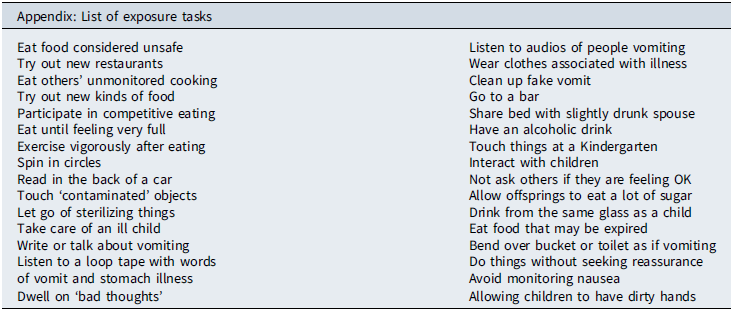
When possible, different classes of triggers were combined and approached simultaneously. An example of this was to cook chicken for the group to eat at lunch while listening to a looptape describing frightening scenarios where the outcome was uncertain. Some of the tasks involved interoceptive exposures such as exercising vigorously after eating, reading during bus trips, and drinking lukewarm salty water in one draught. The purpose was to induce nausea, not necessarily vomiting. Other tasks counted as ERP such as eating unsafe foods, touching contaminated items and resisting the urge to sterilize hands and seek reassurance. Some tasks inexplicitly challenged magical thinking, like wearing yellow clothes and letting go of neutralizing thoughts, both thought to bring on illness. A complete list of the exposure tasks in the treatment can be seen in the Appendix.
These tasks were followed by self-administered exposure in the evenings. The participants were encouraged to contact the therapist if any difficulties arose during the course of the evening and send a text message at 9 pm where they rated their performance from 1 to 6 as to what extent they had leaned into the anxiety without holding back. If the participants rated themselves as 4 or lower, this was taken as an opportunitiy to troubleshoot with the patient on how she could best let go of her attempts to control the anxiety and do the opposite.
Daily group meetings in the morning, at lunchtime, and in the afternoon, facilitated the sharing of progress and the discussion of challenges related to the exposure therapy process.
On the third day, a psychoeducational session was extended to the relatives and significant others of the participants. This session aimed to enhance their comprehension of SPOV and equip them with strategies to effectively support the participants in their quest to overcome the phobia.
On the fourth day, participants received a 4-hour session where they received instructions on strategies for maintaining the positive changes achieved during the treatment program. Additionally, they collaboratively planned self-administered exposure tasks for the subsequent 3 weeks. Throughout this post-treatment period, participants diligently recorded their progress by completing a daily online survey.
Apart from the psychoeducation where the purpose of vomiting was explained, the main change to the original B4DT manual regarded the exposure tasks, which targeted SPOV instead of OCD. Many were similar, such as when contamination fears were targeted. Magical thinking formed part of SPOV as well as OCD, like when a SPOV-patient was encouraged to wear yellow clothes, thought to bring on stomach illness. Interoceptive exposure to the feeling of nausea was also added, a task relevant to all participants. Implementation of the treatment was without difficulties although it was some challenge to create the smell of vomit.
Therapists
The therapists were all part of the OCD- and SPOV-teams at the Icelandic Anxiety Centre Kvíðameðferðarstöðin. They were all but one between 36 and 52 years old, with 8–20 years of clinical experience treating anxiety disorders, and had led several B4DT groups. One of the two male therapists was 27-year-old and had only 1 year of clinical experience.
Data analyses
Symptoms as measured by questionnaires and self-report during the behavioural test were graphed and subject to visual analysis. Reliable and clinically significant change on SPOVI was determined (Jacobson and Truax, Reference Jacobson and Truax1991) using the cut-off score of 10 that Veale et al. (Reference Veale, Costa, Murphy and Ellison2012) recommended.
Results
Figure 1 shows the development of participants’ self-report on symptoms of SPOV as measured by SPOVI and EmetQ-13. There was a clear reduction in SPOV-symptoms from the point of intervention to post-treatment for participants A to E, which is not seen during baseline. These results were maintained for all participants at follow-up except for participant C where there was an increase in symptoms although not to pre-treatment levels.
SPOV score severity (SPOVI, EmetQ-13) for participants (A–E) at baseline, pre- and post-treatment, and 3- and 6-month follow-up assessments.
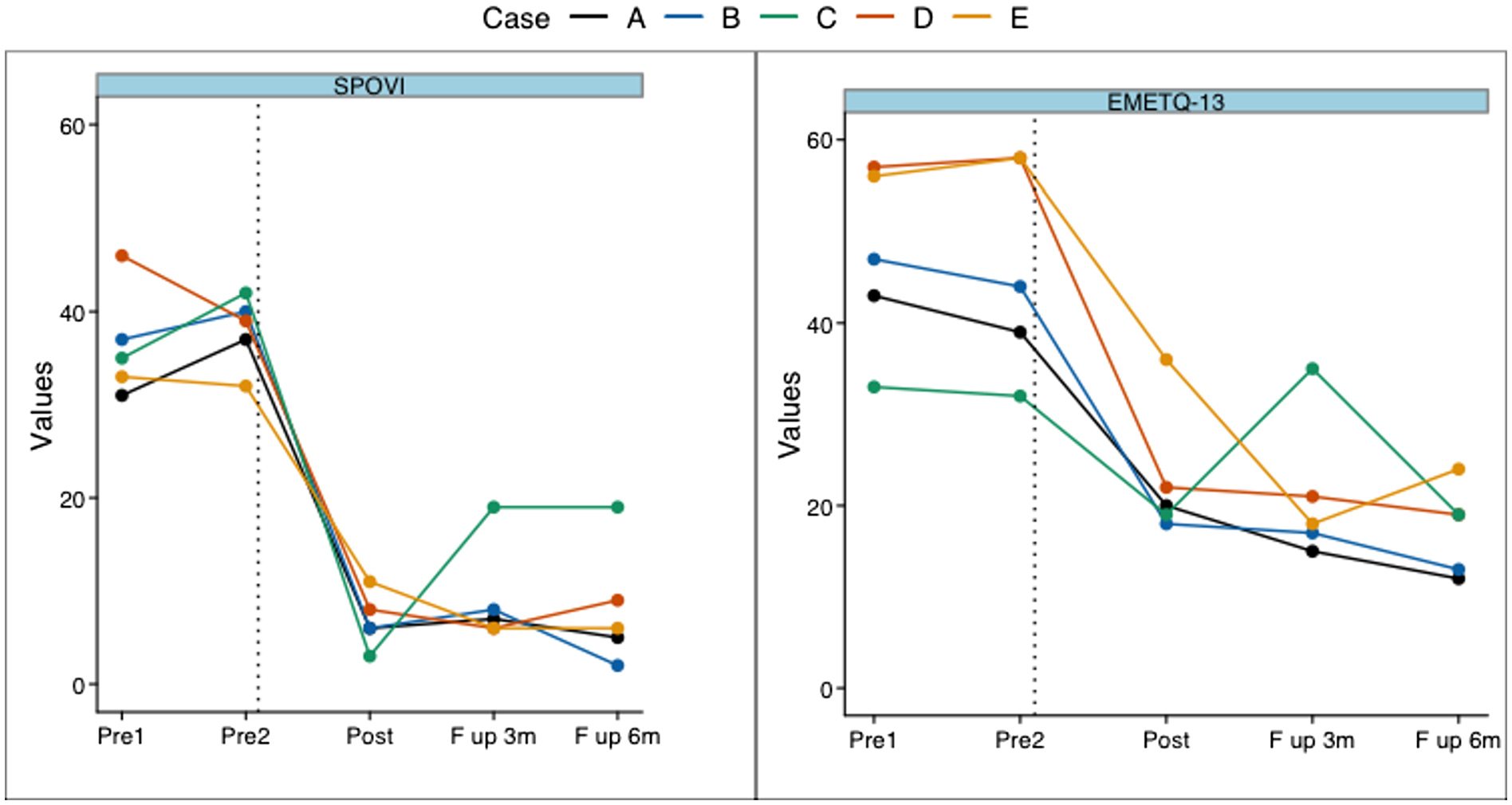
All five participants showed a reliable change index of 3.97 (where the critical value is 1.96 at p=0.05) both at post and 6-month follow-up. Four of the participants were also below the suggested cut-off score of 10 points for SPOVI (Veale et al., Reference Veale, Costa, Murphy and Ellison2012) post-treatment and at 6-month follow-up and, thus, achieved clinically significant change (Jacobson and Truax, Reference Jacobson and Truax1991) criteria; the fifth participant obtained reliable improvement. Four of the participants were also below the suggested cut-off score of 22 for EmetQ-13 (Boschen et al., Reference Boschen, Veale, Ellison and Reddell2013).
Behavioural test for emetophobic stimuli
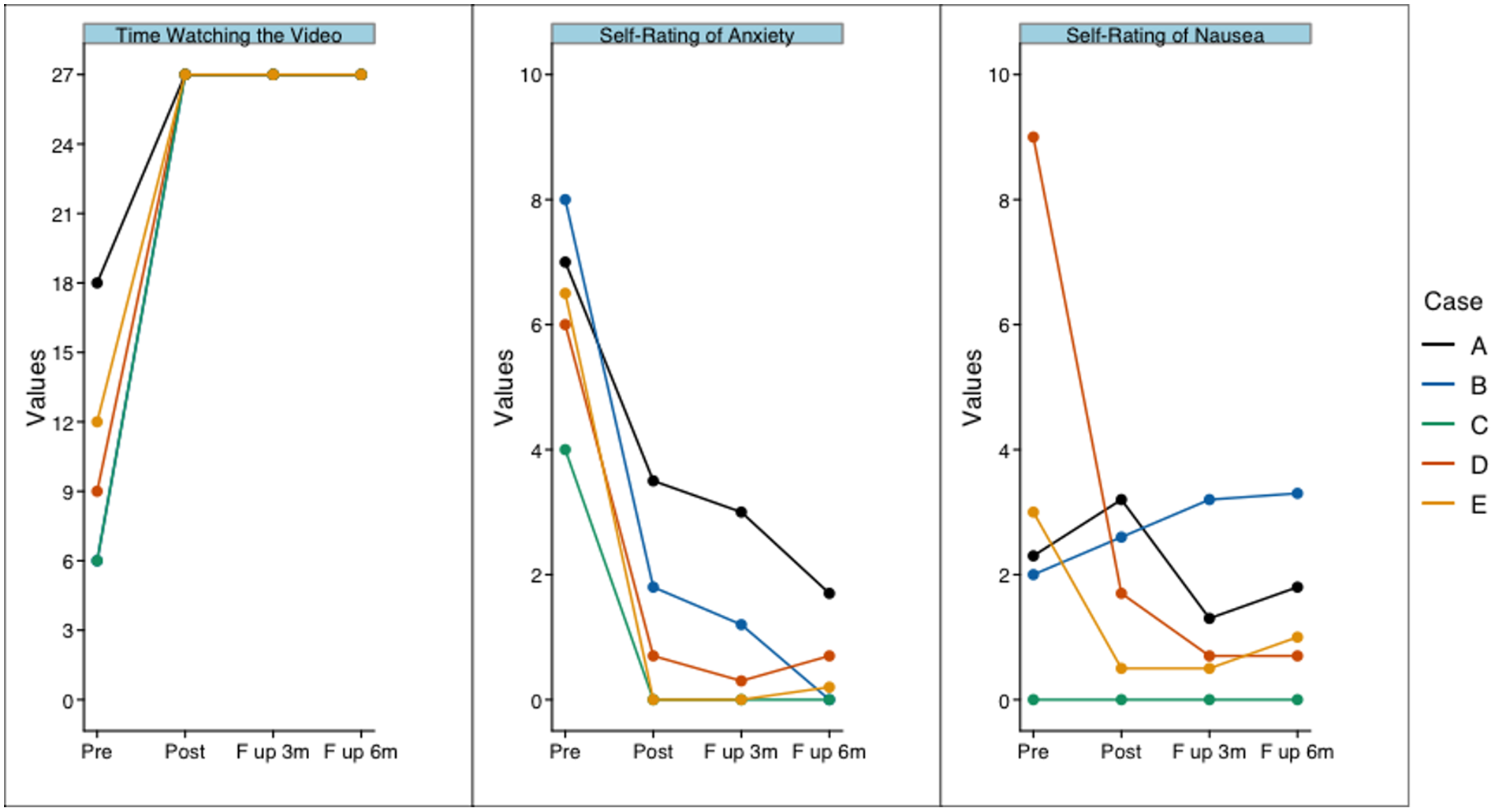
The behavioural test (emetophobic-stimuli video) was administered only once during the pre-treatment baseline to avoid the risk of habituation due to repeated watching of the video. As can be seen in Fig. 2, there is a clear increase in the amount of time participants were able to watch the video; none could complete it pre-treatment whereas all completed it post-treatment. These results were maintained at follow-up. There was also a clear decrease of self-reported anxiety while watching the video, which was also maintained at follow-up. There was more variability in self-reported nausea between the different assessment points.
Time watching the emetophobic-stimuli video (left), self-rating of anxiety (middle) and self-rating of nausea (right) during the behaviour task pre- and post-treatment, and at 3- and 6-month follow-up assessments.
Measures of anxiety sensitivity, generalized anxiety and depression
There was a clear reduction of scores on anxiety sensitivity (ASI) from pre-treatment to post-treatment which was not seen for three of the patients during baseline, as seen in Table 2, although patient C demonstrated a slight increase in scores at 3-month follow-up, which were reduced again at 6-month follow-up. All participants were within normal range on ASI at 6-month follow-up compared with having scores at the level for panic disorder patients at pre-treatment.
Pre-treatment and follow-up results on questionnaires

1, baseline 1; 2, baseline 2; 3, one week post-treatment; 4, three months post-treatment; 5, six months post-treatment; ASI, Anxiety Sensitivity Index; GAD-7, Generalized Anxiety Disorder-7; PHQ-9, Patient Health Questionnaire; DPSS-R-12, The 12-Item Disgust Propensity and Sensitivity Scale-Revised; DOCS-SF, The Dimensional Obsessive-Compulsive Scale-Short Form; QOLS, Quality of Life Scale; BIBQ, Brief Illness Perception Questionnaire; WSAS, Work and Social Adjustment Scale.
There was no clear trend on symptoms of generalized anxiety from pre- to post-treatment as measured by GAD-7, as can be seen in Table 2. All participants were somewhat less anxious post-treatment but slightly more anxious at follow-up, although at most moderately anxious. The same goes for depression as measured by PHQ-9, where symptoms were at mostly mild at follow-up.
Symptoms of disgust propensity/sensitivity and OCD
There was a clear trend on disgust propensity and sensitivity from pre-treatment to post-treatment as measured by DPSS-R-12 (see Table 2), with all participants demonstrating less propensity and sensitivity to disgust post-treatment. These findings were maintained at follow-up for four of the participants.
There was also a downward slope for participants on DOCS-SF; their OCD symptoms were less post-treatment and at follow-up. All were below the suggested cut-off score of 16 for OCD post-treatment (Eilertsen et al., Reference Eilertsen, Hansen, Kvale, Abramowitz, Holm and Solem2017) and all but participant C at 6-month follow-up. All participants were above this cut-off score for OCD pre-treatment.
Quality of life and impact of SPOV
There was a slight upward trend on scores of quality of life and all participants but one were within normal limits on the scale post-treatment. There was a downward trend on scores of BIP-Q from treatment to post-treatment, meaning that the participants experienced their symptoms of SPOV less burdensome post-treatment. Four of the participants were significantly impaired by SPOV pre-treatment as measured by WSAS (scores above 10 points) but only one participant at post-treatment and at 6-month follow-up.
Client satisfaction
The Client Satisfaction Questionnaire (CSQ-8) indicated that four of the five participants were very satisfied with the treatment, obtaining the highest possible score of 32 points. Participant C obtained 19 points and was moderately satisfied. Four out of five rated the quality of service they received as excellent, felt that they had definitely got the service they needed and would clearly recommend it to a friend. The fifth participant rated the treatment as fair and had not really obtained the service she needed; she did not think she would recommend the treatment to a friend. All stated that they preferred concentrated treatment to weekly sessions.
Discussion
The aim of the present study was to evaluate the feasibility and effectiveness of the Bergen 4-day treatment (B4DT) in treating five Icelandic patients suffering from SPOV. All participants, meeting criteria for SPOV, were offered the treatment, regardless of performance on the behaviour avoidance test (BAT), as it is quite possible that someone with SPOV could perform well on the test as those were not ‘real life circumstances’. Four participants obtained clinically significant change post-treatment and at 6-month follow-up on measures of SPOV-symptoms, and the fifth participant achieved reliable improvement. All participants performed better on the BAT post-treatment and at 6-month follow-up. Participants were able to watch the entire video post-treatment but were unable do so pre-treatment. Importantly, they were less anxious while watching the video at post-treatment and 6-month follow-up.
The BAT was effective in provoking the SPOV pre-treatment as can be seen in the short amount of time participants managed to watch the video and the amount of anxiety it provoked. The video also induced nausea in four out of five participants, which ought to have provoked the fear of themselves vomiting, not merely their fear of others doing so.
The fact that all participants managed to watch the whole 27-minute video ending with close-ups of people vomiting, raises the questions as to whether there was a ceiling effect on the BAT, at post-treatment and follow-up. This is hard to say, but it does not detract from its ability to measure change as the participants increased their viewing time between 50 and 350%. Watching vomiting scenes as in the final part of the video is something none of the participants had been able to do since the onset of their phobia. It would have been difficult to design a BAT that more accurately simulated the situations emetophobic individuals fear the most, like a family member getting a stomach illness or having to clean up someone’s vomit at work. The BAT may have had its limitations, but its results are in line with changes on questionnaires evaluating symptoms of SPOV.
Interestingly, the nausea the BAT provoked remained similar post-treatment. The participants may thus have become less fearful of feeling nauseous. They scored lower on a measure of disgust sensitivity, meaning they were less bothered by the experience of disgust at post-treatment. This is important as it may be predictive of lower avoidance of SPOV stimuli in the future (van Overveld et al., Reference van Overveld, Jong and Peters2010). The fact that the participants scored lower on measures of disgust (DPSS-R-12) post-treatment, despite this not being targeted specifically in the treatment, is interesting. However, it is common that treatments that target specific anxiety problems bring about change in other aspects, like measures of quality of life and depression (Öst et al., Reference Öst, Enebrink, Finnes, Ghaderi, Havnen, Kvale, Salomonsson and Wergeland2022). These findings suggest that participants were less triggered by SPOV stimuli by the end of treatment, and that intense and time-limited exposure therapy may be a promising approach to treating SPOV. This treatment may be just what Riddle-Walker et al. (Reference Riddle-Walker, Veale, Chapman, Ogle, Rosko, Najmi, Walker, Maceachern and Hicks2016) called for, a more intensive program with greater therapy assisted exposure, which they concluded that some patients might need to reach optimal outcome. It is, however, too early to tell, as further studies on B4DT for SPOV are needed as well as a comparison with other treatment formats for SPOV.
Interestingly, the participants scored as high as patients with panic disorder (Zinbarg et al., Reference Zinbarg, Mohlman, Hong and Taylor1999) on anxiety sensitivity pre-treatment, which means that their fear of physical sensations was very high pre-treatment. All scored within normal limits on the scale post-treatment, which might mean that their tendency to interpret physical sensations in a catastrophic way was lessened by the treatment. The high scores on ASI pre-treatment are in line with the studies that point to similarities between SPOV, health anxiety and panic disorder in the vigilance to, and catastrophic misinterpretation of, physical sensations (Veale and Lambrou, Reference Veale and Lambrou2006).
One participant that was offered treatment never attended any treatment sessions and found the idea of participating in the treatment too stressful. It is possible that a proportion of SPOV-sufferers are highly avoidant of treatment, perhaps due to high anxiety sensitivity. It is, however, impossible to draw conclusions based on such a small sample.
The participants’ scores on DOCS-SF were above the cut-off for OCD pre-treatment even though they did not fulfil the diagnosis for OCD. This is in line with the idea that there are features in SPOV that are shared with OCD, like ritualistic behaviour and magical thinking, and that the disorder, might perhaps, as Veale et al. (Reference Veale, Hennig and Gledhill2015) suggested, in severe cases be conceptualized as a form of OCD.
Four of the participants were no longer significantly impaired by the disorder post-treatment, and the fifth participant was slightly impaired. Four of the participants were very satisfied with the treatment and one was moderately satisfied. This suggests that B4DT may be particularly suitable for persistent and severe anxiety disorders where ritualistic behaviour is part of the picture.
The strength of the current study was its naturalistic setting, implemented in a private anxiety centre, and thus has a high generalizability to treatment as it occurs in situ. The patients paid for the treatment, whereas the trials of B4DT for OCD were free of charge and part of general health care delivery. Participants at a private clinic may be better off in some ways compared with a sample recruited within the national health care system. The participants in the study may, for example, have been more motivated to work on their problem, having paid for the treatment themselves to a large extent. They may thus not represent the population at large but are probably representative of most patients in Iceland who must finance psychological treatment out of pocket. However, this is not possible to investigate, as this treatment is not available within that system. The SPOV-scores of the participants in this study were, however, somewhat higher on two separate measures pre-treatment, than in other studies (Åhlén et al., Reference Åhlén, Edberg, Di Schiena and Bergström2015; Keyes et al., Reference Keyes, Deale, Foster and Veale2020; Riddle-Walker et al., Reference Riddle-Walker, Veale, Chapman, Ogle, Rosko, Najmi, Walker, Maceachern and Hicks2016).
Although the study did not contain a control group, it did utilize a double pre-test and a 6-month follow-up, suggesting that changes on symptoms of SPOV were probably due to the treatment and just not repeated assessment. A longer follow-up than 6 months would of course have been optimal, to ascertain that treatments gains were maintained in the long run. To further establish this finding in future studies, a randomized controlled study is needed. Another limitation of the current study was the lack of blind assessors. The therapists administered the measures and both participants and therapists may thus have been affected by expectations of treatment outcome. Nonetheless, improvement on a behavioural test of SPOV indicates that there were real improvements associated with the treatment rather than expectation effects.
The current study also lacked information on diagnostic status following treatment. Symptoms of SPOV were reduced but it is still unclear whether participants met criteria for SPOV following treatment. Improved performance on the behavioural test suggests that participants were less triggered by emetophobic stimuli post-treatment, suggesting that the treatment was successful in reducing the severity of the disorder. It should also be stressed that the exploratory nature of the study and small sample size limits the inference of treatment effectiveness of the current B4DT adaptation for SPOV. Further research is needed using larger sample sizes, in different controlled settings and utilizing a longer follow-up period to better ascertain treatment effectiveness and whether gains are maintained over time.
Taken together, the current findings suggest that the B4DT may be a feasible treatment option for people suffering from SPOV. Further research is needed to investigate this.
Data availability statement
Data are available upon request.
Acknowledgements
The authors would like to thank the Memorial and Science Fund of Arnór Björnsson and the Kavli Trust for their support.
Author contributions
Sóley Dröfn Davíðsdóttir: Conceptualization (lead), Formal analysis (lead), Investigation (lead), Project administration (lead), Writing - original draft (lead), Writing - review & editing (lead); Kristján Helgi Hjartarson: Methodology (supporting), Writing - review & editing (supporting); Sigurbjörg Jóna Ludvigsdóttir: Investigation (supporting), Writing - review & editing (supporting); Ásmundur Gunnarsson: Investigation (supporting), Writing - review & editing (supporting); Sigurður Viðar: Writing - review & editing (supporting); Gerd Kvale: Project administration (supporting), Supervision (supporting), Writing - review & editing (supporting); Bjarne Hansen: Supervision (supporting), Writing - review & editing (supporting); Kristen Hagen: Supervision (supporting), Writing - review & editing (supporting); Lars-Göran Öst: Methodology (supporting), Supervision (supporting), Writing - review & editing (supporting).
Financial support
The study was funded by the Kavli Trust and the Memorial and Science Fund of Arnór Björnsson.
Competing interests
There are no competing interests reported by the authors.
Ethical standards
Ethics approval was obtained from the Icelandic ethical board (VSN-21-223) and the Norwegian (REK-West) regional ethical committee (417836), and the research has conformed to the Declaration of Helsinki.
Appendix


 Open access


Comments
No Comments have been published for this article.