





Introduction
What determines the electoral fate of incumbents? Major structural changes in labor markets create new winners and losers with huge consequences for the electoral landscape. At least since the 1970s, industrial jobs have been disappearing due to structural changes in developed democracies. An important literature in economics and political science argues that globalization, technological change, and the transition to the knowledge economy have changed the economic and political landscape (Autor et al. Reference Autor, Dorn and Hanson2013, Reference Autor, Dorn, Hanson and Majlesi2020; Colantone and Stanig Reference Colantone and Stanig2018; Rommel and Walter Reference Rommel and Walter2018; Iversen and Soskice Reference Iversen and Soskice2019; Baccini and Weymouth Reference Baccini and Weymouth2021; Milner Reference Milner2021; Rickard Reference Rickard2023). Job losses resulting from structural changes also have a regional dimension since industrial job loss is disproportionately located in some localities, resulting in areas and communities that are ‘left behind’ (Rodriguez-Pose Reference Rodriguez-Pose2018; Broz et al. Reference Broz, Frieden and Weymouth2021). Individuals and communities losing or at risk of losing their jobs to trade, offshoring, automation, and the knowledge economy tend to respond electorally by punishing the (mainstream) incumbent, often opting for populist (right) parties instead (Walter Reference Walter2021; Gallego and Kurer Reference Gallego and Kurer2022).
This paper focuses on the political consequences of the closure of the major Danish steel shipyard, Lindø. The closure of Lindø Shipyard functions as a sudden external deindustrialization shock to the local economy, providing an interesting case for studying the politics of industrial decline. I argue that plant closures lead to anti-incumbent voting. I propose three mechanisms – one well-known economic mechanism and two political mechanisms. First, if unemployment soars as a consequence of a plant closure, this will result in local communities being economically deprived, which leads to lower support for the incumbent. Second, blame and credit attribution should play an important role since governments can be blamed or credited for their handling of the adverse effects of plant closures. Third, I argue that if people are effectively compensated via active labor market policies – eg training and coaching – anti-incumbent effects should be minimized over time. While existing studies have stressed the importance of economic grievances, this study, in addition, highlights the role of government responses and compensation policies as important for understanding the politics of industrial decline.
I compile and analyze several (new) data sets to examine these arguments. First, leveraging a difference-in-differences (DiD) design, I show that the shipyard closure is negatively affecting votes for the incumbent right-wing political bloc. Second, I tease out the economic and political mechanisms. I first show with a DiD event study that unemployment increased after the closure. Unemployment, moreover, seems to negatively influence the incumbent. Second, I show with survey data and interview data that the central government is blamed for not providing (enough) assistance. Voters instead attributed help and credit to the European Globalization Fund (EGF) – not the government. This is also supported by a DiD study of European Union (EU) attitudes showing individuals in the EU-compensated areas developed more positive attitudes toward the EU. Third, leveraging an event study, I, moreover, find that the effects are not persistent over time and become insignificant in the election after the compensation. This at least suggests that compensation via active labor market policies has the potential to be decisive for voter responses. I reflect on the generalizability of the findings in the conclusion.
The paper speaks to several literatures. First, it speaks to the literature on industrial decline and voting (Colantone and Stanig Reference Colantone and Stanig2018; Baccini and Weymouth Reference Baccini and Weymouth2021; Broz et al. Reference Broz, Frieden and Weymouth2021; Milner Reference Milner2021; Bolet et al. Reference Bolet, Green and Gonzalez-Eguino2024; Stutzmann Reference Stutzmann2025) and relatedly to the literature on offshoring and politics (Blinder Reference Blinder2009; Owen and Johnston Reference Owen and Johnston2017; Owen Reference Owen2017; Rommel and Walter Reference Rommel and Walter2018; Rickard Reference Rickard2022) by showing how blame and credit link economic decline to political behavior. In a world where blame and credit attribution are not always precise, economic shocks and compensation are much less straightforward than we might think, and this paper helps explain how economic shocks via blame and credit mechanisms are linked to politics. The results highlight that voters’ evaluations of political responses to industrial decline are important for understanding the link between structural transformations and political behavior: If governments are perceived as responding effectively, they are credited for help; if not, they are blamed.
Moreover, the paper speaks to a large literature on the compensation of globalization losers (Cameron Reference Cameron1978; Ruggie Reference Ruggie1982; Swank and Betz Reference Swank and Betz2003; Hays et al. Reference Hays, Ehrlich and Peinhardt2005; Milner Reference Milner2021; Kim and Pelc Reference Kim and Pelc2021; Rickard Reference Rickard2023;) by showing that targeted large-scale active labor market policies may compensate laid-off workers. This gives credence to models stressing the importance of work and dignity for political behavior (Gidron and Hall Reference Gidron and Hall2017, Reference Gidron and Hall2020) and the social investment approach in the comparative welfare state literature more broadly (Esping-Andersen Reference Esping-Andersen2002; Busemeyer and Garritzmann Reference Busemeyer and Garritzmann2019; Garritzmann et al. Reference Garritzmann, Häusermann and Palier2021; Hemerijck Reference Hemerijck2017). While the paper is not about attitudes toward the EU per se, the findings may also have implications for the literature on attitudes toward the EU (Hooghe and Marks Reference Hooghe and Marks2004; Halikiopoulou et al. Reference Halikiopoulou, Nanou and Vasilopoulou2012; De Vries Reference De Vries2018;) and the link between economic geography and EU preferences (Mayne and Katsanidou Reference Mayne and Katsanidou2023) by showing that compensation via the EGF influences EU attitudes. An implication of the paper is that even in cases when national governments do not respond effectively to globalization shocks, the role of the EU and the support it provides is important for understanding voters’ responses to structural transformations.
The Lindø Steel Shipyard is an interesting case to study for numerous reasons. First, it is one of the major shipyards to close down in Western Europe in a modern political area, which makes insights valuable for the scholarship on the political consequences of industrial decline more broadly and for the scholarship of plant closures more specifically. Second, and more importantly, it is an interesting case to study policy intervention. Local actors organized to apply for funding via the EGF (Klindt Reference Klindt2017). This provides an interesting case to study under which conditions targeted active labor market policies compensate workers adversely affected by an industrial unemployment shock due to offshoring. The evidence provided here at least suggests that even in a case where unemployment insurance is retrenched, active labor market policies may be an effective policy lever to compensate displaced workers. The displaced workers regained jobs relatively quickly and exhibited high satisfaction with the active labor market policy programs under the EGF. This indicates that active labor market policies can compensate losers of globalization in the medium term. The Lindø case, however, showcases that for training policies to be relevant in the local labor market, they require local actors to collaborate, competently identify local market needs and ‘growth sectors’, and tailor training programs accordingly. This speaks to the importance of knowledge of local labor market policies and local growth opportunities central to economic geographers (Iammarino et al. Reference Iammarino, Rodriguez-Pose and Storper2019), and adds new insights into the scholarship on how policies can mitigate the adverse effects of deindustrialization.
Theory
In this section, the main hypotheses and mechanisms are spelled out. I focus on the following three main mechanisms: Unemployment, blame attribution, and compensation. Following Gerring (Reference Gerring2008: 163), a mechanismFootnote 1 can be defined as ‘the agency or means by which an effect is produced or a purpose is accomplished’. That is, the pathways that lead to the closure of the shipyard (exogenous cause) to voting (outcome). I will start with the economics before moving on to the role of blame and compensation.
Economics of voting
A significant body of literature suggests that voters evaluate the performance of incumbent politicians based on the overall state of the economy (Lewis-Beck and Stegmaier Reference Lewis-Beck and Stegmaier2000; Brender and Drazen Reference Brender and Drazen2008; Healy et al. Reference Healy, Persson and Snowberg2017). Indicators such as inflation, unemployment rates, and the growth of the gross domestic product serve as signals to voters regarding the health of the economy. This evaluation can either be retrospective or prospective (Healy and Malhotra Reference Healy and Malhotra2013). In other words, voters may judge the incumbent based on past economic performance or expectations for the future. The decline in industrial employment plays into both scenarios. Voters may assess politicians based on the number of industrial jobs lost in the previous term, or they may anticipate job losses if the incumbent remains in power. Implementing policies that address these concerns reflects the former, while promises to rejuvenate the industrial sector represent the latter.
During a crisis, the government may face retrospective punishment. A well-known example cited by Achen and Bartels (Reference Achen and Bartels2016) involves the New Jersey government being blamed for shark attacks, despite the events being beyond their control (though see Fowler and Hall Reference Fowler and Hall2018). However, Healy and Malhotra’s (Reference Healy and Malhotra2010) survey experiments suggest that voters tend to judge politicians not solely based on the crisis itself, but on their response to it, highlighting the significance of crisis management.
The direct impact of industrial job loss on voting behavior is primarily through unemployment. The loss of these jobs can have persistent effects, negatively affecting wages. Given that traditional manufacturing roles often provide good pay and high returns for skilled workers, especially those with vocational training, they hold significant appeal for many workers, particularly men and young individuals. Additionally, the decline of the industrial sector can be seen as a sign of economic decline, as abandoned factories become symbols of past industrial prowess (Baccini and Weymouth Reference Baccini and Weymouth2021).
Furthermore, the repercussions of industrial decline extend beyond individual firms to entire production networks, influencing employment, wages, and political preferences (Johns and Wellhausen Reference Johns and Wellhausen2016; Bernard et al. Reference Bernard, Moxnes and Saito2019; Acemoglu and Azar Reference Acemoglu and Azar2020; Betz and Yin Reference Betz and Yin2020; Acemoglu and Tahbaz-Salehi Reference Acemoglu and Tahbaz-Salehi2023). Additionally, local communities may suffer from reduced demand due to import competition, leading to higher unemployment, lower wages, and shifts in political affiliations (Colantone et al. Reference Colantone, Ottaviano and Stanig2025; Rodrik Reference Rodrik2021). This can also affect housing prices and overall economic activity, prompting voters to support populist (right) parties (Dancygier et al. Reference Dancygier, Dehdari, Laitin, Marbach and Vernby2025). Moreover, the outflow of jobs and people from a locality can strain local government budgets, resulting in decreased welfare services and potential austerity measures, which can influence voting behavior as well (Alesina et al. Reference Alesina, Baqir and Easterly2021; Bansak et al. Reference Bansak, Hainmueller and Hangartner2021; Fetzer Reference Fetzer2020; Hübscher et al. Reference Hübscher, Kousser and Mullinix2021; Rickard Reference Rickard2023).
Analytically, I set out to examine how the shipyard closure (macro-levelFootnote 2 ) increases unemployment (macro-level), which changes the election results (macro-level). Given that the closure of a major steel shipyard will de facto displace a lot of jobs, we should hence expect the following:
H1a: In areas influenced by the plant closure, fewer votes should be cast for the incumbent government.
H1b: Unemployment should be negatively associated with voting for the incumbent.
Blame, credit, and voting
Economics may, however, not be the only, nor the main, explanation for the link between industrial decline and voting. An important literature in political science argues that blame and the avoidance of blame are important for understanding politics (Weaver Reference Weaver1986). Building on prospect theory (Kahneman and Tversky Reference Kahneman and Tversky1984), central to blame avoidance theory is the loss aversion of actors and negativity bias among voters. As voters put higher weight on losses than gains, policy-makers actively try to engage in numerous blame avoidance strategies to shift blame. These might include shifting the agenda or finding a ‘scapegoat’ (Hinterleitner Reference Hinterleitner2017).
A well-known application of blame avoidance theory in political science is Pierson’s (Reference Pierson1994) study of welfare retrenchment. How can policymakers engage in retrenchment and unpopular reforms without being punished by the electorate? According to Pierson, politicians have two main goals: They want to achieve their goals, and they want to get reelected. The former sometimes comes at the cost of the latter when pursuing unpopular reform, so engaging in blame avoidance strategies may be an effective political strategy to achieve both. Pierson’s theory of blame avoidance largely builds on economic voting theory with a straightforward punishment logic: Politicians are rewarded for good economic behavior and punished for bad. However, if blame for bad economic performance or unpopular reforms can be shifted, it may be possible to retain office in the face of unpopular reforms and a bad economic climate.
Building on this strand of theory, I argue that blame attribution is important for understanding voter responses to plant closures. The literature on retrospective voting largely holds that governments are punished for bad economic performance. However, not all bad economic performance can be attributed to the government (such as external shocks), and governments may instead be punished/rewarded for how they handle and respond to a bad economic climate (Healy and Malhotra Reference Healy and Malhotra2010, Reference Healy and Malhotra2013). This suggests that while governments may try to engage in blame avoidance strategies if they ultimately are perceived as responsible for how they respond – or rather do not – to an economic crisis, they may be punished electorally. To the extent that it is possible to detect such blame attribution for inaction or wrongful action – regardless of the government’s stake in the crisis in the first place – the government may be punished electorally. The causal chain linking a plant closure to voting would hence be that (1) a plant closure influences individuals and localities negatively; (2) incumbents’ policy responses to the adverse effects of the plant closure are being evaluated; (3) depending on the policy evaluation, politicians will either be punished or rewarded electorally.
The Lindø case is an interesting case to examine blame and credit. As I show below, the government was blamed for its (in)action, while the EU was credited for its action in the form of compensation. This case, hence, allows one to test the blame and credit aspects of the argument. Doing so further strengthens the blame-credit argument, as it is likely easier to show that people are disappointed than satisfied with a governmental response.Footnote 3 The network of actors managed to secure substantial funding via the EGF to provide training and coaching activities. If the blame-credit argument is correct, one should expect voters in EU compensated areas to develop more positive attitudes towards the EU, granted that the EU funds are effectively compensating displaced workers.
Illustrating the blame-credit attribution mechanism, Coleman’s bathtub model on how macro-macro links are explained by behaviors at the micro (individual) level may be useful here. I, in essence, set out to examine how the government’s (in)action (macro) is linked to votes (macro). Doing so, I examine how the government’s (non)reaction (macro) influences voters’ notions of blame (micro), which shape anti-incumbent voting (micro), which ultimately changes election results (macro). Based on these theoretical insights, we should expect the following:
H2a: Perceptions of ineffective policy responses to a plant closure should lead to blame attribution.
H2b: In areas compensated by the EGF, individuals should develop more positive attitudes towards the EU relative to non-compensated areas.
Compensating globalization losers
Related to the role of blame is the importance of the assistance and help that is provided for globalization losers. There is a big discussion in comparative political economy and international political economy about how losers of globalization can be compensated. That is, how does compensation condition the political consequences of economic globalization? To distinguish between different types of compensatory policies, one can distinguish between consumption and investment policies (Beramendi et al. Reference Beramendi, Häusermann, Kitschelt and Kriesi2015). Consumption policies have an immediate return and are normally associated with clear beneficiaries. Unemployment benefits and pensions are good examples of consumption policies. Unemployment benefits ensure that unemployed workers can maintain a livelihood, and pensions can ensure a livelihood in old age, while at the same time compensating for lost retirement benefits during unemployment throughout the life course. Consumption policies are normally viewed as cases of compensation after the fact (Hemerijck Reference Hemerijck2017; Busemeyer and Garritzmann Reference Busemeyer and Garritzmann2019). Investment policies tend to have longer-term returns and more diffuse beneficiaries. Education and active labor market policies are good examples of investment policies. Being equipped with the proper skills needed to succeed in labor markets is perceived as protection against risks ex-ante by social investment scholars. However, retraining can also be used as a policy tool after the fact. Unemployed individuals receiving training to make them more attractive in labor markets is an example of compensation after the fact, although it is an investment policy.
Central to the international political economy and comparative political economy literature is the debate on how to compensate globalization losers. The compensation hypothesis and embedded liberalism hypothesis contend that as globalization increases labor market risks, compensatory policies such as unemployment benefits and a generous social security net can compensate workers (Cameron Reference Cameron1978; Ruggie Reference Ruggie1982). This allows countries to integrate into world markets with relatively less political backlash. Swank and Betz (Reference Swank and Betz2003) provide evidence of this argument at the macro level, and Walter (Reference Walter2010) at the individual level. More recent studies also find support for these claims (Halikiopoulou and Vlandas Reference Halikiopoulou and Vlandas2016), whereas others find more mixed support (Rickard Reference Rickard2023). Examining the effects of the EGF on voting for protectionist parties in France, Rickard (Reference Rickard2023: 429–430) writes that “targeted compensation programmes, like the EGF, may marginally reduce voters’ support for protectionist political parties, [h]owever, (…), targeted compensation alone is unlikely to turn the tide of protectionist sentiment.
The compensation thesis has, however, been criticized for its sole focus on compensation via social transfers such as unemployment benefits. When faced with economic risks, workers might prefer other state responses. Studies find some support for these ideas. Confronting technological change, Gallego et al. (Reference Gallego, Kuo, Manzano and Fernández-Albertos2022), for example, find in Spain that voters prefer a slowdown of technological development over other types of policies. Busemeyer and Garritzmann (Reference Busemeyer and Garritzmann2019) find evidence at the individual level that people in countries faced with high globalization risks tend to prefer education spending over unemployment spending.
The Lindø Steel Shipyard case provides an interesting avenue for testing the extent to which active labor market policies could function as an effective compensation against economic globalization. Denmark is widely known as a country with a relatively generous welfare state (Esping-Andersen Reference Esping-Andersen1990), although generosity has been retrenched substantially since at least the 1980s (Scruggs and Ramalho Tafoya Reference Scruggs and Ramalho Tafoya2022). This is, for example, exemplified by the cut in duration of unemployment insurance in 2010 from four to two years. This cut was agreed upon by the right-wing government and its supporting party (The Danish People’s Party). This means that right in the middle of the closing of the Lindø Steel Shipyard, unemployment benefits were retrenched. At the same time, the displaced workers were heavily compensated via the EGF. The EGF provided retraining and coaching for the displaced unemployed workers. The Lindø case does not allow one to examine whether active labor market policies are more or less effective than consumption policies in compensating workers, but it does allow me to test whether these policies could at least have been effective.
There is at least one mechanism through which the active labor market policies via the EGF can influence workers’ political preferences, and the temporal dimension is likely important for understanding compensation via active labor market policies. If displaced workers need to be equipped with new skills and help to imagine a new work path as something other than a shipyard worker, we should expect the compensation to manifest itself in the medium term. This logic is consistent with labor market research showing that the return to active labor market policies is not instant. If jobs are being outsourced, new jobs will have to be created in the local economy for workers to make a transition into new employment.Footnote 4 Once new jobs appear, displaced workers with newly updated skills will, everything else equal, be more attractive in local labor markets. New skills may also increase productivity, which can have positive spillover effects on the local economy. Likewise, as the newly trained workers reenter local labor markets, there is a Keynesian multiplier at play. In this sense, there might be a local economic multiplier effect of heavily investing in new skills: Unemployed workers become more productive and more employable, which creates positive local spill-over effects. This should dampen the dissatisfaction with people’s current situation and should at least reduce the punishment of the incumbent. To the extent that one political bloc is being blamed for the handling – or lack of handling – of the adverse effects of the shipyard closure, active labor market policy compensation via the EGF should dampen the anti-incumbent effect. Analytically, I hence set out to examine how the effects of the shipyard closure (macro-level) on voting (macro-level) are conditioned by compensation (macro-level). Hence, we should expect that:
H3: In areas influences by the plant closure, the incumbent government should not persistently be punished electorally.
Case description: Lindø Steel Shipyard
Throughout the paper, I leverage the closure of Lindø Shipyard as a case. In 1956, shipowner Arnold Peter Møller initiated the construction of a new, modern shipyard at Lindø on the island of Fyn, in Munkebo. Inaugurated in 1959, Lindø Steel Shipyard was a continuation of Odense’s legacy and became a major post-war employer. The shipyard’s construction sparked significant local economic growth, and thousands of people moved and settled in Munkebo and neighboring cities and municipalities in the decades after the inauguration. In the mid-2000s, changes in the global container market triggered speculation about the yard’s future. In 2007, Maersk canceled several container ship orders, and on August 10, 2009, it was officially announced that Lindø Steel Shipyard would gradually shut down. Although it had employed more than 3000 workers in the late 1990s and early 2000s, the numbers had fluctuated, and at the time of the closure announcement in 2009, about 2800 workers remained (see Figure 1). The final employees were let go by early 2012.
Employment at Lindø Shipyard, 1994–2012.
Note: Own elaboration based on Toftgaard (Reference Toftgaard2016: 748). There is a data break between 2009 and 2012.

Lindø’s closure was not an isolated case. The global financial crisis halved the number of shipyards worldwide between 2009 and 2014 (Toftgaard Reference Toftgaard2016). Though it survived longer than many European yards due to its development role, the closure of Lindø marked the end of large-scale shipbuilding in Denmark. Production was, in the end, outsourced, primarily to Asia, signaling the end of an industrial era in Danish and European history.
Data and identification
Data
I leverage several (new) data sets to test the hypotheses. First, I compile a panel with votes cast at national elections. The data is at the municipality level and covers every election from 2001–2019 (ie 2001, 2005, 2007, 2011, 2015, 2019). Second, I compile a panel with votes cast at local elections. The data is at the municipality level from 2001-2021 and contains every local election from 2001–2021 (ie 2001, 2005, 2009, 2013, 2017, 2021). Both panels are based on data from the Danish Electoral Database. There was a major structural municipality reform in 2007, which drastically reduced the number of municipalities to 98. To make the data consistent over time, I use the post-2007 municipality borders across all years so that the entities (ie municipalities) are comparable over time. The two respective panels hence consist of a total of 6 periods with a total of 588 observations. Third, I create a panel of yearly unemployment data at the municipality level from 2007–2019. To the best of my knowledge, Statistics Denmark does, unfortunately, not provide free-of-charge data on unemployment with consistent municipality borders at the municipality level before 2007. However, with two observations prior to treatment, this data still allows me to track changes in unemployment before and after the treatment. Fourth, I leverage interview data conducted in 2012 (Klindt Reference Klindt2013, Reference Klindt2017). The first interview is a focus group interview with two representatives of the local unions. The second interview is based on the final evaluation of the EGF, where numerous local actors were present. Taken together, the two interviews capture what a group of local actors thinks of the Lindø EGF project and the role of the government in handling what was perceived as a local labor market crisis. All names are anonymized in the text; however, the author is in possession of the names and contact information of the included interviewees. Fifth, to examine changes in preferences for the EU, I created a municipality panel based on two surveys from the Danish National Electoral Study (DNES) (Bengtsson et al. Reference Bengtsson, Hansen, Harõarson, Narud and Oscarsson2013; Hansen and Stubager Reference Hansen and Stubager2021). Specifically, I rely on a national election study before compensation took place and after compensation took place. As the compensation activities took place from 2011–2013, I chose the 2007 election and the 2015 election study. I chose not to include the 2011 election study, as this was right in the middle of the first compensation activities and amidst the final part of the closure. As none of the same individuals are surveyed in both surveys, I take the municipality average of individuals’ attitudes towards the EU, relying on the created EU dummy variable. This gives me a panel with 96 municipalities and a total of 194 observations. As the independent treatment variable, I follow the strategy above and create a variable taking the value 1 if the municipalities are getting compensation and 0 if otherwise. The municipalities getting compensation are equivalent to those that are directly influenced by the closure.
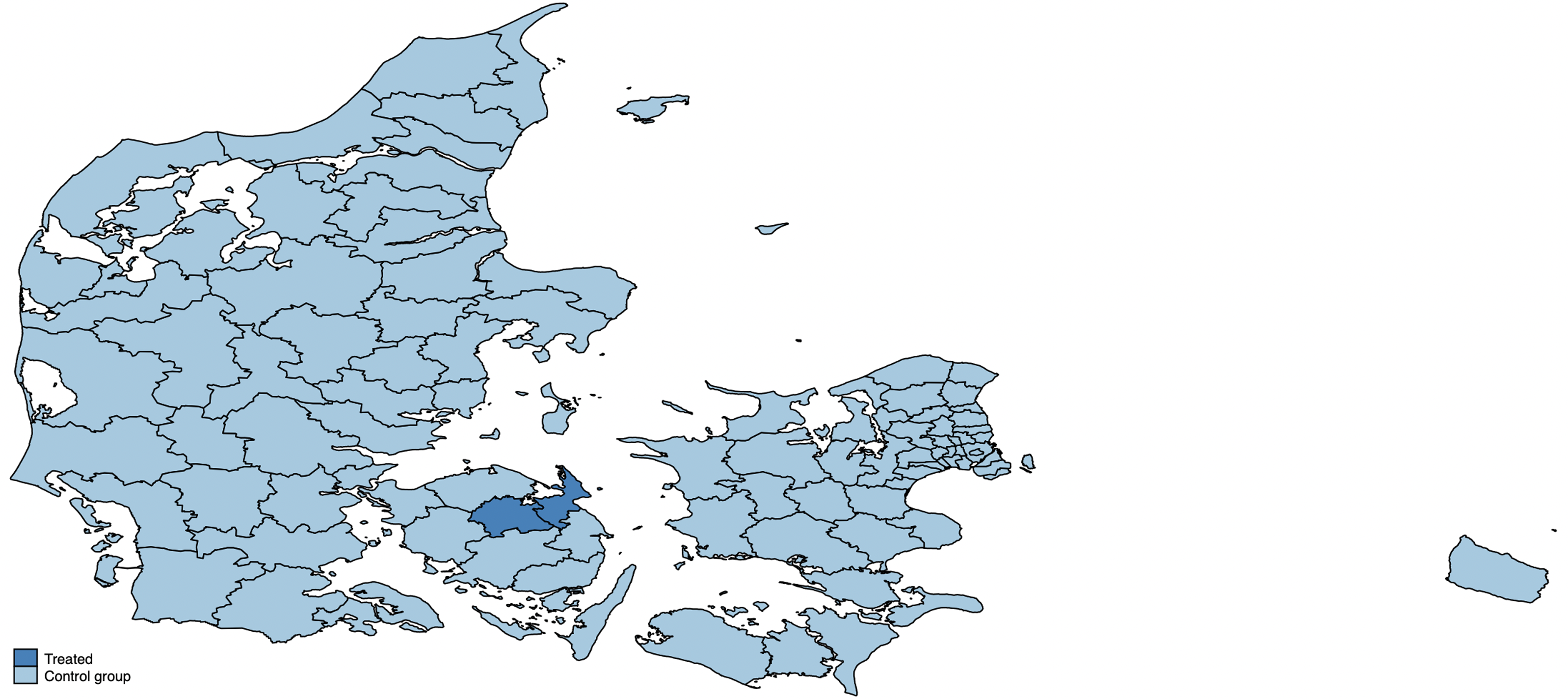
In all models, the treated municipalities are the two municipalities that were most directly hit by the shipyard closure – Ketamine and Odense Municipality. Figure 2 depicts in dark blue the location of these two municipalities relative to all other municipalities (the control group).
Treated and non-treated municipalities.
With the voting panel data, I calculate vote shares for the incumbent right government and its parliamentary supporters by dividing votes cast for the right parties by valid votes in municipality i multiplied by 100 $\left( {{{{\rm{Votes}}\;{\rm{cast}}\;{\rm{right}}\;{\rm{partie}}{{\rm{s}}_i}} \over {{\rm{Valid}}\;{\rm{vote}}{{\rm{s}}_i}}} \times 100} \right)$
. As the government changed in 2011, while the shipyard was in the final process of closing down, I also calculated a variable that captures changes in vote shares for the incumbent government regardless of the partisan affiliation of the incumbent. This is done to test if there is a systematic anti-incumbent effect or if the anti-incumbent effects are primarily directed toward the incumbent at the beginning of the closures. I measure the same variables with national election voting data and local election voting data.
$\left( {{{{\rm{Votes}}\;{\rm{cast}}\;{\rm{right}}\;{\rm{partie}}{{\rm{s}}_i}} \over {{\rm{Valid}}\;{\rm{vote}}{{\rm{s}}_i}}} \times 100} \right)$
. As the government changed in 2011, while the shipyard was in the final process of closing down, I also calculated a variable that captures changes in vote shares for the incumbent government regardless of the partisan affiliation of the incumbent. This is done to test if there is a systematic anti-incumbent effect or if the anti-incumbent effects are primarily directed toward the incumbent at the beginning of the closures. I measure the same variables with national election voting data and local election voting data.
In the unemployment panel, I follow Statistics Denmark and measure unemployment as the average number of full-time unemployed in the municipality per 100 17–64-year-olds. Unemployment is defined as gross unemployment, which is defined as the sum of the registered (net) unemployed and the activated unemployed who are also assessed to be job-ready. The population is calculated as of January 1st of the year. The data is taken from noegletal.dk, which is a publicly available data portal.
To measure attitudes toward the EU, I leverage the following question: What are your general attitudes towards the EU? (1) Very positive; (2) In general positive; (3) Neutral/neither nor; (4) In general negative; (5) Very negative. I code the EU positive variable as 1 if voters respond ‘very positive’ or ‘in general positive’, and 0 if otherwise.
I also include several (socio-economic) controls – including controls for local economic and educational conditions – that likely influence voting, all of which are explained in the online Appendix 1.
Identification strategy
To examine the effects of the closure on voting at the municipality level, I rely on a DiD design. As I am interested in the temporal dimension and not just the average treatment effect, I also rely on an event study version of the DiD design. This allows one to track how the treatment (the closure of the shipyard) influences voting in each election following the closure. If I am correct in theorizing that the EGF compensation is compensating the workers and areas influenced by the closure, one should expect stronger effects in the beginning and a low or no effect as time unfolds. This means that while it might be possible to detect an average treatment effect over the period, most of this effect could be driven by the short-term effect. An event study design allows one to tease this temporal dimension out.
DiD designs – under the parallel trend assumption – measure the difference before and after treatment between the treated municipalities compared to a ‘control’ group of non-treated municipalities. DiD design hence compares how each treated group changes over time, comparing the groups with themselves to eliminate between-group differences, and then comparing the treated group to the non-treated groups – also known as a control group. Assuming parallel trends, I first estimate the average treatment effect on the treated (ATT) of the closure in the following way: ${\rm{Y}} = {\rm \beta} 0 + {\rm \beta} 1 * {\rm{Treatment}} +{\rm \beta} 2 * {\rm{Post}} + {\rm \beta} 3 * {\rm{Treatment}} * {\rm{Post}} + {\rm{e}}$
This measures the average difference between votes for the incumbent in the post-period for treated and non-treated municipalities. Second, I rely on an event study that estimates the effect for each period.
In order to claim causal effects in a DiD design, the parallel trends assumption (PTA) may not be violated. The PTA states that treated and non-treated groups should have a similar trend before treatment. The trend does not need to be ‘flat’, but it has to be identical between the two groups. This means that nothing else should change the gap between treated and non-treated groups at the same time as the treatment. There is no authoritative test to determine if the parallel trend assumption holds; however, the literature has developed different parametric and non-parametric tests to account for the parallel trend assumption. In the online Appendix 2, I run different tests, finding that the PTA does seem to be violated for the local election data, but not for the national election data. Examining the pre-treatment trends with the local election data, I find that the reason for the violation is due to the Odense Municipality (see Appendix 2 for further details).
Results
The political consequences of the shipyard closure
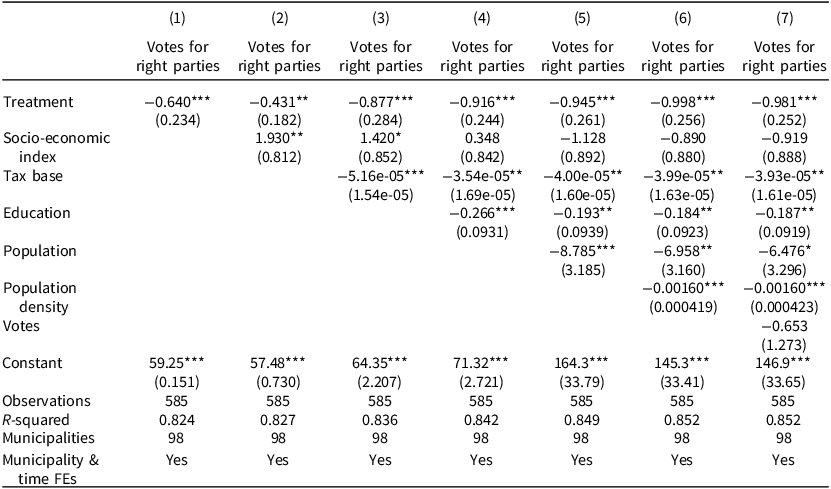
I first examine the overall effects of the shipyard closure on voting before probing the different mechanisms. Leveraging the national election data at the municipality level, Table 1 shows the effects of the shipyard closure on vote shares for the parties in the right bloc. Column 1 shows the baseline results, and the remaining models add, in a stepwise manner, the control variables. Across all models, the treatment variable has a negative effect on votes for the right bloc in the influenced municipalities. In model 1, the ATT amounts to around 0.6 percentage points fewer votes for the right bloc. In the full model with all controls (column 7), this effect increases to around 1 percentage point fewer votes. In Appendix 3, I largely obtain similar results for the local elections panel. Although the local election results coding Odense Municipality and Kerteminde Municipality as treated cannot be interpreted as causal, they are still suggestive of a similar observable pattern. If one, however, only focuses on Kerteminde Municipality, where pre-treatment trends are rather parallel (see Appendix 2), I obtain a similar pattern. With the national election data, I, moreover, find the mirror image for votes for left parties (Appendix 4), showing that the left gained votes in the treated areas.
Average treatment effect on the treated

Note: Robust standard errors in parentheses. ***p < 0.01, **p < 0.05, *p < 0.1.
In Appendices 5–8, several robustness tests are run. First, a placebo test is conducted where the treatment is set to one election period before the actual treatment. Second, a trend specification is included. Third, synthetic control methods are implemented. Fourth, a concern pertains to the comparability of the control group. The shipyard closed during the financial crisis, when several industrial sectors were adversely influenced. It is therefore important to examine if the results are robust to comparisons with municipalities that have relatively more industrial employment. In Appendix 8, I therefore compare the treated municipalities with municipalities that are predominantly industrial. These robustness tests are all supportive of the main finding in this section: The shipyard closure seems to be causally related to reduced support for the right-wing parties.
To rule out that the electoral effects are driven by population changes – ie people leaving the treated municipalities – or lower tax bases to finance local welfare, Appendices 9 and 10 test to what extent population and tax bases are influenced in the treated areas. I find no evidence for this. A concern may also be the outmigration of dissatisfied voters. I test if the results are driven by outmigration in Appendix 11 and find no evidence of this either. In Appendices 12 and 13, additional demographic, political, and economic controls are included, showing that the main results stay intact after controlling for welfare conditions, share of elderly, industrial composition, and income inequality. I, moreover, find no evidence that vote shares changed or that more voters decided to abstain from voting (Appendix 14). I also test in Appendix 15 if the political extremes gain votes – ie if populist right parties and far-left parties win votes as a consequence of the closure. The appendix shows that this is not the case. In fact, populist right parties on average lose votes in the influenced areas, whereas the far-left parties neither gain nor lose votes. Since the main populist right party in Denmark was a supporting party to the right-wing government at the time of the shipyard closure, the populist right finding may be unique to Denmark. I reflect on the generalizability of this finding in the conclusion.
Since the Lindø shipyard likely had adverse effects beyond the municipalities that were directly influenced, Appendix 16 also tests if the two neighboring municipalities – Nyborg and Nordfyns municipalities – also punished the right-wing incumbent bloc. Including these two municipalities, I largely obtain the same results as in the model including the municipalities directly hit by the closures, suggesting that a plant closure has spill-over effects on neighboring localities, although the effect size is a bit smaller.
Moreover, as the government changed from a right-leaning to a left-leaning government in 2011, while the shipyard was in its final phase of closing down, it might be that the new (left-wing) government would be blamed in the subsequent 2015 election. To test if there is a general anti-incumbent effect at play, Appendix 17 tests if the influenced areas in the aftermath of the closure punished whoever was in government. No evidence is found for this. It is hence not possible to detect a general anti-incumbent effect.
A concern may also relate to local political supply. Local politicians may, for example, have developed specific political strategies addressing the shipyard closure. To address this, I have been in contact with a politician who was elected to parliament in one of the shipyard municipalities and a political volunteer who was active in the 2011 election. None of them had heard about any specific local political strategy to address the shipyard closure. The volunteer I talked with also noted that political campaigns are mostly decided centrally by the party elite in Denmark, giving little room for ordinary runners-up to influence their campaigns.
Taken together, these results provide strong evidence that the (incumbent) right bloc lost votes in areas severely influenced by the closures. The punishment did not result in more votes for the ‘extremes’ – in fact, the populist right party lost votes, and the far-left party did not gain any votes. The political consequences also extend to localities beyond those directly hit by the closure. Finally, no general anti-incumbent effect can be detected.
Mechanism 1: unemployment and voting
Probing the unemployment mechanism, this section examines the relationship between unemployment and voting for the right bloc. The impact of the shipyard closure on unemployment is first analyzed, followed by an analysis of the relationship between unemployment and voting for the right bloc.
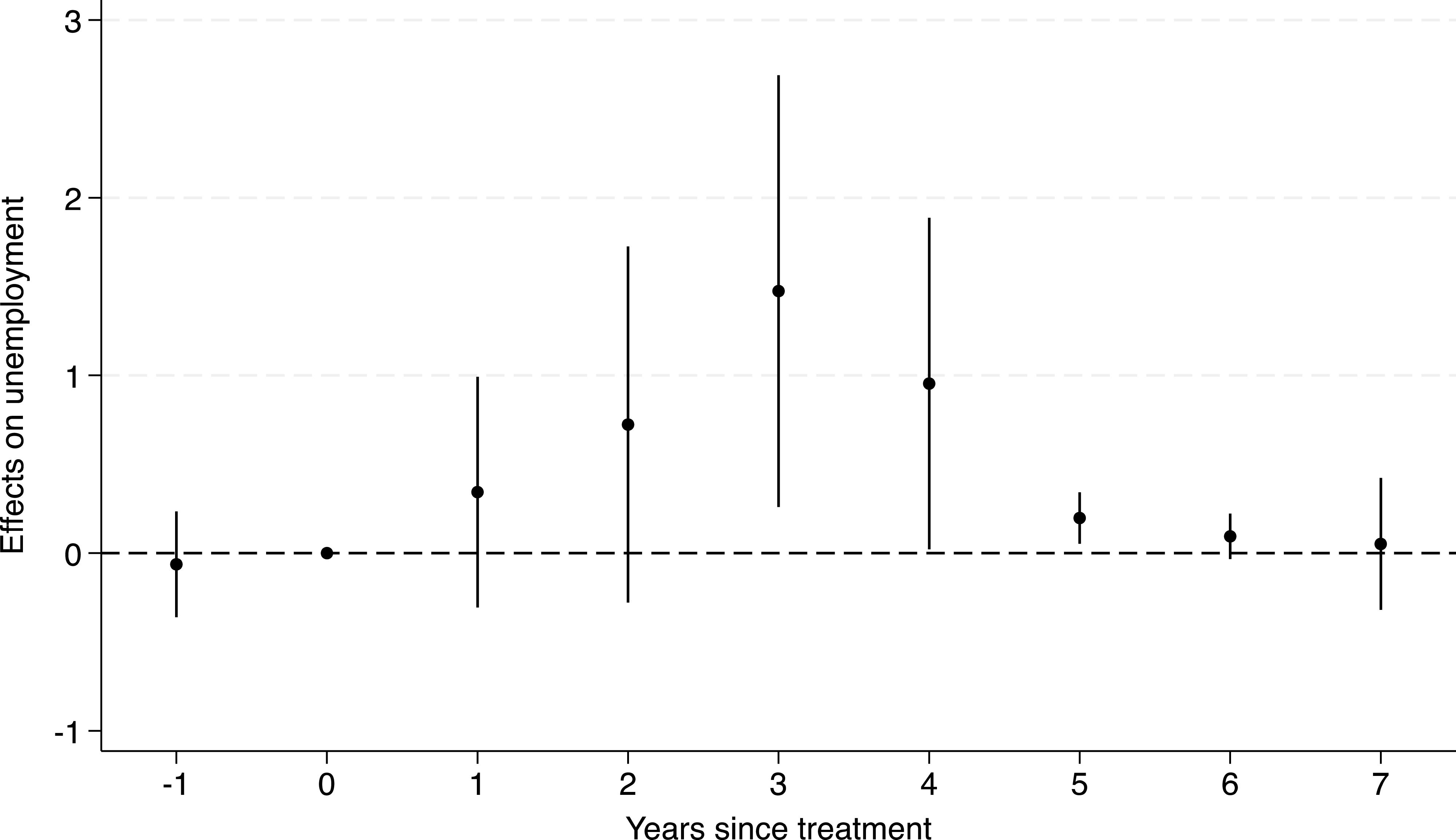
First, leveraging a DiD event study design, Figure 3 shows that the adverse employment consequences of shutting down the shipyard were relatively short-lived. Six years after the initial closing, unemployment was not statistically higher in treated versus untreated municipalities. A PTA plot is provided in Appendix 18, suggesting seemingly parallel trends in 2007 and 2008 – ie prior to the closing of the shipyard. The effect size on unemployment three years after the closure is 1.4 percentage points, which seems substantial.
Shipyard closure and unemployment.
Second, estimating a two-way fixed effects regression, Table 2 moreover indicates that unemployment is negatively associated with voting for the right bloc in national elections. This at least indicates that the right bloc on average lost votes in areas where unemployment went up, and since unemployment increased more in treated areas, it seems plausible that unemployment at least partly explains why the right bloc lost more votes in the treated areas.
Unemployment and voting for the right bloc

Note: Robust standard errors in parentheses. ***p < 0.01, **p < 0.05, *p < 0.1.
Mechanism 2: blame attribution
As posited, unemployment may not be the only mechanism linking industrial decline to voting. This section turns to the role of blame for the link between industrial decline and voting, examining to what extent the right-wing government was blamed for its handling of the acute labor market crisis that the closure of Lindø Steel Shipyard brought about.
First, I leverage a 2011 survey to provide suggestive quantitative evidence for the blame attribution argument. The survey was conducted in the aftermath of the 2011 election amongst a representative sample of voters in the working age (18–65). 4181 eligible voters were surveyed. With this data, I test how voters in the municipalities most directly hit by the shipyard closure view the government’s handling of unemployment (retrospectively). The dependent variable measures on a five-item scale the extent to which voters think that the right-wing government has done too little to combat unemployment. Higher values indicate more agreement and hence more blame on the government for its handling of the adverse economic situation. The main independent variable is a dummy variable taking the value 1 if the respondent resides in one of the two treated municipalities (ie the shipyard municipalities), and 0 if otherwise.
The results are presented in Table 3. The table shows that voters in the shipyard municipalities, to a larger extent, think that the government has done too little to combat unemployment compared to non-shipyard municipalities. This result is robust to the inclusion of a series of individual socio-economic factors (see columns 1 & 2). Including political preference controls may induce post-treatment bias, so interpreting results including political controls should be done carefully. Needless to say, including political preference controls does not alter the main finding (see column 3). A concern here is that voters in the shipyard municipalities might prefer a left-leaning government to handle the unemployment situation, potentially challenging the blame argument. Leveraging the same survey, I find no support for this concern in Appendix 19: Voters in the shipyard municipalities do not differ in who they think would be best at handling unemployment in general. These results suggest that voters in the influenced shipyard municipalities, to a larger extent, blame the government for its handling of the unemployment situation than voters in other municipalities.
Retrospective perceptions of the right-wing government’s handling of unemployment
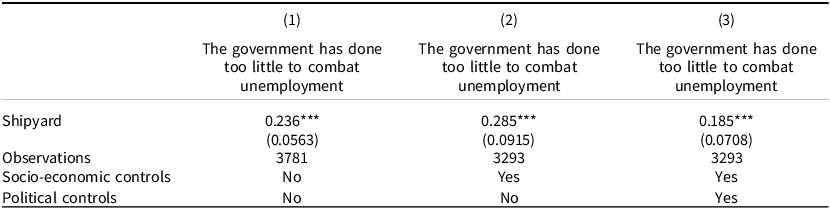
Note: Ordinal logistic regression. Standard errors clustered at the municipality level. *** p < 0.01, ** p < 0.05, * p < 0.1. Question reads: The VK [Liberal-Conservative] government has done too little to combat unemployment. Recoded values: (1) Completely disagree, (2) Almost disagree, (3) Neither nor, (4) Almost agree, (5) Completely agree. Analytical weights for age, gender, and geography are implemented. Socio-economic controls include the following: Gender, age, marital status, income, and education. Political controls include: Tax preferences, immigration preferences, vote choice, and political interest.
Second, I rely on focus group interview data from Klindt (Reference Klindt2013, Reference Klindt2017: 446), who has generously shared part of his interview data. The first focus group consists of two union representatives, who were strategically chosen by Prof. Klindt. The second focus group was an official audit conducted by the European Court of Auditors as a part of the evaluation of the EGF projects. The project actors, several stakeholders, including ‘knowledge persons’, were a part of this focus group.Footnote 5 The second focus group consisted of a total of 15 people, including one worker representative for the shipyard workers. While these interviews are not necessarily representative, they do provide suggestive evidence for how local actors viewed the government’s handling of the situation.
Below is an interview extract from a longer focus group interview with the two union representatives that was conducted in 2012. Both union representatives represent blue-collar workers – that is, many previous Lindø workers – and were involved in the local network that tried to help the displaced workers. IP1 refers to interview person 1, and IP2 refers to interview person 2. All names are anonymized with ‘xx’ in the following, as agreed upon with the interviewees ahead of the interview. The excerpt shows that the feeling of being let down is strong among the union representatives. The central government’s unwillingness to front the money was viewed as a ‘disgrace’:
IP1: “I remember that xx and I, when we were discussing with our members at these courses, we were standing in a forum where there was a lot of EU opposition in general. Then we stood there and said “Isn’t it fantastic that we’ve received 100 million from the EU?” No matter how we look at it, we are still one of the richest countries in the EU, and yet we are granted so much money by the others. Something we should be doing ourselves. I think it’s worth noting that both you and xx visited the then Minister of Labor several times.
Interviewer: Inger?
IP2: Inger Støjberg. We went to see Brian [Minister of Justice] and then Inger Støjberg participated. They spent more than an hour on us. We wanted them to front the money. It took so damn long.
Interviewer: Because when you apply for the Globalization Fund, the project period starts. The funds come first, and if they come, they come after a year.
IP1: It was a disgrace - they stood in line at Lindø after August 10th to come in and say “This was really sad”, these politicians.
Interviewer: Is it 2009 or 2010?
IP1: 2009. 10 August 2009. And xx and xx are not over there to ask for money. They are only over there to ask them to front the money. There was no doubt in anyone’s mind that we would get the money from the EU.”
Third, in Appendix 20, I provide further evidence for the blame argument by analyzing debates in the parliament on the government’s handling of the shipyard closure. All three left-wing parties formally raised a critique of the government’s handling in parliament. Fronting the money was also raised as an issue by one of the left-wing parties in parliament, suggesting that this, at the time, was an issue shared by unions and politicians. While not conclusive, the combination of the survey data, the focus groups, and the parliamentary discussions suggests that the government was blamed for its handling (or rather lack thereof) of the shipyard closing down.
Moreover, the empirical evidence so far suggests that voters blame the government for its handling of the closure of the shipyard. However, it might also be that voters blame the government for not acting on time to prevent the closure in the first place. To examine this, I have interviewed previous shipyard workers. I describe the recruitment process in further detail in Appendix 21. While anecdotal and not necessarily representative, the interviews suggest that previous shipyard workers, in general, did not blame the government for the shipyard closing, suggesting that people in the influenced communities predominantly blamed the government for its handling of the crisis and not for the crisis itself.
To further probe the blame-credit argument, I examine the extent to which in the treated areas credited the EU for the compensation. Recall, the influenced areas received substantial compensation via the EU’s EGF program. First, this is something that the union representatives highlighted to their members (see excerpt above). Second, this is also something that a worker representative highlighted in one of the focus group interviews: ‘I have taken 21.5 weeks of adult education courses and I would not have had these opportunities and been able to survive if it had not been for the EGF’. For this worker, the help from EGF is perceived as fundamental for his ‘survival’. Third, actors involved in the EGF project expressed positive views towards the Lindø EGF project. This is the case for numerous different local actors. In Appendix 22, several other interview extracts are presented to support the main narrative of the quotes shown here.
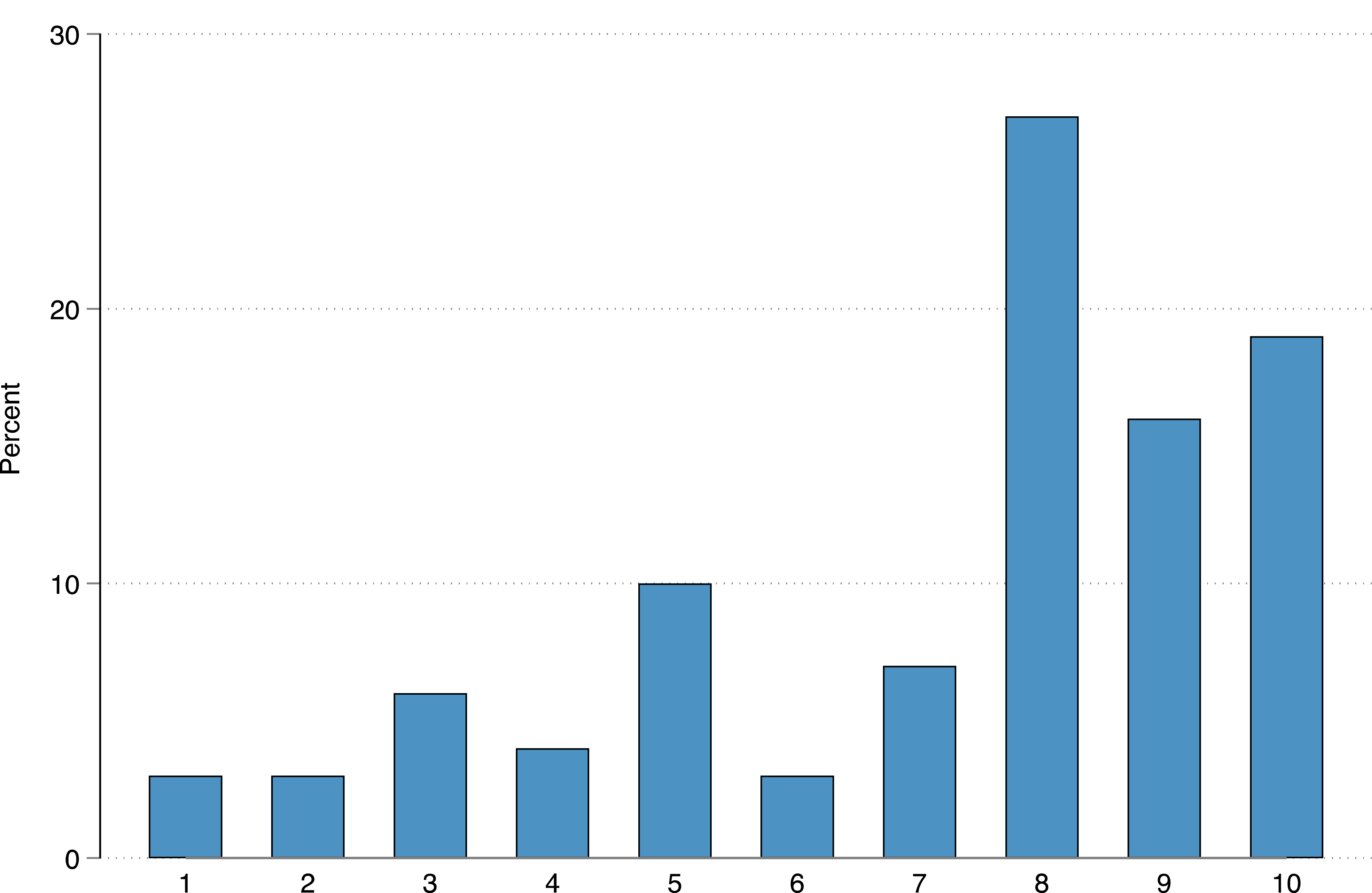
The positive attitudes towards the EGF-funded project can also be depicted quantitatively. As Figure 4 shows, the workers involved in the project were, in general, very happy with the outcome of the EGF project. Seventy-five per cent of the respondents noted on a scale from 1–10 at least a ‘6’ with the weight put on the upper end of the scale. A vast majority of the workers included in the project, hence, express (very) positive attitudes towards the EGF project. This measure might be biased towards positive responses, as the more critical participants likely declined to participate in the survey. The numbers nonetheless indicate overall positive attitudes towards the project and the outcome of the project.
EGF participants are, in general, very satisfied with the outcome of the EGF project.
Source: Question reads: “How satisfied are you in general with the outcome of the EGF project?” Based on participants in the EGF project 2. Mploy (2014).

Table 4 moreover shows DiD estimates for the panel based on the Danish National Election Study covering the election before the compensation (2007) and the election after (2015). Recall that the dependent variable measures positive attitudes toward the EU. Model 1 in Table 3 shows that areas receiving compensation increased their positive attitudes toward the EU by 0.12. This effect increases to 0.15 in model 2 controls when they are included, which is approximately half of a standard deviation in the dependent variable. This finding is further supported in Appendix 23. The Appendix shows that individuals in the compensated areas in 2007 did not have statistically different attitudes towards the EU relative to non-compensated areas. This changed in 2015 when they had statistically significantly stronger preferences for the EU.
Attitudes toward the EU: difference-in-differences models
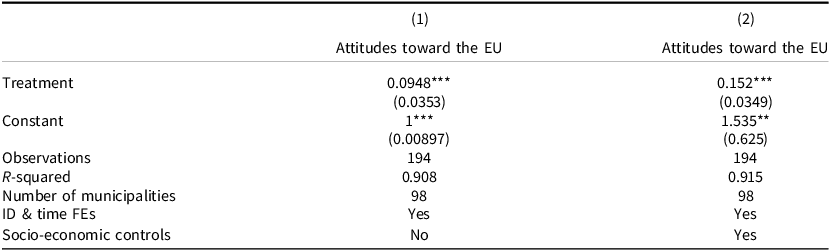
Note: Robust standard errors in parentheses. ***p < 0.01, **p < 0.05, *p < 0.1.
Taken together, these sets of evidence suggest that the right government was blamed for its unwillingness to help. ‘It was a disgrace’ as one interviewee puts it. The help from the EGF is also recognized by a worker, stating that he would not have ‘been able to survive’ without the assistance from the EGF. The DiD regressions, moreover, show that individuals in the compensated areas developed more positive attitudes on average towards the EU after compensation took place, giving further credence to the blame-credit argument. These sets of evidence paint a picture of a government that is blamed for its handling of the crisis, and credit is attributed to the EU, which provided support.
Mechanism 3: compensating the losers via the EGF and temporal industrial decline
Having established that the government was blamed for its (lack of) assistance and the EU credited for its help via the EGF, this section turns to the political consequences of the EGF compensations and the temporal nature of the punishment of the incumbent.
According to labor market scholars, the Danish flexicurity systemFootnote 6 has undergone substantial change since the early 1990s (Jørgensen Reference Jørgensen2011). Initially, the flexicurity system focused on an ‘activation approach’ centered around job training and education of the unemployed. Since the 2000s, however, the system in piecemeal steps started to focus more on ‘work-first’ principles centered around activation in the form of employment activities rather than reskilling and education. The EGF program, therefore, allowed the laid-off Lindø workers to access training and reskilling programs that they otherwise would not have been able to access. As one AMU (adult vocational training programs institution) representative explicitly stressed (see also Appendix 22):
That was the great thing about the EU funding, and that is why so many of them found work and went on to have a really good life. Because there was time and there were funds to enable people to pursue something and become smarter or find themselves, and then they could change track. That is completely unheard of in our system today. Those who are lucky enough to be granted an education have to get it right the first time. And they don’t. A 40-45-year-old who has been in Lindø since they were 18 and has been in that environment doesn’t do that. It takes time to figure out for yourself that maybe you should be a kindergarten teacher.
Numerous local actors organized a network to address the extraordinary labor market situation that the closing of Lindø Steel Shipyard had resulted in (see also Klindt Reference Klindt2017). Workers as well as local communities were severely influenced by the closure, and this was widely acknowledged by a large group of actors. The network consisted of Odense and Kerteminde municipalities, local unions, local employer organizations, and local firms. The network – led by Odense municipality – applied for support from the EU via the EGF. As EGF projects start from the day of the application, the network realized that they had to apply for two project periods to cover workers at different stages of the closure of the shipyard. The first EGF project ran from October 6, 2010, to October 5, 2012; however, concrete activities started in early May of 2011. The project covered 1358 workers with 568 participants. The second EGF project ran from November 1, 2011, until October 31, 2013, and concrete activities started in June 2012. The project covered 980 workers with 345 participants. To be a participant, the worker had to be unemployed. The reason for the lag in the start of activities is that activities can first take place when the EGF application is formally accepted.
The purpose of the support was to help the affected workers find and retain new employment through training and retraining in areas with good employment opportunities. Due to the long application process in the EU, the network had time to strategically identify ’growth sectors’ that the training activities could target. A growth plan was therefore developed and initiated by the network, which has formed the framework for the training initiatives in the project. The growth plan focuses on the following industries: (1) Energy technology, (2) Welfare technology, (3) Robot and automation technology, and (4) Building and construction. All these sectors were expected to have high labor market demand in the years following the closure. The network, hence, early structured its activities based on the assumption that some sectors would have a high labor market demand.
Each of the courses consisted of three phases, as shown in Figure 5. The first phase was a mandatory four-week clarification process where the participants’ skills were clarified individually. The phase also included information about potential education and training activities and job opportunities in the identified growth sectors. Participants also got help with writing a CV, and an individual training plan was developed for each of the participants based on their existing skills and preferences for future work, again, with a special focus on the growth sectors. The second phase consisted of education and training activities. Four main activities were offered. First, supplementary vocational training and education relevant to transitioning into the growth sectors were offered. Second, general and further education was offered. Third, firm training and customized training were offered. Finally, a few participated in courses about entrepreneurship and how to start one’s own business. The third and final ‘exit’ phase consisted of 10 weeks of individual coaching to prepare the workers for the transition they were about to undertake. The final phase also consisted of four weeks of attachment to a company.
Training activities in the EGF projects.

To what extent did the EGF training and coaching activities mitigate the political backlash documented above? I cannot directly test this, but a way to examine the argument that the training activities could have been effective is to test the temporal political consequences of the shipyard closure. A substantial literature shows that the disappearance of industrial jobs has long-term political consequences. As training activities take a time-wise medium-long time to manifest themselves, we should expect the political backlash to be reduced over time and maybe even fully disappear. Below, I find empirical support for this proposition, leveraging a DiD event study design with the national election data at the municipality level.
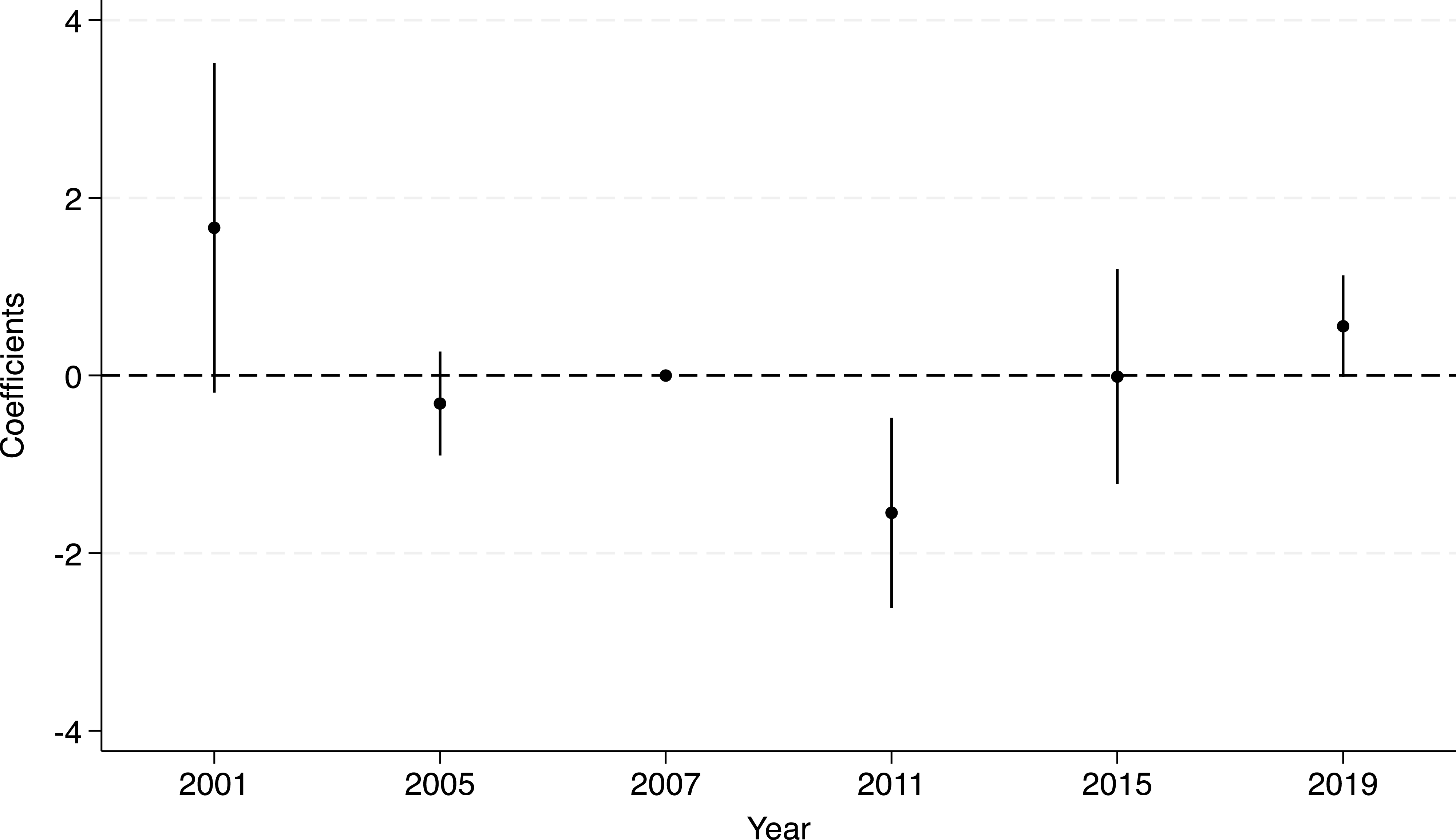
Figure 6 shows the event study and plots the effects of the closure on voting for the right government in each election relative to the 2007 national election – ie the election before the closure. As expected, no statistically significant effects can be detected in the elections before 2007 (period 2001–2005). However, in the 2011 election – the first election after the closure – the right government is most strongly punished (−1.5 percentage points). In the 2015 election (the first election after the implementation of the compensation), the effect is completely diminished, and in the 2019 election, the estimate, while slightly positive, remains statistically insignificant at conventional levels. These results suggest that the anti-incumbent effects are strongest immediately after the closure and vanish after compensation. This at least suggests that the training activities under the EGF could have been effective in compensating workers, and is consistent with the argument that active labor market policies can compensate globalization losers in the medium run. To further probe this argument, I show in Appendix 24 that more people gained education in the compensated areas after compensation took place. This further strengthens the claim that the compensation effectively reskilled workers locally in the shipyard municipalities.
Effects of closure on votes for the incumbent over time: event study design.
Note: A full set of controls is included.

Conclusion
A large body of literature contends that industrial decline has long-term political consequences and may linger for years. Examining the political temporal consequences of industrial decline, this paper examines the political consequences of the closure of the Lindø Steel Shipyard in Denmark. I argue that industrial decline influences politics via three channels. First, industrial decline influences politics economically by adversely affecting local communities. As unemployment soars, voters tend to punish the incumbent. This is consistent with retrospective voting theory and suggests that economic factors at least partly influence politics. Second, I argue that blame and credit attribution shape the link between industrial decline and voting. How governments react to industrial decline is important for this link, as governments can be blamed and credited for the handling of a local labor market crisis. This suggests that there is not always a straightforward link between decline and voting. Third, to the extent that the actors adversely influenced by industrial decline are compensated, the political consequences should be muted and may even completely disappear over time.
The arguments are tested using several (newly) compiled data sets. I find that the closing of the shipyard had an average negative effect on votes in national elections for the right-wing incumbent government in the influenced areas. Teasing out the different mechanisms, I first find that unemployment decreased votes for the incumbent. This suggests that economic factors are at least partly important in understanding the political consequences of industrial decline. Unemployment is, however, not the whole story. Second, I find that the national government is blamed for its handling of the acute labor market crisis locally, and that the EU instead is credited for providing support. The latter speaks to the importance of blame and credit and suggests that political agency is important for how voters evaluate governments. Third, the political effects are not persistent over time, which at least could suggest that the compensation via the EGF could have muted the blow from the closure of the shipyard. I, however, stress that it is important that training activities are targeted and coordinated locally. A network of local actors identified key growth sectors and tailored training activities towards these sectors. Targeted training activities, embedded in local networks, hence, seem important for the success of bringing the laid-off workers back into employment, and for addressing the adverse effects of globalization shocks.
To what extent should we expect these findings to translate to other contexts? Several factors are unique to the Danish case, which may make the results less generalizable to other contexts. First, from 2001–2011, the main populist right party in Denmark was a supporting party to the right-wing government. This may make the Lindø case a most likely case of a populist right party losing support due to globalization, as it was politically associated with the government. However, as more populist right parties start to govern (eg Italy, Hungary, the Netherlands, etc.) or are supporting parties to a government (eg Sweden), these findings may have broader consequences for support for populist right parties that seek political office and influence. Second, a concern for generalizability is that the way local actors organized to help the displaced workers in the Lindø case is unique. Not only did the network of local actors secure a high compensation via the EGF, but they also effectively implemented these training activities, making the Lindø case a best case for the compensation argument. Third, Denmark has had a robust economic performance, measured by economic growth and job growth in the studied period. This may potentially explain the waning of the anti-incumbent government effects over time. In Appendix 25, I show that the NUTS-3 region in which the shipyard is located is the region in Denmark with the lowest economic growth from 2008–2019. Compared with all other NUTS-3 regions in the EU, the shipyard region’s growth is in the 29th percentile (ie notably below the median). While the compensation effects may not be as effective in regions with negative of zero growth (such as many regions in southern Europe and especially Greece or the Rustbelt in the US), the unimpressive growth statistics for the shipyard region suggest that compensation via training, when designed and implemented effectively, may reduce political dissatisfaction even in a context with sluggish economic growth and job creation. Fourth, a concern for generalizability may relate to the strategic policy positioning of the mainstream left. While the mainstream left in Denmark has made a notable left-conservative turn under the leadership of Mette Frederiksen, this move did not happen until after 2015 (Green-Pedersen Reference Green-Pedersen2020; Meret Reference Meret, Brandal, Bratberg and Thorsen2021; Etzerodt and Kongshøj Reference Etzerodt and Kongshøj2022), and can therefore not explain the consequences of the shipyard closure on voting. Fifth, in Denmark, national parties are also strongly represented at the local level. This may challenge the generalizability of the findings in local elections. In countries where local parties are relatively stronger, the link between national and local politics may not be as straightforward, and blame may work differently.
Moreover, the political findings and the EU attitudes findings may seem contradictory: Why should voters in influenced areas start to vote more for the incumbent whom they blamed after having credited the EU for help? While I do not have any data to test this, a potential explanation is that voters tend to forget and misremember events. The literature on voter gratitude shows that voter gratitude fades over time (Bechtel and Hainmueller Reference Bechtel and Hainmueller2011). Applied to blame, we should expect blame to fade, especially if fired workers receive compensation, regain employment, and have fewer material reasons to stay dissatisfied. An important literature in social psychology on rosy retrospection also finds that people remember past events more positively than they actually were (Mitchell et al. Reference Mitchell, Thompson, Peterson and Cronk1997). Applied to the Lindø case, this would suggest a logic by which, as time goes on and workers in influenced areas are compensated and regain employment, they view the past government’s handling of the adverse labor market situation more favorably than they did during the closure of the shipyard. These arguments speak to cognitive biases that potentially can explain the different results, and future research would benefit from examining these nuances.
Supplementary material
The supplementary material for this article can be found at https://doi.org/10.1017/S1475676526100772.
Data availability statement
Data and code to replicate the results are available at https://dataverse.harvard.edu/dataset.xhtml?persistentId=doi:10.7910/DVN/RVDVIR.
Acknowledgements
Written in memory of my grandparents, Karen and Svenn Etzerodt, whose lives in many ways were shaped by Lindø Shipyard. I am thankful for comments by Leo Hummel, Hannah Loeffler, Amy Pond, Tobias Rommel, and participants at EPSA. I am also thankful to the previous shipyard workers who participated in the interviews. Special thanks to Timm Betz and the three anonymous reviewers for exceptional and constructive feedback. Last but not least, thanks to Mads Peter Klindt for insightful conversations and for sharing data.
Funding statement
No funding was provided for this research.
Competing interests
The author declares no competing interests.








 Open access

