





1 Introduction
The motivation for this article arises from a theorem of F. Galvin (see Theorem 3.1), first published in [Reference Baumgartner, Hajnal and Mate1], which states that whenever
$\kappa ^{<\kappa } = \kappa $
 , F is a normal filter over
$\kappa $
, F is a normal filter over
$\kappa $
 , and
${\langle } A_i : i < \kappa ^+ {\rangle } $
, and
${\langle } A_i : i < \kappa ^+ {\rangle } $
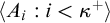 is a sequence of sets in F, there is some I of size
$\kappa $
is a sequence of sets in F, there is some I of size
$\kappa $
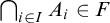
 such that
$\bigcap _{i \in I} A_i \in F$
such that
$\bigcap _{i \in I} A_i \in F$
 . For example, Galvin’s theorem applies if F is the club filter on
$\kappa $
. For example, Galvin’s theorem applies if F is the club filter on
$\kappa $
 and
$\operatorname {\mathrm {GCH}}$
and
$\operatorname {\mathrm {GCH}}$
 holds, or F is a normal measure over a measurable cardinal
$\kappa $
holds, or F is a normal measure over a measurable cardinal
$\kappa $
 . Parameterizing the combinatorial property from Galvin’s theorem yields the following definition.
Definition [The Galvin property].
Let X be a set and F a filter on X and
$\kappa \leq \lambda $
 cardinals. We say that
$\operatorname {\mathrm {Gal}}(F,\kappa ,\lambda )$
cardinals. We say that
$\operatorname {\mathrm {Gal}}(F,\kappa ,\lambda )$
 holds iff whenever
${\langle } A_i : i < \lambda {\rangle }$
holds iff whenever
${\langle } A_i : i < \lambda {\rangle }$
 is a sequence of sets in F of length
$\lambda $
is a sequence of sets in F of length
$\lambda $
 , there is some
$I \in [\lambda ]^\kappa $
, there is some
$I \in [\lambda ]^\kappa $
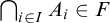
 such that
$\bigcap _{i \in I} A_i \in F$
such that
$\bigcap _{i \in I} A_i \in F$
 .
.
This is a regularity-like property in the sense of Chang and Keisler [Reference Chang and Keisler13] that has been considered in other contexts as well. Kanamori [Reference Kanamori24] called it cohesiveness, while Tukey and Isbell [Reference Ginsburg and Isbell19, Reference Tukey32] and more recently in the work of Todorcevic, Dobrinen, Milovich, and the first author [Reference Benhamou and Dobrinen4, Reference Dobrinen and Todorcevic15, Reference Milovich27, Reference Todorcevic31] used it in connection to the Tukey order.
Interest in the Galvin property has had a recent resurgence due to its relevance to Prikry-type forcing theory [Reference Benhamou and Gitik7, Reference Benhamou and Gitik8, Reference Gitik21]. Gitik [Reference Gitik21] used the Galvin property to prove the following.
Theorem (Gitik, [Reference Gitik21]).
Suppose
$2^\kappa = \kappa ^+$
 and U is a normal ultrafilter on
$\kappa $
and U is a normal ultrafilter on
$\kappa $
 . Then in a generic extension by Prikry forcing with U, every subset of
$\kappa ^+$
. Then in a generic extension by Prikry forcing with U, every subset of
$\kappa ^+$
 such that contains a ground model subset of the size
$\kappa $
such that contains a ground model subset of the size
$\kappa $
 .
.
In [Reference Benhamou and Gitik8] it was then proven that the Galvin property of a general
$\kappa $
 -complete ultrafilter over
$\kappa $
-complete ultrafilter over
$\kappa $
 is equivalent to the density of ground model sets of the tree-Prikry forcing analogous to the one described in Gitik’s theorem. The first author and Gitik further extend this analysis in [Reference Benhamou and Gitik8] to study ultrafilters U such that Prikry forcing with U adds a generic for the Cohen forcing at
$\kappa $
is equivalent to the density of ground model sets of the tree-Prikry forcing analogous to the one described in Gitik’s theorem. The first author and Gitik further extend this analysis in [Reference Benhamou and Gitik8] to study ultrafilters U such that Prikry forcing with U adds a generic for the Cohen forcing at
$\kappa $
 .
.
In [Reference Benhamou and Goldberg10] the first author and Goldberg use a
$\diamondsuit $
 -like principle, which also inspired the one introduced in [Reference Benhamou and Wu12], to show that under the ultrapower axiom (UA) if U is a
$\sigma $
-like principle, which also inspired the one introduced in [Reference Benhamou and Wu12], to show that under the ultrapower axiom (UA) if U is a
$\sigma $
 -complete ultrafilter on
$\kappa ^+$
-complete ultrafilter on
$\kappa ^+$
 then
$\operatorname {\mathrm {Gal}}(U,\kappa ^+,\kappa ^{++})$
then
$\operatorname {\mathrm {Gal}}(U,\kappa ^+,\kappa ^{++})$
 must fail. In the same paper, they ask the following question.
Question [Reference Benhamou and Goldberg10, Question 7.4].
Suppose U is a normal, fine ultrafilter on
$P_\kappa (\kappa ^+)$
 . Must
$\operatorname {\mathrm {Gal}}(U,\kappa ,(2^\kappa )^+)$
. Must
$\operatorname {\mathrm {Gal}}(U,\kappa ,(2^\kappa )^+)$
 hold?
hold?
Here we answer this question negatively. In fact, not only does the Galvin property need not hold, it never holds in this case.
Theorem 3.6. Let U be a normal, fine ultrafilter on
$P_\kappa (\lambda )$
 . Suppose that
$2^{<\lambda }=\lambda $
. Suppose that
$2^{<\lambda }=\lambda $
 and
$\mathrm {cf}(\lambda ) \neq \kappa $
and
$\mathrm {cf}(\lambda ) \neq \kappa $
 . Then
$\lnot \operatorname {\mathrm {Gal}}(U,\kappa ,2^\lambda )$
. Then
$\lnot \operatorname {\mathrm {Gal}}(U,\kappa ,2^\lambda )$
 .
.
The situation when
$\mathrm {cf}(\lambda ) = \kappa $
 is more subtle. In this case, the proof of Galvin’s original theorem generalizes using tools of Goldberg’s book [Reference Goldberg22].
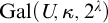
Theorem 3.16. Let U be a normal, fine ultrafilter on
$P_\kappa (\lambda )$
 . Suppose that
$2^{<\lambda }=\lambda $
. Suppose that
$2^{<\lambda }=\lambda $
 and
$\mathrm {cf}(\lambda ) = \kappa $
and
$\mathrm {cf}(\lambda ) = \kappa $
 . Then
$\operatorname {\mathrm {Gal}}(U,\kappa ,2^\lambda )$
. Then
$\operatorname {\mathrm {Gal}}(U,\kappa ,2^\lambda )$
 .
.
We then investigate the extent to which this theorem can be improved, and show the following.
Theorem 3.18. Let U be a normal, fine ultrafilter on
$P_\kappa (\lambda )$
 . Suppose that
$2^{<\lambda }=\lambda $
. Suppose that
$2^{<\lambda }=\lambda $
 and
$\mathrm {cf}(\lambda ) = \kappa $
and
$\mathrm {cf}(\lambda ) = \kappa $
 .
$\lnot \operatorname {\mathrm {Gal}}(U,(2^\kappa )^+,2^\lambda )$
.
$\lnot \operatorname {\mathrm {Gal}}(U,(2^\kappa )^+,2^\lambda )$
 .
.
This leaves (at least) one case open, namely,
$\operatorname {\mathrm {Gal}}(U,2^\kappa ,2^\lambda )$
 (see Question 3.19).
Our results have several applications to the theory of ultrafilters. First, the failure of Galvin’s property for
$\mathrm {cf}(\lambda ) \neq \kappa $
 shows that normal, fine ultrafilters on
$P_\kappa (\lambda )$
shows that normal, fine ultrafilters on
$P_\kappa (\lambda )$
 are
$\kappa $
are
$\kappa $
 -Tukey-top, namely, Tukey-maximal among
$\kappa $
-Tukey-top, namely, Tukey-maximal among
$\kappa $
 -complete ultrafilters U over
$P_\kappa (\lambda )$
-complete ultrafilters U over
$P_\kappa (\lambda )$
 , whereas Galvin’s theorem says that normal ultrafilters on cardinals are necessarily non-
$\kappa $
, whereas Galvin’s theorem says that normal ultrafilters on cardinals are necessarily non-
$\kappa $
 -Tukey-top.
Secondly, we can improve the Theorem from [Reference Benhamou and Goldberg10] regarding ultrafilter on successor cardinals under UA.
Corollary 4.3. Let U be a
$\sigma $
 -complete ultrafilter on
$\kappa ^+$
-complete ultrafilter on
$\kappa ^+$
 . If
$2^\kappa =\kappa ^+$
. If
$2^\kappa =\kappa ^+$
 then
$\lnot \operatorname {\mathrm {Gal}}(U,\kappa ,2^{\kappa ^+})$
then
$\lnot \operatorname {\mathrm {Gal}}(U,\kappa ,2^{\kappa ^+})$
 .
.
Then, using our theorem, we generalize Gitik’s result on the density of old sets in generic extensions by Prikry forcing to the case of the supercompact Prikry forcing.
Theorem 4.6. Suppose U is a normal
$P_\kappa (\lambda )$
 ultrafilter where
$\mathrm {cf}(\lambda ) \neq \kappa $
ultrafilter where
$\mathrm {cf}(\lambda ) \neq \kappa $
 and
${2^{<\lambda } = \lambda }$
and
${2^{<\lambda } = \lambda }$
 . Let G be generic for the supercompact Prikry forcing with respect to U. In
$V[G]$
. Let G be generic for the supercompact Prikry forcing with respect to U. In
$V[G]$
 , there is a set
$S \subseteq 2^\lambda $
, there is a set
$S \subseteq 2^\lambda $
 that contains no ground model set of size
$\kappa $
that contains no ground model set of size
$\kappa $
 .
.
Finally, we use these results to study generating sets of
$P_\kappa (\lambda )$
 -measure and conclude the following.
Corollary 4.11. If U is a
$\sigma $
 -complete
$(\kappa ,\lambda )$
-complete
$(\kappa ,\lambda )$
 -regular ultrafilter over
$\lambda $
-regular ultrafilter over
$\lambda $
 ,
$\kappa $
,
$\kappa $
 being a strong limit and
$2^{<\lambda }=\lambda $
being a strong limit and
$2^{<\lambda }=\lambda $
 , then
$\chi (U)=2^\lambda $
, then
$\chi (U)=2^\lambda $
 .
.
In the last section of this article, we consider the revised Galvin property defined using inclusion modulo the fine filter, which be denote by
$\mathcal {F}$
 which is the filter generated by cones, i.e., sets of the form
$\check {\alpha } = \{x \in P_\kappa (\lambda ) : \alpha \in x\}$
which is the filter generated by cones, i.e., sets of the form
$\check {\alpha } = \{x \in P_\kappa (\lambda ) : \alpha \in x\}$
 . In Theorem 5.10 we prove a variation of Galvin’s theorem using inclusion modulo this filter. We then use the inclusion modulo the fine filter to study variation of the filter games introduced in [Reference Nielsen and Welch28] by Nielsen and Welch, which were used to characterize small large cardinals. Foreman et al. in [Reference Foreman, Magidor and Zeman17] call these games Welch games and use their determinacy to construct interesting ideals. In particular, they prove the following.
Theorem [Reference Foreman, Magidor and Zeman17, Theorem 1.4].
Assume
$2^\kappa = \kappa ^+$
 and
$\kappa $
and
$\kappa $
 does not carry a saturated ideal. Let
$\gamma $
does not carry a saturated ideal. Let
$\gamma $
 be an infinite regular cardinal below
$\kappa ^+$
be an infinite regular cardinal below
$\kappa ^+$
 . If player II has a winning strategy in the Welch game of length
$\gamma $
. If player II has a winning strategy in the Welch game of length
$\gamma $
 , then there is a uniform normal ideal I on
$\kappa $
, then there is a uniform normal ideal I on
$\kappa $
 with a dense set
$D \subseteq I^+$
with a dense set
$D \subseteq I^+$
 such that:
-
1. $(D, \subseteq ^*)$
 is a downwards-growing tree of height
$\gamma ;$
is a downwards-growing tree of height
$\gamma ;$
-
2. D is closed under $\subseteq _I$
-decreasing sequences of length
$\gamma ;$
-
3. D is dense in $P(\kappa )/I$
.


From the ideal I, a precipitous ideal can be constructed, given that
$\gamma>\omega $
 , showing the equiconsistency of a winning strategy for Player II in the game of length
$\omega +1$
, showing the equiconsistency of a winning strategy for Player II in the game of length
$\omega +1$
 and the existence of a measurable cardinal.
This result was generalized to some extent by the second author and Gitman in [Reference Benhamou and Gitman9] to filter games in the two-cardinal settings. Also, it was noticed in [Reference Benhamou and Gitman9] that an additional property of the constructed ideal, named
$\mu $
 -measuring
Footnote
1
could be extracted, with which Theorem 1 could be reversed. However, the generalization was not fully satisfactory as the dense tree did not consist of positive sets from the constructed ideal. In an attempt to find a direct generalization to Theorem 1, it was then asked the following.
-measuring
Footnote
1
could be extracted, with which Theorem 1 could be reversed. However, the generalization was not fully satisfactory as the dense tree did not consist of positive sets from the constructed ideal. In an attempt to find a direct generalization to Theorem 1, it was then asked the following.
Question [Reference Benhamou and Gitman9, Question 9.8].
Is there an equivalent version of the two-cardinal games where sets are played instead of ultrafilters?
In the last part of the article, we answer this question and generalize Theorem 1 to the setting of ideals on
$P_\kappa (\lambda )$
 , using two-cardinals filter games where sets are played in analogy to the Welch games. This enables us to construct dense trees consisting of sets. In the following theorem
$\mathcal {F}$
, using two-cardinals filter games where sets are played in analogy to the Welch games. This enables us to construct dense trees consisting of sets. In the following theorem
$\mathcal {F}$
 denotes the fine filter on
$P_\kappa (\lambda )$
denotes the fine filter on
$P_\kappa (\lambda )$
 .
.
Theorem 5.19. Suppose that
$2^\lambda =\lambda ^+$
 , there is no saturated ideal on
$P_\kappa (\lambda )$
, there is no saturated ideal on
$P_\kappa (\lambda )$
 , and that the Judge has a winning strategy for the game
$G^\gamma _2$
, and that the Judge has a winning strategy for the game
$G^\gamma _2$
 for some regular
$\omega <\gamma \leq \lambda $
for some regular
$\omega <\gamma \leq \lambda $
 . Then there is an ideal I on
$P_\kappa (\lambda )$
. Then there is an ideal I on
$P_\kappa (\lambda )$
 such that:
-
1. I is normal.
-
2. I is precipitous.
-
3. $I^+$
has a dense subtree (ordered by
$\supseteq _{\mathcal {F}}$
) T which is
$\gamma $
-closed. -
4. I is $\lambda $
-measuring. That is, for any
${\langle } A_\alpha \mid \alpha <\lambda {\rangle }\subseteq P_\kappa (\lambda )$
and any
$S\in I^+$
there is
$S'\subseteq S$
,
$S'\in I^+$
such that for any
$\alpha <\lambda $
,
$S'\subseteq _{\mathcal {F}} A_\alpha $
or
$S'\subseteq _{\mathcal {F}} P_\kappa (\lambda )\setminus A_\alpha $
.





The article is organized as follows:
-
1. Section 2: We begin with some preliminary definitions related to the Galvin property. We introduce other combinatorial properties of ultrafilters and show some basic relations between these properties, the Galvin property, and the Rudin–Keisler order.
-
2. Section 3: Here we prove the main result of the article and other results on the Galvin property on fine two-cardinal ultrafilters. We also prove some results about the Galvin property on ultrafilters on successor cardinals under the UA.
-
3. Section 4: We show some applications of our results on Galvin’s property from the previous section: We consider the Galvin property under the UA, density of ground model sets after the supercompact Prikry forcing, and generating sets of $P_\kappa (\lambda )$
measures. -
4. Section 5: We analyze filter combinatorics modulo the filter $Fine_{\kappa ,\lambda }$
: We consider a revised Galvin property with respect to this ideal, define a version of P-point filters, define a modification of the diagonal intersection, and construct a two-cardinal analog of the ideal constructed in Section
$5$
of [Reference Foreman, Magidor and Zeman17].


2 Preliminaries
2.1 Ultrafilters and ultrapowers
Here we collect some definitions and basic facts about ultrafilters. Let U be an ultrafilter over a set X. We let
$M_U$
 denote the class of equivalence classes of functions f with domain X and let
$j_U$
denote the class of equivalence classes of functions f with domain X and let
$j_U$
 denote the usual ultrapower construction of the set-theoretic universe V. Namely,
$j_U\colon V \to M_U$
denote the usual ultrapower construction of the set-theoretic universe V. Namely,
$j_U\colon V \to M_U$
 is defined by
$j_U(x)=[c_x]_U$
is defined by
$j_U(x)=[c_x]_U$
 , where
$c_x$
, where
$c_x$
 is the constant function with value x. We denote by
$\operatorname {\mathrm {id}}$
is the constant function with value x. We denote by
$\operatorname {\mathrm {id}}$
 the identity function and we use
$\operatorname {\mathrm {id}}_U$
the identity function and we use
$\operatorname {\mathrm {id}}_U$
 as shorthand for the class of the identity function
$\operatorname {\mathrm {id}}_U$
as shorthand for the class of the identity function
$\operatorname {\mathrm {id}}_U$
 . When
$M_U$
. When
$M_U$
 is well-founded, we identify
$M_U$
is well-founded, we identify
$M_U$
 with its Mostowski collapse, and do the same with
$\operatorname {\mathrm {id}}_U$
with its Mostowski collapse, and do the same with
$\operatorname {\mathrm {id}}_U$
 .
.
Definition 2.1. Let
$U,W$
 be ultrafilters over
$X,Y,$
be ultrafilters over
$X,Y,$
 respectively. We say that U is Rudin–Keisler below W, written
$U \leq _{RK} W$
respectively. We say that U is Rudin–Keisler below W, written
$U \leq _{RK} W$
 , if there is
$f:Y\to X$
, if there is
$f:Y\to X$
 such that
$U=f_*(W)$
such that
$U=f_*(W)$
 , where

We say that U is Rudin–Keisler equivalent to W, written
$U \cong _{RK} W$
 if
$U \leq _{RK} W$
if
$U \leq _{RK} W$
 and
$W \leq _{RK} U$
and
$W \leq _{RK} U$
 .
.
It is well known (see, e.g., [Reference Comfort and Negrepontis14]) that
$U\cong _{RK}W$
 if and only if there is
$f:Y\to X$
if and only if there is
$f:Y\to X$
 which is one-to-one and
$f_*(W)=U$
which is one-to-one and
$f_*(W)=U$
 . The following facts about the Rudin–Keisler order are standard (see, e.g., [Reference Goldberg22]).
Proposition 2.2. Let U and W be ultrafilters. Then
$U \leq _{RK} W$
 if and only if there is an elementary
$k \colon M_U \to M_W$
if and only if there is an elementary
$k \colon M_U \to M_W$
 such that
$k \circ j_U = j_W$
such that
$k \circ j_U = j_W$
 . If k is also a surjection, then also
$U \cong _{RK} W$
. If k is also a surjection, then also
$U \cong _{RK} W$
 .
.
Let
$\kappa $
 and
$\lambda $
and
$\lambda $
 be cardinals. We set

The ultrafilters in this article all have
$P_\kappa (\lambda )$
 as an underlying set.
Definition 2.3. Let U be an ultrafilter on
$P_\kappa (\lambda )$
 . We say that U is fine if for all
$\alpha <\lambda $
. We say that U is fine if for all
$\alpha <\lambda $
 we have
$\{x \in P_\kappa (\lambda ) : \alpha \in x\} \in U$
we have
$\{x \in P_\kappa (\lambda ) : \alpha \in x\} \in U$
 . We say that U is normal if whenever
$X_\alpha \in U$
. We say that U is normal if whenever
$X_\alpha \in U$
 for
$\alpha < \lambda $
for
$\alpha < \lambda $
 then the diagonal intersection
$\Delta _{\alpha < \lambda } X_\alpha \in U$
then the diagonal intersection
$\Delta _{\alpha < \lambda } X_\alpha \in U$
 where
where

Proposition 2.4 [Reference Goldberg22, p. 185].
Let U be an ultrafilter over
$P_\kappa (\lambda )$
 .
.
-
1. U is fine if and only if $M_U\models j_U[\lambda ]\subseteq \operatorname {\mathrm {id}}_U$
. -
2. U is normal if and only if $M_U\models \operatorname {\mathrm {id}}_U\subseteq j_U[\lambda ]$
.Footnote
2


Note that every fine ultrafilter U on
$P_\kappa (\lambda )$
 is uniform, namely, every set
$X\in U$
is uniform, namely, every set
$X\in U$
 has cardinality
$\lambda $
has cardinality
$\lambda $
 . Otherwise
$|X|<\lambda $
. Otherwise
$|X|<\lambda $
 , and
$|\bigcup X|\leq |X|\cdot \kappa <\lambda $
, and
$|\bigcup X|\leq |X|\cdot \kappa <\lambda $
 . Take any
$\alpha \in \lambda \setminus \bigcup X$
. Take any
$\alpha \in \lambda \setminus \bigcup X$
 . If U is fine, there is some
$x_0\in \{y\in P_\kappa (\lambda ): \alpha \in y\}\cap X\neq \emptyset $
. If U is fine, there is some
$x_0\in \{y\in P_\kappa (\lambda ): \alpha \in y\}\cap X\neq \emptyset $
 but then
$\alpha \in x_0\subseteq \bigcup X$
but then
$\alpha \in x_0\subseteq \bigcup X$
 , contradicting our choice of
$\alpha $
, contradicting our choice of
$\alpha $
 .
.
We say that an ultrafilter U is
$\kappa $
 -complete if whenever
$X_\alpha \in U$
-complete if whenever
$X_\alpha \in U$
 for all
$\alpha <\kappa $
for all
$\alpha <\kappa $
 then
$\bigcap _{\alpha <\kappa } X_\alpha \in U$
then
$\bigcap _{\alpha <\kappa } X_\alpha \in U$
 . We say that U is
$\sigma $
. We say that U is
$\sigma $
 -complete if it is
$\omega _1$
-complete if it is
$\omega _1$
 -complete.
Definition 2.5. A cardinal
$\kappa $
 is strongly compact if for all
$\lambda \geq \kappa $
is strongly compact if for all
$\lambda \geq \kappa $
 there is a
$\kappa $
there is a
$\kappa $
 -complete fine ultrafilter on
$P_\kappa (\lambda )$
-complete fine ultrafilter on
$P_\kappa (\lambda )$
 .
$\kappa $
.
$\kappa $
 is supercompact if for all
$\lambda \geq \kappa $
is supercompact if for all
$\lambda \geq \kappa $
 there is a normal, fine ultrafilter on
$P_\kappa (\lambda )$
there is a normal, fine ultrafilter on
$P_\kappa (\lambda )$
 .
.
Note that any normal, fine ultrafilter on
$P_\kappa (\lambda )$
 is automatically
$\kappa $
is automatically
$\kappa $
 -complete [Reference Kanamori25].
Definition 2.6. An ultrafilter U is
$(\kappa ,\lambda )$
 -regular if there is a sequence of sets
$\langle X_\alpha : \alpha < \lambda \rangle \subseteq U$
-regular if there is a sequence of sets
$\langle X_\alpha : \alpha < \lambda \rangle \subseteq U$
 such that whenever
$I \subseteq \lambda $
such that whenever
$I \subseteq \lambda $
 and
$|I| = \kappa $
and
$|I| = \kappa $
 ,
$\bigcap _{\alpha \in I} X_\alpha = \emptyset $
,
$\bigcap _{\alpha \in I} X_\alpha = \emptyset $
 .
.
Regularity of ultrafilters can be viewed as a strengthening of the failure of Galvin’s property, since any witness for
$(\kappa ,\lambda )$
 -regularity of an ultrafilter U is also a witness for
$\neg \operatorname {\mathrm {Gal}}(U,\kappa ,\lambda )$
-regularity of an ultrafilter U is also a witness for
$\neg \operatorname {\mathrm {Gal}}(U,\kappa ,\lambda )$
 . Regularity admits the following useful characterization in terms of the ultrapower, which appears as Lemma
$8.4.2$
. Regularity admits the following useful characterization in terms of the ultrapower, which appears as Lemma
$8.4.2$
 in [Reference Goldberg22].
Proposition 2.7. Let U be an ultrafilter. The following are equivalent:
-
1. U is $(\kappa ,\lambda )$
-regular. -
2. There is a set $X \in M_U$
such that
$M_U\models j_U[\lambda ] \subseteq X$
and
$M_U\models |X|<j_U(\kappa )$
.




Hence, regular and fine ultrafilters are connected in the following way.
Corollary 2.8. The following are equivalent:
-
1. U is $(\kappa ,\lambda )$
-regular. -
2. There is a fine ultrafilter on $P_\kappa (\lambda )$
such that
$U\leq _{RK} W$
.


3 The Galvin property
Given a filter F, recall that the Galvin propery (see Definition 1)
$\operatorname {\mathrm {Gal}}(F,\kappa ,\lambda )$
 says that for all
${\langle } A_i : i < \lambda {\rangle }\subseteq F$
says that for all
${\langle } A_i : i < \lambda {\rangle }\subseteq F$
 , there is
$I \subseteq \lambda $
, there is
$I \subseteq \lambda $
 with
$|I| = \kappa $
with
$|I| = \kappa $
 such that
$\bigcap _{i \in I} A_i \in F$
such that
$\bigcap _{i \in I} A_i \in F$
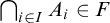 . We will present the proof of Galvin’s theorem, not only for completeness but also because our proof of Theorems 3.16 and 5.10 mirrors this one.
Theorem 3.1 (Galvin’s theorem).
Suppose that
$2^{<\kappa }=\kappa $
 and let F be a normal filter over
$\kappa $
and let F be a normal filter over
$\kappa $
 . Then
$\operatorname {\mathrm {Gal}}(F,\kappa ,\kappa ^+)$
. Then
$\operatorname {\mathrm {Gal}}(F,\kappa ,\kappa ^+)$
 . Namely, letting
$\langle X_i\mid i<\kappa ^+\rangle $
. Namely, letting
$\langle X_i\mid i<\kappa ^+\rangle $
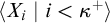 be a sequence of sets such that for every
$i<\kappa ^+$
be a sequence of sets such that for every
$i<\kappa ^+$
 ,
$X_i\in F$
,
$X_i\in F$
 , there is
$Y\subseteq \kappa ^+$
, there is
$Y\subseteq \kappa ^+$
 of cardinality
$\kappa $
of cardinality
$\kappa $
 , such that
$\bigcap _{i\in Y}X_i\in F$
, such that
$\bigcap _{i\in Y}X_i\in F$
 .
.
Proof. For every
$\alpha <\kappa ^+$
 and
$\xi <\kappa $
and
$\xi <\kappa $
 , let
, let

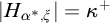
Claim 3.2. There is
$\alpha ^*<\kappa ^+$
 such that for every
$\xi <\kappa $
such that for every
$\xi <\kappa $
 ,
$|H_{\alpha ^*,\xi }|=\kappa ^+$
,
$|H_{\alpha ^*,\xi }|=\kappa ^+$
 .
.
Proof of claim.
Otherwise, for every
$\alpha <\kappa ^+$
 there is
$\xi _\alpha <\kappa $
there is
$\xi _\alpha <\kappa $
 such that
$|H_{\alpha ,\xi _\alpha }|\leq \kappa $
such that
$|H_{\alpha ,\xi _\alpha }|\leq \kappa $
 . By the pigeonhole principle, there is
$X\subseteq \kappa ^+$
. By the pigeonhole principle, there is
$X\subseteq \kappa ^+$
 and
$\xi ^*<\kappa $
and
$\xi ^*<\kappa $
 , such that
$|X|=\kappa ^+$
, such that
$|X|=\kappa ^+$
 and for each
$\alpha \in X, \ \xi _\alpha =\xi ^*.$
and for each
$\alpha \in X, \ \xi _\alpha =\xi ^*.$
 Since
$\kappa $
Since
$\kappa $
 is strong limit and
$\xi ^*<\kappa $
is strong limit and
$\xi ^*<\kappa $
 , there are less than
$\kappa $
, there are less than
$\kappa $
 many possibilities for
$X_\alpha \cap \xi ^*$
many possibilities for
$X_\alpha \cap \xi ^*$
 . Hence we can shrink X to
$X'\subseteq X$
. Hence we can shrink X to
$X'\subseteq X$
 such that
$|X'|=\kappa ^+$
such that
$|X'|=\kappa ^+$
 and find a single set
$E^*\subseteq \xi ^*$
and find a single set
$E^*\subseteq \xi ^*$
 such that for every
$\alpha \in X'$
such that for every
$\alpha \in X'$
 ,
$X_\alpha \cap \xi ^*=E^*$
,
$X_\alpha \cap \xi ^*=E^*$
 . It follows that for every
$\alpha \in X'$
. It follows that for every
$\alpha \in X'$
 :
:

Hence the set
$H_{\alpha ,\xi _\alpha }$
 does not depend on
$\alpha $
does not depend on
$\alpha $
 , which means that it is the same for every
$\alpha \in X'$
, which means that it is the same for every
$\alpha \in X'$
 . Denote this set by
$H^*$
. Denote this set by
$H^*$
 . To see the contradiction, note that for every
$\alpha \in X'$
. To see the contradiction, note that for every
$\alpha \in X'$
 ,
$\alpha \in H_{\alpha ,\xi _\alpha }=H^*$
,
$\alpha \in H_{\alpha ,\xi _\alpha }=H^*$
 , thus
$X'\subseteq H^*$
, thus
$X'\subseteq H^*$
 , hence

contradiction.
Let
$\alpha ^*$
 be as in the claim. Let us choose
$Y\subseteq \kappa ^+$
be as in the claim. Let us choose
$Y\subseteq \kappa ^+$
 that witnesses the lemma. By recursion, define
$\beta _i$
that witnesses the lemma. By recursion, define
$\beta _i$
 for
$i<\kappa $
for
$i<\kappa $
 . At each step we pick
$\beta _i\in H_{\alpha ^*,i+1}\setminus \{\beta _j\mid j<i\}$
. At each step we pick
$\beta _i\in H_{\alpha ^*,i+1}\setminus \{\beta _j\mid j<i\}$
 (at the first step pick any index in
$H_{\alpha ^*,1}$
(at the first step pick any index in
$H_{\alpha ^*,1}$
 ). It is possible to find such
$\beta _i$
). It is possible to find such
$\beta _i$
 , since the cardinality of
$H_{\alpha ^*,\rho _i+1}$
, since the cardinality of
$H_{\alpha ^*,\rho _i+1}$
 is
$\kappa ^+$
is
$\kappa ^+$
 , and
$\{\beta _j\mid j<i\}$
, and
$\{\beta _j\mid j<i\}$
 is of size less than
$\kappa $
is of size less than
$\kappa $
 . Let us prove that
$Y=\{\beta _i\mid i<\kappa \}$
. Let us prove that
$Y=\{\beta _i\mid i<\kappa \}$
 is as wanted. Indeed, by definition, it is clear that
$|Y|=\kappa $
is as wanted. Indeed, by definition, it is clear that
$|Y|=\kappa $
 . Next, we need to prove that
$\bigcap _{\gamma \in Y}X_\gamma =\bigcap _{i<\kappa }X_{\beta _i}\in F$
. Next, we need to prove that
$\bigcap _{\gamma \in Y}X_\gamma =\bigcap _{i<\kappa }X_{\beta _i}\in F$
 . By normality of F,

Thus it suffices to prove that
$X^*\subseteq \bigcap _{i<\kappa }X_{\beta _i}$
 . Let
$\zeta \in X^*$
. Let
$\zeta \in X^*$
 , then for every
$i<\zeta $
, then for every
$i<\zeta $
 ,
$\zeta \in X_{\beta _i}$
,
$\zeta \in X_{\beta _i}$
 by the definition of the diagonal intersection. For
$i\geq \zeta $
by the definition of the diagonal intersection. For
$i\geq \zeta $
 ,
$\zeta \in i+1$
,
$\zeta \in i+1$
 , and thus
$\zeta <i+1$
, and thus
$\zeta <i+1$
 . Recall that
$\beta _i\in H_{\alpha ^*,i+1}$
. Recall that
$\beta _i\in H_{\alpha ^*,i+1}$
 which means that

and since
$\zeta \in X_{\alpha ^*}\cap (i+1)$
 ,
$\zeta \in X_{\beta _i}$
,
$\zeta \in X_{\beta _i}$
 . We conclude that
$\zeta \in \bigcap _{i<\kappa }X_{\beta _i}$
. We conclude that
$\zeta \in \bigcap _{i<\kappa }X_{\beta _i}$
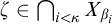 , thus
$X^*\subseteq \bigcap _{i<\kappa }X_{\beta _i}$
, thus
$X^*\subseteq \bigcap _{i<\kappa }X_{\beta _i}$
 .
.
The Galvin property is an invariant of the Rudin–Keisler order (or more generality the Tukey order, see [Reference Benhamou and Dobrinen4]).
Lemma 3.3 [Reference Benhamou, Garti, Gitik and Poveda5, Lemma 2.1].
Suppose
$W \leq _{RK} U$
 are ultrafilters and
$\kappa \leq \lambda $
are ultrafilters and
$\kappa \leq \lambda $
 are cardinals. If
$\lnot \operatorname {\mathrm {Gal}}(W,\kappa ,\lambda )$
are cardinals. If
$\lnot \operatorname {\mathrm {Gal}}(W,\kappa ,\lambda )$
 then
$\lnot \operatorname {\mathrm {Gal}}(U,\kappa ,\lambda )$
then
$\lnot \operatorname {\mathrm {Gal}}(U,\kappa ,\lambda )$
 .
.
The main question inspiring this article concerns the Galvin property on ultrafilters on
$P_\kappa (\kappa ^+)$
 , but we shall answer the question more generally for ultrafilters on
$P_\kappa (\lambda )$
, but we shall answer the question more generally for ultrafilters on
$P_\kappa (\lambda )$
 for any
$\lambda \geq \kappa ^+$
for any
$\lambda \geq \kappa ^+$
 . We shall split this section to three sections, each addressing this general question depending on the cofinality of
$\lambda $
. We shall split this section to three sections, each addressing this general question depending on the cofinality of
$\lambda $
 .
.
3.1 The case
$\mathrm {cf}(\lambda )> \kappa $

We begin with a lemma that we shall use repeatedly.
Lemma 3.4. Let
$\kappa < \lambda $
 be cardinals and let U be an ultrafilter on
$P_\lambda (\lambda )$
be cardinals and let U be an ultrafilter on
$P_\lambda (\lambda )$
 such that U does not concentrate on
$P_\kappa (\zeta )$
such that U does not concentrate on
$P_\kappa (\zeta )$
 for any
$\zeta < \lambda $
for any
$\zeta < \lambda $
 . Suppose that
$[X \mapsto \mathcal {A}_X]_U = \mathcal {A} \in M_U$
. Suppose that
$[X \mapsto \mathcal {A}_X]_U = \mathcal {A} \in M_U$
 and
$\delta <\mathrm {cf}(\lambda )$
and
$\delta <\mathrm {cf}(\lambda )$
 . If
$M_U\models |\mathcal {A}| < j_U(\delta )$
. If
$M_U\models |\mathcal {A}| < j_U(\delta )$
 . Then for any
$B \in U$
. Then for any
$B \in U$
 there is
$\theta <\delta $
there is
$\theta <\delta $
 such that
$ \{ \sup (X) : X\in B \text { and } |\mathcal {A}_X| < \theta \}$
such that
$ \{ \sup (X) : X\in B \text { and } |\mathcal {A}_X| < \theta \}$
 is unbounded in
$\lambda $
is unbounded in
$\lambda $
 .
.
Proof. For every
$\theta < \delta $
 let
$S_\theta = \{ \sup (X) : X \in B \text { and } |\mathcal {A}_X| < \theta \}$
let
$S_\theta = \{ \sup (X) : X \in B \text { and } |\mathcal {A}_X| < \theta \}$
 . We want to show that there is some
$\theta $
. We want to show that there is some
$\theta $
 such that
$\sup S_\theta = \lambda $
such that
$\sup S_\theta = \lambda $
 . Since
$M_U \models |\mathcal {A}| < j_U(\delta )$
. Since
$M_U \models |\mathcal {A}| < j_U(\delta )$
 , by Łoś we have
$Y := \{X \in B : |\mathcal {A}_X| < \delta \} \in U$
, by Łoś we have
$Y := \{X \in B : |\mathcal {A}_X| < \delta \} \in U$
 . Note that

Suppose now towards a contradiction that
$\sup S_\theta < \lambda $
 for all
$\theta < \mathrm {cf}(\lambda )$
for all
$\theta < \mathrm {cf}(\lambda )$
 . It follows that

But then U concentrates on
$P_\kappa (\zeta )$
 , contradicting our assumption.
Remark 3.5. Note that in the previous lemma, if we only assume
$M_U\models |\mathcal {A}| \leq j_U(\delta )$
 , then we still get that for any
$B \in U \{ \sup (X) : X\in B \text { and } |\mathcal {A}_X| \leq \delta \}$
, then we still get that for any
$B \in U \{ \sup (X) : X\in B \text { and } |\mathcal {A}_X| \leq \delta \}$
 is unbounded in
$\lambda $
is unbounded in
$\lambda $
 . The reason is that for
$\{X\in B\mid |\mathcal {A}_X|\leq \delta \}\in U$
. The reason is that for
$\{X\in B\mid |\mathcal {A}_X|\leq \delta \}\in U$
 and for any set in
$Z\in U$
and for any set in
$Z\in U$
 ,
$\{\sup (X)\mid X\in Z\}$
,
$\{\sup (X)\mid X\in Z\}$
 is unbounded in
$\lambda $
is unbounded in
$\lambda $
 .
.
Now we answer [Reference Benhamou and Goldberg10, Question 6.4] of the first author and Goldberg.
Theorem 3.6. Let U be a normal, fine ultrafilter on
$P_\kappa (\lambda )$
 . Suppose that
$2^{<\lambda }=\lambda $
. Suppose that
$2^{<\lambda }=\lambda $
 and
$\mathrm {cf}(\lambda )> \kappa $
and
$\mathrm {cf}(\lambda )> \kappa $
 . Then
$\lnot \operatorname {\mathrm {Gal}}(U,\kappa ,2^\lambda )$
. Then
$\lnot \operatorname {\mathrm {Gal}}(U,\kappa ,2^\lambda )$
 .
.
Proof. Let
$\mathcal {A} = \{j_U(Y) \cap (\sup j_U[\lambda ]) : Y \subseteq \lambda \}$
 . Note that
$M_U$
. Note that
$M_U$
 is only closed under
$\lambda $
is only closed under
$\lambda $
 -sequences and therefore it is not immediate that
$\mathcal {A}\in M_U$
-sequences and therefore it is not immediate that
$\mathcal {A}\in M_U$
 . However, since
$2^{<\lambda }=\lambda $
. However, since
$2^{<\lambda }=\lambda $
 , by Lemma
$4.3.4$
, by Lemma
$4.3.4$
 in [Reference Goldberg22], we do get
$\mathcal {A} \in M_U$
in [Reference Goldberg22], we do get
$\mathcal {A} \in M_U$
 . For completeness, we will sketch the proof of this lemma. Since
$2^{<\lambda } = \lambda $
. For completeness, we will sketch the proof of this lemma. Since
$2^{<\lambda } = \lambda $
 and
$M_U$
and
$M_U$
 is closed under
$\lambda $
is closed under
$\lambda $
 sequences,
$j_U[P_\lambda (\lambda )] \in M_U$
sequences,
$j_U[P_\lambda (\lambda )] \in M_U$
 . Also
$j_U \upharpoonright P_\lambda (\lambda ) \in M_U$
. Also
$j_U \upharpoonright P_\lambda (\lambda ) \in M_U$
 since this is the inverse of the transitive collapse of
$j_U[P_\lambda (\lambda )]$
since this is the inverse of the transitive collapse of
$j_U[P_\lambda (\lambda )]$
 . By supercompactness,
$P(\lambda ) \subseteq M_U$
. By supercompactness,
$P(\lambda ) \subseteq M_U$
 , so
$j_U \upharpoonright P_\lambda (\lambda )^M = j_U \upharpoonright P_\lambda (\lambda )$
, so
$j_U \upharpoonright P_\lambda (\lambda )^M = j_U \upharpoonright P_\lambda (\lambda )$
 . Since
$j_U(X) \cap \sup j_U[\lambda ] = \bigcup _{\xi < \lambda } j_U(X \cap \xi )$
. Since
$j_U(X) \cap \sup j_U[\lambda ] = \bigcup _{\xi < \lambda } j_U(X \cap \xi )$
 we can define
$\mathcal {A}$
we can define
$\mathcal {A}$
 from
$j_U \upharpoonright P_\lambda (\lambda )$
from
$j_U \upharpoonright P_\lambda (\lambda )$
 .
.
Let
$f \colon P_\kappa (\lambda ) \to P(P(\lambda ))$
 represent
$\mathcal {A}$
represent
$\mathcal {A}$
 in
$M_U$
in
$M_U$
 , so that
$j_U(f)(j_U[\lambda ]) = \mathcal {A}$
, so that
$j_U(f)(j_U[\lambda ]) = \mathcal {A}$
 . For each
$X \in P_\kappa (\lambda )$
. For each
$X \in P_\kappa (\lambda )$
 let
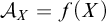
$\mathcal {A}_X = f(X)$
let
$\mathcal {A}_X = f(X)$
 . We may assume that for every X,
$f(X) \subseteq P(\sup (X))$
. We may assume that for every X,
$f(X) \subseteq P(\sup (X))$
 . For every
$Y \subseteq \lambda $
. For every
$Y \subseteq \lambda $
 , define

then
$B_Y \in U$
 as
$j_U[\lambda ]\in j_U(B_Y)$
as
$j_U[\lambda ]\in j_U(B_Y)$
 by definition of
$\mathcal {A}$
by definition of
$\mathcal {A}$
 . We claim that
$\{B_Y : Y \subseteq \lambda \}$
. We claim that
$\{B_Y : Y \subseteq \lambda \}$
 witnesses
$\lnot \operatorname {\mathrm {Gal}}(U,\kappa ,2^{\lambda })$
witnesses
$\lnot \operatorname {\mathrm {Gal}}(U,\kappa ,2^{\lambda })$
 . Otherwise, there is a sequence of distinct
$\langle Y_i \subseteq \lambda : i < \kappa \rangle $
. Otherwise, there is a sequence of distinct
$\langle Y_i \subseteq \lambda : i < \kappa \rangle $
 so that
$B = \bigcap _{i<\kappa } B_{Y_i} \in U$
so that
$B = \bigcap _{i<\kappa } B_{Y_i} \in U$
 .
.
Note that since
$\lambda <j_U(\kappa )$
 , and
$j_U(\kappa )$
, and
$j_U(\kappa )$
 is measurable in
$M_U$
is measurable in
$M_U$
 ,
$M_U\models |\mathcal {A}|=2^\lambda <j_U(\kappa )$
,
$M_U\models |\mathcal {A}|=2^\lambda <j_U(\kappa )$
 so by Lemma 3.4, we can fix
$\theta _0<\kappa $
so by Lemma 3.4, we can fix
$\theta _0<\kappa $
 such that
$S_{\theta _0}$
such that
$S_{\theta _0}$
 is unbounded in
$\lambda $
is unbounded in
$\lambda $
 . For
$i\neq j < \theta _0^+$
. For
$i\neq j < \theta _0^+$
 let
$\beta _{i,j}$
let
$\beta _{i,j}$
 be least such that
$Y_i \setminus \beta _{i,j} \neq Y_j \setminus \beta _{i,j}$
be least such that
$Y_i \setminus \beta _{i,j} \neq Y_j \setminus \beta _{i,j}$
 . Since
$\mathrm {cf}(\lambda )>\kappa >\theta _0$
. Since
$\mathrm {cf}(\lambda )>\kappa >\theta _0$
 ,
$ \beta ^* := \sup _{i\neq j<\theta _0^+}(\beta _{i,j})<\lambda $
,
$ \beta ^* := \sup _{i\neq j<\theta _0^+}(\beta _{i,j})<\lambda $
 , and by our choice of
$\theta _0$
, and by our choice of
$\theta _0$
 , there is an
$X^* \in B$
, there is an
$X^* \in B$
 with
$|\mathcal {A}_{X^*}| < \theta _0$
with
$|\mathcal {A}_{X^*}| < \theta _0$
 and
$\sup (X^*) \geq \beta ^*$
and
$\sup (X^*) \geq \beta ^*$
 . Then the map
$i \mapsto Y_i \cap \sup (X^*)$
. Then the map
$i \mapsto Y_i \cap \sup (X^*)$
 is now a one-to-one map from
$\theta _0^+$
is now a one-to-one map from
$\theta _0^+$
 into
$\mathcal {A}_{X^*}$
into
$\mathcal {A}_{X^*}$
 , a contradiction.
Corollary 3.7. If
$2^\kappa = \kappa ^+$
 and U is a normal, fine ultrafilter on
$P_\kappa (\kappa ^+)$
and U is a normal, fine ultrafilter on
$P_\kappa (\kappa ^+)$
 then
$\lnot \operatorname {\mathrm {Gal}}(U,\kappa ,2^{\kappa ^+})$
then
$\lnot \operatorname {\mathrm {Gal}}(U,\kappa ,2^{\kappa ^+})$
 .
.
Notice that the assumption
$\mathrm {cf}(\lambda )> \kappa $
 is crucial for the argument to work, so that the supremum of the
$\beta _{i,j}$
is crucial for the argument to work, so that the supremum of the
$\beta _{i,j}$
 ’s is below
$\lambda $
’s is below
$\lambda $
 . The case when
$\mathrm {cf}(\lambda ) < \kappa $
. The case when
$\mathrm {cf}(\lambda ) < \kappa $
 will admit a much easier argument.
Normality is crucial to show that the set
$\mathcal {A}$
 is in
$M_U$
is in
$M_U$
 to produce the counterexample to the Galvin property. Without normality, we cannot guarantee this, but we can effectively cover
$\mathcal {A}$
to produce the counterexample to the Galvin property. Without normality, we cannot guarantee this, but we can effectively cover
$\mathcal {A}$
 in the ultrapower if U is fine. This yields the following result.
Theorem 3.8. Let U be a fine,
$\sigma $
 -complete
$P_\kappa (\lambda )$
-complete
$P_\kappa (\lambda )$
 -ultrafilter where
$\kappa $
-ultrafilter where
$\kappa $
 is strong limit,
$\mathrm {cf}(\lambda )> \kappa $
is strong limit,
$\mathrm {cf}(\lambda )> \kappa $
 , and
$2^{<\lambda } = \lambda $
, and
$2^{<\lambda } = \lambda $
 . Then
$\lnot \operatorname {\mathrm {Gal}}(U,\kappa ,2^{\lambda })$
. Then
$\lnot \operatorname {\mathrm {Gal}}(U,\kappa ,2^{\lambda })$
 .
.
Proof. For each
$\alpha $
 with
$\kappa \leq \alpha < \lambda $
with
$\kappa \leq \alpha < \lambda $
 , let
$f_\alpha \colon \lambda \to P(\alpha ) $
, let
$f_\alpha \colon \lambda \to P(\alpha ) $
 be a surjection (here we use
$2^{<\lambda } = \lambda $
be a surjection (here we use
$2^{<\lambda } = \lambda $
 ). Since U is fine,
$\operatorname {\mathrm {id}}_U \supseteq j_U[\lambda ]$
). Since U is fine,
$\operatorname {\mathrm {id}}_U \supseteq j_U[\lambda ]$
 . It follows that
$j_U(f_\alpha )[\operatorname {\mathrm {id}}_U ]\supseteq j_U[P(\alpha )]$
. It follows that
$j_U(f_\alpha )[\operatorname {\mathrm {id}}_U ]\supseteq j_U[P(\alpha )]$
 .
.
Now let
$\langle f^*_\alpha : \alpha < j_U(\lambda ) \rangle = j_U(\langle f_\alpha : \alpha < \lambda \rangle ),$
 and set
$X_\alpha = f^*_\alpha {} [\operatorname {\mathrm {id}}_U].$
and set
$X_\alpha = f^*_\alpha {} [\operatorname {\mathrm {id}}_U].$
 Notice
${\langle } X_\alpha : \alpha < j_U(\lambda ) {\rangle }$
Notice
${\langle } X_\alpha : \alpha < j_U(\lambda ) {\rangle }$
 is in
$M_U$
is in
$M_U$
 :
$X_\alpha \subseteq P(\alpha )^{M_U} \in M_U$
:
$X_\alpha \subseteq P(\alpha )^{M_U} \in M_U$
 and
$\operatorname {\mathrm {id}}_U \in M_U$
and
$\operatorname {\mathrm {id}}_U \in M_U$
 , and the sequence is definable from
$\operatorname {\mathrm {id}}_U $
, and the sequence is definable from
$\operatorname {\mathrm {id}}_U $
 and
$\langle f^*_\alpha : \alpha < j_U(\lambda ) \rangle $
and
$\langle f^*_\alpha : \alpha < j_U(\lambda ) \rangle $
 . Again, since
$\operatorname {\mathrm {id}}_U \supseteq j_U[\lambda ]$
. Again, since
$\operatorname {\mathrm {id}}_U \supseteq j_U[\lambda ]$
 it follows that
$j_U[P(\alpha )] \subseteq X_{j_U(\alpha )}$
it follows that
$j_U[P(\alpha )] \subseteq X_{j_U(\alpha )}$
 .
.
Let
$\lambda ^* = \sup j_U[\lambda ]$
 . In
$M_U$
. In
$M_U$
 , define the following set:

Working in
$M_U$
 , we have that
$|\operatorname {\mathrm {id}}_U|<j_U(\kappa )$
, we have that
$|\operatorname {\mathrm {id}}_U|<j_U(\kappa )$
 and
$j_U(\kappa )$
and
$j_U(\kappa )$
 is strong limit. Therefore,

By definition of
$\mathcal {A}$
 and elementarity we have
$j_U(Y) \cap \lambda ^* \in \mathcal {A}$
and elementarity we have
$j_U(Y) \cap \lambda ^* \in \mathcal {A}$
 for all
$Y \subseteq \lambda $
for all
$Y \subseteq \lambda $
 . To see this, we will prove that for all
$\alpha \in j_U[\lambda ]$
. To see this, we will prove that for all
$\alpha \in j_U[\lambda ]$
 we have
$j_U(Y) \cap \lambda ^* \cap \alpha \in X_\alpha $
we have
$j_U(Y) \cap \lambda ^* \cap \alpha \in X_\alpha $
 . Note that if
$\alpha = j_U(\beta )$
. Note that if
$\alpha = j_U(\beta )$
 for some
$\beta < \lambda $
for some
$\beta < \lambda $
 then
then

Now let
$f \colon P_\kappa (\lambda ) \to P(P(\lambda ^*))$
 represent
$\mathcal {A}$
represent
$\mathcal {A}$
 in the ultrapower so that

For each
$X \in P_\kappa (\lambda )$
 let
$\mathcal {A}_X = f(X)$
let
$\mathcal {A}_X = f(X)$
 . Let g represent
$\lambda ^*$
. Let g represent
$\lambda ^*$
 in
$M_U$
in
$M_U$
 , so
$j_U(g)(\operatorname {\mathrm {id}}) = \lambda ^*$
, so
$j_U(g)(\operatorname {\mathrm {id}}) = \lambda ^*$
 . By the previous paragraph,
$j_U(Y) \cap \sup (\operatorname {\mathrm {id}}_U) \in \mathcal {A} = j_U(f)(\operatorname {\mathrm {id}})$
. By the previous paragraph,
$j_U(Y) \cap \sup (\operatorname {\mathrm {id}}_U) \in \mathcal {A} = j_U(f)(\operatorname {\mathrm {id}})$
 . Reflecting this we have

This is true as
$\operatorname {\mathrm {id}}_U \in j_U(B_Y)$
 by elementarity and the definition of
$\mathcal {A}$
by elementarity and the definition of
$\mathcal {A}$
 . We claim that
$\{B_Y : Y \subseteq \lambda \}$
. We claim that
$\{B_Y : Y \subseteq \lambda \}$
 witnesses
$\lnot \operatorname {\mathrm {Gal}}(U,\kappa ,2^{\lambda })$
witnesses
$\lnot \operatorname {\mathrm {Gal}}(U,\kappa ,2^{\lambda })$
 . Otherwise there is
$\langle Y_i \subseteq \lambda : i < \kappa \rangle $
. Otherwise there is
$\langle Y_i \subseteq \lambda : i < \kappa \rangle $
 so that
$B = \bigcap _{i<\kappa } B_{Y_i} \in U$
so that
$B = \bigcap _{i<\kappa } B_{Y_i} \in U$
 .
.
By Lemma 3.4, fix
$\theta _0<\kappa $
 such that
$\{\sup (X) : X\in B \text { and } |\mathcal {A}_X| \leq \theta _0\}$
such that
$\{\sup (X) : X\in B \text { and } |\mathcal {A}_X| \leq \theta _0\}$
 is unbounded in
$\lambda $
is unbounded in
$\lambda $
 . Now for
$i\neq j < \theta _0^+$
. Now for
$i\neq j < \theta _0^+$
 let
$\beta _{i,j}$
let
$\beta _{i,j}$
 be least such that

Now take
$\alpha ^*> \sup _{i\neq j<\theta _0^+}(\beta _{i,j})$
 below
$\lambda $
below
$\lambda $
 such that there is an
$X^* \in B$
such that there is an
$X^* \in B$
 with
$|\mathcal {A}_{X^*}| \leq \theta _0$
with
$|\mathcal {A}_{X^*}| \leq \theta _0$
 and
$g(X^*) = \alpha ^*$
and
$g(X^*) = \alpha ^*$
 . Then the map
$i \mapsto Y_i \cap g(X^*)$
. Then the map
$i \mapsto Y_i \cap g(X^*)$
 is a 1–1 map from
$\theta _0^+$
is a 1–1 map from
$\theta _0^+$
 into
$\mathcal {A}_{X^*}$
into
$\mathcal {A}_{X^*}$
 , a contradiction.
Together with Corollary 2.8 we get the following, improving a result of Taylor [Reference Taylor30, Theorem 2.4(2)] in some cases.
Corollary 3.9. Let
$\kappa $
 be a strong limit cardinal. If U is a
$(\kappa ,\lambda )$
be a strong limit cardinal. If U is a
$(\kappa ,\lambda )$
 -regular and
$\sigma $
-regular and
$\sigma $
 -complete ultrafilter over
$\lambda $
-complete ultrafilter over
$\lambda $
 where
$\mathrm {cf}(\lambda )>\kappa $
where
$\mathrm {cf}(\lambda )>\kappa $
 and
$2^{<\lambda }=\lambda $
and
$2^{<\lambda }=\lambda $
 then
$\neg \operatorname {\mathrm {Gal}}(U,\kappa ,2^\lambda )$
then
$\neg \operatorname {\mathrm {Gal}}(U,\kappa ,2^\lambda )$
 .
.
Proof. By Corollary 2.8, there is fine ultrafilter W on
$P_\kappa (\lambda )$
 such that
$W\leq _{RK} U$
such that
$W\leq _{RK} U$
 . Also, since U is
$\sigma $
. Also, since U is
$\sigma $
 -complete so is W. By Theorem 3.8,
$\neg \operatorname {\mathrm {Gal}}(W,\kappa ,2^\lambda )$
-complete so is W. By Theorem 3.8,
$\neg \operatorname {\mathrm {Gal}}(W,\kappa ,2^\lambda )$
 . By Lemma 3.3, also
$\neg \operatorname {\mathrm {Gal}}(U,\kappa ,2^\lambda )$
. By Lemma 3.3, also
$\neg \operatorname {\mathrm {Gal}}(U,\kappa ,2^\lambda )$
 .
.
This corollary is also interesting in the light of the conjecture from [Reference Benhamou, Moore and Serafin11] that non-Tukey-top ultrafilters (i.e., those which satisfy the Galvin property) must be non-regular.
3.2 The case
$\mathrm {cf}(\lambda ) < \kappa $

Here the situation trivializes due to a powerful result of Goldberg, which generalizes a classic result of Solovay. We begin with some definitions.
Definition 3.10. An ultrafilter U on a cardinal
$\lambda $
 is weakly normal if whenever
$A \in U$
is weakly normal if whenever
$A \in U$
 and
$f \colon A \to \lambda $
and
$f \colon A \to \lambda $
 is regressive, then there is a
$B \subseteq A$
is regressive, then there is a
$B \subseteq A$
 in U such that
$| f [B]| < \lambda $
in U such that
$| f [B]| < \lambda $
 .
.
Weakly normal ultrafilters admit a nice characterization in the ultrapower (see [Reference Goldberg22, Proposition 4.4.23]).
Proposition 3.11. Let
$\lambda $
 be a cardinal. A countably complete, uniform ultrafilter U on
$\lambda $
be a cardinal. A countably complete, uniform ultrafilter U on
$\lambda $
 is weakly normal if and only if
$\operatorname {\mathrm {id}}_U$
is weakly normal if and only if
$\operatorname {\mathrm {id}}_U$
 is the unique ordinal
$\alpha \geq \sup j_U[\lambda ]$
is the unique ordinal
$\alpha \geq \sup j_U[\lambda ]$
 such that
$\alpha \neq j_U(f)(\beta )$
such that
$\alpha \neq j_U(f)(\beta )$
 for any
$f \colon \lambda \to \lambda $
for any
$f \colon \lambda \to \lambda $
 and
$\beta < \alpha $
and
$\beta < \alpha $
 (i.e.,
$\operatorname {\mathrm {id}}_U$
(i.e.,
$\operatorname {\mathrm {id}}_U$
 is the unique generator of
$j_U$
is the unique generator of
$j_U$
 above
$j_U[\lambda ]$
above
$j_U[\lambda ]$
 ).
).
Definition 3.12. Let
$\theta $
 be a cardinal. An ultrafilter U on
$\theta $
be a cardinal. An ultrafilter U on
$\theta $
 is isonormal if U is weakly normal and
$M_U$
is isonormal if U is weakly normal and
$M_U$
 is closed under
$\theta $
is closed under
$\theta $
 -sequences.
Goldberg gives an exact characterization of when an ultrafilter on a cardinal is equivalent to a supercompactness measure. Using this characterization, we can reduce the study of
$P_\kappa (\lambda )$
 ultrafilters to ultrafilters on cardinals when we are considering only Rudin–Keisler invariant properties, such as the Galvin property. We shall use this deep fact again in the next section.
Theorem 3.13 (Goldberg [Reference Goldberg22, Theorem 4.4.37]).
Every normal, fine ultrafilter is Rudin–Keisler equivalent to a unique isonormal ultrafilter.
Remark 3.14. The proof of the above theorem also shows the following fact that we shall use in the next section: suppose U a normal, fine ultrafilter on
$P_\kappa (\lambda )$
 and
$\mathrm {cf}(\lambda ) \geq \kappa $
and
$\mathrm {cf}(\lambda ) \geq \kappa $
 . Let W be the unique isonormal ultrafilter isomorphic to U. Then there is some ordinal
$\theta $
. Let W be the unique isonormal ultrafilter isomorphic to U. Then there is some ordinal
$\theta $
 such that
$\sup j_U[\lambda ] \leq \theta < j_U(\lambda )$
such that
$\sup j_U[\lambda ] \leq \theta < j_U(\lambda )$
 and
$X \in W$
and
$X \in W$
 iff
$\theta \in j_U(X)$
iff
$\theta \in j_U(X)$
 .
.
This yields an even stronger failure of Galvin’s property in this case.
Theorem 3.15. Let
$\mathrm {cf}(\lambda )<\kappa <\lambda $
 and
$2^{<\lambda } = \lambda $
and
$2^{<\lambda } = \lambda $
 . If U is a normal, fine ultrafilter on
$P_\kappa (\lambda )$
. If U is a normal, fine ultrafilter on
$P_\kappa (\lambda )$
 then
$\lnot \operatorname {\mathrm {Gal}}(U,\kappa ,2^{\lambda ^+})$
then
$\lnot \operatorname {\mathrm {Gal}}(U,\kappa ,2^{\lambda ^+})$
 .
.
Proof. Applying Theorem 3.13, U is Rudin–Keisler equivalent to an isonormal ultrafilter W on
$|\theta | \geq \lambda $
 , where
$\theta $
, where
$\theta $
 is as in the previous remark. Note that
$M_U$
is as in the previous remark. Note that
$M_U$
 and
$M_W$
and
$M_W$
 are in fact closed under
$\lambda ^{<\kappa }$
are in fact closed under
$\lambda ^{<\kappa }$
 -sequences and in this case
$\lambda ^{<\kappa } \geq \lambda ^+$
-sequences and in this case
$\lambda ^{<\kappa } \geq \lambda ^+$
 . Hence we may derive a normal, fine ultrafilter Z on
$P_\kappa (\lambda ^+)$
. Hence we may derive a normal, fine ultrafilter Z on
$P_\kappa (\lambda ^+)$
 from
$j_W$
from
$j_W$
 using
$j_W[\lambda ^+]$
using
$j_W[\lambda ^+]$
 . Now Theorem 3.6 applies to Z and
$Z \leq _{RK} W \cong _{RK}U$
. Now Theorem 3.6 applies to Z and
$Z \leq _{RK} W \cong _{RK}U$
 , so by Lemma 3.3 we may conclude
$\lnot \operatorname {\mathrm {Gal}}(U,\kappa ,2^{\lambda ^+})$
, so by Lemma 3.3 we may conclude
$\lnot \operatorname {\mathrm {Gal}}(U,\kappa ,2^{\lambda ^+})$
 .
.
3.3 The case
$\mathrm {cf}(\lambda ) = \kappa $

Here the situation is more complicated, and the only one yielding a positive result. First we will show that the proof of Galvin’s theorem for normal filters on a cardinal actually generalizesthe following.
Theorem 3.16. Suppose
$\mathrm {cf}(\lambda ) = \kappa $
 and
$2^{<\lambda } = \lambda $
and
$2^{<\lambda } = \lambda $
 . Let U be a normal, fine ultrafilter on
$P_\kappa (\lambda )$
. Let U be a normal, fine ultrafilter on
$P_\kappa (\lambda )$
 . Then
$ \operatorname {\mathrm {Gal}}(U, \kappa , \lambda ^+)$
. Then
$ \operatorname {\mathrm {Gal}}(U, \kappa , \lambda ^+)$
 .
.
Proof. By Theorem
$4.4.37$
 in [Reference Goldberg22], there is a unique weakly normal ultrafilter W on
$\lambda $
in [Reference Goldberg22], there is a unique weakly normal ultrafilter W on
$\lambda $
 such that
$W \cong _{RK} U$
such that
$W \cong _{RK} U$
 . Furthermore,
$M_W$
. Furthermore,
$M_W$
 is closed under
$\lambda $
is closed under
$\lambda $
 -sequences. We will show that
$\operatorname {\mathrm {Gal}}(W, \kappa , \lambda ^+)$
-sequences. We will show that
$\operatorname {\mathrm {Gal}}(W, \kappa , \lambda ^+)$
 holds. Let
${\langle } X_i : i < \lambda ^+ {\rangle } \subseteq W$
holds. Let
${\langle } X_i : i < \lambda ^+ {\rangle } \subseteq W$
 . For
$\alpha < \lambda ^+$
. For
$\alpha < \lambda ^+$
 and
$\xi < \lambda $
and
$\xi < \lambda $
 let
let

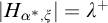
Claim 3.17. There is an
$\alpha ^* < \lambda ^+$
 such that
$|H_{\alpha ^*,\xi }| = \lambda ^+$
such that
$|H_{\alpha ^*,\xi }| = \lambda ^+$
 for every
$\xi < \lambda $
for every
$\xi < \lambda $
 .
.
Proof of claim.
Otherwise, for every
$\alpha < \lambda ^+$
 there is
$\xi _\alpha < \lambda $
there is
$\xi _\alpha < \lambda $
 such that
$|H_{\alpha ,\xi _\alpha }| \leq \lambda $
such that
$|H_{\alpha ,\xi _\alpha }| \leq \lambda $
 . There must be
$X \subseteq \lambda ^+$
. There must be
$X \subseteq \lambda ^+$
 with
$|X| = \lambda ^+$
with
$|X| = \lambda ^+$
 and a
$\xi ^* < \lambda $
and a
$\xi ^* < \lambda $
 such that
$\xi _\alpha = \xi ^*$
such that
$\xi _\alpha = \xi ^*$
 for all
$\alpha \in X$
for all
$\alpha \in X$
 . Since
$2^{<\lambda }=\lambda $
. Since
$2^{<\lambda }=\lambda $
 and
$\xi ^* < \lambda $
and
$\xi ^* < \lambda $
 there are fewer than
$\lambda $
there are fewer than
$\lambda $
 many possibilities for
$X_\alpha \cap \xi ^*$
many possibilities for
$X_\alpha \cap \xi ^*$
 . Hence we may shrink X to
$X' \subseteq X$
. Hence we may shrink X to
$X' \subseteq X$
 with
$|X'| = \lambda ^+$
with
$|X'| = \lambda ^+$
 and find an
$E^* \subseteq \xi ^*$
and find an
$E^* \subseteq \xi ^*$
 such that
$X_\alpha \cap \xi ^* = E^*$
such that
$X_\alpha \cap \xi ^* = E^*$
 for every
$\alpha \in X'$
for every
$\alpha \in X'$
 . Then for every
$\alpha \in X'$
. Then for every
$\alpha \in X'$
 ,
$H_{\alpha ,\xi _\alpha } = H_{\alpha ,\xi ^*}$
,
$H_{\alpha ,\xi _\alpha } = H_{\alpha ,\xi ^*}$
 . Denote this set by
$H^*$
. Denote this set by
$H^*$
 . We see that
$X' \subseteq H^*$
. We see that
$X' \subseteq H^*$
 , but
$|X'|$
, but
$|X'|$
 is strictly larger than
$|H^{\prime}|$
is strictly larger than
$|H^{\prime}|$
 , a contradiction.
Let
$\alpha ^*$
 be as in the claim. Fix
$f : \lambda \to \kappa $
be as in the claim. Fix
$f : \lambda \to \kappa $
 so that
$[f]_W = \kappa $
so that
$[f]_W = \kappa $
 . Note that we may take f to be monotone. To see this, let
$g \colon \kappa \to \lambda $
. Note that we may take f to be monotone. To see this, let
$g \colon \kappa \to \lambda $
 be increasing, continuous, and cofinal, and assume the range of g consists only of cardinals. For every
$\beta < \lambda $
be increasing, continuous, and cofinal, and assume the range of g consists only of cardinals. For every
$\beta < \lambda $
 let
$f(\beta ) = \alpha $
let
$f(\beta ) = \alpha $
 where
$\alpha $
where
$\alpha $
 is least such that
$g(\alpha )> \beta $
is least such that
$g(\alpha )> \beta $
 . Then f is clearly weakly monotone. Now we check that
$[f]_W = \kappa $
. Then f is clearly weakly monotone. Now we check that
$[f]_W = \kappa $
 . As mentioned in Remark 3.14, there is some ordinal
$\theta $
. As mentioned in Remark 3.14, there is some ordinal
$\theta $
 strictly between
$\sup j_U[\lambda ]$
strictly between
$\sup j_U[\lambda ]$
 and
$j(\lambda )$
and
$j(\lambda )$
 such that

So we shall show that
$j_W(f)([\operatorname {\mathrm {id}}]_W) = j_U(f)(\theta ) = \kappa $
 . If
$\alpha < \kappa $
. If
$\alpha < \kappa $
 then
$j_U(g)(\alpha ) = j_U(g(\alpha )) < \sup j_U[\lambda ] < \theta $
then
$j_U(g)(\alpha ) = j_U(g(\alpha )) < \sup j_U[\lambda ] < \theta $
 . Since g is continuous,
$\sup j_U[\lambda ] = j_U(g)(\kappa )$
. Since g is continuous,
$\sup j_U[\lambda ] = j_U(g)(\kappa )$
 . Since
$g(\alpha )$
. Since
$g(\alpha )$
 is always a cardinal,
$\theta < |\sup j_U[\lambda ]|^{+M_U} \leq j(g)(\kappa +1)$
is always a cardinal,
$\theta < |\sup j_U[\lambda ]|^{+M_U} \leq j(g)(\kappa +1)$
 . Hence
$j_U(f)(\theta ) = \kappa $
. Hence
$j_U(f)(\theta ) = \kappa $
 , as desired.
Now for all
$i < \kappa $
 choose
$\beta _i \in H_{\alpha ^*,g(i)+1} \setminus \{\beta _j \mid j < i\}$
choose
$\beta _i \in H_{\alpha ^*,g(i)+1} \setminus \{\beta _j \mid j < i\}$
 for
$i < \kappa $
for
$i < \kappa $
 . We define the f-diagonal intersection:

Note that
$j_W(\vec {X})_i= j_W(X_{\beta _i})$
 for all
$i < \kappa $
for all
$i < \kappa $
 and
$j_W(f)([\operatorname {\mathrm {id}}]_W) = \kappa $
and
$j_W(f)([\operatorname {\mathrm {id}}]_W) = \kappa $
 , so it follows that W is closed under f-diagonal intersections. Now it suffices to show that

Towards this end suppose
$\zeta \in X_{\alpha ^*} \cap D$
 . Fix
$i < \kappa $
. Fix
$i < \kappa $
 . If
$i < f(\zeta )$
. If
$i < f(\zeta )$
 then
$\zeta \in X_{\beta _i}$
then
$\zeta \in X_{\beta _i}$
 by definition of D. If
$i \geq f(\zeta )$
by definition of D. If
$i \geq f(\zeta )$
 , since
$\zeta \in X_{\alpha ^*}$
, since
$\zeta \in X_{\alpha ^*}$
 then
$X_{\beta _i} \cap \lambda _i+1 = X_{\alpha ^*} \cap \lambda _i+1$
then
$X_{\beta _i} \cap \lambda _i+1 = X_{\alpha ^*} \cap \lambda _i+1$
 , so
$\zeta \in X_{\beta _i}$
, so
$\zeta \in X_{\beta _i}$
 .
.
We cannot use the strategy in the proof of Theorem 3.6 since the cofinality of
$\lambda $
 is too small in this case to show the failure of Galvin’s property in the same way. However we can use a simple counting argument to show some failure of Galvin’s property. The following proof was shown to the second author by Goldberg.
Theorem 3.18. Suppose
$\mathrm {cf}(\lambda ) = \kappa $
 and
$2^{<\lambda }=\lambda $
and
$2^{<\lambda }=\lambda $
 . Let U be a normal, fine ultrafilter on
$P_\kappa (\lambda )$
. Let U be a normal, fine ultrafilter on
$P_\kappa (\lambda )$
 . Then
$\neg \operatorname {\mathrm {Gal}}(U,(2^{\kappa })^+,2^\lambda )$
. Then
$\neg \operatorname {\mathrm {Gal}}(U,(2^{\kappa })^+,2^\lambda )$
 .
.
Proof. Let W be the isonormal ultrafilter on
$\lambda $
 that is RK-equivalent to U. Let
$\lambda ^* := \sup (j_U[\lambda ])$
that is RK-equivalent to U. Let
$\lambda ^* := \sup (j_U[\lambda ])$
 and
$\mathcal {A} = {\langle } j_U(S) \cap \lambda ^* \mid S \subseteq \lambda {\rangle }$
and
$\mathcal {A} = {\langle } j_U(S) \cap \lambda ^* \mid S \subseteq \lambda {\rangle }$
 . As in Theorem 3.6,
$\mathcal {A}\in M_W$
. As in Theorem 3.6,
$\mathcal {A}\in M_W$
 so we may let
$\mathcal {A} = [\beta \mapsto \mathcal {A}_\beta ]_W$
so we may let
$\mathcal {A} = [\beta \mapsto \mathcal {A}_\beta ]_W$
 . We may assume that for every
$\beta <\lambda $
. We may assume that for every
$\beta <\lambda $
 ,
$|\mathcal {A}_\beta |<\kappa $
,
$|\mathcal {A}_\beta |<\kappa $
 . Let
${\langle } X_\alpha \mid \alpha < 2^\lambda {\rangle } $
. Let
${\langle } X_\alpha \mid \alpha < 2^\lambda {\rangle } $
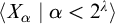 be a one-to-one enumeration of subsets of
$\lambda $
be a one-to-one enumeration of subsets of
$\lambda $
 . For
$\alpha < \lambda $
. For
$\alpha < \lambda $
 let
let

Suppose towards a contradiction that there is some
$I \subseteq 2^\lambda $
 such that
$|I| = (2^\kappa )^+$
such that
$|I| = (2^\kappa )^+$
 and
$B := \bigcap _{\alpha \in I} B_\alpha \in U$
and
$B := \bigcap _{\alpha \in I} B_\alpha \in U$
 . Let
$C \subseteq B$
. Let
$C \subseteq B$
 be cofinal in
$\lambda $
be cofinal in
$\lambda $
 with
$ot(C) = \kappa $
with
$ot(C) = \kappa $
 . Now consider

Then f is a well-defined injection by the definition of B but
$|I| = (2^\kappa )^+$
 and the above product has size
$2^\kappa $
and the above product has size
$2^\kappa $
 , a contradiction.
The above proof shows that the sets
${\langle } B_\alpha \mid \alpha <2^\lambda {\rangle }$
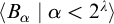 have the following property: For any
$I\in [2^\lambda ]^{(2^\kappa )^+}$
have the following property: For any
$I\in [2^\lambda ]^{(2^\kappa )^+}$
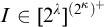 ,
$\bigcap _{\alpha \in I} B_\alpha $
,
$\bigcap _{\alpha \in I} B_\alpha $
 must be bounded in
$\lambda $
must be bounded in
$\lambda $
 .
.
3.4 Possible strengthenings
Under the assumptions that
$2^{<\lambda }=\lambda $
 , the Galvin property for a normal, fine ultrafilter on
$P_\kappa (\lambda )$
, the Galvin property for a normal, fine ultrafilter on
$P_\kappa (\lambda )$
 is fully settled when
$\mathrm {cf}(\lambda )\neq \kappa $
is fully settled when
$\mathrm {cf}(\lambda )\neq \kappa $
 . For
$\mathrm {cf}(\lambda ) = \kappa $
. For
$\mathrm {cf}(\lambda ) = \kappa $
 , there is still one last case.
Question 3.19. Let U be a normal, fine ultrafilter on
$P_\kappa (\lambda )$
 , where
$\mathrm {cf}(\lambda ) = \kappa $
, where
$\mathrm {cf}(\lambda ) = \kappa $
 . Must
$\operatorname {\mathrm {Gal}}(U,2^\kappa ,2^\lambda )$
. Must
$\operatorname {\mathrm {Gal}}(U,2^\kappa ,2^\lambda )$
 hold? Must
$\operatorname {\mathrm {Gal}}(U,2^\kappa ,2^\lambda )$
hold? Must
$\operatorname {\mathrm {Gal}}(U,2^\kappa ,2^\lambda )$
 fail?
fail?
We conjecture that the answer is independent. Another question we would like to address is the necessity of the assumptions of Theorem 3.8 (or rather its Corollary 3.9) regarding U being a
$(\kappa ,\lambda )$
 -regular
$\sigma $
-regular
$\sigma $
 -complete ultrafilter on
$P_\kappa (\lambda )$
-complete ultrafilter on
$P_\kappa (\lambda )$
 . The cardinal arithmetic assumptions of this theorem will be considered in Section 4.3.
Let us consider the fineness assumption. There is a simple counter example if we take
$\lambda $
 to be much larger than
$\kappa $
to be much larger than
$\kappa $
 .
.
Example 3.20. Suppose
$\kappa <\lambda $
 are measurable cardinals, and let
$U_0,U_1$
are measurable cardinals, and let
$U_0,U_1$
 be normal ultrafilters on
$\kappa $
be normal ultrafilters on
$\kappa $
 and
$\lambda ,$
and
$\lambda ,$
 respectively. Let W be an ultrafilter over
$\lambda $
respectively. Let W be an ultrafilter over
$\lambda $
 which is Rudin–Keisler equivalent to the product ultrafilter
$U_0\cdot U_1$
which is Rudin–Keisler equivalent to the product ultrafilter
$U_0\cdot U_1$
 on
$\kappa \times \lambda $
on
$\kappa \times \lambda $
 . So W is a
$\kappa $
. So W is a
$\kappa $
 -complete ultrafilter on
$\lambda $
-complete ultrafilter on
$\lambda $
 and
$2^{<\lambda }=\lambda $
and
$2^{<\lambda }=\lambda $
 but W satisfies
$\operatorname {\mathrm {Gal}}(U,\lambda ,\lambda ^+)$
but W satisfies
$\operatorname {\mathrm {Gal}}(U,\lambda ,\lambda ^+)$
 . Indeed, if
${\langle } A_\alpha \mid \alpha <\lambda ^+\rangle \subseteq U$
. Indeed, if
${\langle } A_\alpha \mid \alpha <\lambda ^+\rangle \subseteq U$
 , then for each
$\alpha $
, then for each
$\alpha $
 we can find
$A_{\alpha ,0}\in U_0$
we can find
$A_{\alpha ,0}\in U_0$
 and
$A_{\alpha ,1}\in U_1$
and
$A_{\alpha ,1}\in U_1$
 such that
$A_{\alpha ,0}\times A_{\alpha ,1}\subseteq A_\alpha $
such that
$A_{\alpha ,0}\times A_{\alpha ,1}\subseteq A_\alpha $
 . We can now stabilize
$A_{\alpha ,0}$
. We can now stabilize
$A_{\alpha ,0}$
 for many
$\alpha $
for many
$\alpha $
 ’s, so we assume without loss of generality that
$A_{\alpha ,0}=X_0\in U_0$
’s, so we assume without loss of generality that
$A_{\alpha ,0}=X_0\in U_0$
 for every
$\alpha <\lambda ^+$
for every
$\alpha <\lambda ^+$
 . Now we apply Galvin’s theorem for the normal measure
$U_1$
. Now we apply Galvin’s theorem for the normal measure
$U_1$
 on
$\lambda $
on
$\lambda $
 , to find
$I\in [\lambda ^+]^{\lambda }$
, to find
$I\in [\lambda ^+]^{\lambda }$
 such that
$X_1=\bigcap _{i\in I}A_{\alpha ,1}\in U_1$
such that
$X_1=\bigcap _{i\in I}A_{\alpha ,1}\in U_1$
 . It follows that
$X_0\times X_1\subseteq \bigcap _{\alpha \in I}A_\alpha $
. It follows that
$X_0\times X_1\subseteq \bigcap _{\alpha \in I}A_\alpha $
 , as wanted.
For ultrafilters over successor cardinals we need to work a bit harder. We can use recent results [Reference Benhamou, Moore and Serafin11] regarding the consistency of non-Tukey-top ultrafilters on successor cardinals. For the convenience of the reader, we translate the results to our settings.
Theorem 3.21 (Essentially [Reference Benhamou, Moore and Serafin11, Theorem 5.4]).
Let
$\nu ^{<\nu }=\nu $
 . Suppose that
$2^\nu <2^{\nu ^+}$
. Suppose that
$2^\nu <2^{\nu ^+}$
 and that there is a normal
$\nu ^+$
and that there is a normal
$\nu ^+$
 -dense idealFootnote
3
on
$\nu ^+$
-dense idealFootnote
3
on
$\nu ^+$
 . Then there is a uniform ultrafilter U on
$\nu ^+$
. Then there is a uniform ultrafilter U on
$\nu ^+$
 such that
$\operatorname {\mathrm {Gal}}(U,\nu ^+,2^{\nu ^+})$
such that
$\operatorname {\mathrm {Gal}}(U,\nu ^+,2^{\nu ^+})$
 .
.
Note that the ultrafilter produced by the above theorem is non-
$(\nu ,\nu ^+)$
 -regular. The consistency of dense ideals on small cardinals was proven to be consistent by Woodin [Reference Hugh Woodin33], and recent results of Eskew and Hayut [Reference Eskew and Hayut16] made significant progress in the study of such ideals.
Theorem 3.22 [Reference Eskew and Hayut16].
It is consistent (relative to large cardinals) that
$\operatorname {\mathrm {GCH}}$
 holds and for every
$n < \omega $
holds and for every
$n < \omega $
 there is a uniform, normal
$\omega _{n+1}$
there is a uniform, normal
$\omega _{n+1}$
 -dense ideal on
$\omega _{n+1}$
-dense ideal on
$\omega _{n+1}$
 .
.
This gives the consistency of an ultrafilter on a successor cardinal which satisfies the Galvin property; however, it is unclear if this could be made the successor of a supercompact cardinal.
Question 3.23. Is it consistent to have a normal
$\kappa ^+$
 -dense ideal on
$\kappa ^+$
-dense ideal on
$\kappa ^+$
 where
$\kappa $
where
$\kappa $
 is
$\kappa ^+$
is
$\kappa ^+$
 -supercompact?
4 Some applications
In this section we present several applications of the failure of the Galvin property.
4.1 The ultrapower axiom
Here we present some results on the Galvin property under the UA. First a concept due to Goldberg that will be vital to the proof of the next theorem.
Definition 4.1. A nonprincipal
$\sigma $
 -complete ultrafilter U is
$\lambda $
-complete ultrafilter U is
$\lambda $
 -irreducible if whenever there is an ultrafilter W concentrating on a set of size
$<\lambda $
-irreducible if whenever there is an ultrafilter W concentrating on a set of size
$<\lambda $
 and
$W' \in M_W$
and
$W' \in M_W$
 such that
$(M_{W'})^{M_W} = M_U$
such that
$(M_{W'})^{M_W} = M_U$
 , either W is principal or
$W \leq _{RK} U$
, either W is principal or
$W \leq _{RK} U$
 . U is irreducible if U is
$\lambda $
. U is irreducible if U is
$\lambda $
 -irreducible for all
$\lambda $
-irreducible for all
$\lambda $
 .
.
Theorem 4.2. (UA) Let U be a
$\sigma $
 -complete ultrafilter on
$\kappa ^+$
-complete ultrafilter on
$\kappa ^+$
 . Then there is a fine,
$\sigma $
. Then there is a fine,
$\sigma $
 -complete ultrafilter F on
$P_\kappa (\kappa ^+)$
-complete ultrafilter F on
$P_\kappa (\kappa ^+)$
 such that
$F \leq _{RK} U$
such that
$F \leq _{RK} U$
 .
.
Proof. Let U be a
$\sigma $
 -complete ultrafilter on
$\kappa ^+$
-complete ultrafilter on
$\kappa ^+$
 . By Theorem
$8.2.24$
. By Theorem
$8.2.24$
 in [Reference Goldberg22] there is an ordinal
$\lambda < \kappa ^+$
in [Reference Goldberg22] there is an ordinal
$\lambda < \kappa ^+$
 and an ultrafilter D on
$\lambda $
and an ultrafilter D on
$\lambda $
 with
$D \leq _{RK} U$
with
$D \leq _{RK} U$
 such that
$j_D(U) = W$
such that
$j_D(U) = W$
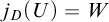 is a
$j_D(\kappa ^+)$
is a
$j_D(\kappa ^+)$
 -irreducible ultrafilter and
$j_U = j_W^{M_D} \circ j_D$
-irreducible ultrafilter and
$j_U = j_W^{M_D} \circ j_D$
 . By Theorem
$8.2.22$
. By Theorem
$8.2.22$
 in [Reference Goldberg22]
$j_W^{M_D}$
in [Reference Goldberg22]
$j_W^{M_D}$
 is a
$j_D(\kappa ^+)$
is a
$j_D(\kappa ^+)$
 supercompactness embedding from the perspective of
$M_D$
supercompactness embedding from the perspective of
$M_D$
 . Hence
$j_W^{M_D}[j_D(\kappa ^+)] \in M_U$
. Hence
$j_W^{M_D}[j_D(\kappa ^+)] \in M_U$
 . Now define an ultrafilter F on
$P_\kappa (\kappa ^+)$
. Now define an ultrafilter F on
$P_\kappa (\kappa ^+)$
 by
by

then F is
$\sigma $
 -complete. To see that F is fine, notice
$j_D(\kappa ^+)> \kappa ^+$
-complete. To see that F is fine, notice
$j_D(\kappa ^+)> \kappa ^+$
 we have
$j_W^{M_D}[j_D(\kappa ^+)] \supseteq j_U[\kappa ^+]$
we have
$j_W^{M_D}[j_D(\kappa ^+)] \supseteq j_U[\kappa ^+]$
 . Also
$j_U(\kappa ) = j_W(j_D(\kappa ))> j_D(\kappa ^+)$
. Also
$j_U(\kappa ) = j_W(j_D(\kappa ))> j_D(\kappa ^+)$
 since
$j_W(\kappa )> \kappa ^+$
since
$j_W(\kappa )> \kappa ^+$
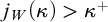 . Hence

Since
$j_W^{M_D}[j_D(\kappa ^+)]$
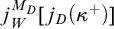 covers
$j_U[\kappa ^+]$
covers
$j_U[\kappa ^+]$
 and has size less than
$j_U(\kappa )$
and has size less than
$j_U(\kappa )$
 we conclude that F is fine. Furthermore
$F \leq _{RK} U$
we conclude that F is fine. Furthermore
$F \leq _{RK} U$
 since F was derived using
$j_U$
since F was derived using
$j_U$
 .
.
This yields an improvement of [Reference Benhamou and Goldberg10, Corollary 6.2].
Corollary 4.3. (UA) Let U be a
$\sigma $
 -complete ultrafilter on
$\kappa ^+$
-complete ultrafilter on
$\kappa ^+$
 . If
$2^\kappa =\kappa ^+$
. If
$2^\kappa =\kappa ^+$
 then
$\lnot \operatorname {\mathrm {Gal}}(U,\kappa ,2^{\kappa ^+})$
then
$\lnot \operatorname {\mathrm {Gal}}(U,\kappa ,2^{\kappa ^+})$
 .
.
4.2 Density of old sets
The failure of the Galvin property for supercompactness measures allows us to generalize a result of Gitik [Reference Gitik21] and Benhamou–Garti–Poveda [Reference Benhamou, Garti and Poveda6] on ground model sets after Prikry forcing over a measurable cardinal. First we start by recalling the definition of the supercompact Prikry forcing (see [Reference Gitik, Foreman and Kanamori20]).
Definition 4.4. Let
$x,y \in P_\kappa (\lambda )$
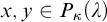 we say that x is strongly below y, written
$x \prec y$
we say that x is strongly below y, written
$x \prec y$
 , iff
$x \subseteq y$
, iff
$x \subseteq y$
 and
$|x| < |\kappa \cap y|$
and
$|x| < |\kappa \cap y|$
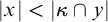 .
.
Definition 4.5. Let U be a normal ultrafilter on
$P_\kappa (\lambda )$
 . The supercompact Prikry forcing consists of
$\langle \vec {x},A\rangle $
. The supercompact Prikry forcing consists of
$\langle \vec {x},A\rangle $
 where
$\vec {x}$
where
$\vec {x}$
 is a finite
$\prec $
is a finite
$\prec $
 -increasing sequence of elements in
$P_\kappa (\lambda )$
-increasing sequence of elements in
$P_\kappa (\lambda )$
 and
$A \in U$
and
$A \in U$
 is such that
$\max _{\prec }(\vec {x}) \prec a$
is such that
$\max _{\prec }(\vec {x}) \prec a$
 for all
$a \in A$
for all
$a \in A$
 . We set
$\langle \vec {x}, A\rangle \leq {\langle } \vec {y}, B {\rangle }$
. We set
$\langle \vec {x}, A\rangle \leq {\langle } \vec {y}, B {\rangle }$
 if the following hold:
-
1. $\vec {x}$
is an end-extension of
$\vec {y}$
. -
2. $A \subseteq B$
. -
3. Whenever $|\vec {y}| < i \leq |\vec {x}|$
,
$x_i \in B \setminus A$
.


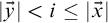

Theorem 4.6. Assume
$2^{<\lambda } = \lambda $
 and
$\mathrm {cf}(\lambda ) \neq \kappa $
and
$\mathrm {cf}(\lambda ) \neq \kappa $
 . Suppose U is a normal
$P_\kappa (\lambda )$
. Suppose U is a normal
$P_\kappa (\lambda )$
 ultrafilter, and let
$\mathbb {P}$
ultrafilter, and let
$\mathbb {P}$
 be the supercompact Prikry forcing with respect to U. In
$V[G]$
be the supercompact Prikry forcing with respect to U. In
$V[G]$
 , there is a set
$S \subseteq 2^\lambda $
, there is a set
$S \subseteq 2^\lambda $
 that contains no ground model set of size
$\kappa $
that contains no ground model set of size
$\kappa $
 .
.
Proof. By Theorem 3.6, in V there is
${\langle } A_\alpha : \alpha < 2^\lambda {\rangle } \subseteq U$
 such that no intersection of
$\kappa $
such that no intersection of
$\kappa $
 many
$A_\alpha $
many
$A_\alpha $
 ’s lies in U. An easy density argument ensures that for every
$\alpha <2^\lambda $
’s lies in U. An easy density argument ensures that for every
$\alpha <2^\lambda $
 there is
$n_\alpha <\omega $
there is
$n_\alpha <\omega $
 such that for every
$m>n_\alpha $
such that for every
$m>n_\alpha $
 ,
$X_m\in A_\alpha $
,
$X_m\in A_\alpha $
 . Since
$\mathrm {cf}(2^\lambda )>\omega $
. Since
$\mathrm {cf}(2^\lambda )>\omega $
 , there is
$S\in [2^\lambda ]^{2^\lambda }$
, there is
$S\in [2^\lambda ]^{2^\lambda }$
 , and
$n^*<\omega $
, and
$n^*<\omega $
 such that for every
$\alpha \in S$
such that for every
$\alpha \in S$
 ,
$n_\alpha =n^*$
,
$n_\alpha =n^*$
 . This means that
$\{X_m\mid m<n^*\}\subseteq \bigcap _{\alpha \in S}A_\alpha $
. This means that
$\{X_m\mid m<n^*\}\subseteq \bigcap _{\alpha \in S}A_\alpha $
 . We will show that S contains no ground model set of size
$\kappa $
. We will show that S contains no ground model set of size
$\kappa $
 . Otherwise
$T \in [S]^\kappa $
. Otherwise
$T \in [S]^\kappa $
 in V, then by the failure of Galvin’s property,
$\bigcap _{\alpha \in T} A_\alpha \notin U$
in V, then by the failure of Galvin’s property,
$\bigcap _{\alpha \in T} A_\alpha \notin U$
 . On the other hand,
$\{X_m \mid m>n^*\}\subseteq \bigcap _{\alpha \in T} A_\alpha $
. On the other hand,
$\{X_m \mid m>n^*\}\subseteq \bigcap _{\alpha \in T} A_\alpha $
 . However, since
$\kappa \setminus (\bigcap _{\alpha \in T} A_\alpha ) \in U$
. However, since
$\kappa \setminus (\bigcap _{\alpha \in T} A_\alpha ) \in U$
 , the same density argument as before yield that for some
$n'<\omega $
, the same density argument as before yield that for some
$n'<\omega $
 , for every
$m>n'$
, for every
$m>n'$
 ,
$X_m\notin \bigcap _{\alpha \in T} A_\alpha $
,
$X_m\notin \bigcap _{\alpha \in T} A_\alpha $
 , this is a contradiction.
We will give some example conclusions we may draw from this theorem. Let G be generic for the supercompact Prikry forcing, and let
$X \in V[G] \setminus V$
 such that
$X \subseteq V[G]$
such that
$X \subseteq V[G]$
 . Let
$\eta = |X|$
. Let
$\eta = |X|$
 . Then:
-
1. If $C = \bigcup \{ \vec {x} : \langle \vec {x},A\rangle \in G \}$
is the Prikry sequence, then C contains no infinite ground model set. -
2. If $\theta $
is any cardinal of
$V[G]$
of countable cofinality, then
$\theta $
has a subset of size
$\theta $
with no ground model subset of the same cardinality. -
3. If $\omega < \mathrm {cf}^V(\eta ) < \kappa $
, then X contains a ground model set of size
$\eta $
. -
4. If $\kappa < \mathrm {cf}(\eta ) \leq 2^\lambda $
then X contains ground model subsets of every cardinality
$< \kappa $
, but no ground model set of size
$\kappa $
. -
5. If $\mathrm {cf}(\eta )> 2^\lambda $
then X contains a ground model set of the same size.



Remark 4.7. If U is a supercompactness measure on
$P_\kappa (\lambda )$
 then there is a Rudin–Keisler projection from U to a normal measure on
$\kappa $
then there is a Rudin–Keisler projection from U to a normal measure on
$\kappa $
 , via
$x \mapsto |x \cap \kappa |$
, via
$x \mapsto |x \cap \kappa |$
 . This can be lifted to a projection from the supercompact Prikry forcing with U to the classical Prikry forcing with a normal measure on
$\kappa $
. This can be lifted to a projection from the supercompact Prikry forcing with U to the classical Prikry forcing with a normal measure on
$\kappa $
 . Hence any new sets with no large ground model subsets added by the classical Prikry forcing will also persist into the supercompact Prikry extension. Hence, Gitik’s analysis of the density of old sets in a usual Prikry extension can be used. In fact, if U is
$2^\kappa $
. Hence any new sets with no large ground model subsets added by the classical Prikry forcing will also persist into the supercompact Prikry extension. Hence, Gitik’s analysis of the density of old sets in a usual Prikry extension can be used. In fact, if U is
$2^\kappa $
 -supercompact, then any
$\kappa $
-supercompact, then any
$\kappa $
 -complete ultrafilter on
$\kappa $
-complete ultrafilter on
$\kappa $
 is a Rudin–Keisler projection of U and the Rudin–Keisler projection induces a projection of the corresponding forcings.
4.3 Generating sets of
$P_\kappa (\lambda )$
-measures

Recall that given an ultrafilter U on a set X, and a filter F, we say that
$\mathcal {B}\subseteq U$
 is a
$\subseteq _F$
is a
$\subseteq _F$
 -base for U if for every
$A\in U$
-base for U if for every
$A\in U$
 there is
$B\in \mathcal {B}$
there is
$B\in \mathcal {B}$
 such that
$B \subseteq A \ (\text {mod} \ F)$
such that
$B \subseteq A \ (\text {mod} \ F)$
 , namely, there is
$C\in F$
, namely, there is
$C\in F$
 such that
$B\cap C\subseteq A$
such that
$B\cap C\subseteq A$
 . When U is an ultrafilter over a cardinal
$\mu $
. When U is an ultrafilter over a cardinal
$\mu $
 , we usually consider
$F=\{\kappa \}$
, we usually consider
$F=\{\kappa \}$
 or F being the co-bounded filter on
$\kappa $
or F being the co-bounded filter on
$\kappa $
 , in which case
$ \subseteq \ (\text {mod} \ F)$
, in which case
$ \subseteq \ (\text {mod} \ F)$
 translates to
$\subseteq $
translates to
$\subseteq $
 and
$\subseteq ^*$
and
$\subseteq ^*$
 , respectively. However, on
$P_\kappa (\lambda )$
, respectively. However, on
$P_\kappa (\lambda )$
 -measures, there is another natural ideal to consider—the fine ideal. Let

The following is well-known (see, e.g., [Reference Garti and Shelah18, Claim 1.2]).
Lemma 4.8. No uniform ultrafilter over X has a
$\subseteq $
 -base consisting of
$|X|$
-base consisting of
$|X|$
 -many sets.
An immediate corollary is as follows.
Corollary 4.9. Let U be a uniform ultrafilter on X and F a filter over X. Suppose that
$F\subseteq U$
 , and F is generated by
$|X|$
, and F is generated by
$|X|$
 -many sets, then
$\chi _F(U)=\chi (U)$
-many sets, then
$\chi _F(U)=\chi (U)$
 .
.
The way our results connect to the above is by using the following lemma.
Lemma 4.10 (Folklore).
Let
$\lambda $
 be a regular cardinal and U an ultrafilter on
$\lambda $
be a regular cardinal and U an ultrafilter on
$\lambda $
 . Suppose that U satisfy
$\neg \operatorname {\mathrm {Gal}}(U,\lambda ,\lambda )$
. Suppose that U satisfy
$\neg \operatorname {\mathrm {Gal}}(U,\lambda ,\lambda )$
 . Then
$\chi (U)\geq \lambda $
. Then
$\chi (U)\geq \lambda $
 .
.
Proof. Let
${\langle } A_\alpha \mid \alpha <\lambda {\rangle }\subseteq U$
 witness that
$\neg \operatorname {\mathrm {Gal}}(U,\lambda ,\lambda )$
witness that
$\neg \operatorname {\mathrm {Gal}}(U,\lambda ,\lambda )$
 . Towards a contradiction, if
$\chi (U)<\lambda $
. Towards a contradiction, if
$\chi (U)<\lambda $
 , let
${\langle } X_\beta \mid \beta <\theta {\rangle }\subseteq U$
, let
${\langle } X_\beta \mid \beta <\theta {\rangle }\subseteq U$
 be a
$\subseteq $
be a
$\subseteq $
 -base for U for some
$\theta <\lambda $
-base for U for some
$\theta <\lambda $
 . For each
$\alpha <\lambda $
. For each
$\alpha <\lambda $
 , we find
$\beta _\alpha <\theta $
, we find
$\beta _\alpha <\theta $
 such that
$X_{\beta _\alpha }\subseteq A_\alpha $
such that
$X_{\beta _\alpha }\subseteq A_\alpha $
 . By the regularity of
$\lambda $
. By the regularity of
$\lambda $
 , we can find a single
$\beta ^*$
, we can find a single
$\beta ^*$
 ans
$S\in [\lambda ]^\lambda $
ans
$S\in [\lambda ]^\lambda $
 such that for every
$\alpha \in S$
such that for every
$\alpha \in S$
 ,
$\beta _\alpha =\beta ^*$
,
$\beta _\alpha =\beta ^*$
 . It follows that
$X_{\beta ^*}\subseteq \bigcap _{\alpha \in S}A_{\alpha }$
. It follows that
$X_{\beta ^*}\subseteq \bigcap _{\alpha \in S}A_{\alpha }$
 , contradicting that
${\langle } A_\alpha \mid \alpha <\lambda {\rangle }$
, contradicting that
${\langle } A_\alpha \mid \alpha <\lambda {\rangle }$
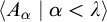 witnesses
$\neg \operatorname {\mathrm {Gal}}(U,\lambda ,\lambda )$
witnesses
$\neg \operatorname {\mathrm {Gal}}(U,\lambda ,\lambda )$
 .
.
Corollary 4.11. If U is a
$\sigma $
 -complete
$(\kappa ,\lambda )$
-complete
$(\kappa ,\lambda )$
 -regular ultrafilter over
$\lambda $
-regular ultrafilter over
$\lambda $
 ,
$\kappa $
,
$\kappa $
 being a strong limit and
$2^{<\lambda }=\lambda $
being a strong limit and
$2^{<\lambda }=\lambda $
 , then
$\chi (U)=2^\lambda $
, then
$\chi (U)=2^\lambda $
 .
.
Next, let us show that
$2^{<\lambda }=\lambda $
 cannot be dropped from Theorem 3.8. Towards that, we need the following theorem.
Theorem 4.12 (Raghavan–Shelah [Reference Raghavan and Shelah29]).
Suppose that
$\kappa ^{<\kappa }=\kappa $
 , and
$\kappa <cf(\mu )<\lambda <\mu $
, and
$\kappa <cf(\mu )<\lambda <\mu $
 , where
$\mu $
, where
$\mu $
 is a strong limit cardinal and suppose U is a
$\mathrm {cf}(\mu )$
is a strong limit cardinal and suppose U is a
$\mathrm {cf}(\mu )$
 -indecomposable ultrafilter over
$\lambda $
-indecomposable ultrafilter over
$\lambda $
 . If
$G \subseteq \operatorname {\mathrm {Add}}(\kappa ,\mu )$
. If
$G \subseteq \operatorname {\mathrm {Add}}(\kappa ,\mu )$
 is a V-generic filter, any extension of U to a
$V[G]$
is a V-generic filter, any extension of U to a
$V[G]$
 -ultrafilter
$U^*$
-ultrafilter
$U^*$
 is generated by
$\mu $
is generated by
$\mu $
 -many sets.
We remark that to apply the above theorem, we do not need any further cardinal arithmetic assumptions. See Definition
$5$
 and Theorem
$7$
and Theorem
$7$
 of [Reference Raghavan and Shelah29].
Corollary 4.13. Let
$\kappa $
 be a Laver-indestructible supercompact cardinalFootnote
4
and let
$\lambda>\kappa $
be a Laver-indestructible supercompact cardinalFootnote
4
and let
$\lambda>\kappa $
 be a regular cardinal such that there is
$\lambda $
be a regular cardinal such that there is
$\lambda $
 -complete fine ultrafilter U over
$P_\lambda (\lambda ^+)$
-complete fine ultrafilter U over
$P_\lambda (\lambda ^+)$
 . If
$G \subseteq \operatorname {\mathrm {Add}}(\kappa ,\mu )$
. If
$G \subseteq \operatorname {\mathrm {Add}}(\kappa ,\mu )$
 is a V-generic filter, then in
$V[G]$
is a V-generic filter, then in
$V[G]$
 there is a
$\kappa $
there is a
$\kappa $
 -complete fine ultrafilter
$U^*$
-complete fine ultrafilter
$U^*$
 on
$P_\lambda (\lambda ^+)$
on
$P_\lambda (\lambda ^+)$
 such that
$\operatorname {\mathrm {Gal}}(U^*,2^{\lambda ^+},2^{\lambda ^+})$
such that
$\operatorname {\mathrm {Gal}}(U^*,2^{\lambda ^+},2^{\lambda ^+})$
 . In particular
$\operatorname {\mathrm {Gal}}(U^*,\kappa ,2^{\lambda ^+})$
. In particular
$\operatorname {\mathrm {Gal}}(U^*,\kappa ,2^{\lambda ^+})$
 .
.
Proof. Let
$\bar {U}$
 be the filter generated by U in
$V[G]$
be the filter generated by U in
$V[G]$
 . Since
$\text {Add}(\kappa ,\lambda ^{+\kappa ^+})$
. Since
$\text {Add}(\kappa ,\lambda ^{+\kappa ^+})$
 is
$\kappa $
is
$\kappa $
 -closed,
$\bar {U}$
-closed,
$\bar {U}$
 is a
$\kappa $
is a
$\kappa $
 -complete filter, and since
$\kappa $
-complete filter, and since
$\kappa $
 is indestructible, in
$V[G]$
is indestructible, in
$V[G]$
 , we can extend
$\bar {U}$
, we can extend
$\bar {U}$
 to a
$\kappa $
to a
$\kappa $
 -complete ultrafilter
$U^*$
-complete ultrafilter
$U^*$
 on
$P_\lambda (\lambda ^+)$
on
$P_\lambda (\lambda ^+)$
 . To see that
$U^*$
. To see that
$U^*$
 remains fine, it suffices to use the fineness of U and note that
$\{A\in P_\lambda (\lambda ^+)\mid \alpha \in A\}^V\subseteq \{A\in P_\lambda (\lambda ^+)\mid \alpha \in A\}^{V[G]}$
remains fine, it suffices to use the fineness of U and note that
$\{A\in P_\lambda (\lambda ^+)\mid \alpha \in A\}^V\subseteq \{A\in P_\lambda (\lambda ^+)\mid \alpha \in A\}^{V[G]}$
 . It remains to see that
$\operatorname {\mathrm {Gal}}(U^*,2^{\lambda ^+},2^{\lambda ^+})$
. It remains to see that
$\operatorname {\mathrm {Gal}}(U^*,2^{\lambda ^+},2^{\lambda ^+})$
 holds, since U is
$\lambda $
holds, since U is
$\lambda $
 -complete, it is in particular
$\kappa ^+$
-complete, it is in particular
$\kappa ^+$
 -complete, so we may apply Theorem 4.12, to conclude that the extension
$U^*$
-complete, so we may apply Theorem 4.12, to conclude that the extension
$U^*$
 of U is generated by
$\lambda ^{+\kappa ^+}$
of U is generated by
$\lambda ^{+\kappa ^+}$
 -many sets. Also note that in
$V[G]$
-many sets. Also note that in
$V[G]$
 ,
$2^{\lambda ^+}=\lambda ^{+\kappa ^++1}$
,
$2^{\lambda ^+}=\lambda ^{+\kappa ^++1}$
 . By Lemma 4.10, we conclude that
$\operatorname {\mathrm {Gal}}(U^*,2^{\lambda ^+},2^{\lambda ^+})$
. By Lemma 4.10, we conclude that
$\operatorname {\mathrm {Gal}}(U^*,2^{\lambda ^+},2^{\lambda ^+})$
 holds, as desired.
5 On generating sets modulo the fine filters
In this section we discuss two results concerning generating sets of a fine filter with respect to
$\subseteq _{\mathcal {F}}$
 , where
$\mathcal {F}$
, where
$\mathcal {F}$
 is the fine filter defined as follows.
Definition 5.1. The fine filter
$\mathcal {F}$
 is the filter generated by sets for the form
$\{X\in P_\kappa (\lambda )\mid i\in X\}$
is the filter generated by sets for the form
$\{X\in P_\kappa (\lambda )\mid i\in X\}$
 for some
$i<\lambda $
for some
$i<\lambda $
 . For
$X,Y \in P_\kappa (\lambda )$
. For
$X,Y \in P_\kappa (\lambda )$
 we say
$X \subseteq _{\mathcal {F}} Y$
we say
$X \subseteq _{\mathcal {F}} Y$
 if there is some
$A \in \mathcal {F}$
if there is some
$A \in \mathcal {F}$
 such that
$X \cap A \subseteq Y$
such that
$X \cap A \subseteq Y$
 . When
$\kappa $
. When
$\kappa $
 and
$\lambda $
and
$\lambda $
 are clear from context, we will simply write
$X \subseteq _{\mathcal {F}} Y$
are clear from context, we will simply write
$X \subseteq _{\mathcal {F}} Y$
 .
.
Note that by Corollary 4.9, we have that
$\chi _{\mathcal {F}}(U)=\chi (U)$
 .
.
5.1 The revised Galvin property
One may argue that the problem of generalizing Galvin’s theorem to normal
$P_\kappa (\lambda )$
 -ultrafilters is that the wrong version of Galvin’s property was used. In this section, we present two possible ways the theory generalizes if one uses the inclusion modulo the fine ideal.
Definition 5.2. Let U be a fine ultrafilter on
$P_\kappa (\lambda )$
 .
$\mathrm {Gal}^{*}(U,\mu ,\mu ')$
.
$\mathrm {Gal}^{*}(U,\mu ,\mu ')$
 is the statement that from any
$\mu '$
is the statement that from any
$\mu '$
 -many sets in U there are
$\mu $
-many sets in U there are
$\mu $
 -many which have a lower bound in
$\subseteq _{\mathcal {F}}$
-many which have a lower bound in
$\subseteq _{\mathcal {F}}$
 . In other words, given
${\langle } A_\alpha : \alpha < \mu ' {\rangle } \subseteq U$
. In other words, given
${\langle } A_\alpha : \alpha < \mu ' {\rangle } \subseteq U$
 there is some
$I \subseteq \mu '$
there is some
$I \subseteq \mu '$
 with
$|I| = \mu $
with
$|I| = \mu $
 and
$A^* \in U$
and
$A^* \in U$
 such that whenever
$\alpha \in I$
such that whenever
$\alpha \in I$
 ,
$A^* \subseteq _{\mathcal {F}} A_\alpha $
,
$A^* \subseteq _{\mathcal {F}} A_\alpha $
 .
.
Definition 5.3. Let F be a filter on a set D. Suppose
$\mathcal {A}$
 is a family of subsets of D such that whenever
$A_0,\ldots , A_{n-1} \in \mathcal {A}$
is a family of subsets of D such that whenever
$A_0,\ldots , A_{n-1} \in \mathcal {A}$
 ,
$\bigcap _{i < n}A_i \in F^+$
,
$\bigcap _{i < n}A_i \in F^+$
 . Then we denote by
$F[\mathcal {A}]$
. Then we denote by
$F[\mathcal {A}]$
 the minimal filter such that
$F \cup \mathcal {A} \subseteq F[\mathcal {A}]$
the minimal filter such that
$F \cup \mathcal {A} \subseteq F[\mathcal {A}]$
 .
.
There are limitations on the variation of Galvin’s property that can hold. The following limitation is a slight modification of [Reference Benhamou3, Theorem 4.3].
Corollary 5.4. Let U be a fine ultrafilter on
$P_\kappa (\lambda )$
 and let
$\mu = \mathrm {cf}(\chi (U))$
and let
$\mu = \mathrm {cf}(\chi (U))$
 . Then
$\lnot \mathrm {Gal}^{*}(U,\mu ,\mu )$
. Then
$\lnot \mathrm {Gal}^{*}(U,\mu ,\mu )$
 . In particular, if
$2^\lambda = \lambda ^+$
. In particular, if
$2^\lambda = \lambda ^+$
 then
$\lnot \mathrm {Gal}^{*}(U,\lambda ^+,\lambda ^+)$
then
$\lnot \mathrm {Gal}^{*}(U,\lambda ^+,\lambda ^+)$
 .
.
Proof. Let
${\langle } X_i : i < \chi _{\mathcal {F}}(U) {\rangle }$
 be a
$\subseteq _{\mathcal {F}}$
be a
$\subseteq _{\mathcal {F}}$
 -base for U. By Lemma 4.8,
$\chi _{\mathcal {F}}(U)=\chi (U) \geq \lambda ^+$
-base for U. By Lemma 4.8,
$\chi _{\mathcal {F}}(U)=\chi (U) \geq \lambda ^+$
 . By thinning out the
$\subseteq _{\mathcal {F}}$
. By thinning out the
$\subseteq _{\mathcal {F}}$
 -base, we may assume that for any
$j < \chi (U)$
-base, we may assume that for any
$j < \chi (U)$
 ,
$X_j\notin \mathcal {F}[{\langle } X_i : i < j{\rangle }]$
,
$X_j\notin \mathcal {F}[{\langle } X_i : i < j{\rangle }]$
 , namely
$X_i\not \subseteq _{\mathcal {F}} X_j$
, namely
$X_i\not \subseteq _{\mathcal {F}} X_j$
 for any
$i<j$
for any
$i<j$
 . Now let
${\langle } \alpha _i\mid i<\mathrm {cf}(\chi (U)){\rangle }$
. Now let
${\langle } \alpha _i\mid i<\mathrm {cf}(\chi (U)){\rangle }$
 be increasing and cofinal in
$\chi (U)$
be increasing and cofinal in
$\chi (U)$
 . We claim that
${\langle } X_{\alpha _i}\mid i<\mathrm {cf}(\chi (U)){\rangle }$
. We claim that
${\langle } X_{\alpha _i}\mid i<\mathrm {cf}(\chi (U)){\rangle }$
 witnesses that
$\lnot \mathrm {Gal}^{*}(U,\lambda ,\lambda )$
witnesses that
$\lnot \mathrm {Gal}^{*}(U,\lambda ,\lambda )$
 . Otherwise, there is I unbounded in
$\mathrm {cf}(\chi (U))$
. Otherwise, there is I unbounded in
$\mathrm {cf}(\chi (U))$
 such that
$\{X_{\alpha _i}\mid i\in I\}$
such that
$\{X_{\alpha _i}\mid i\in I\}$
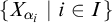 has a
$\subseteq _{\mathcal {F}}$
has a
$\subseteq _{\mathcal {F}}$
 -lower bound
$X\in U$
-lower bound
$X\in U$
 . Then there is
$j< \mathrm {cf}(\chi (U))$
. Then there is
$j< \mathrm {cf}(\chi (U))$
 such that
$X_j\subseteq _{\mathcal {F}} X$
such that
$X_j\subseteq _{\mathcal {F}} X$
 . Since
${\langle } \alpha _i\mid i<\mathrm {cf}(\chi (U)){\rangle }$
. Since
${\langle } \alpha _i\mid i<\mathrm {cf}(\chi (U)){\rangle }$
 is cofinal and I is unbounded, there is
$i\in I$
is cofinal and I is unbounded, there is
$i\in I$
 such that
$j<\alpha _i$
such that
$j<\alpha _i$
 . But this is impossible since this would mean that
$X_j\subseteq _{\mathcal {F}} X\subseteq _{\mathcal {F}} X_{\alpha _i}$
. But this is impossible since this would mean that
$X_j\subseteq _{\mathcal {F}} X\subseteq _{\mathcal {F}} X_{\alpha _i}$
 , contradicting the choice that
$X_{\alpha _i}\notin \mathcal {F}[{\langle } X_j\mid j<\alpha _i{\rangle }]$
, contradicting the choice that
$X_{\alpha _i}\notin \mathcal {F}[{\langle } X_j\mid j<\alpha _i{\rangle }]$
 .
.
Definition 5.5. We say that a fine ultrafilter U on
$P_\kappa (\lambda )$
 is a
$P_\mu $
is a
$P_\mu $
 -point if every collection
${\langle } X_i\mid i<\rho {\rangle }\subseteq U$
-point if every collection
${\langle } X_i\mid i<\rho {\rangle }\subseteq U$
 such that
$\rho <\mu $
such that
$\rho <\mu $
 there is a set
$A\in U$
there is a set
$A\in U$
 such that for every
$i<\rho $
such that for every
$i<\rho $
 ,
$A\setminus X_i\in \mathcal {F}^*$
,
$A\setminus X_i\in \mathcal {F}^*$
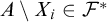 , where
$\mathcal {F}^*$
, where
$\mathcal {F}^*$
 is the ideal dual to
$\mathcal {F}$
is the ideal dual to
$\mathcal {F}$
 .
.
For successor cardinals, Benda and Ketonen [Reference Benda and Ketonen2] have another definition of a p-point which differs from this one.
Proposition 5.6. If U is a normal, fine ultrafilter then U is a
$P_{\lambda ^+}$
 -point.
Proof. Let
$\rho < \lambda ^+$
 and let
${\langle } X_i : i <\rho {\rangle } \subseteq U$
and let
${\langle } X_i : i <\rho {\rangle } \subseteq U$
 . Let
${\langle } X_{i_\nu }\mid \nu <\lambda {\rangle }$
. Let
${\langle } X_{i_\nu }\mid \nu <\lambda {\rangle }$
 be a re-enumeration of order type
$\lambda $
be a re-enumeration of order type
$\lambda $
 . Let
. Let

Then
$A \in U$
 by normality. Furthermore, for each
$i<\rho $
by normality. Furthermore, for each
$i<\rho $
 we find
$\nu <\lambda $
we find
$\nu <\lambda $
 such that
$i=i_\nu $
such that
$i=i_\nu $
 . Then,

It is easy to see that the following holds.
Proposition 5.7. If U is a
$P_{\lambda ^+}$
 -point then
$\mathrm {Gal}^{*}(U,\lambda ,\lambda )$
-point then
$\mathrm {Gal}^{*}(U,\lambda ,\lambda )$
 .
.
Let us provide some analogies to the usual characterization of p-points using partitions.
Proposition 5.8. Let U be a fine ultrafilter on
$P_\kappa (\lambda )$
 . The following are equivalent:
-
1. U is a $P_{\lambda ^+}$
-point. -
2. Whenever ${\langle } X_i : i < \lambda {\rangle } \subseteq P(P_\kappa (\lambda ))$
either there is
$j < \lambda $
such that
$X_j \in U$
or else there is an
$X \in U$
such that
$X \cap X_i \in \mathcal {F}$
for all
$i < \lambda $
.




Proof. Assume U is a
$P_{\lambda ^+}$
 -point and let
${\langle } X_i\mid i<\lambda {\rangle }\subseteq P(P_\kappa (\lambda )$
-point and let
${\langle } X_i\mid i<\lambda {\rangle }\subseteq P(P_\kappa (\lambda )$
 be such that for every
$i<\lambda $
be such that for every
$i<\lambda $
 ,
$X_i\notin U$
,
$X_i\notin U$
 . Then
${\langle } X_i^c\mid i<\lambda {\rangle }\subseteq U$
. Then
${\langle } X_i^c\mid i<\lambda {\rangle }\subseteq U$
 . By
$(1)$
. By
$(1)$
 , there is
$X\in U$
, there is
$X\in U$
 such that
$X\subseteq _{\mathcal {F}} X_i^c$
such that
$X\subseteq _{\mathcal {F}} X_i^c$
 for each i. This means that
$X\cap X_i\in \mathcal {F}$
for each i. This means that
$X\cap X_i\in \mathcal {F}$
 for every
$i<\lambda $
for every
$i<\lambda $
 . The other direction is similar.
The variation of Galvin’s theorem we obtain here is with respect to the following special kind of intersection.
Definition 5.9. Let
${\langle } A_x\mid x\in P_\kappa (\lambda ){\rangle }\subseteq P_\kappa (\lambda )$
 . The cone intersection of the sequence
${\langle } A_x\mid x\in P_\kappa (\lambda ){\rangle }\subseteq P_\kappa (\lambda )$
. The cone intersection of the sequence
${\langle } A_x\mid x\in P_\kappa (\lambda ){\rangle }\subseteq P_\kappa (\lambda )$
 is the set

Clearly, the cone intersection satisfies

For example, if
$A_x=\{z\in P_\kappa (\lambda )\mid x\subseteq z\}$
 , then for every
$y\in P_\kappa (\lambda )$
, then for every
$y\in P_\kappa (\lambda )$
 , there is
$y\subsetneq x$
, there is
$y\subsetneq x$
 , which means that
$y\notin A_x$
, which means that
$y\notin A_x$
 , and in turn
$y\notin {\unicode{x29D6}}_{x\in P_\kappa (\lambda )}A_x$
, and in turn
$y\notin {\unicode{x29D6}}_{x\in P_\kappa (\lambda )}A_x$
 , i.e.,
${\unicode{x29D6}}_{x\in P_\kappa (\lambda )}A_x=\emptyset $
, i.e.,
${\unicode{x29D6}}_{x\in P_\kappa (\lambda )}A_x=\emptyset $
 . If follows that normal measures on
$P_\kappa (\lambda )$
. If follows that normal measures on
$P_\kappa (\lambda )$
 are not in general closed under cone intersections of their elements. Nonetheless, we have the following analogy of Galvin’s theorem.
Theorem 5.10. Suppose that
$\lambda ^{<\kappa }=\lambda $
 and let U be a normal, fine ultrafilter over
$P_\kappa (\lambda )$
and let U be a normal, fine ultrafilter over
$P_\kappa (\lambda )$
 . Then for any
${\langle } A_\alpha \mid \alpha <\lambda ^+{\rangle }\subseteq U$
. Then for any
${\langle } A_\alpha \mid \alpha <\lambda ^+{\rangle }\subseteq U$
 there are sets
$H_x\in [\lambda ^+]^{\lambda ^+}$
there are sets
$H_x\in [\lambda ^+]^{\lambda ^+}$
 for
$x\in P_\kappa (\lambda )$
for
$x\in P_\kappa (\lambda )$
 such that for every choice
${\langle }\alpha _x\mid x\in P_\kappa (\lambda ){\rangle }\in \prod _{x\in P_\kappa (\lambda )}H_x$
such that for every choice
${\langle }\alpha _x\mid x\in P_\kappa (\lambda ){\rangle }\in \prod _{x\in P_\kappa (\lambda )}H_x$
 ,
${\unicode{x29D6}}_{x\in P_\kappa (\lambda )}A_{\alpha _x}\in U$
,
${\unicode{x29D6}}_{x\in P_\kappa (\lambda )}A_{\alpha _x}\in U$
 .
.
Proof. For each
$x\in P_\kappa (\lambda )$
 and
$\alpha <\lambda ^+$
and
$\alpha <\lambda ^+$
 let
let

Claim 5.11. There is
$\alpha ^*<\lambda ^+$
 such that for every
$x\in P_\kappa (\lambda )$
such that for every
$x\in P_\kappa (\lambda )$
 ,
$|H_{\alpha ^*,x}|=\lambda ^+$
,
$|H_{\alpha ^*,x}|=\lambda ^+$
 .
.
Proof of claim.
Otherwise, for each
$\alpha <\lambda ^+$
 there is
$x_\alpha $
there is
$x_\alpha $
 such that
$|H_{\alpha ,x_\alpha }|\leq \lambda $
such that
$|H_{\alpha ,x_\alpha }|\leq \lambda $
 . Since
$\lambda ^{<\kappa }=\lambda $
. Since
$\lambda ^{<\kappa }=\lambda $
 , there is
$S\in [\lambda ^+]^{\lambda ^+}$
, there is
$S\in [\lambda ^+]^{\lambda ^+}$
 and
$x^*\in P_\kappa (\lambda )$
and
$x^*\in P_\kappa (\lambda )$
 such that for every
$\alpha \in S$
such that for every
$\alpha \in S$
 ,
$x_\alpha =x^*$
,
$x_\alpha =x^*$
 . Next, note that the value of
$A_\alpha \cap P(x^*)$
. Next, note that the value of
$A_\alpha \cap P(x^*)$
 has
$2^{2^{|x^*|}}$
has
$2^{2^{|x^*|}}$
 -many possibilities. Since
$\lambda ^{<\kappa }=\lambda $
-many possibilities. Since
$\lambda ^{<\kappa }=\lambda $
 , there is
$A^*\subseteq P(x^*)$
, there is
$A^*\subseteq P(x^*)$
 and
$S'\in [S]^{\lambda ^+}$
and
$S'\in [S]^{\lambda ^+}$
 such that for every
$\alpha \in S'$
such that for every
$\alpha \in S'$
 ,
$A_\alpha \cap P(x^*)=A^*$
,
$A_\alpha \cap P(x^*)=A^*$
 . But this is impossible, since if
$\alpha \in S'$
. But this is impossible, since if
$\alpha \in S'$
 , then on the one hand
$|H_{\alpha ,x_\alpha }|\leq \lambda $
, then on the one hand
$|H_{\alpha ,x_\alpha }|\leq \lambda $
 , on the other hand,
$S'\subseteq H_{\alpha ,x_\alpha }$
, on the other hand,
$S'\subseteq H_{\alpha ,x_\alpha }$
 .
.
Fix
$\alpha ^*$
 as in the claim above and let
$H_x=H_{\alpha ^*,x}$
as in the claim above and let
$H_x=H_{\alpha ^*,x}$
 . For every
$x\in P_\kappa (\lambda )$
. For every
$x\in P_\kappa (\lambda )$
 , choose
$\alpha _x\in H_{\alpha ^*,x}$
, choose
$\alpha _x\in H_{\alpha ^*,x}$
 and let
$A_x=A_{\alpha _x}$
and let
$A_x=A_{\alpha _x}$
 . To see that
${\unicode{x29D6}}_{x\in P_\kappa (\lambda )}A_x\in U$
. To see that
${\unicode{x29D6}}_{x\in P_\kappa (\lambda )}A_x\in U$
 , we prove that
$\operatorname {\mathrm {id}}_U=j_U[\lambda ]\in j_U({\unicode{x29D6}}_{x\in P_\kappa (\lambda )}A_x)=({\unicode{x29D6}}_{x\in P_{j(\kappa )}(j(\lambda ))}A^{\prime }_x))^{M_U}$
, we prove that
$\operatorname {\mathrm {id}}_U=j_U[\lambda ]\in j_U({\unicode{x29D6}}_{x\in P_\kappa (\lambda )}A_x)=({\unicode{x29D6}}_{x\in P_{j(\kappa )}(j(\lambda ))}A^{\prime }_x))^{M_U}$
 , where
$j_U({\langle } A_x\mid x\in P_\kappa (\lambda ){\rangle })={\langle } A^{\prime }_x\mid x\in P_{j(\kappa )}(j(\lambda ))^{M_U}{\rangle }$
, where
$j_U({\langle } A_x\mid x\in P_\kappa (\lambda ){\rangle })={\langle } A^{\prime }_x\mid x\in P_{j(\kappa )}(j(\lambda ))^{M_U}{\rangle }$
 . Towards this, following the definition of the cone intersection, let
$x\prec j_U[\lambda ]$
. Towards this, following the definition of the cone intersection, let
$x\prec j_U[\lambda ]$
 , then there is
$y\in P_\kappa (\lambda )$
, then there is
$y\in P_\kappa (\lambda )$
 such that
$j_U(y)=j_U[y]=x$
such that
$j_U(y)=j_U[y]=x$
 . In particular,
$A^{\prime }_x=j_U(A_y)$
. In particular,
$A^{\prime }_x=j_U(A_y)$
 and since
$A_y\in U$
and since
$A_y\in U$
 ,
$\operatorname {\mathrm {id}}_U\in j_U(A_y)$
,
$\operatorname {\mathrm {id}}_U\in j_U(A_y)$
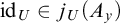 . For the second part of the definition of
$({\unicode{x29D6}}_{x\in P_\kappa (\lambda )} A^{\prime }_x)^{M_U}$
. For the second part of the definition of
$({\unicode{x29D6}}_{x\in P_\kappa (\lambda )} A^{\prime }_x)^{M_U}$
 , let
$y\in (P_{j(\kappa )}(j(\lambda )))^{M_U}$
, let
$y\in (P_{j(\kappa )}(j(\lambda )))^{M_U}$
 such that
$\operatorname {\mathrm {id}}_U\subseteq y$
such that
$\operatorname {\mathrm {id}}_U\subseteq y$
 . By elementarity and the choice of the sequence
${\langle } \alpha _x\mid x\in P_\kappa (\lambda ){\rangle }$
. By elementarity and the choice of the sequence
${\langle } \alpha _x\mid x\in P_\kappa (\lambda ){\rangle }$
 ,
$M_U\models j_{U}(A_{\alpha ^*})\cap P(y)=A_{y}\cap P(y)$
,
$M_U\models j_{U}(A_{\alpha ^*})\cap P(y)=A_{y}\cap P(y)$
 . Since
$\operatorname {\mathrm {id}}_U\subseteq y$
. Since
$\operatorname {\mathrm {id}}_U\subseteq y$
 we conclude that
$\operatorname {\mathrm {id}}_U\in j_U(A^*)\cap P(y)$
we conclude that
$\operatorname {\mathrm {id}}_U\in j_U(A^*)\cap P(y)$
 and therefore in
$A_y$
and therefore in
$A_y$
 . It follows that
$ \operatorname {\mathrm {id}}_U\in j_U({\unicode{x29D6}}_{x\in P_{\kappa }(\lambda )}A_x)$
. It follows that
$ \operatorname {\mathrm {id}}_U\in j_U({\unicode{x29D6}}_{x\in P_{\kappa }(\lambda )}A_x)$
 , as wanted.
Remark 5.12. The above generalizes Galvin’s theorem in the following sense: a normal ultrafilter U on a measurable cardinal
$\kappa $
 can be identified as a normal, fine ultrafilter on
$P_\kappa (\kappa )$
can be identified as a normal, fine ultrafilter on
$P_\kappa (\kappa )$
 which concentrates on the set of ordinals
$\kappa \subseteq P_\kappa (\kappa )$
which concentrates on the set of ordinals
$\kappa \subseteq P_\kappa (\kappa )$
 . Now the above theorem says that if we take
${\langle } A_\alpha \mid \alpha <\kappa ^+{\rangle }\subseteq U$
. Now the above theorem says that if we take
${\langle } A_\alpha \mid \alpha <\kappa ^+{\rangle }\subseteq U$
 , then there are
$H_x\in [\kappa ^+]^{\kappa ^+}$
, then there are
$H_x\in [\kappa ^+]^{\kappa ^+}$
 such that for every
${\langle } \alpha _x\mid x\in P_\kappa (\kappa ){\rangle }\in \prod _{x\in P_\kappa (\kappa )}$
such that for every
${\langle } \alpha _x\mid x\in P_\kappa (\kappa ){\rangle }\in \prod _{x\in P_\kappa (\kappa )}$
 .
${\unicode{x29D6}}_{x\in P_\kappa (\kappa )}A_{\alpha _x}\in U$
.
${\unicode{x29D6}}_{x\in P_\kappa (\kappa )}A_{\alpha _x}\in U$
 . Hence
$ {\unicode{x29D6}}_{x\in P_\kappa (\kappa )}A_{\alpha _x}\in U$
. Hence
$ {\unicode{x29D6}}_{x\in P_\kappa (\kappa )}A_{\alpha _x}\in U$
 . We claim that
$\text {Card.}\cap {\unicode{x29D6}}_{x\in P_\kappa (\kappa )}A_{\alpha _x}\subseteq \bigcap _{\nu <\kappa }A_{\alpha _\nu }$
. We claim that
$\text {Card.}\cap {\unicode{x29D6}}_{x\in P_\kappa (\kappa )}A_{\alpha _x}\subseteq \bigcap _{\nu <\kappa }A_{\alpha _\nu }$
 , where
$\text {Card.}$
, where
$\text {Card.}$
 is the class of cardinals (here we view
$\nu $
is the class of cardinals (here we view
$\nu $
 as an element of
$P_\kappa (\kappa )$
as an element of
$P_\kappa (\kappa )$
 ). Indeed, let
$\rho \in \text {Card.}\cap {\unicode{x29D6}}_{x\in P_\kappa (\kappa )}A_{\alpha _x}$
). Indeed, let
$\rho \in \text {Card.}\cap {\unicode{x29D6}}_{x\in P_\kappa (\kappa )}A_{\alpha _x}$
 and
$\nu <\kappa $
and
$\nu <\kappa $
 . Then either
$\nu <\rho $
. Then either
$\nu <\rho $
 in which case
$\nu \prec \rho $
in which case
$\nu \prec \rho $
 and thus
$\rho \in A_{\alpha _\nu }$
and thus
$\rho \in A_{\alpha _\nu }$
 . Otherwise,
$\rho \leq \nu $
. Otherwise,
$\rho \leq \nu $
 in which case
$\rho \subseteq \nu $
in which case
$\rho \subseteq \nu $
 and again
$\rho \in A_{\alpha _\nu }$
and again
$\rho \in A_{\alpha _\nu }$
 by definition of
${\unicode{x29D6}}$
by definition of
${\unicode{x29D6}}$
 . We conclude that
$\rho \in \bigcap _{\nu <\kappa }A_{\alpha _\nu }$
. We conclude that
$\rho \in \bigcap _{\nu <\kappa }A_{\alpha _\nu }$
 which recovers Galvin’s theorem.
5.2 An ideal from two-cardinal filter games
Throughout this section we assume that
$\kappa \leq \lambda $
 are cardinals and
$\lambda ^{<\kappa } = \lambda $
are cardinals and
$\lambda ^{<\kappa } = \lambda $
 . In this section, we would like to generalize Theorem 1 of [Reference Foreman, Magidor and Zeman17, Theorem 1.2] connecting winning strategy in the filter games and large cardinal ideals, to the two-cardinal filter games. These were interested in [Reference Benhamou and Gitman9]. To set up the game, we first need the following definition.
Definition 5.13. Fix some large regular cardinal
$\theta $
 . A set
$M \prec H_\theta $
. A set
$M \prec H_\theta $
 of size
$\lambda $
of size
$\lambda $
 is called a
$(\kappa ,\lambda )$
is called a
$(\kappa ,\lambda )$
 -model if:
-
1. M is transitive;
-
2. $M \models \operatorname {\mathrm {ZFC}}^{-}$
Footnote
5
; -
3. $M \prec _{\Sigma _0} V$
; -
4. $\lambda +1 \subseteq M$
and
$P_\kappa (\lambda )^M \subseteq M$
.


Given a
$(\kappa ,\lambda )$
 -model N we say that U is a normal N-ultrafilter on
$P_\kappa (\lambda )$
-model N we say that U is a normal N-ultrafilter on
$P_\kappa (\lambda )$
 if
if

That is, U measures all the sets in
$P(P_\kappa (\lambda ))\cap N$
 , and whenever
${\langle } A_\alpha \mid \alpha <\lambda {\rangle }\in N$
, and whenever
${\langle } A_\alpha \mid \alpha <\lambda {\rangle }\in N$
 is a collection of
$\lambda $
is a collection of
$\lambda $
 -many sets in U,
$\Delta _{\alpha <\lambda }A_\alpha \in U$
-many sets in U,
$\Delta _{\alpha <\lambda }A_\alpha \in U$
 .
.
Let us turn to the definition of the games
$G_1$
 and
$G_2$
and
$G_2$
 . This is a game between two players, the Challenger and the Judge, taking turns. Informally, the Challenger presents the Judge with a challenge—a collection of sets they have to measure. The Judge responds with a normal ultrafilter measuring this collection. In further steps of the game, the Challenger can add more sets to the ones which they previously presented, and the Judge has to extend the previous ultrafilter to the new collection.
The game
$G_1$
 , generalizing the game
$G_1$
, generalizing the game
$G_1$
 from [Reference Foreman, Magidor and Zeman17]. For that we need an internally approachable sequence, that is, a sequence
${\langle } N_i : i< \lambda ^+{\rangle }$
from [Reference Foreman, Magidor and Zeman17]. For that we need an internally approachable sequence, that is, a sequence
${\langle } N_i : i< \lambda ^+{\rangle }$
 of
$(\kappa ,\lambda )$
of
$(\kappa ,\lambda )$
 -models which is an increasing, continuous elementary chain such that
${\langle } N_i : i < \alpha {\rangle } \in N_{\alpha '} $
-models which is an increasing, continuous elementary chain such that
${\langle } N_i : i < \alpha {\rangle } \in N_{\alpha '} $
 for all
$\alpha < \alpha ' < \lambda ^+$
for all
$\alpha < \alpha ' < \lambda ^+$
 .
.
Remark 5.14. If
$|P(P_\kappa (\lambda ))| = \lambda ^+$
 then in
$H_\theta $
then in
$H_\theta $
 there is a well-order of
$P_{\lambda ^+}(P(P_\kappa (\lambda )))$
there is a well-order of
$P_{\lambda ^+}(P(P_\kappa (\lambda )))$
 in order type
$\lambda ^+$
in order type
$\lambda ^+$
 . Hence
$P(P_\kappa (\lambda )) = \bigcup _{i< \mu } N_i\cap P(P_\kappa (\lambda ))$
. Hence
$P(P_\kappa (\lambda )) = \bigcup _{i< \mu } N_i\cap P(P_\kappa (\lambda ))$
 , and every
$N_i$
, and every
$N_i$
 -ultrafilter appears in
$N_j$
-ultrafilter appears in
$N_j$
 for some
$j> i$
for some
$j> i$
 .
.
Definition 5.15 (The game
$G_1$
).

Fix any ordinal
$\gamma $
 . The rules of
$G^\gamma _1$
. The rules of
$G^\gamma _1$
 are as follows:
-
1. The Challenger plays an increasing sequence of ordinals $\alpha _i < \lambda ^+$
. -
2. The Judge plays a sequence $U_i$
of
$N_{\alpha _i+1}$
-ultrafilters on
$P_\kappa (\lambda )$
such that:-
(a) ${\langle } U_j\mid j<i{\rangle }\in N_{\alpha _i+1}$
. -
(b) $U_j \subseteq U_i$
for all
$i> j$
.
-


The Challenger goes first at limit stages. The game proceeds for some length
$\ell < \gamma $
 determined by the play, for some fixed
$\gamma \leq \lambda ^+$
determined by the play, for some fixed
$\gamma \leq \lambda ^+$
 . The game continues until either the Judge has no valid move or the play has reached length
$\gamma $
. The game continues until either the Judge has no valid move or the play has reached length
$\gamma $
 . The Judge wins only if the play reaches length
$\gamma $
. The Judge wins only if the play reaches length
$\gamma $
 .
.
Definition 5.16 (The game
$G_2$
).

Fix an internally approachable sequence of
$(\kappa ,\lambda )$
 -models
${\langle } N_i : i<\lambda ^+{\rangle }$
-models
${\langle } N_i : i<\lambda ^+{\rangle }$
 . The rules of
$G^\gamma _2$
. The rules of
$G^\gamma _2$
 are as follows:
-
1. The Challenger plays an increasing sequence of ordinals $\alpha _i < \lambda ^+$
. -
2. The Judge plays a sequence of sets $Y_i \subseteq P_\kappa (\lambda )$
such that:-
(a) $Y_i \subseteq _{\mathcal {F}} Y_j$
for all
$i> j$
and
${\langle } Y_j\mid j<i{\rangle }\in N_{\alpha _i+1}$
. -
(b) $U_i = \{ X \in P(P_\kappa (\lambda )) \cap N_{\alpha _i+1} : Y_i \subseteq _{\mathcal {F}} X\}$
is a normal
$N_{\alpha _i+1}$
-ultrafilter on
$P_\kappa (\lambda ))$
.
-


The rules and winning conditions of
$G^\gamma _2$
 are the same as those of
$G^\gamma _1$
are the same as those of
$G^\gamma _1$
 .
.
Proposition 5.17. The following are equivalent:
-
1. The Judge has a winning strategy in $G^\gamma _1$
. -
2. The Judge has a winning strategy in $G^\gamma _2$
.


Proof. The direction
$(2) \Rightarrow (1)$
 is trivial, since given the set produced by a strategy for
$G_2^\gamma $
is trivial, since given the set produced by a strategy for
$G_2^\gamma $
 the Judge can play the ultrafilter determined by that set in
$G_1^\gamma $
the Judge can play the ultrafilter determined by that set in
$G_1^\gamma $
 .
.
Given a
$G^\gamma _1$
 -winning strategy
$\sigma $
-winning strategy
$\sigma $
 , we will define a
$G^\gamma _2$
, we will define a
$G^\gamma _2$
 -winning strategy
$\sigma '$
-winning strategy
$\sigma '$
 . For the first move, the Challenger plays an ordinal
$\alpha _0$
. For the first move, the Challenger plays an ordinal
$\alpha _0$
 and
$\sigma $
and
$\sigma $
 will yield a normal
$N_{\alpha _0}+1$
will yield a normal
$N_{\alpha _0}+1$
 ultrafilter
$U_0$
ultrafilter
$U_0$
 . To determine the move
$Y_0$
. To determine the move
$Y_0$
 given by
$\sigma '$
given by
$\sigma '$
 , choose
$\beta $
, choose
$\beta $
 large enough that
$U_0 \in N_\beta $
large enough that
$U_0 \in N_\beta $
 and choose a minimal enumeration of
$U_0 = \{X_\xi : \xi < \lambda \}$
and choose a minimal enumeration of
$U_0 = \{X_\xi : \xi < \lambda \}$
 is the well-ordering of
$H_\theta $
is the well-ordering of
$H_\theta $
 . By elementarity, and since
$U_0\in N_\beta $
. By elementarity, and since
$U_0\in N_\beta $
 , this enumeration is in
$N_\beta $
, this enumeration is in
$N_\beta $
 . Then set
$Y_0 = \Delta _{\xi < \lambda } X_\xi $
. Then set
$Y_0 = \Delta _{\xi < \lambda } X_\xi $
 . Note that any legal move
$\alpha _1$
. Note that any legal move
$\alpha _1$
 of the challenger will have to satisfy that
$Y_0\in N_{\alpha _1}$
of the challenger will have to satisfy that
$Y_0\in N_{\alpha _1}$
 and also
$U_0\in N_{\alpha _1}$
and also
$U_0\in N_{\alpha _1}$
 . Again by elementarity, we will have that the minimal enumeration
$U_0 = \{X_\xi : \xi < \lambda \}$
. Again by elementarity, we will have that the minimal enumeration
$U_0 = \{X_\xi : \xi < \lambda \}$
 will also be in
$N_{\alpha _1}$
will also be in
$N_{\alpha _1}$
 , so whenever
$U_0\subseteq U_1$
, so whenever
$U_0\subseteq U_1$
 is a normal
$N_{\alpha _1}$
is a normal
$N_{\alpha _1}$
 -ultrafilter,
$Y_0\in U_1$
-ultrafilter,
$Y_0\in U_1$
 .
.
Now suppose that
${\langle }(\alpha _j,Y_j)\mid j<i{\rangle }$
 is a run in the game according to
$\sigma '$
is a run in the game according to
$\sigma '$
 which has already been defined. Also assume that we maintained an auxiliary
$G^\gamma _1$
which has already been defined. Also assume that we maintained an auxiliary
$G^\gamma _1$
 -run
${\langle } (\alpha _j,U_j)\mid j<i{\rangle }$
-run
${\langle } (\alpha _j,U_j)\mid j<i{\rangle }$
 , such that each
$Y_j$
, such that each
$Y_j$
 is the diagonal intersection of
$U_j$
is the diagonal intersection of
$U_j$
 according to the minimal enumeration of
$U_j$
according to the minimal enumeration of
$U_j$
 in the
$H_\theta $
in the
$H_\theta $
 well-ordering.
Now suppose that the challenger in the game
$G^\gamma _2$
 plays a legal move
$\alpha _i$
plays a legal move
$\alpha _i$
 . Note that
${\langle } (U_j,Y_j)\mid j<i{\rangle } \in N_{\alpha _i+1}$
. Note that
${\langle } (U_j,Y_j)\mid j<i{\rangle } \in N_{\alpha _i+1}$
 , and that for each
$j<i$
, and that for each
$j<i$
 , the minimal enumeration of
$U_j$
, the minimal enumeration of
$U_j$
 is a member of
$N_{\alpha _i+1}$
is a member of
$N_{\alpha _i+1}$
 . Next, we let the challenger in the game
$G^\gamma _1$
. Next, we let the challenger in the game
$G^\gamma _1$
 play
$\alpha _i$
play
$\alpha _i$
 , and the strategy
$\sigma '$
, and the strategy
$\sigma '$
 produces an
$N_{\alpha _i+1}$
produces an
$N_{\alpha _i+1}$
 -normal ultrafilter
$U_i$
-normal ultrafilter
$U_i$
 which extends all the
$U_j$
which extends all the
$U_j$
 ’s for
$j<i$
’s for
$j<i$
 . It follows that
$Y_j\in U_i$
. It follows that
$Y_j\in U_i$
 for each
$j<i$
for each
$j<i$
 . Let
$U_i=\{X^i_\xi \mid \xi <\lambda \}$
. Let
$U_i=\{X^i_\xi \mid \xi <\lambda \}$
 be the minimal enumeration of
$U_i$
be the minimal enumeration of
$U_i$
 , we set
$Y_i=\Delta _{\xi < \lambda }X^i_\xi $
, we set
$Y_i=\Delta _{\xi < \lambda }X^i_\xi $
 . It is routine to check that
$\sigma $
. It is routine to check that
$\sigma $
 is a winning strategy in the game
$G^\gamma _2$
is a winning strategy in the game
$G^\gamma _2$
 .
.
Next, we shall define some properties of ideals that appear in the main theorem of this section.
Definition 5.18. Let I be an ideal on
$P_\kappa (\lambda )$
 .
.
-
1. I is normal if I is closed under diagonal unions: whenever ${\langle } X_\alpha : \alpha < \lambda {\rangle } \subseteq I$
, (12) $$ \begin{align} \underset{{\alpha<\lambda}}{\nabla}X_\alpha := \{ x \in P_\kappa(\lambda) : x \in \bigcup_{\alpha \in x} X_\alpha \}\in I. \end{align} $$
-
2. I is precipitous if whenever $G \subseteq P(P_\kappa (\lambda ))/I$
is generic over V, the generic V-ultrapower
$\mathrm {Ult}(V,G)$
is well-founded. -
3. $D \subseteq I^+$
is dense if D is a dense subset of the partial order
$(P(P_\kappa (\lambda ))/I,\subseteq _I)$
. -
4. I is $\lambda $
-measuring if for any
${\langle } A_\alpha \mid \alpha <\lambda {\rangle }\subseteq P_\kappa (\lambda )$
and any
$S\in I^+$
there is
$S'\subseteq S$
,
$S'\in I^+$
such that for any
$\alpha <\lambda $
,
$S'\subseteq _{\mathcal {F}} A_\alpha $
or
$S'\subseteq _{\mathcal {F}} P_\kappa (\lambda )\setminus A_\alpha $
.



Theorem 5.19. Suppose that
$2^\lambda =\lambda ^+$
 , there is no saturated ideal on
$P_\kappa (\lambda )$
, there is no saturated ideal on
$P_\kappa (\lambda )$
 , and that the Judge has a winning strategy for the game
$G^\gamma _2$
, and that the Judge has a winning strategy for the game
$G^\gamma _2$
 for some regular
$\omega <\gamma \leq \lambda $
for some regular
$\omega <\gamma \leq \lambda $
 . Then there is an ideal I on
$P_\kappa (\lambda )$
. Then there is an ideal I on
$P_\kappa (\lambda )$
 such that:
-
1. I is normal.
-
2. I is precipitous.
-
3. $I^+$
has a dense subtree
$(T,\supseteq _{\mathcal {F}})$
which is
$\gamma $
-closed. -
4. I is $\lambda $
-measuring.


Proof. Given a winning strategy
$\sigma $
 for the Judge, we define the hopeless ideal
$I(\sigma )$
for the Judge, we define the hopeless ideal
$I(\sigma )$
 as the collection of all
$X \subseteq P_\kappa (\lambda )$
as the collection of all
$X \subseteq P_\kappa (\lambda )$
 such that no play of the game played according to
$\sigma $
such that no play of the game played according to
$\sigma $
 ends with a
$Y \subseteq _{\mathcal {F}} X$
ends with a
$Y \subseteq _{\mathcal {F}} X$
 . In other words, no ultrafilter generated in any play according to
$\sigma $
. In other words, no ultrafilter generated in any play according to
$\sigma $
 assigns measure one to X.
More precisely, for any
$\ell \leq \gamma $
 we recursively define a play of
$G^\ell _2$
we recursively define a play of
$G^\ell _2$
 according to
$\sigma $
according to
$\sigma $
 as a sequence
$P = {\langle } (\alpha _i, Y_i) : \sigma ((P \upharpoonright i)^{\smallfrown }\alpha _i) = Y_i \text { for } i < \ell {\rangle }$
as a sequence
$P = {\langle } (\alpha _i, Y_i) : \sigma ((P \upharpoonright i)^{\smallfrown }\alpha _i) = Y_i \text { for } i < \ell {\rangle }$
 . Now define the hopeless ideal:

For two plays P and Q, we say
$P \sqsubseteq Q$
 iff there is a sequence of valid moves
$\vec {M}$
iff there is a sequence of valid moves
$\vec {M}$
 such that
$P{}^{\smallfrown } \vec {M} = Q$
such that
$P{}^{\smallfrown } \vec {M} = Q$
 . We also define the conditional hopeless ideal given some play P of length
$\ell < \gamma $
. We also define the conditional hopeless ideal given some play P of length
$\ell < \gamma $
 :
:

Claim 5.20.
$I(\sigma )$
 is
$\kappa $
is
$\kappa $
 -complete and normal.
Proof of claim.
First we check
$\kappa $
 -completeness. Suppose towards a contradiction that
$I(\sigma )$
-completeness. Suppose towards a contradiction that
$I(\sigma )$
 is not
$\kappa $
is not
$\kappa $
 -complete, so there is some
$\eta < \kappa $
-complete, so there is some
$\eta < \kappa $
 and
${\langle } A_\xi : \xi < \eta {\rangle } \subseteq I(\sigma )$
and
${\langle } A_\xi : \xi < \eta {\rangle } \subseteq I(\sigma )$
 such that
$A = \bigcup _{\xi < \eta } A_\alpha \notin I(\sigma )$
such that
$A = \bigcup _{\xi < \eta } A_\alpha \notin I(\sigma )$
 . Then there must be some play P of length
$\ell $
. Then there must be some play P of length
$\ell $
 such that
$Y_i \subseteq _{\mathcal {F}} A$
such that
$Y_i \subseteq _{\mathcal {F}} A$
 for some
$Y_i$
for some
$Y_i$
 appearing in P. Now we can choose some play Q such that
$P \upharpoonright i = Q \upharpoonright i$
appearing in P. Now we can choose some play Q such that
$P \upharpoonright i = Q \upharpoonright i$
 and
${\langle } A_\xi : \xi < \eta {\rangle } \subseteq N_{\alpha _{i+1}}$
and
${\langle } A_\xi : \xi < \eta {\rangle } \subseteq N_{\alpha _{i+1}}$
 . In particular,
$Y_{i+1} \subseteq _{\mathcal {F}} Y_{i} \subseteq _{\mathcal {F}} A$
. In particular,
$Y_{i+1} \subseteq _{\mathcal {F}} Y_{i} \subseteq _{\mathcal {F}} A$
 and for all
$\xi < \eta $
and for all
$\xi < \eta $
 ,
$\bigcup _{j \leq i+1} A_j \subseteq _{\mathcal {F}} A_\xi $
,
$\bigcup _{j \leq i+1} A_j \subseteq _{\mathcal {F}} A_\xi $
 . Hence
$Y_{i+1} \subseteq _{\mathcal {F}} A_\xi $
. Hence
$Y_{i+1} \subseteq _{\mathcal {F}} A_\xi $
 by normality of
$U_i$
by normality of
$U_i$
 , so there is some
$A_\xi \notin I(\sigma )$
, so there is some
$A_\xi \notin I(\sigma )$
 , a contradiction.
The same proof with
$\nabla _{\xi < \lambda } A_\xi $
 in place of
$\bigcup _{\xi < \eta } A_\xi $
in place of
$\bigcup _{\xi < \eta } A_\xi $
 shows that
$I(\sigma )$
shows that
$I(\sigma )$
 is normal. The same proof also shows that
$I(\sigma ,P)$
is normal. The same proof also shows that
$I(\sigma ,P)$
 is
$\kappa $
is
$\kappa $
 -complete and normal for any P.
To construct the desired ideal, we will first take an arbitrary winning strategy
$\sigma $
 for the Judge in
$G^\gamma _2$
for the Judge in
$G^\gamma _2$
 and build the tree
$T(\sigma )$
and build the tree
$T(\sigma )$
 together with a correspondence taking sets X in
$T(\sigma )$
together with a correspondence taking sets X in
$T(\sigma )$
 to plays of the game
$R_X$
to plays of the game
$R_X$
 . We will then use
$T(\sigma )$
. We will then use
$T(\sigma )$
 to construct a new strategy
$\sigma '$
to construct a new strategy
$\sigma '$
 for which
$T(\sigma )$
for which
$T(\sigma )$
 will witness the required property
$(3)$
will witness the required property
$(3)$
 of
$I(\sigma ')$
of
$I(\sigma ')$
 .
.
The construction of
$T(\sigma )$
 and the assignment
$X\mapsto R_X$
and the assignment
$X\mapsto R_X$
 will go by induction on the levels of
$T(\sigma )$
will go by induction on the levels of
$T(\sigma )$
 . We wish to maintain the following in our induction:
-
1. $R_X$
has successor length and ends with X as the last move played by the Judge. -
2. The tree order is $\subseteq _{\mathcal {F}}$
restricted to the nodes of the tree. -
3. If $X \supseteq _{\mathcal {F}}Y$
are nodes in
$T(\sigma )$
then
$R_X \sqsubseteq R_Y$
. -
4. If $X,Y$
are on the same level of the tree then
$X \cap Y \in \mathcal {F}^*$
(here
$\mathcal {F}^*$
is the ideal dual to
$\mathcal {F})$
.


For
$\delta $
 limit we will take
$T(\sigma ) \upharpoonright \delta = \bigcup _{\alpha < \delta } (T(\sigma ) \upharpoonright \alpha )$
limit we will take
$T(\sigma ) \upharpoonright \delta = \bigcup _{\alpha < \delta } (T(\sigma ) \upharpoonright \alpha )$
 and
$R_X$
and
$R_X$
 will be already be defined for every
$X \in T(\sigma ) \upharpoonright \delta $
will be already be defined for every
$X \in T(\sigma ) \upharpoonright \delta $
 . The induction hypothesis is trivially maintained. So we shall focus on the successor stage of the construction.
Let
$\delta < \gamma $
 and suppose we have constructed every level up to
$\delta $
and suppose we have constructed every level up to
$\delta $
 . Let b be a cofinal branch of the tree constructed thus far. Let
$P_b=\bigcup _{X\in b}R_X$
. Let b be a cofinal branch of the tree constructed thus far. Let
$P_b=\bigcup _{X\in b}R_X$
 be the play of the game following each of the plays encoded by b. Then by
$(2)$
be the play of the game following each of the plays encoded by b. Then by
$(2)$
 ,
$P_b$
,
$P_b$
 is a play according to
$\sigma $
is a play according to
$\sigma $
 . Since we assume that there is no saturated ideal, we can choose some antichain
$\mathcal {A}_b \subseteq I(\sigma ,P_b)^+$
. Since we assume that there is no saturated ideal, we can choose some antichain
$\mathcal {A}_b \subseteq I(\sigma ,P_b)^+$
 with
$|\mathcal {A}| = \lambda ^+$
with
$|\mathcal {A}| = \lambda ^+$
 . For each
$A \in \mathcal {A}_b$
. For each
$A \in \mathcal {A}_b$
 let
$Q_A$
let
$Q_A$
 be a play extending
$P_b$
be a play extending
$P_b$
 such that if
$Y_A$
such that if
$Y_A$
 is the last move of the Judge in
$Q_A$
is the last move of the Judge in
$Q_A$
 then
$Y_A \subseteq _{\mathcal {F}} A$
then
$Y_A \subseteq _{\mathcal {F}} A$
 . Such a play exists by the definition of
$I(\sigma ,P_b)$
. Such a play exists by the definition of
$I(\sigma ,P_b)$
 .
.
Now we construct notes at the
$\delta ^{\text {th}}$
 -level, which will all have b as their set of predecessors in the tree. This is again by recursion. Suppose we have constructed the successors
${\langle } Y_\xi : \xi < \bar {\xi }{\rangle }$
-level, which will all have b as their set of predecessors in the tree. This is again by recursion. Suppose we have constructed the successors
${\langle } Y_\xi : \xi < \bar {\xi }{\rangle }$
 . Then each
$Y_\xi $
. Then each
$Y_\xi $
 corresponds to a play
$R_{Y_\xi }$
corresponds to a play
$R_{Y_\xi }$
 where the last move of the Judge is
$Y_\xi $
where the last move of the Judge is
$Y_\xi $
 . Let
$\alpha (Y_\xi )$
. Let
$\alpha (Y_\xi )$
 denote the last move of the Challenger in
$R_{Y_\xi }$
denote the last move of the Challenger in
$R_{Y_\xi }$
 . Since each
$N_\beta $
. Since each
$N_\beta $
 has size
$\lambda $
has size
$\lambda $
 we may choose some
$A \in \mathcal {A}_b$
we may choose some
$A \in \mathcal {A}_b$
 which is not an element of any
$N_{\alpha (Y_\xi )+1}$
which is not an element of any
$N_{\alpha (Y_\xi )+1}$
 for any
$\xi < \bar {\xi }$
for any
$\xi < \bar {\xi }$
 . Now let
$\alpha $
. Now let
$\alpha $
 be least such that A and every
$Y_\xi $
be least such that A and every
$Y_\xi $
 is in
$N_{\alpha +1}$
is in
$N_{\alpha +1}$
 . Then
$\alpha $
. Then
$\alpha $
 is a legal move following
$Q_A$
is a legal move following
$Q_A$
 , so we may let
$Y_{\bar {\xi }}$
, so we may let
$Y_{\bar {\xi }}$
 be the Judge’s response to
$Q_A {}^\frown {\langle } \alpha {\rangle }$
be the Judge’s response to
$Q_A {}^\frown {\langle } \alpha {\rangle }$
 given by
$\sigma $
given by
$\sigma $
 . Notice that
$Y_\xi \subseteq _{\mathcal {F}} A$
. Notice that
$Y_\xi \subseteq _{\mathcal {F}} A$
 as A was given by a previous move of the Judge. Also, set
$R_{Y_{\bar {\xi }}} = Q_A {}^\frown (\alpha , Y_{\bar {\xi }})$
as A was given by a previous move of the Judge. Also, set
$R_{Y_{\bar {\xi }}} = Q_A {}^\frown (\alpha , Y_{\bar {\xi }})$
 .
.
Now we shall show that the three conditions of the inductive hypothesis are maintained. The first is easily seen to be satisfied, so towards verifying the second condition, let X be any node in
$T(\sigma )$
 and
$Y_\xi $
and
$Y_\xi $
 any node on the newly constructed
$\delta ^{\text {th}}$
any node on the newly constructed
$\delta ^{\text {th}}$
 level of the tree. If X is a predecessor of
$Y_\xi $
level of the tree. If X is a predecessor of
$Y_\xi $
 is the tree order, then X lies on the branch b, and therefore
$Y_\xi \subseteq _{\mathcal {F}} X$
is the tree order, then X lies on the branch b, and therefore
$Y_\xi \subseteq _{\mathcal {F}} X$
 as
$Y_\xi $
as
$Y_\xi $
 was given by a move of the Judge to a run of the game where X was played. In the other direction, if X is not in b, then either
$X=Y_{\bar {\xi }}$
was given by a move of the Judge to a run of the game where X was played. In the other direction, if X is not in b, then either
$X=Y_{\bar {\xi }}$
 in which case
$Y_\xi \not \subseteq _{\mathcal {F}} X$
in which case
$Y_\xi \not \subseteq _{\mathcal {F}} X$
 , or the predecessors of X and
$Y_\xi $
, or the predecessors of X and
$Y_\xi $
 in the tree are different. Applying
$(4)$
in the tree are different. Applying
$(4)$
 of the induction hypothesis to the level where X and
$Y_\xi $
of the induction hypothesis to the level where X and
$Y_\xi $
 split, together with
$(2)$
split, together with
$(2)$
 , we see that
$Y_\xi \not \subseteq _{\mathcal {F}} X$
, we see that
$Y_\xi \not \subseteq _{\mathcal {F}} X$
 .
.
The third condition now follows from the second. If
$X\subseteq Y_\xi $
 , then X must be on the branch b leading to
$Y_\xi $
, then X must be on the branch b leading to
$Y_\xi $
 . But then by definition,

where
$A\in \mathcal {A}_b$
 was the set used in the construction of
$Y_\xi $
was the set used in the construction of
$Y_\xi $
 .
.
Finally, we verify the fourth condition.
$Y,Z$
 lie above distinct branches then this follows from the inductive hypothesis. So suppose now that
$\xi < \zeta $
lie above distinct branches then this follows from the inductive hypothesis. So suppose now that
$\xi < \zeta $
 and
$Y_\xi ,Y_\zeta $
and
$Y_\xi ,Y_\zeta $
 are above the same branch b. Let
$A_\xi ,A_\zeta $
are above the same branch b. Let
$A_\xi ,A_\zeta $
 be the corresponding members of
$\mathcal {A}_b$
be the corresponding members of
$\mathcal {A}_b$
 , respectively. Then
$Y_\xi \subseteq _{\mathcal {F}} A_\xi $
, respectively. Then
$Y_\xi \subseteq _{\mathcal {F}} A_\xi $
 and similar for
$\zeta $
and similar for
$\zeta $
 . But
$A_\xi \cap A_\zeta \in \mathcal {F}^*$
. But
$A_\xi \cap A_\zeta \in \mathcal {F}^*$
 since
$\mathcal {A}_b$
since
$\mathcal {A}_b$
 is an antichain, so
$Y_\xi \cap Y_\zeta \in \mathcal {F}^*$
is an antichain, so
$Y_\xi \cap Y_\zeta \in \mathcal {F}^*$
 . Hence the induction hypothesis is maintained and so the construction of
$T(\sigma )$
. Hence the induction hypothesis is maintained and so the construction of
$T(\sigma )$
 is completed.
Now given
$T(\sigma )$
 we shall recursively define a new strategy
$\sigma '$
we shall recursively define a new strategy
$\sigma '$
 . Suppose
$R = {\langle } (\alpha _i, Y_j): i < j {\rangle }$
. Suppose
$R = {\langle } (\alpha _i, Y_j): i < j {\rangle }$
 is a play of the game according to
$\sigma ' \upharpoonright j$
is a play of the game according to
$\sigma ' \upharpoonright j$
 , and assume further that every move given by
$\sigma '$
, and assume further that every move given by
$\sigma '$
 is in
$T(\sigma )$
is in
$T(\sigma )$
 . Let
$b_R$
. Let
$b_R$
 be the corresponding branch through
$T(\sigma )$
be the corresponding branch through
$T(\sigma )$
 . For each legal move
$\beta $
. For each legal move
$\beta $
 for the Challenger, set

Since
$\sigma $
 is a winning strategy and
$T(\sigma )$
is a winning strategy and
$T(\sigma )$
 has height
$\gamma $
has height
$\gamma $
 we see that
$\sigma '$
we see that
$\sigma '$
 is also a winning strategy. Also since
$T(\sigma )$
is also a winning strategy. Also since
$T(\sigma )$
 has height
$\gamma $
has height
$\gamma $
 and no terminal nodes we see that
$T(\sigma )$
and no terminal nodes we see that
$T(\sigma )$
 is a
$\gamma $
is a
$\gamma $
 -closed subset of
$I(\sigma ')^+$
-closed subset of
$I(\sigma ')^+$
 .
.
We have seen already that
$I(\sigma ')$
 is normal, so we show that it is precipitous. Consider the precipitousness game on an ideal J, which is played as follows: players I and II alternate picking sets
$S_n \in J^+$
is normal, so we show that it is precipitous. Consider the precipitousness game on an ideal J, which is played as follows: players I and II alternate picking sets
$S_n \in J^+$
 such that
$S_{n+1} \subseteq S_n$
such that
$S_{n+1} \subseteq S_n$
 for all
$n \in \omega $
for all
$n \in \omega $
 . The game is played for
$\omega $
. The game is played for
$\omega $
 steps. I wins iff
$\bigcap _{n \in \omega } S_n = \emptyset $
steps. I wins iff
$\bigcap _{n \in \omega } S_n = \emptyset $
 . A proof that I is precipitous iff I does not have a winning strategy can be found in [Reference Jech23, Lemma 22.21].
Claim 5.21. Player I does not have a winning strategy in the precipitousness game
$G(I(\sigma '))$
 , so
$I(\sigma ')$
, so
$I(\sigma ')$
 is precipitous.
Proof of claim.
Assume that
$\tau $
 is a winning strategy for I in the precipitousness game
$G(I(\sigma '))$
is a winning strategy for I in the precipitousness game
$G(I(\sigma '))$
 . We will show that there is a play of the game according to
$\tau $
. We will show that there is a play of the game according to
$\tau $
 where II wins. To do this, we shall use an auxiliary play of
$G^\gamma _2$
where II wins. To do this, we shall use an auxiliary play of
$G^\gamma _2$
 .
.
First let
$S_0$
 be the first move for I given by
$\tau $
be the first move for I given by
$\tau $
 . Let
$\alpha $
. Let
$\alpha $
 be least such that
$S_0 \in N_{\alpha }$
be least such that
$S_0 \in N_{\alpha }$
 . Since
$S_0\in I(\sigma ')^+$
. Since
$S_0\in I(\sigma ')^+$
 , there is a run of the game
$R_0$
, there is a run of the game
$R_0$
 ending with
$Y_0$
ending with
$Y_0$
 such that
$Y_0\subseteq _{\mathcal {F}}S_0$
such that
$Y_0\subseteq _{\mathcal {F}}S_0$
 . Note that by the definition of
$\sigma '$
. Note that by the definition of
$\sigma '$
 ,
$R_0=R_{Y_0}$
,
$R_0=R_{Y_0}$
 . Back in the precipitousness game, we let II play
$S_1=Y_0\cap S_0$
. Back in the precipitousness game, we let II play
$S_1=Y_0\cap S_0$
 . In general, suppose that
$S_0\supseteq S_1\supseteq \cdots \supseteq S_{2n-1}$
. In general, suppose that
$S_0\supseteq S_1\supseteq \cdots \supseteq S_{2n-1}$
 was played according to
$\tau $
was played according to
$\tau $
 and let
$S_{2n}\in I(\sigma ')^+$
and let
$S_{2n}\in I(\sigma ')^+$
 be the move of Player I according to
$\tau $
be the move of Player I according to
$\tau $
 . Again, note that there is a Run
$R_n$
. Again, note that there is a Run
$R_n$
 with last move
$Y_n$
with last move
$Y_n$
 such that
$Y_n\subseteq _{\mathcal {F}} S_{2n}$
such that
$Y_n\subseteq _{\mathcal {F}} S_{2n}$
 . Again,
$R_n=R_{Y_n}$
. Again,
$R_n=R_{Y_n}$
 and note that
$Y_n\subseteq _{\mathcal {F}} S_{2n}\subseteq _{\mathcal {F}}Y_{n-1}$
and note that
$Y_n\subseteq _{\mathcal {F}} S_{2n}\subseteq _{\mathcal {F}}Y_{n-1}$
 . By the properties of the tree, it follows that
$R_{n-1}=R_{Y_{n-1}}\sqsubseteq R_{Y_n}=R_n$
. By the properties of the tree, it follows that
$R_{n-1}=R_{Y_{n-1}}\sqsubseteq R_{Y_n}=R_n$
 . Let
$S_{2n+1}=Y_n\cap S_{2n}$
. Let
$S_{2n+1}=Y_n\cap S_{2n}$
 by the move of
$II$
by the move of
$II$
 .
.
Then at the end of the game,
$\bigcap _{i<\omega }S_i=\emptyset $
 , since
$\tau $
, since
$\tau $
 is a winning strategy. However, the run
$R=\bigcup _{n<\omega } R_n$
is a winning strategy. However, the run
$R=\bigcup _{n<\omega } R_n$
 is a run in the game
$G^\xi _2$
is a run in the game
$G^\xi _2$
 according to the winning strategy
$\sigma $
according to the winning strategy
$\sigma $
 . We can pick
$\alpha $
. We can pick
$\alpha $
 large enough so it is a legal move and
${\langle } S_n\mid n<\omega {\rangle }\pi N_{\alpha +1}$
large enough so it is a legal move and
${\langle } S_n\mid n<\omega {\rangle }\pi N_{\alpha +1}$
 . Then
$\sigma (R^\smallfrown \alpha )=Y$
. Then
$\sigma (R^\smallfrown \alpha )=Y$
 and Y determines a normal ultrafilter U on
$N_{\alpha +1}$
and Y determines a normal ultrafilter U on
$N_{\alpha +1}$
 which includes all the
$Y_n$
which includes all the
$Y_n$
 ’s and therefore all the
$S_n$
’s and therefore all the
$S_n$
 ’s. Also U is
$\kappa $
’s. Also U is
$\kappa $
 -complete which implies that
$\bigcap _{n<\omega }S_n\in U$
-complete which implies that
$\bigcap _{n<\omega }S_n\in U$
 , producing a contradiction.
We remark that all we have really used in the above proof is that we have a winning strategy in the game of length
$\omega +1$
 -closed. Now we just have one claim left to show.
Claim 5.22.
$I(\sigma ')$
 is
$\lambda $
is
$\lambda $
 -measuring.
Proof of claim.
Fix
$A \in T(\sigma )$
 and a sequence
${\langle } A_\alpha : \alpha < \lambda {\rangle }$
and a sequence
${\langle } A_\alpha : \alpha < \lambda {\rangle }$
 . Let
$\xi < \lambda ^+$
. Let
$\xi < \lambda ^+$
 be large enough that
${\langle } A_\alpha : \alpha < \lambda {\rangle } \subseteq N_\xi $
be large enough that
${\langle } A_\alpha : \alpha < \lambda {\rangle } \subseteq N_\xi $
 and let
$A^* \subseteq _{\mathcal {F}} A_\alpha $
and let
$A^* \subseteq _{\mathcal {F}} A_\alpha $
 for all
$\alpha $
for all
$\alpha $
 with
$A^* \in T(\sigma )$
with
$A^* \in T(\sigma )$
 . Then
$A^*$
. Then
$A^*$
 is a valid move for the Judge in response to the Challenger playing
$\xi $
is a valid move for the Judge in response to the Challenger playing
$\xi $
 . Since
$I(\sigma ')$
. Since
$I(\sigma ')$
 extends the fine ideal,
$A^* \subseteq _{\mathcal {F}} A$
extends the fine ideal,
$A^* \subseteq _{\mathcal {F}} A$
 and
$A^*$
and
$A^*$
 measures
${\langle } A_\alpha : \alpha < \lambda {\rangle }$
measures
${\langle } A_\alpha : \alpha < \lambda {\rangle }$
 .
.
Hence
$I(\sigma ')$
 is as desired.
Remark 5.23. Similar to [Reference Benhamou and Gitman9, Theorem 8.14], the existence of a normal
$\lambda $
 -measuring ideal I on
$P_\kappa (\lambda )$
-measuring ideal I on
$P_\kappa (\lambda )$
 with a
$\delta $
with a
$\delta $
 -closed dense tree D implies that the Judge has a winning strategy in the game
$G^\gamma _2$
-closed dense tree D implies that the Judge has a winning strategy in the game
$G^\gamma _2$
 .
.
Acknowledgments
The authors would like to thank Gabriel Goldberg for proposing many ideas and directions that influenced this article enormously. They would also like to thank James Cummings and Moti Gitik for insightful discussions on the matter.
Funding
The research of the first author was supported by the National Science Foundation under Grant No. DMS-2346680.


 Open access

