




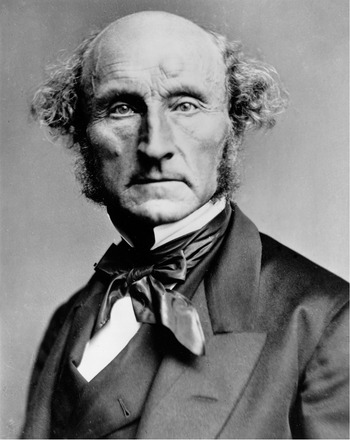
The Mill-Taylor marriage has been subjected to an unusual degree of scrutiny. From the moment of their meeting in 1830 and subsequent marriage in 1851, historians, literary critics, and economists have tried to understand why the father of modern liberalism fell in love with the wife of another man and credited her as the author of their best ideas. F. A. Hayek painstakingly collected and published their correspondence in the 1950s and revived old speculation about this relationship. Critics responded by calling Harriet Taylor, the object of J.S. Mill’s affection, both “hard and insensitive” and “one of the meanest and dullest ladies in literary history”Footnote 1 (Figures 1 and 2). Mill earned the epitaph of “pathological” and “deluded” and “emotionally disturbed” for loving her.Footnote 2 Clearly, this relationship had hit a nerve.
Portrait of Harriet Taylor Mill.

Portrait of John Stuart Mill, ca. 1870.

What could possibly inspire this kind of nastiness about someone else’s marriage? Its unconventionality was only part of it. Mill put his wife on equal footing with him intellectually; even more striking, he made no secret of his reliance on her for his ideas and emotional well-being. The interdependence that characterized this marriage generated new ideas about the relationship between the individual and civil society. It offered a version of Victorian domesticity that made the production of knowledge a joint affair. Critics one hundred years later still could not reconcile the reality of an intimate intellectual partnership that produced some of the most enduring tenets of modern liberalism. While the charge of “repressed hedonist” no longer holds sway, the relationship invites sniggering judgment still today.Footnote 3 A review of a relatively recent biography of Mill compared Taylor to Yoko Ono, claiming that after he met Harriet, John would do “anything for love”: “The romance in Mill’s life helped turn him from a thinking machine into a feeling mensch.”Footnote 4
Excavating the Mill-Taylor relationship renders visible the working out of the “marriage question.” Scholars have shown that challenging marriage meant challenging gender inequality starting in the Enlightenment.Footnote 5 Leonore Davidoff and Catherine Hall revealed how marriage mattered to the Industrial Revolution.Footnote 6 But we know less about its role in intellectual life. The interest in marriage as a social and economic institution has obscured the question of how these unions determine particular cultural and intellectual crosscurrents.
The Victorian period witnessed a break with what I’ll call marriage’s “Old Regime,” when reforms brought changes to coverture, child custody, divorce laws, and the authority of the Church of England.Footnote 7 The 1836 Marriage Act introduced civil marriages.Footnote 8 Four years later, the Infant Custody Act allowed women to petition the courts for child custody. Divorce required an Act of Parliament and demanded proof of a wife’s adultery before the 1857 Matrimonial Causes Act made it more accessible and brought marriage’s Old Regime to an end.Footnote 9 Those who needed other arrangements coped with shifting legal and social constraints and found ways to work within a slowly secularizing and more open system. In short, marriage by the mid-nineteenth century had adapted into a relatively flexible institution that fulfilled the demands of a more dynamic, mobile, and modern society.Footnote 10
Relationships in the public eye generate meaning beyond the private sphere as the Mill/Taylor union suggests. This includes, of course, Victoria and Albert along with the more unconventional marriages of Eliot/Lewes and Wollstonecraft/Shelley.Footnote 11 Unsuccessful marriages suggest failed partnerships such as those of both Thomas Hardy and Charles Dickens.Footnote 12 Fictional marriages in Middlemarch, Jude the Obscure, and Howards End display for readers the consequences for those who do not conform to accepted social practice.
Modern marriage in the Anglo-American context is still a very Victorian affair. Indeed, as historians have shown, many contemporary marriage practices have their origin in this period.Footnote 13 Bridging the Old and New Regime, the Mill-Taylor relationship reveals the changing desires and expectations that shaped English intellectual life and how gendered tropes of genius function. So, how did the Mill-Taylors do marriage?
A Very Victorian Marriage
There were three people in John Taylor’s marriage between 1830 and 1849: himself, Harriet Hardy Taylor, and John Stuart Mill. One contemporary, in describing the relationship, pointed to the “strange generosity” of John Taylor, going so far as to call “Mill’s relationship with Mrs. Taylor … one of the most remarkable love-stories in Victorian literary history.”Footnote 14 This unconventional threesome illuminates the increasingly plastic quality of marriage for those with the leisure and privilege to reimagine social norms.Footnote 15
The Taylor-Hardy-Mill story offers a look at marriage in a moment of transition. It also offers a way to understand what this particular marriage produced. Unlike in the Catholic tradition, children were not considered the primary product of Protestant unions, though they did matter. Companionate or “familiar” marriage created new expectations based on mutual dependence that blurred boundaries between private and public life.Footnote 16
Harriet Hardy was an unlikely reformer. She married 29-year-old John Taylor, a prosperous merchant and reform-minded Unitarian when she was eighteen.Footnote 17 Four years into the marriage, Mill came into their lives. Eventually, after a brief trial separation Taylor accepted that his wife was in love with another man. He continued to support her financially and emotionally throughout his life. She, too, supported him as his wife, raising their three children and nursing him through his final illness, all the while traveling and maintaining a life with Mill. She began her relationship with Mill after the birth of the Taylors’ second son, Algernon. Educated in languages, philosophy, and history, Harriet Taylor began her publishing career while she was pregnant with the Taylors’ third child, Helen.Footnote 18
John Stuart Mill was one year older than Harriet Taylor and already a well-known philosopher when they met in 1830. The free-thinking Unitarian minister W. J. Fox thought they might hit it off and introduced them at a dinner party. Their early correspondence shows a relationship quickly turning from mutual admiration to love. “I am glad that you have said it,” she wrote to Mill in what must have been an acknowledgement of his affection.Footnote 19 She asked for his reassurances that theirs would be “the love of two equals.”Footnote 20 But this was to be an affair conducted relatively out in the open, and Harriet Taylor refused to leave her husband and three children.Footnote 21 After Mill pressed her on the subject she asked him to “Let it be,” worrying that if they did not they would “spoil four lives and injure others.”Footnote 22 John Taylor, for his part, agreed. He funded her travels with Mill and even set up a second home in Kent in 1834 where she received Taylor, her three children, and, of course, Mill.Footnote 23
Mill worked for the East India Company (EIC) until its dissolution in 1858.Footnote 24 As it had done for his father, James Mill, this job and, later, his pension paid the bills and allowed him time to write. He regularly corresponded with Harriet Taylor and they collaborated on a number of publications, leading some scholars to characterize this work—most notably Principles of Political Economy, On Liberty, and The Subjection of Women—as “theirs” rather than the product of one mind.Footnote 25 Their relationship produced a full range of emotions—passion, affection, anxiety, and irritation—and they shared the experience of constant ill-health.Footnote 26 Throughout his lifetime, Mill famously gave her credit for many of the ideas that he published under his own name. This has contributed to the controversy surrounding their relationship. Mill’s decision becomes less mysterious if we think about their collaboration as a shared set of experiences that, in turn, produced the ideological currents that still animate liberalism, feminism, and socialism.
Not long after they met, the two started exchanging letters and conversing on various topics. They exchanged, alongside love notes, essays. The earliest were on marriage. As Mill wrote in 1832: “Marriage is really … a lottery: and whoever is in a state of mind to calculate chances calmly and value them correctly, is not at all likely to purchase a ticket. Those who marry after taking great pains about the matter, generally do but buy their disappointment dearer.”Footnote 27 She responded with “On Marriage,” where she imagined herself with the power to improve the condition of women by freeing romantic bonds from legal constraints: “If I could be Providence … for the express purpose of raising the condition of women, I should … remove all interference with affection.”Footnote 28 “Raising the condition of women” thus required new arrangements that privileged love above legality.
This was an odd sort of romance, an embrace of the feminist utopian idealism of the late eighteenth century by two people who would decide to uphold the status quo. Rather than challenge marriage like Mary Wollstonecraft and William Godwin had in the late eighteenth century, they made it accommodate their own desires and circumstances, fully acknowledging its limit on individual freedom. In “The Nature of the Marriage Contract” Harriet defined marriage as a “legal obligation … which makes the person of one human being the property of another.”Footnote 29 Dependence, she argued, should be a choice. One of the mysteries of this relationship is why, after John Taylor died in 1849, they bothered to get married at all. Waiting for what they considered an appropriate two-year mourning period, they married in 1851. This propriety seems stranger in light of their clear disdain for the institution and the conditions under which they met.
Their flexible marriage played itself out as more than an experiment—it shaped their intellectual lives. Harriet Taylor wrote of her happy courtship with Mill in 1837, characterizing it as “sparking.”Footnote 30 Love letters were interspersed with talk of politics, political theory, and publishing. In a long letter addressed to Mill at India House, she referred to the Ten Hours Bill as a matter of “personal liberty (a fundamental law if there is any)” and accused politicians of violating this principle in Ireland. Opinions on Paris and 1848 as well as comments on a piece Mill wrote about suffrage with “some few pencil marks attached” followed.Footnote 31 Well before their actual marriage, these exchanges of love, political commentary, and work-in-progress tied them to one another and shaped their thinking.
In early 1849 they spent time together in Pau, France, where Mill hoped to recover from a serious eye condition. There Harriet received word that John Taylor was gravely ill. She left France for her husband’s bedside. “I have great hope that by care he may get over this bad state,” she wrote to Mill, “but I see that all depends on keeping up his spirits and nothing does this but my constant presence … I am very tired—and have not been able to find a moment before in which to write.”Footnote 32 Mill, in the meantime, had returned to London and his job at India House where he waited to hear from her. She consulted Mill about her husband’s condition and he sent her medical texts, pills, and advice on Taylor’s care. In turn, she suggested changes to the new edition of Principles of Political Economy, offering encouragement and edits. Weighing in on a falling out that Mill had with one of his critics, she wrote, “I wish that he should see or feel that you are not humbugged by him.” Blaming “stupid doctors” for Taylor’s pain and suffering, she reflected, “How I wish I knew if there is anything more could be done.”Footnote 33 Holding out hope, she refused to leave her husband’s bedside.
But nerves had started to fray. When Mill asked for sympathy about his own ailments, she reminded him of their reality: “I should be anxious about your health dearest if I felt time to be anxious or to think of anything but to try to relieve him … alas I feel as if he besides you is the only life I value in this wretched world.”Footnote 34 For his part, Mill felt forgotten and complained that she wrote to him at “odd time.” Harriet barely contained her anger, replying: “I told you that I have not a moment unfilled by things to be done when not actually standing by the bedside or supporting the invalid … Good God should you think it a relief to think of somebody else some acquaintance or what not while I was dying? … my heart is wrung with indignation and grief.”Footnote 35 Another letter concluded: “If I am to lose him I shall lose the best and most dearly loved friend, and one of the most upright generous true and good men that ever lived.”Footnote 36
Harriet Taylor’s assertion that they were all in this together suggests not a love triangle as much as an alternative family arrangement. A less sexy configuration to be sure, but one that explains how these three individuals accommodated socially unsanctioned feelings of fealty, love, and commitment. Importantly, family and friends tolerated this arrangement, supporting her in the role as wife, nurse, mother, and lover during her husband’s illness. This elasticity sheds light on the private contexts where marriage accommodated unconventional arrangements. They were not the only ones who tested marriages flexibility—consider George Eliot or even W. J. Fox, who had introduced Taylor and Mill and lived in a not dissimilar arrangement to them.Footnote 37
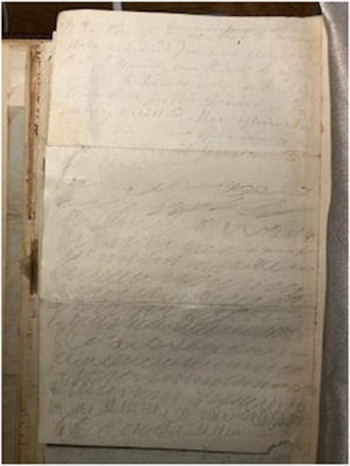
During John Taylor’s months-long illness in 1849, Harriet made her loyalties to her husband clear by setting boundaries with Mill. But this came at a psychological price. Many of her letters from this period were written in almost illegible pencil, suggesting signs of frustration and maybe even confusion. One letter to Mill contained squiggly lines that take up most of the page; the first of these lines looks like trailing off thinking that then transforms into looping, wavy lines (Figure 3).Footnote 38 She didn’t cross out anything, just finished the letter in nonsensical, indecipherable markings. Three days later, she asked Mill not to “call … for a week.”Footnote 39 She managed her husband’s affairs after his death that July in consultation with Mill, including his burial. Taylor left most of his property to his wife. In this way, he also showed his loyalty.
Letter from Harriet Taylor to John Stuart Mill written during John Taylor’s illness. The letter, composed in pencil, ends in looping lines that make up more than half of the page. Photograph by author, Mill-Taylor Archive, LSE.

J. S. Mill and Harriet Taylor wagered on the “lottery,” marrying on 21 April 1851 in Dorset. The lead-up to the event served as a reminder of how closely their commitment to one another was tied to their politics. Mill, feeling “impatient” for “the time til we have a home, til we are together in our life,” wrote a letter before the wedding to buoy her, and possibly himself, about “living to see something decisive really accomplished” on the issues of women’s rights and the abolition of slavery. He offered details of the recent “Convention of Women in Ohio” and expressed hope that marriage would end “this depressing coming and going.”Footnote 40
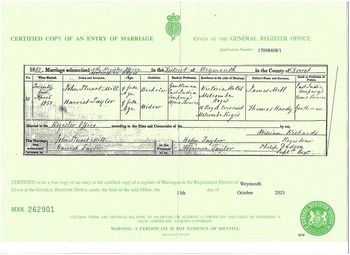
Scholars have struggled to characterize this marriage, which was so clearly defined by its intellectual attachment. Was this an intimate but sexless friendship or a love affair? The fact of their marriage meant that they took the institution seriously—so seriously that Mill worked himself into a state thinking that signing the marriage registry “JS Mill” rather than “John Stuart Mill” (which is how his name appeared on the marriage certificate) would “affect the legality of our marriage” (Figure 4). He asked Harriet to consent to a church wedding that, despite changes to the marriage law legitimating civil unions, John believed would secure their status as man and wife. “The sooner it is done the better,” he wrote. She reassured him that this was unnecessary. A week after the wedding, where two of Harriet’s children served as witnesses, they returned to London and continued work on an article entitled, “Emancipation of Women.”Footnote 41
Mill-Taylor marriage certificate. General Register Office public document.

What allowed them to imagine that they would be able to operate within the bounds of an institution that Harriet Taylor had compared to “slavery” in 1848?Footnote 42 The steady secularization of the institution meant that marriage began to be seen as a contract between two individuals even before the Married Women’s Property Acts increased married women’s financial independence and the 1857 Matrimonial Causes Act made divorce more possible. Mill’s youthful embrace of Romanticism and Romantic poetry encouraged the belief in “natural” affinities, and this mattered, too. It opened up a space to question traditional marriage practices without rejecting its social, religious, and emotional legitimacy. The Mills did not accept marriage as inevitable but embraced it because they saw it as useful to legitimating a relationship that had existed under a cloud of suspicion since they first met.
Marriage, however, created its own problems. Mill’s family did not approve of his marriage to “Mrs. Taylor,” resulting in a rift that lasted until well after Harriet’s death in 1858. Harriet Martineau snubbed them as did other old friends and acquaintances who believed Mill made a fool of himself by courting John Taylor’s wife. They combated this hostility by insisting on their privacy and freedom to choose married life on their own terms. “We have used a right which the whole world, of whatever shade of opinion, accords to us,” Harriet wrote in response to her brother-in-law George’s objection to their marriage.Footnote 43 “Who asks you to form an opinion?” Mill asked his brother, defending his years-long relationship with the Taylors: “What imaginary principles are they which should prevent people who have known each other the greater part of their lives, during which her and Mr. Taylor’s house has been more a home to me than any other, and who agree perfectly in all their opinions, from marrying?”Footnote 44
For all of his appeals to propriety, Mill was no traditionalist. He denied his legal rights as a husband in a contract that stated, in part, that the wife “retains in all respects whatever the same absolute freedom of action, and freedom of disposal of herself and of all that does or may at any time belong to her, as if no such marriage had taken place.”Footnote 45 This radical moment—women’s rights conventions and the sparks of first-wave feminism—inspired them to think of marriage as a contract that protected their mutual independence. It also framed political subjectivity as interdependence, an idea that would later show up in Mill’s Autobiography. Ultimately, marriage created the conditions for husband and wife to strengthen and advance their intellectual collaboration.
Taylor and Mill at Home
Mill really liked being married. On the day he started his diary, a couple of years after he wed, he wrote: “What a sense of protection is given by the consciousness of being loved, and what an additional sense, over and above this, by being near the one by whom one is and wishes to be loved the best.”Footnote 46 The desire to protect this sense of safety may have animated their decision to settle on the edge of London. In September 1851, they chose a large two-story home set off from the road and obscured by a tree-lined path at the end of the railway line (Figure 5).
a, b and c. Present-day images of the home that Mill and Taylor shared in Blackheath. Photograph by author.

Blackheath, situated amid green fields and farmland, was “at that time one of the most distant suburbs of the metropolis.”Footnote 47 The completion of Blackheath Station that same year made it possible for John to commute to his job in central London (Figure 6). Harriet, who had long complained about associating with those who gossiped about their relationship, welcomed the isolation.Footnote 48 Mill’s mother and sisters had spurned her by refusing to visit after their marriage, and this she would not forgive.Footnote 49 Rather than allow them to make her socially invisible, Harriet found solitude living with her children as Mrs. Mill in the suburbs. There they raised Helen together and supported the two older boys.
Blackheath Station today. Photograph by author.

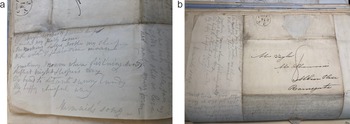
Harriet Taylor Mill seemed to like being married, too. Her marriage to John Taylor had offered stability and produced three children, and, possibly, a nasty case of syphilis.Footnote 50 They seemed to have loved each other, despite it all, and she maintained her own kind of loyalty to the union. What she lacked in this marriage, she found in her marriage to Mill. She could engage her intellectual self in a way that she could only do surreptitiously while married to Taylor. For example, during her second pregnancy in 1829, Taylor had granted her permission, on the advice of Harriet’s father, a “man mid-wife,” to bathe in the sea only under strict conditions. Her defiant response was a poem entitled “Mermaid’s Song,” written (in pencil) on the back of the envelope of the letter that contained her husband’s directive that was dictated by her own father (Figure 7). It read, in part, “In crystal caves of ocean’s deep I made my pearly home.”Footnote 51 It seems she did not share this disappearing act fantasy with her husband or father or publish the poem. She could have remained single after Taylor’s death. As a widow, however, she would have had financial independence but fewer opportunities to engage in the intellectual life that she pursued while living as Mill’s wife and collaborator.
a and b. Envelope that contained a letter from John Taylor to Harriet Taylor with the poem “Mermaid’s Song” written around the margins. Photograph by author; Mill-Taylor Archive, LSE.

Marriage offered stability and a physical space for work. At Blackheath, the Mills’ public and private lives were intertwined, making it possible for both of them to pursue their interests. They could control the comings and goings of friends and family because they lived so far outside the geographical boundaries of society, which offered a level of privacy that shielded them from disapproving eyes. Thomas Carlyle’s wife, Jane, according to one observer, considered Harriet “a peculiarly affected and empty body. She was not easy.”Footnote 52 Harriet, for her part, seemed to have little affection for Jane who, like her husband Thomas, believed that she had made Mill the fool. Jane reportedly recalled Harriet offering a mocking invitation to Blackheath in honeyed tones: “‘Come down to see us … you will be charmed with our house, it is so full of rats.’ ‘Rats!’ cried Jane, ‘Do you regard them as an attraction? ‘Yes’ … ‘they are such dear, innocent creatures.’”Footnote 53 Harriet’s “affected” manner was her armor that kept distractions like the Carlyles at bay.
Blackheath facilitated work both by its isolation and its set up. Here the Mills were ensconced in a domestic life that challenges the trope of the solitary genius. While they would not have spoken of work/life balance at the time, they clearly had it at Blackheath. Mill literally brought his work home: many of their letters were written on EIC-watermarked stationery. While Harriet probably had her own writing desk, most likely in the drawing room, she used EIC paper and their home library to compose her correspondence and essays.Footnote 54 A family life grew up at Blackheath that put members in close contact. The house was cold in the winter—Harriet recalled that one morning her room was 38 degrees—and necessitated that the family gather before the drawing room fireplace.
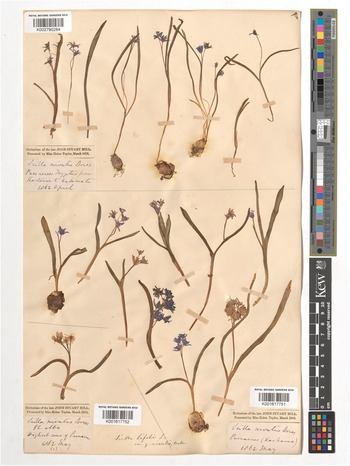
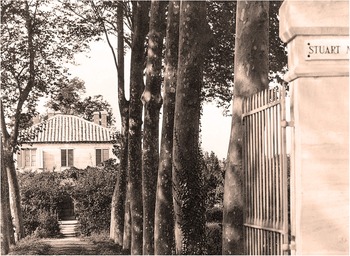
There was a piano on which Mill’s stepson, Algernon, recalled hearing him play his own compositions, “rich in feeling,” when requested by his mother.Footnote 55 Family pictures probably sat on the piano not far from a window-lined alcove that overlooked the garden and likely contained a desk and adjacent bookshelves. The dining room walls, according to Algernon, were lined with “tall bookcases surmounted by plaster casts of classic celebrities, and a fine engraving of Raphael’s Madonna della Seggiola over the mantel piece.”Footnote 56 There would also have been room for Mill’s herbarium, as he was a fanatic collector of plant specimens that he gathered on strenuous walking tours across England and Europe, many of which like this one, are held at Kew (Figure 8). Mill must have liked this set up because he replicated it at Avignon where he lived after his wife died in 1858 (Figure 9).
Specimen from the plant collection of John Stuart Mill collected while on his travels to Kalamata, Greece, currently held in the Royal Botanic Gardens, Kew. Royal Botanic Gardens, Kew. © RBG Kew.

Mill’s home in Avignon that he bought shortly after his wife’s death. https://commons.wikimedia.org/wiki/File:Maison_de_Stuard_Mill.jpg.

The Victorian home used space to “construct intimacies and distances” and this shaped the Mill household interactions.Footnote 57 Families had access to professional spaces in the home—libraries had multiple places to sit—and members read, wrote, sewed, composed, and played piano. While the house at Blackheath still stands, no blue plaque guides the curious. Indeed, there are few physical traces of the family life of the Mills extant.Footnote 58 The Mill “Blue Plaque” is at his family home in Kensington where he resided before his marriage.
We do not know how the Mills furnished their home exactly, but a well-known contemporary offers clues to how they lived and worked at Blackheath.Footnote 59 The house where Charles Dickens lived during this period, which is now a museum, shows the connections between work and family life in the Victorian home.Footnote 60 One family member recalled observing Dickens writing Oliver Twist in the drawing room in his leather armchair.Footnote 61 The library and his desk were next to the drawing room, within earshot of shared family space. When Mill worked at India House, he engaged in a regular back and forth with his colleagues and would pace in his large office throughout the day, taking care of visitors and personal business.Footnote 62 More than likely, he would have engaged in a similar process with his wife at Blackheath.Footnote 63 Domestic arrangements shaped the writer as much as the work. They reveal a world that belies the notion of the solitary genius composing great works in isolation. Less a room of one’s own than a room near the piano.
Travel also mattered. The Mills travelled extensively together and apart, but always kept in close contact. Blackheath was home and it grounded their wanderings throughout Europe and England. In late 1854, Mill embarked on a six-month walking tour to Italy and Greece to recover his health: both he and Harriet suffered from consumption. He walked hundreds of miles, gathering plant specimens along the way and camped, believing that this constant activity would cure him.Footnote 64 He wrote to his wife from Orleans that he believed that their separation would drive him “mad.”Footnote 65 Just over a month later, his letter from Rome was full of excitement about the idea for a book about liberty: “I came back to an idea we have talked about and thought that the best thing to write and publish at present would be a volume on Liberty.”Footnote 66
He asked for her help: “I wish I had brought with me here the paper on Liberty that I wrote for our volume of Essays—perhaps my dearest will kindly read it through and tell me whether it will do as the foundation of one part of the volume in question—if she thinks so I will try and write and publish it in 1856 if my health permits as I hope it will.”Footnote 67 She did, leading Mill to conclude: “I shall think seriously about the book on liberty since my darling approves of the subject.” This idea moved him to a nervous state, inspired by “the sensation of beauty I am living among” and thoughts of domestic life.Footnote 68 Asked by a woman if the overflowing armload of flowers he had collected for study (later destined for Kew Gardens) were for his “bella,” he wrote to Harriet, “I wish indeed it had been for my bella, and a day never passes when I do not wish to bring flowers home to her.”Footnote 69 Instead, he spent the evening pressing and drying samples that he would take back to England and offer to Kew.Footnote 70
They both always came home. In spring 1855, Mill wrote from Corfu to suggest that he take a position there with the English-led administration. Harriet said no, claiming that Continental life would not suit him as he would miss interactions with colleagues that stimulated his work. She also thought it was too hot.Footnote 71 She preferred the English seaside and often went there on her own or with her daughter, Helen. For Harriet, these times of separation fed and grounded her. Her husband knew this. As he wrote again from Corfu: “though the last letter does not say how you are, the handwriting and its being in ink are encouraging.” John believed this a sign of physical and emotional strength.Footnote 72 Indelible ink revealed a deliberateness that eschewed any uncertainty about the space she occupied on the page. These are not the patterned experiences of the solitary genius locked away in his library or the furtive female scribbler. Rather, marriage facilitated independence and collaboration.Footnote 73 Their intellectual life relied on engaging in an intimate family-centered environment that did not always happen around the actual hearth.
Marriage proved a productive space because of this physical and emotional configuration, which made it possible for Harriet to think and for the two of them to write.Footnote 74 The project they worked on most closely during these years was J. S. Mill’s Autobiography, by design a book not published until after both of their deaths.Footnote 75 Neither published very much during their seven-and-a-half years of marriage, but they clearly were working. The Autobiography had its own urgency and was written largely to set the record straight about their marriage. As Mill wrote in early 1854: “I too have thought very often lately about the life and am most anxious that we should complete it the soonest possible … until revised by you it is little better than unwritten.” He worried that “it contains nothing about our private circumstances … and you only can decide what more is necessary or desirable to say in order to stop the mouths of the enemies hereafter.”
This attempt to control the narrative was a joint effort, with Mill imploring that “we must go through this together and add the rest to it at the very first opportunity.”Footnote 76 In order to “not put arms into the hands of the enemy,” she wrote in response to her husband, “every ground should be occupied by ourselves on our own subject.”Footnote 77 It may seem strange that Mill gave Harriet so much control over his own story—they didn’t call it a joint autobiography after all—but as he recorded in his diary around the same time, “I own the enlargement of my ideas and feeling to her influence.”Footnote 78 Nervous about how to characterize their relationship and eager to avoid “scandalous suspicions about us,” he put the burden on his wife.Footnote 79 They cloaked their romance as companionship in a chapter entitled, “Commencement of the Most Valuable Friendship of My Life.”
The marriage produced ideas largely through correspondence and conversation. Harriet Taylor Mill, whose writing today is considered part of the canon of female philosophers, produced very few single authored works. It is telling that she worked so hard on Mill’s autobiography in sacrifice of her own work. The overwhelming desire to avoid “scandalous suspicions” subsumed their intellectual project. Mill’s seeming generosity in crediting her with ideas, though not authorship, may have been a function of how much he wanted to shape the story of his own genius. This required placing boundaries on what the world saw of his private life under a guise of transparency.
This obsession made very little space for Harriet to author work independently. After her death, John’s productivity grew substantially, a self-conscious effort he claims to have embarked upon to honor his wife’s memory. Ultimately, he credited her with many of liberalism’s most well-known ideas while relying on her to secure his own legacy.Footnote 80 That may explain the focus on Mill’s Autobiography during their marriage. They saw it as a way to settle scores, but in the end they could not control their own story through the singular lens of Mill’s experience. While her presence hovered over every page, Mill made his wife more ghostwriter than coauthor.
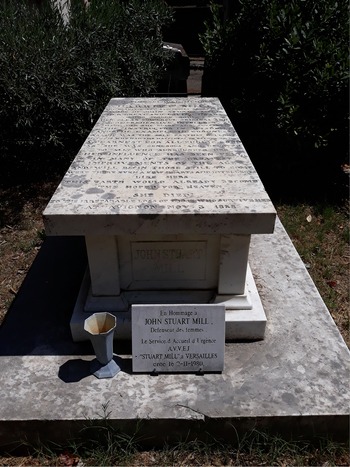
Harriet died of lung disease in southern France on 3 November 1858. John bought a house in Avignon near where he buried her and spent many of his remaining days there with Helen, his stepdaughter and constant companion after her mother’s death. In February 1859, he published On Liberty. The dedication reads, in part: “To the beloved and deplored memory of her who was the inspirer, and in part the author of all that is best in my writings—the friend and wife whose exalted sense of truth and right was my strongest incitement, and whose approbation was my chief reward.” Similar words were carved in stone on her tomb in Avignon—an echo of the Autobiography (Figure 10).
The grave of Harriet Taylor Mill in John Stuart Mill’s tomb, Cimetière Saint-Véran in Avignon.

Feminist scholars argue that we cannot study Taylor Mill’s limited writerly output or intellectual ability in a vacuum, just as we cannot study Mill’s extensive canon as the work of one person. She engaged politics and philosophy, still realms of knowledge then not fully accepting of female voices. History had to discover her—though maybe she didn’t want to be discovered. She thrived on what she called “very little society” and, as she wrote to Mill, “I know what the world is, and have not the least desire either to brave it or to court it.”Footnote 81 In the end, her longing for privacy failed to shield her from the public eye.
Marriage, Feminism, and Liberalism
Harriet Taylor Mill did not disappear. F. A. Hayek conjured her up and offered fodder for her critics in his 1951 publication The Mill-Taylor Friendship, after he became preoccupied with the marriage story I’ve just related. I’d like to conclude by considering why Hayek needed this marriage to craft his own libertarian brand.
Mill’s letters were scattered after his death.Footnote 82 Hayek, then a professor at LSE, set out to put together an archive focused on Mill’s relationship with Taylor. It’s the one that historians work with still today and that I’ve relied on for this talk. Hayek, like others before him, grappled with the credit Mill gave to his wife for liberalism’s best ideas. He even got a Guggenheim to retrace their footsteps in France, Italy, and Greece and supposedly slept in the room where Taylor died.Footnote 83
It would be easy at this point to put Hayek on the proverbial couch and relate to you his messy personal life and terrible treatment of his own wife—that really wouldn’t be nice. But there are details of his private and public life that help us with this story. An Austrian who fought in the First World War and became disillusioned with socialism, Hayek moved to England and had an affair with another man’s wife.Footnote 84 Hayek was looking for a hero and, maybe, a role model: an independent male political subject, the quintessential freeborn Englishman. From here he could rewrite Burkean conservatism from a passive defense of freedom through maintaining the ancient heredity rights of the privileged few, to an activist, libertarian political agenda inspired by an educated middle-class prophet.Footnote 85 Mill mostly fit the bill but only if he rewrote the intellectual collaboration that took place in the bonds of his relationship with Taylor.
Hayek’s painstaking reconstruction of what is now known as the Mill-Taylor Collection focused on excavating Taylor’s influence on Mill. Their unconventional relationship had been the subject of much musing and hand-wringing long before Hayek began his work. Soon after Mill’s death, one critic wondered “whether Mill’s interest in the cause of woman is serviceable to him as a thinker. It has a tendency to develop the sentimental part of his intelligence … and has only been kept in due subjection by his respect for his own reason.”Footnote 86 The observation conveys a sense of embarrassment and, in the case of Hayek, downright obsession. Mill’s insistence on his wife’s genius—a word used multiple times in the Autobiography—shattered the myth of the philosopher working alone, untouched by the life around him. Authorship in this scenario is not individual but corporate. However, for Hayek and others, someone must take credit for a significant work, and this is especially true of a work of philosophy—the undisputed domain of male genius.
Mill turned this myth inside out in an autobiography that we now know was essentially cowritten by his wife. Its confessional form and Mill’s choice to collaborate with Taylor in writing it produced a different narrative of genius. The choice to discuss an interlude of moral self-doubt brought on by a mental breakdown bolstered the claim that his development as a liberal thinker relied on exploring nature and English Romanticism while forging human connection. He flipped the script on his own inherited privilege as well. The Autobiography minimized his status as son of the great James Mill and inheritor of Benthamite Utilitarianism in favor of a freer, more earthbound identity that relied on intellectual guidance from his partner. In the place of his father’s influence stood Harriet, severing the parental bond through a marriage that gave him a new origin story and produced a new set of ideas.Footnote 87
Embracing corporate authorship and a search for happiness didn’t easily square with the strident utilitarianism of Mill’s father’s generation. Mill expressed his “theory of life” after his breakdown: “Those only are happy who have their minds fixed on some object other than their own happiness; on the happiness of others, on the improvement of mankind, even on some art or pursuit, followed not as a means, but as itself an ideal end.”Footnote 88 I sometimes cite this passage in the Autobiography to explain to students the logic of liberalism [Yes—be a good person, contribute to your community; rely on one another!]. I realize that most do not see liberalism through this idealized lens. Sentiments like this led critics like Hayek to believe that Mill the Romantic betrayed Mill the empiricist. He blamed Harriet for this.
There were other uncomfortable truths in Mill’s writing that Hayek, the father of modern libertarianism, needed to write out of the story. Previous critics had blamed Mill for giving his wife too much credit for the ideas published under his name. Hayek took a different approach. He took Mill seriously when he said that many of his best ideas belonged to his wife but selectively applied Mill’s assertation to the ideas that did not fit into Hayek’s evolving libertarian worldview. Taylor, he claimed, pushed Mill toward socialist and feminist positions and made his work weaker for it. Feminist scholars since have agreed that she deserves credit for the ideas in On Liberty and Subjection of Women but they haven’t challenged the heart of Hayek’s critique, which elides feminism from John and Harriet’s understanding of liberalism.
Hayek’s papers, now at the Hoover Institution, show how he came to this position. He needed an independent, liberal male subject to build his anti-socialist agenda, most famously articulated in the Road to Serfdom. It was the marriage that was the problem, not Harriet. The classic Enlightenment subject was a fully formed adult male. This gendered and age-based independence characterized the early liberal project and cast mutuality and collaboration as feminine.Footnote 89 Marriage, a fundamentally interdependent relationship, impeded Mill’s qualification as the father of Hayek’s libertarian project that made male autonomy its hallmark.
It’s telling that Hayek had trouble titling the letters he collected. He first published them as John Stuart Mill and Harriet Taylor: Their Correspondence and Subsequent Marriage, but then immediately issued an erratum changing “Correspondence” to “Friendship” in the title. A new edition published recently by the Liberty Fund dispenses with marriage altogether in its title, calling the volume The Mill-Taylor Friendship and Related Writings, thus rendering the marriage invisible. To be fair, Mill and Taylor also had difficulty characterizing their relationship. But it was theirs to label, not Hayek’s nor the Liberty Fund’s.
It took 1980s feminism to “rediscover” Taylor as an independent thinker. Nonetheless, she became an add-on to Mill’s thinking at best and remained an encumbrance at worst.Footnote 90 Hayek claimed that after she died, Mill went back to the more “sensible” ideas of his youth. Hayek, like others before him, blamed her for Mill’s engagement with socialism. It’s no surprise that when the curriculum included Road to Serfdom in my first job, I scratched my head. I wondered why a class organized around the rise of liberalism did not require On Liberty. At the time, I was writing Women Making News and considered Mill’s Political Economy as a central feminist text. As I researched this relationship 25 years later, I finally understood that teaching Hayek was teaching Mill, just a version of Mill that had been sanitized of its radicalism, its socialism, its gendered critique. Hayek’s libertarianism coopted the Mill’s liberalism as a twentieth-century postwar ideology useful for creating a political program based on the cult of the individual. There could be no romance in freedom.
Marriage, however, was more flexible than Hayek wanted to believe. He saw it as a straitjacket that constrained Mill and made him go against his better judgments, making him less free to choose. Only when his wife died could he do the work he wanted to do. But if we listen to Mill, and look closely at the years he and Taylor had together, we get a different view of how marriage mattered to the intellectual development of liberalism. Mill felt freed, not constrained, by marriage. His wife may have agreed, though it was different for her. Defending their choices fell most heavily on her shoulders as indicated by the intellectual labor she dedicated to Mill’s Autobiography.
Hayek saw Mill’s years with Taylor as an impediment to the realization of liberal political subjectivity. What he couldn’t see was how much the ideals that he himself purported to uphold relied on a feminist socialist agenda that understood freedom as part of a collaborative project that valued interdependence. The Mill-Taylor marriage suggested that this was possible.
Conclusion
This talk has not sought to rescue the Mills from the condescension of posterity nor to reveal some yet undiscovered truths about the authorship of arguably the most important treatises on liberalism. Rather, I wanted to consider the modern liberal idea as lived experience. Harriet and John found solace, comfort, and creative energy in marriage. Ignoring this leaves us with a less nuanced understanding of both marriage and liberalism. Mill belonged as much to the English Romantic tradition as the Utilitarian.Footnote 91 The marriage and what it produced revised the utilitarian pragmatism of his father’s generation to make room for human agency realized through genuine connection. I think we’ve been asking the wrong question: it’s not who is responsible for which idea but, rather, how did collaboration create a set of intertwined ideas? Feminism and liberalism, born of the same parentage, grew up together.
The Taylor-Mill-Hardy throuple did not change marriage conventions. Rather, their arrangement reflected a kind of intimate pleasure bound by legal and cultural constraints. This very Victorian marriage—elastic, interdependent, and productive—was mirrored in other literary couples, and probably regular ones as well. There was much unhappiness in this threesome. Doubt, anger, loneliness, and jealousy plagued each of them at one point or another. They pushed the limits of marriage as an institution in a moment when the difficulty of obtaining a divorce and coverture invited it. Those who craved more freedom in social arrangements adjusted.
So, in the bonds of an institution meant to constrain emerged a space for autonomy in private life forged between husbands and wives, friends and lovers. Liberalism required collaboration between ideas and individuals. From this household came the refinement of a set of principles: equality before the law, limited state intervention in private life, freedom of conscience, what we do and do not owe one another.
Hayek and others erased the material complexity of the liberal ideal by appropriating the bits that sustained a gendered Enlightenment subjectivity. That modern liberalism continues to enshrine the autonomous male as the model political subject is a product of such thinking. Ultimately, this distortion has cast marriage as, at worst, banal economic dependence or, at best, contractual consent. For Taylor-Mill-Hardy, it was not quite that simple.
Michelle Tusan is Professor of History at the University of Nevada, Las Vegas. Her most recent book is The Last Treaty: Lausanne and the End of the First World War in the Middle East (Cambridge University Press, 2023). Other books include: The British Empire and the Armenian Genocide, Smyrna’s Ashes, and Women Making News. She is Immediate Past President of the North American Conference on British Studies. Thank you to the WWWW’s for their support and reading and commenting on the first draft; Susan Johnson provided sage advice on framing and thinking more deliberately about marriage; Elizabeth Fraterrigo offered encouragement and pushed me in my conclusions. Please address any correspondence to michelle.tusan@unlv.edu




 Open access



