





1. Introduction
Accelerated deployment of renewable energy in northern Europe requires an expansion of electricity grid capacity and a reconfiguration of these systems to address growing imbalances between regions with high levels of renewable generation and demand centres. These imbalances are evidenced by increasing curtailment of generation and long connection queues; addressing these bottlenecks will require coordinated and managed network transitions (European Commission, 2023; IEA, 2023). Large-scale grid projects are scrutinised by regulators and are typically only approved after lengthy and complex planning processes. As a result, network transitions are highly path-dependent processes and are increasingly out of sync with accelerated technological transitions in wind and solar generation technologies.
While governments and system operators are responding with the development of ambitious grid plans aligned with net zero transition pathways (50Hertz Transmission GmbH, Amprion GmbH, TenneT TSO GmbH & TransnetBW GmbH, 2023; ENTSO-E, 2014, 2025; NESO, 2024), realising these plans according to the envisioned timescales presents a significant challenge. However, relative to the volume of technical publications on grid planning, little is known about the social and institutional dimensions of transformations in the sector (Bolton & Foxon, Reference Bolton and Foxon2015). There is therefore a need for in-depth sociotechnical research that examines the relationships and interdependencies between technical and non-technical aspects of realising large transmission projects in different contexts. More widely, this contributes to sociotechnical research on accelerated transitions by unpacking their infrastructural dimension, and scrutinising how governments, system operators, and regulators seek to align different temporalities of change across renewable generation and networks.
In this paper, we analyse two interconnector projects that are intended to strengthen electricity transmission grids between national borders, thereby reducing existing bottlenecks in the energy transition: NordLink (Norway–Germany) and NorthConnect (Norway–UK). The basic technical components of these projects are high-voltage direct current (HVDC) cables and transformers, which convert the alternating current from national transmission grids into direct current for long-distance transport. Electricity is exported from low price markets via these cables and used to meet demand in high price areas, in theory increasing the utilisation of renewables and societal welfare.
Our conceptual approach combines insights from large technical systems (LTS) research (Hughes, Reference Hughes1983) and transitions studies (Geels et al., Reference Geels, Kern and Clark2023) to account for the influence of technical, economic, political, and societal factors in the development and evolution of HVDC interconnector projects. Based on in-depth qualitative research – including interviews with project developers, regulators, and policy makers – we identify individual critical branching points (Foxon et al., Reference Foxon, Pearson, Arapostathis, Carlsson-Hyslop and Thornton2013) at different stages within these projects, and analyse how key actors mediated outcomes, in both a successful and a stalled project. Analysing two interconnectors from different countries allows us to gain insights into the tensions between accelerated technological transitions – particularly wind power in northern Europe – and the highly path-dependent institutionalised processes for approving and delivering high-voltage transmission projects.
Through the case study analysis of these projects, we gain insights into the actions of governments, regulators, and industry actors in a sector that is crucial for the energy transition, yet receives relatively little attention in transitions and innovations research (Andersen & Markard, Reference Andersen and Markard2020). While the generation of electricity and its use have received considerable attention in the transitions field, there are only a few studies that deal with interconnectors and the underlying HVDC technology (Andersen, Reference Andersen2014; Andersen & Markard, Reference Andersen and Markard2020).
In the next section, we provide an overview of interconnectors and their importance for the energy transition. In Section 3, we expand upon our conceptual approach, linking LTS and transition frameworks. In Section 4, we investigate the development of NordLink – a successful project – and NorthConnect – a stalled project – explaining the divergent outcomes in each case. In Section 5, we reflect on the analysis, discuss wider implications of the findings, and conclude the paper.
2. HVDC interconnectors in electricity transmission
Domestic transmission grids enable the long-distance transport of large quantities of electricity, often at voltage levels between 220 and 400 kV in Europe, and are thus the ‘motorways’ of electricity systems. Since electricity cannot be stored in sufficient quantities, and significant deviations between supply and demand threaten system stability, system operators must maintain a balance at all times through appropriate energy flows and intervene in the market when necessary. Interconnectors are connected to national networks to facilitate exchange, enable synergies between different generation and demand profiles, and further increase security of supply (Silvester, Reference Silvester2024; Statnett, 2013a).
High-voltage alternating current (HVAC) is the preferred technology for land-connections, while HVDC is generally required for offshore links, for bridging long distances and for connecting systems with asynchronous frequencies (Andersen & Markard, Reference Andersen and Markard2020; ENTSO-E, 2023). The latter is made possible by means of HVDC cables, which act as a (typically bidirectional) point-to-point connection between two transformers, which in turn convert the electricity from alternating current to direct current and vice versa.
Due to the size and complexity of these projects, the costs can run into several billion euros, while the planning procedures and construction times are lengthy (4C Offshore, 2025b, 2025c). Three actor groups play a central role in developing these projects: project planners, including transmission system operators (TSOs) and other industry actors; government authorities, who shape the legal framework and intervene when necessary (Reichert, Reference Reichert2013, pp. 45–48); and regulatory authorities, who evaluate and monitor projects in line with licenses and regulatory frameworks (NVE, 2019).
A rapid decarbonisation of electricity generation challenges established transmission systems. In many European countries, the dependence on conventional power plants is gradually being reduced: the UK, for instance, has increased the share of renewable energies in electricity generation from 3.5% in 2000 to 49.8% in 2024 (IEA, 2025c). Rising shares of electric cars and heat pumps reduce emissions in adjacent sectors and reflect a fundamental change in electricity consumption. Accordingly, we can see an acceleration towards low-emission solutions in both generation and end-use (Markard et al., Reference Markard, Geels and Raven2020). This poses a number of challenges for national electricity grids, in particular due to the location and generation profiles of the new renewable projects.
While conventional power plants have traditionally been built close to population centres, large-scale wind and solar photovoltaic (PV) projects are often built in more remote locations with favourable generation conditions, meaning that electricity has to be transported over long distances. In Germany, for instance, there are many wind power plants in the north, while the large consumption centres tend to be located in the south. A lack of transmission capacity regularly causes bottlenecks that require wind power generation to be curtailed (Markard et al., Reference Markard, Geels and Raven2020).
A second factor is seasonal and short-term fluctuations in the generation of wind and solar parks, which is correspondingly high during favourable weather conditions, but low when there is little wind or sun. Electricity grids must ensure that electricity from geographically distant power plants is available in the event of supply shortages. Here too, new challenges are emerging: the Federal Audit Office in Germany and the National Audit Office in the UK have both pointed out that the availability and affordability of electricity are already threatened by a lack of grid investment (Deter, Reference Deter2019; National Audit Office, 2023). While our focus is on northern Europe, the need for grid expansion has become a global issue (European Commission, 2023; IEA, 2023).
Interconnectors help to address these challenges. These cables are already a central component of the energy transition: Denmark’s high-wind power generation, for example, would not be possible without power lines to Norway (Silvester, Reference Silvester2024). In the European Union (EU), the interconnector capacity of individual countries is targeted to reach 15% of installed electricity generation by 2030 (European Commission, 2023). While some projects are coming online, but often behind schedule (e.g. NordLink), others are being discontinued (e.g. NorGer, NorthConnect). In the following section, we develop an approach that helps better understand the causes of these different outcomes, in terms of the success and discontinuation of interconnector projects.
3. Conceptual framework
The need for acceleration in the energy transition is increasingly reflected in sociotechnical transitions research. Approaches in this field share the basic idea that transitions represent fundamental and long-term changes at various levels of sociotechnical systems (Geels, Reference Geels2002; Markard et al., Reference Markard, Raven and Truffer2012), and that reaching the goals of the Paris Agreement will require governments to purposely accelerate innovation in key low-carbon technologies (Gorissen et al., Reference Gorissen, Spira, Meynaerts, Valkering and Frantzeskaki2018; Markard, Reference Markard2018; Markard et al., Reference Markard, Geels and Raven2020; Roberts et al., Reference Roberts, Geels, Lockwood, Newell, Schmitz, Turnheim and Jordan2018). Roberts et al. (Reference Roberts, Geels, Lockwood, Newell, Schmitz, Turnheim and Jordan2018) explore aspects beyond ‘more political will’ that may drive accelerated change, including coalitions that contribute to (or prevent) deployment, feedbacks between policies and actor preferences, and contexts that may create favourable conditions for accelerated transition.
A whole systems perspective, similar to that of Markard (Reference Markard2018), is required for the investigation of large-scale, complex, and capital-intensive infrastructure projects such as HVDC interconnectors. To this end, we base our conceptual framework on the LTS approach first developed by Thomas Hughes (Reference Hughes1983). The basic idea of the LTS framework is that the development of systems, such as electricity power grids, is initially driven by powerful actors, known as system builders. If single components – whether social or technical – fall behind the development of the overall system, these actors intervene and resolve reverse salients by breaking up the complex issue into smaller solvable critical problems. After overcoming these reverse salients, the system can return to growth, a phase defined as momentum (Hughes, Reference Hughes1983, Reference Hughes1987). Building on Hughes’ work, scholars have extended this approach to a wide range of applications, providing insights into the early development of systems across a range of sectors (Mayntz & Hughes, Reference Mayntz and Hughes1988), their governance (Coutard, Reference Coutard1999), and the reconfiguration of mature sociotechnical systems (Summerton, Reference Summerton1994; Winskel, Reference Winskel2002).
In contrast to his earlier LTS works, mature systems are deeply embedded in national and international institutional contexts and are shaped by a wide range of actors, not just single-system builders (Hughes, Reference Hughes1998). We therefore need to broaden the frame to incorporate coalitions and feedbacks (Roberts et al., Reference Roberts, Geels, Lockwood, Newell, Schmitz, Turnheim and Jordan2018) when we investigate large-scale infrastructural projects. The nature of reverse salients will also be broader than in the early LTS work. These have typically been analysed as technical impediments to the growth of systems (Hughes, Reference Hughes1983; MacKenzie, Reference MacKenzie1987), but in the contemporary context, there is a broader agenda of influences on the direction of established systems (Takeishi & Lee, Reference Takeishi and Lee2005).
In order to incorporate this, we draw on Foxon et al.’s concept of branching points, which are ‘key decision points at which choices made by actors, in response to internal or external stresses or triggers, determine whether and in what ways the pathway is followed’ (Foxon et al., Reference Foxon, Pearson, Arapostathis, Carlsson-Hyslop and Thornton2013, p.146). The study of branching points is closely linked to the analysis of transition pathways; branching points mark the key decision points, which influence overall system-level change processes. While systems usually follow an existing direction influenced by path-dependence and momentum, internal and external influences reveal the ‘plurality of possibilities’ (Rosenbloom et al., Reference Rosenbloom, Haley and Meadowcroft2018, p.23), leading to branching points. At these moments of agency, actors negotiate the direction of systems; an analysis of branching points can reveal how and why the existing trajectory is maintained, or a new one was taken.
The notion of temporal stability is evident in the analysis of both systems and pathways. Summerton (Reference Summerton1994) notes that LTS are dynamic entities in which stability is typically achieved only temporarily during periods of high momentum. She describes one form of the resulting reconfiguration of mature systems as territorial interconnection across political borders – the subject of the HVDC interconnectors considered in this study. The temporary nature of stability becomes evident in pathways as branching points open up choices systems to agency. We link both approaches, system stability and agency, by considering the electricity transmission system as a mature LTS undergoing a reconfiguration. In addition, we view branching points as critical junctions in HVDC interconnector projects, which influence the direction these projects take, their alignment (or not) with timescales of accelerated transitions, and their overall success or failure.
Figure 1 illustrates our approach: here, the reverse salient is the overall system level problem of wind integration. While increasing levels of wind power allow for some elements of the electricity supply system shown on the left to advance towards decarbonisation, other parts of the system are held back in a reverse salient, leading to issues such as grid bottlenecks and load shedding. System actors such as TSOs, governments, and regulators translate the complex reverse salient into smaller solvable critical problems – in this case, projects deemed feasible to address the reverse salient. Each of these, if pursued, is then developed as a project, such as an interconnector, which is composed of multiple branching points, as shown on the right-hand side of Figure 1.
Branching points in responses to reverse salients.

Figure 1 Long description
While factors such as wind power generation allow for elements of the energy system to progress, some elements are held back by the reverse salient. Critical problems can be identified within the reverse salient. On the right hand side, we see how a critical problem in the form of an interconnector faces two branching points in its development. As soon as the interconnector becomes operational, the reverse salient is reduced.
By applying the notion of branching points to individual projects rather than aggregate transition pathways, we deviate from the original application of the concept (Foxon et al., Reference Foxon, Pearson, Arapostathis, Carlsson-Hyslop and Thornton2013; Rosenbloom et al., Reference Rosenbloom, Haley and Meadowcroft2018). This approach, we argue, allows us to examine in a more granular way how actors influence different possible trajectories or paths. Outcomes at these branching points determine the direction, timing, and success (or failure) of the project. While various options can lead to success, there are also paths and branching points that ultimately lead to a negative outcome, as in the case of NorthConnect outlined below.
As Table 1 explains, the framework allows a connection to be drawn between project-level branching points and system-level analysis. In the example shown in the diagram, the completed project has a mitigating effect on the reverse salient of system development, allowing the solid line to advance further towards the dotted line. In order to eliminate the entire reverse salient, six critical problems must be solved in this illustrative case.
Delineation of reverse salient, critical problem, and branching point

Table 1 Long description
Reverse Salient: Part of an advancing System that has fallen behind overall development and may hamper further advancement. Critical Problem: Projects that were translated as a solvable task by central system builders to target a reverse salient. Branching Point: Section within a project path where interpretive flexibility opens up different options for progression and decisions are orchestrated by central actors.
Source: Lindemann, Reference Lindemann2025, p. 115.
Alongside project and system-level analysis, it is also important to represent the regulatory environment, represented by the shaded area in the figure. Since electricity grids, as quasi-monopolies, are subject to strict government regulation, regulatory influences on individual projects and the system must be taken into account in the analysis.
4. Interconnector case analysis
4.1. Case selection and methods
For our investigation, we opted for a qualitative case study approach. While large samples provide broad information, case studies are particularly suited for providing in-depth insights (Flyvbjerg, Reference Flyvbjerg2006). After gaining an overview of existing interconnectors and current projects in Europe, two electricity connections were selected: NordLink and NorthConnect. While Europe stands out due to the high demand for interconnectors (arising from market integration and grid bottlenecks), the selection of two projects allows us to make a comparison that increases the reliability of findings (Yin, Reference Yin2003). In detail, we investigate NordLink (between Germany and Norway) and NorthConnect (between the UK and Norway). These projects were selected because they are suitably comparable in terms of technical parameters and implementation period. While these links were still under development at the start of the study, one project was realised (NordLink) and the other was discontinued (NorthConnect) during the study period.
Much of the information on the cases was retrieved through document analysis, while semi-structured interviews were used to identify and validate literature sources and gain additional insights. The documents examined include publications by the project developers, regulatory authorities, and government departments, as well as contributions by third parties in trade journals and websites. Potential interviewees were identified based on a purposive sampling with direct or indirect involvement in the projects and with knowledge of decision-making processes at key project branching points across technical, legal, economic, or political domains. Twenty-one stakeholders from research and civil society (n = 11), industry (n = 6), and policy and regulation (n = 4) were interviewed in a semi-structured format in video calls lasting between 30 min and 2 h. Participants based in Norway formed the largest group of interviewees (n = 8) due to the Norwegian involvement in both cables, while participants from Germany (n = 6), the UK (n = 4), and other (n = 3) were also interviewed.
This research employed an iterative, qualitative research design and was conducted between 2018 and 2025. Project timelines, regulatory publications, and newspaper articles were first collected and analysed to construct a chronological overview of each project and to identify potential branching points and relevant actors. This informed a more in-depth round of data collection and validation through analysis of consultation documents (e.g. 50Hertz Transmission GmbH, Amprion GmbH, TenneT TSO GmbH & TransnetBW GmbH, 2012), technical appraisals (e.g. ENTSO-E, 2014), legislations, regulatory documents (e.g. NVE, 2019), and interviews – enabling the identification and refinement of critical branching points in project trajectories where negotiations influenced outcomes. This iterative process allowed empirical materials and interpretive analysis to co-evolve, strengthening the findings.
As Table 2 illustrates, NordLink and NorthConnect share many similarities, yet the outcomes were very different. Both projects were intended to connect European countries to Norway via the North Sea, and are comparable in length, capacity, and estimated cost. However, while the cable to Germany was completed, the project to Scotland was unrealised.
Key information on NordLink and NorthConnect
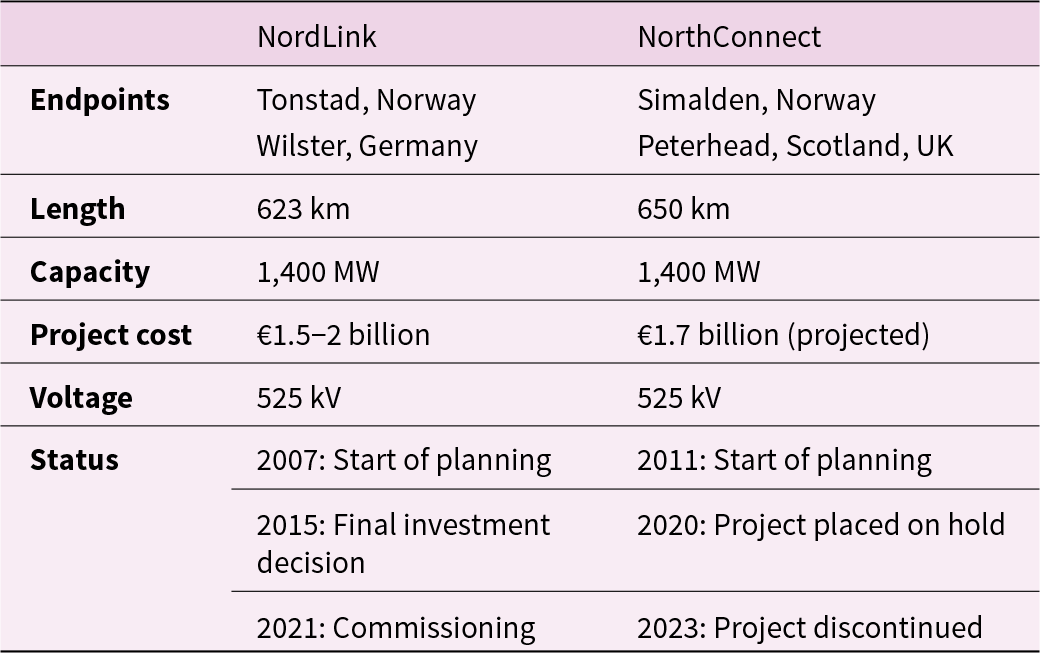
Table 2 Long description
NordLink connects Tonstad in Norway with Wilster in Germany with a length of 623 km and a capacity of 1,400 MW. The project costs are estimated €1.5-2 billion and the voltage is 525 kV. Planning started in 2007, the final investment decision was taken in 2015 and it was commissioned in 2021. NorthConnect aimed at connecting Simalden in Norway with Peterhead in Scotland, UK, with a lenth of 650 km and a capacity of 1,400 MW. The project costs are estimated €1.7 billion and the voltage is 525 kV. Planning started in 2011, in 2020 the project was placed on hold and discontinued in 2023.
In Figure 2, the two case study projects are highlighted with black borders on the map. Other HVDC lines are marked in pink in this view, while red, orange, and green colours indicate HVAC connections within national transmission systems with different voltages. Some of the pink lines end in the sea; these are connections to offshore wind farms. NordLink is recognisable as a working connection; NorthConnect is absent (a connection between Great Britain and Norway only exists via the North Sea Link, which runs south of the envisaged NorthConnect).
Map of case studies.

Figure 2 Long description
Two lines are highlighted, NorthConnect between the UK and Norway, and NordLink between Norway and Germany.
A similarity between NordLink and NorthConnect is that markets with a high proportion of wind and solar energy were to be linked to the Norwegian electricity system, which is predominantly fuelled by hydroelectricity (IEA, 2025b). At the beginning of the 2000s, electricity in both Germany and the UK was mainly generated from fossil fuels. Since then, a significant acceleration in the transition from CO2-intesive supply to renewable sources has taken place in both countries. While Germany generated 41.8% of its electricity from wind and solar PV in 2024, the figure for the UK was 33.6% (IEA, 2025a, 2025c). This change is increasingly causing grid bottlenecks, curtailment and high price fluctuations on the electricity markets.
New interconnectors can be part of the solution. In this specific case, both cables promise to enable electricity to be exported to Norway when electricity prices are low, especially when wind or solar power generation is high, and electricity to be imported from Norway when there is a shortage of supply. Norway’s predominantly hydroelectric power system enables this as water storage in reservoirs can be managed in a way which absorbs surplus wind and solar generation through pumps and exports power during deficits in the UK and Germany; Norway thereby becomes a ‘green battery for Europe’ (Gullberg et al., Reference Gullberg, Ohlhorst and Schreurs2014).
In the following sections, we investigate why the two projects have developed differently, beginning with NordLink and then focusing on NorthConnect. The case studies illustrate the opportunities and challenges associated with the idea of interconnecting countries and how the distribution of risks and costs affected project outcomes.
4.2. Nordlink – mutual support for the green cable
In this section, we investigate the development of the NordLink project, a 623 km, 1,400 MW, and 525kV HVDC interconnector between Tonstad in Norway and Wilster in Germany (ENTSO-E, 2014). The project, commissioned in 2021, was developed by a consortium of Statnett, TenneT, and KfW. It establishes a connection between the two countries for the first time. In the following paragraphs, we outline the development of the link, from the initial ideas to ongoing operation, analysing key branching point during the project.
Attempts to establish an interconnector between Germany and Norway date back to the 1990s. Two early examples are the Eurokabel, planned by Eurokraft, HEW, and RWE, and the Viking Cable, by PreussenElektra and Statkraft (Carlsen et al., Reference Carlsen, Lysheim, Time, Rittiger, Schultz, Troger and Witzmann1996). Both projects failed because the German project partners withdrew. In the case of Eurokabel, it was argued that changed economic parameters and political uncertainty due to the upcoming liberalisation of the German power market were decisive factors (Binder, Reference Binder1999). In the case of Viking Cable, environmental concerns and the political preference for wind power projects within Germany were cited (Schulz, Reference Schulz2018). However, due to the importance of Norwegian hydropower in the European energy transition (Gullberg et al., Reference Gullberg, Ohlhorst and Schreurs2014; SRU, 2011), two 1,400 MW project proposals followed in the early 2010s: NorGer and NordLink.
NordLink faced fierce competition in its early stages. In 2006, a consortium consisting of EGL, Agder, and Lyse initiated NorGer, and just 1 year later, E.ON Netz and Statnett also formally began planning for NordLink (UCTE, 2008). At this point, there were two forms of financing such projects in Europe: NordLink was planned as a regulated project, while NorGer aimed at a merchant line. Under EU rules, regulated interconnectors are integrated into each TSO's regulated asset base, so can recover costs through tariffs, but are limited in the use of associated revenues – typically prescribed for network investments to alleviate congestion (Regulation [EC] No 1228/2003, Art. 6[6]). Merchant interconnectors seek specific exemptions to retain the revenues from arbitrage, known as the congestion rent (Regulation [EC] No 1228/2003, Art. 7).
While E.ON sold its transmission grid to TenneT in 2009, thereby setting back NordLink, plans for NorGer were progressing. Initial national approvals were granted in Germany and exemptions from regulatory requirements were applied for at the EU level (Reichert, Reference Reichert2013, p.38). However, this lead did not last long. The intended operation as a merchant line was a recurring point of criticism of NorGer, which, as the Norwegian Oil and Energy Ministry (OED) pointed out, ‘first and foremost creates profit for the owners of the cable’ (Lie, Reference Lie2011, [no pagination]). In 2011, regulatory approvals for NorGer appeared unlikely, prompting all project partners except Statnett, which had acquired a 50% stake in the project a year earlier, to withdraw (Reichert, Reference Reichert2013, pp. 43–45). Statnett discontinued its project planning 2 years later (Statnett, 2013b).
Since national TSOs were involved in NordLink at an early stage, momentum was with this project. The level of investment required, however, led to a branching point: in a letter to the Federal Chancellery, the Ministry of the Environment and the Ministry of Economics, TenneT warned that financing the cable would not be feasible (Baethge, Reference Baethge2011). In order to save the project, internal negotiations were initiated and a solution was presented in June 2012, whereby half of the German share was to be covered by the state-owned bank KfW. In addition to sufficient financial security, the project also gained an important political advantage, as Statnett had already indicated at the beginning of the year that only one project to Germany could be realised at the time (Reichert, Reference Reichert2013, pp. 45–48). Political commitment, particularly on the German side, ultimately led to the announcement in May 2013 that NordLink would be completed by 2018 (Statnett, 2013b).
Interconnectors contribute to ‘security of supply, efficient resource utilisation and value creation’ (Statnett, 2013a, p. 1), but also entail risks. While the construction phase of the power line between 2017 and 2020 proceeded largely without incident, exceptionally high electricity prices, especially from November 2021 onwards, led to criticism (Buli, Reference Buli2021; Silvester, Reference Silvester2024). At this point, reduced gas imports from Russia and Norway, as well as unplanned outages at nuclear power plants in France, drove up electricity prices in continental Europe.
In Norway, electricity prices are traditionally low – important not only for industrial customers but also for households. The proportion of electric heating in Norway is very high, which is one reason why the country has one of the highest per capita electricity consumption rates in Europe. According to Reichert (Reference Reichert2013, p.34), the social relevance of affordable electricity in Norway is comparable to affordable gasoline in the USA. The connection to markets with significantly higher prices had the effect of creating additional demand for electricity in Norway, which drove up prices, and especially in the southern price zone NO2 (THEMA, 2021). While the NordLink project highlights the benefits of an interconnector across two national markets, the transfer of risks to consumers has had political consequences and has increased scepticism about interconnector development from Norway in future years.
4.3. NorthConnect – from overall beneficial to security threat
NorthConnect was proposed as a 650 km, 500 kV, and 1,400 MW HVDC interconnector between Sima in western Norway and Peterhead in Scotland (ENTSO-E, 2014; NVE, 2019). A similar project, the North Sea Interconnector, was rejected in 2003 due to concerns about the ‘welfare economic benefits to Norway’ (Munthe & Halvorsen, Reference Munthe and Halvorsen2011, p. 2). Challenges repeatedly arose during the NorthConnect development process, ultimately leading to the licence being denied on the Norwegian side.
In February 2011, ‘Vattenfall and its partners, Agder Energi, E-CO, Lyse, and Scottish and Southern Energy, agreed to establish NorthConnect, a jointly owned interconnector-development company’ (Ford, Reference Ford2011). Although Agder and Lyse already had negative experiences with the NorGer project discussed in Section 4.2, at this point, the merchant approach was pursued for NorthConnect. In 2012, an agreement was reached with the British TSO National Grid regarding Peterhead in north-east Scotland as the converter station on the British grid. A year later, in 2013, licences were applied for on the Norwegian side from the Norwegian Water Resources and Energy Directorate (NVE).
Although the sole shareholder Scottish and Southern Energy withdrew from the project a year later, primarily due to regulatory uncertainty (Reuters, 2013), the project received support from the EU. In October 2013, it was declared a project of common interest (PCI) together with the North Sea Link (Commission Delegated Regulation (EU) 1391/2013 of 14 October 2013), and in 2014, it became part of ENTSO-E's Ten-Year Network Development Plan (TYNDP) (ENTSO-E, 2014, p. 167).
The PCI mechanism was created to accelerate planning and consenting approvals for projects of strategic importance to EU member states, while the TYNDP includes the projects planned by ENTSO-E – the industry body representing TSOs — for the next decade. However, despite this European significance and successful licence applications in the UK between 2018 and 2019 (NorthConnect, 2024b), discussions about ownership structure of NorthConnect and its likely impact on energy prices dominated the debate in Norway (Sandbekk, Reference Sandbekk2018; Silvester, Reference Silvester2024).
Ongoing political discussions continued to shape the course of the project in the following years. The Norwegian regulator NVE was typically delegated responsibility for approving interconnectors, but in 2019, it was only tasked by the Norwegian Government to provide its opinion on NorthConnect. While the project was described as worthwhile by NVE, who identified a socio-economic surplus of NOK 8.5 billion over its 40-year lifetime, reference was made to higher prices for domestic electricity consumers (NVE, 2019).
In addition, NVE (2019) identified a risk that a new cable would reduce the profitability of Statnett's existing interconnectors; the main beneficiaries of NorthConnect were identified as hydropower producers in certain regions of Norway. The extent to which the transfer of profits and revenues from consumers – and potentially Statnett – to producers and regional actors influenced the project's final assessment is difficult to determine. While the responsible OED postponed a decision on the project in 2020, in order to await findings from the operation of NordLink and North Sea Link, the project was rejected in March 2023. Although the economic advantages were recognised, in terms of overall societal welfare, security concerns associated with the additional export capacity outweighed them, according to the reasoning given (Skopljak, Reference Skopljak2023). Silvester (Reference Silvester2024) identifies a number of additional reasons for this decision, including the 2022 energy crisis and its impact on prices, as well as scepticism about the benefits of the cable and system security impact.
At the time of writing, in late 2025, preliminary work on an adapted version of the project has continued, as elements of the original NorthConnect become integrated into a 1,350 MW offshore wind farm in the North Sea. Flotation Energy and Vårgrønn, who are jointly planning the Cenos wind farm, have taken over the NorthConnect project company and can use the licenses already approved for the cable and connection on the British side. While the actual goal of electricity exchange between countries is no longer achievable, the project can still contribute to further decarbonisation of the energy system by feeding additional wind power into the UK's electricity grid (4C Offshore, 2025a).
4.4. Comparative analysis: from branching points to accelerating the grid transition
In our examination of NordLink and NorthConnect, we identified several key branching points that had a significant impact on the evolution of the projects. The development of an interconnector project involves a plurality of decisions, including the siting of a converter station, capacity sizing of the cable, and financing of the project. Some of these decisions stand out in our investigations, because they are specifically mentioned in documents, are repeatedly referred to in later discussions, or represent significant deviations from an existing trajectory. By cross-checking sources, examining the actions of the actors involved, and analysing the impact on the course of the project, it is possible to identify the branching points that had a powerful influence on the project outcomes.
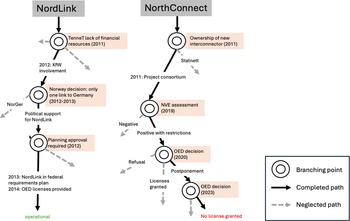
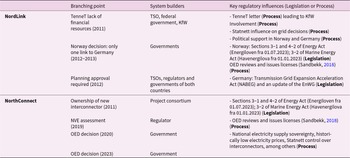
At these critical moments, key players from TSOs, governments, and regulatory agencies were able to influence the course of events. In Figure 3, we provide an overview for the key branching points, while Table 3 connects the respective system builders involved and the regulatory influences that affected the negotiation of options and outcomes. For clarity, in the table, we distinguish between decisions made with reference to legal texts (‘legislation’) and regulatory, institutional, and political dynamics (‘process’).
NordLink and NorthConnect branching point overview.

Figure 3 Long description
The NordLink project has three branching points; ultimately, the project goes into operation. NorthConnect passes through four branching points, with a denial of licenses in the end.
Branching points in NordLink and NorthConnect

Table 3 Long description
In both projects, national governments, TSOs/project developers and regulators are involved in the branching points. The legal frameworks are comparable, although NordLink is subject to increased political support in the regulatory processes.
Source: Lindemann, Reference Lindemann2025, pp. 285 & 289.
We identify three key branching points in the NordLink project. Firstly, when TenneT sought political support to address financing constraints in 2011, it could have resorted to private-sector solutions. The involvement of KfW, on the other hand, represented a political commitment to the project, as the risk would ultimately be borne by taxpayers. Secondly, in 2012, it became clear that only one cable would be laid from Norway to Germany. Here, NordLink repeatedly received support from the German government, paving the way for a positive decision in 2013. At this point, path dependencies already existed, as both Germany, through KfW, and Norway, through Statnett, had invested financial and political capital in the project. This had a positive reinforcing impact at a third branching point, when the project went through the formal planning processes. As grid operators were involved, the regulatory and planning approval processes for conventional power lines was used in Germany. The momentum generated through the positive reinforcement between these branching points built until the project was eventually completed.
For NorthConnect, we identify four key branching points whose outcomes defined the project outcome. Firstly, in 2011, it was decided to initiate the project on the Norwegian side without a TSO. While this approach is common in the UK, Statnett had been involved in all previously successful interconnectors in Norway. Secondly, although the NVE certified that the project would bring socio-economic benefits for Norway in 2019, it also pointed to the risk of higher electricity prices for end customers in the country. The political debate on electricity prices had already become a critical issue for the government at that point, and there were other points of criticism regarding the cable in addition to its ownership structure. Thirdly, the Norwegian Energy Authority's decision was postponed in 2020 and the licence was ultimately denied in 2023. Redistributing the revenues from the operation of the cable to customers, for example, would have reduced the disadvantages at this final branching point, but unlike with NordLink, sufficient support was lacking until the very end. There was a path-dependent effect from the initial decision to pursue a merchant interconnector model, with the result that the consortium lacked the key system builder for interconnectors in Norway. This was associated with the failure to build a level of project momentum that was sufficient to overcome subsequent economic and political barriers.
The comparison between NordLink and NorthConnect reveals wider systemic influences. NordLink and North Sea Link are among the first interconnectors between Norway and non-Scandinavian countries. The discourse on Norway's role in the EU, the conflict between cooperation and independence in energy matters, and the importance of domestic hydropower for security of supply and energy prices were already present during the planning of these cables. With the commissioning of NordLink and North Sea Link in 2021, the energy crisis in continental Europe from 2022 onwards, and growing pressure to implement the EU’s 2nd Renewable Energy Directive, these issues have become even more prominent. The sum of local political, economic, and technical factors restricted the OED's room for manoeuvre to such an extent that it rejected NorthConnect in 2023. While security of supply was cited as the central argument for the denial, wider contextual influences were critical.
Once NordLink successfully navigated key branching points, it reduces the reverse salient. In Figure 1, we have schematically illustrated how individual critical problems affect a reverse salient, in our case the lack of electricity network capacity. While this framing helps identify and investigate NordLink as critical problem, it also highlights its impact on the reverse salient. While wind farms expand in northern Germany, generation is frequently curtailed due to a lack of transport options provided by network operators. To reduce this, system builders focus on critical problems, including interconnectors and domestic HVDC lines such as SuedLink or A-Nord. In contrast to the stalled domestic links, NordLink has already successfully navigated though its branching points. Returning to Figure 1, the additional capacity allows the reverse salient to advance. In this way, wind power expansion and the decarbonisation of the German electricity system can progress.
5. Conclusions and recommendations
In this study, we proposed a novel analytical framework to investigate large-scale infrastructure projects, drawing on LTS and sociotechnical transition literatures. In the transitions literature, there is a growing recognition of the need to accelerate the implementation of renewable technologies to achieve net zero goals. Acceleration becomes visible in policy-mediated efforts to decarbonise electricity generation, but limited electricity grid capacity is an obstacle to the integration of renewable energy sources: in other words, a reverse salient for system transition.
By enabling electricity trading across national borders, interconnectors are a critical component of system transition. Despite their central role, however, many projects are delayed or discontinued. The two recent projects analysed here, NordLink and NorthConnect, were intended to connect Norway's hydropower-dominated electricity system with countries that have significantly reduced their dependence on fossil fuels with the help of wind and solar PV plants, but need access to more flexible electricity sources for furthering the transition. Despite this compelling need, only one of the two projects became operational.
Our framework was used to analyse these projects through the conceptual lens of branching points, to understand how reverse salients in mature and decarbonising power systems are approached by actors such as governments, regulators, and network operators. After identifying individual branching points in the development of the two case studies, we revealed the impacts of early decisions on project trajectories, and the subsequent need to align technical, economic, and political aspects to develop and maintain momentum. We also investigated the range of available options and the external influences shaping decision making.
In this way, we offer a number of insights into HVDC interconnector planning in the energy transition: firstly, actors need to be aware of path-dependencies, as early decisions and branching points, such ownership structure and financing models, greatly influence options at later branching points. This was clearly evident in the NorthConnect case. The involvement of central actors, or system builders, is crucial for large-scale projects. While economic and technical factors favoured the early NordLink project, political engagement was decisive in navigating its branching points. Finally, if internal and external forces prevent the critical problems to be overcome, system builders must consider alternative solutions – such as NorthConnect's plans to align with wind farm projects.
While our framing of grid capacity shortfalls as a reverse salient established analytical boundaries, other LTS concepts such as system builders and critical problems helped us to reflect on our branching point analysis. These concepts provide distinctive insight on large-scale, highly regulated system reconfiguration and infrastructure change.
This study is based on a limited sample of two in-depth cases. Further research is needed on large-scale electricity transmission projects across different geographies, in order to strengthen the understanding of the relationship between renewables acceleration and network reconfiguration. Our approach provides the basis for future studies into a highly relevant yet under researched dimension of energy transitions.
In addition, our framework can also be applied to other large-scale decarbonisation initiatives. Reaching climate targets means accelerating decarbonisation in other systems and sectors, such as heating, transport, and industry. Identifying reverse salients and critical problems, and analysing how actors navigate branching points provides an analytical structure to reveal the sociotechnical shaping of infrastructure projects and system transitions.
Acknowledgements
We would like to take this opportunity to thank the interviewees for taking the time, despite their professional commitments, to answer our questions comprehensively and transparently, so that their expertise and perspectives could be reflected in this work.
Author contributions
A.L., R.B., and M.W. conceived and designed the study; performed the data analyses and processing; and wrote the article. A.L. conducted data gathering.
Funding statement
This research received no specific grant from any funding agency, commercial, or not-for-profit sectors.
Competing interests
None declared.
Data availability
Not applicable.




 Open access

