


Introduction
An international YouGov public opinion poll in late October 2022 revealed that more Indians held ‘the West’ responsible for the Russian invasion of Ukraine than Russia (28% compared to 27%, with 45% saying both were responsible or didn’t know). In this contribution, we analyze how television news influences opinion formation through framing the conflict in particular ways. As Bilgic and Irrera in their introduction point out, however, framing analysis can lack a temporal dimension, and so we seek to situate our analysis in a historical context. It is not merely news coverage that determines public opinion, but the history of international relations. We aim to explain why this is the case through reference both to the enduring strategic alliance between the Soviet Union and then Russia with India since the 1950s and to how the Russian invasion of Ukraine is framed in Indian broadcast news media. We argue that there are three competing frames present in various degrees in the reporting of the war: the Ukrainian sovereignty frame, the Russian anti-West frame, and the Indian national interest frame, with both international and domestic advocates of each frame eager to influence how their position is reported. The Indian national interest frame that navigates between the pro and anti-West frames, however, is predominant. We argue, therefore, that a news media, largely submissive to government policy, through deciding which frames to present and which political actors to support, plays an important role in shaping public attitudes toward the conflict, securing domestic consent for foreign policy, and consequently in enabling the Indian government’s approach to the war.
Russian–Indian relations
Public opinion in India has not altered significantly over the past few years, with relatively positive views of Russia and the USA and negative views of China and Pakistan. A study from 2014 demonstrates this. In a Pew Research Centre survey (2014) conducted before Russia’s annexation of Crimea on “how Indians assess other countries,” 45% of the public had a favorable view of Russia, 23% had an unfavorable view, and 32% had no opinion. Only 34% of Indians view the European Union positively, 25% have a negative opinion, and 40% have no opinion. India has been negotiating a free trade agreement with the EU since 2007. It is noteworthy that more Indians viewed the USA favorably than either Russia or the EU in 2014, but Russia was viewed considerably more favorably than the EU. The findings of these opinion polls need to be understood in the historical context of relations between Russia and India, stretching back at least one hundred years.
India and Russia have a long history dating back to the early 20th century when India was colonized by the British. Indian freedom fighters were inspired by the 1905 Russian Revolution, and Mahatma Gandhi was impressed by the similarities between India's and Russia's political climates. According to Menon and Rumer (2022), Lenin was interested in India's early independence movement, and the Soviet leadership wanted India to obtain independence after the 1917 Bolshevik Revolution. Jawaharlal Nehru's approach to the Soviet Union formed the basis of the Indian National Congress (Mohanty 2016). In 1927, Nehru visited the Soviet Union to commemorate the tenth anniversary of the Bolshevik Revolution. Diplomatic relations were established on April 13, 1947 (Budhwar Reference Budhwar2007).
The Soviet Union backed India politically, strategically, and diplomatically, particularly concerning Kashmir and other vital issues. Kapoor (2019) emphasizes the Indo-Soviet Treaty's role in India’s successful 1971 operations leading to Bangladesh’s formation. This political alliance was reinforced by a strong economic partnership. In the 1950s, the Soviet Union significantly aided India's industrialization, military, space, and atomic energy endeavors. The support was crucial given India's deficiencies in foreign currency, capital, and technology. Major public-sector businesses and the first Indian Institute of Technology in Mumbai were established with Soviet assistance, Kapoor (2019). Nandy (Reference Nandy2020) notes the geopolitical alliance between the Soviet Union and India against the US, Pakistan, and China.
Tellis (2022) highlights that significant changes, like the Soviet Union’s fall and the rise of India and China, have reshaped Russia–India relations. The once robust Moscow-New Delhi relationship from the Cold War era now primarily hinges on the arms trade. Recently, India has lessened its dependency on Russian arms, turning to France as its leading supplier.
According to a Stockholm International Peace Research Institute (Sipri) (2022) assessment, India’s imports of Russian weaponry have decreased over the past five years, while France has become a more important provider of military equipment. As India strives to diversify its supply of armaments, imports from Russia fell by 47% in the last 5 years (bbc.com, 2023).
However, since the Russian invasion, India has become the largest global importer of Russian oil. In October, India bought a record-setting 106,000 barrels per day of fuel oil from Russia. The steep discounts that followed the February invasion of Ukraine led to a substantial increase in Russia's market share in India. According to Chakravarty (2022), in an article in The Print titled ‘Who is profiting from Russian oil? Not the common people, but private companies’, India has become a prolific buyer of Russian oil following the outbreak of the war in Ukraine. By making Russia its biggest oil supplier, India now buys ten times more oil than before the war. According to the Directorate General of Commercial Intelligence and Statistics (2022) at the Ministry of Commerce and Industry, India has paid Russian oil companies nearly $20 billion between April and October, more than in the previous ten years combined. By purchasing large quantities of Russian oil at a lower price, India claims it is in its interests to take advantage of the lower prices. While the West has imposed sanctions and has endeavored to reduce its reliance on Russian energy exports, India has significantly ramped up its imports, taking advantage of discounts. In addition to consumables such as coffee and tea, spices, and animal and vegetable fats, typical Russian exports to India have included petroleum oil and other fuel products and fertilizers. In 2022, fertilizers and gasoline accounted for nearly 91% of bilateral commerce. Russia became the second-largest crude oil exporter to India in September. 85% of India’s petroleum needs are met by imports. India is the world’s third-largest importer and user of oil. Russia’s share of India’s oil imports grew from 1% in February, before the Ukraine conflict, to 21% by September 2022.
India’s response to the crisis in Ukraine has been different from that of other major democracies and key U.S. allies. Even though Moscow’s war clearly makes New Delhi uncomfortable, it has chosen to be neutral toward Russia in public while significantly benefiting economically from the war and indeed helping to finance Russia’s invasion through purchasing Russian exports.
India’s stand
Indian reactions to military crises involving Russia have not changed much since independence. According to Sen (2022), India did not criticize Russia for its military presence in Hungary during the 1956 Hungarian Revolution. During the 1957 session of Parliament, Jawaharlal Nehru explained India’s non-condemnatory position to Parliament. “Sen argues that we may have a strong dislike toward many happenings in the world as time passes and on a daily basis. Instead of using name-calling and condemnation, we choose not to criticize, acknowledging that these methods are not useful in dealing with the root causes of the problems. In line with Nehru’s dictum, India continues to respond to conflicts with its allies. India has used a similar strategy in response to foreign invasions, whether they were Soviet incursions into Hungary in 1956, Czechoslovakia in 1968, Afghanistan in 1979, or the United States invasion of Iraq in 2003.
India’s response to Russia’s invasion of Ukraine—critiquing the deaths of civilians without naming names and staying out of UN votes—is consistent with how it has acted in previous conflicts. India did not vote for a US-proposed UNSC resolution that strongly condemns Russia’s actions in Ukraine. India refrained from voting on a resolution of the United Nations General Assembly that condemned Russia for its military activities in Ukraine. India did not vote on an International Atomic Energy Agency (IAEA) resolution about the safety of these facilities after the Russians took over four nuclear power plants and a number of nuclear waste sites, including Chernobyl (TOI, 2022). President Joe Biden of the United States has said that India’s situation is “rather precarious.” His Deputy National Security Adviser for International Economics warned India that doing business with Russia against U.S. sanctions would have “consequences” (Haider 2022). India, in a sense, is navigating an increasingly bipolar world with the US and its allies on one side and Russia and China on the other. In such circumstances, it is crucial for the Indian government to continue to have popular support, and the representation of the conflict through broadcast news is a key means to that end.
Mainstream Indian television news media over the war
It is widely acknowledged that media organizations shape public opinion and set the agenda for dialog. India has 392 news channels, with regional language channels and private operators dominating the market. India's media landscape is incredibly diversified, with hundreds of channels in many languages. Krishnan (2021) provides examples of large, for-profit businesses possessing significant control over media content, which is primarily supported by advertising. With no restrictions on cross-media ownership, broadcast television networks in India are self-regulated, sometimes owned by large corporations, and frequently have strong political links. A culture of round-the-clock “Breaking News” networks and politicized discussions, according to Krishnan, distorts and sensationalizes the news constantly. According to Rodrigues and Ranganathan (2015), Indian television is often accused of promoting partial news that misleads citizens and weakens democracy.
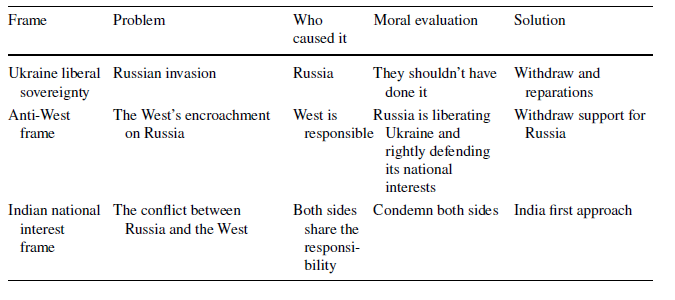
Here, we identify briefly the three principal ways that Indian television news outlets have framed the Russian–Ukrainian War and critically examine the role that television news organizations have had in determining the nature of the public discussion on the issue. The three primary frames are the liberal frame (which is pro-Ukraine), the anti-Western frame (pro-Russia), and the national interest frame (India should do whatever is in its interests irrespective of morality) (Table 1).
.

We adopted Robert Entman’s idea of a frame to investigate the meaning-making processes of journalists and media outlets regarding the war. In this approach, news frames highlight how politicians, journalists, bureaucratic elites, and influential people, among others, depict the parameters of a discussion or events in a race to shape public opinion. According to Entman (Reference Entman1993: p.52), framing is the selection of certain features of reality to promote a specific issue description, causal interpretation, moral judgement, and/or treatment prescription.
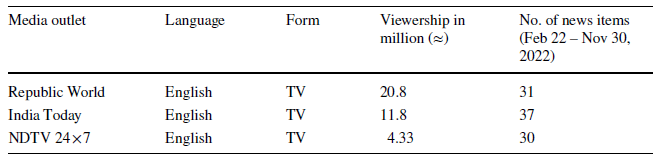
Our research, undertaken from February 24, 2022 to November 2022, included a comprehensive examination of the media portrayal of the Russia–Ukraine crisis on three prominent Indian television news channels: NDTV, India Today, and Republic TV. The comprehensive coverage consisted of a total of 98 news pieces pertaining to the war, distributed as follows: NDTV reported 30 stories, India Today covered 37 stories, and Republic TV included 31 stories. The duration of these news items exhibited considerable variation, spanning from a little interval of 0.48 s to a more extended period of 1 h and 55 s.
In order to enhance comprehension of the framing and narratives, we systematically classified each story into established thematic frames. The results of our study indicated that a total of 32 stories had an anti-Western perspective; while, a focus on Indian national interest characterized 40 stories. The remaining 26 stories were situated within the framework of Ukraine's liberal sovereignty.
One notable finding derived from our investigation pertained to the presence and involvement of subject matter experts. The number of stories featuring Russian experts amounted to 28; while, their Ukrainian colleagues were represented in just 13 narratives. The observed divergence may indicate a tendency of India's television media to adopt an anti-Western viewpoint, possibly facilitating the dissemination of Russian narratives. This alignment coincides with the position of the present government.
The rationale for choosing the above-mentioned TV channels was based on their popularity and standing. The TV media outlets considered for the study were consistently at the top-5 of the list of viewers, as can be seen in Table 2. This ensured that the study had enough sample size to draw meaningful conclusions. The study also took into account the diversity of the TV channels to ensure that a wide range of perspectives were represented.
.

Source: (BARC, January 2020)
Broadcast Audience Research Council (BARC), India, is an industry body that presents the weekly viewership figures for general entertainment and television channels. However, it is important to note that TV viewership ratings are currently paused in India. This is due to a review of the system by the BARC. Therefore, there are no official TV viewership figures available for the Indian news channel at this time
NDTV (left alignment), Indian Today (center-right alignment), and Republic TV (right alignment), three prominent English-language news channels, were analyzed for this study. NDTV, which focuses on broadcast and internet news dissemination, is considered to be a legacy brand that pioneered independent news broadcasting in India. Recently, Adani Group, a conglomerate with broad commercial interests, bought a significant share in NDTV Ltd. The chairman of NDTV, Prannoy Roy, and the executive director of the channel, Radhika Roy, have both resigned as board directors. NDTV has maintained an independent stance critical of the government for years; while, others have adopted a strident Hindu nationalist position. The pejorative phrase “Godi-media”, which literally means “media sitting on the lap”, was introduced and popularized by NDTV journalist Ravish Kumar to refer to the sensationalist and biased print and television news media.
TV Today Network Ltd, a division of Living Media, owns the India Today channel. The channel’s consulting editor is the well-known journalist Rajdeep Sardesai. The Bombay High Court has ordered TV Today to pay the Rs. 5 lakh penalty imposed by the Broadcast Audience Research Council (BARC) for breaking its code of conduct in the false TRP rating scandal. The scam goes back to 2020 when the Mumbai police stated that certain media houses were paying homeowners bribes to “rig” ratings.
In May 2017, Arnab Goswami and Rajeev Chandrasekhar co-founded Republic TV, with Chandrasekhar renouncing his shares in May 2019, leaving Goswami as the channel’s majority shareholder and editor-in-chief. Chandrasekhar was a member of the National Democratic Alliance who later joined the Bharatiya Janata Party (BJP); while, Goswami was the former editor-in-chief of Times Now. The majority of the venture’s finance came from Jupiter Capital Private Limited, a company owned by Chandrasekhar.
According to an opinion post titled “India’s Media Is Partly to Blame for Its COVID Tragedy” by Chowdhury for Time magazine (2021), Modi’s rise to power in 2014 resulted in the taming of India's media industry. His ascension coincided with rearranging the editorial authority of several of India’s most influential news organizations, especially national television networks. The previous generation of top editors, who were perceived to be more loyal to India’s liberal outlook than the BJP’s Hindu nationalist ideology, was eliminated, and new channels and news leaders with a commitment to the BJP and Modi were formed. Bose (2020) mentions in a Deccan Herald news article titled “Modi government spent over Rs 700 crore on commercials in 2019–20, discloses RTI reply” that during the 2019–20 fiscal year, the federal government spent around 1.95 crores (US$240,000) every day on advertisements.
From the commencement of the conflict in February 2022, we have collected and examined their coverage of the Russian invasion via their YouTube channels, as it is impossible to obtain archives from media outlets.
The anti-western frame
At least in the early weeks of the Russian invasion, the anti-Western frame was prevalent, if not entirely dominant, on Indian broadcast news channels, in stark contrast to the dominance of the liberal sovereignty frame in many Western countries.
In a news story, “Russia Dares America,” on Republic TV, the anchor criticizes the United States for being responsible for the ongoing war by allowing Russian experts more time to discuss. When compared to other experts who had fewer than five minutes to share their opinions during the hour-long discussion, the Russian expert had a full 20 min to speak. Even channels like India Today TV, with a central-right lean, made it a point to emphasize Russia’s perspective on the invasion. Volodymyr Zelenskyy, the President of Ukraine, was the only Ukrainian to receive television coverage during this period. Exclusive interviews with him were conducted on all three of the networks under study.
The Russian government gave some Indian journalists access to the battle lines in eastern Ukraine, which had never been done before. This embedding of Indian journalists with Russian forces provided Indian audiences with largely Russian perspectives on the invasion.
Opting for an anti-Western frame in a 9.15-min NDTV debate titled “Russia–Ukraine stalemate as war approaches one-month mark,” on March 25, 2022, Russian journalist Sergai Strokan, Kommersant Publishing House, was given over 4 min to speak, while Ukraine expert Olena Tregub, Ukraine Government Officer, was given less than two. The Ukrainian expert then accuses the show’s host of inviting a Russian propagandist, whom she claims is a liar. “Why are you broadcasting Russian propaganda on Indian television, and why are you disrespecting Indian viewers? Please invite someone neutral and independent.”
In another 48-min debate titled “Top Experts Discuss Russia–Ukraine War” on Indian Today TV on July 2022, the Ukraine panelist, Ivanna Klympush, Chair the Parliamentary Committee, Ukraine Integration EU, is given less than 2 min to speak; whereas, other experts are given a minimum of five minutes to present their point of view.
The Ukrainian government has accused three Indian nationals, including the former chair of the National Security Advisory Board (NSAB), of promoting “Russian propaganda,” according to an article titled “Ukraine Accuses 3 Indians, Including Former NSAB Head, of Promoting Russian Propaganda” in The Wire, (2020) a nonprofit news and opinion website. The Centre for Countering Disinformation (CCD), a division of Ukraine’s National Security and Defence Council created by presidential order, published the list. The director of the center explained that one of her responsibilities was to serve as a “reliable barrier” against informational threats coming from both inside and outside of Ukraine that was “intended to weaken state institutions and manipulate public opinion.” The list, titled “Speakers promoting narratives consonant with Russian propaganda,” has over 75 entries from around the world, including US lawmakers, European politicians, and Chinese academics. P.S. Raghavan, a retired foreign service officer who had additionally served as India’s ambassador to Russia, is one of three Indian commentators and the former head of that country’s NSAB. The other two are Sam Pitroda, a former adviser to Prime Ministers Rajiv Gandhi and Manmohan Singh, and renowned journalist Saeed Naqvi. Raghavan has been accused of spreading a “pro-Russian narrative” that says “Ukraine against Russia is like NATO against Russia,” which is probably a reference to Moscow’s assertion that Kyiv’s government is carrying out the orders of Western armed powers. Raghavan said in the same article that he had not known the list existed before. In response to the exercise, he told The Wire, “I have no remarks to make other than mystification at my presence on this list.” Pitroda and Naqvi both said that their appearance on the list “puzzled and astonished” them. According to Naqvi, the story of Ukraine did not begin in 2022 but in 1998, when the US Senate confirmed NATO’s eastward expansion. The work of the historians of Russian history made it evident that a response would occur.
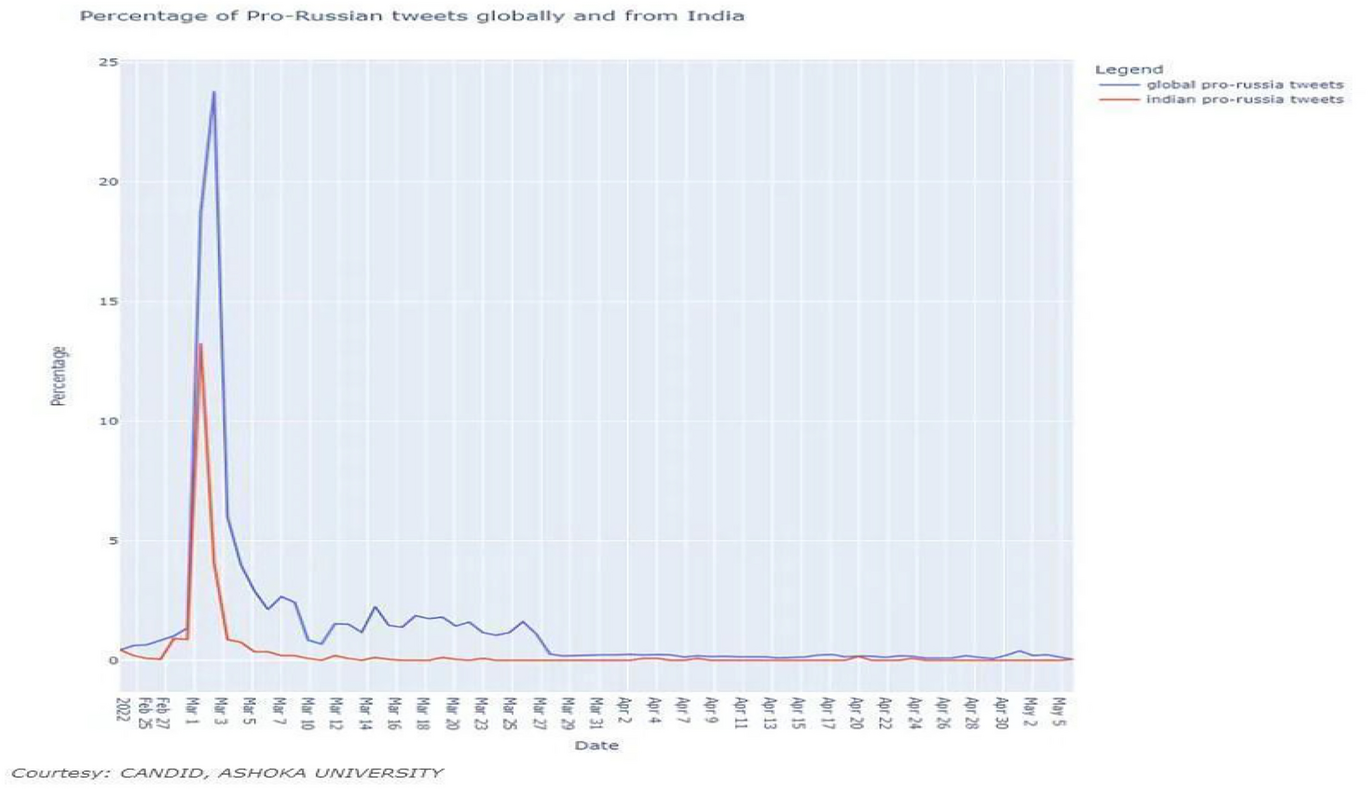
A study by Ashoka University's Centre for Analysis of Network Data and Insight Derivation (CANDID) (2022) reveals that between February when the conflict started, and May 2022, India-based handles were the most common source of pro-Russia tweets (MihinduIkulasuriya 2022). The study used location-based analysis of Twitter users who have enabled their IP addresses to determine which nation a tweet was coming from. It was discovered that India-based accounts were the main source of pro-Russia tweets. This “suggests a concerted effort may exist from users residing in India to spread a narrative that is pro-Russian,” the study paper shared with The Print (2022) online magazine states. CANDID’s study focused on 6,88,107 tweets sent by individuals from throughout the world between 24 February and 6 May. These tweets were divided into pro-Ukraine and pro-Russia (MihinduIkulasuriya 2022) (Fig. 1).
Percentage of Pro-Russian tweets globally and from India.

In TV discussions and debates, Russian Foreign Minister Sergey Lavrov, AMB Konstantin Kosachev, Deputy Speaker of the Federal Assembly of the Russian Federation, as well as Russian journalists and academics, got more airtime than their Ukrainian counterparts.
Evgeny Georgievich Popov was a Russian politician and journalist who was often on TV in the early days of the war. According to a NewsLaundry article titled “Know Your TV News Panelists: Russian experts or propagandists? You decide,” (Meghnad 2022) John Dougan, an American who left the US in 2009 to escape being detained on hacking charges, and sought political asylum in Russia under the guise of “BadVolf,” was an anti-corruption whistleblower. However, the host of Republic TV presents him as “a geopolitical specialist and a former US marine joining from Moscow.”
Another expert on Russia, Anton Anisimov, Head of Foreign Broadcasting at the Russian news organization Sputnik, is one of the key players in “Russia’s misinformation and propaganda ecosystem,” according to the US, and has appeared on most of the Indian television channels for discussions.
Republic TV viewers are accustomed to seeing Alexey Gromyko, who provides the “Russian view” on the current conflict. He is the director of the Institute of Europe of the Russian Academy of Sciences, and a member of the Research Council at the Russian Security Council and the Research Council for the Minister of Foreign Affairs of Russia.
A recurring issue is that Indian television media outlets deliberately chose to cover the war in a seemingly “balanced” manner, avoiding criticizing Russia’s invasion. TV news coverage has been neutral at least with respect to Ukraine and Russia, which is in accordance with the Indian government’s longstanding neutrality policy.
The liberal frame
In contrast to many western societies where the liberal frame has been predominant and where Russia is clearly cast as the illegal aggressor, at least in the early stages of the conflict, the liberal frame was only marginally present in Indian broadcast news. It was only when civilian deaths and potential Russian war crimes were increasingly being reported by Western media that the coverage in India became more hospitable to the liberal frame, and Indian reporting became more “balanced”.
In a story titled “Nordic PMs denounce Russian aggression at summit with PM Modi”, broadcast on May 4, 2022, on the left-leaning television network NDTV, one may see a liberal frame emerging when Prime Minister Modi joins the Nordic prime ministers in categorically condemning civilian deaths in Ukraine. When the revelations of the Bucha killing of civilians in Ukraine occurred, Republic TV that had previously adopted an anti-Western frame in its reporting, took a more liberal perspective. Arnab Goswami, the anchor and owner of Republic TV, a channel that frequently follows a hyper-nationalist script in accordance with the intentions of the government, questioned, “Have the Russians fully lost it?” The controversial host suspended the broadcast of the Russia friendly incident in Ukraine following the Bucha tragedy. When Minister of Foreign Affairs of the Russian Federation, Sergey Lavrov, asserted that the deaths were staged and was refuted by the television anchor with the remark, “No, Russians, it’s not false news.”
The change in tone was not just announced by Republic TV in English. Some of India’s top broadcasters and journalists fiercely criticized Russia when gruesome reports of victims lying on the streets of the Bucha neighborhood of Kyiv started airing in early April. There has been strong evidence of war crimes, according to Vishnu Som, an anchor for NDTV who was reporting from the location of a mass grave in Bucha. On April 4, a journalist for India Today Television reported from a Russian tank as it prepared to enter Donetsk. The most explosive news of the week, though, comes from the channel’s Kyiv-based staff. Driving into Bucha “minutes after the Russian departure,” India Today anchor Gaurav Sawant discovered what Russia did not want the world to see: a fleeing army leaving the bodies of slaughtered civilians behind them.
The Indian national interest frame
This tendency for “balanced” coverage of the war opens up the discursive opportunity of seeing India’s policy of pursuing its own geostrategic and economic interests as legitimate. In its coverage of the conflict, India Today TV has pushed hard for the Indian national interest frame. In a story titled “Jai Jai Jaishankar,” (April 12, 2022) anchor Shiv Aroor gives more prominence to the external affairs minister, Mr. Jai Shankar. He says, “Jai Shankar has been dropping truth bomb after truth bomb after truth bomb on Indian foreign policy and geopolitics while on tour in the United States, frequently targeting the American media and American policymakers, and the latest he’s called out Western hypocrisy on the issue of India’s abrogation of Article 370. He also criticized the Western media for what he termed “biased anti-India propaganda perpetrated by special interests.”
Indian media outlets have historically focused on domestic issues rather than covering global events, and there has been little local coverage of the brutal war being waged by Russia. Little coverage is given to the millions of civilians in Ukraine who are in danger of losing their lives—the killing of families attempting to flee through humanitarian corridors, the valor of the resistance fighters, the anti-war demonstrations in Russia, or the Russian military’s startling incompetence. It means that Indians are largely unable to recognize the shortcomings of their foreign policy toward Ukraine. By opting for the “national interest frame,” Indian media outlets merely repeat the statements made by the Foreign Ministry, refusing to question Indian officials about their approach to Ukraine or allow for an in-depth discussion of what India should do.
The Indian External Affairs Minister, Mr Jaishankar, has emerged as a hero in the Indian media, with every news channel giving more importance to his views by adopting the Indian national interest frame. During the initial months of the war, he appeared regularly on all three channels under study. The media followed him everywhere he went as he explained India’s position on the conflict. In the above news story on NDTV (October 10, 2022), he slammed the West for criticizing India’s stance. He asserted, “They must accept it as India did when they disagreed with each other over matters pertaining to Pakistan and Afghanistan.” The most significant defence of India’s foreign policy was given by Mr Jaishankar, who received acclaim at home for pointing out western “hypocrisy” on Russian oil flows to India, which the majority of channels supported by giving it ample coverage.
Conclusion
To comprehend the divergent viewpoints in India about the conflict in Ukraine, it is imperative to take into account the enduring military and diplomatic ties between Russia and India, which predate the independence of India and have persisted after the dissolution of the Soviet Union. The available evidence indicates that Russian propaganda activities in India have achieved a notable degree of success in influencing public opinion. The Russian framing of the conflict can be found on all the mainstream news channels as well as that of the Ukrainian state. However, it is important to note that the prevailing discourse mostly revolves around the Indian national interest, which is effectively advocated by influential individuals such as Jaishankar. The media's portrayal of the conflict serves to present the Indian national interest position as a reasonable response to the conflict. The notion that assigning blame to neither party fully justifies the principle of prioritizing national interests. The national interest frame has significant support from the broadcast news media, suggesting a high degree of alignment between the Indian news media and the state's position. Such an alignment between political and media elites and the presence of Russian and Ukrainian frames helps to explain both the divided nature of public opinion in India concerning the attribution of blame and the degree of popular support for the Indian government's position.

 Open access

