





Introduction
Cerebral stroke is a leading cause of mortality in the paediatric population, yet timely diagnosis remains challenging for frontline providers. Reference Phelps, Silos and De La Torre1–Reference Ferriero, Fullerton and Bernard3 Among children with CHD, the most common type of congenital malformation present in about 1% of all live births, the risk for paediatric stroke is especially high and represents 20% of all paediatric strokes. Reference Giang, Fedchenko, Dellborg, Eriksson and Mandalenakis4,Reference Asakai, Cardamone and Hutchinson5 Patients with CHD are five times more likely to experience ischaemic stroke (IS) than those with normal heart physiology, largely due to overlapping comorbidities such as cyanosis, right-to-left shunting, and procedural complications. Reference Giang, Fedchenko, Dellborg, Eriksson and Mandalenakis4–Reference Mandalenakis, Rosengren, Lappas, Eriksson, Hansson and Dellborg6
Endovascular mechanical thrombectomy (EMT) offers a promising alternative to the medical management of stroke, providing rapid cerebral reperfusion even in children with recent surgeries, anticoagulation, or delayed presentation. Reference Sun, Felling and Pearl7,Reference Sporns and Psychogios8 However, the risk of intervention and optimal patient selection is still underreported due to the lack of safety trials, case-controlled trials, or comprehensive retrospective studies. Reference Barry, Hallam, Bernard and Amlie-Lefond9 This case series represents a single-centre experience with EMT in the setting of thromboembolic stroke in patients with CHD as a means for the rapid reestablishment of cerebral blood flow successfully with subsequently improved neurologic outcomes. Patient caregivers signed informed consent regarding publishing their child’s data and images for publication.
Case series
This study retrospectively analysed patients with a confirmed diagnosis of CHD who underwent EMT for large-vessel occlusion after IS while hospitalised at the Texas Center for Pediatric and Congenital Heart Disease between January 2018 and March 2024. The diagnosis and treatment indications for EMT were determined using MRI or computed tomography angiography (CTA) at our hospital. We analysed the patient’s age, type of CHD lesion, type of congenital heart surgery (CHS), initial clinical manifestations of the IS, IS artery territory, day of IS since CHS, and clinical outcomes from the retrospective chart review. The time of symptom onset from last known well, PedNIHSS score, angiographic reperfusion technique, and degree of reperfusion were also examined. The degree of reperfusion was defined by using the thrombolysis in cerebral infarction (TICI) classification, where TICI 0 means no reperfusion and TICI 3 means complete reperfusion with rapid clearance of contrast material.
Results
This study includes four patients with their clinical characteristics summarised in Table 1.
Description of acute ischaemic stroke case series

HLHS = Hypoplastic Left Heart Syndrome; DORV = Double Outlet Right Ventricle; MCA = Middle Cerebral Artery; SCA = Superior Cerebellar Artery; DSA = Digital Subtraction Angiography; TICI = Thrombolysis In Cerebral Infarction; POD = Post-Operative Day.
Case 1
A 13-year-old male with critical pulmonary stenosis status post neonatal balloon valvuloplasty, with a small patent foramen ovale (PFO), autism, and obstructive sleep apnoea who presented to an outside emergency department with symptoms of inability to move his left arm and left leg, confusion, and headache, all recognised when he woke up. His last known well was at 23:00 the night before his symptom onset. Code stroke was activated 46 minutes after symptom discovery (9 hours and 40 minutes from last known well). His initial PedNIHSS score on arrival was 19. Brain MRI demonstrated an acute large right middle cerebral artery (MCA) ischaemic infarction with negative fluid-attenuated inversion recovery (FLAIR) changes. CTA confirmed right M1 occlusion with a CT perfusion scan showing a diffusion/perfusion mismatch volume of 71 ml with a ratio of 1.7, indicating candidacy for reperfusion therapy. Intravenous tenecteplase (TNK) was administered 2 hours after awakening (10 hours after last known normal). Within 26 minutes of receiving TNK, his NIHSS score had improved to 2 (mild left facial droop and mild dysarthria). Upon transfer to the ICU, digital subtraction angiography (DSA) revealed a right M2 branch filling defect with TICI 2A flow, where only partial filling (less than two-thirds) of the entire vascular territory is visualised. Subsequently, EMT was performed 11.5 hours after the last known well. Post-thrombectomy DSA demonstrating complete, TICI 3, recanalisation of the right MCA. Brain MRI on day 1 post-thrombectomy showed a moderate decrease in the size of the infarction without haemorrhagic transformation. Enoxaparin was started 36 hours post stroke and transitioned to rivaroxaban on hospital day 5.
Case 2
A 6-year-old male with a cleft mitral valve that underwent mitral valve cleft repair 2 years prior developed left facial weakness as well as left upper and lower extremity weakness. His last known well was at 17:00 the day of his symptom onset. The code stroke was activated upon hospital presentation, 23 minutes after symptom discovery (12 hours and 24 minutes from last known well). His initial PedNIHSS score on arrival was 5. Brain MRI demonstrated decreased diffusion in the right anterior MCA distribution without evidence for FLAIR hyperintensity, suggesting acute infarct less than 4 1/2 hours old (Figure 1e, f). There was no evidence for haemorrhage. CTA confirmed right M1 occlusion with attenuated right anterior division MCA branches. He was considered ineligible for intravenous tissue plasminogen activator (tPA) due to the timeline of the last known well-being unclear and a relatively low PedNIHSS. He subsequently underwent EMT. Follow-up angiography demonstrated persistent right M1 MCA occlusion. A second attempt was made with only partial success at a TICI 2C (near-complete reperfusion). After repeat imaging, systemic heparinisation was initiated with a 50 unit/kg heparin bolus followed by a 20 units/kg/h heparin rate. After 48 hours, his transcranial Doppler demonstrated restoration of flow in the basilar artery and distal branches (Figure 1g). He was transitioned to aspirin 40.5 mg daily. He was discharged from the paediatric ICU on postoperative day (POD) 3 with mild left upper extremity dyspraxia and discharged home on POD 8 with no remaining neurologic symptoms. Postoperative FLAIR revealed residual left cerebellum infarction on POD 15 (Figure 1h).
Brain ischaemic changes and vessel imaging before ( a ), ( c ) and after thrombectomy ( b ),( d ) in two patients. Case 1: ( a ) Acute right MCA M1 occlusion. ( b ) Restored MCA flow with residual basal ganglia infarct (24 h post-thrombectomy). Case 2: ( c ) Acute left SCA occlusion. ( d ) Restored basilar artery flow with residual cerebellar infarction (15d post-thrombectomy).

Case 3
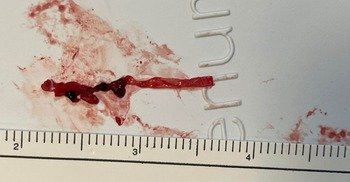
An 11-year-old female with hypoplastic left heart syndrome (HLHS) status post staged palliation, which culminated with an extracardiac fenestrated Fontan at 4 years of age, was admitted with worsening heart failure and listed as status 1A for orthotopic heart transplantation. On admission day 64, she developed a sudden onset of right facial droop, partial gaze palsy, and left arm drift. Her last known well was at 14:10 the day of her symptom onset. Code stroke was activated 20 minutes after the symptoms were discovered. Her PedNIHSS was 5 f. Brain MRI demonstrated a focal linear acute ischaemic infarction of the left superior cerebellar hemisphere and basilar artery occlusion with involvement of the bilateral superior cerebellar branch arteries. Rapid processing of perfusion and diffusion (RAPID) demonstrated 11 ml of Tmax >6 s in the right superior cerebellum and pons without corresponding decreased cerebral blood flow in these regions. She was not a candidate for tPA at that time, as she had been on a heparin drip with PTT levels of 45.7 s. Following neuroimaging, she developed further neurological deficits over the subsequent 90 minutes, resulting in a PedNIHSS score of 14. A left vertebral artery angiogram confirmed a basilar artery thrombus occluding the midsegment with involvement of the bilateral superior cerebellar arteries. EMT of a large 3 cm thrombus was performed consistent with TICI 3 reperfusion 5 hours following stroke activation (Figure 2). The immediate post-procedure PedNIHSS score was 4. On POD 1, repeat MRI angiography revealed resolution of the thrombus, no evidence for haemorrhagic conversion, complete patency of the basilar artery, and evolution of diffusion-weighted imaging changes now seen within the brainstem and cerebellum. Unfractionated heparin was restarted 48 hours after the thromboembolic event. At POD 7, she was cleared for cardiopulmonary bypass and was reactivated on the transplant list 14 days after the event. The patient received an orthotopic heart transplantation on POD 53 from her stroke.
Case 3: Retracted clot from aspiration thrombectomy of the basilar artery.

Case 4
A 4-year-old male with d-transposition of the great arteries (d-TGA) and double outlet right ventricle (DORV) palliated to an extracardiac fenestrated Fontan two years prior to the event was admitted for cardiac catheterisation and transplant evaluation. His postoperative course was complicated by sinus node dysfunction that required placement of a dual-chamber pacing system, pulmonary hypertension, left pulmonary artery stenosis that required multiple balloon angioplasty procedures and stenting, and protein-losing enteropathy. On day 6 of admission, he woke up with left-sided weakness and dysarthria. His last known well was at 20:00 the night before his symptom onset. Code stroke was activated 5 hours after neurological symptoms were recognised. His initial PedNIHSS was scored 14. The patient was ineligible for MRI due to his pacemaker and extracardiac wire. CTA with CT perfusion was positive for occlusion of the right proximal M2 superior division with distal reconstitution by the lenticulostriate arteries that favoured a chronic obstruction (Figure 1a, b). The resultant mismatch volume was 12 ml. He was not a candidate for tPA due to being out of the therapeutic window, so he was taken for EMT due to a possible large vessel occlusion and <24 hours since last known well.
EMT was performed 8 hrs and 30 minutes from code stroke activation. After 2 minutes of suction, the DSA showed right M1 recanalisation with residual thrombus in the posterior M2 MCA. A second attempt was performed using the RED 43 aspiration catheter in the M2 MCA. The final DSA showed complete right MCA reperfusion (TICI3). A repeat CT head on POD 1 showed an evolving infarct involving the right putamen, periventricular white matter, and caudate nucleus, as well as the right superior temporal gyrus and right posterior frontal lobe, without haemorrhagic transformation (Figure 1 c, d). Clinically, he remained intubated and sedated for 24 hours after the procedure. A repeated neurological exam after extubation on POD 2 showed persistent mild facial droop on the left at baseline, tongue deviation on protrusion to the left, and improvement in right upper and lower extremity tone. Unfractionated heparin was started 48 hours after DSA at 12 units/kg with a PTT goal of 45–60 and transitioned to enoxaparin on POD 9. His clinical course was complicated by neuro agitation, which responded to gabapentin 200 mg three times a day, which was ultimately discontinued at discharge on POD 85.
Discussion
Paediatric cerebral stroke, though rare compared to adults, presents unique diagnostic and therapeutic challenges, particularly in children with CHD. Reference Odat, Idrees and Jain10 For these patients, timely and effective treatment is critical, yet the application of standard therapies, such as tPA, is often limited due to contraindications, including anticoagulation, recent surgeries, or delayed presentation. In this context, EMT represents a promising intervention, with the potential to restore cerebral perfusion in high-risk paediatric populations without reliance on pharmacologic thrombolysis. This case series highlights the feasibility and clinical outcomes of EMT in children with CHD as young as 4 years old who experienced large-vessel occlusions resulting in IS. All patients underwent successful reperfusion, with most achieving TICI 2C or 3 recanalisation. Despite varied presentations, including differences in timing from symptom onset to treatment, each patient demonstrated improved neurologic outcomes post-EMT. While the case series supports the utility of EMT in this context, it also highlights the need for a tailored approach to CHD stroke. At our centre at Dell Children’s Medical Center, in Austin, TX, the Evidence-Based Outcomes Center (EBOC) is an entity with a mission to improve patient outcomes by providing best-practice resources (guidelines, algorithms, and protocols) that are backed by evidence-based research (Supplement S1). Clinical practice guidelines for many paediatric conditions are created to include recommendations to optimise patient care that are informed by a systematic review of evidence and an assessment of the benefits and harms of alternative care options (GRADED recommendations). The clinical algorithm for paediatric stroke in CHD serves as a multidisciplinary management tool that may be of value to heart centres looking to become experienced at EMT.
Critical points of evidence
Intravenous tissue plasminogen activator (IV-tPA) remains the cornerstone of thrombolytic therapy, with alteplase being recommended for children based on adult dosing protocols and inclusion criteria. Reference Ferriero, Fullerton and Bernard3 However, its use is limited to select patients within the critical 4.5-hour window following symptom onset. Reference Harrar, Salussolia and Kapur11 Anticoagulation, while generally avoided in cases of large infarctions or haemorrhagic complications, is reserved for patients with significant embolic risks, such as those with CHD or hypercoagulable states, and requires haematologic consultation. Reference DeLaroche, Sivaswamy, Farooqi and Kannikeswaran12 Aspirin is recommended for arterial dissection and certain idiopathic strokes. Reference Stence, Fenton, Goldenberg, Armstrong-Wells and Bernard13
Imaging plays a critical role in diagnosis and treatment planning, with MRI preferred for its sensitivity in detecting acute ischaemic changes and ruling out stroke mimics. Reference Mirsky, Beslow and Amlie-Lefond14–Reference Christy, Murchison and Wilson17 CT and CTA, though less sensitive, are alternatives when rapid vessel assessment is needed. Reference Briest, Cheung and Kandula18 For large vessel occlusions with severe stroke symptoms (NIH stroke scale >6), mechanical thrombectomy is a viable option, with time-to-catheter puncture ideally within 6 hours but potentially longer based on patient-specific factors. Reference Abbas, Herial and Naamani19 Emerging therapies, such as tenecteplase (TNK), warrant further investigation, though alteplase remains the standard for paediatric patients. Reference Sun, Wilson and Waak20
Stroke alert protocol
The paediatric stroke algorithm outlines a systematic approach to managing suspected cases of stroke, emphasising rapid evaluation, stabilisation, and intervention to optimise outcomes. The process begins with the activation of a Level 1 Stroke Alert upon recognition of acute central nervous system deficits consistent with stroke. Immediate stabilisation measures include airway management, oxygen supplementation (targeting oxygen saturation >95%), normoglycemia (blood glucose 60–180 mg/dL), and blood pressure control. Concurrently, a multidisciplinary team assembles, including the neurology attending, neuroimaging specialists, critical care attending, interventional radiology, pharmacy, and anaesthesia, ensuring that all necessary expertise is available.
STAT imaging is a cornerstone of the algorithm. If available within 60 minutes, MRI is preferred for its sensitivity to acute ischaemic changes; otherwise, non-contrast CT, combined with CTA, is performed to evaluate vessel patency and rule out haemorrhage or stroke mimics. Imaging results guide further management decisions. For ischaemic strokes within 4.5 hours of symptom onset, the patient may qualify for IV-tPA. EMT is considered in cases of large vessel occlusion identified on imaging, with a target catheter puncture time of six hours or less from symptom onset, though recent studies in adult patients have suggested beneficial outcomes with EMT performed within 24 hours of stroke onset in select patients. Reference D’Anna, Abu-Rumeileh and Merlino21 Decisions regarding thrombolysis or thrombectomy involve the neurology and interventional radiology teams, who assess risks and benefits while consulting with the patient’s family. Supportive care measures are implemented throughout, including seizure management, temperature control (goal <37.5°C), and head positioning to optimise cerebral perfusion. Patients are admitted to the PICU for close monitoring with hourly neurologic checks during the first 24 hours. The interventional team collaborates with critical care and haematology specialists for anticoagulation management or addressing comorbid conditions such as CHD or coagulopathies.
This algorithm’s stepwise structure, coupled with clearly defined roles for each team member, facilitates seamless coordination. The time goals are to maintain a door-to-needle time within 60 minutes and perform a diagnostic image within those same 60 minutes (S1). By integrating prompt diagnostic measures, multidisciplinary expertise, and tailored interventions, this protocol exemplifies a robust framework for managing paediatric strokes in hospital settings.
Skillsets and personnel requirements
The success of EMT in paediatric settings relies on the expertise of specialised personnel and the use of tailored techniques. Interventional radiologists experienced in paediatric cases and skilled in handling appropriately sized devices are essential, along with anaesthesia teams proficient in paediatric sedation and airway management, to minimise procedural risks. Hospital staff must also be trained to recognise paediatric stroke symptoms and respond with urgency. Our institution benefits from a dedicated team of neurointerventionalists who are readily available for rapid consultation, including real-time imaging review and urgent intervention when necessary.
This availability ensures timely decision-making and minimises delays to revascularisation in eligible paediatric stroke patients. In parallel, our paediatric ICU and specialised paediatric neurology teams provide close post-procedural monitoring, with close serial neurologic assessments to detect early signs of deterioration or recovery. This multidisciplinary infrastructure is especially impactful in managing high-risk populations, such as children with CHD, who are predisposed to stroke and may present with complex perioperative or postoperative courses.
Patient selection for EMT must be individualised, considering clinical severity, imaging findings, and the feasibility of safe endovascular access. While no universally accepted age or weight cutoff exists, many centres consider thrombectomy in children older than 2–3 years or weighing more than 15–18 kg, where femoral access can be safely achieved with small-calibre sheaths and the neurovascular anatomy can accommodate current devices. Reference Sun, Harrar, Drocton, Castillo-Pinto, Gailloud and Pearl22 In children below these thresholds, technical limitations, including vessel size and limited catheter compatibility, significantly increase procedural risk and must be weighed carefully against potential benefit. Reference Bhatia, Kortman and Blair23 Low-profile access equipment and catheters must be used cautiously to avoid vessel injury, and stent retrievers or aspiration devices are selected based on vessel size and clot location. Reference Sporns, Sträter and Minnerup24,Reference Ravindra, Alexander and Taussky25 In our practice, high technical success was achieved by carefully matching access devices to the vessel calibre.
Pre-procedural imaging with CTA or MR angiography is required to confirm large vessel occlusion and assess infarct core and penumbra. The choice between CT and MRI depends on institutional workflows, scanner availability, and the clinical context. Reference Pero, Ruggieri and Macera26 In our programme, MRI was preferred when rapid access was available and the child could be safely monitored during the scan, especially in cases where diagnostic certainty was needed or the stroke onset time was unclear. In other cases, particularly in unstable patients, CT with CTA was used to expedite diagnosis and treatment decision-making. Reference Lauzier, Galardi and Guilliams27
Following EMT, children are admitted to the paediatric or cardiac ICU for close neurologic and haemodynamic monitoring. Specific measures include frequent serial neurologic examinations, continuous EEG when indicated, and repeat imaging (CT or MRI) within 24 hours to evaluate for haemorrhagic transformation or infarct progression. Reference Lauzier, Galardi and Guilliams27 Cardiac ICU teams are particularly well-suited to manage patients with CHD and complex haemodynamics, with multidisciplinary care and availability of neurology and neurointerventional teams.
Performing EMT in children presents distinct anatomical and clinical challenges compared to adults. The internal carotid artery and its intracranial branches, including the middle cerebral artery, often have smaller luminal diameters in young children, particularly those under the age of 5. This necessitates the use of low-profile access systems, microcatheters, and smaller stent retrievers or aspiration catheters. Reference Derrico, Kimball, Weaver and Strickland28 Moreover, the relative fragility of paediatric vessels may increase the risk of dissection, vasospasm, or vessel perforation during navigation and device deployment. Therefore, operator experience in paediatric neurointervention and careful selection of devices are critical to procedural safety and success. Femoral artery size may be a limiting factor in younger children, both in terms of sheath placement and safe haemostasis post-procedure. Despite these challenges, accumulating evidence suggests that thrombectomy in children with large vessel occlusion can be performed safely and is associated with favourable outcomes. Reference Findlay, Grandhi and Nelson29
The technical feasibility of EMT in our paediatric CHD population is influenced by the size of the femoral artery. For patients aged ≤2 years with femoral artery diameters typically <4 mm, there is a heightened risk of vasospasm when using vascular sheaths. The smallest available sheath, a 4F radial sheath with an outer diameter of 1.96 mm, provides limited options, often requiring the advancement of the aspiration catheter directly over the guidewire, sacrificing proximal catheter stability. Blood loss during aspiration must be minimised due to reduced total blood volumes in paediatrics. Reference Jadhav, Desai and Jovin30 Device selection and technique are critical, as arteriopathy associated with CHD and related syndromes can increase the risk of arterial rupture or dissection. Furthermore, paediatric patients are particularly vulnerable to complications from contrast media and radiation exposure, necessitating minimised treatment duration.
When comparing workflows on stroke management in paediatric care, Lauzier et al.’s study examines their experience at two high-volume centres, offering insights into the infrastructure required for effective EMT at co-located and separated hospitals. Reference Lauzier, Galardi and Guilliams27 Though this study leveraged the expertise of adult neurointerventional teams in their workflow, our single-centre experience was able to integrate paediatric cardiology and neurocritical care to address CHD-specific complications. Similarities were identified between their study and our institution’s protocols in personnel responsibility breakdown, balancing broad operational strategies with patient-specific considerations.
Limitations
This study has several limitations that should be acknowledged. One of the primary limitations is the small sample size, as paediatric ischaemic stroke, particularly in the CHD population, is rare. Additionally, the single-centre design of the study introduces potential biases related to institutional practices, resources, and expertise. Our centre is equipped with a specialised paediatric stroke team, which includes experts in paediatric cardiology, critical care, neurology, and interventional radiology. This expertise may have contributed to successful outcomes, and the findings may not be fully representative of other institutions. However, by adhering to a structured protocol for patient selection and management, we sought to minimise variability in treatment approaches. Finally, the study’s short follow-up period limits our understanding of the long-term effects of EMT in paediatric CHD patients. Recognising this, it has been emphasised that there is a need for future research with extended follow-up to assess the durability of outcomes.
Conclusion
The management of paediatric stroke in the context of complex CHD, exemplified by these cases, requires prompt recognition and tailored intervention. Endovascular mechanical thrombectomy is an effective means for the treatment of thromboembolic stroke as young as four years of age. Despite the challenges posed by the patients’ medical histories and the potential risks associated with abnormal circulation, the successful outcomes achieved reflect the effectiveness of multidisciplinary care and vigilant monitoring. By addressing the unique needs of paediatric patients through specialised protocols, skilled personnel, and comprehensive care pathways, EMT can improve outcomes for this vulnerable population. Future research is needed to refine paediatric-specific criteria further and evaluate long-term outcomes to strengthen the evidence base for EMT in children.
Supplementary material
The supplementary material for this article can be found at https://doi.org/10.1017/S1047951125109499.
Financial support
This research received no specific grant from any funding agency, commercial or not-for-profit sectors.
Competing interests
The authors declare none.




 Open access

