
Skip to main content Accessibility help
×
  • Cited by 3
    • Show more authors
    • You may already have access via personal or institutional login
    • Select format
    • Publisher:
      Cambridge University Press
      Publication date:
      05 January 2016
      17 December 2015
      ISBN:
      9781139245869
      9781107029033
      Dimensions:
      (228 x 152 mm)
      Weight & Pages:
      1.34kg, 865 Pages
      Dimensions:
      Weight & Pages:
    You may already have access via personal or institutional login
  • Selected: Digital
    Add to cart View cart Buy from Cambridge.org

    Book description

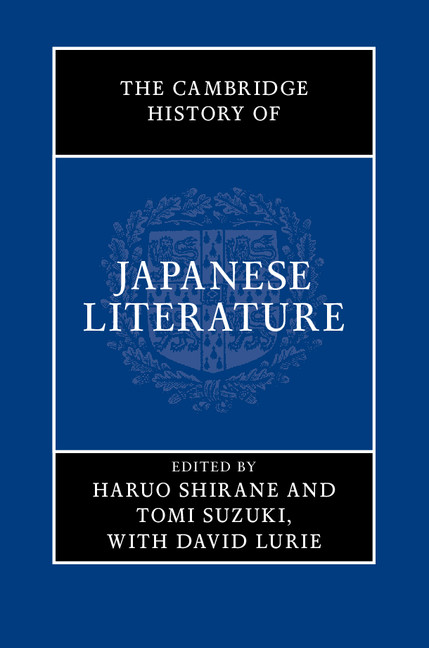
    The Cambridge History of Japanese Literature provides, for the first time, a history of Japanese literature with comprehensive coverage of the premodern and modern eras in a single volume. The book is arranged topically in a series of short, accessible chapters for easy access and reference, giving insight into both canonical texts and many lesser known, popular genres, from centuries-old folk literature to the detective fiction of modern times. The various period introductions provide an overview of recurrent issues that span many decades, if not centuries. The book also places Japanese literature in a wider East Asian tradition of Sinitic writing and provides comprehensive coverage of women's literature as well as new popular literary forms, including manga (comic books). An extensive bibliography of works in English enables readers to continue to explore this rich tradition through translations and secondary reading.

    Awards

    Honourable Mention, 2017 PROSE Award for Single Volume Reference/Humanities and Social Sciences

    Refine List

    Actions for selected content:

    Select all | Deselect all
    • View selected items
    • Export citations
    • Download PDF (zip)
    • Save to Kindle
    • Save to Dropbox
    • Save to Google Drive

    Save Search

    You can save your searches here and later view and run them again in "My saved searches".

    Please provide a title, maximum of 40 characters.
    ×

    Contents


    Page 1 of 4


    • 12 - Late courtly romance
      pp 140-156
    • View abstract

      Summary

      For all periods of premodern Japanese literature, and indeed, for all premodern literatures, what survives is only a portion of the writings that were produced, but this situation is more extreme for the Nara and early Heian periods than for any subsequent point in Japanese history. Until the mid seventh century literacy remained the province of specialist scribes who were employed by the Yamato Kings, rulers from the area of modern Nara and Osaka who presided over a loose federation of local potentates spanning the archipelago from Northern Kyushu to the Kanto region. The importation of Buddhism in the mid to late sixth century introduced new kinds of texts and new modes of literacy, but these too remained narrow, specialized pursuits. The legitimacy of imperial rule by Tenmu's and Jito's successors was supported by a melange of symbols and rituals with complex origins. Similarly, early Japanese poetry and prose drew on a wide range of sources, foreign and domestic.
    • 13 - Premodern commentary on the classical literary canon
      pp 157-160
    • View abstract

      Summary

      The earliest extant works of the Japanese tradition date to the early eighth century, during the first decade of the Nara capital. The Kojiki and Nihon shoki are important for their content, a mix of myth, legend, and history, interspersed with poetry, and for the very different styles in which they were written. Kojiki is divided into three books, the first of which describes an early age of the gods, beginning with heaven and earth coming into existence and ending with accounts of the descent of Ninigi. The second book portrays the origins of rule by legendary sovereigns, starting with Jinmu, and describes the expansion of their realm, following reign-by-reign until that of the fifteenth legendary ruler, Ojin. The third book continues from the sixteenth ruler, Nintoku, to Suiko, whose reign represented the beginning of a new era for eighth-century historians. The Nihon shoki provides historians with a fundamental chronology of events in early Japan, especially for the seventh century.
    • 14 - ThePillow Bookof Sei Shōnagon
      pp 161-164
    • View abstract

      Summary

      Kayo first appeared as a literary category in the early twentieth century and was used to describe the songs of the Kojiki and the Nihon shoki to emphasize the view that they were oral songs dating from a period prior to the use of Chinese writing. The common poetic theme in both the Kojiki and the Nihon shoki is that of the ruler's marriage, which accounts for half of the songs in the Kojiki and one-third of the songs in the Nihon shoki. The Kojiki in fact has no songs at all after the sixth century and 88 songs out of its total of 112 appear in only six reigns, those of Jinmu, Yamato Takeru's father Keiko, Ojin, Nintoku, Ingyo, and Yuryaku. The Kojiki and the Nihon shoki are mytho-historical narratives of the formation of the imperial realm of Yamato, told from an impersonal perspective that is located outside the world of the text.
    • 15 - Heian literary diaries: fromTosa nikkitoSarashina nikki
      pp 165-175
    • View abstract

      Summary

      In discussions of early Japanese literature the term usually refers to the five "old gazetteers", which are the only substantial survivors of dozens of stable works compiled in response to a central government order in 713. This chapter focuses on the five relatively intact "old fudoki", but it is important to remember that the surviving fragments are essential to understanding the scope and content of the genre; they contain some of the most interesting and oft-cited stories from the fudoki corpus. The fudoki contain much material of local origin, but it is filtered through the outlook of the central elite, either directly because provincial officials from the capital worked as compilers, or indirectly because editors with peripheral origins catered to metropolitan concerns. Only one gazetteer survives in a complete manuscript. The remaining four old fudoki include one that is missing its introduction and at least one district and three abridgements: Hitachi province and two from Kyushu, Bungo and Hizen.
    • 16 - The Heian Academy: literati culture from Minamoto no Shitagō to Ōe no Masafusa
      pp 176-183
    • View abstract

      Summary

      Manyoshu is Japan's oldest extant anthology of vernacular verse and the most revered repository of its classical poetic tradition. Just as Kojiki and Nihon shoki were compiled with the aid of earlier histories that do not survive, Manyoshu drew material from numerous other lost Japanese anthologies that are cited in its pages. The anthology was compiled during the greatest period of social change in premodern Japanese history. Manyoshu begins with a courting verse for a maiden gathering herbs on a hillside; it was purported to have been composed by Emperor Yuryaku, who was remembered as an exemplar. From the accession in 629 of the ruler known as Emperor Jomei, attributions of authorship gain historical plausibility; the number of poems markedly increases. Jomei ascended the throne after the death of the female sovereign Suiko, the last ruler represented in the Kojiki. The characterization of Manyoshu as a text that was widely read through the centuries is a modern myth.
    • 17 - Heian canons of Chinese poetry:Wakan rōeishūand Bai Juyi
      pp 184-187
    • View abstract

      Summary

      In contrast to Western antiquity, poetry anthologies have been a prominent form of literary production in East Asia. This ideology of anthologization fit the needs of the early Japanese state. In Japan the tradition of imperial anthologies, prefigured by the eighth-century Kaifuso, was pioneered by the three ninth-century kanshi anthologies and continued in the line of twenty-one imperial waka anthologies from the Kokinwakashu into the fifteenth century. Sixty years after Kaifuso, Emperor Saga and his successor Junna, both sons of Emperor Kanmu, the founder of the Heian capital, commissioned three imperial anthologies in a short period of thirteen years: Ryounshu, Bunka shureishu, and Keikokushu. Saga vigorously promoted literature. The early Sino-Japanese anthologies represent the foundations of court poetry in Japan and show the importance of kanshi both as a domestic and cross-cultural medium of communication and entertainment. The early Sino-Japanese anthologies highlight kanshi as a transnational skill and a medium of cross-cultural communication.

    Page 1 of 4


    Metrics

    Altmetric attention score

    Full text views

    Total number of HTML views: 0
    Total number of PDF views: 0 *
    Loading metrics...

    Book summary page views

    Total views: 0 *
    Loading metrics...

    * Views captured on Cambridge Core between #date#. This data will be updated every 24 hours.

    Usage data cannot currently be displayed.

    Accessibility standard: Unknown

    Why this information is here

    This section outlines the accessibility features of this content - including support for screen readers, full keyboard navigation and high-contrast display options. This may not be relevant for you.

    Accessibility Information

    Accessibility compliance for the HTML of this book is currently unknown and may be updated in the future.
