


This letter briefly outlines why a friction-sleeve-equipped cone penetrometer may be a useful tool for assessing surface mass balance of polar ice masses.
Mass balance is defined as ‘the change in the mass of a glacier, or part of the glacier, over a stated span of time’ (Cogley and others, Reference Cogley2011). Historically, glaciological mass balance was assessed using repeat surface measurements of a stake network where temporal changes in ablation or accumulation were recorded (Ostrem and Brugman, Reference Ostrem and Brugman1991). Today, this role is increasingly performed over large spatial scales using geodetic methods. Satellites such as ICESat, CryoSat II and GRACE use various methods to calculate ice mass volumetric change over time (Shepherd and others, Reference Shepherd2012). However, empirical surface mass-balance assessment is still necessary to ‘ground-truth’ and constrain models that utilise satellite-derived geodetic mass-balance data.
Methods that can be used to assess mass balance include: ablation and accumulation measurements using stakes; static ultrasonic depth sensors; avalanche probes (for shallow assessment); snow pits; the ‘coffee-can’ method (Hamilton and others, Reference Hamilton, Whillans and Morgan1998); borehole techniques such as the neutron probe or borehole optical stratigraphy (Hawley and Morris, Reference Hawley and Morris2006); and by assessing extracted cores with instruments such as the MABLE (mostly automated borehole logging experiment) (Breton and Hamilton, Reference Breton and Hamilton2012). Ground Penetrating Radar (GPR) can also be used for approximate estimation over large spatial scales, but, although snow density assessment using GPR data is possible (McCallum, Reference McCallum, Robertson and Cabal2014c) poor interface detection can hinder interpretation (Hubbard and Glasser, Reference Hubbard and Glasser2005). While all of these methods have been shown to be effective, empirical means by which surface mass-balance changes can be easily and rapidly assessed over large spatial areas are needed. A friction-sleeve-equipped penetrometer may address this deficiency.
McCallum (Reference McCallum2014b) described the first use of a friction-sleeve-equipped hydraulically driven cone penetrometer, the Cone Penetration Test (CPT) in Antarctica. It was used to penetrate snow and ice layers with strength of up to 40 MPa, to depths of 10 m. Further work described methods by which snow density, relative microstructure and strength can all be estimated using data obtained from the friction-sleeve-equipped penetrometer (McCallum, Reference McCallum2014a; McCallum, Reference McCallum, Robertson and Cabal2014c).
This letter briefly outlines why repeated use of a friction-sleeve-equipped cone penetrometer may be useful for assessing surface mass balance of glaciers and ice sheets.
ASSESSMENT OF MASS BALANCE
To determine mass balance, changes in glacial mass must be assessed over time: mass can be calculated by knowing both density and volume; and unit volume can be determined by measuring depth. Therefore, to determine ice mass at a particular time, the density and thickness of a specific layer must be determined.
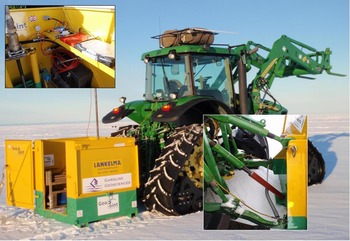
The CPT involves hydraulically forcing a 60° cone of 35.7 mm diameter into the ground at a standard rate of 20 mm s−1. Sufficient reaction to penetration resistance is provided by the CPT equipment that is typically tractor-mounted (Fig. 1).
Tractor-mounted CPT equipment used at Halley V Research Station, Antarctica, 2009/10. Insets show: a rigid steel link (~100 mm outside diameter) that can be engaged to enable additional reaction force from the ~20 tonne tractor, and hydraulic rams and data collection equipment (from McCallum (Reference McCallum2014b)).

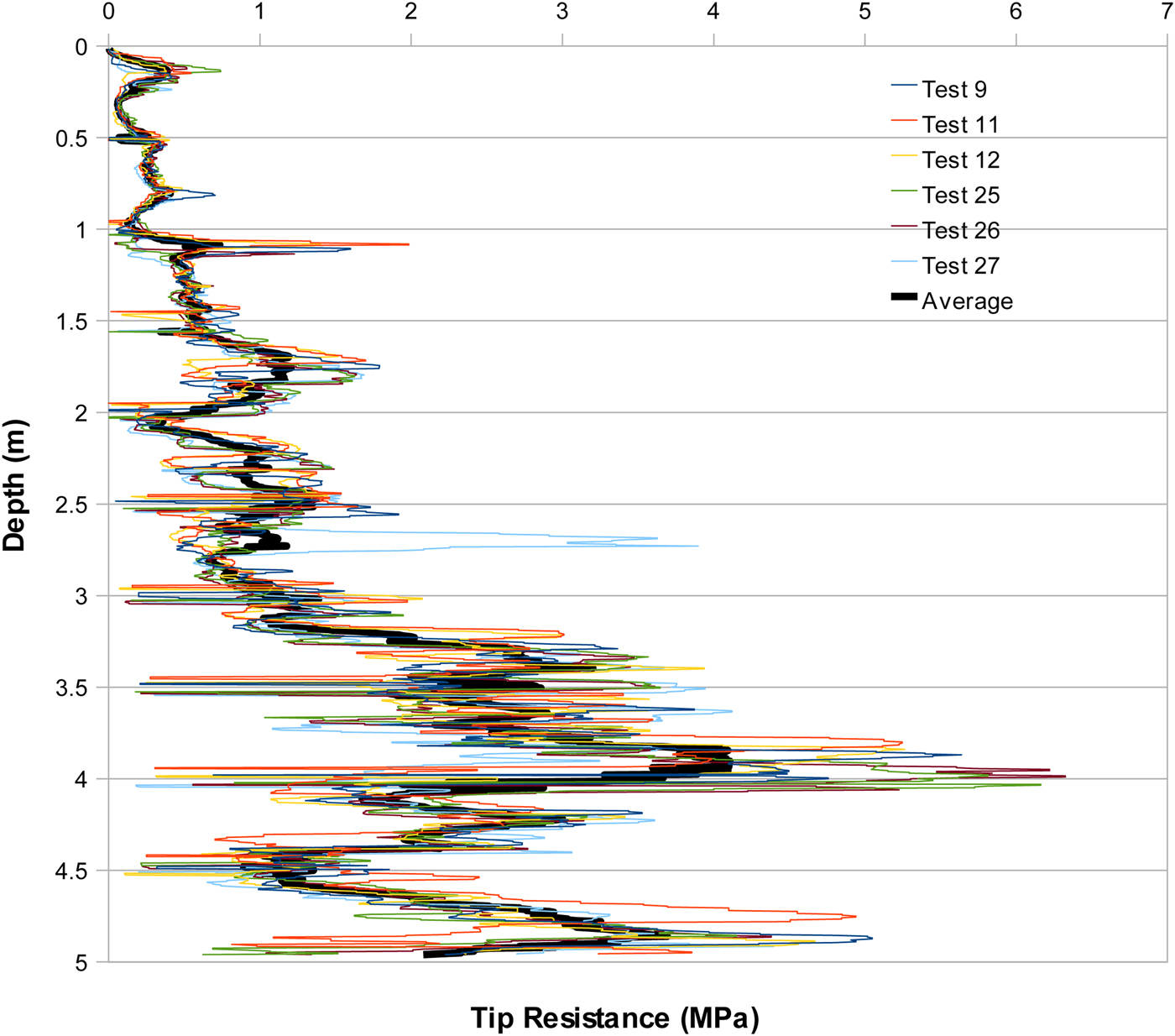
The cone tip is sensitive to harder or softer layers. Tip resistance (MPa) can be recorded and displayed and layer interfaces can be identified to a resolution of ~25 mm (McCallum, Reference McCallum2014a) (Fig. 2).
Tip resistance (MPa) for six individual tests to a depth of 5 m is shown along with an average value. Negative spikes apparent every 0.5 m occur when penetration was stopped to change rods; these spikes are generally removed in post-acquisition data-processing. The cone responds to harder and softer layers; layer interfaces can be identified to a resolution of ~25 mm. Data were collected on the Brunt Ice Shelf in the vicinity of Halley V Research Station in 2010.
McCallum (Reference McCallum2014b) describes this method in detail. Smaller penetrometers allow higher layer-interface resolution and can be used for density assessment (Schneebeli and others, Reference Schneebeli, Pielmeier and Johnson1999; Proksch and others, Reference Proksch, Lowe and Schneebeli2015), but they are unable to penetrate to depths below ~1 m in hard polar snow. Penetration to greater depths using the CPT may allow multi-year accumulation records to be assessed.
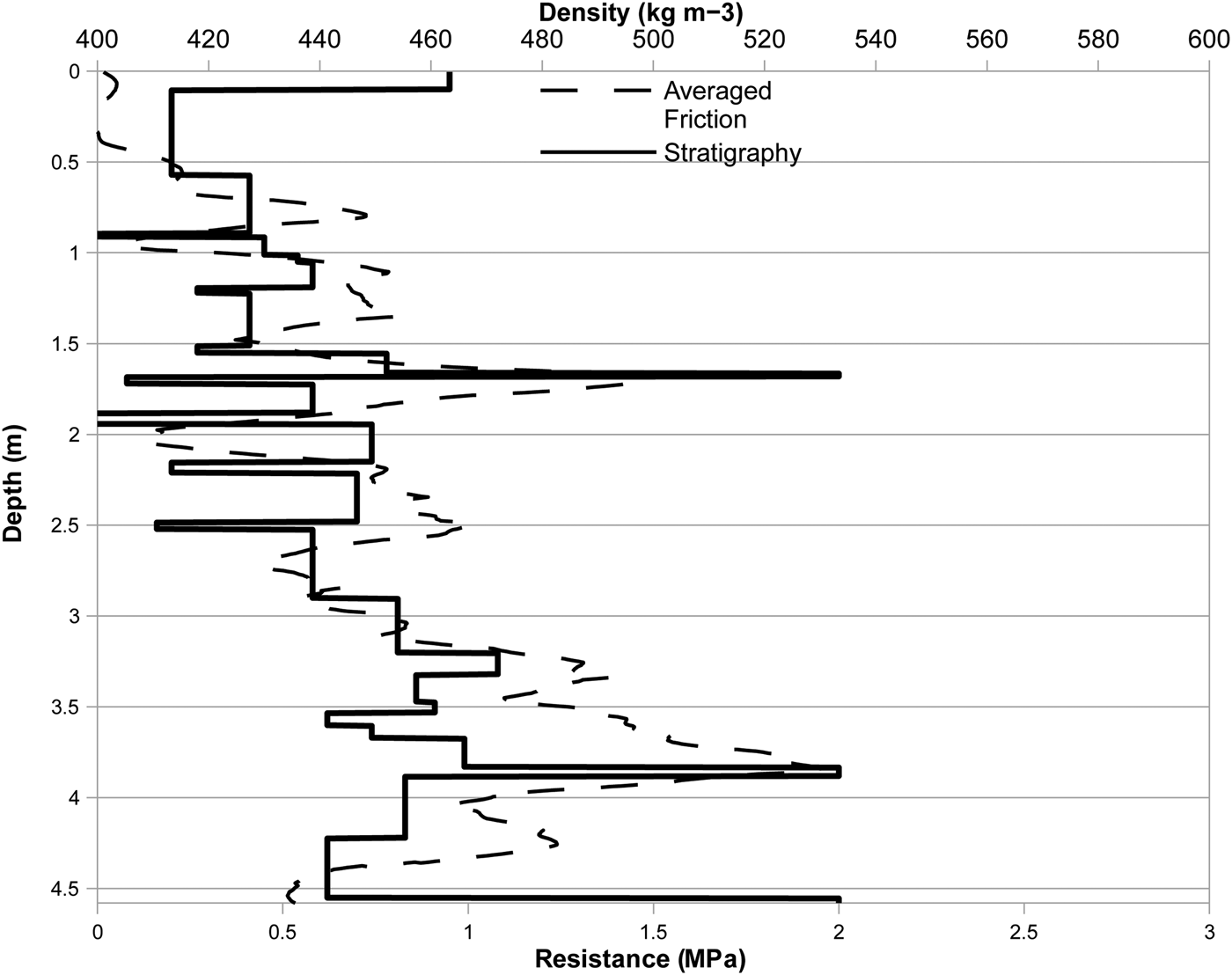
In addition to a cone tip, the cone used in the CPT is also uniquely equipped with a friction sleeve. Studies in Greenland (McCallum and Looijen, Reference McCallum and Looijen2017) and Antarctica (McCallum (Reference McCallum2014b) and McCallum (Reference McCallum2016)) have examined the relationship between CPT sleeve friction and snow density and a positive qualitative correlation is evident (Fig. 3).
Comparison of sleeve friction, averaged over friction-sleeve length and normalised for comparison purposes, with gravimetrically-determined snow density. In this figure, additional stress due to overburden has been subtracted from friction-sleeve data. Data were collected on the Brunt Ice Shelf in the vicinity of Halley V Research Station in 2010.

This probably occurs because as snow density increases: (i) the normal force on the cone will increase because of increased mass compacted within a semiconstant volume; and (ii) the friction coefficient will increase because of increased cone/ice contact area.
McCallum and Looijen (Reference McCallum and Looijen2017), discussing friction-sleeve-equipped mini penetrometer data from Greenland, also suggested that a quantitative relationship existed between penetrometer sleeve friction and snow density. However, because no additional CPT friction-sleeve data for snow exist, definitive quantitative analysis is not currently possible (McCallum, Reference McCallum2016).
In summary, a qualitative relationship between sleeve friction and snow density is readily observed and a quantitative relationship is likely.
CONCLUSION
Mass-balance assessment of glaciers and ice sheets is crucial to constrain ice mass models. However, existing techniques do not enable efficient point assessment to depths >1 m in hard polar snow. The CPT has the potential to offer a simple and robust method that can be easily repeated over time to enable mass balance to be determined.
It is likely that a quantitative relationship exists between CPT sleeve-friction data and snow density that can be applied to depths of 5–10 m in polar snow. However, only one field campaign has been conducted with this friction-sleeve-equipped penetrometer (McCallum, Reference McCallum2014b) and additional controlled field or laboratory testing is necessary to refine this relationship.
CPT data presented herein were collected using heavy equipment (Fig. 1). However, a lightweight modular CPT system that can be transported by Twin Otter or equivalent aircraft and towed by a snowmobile is currently being constructed. This should enable the rapid acquisition of surface mass-balance data from remote polar and accessible alpine ice masses. Moreover, CPT can be conducted with additional commercially-proven in-line sensors such as a resistivity module or a video module to enable comprehensive assessment of snowpack properties during a single test.
ACKNOWLEDGEMENTS
This letter introducing the application of the CPT for the assessment of glacial mass balance was suggested by Martin Schneebeli, SLF. Advice from the Chief Editor, Journal of Glaciology and two reviewers has significantly improved this letter; their contributions are greatly appreciated.

 Open access

