

Introduction
Not long ago a report of the German TV MDR and by David Keys in the British newspaper The Independent (11 June 2005) about the discovery of the 'oldest' civilisation on the European continent dating back to the latest period of the Stone Age (Neolithic) between 4800 and 4600 BC excited the European intellectual public (Antiquity 79: 501). This civilisation, building circular 'temples', is said to have been founded by the descendants of 'nomads from the Danubian lowlands' and after a 'short period of two to three centuries' ceased to exist. The report evoked the impression that it is a recent discovery of German archaeologists.
But what in fact are we talking about?
To begin with we should consider very carefully the term 'civilisation', a definition in history assigned to that stage of development when mankind discovered vocal writing; naturally this is not the case of the Neolithic, the stage into which the reported 'civilisation' falls. For all that we may perhaps use this term with certain reservations, especially when we take into consideration the fact that some languages (e.g. French) use the term 'la civilisation' instead of 'archaeological culture'.
Indeed, after c. 4800/4700 BC a late-Neolithic population with state-of-the-art material and spiritual culture was established in the countries of the central Danubian region (Pannonia, southern and western Slovakia, South Moravia, Lower Austria), in archaeological terminology indicated as people of the Lengyel Culture (after Lengyel in west Hungary). This cultural complex formed the outermost of the Anatolian-Balkan Neolithic zone characterised by advanced agricultural economy and highly developed material and spiritual culture; in particular it had an advanced agronomical practice, abundant assortment of tools made of stone (chipped and also ground and drilled), bone and horn (originally definitely also wooden) and pottery with rich polychromic paintings and mass occurrence of human, particularly female figures - 'Venuses', indicating respect for the Great Goddess - Mother (Mother-Earth). Today the makers of this cultural complex are more frequently thought of as Proto-Indo-Europeans. Several cultures or cultural groups, related chronologically and geographically, were part of the Lengyel domain; one of the most important was the Moravian-Austrian group, in Moravia traditionally indicated as the Moravian painted pottery culture.
As early as 1888, Jaroslav Palliardi (1861-1922) the renowned archaeologist, discovered the Moravian painted pottery culture on the site of a settlement of the culture's founders in Znojmo in South Moravia. Together with his colleague and follower František Vildomec (1878-1975) he explored many settlements of Late Neolithic farmers in South Moravia; the best known are Střelice and Hluboké Mašůvky (in the latter the well known statue of 'Venus' was found, her face upturned to heaven, her arm in adoration gesture). In the early 1960s a group of archeologists from Masaryk University in Brno took up the work of Palliardi and Vildomec. In 1967, working on the site of the people of the Moravian painted pottery near Těšetice-Kyjovice in the Znojmo region, for the first time they came across a deep ditch of a sacral circular area - the 'rondel', and in 1968-1978 they were the first in Central Europe to carry out complete research and scientific evaluations and to publish a monograph (see references). Thus they started off the era of 'rondel archaeology' in Europe. Before long other circular ditches were discovered in Slovakia (Bučany, Svodnín and others), in Austria (Kamegg, Friebritz, Hornsburg and others), in Bavaria (where they went back to the half-forgotten uncovered rondel from the 1920s in the locality in Kothingeichendorf), in Bohemia (Vochov, Lochenice, Bylany and others) etc. Aerial archaeology contributed to the discovery of dozens of new rondels; it developed namely in Austria and Bavaria, while such research in the communist countries, where at that time virtually everything was classified, was made very difficult or completely forbidden. For all that, since the early 1980s we have managed to document about 20 new rondels in Moravia even under makeshift conditions (for instance, using a radio ground-guided aircraft model). After 'the sky was opened' following the fall of communism, many new 'rondels' were discovered in countries of the former Soviet satellites, including the German Democratic Republic, as had been expected. In Eythra, Goseck, Kyhna and other places, recently in Dresden and elsewhere, numerous new rondels were found; field exposures established on a grand scale promise to bring important information about the significance and function of the rondels. They have extended the typological range of hitherto known 'circles', however it is not a fundamentally new discovery; this took place as early as the 1960s. We can wish the German archaeologists much success in the field of 'rondel archaeology' as well as in the theoretical area, especially with regard to the already developed models elaborated primarily in Moravia.
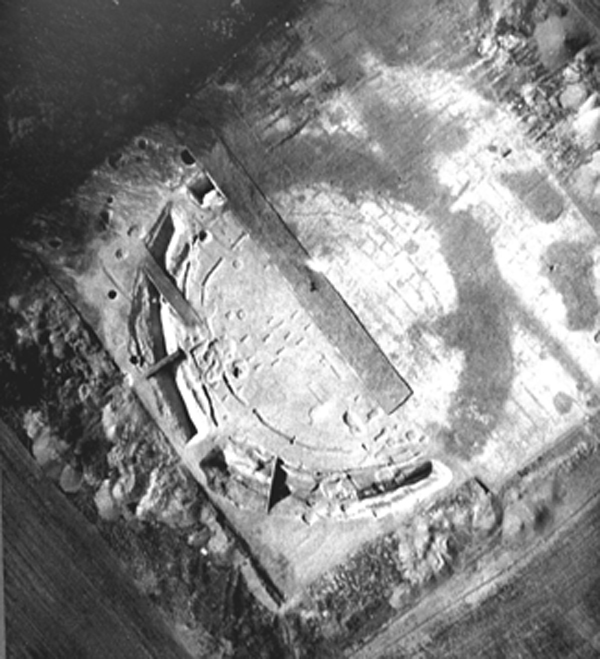
First air photograph of the Neolithic-Rondel in Těšetice-Kyjovice (Moravia).

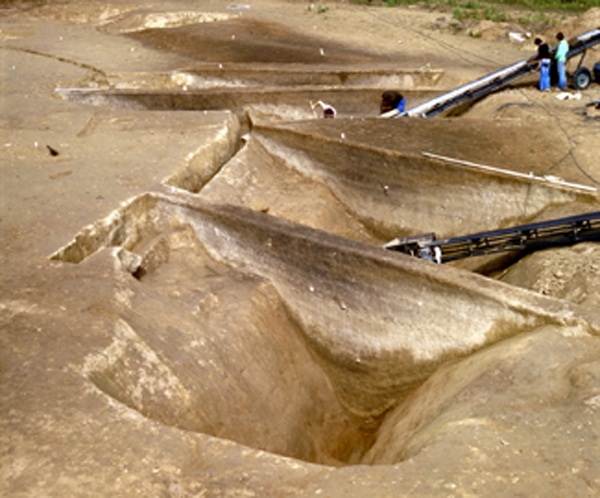
Archaeological excavation of the triangular ditch of the Neolithic-Rondel in Těšetice-Kyjovice (Moravia).

We should also specify the origin and the builders of the Neolithic rondels. Today it is generally acknowledged that the cradle of rondel architecture is the central Danubian region; here the network of rondels is the densest. From here the rondel ideology spread to the west and north-west into the environment of other cultures (particularly into regions of the pricked pottery people), eventually reaching the Rhineland. At present about 200 circular areas have been registered in this zone; regrettably only few have undergone sound archaeological research. Therefore the research of German archaeologists in Saxony will indeed be a important contribution.
The primary scepticism of some authors to be able to give a rational interpretation of the function of rondels has been overcome. The rondel builders were not nomads; they were advanced farmers, they grew a number of various varieties of wheat, millet, barley and pulses and kept herds of domesticated animals; along with small ruminants (sheep and goats) namely horned cattle and pigs. Their permanent companion was naturally the dog. After complete analyses of the results of research of the Moravian Neolithic rondels we are now confident that they were multi-purpose socio-cultic buildings used as the meeting place for several related units where the people discussed various issues, be they administrative, economic, exchange, judicial or other. The rondels were also adapted in such a way as to allow the people to observe the movements of celestial bodies and they served as a sort of 'calendar'; the fortifications (deep ditches, palisades) were also used as defence against attackers in case of danger.
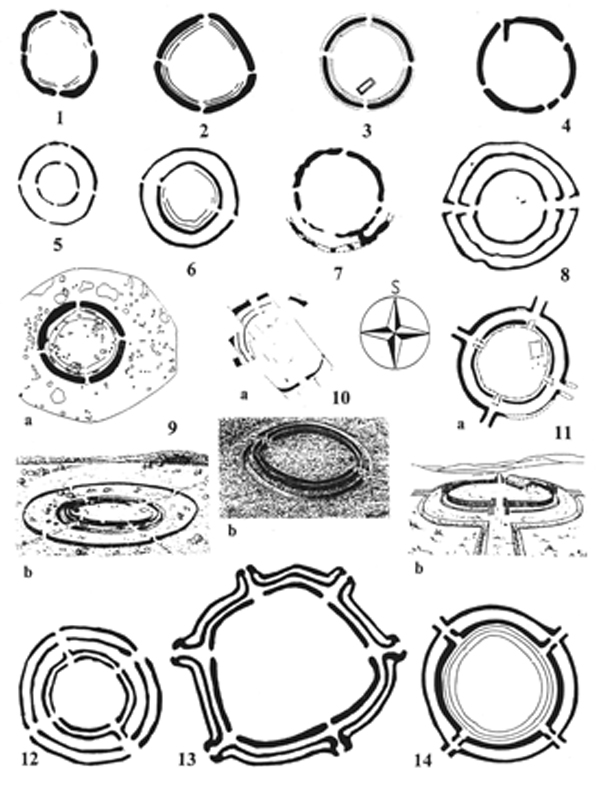
Principal types of the Neolithic-Rondels in central Danubian region: (1) Nìmèièky, Moravia.

Of great significance is the finding that the distribution of the rondels in the landscape respected the routes of the trails. As early as the Palaeolithic people had traversed certain routes and later, in the Neolithic, they trod long-distance trails mostly copying the natural predispositions. More often than not the routes of the trails followed the water courses, namely rivers, but also large streams; very frequently they ran along the edges of terraces alongside rivers, or over lowlands out of the reach of the water courses, for instance on the edge of valleys or at the foot of hillsides. The trails passed over saddles when hills had to be crossed from the headwaters on one side to the headwaters on the other side. When the people of the Moravian painted pottery settled down on convenient places along the trails in Moravia, that is on fertile land, they built a rondel in their immediate surroundings, most frequently on exposed sites. At that time it was undoubtedly possible to disseminate and accept new ideas within a few years in all parts of the society.
On the basis of contemporary research it was discovered that a temporary recession (but not termination of existence) followed the 'great explosion' of Neolithic rondels around 4800/4700-4500 BC. However, in Europe as early as the beginning of the late Bronze Age (Aeneolithic, Chalcolithic) we see more freely structured 'rondeloids (Bajč-Vlkanovo in Slovakia, Ledce in Moravia, Chleby in Bohemia, Hienheim in Bavaria etc.), which continued into the early Bronze Age. On top of that, starting from the Neolithic, rectangular socio-cultic structures began to be built.
Based on archaeological research it has been proved that rondeloids existed also in the early Bronze Age in south Moravia (Troskotovice, Šumice and others), in Slovakia (Branč, Velký Cetìn and others) and in Lower Austria (Kollnbrunn, Oberschoderle) and we are sure that they will gradually be discovered in other places too. From the middle Bronze Age, 'imitations' of rondels begin to appear - simple stone circles known as 'henges' in England (for instance Horní Metelsko in the Plzeň region), or small cultic sites enclosed in a circular ditch and wooden 'statue' (idol?), or with a stone stele inside (Čakovice near Prague, Kuřim near Brno and elsewhere). On the whole we can say that various modifications of the circular socio-cultic architecture were also built in protohistoric times and in the middle ages.