

Descubriendo botánicas en los barrios neoyorkinos
En las páginas que siguen, se presentan los resultados de un estudio de investigación de naturaleza etnográfica acerca del rol de las botánicas en la población de origen latinoamericano en la Ciudad de Nueva York (NY). Las botánicas, cuya denominación es variada y que incluye nombres tales como centros espirituales y religiosos, se ubican mayormente en las grandes metrópolis de los Estados Unidos. En NY podemos encontrarlas en los enclaves latinos de los condados de Queens, el Bronx, Brooklyn, los Altos de Manhattan (Washington Heights) y en las Naciones Unidas de NY, como muchos denominan al municipio de Jackson Heights en Queens.
En este artículo, definimos a las botánicas como nodos centrales en la convergencia urbana de diversas prácticas religioso-curativas entre las que sobresalen las relacionadas con la Regla de Ocha, conocida popularmente como Santería.Footnote 1 Consideradas como la puerta visible al mundo invisible de las religiones afrocaribeñas (Reference ViladrichViladrich 2018) las botánicas constituyen establecimientos poli-funcionales que proveen de un anclaje físico, simbólico y reivindicatorio a creencias religioso-curativas que en su mayoría circulan fuera de los canales oficiales. Los productos y servicios que ofrecen las botánicas ponen de relieve los campos superpuestos de la religiosidad popular, las formas alternativas del cuidado de la salud y la participación comunitaria.
Consideradas como paganas y esotéricas por un gran parte del público americano, las botánicas se han sostenido a lo largo del tiempo gracias a los miembros de minorías étnicas que, además de la población latina, incluyen segmentos de la población caribeña y afroamericana. Los grupos latinoamericanos que llegan a las botánicas provienen de una diversidad de regiones y países entre los que se incluyen Cuba, Puerto Rico, la República Dominicana, México, Ecuador, Colombia, Perú, así como otras naciones del Caribe y de América Central. La presencia conspicua de las botánicas en los barrios latinos en las grandes urbes de los EEUU, coincide con el hecho de que son relativamente pocas y recientes las publicaciones académicas abocadas a estudiar su rol como sistemas terapéuticos alternativos.
Los estudios sobre las botánicas se remiten a los trabajos de Delgado (Reference Delgado1979), Fisch (Reference Fisch1968), Garrison (Reference Garrison1977) y Harwood (Reference Harwood1977) los cuales fueron seminales en la comprensión de la importancia del Espiritismo en la población puertorriqueña en la ciudad de NY. La información acerca de las séances, o sesiones en las que los presentes se contactan, a través de médiums, con personas fallecidas fueron claves para entender la relación entre el Espiritismo y la salud mental en la población puertorriqueña. Estas investigaciones contribuyeron significativamente a difundir los resultados de proyectos colaborativos, desarrollados en las décadas de 1960 y 1970, entre los espiritistas puertorriqueños, los servicios psiquiátricos y las clínicas comunitarias en los EEUU. Los resultados de dichos estudios permitieron apreciar la importancia de las prácticas espiritistas en la población latina, por cuanto constituyen una expresión manifiesta de cómo funcionan los sistemas de sanación a nivel comunitario (Reference BirnBirn 2005). Con respecto a las botánicas específicamente, el alcance de dichas investigaciones se limitó a estudiar su rol como proveedoras de hierbas y otros productos (ej., velas y perfumes) utilizados durante las séances.
Más recientemente, el interés académico por las botánicas se ha expandido a diversas disciplinas incluyendo las artes visuales (Reference OteroOtero 2007; Reference PolkPolk 2004), la etnobotánica que estudia el tratamiento con hierbas de afecciones específicas (Reference Anderson, McKee, Yukes, Alvarez and KaraszAnderson et al. 2008; Reference Balick, Kronenberg, Ososki, Reiff, Fugh-Berman, Roble, Lohr and AthaBalick et al. 2000; Reference Dearfield, Pugh-Yi and DownerDearfield y Pugh-Yi 2011), hasta llegar a su rol holístico —que implica la convergencia entre los niveles espiritual, físico y religioso (Reference CastañedaCastañeda 2015; Reference Cintrón-MoscosoCintrón-Moscoso 2012; Reference Gomez-Beloz and ChavezGomez-Beloz y Chavez 2001; Reference Jones, Polk, Flores-Peña, Evanchuk and BradyJones et al. 2001; Reference MurphyMurphy 2015 y Reference Murphy2010). Este trabajo se ubica en esta última línea de investigación por cuanto examina el papel que desempeñan las botánicas y sus proveedores, en cuanto a satisfacer las necesidades diversas de la población latinoamericana que se acerca a ellas.
Las botánicas se han tornado aún más notorias en la última década debido al crecimiento y diversificación de la población latina en las grandes urbes, incluyendo la ciudad de NY. El marcado proceso de gentrificación en dichas ciudades (Reference Chronopoulos and JonathanChronopoulos y Soffer 2017) ha derivado en la transformación paulatina de la geografía social de las botánicas. Como resultado de dicho proceso, varios de estos establecimientos han ido cerrando sus puertas o se han trasladado a otros distritos neoyorkinos, como en el caso de las botánicas del barrio puertorriqueño ubicado en la zona este de Manhattan, que han ido desapareciendo o se han transformado en negocios New Age, llamados a satisfacer los gustos de una clientela americana de ingresos medios y altos.Footnote 2 En contrapartida, han surgido (y se han afianzado) botánicas en varios barrios de los condados de Queens y el Bronx que continúan manteniendo una identidad mayormente latinoamericana (Reference ViladrichViladrich 2018).
Este trabajo analiza el papel terapéutico de quienes trabajan en las botánicas en tanto que se desempeñan como consejeros de los inmigrantes latinos y sus descendientes. Inspirado en el término hospitales invisibles utilizado por Jones et al. (Reference Jones, Polk, Flores-Peña, Evanchuk and Brady2001), se utiliza aquí la expresión farmacias invisibles, dado que las botánicas nos remiten al rol tradicional del farmacéutico encarnado por sus dueños y empleados. Estos últimos orientan a sus clientes respecto de las terapias y productos que consideran más apropiados, los cuales se venden en el mismo lugar en donde se recetan. En este sentido las botánicas concentran prácticas, productos y servicios en un solo espacio físico y simbólico.
A través de limpiezas espirituales y energéticas, ofrendas religiosas y consejería, las botánicas hacen mucho más que proporcionar soluciones rápidas a un vasto abanico de problemas. Los seguidores de las religiones afroamericanas encuentran allí un espacio de aceptación y difusión de sus creencias en lo que se ha denominado como eclecticismo terapéutico (Reference FreidenbergFreidenberg 2000; Reference ViladrichViladrich 2006). En este texto, nos centramos particularmente en la relación proveedor-cliente teniendo en cuenta que la botánica ofrece un espacio culturalmente accesible para la población latina en especial (Reference Gomez-Beloz and ChavezGomez-Beloz y Chavez 2001). Por último, es menester considerar que estos establecimientos son, ante todo, empresas comerciales en donde la venta de productos (sean estos materiales o servicios de consejería) constituyen la clave de su funcionamiento.
Este trabajo se divide en seis secciones. En el apartado siguiente se analiza el significado del término sociosoma que conceptualiza los vínculos entre las dimensiones orgánicas, sociales y espirituales de las dolencias más frecuentes que aquejan a la población latina que se atiende en las botánicas. El texto continua luego con la presentación del diseño del estudio de investigación incluyendo una descripción de los métodos utilizados, seguida por una introducción al universo de las botánicas. El artículo describe luego las condiciones sociosomáticas más frecuentes que afectan a la población latina, cuyas raíces se ubican en sus difíciles condiciones de vida y que se expresan en lo que se denomina el continuum inmigrante. El trabajo ofrece luego un análisis detallado de una tríada terapéutica muy utilizada en las botánicas: limpia, baños y oración. En las conclusiones, se resaltan los resultados más relevantes de este trabajo a la luz del modelo sociosomático y las respuestas concretas que las botánicas, y sus consejeros, proveen a una población latina (a menudo inmigrante) en el seno de sociedades post-industrializadas.
Entendiendo el sociosoma: Articulando el entorno social con el espiritual
El término sociosoma en este estudio ofrece la base conceptual para distinguir las dolencias psíquicas y orgánicas de las funciones psicosomáticas, como en el caso de las diferencias mente-cuerpo. La fuente teórica de la que se nutre este trabajo se basa en los modelos explicativos de los desórdenes psíquicos y orgánicos (Reference KleinmanKleinman 1978) que involucran el entorno social, cultural y físico tanto en la producción de los malestares fisiológicos y emocionales como en cuanto a su tratamiento y cura. El modelo sociosomático entiende que los procesos de salud-enfermedad adquieren sentido a partir de la internalización de fuerzas externas que se manifiestan a través de expresiones idiomáticas culturalmente compartidas (Reference KaraszKarasz 2005; Reference Kleinman and BeckerKleinman y Becker 1998; Reference ViladrichViladrich 2006). Las dolencias individuales (tanto físicas como psíquicas) son entendidas como el resultado de la internalización de fenómenos circundantes, entre las que se incluyen la acción de entidades espirituales y supernaturales, y que pueden derivar en la desestabilización del individuo como en el caso de espíritus que causan daño físico o mental (Reference McCarthy BrownMcCarthy Brown 1991; Reference WareWare 1998; Reference WedelWedel 2003).
Un rasgo fundamental del sociosoma es que responde a modos gnoseológicos de causalidad en el diagnóstico y tratamiento de dolencias físicas y emocionales en las cuales el eje se centra en las relaciones sociales. La enfermedad no se conceptualiza simplemente como un fenómeno individual sino como una alteración en los vínculos interpersonales que se expresan a través de relaciones conflictivas (Reference Low and CsordasLow 1994). En esta línea, una enfermedad autoinmune, como el lupus, podría ser causada o exacerbada por la energía negativa que un individuo recibe de su entorno.Footnote 3 Los estudios sobre desórdenes sociosomáticos en poblaciones latinas identifican asociaciones significativas entre los determinantes sociales (aislamiento y discriminación, por ejemplo) y el consecuente inicio de la enfermedad, incluida la depresión y los nervios (Reference Jenkins and CofresiJenkins y Cofresi 1998; Reference ViladrichViladrich 2018).Footnote 4 Los ataques de ansiedad pueden deberse a conflictos con el mundo espiritual, como cuando un sujeto se ve perturbado por el alma errante de un familiar cercano y recientemente fallecido (Reference Baer, Weller, de Alba Garcia, Glazer, Trotter, Pachter and KleinBaer et al. 2003; Reference Guarnaccia, Lewis-Fernández and MaranoGuarnaccia et al. 2003; Reference KaraszKarasz 2005; Reference Kleinman and BeckerKleinman y Becker 1998). En el compendio sociosomático, la presencia de fuerzas intangibles juega un rol central en el malestar y la posterior sanación de quienes llegan a las botánicas. Dichos agentes (definidos como fuerzas, vibraciones y espíritus negativos) participan activamente en la vida de las personas tanto en el campo físico como en el espiritual (Reference McCarthy BrownMcCarthy Brown 1991; Reference WedelWedel 2003). El síntoma sociosomático es entendido así como una entidad clínico-semiológica que refleja la internalización de las fuerzas terrenales y sobrenaturales que se manifiestan a través de dolencias individuales.
Diseño del estudio y métodos de investigación
Este trabajo es el resultado de un proyecto de naturaleza etnográfica que incluyó dos etapas de trabajo de campo. Durante la primera (2004–2007) la autora de este artículo (y directora principal del estudio) y su equipo realizaron un trabajo pormenorizado de identificación geográfica de las botánicas en los cinco condados de la ciudad de Nueva York. Esta cartografía inicial fue acompañada por el ejercicio sistemático de observación participante y entrevistas informales, las cuales permitieron identificar informantes claves y participantes potenciales. Un aspecto que facilitó el acceso a las botánicas fue el hecho de que todos los integrantes del equipo de investigación hablaran el idioma español, como primera o segunda lengua. Las visitas asiduas a las botánicas, sobre todo aquellas ubicadas en los condados de Queens y Brooklyn, permitió solidificar los lazos de confianza entre los miembros del equipo de trabajo y quienes trabajan y concurren a ellas. En varios casos, estos últimos resultaron ser santeros (practicantes de la Santería) y/o seguidores de otras religiones afrocaribeñas.
El equipo de trabajo participó también en actividades religiosas, incluyendo toques e iniciaciones de Santería, que tuvieron lugar en los sótanos y patios traseros de las botánicas, así como en centros comunitarios y jardines comunales donde se cultivan hierbas y plantas utilizadas para curar distinto tipo de dolencias. Esta diversidad de espacios permitió a los investigadores observar las interacciones cotidianas que regularmente tienen lugar entre los proveedores y los clientes de las botánicas. La información recopilada en estos eventos permitió triangular los datos recabados durante todo el proceso de trabajo de campo y el análisis posterior.
Durante la fase inicial de este estudio, el equipo identificó dos concentraciones principales de botánicas en los condados de Queens y el Bronx, con enclaves más pequeños ubicados en Manhattan y Brooklyn. Un segundo paso en la investigación consistió en visitar asiduamente un grupo selecto de botánicas, alrededor de veinte, a los efectos de establecer confianza con los posibles entrevistados.
Concomitante con las actividades de observación participante, se realizaron entrevistas en profundidad consistente en un mínimo de dos sesiones, con un promedio de una hora y media cada una, en las que participaron cincuenta y seis informantes claves (consejeros religiosos y espirituales). Una segunda fase del proyecto se llevó a cabo durante los años 2014–2018 y se centró en los servicios prestados por las botánicas en Queens. Veinticinco proveedores fueron entrevistados durante este período. Ambas etapas de la investigación siguieron protocolos de consentimiento informado regulados y aprobados por las instituciones patrocinadoras de la autora.
Botánicas: Las puertas visibles al mundo invisible de la Santería
La vidriera de una botánica se asemeja a un bazar esotérico en dónde los representaciones pictóricas de tradiciones religiosas diversas se amontonan en aparente desorden entre estatuas de Buda y religiosidades hindúes, santos católicos y collares (elekes), cuyos colores representan distintos orishas —divinidades propias de la Regla de Ocha o Santería—. Eleguá por ejemplo, es simbolizado con el rojo y negro y Chango con el rojo y blanco. Ampliamente reconocido como un sistema de religiosidad popular caracterizado por la relación estrecha de los dioses yoruba (u orishas) y los santos católicos, la Santería ocupa un lugar privilegiado en las botánicas. Una de las características más salientes y compartidas por dichos establecimientos se refleja en la conjunción entre las imágenes cristianas y las religiones afroamericanas en lo que se considera frecuentemente como sincretismo religioso (Reference MurphyMurphy 2015).Footnote 5
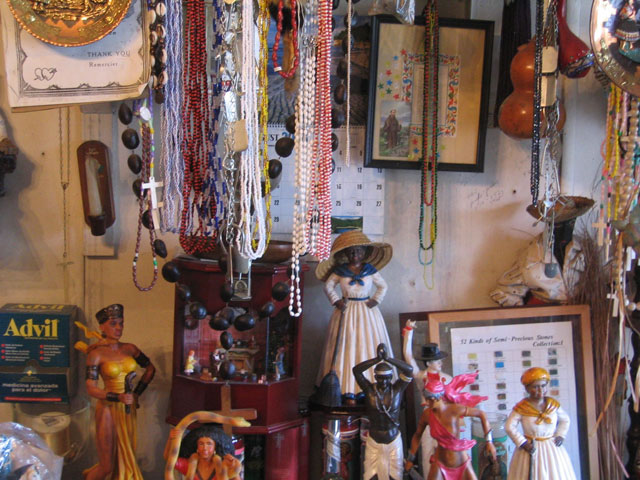
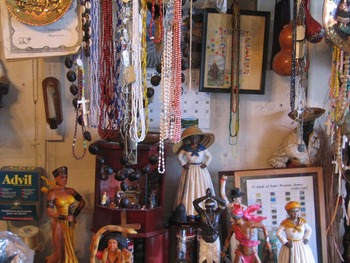
La Santería, originada en Cuba, se ha convertido en uno de los sistemas religiosos más populares en las botánicas de los EEUU, en coexistencia con otras prácticas religioso-curativas de origen africano tales como el Palo Mayombe, en sus distintas variantes y denominaciones que incluyen el Palo Monte, Palo Congo, y Kimbisa (también de Cuba) junto al vudú de Haití, las veintiún divisiones de la República Dominicana, el candomblé de Brasil, el orisha de Trinidad, y el Espiritismo de Puerto Rico. Pese a sus diferencias epistemológicas y prácticas, las religiones afroamericanas comparten los sistemas de adivinación, las celebraciones con tambores y cánticos, y las experiencias de posesión-trance como vehículo fundamental de comunicación con los orishas. En el interior de una botánica lo sagrado no es inalcanzable, sino que forma parte de un entorno familiar y próximo a los que operan en la tierra (ver Figura 1).
Interior de una botánica en donde se observan objetos pertenecientes a las religiones afro-caribeñas junto a un símbolo de la medicina alopática (ver caja de Advil al lado izquierdo de la fotografía). Fotógrafa: María Gómez.
La Santería, en tanto que simboliza uno de los pilares principales de las botánicas, representa un modelo sociosomático de vida y curación. Junto a otras religiones afrocaribeñas, la Santería reúne un sistema de creencias meta-filosóficas que proporciona a sus practicantes un marco cultural para interpretar el mundo, así como una filosofía para vivir en él. En el universo de la Santería, la personalidad es una construcción social a través de la cual los seres humanos nos encontramos ligados a fuerzas supraterrenales, que conectan el pasado con el presente y futuro en una suerte de trayectoria virtual. Los sujetos nunca estamos solos: una multiplicidad de orishas nos rodean sin importar el tiempo, espacio y lugar de que se trate (Reference BrandonBrandon 2002; Reference BrownBrown 2003; Reference HagedornHagedorn 2001).
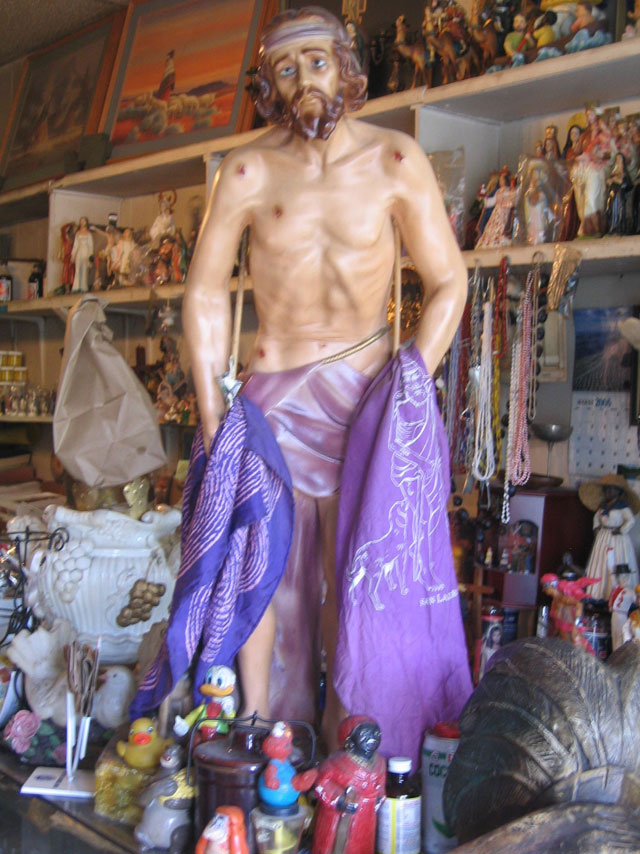
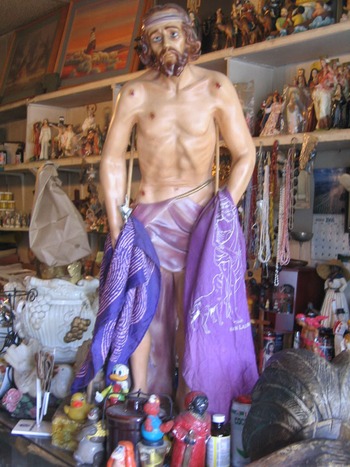
Los practicantes de la Santería, y otras religiones afrocaribeñas, acuden a las botánicas con el fin de abastecerse de los collares, plantas, hierbas (y hasta gallinas y palomas para sacrificio) que pertenecen a orishas y deidades específicas como es el caso del orisha Babalú-Ayé. Este orisha, muy conocido en la Santería y en las botánicas neoyorkinas (Figura 2) es generalmente representado por San Lázaro, el patrón de los pobres y los enfermos y el que cura, y a la vez origina, epidemias y enfermedades infecciosas. Los baños de San Lázaro son utilizados por aquellos que sufren de problemas en las articulaciones y enfermedades infecciosas incluyendo el VIH (Reference Holliday, McNeill and CervantesHolliday 2008).
Estatua de San Lázaro que también representa al orisha Babalú-Ayé en la Santería y en otras religiones afro-caribeñas. Fotógrafa: María Gómez.
Diferentes signos de pluralismo religioso se hacen presentes en las botánicas en dónde clientes y proveedores ratifican, tanto discursiva como performativamente, una puesta en escena de religiosidad popular que combina e hibridiza elementos y símbolos provenientes de diferentes cultos. Por ejemplo, en las botánicas abundan las soperas de la Santería llamadas a resguardar el fundamento que incluye los elementos pertenecientes a determinados orishas, tales como piedras, semillas y agua (Reference ArellanoArellano 2012; Reference BolívarBolívar 1993). Las soperas se presentan en distintos materiales, formas y colores y comparten los estantes con frascos y botellas que contienen pociones para el amor y velas de la suerte, así como aerosoles que prometen traer de regreso a un amante fugitivo y mejorar la oferta laboral de quienes los compran y utilizan. En los últimos años, han surgido en las botánicas imágenes y elementos religiosos (ej., plegarias, velas, amuletos) relacionados con figuras muy populares en Latinoamérica, como es el caso de la Santa Muerte que —pese a su fama de protectora de los narcotraficantes mexicanos— se ha hecho presente en contextos y poblaciones diversos (Reference RoushRoush 2014). Al momento de la redacción de este trabajo, su presencia en las botánicas era todavía incipiente y subsidiaria al de las religiones afrocaribeñas.
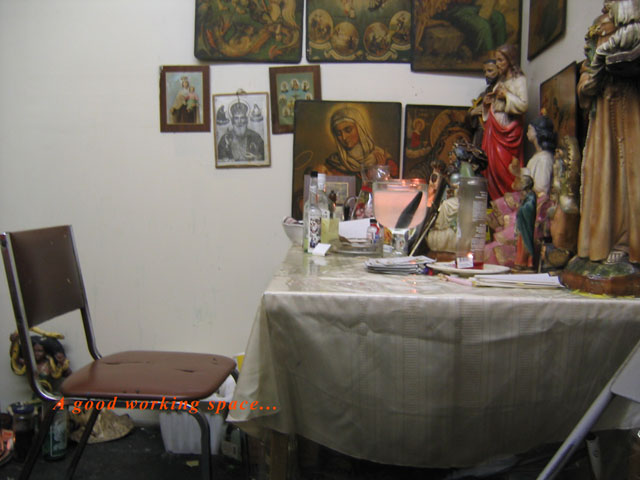
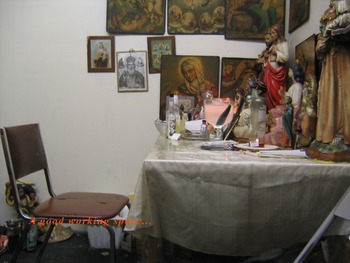
Las botánicas ofrecen servicios de asesoramiento y consultoría que prometen resolver problemas orgánicos, emocionales e interpersonales (Reference Fernández Olmos and Paravisini-GebertFernández Olmos y Paravisini-Gebert 2011 y Reference Fernández Olmos and Paravisini-Gebert2001; Reference Gelb and FarrGelb 2005; Reference Viladrich, Sutherland, Moodley and ChevannesViladrich 2014; Reference Viladrich, Abraído-Lanza, Loue and SajatovicViladrich y Abraído-Lanza 2009). Los dueños de estos establecimientos y/o quienes trabajan en ellos, suelen autodefinirse con distintos rótulos que varían desde dependiente o empleado, hasta el de consejeros y guías espirituales, títulos que combinan con sus roles de padrinos de Santería y de otras prácticas afines. Muchos de los dependientes en las botánicas cumplen un doble papel como terapeutas informales por un lado y líderes religiosos y espirituales por el otro. Las botánicas suelen contar con un cuarto o rincón apartado, ya sea en la parte trasera de la tienda o en el sótano que a menudo se utiliza para celebraciones rituales y consultas, durante las cuales los consejeros ofrecen lecturas personales a sus clientes (Figura 3).
Cuarto utilizado para consultas privadas en el interior de una botánica. Fotógrafa: María Gómez.
Es importante señalar que pese a la amplia visibilidad de las botánicas —lo cual se refleja en sus coloridas vitrinas y en las imágenes prominentes de santos y deidades que las adornan— quienes trabajan en ellas tienden a ser discretos respecto de lo que sucede puertas adentro. De hecho, estos establecimientos han permanecido casi invisibles al público americano en general, en parte debido a que atraen a una clientela específica perteneciente a minorías étnicas. Por otro lado, muchas botánicas figuran como florerías en los listados oficiales, una designación que se utiliza para auto-protegerse de las posibles injerencias gubernamentales. Sus dependientes intentan así alejarse de la prensa negativa y de las inspecciones del Departamento de Salud de la Ciudad de NY, que puede acusarlos de estar ejerciendo la medicina ilegalmente o de vender productos dañinos para la salud. Los medios de comunicación en los EEUU, en particular, han contribuido a criminalizar las actividades que se realizan en el interior de las botánicas (o en las casas-templos y hogares de sus clientes) como en el caso del sacrificio de animales que tienen lugar durante las ceremonias del asiento de Ocha.
Algunos cuestionan la mercantilización de la práctica religiosa en las botánicas, incluyendo la venta de sustancias de dudosa eficacia (Reference Garetano, Stern, Robson and GochfeldGaretano et al. 2008; Reference LongLong 2001). En esta línea, la literatura académica señala el efecto pernicioso de ciertos productos curativos-religiosos, que presumiblemente se venden en las botánicas, como es el caso del plomo y el mercurio (Reference Garetano, Stern, Robson and GochfeldGaretano et al. 2008; Reference PrasadPrasad 2004; Reference Zayas and OzuahZayas y Ozuah 1996). Por último, el hecho de que la Santería, así como otras religiones, sea transmitida oralmente entre padrinos y ahijados conforme se avanza en las etapas de iniciación, ha contribuido a que sus seguidores sean generalmente reticentes a revelar detalles de su religión a extraños.
Las botánicas son también vistas como supermercados de la Santería, ya que se consiguen allí prácticamente todos los elementos de culto y es donde se dan cita practicantes de la religión, iniciados o en vías de iniciación, sea de forma casual o a los efectos de participar en eventos previamente pautados. En este sentido, es importante resaltar que las botánicas son ante todo negocios comerciales cuyo bien de intercambio se apoya en una suerte de economía espiritual que depende de los vaivenes de la oferta y demanda religiosa (Reference RombergRomberg 2003). La popularidad de estos negocios descansa en su capacidad de proveer respuestas prácticas y efectivas a las necesidades de quienes llegan a ellas, en base a creencias religiosas y espirituales muy afianzadas en Latinoamérica y el Caribe (Reference ChesnutChesnut 2005). Lejos de operar en compartimentos geográficos estancos, dichas creencias se han ido tornando más sólidas y sustentables en virtud de las redes transnacionales que conectan a las ciudades globales con centros religiosos afrocaribeños ubicados en Haití y Cuba, entre otros (Reference Beliso-De JesúsBeliso-De Jesús 2015; Reference SamsonSamson 2018).
Pese a las críticas mencionadas en los párrafos anteriores, las botánicas continúan floreciendo en los centros urbanos de los EEUU, particularmente en barrios donde residen migrantes latinoamericanos y sus descendientes. Dado que representan espacios culturalmente accesibles para la población hispana, estos negocios cumplen un papel clave como nodos de conexión comunitaria y socialización entre los practicantes de la Santería, los vecinos de la zona o simplemente curiosos que se congregan allí para conversar en su idioma, intercambiar información y hasta entretenerse jugando al ajedrez o al dominó.
El continuum inmigrante: “Es la sociedad la que te enferma y es la botánica la que te sana”
En cumplimiento con los preceptos de la Santería, muchos de los consejeros que trabajan en las botánicas suelen recurrir al oráculo como vehículo para la adivinación, el cual se concibe como la puerta de conexión entre los orishas y los seres humanos. Además del uso de cartas (de tarot o españolas), las formas más utilizadas como sistemas de adivinación incluyen el diloggún (los caracoles) y el Obí, cuatro trozos de coco que se dejan caer para ser leídos, al cual se le hacen preguntas a cambio de respuestas concretas a los problemas que el cliente trae a la consulta. A diferencia de una terapia psicológica, en la cual el paciente ahonda en sus síntomas y problemas, los consejeros usan el oráculo para obtener una lectura rápida acerca de los asuntos principales que aquejan al sufriente y a los efectos de indagar sobre sus posibles soluciones.
Gran parte de la autoridad y reputación de la que gozan los consejeros de las botánicas (independientemente de la disciplina que profesen) radica en su habilidad para “dar en la tecla”, o sea acertar acerca de cómo resolver los problemas que aquejan a quienes los consultan. En comunicación con distintos orishas, y con los espíritus de apoyo como en el caso de quienes practican el Espiritismo y el Palo Mayombe, los consejeros orientan a sus clientes acerca de los pasos a seguir respecto de la resolución de una plétora de problemas de salud, emocionales y familiares (Reference Ransford, Edward and RiveraRansford et al. 2010; Reference Reiff, O’Connor, Kronenberg, Balick, Lohr, Roble, Fugh-Berman and JohnsonReiff et al. 2003).
Durante el trabajo de campo, tuvimos la oportunidad de observar el sociosoma en acción a partir de constatar cómo los consejeros de las botánicas, y quienes trabajan con ellas, son capaces de distinguir el origen entre una enfermedad orgánica (ej., debida a una bacteria o virus) versus un trauma socialmente infligido como cuando se trata de un hechizo, o maldición, encargado por un compañero de trabajo. Son los empleados de las botánicas los que aconsejan a la población latina acerca de las hierbas, velas, perfumes y aerosoles que se deben usar para limpiar el ambiente y atraer el amor y la fortuna en el trabajo y los negocios. Y es la santera la encargada de tirar las cartas a los efectos de determinar las causas manifiestas y latentes del insomnio que aqueja a una mujer inmigrante que llega a la botánica angustiada como resultado de los problemas con sus hijos adolescentes, el dinero que no alcanza para llegar a fin de mes, o la separación familiar.
Quienes trabajan en las botánicas se apoyan en un modelo explicativo multicausal de la enfermedad, que encuentra su principal pilar en el efecto combinado de los estresores sociales y causas divinas como las fuentes principales de los males que afectan a quienes los consultan. En este sentido, la distinción entre los campos físicos, espirituales, emocionales y mentales no es discreto sino continuo. Tal es el caso de una jefa rencorosa o un colega envidioso que por medio de un trabajo (de magia negra y hechicería) pueden terminar perjudicando la salud física y mental de un individuo. En esta línea, los trastornos del sueño suelen ser atribuidos al espíritu inquieto de un familiar ya fallecido que no se decide a partir al más allá, o el hechizo perpetrado por un celoso compañero de trabajo. Los problemas de bulimia y/o anorexia experimentados por una mujer joven pueden deberse a la influencia negativa de un entorno familiar tóxico (tal como lo describió uno de nuestros entrevistados) que puede conducir a distorsiones en la percepción del cuerpo y el consecuente trastorno alimenticio.
La actual política de inmigración de Estados Unidos ha derivado en un aumento vertiginoso en la tasa de deportaciones y en un limbo legal que ha afectado a millones de inmigrantes latinos indocumentados (Reference Alarcón and BecerraAlarcón y Becerra 2012; Reference Barboza, Dominguez, Siller and MontalvaBarboza et al. 2017; Reference Hagan, Rodriguez and CastroHagan et al. 2011). En este sentido, las políticas anti-inmigrantes fueron frecuentemente mencionadas por nuestros entrevistados como un disparador directo de los problemas sociosomáticos que experimentan sus clientes. Si bien la población latina es la nueva gran mayoría dentro de los grupos minoritarios en los EEUU (Reference TreschanTreschan 2010), el deterioro de sus condiciones de vida se ha ido exacerbando en virtud del incremento de la ilegalidad y el empeoramiento de las condiciones de vida, de la mano del racismo estructural que padecen las minorías étnicas en los EEUU (Reference De la Rosa, De Haymes, Kilty and SegalDe la Rosa 2011; Reference Massey and PrenMassey y Pren 2012; Reference Viruell-Fuentes, Miranda and AbdulrahimViruell-Fuentes et al. 2012).Footnote 6 El índice de las tasas de desempleo, la pobreza, y la deserción escolar en la población latina ha ido en aumento junto al empeoramiento de los indicadores de salud en ese país (Reference Gee and FordGee y Ford 2011; NYC DOHMH 2017). Ante la pregunta de cuáles son los principales problemas que la población latina trae a la consulta, los entrevistados coinciden en resaltar el riesgo de vivir en los EEUU, y particularmente en NY. De acuerdo con el NYU–Furman Center (2017), más de la mitad de los neoyorquinos pobres de origen hispano y afroamericano residían en barrios caracterizados por la pobreza extrema en el año 2016.
Como lo señala Torres (Reference Torres2013) la población latina en los Estados Unidos en general se ubica en los estratos más bajos del mercado ocupacional y percibe generalmente salarios reducidos con muy pocas posibilidades de movilidad ascendente. Empleadores inescrupulosos suelen aprovecharse de la vulnerabilidad de los inmigrantes latinoamericanos, tanto legales como indocumentados, ya sea reteniendo buena parte de sus ingresos, ignorando los estándares de salud ocupacional y absteniéndose de proporcionarles de cobertura médica. La mayoría de los consejeros en las botánicas hacen referencia (directa o indirecta) a lo que hemos denominado como continuum inmigrante, concepto que simboliza el impacto perjudicial de las experiencias postmigratorias en los inmigrantes latinoamericanos (Reference ViladrichViladrich 2018). Entre las dimensiones principales de dicho continuum se incluyen las variables legales y estructurales (ej., problemas para regularizar el estatus migratorio, dificultades para obtener empleo) así como la precariedad en las condiciones de vida (ej., trabajos mal remunerados e inestables, viviendas temporarias y compartidas con muchas personas) que con frecuencia derivan en relaciones interpersonales y familiares conflictivas. Los consejeros también hacen referencia al temor a la deportación y las dificultades para regularizar el estatus migratorio que experimenta gran parte de la población latina indocumentada en los EEUU.
En el campo de las dimensiones culturales, quienes trabajan en las botánicas mencionan las barreras con las que se enfrentan los inmigrantes latinos para manejarse con el idioma inglés así como el sentirse social y emocionalmente rechazados por la cultura dominante, lo cual suele derivar en el aislamiento social y depresión posterior. En coincidencia con la literatura, los entrevistados destacan el efecto nocivo en la salud mental producto de la falta de relaciones emocionales productivas, duraderas y confiables (Reference Cabassa, Lester and ZayasCabassa, Lesser y Zayas 2007; Reference De la Cancela, Chin and JenkinsDe la Cancela, Chin y Jenkins 2016). Las situaciones de tensión y ansiedad cotidiana que presentan muchos de quienes acuden a las botánicas se hayan directamente vinculadas a la discriminación racial y étnica que contribuyen a que eventualmente sufran de síntomas depresivos.
Por último, los sentimientos de frustración, y hasta de fracaso, en el encuentro médico contribuyen a la popularidad de las botánicas. De hecho, las dificultades de los inmigrantes para acceder a los servicios de salud (incluyendo servicios psicológicos) se relacionan con las barreras idiomáticas, financieras y logísticas. Entre ellas se incluyen los largos tiempos de espera para obtener un turno médico, junto a su alto costo en los EEUU, particularmente para quienes no cuentan con cobertura de salud. Es importante destacar que quienes acuden a una botánica no necesariamente se encuentran vinculados a la Santería y/o a su cosmología. Muchos llegan a ellas interesados en obtener respuestas concretas a problemas específicos, particularmente en el plano de las relaciones interpersonales (ej., problemas de pareja y con los hijos), así como síntomas físicos y emocionales. Además de compartir el marco cultural de sus clientes, los consejeros de las botánicas son más económicos que los médicos, hablan el mismo idioma que sus clientes y son fácilmente accesibles. Dichos factores contribuyen a afianzar la popularidad de las botánicas como farmacias invisibles en cuanto representan canales alternativos de atención de la salud (Reference Gomez-Beloz and ChavezGomez-Beloz y Chavez 2001; Reference Hoogasian and LijtmaerHoogasian y Lijtmaer 2010; Reference Viladrich, Abraído-Lanza, Loue and SajatovicViladrich y Abraído-Lanza 2009).
Consejería: “Toma, baño y oración”
Toma, baño y oración (infusiones de hierbas, baños de limpieza y plegarias) son los tres pilares básicos sobre los que se organizan la mayoría de las vías de tratamiento en las botánicas, y que ilustran el modelo sociosomático presentado anteriormente. Por toma los consejeros se refieren específicamente a la preparación y consumo de determinadas hierbas para limpiar (y mejorar) el sistema fisiológico y anímico de sus clientes. En este sentido, las botánicas proporcionan un acceso único a sustancias naturales que incluyen plantas, tubérculos, semillas y hierbas que se consideran complementos naturales con la biomedicina. Por ejemplo, Oshún, una orisha muy popular en la Santería (representada por la Virgen de la Caridad del Cobre en el catolicismo) es una diosa sensual que encarna el arquetipo de la femineidad y que se nutre de la energía de los ríos de agua dulce. Varias de nuestras entrevistados mencionaron a Oshún como la orisha a la que recurren para el tratamiento de infertilidad de sus clientas a quienes les recetan anís estrellado y miel, dos de los elementos preferidos por la diosa.
Las limpiezas tienen dos funciones principales: remover las influencias espirituales negativas y mejorar el campo energético a partir de atraer espíritus protectores y energías positivas. Estos procedimientos suelen recibir distintos nombres entre los que se incluyen: trabajo, despojo, rompimiento y limpia, términos que a veces se utilizan indistintamente pero cuyo significado compartido es el de romper el vínculo entre el individuo y las energías negativas (sociales y celestiales) que lo circundan y afectan. Las limpiezas incluyen trabajos internos y externos. Las hierbas consideradas dulces se usan en general para realizar limpiezas internas a través de infusiones que incluyen la artemisa, salvia, siempre viva, menta, manzanilla, yerba buena y mejorana. La valeriana, una hierba dulce muy utilizada para reducir la ansiedad y mejorar el sistema inmune, suele combinarse con el uso externo de la ruda (sea en jabón o en lociones) a los efectos de mejorar la energía ambiental y atraer la buena suerte.
En sintonía con el modelo sociosomático, las limpiezas externas (tales como los baños del cuerpo con agua florida) son esenciales para sanar el ambiente interpersonal, como en el caso de quienes atraviesan problemas conyugales o relaciones laborales conflictivas. Estos baños tienen el fin de atraer buenas energías y promover la reconciliación con los seres queridos, así como la de repeler el daño espiritual causado por los trabajos (hechizos) encargados por los enemigos. Las hierbas, plantas y hortalizas amargas son las preferidas para liberar el entorno de vibraciones impuras. Entre ellas se incluyen la ruda, el orégano, el eucalipto, el sándalo, el tomillo, el romero, la albahaca, y el jengibre. Las limpiezas también se basan en el uso teleológico de hierbas, representadas por aquellas que persiguen un fin último como en el caso de las denominadas abrecaminos, cundeamor, moriviví, y salpafuera.
La relación entre el origen de los padecimientos y las vías de tratamiento no son unilaterales; los trastornos pueden tener más de una causa: es decir una misma condición puede deberse a distintos agentes materiales y espirituales y hasta manifestarse como la interacción entre ambos. Por ejemplo, la gastritis y las úlceras pueden deberse a un maleficio perpetrado por un vecino envidioso, en cuyo caso el consejero realizará un despojo seguido por la prescripción de remedios caseros. Estos últimos pueden incluir infusiones de zumo de limón y tés de jengibre y sábila. Ante la recurrencia, o agravamiento, de los malestares físicos los consejeros suelen derivar a sus clientes a especialistas de la salud (y aun a psiquiatras) como en el caso de pacientes que presentan síntomas de depresión severa o rasgos de violencia para consigo mismos o terceros.
Por otro lado, no todas las energías negativas son intencionales debido a que en muchos casos el perpetrador no tiene conciencia de ello. Un ejemplo concreto es el del mal de ojo, una creencia compartida por muchas culturas según la cual una persona puede dañar (física y espiritualmente) a otro individuo con sólo mirarla. Si bien el mal de ojo es frecuentemente considerado involuntario y suele atribuirse a los celos y envidia entre adultos (Reference JungeJunge 2014; Reference Van de Ven, Zeelenberg and PietersVan de Ven, Zeelenberg y Pieters 2010), su efecto negativo suele afectar a los hijos de las víctimas, dado que las criaturas son más vulnerables energéticamente que las personas mayores (Reference Weller and BaerWeller y Baer 2001). Los consejeros de las botánicas se refieren directamente a las prácticas de brujería o hechizo en los casos en los que diagnostican “una maldad por encargo”. En esta línea, la Santería simboliza la forma blanca (benigna) de las religiones afrocaribeñas, mientras que el Palo (abreviación del Palo Monte o Mayombe) es frecuentemente definido como el lado oscuro de la religión y suele equipararse con actos de brujería, distinción que es compartida por Murphy (Reference Murphy2015).Footnote 7
Si bien el Palo es popular en muchas botánicas, su práctica es cuestionada por algunos santeros y miembros de otras congregaciones por el tipo de elementos utilizados en su ejercicio, y que incluye el poder superior que se le adjudica en la concreción de ciertos maleficios. El Palo funciona a partir de la manipulación de huesos humanos los cuales son esenciales en la composición de la nganga o prenda, que se utiliza para solicitar la mediación de los espíritus de personas fallecidas —incluyendo el de los antiguos esclavos. Estos últimos también encuentran un lugar privilegiado en las botánicas como en el caso de la Madama Francesita (que representa el espíritu de una esclava de Martinica) cuya fuerza espiritual suele, en ocasiones, considerarse superior a la de los orishas.
El tercer aspecto de la tríada terapéutica en las botánicas incluye la oración que simboliza los rezos cristianos, ofrendas y afirmaciones positivas que, en base a tradiciones católicas y afrocaribeñas, los consejeros recomiendan a sus clientes. En todos los casos consultados la compra de productos en la botánica (ej., baños de hierbas y amuletos para la suerte) representa el paso siguiente a la consulta. En general, los clientes suelen regresar a la botánica tiempo después de la consulta a los efectos de comprar nuevos productos y/o realizar sesiones de seguimiento. En virtud de sus ricas y numerosas redes informales, los consejeros también actúan como intermediarios legales y culturales a partir de contactar a la población migrante con los servicios sociales y de abogacía. Varios de los entrevistados mencionaron su intervención en casos relacionados con la justicia, como cuando intentan limpiar el campo energético de una persona “sin papeles” (indocumentada) a los efectos de que un juez decida a su favor, o cuando deciden mediar en casos de litigio con un ex-cónyuge por la tenencia de los hijos.
La relación entre los consejeros y quienes los consultan se haya estrechamente condicionada por el tipo de vínculo que los une (como en el caso de padrinos y sus ahijados) y de la empatía que exista entre ambos. En algunos casos, entre el consejero y el paciente se produce lo que Koss-Chioino (Reference Koss-Chioino2006) denomina “empatía radical”, a partir de la cual las diferencias individuales entre sanador y sufriente se funden en el terreno de las emociones y experiencias compartidas. En otros casos, lo que determina el carácter de la relación entre ambos es el ámbito condicionado de la consulta, durante la cual los empleados de las botánicas intentan identificar la causa inmediata de los problemas que aquejan al sufriente y lo aconsejan acerca de las vías de acción más rápidas y efectivas. Si bien ciertas botánicas cuentan con una clientela regular, muchos inmigrantes latinos suelen visitar y comprar los productos y servicios de distintas botánicas hasta dar con los que les resultan más útiles, accesibles y convenientes.
Una clave fundamental del éxito de las botánicas se basa en la capacidad de generar confianza en su clientela respecto de las posibilidades de modificar y mejorar su destino. En este sentido, el poder de estos establecimientos descansa en su habilidad para alimentar la construcción cultural de la esperanza, a partir de promover expectativas de mejoría entre quienes las visitan. El marco de la consulta en general incentiva el “tomar las armas” en los asuntos que aquejan a sus clientes y que los conduce a convertirse en agentes proactivos en el proceso de curación y mejoría.
La multiplicidad de religiones y saberes que se despliegan, y complementan, en las botánicas, pone de manifiesto las tensiones dentro de un contexto de resistencia y resiliencia. En consonancia con Romberg (Reference Romberg2003, Reference Romberg2011) utilizamos el término resistencia por cuanto los inmigrantes latinos que buscan asesoramiento en las botánicas se oponen a ser objetos pasivos de sus destinos. Por otro lado, utilizamos el concepto de resiliencia debido a que en su mayoría se trata de personas que enfrentan situaciones adversas y que intentan mejorar sus vidas en contextos que se han ido tornando más complejos, difíciles y hostiles en los EEUU. Sea mediante la neutralización de un hechizo encargado por un brujo, como popularmente se les llama a los practicantes de Palo Mayombe, o la participación en oraciones cristianas y ofrendas presentadas a determinados santos con el objetivo de curar el cáncer (Reference Rosario and De La RosaRosario y De La Rosa 2014), quienes llegan a las botánicas lo hacen llamados a contrarrestar las síntomas y dolencias que los limitan social, emocional y físicamente.
Conclusiones: Las botánicas como sociosoma in situ
En este trabajo, presentamos los resultados de un estudio etnográfico interesado en entender cómo en las sociedades post-industrializadas conviven modalidades religioso-espirituales de sanación con las iglesias oficiales y las prácticas biomédicas. Es a través de la noción de sociosoma que los desórdenes emocionales, psicológicos y físicos se interpretan como el efecto de relaciones conflictivas que se materializan a través de imágenes y creencias culturalmente compartidas (Reference KleinmanKleinman 1978; Reference Low and CsordasLow 1994; Reference ViladrichViladrich 2018; Reference WareWare 1998).
En las botánicas, la práctica de las religiones afroamericanas pone de manifiesto un pragmatismo religioso que supone la intervención de los orishas en asuntos mundanos con el propósito de resolver problemas concretos, como cuando se trata de proporcionar asesoría legal respecto de un caso de deportación o mediar en conflictos familiares. Es en las botánicas donde los santos del catolicismo y los orishas mantienen un diálogo permanente a los efectos de proveer respuestas prácticas a los problemas de quienes acuden a la consulta, crean en la Santería o no. Tal es el caso de quienes sufren de enfermedades crónicas, abuso doméstico o falta de empleo. Siguiendo el marco interpretativo de Kleinman (Reference Kleinman1978), en base a los modelos explicativos de la salud-enfermedad, la Santería encarnaría un sistema holístico de sanación en la que los síntomas fisiológicos y emocionales dan cuenta de disrupciones cósmicas e interpersonales. Las mismas son resueltas a partir de reparar los vínculos con los otros —representados por el enojo de espíritu de un familiar recientemente fallecido o los conflictos con los compañeros de vivienda.
Como fuera analizado en este trabajo, la mayoría de los entrevistados reconocen el impacto del continuum inmigrante entre quienes sufren de experiencias post-migratorias (por ejemplo, el no tener papeles, el sentirse víctima de conflictos familiares o padecer preocupaciones financieras), como la raíz del sufrimiento emocional y físico que experimenta gran parte de la población migrante de origen latinoamericano. La noción de sociosoma es común a muchos sistemas religiosos cuyo eje nosológico se centra en el impacto deletéreo de las relaciones interpersonales como en el caso de la enfermedad debida a la envidia, así como la falta de compromiso con la religión representado en el incumplimiento de los sacrificios que se les deben a los orishas (Reference Baez and HernandezBaez y Hernandez 2001; Reference GregoryGregory 1999; Reference ViladrichViladrich 2006).
Es en las botánicas donde se construyen puentes terapéuticos y espirituales entre los consejeros y sus clientes. Los inmigrantes latinos encuentran en ellas un espacio de contención y familiaridad a partir de comunicarse en su lengua materna sin temor a ser estigmatizados debido a su condición legal. Durante las consultas, los consejeros no solamente leen (por medio de cartas y caracoles) el futuro de sus clientes, sino que ofrecen soluciones prácticas y relativamente económicas a toda una gama de problemas físicos y emocionales, a la vez que restauran su sentido de agencia. En última instancia, las botánicas, y quienes trabajan en ellas, profesan un modelo pragmático de eficacia basado en una suerte de eclecticismo terapéutico que abarca, en lugar de excluir, dimensiones de la medicina occidental en combinación con terapias naturales y la religiosidad afrocaribeña.
Para terminar, es menester resaltar que la presencia de las botánicas en el ámbito urbano es un síntoma de las condiciones de vida, cada vez más difíciles, que atraviesan los inmigrantes latinoamericanos en los EEUU. Sea a partir de satisfacer las demandas de sus santos protectores o apaciguar los espíritus en estado de enojo, quienes llegan a ellas intentan convertirse en actores eficaces de su propio proceso de curación y mejoría. Como fuera analizado en este texto, muchos de quienes llegan a las botánicas pertenecen a poblaciones latinas vulnerables, cuyas necesidades no satisfechas encuentran en dichos establecimientos un lugar de construcción de la esperanza por cuanto se reafirman como sujetos capaces de transformar su entorno y, eventualmente, mejorar su destino.
Agradecimientos
Agradezco a todos los participantes de este estudio quienes generosamente compartieron sus conocimientos y experiencias. Este proyecto de investigación fue posible gracias al compromiso de los etnógrafos y asistentes de investigación que participaron en las distintas etapas del trabajo de campo. En orden alfabético ellos son Lori Bukiewicz, Antonella Fabri, Andrea Feduzi, Jasmine Gartner, Sabina Gritta, María Gomez, Vincent Goldberg, Silvana Mantovano, Joel Naatus, Maritza Ordoñez, Helga Perez, Martha Rodriguez, Maria Angela Soto, Cassandra Torrico. Sabina Gritta llevó a cabo una labor destacada como coordinadora de trabajo de campo y supervisora del proceso de entrevistas y trascripciones posteriores. Este proyecto contó con el financiamiento del Russeau Gift, varios PSC-CUNY grants y un Research Enhancement Grant de Queens College. Versiones anteriores de este trabajo fueron presentadas en dos reuniones profesionales organizadas por el Instituto Cubano de Antropología en el año 2017 y el Centro de Investigaciones Psicológicas y Sociológicas (CIPS) en el año 2016. Agradezco a los colegas de ambas instituciones por el entusiasmo con el que recibieron mi estudio de investigación sobre las botánicas en los EEUU. Por último, agradezco a los tres evaluadores anónimos de LARR por sus valiosos comentarios y sugerencias constructivas que contribuyeron significativamente a mejorar los contenidos de este artículo.
Información sobre la autora
Anahí Viladrich es graduada de la carrera de sociología de la Universidad de Buenos Aires y cuenta con una maestría en sociología de la New School University y una maestría y doctorado en ciencias sociomédicas, con especialización en antropología médica, de la Universidad de Columbia en la Ciudad de Nueva York. Experta en migración y salud, Viladrich ha publicado libros y trabajos sobre temas que vinculan las inequidades en el acceso a los servicios de salud con los valores culturales y religiosos de poblaciones vulnerables, particularmente en el seno de la población latina en los EEUU. Viladrich es actualmente profesora e investigadora titular en el Departamento de Sociología del Queens College, y se encuentra afiliada al Departamento de Antropología (Queens College), al Departamento de Sociología (The Graduate Center) y la Escuela Graduada de Salud Pública y Políticas de Salud, The City University of New York (CUNY) en la ciudad de Nueva York.

 Open access

