


1 Introduction
Politeness theory postulates the existence of a public self-image that each individual tries to protect (Reference Brown and LevinsonBrown & Levinson, 1987). This image is posited to rely on two faces: the positive face represents the need to be approved, valued and desired, whereas the negative face represents the need to be free and independent. Social interaction involves behaviour that threatens the integrity of our public image, and therefore people often resort to face-management strategies to preserve good relationships. Face-management strategies harness conversational means to alleviate potential damage to the positive and the negative faces of the conversational partners (i.e., speakers and hearers). For example, speakers may soften a criticism to avoid threatening the positive faces of hearers and to avoid making them feel incompetent, or speakers may avoid statements upsetting to hearers, thus avoiding the implication that hearers’ feelings do not matter. Simultaneously, speakers may be anxious about the possible threat to their own positive faces. For example, speakers may under-estimate the probability of a negative outcome where they wish to avoid being blamed in hindsight for exaggerating the probability. They may also over-estimate the probability of the negative outcome where they worry about being blamed in hindsight for underplaying the probability.
Hence, politeness theory relies, inter alia, on two core postulates to account for variability in everyday communication. First, speakers announcing potentially upsetting information may intend to inform hearers, but may also intend to manage the faces of hearers (hearer face-managing intention) or their own faces (speaker face-managing intention) so as to limit damage to the public self-image of hearers or of themselves (e.g., “loss of face”). Second, speakers adopting face-managing intentions deliver information that differs from the information they actually have in mind.
The two postulates of politeness theory might be applied to the communication of uncertainty associated with negative outcomes. First, speakers making a prediction may intend not only to inform about a probability level, but also to manage the hearers’ faces or their own (i.e., hearer and speaker face-managing intentions) [hereafter Postulate 1]. Second, speakers perform face-managing intentions by altering (e.g., lessening or magnifying) the explicitly communicated probability of a negative outcome [hereafter Postulate 2]. Thus, politeness theory posits that speakers use uncertainty quantifiers to pursue informative intentions and also to sugar-coat threatening news to manage the hearers’ or their own faces. For example, a physician could qualify the likelihood of cancer developing in a patient as “likely” in order to informatively communicate her opinion about the probability (i.e., informative intention). However, she could also qualify it as “possible” rather than “likely” to communicate the bad news more tactfully (i.e., hearer face-managing intention). Alternatively, she could qualify it as “quite possible” rather than “likely” to communicate the likely diagnosis cautiously, in case the patient does not, in fact, turn out to have cancer (i.e., speaker face-managing intention, downward adjustment). She could also qualify it as “very likely” rather than “likely” to communicate the likely diagnosis cautiously, in the case in which the patient does indeed turn out to have cancer (i.e., speaker face-managing intention, upward adjustment), thus protecting her own face against the embarrassment of missing the diagnosis.
Prior research has used both these postulates to derive hypotheses explaining different judgment and reasoning phenomena in hearers receiving a face-threatening message: indeed almost all previous research has focused on the hearer. For instance, prior research has explained the severity effect as caused by hearers who inflated their subjective probability of a severe outcome on the basis of face-managing considerations. Hearers assumed more frequently that speakers use face-managing intentions when announcing severe—face-threatening—outcomes rather than when announcing less negative outcomes (Reference Bonnefon and VillejoubertBonnefon & Villejoubert, 2006). In additional studies, hearers who assumed speakers to be polite or cautious adjusted the numerical meaning of various verbal and numerical quantifiers of negative outcomes upwards. They did so, because they believed that face-managing speakers communicated a downplayed probability (Reference Juanchich, Sirota and ButlerJuanchich, Sirota & Butler et al., 2012; Reference Sirota and JuanchichSirota & Juanchich, 2012b). In a domain of reasoning, hearers derived scalar inferences with existential quantifiers such as “some” differently, depending on whether they thought the speakers aimed to be tactful or not (Reference Bonnefon, Feeney and VillejoubertBonnefon, Feeney & Villejoubert, 2009; Reference Feeney and BonnefonFeeney & Bonnefon, 2013). Finally, prior research pinpointed the practical danger of hearers’ polite misunderstandings in the communicated risk of, for instance, health-related outcomes (Reference Bonnefon, Feeney and De NeysBonnefon, Feeney & De Neys, 2011; Reference Pighin and BonnefonPighin & Bonnefon, 2011). In summary, prior studies focused on the hearers—hearers’ inferences about the speakers’ intentions guiding the interpretation of communicated information—rather than on the speakers. Therefore, this previous research supports the two core postulates only indirectly.
One notable exception to the focus on hearers is a study in which the researchers manipulated the intentions of speakers instead of hearers’ expectations of the speakers’ intentions (Reference Juanchich, Sirota, Karelitz and VillejoubertJuanchich & Sirota, 2013). The researchers asked subjects to either be informative, tactful, or cautious when communicating the predefined probability of a negative outcome. Consistent with the second postulate, the intentions of speakers affected the probability they communicated: tactful and cautious speakers communicated a lower probability than informative speakers. However, this study failed to test the first postulate (i.e., speakers adopt these intentions spontaneously) and to test the two postulates conjointly.
To test the first postulate is critical, because speakers may spontaneously generate a different spectrum of communication intentions or different proportions of the intentions than those assumed in Juanchich and Sirota’s study (2013). Indeed, other authors have suggested that speakers, in general, adopt mainly informative intentions (e.g., Grice, Reference Grice, Cole and Morgan1975). If we follow the quality maxim of Grice (Reference Grice, Cole and Morgan1975), which prescribes speakers to be truthful in fulfilling the cooperative principle of a conversation, then we could assume that speakers would be as informative as possible and would say what they believed to be true in a clear and unambiguous manner (Reference Grice, Cole and MorganGrice, 1975).
To test the two politeness theory postulates conjointly is also critical. Even if speakers naturally generate a similar spectrum of intentions and in comparable proportions (Reference Juanchich, Sirota, Karelitz and VillejoubertJuanchich & Sirota, 2013), it is still possible that the naturally adopted intentions, in contrast with those experimentally enforced, could fail to affect the communicated probability. For example, speakers may intend to be tactful when giving bad news but may not provide a lower probability than informative speakers. Indeed, tactful speakers may perform the face-managing function by different verbal or non-verbal means to verbal probability expressions. Consistent with such an alternative explanation of their findings, Reference Juanchich, Sirota, Karelitz and VillejoubertJuanchich and Sirota (2013) discussed the possibility that demand effects could have triggered the effects of intentions on probability observed in their study.
2 The present research
In the present research, we aimed to devise a direct and comprehensive test of two postulates of politeness theory applied to uncertainty communication by investigating speakers’ reported intentions and their effect on communicated probability. We drew two hypotheses from the two postulates of politeness theory. First, we hypothesized that speakers will spontaneously adopt face-managing intentions (i.e., hearer or speaker face-managing intentions). Second, we hypothesized that speakers adopting face-managing intentions will communicate a different probability to speakers adopting informative intentions. Specifically, speakers adopting hearer face-managing intentions will communicate a lower probability. However, speakers adopting speaker face-managing intentions will communicate either a lower or a higher probability. Some such speakers will worry about being blamed in hindsight for over-emphasizing the probability of a negative outcome and some others for under-emphasizing it.
To test these hypotheses, we employed a paradigm in which subjects took the role of speakers. Subjects communicated the possible occurrence of two negative outcomes to a friend by selecting a verbal probability expression from a list and, then, reported their communication intentions. This paradigm differs from those employed in prior research in three important aspects. In contrast with “hearers’ studies” (e.g., Juanchich et al., 2012), subjects in the present study took the role of speakers, not of hearers, to enable a direct test of the politeness theory postulates. Further, the present study differs in two ways from the previous study that focused on speakers (Reference Juanchich, Sirota, Karelitz and VillejoubertJuanchich & Sirota, 2013). First, subjects reported their own spontaneous intentions, not experimentally enforced ones, as well as their communicated probability, to enable us to provide a comprehensive test. Second, subjects reported their intentions after communicating the probability, not before, to enable us to eliminate the possible demand effects of intentions on probability.
2.1 Method
2.1.1 Subjects and design
Based on our previous experience with these studies, we recruited 132 Amazon Mechanical Turk workers. Subjects were English speaking Americans who received $0.15 for taking part in a three-minute study. Five subjects failed to report their socio-demographic information. Subjects represented a heterogeneous sample in terms of age (age ranged from 18 to 67 years, M = 34.7, SD = 13.1), gender (females: 60.6%), employment (working: 68.5%, unemployed: 27.6%, retired: 3.9%), education (a majority had at least some college education: 85.0%), and ethnicity (Caucasian: 74.0%, Asian: 10.2%, Hispanic: 7.1%, African American: 3.9%, and others: 4.7%).
Subjects communicated the probability of a negative outcome to a hypothetical friend and then they reported the communication they intended (informative, speaker face-managing, hearer face-managing, or other), in two different scenarios (car scenario and investment scenario), presented randomly to each subject. The order of presentation of the scenarios had no effect on the ascribed intentions, χ2(2) = 2.04, p = .173, nor on the perceived probabilities, t(262) = 0.83, p = .405.
2.1.2 Materials and procedure
After providing their informed consent, subjects read the first of the two scenarios, selected a verbal probability to communicate the bad news to a friend (i.e., 50% probability of occurrence of a negative outcome) and subsequently reported their communication intention, justifying their use of the specific verbal probability expression. Note that subjects could choose only one intention in each scenario. Subjects responded to the same questions, presented in the same order, for the second scenario. We used two scenarios describing a negative outcome to establish the robustness of the structure of intentions and their effect on probability (both adapted from Reference Juanchich, Sirota, Karelitz and VillejoubertJuanchich & Sirota, 2013, see Appendix). In the car scenario, subjects communicated a 50% probability that a friend’s newly-bought second-hand car would break down. In the investment scenario, subjects communicated a 50% probability that their friend’s stocks would lose their value.
To communicate the 50% probability, subjects selected a verbal probability from a list of seven expressions, conveying various degrees of certainty from 10% to 90% (adopted from Juanchich & Sirota, Experiment 1, 2013). The verbal probability scale consisted of seven positive verbal probabilities, ordered according to their probability magnitude, from low probability expressions to high probability ones: “a very small probability”, “a small probability”, “slightly probable”, “evenly probable”, “rather probable”, “probable”, “quite probable”. We avoided negative expressions such as unlikely or uncertain, to prevent subjects from selecting a term for its directionality rather than for its probability magnitude (Reference Teigen and BrunTeigen & Brun, 1999; Reference Juanchich, Sirota, Karelitz and VillejoubertJuanchich, Sirota, Karelitz & Villejoubert, 2013).
Subjects reported their communication intentions by selecting only one intention from the following four options: I wanted to communicate the probability I had in mind(measuring informative intentions); I tried to give my opinion in the most tactful way(measuring hearer face-managing intentions); I tried to be cautious, in case I could be wrong(measuring speaker face-managing intentions); and other - please provide an explanation in the space available(measuring other possible intentions).
After answering the two questions for the two scenarios, subjects estimated the numerical probabilities they associated with the seven verbal probabilities used in the verbal probability scale but presented in a randomized order and without specific context (i.e., not embedded into any specific scenario). We asked subjects to estimate the communicated probability (i.e., “In your opinion, what is the probability communicated by the expressions presented here?”). Subjects provided their estimates by positioning a cursor on a visual analog 0-100% probability scale (increments of 1). The scale had incremental anchors by 10 and three additional verbal/numerical probability anchors: 0%, no chance, 50%, and 100%, certain. The estimated number was simultaneously depicted to subjects as they moved the slide. The numerical translation aimed to enable us to capture the numerical meaning that each individual intended to convey when choosing a particular verbal probability expression. We chose to measure the numerical meaning of verbal probabilities to cope with the large between-subjects variability observed in numerical translation. For example, “it is possible” can mean 50% probability for a group of subjects, but it can easily mean 30% for one of them and 70% for another. The group-level numerical values also controlled whether the probability magnitude order of the expressions of the scale was preserved.
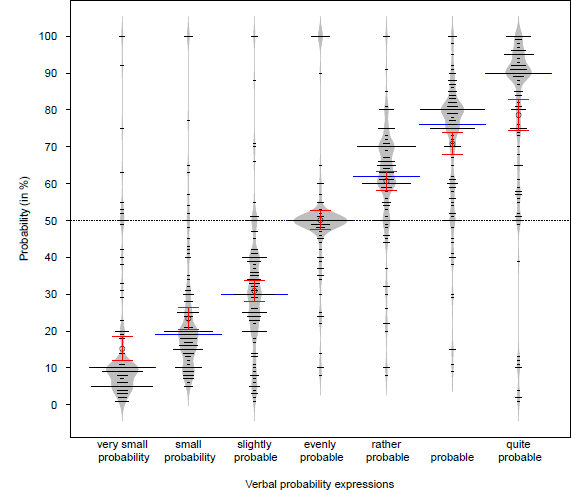
Figure 1 shows subjects’ ratings and indicates that the probability magnitude order was preserved and that the middle point (i.e., evenly probable) gave a good representation of a 50% probability. Prior to the analysis, we translated the verbal probabilities into the numerical probabilities that each subject individually associated with the verbal probabilities. For example, subject 08 selected the expression “rather probable” in the car scenario and then quantified this expression as conveying a “60%” probability in the follow-up task and therefore, we translated the selection as “60%”, whereas subject 94 selected the same expression but quantified it as conveying “80%” and therefore we translated this selection as “80%”. Finally, subjects provided their socio-demographic information. We analyzed data using the R statistical programming language (R Core Team, 2014).
Subjective numerical probability associated with the verbal probability expressions used in the verbal probability scale (symmetric bean plot combined with error bars showing 95% confidence interval of the mean). The blue lines represent the overall median probability per expression. The polygons represent the density shape determined by a normal density trace computed with a default bandwidth method using the Sheather-Jones method to select a bandwidth per batch and then averaging bandwidths over all batches (see Reference KampstraKampstra, 2008).
2.2 Results
2.2.1 Postulate 1: Proportion of speakers’ intentions.
Out of all 246 reported intentions, speakers intended not only to be informative but also to tactfully announce bad news or to avoid being blamed (Figure 2). Although subjects reported most often informative intentions, they also reported a substantial number of face-managing intentions: 41.6% of all intentions. The hearer face-managing intentions were slightly more common than the speaker face-managing intentions. Only a few speakers selected the “other intention” response, aside from the options we provided: a likely indicator that the three studied intentions covered quite well the spectrum of the speakers’ communication goals. These findings support the first hypothesis positing that speakers not only adopt informative intentions, but also face-managing intentions.
Speakers’ intentions in the Car and the Investment scenario in % (n = 132, Error bars represent 95% CIs). “Hearer FM” = hearer face-managing intentions, “Speaker FM” = speaker face-managing intentions, “Informative” = informative intentions, “Other” = other than the pre-defined intentions.
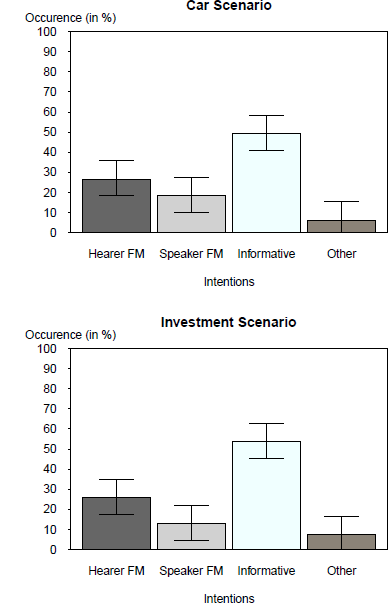
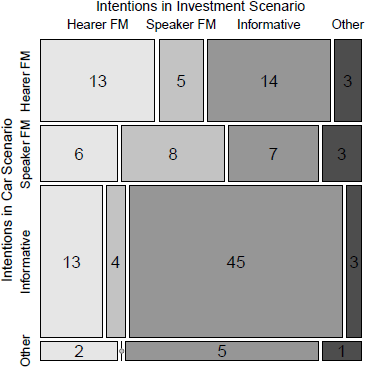
Two other findings deserve more attention. The proportion of speakers’ intentions differed only minimally across the Investment and Car scenarios (Figure 2). Indeed, a marginal homogeneity test pointed to an equality of the row marginal proportions (Investment Scenario) and the corresponding column proportions (Car Scenario), since we found no statistically significant difference, MH statistic: M = 147.5, SD = 7.0; p = .476. Furthermore, and consistently with the first observation, subjects often reported relatively similar intentions for the two scenarios, between which we found a statistically significant association, χ2(9) = 22.53, p = .008, Cramer’s V = 0.24 (Figure 3).
Relative intra-individual consistency in adopting intentions in the Investment and Car scenarios. “Hearer FM” = hearer face-managing intentions, “Speaker FM” = speaker face-managing intentions, “Informative” = informative intentions, “Other” = other than pre-defined intentions.
Interestingly, only a few subjects defined their own intentions (i.e., the category “other intention”), beyond the options we provided, n = 18. Ten of the other intentions actually described one of the three types of predefined intentions or a combination of these (e.g., being informative: This could seriously affect my friend so I would try to be very blunt and honest for his sake). Four of them described a new “better safe than sorry” intention, according to which subjects exaggerated the probability of occurrence of the negative outcome so as to err on the safe side (e.g., Better safe than sorry so I said it could be probable). The remaining four intentions were hard-to-classify (e.g., I was laughing at him). Because of the heterogeneity of this category, we have excluded these intentions from the subsequent analyses.
2.2.2 Postulate 2: Effect of speakers’ intentions on communicated probability.
To communicate 50% probability the informative speakers selected the verbal probability “evenly probable” more often than face-managing speakers who selected more verbal probabilities from the bottom of the verbal probability scale (Figure 4). In the Investment scenario, the downward adjustment was more pronounced with the speaker face-managing intentions, whereas in the Car scenario, the downward adjustment was more pronounced with the hearer face-managing intentions (Figure 4). Importantly, the bimodal distribution of probabilities communicated in the Car scenario for the speaker face-managing intentions shows that subjects communicated in both directions: either a lower or a higher probability than 50%.
Effect of communication intentions on verbal probability expressions chosen to convey bad news (asymmetric bean plot). The thick bold lines represent the mean probability per condition. The polygons represent a density shape determined by a normal density trace computed with a default bandwidth method. “Hearer FM” = hearer face-managing intentions, “Speaker FM” = speaker face-managing intentions, “Informative” = informative intentions.
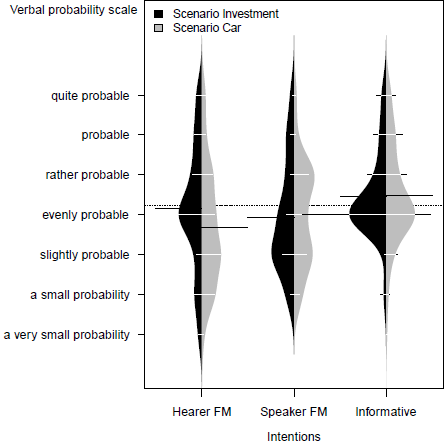
To test our hypothesis we recoded the verbal probability scale into three categories: “underestimation” for the expressions denoting lower than 50% probability, “adequate estimation” for the expression “equal probability” and “overestimation” for the expressions denoting higher than 50% probability (Table 1 ). In the Investment scenario, subjects selected verbal probabilities as a function of their intentions, χ2(4) = 21.95, p < .001, Cramer’s V = 0.30. Speakers adopting hearer and speaker face-managing intentions conveyed an underestimated probability more often than those adopting informative intentions, respectively χ2(2) = 10.80, p = .004, Cramer’s V = 0.32 and χ2(2) = 21.18, p < .001, Cramer’s V = 0.49. We found no difference between the two face-managing intentions, χ 2(2) = 2.29, p = .424, Cramer’s V = 0.21. In the Car scenario, subjects also selected verbal probabilities as a function of their intentions, χ 2(4) = 20.77, p < .001, Cramer’s V = 0.29. Subjects adopting hearer face-managing intentions underestimated the probability more often than those adopting informative intentions, χ2(2) = 17.13, p < .001, Cramer’s V = 0.41. However, subjects adopting speaker face-managing intentions in this scenario had a tendency to underestimate or overestimate the probability more often than those adopting different intentions, χ 2(2) = 10.69, p = .005, Cramer’s V = 0.35. Again, we found no difference between the two face-managing intentions, χ2(2) = 1.09, p = .648, Cramer’s V = 0.14.
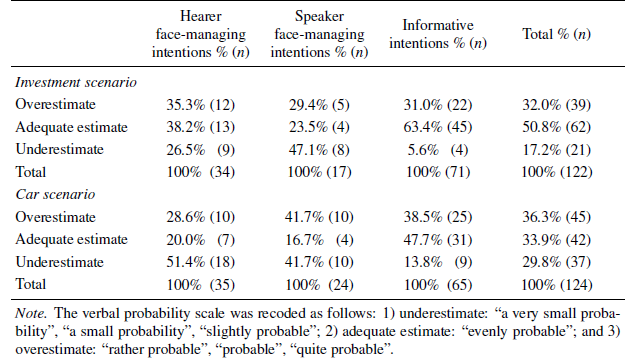
Note. The verbal probability scale was recoded as follows: 1) underestimate: “a very small probability”, “a small probability”, “slightly probable”; 2) adequate estimate: “evenly probable”; and 3) overestimate: “rather probable”, “probable”, “quite probable”.
We found similar effects of intentions on the individualized numerical translations of the selected verbal probability expressions in the Investment scenario, F(2,119) = 3.33, p = .039, µ2 = .05, as well as in Car scenario, F(2,121) = 3.23, p = .043, µ2 = .05. In the Investment scenario, hearer face-managing subjects as well as speaker face-managing subjects conveyed a lower probability (respectively, −7.3, 95% CI [−15.8, 1.2], p = .093; −12.9, 95% CI [−23.9, −1.8], p = .023) than those with informative intentions ( M = 59.1, SD = 20.8). In the Car scenario, hearer face-managing subjects as well as speaker face-managing subjects conveyed a lower probability (respectively, −12.0, 95% CI [−21.7, −2.3], p = .016; −7.9, 95% CI [−19.0, 3.1], p = .159) than those with informative intentions ( M = 55.9, SD = 22.6). In a 2-level linear regression model with random intercept, subjects with face-managing intentions communicated a lower probability than informative speakers: intercept b 0 = 57.3, 95% CI [52.9, 61.6], t(163.239) = 26.03, p < .001; hearer face-managing intentions slope b 1 = −6.8, 95% CI [−12.5, −1.0], t(191.142) = −2.32, p = .022, speaker face-managing intentions slope b 2 = −11.6, 95% CI [−18.9, −4.3], t(205.787) = −3.14, p = .002.
Overall, all these analyses support the second hypothesis predicting that face-managing intentions would lead to the communication of a different probability than would informative intentions.
3 Discussion
In agreement with the first postulate of politeness theory, we found that speakers intended to manage hearers’ faces from threatening news or to manage their own faces from being wrong. In agreement with the second postulate derived from politeness theory, speakers communicated an altered (in the case of our scenarios, lower) outcome probability when they intended to be tactful or cautious than when they intended to be informative. Speakers conveyed on average a lower probability of occurrence for a negative outcome to manage hearers’ faces or to manage their own faces. Our data represent the first direct and comprehensive empirical evidence supporting the two politeness theory postulates as applied to uncertainty communication.
Our study complements prior research showing that hearers believe that speakers soften bad news by hedging and downplaying their opinion with a vague uncertainty quantifier (e.g., Reference Bonnefon and VillejoubertBonnefon & Villejoubert, 2006; Reference Bonnefon, Feeney and De NeysBonnefon et al., 2011; Reference Juanchich, Sirota and ButlerJuanchich et al., 2012). Our study demonstrates that speakers actually use verbal probabilities not only as probability information vehicles but also as face-managing devices oriented either toward the speaker or the hearer (Reference Juanchich, Sirota and ButlerJuanchich et al., 2012; Reference Juanchich, Sirota, Karelitz and VillejoubertJuanchich & Sirota, 2013). These three intentions seem to cover most of the intentions of subjects giving uncertain or bad news as very few subjects reported another intention. Only a few instances of a “better safe than sorry” intention—in which speakers intentionally exaggerated the probability magnitude of a negative outcome to encourage hearers to take preventive action—deviated systematically from the three intentions previously studied. To study this intention, along with the other intentions, in circumstances other than those investigated here, would be an exciting avenue for future research, since different intentions may be at work in different circumstances.
Our study further supports the conjectures of prior research postulating that personality traits, such as honesty, are associated with specific intentions such as a higher rate of informative intentions (Reference Feeney and BonnefonFeeney & Bonnefon, 2013). We observed some intra-individual consistency in intention selection. For example, a person who adopted a face-managing intention to describe the probability of car breakdown was more likely to adopt the same intention when describing the probability of losing a financial investment. Thus, these findings indirectly support the hypothesis that personality traits could account for differences in the adoption of speakers’ intentions.
Our study diverges from previous research using similar scenarios, since it reveals that the proportion of intentions of speakers differs from the one assumed by hearers (see Reference Juanchich, Sirota and ButlerJuanchich et al. 2012). Speakers intended mainly to inform hearers but hearers believed that speakers mainly intended to manage their own faces when communicating bad news (Reference Juanchich, Sirota and ButlerJuanchich et al. 2012). Further, speakers reported that they aimed to be tactful more often than was believed by hearers (Reference Bonnefon and VillejoubertBonnefon & Villejoubert, 2006; Reference Juanchich, Sirota and ButlerJuanchich et al. 2012). Such discrepancies may originate from purely methodological differences or from deeper psychological reasons. Methodological variances, such as the different expertise status of speakers, between the two sets of studies could account for the gap, since speakers were experts in the “hearer” studies but not in the present study. Subjects may perceive experts to be worrying more about their own faces when making predictions and may assume, in turn, a higher rate of self-face-managing intentions. Nevertheless, it is possible that psychological reasons, such as error in attribution processes, could also account for the gap (e.g., Reference Epley and DunningEpley & Dunning, 2000). Speakers could have attributed more altruistic motives to themselves than they actually had and/or hearers could have attributed to speakers more egotistical motives than they actually had; both misattributions would lead to lower rates of speakers’ face-managing intentions in our study compared to those in the “hearers” studies.
Although the observed effects appear to be robust—estimated from a sufficient sample size and from two different scenarios, some methodological issues could limit our conclusions. One could argue that the order of the probability estimation question and the intention question could account for the intention’s effect. However, previous research on the effect of intentions weakens such a conclusion, since the effect of the perceived intention of speakers affected the perceived probability of hearers, whether the probability question was before or after the intention interpretation question (see Reference Juanchich, Sirota and ButlerJuanchich et al., 2012; Reference Juanchich, Sirota, Karelitz and VillejoubertJuanchich & Sirota, 2013). One could also argue that allowing subjects to choose only one intention instead of a combination of several different intentions might reflect very imprecisely the dynamic of speakers adopting intentions in real-life conversations. For example, people could intend to be both informative and tactful at the same time. Future research should therefore consider a design that captures the relative impact of the intentions of speakers. However, our conclusions should not be restricted too much by this shortcoming, since our subjects had the opportunity to report a mixed-intention in the “other” category if they felt that choosing one or the other of the intentions did not sufficiently match their personal intention. Finally, one could argue that our findings failed to indicate how people actually communicate probability in real life situations, since we have used fictitious scenarios. Paradoxically, we argue the opposite: we expect that the intentions reported here would have a stronger effect in real life situations, because politeness concerns have a larger effect in real life than in hypothetical situations. For example, Woodzicka and LaFrance (2001) showed that women reported their intention to confront a person uttering a sexist comment in a hypothetical situation more often than they actually did in reality, probably because of people’s need to avoid threatening others by being confrontational. Similarly, Kawakami, Dunn, Karmali and Dovidio (2009) showed that people admitted to feeling upset by a racist comment in a hypothetical situation more than when they were actually confronted with a racist comment. Therefore, future research should test whether people in real life situations would opt more for face-managing intentions and communicate even lower probability values than was the case in our fictitious scenarios.
The present findings bear wider theoretical and practical implications. Although we have considered only verbal probabilities here, the focus on how speakers use face-managing strategies could be extended to a wider range of verbal and numerical quantifiers. Some research already exists on these quantifiers but only from the standpoint of hearers (e.g., Bonnefon et al., 2011; Reference Sirota and JuanchichSirota & Juanchich, 2012b). Such an extension would strengthen the conclusion that a general politeness mechanism underlies some other effects embedded in communication contexts observed in the literature, which have been traditionally attributed to purely mental cognitive processes. Progress in this area would be warranted for the understanding of human cognition in its complexity and would further advance theories of mental phenomena (e.g., see Bonnefon et al. 2009).
The practical implications of our study can be seen at different levels. First, our study extends the currently prevailing audience-oriented research by providing insights on the thought processes underpinning the ways speakers communicate probabilities. Second, our study pinpoints a possible speaker-hearer discrepancy in the proportion of intentions, because hearers believe speakers are more often self-oriented than speakers actually report. Finally, our study highlights the danger that probability misperceptions result from improper encoding or decoding of intentions in the risk communication process. Therefore, professional risk communicators should consider both sides of the communication equation: be aware of potential mismatch, and try to make their intentions as clear as possible to hearers (Reference Sirota and JuanchichSirota & Juanchich, 2012a).
Conclusion
In summary, we have provided the first comprehensive and direct evidence to support the two core postulates of politeness theory as applied to uncertainty communication. First, we have shown that speakers spontaneously adopt different communication intentions. Our subjects reported having both informative but also face-managing intentions when communicating the probability of negative outcomes. Second, we have shown that speakers perform face-managing intentions by conveying a different probability than the one they have in mind. The subjects adopting face-managing intentions communicated, on average, a lower probability than the subjects adopting informative intentions. Overall, our findings corroborate politeness theory, strengthen the conclusions of prior studies utilizing these postulates and pinpoint the potential gap between speakers’ communication intentions and hearers’ interpretations of their intentions.
Appendix: Scenarios, adapted from Reference Juanchich, Sirota, Karelitz and VillejoubertJuanchich and Sirota (2013)
Car:
Imagine that a friend of yours has just bought a new used car without a warranty. He is explaining to you that he thinks he made a good deal. Your friend is showing you the car and you examine it while discussing. After a while he asks your opinion about the car. You think that there is a 50% probability that the car will break down in the next few months.
Select the statement you judge most appropriate to respond to your friend: “Do you think the car will break down?” “I think that …”
Investment:
Imagine that a friend of yours has invested in the stock market all the savings he has accumulated over time. He is explaining to you that he may be a novice with such investments but that he thinks that the stocks he bought are very good. As he is nevertheless not completely confident in the value of the stocks, he asks your opinion. You think that there is a 50% probability that the stock will lose their values.
Select the statement you judge most appropriate to respond to your friend: “Do you think my stocks will lose their values?” “I think that …”


 Open access

