





1 Introduction
Partitioning data sets via anticlustering establishes homogeneity between clusters and heterogeneity within clusters. Applications exist in many research fields, including psychology (Brusco et al., Reference Brusco, Cradit and Steinley2020; Nagel et al., Reference Nagel, Morgan, Gürsoy, Sander, Kern and Feld2024; Schaper et al., Reference Schaper, Kuhlmann and Bayen2023), test assembly (Gierl et al., Reference Gierl, Daniels and Zhang2017), education (Baker & Powell, Reference Baker and Powell2002; Krauss et al., Reference Krauss, Lee and Newman2013), artificial intelligence (Steghöfer et al., Reference Steghöfer, Behrmann, Anders, Siefert, Reif, Bauer, Calinescu, Grottke and Dillenseger2013), machine learning (Mauri et al., Reference Mauri, Apolloni and Damiani2023; Rahu et al., Reference Rahu, Kull and Kruve2024), network systems (Mohebi et al., Reference Mohebi, Zanella and Zorzi2022), and operations research (Gallego et al., Reference Gallego, Laguna, Marti and Duarte2013; Gliesch & Ritt, Reference Gliesch and Ritt2021). In psychological research, an important application is the assignment of stimuli to different experimental sets that are presented in within-subjects designs: The different sets should be as similar as possible with regard to variables that affect the responses (Lahl & Pietrowsky, Reference Lahl and Pietrowsky2006). Anticlustering is a powerful tool for automatically assigning stimuli—or in general, any objects—to equivalent subsets (Papenberg & Klau, Reference Papenberg and Klau2021). Handling this task manually, on the other hand, is time-consuming and usually inadequate (Cutler, Reference Cutler1981; Lintz et al., Reference Lintz, Lim and Johnson2021).
In the current article, we investigate and extend a bicriterion anticlustering method that was recently introduced by Brusco et al. (Reference Brusco, Cradit and Steinley2020). Their algorithm aims for group-level similarity between clusters (via the diversity criterion) and heterogeneity between pairs of objects in the same cluster (via the dispersion criterion). We investigate how their bicriterion approach profits from employing exact algorithms as opposed to the pure heuristic approach that was originally presented by the authors. Our article is organized as follows. We start by formalizing the computation of anticlustering objectives, before reviewing exact and heuristic algorithms for optimizing these objectives. We reiterate the bicriterion heuristic by Brusco et al. (Reference Brusco, Cradit and Steinley2020) and then present our own contributions to the bicriterion approach. We evaluate our extensions using synthetic data in two simulation studies as well as real data in an example application. All anticlustering methods presented in this article are available as part of the free and open-source R package anticlust (Papenberg & Klau, Reference Papenberg and Klau2021). All code and data used in the simulations and practical examples are available from the accompanying Open Science Framework (OSF) repository (https://osf.io/hsztn/).
1.1 Formalizing anticlustering
Anticlustering is used to partition N objects into K exhaustive and mutually exclusive subgroups. Following the notation by Brusco & Cradit (Reference Brusco and Cradit2005), we define $S = \{o_1, o_2, \ldots , o_N\}$
as a set of N objects and
$S = \{o_1, o_2, \ldots , o_N\}$
as a set of N objects and $I = \{1, 2, \ldots , N\}$
as the set of their indices. A partition of a set S into K clusters is denoted as
$I = \{1, 2, \ldots , N\}$
as the set of their indices. A partition of a set S into K clusters is denoted as $C = (C_1, \ldots , C_K)$
, where the elements of cluster
$C = (C_1, \ldots , C_K)$
, where the elements of cluster $C_k$
are the indices of objects assigned to cluster k and the number of objects assigned to cluster k is
$C_k$
are the indices of objects assigned to cluster k and the number of objects assigned to cluster k is $n_k = \vert C_k \vert $
(
$n_k = \vert C_k \vert $
( $k = 1, \ldots , K$
). A feasible partition of the N objects is defined via (a)
$k = 1, \ldots , K$
). A feasible partition of the N objects is defined via (a) $n_k> 0$
for all
$n_k> 0$
for all $k = 1, \ldots , K$
, (b)
$k = 1, \ldots , K$
, (b) $C_k \cap C_l = \emptyset $
for
$C_k \cap C_l = \emptyset $
for $1 \le k < l \le n$
, and (c)
$1 \le k < l \le n$
, and (c) $C_1 \cup C_2 \cup \cdots \cup C_K = I$
. We denote the set of feasible partitions of N objects into K clusters as
$C_1 \cup C_2 \cup \cdots \cup C_K = I$
. We denote the set of feasible partitions of N objects into K clusters as $\Pi _K$
(
$\Pi _K$
( $C \in \Pi _K$
). In anticlustering, K and
$C \in \Pi _K$
). In anticlustering, K and $n_k$
are usually predetermined by the application. We will refer to the subgroups
$n_k$
are usually predetermined by the application. We will refer to the subgroups $C_k$
as anticlusters, clusters, or groups interchangeably, and to the collection C as the anticlustering partitioning. We will refer to the fixed values
$C_k$
as anticlusters, clusters, or groups interchangeably, and to the collection C as the anticlustering partitioning. We will refer to the fixed values $n_k$
as cardinality constraints.
$n_k$
as cardinality constraints.
Anticlustering seeks for homogeneity between groups and heterogeneity within groups by maximizing a clustering objective criterion. Thus, anticlustering is the logical and mathematical opposite of classical clustering, which partitions data sets via minimization of the same criteria (Brusco et al., Reference Brusco, Cradit and Steinley2020; Späth, Reference Späth1986; Steinley, Reference Steinley2006). We assume that a data matrix $\mathbf {Z}$
is used as input for computing the anticlustering criterion on the basis of a partitioning C.
$\mathbf {Z}$
is used as input for computing the anticlustering criterion on the basis of a partitioning C. $\mathbf {Z}$
is either a feature matrix
$\mathbf {Z}$
is either a feature matrix $\mathbf {X}_{N \times P} = \{x_{ij}\}_{N \times P}$
, where the P columns contain numeric or categorical measurements on the N objects, or a symmetric matrix
$\mathbf {X}_{N \times P} = \{x_{ij}\}_{N \times P}$
, where the P columns contain numeric or categorical measurements on the N objects, or a symmetric matrix $\mathbf {D}_{N \times N} = \{d_{ij}\}_{N \times N}$
of pairwise dissimilarity measurements between the objects. The partitioning is then obtained by maximizing a clustering criterion
$\mathbf {D}_{N \times N} = \{d_{ij}\}_{N \times N}$
of pairwise dissimilarity measurements between the objects. The partitioning is then obtained by maximizing a clustering criterion $f(C, \mathbf {X}_{N \times P})$
or
$f(C, \mathbf {X}_{N \times P})$
or $f(C, \mathbf {D}_{N \times N})$
.
$f(C, \mathbf {D}_{N \times N})$
.
1.1.1 The k-means criterion
The k-means criterion is computed as the sum of squared Euclidean distances between each object and its cluster center, also coined the variance (Späth, Reference Späth1986; Steinley, Reference Steinley2006):
 $$ \begin{align} f_1(C, \mathbf{X}_{N \times P}) = \sum\limits_{j=1}^{P} \sum\limits_{k=1}^{K} \sum\limits_{i \in C_k} (x_{ij} - \overline{x}_j ^{(k)})^2 \end{align} $$
 $$ \begin{align} \kern-13pt \overline{x}_j ^{(k)} = \frac{1}{n_k} \sum\limits_{i \in C_k} x_{ij}. \end{align} $$
The kth cluster center $\overline {\mathbf {x}}^{(k)} = (\overline {x}_1^{(k)}, \overline {x}_2^{(k)} \ldots , \overline {x}_P^{(k)})$
contains the mean values of the P variables computed across all observations belonging to the kth group. There is a direct connection between
$\overline {\mathbf {x}}^{(k)} = (\overline {x}_1^{(k)}, \overline {x}_2^{(k)} \ldots , \overline {x}_P^{(k)})$
contains the mean values of the P variables computed across all observations belonging to the kth group. There is a direct connection between $f_1$
and the location of the cluster centroids (Späth, Reference Späth1986). When minimizing
$f_1$
and the location of the cluster centroids (Späth, Reference Späth1986). When minimizing $f_1$
—the goal of k-means cluster analysis—the centroids
$f_1$
—the goal of k-means cluster analysis—the centroids $\overline {\mathbf {x}}^{(k)} (k = 1, \ldots , K)$
are as far located as possible from the global centroid
$\overline {\mathbf {x}}^{(k)} (k = 1, \ldots , K)$
are as far located as possible from the global centroid $\overline {\mathbf {x}} = (\overline {x}_1, \overline {x}_2, \ldots , \overline {x}_P)$
;
$\overline {\mathbf {x}} = (\overline {x}_1, \overline {x}_2, \ldots , \overline {x}_P)$
; $\overline {x}_j$
(
$\overline {x}_j$
( $j = 1, \ldots , P$
) is computed as the global mean of the j’th attribute:
$j = 1, \ldots , P$
) is computed as the global mean of the j’th attribute:
 $$\begin{align*}\overline{x}_j = \frac{1}{N} \sum\limits_{i=1}^{N} x_{ij}. \end{align*}$$
When maximizing $f_1$
, which is the goal of k-means anticlustering, the cluster centroids are as close as possible to the global centroid
$f_1$
, which is the goal of k-means anticlustering, the cluster centroids are as close as possible to the global centroid $\overline {\mathbf {x}}$
—and as a consequence to each other. In particular, maximizing
$\overline {\mathbf {x}}$
—and as a consequence to each other. In particular, maximizing $f_1$
is equivalent to minimizing the weighted sum of the squared Euclidean distances between the global centroid and the cluster centroids (Steinley, Reference Steinley2006):Footnote
1
$f_1$
is equivalent to minimizing the weighted sum of the squared Euclidean distances between the global centroid and the cluster centroids (Steinley, Reference Steinley2006):Footnote
1
 $$ \begin{align} f_1^* = \sum\limits_{k=1}^{K} n_k \sum\limits_{j = 1}^P (\overline{x}_j ^{(k)} - \overline{x}_j)^2. \end{align} $$
Thus, k-means anticlustering directly maximizes the similarity of the mean attribute values between clusters. Though counterintuitive, the connection between mean values and the group variance is actually well-known in the context of Analysis of Variance (ANOVA). In ANOVA, the within-group variance is compared to the between-group variance to perform a statistical test among group means. If the variance within-groups is large relative to the variance between-groups, the group means are similar to each other. If the variance within-groups is small relative to the variance between-groups, the group means are dissimilar to each other, potentially leading to the conclusion that at least two group means are significantly different from each other. The k-means criterion is a multivariate extension of the ANOVA error sum of squares, as it can be computed on the basis up to P variables and not just one.
1.1.2 The k-plus criterion
The k-plus criterion is an extension of the k-means criterion that can be implemented by adding fictitious variables to the data matrix $\mathbf {X}_{N \times P}$
(Papenberg, Reference Papenberg2024). When using the k-plus criterion, we do not only obtain similar means, but higher order moments, such as the variance or skewness as well. For example, to equate means and variances, we define a new data matrix
$\mathbf {X}_{N \times P}$
(Papenberg, Reference Papenberg2024). When using the k-plus criterion, we do not only obtain similar means, but higher order moments, such as the variance or skewness as well. For example, to equate means and variances, we define a new data matrix $\mathbf {Y}_{N \times P} = \{y_{ij}\}_{N \times P}$
with
$\mathbf {Y}_{N \times P} = \{y_{ij}\}_{N \times P}$
with $y_{ij} = (x_{ij} - \overline {x}_j)^2$
, where
$y_{ij} = (x_{ij} - \overline {x}_j)^2$
, where $\overline {x}_j$
is the overall mean of the
$\overline {x}_j$
is the overall mean of the $j^{th}$
attribute. Then, the k-plus criterion is computed as
$j^{th}$
attribute. Then, the k-plus criterion is computed as
 $$ \begin{align} f_2(C, \mathbf{(X | Y)_{N \times 2P}}) = \sum\limits_{j=1}^{P} \sum\limits_{k=1}^{K} \sum\limits_{i \in C_k} (x_{ij} - \overline{x}_j ^{(k)})^2 + (y_{ij} - \overline{y}_j ^{(k)})^2. \end{align} $$
1.1.3 The diversity criterion
Arguably, the most popular and important criterion for anticlustering is the diversity, which uses a dissimilarity matrix $\mathbf {D}_{N \times N}$
as input. It is computed as the within-group sum of pairwise dissimilarities across all clusters (Brusco et al., Reference Brusco, Cradit and Steinley2020; Feo & Khellaf, Reference Feo and Khellaf1990; Gallego et al., Reference Gallego, Laguna, Marti and Duarte2013):
$\mathbf {D}_{N \times N}$
as input. It is computed as the within-group sum of pairwise dissimilarities across all clusters (Brusco et al., Reference Brusco, Cradit and Steinley2020; Feo & Khellaf, Reference Feo and Khellaf1990; Gallego et al., Reference Gallego, Laguna, Marti and Duarte2013):
 $$ \begin{align} f_3(C, \mathbf{D}_{N \times N}) = \sum\limits_{k = 1}^{K} \sum_{i, j \in C_k, i < j} d_{ij}. \end{align} $$
Maximizing the diversity $f_3$
simultaneously minimizes the sum of distances between objects not in the same group. Therefore, the diversity represents within-group heterogeneity as well as between-group similarity (Feo & Khellaf, Reference Feo and Khellaf1990). Being a sum instead of an average, however, it no longer adequately captures between-group similarity if group sizes are not equal (Papenberg, Reference Papenberg2024).
$f_3$
simultaneously minimizes the sum of distances between objects not in the same group. Therefore, the diversity represents within-group heterogeneity as well as between-group similarity (Feo & Khellaf, Reference Feo and Khellaf1990). Being a sum instead of an average, however, it no longer adequately captures between-group similarity if group sizes are not equal (Papenberg, Reference Papenberg2024).
1.1.4 On the equivalence of variance and diversity: The average diversity
The diversity is most often computed by first converting a feature matrix $\mathbf {X}_{N \times P}$
into a matrix of pairwise Euclidean distances
$\mathbf {X}_{N \times P}$
into a matrix of pairwise Euclidean distances $\mathbf {D}_{N \times N}$
(Brusco et al., Reference Brusco, Cradit and Steinley2020; Gallego et al., Reference Gallego, Laguna, Marti and Duarte2013; Papenberg & Klau, Reference Papenberg and Klau2021). If the squared Euclidean distances are used instead, we note an important equivalence between the k-means criterion
$\mathbf {D}_{N \times N}$
(Brusco et al., Reference Brusco, Cradit and Steinley2020; Gallego et al., Reference Gallego, Laguna, Marti and Duarte2013; Papenberg & Klau, Reference Papenberg and Klau2021). If the squared Euclidean distances are used instead, we note an important equivalence between the k-means criterion $f_1$
and the diversity
$f_1$
and the diversity $f_3$
. Traditionally, the k-means criterion is denoted as the variance, i.e., the sum of squared Euclidean distances between data points and cluster centroids. However, it can also be expressed using the pairwise squared Euclidean distances among data points (Späth, Reference Späth1980, p. 52). That is, “the sum of squared distances of a collection of points from the centroid associated with those points is equal to the sum of the pairwise squared distances between those points divided by the size (number of objects) of the collection” (Brusco, Reference Brusco2006, p. 350). Hence, if we let
$f_3$
. Traditionally, the k-means criterion is denoted as the variance, i.e., the sum of squared Euclidean distances between data points and cluster centroids. However, it can also be expressed using the pairwise squared Euclidean distances among data points (Späth, Reference Späth1980, p. 52). That is, “the sum of squared distances of a collection of points from the centroid associated with those points is equal to the sum of the pairwise squared distances between those points divided by the size (number of objects) of the collection” (Brusco, Reference Brusco2006, p. 350). Hence, if we let $\mathbf {D'}_{N \times N}$
= {
$\mathbf {D'}_{N \times N}$
= { $d^{\prime }_{ij}$
} represent the squared Euclidean distance, i.e.,
$d^{\prime }_{ij}$
} represent the squared Euclidean distance, i.e., $d^{\prime }_{ij} = \sum \nolimits _{p = 1}^{P}(x_{ip} - x_{jp})^2$
, the k-means criterion can be expressed as:
$d^{\prime }_{ij} = \sum \nolimits _{p = 1}^{P}(x_{ip} - x_{jp})^2$
, the k-means criterion can be expressed as:
 $$ \begin{align} f_4(C, \mathbf{D'}_{N \times N}) = \sum\limits_{k = 1}^{K}\left( \frac{1}{n_k} \sum_{(i<j)\in C_k} d^{\prime}_{ij} \right) = f_1(C, \mathbf{X}_{N \times P}). \end{align} $$
An important special case of anticlustering applications is that all groups are equal-sized, i.e., $n_k = \frac {N}{K}$
(
$n_k = \frac {N}{K}$
( $k = 1, \dots , K$
). In this context,
$k = 1, \dots , K$
). In this context, $f_4$
can be simplified to
$f_4$
can be simplified to $f_4^*$
via
$f_4^*$
via
 $$ \begin{align} f_4^*(C, \mathbf{D'}_{N \times N}) = \frac{K}{N} \sum\limits_{k = 1}^{K} \sum_{(i<j)\in C_k} d_{ij}. \end{align} $$
In the context of maximization, the factor $\frac {K}{N}$
can be ignored because it does not depend on the partitioning C:
$\frac {K}{N}$
can be ignored because it does not depend on the partitioning C:
 $$ \begin{align} f_4^*(C, \mathbf{D'}_{N \times N}) \propto \sum\limits_{k = 1}^{K} \sum_{(i<j)\in C_k} d_{ij} = f_3(C, \mathbf{D'}_{N \times N}). \end{align} $$
Therefore, the criterion $f_4^*$
(i.e., the k-means criterion for equal-sized groups) reduces to the standard diversity
$f_4^*$
(i.e., the k-means criterion for equal-sized groups) reduces to the standard diversity $f_3$
—if the diversity is computed on the basis of the squared Euclidean distance. For arbitrary measures of dissimilarity (and not just the squared Euclidean distance), we denote
$f_3$
—if the diversity is computed on the basis of the squared Euclidean distance. For arbitrary measures of dissimilarity (and not just the squared Euclidean distance), we denote $f_4$
as the average diversity criterion, which was recently adapted by Mohebi et al. (Reference Mohebi, Zanella and Zorzi2022).
$f_4$
as the average diversity criterion, which was recently adapted by Mohebi et al. (Reference Mohebi, Zanella and Zorzi2022).
1.1.5 The dispersion criterion
Unlike $f_1$
–
$f_1$
– $f_4$
, the dispersion criterion does not quantify between-group similarity, but is a pure measure of within-group heterogeneity. It is defined as the minimum dissimilarity across any two objects that are part of the same group (Brusco et al., Reference Brusco, Cradit and Steinley2020; Fernández et al., Reference Fernández, Kalcsics and Nickel2013):
$f_4$
, the dispersion criterion does not quantify between-group similarity, but is a pure measure of within-group heterogeneity. It is defined as the minimum dissimilarity across any two objects that are part of the same group (Brusco et al., Reference Brusco, Cradit and Steinley2020; Fernández et al., Reference Fernández, Kalcsics and Nickel2013):
 $$ \begin{align} f_5(C, \mathbf{D}_{N \times N}) = \textrm{min}_{(i < j) \in C_k} d_{ij}. \end{align} $$
The dispersion is a measure of the “worst-case” pairwise dissimilarity (Brusco et al., Reference Brusco, Cradit and Steinley2020). Maximizing the dispersion ensures that any two objects in the same group are as dissimilar from each other as possible, which is desirable when striving for high within-group heterogeneity.
1.2 Algorithms for anticlustering
An anticlustering algorithm assigns objects to groups in such a way that one of the criteria $f_1$
–
$f_1$
– $f_5$
is maximized, while incorporating constraints on the number of groups and the number of objects per group (cardinality constraints). Anticlustering algorithms can be classified into exact methods on the one hand, and heuristics on the other hand. Exact algorithms are guaranteed to find a globally optimal partition according to the anticlustering criterion that is optimized. A globally optimal partition is a partition that has the highest value among all possible partitions. Heuristics do not make the promise of returning a globally optimal partition, but they usually provide satisfying results in practice (Papenberg & Klau, Reference Papenberg and Klau2021), and their use is much more common. The preponderance of heuristics can be explained by the computational complexity of anticlustering. In the case of equal-sized groups, the number of possible anticlustering partitions
$f_5$
is maximized, while incorporating constraints on the number of groups and the number of objects per group (cardinality constraints). Anticlustering algorithms can be classified into exact methods on the one hand, and heuristics on the other hand. Exact algorithms are guaranteed to find a globally optimal partition according to the anticlustering criterion that is optimized. A globally optimal partition is a partition that has the highest value among all possible partitions. Heuristics do not make the promise of returning a globally optimal partition, but they usually provide satisfying results in practice (Papenberg & Klau, Reference Papenberg and Klau2021), and their use is much more common. The preponderance of heuristics can be explained by the computational complexity of anticlustering. In the case of equal-sized groups, the number of possible anticlustering partitions $\Pi _K$
is computed as the normalized product of binomial coefficients (Papenberg & Klau, Reference Papenberg and Klau2021):
$\Pi _K$
is computed as the normalized product of binomial coefficients (Papenberg & Klau, Reference Papenberg and Klau2021):
 $$ \begin{align} \Pi_K = \frac{1}{K!} \prod\limits_{i=0}^{K - 1} \binom{N - \frac{iN}{K}}{\frac{N}{K}}. \end{align} $$ $\Pi _K$
grows exponentially with N, and even more severely so for higher values of K. For
$\Pi _K$
grows exponentially with N, and even more severely so for higher values of K. For $N = 30$
and
$N = 30$
and $K = 3$
, there are already more than 900 billion possible partitions, which is beyond the search capacities of contemporary personal computers. Moreover, with the exception of some special cases, anticlustering problems have been identified as NP-hard problems (Feo & Khellaf, Reference Feo and Khellaf1990; Fernández et al., Reference Fernández, Kalcsics and Nickel2013). A strong conjecture of theoretical computer science states that NP-hardness implies that with increasing problem size, “no amount of clever algorithm design can ever completely defeat the potential for combinatorial explosions that lurks within this problem” (Karp, Reference Karp1986, p. 100). Thus, it is very likely that there is no algorithm that can find the globally optimal solution in running time that is a polynomial function of the input size, i.e., in “acceptable” running time (van Rooij, Reference van Rooij2008). There are improved techniques, such as dynamic programming or integer linear programming (ILP) that may circumvent the computationally expensive explicit enumeration of all possible partitions (Brusco et al., Reference Brusco, Steinley and Watts2024). These methods have the chance to return solutions for larger data sets than would be possible via complete enumeration. However, they do not prevent the eventual exponential explosion of the running time; instead, they just push the boundary of feasibility upward. The degree to which delaying the combinatorial explosion is successful depends on the specific problem or even the specific data input (Chen, Reference Chen2017). For anticlustering, we even observe a sharp contrast in feasibility depending on the anticlustering objective: While partitions with optimal maximum dispersion can be found for quite large data sets (Fernández et al., Reference Fernández, Kalcsics and Nickel2013), creating partitions with optimal maximum diversity even fails for quite small data sets (Papenberg & Klau, Reference Papenberg and Klau2021; Schulz, Reference Schulz2022).
$K = 3$
, there are already more than 900 billion possible partitions, which is beyond the search capacities of contemporary personal computers. Moreover, with the exception of some special cases, anticlustering problems have been identified as NP-hard problems (Feo & Khellaf, Reference Feo and Khellaf1990; Fernández et al., Reference Fernández, Kalcsics and Nickel2013). A strong conjecture of theoretical computer science states that NP-hardness implies that with increasing problem size, “no amount of clever algorithm design can ever completely defeat the potential for combinatorial explosions that lurks within this problem” (Karp, Reference Karp1986, p. 100). Thus, it is very likely that there is no algorithm that can find the globally optimal solution in running time that is a polynomial function of the input size, i.e., in “acceptable” running time (van Rooij, Reference van Rooij2008). There are improved techniques, such as dynamic programming or integer linear programming (ILP) that may circumvent the computationally expensive explicit enumeration of all possible partitions (Brusco et al., Reference Brusco, Steinley and Watts2024). These methods have the chance to return solutions for larger data sets than would be possible via complete enumeration. However, they do not prevent the eventual exponential explosion of the running time; instead, they just push the boundary of feasibility upward. The degree to which delaying the combinatorial explosion is successful depends on the specific problem or even the specific data input (Chen, Reference Chen2017). For anticlustering, we even observe a sharp contrast in feasibility depending on the anticlustering objective: While partitions with optimal maximum dispersion can be found for quite large data sets (Fernández et al., Reference Fernández, Kalcsics and Nickel2013), creating partitions with optimal maximum diversity even fails for quite small data sets (Papenberg & Klau, Reference Papenberg and Klau2021; Schulz, Reference Schulz2022).
1.2.1 Exact algorithms for anticlustering
ILP is a powerful framework to optimally solve NP-hard combinatorial optimization problems. Brusco et al. (Reference Brusco, Steinley and Watts2025) recently provided an extensive overview of the usages of ILP in Psychology. Important applications are found in test assembly (Chen, Reference Chen2017; van der Linden, Reference van der Linden2005) or cluster analysis (Brusco et al., Reference Brusco, Steinley and Watts2024). ILP uses mathematical modeling to present a problem as a combination of (a) decision variables (e.g., to encode if an object i is assigned to a cluster k), (b) an objective function to be optimized (e.g., the diversity), and (c) a system of constraints (e.g., to restrict the number of objects in a cluster). The model is usually formulated by a user and then given to a so-called solver, which returns values for the decision variables that yield the optimal value of the objective function. A variety of solvers exists, including commercial and open-source options. Commercial solvers, such as Gurobi (Gurobi Optimization LLC, 2024) oftentimes, outperform their open-source counterparts in terms of running time (Meindl & Templ, Reference Meindl and Templ2012).
Schulz (Reference Schulz2022) contrasted three ILP models for finding anticlustering partitionings with maximum diversity: the standard formulation as described by Gallego et al. (Reference Gallego, Laguna, Marti and Duarte2013), an adaptation of the clique partitioning model from Grötschel & Wakabayashi (Reference Grötschel and Wakabayashi1989) in Papenberg & Klau (Reference Papenberg and Klau2021), and a new block formulation. Schulz’s block formulation performed best and could solve problem instances up to $N = 80$
objects optimally within a time limit of 1,800 seconds. However, Schulz’s formulation is restricted to using the Manhattan distance as input, while, for example, the more common Euclidean distance cannot be used. The model by Papenberg & Klau (Reference Papenberg and Klau2021), which allows arbitrary measures of dissimilarity, was able to solve instances with up to
$N = 80$
objects optimally within a time limit of 1,800 seconds. However, Schulz’s formulation is restricted to using the Manhattan distance as input, while, for example, the more common Euclidean distance cannot be used. The model by Papenberg & Klau (Reference Papenberg and Klau2021), which allows arbitrary measures of dissimilarity, was able to solve instances with up to $N = 30$
within the time limit, followed by the standard formulation, which solved problem sizes up to
$N = 30$
within the time limit, followed by the standard formulation, which solved problem sizes up to $N = 20$
. These results are in contrast to the success of exact approaches in cluster analysis, where it is common that hundreds or even thousands of objects can be partitioned optimally in acceptable time (e.g., Böcker et al., Reference Böcker, Briesemeister and Klau2011; Brusco, Reference Brusco2006; Brusco et al., Reference Brusco, Steinley and Watts2024). Even though it is also NP-hard (at least when
$N = 20$
. These results are in contrast to the success of exact approaches in cluster analysis, where it is common that hundreds or even thousands of objects can be partitioned optimally in acceptable time (e.g., Böcker et al., Reference Böcker, Briesemeister and Klau2011; Brusco, Reference Brusco2006; Brusco et al., Reference Brusco, Steinley and Watts2024). Even though it is also NP-hard (at least when $K \ge 3$
; see Discussion), the maximum dispersion problem has been shown to be more accessible to exact solution approaches. Fernández et al. (Reference Fernández, Kalcsics and Nickel2013) presented an exact algorithm based on ILP for a generalized version of the maximum dispersion problem that scaled to several hundred objects (see also Gliesch & Ritt, Reference Gliesch and Ritt2021).
$K \ge 3$
; see Discussion), the maximum dispersion problem has been shown to be more accessible to exact solution approaches. Fernández et al. (Reference Fernández, Kalcsics and Nickel2013) presented an exact algorithm based on ILP for a generalized version of the maximum dispersion problem that scaled to several hundred objects (see also Gliesch & Ritt, Reference Gliesch and Ritt2021).
1.2.2 Heuristic algorithms for anticlustering
Heuristic methods for anticlustering broadly fall into the categories of local neighborhood search and metaheuristics. Applying the hill-climbing algorithm by Rubin (Reference Rubin1967) to the domain of anticlustering, Späth (Reference Späth1986) used a single-object cluster relocation algorithm to maximize the k-means criterion. Starting with a random initial partition, each object is successively moved from its current cluster to all the other ones, and the difference in objective is computed for each of the exchanges. The one exchange that leads to the largest improvement in the criterion is actually realized. The exchange procedure is repeated for each object and, after iterating through all objects, is repeated from the beginning until no swap can improve the objective, i.e., until a local maximum is found. The entire process can be restarted multiple times based on different random partitionings. Because the hill-climbing method switches the cluster affiliation of individual objects, it yields a partitioning that aims at maximizing the k-means criterion over different possible group sizes—the group sizes are not known in advance. More commonly, however, anticlustering applications assume that group sizes are fixed. A straightforward adjustment of the hill-climbing method to accommodate fixed group sizes is to apply the exchange rule to pairs of objects, i.e., to inspect how exchanging two objects between their respective clusters influences the objective.Footnote 2 This adaptation yields the method LCW by Weitz & Lakshminarayanan (Reference Weitz and Lakshminarayanan1998), which at the time performed better than all of the available competitors. However, later research has focused on metaheuristics that tend to outperform simple local maximum search (e.g., Gallego et al., Reference Gallego, Laguna, Marti and Duarte2013). Different metaheuristics use different strategies for a more effective search through the available partitions, while trying to avoid getting stuck in local optima. Metaheuristics for anticlustering include variable neighborhood search (Urošević, Reference Urošević2014), tabu search (Gallego et al., Reference Gallego, Laguna, Marti and Duarte2013), iterated local search (ILS) (Brusco et al., Reference Brusco, Cradit and Steinley2020), simulated annealing, genetic algorithms (Palubeckis et al., Reference Palubeckis, Karčiauskas and Riškus2011), or mixture approaches (Yang et al., Reference Yang, Cai, Jin, Tang and Gao2022).
1.2.3 The bicriterion heuristic for anticlustering
Brusco et al. (Reference Brusco, Cradit and Steinley2020) outlined the importance of simultaneously considering multiple criteria when addressing anticlustering problems. In particular, they argued that anticlustering algorithms should simultaneously optimize an objective of between-group similarity, such as the diversity, and pairwise within-group dissimilarity, i.e., the dispersion. To this end, Brusco et al. (Reference Brusco, Cradit and Steinley2020) presented a bicriterion algorithm (BILS) that simultaneously maximizes the diversity $f_3$
and the dispersion
$f_3$
and the dispersion $f_5$
by approximating the Pareto efficient set of partitions according to both criteria. By investigating the Pareto set for many problem instances, they found that a considerable improvement in one of these criteria is often possible with little or even no sacrifice in the other.
$f_5$
by approximating the Pareto efficient set of partitions according to both criteria. By investigating the Pareto set for many problem instances, they found that a considerable improvement in one of these criteria is often possible with little or even no sacrifice in the other.
The BILS is a two-phase algorithm. The initial phase performs a basic local maximum search (bicriterion pairwise interchange heuristic, BPI) similar to LCW, followed by a subsequent improvement phase via ILS, which attempts to escape local optima. The BPI guides its search via optimization of a weighted sum criterion of the diversity and dispersion, i.e., $\omega _1 f_3(C, \mathbf {D}_{N \times N}) + \omega _2 f_5(C, \mathbf {D}_{N \times N})$
. By committing to exchanges that improve the weighted bicriterion, the BPI investigates the search space for partitions that have high diversity as well as high dispersion. The search is restarted repeatedly using a different initial random partitioning and varying
$\omega _1 f_3(C, \mathbf {D}_{N \times N}) + \omega _2 f_5(C, \mathbf {D}_{N \times N})$
. By committing to exchanges that improve the weighted bicriterion, the BPI investigates the search space for partitions that have high diversity as well as high dispersion. The search is restarted repeatedly using a different initial random partitioning and varying $\omega _1$
and
$\omega _1$
and $\omega _2$
, yielding the multistart BPI or MBPI. Crucially, being a direct bicriterion algorithm (Ferligoj & Batagelj, Reference Ferligoj and Batagelj1992), the MBPI does not only conduct a search for improved bicriterion values, but an additional bookkeeping takes place during search: For each partition that is generated, a decision is made whether to include it in the Pareto set of efficient solutions. That is, the MBPI keeps a list of partitions that are not dominated by any other partition. A partition is dominated if there is another partition that is strictly better with regard to one criterion and not worse with regard to the other. After every exchange, the Pareto set is updated via potential inclusion of the new partition and potential removal of dominated partitions. The Pareto set is a set of partitions among which—without additional assumptions or quantification—no one partition is clearly better than any of the others; no Pareto partition is dominated by another Pareto partition with regard to both criteria (diversity and dispersion). The Pareto set is an important concept in multicriterion optimization and providing a Pareto set for dispersion and diversity was one of the main contributions of the original BILS algorithm.
$\omega _2$
, yielding the multistart BPI or MBPI. Crucially, being a direct bicriterion algorithm (Ferligoj & Batagelj, Reference Ferligoj and Batagelj1992), the MBPI does not only conduct a search for improved bicriterion values, but an additional bookkeeping takes place during search: For each partition that is generated, a decision is made whether to include it in the Pareto set of efficient solutions. That is, the MBPI keeps a list of partitions that are not dominated by any other partition. A partition is dominated if there is another partition that is strictly better with regard to one criterion and not worse with regard to the other. After every exchange, the Pareto set is updated via potential inclusion of the new partition and potential removal of dominated partitions. The Pareto set is a set of partitions among which—without additional assumptions or quantification—no one partition is clearly better than any of the others; no Pareto partition is dominated by another Pareto partition with regard to both criteria (diversity and dispersion). The Pareto set is an important concept in multicriterion optimization and providing a Pareto set for dispersion and diversity was one of the main contributions of the original BILS algorithm.
The combination of the MBPI and the ILS yields the complete bicriterion ILS (BILS) algorithm. Building on a randomly selected partition from the Pareto set provided by the MBPI phase, the ILS iterates through all $\frac {N(N-1)}{2}$
pairs of objects. For each pair, a decision is made whether to exchange their cluster affiliation. For each pair, the probability of a swap is uniformly sampled from the interval [5%, 10%]. This perturbation leads to a partition that is not locally optimal, which is then restored to local optimality using the BPI method. Because the perturbed partition tends to be similar to a “pretty good” locally optimal partition but is no longer bound by its local optimality, the BPI search has the chance of refining it toward an even better local optimum. As the BPI, the ILS can be restarted multiple times. Brusco et al. (Reference Brusco, Cradit and Steinley2020) recommended using 10,000 restarts in total for the BILS (5,000 restarts of the BPI and 5,000 restarts of the ILS). The output of the BILS algorithm is the (approximated) Pareto set and not a single partition. From this Pareto set, users can select a partition according to their liking; Brusco et al. (Reference Brusco, Cradit and Steinley2020) discussed several automated criteria for selecting a partition from the Pareto set, though the decision can also be based on substantive considerations.
$\frac {N(N-1)}{2}$
pairs of objects. For each pair, a decision is made whether to exchange their cluster affiliation. For each pair, the probability of a swap is uniformly sampled from the interval [5%, 10%]. This perturbation leads to a partition that is not locally optimal, which is then restored to local optimality using the BPI method. Because the perturbed partition tends to be similar to a “pretty good” locally optimal partition but is no longer bound by its local optimality, the BPI search has the chance of refining it toward an even better local optimum. As the BPI, the ILS can be restarted multiple times. Brusco et al. (Reference Brusco, Cradit and Steinley2020) recommended using 10,000 restarts in total for the BILS (5,000 restarts of the BPI and 5,000 restarts of the ILS). The output of the BILS algorithm is the (approximated) Pareto set and not a single partition. From this Pareto set, users can select a partition according to their liking; Brusco et al. (Reference Brusco, Cradit and Steinley2020) discussed several automated criteria for selecting a partition from the Pareto set, though the decision can also be based on substantive considerations.
1.3 Contributions of the current article
We endorse Brusco et al.’s bicriterion approach for anticlustering and extend it in several ways. First, in our software anticlust, we implemented several minor extensions that enhance BILS’s applicability. In our implementation, it is possible that the diversity and dispersion are computed on the basis of two different dissimilarity matrices $\mathbf {D}_{N \times N}$
and
$\mathbf {D}_{N \times N}$
and $\mathbf {D^*}_{N \times N}$
. Moreover, we allow optimizing the average diversity
$\mathbf {D^*}_{N \times N}$
. Moreover, we allow optimizing the average diversity $f_4$
instead of only the ordinary diversity. The average diversity is better suited to represent between-cluster similarity when cluster sizes are unequal and via (6), allows the BILS to optimize the k-means and k-plus objectives. In the application presented below, we will make use of these extensions in the context of designing memory experiments.
$f_4$
instead of only the ordinary diversity. The average diversity is better suited to represent between-cluster similarity when cluster sizes are unequal and via (6), allows the BILS to optimize the k-means and k-plus objectives. In the application presented below, we will make use of these extensions in the context of designing memory experiments.
As our most important contribution, we develop a model that yields provably optimal solutions for the bicriterion approach. Specifically, we employ a constraint method (Brusco et al., Reference Brusco, Cradit and Steinley2020; Brusco & Cradit, Reference Brusco and Cradit2005; Brusco & Stahl, Reference Brusco and Stahl2005) that first identifies an optimal value for maximum dispersion and then maximizes the diversity under the constraint of preserving maximum dispersion. The approach seamlessly generalizes toward generating the entire (optimal) Pareto set. After evaluating the exact bicriterion approach, we present hybrid approaches that aim for optimal maximum dispersion, but use heuristic algorithms to maximize the diversity.
1.4 OptDispF: An exact algorithm for maximum dispersion
To obtain a partitioning having maximum dispersion, we developed a new algorithm. The algorithm optimally maximizes the dispersion using fixed group sizes, for which reason we refer to it as OptDispF. It is based on an approach employed by Brucker (Reference Brucker1978) to solve the converse clustering problem for $K = 2$
.
$K = 2$
.
An important insight for finding an exact algorithm for maximum dispersion is that the dispersion acts like a set of cannot-link constraints on pairs of objects (Davidson, Reference Davidson, Liu and Özsu2009). That is, if the pairwise dissimilarity of two objects is below some threshold $\delta $
, they must not be linked in the same cluster. For the maximum dispersion problem, an exact algorithm has to find a
$\delta $
, they must not be linked in the same cluster. For the maximum dispersion problem, an exact algorithm has to find a $\delta _{max}$
: the maximum possible
$\delta _{max}$
: the maximum possible $\delta $
such that the resulting set of cannot-link constraints can still be satisfied, while for any value larger than
$\delta $
such that the resulting set of cannot-link constraints can still be satisfied, while for any value larger than $\delta _{max}$
, at least one pair of objects has to be assigned to the same cluster (i.e., the corresponding set of cannot-link constraints can no longer be satisfied). The dispersion then is the next higher distance than
$\delta _{max}$
, at least one pair of objects has to be assigned to the same cluster (i.e., the corresponding set of cannot-link constraints can no longer be satisfied). The dispersion then is the next higher distance than $\delta _{max}$
.
$\delta _{max}$
.
Our algorithm starts by setting $\delta $
to the minimum of all dissimilarities, i.e.,
$\delta $
to the minimum of all dissimilarities, i.e., $\delta = \mathrm {min} \{d_{ij}\}$
. We then generate the cannot-link constraints corresponding to
$\delta = \mathrm {min} \{d_{ij}\}$
. We then generate the cannot-link constraints corresponding to $\delta $
by creating a graph
$\delta $
by creating a graph $G = (V, E)$
with V consisting of N vertices representing the N objects and initialize an empty set of edges E. We add an edge
$G = (V, E)$
with V consisting of N vertices representing the N objects and initialize an empty set of edges E. We add an edge $\{i, j\}$
for each pair of objects i and j whose distance equals
$\{i, j\}$
for each pair of objects i and j whose distance equals $\delta $
. We then test if the resulting graph is K-colorable (Davidson & Ravi, Reference Davidson and Ravi2005). A graph is K-colorable if all adjacent vertices can be assigned different colors, while the maximum allowed number of colors is K. In our case, assigning different colors implies that objects whose dissimilarity is
$\delta $
. We then test if the resulting graph is K-colorable (Davidson & Ravi, Reference Davidson and Ravi2005). A graph is K-colorable if all adjacent vertices can be assigned different colors, while the maximum allowed number of colors is K. In our case, assigning different colors implies that objects whose dissimilarity is $\delta $
can indeed be assigned to K different groups. The K-coloring problem reduces to testing if a graph is bipartite for
$\delta $
can indeed be assigned to K different groups. The K-coloring problem reduces to testing if a graph is bipartite for $K = 2$
(Brucker, Reference Brucker1978). Because anticlustering applications apply fixed cardinality constraints on the number of objects per group, we employed an adaptation of the graph coloring model that restricts the number of times a color may be chosen (Méndez-Díaz et al., Reference Méndez-Díaz, Nasini and Severín2009, Reference Méndez-Díaz, Nasini and Severín2014). This way, we ensure that each solution to the K-coloring problem is valid regarding the cardinality constraints of the application. The full details of our graph coloring ILP model are found in the Appendix. If the graph is K-colorable while adhering to the cardinality restrictions, we increase
$K = 2$
(Brucker, Reference Brucker1978). Because anticlustering applications apply fixed cardinality constraints on the number of objects per group, we employed an adaptation of the graph coloring model that restricts the number of times a color may be chosen (Méndez-Díaz et al., Reference Méndez-Díaz, Nasini and Severín2009, Reference Méndez-Díaz, Nasini and Severín2014). This way, we ensure that each solution to the K-coloring problem is valid regarding the cardinality constraints of the application. The full details of our graph coloring ILP model are found in the Appendix. If the graph is K-colorable while adhering to the cardinality restrictions, we increase $\delta $
to the next higher value in our dissimilarity matrix, and again generate the corresponding constraints by adding all pairs of objects whose dissimilarity is
$\delta $
to the next higher value in our dissimilarity matrix, and again generate the corresponding constraints by adding all pairs of objects whose dissimilarity is $\delta $
as edges to G, and test if the graph is still K-colorable. As long as the graph is K-colorable, we increase
$\delta $
as edges to G, and test if the graph is still K-colorable. As long as the graph is K-colorable, we increase $\delta $
and each time test for K-colorability. As soon as the graph is no longer K-colorable, we set
$\delta $
and each time test for K-colorability. As soon as the graph is no longer K-colorable, we set $\delta _{max} = \delta $
. Figure 1 illustrates the process of finding the maximum dispersion, highlighting that it can be found before all objects have been inspected; here, the maximum dispersion was found by inspecting only 5 of the
$\delta _{max} = \delta $
. Figure 1 illustrates the process of finding the maximum dispersion, highlighting that it can be found before all objects have been inspected; here, the maximum dispersion was found by inspecting only 5 of the $N = 10$
objects.
$N = 10$
objects.
Illustrates the logic of the optimal search for the maximum dispersion for $K = 2$
.
$K = 2$
.
Note: In Panel (a), the minimum distance between two points is identified and tested if the elements having it can be divided into two groups. It can be divided into two groups if the graph that consists of one edge can be 2-colored, i.e., is bipartite. After establishing bipartiteness, the next higher distance is identified and an edge is added to the graph between the elements that have it (Panel (b)). Again, the graph is tested for bipartiteness. The procedure of adding edges according to the order of increasing distances continues until the graph is no longer bipartite (Panel (d)). The last edge added in Panel (d) corresponds to the worst-case distance, i.e., the maximum dispersion. All data points that have not been colored are irrelevant for finding the maximum dispersion because all of their distances to other objects are larger than the dispersion. Hence, these remaining data points can be assigned to clusters arbitrarily (while respecting the cardinality constraints).

1.5 The exact bicriterion method
Based on the algorithm OptDispF, we developed an exact constraint method for the bicriterion model, which ensures that a partition with (optimal) maximum diversity cannot have lower dispersion than a pre-specified value. We refer to our method as OptBicriterion. Note that OptBicriterion is highly similar to the bicriterion partitioning method described by Brusco & Stahl (Reference Brusco and Stahl2005, pp. 82–84). The key differences are that they solved the converse clustering problem by minimizing the cluster diameter instead of maximizing the dispersion, and by minimizing within-group diversity instead of maximizing within-group diversity. Moreover, their approach did not incorporate cardinality constraints on the cluster sizes. Whereas cardinality constraints are oftentimes used in anticlustering methods, they are usually not applied in cluster analysis.
Our method OptBicriterion proceeds as follows. Using $\delta _{max}$
provided by OptDispF, we generate an adjusted distance matrix by setting dissimilarities for all objects i and j with
$\delta _{max}$
provided by OptDispF, we generate an adjusted distance matrix by setting dissimilarities for all objects i and j with $d_{ij} \le \delta _{max}$
to
$d_{ij} \le \delta _{max}$
to $-\infty $
.Footnote
3
This transformation of the dissimilarity matrix is already sufficient to ensure that any partition that is optimal with regard to the diversity cannot group objects i and j in the same cluster. If any such pair i and j were grouped in the same cluster, the diversity of the resulting partitioning would be
$-\infty $
.Footnote
3
This transformation of the dissimilarity matrix is already sufficient to ensure that any partition that is optimal with regard to the diversity cannot group objects i and j in the same cluster. If any such pair i and j were grouped in the same cluster, the diversity of the resulting partitioning would be $-\infty $
. However, at least one partition exists—the partition having maximum dispersion—where all object pairs with
$-\infty $
. However, at least one partition exists—the partition having maximum dispersion—where all object pairs with $d_{ij} \le \delta _{max}$
are in separate groups, and which has higher diversity than
$d_{ij} \le \delta _{max}$
are in separate groups, and which has higher diversity than $-\infty $
. This trick of adjusting a (dis)similarity matrix to induce cannot-link constraints is well-known in the context of optimal cluster editing (Böcker et al., Reference Böcker, Briesemeister and Klau2011), which is the mathematical reversal of diversity anticlustering (Papenberg & Klau, Reference Papenberg and Klau2021). By passing the adjusted dissimilarity matrix to the ILP method by Papenberg & Klau (Reference Papenberg and Klau2021), we optimally maximize the diversity under the constraint of preserving maximum dispersion. Generating the entire Pareto set is a straightforward extension of this logic: We successively decrease
$-\infty $
. This trick of adjusting a (dis)similarity matrix to induce cannot-link constraints is well-known in the context of optimal cluster editing (Böcker et al., Reference Böcker, Briesemeister and Klau2011), which is the mathematical reversal of diversity anticlustering (Papenberg & Klau, Reference Papenberg and Klau2021). By passing the adjusted dissimilarity matrix to the ILP method by Papenberg & Klau (Reference Papenberg and Klau2021), we optimally maximize the diversity under the constraint of preserving maximum dispersion. Generating the entire Pareto set is a straightforward extension of this logic: We successively decrease $\delta $
, adjust the dissimilarities
$\delta $
, adjust the dissimilarities $d_{ij}$
for each
$d_{ij}$
for each $\delta $
, and then compute the optimal diversity for the adjusted dissimilarity matrix. We store all partitions that are generated, remove potential duplicates, and drop all partitions that are not Pareto optimal, i.e., are dominated by a different partition.
$\delta $
, and then compute the optimal diversity for the adjusted dissimilarity matrix. We store all partitions that are generated, remove potential duplicates, and drop all partitions that are not Pareto optimal, i.e., are dominated by a different partition.
1.6 Simulation 1: Feasibility of the exact bicriterion approach
To systematically investigate the computational feasibility of the exact bicriterion approach, we investigated the run time of OptDispF and OptBicriterion, which we implemented in anticlust (Version 0.8.10). We used the commercial software Gurobi (Version 12.0.1, Gurobi Optimization LLC, 2024) to solve the ILP models for equal-sized clusters. In the simulation, we restricted OptBicriterion to finding the maximum diversity on top of the globally optimal dispersion, instead of recovering the entire Pareto set. The simulation was implemented using the R programming language (version 4.4.2) on an Intel i7-10700 computer (4.800 GHz $\times $
8) with 16 GB RAM, running Ubuntu 24.04.2 LTS x86_64.
$\times $
8) with 16 GB RAM, running Ubuntu 24.04.2 LTS x86_64.
We varied the sample size N and the number of K, whereas the number of variables was fixed at $M = 5$
. All data were generated from a normal distribution (
$M = 5$
. All data were generated from a normal distribution ( $M = 0$
and SD = 1). Each combination of K and N was replicated 50 times to estimate the average run time. For each K, we increased N until one of two stopping criteria was met: either when a time limit was exceeded (we opted for 1,800 seconds following Schulz (Reference Schulz2022)) or when the sample size exceeded
$M = 0$
and SD = 1). Each combination of K and N was replicated 50 times to estimate the average run time. For each K, we increased N until one of two stopping criteria was met: either when a time limit was exceeded (we opted for 1,800 seconds following Schulz (Reference Schulz2022)) or when the sample size exceeded $N = 1,000$
. Increasing N sequentially was implemented by the following rule: Starting with
$N = 1,000$
. Increasing N sequentially was implemented by the following rule: Starting with $N = 2 \cdot K$
(e.g.,
$N = 2 \cdot K$
(e.g., $N = 8$
for
$N = 8$
for $K = 4$
), N was increased by K in each step for
$K = 4$
), N was increased by K in each step for $N < 100$
, by
$N < 100$
, by $10 \cdot K$
for
$10 \cdot K$
for $100 \le N < 500$
and by
$100 \le N < 500$
and by $20 \cdot K$
for
$20 \cdot K$
for $500 \le N \le 1,000$
.
$500 \le N \le 1,000$
.
Figure 2 shows that OptDispF was very quick in finding optimal solutions, especially for $K = 2$
and
$K = 2$
and $K = 3$
, where the optimal dispersion was usually found in less than 1 second. For
$K = 3$
, where the optimal dispersion was usually found in less than 1 second. For $K = 4$
and
$K = 4$
and $K = 5$
, we observe a stronger increase in run time with increasing N. Still, the time limit was never exceeded for
$K = 5$
, we observe a stronger increase in run time with increasing N. Still, the time limit was never exceeded for $K = 4$
, and it only exceeded the time limit for
$K = 4$
, and it only exceeded the time limit for $K = 5$
at
$K = 5$
at $N = 800$
. The pattern of results looked very different for OptBicriterion, where the combinatorial explosion happened rather quickly. The maximum N that could be processed without exceeding the time limit was 36, 30, 32, and 30 for
$N = 800$
. The pattern of results looked very different for OptBicriterion, where the combinatorial explosion happened rather quickly. The maximum N that could be processed without exceeding the time limit was 36, 30, 32, and 30 for $K = 2$
, 3, 4, and 5, respectively.
$K = 2$
, 3, 4, and 5, respectively.
Average run time for the exact bicriterion approach (maximizing diversity while preserving optimal dispersion) and for optimally maximizing the dispersion alone.
Note: Note that the y-axis is on a logarithmic scale and that the range of the x-axis differs between criteria.

1.7 The hybrid bicriterion approach
Figure 2 shows that the fully exact bicriterion approach is only feasible for small to moderately sized data sets. However, the single criterion optimization of the dispersion could be applied to quite large data sets; arguably, most use cases in psychological research would be covered using the exact approach. To capitalize on the possibility of guaranteed optimal dispersion in the context of the bicriterion approach to anticlustering, we therefore developed the hybrid bicriterion approach. That is, we investigated how to utilize heuristic methods that maximize diversity while preserving the optimal dispersion returned by OptDispF. The BILS algorithm (Brusco et al., Reference Brusco, Cradit and Steinley2020) is a natural choice for this task because by keeping track of the Pareto set, it will never lose a partition that has a globally optimal value in dispersion when it has found one; such a partition can only be dominated by a partition that is also optimal with regard to the dispersion and better with regard to the diversity.
We generated the initializing partition for BILS as follows: We first apply OptDispF. As Figure 1 suggests, OptDispF does not necessarily have to assign each object to a group to fix the optimal dispersion. The remaining elements can be assigned randomly to groups without changing the dispersion. It is therefore possible to generate multiple different initializing partitions that are all globally optimal with regard to the dispersion. Hence, we can potentially initialize the MBPI with a different optimal partition for each restart. Whether it is preferable to just use one optimal partition for initialization—and use random partitions for the remaining runs—or if it is better to use multiple optimal partitions was investigated in Simulation 2 that compared different hybrid approaches.
We also developed a hybrid anticlustering approach based on a single criterion optimization of the diversity, which restricts the search space toward partitions that maintain optimal dispersion. To this end, we employed the LCW algorithm (Weitz & Lakshminarayanan, Reference Weitz and Lakshminarayanan1998) and initialized it with an optimal partition provided by OptDispF. Based on the optimal dispersion, we adjusted the dissimilarity matrix as we did for OptBicriterion, i.e., by replacing all $d_{ij} \le \delta _{max}$
by
$d_{ij} \le \delta _{max}$
by $-\infty $
. During search, this manipulation of the dissimilarity matrix prevents LCW from accepting a pairwise exchange that would decrease the dispersion, because such an exchange would always be accompanied with a decrease in diversity. As compared to the hybrid BILS, the restricted LCW approach forbids some exploration of the search space all together, while BILS’s search is not restricted. BILS maintains the optimal dispersion of a partition by keeping track of the Pareto set, but otherwise moves through the space of partitions more freely.
$-\infty $
. During search, this manipulation of the dissimilarity matrix prevents LCW from accepting a pairwise exchange that would decrease the dispersion, because such an exchange would always be accompanied with a decrease in diversity. As compared to the hybrid BILS, the restricted LCW approach forbids some exploration of the search space all together, while BILS’s search is not restricted. BILS maintains the optimal dispersion of a partition by keeping track of the Pareto set, but otherwise moves through the space of partitions more freely.
1.8 Simulation 2: Comparison of hybrid bicriterion approaches
To find out which heuristic method best provides high diversity on top of an optimal dispersion, we conducted a simulation study that compared the different hybrid anticlustering algorithms. All anticlustering methods were implemented in the anticlust software (Version 0.8.10, Papenberg & Klau, Reference Papenberg and Klau2021). Again, the Gurobi solver was used as the ILP backend of our exact algorithm OptDispF, and we used the same computer setup as in Simulation 1. The R packages dplyr (Version 1.1.4, Wickham et al., Reference Wickham, François, Henry and Müller2019), papaja (Version 0.1.2, Aust & Barth, Reference Aust and Barth2018), ggplot2 (Version 3.5.1, Wickham, Reference Wickham2016), and tidyr (Version 1.3.1, Wickham, Reference Wickham2021) were used for data analysis. All code and data used in the simulation study can be retrieved from the accompanying OSF repository (https://osf.io/hsztn/).
In total, the simulation included four hybrid adaptations of the BILS and hybrid LCW. The four hybrid BILS adaptations resulted because (a) we varied if each run of the MBPI was initialized with a partition having optimal dispersion (BILS-Hybrid-All) or just the first (BILS-Hybrid-1) and (b) we used one BILS version that employed the ILS improvement procedure and one that only applied the initial local search phase of MBPI. The number of restarts was always set to 100; for the two methods that employed ILS, half of them conducted ILS. To generate initializing partitions for the hybrid BILS algorithms, we first applied OptDispF and randomly assigned the objects that were not fixed through the constraint of maximum dispersion (see Figure 1). For all BILS versions, we used the default values employed by Brusco et al. (Reference Brusco, Cradit and Steinley2020) for the remaining parameters of the algorithm: For each restart, $\omega _1$
—which determines the relative weight of the diversity and dispersion criteria during search—was randomly selected from among ten values (0.000001, 0.00001, 0.0001, 0.001, 0.01, 0.1, 0.5, 0.99, 0.999, and 0.999999). The probability of swapping two objects during the ILS phase was uniformly sampled from the interval [5%, 10%].
$\omega _1$
—which determines the relative weight of the diversity and dispersion criteria during search—was randomly selected from among ten values (0.000001, 0.00001, 0.0001, 0.001, 0.01, 0.1, 0.5, 0.99, 0.999, and 0.999999). The probability of swapping two objects during the ILS phase was uniformly sampled from the interval [5%, 10%].
To apply anticlustering using a varying number of groups $K = 2$
, 3, 4, and 5, 5,000 data sets were generated from a normal distribution for each K, totaling 20,000 data sets. The following parameters were selected randomly for each data set: (a) the sample size N varied between 20 and 120, imposing the restriction that N had to be divisible by K to create equal-sized groups via anticlustering; (b) the number of features varied between 2 and 5 with a population correlation of 0 for each pair of variables; and (c) the standard deviation of all features was set to 1, 2, or 3 (the mean was always 0). All six anticlustering methods were applied to each of the 20,000 data sets. For each BILS method, we retrieved the Pareto set and selected the partition having maximum—i.e., optimal—dispersion.
$K = 2$
, 3, 4, and 5, 5,000 data sets were generated from a normal distribution for each K, totaling 20,000 data sets. The following parameters were selected randomly for each data set: (a) the sample size N varied between 20 and 120, imposing the restriction that N had to be divisible by K to create equal-sized groups via anticlustering; (b) the number of features varied between 2 and 5 with a population correlation of 0 for each pair of variables; and (c) the standard deviation of all features was set to 1, 2, or 3 (the mean was always 0). All six anticlustering methods were applied to each of the 20,000 data sets. For each BILS method, we retrieved the Pareto set and selected the partition having maximum—i.e., optimal—dispersion.
To quantify the performance of the competing methods, we used the following computations: First, we used average diversity as an indicator of the quality of the partitions across simulation runs. Second, we defined each solution as “good” or “not good” using a cutoff: Whenever the diversity of a partition was within 0.1% of the diversity of the highest diversity that was attained in this simulation run, it was defined as a “good” solution. Otherwise, it was defined as “not good.” The proportion of good solutions was used as a secondary indicator of the quality of the competing methods. Due to strong outliers in diversity, this additional measure provided crucial insights over and above what was portrayed in average diversity.
Table 1 displays the globally aggregated simulation results and the results in dependence of the number of groups K. Aggregated across all simulation runs, BILS-Hybrid-All with ILS performed best. It had the highest number of good solutions (98%) as well as the highest average diversity (4,351.18). For $K = 2$
, all methods yielded comparable average diversity. For
$K = 2$
, all methods yielded comparable average diversity. For $K> 2$
, the BILS-Hybrid-1 method obtained increasingly worse average diversity, while the constrained LCW algorithm obtained the highest average diversity. The pattern of results was, however, not unambiguously reflected through the proportion of good solutions; here, the LCW method tended to yield the worst results. Hence, while on average the LCW method found the most diverse partitions, it was less consistent in finding good solutions. In contrast, the BILS-Hybrid-1 methods oftentimes returned good solutions, even though their average performance was clearly subpar. During exploration of the results, it became evident that the BILS-Hybrid-1 methods sometimes tended to blunder and returned a far inferior partition. These outliers strongly decreased average diversity while the proportion of good solutions was on a similar level to the other methods (see Figure 3, which is discussed in more detail below). The BILS-Hybrid-All method that employed the ILS improvement phase offered the best performance across both quality measures: It produced the highest proportion of good solutions as well as high average diversity across simulation runs. Interestingly, using the ILS improvement led to considerably improved results as compared to only using the initial MBPI local search, especially for larger K.
$K> 2$
, the BILS-Hybrid-1 method obtained increasingly worse average diversity, while the constrained LCW algorithm obtained the highest average diversity. The pattern of results was, however, not unambiguously reflected through the proportion of good solutions; here, the LCW method tended to yield the worst results. Hence, while on average the LCW method found the most diverse partitions, it was less consistent in finding good solutions. In contrast, the BILS-Hybrid-1 methods oftentimes returned good solutions, even though their average performance was clearly subpar. During exploration of the results, it became evident that the BILS-Hybrid-1 methods sometimes tended to blunder and returned a far inferior partition. These outliers strongly decreased average diversity while the proportion of good solutions was on a similar level to the other methods (see Figure 3, which is discussed in more detail below). The BILS-Hybrid-All method that employed the ILS improvement phase offered the best performance across both quality measures: It produced the highest proportion of good solutions as well as high average diversity across simulation runs. Interestingly, using the ILS improvement led to considerably improved results as compared to only using the initial MBPI local search, especially for larger K.
Results of the simulation study, grouped by K

Note: Shows the performance of the competing heuristics. A good solution was defined as a partition whose diversity was within 0.1% of the maximum diversity that was attained during a simulation run.
Sorted differences between the diversity returned by BILS-Hybrid-1-ILS and restricted LCW in data sets with maximum restriction.
Note: The red vertical line highlights the turning point (difference of 0). While BILS-Hybrid-1-ILS more often had higher diversity than LCW, it sometimes returned far inferior partitions.

When exploring the results, we identified the factor that explained the complex pattern of results, i.e., the reason why the two quality measures did not always agree: the level of restriction that is induced by the constraint of maximum dispersion. To clarify, as suggested in Figure 1, it is oftentimes possible to randomly assign many objects to clusters while maintaining the same (optimal) dispersion. We used this feature to generate multiple different initializing partitions for the BILS-Hybrid-All and LCW methods. However, the number of objects that are fixed in their group to maintain the optimal dispersion depends on the data set. To quantify the degree of restriction that the constraint of maximum dispersion enforces in a particular data set, we computed the number of duplicate partitions that were generated as initialization of the BILS-Hybrid-All methods. If there was no duplicate, we labeled the corresponding data set with “no restriction”; if all 100 partitions were the same, we labeled the data set with “maximum restriction”; the remaining data sets were labeled with “some restriction.” As shown in Table 2, the most prevalent label was “no restriction,” followed by “some.” However, the restriction strongly depended on the number of groups K: For larger K, it was more likely that duplicate partitions were generated.
Level of restriction in dependence of K

Table 3 displays the performance of the hybrid algorithms by level of restriction. In data sets with no restriction, the restricted LCW method was the best method: It obtained the highest diversity and was tied with regard to the number of good solutions. However, the performance of LCW strongly decreased when data sets became more restricted. When the level of restriction increased, the BILS methods performed better. Interestingly, the BILS-Hybrid-1 methods had the highest proportion of good solutions when there was maximum restriction, but still yielded the worst average diversity. Figure 3 displays the reason for this discrepancy, by plotting the difference in diversity between LCW and BILS-Hybrid-1 with ILS in data sets with maximum restriction. BILS-Hybrid-1 had higher diversity than LCW in the vast majority of comparisons (79.65%), but had slightly lower average diversity (536.33 vs. 535.36). The discrepancy is explained by the strong outliers shown in Figure 3. Sometimes, BILS-Hybrid-1 provided far inferior results. The application of BILS-Hybrid-1 is therefore not recommended.
Results of the simulation study, grouped by level of restriction

Note: Shows the performance of the competing heuristics. A good solution was defined as a partition whose diversity was within 0.1% of the maximum diversity that was returned during a simulation run.
1.9 Example application
In an example application, we illustrate the usage of the hybrid anticlustering approaches. The full code and data to reproduce these examples with the anticlust R package are available from the accompanying OSF repository (https://osf.io/hsztn/). We employed a set of word stimuli used by Schaper et al. (Reference Schaper, Kuhlmann and Bayen2019b; Reference Schaper, Kuhlmann and Bayen2019a), consisting of 96 words that are typically associated with bathrooms (n = 48) or with kitchens (n = 48). For their experiment on source memory, each stimulus set was divided into three equal-sized lists, respectively, with equal frequency of each room type. Lists either served as stimuli during the learning phase or as distractors in a test phase, and lists should be comparable on typicality ratings, word frequency, and number of syllables. In the following, we outline how to obtain balance with regard to the covariates between lists; using our hybrid methods, we illustrate how to simultaneously maximize pairwise orthographic dissimilarity within lists.
We used two dissimilarity matrices to compute the dispersion and diversity, respectively. The first dissimilarity matrix $D_{lt}$
was used to maximize dispersion; it was computed as the normalized Levenshtein distance, representing pairwise orthographic dissimilarity of the word stimuli (Yujian & Bo, Reference Yujian and Bo2007). The second dissimilarity matrix
$D_{lt}$
was used to maximize dispersion; it was computed as the normalized Levenshtein distance, representing pairwise orthographic dissimilarity of the word stimuli (Yujian & Bo, Reference Yujian and Bo2007). The second dissimilarity matrix $D_{kplus}$
was used to maximize the diversity; it was computed as the pairwise squared Euclidean distance based on typicality ratings, number of syllables, and word frequency, and room type (binary coded). Before computing the squared Euclidean distances, the numeric variables (typicality ratings, number of syllables, word frequency) were extended via k-plus variables (Papenberg, Reference Papenberg2024). Thus, via (8), maximizing the diversity on this dissimilarity matrix performed k-plus anticlustering, which maximizes similarity with regard to means and standard deviations of the input features. In the case of the binary coded room type, the mean is equivalent to the proportion of room types.
$D_{kplus}$
was used to maximize the diversity; it was computed as the pairwise squared Euclidean distance based on typicality ratings, number of syllables, and word frequency, and room type (binary coded). Before computing the squared Euclidean distances, the numeric variables (typicality ratings, number of syllables, word frequency) were extended via k-plus variables (Papenberg, Reference Papenberg2024). Thus, via (8), maximizing the diversity on this dissimilarity matrix performed k-plus anticlustering, which maximizes similarity with regard to means and standard deviations of the input features. In the case of the binary coded room type, the mean is equivalent to the proportion of room types.
We divided the stimulus set of 96 words into three groups of 32 words, respectively. First, we applied OptDispF on the normalized Levenshtein distances. The optimal dispersion was 0.47, which, for example, corresponds to the orthographic dissimilarity between the German words “Nagelfeile” (nail file) and “Badmuelleimer” (bathroom trash bin). Thus, for a stimulus assignment with optimal maximum dispersion, the worst-case within-list dissimilarity corresponds to the dissimilarity between these words. On the basis of the output of OptDispF, we generated 10,000 equal-sized partitions having optimal dispersion. The 10,000 partitions contained no duplicates; hence, the data set constitutes an unrestricted hybrid problem. We applied three hybrid methods (restricted LCW, BILS-Hybrid-1, and BILS-Hybrid-All) and vanilla BILS with 10,000 restarts, respectively. For each BILS method, we used 5,000 restarts of MBPI and 5,000 restarts of ILS. Though Simulation 2 indicated that the ILS phase does not improve results for unrestricted hybrid problems, we generally recommend using it because the structure of the data is usually not known in advance. Moreover, ILS always has the potential to improve upon results from MBPI. Hence, instead of dropping ILS entirely, it would be more reasonable to increase the total number of BILS iterations, so that a sufficient number of MBPI restarts are conducted before the ILS improvement phase proceeds.
Figure 4 shows the criterion values returned by the four methods. For each BILS method, the entire Pareto set returned is depicted as a curve, which is a common depiction of Pareto sets and was also used by Brusco et al. (Reference Brusco, Cradit and Steinley2020) to display the results of BILS. As LCW returns a single partition, its results are depicted using a single data point. Note that vanilla BILS found a partition having optimal dispersion, which was not guaranteed by this method. The diversities of the four partitions with optimal dispersion were 25,852.9 (Restricted LCW), 25,852.55 (BILS-Hybrid-All), 25,850.96 (BILS-Vanilla), and 25,848.12 (BILS-Hybrid-1). Consistent with the simulation results, BILS-Hybrid-All and restricted LCW yield the highest diversity on top of optimal dispersion. BILS-Hybrid-1 and vanilla BILS provided considerably worse diversity for the partition that had optimal dispersion.
Illustrates the objective values of the hybrid anticlustering methods applied on the data set by Schaper et al. (Reference Schaper, Kuhlmann and Bayen2019a; Reference Schaper, Kuhlmann and Bayen2019b).

Table 4 illustrates the descriptive statistics for the partition that had overall highest diversity (returned by BILS-Hybrid-1) and the partition that provided highest diversity on top of optimal dispersion (returned by Restricted LCW). Arguably, between-group similarity is the same for both partitions. However, these partitions differ with regard to dispersion in practically meaningful terms: The partition with overall highest diversity had a dispersion of 0.26, which, for example, corresponds to the orthographic similarity of the German words Gesichtswasser (face lotion) and Gesichtspuder (face powder). These words are orthographically and semantically highly similar and could easily be confused in a memory experiment, possibly confounding the measurement of memory performance (Sekuler & Kahana, Reference Sekuler and Kahana2007). The worst case orthographic dissimilarity in partitions with maximum dispersion (nail file vs. bathroom trash bin) does not suffer from this potential problem.
Between-group similarity for partitions having optimal dispersion (returned by Restricted LCW) and maximum diversity (returned by BILS-Hybrid-1) using the data set provided by Schaper et al. (Reference Schaper, Kuhlmann and Bayen2019a; Reference Schaper, Kuhlmann and Bayen2019b)

Note: Means and standard deviations (in parentheses) are given for the numeric variables Typicality, Atypicality, Syllables, and Frequency. Counts are given for the categorical variable room type (bathroom and kitchen).
We would like to highlight that while BILS-Hybrid-All performed best in Simulation 2 with regard to maximizing the diversity of the dispersion-maximizing partition, Figure 4 suggests that it does not improve the overall Pareto optimality of the BILS algorithm. BILS-Hybrid-1 and the original BILS overall discovered partitions with higher diversity. BILS-Hybrid-All instead seemed to nudge the search algorithm to improve upon the partition having optimal dispersion, potentially at the cost of finding overall higher diversity. While we argue that in the current case it is useful to select the dispersion-maximizing partition—as it does not really come at a cost of between-group similarity—there may be data sets where the optimal dispersion does induce a greater cost for between-group similarity. In these cases, BILS-Hybrid-All may not be the best choice.
1.10 Discussion
Anticlustering is a partitioning method that leads to similarity between groups and heterogeneity within groups. Many applications in psychology focus on obtaining groups that are similar with regard to relevant covariates, e.g., when assigning stimuli to sets in within-subjects experiments (Lintz et al., Reference Lintz, Lim and Johnson2021; Schaper et al., Reference Schaper, Kuhlmann and Bayen2023). Brusco et al. (Reference Brusco, Cradit and Steinley2020) noted that a sole focus on group-level characteristics overlooks that dissimilarity on the item level can usually be achieved without losing out on between-group similarity. They presented an anticlustering algorithm that simultaneously optimizes for both criteria (BILS). In an example application using a data set by Schaper et al., Reference Schaper, Kuhlmann and Bayen2019a (Reference Schaper, Kuhlmann and Bayen2019a, Reference Schaper, Kuhlmann and Bayen2019b; see also Papenberg & Klau, Reference Papenberg and Klau2021), we illustrated a context where their bicriterion approach is practically useful: In recognition memory experiments, it might be desirable to maximize within-list orthographic dissimilarity to avoid unwarranted confusion among stimuli, thus ensuring valid measures of memory performance (Sekuler & Kahana, Reference Sekuler and Kahana2007). At the same time, it is desirable to equate variables that affect overall memory performance (Lintz et al., Reference Lintz, Lim and Johnson2021). Using our novel hybrid anticlustering method, we achieved high balance on covariates while simultaneously achieving low confusability of stimuli. Just striving for similarity between lists did not meaningfully improve group-level balance, but led to considerably increased confusability.
In this article, we extended the bicriterion approach for anticlustering by Brusco et al. (Reference Brusco, Cradit and Steinley2020) in several ways. First, our implementation of their BILS algorithm allows that the diversity and dispersion can be computed on the basis of two different dissimilarity matrices. Thus, different kinds of information can be employed for both criteria, which was beneficial in our example application. As another contribution, we recognized the close connection of the k-means and diversity criteria for anticlustering (see (6)–(8)). Consequently, we ensured that our implementation of the BILS algorithm can also optimize the k-means and k-plus anticlustering criteria as measures of between-group similarity, instead of only the diversity (Papenberg, Reference Papenberg2024).
As our most important contribution, we developed a model that optimally solves the bicriterion anticlustering approach, consisting of the algorithms OptDispF and OptBicriterion. OptDispF optimally partitions data sets with the objective of obtaining maximum dispersion. It can be applied to large data sets despite the NP-hardness of the maximum dispersion problem (see Figure 2). Note that the maximum dispersion problem involving only two groups ( $K = 2$
) is not NP-hard when no cardinality constraints are imposed. This result has been shown repeatedly for the converse clustering problem (Brucker, Reference Brucker1978; Rao, Reference Rao1971), and it also follows directly from the logic of
$K = 2$
) is not NP-hard when no cardinality constraints are imposed. This result has been shown repeatedly for the converse clustering problem (Brucker, Reference Brucker1978; Rao, Reference Rao1971), and it also follows directly from the logic of $OptDispF$
, which would run in polynomial time if it were sufficient to repeatedly test if a graph is bipartite without ensuring that the cardinality constraints are met. For
$OptDispF$
, which would run in polynomial time if it were sufficient to repeatedly test if a graph is bipartite without ensuring that the cardinality constraints are met. For $K \ge 3$
, constrained and unconstrained versions of the maximum dispersion problem are NP-hard (e.g., Fernández et al., Reference Fernández, Kalcsics and Nickel2013). To the best of our knowledge, it remains an open question if the maximum dispersion problem for
$K \ge 3$
, constrained and unconstrained versions of the maximum dispersion problem are NP-hard (e.g., Fernández et al., Reference Fernández, Kalcsics and Nickel2013). To the best of our knowledge, it remains an open question if the maximum dispersion problem for $K = 2$
is NP-hard when cardinality constraints are imposed.
$K = 2$
is NP-hard when cardinality constraints are imposed.
Based on the results provided by $OptDispF$
, OptBicriterion applies a constraint method that maximizes diversity while ensuring that the maximum level of dispersion is not exceeded (see also Brusco & Stahl, Reference Brusco and Stahl2005). Because the fully exact approach OptBicriterion was shown to only scale to rather small data sets, we also developed hybrid approaches (BILS-Hybrid-All, BILS-Hybrid-1, and Restricted LCW). The hybrid approaches utilize OptDispF, but employ heuristic algorithms to maximize the diversity on top of an optimal dispersion.
$OptDispF$
, OptBicriterion applies a constraint method that maximizes diversity while ensuring that the maximum level of dispersion is not exceeded (see also Brusco & Stahl, Reference Brusco and Stahl2005). Because the fully exact approach OptBicriterion was shown to only scale to rather small data sets, we also developed hybrid approaches (BILS-Hybrid-All, BILS-Hybrid-1, and Restricted LCW). The hybrid approaches utilize OptDispF, but employ heuristic algorithms to maximize the diversity on top of an optimal dispersion.
We developed several hybrid extensions of the original BILS method. In the most simplest adaptation, we initialized BILS with a single partition that is optimal with regard to the dispersion. Because the BILS keeps track of the Pareto set, it will also output a partition with optimum dispersion, which is however likely improved over the initial partition with regard to diversity. Our simulation study showed that it is actually preferable to initialize each restart of the BILS with a different initial partition that is optimal with regard to the dispersion. That is, BILS-Hybrid-All outperformed BILS-Hybrid-1. As another hybrid approach, we developed an adaptation of the LCW algorithm, which is a single criterion optimization algorithm. We initialize the LCW search with one or multiple optimal partitions provided by OptDispF; by adjusting pairwise distance between objects that must not be assigned to the same cluster, the search process is then restricted toward partitions that maintain optimal dispersion. The restricted LCW algorithm also provided strong results in the simulation, but showed decreased performance when maintaining maximum dispersion restricted the search process too severely. In this case, BILS proved to be more flexible in its search for improved partitions.
We provide several recommendations for practical researchers who wish to apply our bicriterion anticlustering algorithms. First, based on Simulation Study 2, we recommend addressing bicriterion anticlustering problems using the BILS-Hybrid-All algorithm with both phases (MBPI + ILS), preferably using many restarts. This method provided the most robust results and is expected to be a reasonable choice in most settings. However, note that for anticlustering, it is usually possible to just try out different methods and select the best result post-hoc. It is entirely reasonable to try out different adaptations of BILS (as well as LCW) and to investigate the resulting partitionings according to the descriptive statistics of all variables, the dispersion, or even regarding any secondary criteria that were not part of the optimization process. The code underlying our practical example is available from the accompanying OSF repository and can be adapted by users for their purposes. We would also like to remind readers that all BILS methods return a Pareto set of partitions and not a single partition (see Figure 4). If the dispersion-maximizing partition is satisfactory with regard to between-group similarity, researchers may just choose this partition—as we did in our practical example (see Table 4). However, sometimes there is a non-trivial tradeoff between the dispersion and between-group similarity. In this case, researchers should inspect the resulting partitions, plot the Pareto set, and thoughtfully decide which partition should be chosen. Brusco et al. (Reference Brusco, Cradit and Steinley2020) also provided guidelines on how to select a partition from the Pareto set returned by BILS.
In the end, we note that our exact algorithm OptDispF provides a general method to include cannot-link constraints with anticlustering (Davidson & Ravi, Reference Davidson and Ravi2005). That is, maximizing the dispersion is only one possibility to enforce such constraints: Based on a threshold on pairwise dissimilarity, pairs of objects are forbidden from being assigned to the same cluster. However, using the graph coloring model that is the critical step in OptDispF (see the Appendix), inducing any kinds of user-defined cannot-link constraints is straightforward. We enable these constraints with a user-friendly interface in our anticlust package: As of version 0.8.6, the main function anticlustering() has an argument cannot_link that users can provide with pairs of objects that should not be assigned to the same cluster. If the set of constraints cannot be satisfied, the function will output an error.
1.10.1 Conclusion
In this article, we provided several extensions of the innovative bicriterion approach for anticlustering by Brusco et al. (Reference Brusco, Cradit and Steinley2020), enhancing its applicability and ensuring optimal results with regard to one or both criteria. All methods presented here are freely available via the open-source R package anticlust (https://CRAN.R-project.org/package=anticlust). The package website (https://github.com/m-Py/anticlust) provides additional community support and documentation.
Data availability statement
All code and data to reproduce all analyses presented in this article are available from the Open Science Repository via https://osf.io/hsztn/.
Funding statement
This research received no specific grant funding from any funding agency, commercial, or not-for-profit sectors.
Competing interests
The authors declare none.
Appendix
We used an ILP model to test if a graph is K-colorable as the critical step of our exact algorithm for maximum dispersion ( $OptDispF$
). It is an adaptation of the equitable graph coloring ILP by Méndez-Díaz et al. (2009, 2014). Our model has binary assignment variables
$OptDispF$
). It is an adaptation of the equitable graph coloring ILP by Méndez-Díaz et al. (2009, 2014). Our model has binary assignment variables $w_k$
for each color
$w_k$
for each color $k \in \{1, \ldots , K\}$
, with
$k \in \{1, \ldots , K\}$
, with $w_i = 1$
if a color is used and
$w_i = 1$
if a color is used and $w_i = 0$
otherwise. Next, for each node
$w_i = 0$
otherwise. Next, for each node $v \in V$
and each color
$v \in V$
and each color $k \in \{1, \ldots , K\}$
, we introduce assignment variables
$k \in \{1, \ldots , K\}$
, we introduce assignment variables $x_{v,k}$
with
$x_{v,k}$
with $x_{v,k} = 1$
if a vertex v is given color k and
$x_{v,k} = 1$
if a vertex v is given color k and $x_{v,k} = 0$
otherwise. The complete ILP model is defined as
$x_{v,k} = 0$
otherwise. The complete ILP model is defined as
 $$ \begin{align} \text{minimize} & \quad \displaystyle \sum_{1 \le k \le K} w_k \end{align} $$
 $$ \begin{align} \text{subject to} &\quad \displaystyle \sum_{k = 1}^K x_{v, k} = 1 \qquad\qquad\! v \in V \end{align} $$
 $$ \begin{align} &\quad\displaystyle x_{u, k} + x_{v, k} \le w_k \qquad \{u, v\} \in E, k \in \{1, \ldots, K\} \end{align} $$
 $$ \begin{align} &\quad\displaystyle \sum_{v \in V} x_{v, k} \le n_k \quad\qquad\ k = (1, \ldots, K) \end{align} $$
 $$ \begin{align} &\quad\displaystyle w_k \in \{0, 1\} \quad\qquad\ \ \ k = (1, \ldots, K) \end{align} $$
 $$ \begin{align} &\quad\displaystyle x_{v, k} \in \{0, 1\} \quad\qquad\ \{u, v\} \in E. \end{align} $$
The model minimizes the colors used (1), ensures that each vertex is assigned exactly one color (2), that neighboring vertices are assigned different colors (3), and that the cardinality constraints are respected (4). Constraints (5) and (6) ensure that all decision variables are binary. The minimization (1) is standard for graph coloring models, but in principle, it is not needed here—it is sufficient to know whether the constraints can be fulfilled, as the optimization of the objective of interest (maximizing the dispersion) takes place outside of the graph coloring model.
There are three differences of our model to the model by Méndez-Díaz et al (2009; 2014). First, our model only requires upper bounds on the number of times a color is used, whereas their model specifies upper bounds and lower bounds. Second, we only allow K different colors, whereas their model uses up to N colors. When minimizing the objective function (1) while allowing N as the maximum number of colors, the so-called chromatic number is obtained, i.e., the minimum number of colors needed to color the graph. However, we are not interested in the chromatic number, but only whether the graph can be colored using K colors. As a third and last difference, we dropped an additional set of constraints used by Méndez-Díaz et al. for symmetry breaking. Symmetry breaking is a technique to prevent the occurrence of equivalent solutions, which can be crucial in many kinds of graph coloring problems. Specifically, in graph coloring, colors are interchangeable. In the sense of the ILP model, however, exchanging two colors with one another exhibits different solutions (i.e., constellations of the decision variables), even if they constitute the same grouping of nodes. To prevent the solver from testing symmetric solutions, which may increase running time, an additional set of constraints can be employed:
 $$ \begin{align*} w_{j+1} \le w_j & & \qquad \qquad 1 \le j \le n -1. \end{align*} $$
In this case, color $j+1$
can only be used if color j has also been used.
$j+1$
can only be used if color j has also been used.
In the early development of our method, we implemented the symmetry breaking constraints, but they tended to increase rather than decrease run time. The cost of including the additional constraints seemed to outweigh the benefits of symmetry breaking. We presume this is because we only allowed K colors and K was usually small for the practical problems we were interested in. The effect of symmetry breaking is much stronger if N colors can be used, because the number of symmetric solutions increases factorially with the number of possible colors.


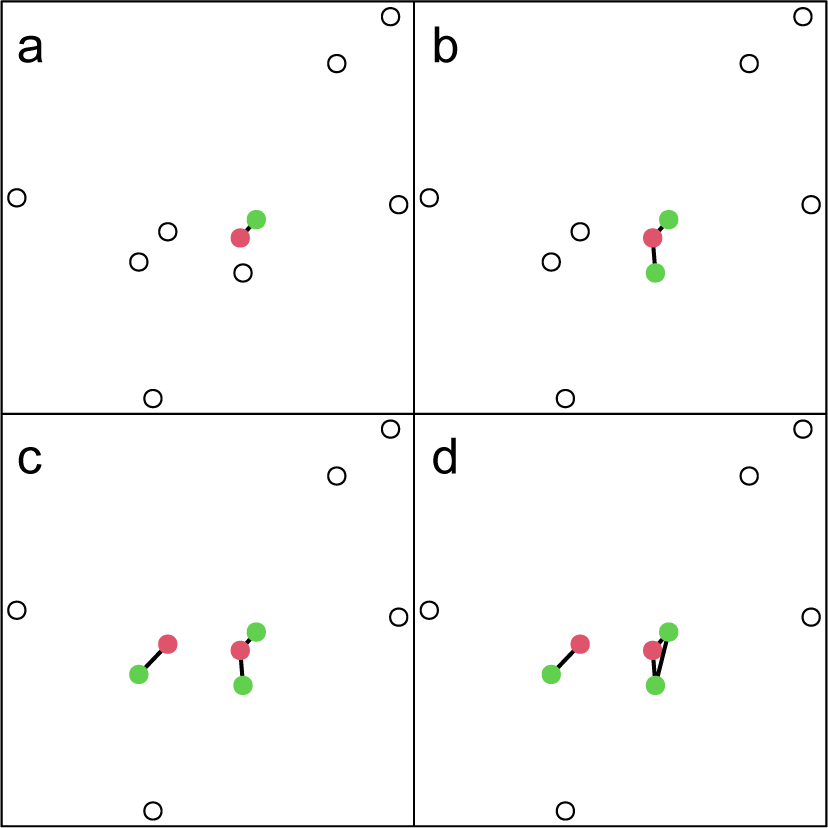

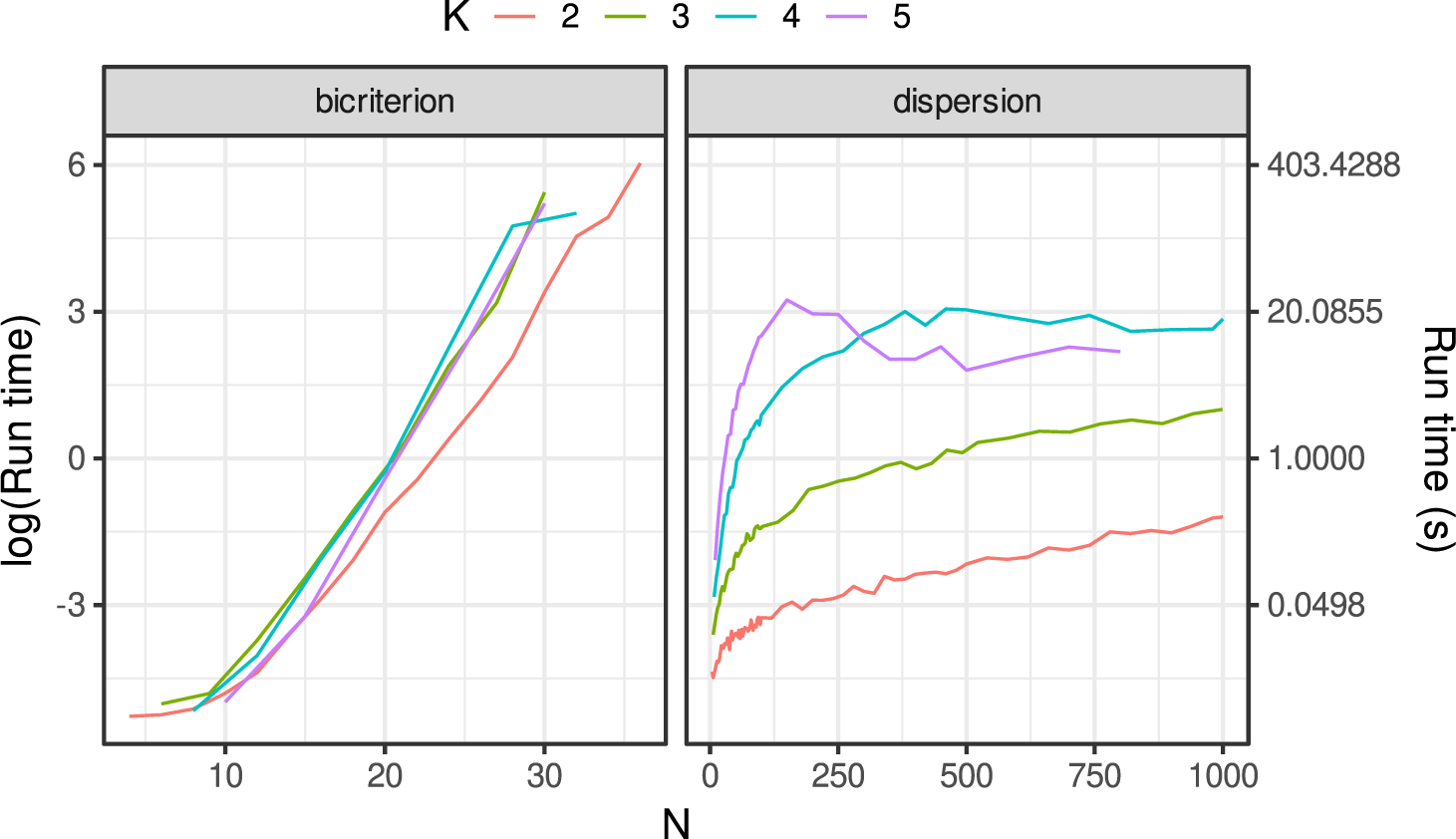
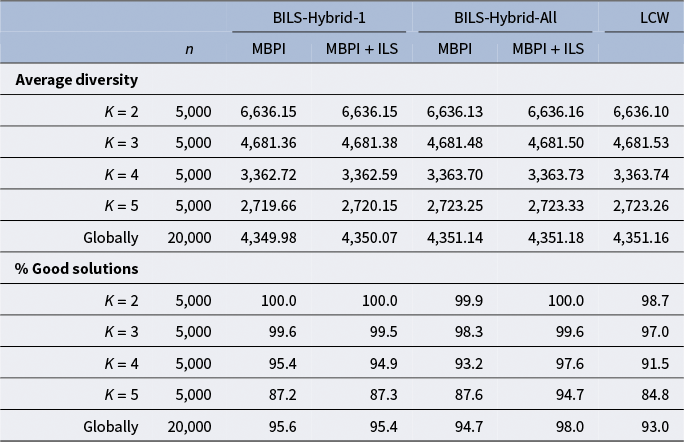
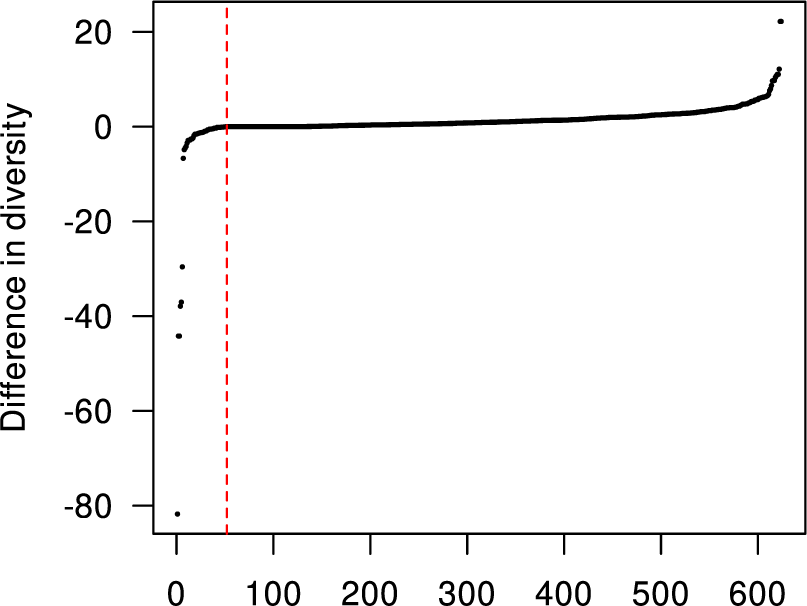
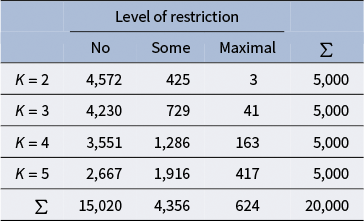
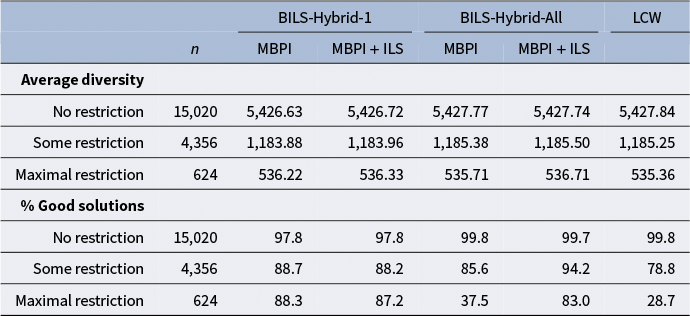
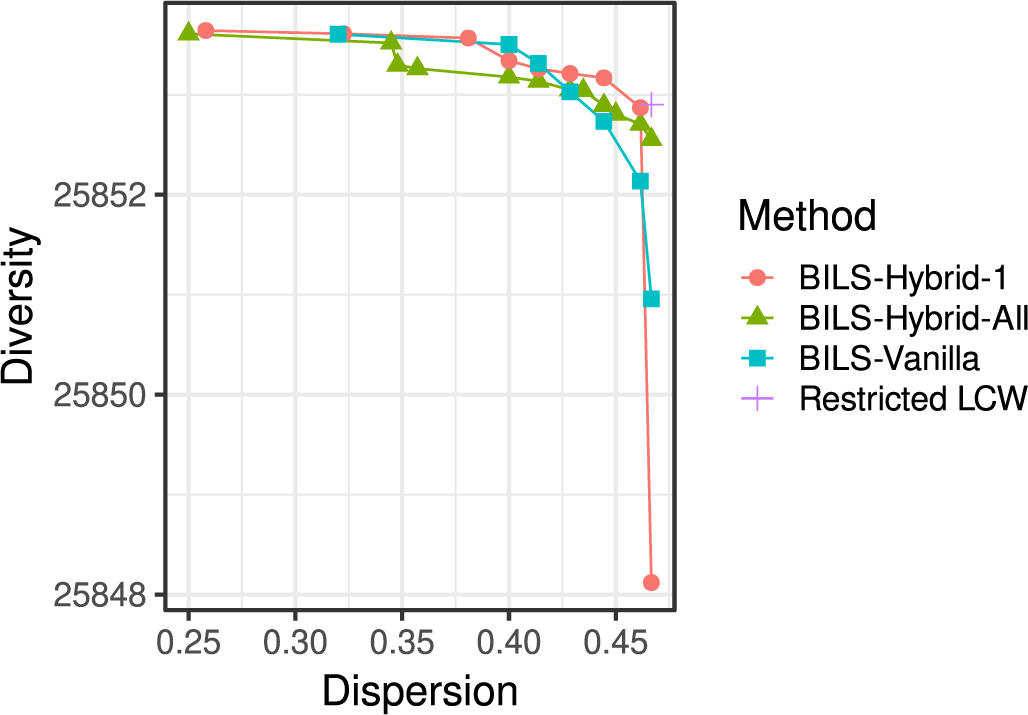
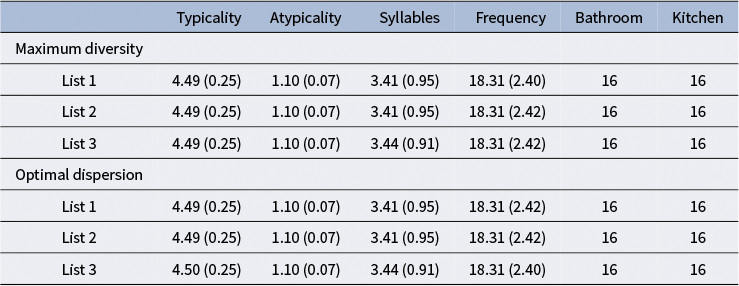

 Open access

