

Introduction
The year 2022 proved to be a challenging year for Norway's newly elected Prime Minister, Støre, from the Labor Party. A series of obstacles, including record-breaking electricity prices and minor scandals, contributed to a significant decline in support for the two governing parties in the opinion polls.
Election report
There was no election in Norway in 2022.
Cabinet report
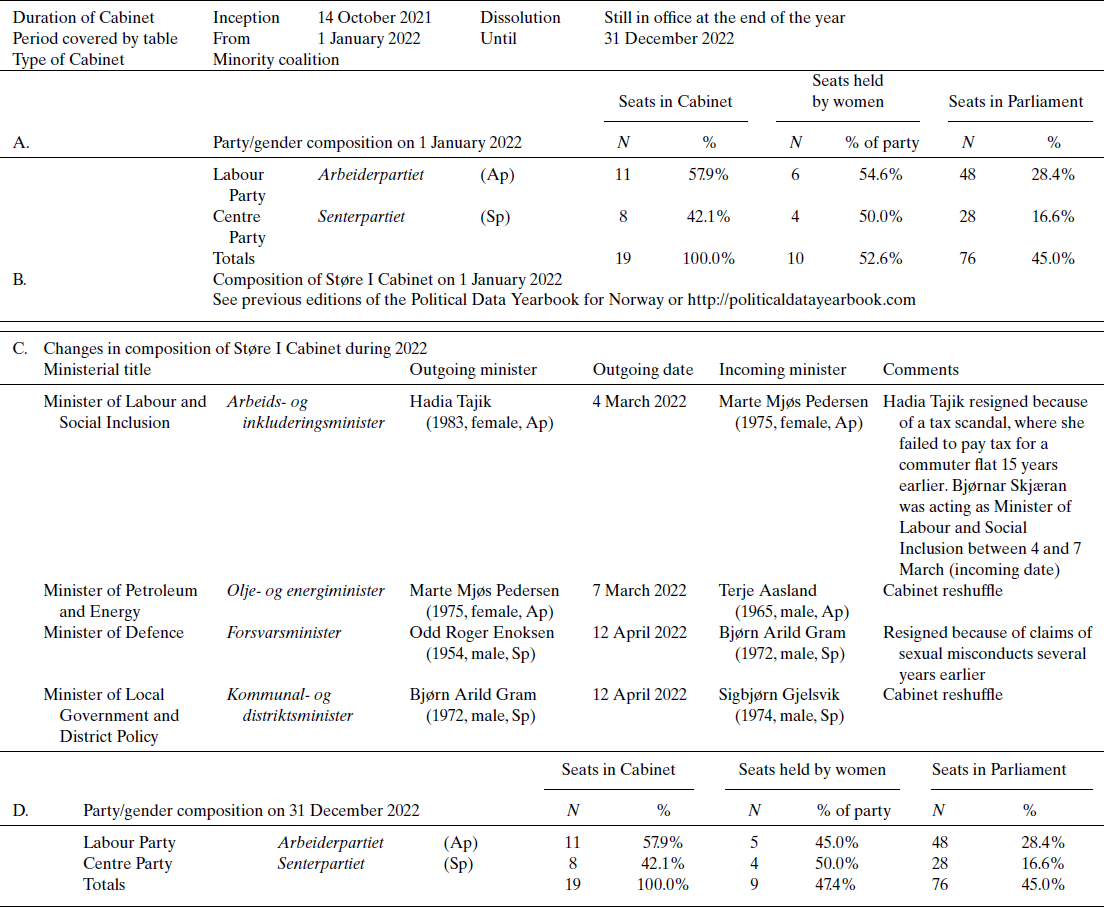
In January 2022, Norway's Cabinet consisted of a coalition of the Labor Party (11 seats) and the Centre Party (eight seats) and was headed by Prime Minister Jonas Gahr Støre from the Labor Party. Of the total of 19 ministers (including the PM) in the Cabinet, 10 were women, meaning the Cabinet consisted of a majority of women. In 2022, this changed to 10 men and nine women due to a Cabinet reshuffle (Table 1).
Cabinet composition of Støre I in Norway in 2022

Source: Norwegian Government's website (2022) (regjeringen.no).
Hadja Tadjik, the female Minister of Labour and Social Inclusion resigned on 4 March due to a scandal related to free housing and taxes (see Issues in National Politics). She was replaced by Marthe Mjøs Pedersen, who was Minister of Petroleum and Energy, and Pedersen was in turn replaced by Terje Aasland.
Parliament report
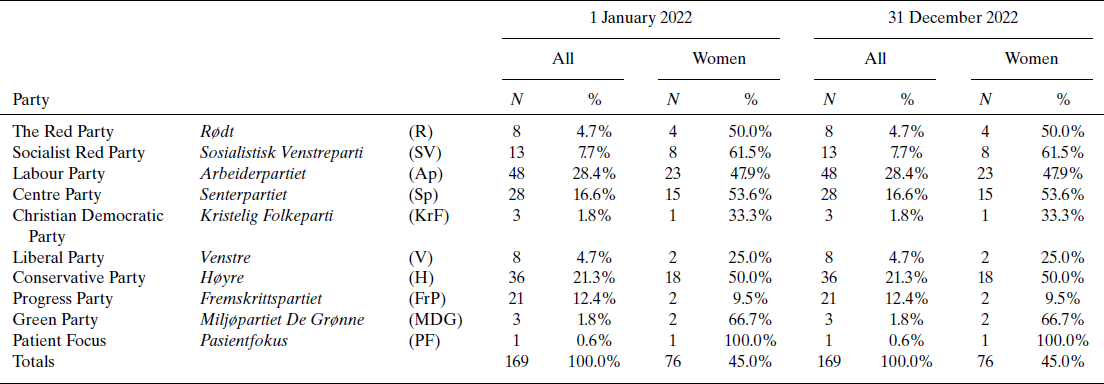
There were no changes in the composition of Parliament in 2022 (Table 2).
Party and gender composition of Parliament (Stortinget) in Norway in 2022

Source: Norwegian Parliament's website (2022) (www.stortinget.no).
Political party report
Two party leaders resigned in 2022 (Table 3). The leader of the Green Party, Une Bastholm, resigned abruptly and surprisingly in August, having been re-elected as leader of the party just three months earlier. At the extraordinary national meeting of the party in November, Arild Hermstad was elected party leader with a slim majority of just a single vote over the challenger Kristoffer Robin Haug. In November, Audun Lysbakken, leader of the Socialist Left Party, announced that he would step down from that position at the next party congress (in March 2023). Lysbakken had served more than 10 years as party leader. Both party leaders gave personal, family-related reasons for their resignations.
Changes in political parties in Norway in 2022

Source: mdg.no, Homepage of the Greens (2023) (mdg.no).
Institutional change report
There were no major institutional changes in 2022.
Issue in national politics
The government of Prime Minister Jonas Gahr Støre faced a series of difficult issues and a few scandals throughout 2022. The two parties that comprise the centre-left minority government, the Labor Party and the Centre Party, consequently suffered a substantial decline in support, according to public opinion polls.Footnote 1 Although the 2021 election was a resounding victory for the centre-left, support for the two governing parties had quickly started to decline in the polls already in late 2021, and this continued through 2022. By the end of the year, support for the Labor party (vote intention) had declined to below 20 per cent, which is extraordinary for the party that has been the dominant force in Norwegian politics for almost a century. The Conservative Party, Høyre, rose in the polls to above 30 per cent, which is unusually high. The loss of support for the Centre Party was also quite dramatic, but it was a decline from one of their best-ever election results in 2021. By the end of 2022, the party had a standing in the polls that was similar to the historical average for the party.
The year started with the country in COVID-19-lockdown due to the spread of the Omicron variant of the coronavirus. This lockdown was a bit more controversial than previous lockdowns, and there was some public debate about its necessity. Most restrictions were lifted on 13 January 2022.
The attack by Russia and the subsequent war in Ukraine naturally dominated news headlines in Norway as in most countries. There was a broad political consensus behind the government's support for Ukraine in this situation, which was evident when the President of Ukraine, Volodymyr Zelensky, gave a speech to the Norwegian Parliament on 30 March. The Norwegian government provided substantial financial and military aid to Ukraine in 2022.
As mentioned earlier, the government was plagued by two different scandals and subsequent resignations of Cabinet ministers within about a month in March–April. The first to resign was the Minister of Labor and Social Inclusion, Hadia Tajik. She was a rising star in the Labor Party; she served as the party's deputy leader and was generally one of the most well-known politicians in the country. It became known that she had received benefits as a member of Parliament and in a previous role as Cabinet minister that she was not fully entitled to—specifically, free housing in an apartment in Oslo. This was the last of a series of scandals concerning the arrangement that parliamentarians could get free housing in Oslo if they also had a place of residence with actual expenses in their home district. It gradually came to light that Tajik did not have substantial expenses in her home-district residence and should therefore have paid taxes on her government housing in Oslo. Tajik resigned both from her position as Cabinet minister and as deputy leader of the Labor Party.
The second scandal concerned Odd Roger Enoksen, the Minister of Defence from the Centre Party. He resigned after it was revealed that he had an inappropriate relationship with a teenage girl in the early 2000s, when he was also a minister.
On 25 June, there was a mass shooting outside two bars in the centre of Oslo carried out by an anti-LGBT terrorist. Two people were killed, and more than 20 were injured. The annual pride parade was scheduled for the same day but was cancelled following a recommendation by the police.
Electricity prices started rising quite dramatically in parts of the country in the fall of 2022. The government did instigate electricity subsidies for both businesses and households. However, they often came under attack from both opposition politicians and others who took part in public debate, for what was seen as an inadequate or too slow response to the rising prices. General inflation also became an issue in 2022, in part as a result of rising energy costs.


 Open access

