

That someone like me could serve as president of the American Political Science Association is a testament to one story about America. It is a story of success that we celebrate, even as such stories erase and conceal other stories about the United States.
I was born in a Korea still reeling from war with a per capita GDP comparable to Ghana, Cambodia, Bangladesh, and other poor nations of the world. My mom birthed me in a complicated delivery with the help of a street vendor as a make-do doula. My childhood years were spent in various towns and villages in Malaysia before my parents made an unthinkable decision—the same unthinkable decision that millions and millions of others had made before them—to leave family and friends and all they knew for the promise of freedom and fortune for their children in a foreign land.
My story is but the tiniest of threads in the immense, textured, varicolored fabric that is the history of immigrants in the United States—which Oscar Handlin (Reference Handlin1951) argued was, simply, American history. I start on a biographical note because today stories like mine and that great fabric of America are fraying and under threat. Just as our 236-year-old democracy is fraying and under threat.
Democracies are a diverse lot, and ours has taken many forms and survived forbidding external and internal threats throughout its history. Since its inception, American democracy has been characterized by defining, unsettled tensions (see, e.g., Allen Reference Allen2014; Lepore Reference Lepore2018; Smith Reference Smith1997). Tensions between the founding myths of liberty, equality, and the pursuit of happiness and the ground truths of settler colonialism, chattel slavery, entrenched patriarchy, and the like. Between creedal commitments to inclusion and constitutionally mandated equal protection and institutions, practices, and prejudices that reproduce exclusion and inequality. Between stories of success and stories of struggle.
The poet Langston Hughes (Reference Hughes and Rampersad1994) described this American dialectic as “the land that never has been yet … And yet must be.” Ours is a history of struggle and seesawing between what we must be and what we have never yet been.
In our nation’s most recent history, that struggle has swerved at a “move fast and break things” pace. The path of wreckage this time is taking dead aim at our constitutional democracy itself and, with it, science, higher education, and the evidence-based, knowledge-producing institutions vital to a functioning democracy. In short, the path is also taking dead aim at us.
The United States is no longer in the slow and incremental stages of democratic backsliding (Bermeo Reference Bermeo2016; Levitsky and Ziblatt Reference Levitsky and Ziblatt2018; Stokes Reference Stokes2025). Rather we are descending into democratic breakdown (Linz Reference Linz1978) and what Steve Levitsky and Lucan Way (Reference Levitsky and Way2010) call a “competitive authoritarianism.” The power of government is being weaponized to punish opposition and quell dissent. The constitutionally inscribed balance of powers is coming undone. Civil rights and liberties are ignored by diktat, seemingly without regard to citizenship status. Extralegal violence is tolerated, if not encouraged. We are in that danger zone that Barbara Walter (Reference Walter2022) calls “anocracy”—between full democracy and full autocracy—when a long period of political uncertainty, unrest, violence, and even civil war is possible. As political scientists, we have a professional responsibility to meet this moment.
This is the context for my presidential address. And so, I will focus not on the science of politics but on the politics of science. It is a politics whose backdrop is set by major transformations over the last half-century. It is a politics where populist sentiments occupy center stage. And these politics, I will argue, demand that we reimagine political science as a vocation.
Reasoned, constructive disagreement is the lifeline of our vocation, so my goal here is not to settle a debate but rather to open the tough talk that we should be having with each other and as a discipline. It is the kind of talk that is tough to even think about having when we worry about the survival of our departments and its PhD programs, if we have them; worry about vanishing jobs; worry about whether contingent faculty positions will be even more precarious and ungenerous; worry about whether tenure prospects will be held hostage to the good will of state legislators in red states—all the way up the ladder of privilege to those who can afford to worry about whether funding for political science research will return.
***
Five Major Transformations
So, how has a nation poised to celebrate the 250th anniversary of its independence broken down and so quickly? Ask an audience of 10 political scientists this question, and you may get 20 different answers. For my part, key parts of any answer are five major transformations that have changed the United States over the past half-century.
Political Change
In the United States, much has changed over the last 50 years, from the nature of parties as organizations to our primary system, the outsized role of money post–Buckley v. Valeo and Citizens United, the expansion and then contraction of voting rights, and so on. Modulo these changes, an especially conspicuous and critical change has been the rise in partisan and ideological polarization and, with it, authoritarian sentiments and a cratering of trust in government (Hetherington and Weiler Reference Hetherington and Weiler2009; McCarty, Poole, and Rosenthal Reference McCarty, Poole and Rosenthal2016). We have all seen some version of figure 1, showing partisan differences in ideology over time, as measured by DW-Nominate scores, with a yawning gap in common political ground across party lines (McCarty Reference McCarty, Lee and McCarty2019).

Figure 1 Polarization in Congress, 1880–2016
Source: McCarty (Reference McCarty, Lee and McCarty2019).
Figure 2 shows that there are also historic levels of dislike among Americans for one another across the partisan aisle (Finkel et al. Reference Finkel, Bail, Cikara, Ditto, Iyengar, Klar and Mason2020; Iyengar, Sood, and Lelkes Reference Iyengar, Sood and Lelkes2012). In 1978, Democrats were warmer toward fellow Democrats than they were toward Republicans across the aisle by an average of 24 degrees; for Republicans, that warmth gap was 16 degrees. By 2024, the warmth gap for Democrats has soared to 54 degrees and for Republicans to 57 degrees. Today, partisanship is a “mega-identity” that increasingly subsumes previously salient identities like race, religion, geography, and culture (Mason Reference Mason2018). Partisan polarization not only has divided our politicians, our neighbors, our friends, and our family but also has made us exhausted, angry, and hopeless. In 2023, 65% of Americans said that they are “exhausted” most of the time or all the time when politics came to mind; 55% said they were “angry” most or all the time (Pew Research Center 2023).

Figure 2 Affective Polarization, 1964–2020
Source: American National Election Studies, 1978–2024.
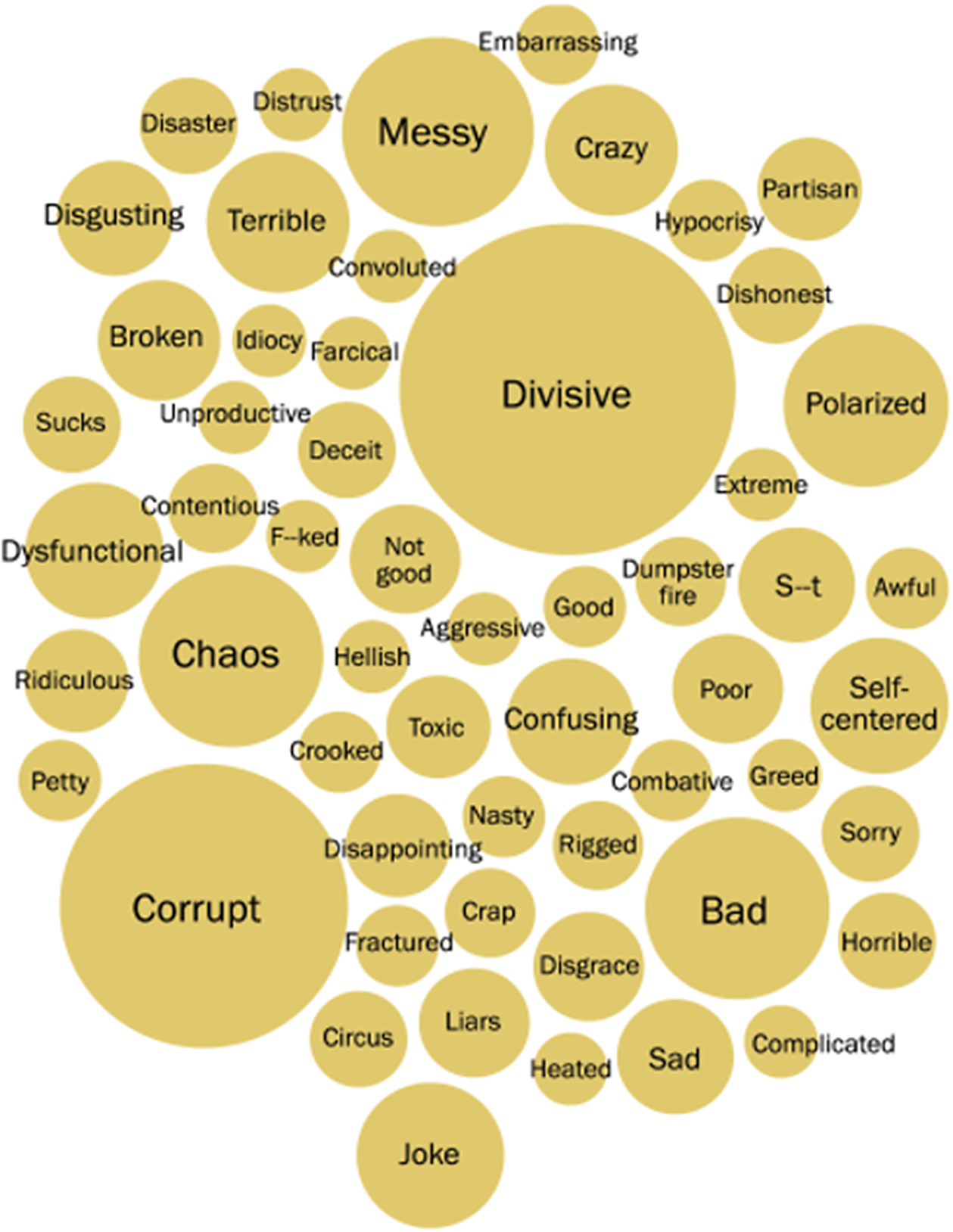
The word cloud in figure 3 is a powerful visual representation of the trouble facing democracy in America today. To the Pew question, “What one word or phrase would you use to describe politics in the U.S. these days,” it shows only one positive word of the 63 most often chosen words. Buried by the massive circles for “divisive” and “corrupt” and just next to “dumpster fire” is the barely visible word “good.” Democratic Party candidates since 2016 have been trying to rally voters to the bugle call of “democracy itself is at stake.” But why should voters care about saving democracy when the “democracy” they experience is exhausting, angering, divisive, and corrupt?

Economic Change
Economic changes over the last half-century have been myriad, from globalization and dependency related to global supply chains; the rise of a knowledge and gig economy; fissured work, a growing precariat, and declining unionism; to the imminent threat of automated labor and the like. The tip of the iceberg of democratic breakdown, however, is almost surely the widening gap between the rich and the poor in many nations, especially wealthy democracies (Piketty and Saez Reference Piketty and Saez2014). American democracy—founded on the idea of formal political equality—has always coexisted with inequality of fortunes. Today that inequality is massive.
Figure 4 shows that in the United States the income share of the top 1% surpassed that of the bottom 50% two decades ago. In terms of wealth, the top 1% enjoy about one-third of the nation’s total wealth, whereas the bottom 50% are asked to make do with only 2.5% of that total wealth.Footnote 1 Alongside this inequality we have a new Gilded Age of deregulation, with a modern-day robber baron class that sends rockets into space, controls satellite communications, masterminds alternatives to the bank-fiat monetary system, and ushers in an era of artificial intelligence that no majority of voters in any democratic country asked for.

With these changes, we see not just rising economic precarity but with it also a loss of the time-honored belief that in America, your children have a right to expect better than you under fair rules of upward mobility. In 2001, 71% of Americans agreed that “today’s youth will have a better life than their parents.” By 2022, that figure plummeted to 42% (Brenan Reference Brenan2022), and in 2024, 74% of Americans believed that children in the United States will grow up financially worse off than their parents (Wike et al. Reference Wike, Fagan, Huang, Clancy and Lippert2025). As scholars have shown, our politics are implicated in this distressing rise of inequality, further fueling polarization and populist sentiments (Hacker and Pierson, Reference Hacker and Pierson2010; Reference Hacker and Pierson2020; McCarty, Poole, and Rosenthal Reference McCarty, Poole and Rosenthal2016).
So, again, consider the question: Why should we care about democracy as a system of government based on formal equality when the policies that system delivers either ignore or enable such an extreme level of lived inequality? As Justice Louis Brandeis is alleged to have once said, “We can have democracy in this country, or we can have great wealth concentrated in the hands of a few, but we can’t have both.”
Demographic Change
More and more Americans today feel like our democracy is not working for “we the people.” It seems to be working for “them,” whoever they are. This kind of populist “us” versus “them” schema is fueled by the third key transformation: demographic change. Societies are becoming more plural everywhere, especially on dimensions of immigration and racial and ethnic diversity.
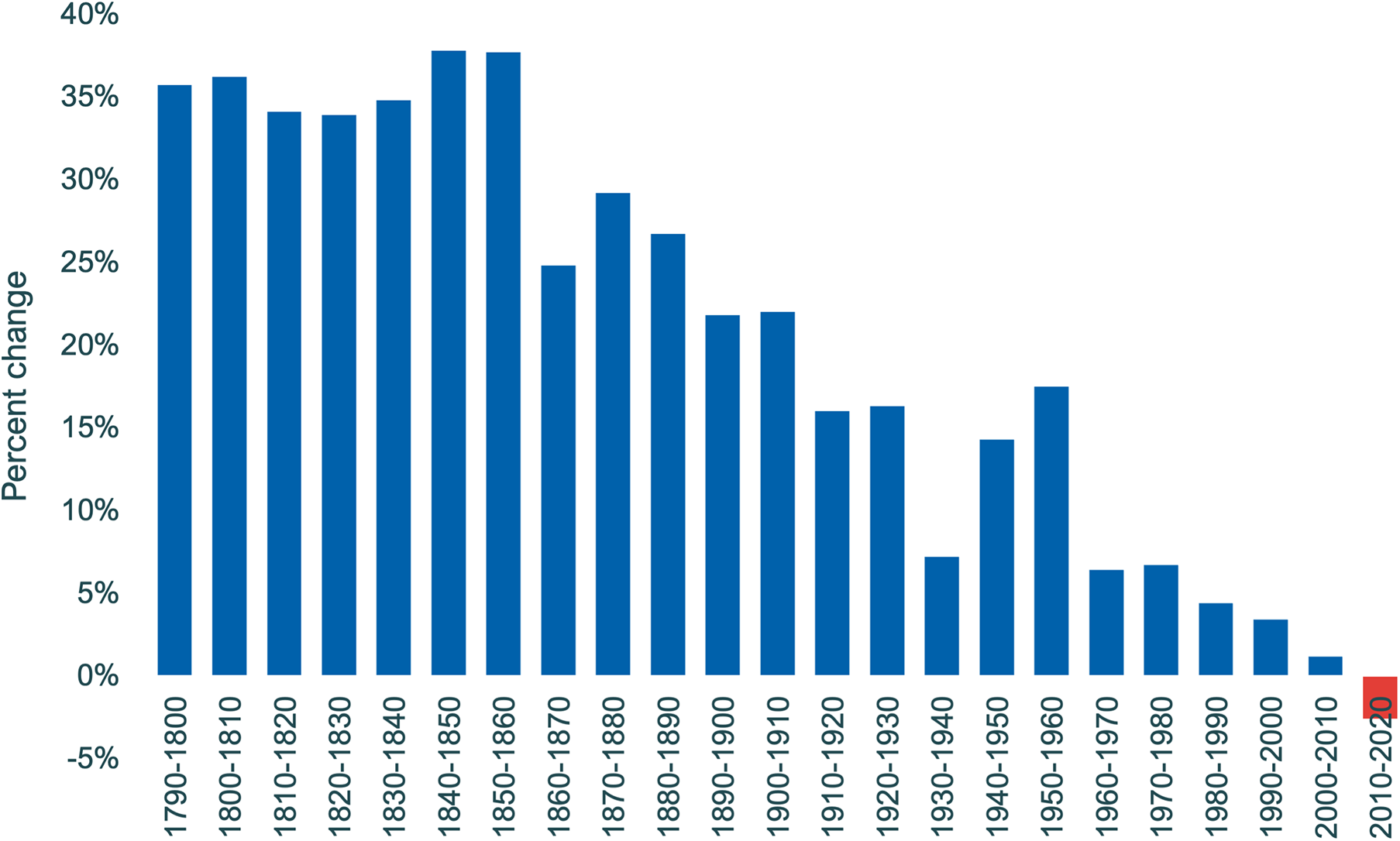
In the United States, diversity is not just about the post-1965 boom in the Latino and Asian American populations and the rise of mixed-race Americans but is also a story about whites. Figure 5 shows that white population growth in the United States has steadily fallen since the Civil War, from 38% growth between 1850 and 1860 to a negative growth rate of -1.4% in the last period, from 2010 to 2020. That more recent decrease is due not just to lower birth rates and low immigration rates for whites but also a result of “deaths of despair”—suicides, drug overdoses, and alcohol-related liver disease—that have become far more commonplace among whites (Case and Deaton Reference Case and Deaton2020).

Figure 5 White Population Growth by Decade, 1790–2020
Source: Frey (Reference Frey2018) and the American Community Survey.
White Americans, especially men, have for most of our country’s history enjoyed a virtual monopoly over power and privilege, as well as over the design of the rules of the game to ensure that dominance. Many in this group no longer feel so powerful or privileged. Yet democracy demands that they share or even cede their power and privilege because demographic changes to the vox populi dictate it, because that is what political equality in a democracy requires.
But what if this group asked themselves this question: What if we didn’t cede power and privilege and did away with democracy instead?
As numerous scholars show, demographic and economic change fuels resentment and status threat and gives rise to reactionary conservatism, populism, and nativist beliefs (Abrajano and Hajnal Reference Abrajano and Hajnal2015; Barreto and Parker Reference Barreto and Parker2013; Craig and Richeson Reference Craig and Richeson2014; Jardina Reference Jardina2019). Today, these forces are gathered to mobilize a minority of white voters who are ready to upend the rule of law and bulldoze constitutional guardrails in an ends-justify-the-means crusade to forcibly remake the United States in a mythologized remembrance of its past.
Social Change
A fourth major transformation is social change. Of the myriad social transformations over the last half-century that could be noted, the one that I see as pivotal to democratic breakdown today is the massive decline in trust and confidence in institutions. Institutional trust and confidence are the oxygen that sustain the proper functioning of modern societies, and as Elinor Ostrom (Reference Ostrom2015) reminds us, they are requisite to collective action and the governance of the commons.
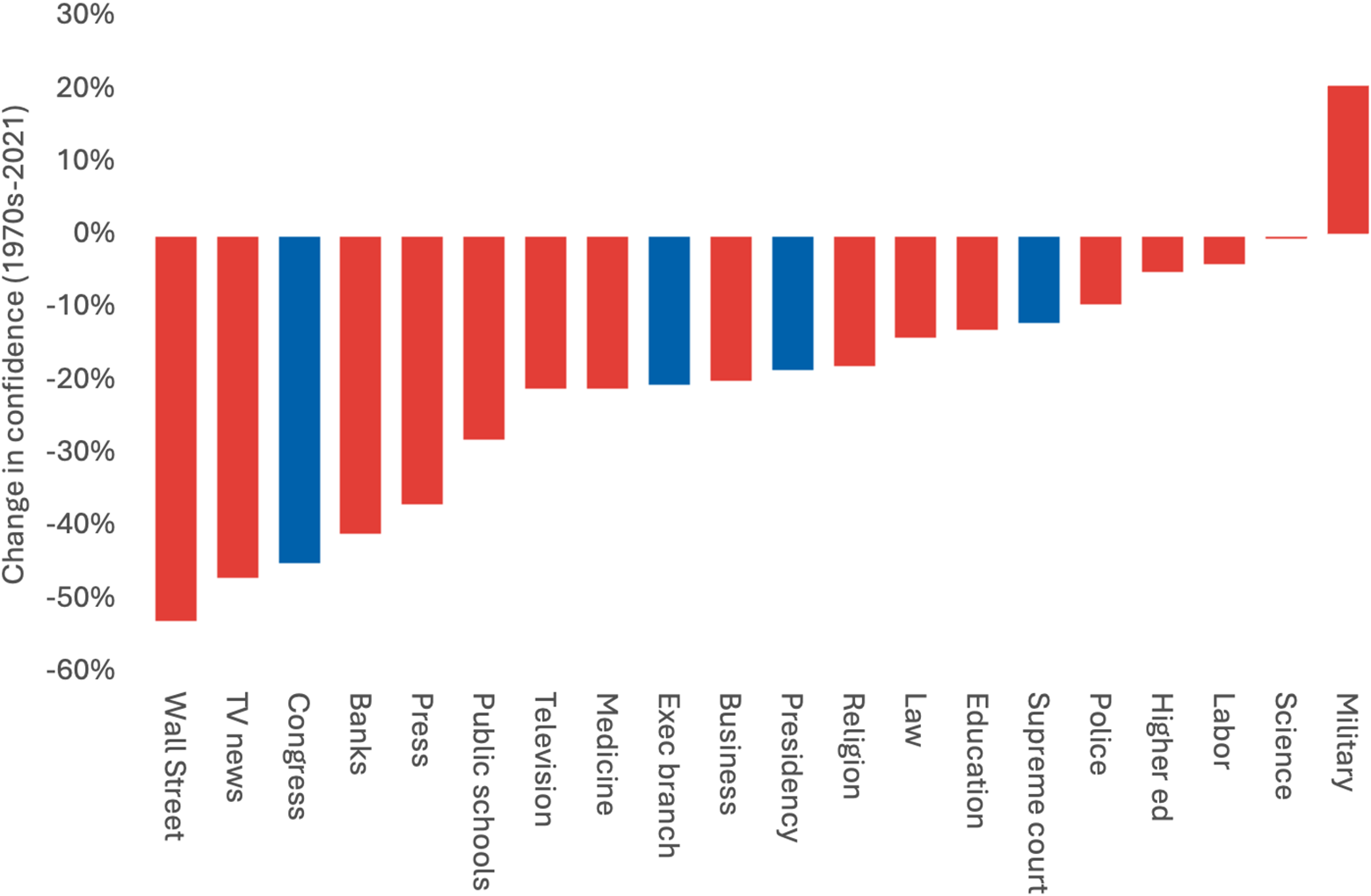
We are all familiar with the massive drop-off in trust in government. Pew’s compilation of regular polling reveals a shocking decline from a peak of trust in government at 77% in 1964 to today, where only about one in every five Americans trust government to do the right thing. But what we have not worried enough about as political scientists is that the freefall in institutional confidence has affected just about every American social, economic, cultural, or political institution (Brady and Kent Reference Brady and Kent2022). Figure 6 is a representation of that decline, comparing institutional confidence levels as measured in the 1970s to those measured between 2010 and 2021. Until recently, among the only notable exceptions to this trend were confidence in higher education and in science. But in the last decade, confidence in in these institutions has also bottomed out.

Figure 6 Declining Confidence in Institutions, 1970s–2020s
Note: Blue bars indicate change in confidence in political institutions — Congress, the Executive Branch, the presidency, and the Supreme Court; red bars indicate change in confidence for all other institutions.
Source: Brady and Kent (Reference Brady and Kent2022).
Confidence in science has long been high but took a downward and partisan turn as the idea of a scientific consensus around COVID became politicized and fiercely contested. In April 2020, just as COVID began, confidence in science was very positive and bipartisan, with 91% of Democrats and 85% of Republicans expressing “a great deal” or “a fair amount” of confidence. By October 2023, confidence remained high among Democrats at 86% but dropped among Republicans to just 61% (Kennedy and Tyson Reference Kennedy and Tyson2023; Lupia et al Reference Lupia, Allison and Jamieson2024). At the same time, 61% is a solid majority, and a recent 68-country study finds that the United States sits in the top quintile of trust in scientists across the globe (Cologna et al Reference Cologna2025).
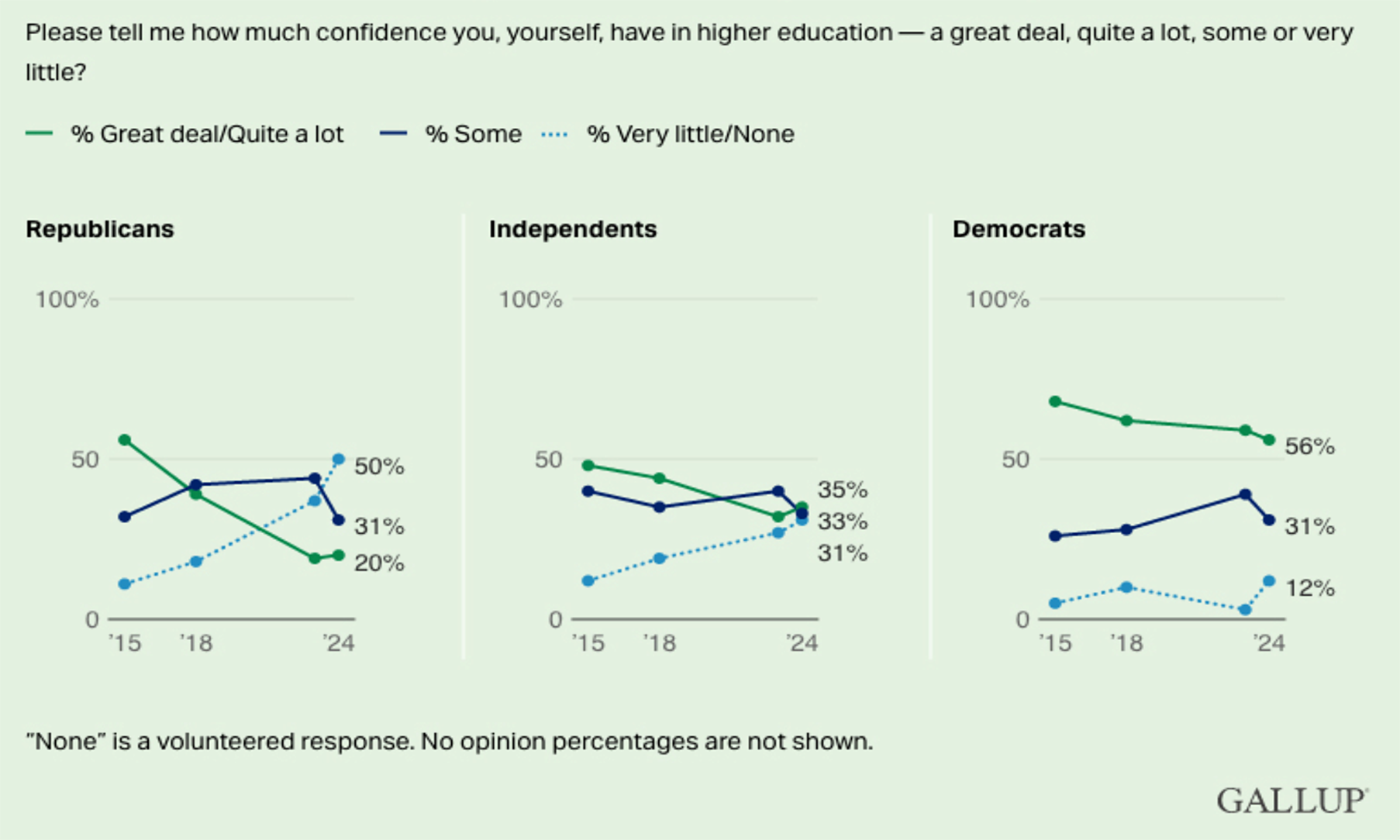
The declining confidence is even steeper and even more partisan for higher education. As figure 7 shows, a Gallup Poll found in 2015 that 56% of Republicans and 68% of Democrats expressed a great deal or quite a lot of confidence in higher education. By 2024, that confidence among Republicans had plummeted to 20%, with confidence among Democrats falling to 56% (Jones Reference Jones2024). There are some hints that confidence levels are ticking up again in the aftermath of the Trump administration’s attacks on high-profile universities (Jones Reference Jones2025). These lowered levels of public confidence in science and higher education are especially troubling in ways that I return to when discussing populism and epistemic institutions.

Technological Change
The fifth and last major change is technological transformation. Again, many shifts in our Third Industrial Revolution could be discussed, including the prospects of artificial general intelligence. For now, there is the immediate and profound impact of technology on our information environment. The digital age promised ubiquitous and instantaneous information and unbounded possibilities of connectivity. Indeed, in many instances digital media have facilitated movements for more freedom and greater democracy, from the Arab Spring and the Umbrella Revolution in Hong Kong abroad to Occupy Wall Street, #MeToo, and Black Lives Matter in the United States.
But that same technology has also ushered in our current rise of misinformation, disinformation, and conspiracy theories (see Figure 8). Today the United States and democracies everywhere are suffocated by a toxic, polluted information environment. Bad actors are recasting truths as untruths and broadcasting untruths as truths, and the atmosphere of what is fact and what is falsehood is so contaminated that too many voters cannot tell the difference. A recent report found that supermajorities of citizens in most countries today see false information as a major national threat. Often, it is the most frequently identified major national threat—more so than climate change, infectious diseases, terrorism, and the state of the global economy (Poushter et al. Reference Poushter, Fagan, Smerkovich and Prozorovsky2025).

Figure 8 False Information as a Major Threat
Of course, this pollution of our information environment is not the byproduct of technological change alone. Misinformation and disinformation are likelier to proliferate in polarized societies and those with weakened, distrusted institutions—societies like what the United States has become over the past half-century. Moreover, as I argue next, they are likelier to proliferate when epistemic institutions, which are traditional bulwarks against misinformed and disinformed publics, are weakened and under attack.
***
Epistemic Institutions
So let me now turn to epistemic institutions: what I mean by the term, why they are so central to democracies and democratic breakdown, and how we as political scientists are implicated. What are epistemic institutions? I do not mean epistemic in the Aristotelian sense of epistēmē or in the kind of proceduralism advanced by Cohen (Reference Cohen1986) or Estlund (Reference Estlund2008). Epistemic institutions are those established entities whose core function includes the discovery, adjudication, analysis, interpretation, and communication of facts and evidence relevant to those who govern and those who are governed. They include mainstream news media, many federal agencies, fact-finding commissions, the judicial system, the scientific community, and, importantly, educational and research institutions.
That is a functional description of the field of epistemic institutions. But there is also a normative role that this field plays. Whether it is on the grounds defended by Cohen or Estlund or Landemore’s (Reference Landemore2012) commitments to aggregation plus deliberation or Anderson’s (Reference Anderson2006) Deweyian commitments to public experimentation and collective inquiry, epistemic institutions are vital because truth is an essential democratic value. Democracy is an epistemic project, in which other aims like free and fair electoral competition and other ends like collective governance and social largesse are unachievable without the adjudication of facticity and reasoning about relevant evidence.
The “people” in a democracy cannot govern themselves or govern together if they cannot agree on the relevant facts and evidence necessary to govern. That is so for the basic ground truths about population parameters or statistics on carbon emissions, employment figures, the risks and benefits of vaccination, the costs of consumer goods all the way up the ladder of generality to what John Rawls (Reference Rawls1971) refers to as the “social facts” necessary to design just institutions and a fair society—such as facts about the background conditions of human capacity, scarce resources, conflicting interests, and so on.
Hannah Arendt’s warning nearly 60 years ago with respect to truth under the threat of totalitarianism could not be timelier today. Arendt (Reference Arendt1967, 78) cautioned, “The result of a consistent and total substitution of lies for factual truth is not that lies will now be accepted as truth, and the truth be defamed as lies, but that the sense by which we take our bearings in the real world—and the category of truth vs. falsehood [as a] mental means to this end—is being destroyed.” Today, some use the word “gaslighting” as shorthand for the destruction of our ability to take our bearings in the real world. Political scientists might see it as evidence of the third face of power: invisible power. For Arendt (Reference Arendt and Beiner1982, 43), the stakes in destroying this ability would be the further loss of the “capacity for an ‘enlarged mentality.’” Arendt (Reference Arendt and Beiner1982, 43) saw such an enlarged mentality as necessary not just to distinguish truth from opinion or to form judgment but also to enable critical reasoning necessary for an ideal—democratic perspective-taking —to “train one’s imagination to go visiting.”
Whether it is to regain one’s senses against gaslighting or to go visiting the mentality of fellow citizens, epistemic institutions are essential to the proper functioning of democratic societies. Importantly, although isolated individual attacks on any one institution that adjudicates evidence and facts may adversely affect that institution, the whole-cloth, broadside attack on epistemic institutions affects all of us when democracy itself is properly understood as an epistemic project. We must understand the current attacks against higher education in this context. When universities and scientific communities have the confidence of the public, they can be bulwarks against threats to undermine our bearings about the real world. But today, that confidence has waned, and a standard in the playbook of resurgent authoritarianism has been to attack epistemic institutions.
This attack is political in nature. And because it is political in nature, political science as a discipline and the American Political Science Association as its flagship organization have a special duty to dedicate ourselves to understanding the origins of this threat and to identifying mechanisms and strategies that might mitigate it. We are the profession that knows something about politics, about democracy and democratic breakdown. As Jane Mansbridge (Reference Mansbridge2014, 8) averred in her presidential address, “if political science is ‘for’ anything, I think it is, and should be, for helping us to govern ourselves.” The increasingly menacing threats to democracy and, as a result, the increasingly urgent responsibility of political science to meet the moment have not been lost on my predecessors. For the last decade, nearly every APSA president has addressed some aspect of challenge or crisis or assembled annual meetings around themes like “Democracy and its Discontents” (2018); “Democracy, Difference, and Destabilization” (2020); and “Democracy: Retrenchment, Renovation, and Reimagination (2024).Footnote 2
At the same time, I hope to persuade us to consider doing even more. This year’s theme, “Reimagining Politics, Power, and Peoplehood in Crisis Times” asks us, together, to reckon with these questions: “What can political science tell us about the roots of division and disorder today?… What constitutive stories of peoplehood and constructions of power might counter these roots of division and disorder?… How can our tools … help us to reimagine the possibilities of politics?” Such questions warrant our collective attention because the work of epistemic institutions today faces a legitimation crisis. When Habermas (Reference Habermas1975) used the term, he referred to a crisis that arises out of the failure of governing institutions to secure and maintain the trust and consent of the governed. Although not all epistemic institutions govern per se—for example, higher education, mainstream media, and citizen watchdog nonprofits—the loss of public trust in them undermines the very “circumstances of justice” that Rawls describes under which human cooperation and collective self-rule are even possible.
This legitimation crisis, moreover, is the tip of the iceberg of populist movements everywhere. As Cas Mudde (Reference Mudde2004), Jan-Werner Müller (Reference Müller2016), and others argue, populism feeds on the belief that societies are separated by an “us,” a pure “original” or “true” people, and an imagined corrupted “them,” whether “they” be outsiders or elites. As academics, we study populist movements in which the “them” are immigrants; ethnic, religious, and sexual minorities; political elites and the apparatus of the state; the billionaire class and their shadowy capitalist cabal. However, we rarely think about the “them” as us: academics, educators, researchers, experts.
To be fair, Americans have cause to distrust institutions of higher education. The costs of a college education have spiraled out of control, while the wage premium for college graduates continues to decline. Rightly or wrongly, many also see our colleges and universities as hotbeds of liberal ideological indoctrination, as failed organizations that have veered far from their mission, and—at least for elite universities like mine—as opportunity-hoarding cartels of high-end credentialing that worsen existing inequalities rather than meliorate them.
Whatever we individually or collectively believe are the intrinsic or instrumental merits of higher education, those values are increasingly lost on the American public. Higher education, like science, has become political fodder for populist attacks against epistemic institutions. In the United States today, less than one in four Americans have “a great deal” of confidence in science. Only one in six have a “great deal” of confidence in higher education.
This creates what I call a “populism dilemma.” In essence, it is the difficult choice that individuals and institutions who are part of the “establishment” face between their self-interest and the collective good of our democratic republic. Self-interest says we should continue doing what seems right to us by habit and experience, which is to defend the value of evidence, education, and expertise. But under populism, that will be heard by those outside academia as an inward-looking, tone-deaf defense of elitism and the establishment. The common good of democracy, under populism, by contrast, might require rethinking, reforming, or perhaps even renovating the establishment from the ground up. That includes higher education.
The populism dilemma, in effect, asks, given the current groundswell of populist sentiments among voters in democracies everywhere, especially the attacks on epistemic institutions, are we (political scientists, academics, experts) part of the problem or part of the solution? And if we are part of the problem—or if we are widely seen as part of the problem—what should we do about it?
The most common response from higher education and many other institutions thus far has been to seek safety in silence and in the shadows. Or, to secure ill-gotten cold comforts by pre-complying with the administration’s demands or negotiating settlement terms to stay out of the limelight. We have, on all our campuses, crackerjack legal teams, public relations teams, distinguished governing boards or corporations, and experienced senior administrators, all trying to do the right thing.
This is the public-facing infrastructure of the neoliberal university. And as Wendy Brown (Reference Brown2015) rightly points out in Undoing the Demos, in the neoliberal university, the ends of learning are conceived in terms of returns on investment, use value, exchange value, option value, and the like, and organizational goals are defined by indicia like maximizing rankings and reputation and minimizing risk. Now, in any isolated, individual case, maximizing rankings and reputation and minimizing risk may advance the interests of any one school, as it has many times before. Yet, under the populism dilemma, when those institutions are broadly distrusted and viewed as illegitimate by democratic publics, those interests will only continue to be advanced under certain scenarios.
***
Four Possible Futures
So let me turn to several possible future scenarios for democracy in the United States and what they entail for the populism dilemma. The list is just illustrative and not mutually exclusive. There are surely many alternative future scenarios, and the ones I elaborate here may age poorly.
Sliding Doors
The first is the sliding doors scenario. In this scenario, the current predicament in the United States is the result of specific, “as-if random” exogenous events. For instance, just days before the 2016 election, former FBI director James Comey makes an announcement about Hilary Clinton’s emails. In the 2024 election, there is an assassination attempt on Donald Trump just weeks after Joe Biden announces that he is dropping out of the race. In both elections, many battleground states were decided by razor-thin margins.
If these sliding door events did not happen, if the knife-edge margins of victory fell the other way, we would not be in our current predicament. And so, ceteris paribus, if these seemingly arbitrary outcomes reversed course in the next few elections, maybe that in itself will bring the United States back from the brink and back to a stable democracy. This is my rendition of the “Democrats just need to win in 2026 and 2028” scenario.
Note, that in this scenario there is no populism dilemma. Maybe the default, usual response to defend evidence, expertise, and epistemic institutions will persuade enough judges, enough legislators, enough voters that the center will hold. Or, more plausibly, maybe the widespread dislike and distrust of epistemic institutions will not get in the way of other issues convincing voters to change the party in power, like the economy; foreign policy; concern about competence, corruption and cronyism; or something else. And if MAGA Republicans are no longer in power, it will be “business as usual” for political science and for higher education.
Of course, past events, like the 2016, 2020, and 2024 elections, shape contemporary events, and contemporary events will no doubt affect the 2026 and 2028 elections. Thus, it is admittedly too pat to describe past or future elections as “sliding doors” or “as-if random” events. Even conceding this point, however, the next several elections could very well continue to be decided by razor-thin margins. Ousting MAGA Republicans from their control of unified government in 2026 or 2028 alone will not undo democratic breakdown, or reverse the tide of populism, or renew the public’s confidence in epistemic institutions of democracy. To me, it is thus folly to pin our hopes on this scenario.
Breakdown Continues
The second scenario is the “things continue to fall apart” scenario. Here, democratic norms and institutions continue to be dismantled unabatedly, and the United States becomes a competitive authoritarian regime for the long term. Or breakdown worsens, opposition ceases to exist, and the United States becomes more of a dictatorship, a single-party state, a populist authoritarianism, or something else.
To animate the populism dilemma in this scenario, let me share a cautionary tale from Adam Przeworski’s Substack.Footnote 3 In it, Przeworski excerpts Peter Drucker’s (Reference Drucker1979) account of the Gleichshaltung—the Nazi takeover of Germany’s epistemic institutions—in which Drucker describes a Nazi-led mandatory faculty meeting at Frankfurt University. This institution was world renowned for its liberal faculty and serving as a home to critical theory, the Frankfurt School, and the Institute for Social Research. The Nazis specifically targeted Frankfurt University to bend to its will, because if they could bring its faculty to their knees, they could bring all German academia to submission.
At this mandatory meeting, the Nazi-appointed commissar for Frankfurt pointed to each department chair and said, “You either do what I tell you or we’ll put you into a concentration camp.” After a long silence, one of Frankfurt’s most distinguished and outspoken liberal faculty member, a scientist, stood up and said, and here I quote, “Very interesting, Mr. Commissar, and in some respects very illuminating. But one point I didn’t get too clearly. Will there be more money for research in physiology?”
Drucker then writes, “The meeting broke up shortly thereafter with the commissar assuring the scholars that indeed there would be plenty of money for ‘racially pure science.’” What is chilling about this vignette is that it is at once unimaginable and yet all too plausible today. “Academic freedom is non-negotiable,” we all incant. But will there be more money for research in physiology?
If populism continues to fuel a long-term descent into authoritarianism or worse, political science and higher education will likely continue to be targeted, probably more systematically than at present. Then we will face both a pragmatic and a moral imperative. Do we continue to defend our interests by insisting on a professional ethic that is singularly focused on scholarship and science? Or would we be willing—modulo our abiding attention to inference, replication, falsifiability, generalizability, and the like—to engage the political world itself as advocates and even activists? Even if doing so puts us at risk of losing rank, reputation, and resources?
The 3.5% Solution
A third scenario might be called the 3.5% solution, based on research that finds that bottom-up nonviolent demands for change will succeed when 3.5% of a polity rises up in protest (Chenoweth and Stephan Reference Chenoweth and Stephan2011; see also Lichbach Reference Lichbach1995). In this scenario, democracy in America would be restored if there would arise a resistance movement of more than 12 million Americans. This is what a lot of progressive, left-wing Americans probably hope will happen and what the coordinated “No Kings” protests are seemingly aiming to achieve.
Chenoweth herself (Reference Chenoweth2020) notes that 3.5% is not in itself a magical number that fulfills the necessary and sufficient conditions for a protest movement to win. The number alone says little about organizational resources, common causes, and the systematic, sustained building of strategic capacity that enjoins idle spectators to become active participants, and active participants to become committed leaders of successful movements (McKenna and Han Reference McKenna and Han2015). In addition, even a strong civil society alone is no guarantee of democratic flourishing (Riley Reference Riley2010).
Whether mass protest would nullify the populism dilemma will depend on who are the 12 million who march in the streets, what they demand, and why they demand it. Some six million or so Americans came out for the second major “No Kings” protests this October. But who would be the additional six million or so who would resist? They could be the 2.0 version of a pro-democracy Obama coalition that many progressives are hoping will emerge anew. Protest movements are often mobilizations against something, and given the breakneck changes to our politics since January 2025, countless potential coalitions may form—from opposition to deficit spending, isolationism, stagflation, a Deep State that has corrupted even Trump, all the way to opposition to oligarchy and autocracy. At this very moment, we see that playing out in the controversy over the Jeffrey Epstein files, where someone like a Ro Khanna finds himself allied with someone like a Marjorie Taylor Greene.
Importantly, if a significant share of those who march in the streets are populists who see expertise and the establishment as part of the enemy, then whatever project of renovation emerges from the protest may not be friendly to higher education and to the contributions of political science. Here, I have thus far used the term “populism” rather generally, without acknowledging that there are multiple ways that boundaries between “us” versus “them” might be made and remade and multiple pathways to conceiving of reality in such binary terms.
Good Populism?
The major transformations that I began with—political, economic, demographic, social, and technological—are potential seeds for different types of populism of the Left, as well as the Right. This brings us to the fourth and final scenario: that of a future with competing varieties of populism. Most often, the competition is between populist politics championed by parties of the Right and populist politics championed by parties of the left. In my book with Pepper Culpepper (Culpepper and Lee Reference Culpepper and Lee2026a), we propose an alternative opposition between populist politics that is destructive or populist politics that is constructive of pluralist, democratic governance—“bad populism” and “good populism,” if you will. This is not idle speculation but matches what our data show: there are two competing dimensions to populist thinking. One focuses on systemic political failures and blames immigrants and racial and religious minorities for being in cahoots with corrupt elites. The other focuses on structural economic unfairness, identifies large corporations and billionaires as the corrupt elites, and covaries with positive affect toward vulnerable minorities (Culpepper and Lee Reference Culpepper and Lee2026b).
Although our thinking on good populism is still developing, the fourth scenario imagines a pro-democracy populism that taps into the same groundswell of antiestablishment anger and resentment that feeds authoritarian populism. But rather than exploiting that groundswell to stoke greater polarization and turn citizen against citizen, “Americans” against “aliens,” “us” against “them,” a good populism would redirect that animus toward structural critiques of inequality and the establishment, such as we have seen in the United States with critiques of crony capitalism, captured bureaucracies, and the like from antiestablishment progressives like Bernie Sanders, The Squad, Ro Khanna, and, most recently, Zohran Mamdani.
In our book, Pepper and I see the foundation for the possibility of a good populism in V. O. Key’s (Reference Key1961) idea of “latent public opinion,” which he describes as “about the only type of opinion that generates much anxiety” among politicians. For us, latent opinion is the iceberg that lurks beneath the surface of the constantly monitored “mass opinion” waters of polling.
To animate how latent opinion might activate a different kind of populism, such as one that defines the antiestablishment “them” as crony capitalism, corporate capture of democracies, and unabated inequality and economic precarity, consider an ongoing comparative project from the Pew Research Center on public perceptions of “threat” (Poushter et al. Reference Poushter, Fagan, Smerkovich and Prozorovsky2025). Figure 9 shows the percentage of such threats in nine wealthy democracies in their data, from 2013 to 2025. The average percentage who identified “the condition of the global economy” as a major threat to their country jumped from 42% in 2017 to 68% in 2025. This perceived threat from the global economy grows while the perceived threats of terrorism, infectious diseases, and climate change fall and the threat of false information online holds just about steady.

Figure 9. Major Threats to Countries, 2013–2025
Source: Poushter et al. (Reference Poushter, Fagan, Smerkovich and Prozorovsky2025).
In the “good populist” dimension that focuses on structural unfairness in the economy, these are not numbers that economic elites want to see. They go hand in glove with other recent poll findings showing that 80% of Americans think that the donor class has “too much” influence on members of Congress, while 70% think that their constituents in their districts have “too little” influence (Pew Research Center 2023). These are numbers that might generate anxiety and even spark movements—perhaps especially in wealthy, unequal, plural, polarized democracies—to fight democratic ills with more democracy. There is no discernible exogenous shock or structural intervention across so many different countries over this time period driving these trends.
Although I use the term “good populism” to imply something positive and even though this alternative form of populism may revive democratic impulses, it may not be so good for anyone currently considered part of “the establishment.” For academics and political scientists, good populism is easy to consider when we think of the establishment as multinational corporations or the wealthy donor class or hollowed-out, captured political parties. But the establishment also includes institutions like higher education and, to be more specific, the many elite universities that perpetuate existing inequalities, rather than mitigate them.
If that is the case, the idea of a good populism again forces us to consider whether we are part of the problem or part of the solution. I previously described the populism dilemma as a choice between self-interest and collective interest. Between choosing to defend our profession and our institutions to preserve the status quo, even if we are “them.” Or bucking the status quo and collectively working to reform or renovate the academy and educational institutions to take seriously the sources of antiestablishment beliefs.
That is not the only choice that the populism dilemma might pose. A good populism may also surface deep cleavages within higher education. A good populism could fracture, rather than unify, higher education and political science. One obvious cleavage line, for instance, would be between those elite, eminent institutions like the one I work for and non-elite institutions like most public universities, community colleges, and other accredited institutions that are not preoccupied with endowment sizes and school rankings.
The latter institutions are those that are more directly responsive and accountable to the public. Political scientists in these institutions are the ones putting in the daily hard yards of trying to rebuild confidence in higher education; in many states, they are on the frontlines of the assault on academic freedom and political control over what is being taught and who is being hired and promoted. So even though the “good” in good populism implies the positive, acknowledging or advocating for a good populism may not free us, as a discipline and profession, from the horns of a dilemma.
***
It does not have to be that way. Let me close with a few thoughts about what is meaningful about being political scientists and how we might, collectively, undertake the work of reimagining what it means to be a political scientist and to champion political science as a profession under democratic breakdown.
The subtitle for this article is “Reimagining Political Science as a Vocation during Democratic Breakdown.” The choice of “vocation” here is a nod to Max Weber’s (Reference Weber, Gerth and Mills1919) essay on what it means to live for politics, rather than living off politics. In one sense, we are all living off (or aspiring to live off) politics. But that is surely not why we are political scientists. To realize primarily pecuniary ambitions, anyone smart and steely enough to complete a PhD in political science could do materially better for themselves in another trade. We do what we do because it is our passion and it gives us purpose to study, think about, and teach politics. Living for politics should be a first principle of whatever a reform or renovation project of political science looks like.
The subtitle also refers to “democratic breakdown.” The Trump administration is aggressively deploying a campaign of fear to dislodge us from our bearings, divide our communities, and dismantle our institutions. But moments of crisis and breakdown such as the current one are critical junctures at which to ask questions about solidarity, allyship, agency, belonging and community building. Do we, as individual political scientists, have what Michael Dawson (Reference Dawson1994) calls a “linked fate orientation,” where we accept that what happens to other political scientists and others in higher education affects what happens to us as individuals? Academics are not joiners by nature, but this is a time when we may truly need to be in solidarity with one another. What would it mean for us to be in solidarity? How does the APSA help us to be in solidarity with one another, and what more can it do?
The context of democratic breakdown also urges a rethinking about desiderata and normative ends to guide our vocation. How useful are abstracted choice conditions like the state of nature, the original position, and contractarianism under conditions of democratic breakdown? For my part, I have been looking to non-ideal theory; for example, Judith Shklar’s (Reference Shklar and Rosenblum1989) “liberalism of fear,” in which she argues that the goal of liberalism and, by extension, liberal democracy should not be some idealized end based on a radically disembodied self or decontextualized standpoint. Rather, the minimum goal of liberalism should be the non-negotiable defense of negative liberties, thereby preventing authoritarian cruelty and political terror at the hands of the state. Foregrounding a concept like Shklar’s liberalism of fear raises questions, such as how we balance the demands of negative liberty, like the principle of noncruelty, against the demands of positive liberty, like academic freedom. My main point here is that the ideal should not be the enemy of the prudent and the necessary in times like these. Can non-ideal theory better help us triage or at least think through whose claims and which interests are non-negotiable when things are getting dismantled at such a breakneck pace?
Lastly, the subtitle also refers to “reimagining.” In his Reference Wolin1969 essay, “Political Science as a Vocation,” Sheldon Wolin (another non-ideal theorist) argues that imagination is a requirement for political theory and that “democracy, if it is to survive, must be imagined differently.” For Wolin, the project of imagination would reinscribe vision, values, and ideals into how we see and study power and institutions. The project of imagination that Hannah Arendt (Reference Arendt and Beiner1982) prescribes as the good of an “enlarged mentality” is the “ability to consider the perspectives of others.”
My plea for imagination flows from the oft-repeated definition of insanity. Political science, as a discipline, sat mostly dumbfounded when Barack Obama beat Hilary Clinton and then won the presidency in 2008. Our cumulative knowledge about elections, voting behavior, and racial politics did not foresee that outcome. We again sat mostly dumbfounded in 2016 when Donald Trump, who surely would have been coded as a “low-quality candidate” (other than being rich), soundly beat a field of 17 primary candidates and then won the presidency. And even though many of us may have predicted the outcome of the 2024 election, I would venture an educated guess that nearly all of us—using our repository of known political science truths— would also have written Trump’s political obituary after January 6, 2021.
My exhortation for a more imaginative political science thus means that we cannot use the same tools and frameworks and habituated ways of conceiving of research questions and designing answers to those questions and then expect a different, more relevant, and more resonant result. We are in a moment of profound disequilibrium in which many things are shifting and many things are being dismantled, and all of that very quickly. Such a moment calls for political science to work creatively, collectively, and organically to rethink and refurbish our tools and frameworks to better reckon what is happening.
Calling on political science to do more thinking and teaching that engages imagination is, I want to be clear, not a call to abandon the science, our expertise, or our broader authority to adjudicate between good and bad theories, evidence, arguments, and analysis. If anything, with the outbreak of misinformation, disinformation, malinformation, and the now normalized practice of gaslighting, our epistemic role is more vital than ever before. At the same time, if we want to reverse the trend of growing mistrust of higher education and science, if we want to shift populist sentiments toward structural critiques—including structural critiques of higher education and political science—we need to find ways for our research and teaching to be more resonant and responsive to the challenges of this moment.
We must ask questions like these: The science of what? And science for whom? I am far from the first political scientist to urge us in this direction. Janet Box-Steffensmeier’s APSA Presidential Task Force is one such project that encourages imaginative rethinking of what we do, how we do it, and why. The task force’s commitment to sustained dialogue across methodological divides has already produced an important volume (Box-Steffensmeier, Christensen, and Sinclair-Chapman Reference Box-Steffensmeier, Christensen and Sinclair-Chapman2024).Footnote 4 There are also, of course, existing works that already engage our imagination about alternative states of the world and new ways to reform and renovate our politics. In my lane of political science, for instance, there is Allen (Reference Allen2004), Sawyer (Reference Sawyer2005), Fung (Reference Fung2009), Beltran (Reference Beltran2010), Cohen (Reference Cohen2012), Cramer (Reference Cramer2016), and Han (Reference Han2024), to note just a few examples.
Why is engaging imagination the right way to be more resonant and responsive under democratic breakdown? I lean into imagination because I think the fight is, at its core, a fight over power. One specific venue for this battle is over the third face of power; that is, the longer-term fight to preserve our democracy and rebuild trust in epistemic institutions will require more than winning elections, legislative votes, or legal challenges in the first face of power. It will require more than getting debates over reinvestments in public education on the policy agenda in the second face of power.
My untested assertion is that winning back public trust in our social and political institutions, as well as public confidence in evidence, expertise, and epistemic institutions, will also require acts of ideational and ideological innovation. We need better tools and theories to understand how beliefs and belief systems are produced, reproduced, and reconfigured. We need better narratives that contest and change those dynamics.
The fight over power will also entail acts of collaboration and consciousness in the domains of “power to” and “power with,” not just triumph in the realm of “power over” (Allen Reference Allen1998). Political scientists are not joiners by nature, and we are not used to thinking about politics and political science as a vocation. But the fight for epistemic institutions and for democracy will also require agency, action, and advocacy. It will require not just thinking and teaching differently but also doing and doing together differently as political scientists.
Many, maybe most, political scientists draw a bright line that they will not cross between their own personal politics and the politics they study and teach. A call to do more than just study power but also to effectuate what we learn from our research may sound like an invocation to engage in more explicit ideological indoctrination—precisely the stuff that makes us subject to widespread distrust in the first place. A call to reimagine politics as a vocation may feel too activist, too partial for those of us who feel that our professional ethics demand impermeable boundaries between a laser focus on objectivity and neutrality in our work lives as political scientists and the messy subjectivity and partiality of our home lives as people in our communities.
Reasonable colleagues can surely disagree on this point. What I would urge nonetheless is that we not draw such bright lines and impermeable boundaries out of fear and uncertainty in the current moment. The current moment demands that we at least consider and debate doing things differently. Among the components of doing things differently is embracing, rather than shying away from, our interest in politics as a passion, a vocation; recognizing our linked fates as political scientists; and engaging a political science that is not only explanatory and interpretive but also resonant, responsive, and imaginative.
For some of us, that could mean commitments to a pedagogy of community-based learning. For others, that could mean engaging in participatory-action research. For yet others, that could mean developing new methods of “projective inference.” Whatever it looks like, an imaginative political science will not generate quick, simple, or singular strategies for how best we should defend epistemic institutions, rebuild public confidence, and restore democratic institutions.
At the end of the day there remains a sober reality: we cannot hold our noses and wait for voters to realize that their avowed preferences are self-defeating; that immigrants, racial and ethnic minorities, sexual minorities, women, and so on should not be scapegoats for their despair and precarity; that liberal democracy is better than authoritarianism; and that political scientists know a thing or two about how politics works.
All these things may be true, but until and unless we reimagine a political science that enlarges our own mentalities, as well as the mentalities of those we are trying to persuade, we will continue to be stuck in our current echo chambers, filter bubbles, and cognitive biases, and those truths will be forever stuck in the Catch-22 of “you are entitled to your facts and I am entitled to mine.”
Acknowledgments
For their generosity and insight on early threads and prior drafts, I am grateful to Danielle Allen, Henry Brady, Wendy Brown, Erica Chenoweth, Pepper Culpepper, Archon Fung, Zoltan Hajnal, Hahrie Han, Robin Harper, Jennifer Hochschild, Jae Yeon Kim, Sunmin Kim, Shirley Lee, Steve Levitsky, Jenny Mansbridge, Kimberly Mealy, Christopher Parker, Peregrine Schwartz-Shea, and Dvora Yanow. Responsibility for lapses of fact, thought, or judgment is emphatically mine alone.