





Over recent decades, accumulating UK and international evidence has reported growing numbers of children and young people (CYP) experiencing symptoms of emotional disorder (anxiety or depression). Reference Vizard, Pearce, Davis, Sadler, Ford and Goodman1–Reference Patalay and Gage6 These disorders not only cause significant distress to the individuals and their families, Reference Stuart Parrigon and Kerns7 but are also linked to poorer long-term mental health outcomes, Reference Costello and Maughan8,Reference Fonagy, Patalay, Ploubidis, Richards and Thompson9 including increased risks of sleep disorders, Reference Kortesoja, Vainikainen, Hotulainen, Rimpelä, Dobewall and Lindfors10 substance misuse, Reference Chandan, Mallikarjun, Marwaha, Morales-Muñoz, Thayakaran and Upthegrove11,Reference Morales-Muñoz, Hett, Humpston, Mallikarjun and Marwaha12 self-harm, Reference Uh, Dalmaijer, Siugzdaite, Ford and Astle13 suicidality Reference Moitra, Santomauro, Degenhardt, Collins, Whiteford and Vos14 and psychotic disorders. Reference Lång, Ramsay, Yates, Veijola, Gyllenberg and Clarke15 Adolescent-persistent depression symptoms are also associated with disengagement from education, employment or training, Reference Weavers, Heron, Thapar, Stephens, Lennon and Jones16 reducing long-term life chances.
Gaps in knowledge
While overall population trends in the level of CYP general psychological distress have been well documented, Reference Collishaw4 less attention has been paid to variations underlying these trends. Identifying the sociodemographic groups and specific disorders most affected will inform those investigating the causes of recent changes, who will therefore be able to develop effective preventative measures. Only studies using comparable methods across similar population-based samples can reliably determine change in prevalence, as opposed to changes driven by differences in clinical coding practice, help-seeking, diagnostic practices or service provision over time. Reference Collishaw4,Reference McGorry, Mei, Dalal, Alvarez-Jimenez, Blakemore and Browne17 Additionally, much of the research has relied on brief, single-informant screening instruments with poor psychometric properties, limiting their sensitivity and specificity for diagnosing mental disorders. Reference Black, Panayiotou and Humphrey18
Addressing challenges
We address these challenges using the Mental Health of Children and Young People (MHCYP) survey, a random household sample that uses child, teacher and parent reports of mental health, which are then screened by clinical raters to determine a probable mental disorder. Reference Ford, Vizard, Sadler, McManus, Goodman and Merad19 The third in a series, the 2017 survey reported small increases in the prevalence of any mental disorder among 5- to 15-year-olds, from 9.7% in 1999 (95% CI 9.0–10.4%) to 11.2% in 2017 (95% CI 10.3–12.1%). This rise was largely driven by emotional disorders, which increased from 4.3% in 1999 to 5.8% in 2017. Reference Sadler, Vizard, Ford, Marcheselli, Pearce and Mandalia20
Through secondary analysis of the MHCYP, we aim to explore which 5- to 16-year-old CYP in England were most likely to have an emotional disorder, what their common psychiatric comorbidities were and to describe changes in prevalence between 2004 and 2017. The MHCYP employs the Development and Well-Being Assessment (DAWBA) and comparable probability sampling across surveys, enabling us to provide a robust, in-depth analysis. We advance upon the initial report by Sadler et al Reference Sadler, Vizard, Ford, Marcheselli, Pearce and Mandalia20 of trends, by (a) including 16-year-olds (available only in surveys from 2004 and 2017, but not 1999) and studying comorbidity; (b) calculating adjusted trends that differentiate changes in mental disorder from demographic shifts; and (c) conducting statistical tests of changes by sociodemographic subgroups and specific disorders. Exclusion of the 1999 sample does not result in much loss of information, because the prevalence of emotional disorder remained relatively stable between 1999 and 2004 (9.7 and 10.1%, respectively).
Objectives
Our goal is to identify which CYP are most at risk and which CYP’s risk has changed the most, thus enabling more precise resource allocation by policymakers and service providers on intervention and prevention. In this paper, we will:
-
(a) Identify the specific emotional disorders with the steepest increases.
-
(b) Identify the groups in which emotional disorders increased most steeply between 2004 and 2017.
-
(c) Describe common comorbidities among CYP with emotional disorders.
-
(d) Identify groups at the highest rates for anxiety and depressive disorders in CYP in England.
Method
This secondary analysis used data from two cross-sectional, population-based MHCYP surveys conducted in the UK in 2004 (N = 7977) and in England in 2017 (N = 9117). Reference Ford, Vizard, Sadler, McManus, Goodman and Merad19 These surveys used a stratified probability sample of school-aged children and were primarily designed to provide official national estimates of the prevalence of mental disorders to inform policy and service provision. Both 2004 and 2017 surveys included children aged 5–16 years, while in 2017 the age range was extended to cover pre-school (2- to 4-year-olds) and young people aged 17–19 years.
Recruitment and study population
For the 2004 survey, approximately 10% of English, Scottish and Welsh postcodes were selected with an inverse probability of their population size, stratified by regional health authority and socioeconomic indicators. Next, children in each postcode were chosen based on the Child Benefit Register. The response rate was 76% of those invited, with 65% completing the mental health assessment, of which 83% included teacher response. The 2017 survey sampled from the National Health Service (NHS) Patient Register (because child benefit was no longer universal) and included only children from England selected from a stratified probability sample covering 6.3% of postal sectors. Of those invited, 59% responded and 52% completed the mental health assessment, of which 54% included teacher response. Reference Green, McGinnity, Meltzer, Ford and Goodman21
In each survey, design weights accounted for the probability of selection and were calibrated so that the weighted sample had a distribution similar to the population in terms of age, gender and region. In 2017, weighting was improved to also account for differential non-response using a logistic regression model with sociodemographic variables as predictors. Reference Marcheselli, Brodie, Yeoh, Pearce, McManus and Sadler22
A total of 17 094 CYP were initially sampled. To ensure that samples were comparable across surveys, we excluded the following from the 2004 sample: 930 CYP resident in Scotland or Wales and 168 CYP who were not registered with a GP. We excluded the following from the 2017 sample: 2406 CYP younger than 5 years or older than 16 years of age, and 29 CYP in local authority care (Supplementary Fig. 1 available at https://doi.org/10.1192/bjp.2025.124).
Procedure
In both surveys, parents and children were interviewed face to face by a trained interviewer using a computer-assisted schedule. Some sections of the interview covering sensitive topics (including parts of the diagnostic assessment) were self-completed. In addition, the CYP’s teacher, nominated by a parent, was also asked to complete a questionnaire, which they received by mail. Reference Ford, Vizard, Sadler, McManus, Goodman and Merad19
Assessment of mental disorder
Mental disorder was assessed using the DAWBA (www.dawba.info), which is a well-validated, multi-informant, standardised diagnostic assessment that combines structured and semistructured data about symptoms and impact relating to different mental health conditions. Structured questions directly map to diagnostic criteria outlined in the DSM 23 and ICD. 24 Semistructured probes elicit a detailed description of CYP’s problems with regard to their nature, severity and impact on everyday functioning. Reference Goodman, Ford, Richards, Gatward and Meltzer25 Responses to the probes were recorded verbatim by an interviewer. The DAWBA was completed by all parents, young people aged 11 to 16 years and, if the family agreed, teachers were mailed a shortened version. Data from different informants were collated by a computer programme that predicts a probable diagnosis that aligns with DSM-IV (2004) or DSM-5 (2017) and ICD-10 criteria. A small team of clinical raters, with access to both quantitative and qualitative responses from all informants, assigned diagnoses to those who met criteria.
To compare across the 2004 and 2017 survey waves, we defined mental disorders based on ICD-10 only; see Supplementary Table 1. 24
Sociodemographic data
The survey collected demographic data on CYP including age (either as continuous or banded into 5–8, 9–11, 12–14 and 15–16 years), gender (boys, girls) and ethnicity (classified as White; Black; Asian; Mixed/Other or White; Black and minority ethnic) and their family, including: parent’s/guardian’s working status (neither working; one working; both working); highest level of education of the parent/guardian completing the interview (up to the level of General Certificate of Secondary Education (GCSE); Advanced Level (A-level); higher education); parental/guardian’s partner status (single; cohabiting; married) and family’s geographical location (London; southern England; Midlands and the East; northern England).
Statistical analysis
The prevalence of (a) any anxiety disorder, (b) any depressive disorder and (c) any emotional disorder was estimated by survey (2004 and 2017) and sociodemographic subgroup, using the above variables for categorisation. The prevalence of specific anxiety or depressive disorders was also estimated by survey, gender and ethnicity, and that of other psychiatric comorbidities using both surveys.
Risk factors were identified using separate logistic regression models adjusting for age (continuous) and gender. Fully adjusted models were also fitted to examine the independent contribution of risk factors. Multiplicative (relative) and additive (absolute) measures of association were estimated by calculating risk ratios and risk differences, respectively. When outcomes were <10%, it was assumed that the odds ratio from the logistic regression model approximated the risk ratio. For more common outcomes (≥10%), risk ratios, risk differences and their standard errors were computed using combinations of marginal predictions from the logistic regression models. Additional models examined whether changes in emotional disorders between 2004 and 2017 differed by subgroup, by fitting covariate-by-wave interaction terms, adjusting for age and gender. Wald test P-values <0.05 for the interaction were taken as evidence of different changes by subgroup. Lastly, risk raios and risk differences were also estimated to measure the change in the prevalence of specific emotional disorders between 2004 and 2017.
A supplementary analysis examined whether gender differences in emotional disorder differed according to family socioeconomic status, by fitting an interaction term between gender and parental working status.
Missing data were relatively rare; only 1.6% of the sample had at least one missing value, and therefore all analyses used available cases. All models accounted for sampling weights. Analyses were implemented using Stata MP (version 16.1 for Windows) and graphs created using R (version 4.2.2 for Windows). The code is available for access at https://osf.io/hb3ft/.
Use of these data was granted by NHS Digital via the Data Access Request Service (DARS-NIC-632349-B5F8W-v0.7).
Results
The combined sample consisted of 13 561 CYP – 6898 from the 2004 survey and 6663 from the 2017 survey. Although the two samples were comparable on most characteristics (Supplementary Table 2), there were relatively more 5- to 8-year-olds in 2017 (after weighting, 36 v. 32% in 2004) and fewer 12- to 16-year-olds (38 v. 32% in 2004). Also, in 2017, there were relatively more CYP from Black and minority ethnic backgrounds: after weighting, 14% in 2004 increased to 25% in 2017. Lastly, in 2017 there were more parents who were in work (at least one parent working, from 84 to 89%) or with a university education (from 26 to 49%).
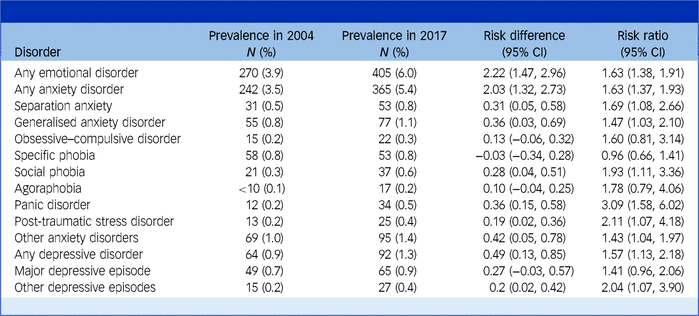
Changes in the prevalence of emotional disorders comprise mainly increases in anxiety disorders (from 3.5 to 5.4%), with a smaller absolute increase in depressive disorders (0.9 to 1.3%) but similar relative increases (Table 1). Increases were found for all subcategories of anxiety and depression, except for specific phobias. Overall, the largest relative increases were in the prevalence of panic disorder (relative ratio 3.09, 95% CI 1.58, 6.02), post-traumatic stress (relative ratio 2.11, 95% CI 1.07, 4.18), social phobia (relative rato 1.93, 95% CI 1.11, 3.36) and separation anxiety (relative ratio 1.69, 95% CI 1.08, 2.66).
Prevalence of specific emotional disorders in 2004 and 2017

Table 1 Long description
The table compares the prevalence of various emotional disorders in 2004 and 2017, including risk differences and risk ratios. It has 14 rows and 4 columns. The columns are labeled 'Disorder', 'Prevalence in 2004 N (%)', 'Prevalence in 2017 N (%)', 'Risk difference (95% CI)', and 'Risk ratio (95% CI)'. The rows list different disorders and their respective data. Row 1: Any emotional disorder, 270 (3.9), 405 (6.0), 2.22 (1.47, 2.96), 1.63 (1.38, 1.91). Row 2: Any anxiety disorder, 242 (3.5), 365 (5.4), 2.03 (1.32, 2.73), 1.63 (1.37, 1.93). Row 3: Separation anxiety, 31 (0.5), 53 (0.8), 0.31 (0.05, 0.58), 1.69 (1.08, 2.66). Row 4: Generalised anxiety disorder, 55 (0.8), 77 (1.1), 0.36 (0.03, 0.69), 1.47 (1.03, 2.10). Row 5: Obsessive-compulsive disorder, 15 (0.2), 22 (0.3), 0.13 (-0.06, 0.32), 1.60 (0.81, 3.14). Row 6: Specific phobia, 58 (0.8), 53 (0.8), -0.03 (-0.34, 0.28), 0.96 (0.66, 1.41). Row 7: Social phobia, 21 (0.3), 37 (0.6), 0.28 (0.04, 0.51), 1.93 (1.11, 3.36). Row 8: Agoraphobia, 10 (0.1), 17 (0.2), 0.10 (-0.04, 0.25), 1.78 (0.79, 4.06). Row 9: Panic disorder, 12 (0.2), 34 (0.5), 0.36 (0.15, 0.58), 3.09 (1.58, 6.02). Row 10: Post-traumatic stress disorder, 13 (0.2), 25 (0.4), 0.19 (0.02, 0.36), 2.11 (1.07, 4.18). Row 11: Other anxiety disorders, 69 (1.0), 95 (1.4), 0.42 (0.05, 0.78), 1.43 (1.04, 1.97). Row 12: Any depressive disorder, 64 (0.9), 92 (1.3), 0.49 (0.13, 0.85), 1.57 (1.13, 2.18). Row 13: Major depressive episode, 49 (0.7), 65 (0.9), 0.27 (-0.03, 0.57), 1.41 (0.96, 2.06). Row 14: Other depressive episodes, 15 (0.2), 27 (0.4), 0.2 (0.02, 0.42), 2.04 (1.07, 3.90).
For disclosure control purposes, frequencies have been suppressed when cell counts are <10.
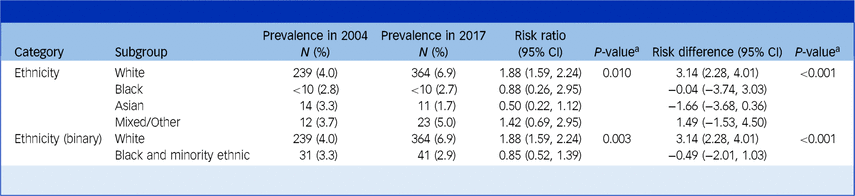
Changes in emotional disorders between 2004 and 2017 varied among CYP from different ethnic groups (P = 0.003 for the additive and P < 0.001 for the multiplicative interaction). In 2017, 7% of White CYP had an emotional disorder, which was 3% more than in 2004 (relative difference 3.14%, 95% CI 2.28%, 4.01%), a relative increase of 88% (relative ratio 1.88, 95% CI 1.59, 2.24; Table 2). In contrast, there was no increase for Black and minority ethnic CYP (3.3% in 2004 v. 2.9% in 2017; relative difference –0.49%, 95% CI –2.01, 1.03 and relative ratio 0.85, 95% CI 0.52, 1.39). There was no evidence that these trends differed based on other sociodemographic characteristics (Supplementary Tables 3 and 4).
Examination of relative differences in the prevalence of any emotional disorder between 2004 and 2017, overall and by subgroup

For disclosure control purposes, frequencies have been suppressed when cell counts are <10.
a. Test for interaction between subgroup and sample year.
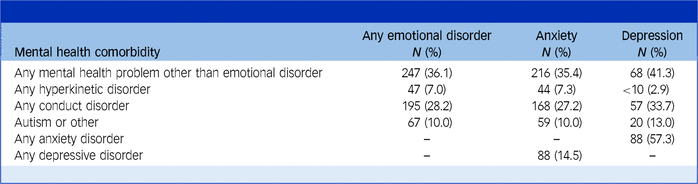
Mental health comorbidities (other than another emotional disorder) were present in 36% (n = 247) of CYP with an emotional disorder, being more common among CYP with a depressive disorder (41%) than in those with an anxiety disorder (35%; Table 3). Respectively, among CYP with anxiety or depressive disorder, 1 in 14 and 1 in 34 had a hyperkinetic disorder; 1 in 4 and 1 in 3 had a conduct disorder; and 1 in 10 and 1 in 8 had autism or a less common disorder. The prevalence of anxiety among CYP with a depressive disorder was 57%, while that of depressive disorder among CYP with an anxiety disorder was 15%.
Comorbidity within children and young people for anxiety and depressive disorder

For disclosure control purposes, frequencies have been suppressed when cell counts are <10.
All sociodemographic variables examined were associated with emotional disorder (Fig. 1). Just over 2% more CYP had an emotional disorder in 2017 (6.0%) compared with 2004 (3.9%), a relative increase of 63% (relative ratio 1.63, 95% CI 1.38, 1.91; Supplementary Table 5). CYP aged 15–16 years were 21 times more likely to have a depressive disorder (relative ratio 20.50, 95% CI 9.30, 45.16) and 2.5 times more likely to have an anxiety disorder (relative ratio 2.52, 95% CI 1.96, 3.24) than CYP aged 5–8 years. Both depressive and anxiety disorders were more prevalent in girls (relative ratio 1.93, 95% CI 1.37, 2.72 and relative ratio 1.27, 95% CI 1.08, 1.51, respectively). Specifically, girls were more likely to experience a major depressive episode, panic disorder, post-traumatic stress disorder or agoraphobia (Supplementary Table 6). Compared with CYP with both parents working, those with no parents working were almost 4 times at risk of emotional disorder (relative ratio 3.80, 95% CI 3.09, 4.68), and those with one parent working were approximately twice as likely (relative ratio 1.78, 95% CI 1.47, 2.15). The association between parental unemployment and emotional disorder was stronger for boys (relative ratio 3.67, 95% CI 2.93, 4.60) than for girls (relative ratio 1.96, 95% CI 1.56, 2.47; Supplementary Table 7). Compared with CYP with married parents, those with single parents were 2.6 times at higher risk of developing an emotional disorder (95% CI 2.21, 3.13), and this association remained after adjustment for family working status (Supplementary Table 8). Anxiety disorders (particularly generalised anxiety disorder and agoraphobia; Supplementary Table 9) were significantly less prevalent in CYP from Black and minority ethnic backgrounds compared with those from a White background (relative ratio 0.58, 95% CI 0.44, 0.76) and were more prevalent in CYP with a parent who had completed education up to GCSE, compared with those with higher education (relative ratio 1.48, 95% CI 1.22, 1.81).
Factors associated with emotional disorders. Measures of depressive disorder associated with age were outwith the limits of this graph; please refer to Supplementary Table 2. For analysis of other risk factors, age was adjusted as a continuous variable. Ref., reference; FWS, family working status; PHE, parental highest education; A level, Advanced Level; GCSE, General Certificate of Secondary Education; PMS, parental marital status.

Discussion
Using data from a high-quality, nationally representative survey that uses clinical raters to assign probable mental disorder, we report a 63% increase in the prevalence of emotional disorders in 5- to 16-year-olds in England from 2004 to 2017. A large proportion of this increase is attributable to rises in anxiety disorders, perhaps unsurprising given the vulnerability to anxiety in this age group. Reference Solmi, Radua, Olivola, Croce, Soardo and Salazar de Pablo26 The increase was most notably evident in CYP from White ethnicities, whereas there was little or no change in the observed prevalence of emotional disorders during this period in CYP from Black and minority ethnic groups. Inequalities in relation to other socioeconomic indicators (including gender, parental working, educational or marital status and geographical location of residency) did not narrow over time. Over a third of those with emotional disorder have an additional psychiatric comorbidity, most commonly a behavioural disorder. Psychiatric comorbidities were more common in 2017, particularly for CYP with depressive disorder.
Our findings align with studies from the UK, Reference McElroy, Tibber, Fearon, Patalay and Ploubidis27 Western Europe, Reference Buli, Larm, Nilsson, Hellström-Olsson and Giannotta28 the USA 3 and China Reference Wu, Wang, Xiang, Zou, Liu and Long29 that have all reported increases in symptoms of emotional disorders in CYP over recent decades, although the current study demonstrates an increase in disorder rather than symptoms. Several of the risk factors we identify confirm prior research: (a) being a girl, older, (b) living in a household where a parent has lower educational attainment, (c) having a single parent and (d) living with parents who are not working were all associated with increased risk of anxiety and depression. While our study compares two cross-sectional surveys, and thus cannot provide evidence on how mental disorders change within a cohort, the higher prevalence in girls than boys, and in adolescents compared with children, conforms to the known epidemiology of emotional disorders in high-income countries. 3,Reference Patalay and Gage6,Reference Goodman, Ford, Richards, Gatward and Meltzer25–Reference McElroy, Tibber, Fearon, Patalay and Ploubidis27 The higher proportion of CYP with depression and who had anxiety compared with those with anxiety and who also had depression supports the theory that anxiety is a developmental precursor of depression. Comorbidity with other disorders was common, as consistently reported by others, and has led to important debates about transdiagnostic processes or general psychological distress. Reference Caspi, Houts, Belsky, Goldman-Mellor, Harrington and Israel30 However, the cross-sectional nature of these surveys, as well as the categorial assessment of psychopathology, prevent us from exploring these issues further. Reference McElroy, Tibber, Fearon, Patalay and Ploubidis27
One potential explanation for the increasing trends in mental health problems is that young people have changed their reporting to surveys, such that they are reporting symptoms at lower thresholds of psychological distress. Reference Foulkes and Andrews31 If this were the case, having a ‘mental health problem’ might be less strongly associated with poorer functioning in later cohorts compared with earlier ones. However, prior studies (including another study using the same data-set as the present one) have reported that functional outcomes in young people have remained consistent or worsened across time for similar levels of reported mental distress. Reference Sellers, Warne, Pickles, Maughan, Thapar and Collishaw32,Reference Armitage, Newlove-Delgado, Ford, McManus and Collishaw33
There are some key differences between our study and published literature. The prevalence of emotional disorder in our study is lower than that reported by other UK studies. This is probably because other studies use short-form screening measures, such as the Moods and Feelings Questionnaire, Reference Patalay and Gage6 that use thresholds on a score to define caseness not directly comparable to clinically rated, standardised, multi-informant, diagnostic assessments. Reference Goodman, Ford, Simmons, Gatward and Meltzer34 A UK-wide study Reference McElroy, Tibber, Fearon, Patalay and Ploubidis27 and one from Wales Reference Anthony, Moore, Page, Ollerhead, Parker and Murphy35 report widening gaps over time in outcomes between young people from higher- and lower-income groups. Although this was not observed in our study, our analysis is limited by the use of crude measures of socioeconomic status, because data such as income brackets were collected differently across waves. Finally, while some studies, such as the Born in Bradford birth cohort, Reference Lewer, Gilbody, Lewis, Pryce, Santorelli and Wadman36 show poorer mental health among White CYP compared with minoritised ethnic groups, ours is the first to evidence comparatively worsening trends in White CYP.
A key strength of the MHCYP survey is that mental disorders were identified using a robust, multi-informant, standardised, diagnostic assessment (DAWBA) that involved verification by clinical raters in a general population sample, 24 which removes increased help-seeking or changes in service provision as an explanation for the observed increased prevalence. Similarly, diagnoses were applied from the same diagnostic manual (ICD-10) by a rating team led by the same two senior clinical raters, ensuring against changes in clinical practice. Although not equivalent to a clinical assessment and diagnosis, we believe this is the closet it is possible to get to a diagnostic assessment of disorder using survey data, and therefore the study avoids some of the sensitivity and specificity issues associated with the use of certain screening tools to measure CYP mental disorder. In addition, the study involved a relatively large sample that provided sufficient power to investigate a range of risk factors, subcategories of emotional disorders and changes according to subgroups.
There are several limitations to the study. First, although the initial sample size used is relatively large, the findings in relation to ethnicity rely on relatively small subgroups and required pooling of ethnic minority groups with potentially widely disparate mental health determinants. Therefore, results in relation to ethnicity need replicating in other samples, in which there may be power to disaggregate by ethnic grouping. Furthermore, examination of ethnicity differences for specific disorders was also not feasible. Second, 35% of CYP invited to the 2004 survey and 48% of those invited to the 2017 survey did not complete the mental health assessment. Non-response may bias estimates if related to the presence of an emotional disorder, and was not accounted for by variables used in the weight calculation. Third, the MHCYP survey lacked detailed data on gender identity other than the binary distinction male/female. Fourth, surveys were carried out before the COVID-19 pandemic, and therefore will not capture recent shifts in CYP mental health dynamics. Reference Bevilacqua, Fox-Smith, Lewins, Jetha, Sideri and Barton37 Lastly, the current study is descriptive – not necessarily a limitation, but it is important to underscore that the results are unsuitable for causal interpretations.
This study reveals further evidence for a significant increase in the population prevalence of emotional disorders among CYP in England between 2004 and 2017. This increase predates the COVID-19 pandemic and is mirrored in other wealthy Western countries. The rapidity of these changes suggests that they are likely to be the result of modifiable effects located in the child’s environment as other, non-modifiable effects, such as genetics, typically change gradually over time. The lack of deterioration observed within Black and minority ethnic CYP has several potential explanations. First, it may be that there is a risk factor that is driving the increase in emotional disorders in CYP, and this is distributed differently by ethnicity. Alternatively, it may be that certain attributes within some groups of CYP mitigate these effects – for example, social or cultural aspects. Finally, it is possible that part of the increase observed may be due to changes in reporting behaviour over time within White CYP compared with those from other groups. Further work is required to disentangle these competing explanations.
Successful prevention of mental disorders requires us to identify their underlying causes. Although multiple theories have been proposed for recent increases, empirical support for each is challenging to obtain. Our findings advance understanding in several important respects. First, any credible theory must explain why these causes affect gender and social class groups similarly, yet ethnic minority groups in England appear resilient. Second, it must account for the greater absolute increase in anxiety disorders compared with depression in 5- to 16-year-old CYP.
Supplementary material
The supplementary material is available online at https://doi.org/10.1192/bjp.2025.124
Data availability
The data for this study can be found and requested at the UK Data Service repository. The authors of this paper are not permitted to share the data. The analytic code used in this analysis is available upon request.
Author contributions
V.P.T., T.J.F. and M.P. designed this study, and V.P.T. conducted the statistical analysis. V.P.T., J.K.A., K.M.A., T.J.F., T.N.-D., S.M., Y.B. and M.P. contributed to drafting, interpretation of the data, critical review and provision of approval for publication.
Funding
The study funders had no role in the study design, data collection, data analysis, data interpretation or writing of the report. M.P. is funded on a Henry Dale Fellowship by the Wellcome Trust and the Royal Society (no. 224243/Z/21/Z). S.M. acknowledges salary support from the UK Prevention Research Partnership (grant no. MR/V049879/1). T.J.F.’s research group receives funding from Place2Be, a third sector organisation providing mental health training and interventions in schools, for research methods consultancy. All research at the Department of Psychiatry in the University of Cambridge is supported by the National Institute for Health and Care Research (NIHR) Cambridge Biomedical Research Centre (no. NIHR203312) and NIHR Applied Research Collaboration East of England. T.N.-D. was supported by an NIHR Advanced Fellowship (no. NIHR300056). K.M.A. was funded by the NIHR Senior Investigator, National Institute for Health Research Health Services and Delivery Research (HS&DR) Programme and Medical Research Council Datamind. The views expressed are those of the author(s) and not necessarily those of any of the funders.
Declaration of interest
None.
Ethical standards
Approval for our access to the Mental Health of Children and Young People database was provided through the UK Data Service Data Access Request Service (no. Z6787610).
Transparency statement
The lead author affirms that the manuscript is an honest, accurate and transparent account of the study being reported; that no important aspects of the study have been omitted; and that any discrepancies from the study as originally planned (and, if relevant, registered) have been explained.


 Open access


eLetters
No eLetters have been published for this article.