





Plain language summary
Many approaches to the classification and recommendation of narratives work by cataloging the contents of narratives, directly or indirectly, or by segmenting narratives into subsets of identifiable features. Computational systems that rely on classification strategies focused on such surface features, we argue, overlook the specifically narrative bases for comparison and similarity between narratives. Moreover, recommendation systems predicated on these approaches are well known to reproduce, if not compound, problems like popularity bias, exposure bias, limited novelty, and explanatory opacity. From our perspective, this is because they are classifying narratives as lists of attributes and not as narrative per se.
Working specifically with film narratives, this article proposes a new approach: classifying films through the lens of contemporary narrative theory. Drawing from developments in cognitive and rhetorical narrative theory, this approach defines narrative according to the cognitive effects it elicits from viewers. To test the hypothesis that a narrative-centered approach would yield appreciably different, and improved results we developed a taxonomy for labeling narrative effects, and annotated a corpus of 8,945 films. We then used a lightweight recommender to compare our results against the MovieLens dataset, a widely used benchmark in recommender systems research.
In this head-to-head comparison with traditional, content-forward recommendation, our method surfaced more films that viewers had not already seen, and surfaced more rarely seen films, while maintaining a strong ratio of liked to disliked recommendations: the recommendations were demonstrably relevant and genuinely novel. This supports the hypothesis that a narratively grounded annotation system identifies previously unrecognized commonalities of preference, or underlying characteristics of taste, and, as a result, would be useful for producing novel recommendations that, because of their grounding in an alternative classification system, do not reproduce the inbuilt biases of other datasets.
This offers a number of advantages. Because these recommendations are grounded exclusively in the experiential effects afforded by film narratives, they are easily understood by users. The recommendations are also made irrespective of surface content, which leads, inevitably, to greater diversity of recommendations and a nudging of audiences toward ostensibly new topics, producers, or materials. Most recommendation systems rely heavily on aggregated data, or massive information on user preferences, to make recommendations, but because our approach only requires that a film has been cataloged according to our descriptive system, we are also able to identify and recommend even unpopular and rarely seen material with a frequency unmatched by traditional systems.
Overall, this project empirically demonstrates that film narratives can effectively be classified and understood in terms of their effects, or specifically narrative properties, rather than their content, and that this approach offers new ways of structuring data and analyzing narratives to computer science and digital humanities. We also demonstrate that this approach can be consequential in commercial applications, enabling recommendation systems to achieve higher accuracy, novelty, transparency, and diversity.
Introduction
This article uses computational simulation to empirically test a hypothesis, originating in the field of rhetorical narrative theory, that media recommendation and content discovery can be enhanced by accounting for novel features of narrative function, thereby surfacing a greater variety of original content and pluralizing media consumption overall. Rather than describing and classifying films based on tertiary characteristics, we drew on rhetorical, functional, and cognitive narrative theory to develop and apply an ontology of narrative effects. The advantage of this approach, we hypothesize, lies in its registration of features perceived narratively, rather than features that merely occur within narratives and must be retroactively construed as narrative functions. Cataloging setting, character, mise-en-scène, affect, or even plot elements exemplifies the latter: while these undeniably contribute to narrative experience, they remain indirect indices of that experience. According to our working theoretical hypothesis, narratives are defined by the effects they produce; the most compelling criterion of similarity is therefore the likeness of those effects or responses, not the similarity of contents employed to elicit them.
For example, What We Do in the Shadows (2014) shares surface similarities of topic, setting, source material, and subject with Bram Stoker’s Dracula (1992) and Nosferatu (2024), but produces narrative effects like low-stakes conflict, ironic detachment, verbal gamesmanship, and socially awkward interaction – effects more aligned with Office Space (1999) or The Death of Stalin (2017). Even tonal aspects of genre lack sufficient narrative granularity. Both Pretty Woman (1990) and Anora (2024) are classified by IMDB as “comedy” and “romance,” and share obvious plot similarities: sex workers fall in love with a male “savior” who promises sudden transformation or escape from their current circumstances. These are often classified as “Cinderella” stories because they all feature elements like a poor girl, a rich man, transformation, fantasy deliverance from circumstances, and the threat that this escape trajectory might ultimately fail. However, these specific narratives can be clearly distinguished from one another in terms of the effects they produce: Pretty Woman produces a sense of escape and optimism, while Anora provokes thoughtful reconsideration; the original Brothers Grimm version of Cinderella, of course, ends with birds mutilating the wicked stepsisters, concluding that tale on a note of spiteful vengeance and even a sense of divine retribution. These differences, we posit, constitute salient and measurable narrative differences.
Narrative theoretical context
This project integrates insights from rhetorical narratology and cognitive narratology. Rhetorical approaches define narrative not primarily by its content but by the effects it produces in audiences, while cognitive approaches seek to explain how such effects arise from underlying mental processes and structures. Our approach treats narrative effects as cognitively grounded responses to narrative stimuli, and therefore models narrative similarity in terms of experiential and cognitive outcomes rather than shared surface features, such as genre, plot, or setting. While this synthesis remains theoretical, it provides the conceptual basis for the ontology of narrative effects used in this study.
Although narrative theorists have identified and cataloged myriad functions and effects (Armstrong Reference Armstrong2020; Fletcher Reference Fletcher2021; Fludernik Reference Fludernik1996; Herman Reference Herman2002; Jacobs Reference Jacobs2015), recommender systems ignore them, focusing instead on genre tags, sentiment scores, or implicit feedback (Ariyanto and Widiyaningtyas Reference Ariyanto and Widiyaningtyas2024; Jayalakshmi et al. Reference Jayalakshmi, Ganesh, Čep and Senthil Murugan2022). None of these search and discovery systems have used narrative theory as a point of departure (ibid.).Footnote 1 Modern (rhetorical and post-classical) narrative theory, relaunched at Chicago in the 1950s as a neuro-cognitive update of Aristotle’s Poetics (Crane et al. Reference Crane, Keast, McKeon, Maclean, Olsen and Weinberg1952; Herman Reference Herman2014), argues that crucial story dynamics – like plot twists, dramatic irony, and anticipatory reversals – are not reducible to surface language (e.g., Booth Reference Booth1961; Fludernik Reference Fludernik1996; Herman Reference Herman2017; Phelan Reference Phelan2015, Reference Phelan2007). Consequently, myriad narrative theorists have characterized narrative as defined by the effects for readers/viewers, rather than any particular set of forms, conventions, content, or surface features (e.g., Fludernik Reference Fludernik1996; Herman Reference Herman2002; Sternberg Reference Sternberg2003a, Reference Sternberg2003b). Narrative, then, actually designates a host of cognitive effects and functions (e.g., Armstrong Reference Armstrong2020; Fletcher Reference Fletcher2021, Reference Fletcher2023; Herman Reference Herman2017), which define the nature of narrative interest (e.g., Baroni Reference Baroni2020; Phelan Reference Phelan2007; Prince Reference Prince1992; Sternberg Reference Sternberg2003a). In other words, films propel narrative interest by affording or inducing these cognitive-narrative effects.
While our method is grounded in the general narratological focus on function and effect, our approach partakes of recent work that explores narrative as a specific mode of cognition (Fletcher Reference Fletcher2023; Turner Reference Turner1998). The human brain is capable of thinking in terms of actions, conjecturing causal relationships, possibilities, and plans (Fletcher Reference Fletcher2023; Fletcher and Benveniste Reference Fletcher and Benveniste2025; Schank and Berman Reference Schank and Berman2003). Narrative derives from this causal, projective thinking. We respond to narrative media in large part as a cognitive response to the types of complex actions, events, relationships, conjectures, or expectations they afford (Comer and Taggart Reference Comer and Taggart2021; Fludernik Reference Fludernik1996; Sternberg Reference Sternberg1993). Though we might itemize the elements of narrative in a list, that list is not narrative, per se, unless it is perceived as an action or event. A list of a film’s contents is not a representation of it as narrative; rather, the perceived patterns of relationships between these contents, and the effects they produce, are (Sternberg Reference Sternberg1993).
Take, for example, the popularly cited six-word “story” – apocryphally attributed to Earnest Hemingway: “For sale: baby shoes, never worn.” Although it lacks explicit, formal narrative features, it nevertheless generates powerful narrative effects as a result of cognitive activities like inference, gap-filling, and implied experientiality. The narrative aspect of this series, then, is constituted by the cognitive process of the reader, as a cumulative response to elements of style, sequence, syntax, diction, tone, etc. This example illustrates that narrativity depends less on formal structure than on the reader’s propensity to construct inferred events and affective scenarios (Caracciolo Reference Caracciolo2014; Fludernik Reference Fludernik1996; Herman Reference Herman2009; Hogan Reference Hogan2011). Our approach emphasizes the consequent effects of perceiving this narratively rather than the contents subtend that response; hence, instead of classifying this narrative by, and seeking matches predicated on, its contents (sale items, classified ads, children’s paraphernalia, footwear, death or loss of a child, etc.), our approach would classify and compare this narrative based on the narrative production of a sudden deflating reversal, understated tragedy, and a lingering sense of hopes foreclosed. Search and recommendation can then identify other narratives that produce a similar constellation of inter-linked effects, regardless of the content by which they are occasioned.
Neuroscience links these sequential cues to cognitive effects, like spikes in surprise producing dopaminergic reward (Friston Reference Friston2010; Ogawa and Shimada Reference Ogawa and Shimada2016; Oudeyer and Kaplan Reference Oudeyer and Kaplan2007), which in turn drive engagement and memory. As a result, per cognitive narrative theory, these effects can themselves be indexed and broadly correlated with neuro-anatomical sub-regions (e.g., Armstrong Reference Armstrong2020; Fletcher Reference Fletcher2021; Jacobs and Willems Reference Jacobs and Willems2018). To illustrate what is meant by “narrative effects” in this context, we draw on representative examples from the cognitive-narratological literature. For example, Angus Fletcher writes that in Emma, the interplay of free indirect discourse, characterization, and narrative causality can trigger “cortex-amygdala blend [that] draws us into experiencing an intimate human connection alongside a wry detachment (Fletcher Reference Fletcher2021).” Similarly, Paul Armstrong proposes that narrative resolution is produced through the temporal structuring of events and the modulation of narrative discourse, which together generate a sense of coherence and closure (Armstrong Reference Armstrong2020). Although this is a theoretical claim within narratology, related findings in cognitive neuroscience suggest that processes of temporal integration and meaning-making involved in such experiences may recruit regions such as the ventromedial prefrontal cortex (Roy, Shohamy, and Wager Reference Roy, Shohamy and Wager2012; Shamay-Tsoory, Tibi-Elhanany, and Aharon-Peretz Reference Shamay-Tsoory, Tibi-Elhanany and Aharon-Peretz2006; Taube et al. Reference Taube, Leelaarporn, Bilzer, Stirnberg, Sagik and McCormick2026). Likewise, while Armstrong has explored the way that narratives spur the cognitive phenomena of emotional responses like fear and anxiety (Armstrong Reference Armstrong2013, Reference Armstrong2020) through the structural production of anticipation and uncertainty, neuroscience studies hypothesize that localized fear and temporally expansive dread can be distinguished both affectively and regionally (Davis et al. Reference Davis, Walker, Miles and Grillon2010; Pedersen, Muftuler, and Larson Reference Pedersen, Muftuler and Larson2019; Somerville, Whalen, and Kelley Reference Somerville, Whalen and Kelley2010). Taken together, this body of work supports the broader hypothesis that narrative experience is constituted through structured cognitive and affective responses, rather than reducible to surface-level features of content or form.Footnote 2 In adopting this hypothesis, our project posits that: narrative is defined by anatomically grounded cognitive responses; the similarity or dissimilarity of narrative perception is best classified through these responses; effects are afforded by the interplay of multiple aspects of narrative; and crucially, none of these effects is deterministically equated with any specific content. Above all, these effects are intuitively legible to viewers/readers because they are descriptions of their narrative perception. Classic examples of such effects include the self-incriminating twist in Sophocles’ Oedipus (Markantonatos Reference Markantonatos2002) or the ironic opening line of Austen’s Pride and Prejudice: “It is a truth universally acknowledged, that a single man in possession of a good fortune, must be in want of a wife” (Müller Reference Müller2018); neither can be recovered by n-gram statistics alone, yet both are instantly recognized by readers.
Narrative in film search and discovery (recommendation systems)
From this theoretical position, content is a proxy variable for experiential narrative effects; hence, those classifiable narrative effects experienced by users are the direct signal of narrative interest, while content is noisy. Put more colloquially: viewers may be drawn to particular topics or genres, but they may also prefer particular kinds of narrative effects, and the two are not synonymous (though they might be conventionally correlated). Content alone is thus unlikely to predictively capture narrative effects and thus risks missing the specifically narrative dimension of engagement. At best, content similarity is indirect; at worst, it can be confounding. Prevailing classificatory systems that label expressed content only obliquely register narrative effects (Ariyanto and Widiyaningtyas Reference Ariyanto and Widiyaningtyas2024; Goyani and Chaurasiya Reference Goyani and Chaurasiya2020; Jayalakshmi et al. Reference Jayalakshmi, Ganesh, Čep and Senthil Murugan2022; Roy and Dutta Reference Roy and Dutta2022; Yao Reference Yao2023): genre categories combine tonal conventions and recurrent subject matter (e.g., noir loosely gathers films centered on crime, corruption, conflicts between legality and illegality, a conventional cinematographic lexicon, and a prevailing atmosphere of bleakness or resignation); sentiment analysis might identify the primary emotions and affects expressed or encoded in the explicit or linguistic content of the medium, yet identifying emotional sequence is not equivalent to grasping its narrative impact – emotional signals might narratively interact in more complicated and non-linear ways, and simply indexing conventional correlations between affective, response, and content risks insensitivity to both novelty and cliché; more specific to recommendation systems, collaborative filtering tries to infer narrative preferences indirectly through the probabilistic overlap of user profiles (Alshbanat, Benhidour, and Kerrache Reference Alshbanat, Benhidour and Kerrache2025; Hu, Koren, and Volinsky Reference Hu, Koren and Volinsky2008). These approaches are not without classificatory value, nor are they narratively irrelevant, but from the standpoint of narrative theory, they bypass the crucial characteristics of narrative experience. We argue that a narratologically-grounded data dimension can augment such methods, sharpening the classification of narratives (films) and enhancing search and discovery, by accounting for the as-yet-uncataloged narrative qualities of media.Footnote 3
The goal of our approach is not to dispute other methods but to test the hypothesis that narratives can be effectively classified by their effects, and determine whether such classification yields insights into similarity and dissimilarity unavailable to surface-feature models. At the level of search and recommendation, we hypothesized that this typology would reveal new criteria underlying user preferences and thereby allow us to identify novel, and compelling, recommendations for users grounded in their core narrative preferences: a narrative “signature” consisting of a constellation of preferred co-occurring narrative elements that drive viewer interest but remain invisible to content-based and collaborative models.
Though a narrative ontology for media classification provides a valuable potential resource for studying, comparing, and analyzing narratives, the ramifications of an improved and expanded basis for narrative comparison and similarity are not merely academic. Commercial search and recommendations systems use algorithmic analysis to ascertain similarities between film narratives, and aspire to increase viewing by locating unexpected or undiscovered films that suit a viewers preference based on prior behavior (Ko et al. Reference Ko, Lee, Park and Choi2022; Raza et al. Reference Raza, Rahman, Kamawal, Toroghi, Raval, Navah and Kazemeini2024). As such, we applied our typology to the task of content discovery to test its practical value – a good test of whether or not our approach could produce different and efficacious insights on narrative preferences. More plainly, our system should produce more surprising-but-plausible recommendations because they would be based on core drivers of narrative interest and not surface-level or representational overlap (contents).
In addition to adding value, this might ameliorate oft-noted challenges and limitations faced by recommender systems due to their dependence on traditional similarity measures. Such over-reliance on content-similarity, directly or via the collaborative filtering proxy (Aljunid et al. Reference Aljunid, Manjaiah, Hooshmand, Ali, Shetty and Alzoubah2025; Papadakis et al. Reference Papadakis, Papagrigoriou, Panagiotakis, Kosmas and Fragopoulou2022), has led to oft-remarked shortcomings of current recommenders (Chaney, Stewart, and Engelhardt Reference Chaney, Stewart and Engelhardt2018; Jayalakshmi et al. Reference Jayalakshmi, Ganesh, Čep and Senthil Murugan2022; Marlin et al. Reference Marlin, Zemel, Roweis and Slaney2011; Roy and Dutta Reference Roy and Dutta2022): their reliance on estimations of the statistical likelihood that a given viewer will be interested in given content, based on previous ratings of narratives with that content, misidentifies the source of narrative interest/enjoyment (Hasan et al. Reference Hasan, Rahman, Ding, Huang and Raza2024), offers an incomplete analysis of narrative similarities, and is reliant on ever-enlarging datasets with diminishing performance returns. Worse yet, recommenders that work with inherently biased data and fitted to standard but unexamined benchmarks risk algorithmically amplifying those shortcomings by causally channeling them back into user behavior (Chaney, Stewart, and Engelhardt Reference Chaney, Stewart and Engelhardt2018; Lin et al. Reference Lin, Gao, Chen, Zhou, Hu, Feng, Chen and Wang2025). While additional data dimensions might refine the current approach, they don’t fundamentally alter the paradigm of search/discovery because they don’t fundamentally reconceive the bases for similarity as anything other than shared material/content. As a result, despite major advances in deep learning (DL) and large language models (LLMs), user satisfaction with movie-recommendation engines remains low (Bischoff Reference Bischoff2024; Jayalakshmi et al. Reference Jayalakshmi, Ganesh, Čep and Senthil Murugan2022; Li and Xia Reference Li and Xia2024; Peng et al. Reference Peng, Siet, Ilkhomjon, Kim and Park2024; Zangerle and Bauer Reference Zangerle and Bauer2022). Viewers routinely complain that “Because-you-watched” rows recycle the same few blockbusters, while more than 95 percent of catalogs stay hidden behind popularity bias (Aqulina Reference Aqulina2023; Johnson, Hills, and Dempsey Reference Johnson, Hills and Dempsey2024; Klimashevskaia et al. Reference Klimashevskaia, Jannach, Elahi and Trattner2024). The business implications – user churn for platforms such as Netflix or Amazon Prime – are well documented (Arvind et al. Reference Arvind, Kumar, Kumar and Pal2024; Comcast 2023), but the cultural cost is broader. By relying on proxies to identify narrative interest, recommenders amplify this problem by creating a feedback loop in which recommendations are predicated on surface similarity to already familiar films or fueled by substantial collaborative signal (other films that people with similar preferences have seen); once consumed, these recommendations become inputs that reinforce priors and narrow consequent recommendations (Jiang et al. Reference Jiang, Chiappa, Lattimore, György and Kohli2019; Mansoury et al. Reference Mansoury, Abdollahpouri, Pechenizkiy, Mobasher and Burke2020; Stoecker, Bayer, and Weber Reference Stoecker, Bayer and Weber2025; Sun et al. Reference Sun, Liu, Wu, Pei, Lin, Ou and Jiang2019; Tong et al. Reference Tong, Qiao, Lee, McInerney and Basilico2023). Hence, viewers face an ever-narrowing exposure to diverse voices and storytelling forms (Biavaz and Denegri-Knott Reference Biavaz and Denegri-Knott2025; Morewedge Reference Morewedge2024; Sah, Xiaoli, and Islam Reference Sah, Xiaoli and Islam2024). This has a resolutely humanistic and pedagogical aspect: by more precisely classifying narrative effects, we can leverage aspects of narrative interest to genuinely diversify search, discovery, and consumption, nudging users toward unfamiliar content, producers, etc.; if users like and incorporate these suggestions into future preference sets, they might in turn further broaden the boundaries of user interest.
Narratively framed search and discovery
Because such approaches to discovery overlook what drives viewer interest in specifically narrative media, state-of-the-art (SOTA) models, capable of writing screenplays on demand, still fail at helping people discover new films. Working from within this narratological approach to data engineering, we therefore pose a simple research problem: Will labeling cognitive narrative elements alter or augment search and recommendation (content discovery) by making previously overlooked features intrinsic to narrative intelligible? If so, then would explicitly modeling cognitive narrative elements improve automated or machine-learning recommendations by identifying “novel” criteria for similarity? If this approach introduced a novel dimension to analysis, it should not merely reduplicate search results obtainable by content (if, for example, content was a secure proxy for effect) but should make otherwise “unexpected” recommendations, balancing relevance with novelty and surprise.
In developing and applying our label system in combination with a simple, lightweight matching algorithm, we anticipated a number of benefits:
Accuracy: Identification of explicit narrative preferences rather than reliance on proxy measures. Our system operates entirely within our narratological feature space. Importantly, films are tagged exclusively in terms of narrative effects rather than narrative content. As a result, the system is effectively content-agnostic: it does not rely on genre, plot, or thematic similarity, but instead on the experiential responses elicited by narrative structure. Two films may therefore be identified as highly similar despite substantial differences in setting or subject matter. Because our system is “context blind” and “content blind” (it does not include data on genre, setting, actors, directors, types of action, year, country of origin, etc.), matches result exclusively from accurately identifying clear signals of narrative interest. Thereby, it accurately identifies what kinds of narratives users like, rather than identifying topics, themes, or subjects about which they are (perhaps incidentally) interested.Footnote 4
Variety, diversity, surprise: Content-blindness naturally fosters diversity. Recommendations cannot cluster around shared content or meta-textual features (classics, eras, and popular genres). Though its possible that other extrinsic groupings, like genres, or films from particular eras, might share narrative features as a tacit component of their grouping, or family resemblance, our system should routinely deviate from genre, period groupings, or other conventional categorizations based on surface features. Likewise, since recommendations would be made irrespective of conventional categories like films topics, themes, or contents, we would expect high levels of perceived surprise or novelty in the recommendations, nudging users toward diverse consumption by linking otherwise dissimilar works through shared narrative features.Footnote 5
Comprehensibility/transparency: Because the matching algorithm relies on a taxonomy and classification system that explicitly identifies perceived narrative characteristics, the grounds for similarity and hence for recommendation are completely transparent and legible. Users can see exactly why a given film was suggested and, conversely, infer latent narrative preferences from their own inputs.Footnote 6
While not explored in this iteration, this level of comprehensibility could potentially facilitate increased levels of user feedback, input, and refinement of result sets, as users can quickly and intuitively identify false positives, refine or respond to suggested narrative preferences, disambiguate results, or generally respond to and/or guide criteria for discovery thanks to the transparency of an ontology grounded in effects.Footnote 7
To explore this, we created:
-
1. A dataset of 8,945 films manually tagged for 321 cognitively motivated narrative elements.
-
2. Symbolic–statistical fusion: A lightweight SQL-based ranking engine where recommendations are driven solely by these narrative features.
-
3. Empirical evaluation: Utilizing the scores and rankings from the MovieLens’s dataset for the purposes of evaluation, we evaluated our recommendations, which were based exclusively on our label data and a lightweight linear scoring algorithm, against industry standard benchmark recommenders (see the “Comparison with other recommendation systems” section). On the MovieLens benchmark (Harper and Konstan Reference Harper and Konstan2015), our approach attains a 7.5:1 ratio of liked to disliked titles and introduces 60 percent unseen content into users’ queues, outperforming genre-only and collaborative baselines without tuning for popularity. Our research goal was to demonstrate plausibly-acceptable novelty. To do so, we wanted to demonstrate a strong ratio of signal-to-noise ratio in the results viewers had seen to support the reliability of the recognized matches, paired with a strong proportion of films unseen by even users with substantial datasets. Hence, our insistence on viewers with at least 50 reviews in the MovieLens benchmark, even though we were relying on a very small input sample to our one-shot recommendation algorithm: six input film IDs per MovieLens user, with a binary user rating for each film (four liked films and two disliked films).
Although the present work is theoretically grounded in cognitive and narrative research, it is conducted within a privately funded context, and accordingly some aspects of the underlying data and implementation cannot be made publicly available. The results suggest that cognitive narrative features alone offer insight on perceived similarity and user preferences between narratives, and suggests that incorporating neuro-cognitive priors into ML pipelines offers a principled route to novelty maximization – an objective that current language-centric models struggle to meet. The content- and context-blind features of the system confirm that this approach identified previously unclassified similarities between films/narratives. Again, our objective was to verify the hypothesized relevance and value of specifically narrative classification as distinct from but potentially complimentary with extant content-driven methods. More broadly, the work serves as a case study in how cognitively grounded symbolic knowledge can act as a complementary inductive bias for modern recommendation and discovery systems, rather than competing with end-to-end learning.
Methods
We built a cognitively grounded recommender system by (i) curating 321 surprise-relevant narrative elements, each linked to specific neuro-anatomical regions (brain parcels), and manually tagging 8,945 films (approx. 43 tags per movie)Footnote 8 ; (ii) creating a light “one-shot” ranking model that scores candidates using only these binary element vectors, weighted by user prevalence and global rarity to favor novelty; and (iii) evaluating on MovieLens-25M with like/dislike polarity, top-30 lists (for HIT@10 and HIT@30 evaluation), and a relevance–novelty harmonic metric, using 2-film query pairs for unseen-item discovery.
Terminology
For clarity, we define several key terms used throughout this article:
Narrative element: A discrete unit within the ontology representing a specific perception of or response to a narrative, represented by a single label.
Narrative effect: A complex cognitive or affective response elicited by narrative structures (e.g., stupefying reversal, tragic resolution, and shifting empathy), characterized by multiple co-occurring elements/labels.
Narrative similarity: The degree to which two works produce comparable configurations of narrative effects; defined quantitatively by the number and statistical value of co-occurring elements/labels between works.
Narrative signal: A measurable indication of user preference derived from the presence or absence of narrative effects, defined by the subset of narrative effects that are most distinctive or consequential within a user’s input set.
Narrative comparison: The process of evaluating similarity between films based exclusively on shared narrative elements rather than shared content.
Constructing a neuro-narrative feature space
To embed cognitively meaningful signals into a recommender, we first curated a vocabulary of 321 discrete narrative effects, manually annotated to films. These elements were organized into six high-level conceptual categories that encompass different dimensions of the narrative experience, including sequential action, pace, causation, atmosphere, world-building, and character dynamics. Each category groups related narrative effects rather than surface-level features, such as genre, theme, or setting. Films were annotated with corresponding labels without the imposition of standardized priors (e.g., no artificial conformity to a standard number or distribution of labels was enforced; label usage reflected empirical evaluation, guided only by the imperative to label what was observed). As such, the frequency and distribution of labels across the annotation corpus were purely observation-driven, and the value of labels (by frequency) was empirically determined.
Twenty-eight trained, expert annotators labeled 8,945 feature-length films (1902–2023) for the presence/absence of each element.Footnote
9
Our senior, supervising annotators held doctorates in literary studies with specific expertise in narrative theory and analysis, and all annotators were trained using internal guidelines defining each narrative element and its application criteria. Annotation proceeded through iterative review, with guidelines refined to improve consistency across evaluators. The process was designed to minimize interpretive divergence through shared training and adjudication practices.Footnote
10
Labeling was undertaken in earnest after annotators achieved a rate of over 80 percent agreement on label attribution on a pilot corpus of 25 films, diversified by genre, year, and popularity. Subsequently, a 200-film pilot yielded Krippendorff’s
$\alpha = 0.78$
 ; thereafter, for this pilot application, single annotations with periodic adjudication were used.
Although we also incorporated supervisory oversight and occasional recursive review of annotation sets, this was a pilot study on the applicability of this typology and labeling approach and hence constrained in size and budget. In future work, we anticipate incorporating multi-reviewer annotations which would permit probabilistic label assignment/fuzzy-sets (to account for interpretive variation across viewers), deriving synthetic reviews, or even mapping user input preferences to specific annotator preferences.
Movies received
$\mu = 42.7 (\sigma = 9.3)$
 labels (range
$18$
labels (range
$18$
 –
$82$
–
$82$
 ), distributed unevenly across six discrete dimensions of narrative analysis, reflecting natural variation in complexity; films were labeled based on the number and variety of effects actually observed. The quantitative disparities themselves offer quantified observations about the differing narrative strategies of films. Label quantities by film did not correlate straightforwardly with genre, period, etc., again suggesting that this criteria is semi-independent of content/subject-matter.
Each element was manually linked – via the modern narrative-theory literature – to one or more functionally defined brain parcels (e.g., parietal-lobe-1, amygdala-6, or frontal-lobe-49) (Friston Reference Friston2010; Itti and Baldi Reference Itti and Baldi2001). For example, “plot twist” was correlated with “parietal4.” The associations between narrative effects and brain regions are manually derived from existing literature in cognitive neuroscience and cognitive poetics. This project is an application of findings drawn from cognitive narratology and cognitive theory and not an experiment in cognitive science or neuro-anatomy; hence, these mappings are intended as illustrative and hypothesis-generating rather than as empirically validated claims within this study. They are used to provide an additional interpretive layer for understanding user preferences, but they are not tested or validated as part of the present analysis.
The principles that inform the ontology are based on the publicly-available, peer-reviewed scholarly works of cognitive and rhetorical narrative theory, such as Crane et al. (Reference Crane, Keast, McKeon, Maclean, Olsen and Weinberg1952), Fletcher (Reference Fletcher2021), Fludernik (Reference Fludernik1996), Herman (Reference Herman2014), and Phelan (Reference Phelan2015), cited above. Though the general approach draws from work in cognitive narrative theory, cognitive poetics, embodied cognition, and post-classical narratology, the specific elements of the ontology constitute the core intellectual property of the company and have been developed through internal research, refinement, and testing. Alternative ontologies could be generated by any team of modern narrative theorists working on any library of narrative content. As an initial experiment, our typology was intended only to assess the general viability and efficacy of cognitive narratological classification, rather than optimize that approach. Refinements, additions, and alternatives would doubtless enhance performance.
Data preparation for simulated user trial and benchmark simulation
We used the user ratings of films from the MovieLens dataset to simulate user interaction with our system, as well as to train and evaluate industry benchmark models for performance comparison (described below). Specifically, subsets of real user histories were generated to provide sparse input conditions (e.g., a small number of liked and disliked films), allowing us to evaluate system performance under controlled conditions. The MovieLens data were not used to construct, refine, or train the narrative ontology or our recommender: the only information from MovieLens used by our recommender consisted of the input conditions: six movie IDs with binary ratings from users.
To create datasets training/tuning the benchmark recommenders for performance comparison, and to generate user data for simulations using our recommender, the processed MovieLens ratings data were partitioned. A training set was created by randomly sampling 80 percent of unique users and 80 percent of unique movies; ratings involving only these sampled users and movies constituted the initial training data. A testing set was similarly constructed using the remaining 20 percent of users and 20 percent of movies.
To ensure that simulated searches represented users with sufficient preference history, both the training and testing rating sets were further filtered. Only ratings from users who had rated at least 50 movies within their respective sets (training or testing) were retained. All of the user data for our simulation was drawn from this pool of users.
Simulated search inputs were then generated based on co-occurrence of “likes” within the filtered training and testing sets. For each set, we identified all pairs of movies (movie1, movie2) that were both “liked” by the same user(s). Each such pair represents a potential search input, simulating a user providing liked movies to the recommendation engine. The set of users who co-liked each pair was also recorded.
Finally, these generated movie pairs (simulated searches), along with the corresponding sets of co-liking users and the count of such users, were saved into separate comma-separated value files for subsequent use in benchmarking experiments. Random samples of these pairs were also saved for potential smaller-scale testing.
One-shot narrative recommender
The system does not employ any neural network architecture; the cognitive/neural element refers to the cognitive-theoretical grounding of the ontology rather than the use of machine learning models based on artificial neural networks. We simulated over 1,000 user searches via our recommender, sampling inputs randomly from the pool of users with 50+ rated films. Our input dataset was small, allowing us to test whether the system could recover meaningful preference signals under sparse data conditions. For each individual MovieLens user, our recommender took as input only a small of sample of movie IDs per user, without any additional selection criteria beyond their user rating (four liked films, two disliked films, based on naive sorting). Hence, our system produced its results from six inputs with binary values (like, dislike),Footnote 11 and no other selection criteria, operating exclusively from our narrative label space. No other, extrinsic information was incorporated into the search, scoring, and recommendations from our own system – it relies entirely on our labels, and the weighting/scoring of narrative labels and features drawn from the statistical analysis of the resultant dataset.
Using this input set, the algorithm identifies and quantifies the value of the narrative effects, also identifying co-occurrences in that sample, to establish a weighting for that user’s specific narrative signature as distinguished from the general corpus frequency of labels and features. The user-indicated values of those specific labels in combination are then used to score and rank our cataloged films. In theory, each search re-ranks the entire review corpus according to determined user preferences, but, for this trial, we returned only the top 30 results per simulated user. The process is described with greater precision below.
Given a user query
$\mathcal {Q}$
 consisting of k seed films, each film m is represented by a binary vector
$E(m)\in \{0,1\}^{300}$
consisting of k seed films, each film m is represented by a binary vector
$E(m)\in \{0,1\}^{300}$
 over the narrative-element vocabulary. Our scoring pipeline is two-stage:
(i) Element importance: For every element
$j,$
 we pre-compute an inverse-movie-frequency
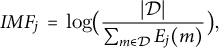
analogous to IDF in IR, so that globally rare cues receive larger weights.
(ii) Query–candidate match: For a candidate film
$m,$
 we first measure set-level similarity with the Jaccard index to establish the strength of the narrative signal relative to the total number of narrative elements associated with each film. This formulation quantifies the distinctiveness of shared narrative features by accounting for their proportional presence across films:

Among the elements present in both
$\mathcal {Q}$
 and m, we keep the three with the largest
$IMF_{j}$
and m, we keep the three with the largest
$IMF_{j}$
 values, denoted
$\mathrm {Top3}(\mathcal {Q},m)$
values, denoted
$\mathrm {Top3}(\mathcal {Q},m)$
 . This weighting emphasized the corpus rarity of individual narrative elements, and non-linearly valued those features that recurred in our small user sample (six films) sets to quantify the distinctiveness of a given user’s narrative signature versus the natural distribution.
The final relevance–novelty score is

that is, the Jaccard overlap scaled by the aggregate rarity of the three most informative shared narrative cues: this constitutes the narrative signature for a given match and emphasizes the most distinctive shared effects rather than overall aggregate similarity.
This formulation blends a global “importance” prior (IDF) with instance-specific similarity, favoring candidates whose rare surprise-bearing elements align with the user’s demonstrated taste. Matches are not based on which films share the most labels, but which films share specific combinations of labels that capture the narrative effects indicated by the user’s preferences.
We deliberately base recommendations on only the most salient shared narrative effects, in order to isolate the distinctive features that characterize a user’s narrative preferences.Footnote
12
This decision was based on work in neuroscience and cognitive psychology which demonstrates that human perception and decision-making incline toward sparse data, outliers, and salient features rather than total similarity of aggregate data dimensions (James Reference James1890; Kahneman and Tversky Reference Kahneman and Tversky1972; Tversky Reference Tversky1977). Work on similarity judgments and selective attention confirms that interest, or perceived similarity is not reducible to overall similarity, but attends to salient cues (Goldstone and Son Reference Goldstone, Son, Holyoak and Morrison2012; Medin and Schaffer Reference Medin and Schaffer1978; Nosofsky Reference Nosofsky1986); moreover, the foci of selective attention can even warp, bias, or alter perception (Bruner and Postman Reference Bruner and Postman1949; Carrasco, Ling, and Read Reference Carrasco, Ling and Read2004; Desimone and Duncan Reference Desimone and Duncan1995). If aggregate similarity of contents drove preferences, any viewer who enjoyed Alfred Hitchcock’s Pyscho ought to enjoy nearly-identically and equally Gus Van Sant’s shot-by-shot remake
$\ldots $
 a conclusion not borne out during internal trials of the recommender
$\ldots $
a conclusion not borne out during internal trials of the recommender
$\ldots $
 nor confirmed by online film ratings or reviews.
Illustrative recommendation example (non-evaluative)
To clarify how the system operates in practice, we provide an illustrative example drawn from the deployed interface of the recommender (not from the MovieLens-based evaluation described below).
Given input films, such as 2001: A Space Odyssey (1968), High Life (2018), and Twin Peaks: Fire Walk with Me (1992), the system identifies a shared pattern of narrative effects characterized by experiential immersion, gradual defamiliarization, epistemic uncertainty, and disquieting social or existential conditions.Footnote 13
Based on this configuration, the system recommends Samaritan Girl (2004). Although the recommended film differs substantially in genre and setting, it produces a comparable constellation of narrative effects, particularly through its portrayal of moral instability, affective unease, and the gradual unfolding of socially and psychologically disruptive events.
This example illustrates how the system links works across otherwise dissimilar domains by identifying shared narrative effects rather than surface-level similarities. The explanatory text presented to users is generated from the model’s internal feature space and rendered in natural language for interpretability.
Comparison with other recommendation systems
One way to evaluate the effectiveness of the proposed recommendation algorithm is to benchmark it against several SOTA models on the widely used MovieLens-1M dataset. We select models that have demonstrated strong performance in recent literature and report their results in terms of hit ratio at rank 10 (HR@10) and normalized discounted cumulative gain at rank 10 (NDCG@10). The chosen baselines represent a diverse set of modeling paradigms, including graph-based, attention-based, generative, and transformer-based approaches:
-
• UFGraphFR (Wang, Hao, and Xiao Reference Wang, Hao and Xiao2026): A unified federated graph feature recommendation model that integrates federated learning, joint embedding, and transformer modules to capture both user and item characteristics. It achieves the highest reported HR@10 and NDCG@10 on MovieLens-1M.
-
• FIDS (Zhu, Yao, and Sun Reference Zhu, Yao and Sun2024): The feature interaction dual self-attention network leverages dual self-attention mechanisms to model both feature interactions and sequential transitions, excelling in capturing complex user–item dynamics.
-
• MultiVAE (Cho and Oh Reference Cho and Oh2022): A variational autoencoder-based collaborative filtering model that models uncertainty in user preferences and provides robust performance across different evaluation strategies.
-
• BERT4Rec (Sun et al. Reference Sun, Khenissi, Nasraoui and Shafto2019): A sequential recommendation model based on the BERT architecture, employing bidirectional self-attention to model user–item interaction sequences.
Table 1 summarizes the performance of four leading models on MovieLens-1M. UFGraphFR and BERT4Rec achieve the highest HR@10 and NDCG@10, with BERT4Rec particularly excelling in sequence modeling tasks. UFGraphFR and MultiVAE also demonstrate competitive results, representing strong baselines for feature interaction and generative modeling, respectively.
Performance comparison of SOTA recommendation models on MovieLens-1M
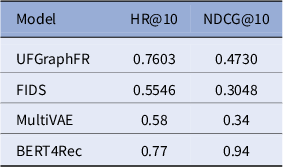
Table 1 Long description
The header row lists Model, H R at 10, and N D C G at 10. The first row is U F Graph F R with H R at 10 of 0.7603 and N D C G at 10 of 0.4730. The second row is F I D S with H R at 10 of 0.5546 and N D C G at 10 of 0.3048. The third row is Multi V A E with H R at 10 of 0.58 and N D C G at 10 of 0.34. The fourth row is BERT4Rec with H R at 10 of 0.77 and N D C G at 10 of 0.94. Values are aligned in columns under each metric.
In conventional offline protocols, a single held-out positive is hidden from each user profile and the recommender is judged on its ability to reproduce that exact item. Under this leave-one-out rubric our narrative-only model achieves an apparent score of 0.0 on both Hit@K and NDCG@K, seemingly suggesting failure. However, the result is an artifact of the metric rather than of the model. As illustrated in Figure 1, the titles surfaced by the narrative system cluster at item-ID ranges 4–5 orders of magnitude larger than those of the validation positives. Because movie identifiers grow with the catalog, large IDs correspond to sparsely reviewed, long-tail films.Footnote 14
Log–log average difference between the IDs of the recommended movies and “ground truth” movies/movies liked by the user. This plots the mean difference between the value of the recommended films IDs and those of the liked films (log scaled) against the liked movie id (log scaled). Movies with fewer reviews have higher IDs. The IDs of films recommended by the narrative-based recommendations are orders of magnitude higher than the one picked by the user. If the recommended and liked/ground-truth movies were of commensurate rarity, the plot would hew low along the y-axis (low mean difference between recommended and liked ids); instead they range above along that axis, at a scale that suggests order-of-magnitude difference.
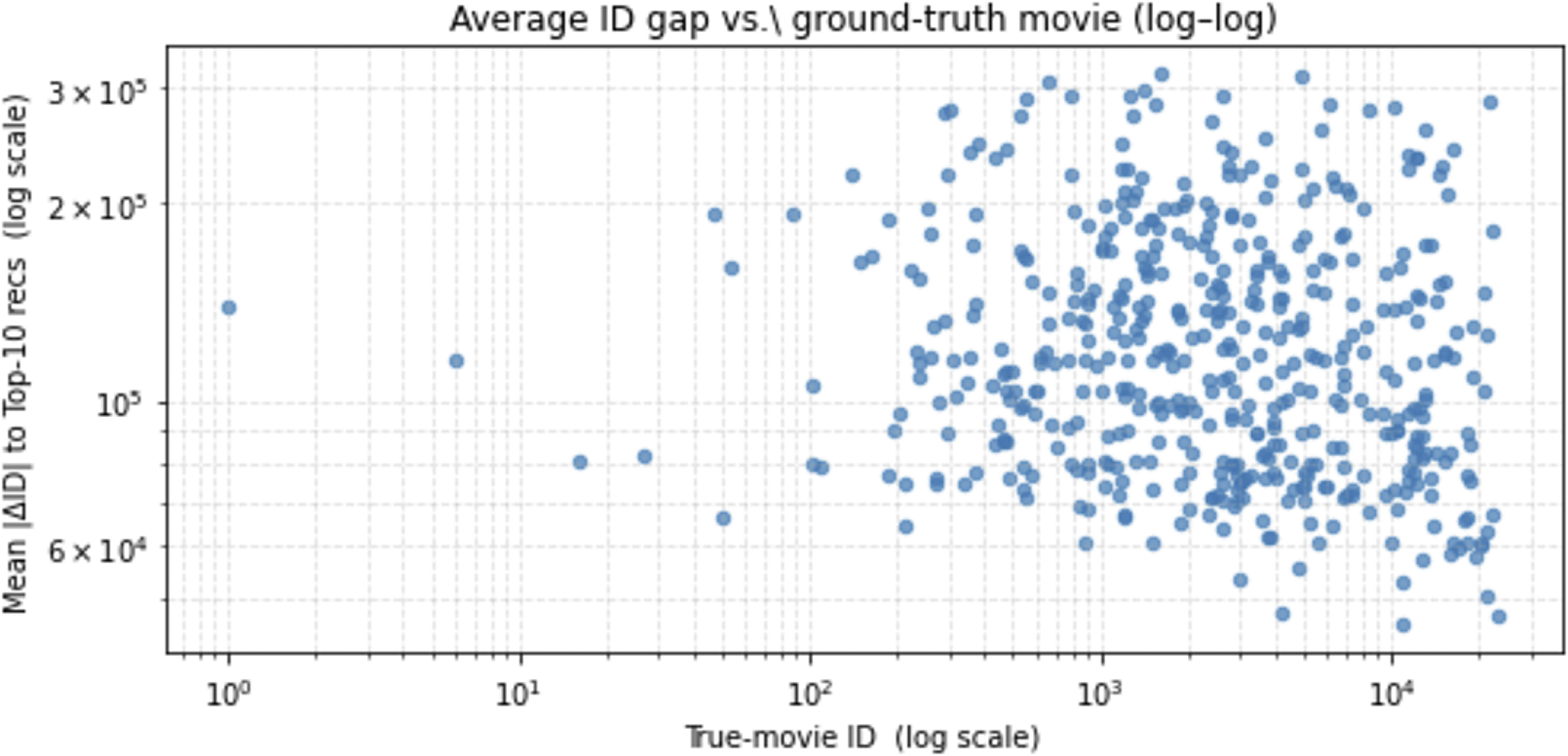
Figure 1 Long description
The plot has a horizontal axis labeled True-movie I D log scale, ranging from 10 to 10 to the 4 power. The vertical axis is labeled Mean absolute value of delta I D to Top-10 recs log scale, ranging from 6 times 10 to the 4 power to 3 times 10 to the 5 power. Each point represents a movie, with its x position set by the log-scaled I D of a liked movie and its y position by the mean log-scaled absolute difference between the I D of that movie and the I Ds of the top-10 recommended movies. The majority of points are distributed between x equals 10 squared and x equals 10 to the 4 power, with y values mostly above 10 to the 5 power, indicating that recommended movie I Ds are typically much higher than those of the liked movies. There is no clear downward trend; instead, the points remain elevated along the y axis, suggesting a persistent order-of-magnitude gap between recommended and liked movie I Ds.
Cold start limitation of standard models: The standard evaluation therefore conflates recovering a known head-item with making a useful discovery: it rewards recommending popular movies that many users have already rated and penalizes recommendations in the cold-start region where no collaborative signal exists. Because of the way that structural biases and media ecologies skew viewer exposure, there is a subtle but significant distinction to be made between successfully predicting the ratings users have applied to already-seen content based on a sample of that viewed content and predicting a user’s potential interest in material to which they have not yet been exposed.
Narrative ontology sidesteps this head-bias: every film, even with zero reviews, can be annotated with plot-level cues. Consequently, the model can recommend genuinely novel content that collaborative-filtering or language-only pipelines overlook. Our analysis shows that the classical leave-one-out benchmark is incompatible with such discovery-oriented objectives and motivates alternative metrics that account for relevance and catalog exploration. This prompts us to evaluate the proposed methodology with human subjects and try to suggest other proxy metrics that could demonstrate the novelty of the proposed solution.
Evaluation protocol of narrative recommender with MovieLens user data
We benchmark on MovieLens-25M (Harper and Konstan Reference Harper and Konstan2015). Ratings are restricted to films in
$\mathcal {D}$
 (18,276 users, 5.3 M ratings). Scores
$\ge 4.0$
(18,276 users, 5.3 M ratings). Scores
$\ge 4.0$
 are likes,
$\le 2.0$
are likes,
$\le 2.0$
 are dislikes, reflecting users’ higher sensitivity to negative items. We split 80/20 by users and movies; users with
$<50$
are dislikes, reflecting users’ higher sensitivity to negative items. We split 80/20 by users and movies; users with
$<50$
 likes are discarded. For each user, we generate all unordered pairs of liked films as 2-item queries, stratified by element overlap to control difficulty.
Metrics: Novel measures
Due to noted insufficiencies of current benchmarks, gaps in the ML dataset, and the novelty of our task, we developed a new metric to benchmark relevant novelty.
For the top-30 list, we compute Relevance (ratio likes/dislikes) and Novelty (fraction of unseen titles). A high ratio indicates the clarity and strength of the narrative preference signal, while novelty reflects the degree of potential discovery.
Their harmonic mean could serve as a single utility score.
Previous uses of this dataset to benchmark have employed two primary performance targets: user rating and/or top-rated movies. In the first case, the goal is to match the ratings of movies in each user set, based off a sample. In the second case, the goal is to predict the top-rated movies in each user set, based off a sample.
In both cases, these targeting methods have yielded mediocre recommendation performance. The reasons for this are manifold, but primarily, they reflect a failure to match movie recommenders’ real-world function: to recommend genuinely novel movies that are in line with a user’s previous preferences, or in other words, to recommend content that the user does not know exists but would have rated highly if they did (Fan et al. Reference Fan, Ji, Zhang and Sun2024).
A number of noted shortcomings both of benchmarking and model-fitting approaches (Dacrema, Cremonesi, and Jannach Reference Dacrema, Cremonesi and Jannach2019), and the MovieLens dataset itself (Lim, McAuley, and Lanckriet Reference Lim, McAuley and Lanckriet2015; Lin et al. Reference Lin, Gao, Chen, Zhou, Hu, Feng, Chen and Wang2025; Marlin et al. Reference Marlin, Zemel, Roweis and Slaney2011; Fan et al. Reference Fan, Ji, Zhang and Sun2024), prompted us to develop an alternative metric better equipped to assess the recommender’s aptitude for genuine novelty: plausible surprise (relevance+novelty). Most industry-standard benchmark metrics for discovery/recommendation involve attempts to reproduce user ratings, rankings, or viewing preferences found in that dataset. This can be done by algorithmically predicting held-out user results in a set, using viewer inputs to predict that user’s top-N films, or trying to predict/reproduce user ratings for given films (Lim, McAuley, and Lanckriet Reference Lim, McAuley and Lanckriet2015). However, assessing and tuning discovery tools on a user’s past viewing subtly misconstrues the task of uncovering novel recommendations and risks compounding the known problems of popularity bias and predictability (Jadon and Patil Reference Jadon and Patil2024; Zhao et al. Reference Zhao, Wu, Liang, Chen, Zhang, Deng, Wang, Shen, Lv and Wu2022).
Most obviously, catalogs of what a user has already watched, by definition, contain narratives of established interest: each film has already cleared the essential bar of discovery by demonstrating sufficient apparent relevance for the viewer to watch it, and the missing-not-at-random data (film ratings) both omit potential true dislike criteria and ambiguate preference criteria (Marlin et al. Reference Marlin, Zemel, Roweis and Slaney2011; Marlin and Zemel Reference Marlin and Zemel2009). It would be erroneous to assume that absent ratings indicated disinterest, rather than a lack of exposure (Lim, McAuley, and Lanckriet Reference Lim, McAuley and Lanckriet2015; Schnabel et al. Reference Schnabel, Swaminathan, Singh, Chandak and Joachims2016). Like others, the MovieLens user-preferences dataset is subject to popularity-, exposure-, selection-, presentation- and other biases (Chen et al. Reference Chen, Dong, Wang, Feng, Wang and He2023; Fan et al. Reference Fan, Ji, Zhang and Sun2024). From a narratological perspective, however, we can distinguish between the interest that initially draws a viewer to a narrative and the enjoyment or appreciation that follows from its execution. Standard rating data conflate these distinct phenomena: a viewer may watch a film out of narrative interest, but assign it a low rating because of unsatisfying delivery. Conversely, a film may be rated highly for executional qualities despite weaker intrinsic narrative appeal. As a result, user ratings and rankings are not inherently tethered to narrative similarity; they instead reflect a mixture of heterogeneous factors that contribute to overall enjoyment (Hasan et al. Reference Hasan, Rahman, Ding, Huang and Raza2024). Additionally, while the MovieLens database contains a rich corpus of user data, it doesn’t constitute a strong control set or neutral empirical sample, but rather an inherently biased one (Chen et al. Reference Chen, Dong, Wang, Feng, Wang and He2023): in addition to biases in the data that might result from causal factors in actual consumption/exposure (e.g., exposure bias, anticipation bias, popularity bias, etc.) (González et al. Reference González, Ortega, Pérez-López and Alonso2022; Yang et al. Reference Yang, Li, Hu, Pan, Huang, Wang and Wang2021), use of the database (Fan et al. Reference Fan, Ji, Zhang and Sun2024; Yang et al. Reference Yang, Cui, Xuan, Wang, Belongie and Estrin2018), as well as user population, popularity bias, coarse-grained metrics for similarity (genre), and current content-dependent recommendation systems are all confounding factors in viewer preferences. Hence, the limitations attributed to these recommendation methods inevitably affect the films viewers are exposed to an ultimately watch. Hypothetically speaking, an empirically neutral sample would need to be generated by having swaths of users watch and rate a set of films that were representative of the diversity of narrative types and contents. Obviously, this is practically, if not theoretically, impossible (considering the sheer number of combinations of narrative types and content, and that innovation is temporally open-ended). We chose not to train a model with our labels and tune it to already extent metrics precisely to avoid reproducing these limitations, albeit with a new data dimension.
Instead, to better match that real-world function, we departed from previous benchmarking methods and formulated an alternative metric for assessing plausible novelty: reliable signal (quantified as a high ratio of liked to disliked films in the recommended films) in combination with degree of novelty (quantified as high percentage of recommended films not present in a viewer’s profile). A high like:dislike ratio paired with a high number of novel film recommendations was therefore an indicator of real-world performance, by demonstrating both our narrative ontology’s propensity to recommend genuinely novel content while remaining in line with users’ previous preferences within the MovieLens dataset. So, despite inherently noisy data, the combination of these two metrics would suggest that the model is indeed identifying genuinely unknown content according to precise and reliable criteria.
Infrastructure
Experiments ran on an AWS c7i.2xlarge instance (8 vCPUs, 16 GiB RAM, no GPU). End-to-end inference over 8,945 candidates takes
$<120$
 ms per query, illustrating that cognitively enriched recommendation is compatible with low-resource deployment demonstrating that neuro-narrative features can drive accurate, diverse recommendations without heavy compute or collaborative data.
Results
Table 2 reports aggregate metrics; Figures 2 and 3 show the user-level distribution of retrieved “likes” and “dislikes.”
Top-k performance on human testers
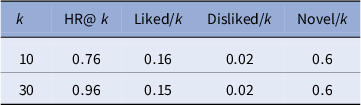
Table 2 Long description
The first row presents k equals 10 with H R at k equals 0.76, Liked per k equals 0.16, Disliked per k equals 0.02, and Novel per k equals 0.6. The second row shows k equals 30 with H R at k equals 0.96, Liked per k equals 0.15, Disliked per k equals 0.02, and Novel per k equals 0.6. Columns are labeled k, H R at k, Liked per k, Disliked per k, and Novel per k. Values are aligned in their respective columns.
Distributions of liked and the disliked movies on the recommended set.
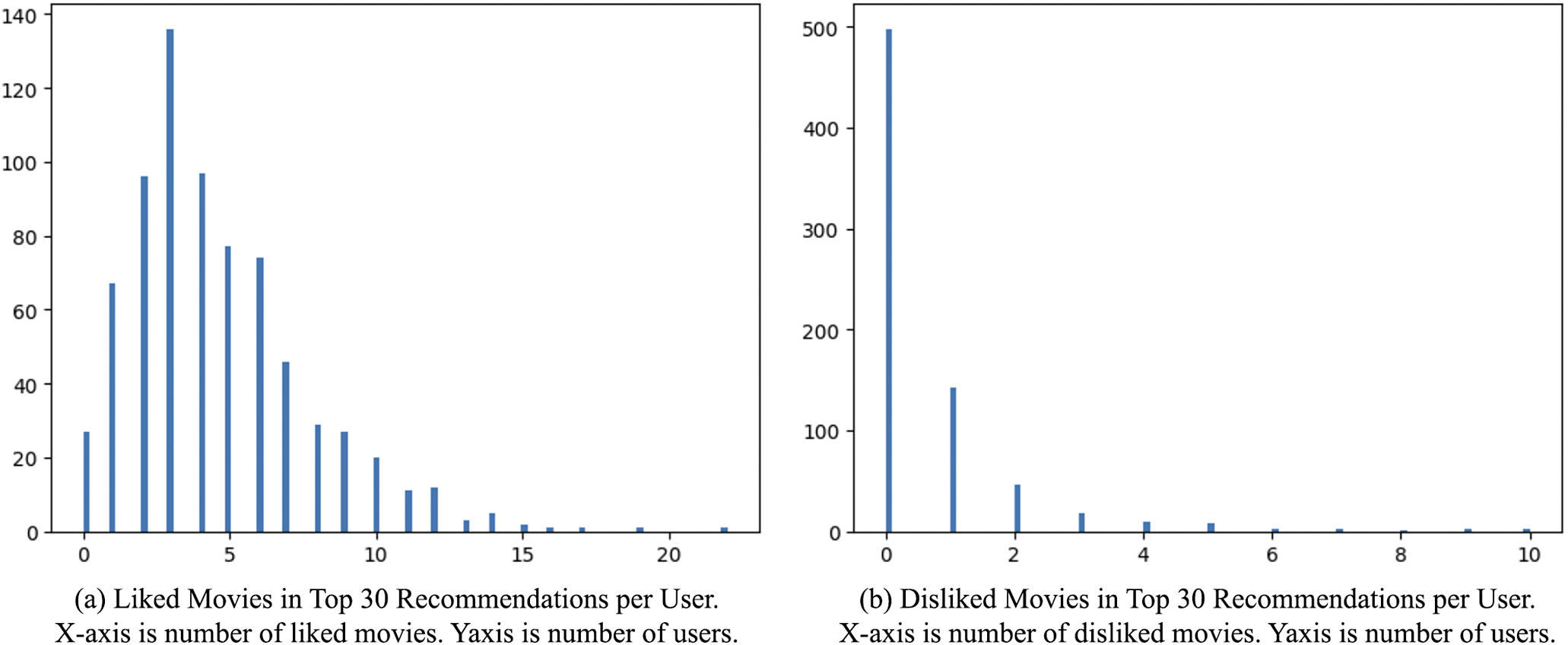
Figure 2 Long description
There are two panels. The left panel is titled ‘Liked Movies in Top 30 Recommendations per User.’ The x-axis is labeled ‘number of liked movies’ and ranges from 0 to over 20. The y-axis is labeled ‘number of users’ and ranges from 0 to 140. Bars peak at 4 liked movies per user, with over 130 users, and decrease steadily as the number of liked movies increases. The right panel is titled ‘Disliked Movies in Top 30 Recommendations per User.’ The x-axis is labeled ‘number of disliked movies’ and ranges from 0 to 10. The y-axis is labeled ‘number of users’ and ranges from 0 to 500. The highest bar is at 0 disliked movies, with nearly 500 users, and the count drops sharply as the number of disliked movies increases. Both panels show that most users have more liked than disliked movies in their top 30 recommendations.
Quantile regressions of the liked and disliked movies, respectively.
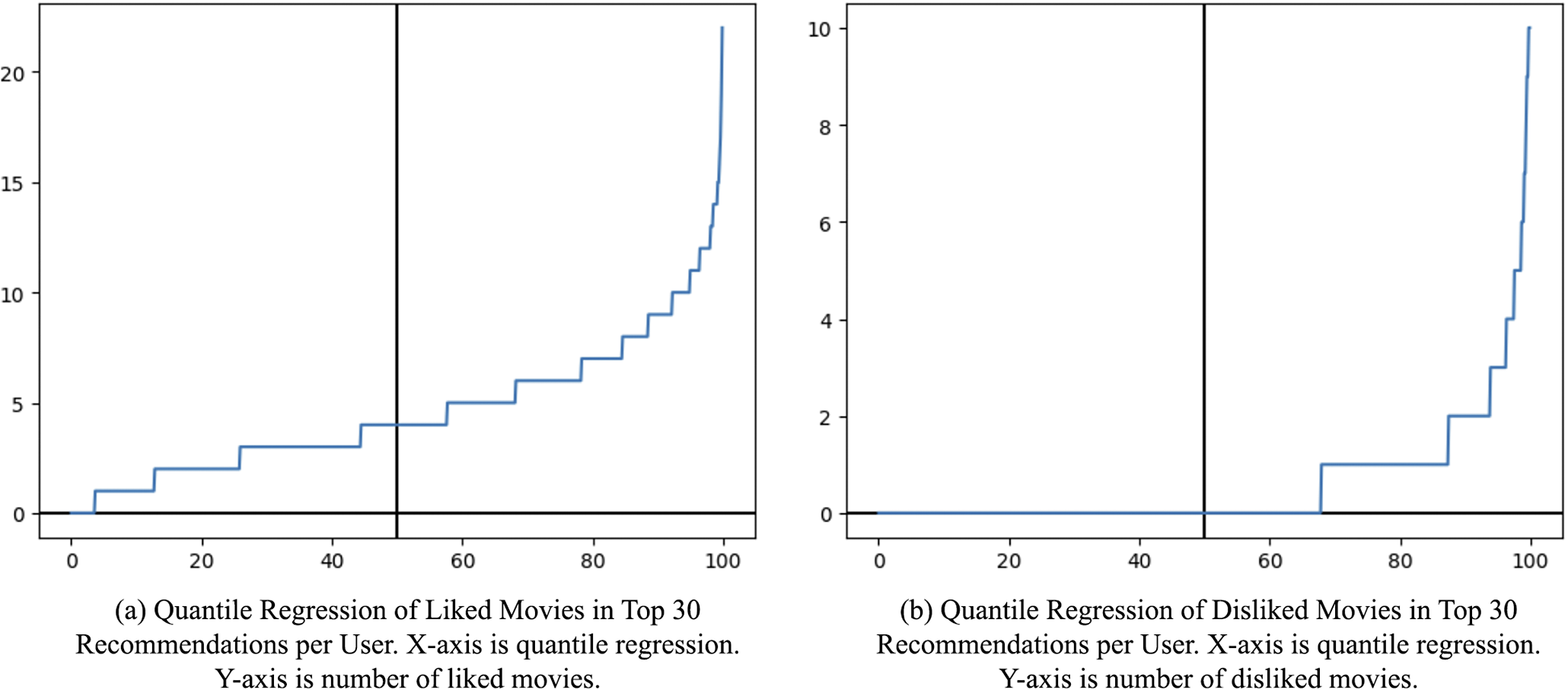
Figure 3 Long description
There are two panels arranged horizontally. The left panel is titled Quantile Regression of Liked Movies in Top 30 Recommendations per User. The x-axis is labeled quantile regression, ranging from 0 to 100. The y-axis is number of liked movies, ranging from 0 to 25. The plotted line starts near zero, remains low until about quantile 40, then gradually increases, with a sharp rise after quantile 80, peaking above 20 at quantile 100. The right panel is titled Quantile Regression of Disliked Movies in Top 30 Recommendations per User. The x-axis is labeled quantile regression, ranging from 0 to 100. The y-axis is number of disliked movies, ranging from 0 to 10. The plotted line remains at zero until about quantile 60, then rises slowly, with a steep increase after quantile 90, peaking at 10 at quantile 100. Both panels have a vertical line at quantile 50.
Relevance
Top-30 slates contain on average
$4.6$
 liked titles (median 4), yielding
$\text {Hit@30}=0.96$
liked titles (median 4), yielding
$\text {Hit@30}=0.96$
 . The Top-10 list delivers
$(1.62)$
. The Top-10 list delivers
$(1.62)$
 likes (
$\text {Hit@10}=0.76$
likes (
$\text {Hit@10}=0.76$
 ).
).
Error
False positives are rare: only
$0.61$
 (Top-30) and
$0.21$
(Top-30) and
$0.21$
 (Top-10) disliked movies on average. Over
$70$
(Top-10) disliked movies on average. Over
$70$
 percent of users receive zero disliked items, and fewer than
$5$
percent of users receive zero disliked items, and fewer than
$5$
 percent receive two or more.
Novelty
Narrative tags extend to unrated films, so
$18.1$
 unseen titles (Top-30) and
$6.02$
unseen titles (Top-30) and
$6.02$
 unseen titles (Top-10) are recommended per user, roughly
$60$
unseen titles (Top-10) are recommended per user, roughly
$60$
 percent of each slate.
Distributional view
Figure 2 plots the empirical CDF of likes-in-Top-30. The
$80^{\text {th}}$
 percentile already reaches seven liked items, indicating that benefits are population-wide rather than confined to heavy-profile users.
Long-tail reach
Recommended item IDs are several orders of magnitude larger than those of held-out positives (Figure 1), confirming systematic exploration of the catalog’s cold region where collaborative signal is absent.
The like-to-dislike ratio remains stable across both Hit@10 and Hit@30, suggesting that the system maintains consistent signal quality as recommendation set size increases: 0.16/0.02@10 and 0.15/0.02@30, for a 7.5:1 ratio of liked to disliked movies, with 60 percent unseen/unrated. The remaining 23 percent of films fall outside the like and dislike bins used for evaluation (scores
$2<x<4$
 ) and are treated as neutral, reflecting films that did not register strong preference signals.
The combination of a high like-to-dislike ratio with a substantial proportion of unseen recommendations indicates that the system is not simply retrieving familiar or high-frequency items, but identifying less-exposed films that nonetheless align with user preferences. In conventional recommender systems, improvements in novelty often come at the cost of relevance. The present results suggest that narrative-effect similarity may mitigate this tradeoff by identifying deeper structural correspondences between narratives.
Because the system operates independently of genre, setting, and other surface-level features, these results further suggest that user preferences may be partially structured by narrative effects that are not well captured by content-based or collaborative models. Since these narrative effects are the only criteria used by our recommender, the alignment between recommendations and user preferences supports the hypothesis that we have identified a distinct and informative dimension of perceived similarity.
The high proportion of unseen recommendations and tendency of recommendations to be surfaced from less popular regions of the dataset indicate that the system consistently surfaces content beyond the most frequently rated or popular items, suggesting its capacity to explore deeper regions of the catalog.
These results are produced using only narrative labels and their associated weights: no collaborative signals, metadata, or content features are incorporated beyond the binary classification of input films as liked or disliked. The observed performance therefore reflects the predictive capacity of the narrative ontology itself, independent of conventional recommendation signals. This supports the broader claim that narrative-based classification captures aspects of similarity that are not reducible to content or user co-behavior.
Discussion
Of the films recommended by the narrative ontology system, an average of 15 percent were liked, 2 percent were disliked, and 60 percent were novel. These proportions remained stable across both the top-10 and top-30 recommendation lists, suggesting that the system scales without degradation in signal quality. The remaining 23 percent of films fell outside the like and dislike bins used for evaluation (scores
$2<x<4$
 ) and were treated as neutral. These correspond to films that did not register strong preference signals; while ratings in this range may indicate moderate narrative interest, the decision to bin ratings at the extremes was made to increase interpretive resolution and better align with practical recommendation contexts.
The high proportion of unseen recommendations is particularly significant given the structure of the simulated user sets. Each user had rated at least 50 films, and often substantially more; consistently returning 60 percent unseen titles in sets of 10 and 30 results, from a pool of only six input films, demonstrates strong capacity to identify genuinely unknown material, even for users with extensive viewing histories. This effect does not appear to result simply from sampling the long tail of the catalog, but from the structure of the feature space itself. Because narrative effects are not tightly coupled to content categories, the system is less constrained by existing similarity clusters, allowing it to traverse the catalog in ways that are less dependent on popularity or exposure.
This suggests that narrative-effect similarity captures latent structures of user preference that are not reducible to genre, topic, or collaborative viewing patterns.
The system performed extremely effectively for most users: approximately 70 percent received multiple liked and zero disliked recommendations, while an additional 26 percent received only a single disliked film. This indicates that, in the majority of cases, the system is able to extract a coherent narrative preference signal from minimal input data. In fact, in 96 percent of cases, users received one or fewer disliked films in their recommendation sets, with high levels of liked films and novelty, demonstrating robust and accurate performance across the vast majority of users even without a priori data curation.
A small subset of users (approximately 4%) exhibited significantly poorer performance, receiving a higher proportion of disliked recommendations. This suggests that either the system failed to identify a coherent narrative signal from the provided inputs, or that narrative effects are not the primary organizing principle of preference for these users. Increasing the granularity of the ontology may improve performance in such cases,Footnote 15 though it is also possible that narrative-based similarity functions as only one dimension of preference among others.
The reliance on small, randomly selected input sets likely contributes to these edge cases. Because inputs were not curated to ensure narrative coherence within the ontology’s feature space, some input combinations may have contained limited shared signal. This design choice was intentional, as it tests the system’s robustness under sparse and noisy conditions. However, more structured input selection – potentially combining MovieLens ratings with narrative features – could yield more consistent performance by ensuring sufficient overlap in narrative characteristics.
Notably, the recommender operates entirely independently of MovieLens data in its scoring and ranking process. The convergence between its recommendations and user preferences therefore suggests that it is capturing underlying structures of preference rather than simply reproducing observed correlations (Hohenecker and Lukasiewicz Reference Hohenecker and Lukasiewicz2020). This property may be particularly valuable for interpretability, as recommendations can be explained in terms of explicit narrative features derived directly from the labels themselves rather than opaque statistical relationships.
This possibility is consistent with results from a prior small-scale user study (n = 100), in which participants reported higher levels of surprise and engagement with recommendations generated using narrative features than with those based on linguistic or collaborative signals (Report Reference Report2025).
The combination of a high like-to-dislike ratio with a substantial proportion of novel recommendations indicates that narrative ontology provides a viable basis for surfacing content that is both relevant and previously unseen. This addresses a central limitation of collaborative filtering systems, which tend to privilege frequently observed items and reinforce existing exposure patterns.
The present results suggest that a taxonomy of narrative effects – that is, a specifically narrative feature space – could be productively integrated into recommendation architectures as a supplementary or hybrid component, providing an additional dimension of similarity. This feature space could be used to augment or restructure existing pipelines in several ways. For example, narrative features could be combined with collaborative filtering methods to better identify the underlying bases of shared user preferences, or incorporated into embedding-based models to improve both discovery and accuracy by aligning recommendations with structured narrative effects. This feature space could also be combined with current ML pipelines to correlate effects with ascribed content, though we are not sanguine about using that correlation predictively. Alternatively, a narrative-based approach could be used to reclassify, re-rank, or reinterpret candidate sets and user histories generated by conventional systems, offering new ways of grouping user data and identifying latent preference structures.
Because this approach does not depend on collaborative signal or large-scale behavioral aggregation, it may be particularly valuable in cold-start settings or in cases where user data are sparse. It may also serve to diversify recommendation outputs even in data-rich environments by identifying smaller clusters of narratively similar content that are not captured by conventional similarity measures.
More broadly, the approach could be extended to other forms of narrative media by adapting the ontology to domain-specific structures, suggesting a generalizable framework for integrating cognitively grounded features into machine learning pipelines. Such integration could be implemented either as feature augmentation within existing models or as a post-hoc ranking layer applied to candidate recommendations.
Limitations
This is the first attempt to use modern narrative theory as a symbolic ontology for movie search and recommendation, so it has many limitations. Among them are (1) the question of what narrative elements best predict movie preferences; (2) the question of how highly users would rank the novel items returned by the system; and (3) the question of how, and whether, the existing system could be improved by combining it with existing search and recommendation methods, such as collaborative filtering, sentiment analysis, and content analysis.
The benchmarks employed, though flawed (as noted above), measure user preferences, which can be distributed across a variety of attentional cues, including, but not limited to narrative. Because ratings entail evaluations of narrative, subject, content, execution, context, etc., such preferences only indirectly capture narrative similarity. However, because no suitable corpus exists as ground truth for perceived narrative similarity,Footnote 16 we adopted user preference data as an acceptable indicator. While our results evince compelling performance in recommendation in line with viewer preferences – suggesting that the ontology captures similarities between latent features that contribute to preference – future empirical attempts might better focus exclusively on the dimension of narrative similarity.
Additionally, while this experiment suggests the potential efficacy of the typology and hence the validity of the underlying classification system, it did not directly test the perceived validity and transparency of the ontology to users. Future behavioral experiments involving live participants could better assess these aspects and provide direct feedback on the category of relevant novelty. While users have affirmed the pertinence of the insights derived and novelty or recommendations in limited internal trials, the perceived accuracy of the recommendation bases, as well as perceived surprise, could be better quantified with live participant feedback.
The analysis of synthetic users also precluded our ability to evaluate the empirical viability of the novel films in our recommendation sets. A live user trial would better allow us to evaluate the perceived suitability of novel recommendations; however, even this approach would have limitations since theoretically, evaluating whether or not users would actually like the recommended narratives would require them to view those films: a prohibitively costly trial in terms of both time and resources for this pilot. A future user trial might plausibly approximate user evaluations of unseen films, by allowing them to rate or rank their interest in said films, based either or both on an explanation generated from our ranking algorithm or viewing a trailer or film synopsis.
This experiment was also limited by current code and computational power: theoretically, a narrative ontology would produce the strongest results by identifying persistent sets of features in combinations shared across user preferences; our current ranker takes a fuzzy approach to these sets rather than strict set evaluation due to computational constraints in generating and computing powersets of our entire feature set, across multiple dimensions, in multiple films. As a result, as described in our methods section, the lightweight algorithm identifies narrative features primarily on co-occurrences within narrative dimensions and then ranking those dimensions and features. A more computationally robust approach might leverage the label space by looking for discrete subsets of co-occurring labels across narrative components as well. Eventually, we hope to solve this problem and evaluate strict sets and subsets, both allowing for increased precision and more effectively distilling clear subsets of preferences from larger user input sets.
Conclusion
The ability to surface low-review, long-tail content offers a potential means of addressing the popularity bias that characterizes collaborative filtering and language-based recommendation systems. In a 100-participant internal user study, the proposed system elicited higher levels of reported surprise, trailer engagement, and add-to-list behavior than baseline recommenders, and consistently exceeded user expectations for diversity.
More broadly, the results suggest that narrative cognition can function as a useful inductive bias for recommendation. A system grounded in a cognitively motivated narrative ontology can achieve a desirable balance of precision and novelty without relying on collaborative signals or textual embeddings. Concretely, Top-30 recommendation sets contain on average 15 percent liked, 2 percent disliked, and 60 percent unseen films, and these proportions persist at smaller list sizes, indicating stability of the signal under sparse conditions.
Because the recommender operates independently of MovieLens data, yet aligns with user preferences derived from that dataset, it is unlikely to depend on spurious co-view correlations. Instead, it appears to capture underlying structures of narrative engagement – such as surprise, suspense, and interpretive ambiguity – that remain stable even for cold-start titles. Each recommendation can therefore be traced to an explicit set of narrative cues, enabling transparent explanations and user-directed refinement.
Finally, narrative theory is largely medium-agnostic. While specific effects may vary across domains, the underlying principle of organizing data around narrative effects rather than content suggests broader applicability. The proposed approach could be extended to other forms of narrative media, and integrated with existing methods in hybrid systems to enhance discovery. More generally, a narrative ontology may offer a complementary framework for the analysis, classification, and comparison of narrative data across domains, including both fictional and non-fictional corpora. This reframing suggests that narrative similarity may constitute a distinct analytical dimension, complementing rather than replacing existing content- and behavior-based approaches.
Data availability statement
The narrative ontology and annotated dataset used in this study were developed as part of a privately funded research project and constitute proprietary intellectual property. For this reason, the complete ontology and dataset cannot be publicly released. However, the conceptual structure of the ontology, representative examples of narrative elements, and the annotation methodology are described in this article to enable evaluation of the approach.
Acknowledgements
The authors wish to acknowledge the valuable contributions of colleagues at MoreMore.ai to the development and execution of this work. Evan Van Tassell, Geoffrey McNeil, and Barry Van Tassell played primary roles in shaping the development of the system and its implementation.
The Senior Narrative Team, led by Evan Van Tassell and Geoffrey McNeil, and including Alaina Belisle, Cody Chun, and Njoki Mwangi, contributed to the refinement of the narrative typology and its early application.
Engineering support was provided by Michael Rousseas and Sean Downes, who developed core components of the recommender system and supported data analysis. Barry Van Tassell integrated and professionalized the code base, fine-tuned the recommender for deployment, provided initial data analysis for this article, and helped to develop the novel metric discussed above. Damien Crone developed the explainer module.
Author contributions
A.F. and M.B. worked in close collaboration on the development of the research program underlying this work, building on A.F.’s initial typology and its subsequent refinement and extension through the company’s research and development activities.
M.B. led the integration and implementation efforts that enabled the work reported here and conducted the primary research for this article, also writing the majority of the manuscript.
I.P.Y. contributed to the formalization of the methods, including mathematical modeling of the approach, primary research, led comparative and benchmark analyses, and composed technical portions of the “Methods” section.
All authors contributed collaboratively to the interpretation of results and revision of the manuscript.
Funding statement
This work was supported by internal funding from MoreMore.ai, a privately held company.
Competing interests
A.F. and M.B. are original founders of, and have an ownership stake in More Ventures, a privately held company that developed the typology and technology described here. The research reported here is related to technologies developed by the company and may benefit from the findings presented. I.P.Y. declares no competing interests.
Ethical standard
The authors affirm that this research did not involve human participants.
Appendix: Examples from internal trial and SemEval similarity task
Sample searches with cognitive regions and search logic surfaced.
Note: This example from our native recommender shows results when a user liked The Godfather, but disliked Goodfellas. Manually/directly illustrating the correlated brain regions pertinent to the search criteria and using an AI-assisted rephrasing module, it identifies a brain pattern/narrative signature that “blends tragic righteousness with operatic heightening,” allowing it to predict that user is 74 percent likely to enjoy haunting Shakespearean tales like Ophelia and 88 percent likely to enjoy existential Westerns like Unforgiven and Outlaw Josey Wales.
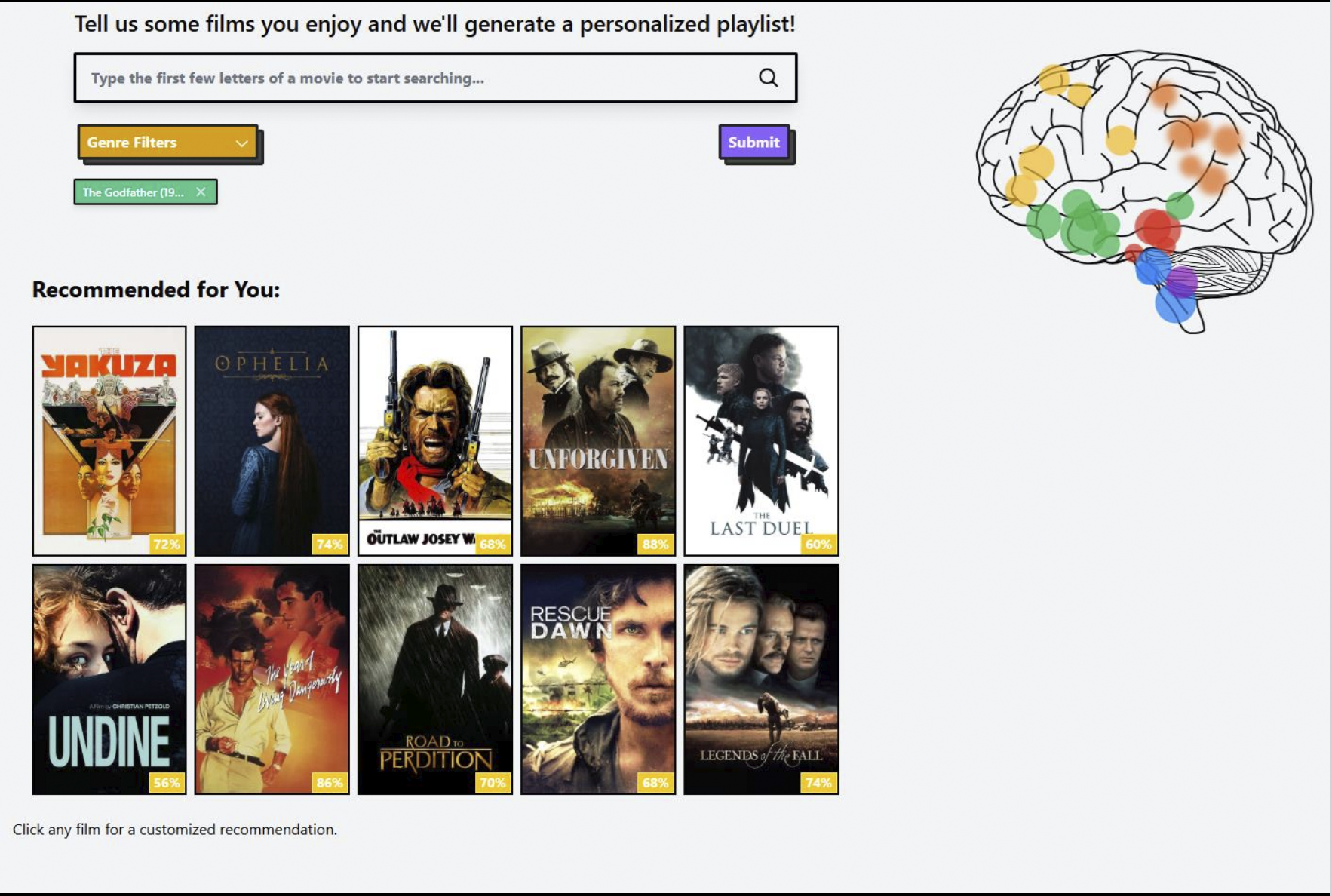
Figure A1(a) Long description
At the top, a prompt invites users to enter film titles for playlist generation. Below, a search bar with a genre filter dropdown and a selected film tag is present, followed by a purple submit button. To the right, a brain outline diagram shows colored regions in orange, green, red, yellow, and blue. The main section, labeled ‘Recommended for You,’ features a two-row grid of ten movie posters. Each poster includes a title and a yellow box at the bottom right with a percentage rating: top row from left to right—‘The Yakuza’ 72 percent, ‘Ophelia’ 74 percent, ‘The Outlaw Josey W’ 68 percent, ‘Unforgiven’ 88 percent, ‘The Last Duel’ 60 percent; bottom row—‘Undine’ 56 percent, ‘The Heart of the Game’ 86 percent, ‘Road to Perdition’ 70 percent, ‘Rescue Dawn’ 68 percent, ‘Legends of the Fall’ 74 percent. A note below the grid instructs users to click any film for a customized recommendation.
Note: An additional example from our native recommender, showing results when a user liked When Harry Met Sally, but disliked Sleepless in Seattle. According to the underlying ontology (via rephraser), it identifies a brain pattern/narrative signature that “blends mismatched desires with the wry folly of life,” allowing it to predict that this user is 70 percent likely to enjoy musical love intrigues like Hello Dolly and 80 percent likely to enjoy absurdist New Wave erotic dramas like Stolen Kisses.
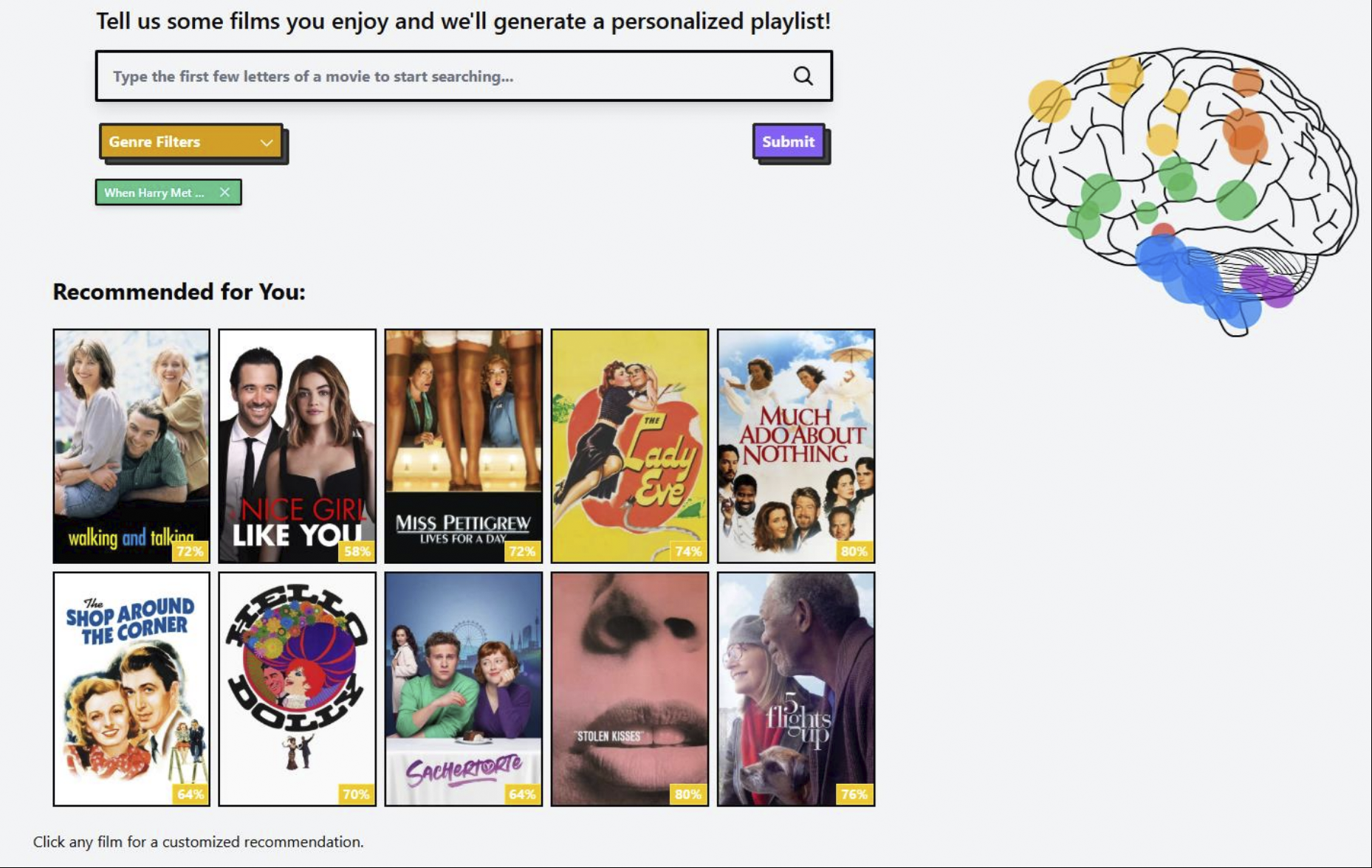
Figure A1(b) Long description
At the top is a search bar with the prompt ‘Tell us some films you enjoy and we'll generate a personalized playlist!’ and a field to type movie titles. Below are a yellow ‘Genre Filters’ dropdown and a green filter tag labeled ‘When Harry Met...’. A purple ‘Submit’ button is to the right. Under the heading ‘Recommended for You:' is a grid of ten movie posters in two rows. The top row, from left to right, shows ‘Walking and Talking’ (72 percent), ‘Nice Girl Like You’ (58 percent), ‘Miss Pettigrew Lives for a Day’ (72 percent), ‘The Lady Eve’ (72 percent), and ‘Much Ado About Nothing’ (80 percent). The bottom row, left to right, displays ‘The Shop Around the Corner’ (64 percent), ‘Hello Dolly!’ (70 percent), ‘Saccharine’ (64 percent), ‘Stolen Kisses’ (no rating visible), and ‘5 Flights Up’ (76 percent). Each poster includes blurred faces. At the top right is a stylized brain diagram with regions colored in orange, green, blue, and purple. At the bottom is the instruction ‘Click any film for a customized recommendation.’
Sample explanations from live searches.
Note: These results from the explainer module of our live explainer demonstrate the comprehensibility and transparency output by our system. The underlying data for narrative effects for each match, and their relative weights, are surfaced and rephrased – for fluency, variety, and to protect the proprietary label space – then supplemented with plot details. The extrinsic details are only added to the ontological information when generating a natural language explanation for the user, and not in any of the data processing. The cogency of the ontology allows us to generate these explanations at the endpoint, live with each search. In our internal trials, users found these explanations informative and compelling.
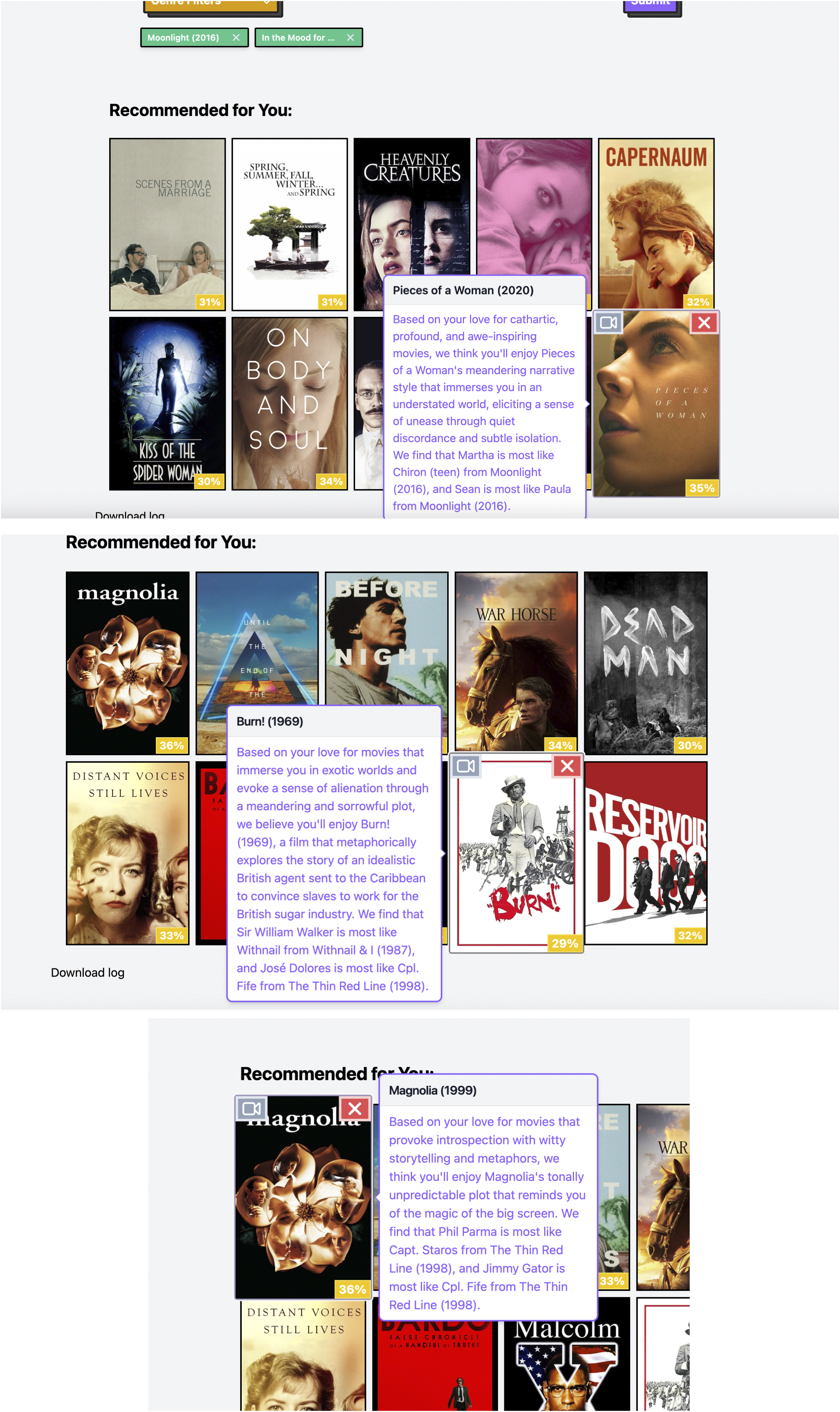
Figure A2. Long description
The interface displays a Recommended for You section across three vertical panels. Each panel features a grid of movie posters, each with a yellow percentage match in the bottom right corner.
In the top panel, the grid includes Scenes from a Marriage, Spring, Summer, Fall, Winter... and Spring, Heavenly Creatures, a close-up of a face, Capernaum, Kiss of the Spider Woman, On Body and Soul, and Pieces of a Woman. A purple-bordered pop-up for Pieces of a Woman (2020) explains the recommendation based on a love for cathartic, profound, and awe-inspiring movies, specifically comparing characters to those in Moonlight (2016).
The middle panel shows Magnolia, a pyramid graphic, Before Night, War Horse, Dead Man, Distant Voices Still Lives, Burn!, and Reservoir Dogs. The pop-up for Burn! (1969) cites a preference for exotic worlds and alienation, comparing characters to those in Withnail and I (1987) and The Thin Red Line (1998).
The bottom panel shows a zoomed-in view of the Magnolia (1999) recommendation. The pop-up explains the choice based on witty storytelling and metaphors, comparing characters to those in The Thin Red Line (1998). Each pop-up includes a video icon and a red close button in the top corners of the associated poster.
SemEval-2026 Task 4: Narrative story similarity and narrative representation learning.
Note: This is the example of narrative similarity assessment and categorization from SemEval 2026, discussed in footnote 2. Also available here: https://narrative-similarity-task.github.io/.
Figure A3 Long description
At the top, instructional text explains the task: to judge which of two options is more narratively similar to the anchor story. Below, the anchor story is presented in a gray box with an anchor icon, describing Anna losing her purse, being terrified due to important documents, retracing her steps unsuccessfully, and Dan returning it to her. Underneath, two horizontally aligned boxes present options. On the left, option A in a gray box describes Brian losing his backpack, not caring much, searching for an hour, and finding it. On the right, option B in a light purple box describes Alex losing his engagement ring while swimming, panicking, searching for hours, and not finding it. Below these, a clickable section labeled ‘Click below to reveal the answer’ is followed by a collapsed ‘Reveal Answer’ area. The revealed explanation states that option A is more similar to the anchor because both A and the anchor involve a lost item that is retrieved, while in B the item is not found.
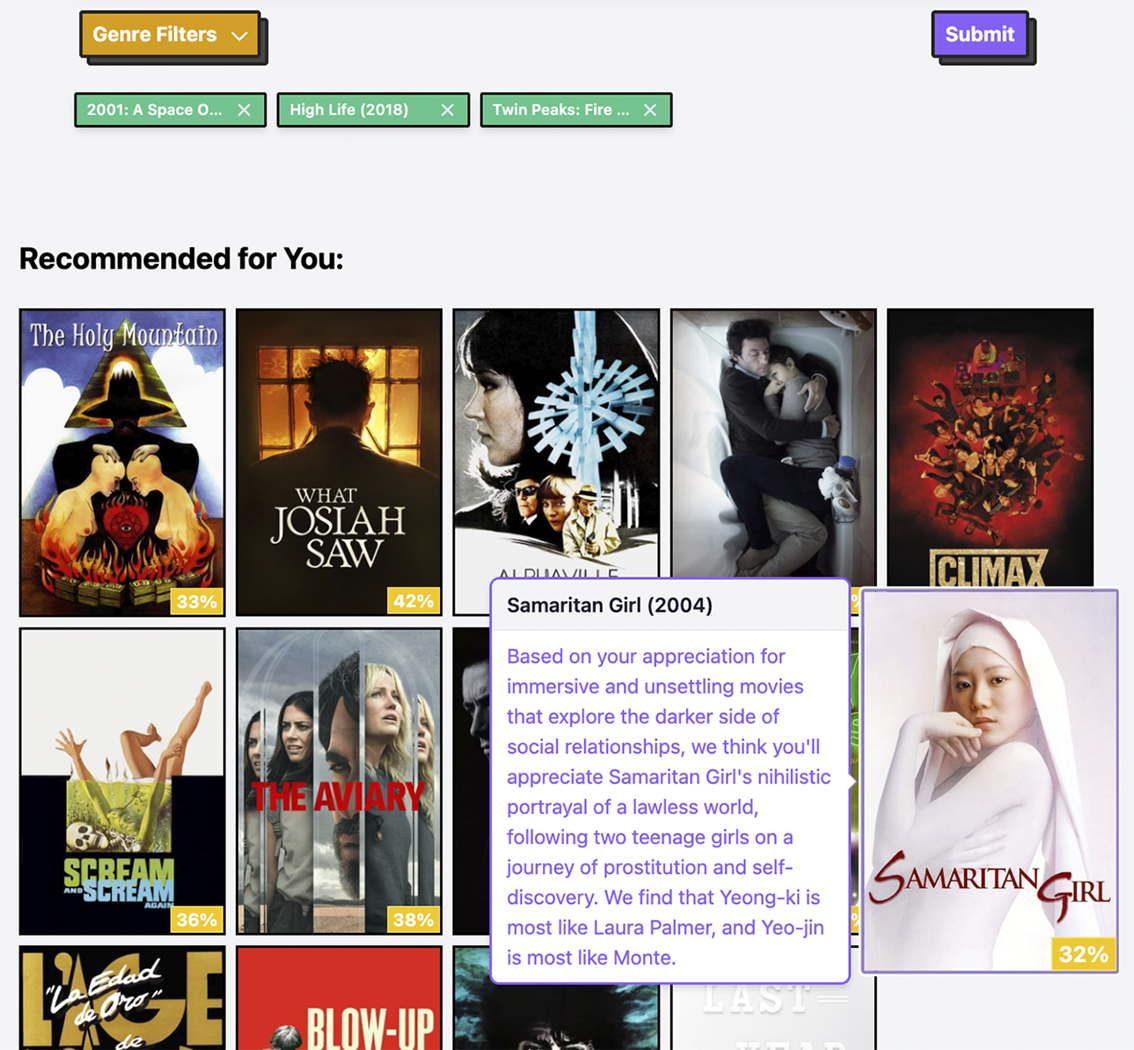 Example output from the deployed interface, illustrating natural-language explanation of recommendations. The recommendation was “based on your appreciation for immersive and unsettling movies that explore the darker side of social relationships, we think you’ll appreciate Samaritan Girl’s nihilistic portrayal of a lawless world.” The descriptive language articulates the narrative effects identified by our system, and underlying the match.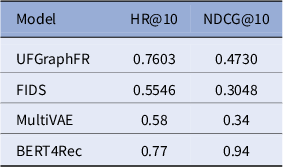
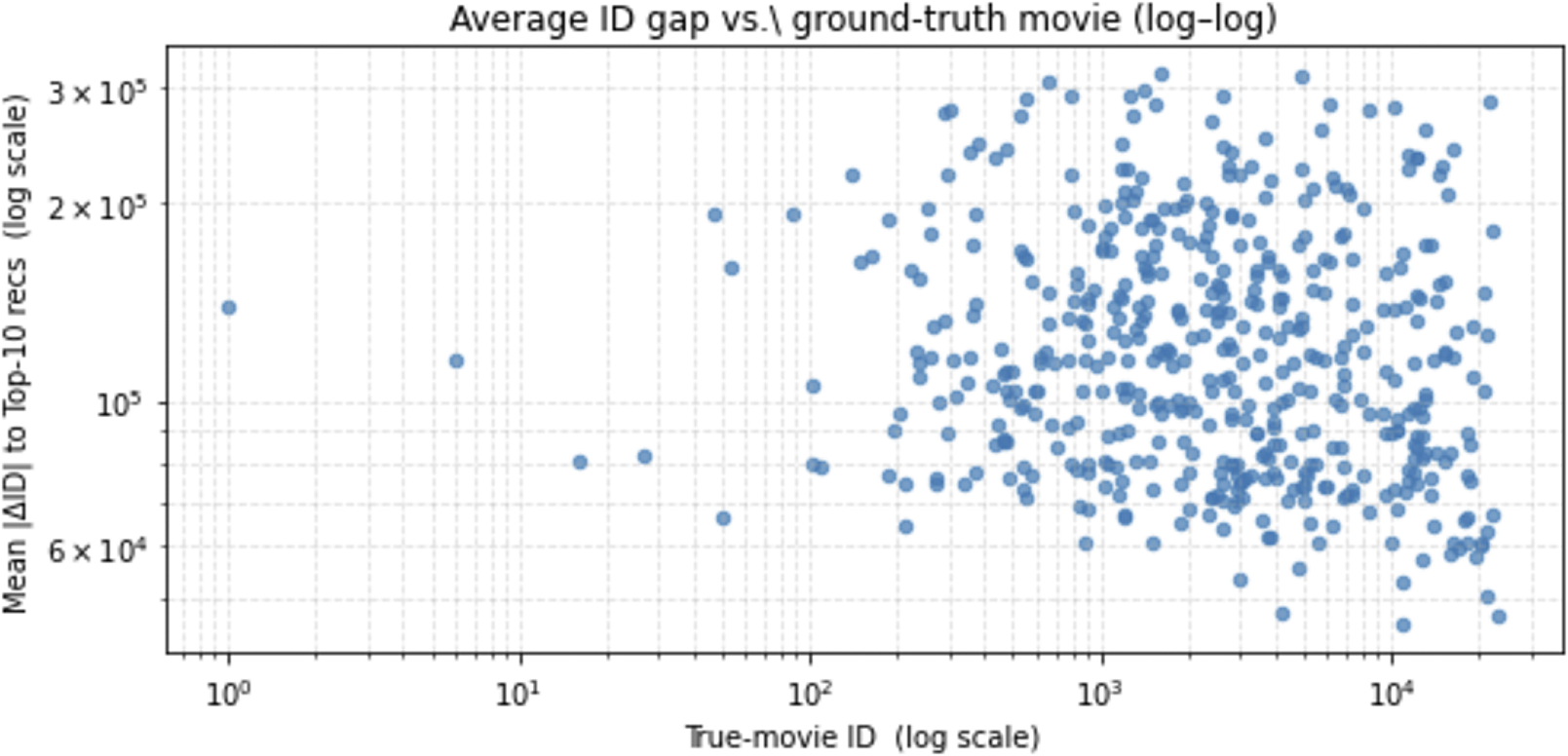
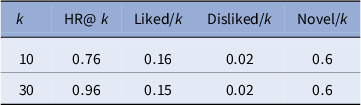
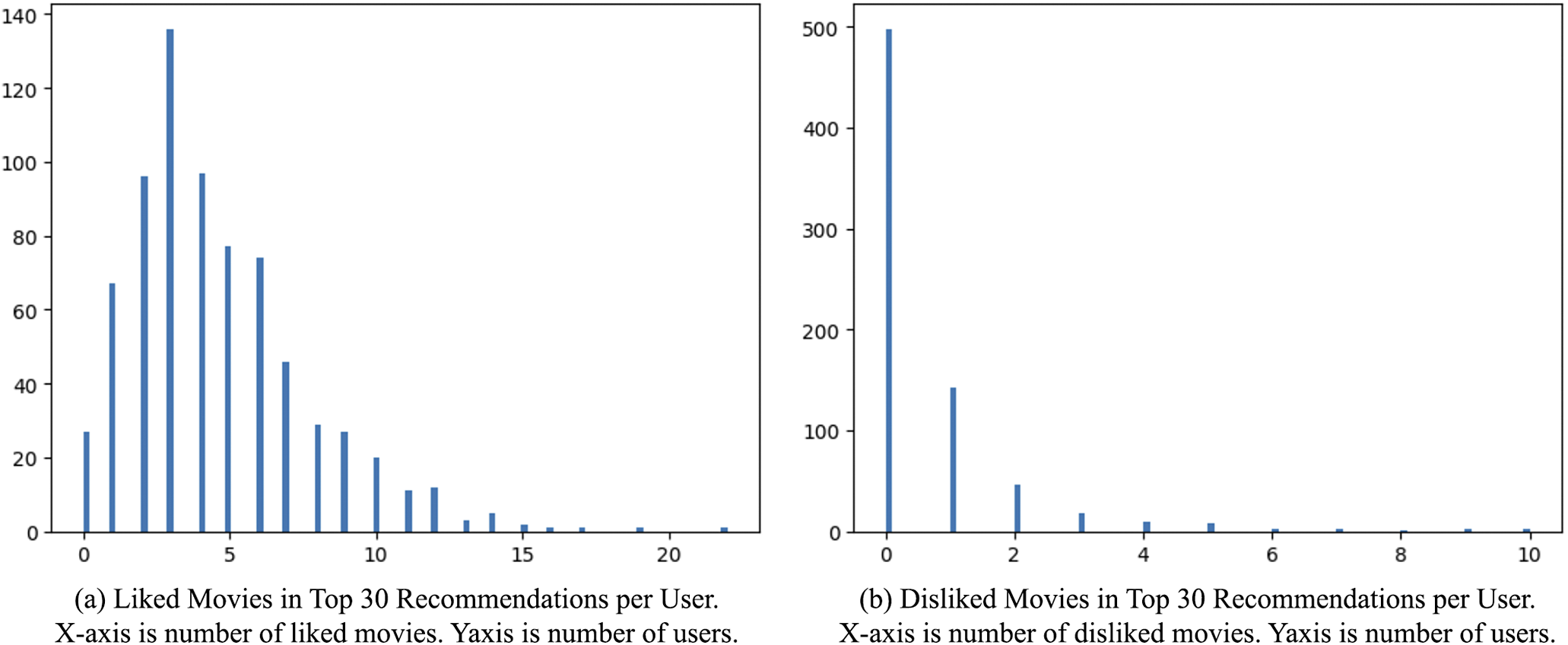
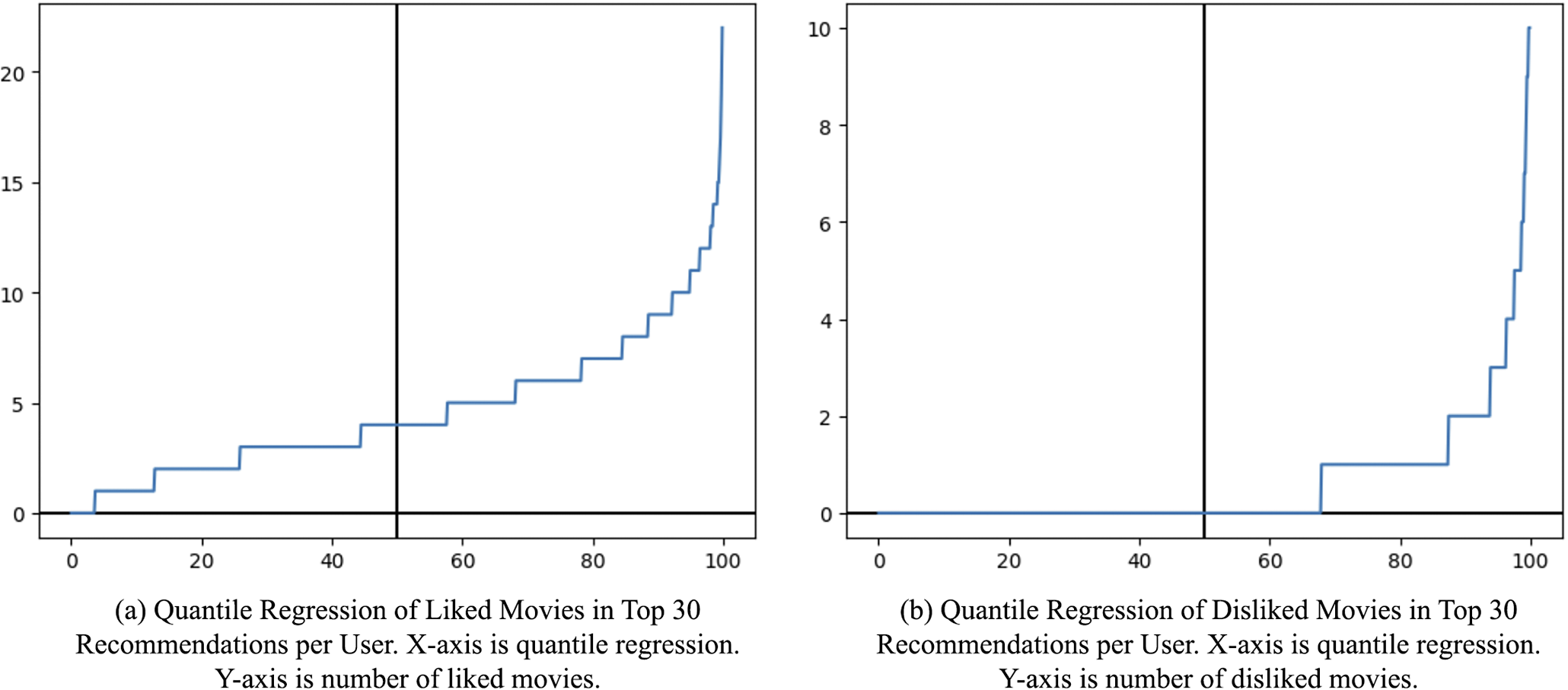
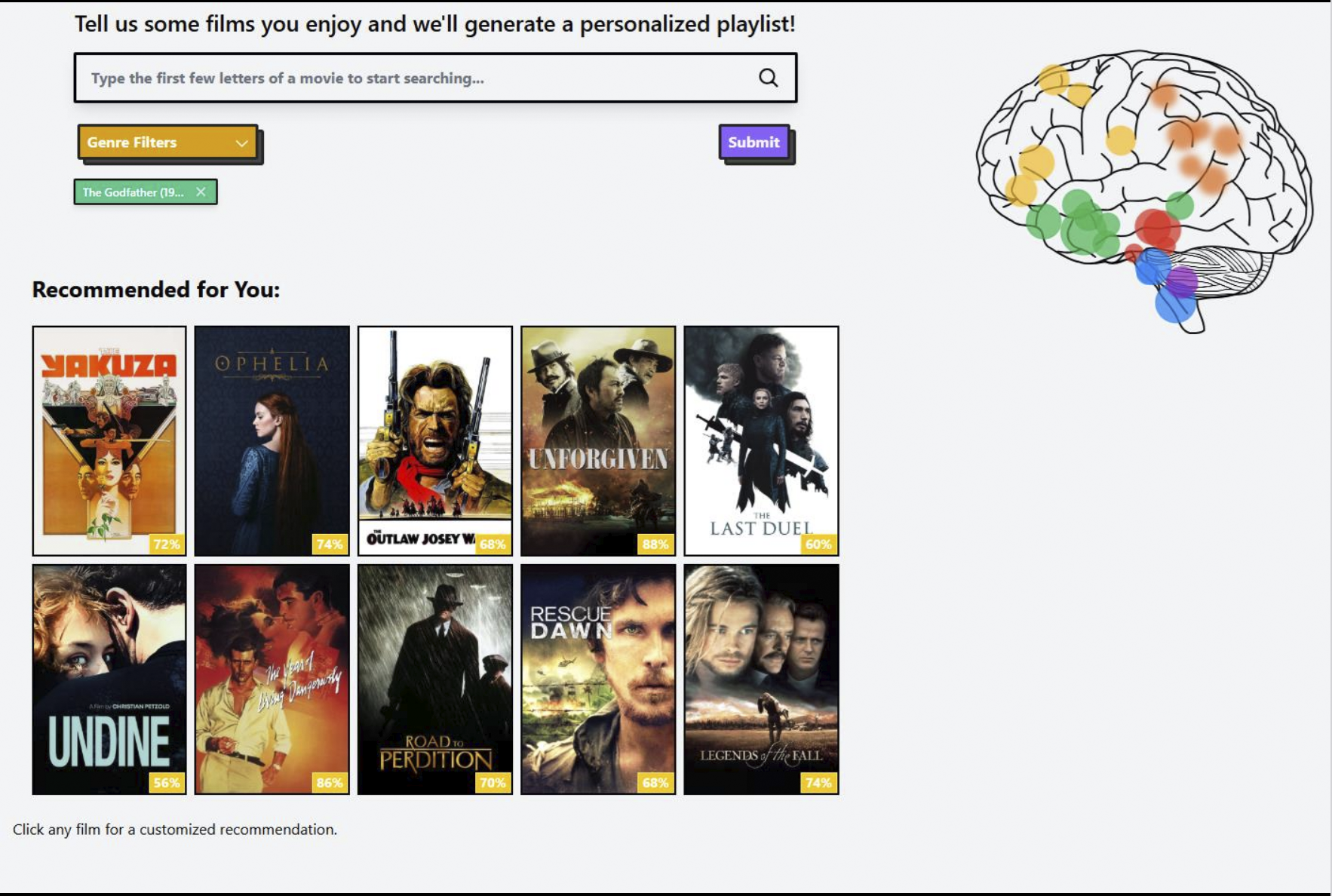
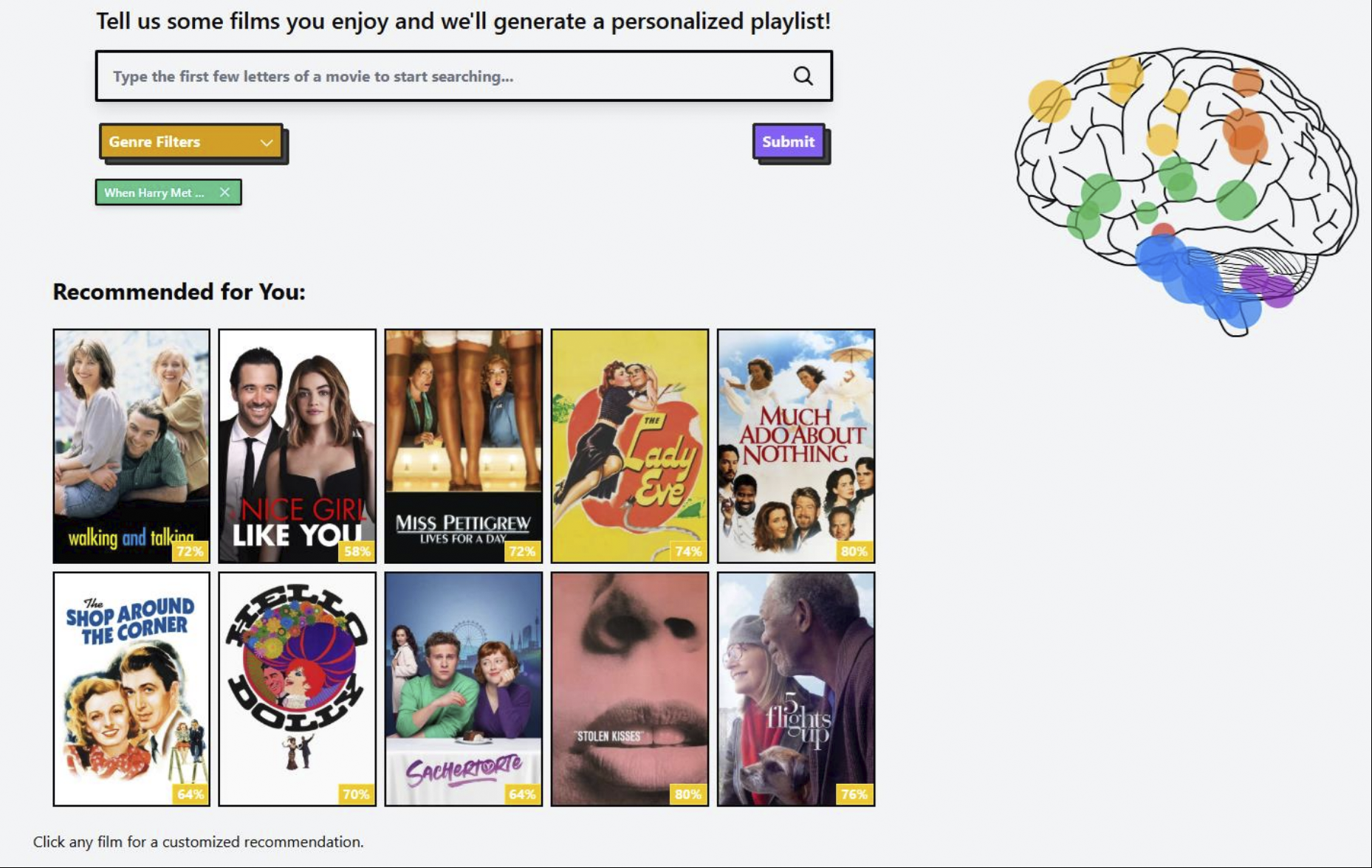
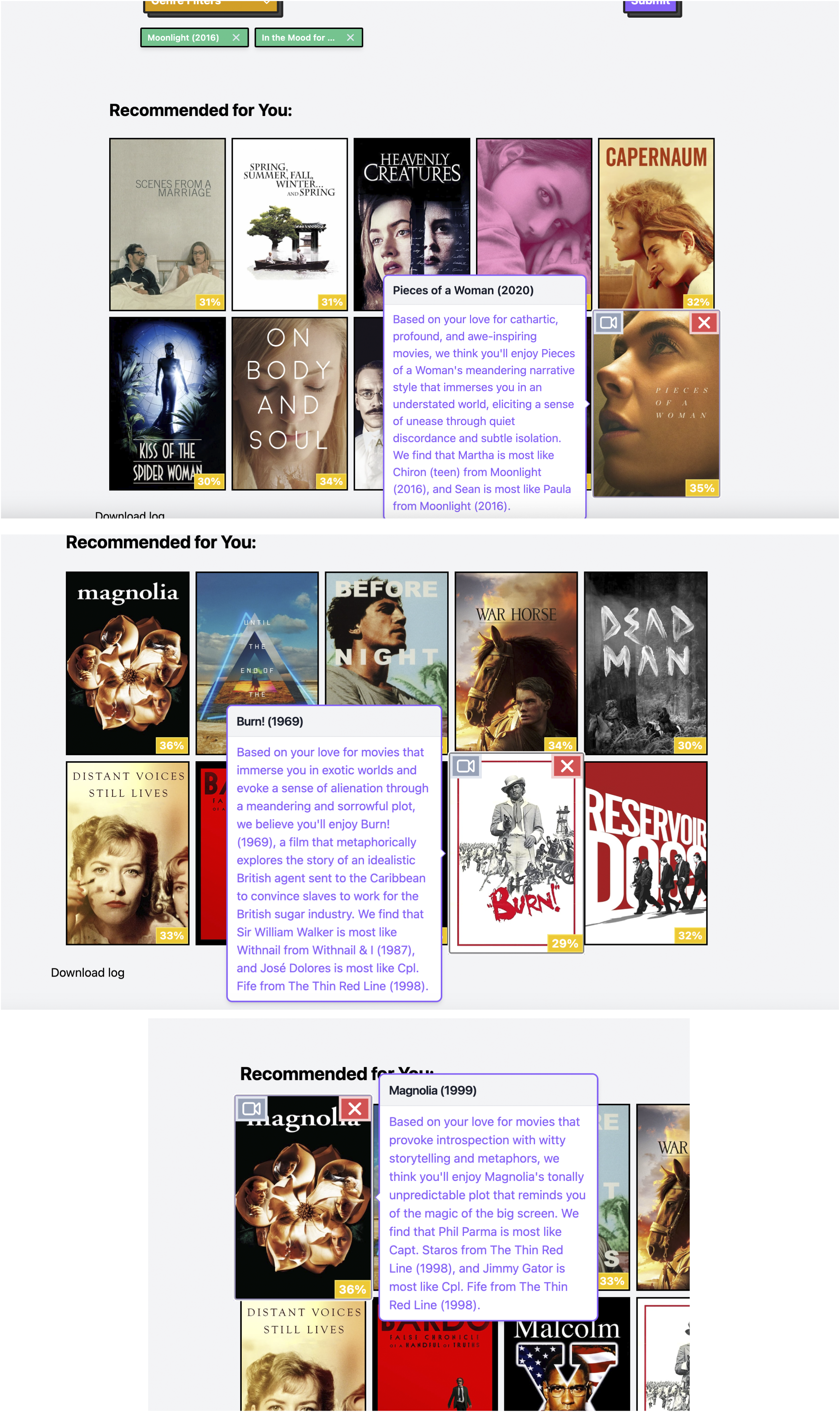
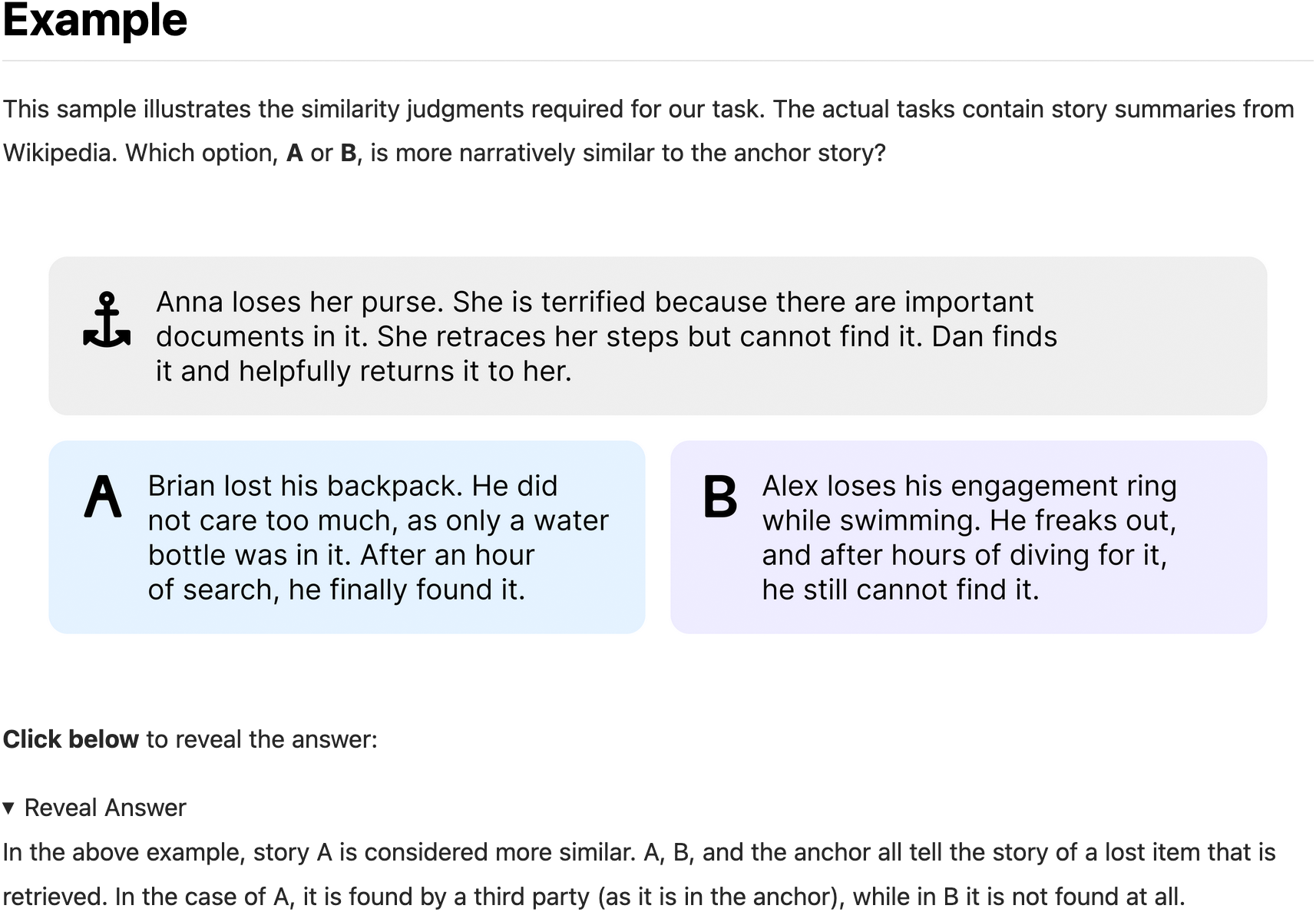

 Open access


Rapid Responses
No Rapid Responses have been published for this article.