





1. Introduction
Human language is constantly evolving. The world we live in is governed by information and communication technologies. Our time, sometimes dubbed the digital era, must thus be prepared to face changes in the way we communicate, and implement mechanisms to adapt to it.
Changes in communication derive from multiple aspects. The use of non-standard written language might stem from cultural or societal factors, among others, or it may simply happen by mistake. In this survey, we refer to both phenomena as misspellings. Misspellings have become pervasive in the digital written production since the revolutionary Web 2.0 led people interact freely through social media, blogs, forums, etc. Even though misspellings are generally unintentional, in some contexts, these may also be intentional. Of course, the presence of misspellings complicates the reading of a text. Notwithstanding this, and somehow, surprisingly, humans have the ability to read and comprehend misspelt text without much effort and, sometimes, even without realising their presence (Andrews Reference Andrews1996; Healy Reference Healy1976; McCusker et al. Reference McCusker, Gough and Bias1981; Shook et al. Reference Shook, Chabal, Bartolotti and Marian2012). Computers do not have similar capabilities, though. Although the NLP community has long downplayed the problem of misspellings (if not for grammatical error correction (Shishibori et al. Reference Shishibori, Lee, Oono and Aoe2002) or text normalisation (Damerau Reference Damerau1964)), it is by now abundant evidence that misspellings represent a serious risk to the performance of NLP systems (Baldwin et al. Reference Baldwin, Cook, Lui, MacKinlay and Wang2013; Heigold et al. Reference Heigold, Varanasi, Neumann and van Genabith2018; Moradi and Samwald Reference Moradi and Samwald2021; Náplava et al. Reference Náplava, Popel, Straka and Straková2021; Nguyen and Grieve Reference Nguyen and Grieve2020; Plank Reference Plank2016; Vinciarelli Reference Vinciarelli2005; Yang and Gao Reference Yang and Gao2019), even for the latest generation of large language models (Moffett and Dhingra Reference Moffett and Dhingra2025).
This survey addresses misspellings as a pervasive phenomenon that negatively impacts downstream NLP tasks. We do not focus on general-purpose automatic spelling correction methods, for which recent, comprehensive reference material is already available (see, e.g., Bryant et al. Reference Bryant, Yuan, Qorib, Cao, Ng and Briscoe2023; Hládek et al. Reference Hládek, Staš and Pleva2020; Wang et al. Reference Wang, Wang, Dang, Liu and Liu2021b). Instead, our focus is on the implications and challenges that misspellings pose for NLP methods that are explicitly designed to be robust to them in downstream applications. We cover research published since 2009, as earlier work is already comprehensively reviewed by Subramaniam et al. (Reference Subramaniam, Roy, Faruquie and Negi2009). Since then, the topic has gained increasing attention. A growing number of methods have been proposed to specifically address the problem of misspellings (Belinkov and Bisk Reference Belinkov and Bisk2018; Heigold et al. Reference Heigold, Varanasi, Neumann and van Genabith2018), alongside dedicated benchmarks (Michel and Neubig Reference Michel and Neubig2018) and even shared tasks and data challenges (Basili et al. Reference Basili, Lopresti, Ringlstetter, Roy, Schulz and Subramaniam2010; Dey et al. Reference Dey, Govindaraju, Lopresti, Natarajan, Ringlstetter and Roy2011; Lopresti et al. Reference Lopresti, Roy, Schulz and Subramaniam2009). This survey aims to provide a comprehensive overview of these recent advancements in the field.
The study of misspellings in NLP is paramount not only as a means for improving the performance of current systems, but also for reasons that are ultimately bound to safety and ethics. Misspellings are, as hinted above, not always an involuntary phenomenon. Misspellings may sometimes be carefully and maliciously designed (Li et al. Reference Li, Ji, Du, Li and Wang2019a) with the purpose of disguising certain words to elude the control of automatic content moderation tools or spam detection filters. The study of misspelling can help in mitigating the proliferation of hate speech or in preventing unwanted content from reaching the final audience. Additionally, the fact that certain misspellings act as obfuscations for computers but not for humans suggests that studying this phenomenon from a psycholinguistic perspective might inspire alternative, more efficient methods for text representation and processing.
The rest of this survey is organised as follows. In Section 2, we offer an overview of the history of misspellings in the digital era, analysing the main trends before and after the proliferation of user-generated content, the upsurge of neural networks and the advent of large language models (LLMs). In Section 3, we describe how the phenomenon is regarded through the lens of linguistics and NLP. In Section 4, we survey previous work on the potential harm of misspellings. Section 5 is devoted to describing methods specifically devised to counter misspellings. Section 6 deals with the challenges misspellings pose in multilingual contexts. The main tasks, evaluation measures, venues and datasets dedicated to misspellings are discussed in Section 7. Section 8 is devoted to analysing the phenomenon of misspellings from the point of view of modern LLMs. Section 9 discusses the main applications in which the presence of misspellings gains special relevance. Section 10 concludes by also pointing to promising directions of research.
2. A brief history of misspellings
The history of misspellings in NLP spans several decades, dating back at least to Blair (Reference Blair1960); Damerau (Reference Damerau1964) seminal works on spelling error detection and correction published in the 1960s. Here, we provide a concise overview of this long-standing topic, focusing on three main phases that hinge upon the proliferation of the so-called Web 2.0 and the subsequent spread of (often carelessly generated) user-generated content, and the advent of LLMs. The term Web 2.0 was first coined by Darcy DiNucci in 1999, but it was not until 2004 that it gained popularity through the Web 2.0 Conference.Footnote 1 It took some time for user-generated content to take hold on the Internet, something we identify as happening around 2010. This section, therefore, briefly surveys the history of misspellings before (Section 2.1) and after (Section 2.2) this turning point.
2.1 Before 2010: fewer data, less misspellings
Before the explosion of user-generated data on the Internet, the vast majority of content available on the web (static web pages, journal articles, etc.) was characterised by the fact that the content was moderately well curated. As a result, the amount of data was relatively limited, and the available data contained few misspellings. For this reason, automated text analysis technologies were rarely concerned with the presence of misspellings, if at all. The study of misspellings was confined to the development of automatic correction tools that aid users in producing misspelling-free texts by, for example, correcting typos or applying OCR-produced errors.
Arguably, the first works on misspellings were those by Blair (Reference Blair1960) and Damerau (Reference Damerau1964), which proposed the earliest dictionary-based methods for spelling correction. In this survey, we do not focus on spelling correction per se (we refer the interested reader to Bryant et al. Reference Bryant, Yuan, Qorib, Cao, Ng and Briscoe2023; Hládek et al. Reference Hládek, Staš and Pleva2020; Wang et al. Reference Wang, Wang, Dang, Liu and Liu2021b), but rather on NLP systems designed to be resilient to misspellings. In this context, Vinciarelli (Reference Vinciarelli2005) stands out as one of the pioneering studies, specifically addressing errors introduced by OCR technologies.
Some studies seemed to indicate that the problem of misspellings was not paramount for text classification technologies, at least when these concern the classification by topic of (curated) text documents (Agarwal et al. Reference Agarwal, Godbole, Punjani and Roy2007). The situation differed somewhat when shifting to other, less curated sources, such as emails, blogs, forums and SMS data, or when analysing the output generated by automatic speech recognition engines from call centres. The problem attracted little attention from the research community at the time, and it was not until 2007 that a dedicated workshop, called Analysis for Noisy Unstructured Text Data (AND), emerged and renewed interest in the field (see also Section 7.4).
To the best of our knowledge, the only survey on NLP systems robust to noise was published in 2009 (Subramaniam et al. Reference Subramaniam, Roy, Faruquie and Negi2009). This survey primarily focused on handling noise in OCR scans, blogs, call centre transcriptions and similar sources.
2.2 After 2010: the rise of social networks and deep learning
Since 2010, user-generated content has become increasingly pervasive, mainly due to the revolution of social networks. At the same time, deep learning technologies have taken the world by storm (Krizhevsky et al. Reference Krizhevsky, Sutskever and Hinton2012), not only due to the increase in performance they show off in most NLP tasks (Collobert et al. Reference Collobert, Weston, Bottou, Karlen, Kavukcuoglu and Kuksa2011), but also because of their potential to eliminate the need for manual feature engineering; instead, the neural network itself learns to represent the input. This raises questions about the necessity of a pre-processing step for correcting misspellings beforehand.
The increasing prevalence of misspelt data and the proliferation of NLP technologies have inspired numerous studies analysing the impact of misspellings on state-of-the-art models (Section 4), as well as papers proposing systems that are resilient to misspellings (Section 5).
The study of misspellings in NLP presents significant benefits. The most apparent advantage is the enhancement of performance in any NLP tool, but not only. Systems that are resilient to misspellings are also safer. For reasons discussed later, some misspellings are intentional, designed to evade the scrutiny of content moderation tools or spam filters. Ultimately, the study of misspelling resilience aims to deepen our understanding of language (further discussions are offered in Section 10).
This increased interest in the subject was partially fostered by the work of Belinkov and Bisk (Reference Belinkov and Bisk2018); Heigold et al. (Reference Heigold, Varanasi, Neumann and van Genabith2018); Edizel et al. (Reference Edizel, Piktus, Bojanowski, Ferreira, Grave and Silvestri2019), who showed the performance of different models decrease noticeably in the presence of misspellings. This renewed momentum has led to the appearance of dedicated workshops devoted to studying the phenomenon from the point of view of user-generated content (such as the WNUT workshop seriesFootnote 2 ) as well as from the point of view of machine translation (such as the WMT workshop/conference seriesFootnote 3 ); more information about dedicated tasks and datasets can be found in Section 7.4.
Between 2017 and 2022, neural machine translation emerged as the most prolific field in the study of misspellings, closely followed by sentiment analysis.
2.3 After 2020: the advent of LLMs
In recent years, the trend has shifted markedly: whereas earlier research focused heavily on developing methods to combat misspellings in downstream tasks (with a disproportionate emphasis on machine translation), the field has now moved toward a growing number of evaluation papers that analyse the ability of LLMs to handle misspellings.
The advent of LLMs around 2020–2021 has dramatically reshaped the NLP and AI landscape, including research on misspelling resilience. Due to their high computational costs, LLMs are not easily amenable to experimentation with new training methods aimed at improving robustness to misspellings. Moreover, some language models (especially commercial ones) already exhibit strong resistance to misspellings (Moffett and Dhingra Reference Moffett and Dhingra2025). Nevertheless, there is substantial interest in understanding how LLMs handle misspellings in both downstream tasks and more general settings, as evidenced by the relatively high number of papers published on the topic between 2024 and 2025 (see, e.g., Pan et al. Reference Pan, Leng and Xiong2024; Wang et al. Reference Wang, Hu, Hou, Chen, Zheng, Wang, Yang, Ye, Huang, Geng, Jiao, Zhang and Xie2024, Reference Wang, Gu, Wei, Gao, Song and Chen2025; Zhang et al. Reference Zhang, Hao, Li, Zhang and Zhao2024).
Figure 1 shows the publication trends with respect to all NLP papers related to misspellings.
Publication trends in NLP papers on misspellings (2004–2025).

3. What is a misspelling?
The term misspelling is too broad a concept, which has come to encompass many different types of unconventional typographical alterations. In this section, we turn to review the main considerations behind this term as viewed through the lens of linguistics and NLP, and we try to break down the many subtle nuances it encompasses. While in NLP, the terms misspelling and noise are by and large interchangeable, in linguistics, the term error is more commonly employed. Other terms like typo, mistake or slip are often used in more general, non-specialised contexts. Throughout this survey, we prefer the term misspelling since it clearly evokes a link with text, and since noise and error are too wide hypernyms that the target audience of this survey might find rather ambiguous.
3.1 Under the lens of linguistics
In linguistics, there are primarily three fundamental viewpoints for models dealing with misspellings, which we cover in this section. The first is that of general linguistics (Section 3.1.1), where some authors have attempted to define and categorise various types of misspellings. The second one is that of sociolinguistics (Section 3.1.2), in which authors analyse misspellings from a social perspective. The last one originates from psycholinguistics (Section 3.1.3), which rather focuses on cognitively relevant aspects of the problem.
3.1.1 General linguistic perspective
As already mentioned, in general linguistics, there is no broadly agreed-upon definition of what a misspelling is, and the term error is often preferred. Error analysis is one important field of linguistics that studies the phenomenon of errors in second language learners. James (Reference James2013) defines errors as an unsuccessful bit of language. Richards and Schmidt (Reference Richards and Schmidt2013) instead define errors as the use of a linguistic item (e.g., a word, a grammatical unit, a speech act, etc.) in a way that a fluent or native speaker of the language regards as showing faulty or incomplete learning.
In general linguistics, it is customary to draw a distinction between error and mistake. Richards and Schmidt (Reference Richards and Schmidt2013) point out that errors are due to a lack of knowledge of the speaker, while mistakes are made because of other compounding reasons, such as fatigue or carelessness. In the same work, errors are classified as belonging to lexical error (i.e., surface forms which are not included in a vocabulary), phonological error (i.e., in the pronunciation) and grammatical error (i.e., not compliant to syntactic rules). Interestingly enough, none of these concepts seems to embrace the possibility that misspellings may be created as a voluntary act (more on this later).
3.1.2 Sociolinguistic perspective
Sociolinguistics focuses on the concept of spelling variation (Nguyen and Grieve Reference Nguyen and Grieve2020). The word misspelling itself carries an implicit judgement against the author: the author of the noise is responsible for missing the correct normative spelling of the word. Contrarily, the sociolinguistic perspective considers that there are no such errors, but rather variations in spelling. These variations can originate from social needs, such as avoiding censorship, expressing group identity or representing regional or national dialects.
Over time, linguistic koinés and speech communities may develop alternative spellings for certain words, whether intentionally or through gradual convention. In the NLP literature, this phenomenon is also referred to as spelling variation, that is, a deviation from the standard orthography that may or may not be perceived as an error. Since there is no universally agreed definition of misspelling, these socially driven orthographic variations deserve special attention. From a morphological standpoint, they can be seen as systematic deviations from the normative form, and as such they evolve diachronically, alongside the language itself.
3.1.3 Psycholinguistic perspective
After outlining key conventions in general linguistics and sociolinguistics, it is essential to emphasise the significant relationship between psycholinguistics and the phenomenon of misspellings. As stated by Fernández and Cairns (Reference Fernández and Cairns2010), psycholinguistics investigates the cognitive processes involved in the use of language, rather than the structure of language itself. In the case of reading, psycholinguistics is concerned with understanding the cognitive processes that underlie this activity, from the acquisition of the sensory stimulus derived from the visual perception of letters, to the subsequent comprehension and cognitive reorganisation of the information within the brain.
The branch of psycholinguistics that is most relevant to the topic of this survey is the one devoted to studying the cognitive processes behind the acts of writing and reading. It has been noted on several occasions that humans are able to read long and complex sentences that include misspelt words with little reduction in performance. The most notable example of this is that of garbled words, in which the internal letters are randomly transposed. Despite this, humans are able to read them with high accuracy. Some related work in the psycholinguistics literature includes the work by Andrews (Reference Andrews1996); Healy (Reference Healy1976); McCusker et al. (Reference McCusker, Gough and Bias1981); Shook et al. (Reference Shook, Chabal, Bartolotti and Marian2012). This cognitive ability of human beings has inspired some of the methods we describe in Section 5.2.
Some researchers in the field of NLP have gained inspiration from lessons learnt in psycholinguistics and have taken advantage of these to devise models robust to misspellings. For example, characters that are graphically similar can be interchanged without significantly affecting human reading comprehension (e.g., cl0sed for closed). This other intuition has inspired some of the methods that we discuss in Section 5.5.
From a computational point of view, the study of misspellings would certainly benefit from the synergies with linguistics and psycholinguistics. The cognitive abilities humans display represent a source of inspiration for methods dealing with misspellings or the creation of adversarial attacks. As an example, consider spam emails in which the content is made of garbled words or in which graphically similar characters have been replaced.
3.2 Under the lens of NLP
In the field of NLP, there is no single, clear-cut definition of misspelling. Indeed, the same type of problem (morphological error) is often expressed with different words, such as noise, typo, and spelling mistake.
The most common of these, along with misspelling, is noise, which is defined as any non-standard spelling variation (Nguyen and Grieve Reference Nguyen and Grieve2020). While this definition of noise may seem appropriate, any attempt to provide a universal definition of misspellings would appear contrived and, above all, imprecise.
To tackle this issue and establish clear boundaries around the concept of misspelling, NLP researchers have proposed various categorisations, which draw from different points of view: For example, from the perspective of the word surface, from the point of view of the user who generated them, or pointing up to the methods used to generate misspelt datasets in an experimental setting. The types of misspellings can be fine-grained, where multiple categories of misspellings are defined in detail, or less fine-grained, where fewer, more representative categories are selected. This lack of uniformity, among other things, complicates the search for relevant papers on the subject (which has indeed represented one of the significant challenges we faced when developing this survey).
In this section, we cover some of the main categorisations of misspellings proposed in the literature. In doing so, we note that the problem of misspelling can be approached from diverse viewpoints and thus there are multiple perspectives on this matter. For example, Heigold et al. Reference Heigold, Varanasi, Neumann and van Genabith(2018) have established three categories based on the word surface:
-
• character swaps: nice $\rightarrow$
ncie, the position of two subsequent characters is exchanged;
$\rightarrow$
ncie, the position of two subsequent characters is exchanged; -
• word scrambling: absolute
$\rightarrow$
alusobte, the order of the characters is permuted with the exception of the first and last one; -
• character flipping: nice
$\rightarrow$
nite, one character is replaced by another.


Belinkov and Bisk (Reference Belinkov and Bisk2018) proposed an alternative classification of misspellings into two main categories based on the dataset generation method:
-
• Natural misspellings: real misspellings that occur in real-world data spontaneously;
-
• Synthetic misspellings: misspellings artificially generated by means of procedural rules.
Note that the differentiation between natural and synthetic misspellings does not establish a clear-cut boundary, as any misspelling generated synthetically could plausibly occur naturally. That is to say, the difference between natural and synthetic misspellings is extrinsic to the word surface form, and regards the mode of generation (spontaneous vs. procedural) while both represent (or mimic) the same underlying phenomenon. Indeed, this distinction is functional to experimental setups and was originally conceived with dataset generation in mind. Synthetic misspellings are more widely used due to the low frequency of natural misspellings, which hinders the collection of large, diverse corpora.Footnote 4
What Belinkov and Bisk (Reference Belinkov and Bisk2018) referred to as natural misspellings actually involves lexical lists that provide context for the misspellings, which can be exploited to artificially introduce natural-sounding misspellings into otherwise correct sentences. In such cases, we will refer to a third category of hybrid misspelling, and reserve the term natural misspelling for real-world misspellings found in actual data. Further aspects related to dataset generation will be discussed in Section 7.4.
Several other researchers, including van der Goot et al. (Reference van der Goot, van Noord and van Noord2018) and Nguyen and Grieve (Reference Nguyen and Grieve2020), have emphasised the user’s intention rather than focusing solely on the surface-level characteristics of misspelt words. They propose to distinguish between intentional and unintentional misspellings. For instance, Nguyen and Grieve (Reference Nguyen and Grieve2020) observed that intentional misspellings, such as lengthening a word, are often used to add emphasis to an opinionated statement. An example of this could be the use of the interjection wow in a context where the user wants to emphasise their surprise, as in wooooooooooow. Furthermore, the categorisation of misspellings can be more or less fine-grained; in this respect, van der Goot et al. (Reference van der Goot, van Noord and van Noord2018) have proposed as many as 14 different categories of misspellings, while Heigold et al. (Reference Heigold, Varanasi, Neumann and van Genabith2018) have proposed only 3.
It is thus important to bear in mind that the variability in the terminologies and approaches to this topic—along with the lack of a universal definition for this type of problem—represents one of the greatest challenges faced by NLP researchers. As for our survey, we found it particularly useful to list the types of misspellings for dataset generation (see Section 7.4).
4. How serious is the problem?
SC/TN tools are commonly employed as a pre-processing step in many industrial applications as a way to cope with misspellings, while the core of the system is designed to work with clean text. (Such an approach represents the simplest scenario within the so-called double-step methods that will be surveyed in Section 5.3.) A legitimate question that arises is the following: Can we simply rely on SC/TN tools and consider the problem solved?
As the reader might have wondered, the answer is no. According to Plank (Reference Plank2016), non-standard (or non-canonical) language is a complex matter: there is no commonly agreed definition of what constitutes a misspelling, nor of what makes a text be considered normalised. For instance, Plank (Reference Plank2016) notes that there is no single standard form for spelling variations such as labor in American English and labour in British English. This highlights the fact that the notion of a misspelling is, in some cases, inherently context-dependent, that is, what counts as an error in one variety (e.g., labour in American English) may be fully standard in another (e.g., British English), and that NLP systems need to account for such contextual dependencies on a task-by-task basis (more about context-dependent misspellings can be found in Mays et al. Reference Mays, Damerau and Mercer1991).
From an application-oriented perspective, the use of spelling correction and text normalisation tools is often beneficial, as it can improve downstream performance by removing orthographic noise safely in many contexts. However, from a linguistic research perspective, and for certain specific applications (Section 9), such tools may mask valuable information about variation, evolution or intentional deviations from standard orthography. For example, text normalisation may remove dialectal traits that could be essential for certain analyses. In literary contexts, for instance, preserving a character’s role might require translating a dialectal expression in the source language into a comparable dialectal expression in the target language. Finally, psycholinguistics studies suggest humans are capable of processing misspellings without significant effort (Andrews Reference Andrews1996; McCusker et al. Reference McCusker, Gough and Bias1981; Rayner et al. Reference Rayner, White, Johnson and Liversedge2006). By removing misspellings as a pre-processing step, we lose the opportunity to better comprehend how natural language is processed and how to improve automated NLP tools accordingly.
A second, legitimate question is Can we simply ignore the phenomenon? This section is devoted to answering this question. Throughout it, we offer a comprehensive review of past efforts devoted to quantifying the extent to which vanilla systems’ performance degrades when in the presence of misspellings. This performance decay is typically large, and is typically assessed with respect to artificial and natural misspellings (Baldwin et al. Reference Baldwin, Cook, Lui, MacKinlay and Wang2013; Belinkov and Bisk Reference Belinkov and Bisk2018).
Note that the work presented in this section focuses on measuring the impact of misspellings in methods that do not make any attempt to counter them. Systems specifically designed to be robust against misspellings will be described in Section 5.
4.1 The harm of synthetic misspellings
Synthetic misspellings are the most commonly employed type of misspelling in the related literature, likely due to the ease with which they can be artificially generated, making them convenient for testing specific approaches without the need for large datasets of naturally occurring errors.
In this section, we review related studies, dividing them into two groups: those conducted before the transformer era (Section 4.1.1) and those focusing on quantifying the impact of misspellings on BERT and other transformer-based models (Section 4.1.2).
4.1.1 Impact on pre-BERT models
The problem was partially dismissed by Agarwal et al. (Reference Agarwal, Godbole, Punjani and Roy2007), who tested traditional classifiers (SVM and Naive-Bayes) using bag-of-words representations, against misspellings generated using an automatic tool (dubbed SpellMess) which considers insertions, deletions, substitutions and QWERTY errors,Footnote 5 in two well-known datasets for text classification (Reuters-21578 and 20 Newsgroups). Their results show that even moderately high levels of noise (affecting up to 40 per cent of the words) did not affect classification accuracy as much as expected. The authors conjectured that this can be explained by the fact that many of the features affected by noise are rather uninformative, and that when classifying by topic, abundant patterns still remain in the rest of the training data, even at high levels of noise.
Quite some time later, Belinkov and Bisk (Reference Belinkov and Bisk2018) confronted various Character-based and BPE-basedFootnote 6 encoded neural translators with synthetic misspellings. Their results demonstrated that all machine translation models were significantly affected by the presence of synthetic misspellings.Footnote 7 This paper became influential and has served to raise awareness on the problem of misspellings.
Inspired by the latter, Naik et al. (Reference Naik, Ravichander, Sadeh, Rosé and Neubig2018) conducted robustness experiments on Natural Language Inference (NLI) models using different types of synthetic misspellings, such as swapping adjacent characters or inserting QWERTY errors. The authors designed a stress test to assess whether the qualitative results of NLI models are driven not only by strong pattern matching but also by genuine natural language understanding procedures. The paper goes on by demonstrating that the performance of NLI models, built on top of BiLSTMs and Word2Vec, declines when misspellings are inserted in the test set.
Heigold et al. (Reference Heigold, Varanasi, Neumann and van Genabith2018) carried out experiments considering different types of synthetic noise on the tasks of morphological tagging and machine translation and using different types of encodings, including word-based, Character-based, and BPE-based ones. In their experiments, different models were trained independently on different variants of the training set, including clean, the original set without misspellings; scramble, obtained by permuting the order of the characters with the exception of the first and last one in each word; swap@10, that randomly swaps 10 per cent of subsequent characters; and flip@10, that randomly replaces 10 per cent of the characters with another one. Every pair of (system, training set variant) was tested against similar variants generated out of the test set. The results show the performance of all tested models degrades noticeably when exposed to synthetic misspellings different from those on which the system was trained.
4.1.2 Impact on BERT and transformer-based models
BERT, the popular transformer model proposed by Devlin et al. (Reference Devlin, Chang, Lee and Toutanova2019), has garnered a great deal of attention due to its ability to deliver state-of-the-art performance across a wide range of NLP tasks. Given its success, several studies have focused on analysing the sensitivity of BERT-based models to misspellings. Yang and Gao (Reference Yang and Gao2019) tested Vanilla BERT (i.e., a raw instance of BERT that does not implement any specific method to counter misspellings) in both extrinsic (customer review and question answering) and intrinsic (semantic similarity) tasks. To this aim, the authors employed both word-level noise (i.e., noise involving the addition or removal of entire words from a sentence) as well as various types of misspellings, showing that misspellings are significantly more detrimental to BERT than word-level noise.
Kumar et al. (Reference Kumar, Makhija and Gupta2020) confronted BERT against QWERTY misspellings at various probabilities. The scope of this work was to quantify the extent to which the presence of misspellings harms the performance of a fine-tuned BERT in the tasks of sentiment analysis (on IMDb and SST-2 datasets) and textual similarity (STS-B dataset). Their results demonstrated that BERT is highly sensitive to this type of misspelling, even at low rates.
Moradi and Samwald (Reference Moradi and Samwald2021) carried out a systematic evaluation of BERT and other language models (RoBERTa, XLNet, ELMo) in different tasks (text classification, sentiment analysis, named-entities recognition, semantic similarity, and question answering), considering different types of synthetic misspellings. Their results confirm that the performance of all tested models degrades noticeably for all tasks and types of misspelling. For instance, RoBERTa experiences a significant decrease in performance, with a loss of 33 per cent accuracy in text classification and a 30 per cent decrease in accuracy in sentiment analysis.
Ravichander et al. (Reference Ravichander, Dalmia, Ryskina, Metze, Hovy and Black2021) conducted an evaluation assessment of the effect of misspellings on question-answering performance, considering various state-of-the-art language models (BiDAF, BiDAF-ELMo, BERT, and RoBERTa). The authors of this study focused on errors induced by specific input interfaces (such as translation, audio transcription, or keyboard) and devised ways for generating synthetic misspellings that represent these errors. The experiments conducted revealed a significant decrease in performance across all models for all types of noise, with $F_1$
drops ranging from 6.1 to 11.7, depending on the nature of the affected words. Additionally, their results indicated that the harm of synthetic misspellings is generally more pronounced than that caused by natural misspellings.
$F_1$
drops ranging from 6.1 to 11.7, depending on the nature of the affected words. Additionally, their results indicated that the harm of synthetic misspellings is generally more pronounced than that caused by natural misspellings.
Satheesh et al. (Reference Satheesh, Beckh, Klug, Allende-Cid, Houben and Hassan2025) created a robustness benchmark for Question Answering based on misspellings of different types. The authors used BERT and other open-source models (Electra, Gelectra, Roberta-XLM), reporting a significant degradation in performance in all cases.
Both Liu et al. (Reference Liu, Schwartz and Smith2019) and Röttger et al. (Reference Röttger, Vidgen, Nguyen, Waseem, Margetts and Pierrehumbert2021) evaluate model performance on difficult data distributions, including misspellings. Liu et al. (Reference Liu, Schwartz and Smith2019) introduce a method called inoculation by fine-tuning, which involves creating normal and challenging versions of both training and test sets. The model is initially trained on the normal set and tested on both versions. If the performance is high on the normal set but low on the challenging set, the model is then fine-tuned using the challenging training set. This approach helps to determine whether the issue lies with the model itself or the original training data. If the model’s performance improves with this fine-tuning, it suggests that data augmentation could be sufficient for the model to generalise better. The method was applied to NLI datasets (some proposed in Naik et al. (Reference Naik, Ravichander, Sadeh, Rosé and Neubig2018) and involved two models: the ESIM model of Chen et al. (2017b) and the decomposable attention model of Parikh et al. (Reference Parikh, Täckström, Das and Uszkoreit2016). The results revealed that all the tested models struggle with synthetic misspellings, even if fine-tuned.
Röttger et al. (Reference Röttger, Vidgen, Nguyen, Waseem, Margetts and Pierrehumbert2021) tested the effectiveness of previously trained hate speech detection models when in the presence of misspellings. Specifically, the models are evaluated on 29 functional classes, including categories such as hate expressed using denied positive statements and denouncements of hate that quote it. This approach allows for very detailed results on the model’s ability to detect different types of hate speech. Among the 29 classes, 5 are related to the presence of misspellings (called spelling variations in the paper). The models tested include BERT, Google’s Perspective, and TwoHat’s SiftNinja. The results revealed that all models struggle to handle misspellings, but the model Perspective fared significantly better than the others.
4.2 The harm of natural misspellings
Naturally occurring misspellings are invaluable resources for testing NLP applications in real-world settings (Baldwin et al. Reference Baldwin, Cook, Lui, MacKinlay and Wang2013; Belinkov and Bisk Reference Belinkov and Bisk2018). However, they are rarely employed in practice since collecting natural misspellings is anything but a simple task. With a lack of consensus on what precisely a misspelling is, some authors have considered as “natural misspellings” phenomena like the errors generated by second language learners (Náplava et al. Reference Náplava, Popel, Straka and Straková2021) or by OCR scans (Vinciarelli Reference Vinciarelli2005). Having said this, natural misspellings may include all the types of misspellings listed in Section 7.4.2, as long as they are user-generated.
In this section, we review works that try to characterise the presence of natural misspellings (Section 4.2.1) and other studies that test the resiliency of different models to natural misspellings (Section 4.2.2).
4.2.1 Where do natural misspellings tend to occur?
Previous studies related to the analysis of natural misspellings are often devoted to understanding which types of misspellings are more likely to occur in which domains (Baldwin et al. Reference Baldwin, Cook, Lui, MacKinlay and Wang2013; Plank Reference Plank2016).
Identifying where natural misspellings are most common is far from trivial, since the very notion of a domain is itself ambiguous. According to Plank (Reference Plank2016), real-world data emerge as complex interactions of many more dimensions (language, genre, register, age group, etc.) than what we can realistically anticipate in an experimental setting. While certain domains of information, such as user-generated content, are known to be particularly prone to generating misspellings, the interplay of these dimensions means that where a misspelling occurs is often a matter of overlapping factors rather than a single one.
Baldwin et al. (Reference Baldwin, Cook, Lui, MacKinlay and Wang2013) compared the rate of out-of-vocabulary terms (as a proxy of the number of misspellings) expected to be found in texts as a function of how curated these texts are. The results were arranged in an ordinal scale of increasing levels of curation: tweets, comments, forums, blogs, Wikipedia articles, and documents from the British National Corpus. In their study, the authors took into account some lexical units like the word length, the sentence length, and the rates of out-of-vocabulary terms, finding interesting direct correlations between the level of formality of the text and the average word and sentence length, with an anti-correlated rate of out-of-vocabulary terms. The same study analysed the perplexity of language models when processing different types of text. The results show that models trained and tested in similar domains (hence close to each other in terms of the degree of formality) tend to display lower perplexity. For example, a model trained on tweets (highly informal) shows a much lower perplexity when used to process blog forums (somewhat informal) than when used to process Wikipedia articles (highly formal).
4.2.2 Testing resilience against natural misspellings
Nguyen and Grieve (Reference Nguyen and Grieve2020) studied how robust different word embedding techniques (such as word2vec variants and FastText) are to deviations from conventional spelling forms (including misspellings, among others) typical of social-media content. Using two datasets from Reddit and Twitter, the authors found that even techniques that are not specifically designed to take into account spelling variations (like the word2vec’s skip-gram model) manage to capture them to some extent. Interestingly enough, the authors draw a connection between intentional spelling variations (like an elongated word “goooood”) and performance, suggesting that these variations typically arise in well-controlled situations, acting as a form of sentiment markers, and, for this reason, models are somehow able to make sense out of them. This is in contrast to unintentional misspellings, which are haphazardly distributed and tend thus to be harder to handle.
In addition to synthetic misspellings, Agarwal et al. (Reference Agarwal, Godbole, Punjani and Roy2007) carried out experiments on natural misspellings. To this aim, the authors used datasets from user-generated content, including logs from call centres, emails, and SMS. Their results suggest that real noise in user-generated content exhibits some patterns, attributable to the consistent usage of abbreviations and the repetition certain users make of specific errors. The results showed the models tested (SVM and Naive-Bayes) performed better than when confronted with synthetic misspellings (see Section 4.1).
In a similar vein, Ravichander et al. (Reference Ravichander, Dalmia, Ryskina, Metze, Hovy and Black2021) conducted experiments not only using synthetic misspellings (see Section 4.1) but also natural ones, in the context of question answering using the XQuAD dataset as a reference. The authors considered two types of natural misspellings: keyboard misspellings and automatic speech recognition (ASR) noise. For keyboard misspellings, natural misspellings were created by asking people to retype XQuAD questions without being able to correct their input when they made a mistake. For ASR, natural noise was created by reading and transcribing every question three times, by three different persons. The experiments showed a noticeable decrease in performance across all tested models (BiDAF, BiDAF-ELMo, BERT, and RoBERTa) for all types of noise. However, synthetic misspellings appeared, on average, to be slightly more problematic than natural ones. Among the types of natural noise, the one generated via ASR was found to be the most harmful. RoBERTa, the top-performing model of the lot, experienced a decay of 8 per cent terms in $F_1$
when confronted with such misspellings.
$F_1$
when confronted with such misspellings.
The study by Benamar et al. (Reference Benamar, Grouin, Bothua and Vilnat2022) provides a detailed evaluation of how state-of-the-art subword tokenisers handle misspelt words. Specifically, they investigated two French versions of BERT (FlauBERT and CamemBERT) against natural misspellings originating in three different domains (medical, legal, and emails). To test the tokenisation of misspellings, the authors randomly extracted 100 misspelt words from each corpus and paired them with their correct forms. The test was conducted by measuring the cosine similarity between tokens generated for the misspelt and clean terms. In all three domains, the average similarity was very low (19 per cent in the legal domain, 39 per cent in the medical domain, and 27 per cent in the email domain). The authors also observed that incorporating POS tagging information drastically helped to improve performance. For example, CamemBERT scored 92 per cent of the average cosine similarity in the email domain with the aid of POS tags.
4.3 The harm of hybrid misspellings
As recalled from Section 3.2, aside from the synthetic and natural misspellings, there is a third type of misspelling called hybrid that refers to real misspellings that have been artificially injected in different contexts for evaluation purposes (more on this in Section 7.4.3). To our knowledge, the only published record that employs hybrid misspellings to quantify the performance impact on systems that do not handle them is that of Belinkov and Bisk (Reference Belinkov and Bisk2018). In their study, words from error correction databases (such as Wikipedia edits and second language learner corrections) were injected into the IWSLT 2016 machine translation dataset. While hybrid misspellings had less of an impact on machine translation tasks compared to synthetic misspellings, Belinkov and Bisk (Reference Belinkov and Bisk2018) noted that hybrid and natural misspellings are more challenging to evaluate in a rigorous manner.
5. Methods
In this section, we offer a comprehensive overview of previous efforts devoted to counter misspellings. We organise existing methods according to the following categorisation:
-
• Data augmentation (Section 5.1): methods that enhance the training set with perturbed signals to develop resiliency to them. This group can be further divided into two sub-categories:
-
• Character-order-invariant representations (Section 5.2): methods devoted to counter one specific type of misspelling caused by variations in the natural order of the characters.
-
• Double step (Section 5.3): techniques that carry out a step of spelling correction (step 1) before solving the final task (step 2).
-
• Tuple methods (Section 5.4): methods that, in order to train a model, use a list of misspellings each annotated with the corrected surface form.
-
• Other methods (Section 5.5): relevant techniques that do not squarely belong to any of the above categories.
While, in principle, the methods are largely orthogonal to the tasks they have been applied to (more on this in Section 7.1), a few incidental patterns can be observed: for example, data augmentation methods have been more frequently tested in machine translation, whereas double-step methods have been applied across a wider variety of tasks. Methods specifically devoted to POS tagging are not homogeneous and are thus included in the “other methods” category. Table 1 provides a comprehensive overview of the associations between methodological principles, tasks, types of misspellings, models, datasets, and evaluation metrics, aggregating information from the papers discussed in this section, and is intended as a practical guide for the reader.
Reference guide for the methods discussed in Section 5, along with tasks and misspellings addressed, type of models, datasets, and metrics used in the evaluation

5.1 Data augmentation
One of the earliest attempts to address the problem of misspellings in NLP comes down to expanding the training set with misspelt instances, so that the model learns to deal with them during training.
Although data augmentation techniques typically lead to direct improvements, there are important limitations worth mentioning. Augmenting the training set entails an additional cost, sometimes derived from complex techniques that seek to uncover the weaknesses of the model. Yet another important limitation regards its circumscription to a limited frame time. The misspelling phenomenon is not stationary, since language is in constant evolution. While core spelling conventions in languages like English remain relatively stable over long periods, vocabulary changes, slang, dialectal variations, and even official spelling reforms in some languages introduce orthographic shifts that impact misspellings and their treatment in NLP (for a more detailed discussion of these diachronic aspects, see Sections 3.1.2 and 6.5). Additionally, data augmentation typically over-represents certain types of misspellings, thus injecting sampling selection bias into the model (i.e., the prevalence of the phenomena represented in the training set widely differs with respect to the prevalence expected for the test data as a result of a selection policy). Finally, misspellings consist of different character combinations, making it nearly impossible to achieve comprehensive coverage.
We first review a direct application of data augmentation strategies to the problem of misspellings (Section 5.1.1) and then move to describing methods that use a specific kind of generation procedure based on adversarial training (Section 5.1.2)
5.1.1 Generalised data augmentation
To the best of our knowledge, the first attempt to cope with misspellings by means of data augmentation is by Heigold et al. (Reference Heigold, Varanasi, Neumann and van Genabith2018). The methodology consists of analysing the type of misspellings that most harmed the performance of a machine translator, and inserting similar occurrences in the training set. In a similar vein, Belinkov and Bisk (Reference Belinkov and Bisk2018) injected misspellings of various types in a parallel corpus, including the full permutation, character swapping, middle permutation, and insertion of QWERTY errors. Information about how precisely these misspellings are individuated, and about other types of misspellings, is available in Section 7.4 devoted to datasets.
Data augmentation has been extensively applied to the problem of machine translation (Karpukhin et al. Reference Karpukhin, Levy, Eisenstein and Ghazvininejad2019; Li and Specia Reference Li and Specia2019; Passban et al. Reference Passban, Saladi and Liu2021; Vaibhav et al. Reference Vaibhav Singh and Neubig2019; Zheng et al. Reference Zheng, Liu, Ma, Zheng and Huang2019) as a means to confer resiliency to misspellings to the models (for the most part, Character-based neural approaches). For example, Vaibhav et al. (Reference Vaibhav Singh and Neubig2019) augment the training instances of French and English languages in the EP dataset (see Section 7.4) by using the MTNT dataset of Michel and Neubig (Reference Michel and Neubig2018) (see Section 7.4). Karpukhin et al. (Reference Karpukhin, Levy, Eisenstein and Ghazvininejad2019) experimented with four different types of misspellings, correspondingly generated by deleting, inserting, substituting, and swapping characters, that were applied to 40 per cent of the training instances for Czech, German, and French source languages. Some authors have investigated the idea of backtranslation (i.e., reversing the natural direction of the translation, thus translating from the target language to the source language) as a mechanism to generate additional data. The idea is to generate the source translation-equivalent in domains in which resources for the target language are more abundant. The final goal is thus to enhance the source data and to inject misspellings so that a machine translation model resilient to misspellings can be later trained (Li and Specia Reference Li and Specia2019; Zheng et al. Reference Zheng, Liu, Ma, Zheng and Huang2019). In particular, Zheng et al. (Reference Zheng, Liu, Ma, Zheng and Huang2019) applied this technique to social media content for English-to-French, based on the observation that training data for this social media rarely contain misspellings in the target side, or do so in very limited quantities. They used additional techniques to expand the training set, including the use of out-of-domain documents (they considered the domain of news) along with their automatic translations.
Similarly, Li and Specia (Reference Li and Specia2019) combined the idea of backtranslation with a method called Fuzzy Matches (Bulté and Tezcan Reference Bulté and Tezcan2019). Fuzzy Matches takes as input a parallel corpus and a monolingual dataset and, for each sentence in the monolingual dataset, searches for the most similar ones in the parallel corpus, and returns the translation equivalent (i.e., its parallel view) as a potential translation for the original sentence. This method was applied to a monolingual corpus containing misspellings either backwards (this happens when the monolingual corpus is from the target language) and forward (this happens when the monolingual corpus is from the source language), thus generating (clean) translation approximations of noisy data. They combined this heuristic with a method to generate a monolingual corpus based on generating automatic transcriptions from audio files (using the so-called Automatic Speech Recognition software), in the hope that these transcriptions would eventually contain misspellings.
A different approach for developing resiliency to misspellings is the so-called fine-tuning approach that, in the context of machine translation, comes down to using a pre-trained translator model (typically trained on clean data) and performing additional epochs of training using source instances with injected misspellings (Namysl et al. Reference Namysl, Behnke and Köhler2020). Passban et al. (Reference Passban, Saladi and Liu2021) experimented with a variant of this approach, called Target Augmented Fine-Tuning (TAFT), that consists of concatenating, at the end of the target sentence, the correct spelling of the misspelt term of the source sentence. The idea is to condition the model not only to produce the target sentence but also to discover the correct spelling of the affected source word.
Data augmentation has been applied to problems other than machine translation as well. For example, Namysl et al. (Reference Namysl, Behnke and Köhler2020) propose a mechanism for generating misspelt entries for the tasks of named entity recognition (NER) and neural sequence labelling (NSL) characters of the words in a sentence as follows. Given a word $w=(c_1, \ldots , c_n)$
consisting of
$w=(c_1, \ldots , c_n)$
consisting of $n$
characters, a pseudo-character
$n$
characters, a pseudo-character $\epsilon$
is inserted before every character and after the last one, thus obtaining a new token
$\epsilon$
is inserted before every character and after the last one, thus obtaining a new token $w = (\epsilon , c_1, \epsilon , c_2, \epsilon ,\ldots ,c_n, \epsilon )$
. For example, given the word spell, a token
$w = (\epsilon , c_1, \epsilon , c_2, \epsilon ,\ldots ,c_n, \epsilon )$
. For example, given the word spell, a token $\epsilon$
s
$\epsilon$
s $\epsilon$
p
$\epsilon$
p $\epsilon$
e
$\epsilon$
e $\epsilon$
l
$\epsilon$
l $\epsilon$
l
$\epsilon$
l $\epsilon$
is created. Subsequently, a few of these characters are randomly chosen and replaced with another character randomly drawn from a certain probability distribution (called the character confusion matrix) that also includes
$\epsilon$
is created. Subsequently, a few of these characters are randomly chosen and replaced with another character randomly drawn from a certain probability distribution (called the character confusion matrix) that also includes $\epsilon$
in its domain. For example, two possible derivations would be (note the underlined characters):
$\epsilon$
in its domain. For example, two possible derivations would be (note the underlined characters):
 \begin{align*} \textrm{(i)}\ {\epsilon\ s\ \underline{\epsilon}\ p\ \epsilon\ e\ \epsilon\ l\ \epsilon\ l\ \epsilon } \ \rightarrow\ {\epsilon\ s\ \underline {m}\ p\ \epsilon\ e\ \epsilon\ l\ \epsilon\ l\ \epsilon }\\ \textrm{(ii)}\ {\epsilon\ s\ \epsilon\ p\ \epsilon\ e\ \epsilon\ l\ \epsilon\ \underline {l}\ \epsilon }\ \rightarrow\ {\epsilon\ s\ \epsilon\ p\ \epsilon\ e\ \epsilon\ l\ \epsilon\ \underline {\epsilon }\ \epsilon }\ \end{align*}
Finally, all the remaining pseudo-characters are removed. In our example, this would give rise to the words (i) smpell and (ii) spel, respectively.
5.1.2 Adversarial training
A different, related strategy for augmenting the data is by means of adversarial training. Adversarial training is a robustness-oriented learning paradigm in which a model is trained not only on the original (clean) data, but also on adversarially perturbed variants of it. These perturbations are deliberately crafted to exploit the model’s weaknesses and induce errors, with the goal of improving its resilience. In the context of misspellings, adversarial training typically involves injecting orthographic perturbations into the training data so that the model learns to maintain performance despite such input variations. There are two main types of adversarial training that have been applied to the problem of misspellings: the black-box setting and the white-box setting, which we discuss in what follows.
In the black-box setting, perturbations are created without direct access to the model, often by applying predefined transformation rules or by using surrogate models. Here, a general-purpose model is trained to develop robustness to adversarial samples.
Li et al. (Reference Li, Ji, Du, Li and Wang2019a) propose TextBugger, a method to generate misspellings by means of adversarial attacks. The method first searches for the most influential sentences (those for which the classifier returns the highest confidence scores) and then identifies the most important words in each such sentence (those that, if removed, would lead to a change in the classifier output). These words are altered by injecting misspellings either in training or in test documents.
In the White-box setting, perturbations are generated using knowledge of the model’s parameters or gradients, and the objective function is a perturbation-aware loss, that is, a loss that jointly optimises performance on clean inputs and on their adversarially perturbed counterparts. This contrasts with the traditional loss, which only accounts for clean inputs.
Zhou et al. (Reference Zhou, Zhang, Jin, Peng, Xiao and Cao2020) generate adversarial examples via a perturbation-aware loss following Goodfellow et al. (Reference Goodfellow, Shlens and Szegedy2015), that is, a perturbation to the input optimised for damaging the loss of the model. Their neural model was dubbed Robust Sequence Labelling (RoSeq) and was applied to the problem of named-entity recognition (NER). The idea is to optimise both for the original model’s loss and for the perturbation loss, simultaneously. Note that in this case, there is no explicit augmentation of training data, but rather an implicit regularisation in the loss function that carries out the adversarial training approach.
Cheng et al. (Reference Cheng, Jiang and Macherey2019) applied a similar idea but in the context of machine translation. The method is called Doubly Adversarial Input since, in this case, the perturbation is applied both to the source and to the target sentences. The most influential words in a sentence (hence, the candidates to perturb) are identified by searching for possible replacements that, if used in place of the original word, would yield the maximum (cosine) distance in the embedding space with respect to the original vector. The set of candidate words that are electable for this replacement is made of words that are likely to occur in place of the original one according to a language model trained for the source or target language, correspondingly. For the target sentences, this set is further expanded with words that the translator model itself considers likely. Later on, Park et al. (Reference Park, Sung, Lee and Kang2020) extended this idea to the concept of subwords and their segmentation (see also Kudo and Richardson Reference Kudo and Richardson2018).
5.2 Character-order-agnostic methods
There is abundant evidence from the psycho-linguistics literature indicating that humans are able to read garbled text (i.e., text in which the character-order within words is rearranged, often called scrambled) without major difficulties, as long as the first and last letters remain in place, as in, The chatrecras in tihs sencetne hvae been regarraned. (see, e.g., Andrews Reference Andrews1996; McCusker et al. Reference McCusker, Gough and Bias1981; Rayner et al. Reference Rayner, White, Johnson and Liversedge2006). This is not true for computational language models relying on current representation mechanisms, though (Heigold et al. Reference Heigold, Varanasi, Neumann and van Genabith2018; Yang and Gao Reference Yang and Gao2019). Character-order-agnostic methods (Belinkov and Bisk Reference Belinkov and Bisk2018; Malykh et al. Reference Malykh, Logacheva and Khakhulin2018; Sakaguchi et al. Reference Sakaguchi, Duh, Post and Durme2017; Sperduti et al. Reference Sperduti, Moreo and Sebastiani2021) gain inspiration from these observations and propose different mechanisms that defy the need for representing the internal order of the characters; Figure 2 depicts this intuition.
Conceptualisation of an order-agnostic representation for garbled words. Dotted lines denote garbled variants of the original word, on the top. Solid lines denote an order-agnostic representation of a surface form word. If all characters (but the first and last) are represented as a set, then the representation of the original word and the garbled variants coincide.

The earliest published work we are aware of is by Sakaguchi et al. (Reference Sakaguchi, Duh, Post and Durme2017). Their model, called the Semi-Character Recurrent Neural Network (ScRNN), represents the first and last characters of a word as separate one-hot vectors, while the internal characters are encoded as a bag-of-characters, that is, a juxtaposition of one-hot vectors where character order is disregarded. The model was applied specifically to spelling correction, rather than to any particular downstream application. ScRNN was adopted as the first stage of a double-step method by Pruthi et al. (Reference Pruthi, Dhingra and Lipton2019) (covered in Section 5.3).
Later on, Belinkov and Bisk (Reference Belinkov and Bisk2018) proposed a representation mechanism, called meanChar, that was tested in machine translation contexts. In particular, the representation comes down to averaging the character embeddings of a word, and then using a word-level encoder, along the lines of the CharCNN proposed by Kim (Reference Kim2014).
Malykh et al. (Reference Malykh, Logacheva and Khakhulin2018) proposed Robust Word Vectors (RoVe), a method that generates three vector representations out of each word: the Begin (B), Middle (M), and End (E) vectors. These vectors correspond to the juxtaposition of the one-hot vectors of certain characters in a word. For example, given the word previous, B is the sum of the one-hot vectors of the first three characters (pre), E is the sum of the one-hot vectors of the last three characters (ous), while M sums the one-hot vectors of all characters in the word (and not only of the remaining central characters, as the name may suggest). The method showed promising results in three different languages, including Russian, English, and Turkish, and in three different tasks, including paraphrase detection, sentiment analysis, and identification of textual entailment.
Sperduti et al. (Reference Sperduti, Moreo and Sebastiani2021) proposed a pre-processing trick, called BE-sort, to tackle the problem. The method comes down to alphabetically sorting all middle characters of a word, excluding the first and the last character, so that the original word itself (e.g., embedding) as well as any potentially garbled variant of it (e.g., edbemindg, ebmeinddg, etc.) would end up being represented by the exact same surface token (e.g., ebddeimng). This pre-processing is not only applied to the words in the training corpus, but also to every future test word. Word embeddings learned by using Skip-gram with negative sampling on a BE-sorted variant of the British National Corpus were found to perform almost on par, across 17 standard intrinsic tasks, with respect to word embeddings learned on the original corpus, and much better than word embeddings learned on variants of this corpus in which words were garbled at different probabilities.
5.3 Double-step with text normalisation
As the name suggests, double-step methods tackle any task by performing two subsequent steps: first, a task-agnostic text normalisation step addresses and corrects any misspellings in the input text; second, the actual task of interest is performed, with the assumption that the input is now error-free. Since the first step removes misspellings from the source text, some authors have suggested that double-step methods represent the opposite of data-augmentation-based approaches. For example, Plank Reference Plank2016 analyses the problem by which models are trained on clean (canonical) data, but tested on potentially noisy data, and suggests that a key component for enabling resiliency to out-of-vocabulary terms and adaptation to language variation would come down to modelling variety (i.e., enlarging the training data) rather than simply cleaning the test.
In this survey, we cover spelling correction methods only when they are specifically aimed at improving the performance of a downstream task (i.e., when they serve as the “first step” in a double-step approach), and we refer readers interested in general-purpose correction methods to Bryant et al. (Reference Bryant, Yuan, Qorib, Cao, Ng and Briscoe2023); Hládek et al. (Reference Hládek, Staš and Pleva2020); Wang et al. (Reference Wang, Wang, Dang, Liu and Liu2021b). This in no way diminishes the importance of spelling correctors; indeed, in most application contexts, spelling correction directly improves final task performance and is often sufficient for many industrial solutions (Bhargava et al. Reference Bhargava, Spasojevic and Hu2017). However, our survey focuses on the implications of misspellings for the entire processing pipeline, that is, cases where removing misspellings might lead to the loss of potentially useful signals for the target task. Some examples of relevant applications are provided in Section 9.
There are two main strategies for implementing double-step methods. The first one, which we could call the independent approach, in which the error correction step is carried out independently from the second, task-specific step, which receives the cleaned input. The second one, which we call the end-to-end approach, instead considers the correction step and the task-specific step as dependent, and optimises both jointly. In most cases, the methods have used the first strategy; for example, Schulz et al. (Reference Schulz, Pauw, Clercq, Desmet, Hoste, Daelemans and Macken2016) proposed a new modular text correction method to serve as the first step in a double-step process. The correction method is structured into three internal layers: (i) a preprocessing layer, which performs text tokenisation; (ii) a suggestion layer, which generates several possible corrections; and (iii) a final decision layer, which selects the best correction. After this correction stage, the second step of the double-step process consists of training and testing POS tagging and NER models on the normalised text. The authors showed that their modular correction method improves robustness to misspellings in the downstream task.
Ljubesic et al. (Reference Ljubesic, Erjavec and Fiser2017) evaluated a standard tagger on non-standard Slovene text and observed a clear drop in accuracy. To address this, the authors incorporated lexical normalisation data, aligning non-standard word forms with their standardised counterparts, either through lexicon-based mappings or automatically generated normalisations. Adding this information to the tagger’s feature set improved its ability to handle spelling variants and colloquial forms, leading to notable gains in POS tagging accuracy.
Later on, Riordan et al. (Reference Riordan, Flor and Pugh2019) set up an experiment inserting Character-based representations into neural word-based content scoring models,Footnote 8 evaluating whether text correction alone or in combination with character-level modelling provides greater improvements on responses that include misspellings. While Character-based information appears to have minimal impact, spelling correction improves the models’ resilience to misspellings in the downstream task.
Pruthi et al. (Reference Pruthi, Dhingra and Lipton2019) adopted a variant of ScRNN (covered in Section 5.2) as the first step of a double-step strategy applied to the problem of sentiment analysis and part-of-speech tagging. The variant implements heuristics for handling the unknown tokens (typically denoted by UNK) that ScRNN produces whenever it encounters an out-of-vocabulary (OOV) word (i.e., words that were not considered during the training phase). In particular, three mechanisms are explored: (i) pass-through, in which the UNK token is replaced by the original OOV term; (ii) back-off to neutral, in which the UNK token is replaced by a word that has a neutral value for the classification task; and (iii) back-off to a background model, in which another, more generic (hence less suitable for the task), spelling corrector is invoked in place of ScRNN.
Kurita et al. (Reference Kurita, Belova and Anastasopoulos2019) propose the Contextual Denoising Autoencoder. The Autoencoder receives as input the incorrect version of a textual token (e.g., wrod, incorrect spelling of a word) and predicts its denoised version in the output (e.g., word) by leveraging contextual information. The base architecture that Kurita et al. (Reference Kurita, Belova and Anastasopoulos2019) employed is a transformer model. To embed words, Kurita et al. (Reference Kurita, Belova and Anastasopoulos2019) exploited the CNN encoder of ELMO. van der Goot et al. (Reference van der Goot, Ramponi, Caselli, Cafagna and Mattei2020) created a new lexical normalisation benchmark for the Italian language and showed how a normalisation step can slightly improve resiliency to misspellings in dependency parsing. Both Li et al. (Reference Li, Rei and Specia2021) and Passban et al. (Reference Passban, Saladi and Liu2021) propose methods for machine translation that take into account error correction in an end-to-end manner. Both approaches resort to an auxiliary task based on a double decoder for correcting the input. Given the noisy instance $x'$
, the decoder is trained to produce its translated version
$x'$
, the decoder is trained to produce its translated version $y$
, while the correction decoder is trained to regenerate
$y$
, while the correction decoder is trained to regenerate $x$
, the clean version of
$x$
, the clean version of $x'$
. The two decoders are jointly optimised by means of a weighted loss that takes into account the translation error and the reconstruction loss simultaneously.
$x'$
. The two decoders are jointly optimised by means of a weighted loss that takes into account the translation error and the reconstruction loss simultaneously.
5.4 The tuple-based methods
By tuple-based methods, we refer to a broad family of approaches in which the input data is represented as tuples that explicitly list relevant spelling variations. This term does not characterise a specific learning paradigm but rather describes a representational format for the data; as such, it places no constraint on the type of method used to learn from these data. Consequently, the methods grouped under this section are diverse in nature. The two most common formats for representing training data are: (i) pairs of the form $(x, x')$
, where
$(x, x')$
, where $x$
is a clean instance and
$x$
is a clean instance and $x'$
is a misspelt variant, and (ii) triplets of the form
$x'$
is a misspelt variant, and (ii) triplets of the form $(x, x', y)$
where
$(x, x', y)$
where $y$
is a task-dependent target (e.g., a translation of
$y$
is a task-dependent target (e.g., a translation of $x$
). Here,
$x$
). Here, $x$
and
$x$
and $x'$
can be words, sentences, or other lexical units.
$x'$
can be words, sentences, or other lexical units.
Alam and Anastasopoulos (Reference Alam and Anastasopoulos2020) used a tuple-based method to endow a transformer-based machine translator with resiliency to misspellings. To do so, they resorted to a dataset originally designed for grammatical error correction and consisting of tuples $(x, x')$
, with
$(x, x')$
, with $x'$
a misspelt version of the sentence
$x'$
a misspelt version of the sentence $x$
. The idea is to generate translations of
$x$
. The idea is to generate translations of $x$
to create new tuples
$x$
to create new tuples $(x', y)$
in which the misspelling-free translation
$(x', y)$
in which the misspelling-free translation $y$
is presented as the desired output for the misspelt input
$y$
is presented as the desired output for the misspelt input $x'$
; tuples thus created are then used to fine-tune a transformer model.
$x'$
; tuples thus created are then used to fine-tune a transformer model.
Zhou et al. (Reference Zhou, Zeng, Zhou, Anastasopoulos and Neubig2019) proposed a cascade model based on triples for machine translation. Given a triplet $(x, x', y)$
(in which
$(x, x', y)$
(in which $x$
,
$x$
, $x'$
, and
$x'$
, and $y$
are defined as before), the model combines two auto-encoders sequentially: the first one is a denoising auto-encoder that receives
$y$
are defined as before), the model combines two auto-encoders sequentially: the first one is a denoising auto-encoder that receives $x$
as the expected output for input
$x$
as the expected output for input $x'$
, while the second one is a translation decoder that receives
$x'$
, while the second one is a translation decoder that receives $y$
as the expected output for the encoded representations of
$y$
as the expected output for the encoded representations of $x$
and
$x$
and $x'$
.
$x'$
.
Edizel et al. (Reference Edizel, Piktus, Bojanowski, Ferreira, Grave and Silvestri2019) propose Misspelling Oblivious word Embeddings (MOE), a variant of FastText (Bojanowski et al. Reference Bojanowski, Grave, Joulin and Mikolov2017; Joulin et al. Reference Joulin, Grave, Bojanowski and Mikolov2017), which, in turn, is a variant of the CBOW architecture of word2vec (Mikolov et al. Reference Mikolov, Chen, Corrado and Dean2013) that endows the architecture with the ability to model subword information. The idea is to enhance the loss function of FastText with a component that favours the embeddings of subwords from misspelt terms to be close to the embedding of the correct term. To this aim, the authors created a dataset of word tuples $(x, x')$
by relying on a probabilistic error model that captures the probability of mistakenly typing a character
$(x, x')$
by relying on a probabilistic error model that captures the probability of mistakenly typing a character $c'$
when the intended character was
$c'$
when the intended character was $c$
by taking into account the entire word and its context. The probabilistic model was developed using an internal query log of Facebook.
$c$
by taking into account the entire word and its context. The probabilistic model was developed using an internal query log of Facebook.
Closely related, Doval et al. (Reference Doval, Vilares and Gómez-Rodríguez2020) propose a modification of the Skip-Gram with Negative Sampling (SGNS) architecture of word2vec (Mikolov et al. Reference Mikolov, Chen, Corrado and Dean2013) based on triplets of the form $(w, w', b_j)$
, where
$(w, w', b_j)$
, where $b_j$
is the
$b_j$
is the $j$
-th word in a set of bridge words, and
$j$
-th word in a set of bridge words, and $w'$
is a misspelt version of word
$w'$
is a misspelt version of word $w$
. The intuition behind bridge words is as follows. Consider the occurrence of the word friend in a document that also contains the misspelt form frèinnd in similar contexts; consider, for example, the sentence my friend is tall and my frèinnd is tall. The method first pre-processes the text by eliminating double letters and accents. In our example, frèinnd would thus become freind (note that two letters remain swapped). Then, two sets of bridge words are generated, each containing all the words that would result from eliminating one single character from friend and freind, respectively. In our example, this would lead to one set of bridge words for the clean word friend, that is,
$w$
. The intuition behind bridge words is as follows. Consider the occurrence of the word friend in a document that also contains the misspelt form frèinnd in similar contexts; consider, for example, the sentence my friend is tall and my frèinnd is tall. The method first pre-processes the text by eliminating double letters and accents. In our example, frèinnd would thus become freind (note that two letters remain swapped). Then, two sets of bridge words are generated, each containing all the words that would result from eliminating one single character from friend and freind, respectively. In our example, this would lead to one set of bridge words for the clean word friend, that is, $\{$
riend, fiend, frend, frind, fried, frien
$\{$
riend, fiend, frend, frind, fried, frien $\}$
, and another one for the misspelt word freind, that is,
$\}$
, and another one for the misspelt word freind, that is, $\{$
reind, feind, frind, freid, frein
$\{$
reind, feind, frind, freid, frein $\}$
. All the words included in the union of both bridge word sets are then given as input to the SGNS model, which is requested to predict the target context (my, is, tall). The name bridge words refers to the fact that there are common elements at the intersection of both sets of variants, thus created (e.g.,
$\}$
. All the words included in the union of both bridge word sets are then given as input to the SGNS model, which is requested to predict the target context (my, is, tall). The name bridge words refers to the fact that there are common elements at the intersection of both sets of variants, thus created (e.g., $\{$
frind
$\{$
frind $\}$
) which act as bridges between the correct and the misspelt variant. Some limitations of this method include the possibility to generate bridge words that collide with other existing words (e.g., fiend), and the increased computational cost that derives from the generation of potentially many new training instances. To counter these problems, the authors propose some heuristics, like generating bridge words only for a limited number of terms, and limiting the impact of the bridge words during training.
$\}$
) which act as bridges between the correct and the misspelt variant. Some limitations of this method include the possibility to generate bridge words that collide with other existing words (e.g., fiend), and the increased computational cost that derives from the generation of potentially many new training instances. To counter these problems, the authors propose some heuristics, like generating bridge words only for a limited number of terms, and limiting the impact of the bridge words during training.
5.5 Other methods
This section is devoted to discussing relevant methods that do not belong to any of the aforementioned groups. Papers in this section include ideas as variegate as experimental encodings (Jones et al. Reference Jones, Jia, Raghunathan and Liang2020; Sankar et al. Reference Sankar, Ravi and Kozareva2021; Salesky et al. Reference Salesky, Etter and Post2021; Wang et al. Reference Wang, Zhang and Xing2020), regularisation functions (Li et al. Reference Li, Cohn and Baldwin2016), and contrastive learning (Chen et al. Reference Chen, Varoquaux and Suchanek2022; Sidiropoulos and Kanoulas Reference Sidiropoulos and Kanoulas2022).
Jones et al. (Reference Jones, Jia, Raghunathan and Liang2020) propose Robust Encoding (RobEn), a (context-free) encoding technique that maps a word (e.g., bird) along with its possible misspellings (e.g., brid, bidr, etc.) to the same token, so that the variability among these surface forms becomes indistinguishable to the downstream model. Unique tokens therefore represent clusters of terms and typos. The authors study means for obtaining these clusters, and analyse the impact of different clustering strategies in terms of stability (measures the resiliency to perturbations) and fidelity (a proxy of the quality of the tokens in terms of the expected performance in downstream tasks). An initial solution is proposed in which clusters are decided by seeking connected nodes in a graph in which nodes represent words from a controlled vocabulary, and in which edges connect words that share a common typo. Such a solution is found to lead to very stable solutions, but at the expense of fidelity. The final proposed method relies on agglomerative clustering and searches for the clusters by optimising a function that trades off stability for fidelity. Sankar et al. (Reference Sankar, Ravi and Kozareva2021) propose a method based on Locality-Sensitive Hashing (LSH). The final goal of LSH representations is to derive vectorial representations on-the-fly, thus reducing the memory footprint that traditional embedding matrices require. In a nutshell, LSH assigns a hash code (i.e., binary representation much shorter than a standard one-hot encoding) to a word based on its n-grams, skip-grams, and POS tags, and derives a vector representation as a linear combination of learnable (low-dimensional) basis vectors. The intuition is that LSH projections may lead to similar representations for clean and misspelt sentences, since this hashing is, by construction, low sensitive to noise. The experiments reported in text classification and perturbation studies seem indeed to confirm these intuitions.
Wang et al. (Reference Wang, Zhang and Xing2020) experimented with visually-grounded embeddings of characters. The idea consists of generating an image for every character (i.e., rastering a character in a specific font type and font size), thus obtaining a matrix representation of it (the pixels of the image), that can directly be used as an embedded representation of the character. The intuition is that visually similar characters (e.g., “o”, “O”, “0”) should end up being represented by similar such embeddings. The images (i.e., the character embeddings) are further reduced using PCA, and given as input to a Character-based CNN that acts as the encoder for a machine translation neural model. In a related study, Salesky et al. (Reference Salesky, Etter and Post2021) explored visually-grounded representations of sliding windows (specifically, subword tokens) for machine translation. This work was later used by the same team of researchers as the basis of PIXEL (Rust et al. Reference Rust, Lotz, Bugliarello, Salesky, de Lhoneux and Elliott2023), a language model that similarly processes text as a visual modality. PIXEL was trained using the ViT-MAE (He et al. Reference He, Chen, Xie, Li, Dollár and Girshick2022) architecture on the same dataset used to train BERT, and demonstrated strong resilience to graphical misspellings, that is, cases where characters are visually similar. Muñoz-Ortiz et al. (Reference Muñoz-Ortiz, Blaschke and Plank2025) used the PIXEL models (described in Section 5.5) to see if they had an effect on non-standard text, showing that PIXEL is promising for dealing with non-standard text (including misspellings) in zero-shot contexts for the German language and several German dialects.
Li et al. (Reference Li, Cohn and Baldwin2016) investigate a special-purpose regularisation of the loss function that aims to confer resiliency to the presence of misspellings. The regularisation terms gain inspiration from adversarial training in computer vision, and are based on minimising the Frobenius norm of the Jacobian matrix of partial derivatives of the outputs with respect to the (perturbed) inputs. Although the method was found to work better than other regularisation techniques (including dropout), the method was only tested against masking misspellings, that is, against one specific type of noise consisting of replacing random characters with a mask symbol. It thus remains to be seen the extent to which this regularisation technique is of help when confronted with more general types of misspellings (e.g., swapping, garbling, deletion, etc.).
Sidiropoulos and Kanoulas (Reference Sidiropoulos and Kanoulas2022) studied ways for improving the performance of passage retrieval when the user questions contain misspellings. The approach is based on a combination of data augmentation and contrastive learning in dual-encoder architectures. The dual-encoder is based on BERT and is trained to rank, given a user question, the correct passages higher than the incorrect passages. The data augmentation strategy consists of randomly deciding when to issue a clean question, or instead a misspelt variant of it, to the dual-encoder during training. The contrastive learning enforces the original question to be closer to the typoed variant than to any other question in the dataset. The experimental results prove that both data augmentation and contrastive learning help to improve the performance of passage retrieval, and that these techniques work even better when combined. In a related paper, Chen et al. (Reference Chen, Varoquaux and Suchanek2022) propose LOVE, a contrastive method for learning out-of-vocabulary embeddings for misspellings that enforces representations of typoed words to be close to the representations BERT derives for the corresponding correct word.
A related body of papers has to do with the treatment of misspellings in the context of spam detection. Most of these papers belong to the first era of misspellings (see Section 2.1). For example, Ahmed and Mithun (Reference Ahmed and Mithun2004) and Renuka and Hamsapriya (Reference Renuka and Hamsapriya2010) rely on word stemming as a method to improve spam message detection, while Lee and Ng (Reference Lee and Ng2005) use a Hidden Markov Model-based method to correct misspelt words before performing detection.
Recent survey papers like those by Crawford et al. (Reference Crawford, Khoshgoftaar, Prusa, Richter and Al Najada2015) and Wu et al. (Reference Wu, Wen, Xiang and Zhou2018) indicate that analysing the textual content of a spam message is only one small part of the operations typically used for spam detection. In addition to text, other elements such as key segments (e.g., URLs), patterns in usernames, account statistics, etc., are also worth considering.
More recently, Mamta et al. (Reference Mamta Ahmad and Ekbal2023) introduced a technique for incorporating auditory features into language models to improve performance on code-mixed text (text produced in different sociolinguistic contexts, in this case blending Hindi or Bangla elements with English). Their approach involves training a BERT architecture with phonetic features extracted using the SOUNDEX algorithm. The resulting models demonstrated resilience to code-mixed data across various tasks and datasets.
Pagnoni et al. (Reference Pagnoni, Pasunuru, Rodriguez, Nguyen, Muller, Li, Zhou, Yu, Weston, Zettlemoyer, Ghosh, Lewis, Holtzman and Iyer2025) proposed a new type of tokeniser for LLMs, the so-called Byte Latent Transformer (BLT). BLT has no fixed vocabulary, but dynamically segments text into byte-based patches using entropy estimates. Their approach allows models with only 1B tokens to perform better or comparably to models with up to 16B tokens (LLaMA3.1) when confronted against different types of misspellings on the HellaSwag dataset (Zellers et al. Reference Zellers, Holtzman, Bisk, Farhadi and Choi2019).
6. Misspelling, error de ortografía, salah eja: the multilingual problem
As in most branches of NLP, the vast majority of methods and evaluations assessing the impact of misspellings have, to date, focused primarily on English. This section turns to the topic of multilinguality in the context of misspellings, with two main goals: (i) to identify which additional languages are covered by the papers discussed so far, and to compare their coverage to that of English; and (ii) to present studies that take an explicitly multilingual-aware approach.
We dedicate separate sections to works that specifically address multilinguality (Section 6.1), cross-linguality for low-resource languages (Section 6.2), as well as L1 learner errors in the context of downstream tasks impacted by misspellings (Sections 6.3 and 6.4). We also include a section on spelling reforms (Section 6.5), which, although not traditionally considered misspellings, can introduce orthographic variation with significant implications for NLP systems.
Note that multilinguality is an orthogonal dimension with respect to other aspects discussed throughout the paper; therefore, this division is not incompatible with methodological aspects, applications, or evaluation strategies covered in other sections. That said, this section aims to raise awareness of the multilingual-related challenges involved in handling misspellings, rather than to provide an exhaustive survey of misspelling studies within the context of multilinguality.
6.1 Quantifying multilingual coverage in misspelling research
In order to provide a rough estimate of language coverage in the field, we rely on the 42 papers surveyed in this work as a sample that we hope is reasonably representative, while still acknowledging that it may not fully reflect the actual distribution.
As discussed in Section 7, many of the reviewed studies on robustness to misspellings are machine translation studies, which inherently involve multiple languages. However, outside the context of machine translation, multilingual representation remains limited, with non-Western languages being particularly underrepresented.
Among the 42 papers summarised in our methods section, 28 include languages other than English. Nevertheless, only three of these (Malykh et al. Reference Malykh, Logacheva and Khakhulin2018; Namysl et al. Reference Namysl, Behnke and Köhler2020; Zhou et al. Reference Zhou, Zhang, Jin, Peng, Xiao and Cao2020) are not focused on machine translation. The most frequently studied languages beyond English are German (12) and French (11), followed by Czech (5). Other represented languages include Arabic (2), Turkish (2), Spanish (2), Italian (2) and one instance each of Vietnamese, Polish, Dutch, Dagur, Alsatian, Nazrabi, Moldovan, Romanian, Hinglish, Benglish, Japanese, Slovenian and Portuguese.
These data underscore a notable imbalance: while some work does address languages other than English, the vast majority of the world’s languages remain largely underrepresented in misspelling-related research.
6.2 Low-resource languages and cross-lingual approaches
Given that there are more than 7,000 living languages in the world, and that modern approaches—especially neural ones—are both computationally expensive and data-intensive, devising effective solutions for low-resource languages can appear daunting. In this context, cross-lingual approaches (i.e., methods that transfer knowledge from high-resource languages to low-resource ones) represent a particularly promising way out of this problem, if not the only viable one. Most cross-lingual approaches consider the source (typically a resource-rich language on which training is performed) and the target (typically a resource-scarce language on which the model is to be deployed) to belong to the same language family.
One of the cross-lingual approaches that has shown promising results in the context of spelling correction is that of Riabi et al. (Reference Riabi, Sagot and Seddah2021), who trained CharacterBERT using approximately 99,000 sentences in NArabizi (a North African colloquial dialect written in the Latin script). Their results demonstrate that this approach yields competitive performance on the NArabizi Treebank, a testbed for noisy textual inputs, and achieves results comparable to those of models trained on much larger datasets.
Similarly, Aepli and Sennrich Reference Aepli and Sennrich2022) show that introducing character-level misspellings in high-resource source data helps improve performance on part-of-speech (POS) tagging tasks in closely related target languages: Their work focuses on language pairs from closely related branches, including Finnic, Germanic variants, and Western Romance languages.
Bernhard and Dolińska (Reference Bernhard and Dolińska2025) explore POS tagging robustness to misspellings in two low-resource languages, Dagur (a Mongolic language spoken by approximately 130,000 people in northern China) and Alsatian (a Germanic language from northern Europe). They fine-tune neural models on related languages and apply noise-reduction strategies, showing that the proximity between the languages has an impact on zero-shot cross-lingual performance.
6.3 Misspellings and robustness in L1 learner English
Another relevant concept in this context is learner English, that is, English written by speakers whose first language (L1) is not English. Although the language in question remains English, learner English embodies the linguistic influence of diverse cultural and linguistic backgrounds. Nevertheless, this perspective remains largely underrepresented in the literature on misspellings and robustness, despite its ubiquity and practical relevance in many real-world NLP applications.
Mizumoto and Nagata (Reference Mizumoto and Nagata2017) demonstrate that applying a spell checker (i.e., a Double-Step method, see Section 5.3) consistently improves POS tagging accuracy on texts written by native Japanese speakers. Likewise, Miaschi et al. (Reference Miaschi, Brunato, Dell’Orletta and Venturi2022) investigate the impact of L1 learner errors using BERT, focusing on the CItA corpus (a collection of essays written by Italian L1 learners). Their experiments show that BERT’s performance on sentence similarity tasks is variably affected depending on the error category, with misspellings having a more detrimental impact than other types of linguistic errors.
6.4 Native language identification: misspellings as an ally
A different, but closely related task is Native Language Identification (NLI), the task of determining a writer’s first language (L1) based on their writing in a second language (typically English) Goswami et al. (Reference Goswami, Thilagan, North, Malmasi and Zampieri2024).
In the context of NLI, misspellings are not merely noise but can serve as informative features reflecting transfer effects from the writer’s native language. These orthographic errors often carry systematic patterns that NLP models can exploit to improve identification accuracy, making misspellings a valuable signal rather than a problem to solve in this specific task.
To the best of our knowledge, the first work to explicitly exploit the presence of misspellings in NLI was conducted by Koppel et al. (Reference Koppel, Schler and Zigdon2005), who used a multiclass SVM model that incorporated spelling errors alongside other stylistic and structural features. Later on, Brooke and Hirst (Reference Brooke and Hirst2012) extended the approach using a larger dataset and cross-corpus evaluation, focusing on lexical features and domain adaptation techniques, though not directly modelling misspellings.
A renewed emphasis on spelling-based features arose with Chen et al. (Reference Chen, Strapparava and Nastase2017a), who showed, using the TOEFL11 dataset, that misspellings alone could be very informative when codified as features. Markov et al. (Reference Markov, Chen, Strapparava and Sidorov2017) integrated such features in the CIC-FBK system for the NLI Shared Task, combining them with other features to further improve performance. Building on this idea, Markov et al. (Reference Markov, Nastase and Strapparava2019) introduced orthographic features like misspelt cognates and L2-ed words-terms from the native language adapted into English orthography, while Markov et al. (Reference Markov, Nastase and Strapparava2022) further confirmed the utility of these cues across multilingual learner corpora.
6.5 Spelling reforms
Over the years, official spelling reforms have been implemented in many languages. A spelling reform is a change in normative orthography, typically introduced by state language authorities through top-down political or institutional action. For example, the French Conseil supérieur de la langue française proposed a spelling reform in 1990 that affected around 2,000 words and sparked considerable public debate (Humphries Reference Humphries2019).Footnote 9 A similar case is the Dutch spelling reform of 2005, which also provoked widespread discussion and resistance (Nunn and Neijt Reference Nunn and Neijt2007).
Other notable examples include the German orthographic reform of 1996, which introduced systematic changes (e.g., replacing “ß” with “ss” in certain cases), and various proposals for simplified spelling in English, such as those of the so-called Simplified Spelling Board in the early 20th century (e.g., “nite” for “night”, “tho” for “though”), which, although not officially adopted, have influenced informal usage. In Spanish, the Royal Spanish Academy (Real Academia Española—RAE) has periodically introduced adjustments to spelling conventions, such as eliminating diacritical marks (e.g., in “solo”) and modifying treatment of foreign words (e.g., the English term “whisky” is replaced by “güisqui”).
Although not usually categorised as misspellings, these reforms can introduce variation and ambiguity in corpora, especially during transitional periods. NLP models trained on pre- or post-reform data may misclassify reformed spellings as errors or unknown words. In this context, spelling reforms represent a socio-linguistic phenomenon that can significantly affect downstream NLP tasks and serve as an additional example of the challenges systems resilient to misspellings have to cope with.
7. Tasks, evaluation metrics, and datasets
Misspellings affect written text in a broad sense, and thus, no text-related application is safe from them. However, the phenomenon has been more actively investigated in particular contexts, with machine translation and text classification being the most prolific such areas. Figure 3 gives an insight into how methods have been applied to which tasks at the time of writing this survey. In this section, we turn to describe the most important tasks (Section 7.1) in which misspellings have been investigated, by also discussing the most employed evaluation metrics (Section 7.2), dedicated events (Section 7.3), and datasets (Section 7.4).
Distribution of methods (left) across tasks (right). Flowchart created using SankeyMATIC https://sankeymatic.com (accessed 25/08/2025).

7.1 Main tasks
The main tasks in which the phenomenon of misspellings has been more thoroughly investigated are listed below:
-
• Machine translation (MT) is a supervised learning task that involves producing a text in a target language that is a translation equivalent of a text written in a different source language. With most modern MT systems relying on neural networks, the field is nowadays broadly referred to as Neural Machine Translation (NMT). Undoubtedly, NMT is the field in which more methods for misspellings have been applied. One possible reason why this area has attracted a lot of attention may have to do with the appearance of two influential papers by Belinkov and Bisk (Reference Belinkov and Bisk2018) and Heigold et al. (Reference Heigold, Varanasi, Neumann and van Genabith2018) that brought the importance of misspellings in MT to the fore. Most methods to counter misspellings in NMT rely on data augmentation (Section 5.1); see, for example, (Alam and Anastasopoulos 2020; Belinkov and Bisk Reference Belinkov and Bisk2018; Cheng et al. Reference Cheng, Jiang and Macherey2019; Heigold et al. Reference Heigold, Varanasi, Neumann and van Genabith2018; Karpukhin et al. Reference Karpukhin, Levy, Eisenstein and Ghazvininejad2019; Li et al. Reference Li, Rei and Specia2021; Park et al. Reference Park, Sung, Lee and Kang2020; Passban et al. Reference Passban, Saladi and Liu2021; Salesky et al. Reference Salesky, Etter and Post2021; Wang et al. Reference Wang, Zhang and Xing2020; Vaibhav et al. Reference Vaibhav Singh and Neubig2019; Zheng et al. Reference Zheng, Liu, Ma, Zheng and Huang2019).
-
• Text classification (TC) is the supervised learning task of assigning class labels to unseen documents (Sebastiani Reference Sebastiani2002). While the class labels may virtually represent anything (e.g., from types of news to opinion stance to characteristics of an author), the most important applications of TC for the concerns of this survey include spam filtering and content moderation (Kurita et al. Reference Kurita, Belova and Anastasopoulos2019). The use of misspellings in such contexts might be deliberate and malicious, targeting specific relevant words so that they become unrecognisable for an automatic detector (thus eluding any ban), but easily recognisable for the final recipient of the message. Some relevant approaches focusing in TC include (Chen et al. Reference Chen, Varoquaux and Suchanek2022; Kurita et al. Reference Kurita, Belova and Anastasopoulos2019; Li et al. Reference Li, Cohn and Baldwin2016; Li et al. Reference Li, Ji, Du, Li and Wang2019a; Sankar et al. Reference Sankar, Ravi and Kozareva2021).
-
• Named entity recognition (NER) (Sang and De Meulder Reference Sang and De Meulder2003) is the task of identifying and categorising (potentially multi-word) expressions referring to entities such as names, locations, and organisations, in text (e.g., White House). Namysl et al. (Reference Namysl, Behnke and Köhler2020) observed that humans can resolve NER even in the presence of corrupted inputs and studied automatic ways for developing NER systems resilient to misspellings. Some techniques explored for NER include data augmentation (Namysl et al. Reference Namysl, Behnke and Köhler2020; Reference Zhou, Zhang, Jin, Peng, Xiao and CaoZhou et al. 2020) and contrastive learning (Chen et al. Reference Chen, Varoquaux and Suchanek2022).
-
• Native language identification: Given a speaker of two languages, the goal of Native Language Identification is to discover the L1 language of the author of a given text written in an L2 language Goswami et al. (Reference Goswami, Thilagan, North, Malmasi and Zampieri2024). In this case, misspellings exhibit patterns that are often strongly correlated with the mother tongue, thus becoming allies to discover the L1 language (see also Section 6.4).
-
• Other downstream tasks tested in the field of misspellings include:
-
– Part-Of-Speech tagging (PoST) is the task of labelling words with their correct morphosyntactic part-of-speech (e.g., verb, noun, preposition, etc.).
-
– Paraphrase detection is the task of determining whether two given sentences have the same meaning or not.
-
– Identification of textual entailment is the task of determining whether there is entailment, contradiction, or no relation between two given sentences.
-
– Question answering: is the task of providing natural language answers to natural language questions.
Influential papers that tested some of these tasks are: Doval et al. (Reference Doval, Vilares and Gómez-Rodríguez2020); Jones et al. (Reference Jones, Jia, Raghunathan and Liang2020); Malykh et al. (Reference Malykh, Logacheva and Khakhulin2018); Sidiropoulos and Kanoulas (Reference Sidiropoulos and Kanoulas2022).
-
-
• Intrinsic tasks: misspellings have also been tested by means of problems carefully designed to probe the capability of the system to cope with one specific language-related ability. Some of these include:
-
– Semantic word similarity is the task of identifying semantic relationships between words like cat and dog, or tall and short (Lenci et al. Reference Lenci, Sahlgren, Jeuniaux, Gyllensten and Miliani2021).
-
– Analogy completion, the task of inferring which, among a closed set of options, is the more likely missing word from an incomplete analogy like Colosseo stands to Rome as the Buckingham Palace stands to
$\ldots ?$
(Lenci et al. Reference Lenci, Sahlgren, Jeuniaux, Gyllensten and Miliani2021). -
– Outlier detection, the task of identifying the word from a set of candidates that bears less semantic similarity to the rest of the terms in that set (Camacho-Collados and Navigli Reference Camacho-Collados and Navigli2016).
Methods that have been assessed in intrinsic tasks include those by Chen et al. (Reference Chen, Varoquaux and Suchanek2022); Doval et al. (Reference Doval, Vilares and Gómez-Rodríguez2020); Edizel et al. (Reference Edizel, Piktus, Bojanowski, Ferreira, Grave and Silvestri2019); Pruthi et al. (Reference Pruthi, Dhingra and Lipton2019); Sperduti et al. Reference Sperduti, Moreo and Sebastiani(2021).
-

7.2 Evaluation metrics
The most straightforward way to measure the robustness of a system to the presence of misspellings (and the way most papers have indeed adhered to) comes down to simply confronting the performance a model scores with and without noisy inputs, given a standard evaluation measure for a specific task.
More formally, let $m\in \mathscr{M}$
be a generic inference model
$m\in \mathscr{M}$
be a generic inference model $m\,:\, \mathcal{X} \rightarrow \mathcal{Y}$
issuing predictions
$m\,:\, \mathcal{X} \rightarrow \mathcal{Y}$
issuing predictions $\hat {y}\in \mathcal{Y}$
on textual inputs
$\hat {y}\in \mathcal{Y}$
on textual inputs $x\in \mathcal{X}$
, that has been trained to perform any given downstream task (classification, translation, etc.), and let
$x\in \mathcal{X}$
, that has been trained to perform any given downstream task (classification, translation, etc.), and let $e\,:\, \mathscr{M} \times (\mathcal{X} \times \mathcal{Y})^n \rightarrow \mathbb{R}$
be our evaluation measure (
$e\,:\, \mathscr{M} \times (\mathcal{X} \times \mathcal{Y})^n \rightarrow \mathbb{R}$
be our evaluation measure ( $F_1$
score, BLEU score, etc.) of choice, that is any scoring function that takes as input a model and a (labelled) test set, and computes a value reflecting the empirical goodness of
$F_1$
score, BLEU score, etc.) of choice, that is any scoring function that takes as input a model and a (labelled) test set, and computes a value reflecting the empirical goodness of $m$
. The degradation in performance due to the presence of misspellings can generally be estimated as the difference in performance:
$m$
. The degradation in performance due to the presence of misspellings can generally be estimated as the difference in performance:
 \begin{equation*} e\left(m,\{(x_i,y_i)\}_{i=1}^n\right) - e\left(m,\{\left(\tilde {x}_i,y_i\right)\}_{i=1}^n\right)\end{equation*}
where $\tilde {x}_i$
is a misspelt variant of the (clean) input
$\tilde {x}_i$
is a misspelt variant of the (clean) input $x_i$
.
$x_i$
.
Such an evaluation strategy is generic enough to apply to virtually any supervised task, and therefore has nothing specific to do with any particular evaluation metric. Typical evaluation measures used in the tasks discussed in Section 7.1 include, among others, BLEU (Papineni et al. Reference Papineni, Roukos, Ward and Zhu2002) and METEOR (Banerjee and Lavie Reference Banerjee and Lavie2005) for machine translation; precision, recall, and $F_\beta$
score for text classification and named entity recognition (van Rijsbergen Reference van Rijsbergen1979); Pearson correlation and Spearman correlation for intrinsic tasks (Doval et al. Reference Doval, Vilares and Gómez-Rodríguez2020; Lenci et al. Reference Lenci, Sahlgren, Jeuniaux, Gyllensten and Miliani2021). An in-depth survey of these and other specific evaluation metrics is out of the scope of this article.
$F_\beta$
score for text classification and named entity recognition (van Rijsbergen Reference van Rijsbergen1979); Pearson correlation and Spearman correlation for intrinsic tasks (Doval et al. Reference Doval, Vilares and Gómez-Rodríguez2020; Lenci et al. Reference Lenci, Sahlgren, Jeuniaux, Gyllensten and Miliani2021). An in-depth survey of these and other specific evaluation metrics is out of the scope of this article.
A few metrics have been proposed by Anastasopoulos (Reference Anastasopoulos2019), which are particularly suitable for measuring the robustness of misspellings in the context of machine translation. These are based on the observation that any perfectly robust-to-noise MT system would produce the exact same output for the clean and erroneous versions of the same input sentence. The intuition is sketched as follows: let $m^*$
be a perfect MT system; then
$m^*$
be a perfect MT system; then $m^*(x)$
should produce the same (correct) prediction
$m^*(x)$
should produce the same (correct) prediction $y^*$
as
$y^*$
as $m^*(\tilde {x})$
, with
$m^*(\tilde {x})$
, with $\tilde {x}$
a noisy variant of
$\tilde {x}$
a noisy variant of $x$
. Such a perfect model is typically unavailable, but we might have a reasonably good model
$x$
. Such a perfect model is typically unavailable, but we might have a reasonably good model $m$
instead. System robustness is therefore estimated by computing the extent to which
$m$
instead. System robustness is therefore estimated by computing the extent to which $m(x)$
produces outputs similar to
$m(x)$
produces outputs similar to $m(\tilde {x})$
, even though such predictions might not be perfect. In light of this, Anastasopoulos (Reference Anastasopoulos2019) proposes the Robustness Percentage (RB) as:
$m(\tilde {x})$
, even though such predictions might not be perfect. In light of this, Anastasopoulos (Reference Anastasopoulos2019) proposes the Robustness Percentage (RB) as:
 \begin{equation} \mathrm{RB}=100 \times \frac {|\{(x,\tilde {x})\,:\, m(x)=m(\tilde {x})\}_{(x,\tilde {x})\in D}|}{|D|} \end{equation}
where $D$
is a dataset of pairs of correct and noisy inputs.
$D$
is a dataset of pairs of correct and noisy inputs.
In the same paper, Anastasopoulos (Reference Anastasopoulos2019) propose the Target-Source Noise Ratio (NR), a more fine-grained evaluation measure that also accounts for the distance between $x$
and
$x$
and $\tilde {x}$
, given that small differences would count just as much as large differences for RB. Instead, NR tries to factor out this distance
$\tilde {x}$
, given that small differences would count just as much as large differences for RB. Instead, NR tries to factor out this distance $d$
, which is computed using a surrogate evaluation metric like BLEU or METEOR, for example. NR is defined as:
$d$
, which is computed using a surrogate evaluation metric like BLEU or METEOR, for example. NR is defined as:
 \begin{equation} \mathrm{NR}(m,x,\tilde {x})=\frac {d(m(x),m(\tilde {x}))}{d(x,\tilde {x})} \end{equation}
Anastasopoulos (Reference Anastasopoulos2019) suggest reporting the mean NR across all pairs $x$
and
$x$
and $\tilde {x}$
contained in a dataset.
$\tilde {x}$
contained in a dataset.
Michel et al. (Reference Michel, Li, Neubig and Pino2019) propose a metric for evaluating adversarial attacks that requires access to the correct translation $y^*$
. The metric requires a similarity function
$y^*$
. The metric requires a similarity function $s$
and is computed for each pair of inputs
$s$
and is computed for each pair of inputs $x$
and
$x$
and $\tilde {x}$
as follows:
$\tilde {x}$
as follows:
 \begin{equation} A(m,x,\tilde {x},y^*) = s(x,\tilde {x})+\frac {s(m(x), y^*)-s(m(\tilde {x}), y^*)}{s(m(x), y^*)} \end{equation}
the adversarial attack is considered to be successful whenever $A(m,x,\tilde {x},y^*)\gt 1$
; the metric therefore computes the fraction of successful cases against all cases in a dataset.
$A(m,x,\tilde {x},y^*)\gt 1$
; the metric therefore computes the fraction of successful cases against all cases in a dataset.
7.3 Conferences and workshops
The most important venues, including workshops, conferences, and shared tasks, that have been devoted to discussing the problem of misspellings in NLP include:
-
• Workshop on Analytics for Noisy Unstructured Text Data (AND): This workshop had five editions run from 2007 to 2011. The main objective of AND was to gather papers discussing techniques for dealing with noisy inputs. The notion of noisy inputs encompasses misspellings, but also grammatical error correction, text normalisation, spelling correction, and any other form of noise affecting textual data as those generated through speech recognition systems or OCR. The first workshop was co-located in the 2007 edition of the Joint Conference of Artificial Intelligence (IJCAI), although no proceedings seem to be available online. The second edition was co-located at the SIGIR conference in the next year (Lopresti et al. Reference Lopresti, Roy, Schulz and Subramaniam2008), followed by a third edition co-located in the International Conference On Document Analysis and Recognition (ICDAR) (Lopresti et al. Reference Lopresti, Roy, Schulz and Subramaniam2009), and a fourth edition co-located in the International Conference on Information and Knowledge Management (CIKM) (Basili et al. Reference Basili, Lopresti, Ringlstetter, Roy, Schulz and Subramaniam2010). The workshop then evolved as a Joint Workshop on Multilingual OCR and Analytics for Noisy Unstructured Text Data (Dey et al. Reference Dey, Govindaraju, Lopresti, Natarajan, Ringlstetter and Roy2011) and was, to the best of our knowledge, discontinued after that.
-
• Robustness task at the World Machine Translation (WMT) Conference: This task was first proposed in 2019 (Li et al. Reference Li, Michel, Anastasopoulos, Belinkov, Durrani, Firat, Koehn, Neubig, Pino and Sajjad2019b) and was later followed by a new edition in 2020 (Specia et al. Reference Specia, Li, Pino, Chaudhary, Guzmán, Neubig, Durrani, Belinkov, Koehn, Sajjad, Michel and Li2020). To the best of our knowledge, this is the only shared task specifically devoted to testing the MT systems’ resiliency to misspellings. In both editions, the shared tasks focused on the same language pairs: English-French and English-Japanese. In the first edition, the test set was constructed by applying the MTNT protocol (Michel and Neubig Reference Michel and Neubig2018) to data gathered from Reddit, while the previously existing datasets (WMT15 for the English-French pair, and KFTT (Neubig Reference Neubig2011), JESC (Pryzant et al. Reference Pryzant, Chung, Jurafsky and Britz2018), and TED Talks (Cettolo et al. Reference Cettolo, Federico, Specia and Way2012) for the English-Japanese pair) were employed as the training set. The systems were evaluated by professional translators as well as in terms of the BLEU score. In the second edition, the news dataset WMT20 was employed as the training set, while the test sets consisted of multiple sources, including Wikipedia and Reddit comments, among others.
-
• Workshop on Noisy and User-Generated Text (W-NUT): Footnote 10 This is an ongoing workshop series that started in 2015, has been held every year (except 2023), with the last edition co-located at the NAACL 2025; the proceedings of all editions are published in the ACL Anthology. The workshop focuses on noise-generated content in social networks and is not exclusively devoted to misspellings. The workshop gathers papers dealing with tasks as disparate as geolocalisation prediction, global and regional trend detection and event extraction, fairness and biases in NLP models, etc.
7.4 Datasets
In this section, we turn to describe the most important types of datasets that have been used for training and evaluation of systems dealing with misspellings in literature, with particular emphasis on the techniques that have been employed for generating them. Since misspellings are relatively infrequent in real texts (with varying levels of prevalence that depend on the medium), the aim of these techniques is to guarantee a relatively high number of misspellings in the corpus, somewhat akin to oversampling strategies often used in extremely imbalanced supervised scenarios. However, as recalled from Section 3.2, the distinction between natural and synthetic misspellings is extrinsic to their surface form and lies in their mode of generation. Since the latter are created procedurally, they are easier to produce and therefore dominate the landscape of currently available datasets.
Broadly speaking, these techniques can be grouped as belonging to the following categories:
-
• Natural misspellings (Section 7.4.1): techniques that collect real misspellings from textual data, that is errors that occur spontaneously in user-generated (e.g., in social media, emails) or technologically-generated contexts (e.g., optical character recognition, automatic transcription).
-
• Artificial Misspellings (Section 7.4.2): techniques for generating synthetic misspellings out of the original (clean) words from the texts in a dataset.
-
• Hybrid approach (Section 7.4.3): consists of using error correction databases (i.e.,, databases in which real misspellings have been labelled with the correct word) to inject misspellings in clean texts. The approach is called hybrid since the misspellings being injected are real, but the injection itself is artificial.
7.4.1 Datasets of natural misspellings
This technique comes down to collecting real misspellings to form a dataset. Since real misspellings are relatively infrequent, datasets of natural misspellings are generated by scanning large quantities of text and retaining those entries in which some misspellings are identified.
The MTNT dataset (Michel and Neubig Reference Michel and Neubig2018) represents, to the best of our knowledge, the only publicly available resource devoted to collecting natural misspellings for research purposes. MTNT arises in the context of machine translation and has come to represent a reference in the field (authors such as Park et al. (Reference Park, Sung, Lee and Kang2020); Salesky et al. (Reference Salesky, Etter and Post2021); Vaibhav et al. (Reference Vaibhav Singh and Neubig2019); Reference Zhou, Zeng, Zhou, Anastasopoulos and NeubigZhou et al. (2019), among many others, used it as a testbed for their methods). The dataset consists of four pairs of languages (French-English, English-French, Japanese-English, and English-Japanese), and contains no less than 75,005 instances gathered from Reddit. Misspellings have been identified with the aid of text normalisation tools, word vocabularies, and scores of perplexity generated by language models as judgments on the feasibility of the texts given as input.
7.4.2 Datasets of artificial misspellings
Since misspellings affect written natural language in general, they potentially harm any textual application one could think of. For this reason, when it comes to measuring the impact that misspellings cause in any downstream task, or when training models that ought to be robust to them, it is customary to simply take standard datasets routinely used for these downstream tasks and produce variants of them that contain misspelt entries; this is the approach followed by, for example Belinkov and Bisk (Reference Belinkov and Bisk2018); Heigold et al. (Reference Heigold, Varanasi, Neumann and van Genabith2018); Passban et al. (Reference Passban, Saladi and Liu2021); Sperduti et al. (Reference Sperduti, Moreo and Sebastiani2021). Given that the phenomenon of misspellings is orthogonal to the downstream tasks in which they are studied, we refrain from listing typical datasets customarily used across different disciplines (a glance at Table 1 reveals many of them).
The most common strategy comes down to generating synthetic misspelt variants of the original words in a text. Some techniques that have been proposed for this purpose (see, e.g., Belinkov and Bisk Reference Belinkov and Bisk2018; Kumar et al. Reference Kumar, Makhija and Gupta2020; Moradi and Samwald Reference Moradi and Samwald2021) and that have been reproduced in other papers are listed below. The terminology we use for naming these types of misspellings is not standard in the literature, but is, we believe, appropriate for describing them. A list of methods with the types of misspellings they used is summarised succinctly in Table 2.
Types of misspellings applied in each paper. We included in this table only works that used synthetic misspellings and that explicitly described the kind of misspellings used

-
• Full Permutation: involves generating a new token by completely permuting the characters of a term, for example, misspell
$\rightarrow$
pseilmls
. -
• Middle Permutation: generates a new token by permuting all characters of a term except the first and last, which remain in place, for example, misspell
$\rightarrow$
mpseisll. This is also known as garbling (Sperduti et al. Reference Sperduti, Moreo and Sebastiani2021) or scrambling (Heigold et al. Reference Heigold, Varanasi, Neumann and van Genabith2018). -
• Swap: consists of choosing two adjacent characters at random from a word and interchanging their positions, for example, miss pell
$\rightarrow$
misp
sell. -
• Qwerty: consists of emulating typographical errors that are likely to arise when employing a QWERTY layout, for example, misspell
$\rightarrow$
mi9sspell (note the key “9” is placed nearby the key ‘i’ in this layout). This kind of error is a special subtype of Addition (see below). -
• Addition: comes down to adding one or more characters to the target word, for example, misspell
$\rightarrow$
missprell. -
• Deletion: amounts to removing one or more characters from a word, for example, misspell
$\rightarrow$
mispell. -
• Substitution: consists of choosing one character at random from a word and replacing it with another character, for example, misspell
$\rightarrow$
mrsspell.


7.4.3 Datasets of hybrid misspellings
Hybrid misspellings are natural misspellings found somewhere else that have been artificially injected in a different context. These misspellings are typically taken from text normalisation and grammar correction databases, in which they are listed along with the correct surface form. Some popular examples of such databases are listed below:
-
• Max and Wisniewski (Reference Max and Wisniewski2010) proposed WiCoPaCo,Footnote 11 a French database of misspellings created with the edit correction log of Wikipedia.
-
• Zesch (Reference Zesch2012) generated, also using the edit correction logs of Wikipedia, a German database of misspellings.
-
• Šebesta et al. (Reference Šebesta, Bedřichová, Štindlová, Hrdlička, Hrdličková, Hana, Rosen, Petkevič, Jelínek, Škodová, Janeš, Lundáková, Skoumalová, Štastný and Sládek2017) created a database of misspellings from text generated by second-language learners in Czech.Footnote 12
Other spelling correction databases that could be potentially useful for creating hybrid misspellings datasets include, among many others, those by Faruqui et al. (Reference Faruqui, Pavlick, Tenney and Das2018); Hagiwara and Mita (Reference Hagiwara and Mita2020); Grundkiewicz and Junczys-Dowmunt (Reference Grundkiewicz and Junczys-Dowmunt2014); Napoles et al. (Reference Napoles, Sakaguchi and Tetreault2017). However, to the best of our knowledge, no one before has come to use them for this purpose.
Taking a database of misspellings and a dataset specific to any downstream task as inputs, one can easily generate a variant of the dataset which contains misspellings. The process is straightforward and comes down to finding word occurrences that appear, as the correct surface form, in any entry of the database, and then replacing such a word with any of the misspelt variants recorded for it. Some popular examples of datasets created following this procedure include those by Belinkov and Bisk (Reference Belinkov and Bisk2018) and Karpukhin et al. (Reference Karpukhin, Levy, Eisenstein and Ghazvininejad2019).
7.4.4 Benchmarks
There are four main benchmarks that introduce misspellings in adversarial settings, namely AdGlue, AdGlue++, PromptRobust, and eBench, which we discuss in what follows. In each case, misspellings are generated using TextBugger (Li et al. Reference Li, Ji, Du, Li and Wang2019a).
Two of these benchmarks, AdvGlue and AdvGlue++, come from the same research team (Wang et al. Reference Wang, Xu, Wang, Gan, Cheng, Gao, Awadallah and Li2021a, Reference Wang, Chen, Pei, Xie, Kang, Zhang, Xu, Xiong, Dutta, Schaeffer, Truong, Arora, Mazeika, Hendrycks, Lin, Cheng, Koyejo, Song and Li2023). The idea is to use various state-of-the-art adversarial methods to create perturbed instances. These methods target models from different perspectives, including character-based, word-based, and syntax-based approaches. The adversarial methods are applied across the entire GLUE testbed. In the case of AdvGlue (Wang et al. Reference Wang, Xu, Wang, Gan, Cheng, Gao, Awadallah and Li2021a), the authors focus on models like BERT, DeBERTa, and others, but exclude larger LLMs. In contrast, AdvGlue++ (Wang et al. Reference Wang, Chen, Pei, Xie, Kang, Zhang, Xu, Xiong, Dutta, Schaeffer, Truong, Arora, Mazeika, Hendrycks, Lin, Cheng, Koyejo, Song and Li2023) tests the best-performing LLMs, including GPT-3.5, LLaMA, and GPT-4.
Another relevant benchmark that includes misspellings is PromptRobust (Zhu et al. Reference Zhu, Wang, Zhou, Wang, Chen, Wang, Yang, Ye, Zhang and Gong2023). The aim of this benchmark is to evaluate larger LLMs against various adversarial datasets. However, the approach does not introduce misspellings in instances or labels, but rather in the prompts given to the LLMs. Similarly, Zhang et al. (Reference Zhang, Hao, Li, Zhang and Zhao2024) created a benchmark, called eBench, to test the most prominent and recent LLMs with different types of adversarial attacks, including one based on misspellings. In this case, the challenging dataset used is called AlpacaEval.
Additionally, Cao et al. (Reference Cao, Kojima, Matsuo and Iwasawa2023) have produced a dedicated scrambled text benchmark for LLMs, called Scrambled Bench, which tests the resilience of LLMs to internally scrambled text in text reconstruction and question-answering tasks. In contrast to the above-discussed benchmarks, Scrambled Bench does not rely on TextBugger.
8. Large language models against misspellings
Large Language Models (LLMs) have brought about a major revolution in the field of NLP, achieving state-of-the-art performance across several tasks (Bubeck et al. Reference Bubeck, Chandrasekaran, Eldan, Gehrke, Horvitz, Kamar, Lee, Lee, Li, Lundberg, Nori, Palangi, Ribeiro and Zhang2023). LLMs have now become part of our everyday life with the availability of proprietary platforms like ChatGPT (OpenAI 2024), Gemini (Anil and 1376 other authors 2024), and open models like LLaMA (Touvron et al. Reference Touvron, Lavril, Izacard, Martinet, Lachaux, Lacroix, Rozière, Goyal, Hambro, Azhar, Rodriguez, Joulin, Grave and Lample2023).
As LLMs are trained by big companies on vast amounts of data, there are no specific methods designed to fix or reduce the impact of misspellings. Instead, a number of papers focus on diagnosing and analysing how these LLMs perform in several generic tasks,Footnote 13 such as solving student tests (Puccetti et al. Reference Puccetti, Cassese and Esuli2024), respecting morpho-syntactic constraints (Miaschi et al. Reference Miaschi, Dell’Orletta and Venturi2024), among many others (see, e.g., Chang et al. Reference Chang, Wang, Wang, Wu, Yang, Zhu, Chen, Yi, Wang, Wang, Ye, Zhang, Chang, Yu, Yang and Xie2024). Few papers, though, and only recently, have focused the evaluation study on the impact of misspellings in LLMs. Overall, these papers show that all LLMs experience a drop in performance when tested against misspellings.
The most important techniques to evaluate the performance of LLMs against misspellings used in the literature include instance-based tests and prompt-based tests. We discuss both types in what follows.
8.1 Instance-based tests
Instance-based tests come down to inserting misspellings into the test instances themselves. The primary approach to testing LLMs against misspellings has been through dedicated benchmarks, as those described in Section 7.4.4.
Wang et al. (Reference Wang, Chen, Pei, Xie, Kang, Zhang, Xu, Xiong, Dutta, Schaeffer, Truong, Arora, Mazeika, Hendrycks, Lin, Cheng, Koyejo, Song and Li2023, Reference Wang, Hu, Hou, Chen, Zheng, Wang, Yang, Ye, Huang, Geng, Jiao, Zhang and Xie2024) employ the AdvGLUE benchmark to evaluate the robustness of models like GPT-3.5 and GPT-4. This benchmark includes misspellings in the test instances, as outlined in Section 7.4.4.
The benchmark AdvGLUE++ (Wang et al. Reference Wang, Chen, Pei, Xie, Kang, Zhang, Xu, Xiong, Dutta, Schaeffer, Truong, Arora, Mazeika, Hendrycks, Lin, Cheng, Koyejo, Song and Li2023) has served to show that both GPT-3.5 and GPT-4 experience a notable drop in performance when exposed to misspellings. However, Wang et al. (Reference Wang, Hu, Hou, Chen, Zheng, Wang, Yang, Ye, Huang, Geng, Jiao, Zhang and Xie2024) found that these models are still more robust when compared to smaller models like BART-L, DeBERTa-L, and even bigger models such as text-davinci-002. Despite these insights, neither AdvGLUE nor AdvGLUE++ allow for a detailed ablation study, since the exact quantity and typology of misspellings in the dataset are not specified.
Pan et al. (Reference Pan, Leng and Xiong2024) evaluated the robustness of large language models (LLMs) to noisy input (including misspellings) in machine translation. Specifically, the authors tested Baichuan2-7B-Chat and Baichuan2-13B-Chat for Chinese–English translation, and Qwen-7B-Chat and Qwen-14B-Chat for Indonesian–Chinese translation. The models are subjected to various types of misspellings, including both synthetic and naturally occurring misspellings. The authors found that incorporating misspellings into the prompt, as demonstrated examples, can improve model robustness. The impact of misspellings varies depending on the method used to generate them and the prompting strategy applied.
In the next section, we turn to methods that incorporate misspellings in the prompt not as demonstrations, but as genuine errors, in order to test model resiliency.
8.2 Prompt-based tests
Prompt-based tests introduce misspellings into the prompts provided to the model. Notable examples include the PromptRobust (Zhu et al. Reference Zhu, Wang, Zhou, Wang, Chen, Wang, Yang, Ye, Zhang and Gong2023) and eBench (Zhang et al. Reference Zhang, Hao, Li, Zhang and Zhao2024) benchmarks.
In contrast to instance-based tests, these benchmarks include an ablation study, which enables further disentangling of how misspellings impact model performance. Zhu et al. (Reference Zhu, Wang, Zhou, Wang, Chen, Wang, Yang, Ye, Zhang and Gong2023) experimented with T5-large, Vicuna, LLaMA2, UL2, ChatGPT and GPT-4 on PromptRobust, while Zhang et al. (Reference Zhang, Hao, Li, Zhang and Zhao2024) used LLaMA, Vicuna, GPT-3.5 and GPT-4 in eBench. Both studies concluded that LLMs experience significant performance drops when faced with misspelt prompts, though GPT-4 appears to be much more resilient than other models.
A similar conclusion was reached by Cao et al. (Reference Cao, Kojima, Matsuo and Iwasawa2023), who introduced ScrambledBench, a benchmark designed to test LLMs on text with internally scrambled characters—a challenge closely related to the problems addressed by the models discussed in Section 5.2. Once again, GPT-4 demonstrated notable robustness to this type of misspelling.
Building on this line of research, Wang et al. (Reference Wang, Gu, Wei, Gao, Song and Chen2025) recently investigated the same phenomenon with the aim of identifying the factors that most influence this resilience. Specifically, they sought to disentangle the relative contributions of context and word form to LLMs’ robustness against misspellings, finding that word form plays a more important role than context in reconstructing scrambled text.
Among prompt-based evaluations under misspellings, Moffett and Dhingra (Reference Moffett and Dhingra2025) introduce a novel task called the recovery task, which assesses a model’s ability to reconstruct the correct surface form given a misspelt variant of a word. To this end, they present the Ad-Word dataset, built from the 10,000 most frequent words in the Trillion Word Corpus. Each word is perturbed using approximately nine cognitively motivated misspelling strategies (e.g., typo-based, phoneme-based, visual-based). Three experimental settings are proposed:
-
• Prediction without context: Several language models, including open-source and commercial versions, were evaluated on isolated word recovery. Surprisingly enough, GPT-4 surpassed the accuracy of the human expert baseline, consisting of five annotators.
-
• Prediction with context: LLaMA2 and Mistral were tested on the same task with the aid of sentence-level context. Contextual information improved recovery in some cases but degrades performance in others, depending on the nature of the misspelling (e.g., in LLaMA2-7B, several additional visual and typographic misspellings were recovered with the aid of context, but accuracy also dropped by about 15 per cent in cases where the model had performed well without it).
-
• Hate speech detection: Words in the HOT (Hate, Offensive, Toxic) dataset were misspelt at varying levels. Both LLaMA2 and Mistral exhibit degraded classification performance, with the latter being more adversely affected.
The results suggest that open-source models are generally more vulnerable to misspellings than commercial counterparts.
9. Applications
Applications of systems robust to misspellings span the entire spectrum of text-based applications, with no exception. It is not our intention to list any possible such application here, but instead, highlight those in which the presence of misspellings might be of particular relevance. This is not to say that research in other applicative areas can simply disregard the problem; certainly, the presence of misspellings harms performance no matter the task, and it is worth investing efforts in trying to devise (maybe application-dependent) ways for countering them. However, in some applications, the presence of misspellings may carry over stronger implications. In particular, when the misspellings are intentional, that is, not due to an unadvertised typographical error. Examples of this include:
-
• Content moderation: language used in social networks is often informal and rich in misspellings and ungrammatical sentences; the phenomenon is well covered by Baldwin et al. (Reference Baldwin, Cook, Lui, MacKinlay and Wang2013). This poses obvious difficulties for any automated analysis tool, and this is of particular concern when the misspellings are intentionally placed to escape the control of a content moderation tool. Malicious users can cover up offensive comments by means of misspellings of graphical type (e.g., those based on replacing some characters with others that are graphically similar, like replacing an “i” with “<”) in order to sneak in toxic comments (e.g., “n<gger”, “<d<ot”) into a debate; see, for example the work by Hosseini et al. (Reference Hosseini, Kannan, Zhang and Poovendran2017); Kurita et al. (Reference Kurita, Belova and Anastasopoulos2019). As a matter of fact, in recent years, online communities have started to develop some alternative slang to avoid censorship that has later come to be known as algospeak.
The phenomenon has had a big impact on media, to the point that it has been echoed by renowned newspapers such as the Washington Post.Footnote 14 The phenomenon is far from new, however, and we might trace its influence back to the usage of the so-called aesopian languages (encrypted forms of language that became popular in totalitarian regimes, see also Loseff Reference Loseff1984). Yet another related area in which (intentional) misspellings play a special role is that of pro-eating-disorders (pro-ED) communities, in which some users might resort to complex lexical variants to promote disordered eating habits that may eventually lead to anorexia or obesity (Chancellor et al. Reference Chancellor, Pater, Clear, Gilbert and De Choudhury2016).
-
• Spam filtering: Span filters are text classification tools aimed at preventing the delivery of unsolicited and even potentially virus-infected emails. The use of misspellings, among many other malicious practices (Fumera et al. Reference Fumera, Pillai and Roli2006), is one way for eluding the filter to reach—much to her regret—the final user (Aldwairi and Flaifel Reference Aldwairi and Flaifel2012; Ahmed and Mithun Reference Ahmed and Mithun2004; Lee and Ng Reference Lee and Ng2005; Renuka and Hamsapriya Reference Renuka and Hamsapriya2010).
-
• Authorship analysis: Systems resilient to misspellings by design are relevant in authorship analysis. Specifically, some misspellings reveal the nativity of their author. For example, Berti et al. (Reference Berti, Esuli and Sebastiani2023) note that de, which is the misspelt form of the, is a typical phonological typo of Spanish native speakers. In a similar vein, the misspelling to allñow (a QWERTY error of to allow) would carry on potential clues about the nationality of the author, since the Spanish layout he/she is probably using places character ñ just to the right of character l. Double-step methods that clean the text as a pre-processing step are thus potentially harmful for authorship analysis endeavours. Indeed, Stamatatos (Reference Stamatatos2009) cite misspellings as relevant features for authorship analysis.
-
• The applicative area that has, by far, received more attention with respect to the phenomenon of misspellings is machine translation (see Section 7.1). Belinkov and Bisk (Reference Belinkov and Bisk2018) and Heigold et al. (Reference Heigold, Varanasi, Neumann and van Genabith2018) were the first to argue that neural machine translation models are heavily affected by the presence of misspellings, in contrast to human translators who have the cognitive ability to bypass misspelt entries without effectively penalising comprehension (Rayner et al. Reference Rayner, White, Johnson and Liversedge2006).
10. Frontiers and the road ahead
While humans can easily read and understand misspelt text, computers still cannot, although significant developments should be noted in the world of LLMs (Section 8). No textual application is out of reach for the potential harm of misspellings (Sections 4 and 9). Despite this, the field of misspelling resiliency has attracted uneven attention, with machine translation being the only field in which the phenomenon has been more thoroughly studied, followed by text classification. This may be fostered by the lack of common definitions and frameworks concerning the concept of misspellings. Furthermore, the absence of a standardised benchmark for evaluating robustness to misspellings currently limits cross-study comparability; while several benchmarks have been proposed in the literature (see Section 7.4.4), these are typically tailored to individual studies and do not provide a unified evaluation arena. We therefore believe that addressing this gap would represent an important avenue for future research.
In any case, and even though a fine-grained quantitative comparison across model families remains technically challenging, a clear trend emerging from our review is that commercial LLMs tend to exhibit higher resilience compared to both traditional NLP models and open-source LLMs. However, while the exact mechanisms underlying this robustness are not always transparent, we hypothesise that it may result from large-scale exposure to noisy web data and perhaps sophisticated (though undisclosed) data augmentation or instruction-tuning pipelines. In this context, evaluation studies assessing robustness to misspellings across different systems and use cases may become increasingly valuable, as they provide the scientific community with insight into model behaviour that would otherwise remain inaccessible.
Another important line of research concerns the treatment of intentional, human-generated misspellings. As hinted throughout this survey, intentional misspellings pose a greater threat than unintentional misspellings (which are stochastically distributed and often affect semantically negligible tokens) since intentional obfuscations specifically target high-value keywords in order to evade moderation or content filters. As a result, these adversarial perturbations are particularly effective at bypassing hate speech detection (Röttger et al. Reference Röttger, Vidgen, Nguyen, Waseem, Margetts and Pierrehumbert2021) or LLM-generated text detection (Creo and Pudasaini Reference Creo and Pudasaini2025). This directly connects with the emerging, yet under-explored, domain of NLP security, where adversarial training techniques are increasingly studied. We therefore anticipate that focused research on misspelling-based adversarial attacks will play a key role in developing robust and secure NLP systems.
Finally, yet another important gap concerns the scarcity of non-English languages, and especially of languages other than Western ones. In the literature, there have been few studies analysing the impact of misspellings in multilingual contexts. Filling these gaps would probably help boost research in the field.
It is our impression that resiliency to misspellings should become a native feature of modern NLP systems, which will contribute to paving the way toward achieving significant goals:
-
• Models dealing with misspellings represent a cornerstone not only for handling textual errors (OCR noise, social-media typo-ridden content, etc.) but also for handling the untamed evolution of natural language, which is closely tied to the evolution of human culture. Models that resolve misspellings by analysing the context in which these appear might prove resistant to changes in morphology over time (diachronically), across different locations (diatopically), or in specific social contexts (diastratically).
-
• Models handling misspellings can inspire ways for attaining more efficient representations. The fact that most misspellings go unnoticed by human readers seems to suggest that the way we process them makes few distinctions between the misspelling and the clean word. From an information-theoretic point of view, this is equivalent to avoiding explicitly codifying information that carries over no really useful information, like the internal order of characters in certain words (Section 5.2) or the graphical differences between certain characters (Section 9). Put otherwise, systems resilient to misspellings should, in principle, be able to compress any spurious information.
The presence of misspellings is pervasive and affects nearly all applications of NLP. The problem spans multiple layers of complexity from different viewpoints, including linguistic, sociolinguistic, cognitive, and computational perspectives, and is far from being solved. Future directions may ideally encompass the broader dimension of language variation (e.g., genre, register, dialect) and be tailored to specific computational tasks, rather than attempting a “one-size-fits-all” solution. We hope this survey has drawn attention to the challenge of misspelling resilience and will serve as a valuable resource for researchers interested in this area.
Glossary
Adversarial attack: An adversarial attack on an artificial intelligence model aimed at undermining its capabilities in order to compromise its stability and security.
Algospeak: A deliberately coded language used by users to bypass social media censorship.
Artificial Misspelling: Artificial misspellings, also known as “synthetic noise,” are misspellings that are generated by an algorithm to imitate natural misspellings. They are designed to simulate the types of errors commonly found in real-world text data. Artificial misspellings are widely used in the field of NLP, as discussed in Section 4.1, and are considered one of the most prevalent forms of noise (Belinkov and Bisk, Reference Belinkov and Bisk2018).
BPE: Byte-Pair Encoding is a data compression technique that replaces recurring sequences of characters with new tokens. In NLP, BPE is used to encode words as sequences of subword units, allowing for flexible representation of rare and unseen words. BPE is commonly applied in tasks like machine translation and text generation to improve model efficiency and vocabulary handling.
Character-based: An encoding technique used to represent words based on their sequential character composition. Character-based models use characters as the building blocks of the representation, instead of entire words. Useful for handling morphologically rich languages and capturing fine-grained information at the character level.
Error: A generic linguistic term used to describe an unsuccessful piece of language, such as a misspelling or a grammatical mistake. In the context of NLP, errors refer to deviations from the intended or correct form of text. Errors can occur due to various factors, including typos, transcription noise, or other forms of linguistic variability.
Fine-Tuning: The process of performing additional training epochs on a pre-trained (language) model, such as BERT or RoBERTa, on domain-specific data. Fine-tuning allows the model to learn task-specific patterns and improve its performance on the target domain.
Garbling: Refers to the reproduction of a text in a confused or distorted manner, as in wrod ebmneddigs ecndoe semnacits. In the context of NLP, garbling can occur due to various factors, including misspellings, typographical errors, or text corruption during transmission or processing. It can affect the readability and interpretation of the text, making it challenging for NLP systems to handle. Somehow, surprisingly, humans are less affected by this type of error if the first and last characters stay in place.
General linguistics: General linguistics is the discipline that studies human language in itself.
Intentional misspelling: A non-standard spelling of a word deliberately chosen by the author in order to achieve communicative advantages, such as avoiding online censorship or being part of a linguistic koiné.
LSH: Local Sensitive Hashing is an encoding technique used to reduce the dimensionality of sparse vectors. LSH groups similar items into the same bucket or index, allowing for efficient nearest neighbour search and similarity-based retrieval. LSH is commonly used in tasks like approximate nearest neighbour search and data deduplication.
Morphology: The study and description of the internal structure and forms of words in a language. Morphology is concerned with analysing how words are formed from smaller meaningful units called morphemes and how they inflect and change to convey grammatical information. Understanding morphology is important in NLP for tasks like word segmentation, lemmatisation, and morphological analysis, among others.
Natural misspelling: In the context of systems robust to misspellings, a natural misspelling is a misspelling that occurs in real-world data sources. Sources prone to this type of misspelling include social networks, OCR (Optical Character Recognition) data, or other forms of user-generated content.
Nnoise: Any unwanted alteration of the original textual source. In NLP, noise often encompasses various forms of errors or inconsistencies in text, such as typographical errors, grammatical mistakes, or other unintended linguistic variations. These alterations can arise from issues in transcription, data transmission, or human error, ultimately affecting the accuracy of language processing tasks.
OOV: Out-Of-Vocabulary. In NLP, OOV words refer to terms that are not included in a model’s training dataset or vocabulary. When processing text, vocabulary-based NLP systems may encounter OOV words and struggle to generate accurate representations or predictions for them due to a lack of prior information. Effectively managing OOV words is crucial to enhance the coverage and overall performance of NLP models.
Perturbation: The process of deliberately introducing modifications or disturbances to an instance of data. In NLP, perturbation involves altering a text sample by adding noise, introducing misspellings, or making other modifications. Perturbed instances are commonly used to create adversarial examples, which help evaluate the robustness of NLP models against different types of input manipulation and unexpected variations.
Psycholinguistics: Psycholinguistics is the discipline that studies the relationship between language and the mind.
Qwerty: Refers to the standard keyboard layout for the Latin alphabet, named after the arrangement of its first six letters. The QWERTY layout is widely used in English-speaking countries and serves as the default on many devices. In NLP, the term is sometimes associated with misspellings or linguistic variations that arise from typing errors commonly made on this layout.
Robustness: In NLP, robustness refers to a system’s ability to effectively process text containing misspellings, noise, or other linguistic variations while maintaining reliable performance and accuracy. A robust NLP model can withstand challenging or imperfect inputs, making it essential for handling real-world text data, which frequently includes misspellings and other forms of noise.
Sociolinguistics: Sociolinguistics is the discipline that studies the relationship between language and society.
Source sentence: In machine translation, a source sentence is a sentence that is written in the source language and serves as the input for translation into a target language.
Spelling variation: A variation in spelling from the normative grammar. In our survey, it always falls under the umbrella term misspelling; however, it is a complex term that could also refer to entire speaker koinés or even to dialectal forms.
Target sentence: In machine translation, a target sentence is a sentence in the dataset that represents the intended translation of a corresponding source sentence, written in the target language.
Synthetic misspelling: A misspelling that is artificially generated by an algorithm and inserted in a text. Synthetic misspellings are commonly used in the context of systems robust to misspellings to simulate different types and levels of misspelt text. By introducing controlled misspellings, NLP models can be trained and evaluated to improve their robustness and generalisation to handle various forms of misspelt input.
Acknowledgements
We are grateful to the four anonymous reviewers, whose insightful comments and suggestions have greatly helped to enhance the quality and scope of this survey. This work has been supported by the project “Word Embeddings: From Cognitive Linguistics to Language Engineering, and Back” (WEMB), funded by the Italian Ministry of University and Research (MUR) under the PRIN 2022 funding scheme (CUP B53D23013050006).
Declaration of generative AI and AI-assisted technologies in the writing process
During the preparation of this work, the authors used ChatGPT in order to proofread the paper. After using this tool, the authors reviewed and edited the content as needed and take full responsibility for the content of the published article.
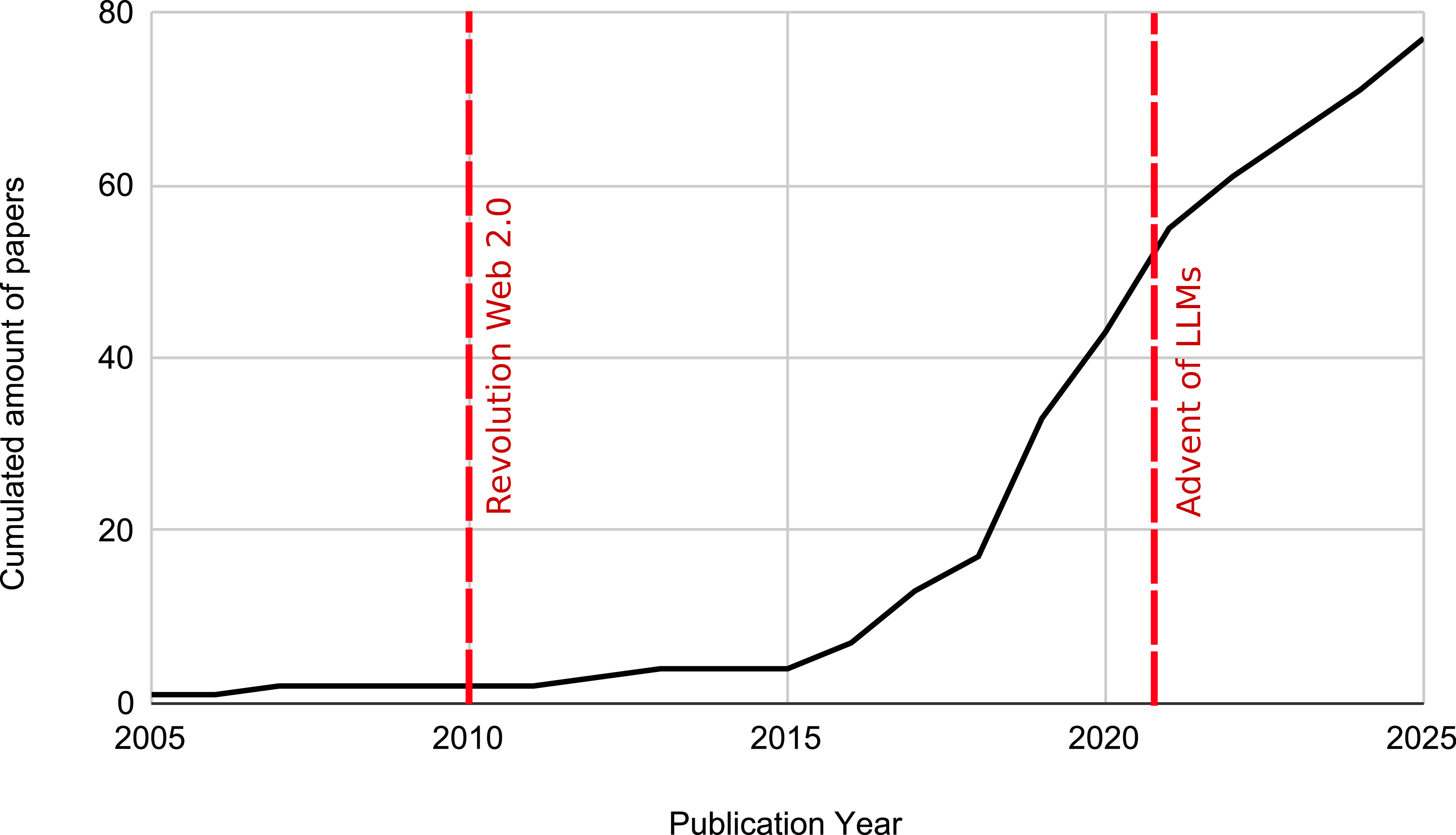

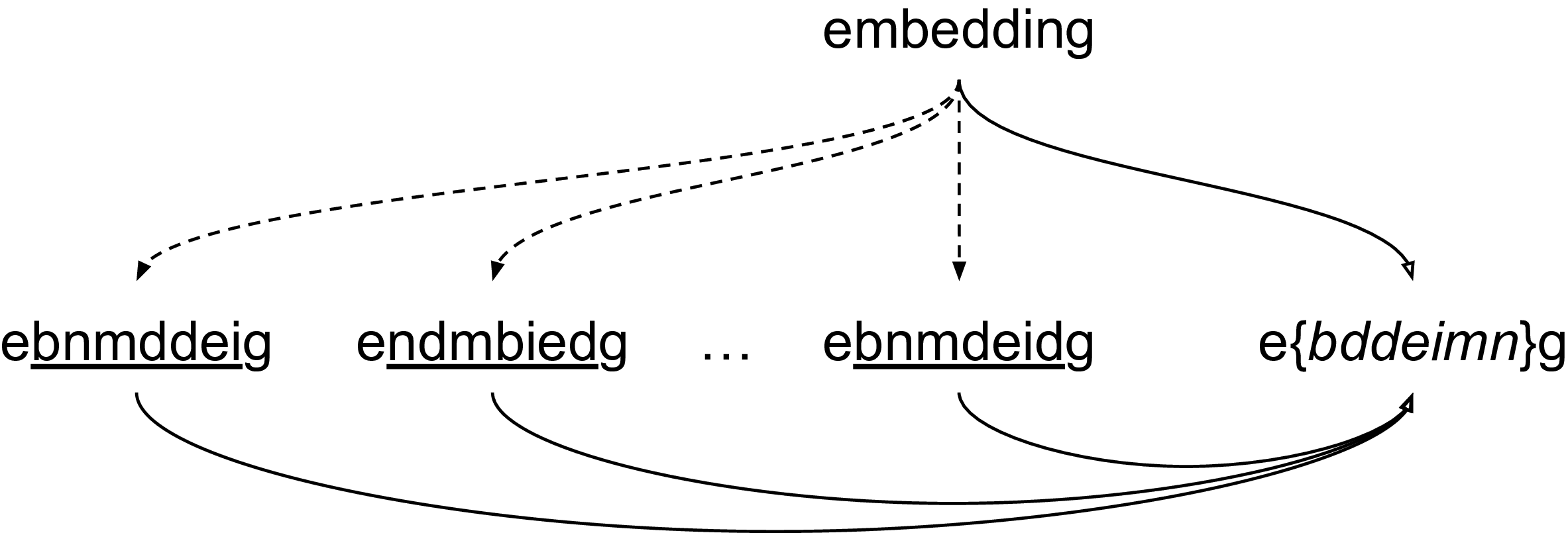

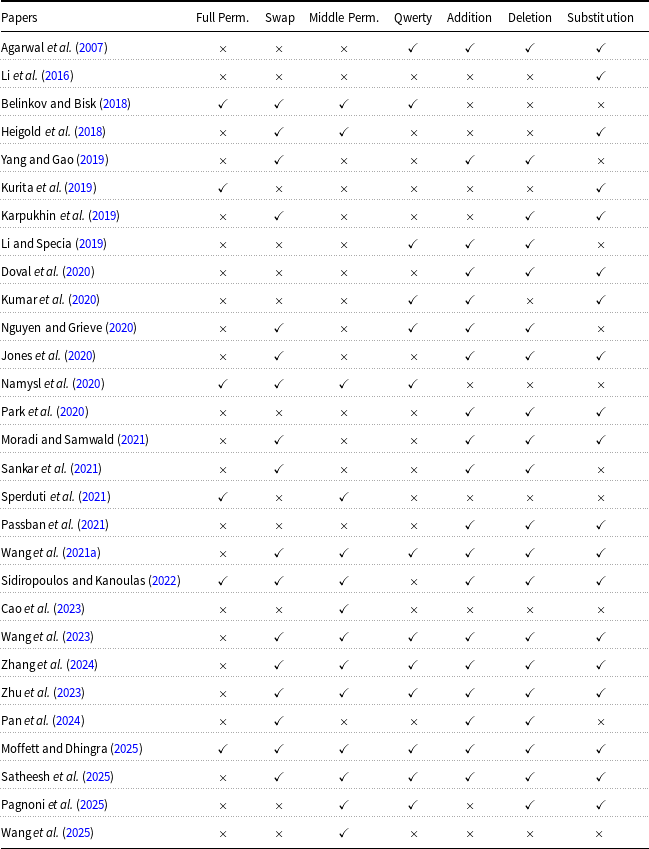

 Open access

