


Introduction
Hypertension, defined as blood pressure (BP) exceeding 130/80 mmHg, is a serious global health concern with an estimated 1.28 billion people aged 30–79 years (WHO, 2021b), a number that has doubled in the last 30 years (Zhou et al., Reference Zhou, Carrillo-Larco, Danaei, Riley, Paciorek, Stevens, Gregg, Bennett, Solomon, Singleton and Sophiea2021). Two-thirds of these individuals live in low- and middle-income countries (LMICs) (WHO, 2021b; Zhou et al., Reference Zhou, Carrillo-Larco, Danaei, Riley, Paciorek, Stevens, Gregg, Bennett, Solomon, Singleton and Sophiea2021), mostly in South Asia and sub-Saharan Africa (Zhou et al., Reference Zhou, Carrillo-Larco, Danaei, Riley, Paciorek, Stevens, Gregg, Bennett, Solomon, Singleton and Sophiea2021). In 2019, the global prevalence of hypertension was 32% in women and 34% in men (Zhou et al., Reference Zhou, Carrillo-Larco, Danaei, Riley, Paciorek, Stevens, Gregg, Bennett, Solomon, Singleton and Sophiea2021). However, this prevalence varies across the life cycle and is less common in younger women, while more common in elderly women compared to their male counterparts (Ahmad and Oparil, Reference Ahmad and Oparil2017; Ahmad and Oparil, Reference Ahmad and Oparil2017; Chowdhury et al., Reference Chowdhury, Rahman, Akter, Akhter, Ahmed, Shovon, Farhana, Chowdhury and Turin2020; Peltzer and Pengpid, Reference Peltzer and Pengpid2018).
Hypertension is associated with an increased prevalence of cardiovascular diseases, including stroke, myocardial infarction, and coronary heart disease (Ahmad and Oparil, Reference Ahmad and Oparil2017; Campbell et al., Reference Campbell, Lackland, Lisheng, Niebylski, Nilsson and Zhang2015), which are major causes of mortality in LMICs, including Bangladesh (WHO, 2021b). Importantly, over 90% of these deaths are premature, contributing to around 10.4 million deaths annually (Bennett et al., Reference Bennett, Kontis, Mathers, Guillot, Rehm, Chalkidou, Kengne, Carrillo-Larco, Bawah and Dain2020). Moreover, hypertension is associated with 218 million disability-adjusted life years (Gakidou et al., Reference Gakidou, Afshin, Abajobir, Abate, Abbafati, Abbas, Abd-Allah, Abdulle, Abera and Aboyans2017; Zheng et al., Reference Zheng, Wang, Xue, Li, Fan, Zhang, Li, Wang, Xie and Xin2023), presenting a growing disease burden for Bangladesh and other LMICs. Furthermore, the current round of global development goals, the Sustainable Development Goals, aims to reduce one-third of all premature deaths by 2030, as well as to reduce the prevalence of high BP by 25% (United Nations, 2015). However, LMICs are unlikely to meet this target unless the current occurrence of premature deaths due to rising BP is reduced through proper hypertension management.
Hypertension management, which includes awareness, treatment, and control of hypertension, is low worldwide, particularly in LMICs (Ahmad and Oparil, Reference Ahmad and Oparil2017). Globally, around 41% of the total hypertensive people are unaware of their hypertensive status with the prevalence being higher in South Asia (55%) (Zhou et al., Reference Zhou, Carrillo-Larco, Danaei, Riley, Paciorek, Stevens, Gregg, Bennett, Solomon, Singleton and Sophiea2021). Even among those who are aware of their hypertensive status, a higher percentage of them do not receive treatment and/or depend on ineffective or traditional medications to control hypertension (Santosa et al., Reference Santosa, Zhang, Weinehall, Zhao, Wang, Zhao, Wang and Ng2020). Therefore, a significant percentage of the diagnosed hypertension is uncontrolled. The causes are lower awareness about hypertension and its consequences. Furthermore, controlling hypertension necessitates continuous care, which may be a burden for many hypertensive people, particularly those in the lowest income quintile in LMICs where there is no universal healthcare coverage. Because of a lack of knowledge about hypertension and limited access to healthcare services, women have poorer hypertension management.
In LMICs, women and children are highly exposed to household air pollution due to women’s roles in household chores, cooking, and infant care (Rana et al., Reference Rana, Islam, Khan, Aliani and Oulhote2021). They spend approximately four hours per day in the kitchen (Jain, Reference Jain2015), with the possibility of long-term exposure due to the lack of a hood system to remove smoke from the living space. Elevated BP has become a significant public health concern in Bangladesh, as almost one-third of adults are hypertensive (NIPORT, 2020). Additionally, the prevalence of household air pollution from cooking is extremely high (>80%) based on existing evidence (NIPORT, 2020). As household air pollution is linked to rising chronic conditions, including hypertension, in LMICs and Bangladesh, exploring the association between household air pollution and elevated BP is of research interest (Khan et al., Reference Khan, Hossain and Gupta2021). However, high-quality studies to address this association are scarce, and available studies mainly focus on the association of solid fuel use with becoming hypertensive (Khan et al., Reference Khan, Hossain and Gupta2021). These studies are also considered less precise methods to estimate the association between household air pollution and hypertension, such as the multivariate logistic regression model for clustering data with a prevalence of hypertension greater than 10. The multilevel Poisson regression model is the most appropriate approach, and an inadequate list of confounding factors is available (Khan et al., Reference Khan, Hossain and Gupta2021; Khan et al., Reference Khan, Nurs, Mofizul Islam, Islam and Rahman2017).
Moreover, the effects of solid fuel use on hypertension status could be higher for those who use solid fuel indoors than outdoors. The reasons are that the indoor use of solid fuel can bring severe consequences, including the development of hypertension, compared to its outdoor use. This hypothesis was proven in recent studies conducted in Myanmar and Bangladesh for another adverse outcome, i.e., under-five mortality, where the likelihood of under-five mortality was reported to be higher among children whose mothers use solid fuel indoors than those who use solid fuel outdoors or do not use solid fuel (Jain, Reference Jain2015). Therefore, a true understanding of the strengths of the associations between household air pollution and hypertension considering significant variation in the adverse effect depending on the place of solid fuel use is essential. However, these understandings are still lacking in Bangladesh and LMICs. Thus, we conducted this study to determine the associations between solid fuel use and the level of exposure to household air pollution with hypertension in Bangladesh using nationally representative survey data.
Methods
Study design
This quantitative study used data from the 2017/18 Bangladesh Demographic and Health Survey (BDHS). This was the most recent survey conducted in Bangladesh as part of the Demography and Health Survey Program of the USA. The Ministry of Health and Family Welfare of Bangladesh conducted this survey through its affiliated institutes, the National Institute of Population Research and Training. International development partners, including UNICEF and UNDP, supported this research financially and technically. The survey followed a two-stage stratified random sample technique to collect a nationally representative sample. In the first phase, 675 primary sampling units (PSUs) were randomly selected from 293,579 PSUs generated by the Bangladesh Bureau of Statistics as part of conducting the 2011 National Population Census. Data were collected from 672 PSUs. A fixed number of 30 households were selected from each PSU in the second stage of sampling. This produced a list of 20,160 households for data collection, while data were collected from 19,457 households with a 96.5% inclusion rate. Further sampling was done to collect BP measurements, with one-fourth of the selected households (7 to 8 households per PSU) chosen, which produced 4,864 households. There were 14,704 respondents aged 18 years or older in these selected households, of which 12,924 (women: 7,341, men: 5,583) had their BP measured with a response rate of 87.9%. Details of the sampling procedure have been published elsewhere (NIPORT, 2020).
Analysed sample
As per the aim of this study, we analysed all women’s data for whom BP was measured and who met the following inclusion criteria: (i) reported their fuel use status for cooking and the location (e.g., indoor/outdoor) where cooking was usually performed in their homes, (ii) had no missing data in other confounding variables, as presented in the confounding adjustment section, that were considered in the analysis. A total of 7,320 women met these conditions and were included in the analysis for this study. We did not include males in this study as, traditionally, they are not engaged in cooking activities in Bangladesh.
Study outcomes
This study was conducted for three outcomes: (i) systolic BP (a continuous variable, reported in millimetres of mercury [mmHg]), (ii) diastolic blood pressure (DBP) (a continuous variable, reported in millimetres of mercury [mmHg]), and (iii) hypertension status (yes or no). The survey reported the systolic and DBP of the included respondents during the survey. For this, the survey used digital oscillometer BP measuring devices with automatic upper-arm inflation and automatic pressure release devices. BP was checked three times with an interval of at least 5 minutes, and the average values of the second and third measurements were used as the individual BP (Islam and Majumder, Reference Islam and Majumder2012). We classified an individual as hypertensive if she had systolic BP ≥140 mmHg and/or DBP ≥90 mmHg or reported using any antihypertensive drugs to control BP. This is the recommendation of the National Guidelines for the Management of Hypertension in Bangladesh and is comparable with the 2018 European Society of Hypertension and European Society of Cardiology hypertension guidelines (WHO, 2013; Williams et al., Reference Williams, Mancia and Spiering2018).
Exposure variables
Two exposure variables were considered in this study: (i) fuel type (solid fuel and clean fuel) and (ii) level of exposure to household air pollution through solid fuel use (unexposed, moderately exposed, and highly exposed). The BDHS recorded the type of fuel used in the respondents’ households for cooking by asking, ‘What type of fuel does your household mainly use for cooking?’ A list of fuels was provided for response. In cases where the fuel used by the respondents was not on the list, they were allowed to write the name of the fuel. We reclassified these responses as solid fuel use (if the respondents recorded coal, lignite, charcoal, wood, straw, shrubs, grass, agricultural crop, and animal dung) and clean fuel use (electricity, liquid petroleum gas, natural gas, and biogas) to generate the first exposure variable. Respondents were also asked about the place of cooking in their households by asking, ‘Is the cooking usually done in the house, in a separate building, or outdoors?’ Responses recorded for this question were considered along with the type of cooking fuel respondents used to generate the second exposure variable, the level of exposure to household air pollution through solid fuel use. There were three categories of this variable: unexposed, moderately exposed, and highly exposed. We classified the respondents based on their exposure levels as follows: those who reported using clean fuel for cooking in their households were considered unexposed; those who reported using solid fuel for cooking in a separate building or outdoors were classified as moderately exposed; and those who reported using solid fuel for cooking inside their houses were classified as highly exposed. This variable was created to assess exposure levels. Previous studies in LMICs also followed similar categorisation (Rana et al., Reference Rana, Islam, Khan, Aliani and Oulhote2021; Khan et al., Reference Khan, Nurs, Mofizul Islam, Islam and Rahman2017).
Confounding adjustment
We considered a range of covariates selected based on the previous literature in LMICs, particularly in Bangladesh (Baumgartner et al., Reference Baumgartner, Schauer James, Ezzati, Lu, Cheng, Patz Jonathan and Bautista Leonelo2011; Bloomfield et al., Reference Bloomfield, Lagat, Akwanalo, Carter, Lugogo, Vedanthan, Velazquez, Kimaiyo and Sherman2012; Chen et al., Reference Chen, Burnett, Kwong, Villeneuve, Goldberg, Brook, Van Donkelaar, Jerrett, Martin and Kopp2014; Norris et al., Reference Norris, Goldberg, Marshall, Valois, Pradeep, Narayanswamy, Jain, Sethuraman and Baumgartner2016). These were women’s age (18–34, 35–39, 40–44, 45–49, 50–54, 55–59, 60–64, and 65+), women’s education (illiterate, primary, secondary, and higher), women’s working status (yes or no), women’s body mass index (underweight, increasing but acceptable risk, increased risk, and high risk), place of residence (urban or rural), and place of region (Barishal, Chattogram, Dhaka, Khulna, Mymensingh, Rajshahi, Rangpur, and Sylhet). We generated the women’s body mass index variable by using the height and weight data available in the survey. For this, we followed the World Health Organization’s recommendation for the Asian population to study non-communicable diseases (World Health Organization, 2004).
Statistical analysis
The characteristics of the respondents were described using descriptive statistics. A separate multilevel linear regression model was used to determine the association between the type of cooking fuel used and the level of household air pollution exposure with systolic and DBP. Additionally, a distinct multilevel mixed-effects Poisson regression model was employed to examine the relationships involving the type of cooking fuel used, the level of household air pollution exposure resulting from solid fuel usage, and hypertensive status. We selected the multilevel mixed-effects Poisson regression model for two reasons. First, the data we examined had a hierarchical structure, with individuals nested within households and households nested within clusters. Therefore, responses recorded from the same household or cluster are not independent. Second, the prevalence of the outcome variables we considered, systolic BP, DBP, and hypertension status, was high (prevalence was >10%). Previous studies discovered that in such cases, with a higher prevalence of outcome variable and a hierarchical data structure, the multilevel Poison regression model produces comparatively better results than the simple logistic regression model (Chen et al., Reference Chen, Qian, Shi and Franklin2018; Gnardellis et al., Reference Gnardellis, Notara, Papadakaki, Gialamas and Chliaoutakis2022). We ran both unadjusted and adjusted models. In the unadjusted model, only a specific outcome measure and exposure variable were taken into account. This model was expanded to the adjusted model, incorporating confounding adjustment factors. The results were reported as a coefficient/prevalence ratio with a 95% confidence interval (95% CI). Sampling weight was considered in all analyses. We used Stata version 15.1 to perform all descriptive statistics (Stata Statistical Software: Release 15. College Station, TX: StataCorp LLC. Texas, USA). All analyses were carried out in accordance with the applicable guidelines and regulations.
Results
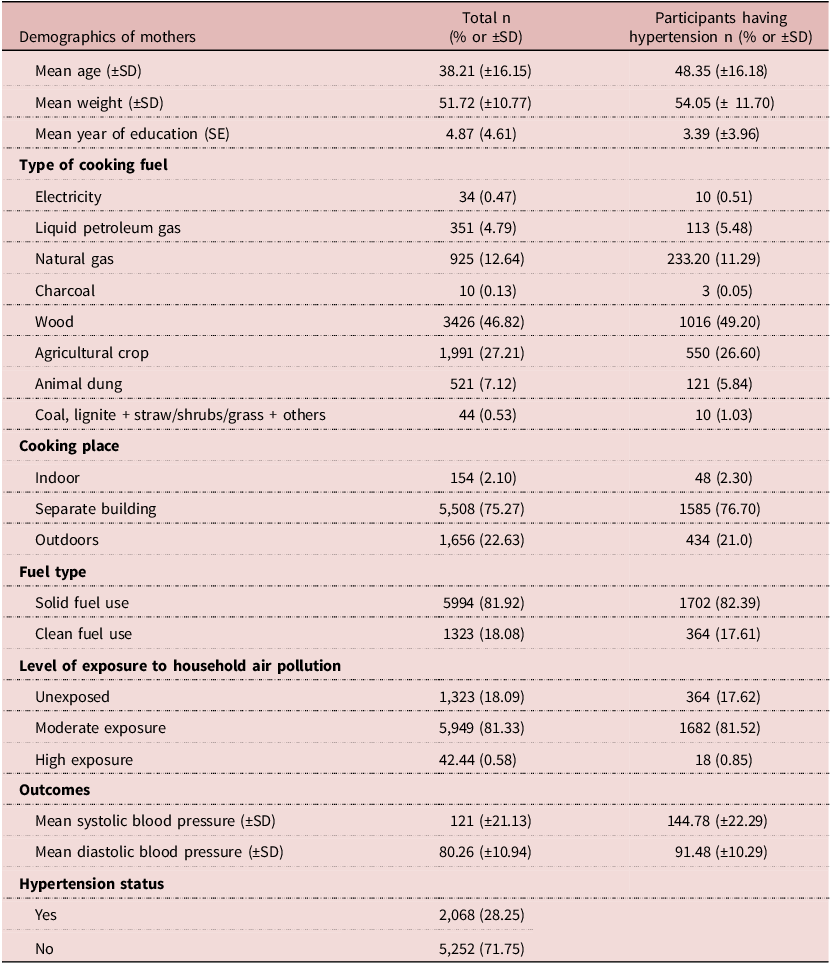
The background characteristics of the total respondents and respondents having hypertension are presented in Table 1. The mean age of the respondents was 38 years, and their average years of education were 4.87. Nearly 82% of all respondents used solid fuel for household cooking. Wood was the most common type of solid fuel (46.82%), followed by agricultural crops (27.21%) and animal dung (7.12%). Around three-fourths of the respondents reported using a separate building for cooking, while only 2.10% cooked indoors. We found that 81% of the total respondents were moderately exposed to household air pollution, and only 0.58% were highly exposed to household air pollution when we considered cooking fuel and place together to create an index of the level of exposure to household air pollution through cooking fuels. The mean systolic and DBPs were 121 and 80.26, respectively. The prevalence of hypertension was 28.25%. A comparable distribution was observed among respondents with hypertension.
Key information about the study participants, exposure, and outcome variables

Note: All estimates are weighted. SD = Standard deviation.
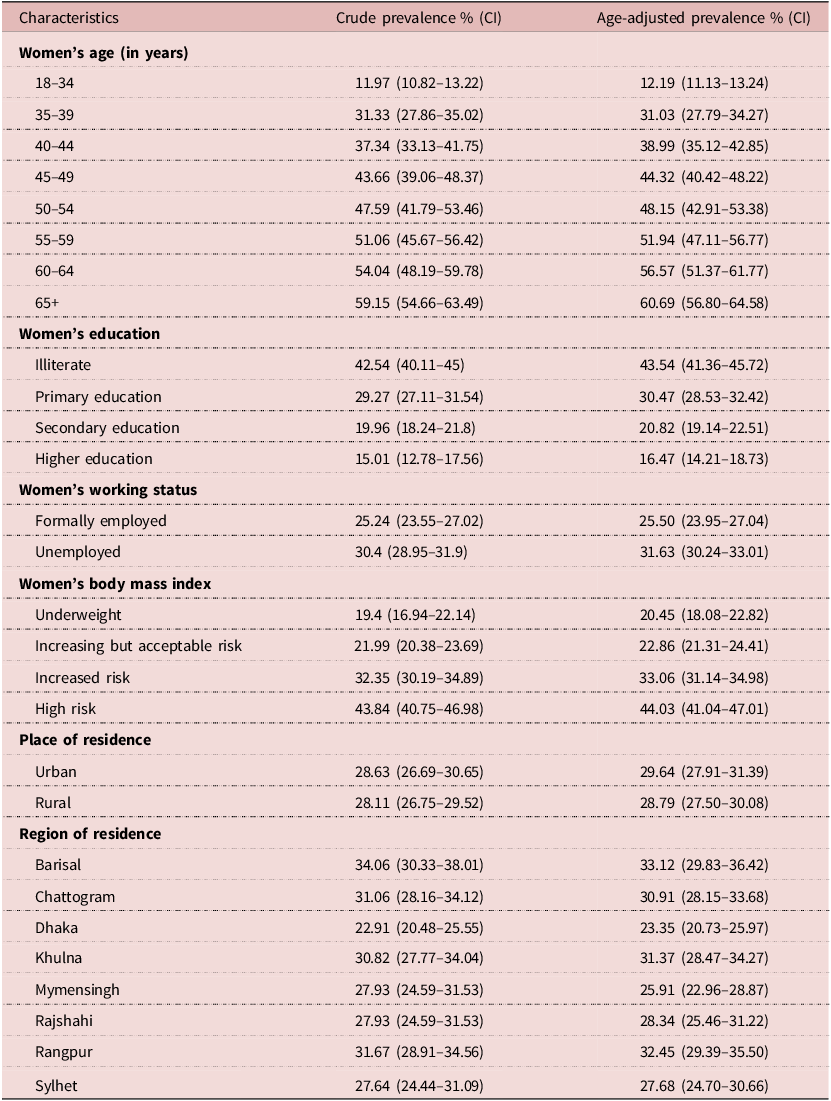
Table 2 presents the crude and age-standardised prevalence of hypertension by respondents’ socio-demographic characteristics. In the crude prevalence, only the finally selected sample was considered, along with survey weight. In the age-standardised prevalence, the analysed sample was considered with the respective ages’ national population of Bangladesh. We extracted the respective ages’ national population from the 2011 national population census of Bangladesh, which is the most recent population census available.
Crude and age-standardised prevalence of hypertension by respondents’ socio-demographic characteristics, BDHS, 2017/18

Note: All estimates are weighted. CI = confidence interval.
The age-adjusted prevalence of hypertension was found to be relatively high among illiterate women (44%) compared to higher-educated women (16%). The prevalence of hypertension was also found to increase with the increase in respondents’ age, with more than half of the respondents aged 50 years and above being hypertensive. The prevalence of hypertension was also found to increase with an increase in body mass index, ranging from 20% among underweight women to 44% among obese women. At the divisional level, women who resided in Rangpur and Chattogram reported a higher prevalence of hypertension.
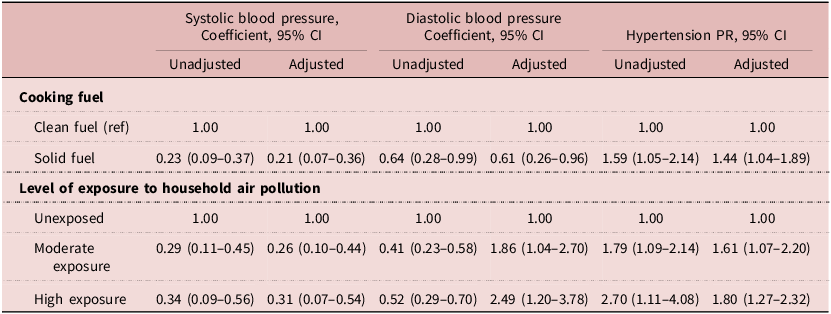
Table 3 presents the unadjusted and adjusted associations of household air pollution with systolic BP, DBP, and hypertension status. The coefficient of systolic BP (coefficient, 0.21 (95% CI, 0.07–0.36)) and DBP (coefficient, 0.61 (95% CI, 0.26–0.96)) was positive, indicating that mean systolic and DBP increase with increased exposure to solid fuel compared to clean fuel. Similarly, the likelihood of hypertension was found to be 1.44 (95% CI 1.04–1.89) times higher among women who used solid fuel compared to their counterparts who used clean fuel for cooking. The likelihood was even higher when we considered the augmented measure of exposure to household air pollution. Compared to unexposed women, a significant increase in the coefficient of systolic and DBP was reported among women moderately exposed and highly exposed to household air pollution. We also found 1.61 times (95% CI 1.07–2.20) and 1.80 times (95% CI, 1.27–2.32) higher likelihood of hypertension among women moderately and highly exposed to household air pollution, respectively, compared to women not exposed to household air pollution.
Unadjusted and adjusted association of household air pollution with systolic blood pressure, diastolic blood, and hypertension status, Bangladesh

Discussion
In this study, we explored the current use of solid fuel use in Bangladesh and its associations with systolic BP, DBP, and hypertension. To do so, we first assessed self-reported household solid fuel usage status. Subsequently, we developed an augmented index, level of exposure to household air pollution, by combining places where solid fuel is used. We then determined their associations with systolic BP, DBP, and hypertension status using the multilevel Poisson regression model, adjusting for possible confounders. We found that solid fuel use increases the prevalence of becoming hypertensive as well as increases the systolic and DBP. The likelihood was found to be even higher among women who used solid fuel indoors rather than outdoor fuel or who used clean fuel. These findings provide an important pathway for the rising prevalence of hypertension in Bangladesh, which currently has an 80% prevalence for solid fuel use, with 2% of them using solid fuel indoors. Furthermore, the findings of this study are robust in relation to the study data examined, the type of confounding factors considered, and the statistical methods employed. As a result, the findings are expected to assist policymakers in Bangladesh in developing evidence-based policies and programmes that will accelerate Bangladesh’s progress towards achieving the Sustainable Development Goals by 2030.
The direction of the associations between the level of exposure to household air pollution through solid fuel use and systolic BP, DBP, and hypertension reported in this study is consistent with previous research conducted in LMICs, including Bangladesh (Bloomfield et al., Reference Bloomfield, Lagat, Akwanalo, Carter, Lugogo, Vedanthan, Velazquez, Kimaiyo and Sherman2012; Khan et al., Reference Khan, Nurs, Mofizul Islam, Islam and Rahman2017; Li et al., Reference Li, Yang, He, Liu, Ma, Niu and Luo2020). This association is due to the fact that women in LMICs typically perform cooking activities and spend a significant amount of time in the kitchen, resulting in their exposure to black carbon and other air pollutants emitted by solid fuel. These pollutants can cause acute increases in systolic and DBP, as well as lead to the development of hypertension (Norris et al., Reference Norris, Goldberg, Marshall, Valois, Pradeep, Narayanswamy, Jain, Sethuraman and Baumgartner2016; Khan et al., Reference Khan, Hossain and Gupta2021).
The gradual increase in the coefficient of systolic BP, DBP, and the likelihood of hypertension with increased household air pollution exposure level is an important aspect of this study’s findings. This finding is novel because a recent study using the same data only examined the relationship between hypertensive status and the use of solid fuel (Khan et al., Reference Khan, Hossain and Gupta2021), leaving out the level of exposure and its effects. Recent studies in Bangladesh and Myanmar have found an increased likelihood of under-five mortality with increased household air pollution exposure (Alam et al., Reference Alam, Acharjee, Mahmud, Tania, Khan, Islam and Khan2022; Rana et al., Reference Rana, Islam, Khan, Aliani and Oulhote2021), which emphasises the magnitude of our study findings. Increased exposure level to household air pollution means that women use solid fuel inside their households and/or living rooms most of the time without proper smoking ventilation systems. As a result, their exposure time increases even after cooking is finished. Traditionally, Bangladeshi people cook three times a day, and every time cooking takes around 2–3 hours. With poor ventilation systems, this usual 6–9 hours of direct exposure to household air pollution increases to 12–16 hours, considering post-cooking hours. This increased exposure time and smoking could be linked to an increase in the likelihood of systolic BP, DBP, and hypertension as household air pollution exposure increases from unexposed to moderately or highly exposed. These findings align with Arku et al. (Reference Arku, Ezzati, Baumgartner, Fink, Zhou, Hystad and Brauer2017), who, in their study, analysed data from 12 Demography and Health Survey (DHS) conducted in 10 different countries. They found that the use of pollutant fuel for cooking serves as an indicator of household air pollution exposure and is positively associated with both systolic and DBP, as well as the risk of hypertension.
In addition to the factors mentioned earlier, it is important to note that many uneducated and rural women in Bangladesh, as well as in other LMICs, typically cook indoors and may not be aware of the risks associated with using solid fuel indoors without adequate ventilation. Moreover, they may not be aware of the importance of managing BP and may rarely check their BP unless they become ill. This lack of awareness, coupled with increasing levels of exposure to household air pollution, could also contribute to the higher likelihood of systolic BP, DBP, and hypertension observed in this study (Baumgartner et al., Reference Baumgartner, Schauer James, Ezzati, Lu, Cheng, Patz Jonathan and Bautista Leonelo2011; Norris et al., Reference Norris, Goldberg, Marshall, Valois, Pradeep, Narayanswamy, Jain, Sethuraman and Baumgartner2016; Rajkumar et al., Reference Rajkumar, Young, Clark, Benka-Coker, Bachand, Brook, Nelson, Volckens, Reynolds, L’orange, Good, Koehler, Africano, Osorto Pinel and Peel2019; Young et al., Reference Young, Clark, Rajkumar, Benka-Coker, Bachand, Brook, Nelson, Volckens, Reynolds, L’orange, Good, Koehler, Africano, Osorto Pinel and Peel2019).
The study has several strengths and limitations. One of the strengths is that we used large-scale nationally representative survey data and employed advanced statistical modelling, adjusting for all possible confounders. Our multilevel mixed-effects Poisson regression model addressed the issues of overestimation or underestimation that may occur in the conventional logistic regression model. Therefore, the findings of this study are more precise and could be useful in national-level policy and programme development. However, as we analysed cross-sectional survey data, the relationships reported were not temporal, but rather correlational only. Additionally, all data in the survey, including the type of cooking fuels and the place where solid fuels were used, were self-reported, and interviewers could not validate the responses. This could be a potential source of recall bias. Also, there is a possibility that respondents are never engaged in cooking although they reside in the households. Furthermore, systolic BP, DBP, and hypertension are associated with various other factors, such as physical activity, diet, ambient air pollution, food habits, and behavioural factors like smoking. Therefore, their adjustment in the model is essential to obtain accurate results. However, due to the lack of data in the survey we analysed, we could not adjust for those factors. A further longitudinal study is necessary to validate the association reported in this study, considering all possible confounding factors.
Conclusion
We found that household air pollution resulting from solid fuel use and the level of exposure to household air pollution through solid fuel use increase the likelihood of systolic BP, DBP, and hypertension. This presents a significant challenge for Bangladesh, given that 80% of households in the country use solid fuel for cooking and hypertension is a major disease burden. Implementing national policies to avoid solid fuel for cooking could lower the prevalence of hypertension among adult women in Bangladesh. Improving cooking facilities, ventilation systems, and raising awareness about the adverse effects of solid fuel use are important steps to reduce the burden of hypertension, particularly among women.
Declaration
This study has not been published or presented anywhere before. I confirm that the manuscript has been submitted solely to this journal and is not published, in-press, or submitted elsewhere. I can confirm that all the research meets the ethical guidelines, including adherence to the legal requirements of the study country.
Data availability statement
The DHS programme of the USA is the custodian of 2017 BDHS data. It is freely available for the user upon submission of reasonable requests to the DHS.
Acknowledgements
We acknowledge the DHS programme of the USA, custodian of the data used in this study, for approving to use of their data.
Author contribution
Khan MN, Islam MS, and Khan MMA designed this study. Paul D, Chowdhury AR, and Ali H analyzed the data along. Khan MN, Paul D, and Chowdhury AR wrote the first draft of this manuscript. Khan MN, Islam MS, Kabir MI, and Khan MMA critically revised this manuscript. All authors approved this submitted version of the manuscript.
Funding statement
This research received no specific grant from any funding agency, commercial entity, or not-for-profit organization.
Competing interests
The authors have no conflicts of interest to declare.
Ethical standard
This study analysed secondary data from the DHS program in de-identified form with permission to analyse. Ethical approval for this survey was provided by the Bangladesh Medical Research Council and the Demographic and Health Survey Program of the USA. No additional ethical approval is required to conduct this study. Informed consent was obtained from each respondent before interviewing.
Consent for publication
Not applicable.

 Open access

