


Recently the concept of continuing professional development through lifelong learning has attained increasing significance in the UK (Department of Health, 1998; Royal College of Psychiatrists, 2004). Associated with this are the concepts of professional self-regulation, self-reflective practice, peer-group support and mentoring. There are few studies examining the role of mentoring in health promotion either in the UK or other countries (Reference Oliver and AggletonOliver & Aggleton, 2002).
Mentoring is one way of providing effective need assessment and feedback, two essential elements in personal development planning. Little has been published on mentoring or the evaluation of mentoring programmes, but some evidence suggests that mentors and those they advise benefit from the relationship. Mentoring may also specifically aid learning (Standing Committee on Postgraduate Medical and Dental Education, 1998). Furthermore, mentoring during early career stages is associated with high career satisfaction and may guide development of professional expertise (Reference Ramanan, Taylor and DavisRamanan et al, 2006). The Royal College of Psychiatrists acknowledges the importance of an effective mentoring relationship and recommends that all newly appointed consultants should have access to at least one designated senior colleague, a mentor, for advice, support or information (Reference DeanDean, 2003). This is expected to reduce stress and uncertainty, effectively and quickly consolidate and widen skills, and lead to ‘best practice’ (Reference Roberts, Moore and ColesRoberts et al, 2002).
Box 1. The questionnaire
-
1. Are you familiar with the concept of mentoring?
-
2. What do you understand by the term mentoring?
-
3. Is it important to have a mentor during training years?
-
4. Did you have a mentor during your training?
-
5. Have you been in a role of mentor?
-
6. If yes, did you receive training for it?
-
7. Does mentoring help in career preparation and development?
-
8. What are the purpose/aim of mentorship?
-
9. What problems do you see in a mentoring relationship?
For many doctors, mentoring is a vague concept. The role seems to overlap with those of counsellor, supervisor, critical friend, role model, tutor, appraiser and even assessor. In fact, there are several definitions of mentoring. Morton-Cooper & Palmer (Reference Morton-Cooper and Palmer1993) defined it as a relationship ‘that is enabling and cultivating; [one] that assists in empowering an individual with the working environment’
A common model for a mentor is that of a critical friend, a trusted and respected peer or a more experienced colleague. It is very popular among non-medical professions, students, high-fliers and people in transition (Holloway, 2000a ,b). The standing committee on postgraduate education (Standing Committee on Postgraduate Medical and Dental Education, 1998) has described primary requirements for an effective mentoring relationship, namely voluntary participation, confidentiality, mutual commitment and respect, early negotiation of explicit relationship boundaries, and formally planned but informally conducted sessions.
We compared the views of psychiatrists working in low- and middle-income countries with those from high-income countries to identify differences in their experiences and views on mentoring in healthcare system.
Method
A purpose-designed, anonymous questionnaire (Box 1) was used for the cross-sectional qualitative survey; a covering letter provided a broad definition of mentoring. The study was piloted in two teaching hospitals.
Questionnaires were distributed and collected personally to improve response rate to 110 psychiatrists attending the 2007 World Psychiatric Conference. Data were analysed generating frequency tables on familiarity, importance and role of mentoring. Responses of psychiatrists from low- and middle-income, and high-income countries were compared and Pearson χ2 and P-values calculated. A stricter P=0.01 was used as a measure for correction for multiple testing. The survey obtained ethical approval from the ethical review committee of the Pakistan Psychiatric Research Centre.
Results
We collected 85 responses; 4 were not filled in completely and were excluded, yielding an overall response rate of 73.6%. The participants’ countries of origin were classified as follows: the UK, Australia, Japan, South Africa – high-income countries; Pakistan, India, Malaysia, Nepal, Sri Lanka, Myanmar, Indonesia, Egypt – low- and middle-income countries (Fig. 1).
Respondents’characteristics
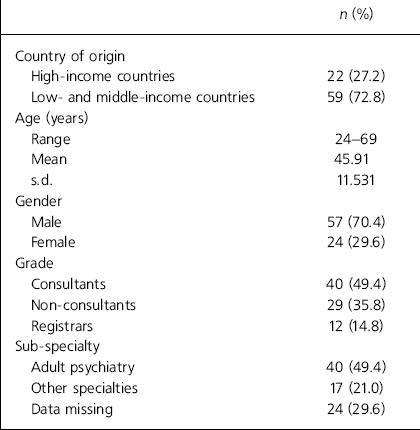
Respondents’ characteristics, like country of origin, age, gender, grade and sub-specialty, are shown in Table 1. There was a significant difference in age between psychiatrists from high-income, and low- and middle-income (high-income countries, mean 52.32; low- and middle-income countries, mean 43.53; t=3.227, d.f.=79, P=0.002).
Respondents’ characteristics (n=81)
| n (%) | |
|---|---|
| Country of origin | |
| High-income countries | 22 (27.2) |
| Low- and middle-income countries | 59 (72.8) |
| Age (years) | |
| Range | 24-69 |
| Mean | 45.91 |
| s.d. | 11.531 |
| Gender | |
| Male | 57 (70.4) |
| Female | 24 (29.6) |
| Grade | |
| Consultants | 40 (49.4) |
| Non-consultants | 29 (35.8) |
| Registrars | 12 (14.8) |
| Sub-specialty | |
| Adult psychiatry | 40 (49.4) |
| Other specialties | 17 (21.0) |
| Data missing | 24 (29.6) |
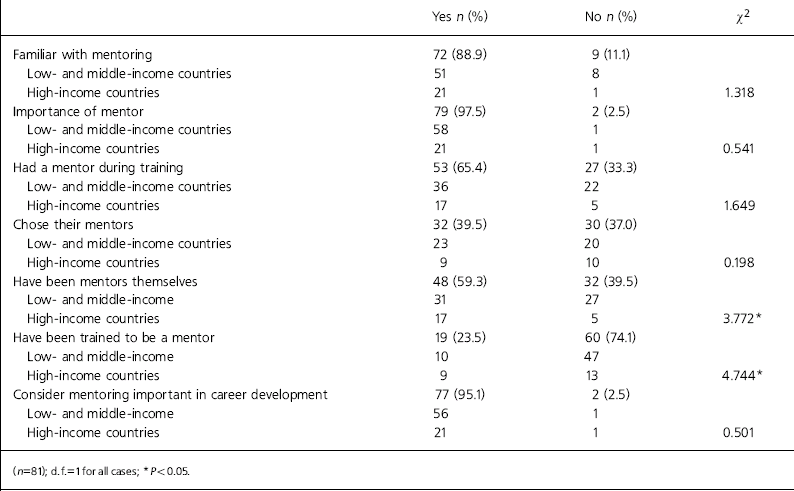
Table 2 summarises participants’ experience of mentoring, depending on their country of origin. No significant differences were found between those from low- and middle-income and high-income countries on familiarity with, importance and role of mentoring. For those who had been mentors themselves there were no perceived differences in their training. Similarly, no significant differences were found between psychiatrists of different grades, sub-specialties and gender.
Experiences of mentoring depending on the country of origin
| Yes n (%) | No n (%) | χ2 | |
|---|---|---|---|
| Familiar with mentoring | 72 (88.9) | 9 (11.1) | |
| Low- and middle-income countries | 51 | 8 | |
| High-income countries | 21 | 1 | 1.318 |
| Importance of mentor | 79 (97.5) | 2 (2.5) | |
| Low- and middle-income countries | 58 | 1 | |
| High-income countries | 21 | 1 | 0.541 |
| Had a mentor during training | 53 (65.4) | 27 (33.3) | |
| Low- and middle-income countries | 36 | 22 | |
| High-income countries | 17 | 5 | 1.649 |
| Chose their mentors | 32 (39.5) | 30 (37.0) | |
| Low- and middle-income countries | 23 | 20 | |
| High-income countries | 9 | 10 | 0.198 |
| Have been mentors themselves | 48 (59.3) | 32 (39.5) | |
| Low- and middle-income | 31 | 27 | |
| High-income countries | 17 | 5 | 3.772* |
| Have been trained to be a mentor | 19 (23.5) | 60 (74.1) | |
| Low- and middle-income | 10 | 47 | |
| High-income countries | 9 | 13 | 4.744* |
| Consider mentoring important in career development | 77 (95.1) | 2 (2.5) | |
| Low- and middle-income | 56 | 1 | |
| High-income countries | 21 | 1 | 0.501 |
Views on other aspects of mentoring
Several adjectives were used by respondents to describe mentor: ‘guide’ (26%), ‘advisor’ (7%), ‘supervisor’ (5%), ‘role model’ (3%), etc. One person defined a mentor as the one whose role is to ‘[develop] a mentee professionally and individually and guide/assist [them] through difficult times in career.’ About half identified career development and facilitating reflective learning as the main purpose of a mentoring relationship.
The lack of understanding, poor interpersonal skills, negative attitudes, including under or over friendliness, extensive criticism, etc., were identified as possible problems in mentoring relationship. Participants also mentioned organisational problems like workload, lack of mentoring schemes, no academic credits for involvement in mentorship, etc. Interestingly, several people identified confidentiality as a possible problem.
Percentage of psychiatrists that took part in the study (by country)

Discussion
This study shows tremendous similarity in views and experiences of mentoring in psychiatrists working in different parts of the world. There were no significant differences in their familiarity with mentoring and its importance during training. This suggests that the importance of mentoring in career preparation and development is appreciated in psychiatric services across different countries and cultures. It remains an area not researched thoroughly, particularly in low- and middle-income countries.
However, the role of mentors is identified in other fields of medicine and nursing (Reference Armitage and BurnardArmitage & Burnard, 1991; Reference FreemanFreeman, 1996; United Kingdom Central Council for Nursing, Midwifery and Health Visiting, 1999; Reference SanaiSanai, 2006) and some evidence suggests that it is of great value for overseas doctors working in the UK (Reference HusainHusain, 1998; Reference OkerekeOkereke, 2000). It also occupies an important position in the initial and continuing professional development of teachers (Department for Education and Employment, 2001).
One problem surrounding the issue of mentorship is there is no common agreement as to the role and function of a mentor. There is no clear operational definition, aims and expectations from those in mentoring relationships. For mentoring to be effective, a number of individual, organisational and professional factors need to be in place (Reference Oliver and AggletonOliver & Aggleton, 2002).
Our survey represents a qualitative method of research and has many limitations. For one thing, the definition of mentoring provided to the participants was a broad one, which may have led some to confuse it with other roles, like supervisor. Also, the sample was not random and selection bias may be present. Other studies have highlighted the need for further qualitative research in this field (Reference OkerekeOkereke, 2000).
Conclusion
This survey highlights that mentoring relationship is valued by psychiatrists regardless of where in the world they practice. Mentoring is identified as an appropriate means of responding to the personal and professional challenges of psychiatric practice (Department of Health, 2000a , b ). In the face of the problems with recruitment and retention (Sainsbury Centre for Mental Health, 2000), supporting newly appointed staff and trainee doctors through mentoring needs further exploring.
Declaration of interest
None.


 Open access


eLetters
No eLetters have been published for this article.