


Introduction
Lawyers and scholars spend a lot of time thinking about the intentions of courts. So, to a lesser extent, do journalists, politicians, and citizens. Legal commentators may extend a fair bit of thought to individual judges, but the real effect of a supreme or appellate court is what the court decides overall, by majority vote. A court is an institutional group agent in the same way a legislature or a corporation is. These institutions are not merely collections of individuals: they are separate agents with their own beliefs, intentions, and actions.
Group agents are groups that can act as unified, intentional agents at the group level. They might have many individual members who take part in the group’s decisions, but group agents are not reducible to their members. Consider courts as an example of this type of aggregated-decision agent.Footnote 1 Courts issue decisions at the group level. We often use expressions such as, “the Supreme Court held that …”. Sometimes a court issues opinions as ‘the Court’, and in these cases we understand that the judges reached unanimity. But we speak of a court deciding, even when a single judge authored the opinion and only a bare majority of judges signed on to it. Courts have the feature of group agency of retaining their identity even when their individual members change. Judgements have the same effect on the law, regardless of which judges happen to be on the bench or which judges are on the panel for a particular case. Just like a corporation or a legislature, courts issue decisions with clear outcomes, even if only a bare majority voted for them. These outcomes have significant impacts in the world.
Courts may seem like paradigmatic examples of group agents. In articles on group agency and social ontology, authors often refer to courts as examples of group agents, often with little or no consideration of the unique features of courts.Footnote 2 But there is one way that courts speak that makes them a problematic fit into a group agency paradigm: courts do not always come to a single result that becomes the intention of the group. When other groups make decisions by vote, the majority’s decision becomes that group’s intention.Footnote 3 When courts decide on issues, they do not always have a majority that signs on to the same reasons. While they will have a majority on the yes/no outcome, they arrive there for different reasons. For instance, in R. v. Parranto, nine judges participated in the decision: four judges signed on to one set of reasons, two judges to a second set, two more to a third set of reasons, and one judge wrote alone.Footnote 4 Three of those separate opinions concurred in the result, and so that result gave the outcome of the case. These types of decisions are called plurality decisions: the judges produce no majority opinion, but the court still issues reasons, and parts of those reasons still become binding law.Footnote 5 Plurality decisions are not the norm, but neither are they particularly uncommon in the law. Even in simple majority-dissent situations, the court is communicating more than just what the majority has decided.
Unlike other group agents, courts communicate along two distinct tracks of meaning. The outcome is one track of meaning—the verdict or disposition—and it is always all one way or another. It is decided by majority, except in the rare cases where there is no majority even on the question of whether the appeal should be allowed or dismissed.Footnote 6 The court’s form of communication is the same as that of other group agents: a written statement of intention, often adopted by means of a majority vote of the relevant members of the group. But courts deliver reasons that answer various legal questions that arise within the case, and these answers to sub-questions persist past the time of the vote. Minority reasons live on to have meaning in the world even if they are not aligned with other aspects of the group’s decision. Written opinions can diverge on reasons that lead to the outcome, and in these matters, there might be a different majority than the majority that makes up the winning side on the outcome, or indeed, no majority at all on some of these sub-questions. Those sub-questions remain unanswered. As such, courts maintain sub-group beliefs in a way that differs from other group agents. Courts hold beliefs in a more complicated way than other groups.
Judgements are often made up of decisions on subsidiary questions and decisions on final outcome. The subsidiary questions are premises in the logical argument that will result in a conclusion, which in turn governs the outcome decision. An example of a premise decision would be, did A owe B a duty of care? This decision may be a necessary part of a tort analysis but, if answered in the affirmative, will not be sufficient to decide the outcome. The preservation of individual reasons allows court voting to preserve both premise-wise and conclusion-wise decision making. Plurality decisions, where the court’s outcome is not backed by consistent reasons, are evidence that decisions on issues and decisions on outcomes are distinct and need not align in order to be valid. Because the court communicates through both issues and outcomes simultaneously, there is no perilous consequence when the issue and outcome votes do not map perfectly onto one another. This means that when employing a premise-driven procedure and a conclusion-driven procedure leads to different results, courts can preserve both results. While there is still the potential for a lack of coherence between the majority’s beliefs on premises and the majority’s vote on outcome, this is less problematic than for other groups because both levels of decision-making are preserved and given effect.
It follows that the discursive dilemma, a problem of group rationality, does not take the same shape for courts as it does for the other groups. The contribution of this paper is to show that courts do not face the discursive dilemma in the way that major authors in group agency theory, including Christian List, Philip Pettit, Lewis Kornhauser, and Lawrence Sager, express it.Footnote 7 Courts still possess many features that make them group agents. But courts are different from many, if not all, other group agents in a way that affects theories of how groups reason and form intentions. We expect this argument to contribute to discussions in social ontology as well as to current conversations about judicial reasoning and the importance of reasoned judgements.
We situate this discussion in judgements of the Supreme Court of Canada (SCC), but the lessons here apply to any court that allows judges to issue dissents or minority concurrences. The rest of the paper proceeds as follows: In Section 1, we introduce the discursive dilemma and show that the literature on group agency has failed to understand an important element of court decision-making. In Section 2, we show that the operation of plurality judgements supports the claims of Section 1. In Section 3, we offer some ways of looking at court decision-making in light of courts’ ability to encode meaning in at least two different ways. We conclude with some thoughts about what this might mean for group agency and for theories of judging.
1. Group Agency and Courts
Group agents are entities that operate with intention at the group level. Many examples of these types of groups are well known in our current politico-legal landscape: companies, legislatures, and universities, for instance. In order to be a group agent, a collection of individuals must be something more than people who happen to be in the same place, at the same time, engaged in the same activity. The collective must act cooperatively to accomplish something together. This means the collective must be able to hold intentions at the group level—an intention being a goal and a plan to accomplish that goal.Footnote 8 To be an agent of this type, it must be rational. As Philip Pettit notes, “a system will pass as an intentional agent only if it preserves intentional attitudes over time … in a rationally permissible manner.”Footnote 9 This does not mean that an intentional agent must be perfectly rational at all times, but that it must have some correspondence between the beliefs it forms, its intentions, and its actions. When a group has the identity of a group agent, we can talk about it and refer to it in a way that makes clear that the group itself has beliefs, intentions, and actions, and that these might be irreducible to the beliefs, etc. of their members.Footnote 10 Groups form intentions and perform actions by coordinating the thoughts and actions of their members, but the resulting mental and physical states are those of the group itself.
Because group agents are derived from the intentions and actions of individual agents, situations can arise where irrationality will creep into the group’s beliefs or actions, if the group does not hold itself to some discipline of reason. When group members vote for a result on the basis of different opinions for why that result should be obtained, groups may suffer from a problem of irrationality. Because some basic ability to be rational is necessary to agency, this irrationality is a sort of existential threat. The literature in social ontology calls this the discursive dilemma.Footnote 11 This is particularly apparent in cases where the group’s intention is formed from more than a simple yes/no binary decision. For example, consider a municipality deciding whether it should block off more roads for pedestrian use in the summer. All three voting members of the city council agree that it makes sense to block off the roads if and only if two conditions are met:
-
1. Some people will leave their cars at home and enjoy the experience of walking or cycling downtown because of the blocked-off roads.
-
2. Downtown businesses will have adequate revenue from pedestrians, and not lose business because people decide not to drive downtown from the suburbs.
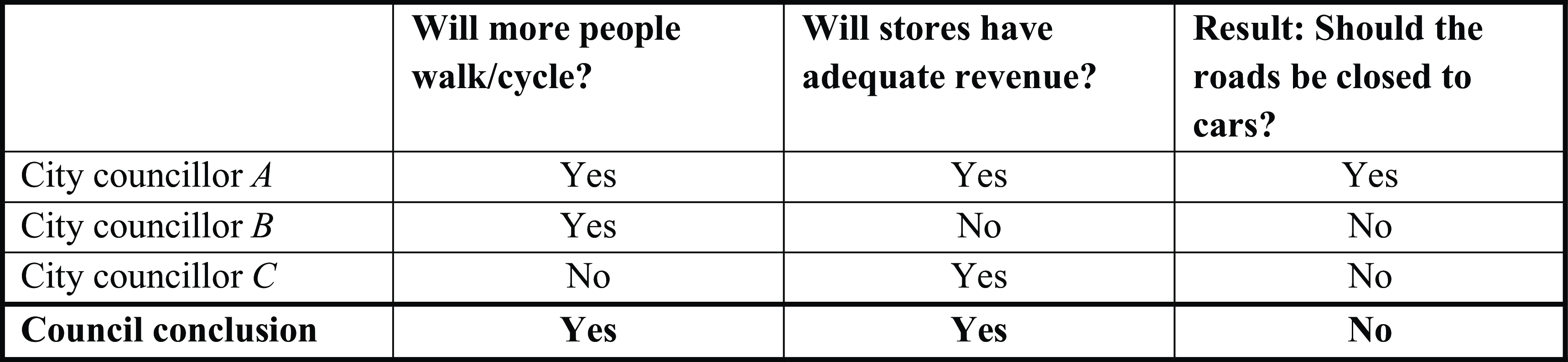
The problem with group decision-making in this example is that there may be a group of three decision-makers who could each make a rational choice, but their individual choices lead to an irrational outcome for the group.Footnote 12 It is rational for someone to vote to block off the road if they believe the two conditions are met, and rational for them to vote to keep the road open to cars if they believe that either condition is not met. The three city councillors vote in the following way (Figure 1):
Group Votes

Here, each individual has voted in a way that is internally consistent: The person who believes both conditions are met has voted yes to closing the road. The two people who believe only one condition was met have voted not to close the road. But because each of those two (Councillors B and C) believes that a different condition was met, the result is that a majority of the group found that each of the individual conditions was met. A and B agreed that more people would walk/cycle, creating a group majority for that premise. A and C agreed that stores would maintain adequate revenue, so the group has a majority belief there. But on the outcome, the majority voted not to close the road. Three individuals are forming logically consistent beliefs, drawing the right conclusions from the premises that they accept, but the group mind is drawing the wrong conclusions from its majority-accepted premises. Logically, one might conclude that the municipality should close the roads, since a majority are of the opinion that both conditions are met. But they do not, because a majority vote on the outcome results in a ‘no’ to closure. Each individual has voted rationally, with views on premises aligning with their view on their respective conclusions. But the aggregation of the votes, which is inconsistent with the results of the issues, means that the group as a whole has not voted rationally, in the sense that its conclusions do not follow from its (group-level) beliefs on the premises.
A group’s decision can yield different results depending on whether it employs a ‘conclusion-driven’ procedure or a ‘premise-driven’ procedure. The conclusion-driven procedure looks to the outcome decision to determine the ultimate result of the case (e.g., close the road?).Footnote 13 The premise-driven procedure looks to the results of the individual issue decisions to determine the ultimate result (e.g., will stores have adequate revenue? will more people walk/cycle?). List and Pettit propose possibilities for maintaining rationality at the group level: an organization can stagger its votes and only hold the vote on ‘should we close the roads?’ once it has a majority endorsing the propositions that could lead to that outcome.Footnote 14 There are several ways out of this dilemma, but each one has a type of cost.
Court decisions are susceptible to discursive dilemma because individual jurists vote on issues before the court in a way that might not align with the outcome released by the court as an entity. In “Unpacking the Court,” Lewis Kornhauser and Lawrence Sager take it as a problem that a three-judge court, in which two judges believe that a different constitutional violation has occurred, may nevertheless not issue a remedy.Footnote 15 They give an example where a criminal defendant appeals a conviction on the basis that, in the investigation and trial, two of his rights were violated: his confession was coerced and should be excluded, and the jury was improperly selected, so their guilty verdict should be thrown out.Footnote 16 So, there are two possible grounds for the violation: 1) coerced confession, and 2) improper jury selection (see Figure 2). On coercion, judges vote in the following way: Judge A: there was coercion, Judge B: there was no coercion, Judge C: there was no coercion. The majority result is that the defendant’s rights were not violated on this ground. On improper jury selection, Judge A finds the jury selection was proper, Judge B finds the jury selection was improper, Judge C finds the jury selection was proper, and again, the result is that the defendant’s rights were not violated. Nevertheless, two of the three judges believe that one ground for reversal is present, so a majority of judges vote to issue a remedy. Kornhauser and Sager explain: “For each issue, two judges believe the defendant was treated fairly. But two judges believe that in this case, the defendant was treated unfairly.”Footnote 17 If aggregating the judges’ votes on the outcome determines the collective decision, the defendant will be afforded a remedy, but if the collective decision is determined by aggregating how each judge votes on each independent issue, the defendant will lose.
The discursive dilemma

When a court’s results from voting on outcome and voting on issues (i.e., premises) are at odds, the group’s status as a rational agent is threatened. How can it be that the court (through a majority vote) finds that no rights violation was committed, but that the court (through a majority vote) also finds that a remedy should be issued for the rights violation? This threat to the group’s ability to function as a rational agent is important because group agents—governments, NGOs, or banks, for example—should behave rationally at the group level. The trouble seems to be that there is no way to align the reasoning process (from premises to outcomes) across the three judges. This will be a problem for typical group agents because they need to provide a decision for the group, and that decision will either have to align with the way that they voted on the issues or the way that they voted on the outcome. The group’s rationality is undermined if it chooses to prioritize outcome, since it would lead to issuing a remedy for no discernible reason (neither coercion nor jury selection having been selected by a majority as a reason to issue a remedy). While choosing premise votes might seem to be a better solution (and is the solution that List and Pettit favour),Footnote 18 that choice would put us in the awkward situation of choosing not to issue a remedy for the person, even though a majority of judges believe they should get a remedy.
In “The Many as One,” Kornhauser and Sager suggest that some choices are better represented by outcome-wise decisions and others by premise-wise decisions. The outcome is more important when aggregating the preferences of many members of the group (their reasons matter less than their conclusions). But the premise-wise decisions are more important when a group is tracking for truth, such as scientists’ conclusions on whether viruses behave in a certain way. There, reasons matter more than eventual conclusions.Footnote 19 Kornhauser and Sager consider courts in this context and note that, for courts, premise-wise decisions are decisions on different elements as doctrine (e.g., ‘was there a valid contract?’ and ‘was there a breach of the contract?’ would both be premise-wise decisions). Courts, like other group agents, can aggregate their views by either premise or outcome decisions.Footnote 20 Somewhat surprisingly, Kornhauser and Sager suggest that there is no need for a normative blanket rule on which choice courts should make. They suggest that courts could hold a “meta-vote” to decide on a method of aggregation.Footnote 21 They offer no suggestion about whether this meta-vote would occur each time a case required it or once for each level of court, but in theory, either would work. This may be a reflection of the fact that courts decide many complex cases that could encompass some decisions that are about tracking the truth of a doctrine or precedent, and some decisions that involve a more complicated mix of values and principles that might be better expressed through a conclusion from a number of different factors, rather than expressing each factor individually.
2. Plurality Judgements
The best way to look at how premise-wise and outcome-wise decisions can be separated in court judgements is to see how the two function in plurality judgements. In this section, we explain what a plurality judgement is and how it breaks apart the usual connection between premises and outcome.
Readers may be more familiar with the concept of pluralities in the political context, where it is often discussed. In an election where no candidate receives an absolute majority (because there are three or more candidates), the candidate who receives more votes than any other is the plurality candidate and wins the election.Footnote 22 In political discourse, people may find that these outcomes give less of a clear mandate or create a problem of ‘vote splitting’ that needs to be addressed. For instance, if two pro-business candidates each receive 30% of the vote and the pro-union candidate receives 40% of the vote, the pro-union candidate is elected, and the pro-business voters may feel frustrated that their least favourite candidate was elected because of the voting mechanism in place in that election. Nevertheless, there is a unitary decision: a single person is elected.
In the context of the judiciary, a plurality judgement is a decision in which a majority of judges vote for one outcome, but they do so for different reasons, and no set of reasons garners a majority. This is unlike the political plurality because there is an absolute majority inevitably formed on outcome, given that the choice is binary: allow or dismiss the appeal. For instance, if there are five judges on a nine-judge court who vote for the appeal to be dismissed, and four judges who vote for the appeal to be allowed, the appeal will be dismissed. In many decisions, the five judges on the winning side will agree on the reasons for their decision. That is, the majority will rely on largely the same reasons to reach their conclusion as to whether the appeal should be allowed or dismissed. In a plurality decision, this may not be the case: the winning side prevails because of the bare result without a clear set of majority reasons to support that result.Footnote 23 The votes that constitute the majority on outcome are separated into different judgements with different rationales for decision. The opinion with agreement from the greatest number of judges often gets referred to as the plurality opinion, but only if it is in the majority on outcome.Footnote 24 This could be an opinion with agreement of only three judges, or even only two, and sometimes no judgement will have this status—a 3–3–3 split, for instance.Footnote 25 Because the outcome is always binary, a 3–3–3 judgement will still have a definite outcome: at least two of the 3-judge groups will have voted for the same outcome. But the difference of opinion about the reasoning is still significant.
The ability to vote in pluralities is not a necessary feature of multi-judge courts. A multi-judge court can have a structure of issuing only one opinion—in which case it will require other procedures to ensure that a majority is always reached on premises (for instance, the Chief Justice as tiebreaker). In Italian courts, disagreements among judges during the deliberation phases are not published as part of the final decision.Footnote 26 The Supreme Court of India renders mostly unanimous decisions because of the customary practice of deference to more senior judges.Footnote 27 The unique feature of some courts that allows for dissents and minority concurrences to move forward as part of the published decision—the feature that allows for the existence of plurality judgements—is a design choice rather than an immutable characteristic. Many influential courts have this multivocality.
There is some disagreement in legal scholarship over the precedential value of plurality judgements and these doctrines may also vary between jurisdictions. The Supreme Court of the United States has held that if there are no reasons forming a majority, the holding of the case can be interpreted as being the specific statements with which a majority of judges clearly agree, based on their different recorded reasons, so long as their reasons support the same outcome.Footnote 28 This process of distilling rules from different opinions (the plurality and the concurrences) is referred to as the ‘narrowest grounds doctrine’. A plurality judgement’s precedential effect can be discerned in this way by extracting only the intersecting parts of the reasons of different opinions, so long as those intersections encompass the views of a majority of the judges who agree on the outcome. According to Ryan C. Williams, outcome-supportiveness is an essential criterion of the precedential legitimacy of plurality judgements.Footnote 29 On the other hand, Nina Varsava has argued that, when a majority of judges agree on a principle with regard to a particular issue, this principle should have a binding effect where some (but not all) of these judges ultimately agree on the outcome.Footnote 30 But in the United States, the conventional view is that which accords with the narrowest grounds doctrine: only those opinions which agree with the plurality on outcome can contribute to the plurality’s precedential effect.
In Canada, there has been much less explicit judicial guidance on the precedential effect of pluralities. It seems that majorities can be formed out of the views of different sides on issues to create binding precedent with regard to those issues. In the case of Tutton there was no majority at all on the outcome.Footnote 31 An exceptional set of circumstances resulted in the Court splitting evenly on the result because three of the judges who sat on the appeal were unable to take part in the judgement. Nevertheless, this case is cited in courts and is taught in classrooms across the country for what it says about objective mens rea.Footnote 32 The lack of agreement on outcome does not seem to have hindered its precedential value. Opinions dissenting on outcome contribute to a plurality’s precedent where they form part of the majority on a particular issue because of the distinctiveness of premise votes and outcome votes. Votes on premises from a dissenting opinion may form a majority with votes on premises from another opinion, even where the ultimate result differs. If a majority is formed in this way, it demonstrates a majoritarian judicial consensus.Footnote 33 Plurality judgements pull apart the precedential value of the reasons from the precedential value of the outcome.Footnote 34 Where there is a majority formed on a specific issue amongst different opinions, those reasons can become precedent even if some of those judges forming this majority disagree on outcome.
Of course, plurality judgements need not contain an intersection of reasons that garners majority support. Where this happens, there is no way to apply the narrowest grounds doctrine. Here, the plurality may not hold precedential value at all. Because of this, the court need not reach a majority on the issues in order to produce an authoritative judgement as a group agent. In this situation, only the outcome seems to matter; no part of the reasons leading to that outcome are backed by a majority. In other words, the court in cases like these has failed to form a group-level intention on premises at all. The outcome vote persists, but there is no further guidance from the court in the form of binding reasons.
Plurality judgements underscore that for courts, there is no real dilemma between voting by issue and voting by outcome, even when the two contradict each other. In one respect, courts employ an outcome-driven procedure. The court’s decision is formed by all of the judges who, jointly or separately, write opinions voting for a given outcome that garners a majority of votes. In another respect, courts employ a premise-driven procedure, because premises that a majority of judges agreed to can go on to affect the law despite those premises being inconsistent with the outcome of the case. In non-plurality judgements, the reasons behind majority vote on outcome are largely or wholly consistent: regardless of whether the outcome-driven or the premise-driven procedure is employed, the result would be the same. In plurality judgements, this is not necessarily the case. As Figure 2, above, illustrates, if the court used an outcome-driven procedure, a remedy would be issued, but if it used a premise-driven procedure, no remedy would be issued.
3. Multivocal Group Speech
Group agents hold intentions at the collective level. For a Supreme Court, the group’s reasoning creates law for lower courts. As the discussion on pluralities shows, courts do have group intentions that shape the law, but these intentions are not simple in the way that another group’s might be, because the group vote does not necessarily lead to a single answer or a single intention. When courts set intentions, these intentions accommodate individual voices—a kind of multivocality. When judges issue minority opinions, their minority views remain encoded in the group’s decision.
Though courts possess many of the same characteristics as other group agents, they defy Kornhauser and Sager’s idea that a group has to vote either by outcomes or by issues in order to maintain their group-level rationality. In the very narrow outcome—i.e., ‘will the appeal be allowed?’—votes are gathered outcome-wise. But judgements do not fall into irrationality when the premise votes would yield a different result than the outcome vote, because the premise votes of the court also still count. Put differently, unlike the city council that acts irrationally in believing “If A and B then C” and then voting “A and B but not C,” the court will have the outcome of C as a bare outcome, but the ‘votes’ on the issues of A and B will still matter as precedent. Because of this, courts do not suffer from the discursive dilemma in the same way that other group agents do. The outcome only speaks to the result for the parties. Majority decisions on individual issues become rules of their own, unlike the majority decisions on the two issues that our hypothetical city councillors voted on.
In court decisions, the outcome is important for the parties to the case, but the decision on the rules is also important, and possibly more important for parties who will come before the court in the future. When analysing a Supreme Court decision, the legal community is often less interested in the outcome of the particular case than in how the members of the court voted on specific issues that contributed to the outcome.Footnote 35 Issue votes carry much of the precedential weight of the case. The outcome may already be moot by the time the court decides—for instance, because the appellant has already served the relevant prison term. Here, the outcome is relevant only because it sheds light on how the issues were applied to the facts in this case.Footnote 36 The issue votes instruct lower courts and lawyers on how to interpret legal doctrine in this area—they give meaning to the case’s precedential effect.
On one interpretation, this does not solve the problem of group rationality. For instance, it still means that collectively, the majority judges from the hypothetical at Figure 2 still believe that there was no coercion and no improper jury selection but also believe that the accused should be granted a remedy. These premises do not lead logically to this conclusion, and so there is a way in which the court has still acted irrationally, even though its issue decisions can also create separate precedents. While the disjunction between majorities on premises and the majority on the outcome still occurs on a formalistic reading, the fact that we encode the answers qualitatively and give them separate effect makes this less of a problem for courts than for groups that may be making decisions that fail to capture the majority conclusions on one or the other type of decision.
This multivocal decision-making might reflect the many different types of questions that a court is called on to answer: assessing expert scientific evidence, parsing statutory language, determining Charter values, to name a few. Kornhauser and Sager’s point that different decisions are best suited to different aggregation methods might explain this design feature of courts. No mode of insight is sacrificed here, although sometimes precedent will be murky in a plurality situation. But perhaps the murkiness is also a kind of meaning, because it occurs in cases in which even the most expert judges, sitting on the highest courts, cannot come to a majority agreement on what the law is on that particular question. Courts do not have to choose one method of vote aggregation over the other—they can simultaneously rely on premise-driven and outcome-driven mechanisms, and both can yield distinct yet important conclusions for the development of the law.
We can explore multivocality by contrasting the court with the legislature, another well-known type of group agent. Legislatures are univocal despite often being made up of members who disagree on issues central to the group’s mandate. In order to set a group intention, legislatures must reach an actual majority, and only one set of intentions becomes the group’s intentions. Like courts, legislatures are group agents that make decisions by means of majority voting, and create new content to the law in their jurisdictions. But a legislature speaks with one voice, even though its membership is often starkly divided.Footnote 37 It may have two or more factions within it, each vying for control of the vote over a particular issue; nevertheless, it issues a unitary statement after it votes. Generally, it either votes to pass legislation and make a change in the law, or it votes not to pass legislation and to maintain the status quo. Legislatures are rational agents that respond to reasons, and the result of their reasoning process is legislation.Footnote 38 This process encompasses the dialogue between legislators—the debate and compromise between individual members of the legislature to produce a group-level intention that is hopefully better than what any individual legislator would have decided on their own. Discussion and compromise are key to the legislative decision-making process.Footnote 39
Plurality plays out very differently for the legislature than for the court. Consider a hypothetical legislature with 100 seats, in which a centrist party holds 40 of the seats, a right-wing party holds 30 of the seats, and a left-wing party holds 30 of the seats. Assume for simplicity that everyone is voting with their party. The three parties each have their own opinion on healthcare spending: the 40-seat party wants to moderately increase funding for hospitals, which might help the hospitals slightly but is essentially maintaining the status quo; the right-wing party wants to restrict hospital funding and introduce some privatisation; and the left-wing party wants to significantly increase funding for hospitals, and to raise income tax rates to pay for the increase. This is a plurality situation where two of the three voices agree on something—increasing funding—but disagree quite sharply on the specifics. The centrist plurality party will need to convince one of the other two parties to join them if they want their reform to go through. Of course, neither of the other parties can act on their own either. But if none of them does anything, then the legislature fails to get a result that would be in line with what a majority of the legislators agree should happen—an increase in funding. Often in politics, the plurality party will have to offer something to one of the other two parties. If the parties that want an increase cannot find a way to compromise and agree on something, the unitary result will be the continuation of the status quo.
An analogous legal case where judges are split 4–3–2 will go differently. To map onto the previous scenario, consider a statutory interpretation case where a hospital in a large population area sues the government, claiming that legislation requires the government to fund the hospital at a higher level. Four judges find that the correct reading of the statute means that the government owes increased funding to certain hospitals that serve large population areas; three judges find that the statute’s wording allows the government to cut the hospitals’ funding if it so chooses; and two judges find that the statute actually requires the government to increase funding for all hospitals, not just the ones that are in a similar situation to the plaintiff hospital (see Figure 3). There might be some value to clarity or persuasive force of the judgement if the plurality of four judges convinces one of the other groups to join them, but the narrowest grounds doctrine means that compromise and agreement are unnecessary. If the three factions stay as they are, the rule that gets carried forward is that this wording creates an increase for the hospitals that serve large population areas. The narrower way of reading the ruling in favour of the hospitals will govern despite that particular result only getting four votes, less than a majority. The judges can still make new law, both in terms of deciding the outcome of this particular case and in terms of setting a new precedent, although that precedent might be less clear than it would be in a simple majority decision.
4-3-2 Statutory Interpretation Case
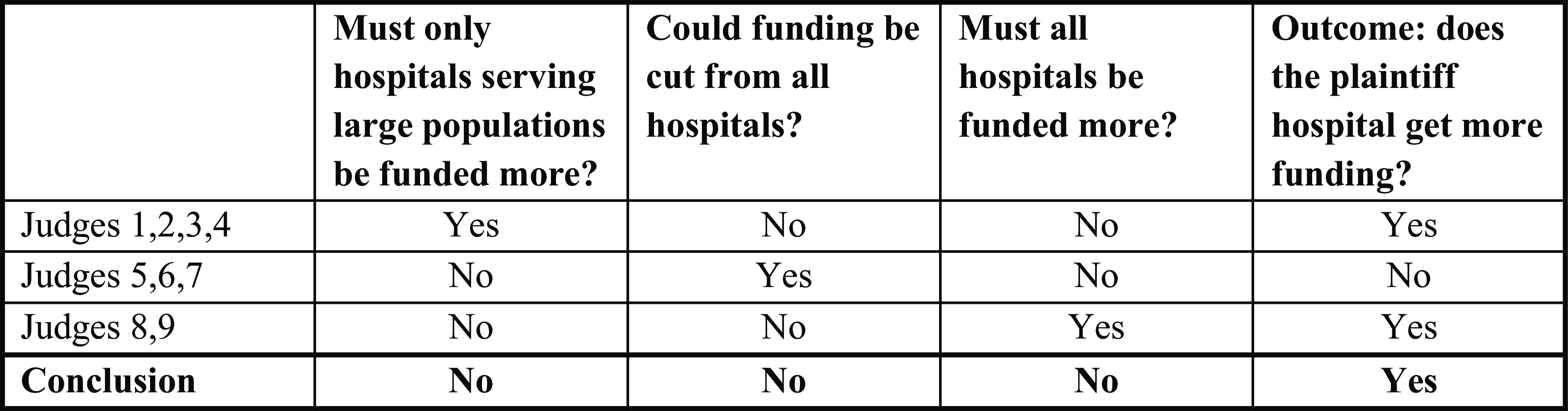
When legislators combine their individual decisions into a group decision, the group issues a univocal intention—either it acts through a piece of legislation, or it does not legislate and thus preserves the status quo. This is one way of conveying meaning with respect to which a court is the same as a legislature. They both issue an outcome based on a majority vote, and the outcome vote is binary—it is either to pass the legislation or not; allow the appeal or dismiss it. However, when the legislature fails to reach a majority, it merely does nothing. A court must move the law one way or the other. This shows a clear divergence between how legislatures and courts combine individual judgements (or preferences) into group judgements. Either the legislature forms the intention that the bill reflects, or it forms no intention at all that day. On the other hand, the court releases a decision regardless of whether it was able to consolidate these individual preferences into one judgement for the group. The outcome would hold for this hospital and possibly, applying the narrowest grounds doctrine, for similar hospitals. The question of whether smaller hospitals are also entitled to an increase in funding would remain undecided until a separate case was brought.
If a legislative vote succeeds and legislation is enacted, the minority views on that legislation are silenced. The official version does not come complete with all the proposed amendments that got voted down, or with any communication other than the single layer of “this makes the new law.” When we want to know what the law is, after the legislature has voted, we do not look back and see who voted for what amendments. The type of majority, who voted which way—none of these are legally relevant once the legislation is in force. While there may be times when people look to the Hansard Index to understand the nature of the legislative intention, this is an interpretive tool, not a part of the legislation. A legislature or other organization can issue its group-level communication and include a record of which members voted against it and why. This does not disturb the singular voice that the group uses to issue the official group decision, since the official action of the legislature remains unitary, a yes or a no.
A court judgement, on the other hand, communicates meaning at more than one level. One communication is the binary decision on an ultimate question—this is the verdict. The verdict tracks the outcome vote. The reasons for judgement communicate in a different way. The judges deliberate together and may spend months trying to find a consensus, or at least a simple majority.Footnote 40 Where the judges cannot agree, they issue minority opinions and sometimes, when the disagreement is pervasive, plurality judgements. If a judge feels strongly about something, they can explain their disagreement in the final document, even if they do not convince any of their colleagues that they are correct. And this solitary voice might have an effect in future jurisprudence. The written reasons provide answers to subsidiary questions, or to what we have been calling ‘premise decisions’, and these subsidiary answers are also aggregated into group intentions. The creation of intentions of this separate type is the crux of the difference between how a court forms intentions and how other group agents form intentions. The different opinions of the different judges are not forced to resolve into a unitary opinion. A downside of this is that there is a loss of clarity—especially in some plurality decisions.Footnote 41 But there are benefits to the court’s preservation of a diversity of perspectives, one of which is its ability to retain answers to different questions with distinct majorities. This makes courts unusual among group agents. Again, this unusual feature of multivocality is not a necessary feature, or an unavoidable by-product of appellate courts. Perhaps it is the most logical design feature for this type of group because courts need to issue decisions in a timely manner. Legislators do not need to churn out legislation. If they are gridlocked, then they may need to call an election but (with some exceptions) there is no requirement for them to legislate in a timely manner. Courts can, very rarely, have a kind of gridlock result, if a judge is absent from the decision and the resulting even-numbered panel issues a decision that is split evenly on the outcome, with no majority.Footnote 42 In Canada, the rule in those situations is that the majority judgement from the court below governs.Footnote 43 It is unclear how precedent gets formed from such a judgement, though as we discussed above, Tutton shows that precedent can come even from that kind of decision.
In a plurality decision, the judges of the country’s highest court have issued their interpretation of the law, even if the reasons and the outcome do not match up. Perhaps one of the reasons courts have this design feature is that they do not have the option to simply fail to reach a majority the way a legislature can. On the other hand, the courts might have chosen this design as a reflection of the esteem that society has for judges—even in a minority, their expertise is still valuable. There are costs to preserving this multivocality, notably that it makes precedent harder to interpret in some complex cases. Our interest in this article has been to make the descriptive point that courts do in fact preserve both types of judgement aggregation, rather than to argue for or against the merits of this type of decision-making.
Conclusion
Courts have many features of group agency: they have intentions at the group level, they have a stable existence despite membership changes, and they present themselves to the world as group entities. But courts also challenge the regular conception of group agency by making decisions in multiple ways, thereby preserving the group’s judgement on both premises and outcomes when these conflict. Premise votes and outcome votes are both recorded, and both become part of the group’s decision. The plurality judgement is perhaps a non-paradigmatic type of court judgement, but it occurs fairly frequently and it offers a window into this feature of the court’s decision-making.
Through parallel premise-wise and outcome-wise majority voting, courts communicate meaning on two tracks in a judgement. The majority vote on the outcome affects the world in an immediate sense. It changes the situation of the parties before the court. The majority votes on the issues or premises do not affect the parties, but they do change the situation for others who will rely on the precedence of that case in the future. In non-plurality judgements, the premises that the majority accepts are supportive of the court’s result on outcome. Plurality judgements demonstrate that the reasons of judges in the minority can form part of the court’s effect on the world, even when those reasons support the opposite conclusion on outcome. Because of this, it is clear that the outcome and the reasons are free-standing elements of a court’s voice.
This discussion may cause some people to conclude that courts are not groups. Our own impression is that despite this variation, courts probably are group agents. This discussion shows that courts do what (other) group agents cannot: they preserve some individuality of their members at the group level. This is not to say that other groups completely erase the individuality of their members—if that were so, then sports fans would not keep track of the stats of individual players on a team. But the formal encoding of individual contributions into the group results seems unique, or at least very unusual, to the design of multi-member courts. This feature of courts complicates the discursive dilemma and group rationality by showing that it is possible for a group to prioritize reasons without sacrificing outcomes.
Sylvia Rich is an associate professor at the University of Ottawa. She researches in the areas of criminal law theory and group agency. Email: srich@uottawa.ca
Sonia Anand Knowlton was called to the Bar of Ontario in 2025. Email: sknow102@uottawa.ca


 Open access

