

1. Introduction
The concept of sense of place has long been explored as the emotional and cognitive bond between people and their environments (Reference TuanTuan, 1977; Reference RelphRelph, 1976). It provides a theoretical framework for understanding how individuals experience, interpret, and form attachments to specific settings. In architecture, urban planning, and design, it remains a key concept for understanding spatial experience and regional identity.
In recent decades, however, human geography has increasingly reframed place as a dynamic and relational process rather than a fixed entity (Reference MasseyMassey, 1994; Reference CresswellCresswell, 2014). From this viewpoint, place is an experiential construct shaped through interactions among people, materials, memories, and narratives. While design research has addressed locality, systematic attempts to reinterpret sense of place through this generative lens remain limited.
Against this background, this study adopts the emerging concept of worlding as a theoretical lens. In design discourse, worlding is understood as a process of questioning and reshaping how worlds are made through relationships, practices, and meanings (Reference EscobarEscobar, 2018; Reference WillisWillis, 2006). This perspective views design as a socially situated process of meaning reinterpretation where new narratives are continuously created (Reference HayamaHayama, 2023).
By integrating sense of place with a worlding perspective, this study explores how place can shift from something merely “felt” to something co-created. To achieve this, the study addresses the following research questions: How can a worlding-inspired design process—integrating narrative and materiality—facilitate the reinterpretation of regional resources? How does this generative approach foster new, relational ways of perceiving and co-creating a sense of place?
By addressing these questions, this paper bridges the gap between theoretical geography and design practice, offering a methodological framework for reimagining regional identity.
2. Toward a worlding perspective on sense of place
2.1. Sense of place: from attachment to relational understanding
The concept of sense of place has historically been understood as the emotional and cognitive connection between individuals and particular environments. Foundational works in geography and phenomenology emphasized attachment, identity, and meaning (Reference TuanTuan, 1977; Reference RelphRelph, 1976; Reference Norberg-SchulzNorberg-Schulz, 1980). These studies helped articulate how people develop feelings of belonging and rootedness through lived experience.
Later research, particularly in human geography and cultural studies, reframed place as an open, dynamic process shaped by social relations, material conditions, and narratives (Reference MasseyMassey, 1994; Reference CaseyCasey, 1996; Reference CresswellCresswell, 2014). From this relational view, place is not a bounded entity but an ongoing negotiation among human and nonhuman actors. It is both experienced and enacted through everyday practices, meanings, and discourses.
2.2. Sense of place in design research
Within design research, the concept of sense of place has been used to understand how spatial experience, material qualities, and cultural context shape human–environment relationships.
Early design-oriented studies, influenced by environmental psychology and phenomenology, examined how built environments evoke meanings, emotions, and identity (Reference LynchLynch, 1960; Reference AlexanderAlexander, 1979; Reference Norberg-SchulzNorberg-Schulz, 1980). These works underscored the role of form, atmosphere, and materiality in shaping how people perceive and inhabit places.
More recent approaches—particularly in interaction design, urban design, and service design—have expanded this understanding by exploring how place is co-created through practices, narratives, and participation. For example, place-making research emphasizes collaborative and community-driven processes that generate shared meaning and attachment (Reference Silberberg, Lorah, Disbrow and MuessigSilberberg et al., 2013; Reference Manzo and Devine-WrightManzo & Devine-Wright, 2020). In parallel, design anthropology and participatory design have shown how designers engage with local knowledge, material culture, and situated practices to mediate relationships between people and environments (Reference Gunn, Otto and SmithGunn et al., 2013; Reference Halse, Brandt, Clark and BinderHalse et al., 2010).
Across these perspectives, design is increasingly viewed not merely as shaping physical form but as facilitating interpretation, engagement, and meaning-making within specific contexts.
However, while these studies acknowledge place as dynamic and relational, explicit attempts to connect sense of place with world-making or worlding practices remain limited.
This gap suggests the need for a more integrated theoretical perspective that examines how design both responds to and reconstructs the meanings embedded in place.
2.3. From sense of place to a worlding perspective
Recent developments in design theory have introduced worlding as an emerging lens for understanding how design participates in shaping the conditions through which social, material, and symbolic worlds come into being. Rather than viewing design as producing a single coherent reality, worlding highlights its role in questioning, negotiating, and reconfiguring relationships among people, materials, environments, and meanings (Reference WillisWillis, 2006; Reference EscobarEscobar, 2018).
Reference WillisWillis (2006) argues that design is inherently ontological: it shapes not only artefacts but also the very ways in which people perceive, inhabit, and imagine their worlds.
Similarly, Reference EscobarEscobar (2018) characterizes worlding as the “making of worlds” grounded in cultural and ecological relationality, emphasizing that design should support communities in articulating their own ontologies and futures.
In parallel, work in design and innovation studies has highlighted how narrative practices—such as storytelling and sensemaking—inform how designers interpret contexts and envision possibilities, particularly when viewed from a worldmaking perspective (Reference HayamaHayama, 2023). These discussions suggest that design mediates meaning through reflective and situated engagement, enabling designers to explore alternative relations and interpretations.
Taken together, these perspectives offer a productive bridge to the notion of sense of place.
While sense of place begins with lived experience, attachment, and interpretation, worlding foregrounds the transformative potential of design to co-create meanings and relations. Integrating these perspectives allows place to be understood not only as something people feel or remember, but as something that can be co-made through design practice—through material engagement, storytelling, reflection, and interaction.
Seen from this viewpoint, design becomes a medium through which the meanings embedded in regional resources can be re-imagined, creating renewed connections between locality and imagination.
Building on this conceptual foundation, the present study examines how sense of place can be reconsidered through a worlding perspective, exploring how design-based inquiry engages with regional contexts and how such engagements may foster plural and regenerative relationships with place.
3. Methodology
3.1. Research approach and context
This study adopts a Research through Design (RtD) approach (Reference Koskinen, Zimmerman, Binder, Redstrom and WensveenKoskinen et al., 2013; Reference Giaccardi and StappersStappers & Giaccardi, 2017), which positions design practice as a medium for inquiry and knowledge generation. RtD emphasizes understanding that emerges through processes of making and reflection. This approach is particularly suitable for examining how design mediates the reinterpretation of regional resources and the regeneration of place meanings.
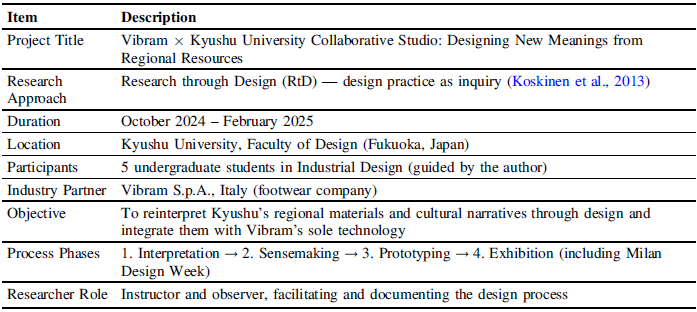
The case investigated in this study was a collaborative project between Vibram, an Italian footwear company, and Kyushu University in Japan. Conducted as part of a design studio course (Creative Design Practice) from October 2024 to February 2025, the project involved five industrial design students who explored Kyushu’s regional resources through design. Their goal was to reinterpret the cultural and material qualities of these resources and integrate them with Vibram’s footwear technologies to envision new design concepts. The process followed four phases inspired by the Worlding framework: (1) interpretation of materials and regional narratives, (2) sensemaking through ideation, (3) prototyping, and (4) presentation and exhibition, both within the university and at Milan Design Week. The author served as instructor and observer throughout the project.
Overview of the Vibram × Kyushu university project

3.2. Data and analytical process
The analysis was based on students’ design artefacts—sketches, prototypes, and presentation boards—alongside written feedback from Vibram’s design team. Supplementary field notes and reflective memos recorded during the studio were consulted to reconstruct the overall process. An interpretive qualitative approach was employed for data analysis (Reference Schwandt, Denzin and LincolnSchwandt, 1994; Reference PattonPatton, 2015; Reference Koskinen, Zimmerman, Binder, Redstrom and WensveenKoskinen et al., 2013).
To ensure methodological rigour, the analysis adopted a “thick description” approach (Reference Creswell and PothCreswell & Poth, 2018), focusing on the narrative and material transformation of each case. Rather than applying external coding, meanings were derived through a process of “reflection-in-action” and “reflection-on-action” (Reference SchönSchön, 1984), where the instructor and students collectively interrogated how regional resources were reinterpreted as “worlding” practices.
3.3. Validity and reflexivity
To enhance the credibility of interpretation, multiple perspectives were incorporated through data triangulation—including students’ design outcomes, industry feedback, and the instructor’s reflective documentation. The author’s dual role as both instructor and researcher required ongoing reflexivity, maintaining awareness of how pedagogical and analytical dimensions intertwined during the study. To mitigate potential bias, “member checking” was employed by cross-referencing interpretations with the industry partner’s evaluations and the students’ own conceptual articulations.
Through this iterative reflection, two analytical foci were developed: (1) how local resources (materials, crafts, and cultural motifs) were reinterpreted through design, and (2) how the worlding process—from interpretation to sensemaking to prototyping—enabled the emergence of new meanings. This interpretive stance demonstrates how design can operate as a relational and reflective practice that connects local resources, cultural values, and creative imagination toward the making of new worlds.
4. Results: reinterpreting the sense of place through design
4.1. The studio context and overview of outcomes
The Vibram and Kyushu University Collaborative Studio was conceived as a space for exploring how design can reinterpret and regenerate the sense of place through material, narrative, and making. Conducted within a design education setting yet grounded in research aims, the studio functioned as a form of Research through Design (RtD), bridging academic inquiry, industry collaboration, and regional engagement. The partnership with Vibram, an Italian footwear company provided a cross-cultural dimension that linked local material traditions with global design practices.
Situated in Kyushu—an island historically shaped by diverse cultural exchanges—the project invited students to rediscover the symbolic and material richness of their surroundings. Rather than beginning from abstract design briefs, participants started by engaging directly with regional resources such as lantern-making, tatami weaving, samurai armour, balloon festival and kite-making. Through field research, conversation with local artisans, and material experimentation, they identified latent meanings embedded in these traditions. The design challenge, therefore, was not to reproduce local forms but to reinterpret how these materials and stories could be experienced anew in the contemporary world.
The studio involved five industrial design students, each developing a distinct concept that reflected both personal interpretation and collective exploration. Their processes were structured around iterative reflection, prototyping, and storytelling—core principles of RtD. Weekly sessions with Vibram designers introduced an external perspective on material performance, prompting students to align their cultural narratives with practical craftsmanship and technological potential. As a result, the studio became an ecology of dialogue between human, material, and cultural actors—a worlding environment where new relationships were continuously formed through design.
Overview of five design outcomes, each reinterpreting the sense of place through regional materials and narratives

The outcomes reveal both diversity and coherence. Each project reimagined the sense of place through its material engagement while sharing an underlying attitude of poetic interpretation and ecological awareness. One project, titled “SHIMAU” (to put away beautifully), reinterpreted the craft of Yame lanterns and Noh aesthetics into folding boots that embody the Japanese sensibility of closure and care. Another, “Harmony”, revived the fading tatami culture of Kyushu by transforming its textures and spatial rhythm into a balanced, minimal footwear design. “Soft & Hard” explored the material duality of Satsuma samurai armour, merging historical craftsmanship with the flexibility of Vibram’s modern rubber sole. “HUSAI (Floating Colors)” drew inspiration from Nagasaki kites, capturing the motion of wind and cultural hybridity through translucent materials and color gradation. Finally, “Balloon Time” is a footwear concept that translates the colors, verticality, and festive atmosphere of Kyushu’s hot-air balloon festival into a light, uplifting shoe design.
Together, these five works redefined Kyushu’s cultural and ecological narratives as living resources for design. They illustrated that place is not a static backdrop but a generative context—where materials, practices, and memories coevolve with human imagination. The prototypes thus became tangible forms of storytelling through making, expressing how design can translate the sense of place into embodied, wearable worlds.
Beyond the artefacts themselves, the studio cultivated a reflective and relational design attitude among participants. Students described the process as “learning to listen to materials,” “feeling the past through the present,” and “discovering new meanings through making.” These reflections demonstrate that the sense of place is not discovered, but constructed—a continual negotiation between heritage, environment, and creativity. The studio setting, oscillating between introspection and collaboration, made visible how worlding occurs not through representation but through engagement: a situated practice of becoming-with materials, stories, and others.
In this sense, the outcomes of the Vibram × Kyushu University studio extend beyond educational value; they represent a microcosm of how design can operate as a cultural interface—connecting the local and the global, the past and the possible. By materializing new narratives of belonging, transformation, and sustainability, the studio collectively reimagined what it means to design the sense of place.
4.2. Reinterpreting place through design practice: the worlding process
While the five projects differed in concept and execution, they collectively demonstrated how sense of place—rather than materials alone—served as the central lens through which the design process unfolded. Students began by encountering regional crafts, environments, and cultural practices, approaching them as expressions of place: situated ways of living, making, and relating. Through hands-on engagement, they explored how the textures, rhythms, and atmospheres of Kyushu’s cultural practices could inspire new interpretations of place. These explorations gradually developed into worlding practices—acts of bringing forth new relations between locality, memory, and imagination.
4.2.1. Re-encountering place through regional practices
In the early stages of the studio, students immersed themselves in regional crafts, environments, and cultural practices—not as isolated materials but as expressions of place. These encounters revealed how ways of making, living, and relating embody the atmospheres and sensibilities of Kyushu. Through direct engagement, students explored how the textures, rhythms, and practices embedded in local traditions could inform new interpretations of place. One project reinterpreted the delicate bamboo structures of Yame lanterns into a foldable footwear concept expressing both resilience and refinement. Another abstracted elements of tatami culture—woven patterns, muted colors, and domestic familiarity—into a contemporary design vocabulary. In each case, place was approached not as a fixed identity but as a lived, evolving phenomenon accessed through the practices that sustain it.
Through iterative prototyping and reflection, students treated regional practices as generative prompts—forms of situated knowledge that guided how place might be reimagined. Their aim was not to represent Kyushu but to explore new ways its cultural textures could be experienced.
4.2.2. Sensemaking through making: worlding in practice
As the projects evolved, the process shifted from interpretation to sensemaking. Students began to articulate narratives that connected place experience with broader cultural and emotional significance. Making became a process of dialogue—not only with materials and tools, but also with themselves, peers, and mentors. Through cycles of reflection and iteration, meaning emerged through practice.
This phase resonates with the idea of design as sensemaking (Reference KolkoKolko, 2010), where design mediates the construction of meaning in uncertain and emergent contexts. The students’ sketches and prototypes were not simply representations of ideas but embodied hypotheses—provisional attempts to grasp what place could mean when experienced through the body.
In HUSAI (Floating Colors), the designer reinterpreted the cultural heritage of Nagasaki kites—locally rooted craft practices shaped by the region’s long history as Japan’s earliest open port. Rather than focusing solely on the visual appearance of kites, the project explored how their relationship with wind, movement, and festivity expresses a distinctive sense of place.
By translating the colorful geometric patterns of Nagasaki kites into layered translucent components, the designer sought to shift the experience of the kite from the sky to the ground. The integration with Vibram’s sole technology enabled this cultural motif to be embodied in footwear, creating new value through the encounter between regional craft and contemporary material innovation. In this way, the design articulated a place-based narrative in which local history, craft tradition, and bodily experience converged to form a renewed interpretation of Nagasaki’s identity.
“HUSAI, Floating Colors” documentation of the making process: place, inspiration, sketching, material experimentation, and collaborative reflection during the studio

Another project, Harmony, began with an encounter with Kumamoto’s igusa industry—the place-based cultural landscape that sustains Japan’s tatami tradition. The designer approached igusa not merely as a material but as an expression of regional life shaped by agriculture, craft, and everyday practice. The concept of Harmony emerged from exploring how Japan’s barefoot tatami culture could intersect with the Western sneaker tradition. By abstracting the scent, softness, and woven rhythm of igusa into a minimal footwear form, the project translated the calmness and groundedness of tatami rooms into bodily experience. At the same time, the work responded to the decline of the igusa industry by reimagining offcuts as new material possibilities. Through this process, worlding occurred as a reinterpretation of cultural and sensory values within contemporary life, turning the footwear into an interface that reconnects regional heritage with new imaginative futures.
“Harmony” – reinterpretation of Kumamoto’s igusa culture, translating the atmosphere of tatami into a minimal footwear concept

Another project, Soft & Hard, examined the armour tradition of the Satsuma domain in Kyushu, a region historically known for its disciplined warrior culture and robust armour craftsmanship. The designer focused on the tension between protection and vulnerability embodied in Satsuma armour, approaching it as a culturally situated expression of strength, discipline, and resilience.
By translating the segmented structure of armour plates into modular rubber components, the project explored how these historical qualities could intersect with contemporary footwear design. Through such reinterpretations, worlding occurred not as conceptual theorizing but as hands-on negotiation—where design objects materialized evolving relations between human experience, cultural memory, and material expression.
“Soft & Hard” – reinterpretation of Satsuma armour from Kyushu, abstracting its segmented structure into modular components

This process-oriented exploration was supported by iterative feedback from Vibram designers. Their emphasis on material performance, sustainability, and comfort encouraged students to consider how traditional meanings could coexist with contemporary needs. Vibram’s comment that “the stories behind materials align with our philosophy of durability and adaptation” captured the resonance between local narrative and global practice. Here, worlding occurred across scales: from the tactile to the industrial, from local making to global interpretation.
4.2.3. Translating the sense of place: from studio to world
The studio process culminated in the presentation of the five prototypes at Milan Design Week 2025. The exhibition acted as a moment of translation, carrying the sense of place embedded in Kyushu’s regional practices into a global context. Each prototype functioned as a cultural interface, allowing international audiences to encounter the material, symbolic, and atmospheric qualities reinterpreted through design.
From a Research through Design perspective, the exhibition offered a moment of reflection-in-action (Reference SchönSchön, 1984), revealing how meaning is generated not only through artefacts but through the experiences they afford. It demonstrated how worlding through design enables local heritage to be reimagined within wider pluriversal networks—where regional practices continue to evolve through new relationships, interpretations, and encounters.
“SOUL AND SOLE” – exhibition of the Vibram × Kyushu university footwear prototypes at Milan Design Week 2025 https://www.interdependence.polimi.it/fabbricadelvapore/catalogue/materialistic-spiritual/sole-and-soul/

4.3. Emerging insights: toward worlding the sense of place
Across the five projects, several recurring patterns were observed in how students engaged with place through design activities. First, students consistently treated regional crafts and practices as experiential entry points to understanding place. Encounters with materials, techniques, and local stories informed early interpretations and guided subsequent design decisions. Second, students tended to abstract and reinterpret elements of regional traditions—such as textures, forms, or rhythms—rather than reproducing them directly. This resulted in design concepts that connected past practices with contemporary expressions. Third, locality frequently emerged as a relational construct. Through dialogue with peers, instructors, and Vibram designers, students explored how regional heritage could be positioned within broader cultural and design contexts. Finally, making played a central role in generating and refining these interpretations. Iterative prototyping, sketching, and reflection allowed students to articulate their understanding of place in tangible form. These patterns indicate that, within the studio context, design activities facilitated multiple ways of engaging with and expressing the sense of place. These observations form the basis for the following discussion.
5. Discussion and conclusion
5.1. Theoretical and practical contributions
This study contributes to ongoing discourse in design research by reinterpreting the concept of sense of place through the lens of worlding. Traditionally, sense of place has been examined as a psychological or phenomenological attachment between people and their environments (Reference RelphRelph, 1976; Reference TuanTuan, 1977). In contrast, the findings of this research suggest that place can be understood as a relational and generative construct continually shaped through design.
From a theoretical perspective, the integration of sense of place and worlding reframes design as a practice of relational imagination. Instead of representing an existing locality, design becomes a means of co-creating new relations between materials, stories, and human experiences. This resonates with Reference WillisWillis’s (2006) notion of ontological design-the idea that design participates in shaping the very worlds we inhabit. Within this framework, worlding the sense of place highlights how design can function as a mediating practice:
-
• Mediating across scales: linking the intimate (bodily experience) with the territorial (regional identity).
-
• Mediating across times: connecting historical heritage with contemporary life.
-
• Mediating across worlds translating local sensibilities into global dialogue.
Through these mediations, design operates as a transformation, turning regional narratives into living expressions that circulate across contexts. The outcomes demonstrated how worlding happens through concrete acts of making, where stories are embodied in material gestures and shared through artefacts.
From a practical standpoint, the findings suggest several implications for design research, education, and collaboration. First, RtD can serve as a medium of inquiry that allows designers to reflect on their own positionality through engagement with local narratives. Second, the studio setting shows that design education can foster relational sensitivity by treating regional crafts and cultural knowledge as active partners. Third, the collaboration with Vibram demonstrates how industry partners can support more situated and culturally attuned innovation.
Beyond the educational context, this worlding-inspired approach offers significant implications for professional practice and regional development. By treating regional heritage not as a static asset to be preserved, but as a generative resource for continuous reinterpretation, practitioners can more fluidly navigate the tensions between global marketability and local authenticity. This methodology transforms the designer’s role into a cultural mediator, capable of translating local sensibilities into viable industrial and social innovations.
Furthermore, for local communities, this framework enables active participation in the ongoing reimagining of their own cultural identity. By moving beyond traditional tourism-centric models, it fosters a model of regional development that is both pluralistic and regenerative, ensuring that local meanings evolve alongside contemporary global changes. Ultimately, “worlding the sense of place” provides a robust methodological bridge between theoretical geography and creative practice, highlighting how design participates in the continual shaping of the plural and situated worlds we inhabit.
5.2. Limitations and future directions
While the study offers valuable insights into how worlding the sense of place can be enacted through design, several limitations must be acknowledged.
First, the scope of the study was limited to a single collaborative studio involving five student projects. Although the outcomes provided rich qualitative material, the findings remain context-specific and cannot be generalized without caution. The analysis relied primarily on the students’ artefacts, reflections, and feedback from the industry partner (Vibram), rather than longitudinal observation or external evaluation. Consequently, the study captures a situated snapshot of how the sense of place was interpreted and reimagined within a particular educational and cultural setting.
Second, the role of the researcher—as both instructor and observer—introduced an interpretive bias that, while typical in Research through Design (RtD), nonetheless shaped the framing of insights. Future research could benefit from multi-perspective evaluation, involving independent observers or follow-up interviews with participants to deepen understanding of the long-term cognitive and professional impact of such experiences.
Third, while this study centered on Kyushu’s regional context, future work could explore cross-cultural or cross-regional comparisons to examine how different material cultures and design traditions influence the process of worlding. Comparative RtD studies could illuminate how designers engage with varying notions of place, belonging, and materiality in diverse sociocultural settings.
In terms of future directions, the concept of worlding the sense of place opens up several promising paths. One avenue is to extend this inquiry into long-term partnerships between academia and industry, developing design frameworks that integrate local knowledge into sustainable innovation. Another direction lies in design education, where reflective and material-based worlding methods could be embedded in curricula to foster ecological and narrative awareness among students. Finally, technological extensions—such as the integration of AI-driven material exploration, digital storytelling, or immersive worldbuilding tools—could provide new means of engaging with place, imagination, and design ethics in the age of hybrid realities.
5.3. Conclusion
This study set out to explore how design can reinterpret and regenerate the sense of place through the lens of worlding.
This research examined how students engaged with regional materials, narratives, and making as a process of Research through Design. The findings revealed that design can mediate between locality and imagination, transforming cultural and material heritage into living expressions of meaning.
By integrating the concepts of sense of place and worlding, the study proposed an understanding of place not as a fixed entity but as a relational and generative process. Through acts of making, reflection, and storytelling, the participants enacted worlding—creating micro-worlds that connected personal experience with collective identity, and regional narratives with global dialogue. In doing so, the study contributes to design theory by positioning worlding the sense of place as both a conceptual and methodological framework for exploring how design participates in the continual shaping of our worlds.
Practically, the project demonstrated how educational and industrial collaboration can cultivate reflective, culturally grounded, and imaginative design practices.
By engaging deeply with local materials and stories, designers can learn to approach design not only as form-giving but as world-giving-a means of generating new relations between people, materials, and environments.
This orientation aligns with the broader movement in design research toward pluriversal worlding (Reference EscobarEscobar, 2018), where multiple ways of knowing, making, and living coexist. Ultimately, worlding the sense of place calls for a rethinking of what design does and for whom it operates.
It invites designers, educators, and researchers to view design not merely as a problem-solving discipline but as a practice of care, relation, and imagination—one that continually reshapes the textures of the worlds we inhabit and the futures we wish to live in.
Acknowledgement
The authors sincerely thank Vibram S.p.A. for their technical guidance and collaboration, Kawamura Tsusho Co., Ltd. for generously providing materials, and the students of Kyushu University whose creativity and dedication made this project possible.





 Open access

