

Introduction
By 2100, there will be 10.9 billion people to feed (United Nations 2013). Insects, a high-protein source often with a small environmental footprint (van Huis & Tomberlin Reference van Huis and Tomberlin2017), can help meet protein demands. The insects as food and feed (IAFF) industry currently farms over 1 trillion insects per year; by 2030, > 8 trillion individuals per year may be farmed (Rowe Reference Rowe2020; de Jong & Nikolik Reference de Jong and Nikolik2021; for scale: ~79 billion birds and land mammals are slaughtered for meat each year; FAOSTAT in Šimčikas Reference Šimčikas2020).
Given the growth of the IAFF industry, it is vital to consider the welfare of its insect livestock, especially if insects are sentient — i.e, they have the capacity to experience negative affective states (Bentham Reference Bentham1948; Singer Reference Singer2002; Birch Reference Birch2017; Broom Reference Broom and Choe2019). Intensive production systems cause a range of negative affective states in vertebrate livestock; from many moral perspectives, those welfare impacts are of serious concern (De Grazia Reference DeGrazia1996; Singer Reference Singer2002; Thompson Reference Thompson2020; Fischer Reference Fischer2021). Comparable impacts upon farmed insects, then, would raise comparable moral issues.
Are insects sentient? At present, the empirical evidence does not readily provide a conclusive answer (Adamo Reference Adamo2016; Barron & Klein Reference Barron and Klein2016; Klein & Barron Reference Klein and Barron2016; Baracchi et al. Reference Baracchi, Lihoreau and Giurfa2017; Birch Reference Birch2020; Lambert et al. Reference Lambert, Elwin and D’Cruze2021; van Huis Reference van Huis2021). Moreover, most work on insect welfare acknowledges that definitive data on insect sentience will come too slowly for industry decision-makers (and trillions of insects). Additionally, there may be reasons to question the emphasis on sentience (Monsò Reference Monsó, Springer and Grimm2018; Pali-Schöll et al. Reference Pali-Schöll, Binder, Moens, Polesny and Monsó2019; van Loon & Bovenkerk Reference van Loon, Bovenkerk, Schübel and Wallimann-Helmer2021).
A reasonable response to current uncertainty is to employ a precautionary principle. The strongest such principle would require that humans should treat insects as though they are sentient, though weaker principles could be formulated (Fischer Reference Fischer2016, Reference Fischer2019; Birch Reference Birch2017; Knutsson & Munthe Reference Knutsson and Munthe2017; Röcklinsberg et al. Reference Röcklinsberg, Gamborg, Gjerris, van Huis and Tomberlin2017; van Huis Reference van Huis2021). Since the welfare of insects has generally been overlooked (Horvath et al. Reference Horvath, Angeletti, Nascetti and Carere2013; Smith & Pryor Reference Smith and Pryor2013; International Platform for Insects as Food and Feed [IPIFF] 2019), even weak principles could significantly impact our assessment of industry practices.
To date, much of the literature on farmed insect welfare has focused on establishing that insect welfare ought to be of concern (Gjerris et al. Reference Gjerris, Gamborg and Röcklinsberg2016; Röcklinsberg et al. Reference Röcklinsberg, Gamborg, Gjerris, van Huis and Tomberlin2017; van Huis Reference van Huis2021) and there is a paucity of literature on the difficulty of improving insect welfare (Pali-Schöll et al. Reference Pali-Schöll, Binder, Moens, Polesny and Monsó2019). Consequently, many challenges to studying insect welfare and applying that knowledge in IAFF industry contexts have been overlooked. Here, we briefly review five of these challenges and end with recommendations for the future study of insect welfare.
Challenge 1: Rapid industry growth and innovation
Eventual ‘world-scale’ mass production facilities are predicted to produce > 1 million tons of insect protein per year, each rearing at least 15 trillion individual insects (Kok Reference Kok, van Huis and Tomberlin2017; Rowe Reference Rowe2020). This scale is immense but so is the potential demand: each world-scale plant would only meet 5–6% of just aquaculture’s potential demand for insect protein (Rowe Reference Rowe2020; de Jong & Nikolik Reference de Jong and Nikolik2021), alongside demand for insect protein as swine/broiler feed and in pet food.
Practically, the vast majority of studies on welfare-relevant factors for farmed insects occur at small, laboratory scales. The IAFF industry must base the rearing of insects-by-the-ton on studies of insects-by-the-gram (Tomberlin & Cammack Reference Tomberlin, Cammack, van Huis and Tomberlin2017). Scaling is not necessarily linear and some welfare concerns may present only in mass-rearing environments, such as the increased risk of overheating in large, high-density rearing containers (Sørensen et al. Reference Sørensen, Addison and Terblanche2012; Scala et al. Reference Scala, Cammack, Salvia, Scieuzo, Franco, Bufo, Tomberlin and Falabella2020; Barrett et al. Reference Barrett, Chia, Fischer and Tomberlin2022). Laboratory-scale studies on welfare may thus be inaccurate/incomplete when applied to mass-production environments (Myers et al. Reference Myers, Tomberlin, Lambert and Kattes2008; Miranda et al. Reference Miranda, Cammack and Tomberlin2020; Yang & Tomberlin Reference Yang and Tomberlin2020).
Scaling will require significant technological innovation (Kok Reference Kok, van Huis and Tomberlin2017), likely including emerging biotechnologies, such as genetic modification (e.g. Zhan et al. Reference Zhan, Fang, Cai, Kou, Xu, Cao, Bai, Zhang, Jiang, Luo, Xu, Xu, Zheng, Yu, Yang, Zhang, Wang, Tomberlin, Zhang and Huang2019). However, new technologies can create new welfare problems (Barrett et al. Reference Barrett, Chia, Fischer and Tomberlin2022), as they have in vertebrate livestock production (Fischer Reference Fischer2021). Intense genetic selection in broiler chickens (Gallus gallus domesticus) has increased growth rates by over 300%, resulting in a variety of painful skeletal disorders (Knowles et al. Reference Knowles, Kestin, Haslam, Brown, Green, Butterworth, Pope, Pfeiffer and Nicol2008). Zhan et al. (Reference Zhan, Fang, Cai, Kou, Xu, Cao, Bai, Zhang, Jiang, Luo, Xu, Xu, Zheng, Yu, Yang, Zhang, Wang, Tomberlin, Zhang and Huang2019) produced genetically modified black soldier fly (Hermetia illucens) larvae whose final larval weight is nearly 300% greater than normal; the welfare impacts of this increase in weight are unknown. Assessing the welfare impacts of technological advancements in each farmed insect species, before they become commonplace for trillions of individuals, may prove incredibly challenging.
Another line of innovation involves rearing new insect species; each species may raise different welfare concerns. Currently, only seven species of insects are farmed in truly significant numbers (Rumbos & Athanassiou Reference Rumbos and Athanassiou2021); however, there are over 2,000 species of edible insects (Jongema et al. Reference Jongema2017), many of which are poorly studied. Devising welfare assessments that accurately characterise the different welfare needs of each species, in each farmed context, will be difficult.
Challenge 2: Adoption of vertebrate welfare tools
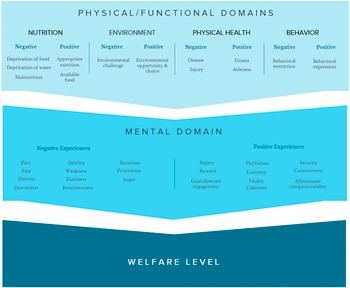
Most entomologists gravitate toward Brambell’s Five Freedoms (Reference Brambell1965), designed for vertebrate livestock, when considering insect welfare (Erens et al. Reference Erens, Es van, Haverkort, Kapsomenou and Luijben2012; de Goede et al. Reference de Goede, Erens, Kapsomenou, Peters, Röcklinsberg and Sandin2013; van Huis Reference van Huis2021; Barrett et al. Reference Barrett, Chia, Fischer and Tomberlin2022). While some aspects of Brambell’s framework readily apply to insects (e.g. freedom from disease), others are more challenging to apply given our limited understanding of insects’ affective states (e.g. freedom from fear; van Huis Reference van Huis2021). Decapod welfare researchers have recently used the Five Domains model as a more practical alternative for invertebrates (Albalat et al. Reference Albalat, Zacarias, Coates, Neil and Planellas2022), though the fundamental issue remains. As Figure 1 illustrates, the physical/functional domains matter as proxies for the mental domain. Every welfare framework available must confront the paucity of data regarding insects’ mental lives.
The Five Domains Model of animal welfare. Adapted from Mellor DJ, Hunt S and Gusset M 2015 Caring for Wildlife: The World Zoo and Aquarium Animal Welfare Strategy. WAZA Executive Office: Gland, Switzerland.

Additionally, behavioural and physiological differences between vertebrates and insects may impact the adaption of vertebrate assessment tools for insects (Boppré & Vane-Wright Reference Boppré, Vane-Wright, Carere and Mather2019). As one example, the vertebrate livestock industry uses percent pre-slaughter mortality as a welfare metric in pigs (Sus scrofa) (Straw et al. Reference Straw, Neubauer and Leman1983; Knauer & Hostetler Reference Knauer and Hostetler2013). However, dead insects can completely disappear; having no bones, farmed insects can cannibalise the entire bodies of dead conspecifics.
For a physiological example, consider that terrestrial vertebrate livestock are typically endotherms (having self-regulated, stable body temperatures across a range of ambient conditions; Clark & Pӧrtner Reference Clarke and Pӧrtner2010). Moderate changes in environmental temperature are thus insignificant from the perspective of terrestrial vertebrate welfare. Insects, however, are typically ectotherms (having body temperatures much closer to ambient conditions; Régnière et al. Reference Régnière, Powell, Bentz and Nealis2012). As a result, moderate changes in environmental temperature can quickly impact insects’ body temperatures with, presumably, some associated effects on welfare. Welfare tools developed for vertebrates may not be sufficiently attuned to the physiological and behavioural needs of insects.
Challenge 3: Inter-population and inter-individual variation
Neutral evolutionary processes, such as genetic drift, can cause populations of initially similar individuals to differentiate genetically over time if they become isolated. Genetic differentiation can occur very quickly when animals with short generation times, such as farmed insects, are reproductively isolated by being housed in different production facilities (Ohta Reference Ohta1993; Thomas et al. Reference Thomas, Welch, Lanfear and Bromham2010). This differentiation can be magnified by selective effects if local conditions on farms vary in fitness-relevant ways (Darwin Reference Darwin1859). In aggregate: evolutionary processes will produce phenotypically variable populations. These ‘strain’ effects are already known to impact farmed insect responses to environmental conditions and these differences may be welfare-relevant (Zhao et al. Reference Zhao, Tomberlin, Zheng, Yu and Zhang2013; Ståhls et al. Reference Ståhls, Meier, Sandrock, Hauser, Zoric, Laiho, Aracil, Doderović, Badenhorst, Unadirekkul, Adom, Wein, Richards, Tomberlin, Rojo, Veselić and Parviainen2020; Rumbos et al. Reference Rumbos, Adamaki-Sotiraki, Gourgouta, Karapanagiotidis, Asimaki, Mente and Athanassiou2021). High degrees of inter-population variation will make it more difficult to design standardised assessment metrics that produce high welfare for insects across strains/facilities.
However, intrapopulation (e.g. inter-individual) variation may also present an overlooked challenge to insect welfare. Inter-individual variation is widespread, involves specialised diets, behavioural strategies, etc, within a common environment, and is generally an underappreciated phenomenon in shaping ecological/evolutionary dynamics; it has been documented in numerous insect orders (Bolnick et al. Reference Bolnick, Svanbӓck, Fordyce, Yang, Davis, Hulsey and Forister2003; Dall et al. Reference Dall, Bell, Bolnick and Ratnieks2012). Farmed and wild contexts differ, potentially affecting the degree of inter-individual variation. Still, inter-individual variation could have welfare-relevant dimensions for farmed insects.
Fundamentally, treating all populations, or all individuals within a population, as identical in their welfare needs may compromise the welfare of some populations or individuals.
Challenge 4: Welfare needs across insect development
Developing juvenile insects molt progressively as they grow until undergoing metamorphosis and emerging in their terminal, adult form. In hemimetabolous insects, such as crickets, nymphs are (mostly) miniature versions of adults and often occupy similar ecological niches (Mito et al. Reference Mito, Nakamura and Noji2010). Holometabolous insects, such as butterflies, undergo complete metamorphosis, e.g. pupation: larvae are morphologically distinct from their adult form and may utilise very different ecological niches (Rolff et al. Reference Rolff, Johnston and Reynolds2019).
Given dramatic differences in anatomy, physiology, or behaviour across life stages in some insect species, there will be differences in their welfare needs (e.g. life stage-dependent nutritional needs for black soldier fly larvae vs adults; Barrett et al. Reference Barrett, Chia, Fischer and Tomberlin2022). These cognitive and welfare differences are likely to be most apparent in holometabolous insects, as pupation involves significant remodelling of almost their entire anatomy, including integrative regions of the nervous system (e.g. Fahrbach Reference Fahrbach2006), to an extent not generally seen in hemimetabolous taxa (Malaterre et al. Reference Malaterre, Strambi, Chiang, Aouane, Strambi and Cayre2002). Holometabolous species will form the majority of farmed insects (Rowe Reference Rowe2020); it is therefore important to understand differences in their species-specific welfare needs across development.
Challenge 5: Inter-specific trade-offs
The availability of insect protein raises questions about how to make trade-offs involving different species, with different probabilities of sentience, and radically different numbers of farmed individuals (Fischer Reference Fischer2019; Pali-Schöll et al. Reference Pali-Schöll, Binder, Moens, Polesny and Monsó2019). One such inter-specific trade-off concerns a standard use case for insect protein: aquaculture. There, insect protein may replace fishmeal. If the goal is to minimise negative welfare impacts, we now need to compare the welfare impacts associated with IAFF facilities rearing a much larger number of insects to commercial fishing operations capturing a much smaller number of fish.
The growth of the IAFF industry means there will be many variations of the inter-specific welfare impacts challenge (e.g. in assessing the sustainability benefits of insect farming, which may generate trade-offs when considering human and wildlife welfare; Gamborg et al. Reference Gamborg, Röcklinsberg, Gjerris, Halloran, Flore, Vantomme and Roos2018; Hampton et al. Reference Hampton, Hyndman, Allen and Fischer2021). It is important, therefore, to develop decision-making frameworks for such trade-offs that allow stakeholders to consider the importance of several factors: the number and kinds of individuals affected, the size and severity of the welfare impacts, and indirect effects on other goals (e.g. sustainability).
Recommendations for early studies of insect welfare
The scale of the IAFF industry, and the welfare challenges it thus poses, can be hard to appreciate. Even if negative welfare impacts were extremely uncommon — let us assume 0.0001% of individuals per facility have low welfare under conditions that serve the average individual — 15 million insects per world-scale facility would be affected each year.
However, the IAFF industry is not at this scale yet; it is just beginning to grow. Accordingly, there is time to prioritise addressing these and other challenges to guide the industry in averting serious welfare impacts on invertebrate livestock. We thus make the following recommendations for early forays into insect welfare:
-
• Transparent, inter-disciplinary collaborations are essential to guide the industry down a cautious, welfare-respecting, and economical path (e.g. Thompson Reference Thompson2020). IAFF producers and entomologists lack the training and regulatory guideposts to address ethical concerns alone; similarly, animal ethicists and welfare biologists lack the necessary knowledge of insect biology and industry practices needed to devise useful welfare tools.
-
• The vertebrate livestock welfare literature is a valuable resource but has clear limitations in applicability. It is probably safer to borrow more theoretical frameworks (e.g. the Five Domains; Albalat et al. Reference Albalat, Zacarias, Coates, Neil and Planellas2022) than applied ones, but all borrowing should be done while considering insect-specific modifications.
-
• Initial insect welfare tools that originate in labs, rather than production-scale facilities, need to be used cautiously as scale may affect their implementation. It is important that researchers and producers collaborate to identify best practices.
-
• As the industry grows, there will be technological innovations, as well as changes in the species, populations, and life stages that are farmed. All these factors are welfare-relevant. So, frequent iteration in welfare assessment tools will be necessary.
Acknowledgments
MB is an NSF post-doctoral fellow at the time of publication: any opinions, findings, conclusions, or recommendations expressed in this manuscript are the authors, and do not necessarily reflect the views of the NSF.
Competing interest
MB and BF report a relationship with Rethink Priorities that includes employment or consulting. No funding was provided to MB or BF for this work (by Rethink Priorities or other sources).

 Open access

