


Introduction
Sustainable representative democracies require citizen participation, of which voting is one of the most accessible and prevalent forms (Blais, Reference Blais2000). Unsurprisingly, there is a vast electoral participation literature (for a review see Blais et al., Reference Blais2007; Smets and van Ham, Reference Smets and van Ham2013), but general overview studies pay little attention to the role of religiosity, or at least not beyond the matter of service attendance as a social capital indicator. Still, more specific work suggests that religiosity is important for electoral turnout among the general population and even more so for minorities (for a review see Esmer and Pettersson, Reference Esmer and Pettersson2007). In this study, we expand on these insights by theorizing the complex impact of religiosity among one of the most politicized and minoritized groups in Western democracies: Muslims in Europe (Cesari, Reference Cesari2004; Modood, Reference Modood2013).
Existing research on the specific relationship between Islamic religiosity and electoral participation is scarce, but following the larger political participation literature, survey studies by Moutselos (Reference Moutselos2019) and Sobolewska et al. (Reference Sobolewska2015) show service attendance among Muslims and racialized minorities can foster participation, at least in three European countries and the UK, respectively. Yet, religiosity is more than service attendance and works differently under specific circumstances, as underscored by qualitative studies drawing attention to how hostile environments might trigger and thus mobilize minority and Muslim identities to vote (Cesari, Reference Cesari2004; Kazi, Reference Kazi2019) as well as how accommodating multicultural policies can result in more strongly identifying Muslims relating to the polity (Scuzzarello, Reference Scuzzarello2015).
Based on these few studies, three important observations can be made. First, besides attendance, other dimensions of religiosity need to be incorporated into the systematic survey-based electoral participation literature. Second, differences within the Western European context might shape how religiosity influences turnout among Muslims, which has implications for theorizing the meaning and impact of Islamic religiosity (on context dependency see Cinalli and Giugni, Reference Cinalli and Giugni2016). Third, our existing knowledge is based on just a few countries and specific Muslim communities. It remains unclear what the larger overall patterns are in this respect. Accordingly, we present a multidimensional and contextualized perspective on the impact of Islamic religiosity on electoral participation among Muslim citizens across Western Europe.
We build our multidimensional approach on the vast amount of work that has convincingly revealed how different dimensions of religiosity can motivate sociopolitical behavior differentially (Glock, Reference Glock1962; Ben-Nun Bloom and Arikan, Reference Ben-Nun Bloom and Arikan2012; Glas et al., Reference Glas2018; Spierings, Reference Spierings2019a, Reference Spierings2019b). With regard to electoral participation, it acknowledges attendance as a core socializing and mobilizing force, while also suggesting that including a measure of private religiosity is important, to capture a more complete picture, for instance, due to attendance being highly gendered. Moreover, as discussed, the religious identity of European Muslims is highly politically salient (Cesari, Reference Cesari2004; Bird et al., Reference Bird2011; Huijnk et al., Reference Huijnk2015; Waldring et al., Reference Waldring2015) and should be considered a third potentially important root of electoral behavior. We therefore theorize the potential impact and underlying mechanisms of these three Islamic-religiosity dimensions: mosque attendance, individual prayer, and religious identification.
Multidimensional religiosity is a concept rooted in the understanding that the meaning and impact of religious affect and behavior are formed by their social context. Consequently, its impact might depend on the context, whereby we zoom in on exclusionary boundaries. Studies have shown that being exposed to environments with more exclusionary boundaries such as policies and practices, can negatively affect one’s sense of belonging (Eggert and Giugni, Reference Eggert and Giugni2011; Scuzzarello, Reference Scuzzarello2015; Simonsen, Reference Simonsen2016; Phoenix, Reference Phoenix2019) which is an antecedent for electoral participation (Hunger, Reference Hunger2018; Kazi, Reference Kazi2019). This raises the question of whether Islamic religiosity is more mobilizing or deterring in contexts with exclusive citizenship laws, veil banning, hostile public attitudes, and a lack of political representation. This will be theorized and tested in this study.
In sum, we ask: How do mosque attendance, religious identification, and individual prayer relate to voting in the national elections for Muslim citizens in contemporary Western European societies and how is this relationship influenced by exclusionary policies and practices on the national level?
Using multilevel models we will compare the religiosity-voting link across 17 Western European countries covering a time span of 18 years, also testing whether existing insights hold up across Western Europe. Moreover, this empirical approach allows us to examine whether and how country-level differences in exclusion condition the relationship between three dimensions of religiosity and electoral participation. For our tests, we use a unique pooled dataset of five European surveys (the European Social Survey, European Values Study, World Value Survey, EURISLAM, and 2000 Families) that includes just under 8,000 European Muslim citizens.
Theory
Muslims in Europe
In this study, we theorize against the backdrop of the position of Muslims in European societies.
Since the middle of the last century, Western Europe changed from a region of emigration to one receiving substantial numbers of migrants, and then mostly from Muslim-majority countries. This was due to post-colonial migration and (recruited) labor migration, particularly from Turkey and Morocco. In the 1970s, Governments introduced stricter migration legislation, but mostly through family reunification, migration continued (Castles et al., Reference Castles2014). Additionally, there have also been inflows of asylum seekers, including Muslims, for example from the Balkans in the 1990s (Valenta and Ramet, Reference Valenta and Ramet2011) and the MENA region, particularly in the last decade (OECD, 2021). Currently, around 5% of the Western European population is Muslim (Lipka, Reference Lipka2017), the vast majority of whom are either first- or second-generation migrants.
In contrast to many traditional migration-receiving countries, such as the USA or Australia, the majority of visible ethnic minorities in Europe are Muslim (Modood, Reference Modood2013). This group is now racialized, marginalized, and struggles for equality and representation (Bird et al., Reference Bird2011; Huijnk et al., Reference Huijnk2015; Waldring et al., Reference Waldring2015). Moreover, Muslims are often highlighted by European government bodies as lacking integration into mainstream society (Dassetto et al., Reference Dassetto2007; Huijnk et al., Reference Huijnk2015), also linking Islam to lower democratic attitudes and engagement (de Koning, Reference de Koning2013).
Electoral participation
Understanding democratic engagement, more specifically electoral participation, requires a broader look at why people vote, or not. The literature addressing this question is vast (for overviews see: Blais et al., Reference Blais2007; Smets and van Ham, Reference Smets and van Ham2013), yet we can derive five core elements from this literature that seem potentially most relevant in theorizing and understanding the impact of Islamic religiosity on individual participation: cognitive resources, mobilization, civic norms, social capital, and interest representation.
In short, cognitive resources refer to knowledge needed for participating electorally, such as information about political parties’ positions and the electoral system (Franklin, Reference Franklin2004). Mobilization refers to exposure to political campaigns, canvassing, and direct calls to go out and vote (Schlozman et al., Reference Schlozman, Brady and Verba2018). Civic norms encompass democratic values such as belief in democracy or a sense of civic duty, which motivate people to vote because it is ‘the right thing to do’ (Blais et al., Reference Blais2007), whereby some sociocultural environments are more conducive to electoral participation than others (Spierings, Reference Spierings2016). Social capital relates to ties, trust, and networks. Social embeddedness and integration are known to be key for solidarity and collective action and are argued to play an important role in civic engagement, including electoral participation (Putnam, Reference Putnam1993, Reference Putnam1995). Last, interest representation refers to strategic or expressive voting, in which citizens vote because issues arise relating either to themselves or a group that they identify with, also called socio-tropic voting (Blais, Reference Blais2000).
These five mechanisms provide a helpful framework when zooming in on our particular research question, which brings religiosity into the picture. We will swallowtail the underlying reasons for voting discussed above with the multidimensional approach to Islamic religiosity as is more common in the sociology of religion (e.g., Glas et al., Reference Glas2018; Spierings, Reference Spierings2019b).
A multi-dimensional Islam
There is a consensus within religious research that religiosity is multidimensional (Azabar et al., Reference Azabar2020; Ben-Nun Bloom et al., Reference Ben-Nun Bloom2021; Glock, Reference Glock1962; Voas, Reference Voas, Beckford and Demerath2007). These dimensions can differ across religions, in meaning, expression, and how they are linked to various beliefs and behavior (Kollar and Fleischmann, Reference Kollar and Fleischmann2022). The context within which one is religious can also impact the salience or meaning of various dimensions, such as the individualization of Islamic practice (Cesari, Reference Cesari2004; Fleischmann and Phalet, Reference Fleischmann and Phalet2012). European Muslims, unlike those in Muslim majority contexts, have to negotiate their faith within a historically Christian and highly secularized environment. This influences religious group identification which is particularly salient among European Muslims (Verkuyten and Yildiz, Reference Verkuyten and Yildiz2010). This negotiation is also related to the meaning of religious practices such as veiling which has been found to represent more than just adherence to religious edict, but is sometimes used as a symbol of resistance (Brünig and Fleischmann, Reference Brünig and Fleischmann2015). The meaning of being a Muslim can also vary between first-generation migrants and subsequent generations, the latter being born into religious families but socialized in secular environments. For those born in Europe, their religiosity seems to interact more with discrimination than for the first generation and they are also arguably more socialized into European Islam (Fleischmann and Phalet, Reference Fleischmann and Phalet2012; Brünig and Fleischmann, Reference Brünig and Fleischmann2015).
This study focuses on three dimensions of Islamic religiosity which, although not exhaustive, can theoretically be connected with known antecedents to voting as discussed above; Mosque attendance, which captures communal or public aspects of religiosity, religious identification, which relates to the strength of religious group identification, and individualist praying, which relates to individual or private aspects of religiosity. In addition to the theoretical considerations, these dimensions can be studied across many contexts, due to availability in a large pooled dataset. Other dimensions could include fasting or zakat (almsgiving), but these are not available across contexts. However the theoretical mechanism presented below, for instance for prayer, might also hold for almsgiving and fasting. In the following section, we elaborate on how the selected dimensions are theoretically linked to voting.
Mosque attendance
When religiosity is included as an antecedent to voting, usually this is measured in terms of frequency of service attendance (Smets and van Ham, Reference Smets and van Ham2013), which is usually considered to be promotive of electoral participation, especially for minorities (see: Jones-Correa and Leal, Reference Jones-Correa and Leal2001; Oskooii and Dana, Reference Oskooii and Dana2018; Moutselos, Reference Moutselos2019). This can be grounded in two mechanisms mentioned earlier: cognitive resources and mobilization. Regarding the first, mosque attendance can bring minority members knowledge about their civic rights and duties as well as the electoral system (e.g., where and how to vote and political party information). Moreover, attendance can also provide psychological resources such as political trust or feelings of efficacy (Calhoun-Brown, Reference Calhoun-Brown1996; Jones-Correa and Leal, Reference Jones-Correa and Leal2001; Sobolewska et al., Reference Sobolewska2015), lowering barriers to participation.
Next to cognitive resources, attending religious institutions can also be mobilizing. Group-specific issues, such as shared grievances, can become more salient as group-specific information and political strategies, such as voting, to counter these grievances are shared at religious meetings (Ben-Nun Bloom and Arikan, Reference Ben-Nun Bloom and Arikan2012). Additionally, political parties are also known to canvass and thus mobilize around religious institutions (Sobolewska et al., Reference Sobolewska2015).
H1 Muslims who attend mosque more frequently are more likely to vote than Muslims who attend mosque less frequently.
While the above expectation reflects the overall consensus on religious attendance in the electoral participation literature, an effect is only found in about half of the studies (Smets and van Ham, Reference Smets and van Ham2013), and it is not theorized specifically for marginalized and politicized religions like Islam in Europe. Therefore, at least two considerations are in place.
First, in a European context hostile to Muslims, it could be argued that social integration into this religious community is not per se a bridging activity to society. Instead, based on the experience of underrepresentation and a discourse becoming more harsh regarding Islam, withdrawing from society and not having faith in the power of politics is also imaginable, and this may be most pregnant for the second generation, who can be considered more ‘integrated’ yet still face various forms of societal exclusion on a regular basis (Waldring et al., Reference Waldring2015). Second, considering European Islam, we acknowledge that the dominant practices in Islam, also regarding attendance, are gendered, and not all mosques and communities facilitate attendance for women (Nyhagen, Reference Nyhagen2019).
Considering these nuances we acknowledge that the hypothesis formulated above might not be that self-evident for Islam in the European context and that the impact of Islamic religiosity may differ across genders and migration generations. Below, we return to this latter issue; first, we discuss the potential overall impact of identification and individual praying.
Identification
Muslims in Europe who do not practice their religion in standard ways can still identify as Muslim and belonging to a group that is politicized and highly visible (Huijnk et al., Reference Huijnk2015; Phalet et al., Reference Phalet2013) is theorized to mobilize.
Studies have shown that social identities can be an impetus for electoral participation and that highly identifying minority members are more likely to politically participate (Kalin and Sambanis, Reference Kalin and Sambanis2018; Simon and Klandermans, Reference Simon and Klandermans2001). To understand this linkage, we need to integrate voting theories (see above) with Social Identity Theory (SIT) (Taifel, Reference Taifel1982; Tajfel and Turner, Reference Tajfel, Turner, Hatch and Schults1979). SIT posits that people strive for a positive group identity. Identifying with a marginalized group – such as European Muslims, is said to motivate group members to act on behalf of their group to better their group position (Taifel, Reference Taifel1982; de Koning, Reference de Koning2013; Simon and Klandermans, Reference Simon and Klandermans2001; Geurts and van Klingeren, Reference Geurts and Van Klingeren2021). If we connect this to the civic duty literature that stresses that voting is considered an esteemed behavior in Western democracies, we could expect that higher identifying Muslims may vote as an act to improve their group distinction. In a qualitative USA-focused study, Kazi (Reference Kazi2019) substantiated this, finding that Muslim Americans indeed argue that voting was a way of demonstrating good citizenship and they held ‘an imperative for Muslims to vote enthusiastically and in large numbers’. By voting, European Muslims can prove they are good citizens to societally dominant groups.
In addition, stronger group identification is known to come with a heightened awareness of group-specific political grievances (Simon and Klandermans, Reference Simon and Klandermans2001; Klandermans et al., Reference Klandermans2008; Baysu and Swyngedouw, Reference Baysu and Swyngedouw2020), and the act of voting can be an avenue to express group solidarity or strategically align with specific parties who promise to address group related grievances (Azabar et al., Reference Azabar2020; Baysu and Swyngedouw, Reference Baysu and Swyngedouw2020). This type of expressive, identity-motivated voting has long been considered one of the main nonmaterial motivations behind voting, also in the broader understanding of rational choice (Blais et al., Reference Blais2007; Kalin and Sambanis, Reference Kalin and Sambanis2018).
H2 More strongly identifying Muslims are more likely to vote than those who identify less strongly as Muslims.
Simultaneously, strong group identity is sometimes connected to a withdrawal from mainstream society (Verkuyten and Yildiz, Reference Verkuyten and Yildiz2007). In relation to political behavior, feelings of political efficacy, or a lack thereof, are an important condition to whether one’s group identity activates or suppresses political participation (Branscombe et al., Reference Branscombe1999; Klandermans et al., Reference Klandermans2008). Because such a sense of efficacy is often related to processes of inclusion and exclusion (Hunger, Reference Hunger2018; Simonsen, Reference Simonsen2016), we address this nuance further when considering how different contexts may moderate the relationship between identification and voting.
Prayer
Lastly, we theorize the impact of individual prayer, practiced outside of communal settings. Opposed to mosque attendance, individual prayer does not lead to socialization or direct interpersonal mobilization, but it does tap into one’s personal connection with a higher deity, and level of religious commitment (Froese and Jones, Reference Froese and Jones2021), which might be relevant for electoral participation. Despite that this relationship has hardly been studied, it can be theorized from the traditional voting mechanisms discussed above.
A few studies have made related steps to investigate the prayer–vote relationship. Ben-Nun Bloom and Arikan (Reference Ben-Nun Bloom and Arikan2012), for example, found that individual religious beliefs (i.e., not prayer itself) generate opposition to democratic norms, which they theorize in terms of following an undemocratic authority, and can thus be linked to connections with a higher deity. Yet, individual prayer (among the general USA population) is argued to be promotive of pro-social attitudes and civic behavior (Loveland et al., Reference Loveland2005), which was also found by Moutselos (Reference Moutselos2019) among Dutch Muslims. However, Moutselos found no significant association for Muslims residing in the UK or Germany.
The above suggests personal prayer is related to voting, but the direction remains undertheorized. Given the state of the field, we formulate two contradicting hypotheses. First, as frequent prayer is one of the pillars of Islam, those who prioritize frequent prayer are likely to be more devout followers of Islam. In line with Ben-Nun Bloom and Arikan (Reference Ben-Nun Bloom and Arikan2012), we might expect that such religious commitment dampens support for democracy, leading to theological exclusivity (or ‘particularism’: the idea that there is only one truth) (Scheepers et al., Reference Scheepers2002; Merino, Reference Merino2010) and fundamentalism (seeing Allah/God as the sole source of authority, rejecting secular authority) (Ben-Nun Bloom and Arikan, Reference Ben-Nun Bloom and Arikan2012; Froese and Jones, Reference Froese and Jones2021). Praying creates a connection with such a deity, thus undermining popular sovereignty and the need to participate.
However, voting can also be considered a religious duty. Some Muslims equate being a good Muslim (i.e., obliging to salah, to communicate with and listen to Allah) with being a voting Muslim. For example, Mustafa (Reference Mustafa2015) found amongst young British Muslims that Islam motivated them to participate politically because it directed them to contribute to the society within which they live. By extension, those who prioritize frequent prayer as a religious duty may also be more inclined to vote (see Hopkins and Kahani-Hopkins, Reference Hopkins and Kahani-Hopkins2004). Moreover, personal prayer, can evoke an awareness of and orientation toward the needs of others, contributing to a ‘civic ethos’ resulting in greater civic involvement (Loveland et al., Reference Loveland2005; Froese and Jones, Reference Froese and Jones2021).
H3a Muslims who pray more frequently are less likely to vote than Muslims who pray less frequently.
H3b Muslims who pray more frequently are more likely to vote than Muslims who pray less frequently.
Gender and generations
Previous research on European Muslims has revealed how differences in gender and migration generation are important for understanding religious and political differences (Just et al., Reference Just2014; Waldring et al., Reference Waldring2015; Nyhagen, Reference Nyhagen2019; van Klingeren and Spierings, Reference van Klingeren and Spierings2020). Despite this, the impact of Islamic religiosity on electoral participation has not been theorized along these lines, nor has it for other behavioral political outcomes. Footnote 1 Acknowledging this and providing a more complete picture of the results, we differentiate our main analyses in an exploratory way allowing effect sizes or even directions to differ by gender and generation. At the same time, theorizing these differences in more detail is beyond the scope of the current study as our main focus is on theorizing the multidimensional impact of Islamic religiosity on electoral participation as a first major and necessary step for understanding its complex influence impact.
Contextual boundaries
Above, we discussed the Western European context that marginalizes Muslim citizens as an important backdrop to theorize religiosity’s impact. Since 9/11 there has been a marked increase in anti-Islamic rhetoric and ‘a tendency to conflate political Islam as an international political force with the ordinary Muslim’ (Cesari, Reference Cesari2004, p. 2). Anti-Islam organizations such as Pegida and radical right parties such as the Flemish Interest Party (Belgium), Party for Freedom (Netherlands), or National Rally (previously the National Front) (France) are gaining support. These organizations normalize Islamophobic claims that national identities and personal freedoms are threatened by increasing Muslim migration (Kedikli and Akça, Reference Kedikli and Akça2018). The past decade has moreover seen public debates and laws introduced regarding the regulation of Islamic dress (Meer et al., Reference Meer, Dwyer and Tariq2010; Eggert and Giugni, Reference Eggert and Giugni2011; Bayrakli and Hafez, Reference Bayrakli and Hafez2022) Consequently, twelve out of the seventeen countries included in this study currently enforce some form of veil banning.
Against the above we theorize the impact of religiosity; however, the extent and manifestation of exclusionary (formal and informal) boundaries towards Muslims vary across Western Europe. For instance, Austria and Denmark have relatively excluding citizenship policies and veil bans, while Portugal and Sweden are relatively inclusive on both. However, in terms of political proportionality the countries rank rather differently, and looking at public attitudes Austria is again amongst the most hostile, but also Italy (which has no veil ban for instance). Iceland is the least hostile while having rather exclusionary citizenship laws (more information on these indicators follows in the data section). All these informal and formal boundaries work to distinguish ‘us’ from ‘them’, therefore negatively impacting the sense of belonging for those considered ‘them’ (Simonsen, Reference Simonsen2016). A sense of belonging and the idea one can make a difference is pertinent for electoral participation, therefore exclusionary boundaries can also function as barriers to such (Hunger, Reference Hunger2018). Moreover, these boundaries might condition the relationship between religiosity and voting, which we theorize below.
If hostilities are experienced through exclusionary practices, it may be even more difficult for Muslims to acquire the necessary cognitive resources and accrue the needed social capital to successfully participate electorally; however, particularly in such a hostile context, mosques serve as safe havens (Maliepaard et al., Reference Maliepaard, Gijsberts and Karen2015) and buffer the negative consequences of exclusionary practices. Moreover, Muslims who attend the mosque more frequently are exposed to more mobilization efforts and these can be more urgent in more hostile contexts. Voting is a readily available defensive action, thus we hypothesize:
H4 The positive relationship between attending and voting will be stronger the more the context is exclusionary of Muslims.
Regarding religious identification, as discussed earlier, SIT posits that being part of a marginalized group will motivate highly identifying group members to act in order to improve their group distinctiveness (Tajfel and Turner, Reference Tajfel, Turner, Hatch and Schults1979). However, the SIT-related Rejection Identification Model (RIM) (Branscombe et al., Reference Branscombe1999) adds that this motivation is contingent on whether boundaries between the marginalized and dominant group are permeable. If impermeable (i.e., social mobility or full acceptance seems unattainable), more highly identifying group members may withdraw from the dominant group, rejecting dominant group values, such as civic values (Verkuyten and Martinovic, Reference Verkuyten and Martinovic2012). Thus we argue that exclusionary practices and policies not only communicate group rejection but also strengthen the impermeability of group boundaries (Fleischmann et al., Reference Fleischmann2011) which can result in the disidentification with or rejection of the majority (Branscombe et al., Reference Branscombe1999; Verkuyten and Yildiz, Reference Verkuyten and Yildiz2007; Röder and Spierings, Reference Röder and Spierings2022). We extrapolate this to voting.
H5 The positive relationship between identification and voting will be weaker the more the context is exclusionary of Muslims.
On individual prayer, we formulated opposing expectations. First, personal prayer is connected to diminished electoral participation because of a rejection of secular authority (Hypothesis 3a). In exclusionary environments, we can expect this effect to be stronger as electoral politics has failed to protect against these exclusionary policies and practices, in a sense validating their rejection of secular authority.
H6 The negative relationship between prayer and voting will be stronger the more the context is exclusionary of Muslims.
If, however, more frequently praying – more devout – Muslims are more likely to vote (Hypothesis 3b), this is less likely to be affected by more exclusionary environments. The theorized motivation hinges on personal faith and how Muslims believe Islam prescribes them to engage in society, which – in this reasoning – is unrelated to their sense of belonging or exclusion.
Data and methods
Data
In this study, we maximized existing Western European surveys by harmonizing datasets collected between 2002–2020, creating a large sample including sufficient contexts to draw Western European-wide conclusions and asses context-dependency, following earlier work on the MENA region (Spierings, Reference Spierings2019a, Reference Spierings2019b). Footnote 2 By selecting on the inclusion of European Muslims, core indicators of religiosity and voting, we created a uniquely large cross-country dataset of European Muslims. Included in our pooled dataset is the European Social Survey (ESS)Footnote 3 , the World Values Survey (WVS)Footnote 4 , the European Values Survey (EVS)Footnote 5 , the 2000 FamiliesFootnote 6 data, and EurIslamFootnote 7 . In total, this includes 7,752 self-identified Muslims with voting rights and valid scores for core variables, from 17 Western European countries (See online Appendix A). The demographics of this sample are roughly what could be expected: 53% were men, 50% had completed secondary education, and 25% of the sample was currently in or had completed tertiary education (Table 1).
Descriptive statistics combined sample selected on core variables N = 7,752

These datasets have all been applied to questions on the (comparative) position of Muslim citizens in Western European countries, each with its own strengths and weaknesses. Most notably, some used questionnaires in the country of origin language, but as a tradeoff only included Muslims from specific origin groups (EurIslam, 2000Families), while others sampled from the general population included all backgrounds, but only surveyed in the country of living languages (ESS, EVS, WVS). In both cases, this might lead to biased samples of the general Muslim population in Western Europe. By combining these data sets we thus not only model contextual influences, but also create an arguably more representative sample of European Muslims, or one that can test whether relationships hold across the various sampled populations.
The validity of our overall relationships evidently depends on the items in the different surveys being similar enough to allow for a pooled analysis. As we will discuss (also see the online Appendixes B and F) in more detail, the items seem to allow this although we are cautious in our interpretations. Differences between surveys can be grounded in substantive differences (i.e., based on country of living, of origin, speaking the destination language, ethnic group) and in differences in items used. The first issue is exactly why we combine data and we partly explore these differences by the analyses per generation and gender and with the cross-level interaction effects. The second issue, however, we want to avoid, account for, and consider in our interpretation of results. In the discussion below and in Appendix B we discuss and show that the items are actually highly comparable, particularly for praying and attendance. In Appendix F, we additionally explore the equivalence of distributions across data sources. While we cannot fully disentangle survey differences from substantive group differences, the analyses in Appendix F help to identify where these differences overlap with substantive differences between survey samples and where they seem of a methodological nature. Across the board, the data seem rather similar, but there are important indications of differences. In the results section, we refer to these additional results where relevant, which in short is most relevant for our assessment of religious identification’s impact.
Electoral participation
The dependent variable electoral participation or ‘voting’ is made up of items referring to voting in the most significant national election, for all countries the lower house/parliamentary elections, except for France for which the presidential election was included. We dichotomized all variables whereby ‘1’ indicates one of the following answers: did vote (vs did not), usually does (vs does not), would if there were elections held tomorrow (vs would not). The inclusion of survey-type dummies and random intercepts at the country and country-year-level controls for different levels of participation due to item formulation. Of the sample, 64% received a positive vote score (Table 1). While turnout is often over-reported in surveys, our percentage is lower than the average turnout in most recent elections in Western Europe of 74% (IDEA, 2022), which is in line with existing knowledge on migrant population turnout (e.g., Spierings and Vermeulen, Reference Spierings and Vermeulen2023).
Islamic religiosity
Mosque attendance was measured similarly across datasets, asking how often respondents attend religious services. Answer sets ranged from four to seven categories, from never to daily. We regrouped the categories across the datasets into four groups: ‘never to less than yearly’, ‘once a year up to a few times a month’, ‘weekly’, and ‘more than once a week’ (See Appendix B).
All of the surveys included at least one indicator regarding the extent one identifies religiously : considers themselves to be Muslim or religious and the importance of God or religion in their lives (see Appendix B). While not all items are present together in one of our datasets, previous studies found these three concepts to tap into the broader affective dimension of religious identification (Spierings, Reference Spierings2019a, Reference Spierings2019b). Also, two items (considering oneself to be religious, importance of God) were present together (EVS, WVS) and correlated well over 0.4 in our data (p < 0.001). Together these items capture the more abstract concept of degree of identification.
Given existing measurement differences, we calculated the z-values of respondents on each item (all of them having at least 1,200 respondents in our Muslim-only database) and averaged these across items. Thus, each respondent was given a score on the degree of identification relative to other respondents, and the items are standardized in terms of their mean and standard error, correcting for some items being, for instance, more ‘polarizing’. Still, additional analyses suggest measurements might vary somewhat (see Appendix F); we reflect on the potential impact hereof in the results section.
Individual prayer captured the frequency that the respondent prayed and could be recoded in a similar way to attendance. All but two of the surveys qualified the frequency of praying by asking about prayer ‘apart from or outside of religious services’; one of these, however, included this distinction in the answer options (WVS) (see Appendix B). EurIslam did not make any distinction. However, praying and attendance vary considerably from each other as, for instance, over 90% of the respondents who said they prayed daily (or more frequently) did not indicate that they attended mosque daily. Thus the responses to praying only at most include a small portion of prayer while in the mosque. Moreover, the mean score on praying is similar to the other surveys and we find the fewest differences between survey types for praying (Appendix F). Given the answering sets across surveys, we were able to create four categories for personal prayer: ‘never’, ‘infrequently, less than weekly’, ‘weekly but not daily’, and ‘daily or more frequently’.
For attendance and prayer, we ran models including the variables as categories and linearly; when the results permit we present the, more parsimonious, latter – which it does for prayer but less so for attendance. With respect to differentiating three different dimensions, Table 2 reveals considerable variation across all three. Moreover, the religious dimensions Footnote 8 do correlate but not to such a degree that indicates multicollinearity; it is reasonable to assume that they capture similar yet not identical religious dimensions.

Contextual boundaries
For macro-level boundaries, we compiled available theoretically relevant indicators from different sources and we tested, through exploratory factor analyses (see Appendixes C–D), whether these indicators could be combined or needed to be included separately. This selection is guided by empirical availability, and does not cover all manifestations of exclusionary boundaries; however, both more formal and informal boundaries are included and the descriptive data show such between-country variation in ranking across variables that we conclude to have captured a wide range of boundaries, whereby our results can show if some are more relevant than others. The factor analysis resulted in four macro-level indicators: exclusionary integration policies, veil banning, hostile public attitudes, and the disproportionality of the electoral system.
First, for exclusionary integration policies, we combined three indicators from the Migrant Integration Policy Index (Solano and Huddleston, Reference Solano and Huddleston2020): permanent residency, access to nationality, and the anti-discrimination index. These policies and laws reflect who is considered an outsider, whereby the lack of state protection from discrimination can signal unwelcomeness (Ersanilli and Koopmans, Reference Ersanilli and Koopmans2011). All three indicators range from 0–100, of which we took the mean, recoding it so that on the new indicator (0–100) higher scores indicate more exclusionary policies.
Second, boundaries are created by symbolic policies of which a prime example is policies on veiling in public spaces (Eggert and Giugni, Reference Eggert and Giugni2011). Therefore we included a country-level measure for veil banning , for which we relied on the newly coded country-year-level indicator introduced by Glas and Spierings (Reference Glas and Spierings2022; Appendix C). The variable runs from 0 (no ban) to 1 (a full public ban on face coverings), with regional and domain and garment-specific bans scoring in between.
Third, as a measurement of informal boundaries, we included hostile public attitudes . This measure was based on the aggregated scores of six items from the biannual ESS general population samples (2002–2018) (see Appendix C). These items are related to negative attitudes towards migrants. The final scale runs from 0 to 10, and a higher score indicates more hostility.
Last, as an indirect measurement of political representation we used the electoral systems’ level of disproportionality , as studies have shown that the interests of minority groups are better served in more proportional systems (Kostadinova, Reference Kostadinova2007; Azabar et al., Reference Azabar2020) and that more proportional systems are associated with more minority MP’s or higher levels of descriptive representation (Aktürk and Katliarou, Reference Aktürk and Katliarou2020). Here we used the standard least square disproportionality index created by Gallagher (Reference Gallagher2021).
All items vary at the country-year level, at least to some extent. Missing scores at this level were (linearly) imputed if scores were available for the same country from a time prior to and after the country-year with a missing score. The exception is the MIPEX scores for which scores were imputed between 2002 and 2006 matching that of 2007, as they appeared rather time-stable, and otherwise, these years needed to be dropped altogether. As we include random intercepts at both the country and country-year levels, false positives at the country-year level are prevented.
Control variables
Standard demographics related to electoral participation, are included as control variables. Age is measured in years as well as age’s quadratic term . Gender was coded 0=male 1=female. Education was divided into five sets of dummies indicating no education, completed primary education, secondary education, tertiary education, or education unknown. Employment could be included as the main activity: in education, employed (for a considerable number of hours), not or minimally employed. Place of birth was coded into three dummy variables indicating being born or not born in the country of residence, or birthplace unknown. Marital status was coded as partnered (including being married, living together with your partner), not married (including widowed/divorced), or other (including unknown).
At the contextual level, we add three control variables. Based on ‘The Yearbook on Muslims in Europe’, register data and data from the World Bank we created items that controlled for % of urban population , proportion of the population being Muslim, and mosque availability (number of Muslims per mosque) (Račius and Müssig, Reference Račius and Müssig2023; The World Bank, Reference Spierings2023). If available, information was included per country-year. Missing years were imputed based on the previous or consecutive years. Footnote 9 Moreover, time differences were controlled for using a linear time variable, and based on the analyses of the harmonization (Appendix F), we not only include the survey source dummy variables in all models but also control the interaction models for the interactions between survey sources and the religiosity dimension under study.
Modeling
As our data include individuals nested in country-years, nested in countries, we estimated three-level multilevel models (MLM) with random intercepts at both contextual levels. MLM prevents false positive conclusions at the macro level and in the models with only individual-level variables it takes geographic and temporal auto-correlation into account. The number of countries is limited (17), while the number of country-years is rather high (240) and beyond the standard minimal numbers of units (Bryan and Jenkins, Reference Bryan and Jenkins2016). As most variables vary over time, but not greatly, the number of degrees of freedom for the macro-level variables in our models can be considered a better indication of the power: for the variables of interest, these are between 40 and 118, which is generally considered to be sufficient for valid modeling (Bryan and Jenkins give 25). Having that said, with relatively lower numbers, the risk of a particular context influencing the result is considerable, and therefore we additionally follow their strategy of zooming in to detect potential influential outliers. Therefore, we also estimated the main model per country (Appendix G), showing that outlier cases are not responsible for our (nil-)findings. Where relevant we discuss this in the results section.
The cross-level interactions are assessed with the religiosity variables included in the random part of the model. This way SPSS estimates p-values at the context level which is the correct, more conservative approach. We estimated linear probability models on our dichotomous outcome to facilitate comparisons across models and included interaction terms. In line with the discussion in our theoretical section, we also run our core models split out by gender and migration generation.
Results
Explaining the electoral participation of Muslims in western Europe
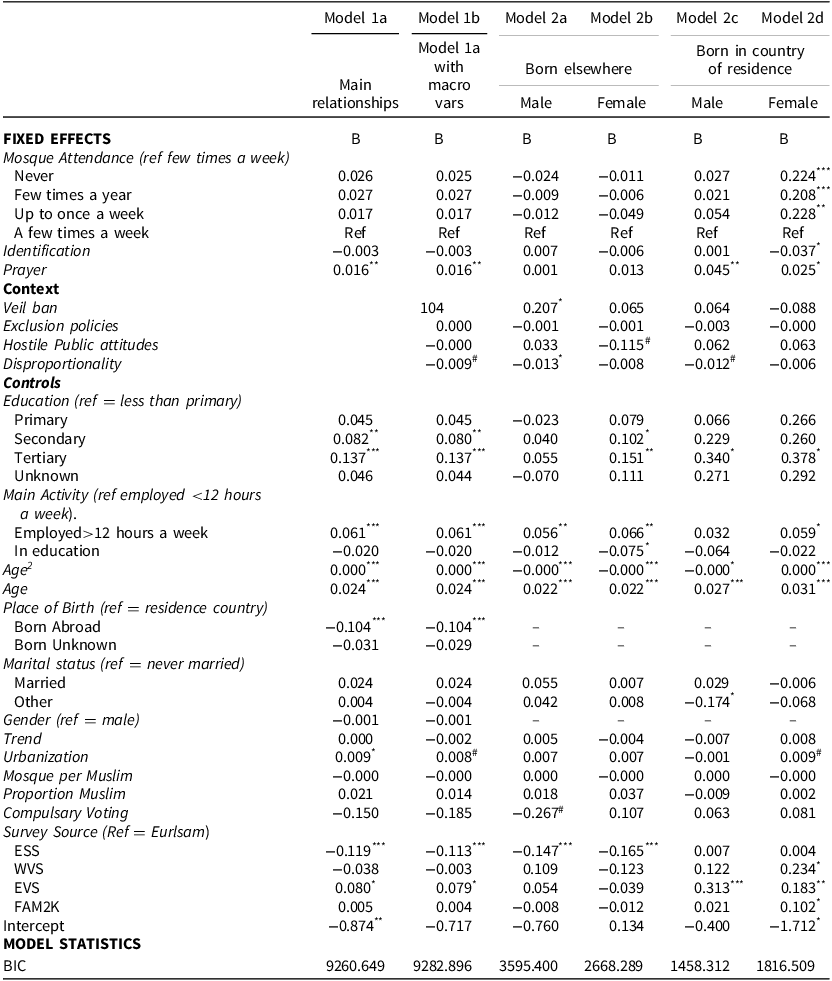
Table 3 shows the result of our voting multilevel models. Before turning to religiosity, it deserves notice that participation links to being more educated, older, and employed. Also being born abroad (first-generation migrants) is strongly negatively related to voting. These results align with previous research (Franklin, Reference Franklin2004; Smets and van Ham, Reference Smets and van Ham2013), validating our data and models to some extent.
Multilevel regression models estimating the impact of Islamic religiosity on voting among western European Muslims (2002–2020)
*** P < 0.001.
** P < 0.01.
* P < 0.05.
# P < 0.1 (macro-level effects only).
The overall impact of religiosity dimensions on electoral participation
Turning to religiosity, we first assess the overall effect across populations, before analyzing the potentially different effects by gender, migration generation, and contextual exclusion. Regarding mosque attendance , more frequent attendance does not increase the likelihood of voting. In Table 3, Models 1a and 1b show no significant relationship. Also when we contrast the multiweek category against the others (creating more power), the differences are not statistically significant. Moreover, additional analyses (Appendix G) indicated that this nil-finding is not due to a specific country being an outlier distorting an otherwise robust effect. A significant effect (P < 0.05) is not found in any of the countries. Noteworthy, though, is that when analyzing the survey sources separately (see our discussion in Appendix F), three sources show no effect, ESS shows a negative effect, and the 2000 Families data shows a positive effect. This is noteworthy, first because no consistent effect is found, and second, because the results for 2000 Families underscore the importance of this study. Studies reporting a positive effect are often based on Turkish samples. So this mobilizing effect might hold for the largest and arguably best-organized Muslim population in Western Europe (Fennema and Tillie, Reference Fennema and Tillie1999), but does not seem to hold for Muslim citizens across Western Europe. In sum we do not find an overall effect of attendance across the Muslim population in Western Europe and thus no support for Hypothesis 1.
Turning to religious identification , again against expectation (H2), we found no significant relationship, and this also holds across countries (Appendix G). Moreover, for identification, the equivalence of measurement after harmonization was least robust, but estimated separately per survey source, we find no statistically significant relationship (p < 0.05) in any of the sources either.
Lastly, for the dimension of prayer , the literature led to contrasting hypotheses. Nevertheless, in our cross-national sample, prayer is positively and significantly related to voting. On average and overall, Muslims who pray more frequently are more likely to vote and the estimated difference in turnout between those who pray at least daily, and those who never pray, is 5 percentage points. Moreover, in all but two countries a positive coefficient was found and for several, this was positive and statistically significant (p < 0.05) or marginally significant (p < 0.1), indicating that the effect is both widespread and not caused by an outlier. There are some differences between survey sources but this is more likely due to the sample population, as the measurement distributions are comparable across surveys, making a methodological issue unlikely (Appendix F). For the overall effect of prayer across Western European Muslim populations, we thus find support for Hypothesis 3b.
Different effects by gender and generation
Overall nil-effects across the Muslim population might obscure that for some demographic groups relationships exist, or that effects found are driven by strong results in certain groups. As theorized, gender and migration generation are potentially related to the meaning of religion; to explore this, we report the groups specific effect in Models 2a−2b in Table 3.
Splitting the results, we see a strong effect for mosque attendance among women born in the country of residence. Particularly, women who attend a few times a week are far less likely to vote than all other (never to weekly attending) women. As touched upon in the theory section, multiweek attending women are an exceptional group (see Nyhagen, Reference Nyhagen2019), and of our data this group counts only 59 women, being 4% of all Muslim women born in the country of residence. This observation raises the question, of whether this is a pure attendance effect or whether unobserved confounders like relatively conservative views on women’s (political) roles explain both low electoral participation and high attendance among this group. Either way, the effect is in the opposite direction to our expectation (Hypothesis 1) based on the resource and mobilization mechanisms.
For women born in the country of residence, we also find a significant and negative relationship between religious identification and voting. For this group, those who identify more strongly as Muslim are less likely to vote (opposite to Hypothesis 2, derived from the existing literature), which arguably aligns with the above and links to the notion of societal withdrawal.
Finally, turning again to prayer , we find that it is positively related to voting for all subgroups, but only statistically significant for men and women who were born in the country of destination, with a respective maximum impact of 14 and 8 percentage points higher turnout. Considering the Europeanization and individualization of Islam (e.g., Cesari, Reference Cesari2014), it is interesting to note this impact of prayer is mostly driven by European Muslims who are born in Western Europe; among them, a seemingly stronger connection to Allah does not dampen their democratic participation, but activates it.
Across dimensions, it is noteworthy that among women who are born in the country of residence, we find relationships for all dimensions: those who attend mosque more frequently and identify more strongly as Muslim are less likely to vote while prayer impels voting for this group. Moreover, effects vary considerably across gender and migration generation, with an important observation that all found effects are driven by the European Muslims born in the country of residence (the smaller half of our sample, ruling out sample size explanations for those born abroad).
Religiosity’s impact in hostile environments
Lastly, we consider the role of contextual hostility. Before assessing the cross-level interactions – how the impact of religiosity differs – let us first briefly consider the direct effects of the exclusionary indicators (Table 3). In total, we present 20 coefficients, of which only 5 are (marginally) significant and none show a consistent effect across models. For instance, we only find a mobilizing effect of veil banning among Muslim men born abroad. Arguably the strongest effect is the suppressing effect of disproportionality of electoral systems (Franklin, Reference Franklin2004; Kostadinova, Reference Kostadinova2007), among Muslim men. We cannot make grand claims based on these results. If anything, this suggests it might be interesting to look into the differences between forms of drawing boundaries, some leading to mobilizing while others suppressing turnout.
Turning to our remaining hypotheses, we included interaction terms per dimension of religiosity across the four exclusionary measures (see Appendix E). Out of the 20 interactions we did not find any significant relationships. To continue our exploration of the impact of gender and generation we ran the same analyses split along these lines. Of the 80 resulting interactions, 5 are significant or marginally significant (P < 0.1). However, these effects are scattered over the different groups and not consistently in the same direction. Taken together with the main analysis, this leads to the overall conclusion that Western European variation in our exclusionary measures and the relationship of religiosity on the likelihood to vote are rather independent from each other. Does this mean that the relationships between religiosity and electoral participation are largely similar across Western European contexts? No, for all three dimensions additional models with religiosity in the random part of the model at the country-year level, Footnote 10 show 0.95 confidence intervals above zero for the variance in effects of religiosity (Appendix G); however, our measures for exclusion do not explain this variance.
Discussion and conclusion
This paper was grounded on two premises. First, to understand how Islamic religiosity is related to voting among European Muslims we must treat religiosity as a multidimensional phenomenon. Second, it is important to consider how exclusionary boundaries, whether formal or informal, might condition the multifaceted relationship between religiosity and voting. The differential and even opposite relationships found in our analyses between the dimensions of religiosity give support to the importance of taking a more fine-grained approach when studying religiosity’s impact on electoral participation. However, with our operationalizations of differences in exclusion across Western Europe, we found no support for our second premise, although religiosity’s effects differ by context and demography.
Taking the multidimensionality of religiosity into account we identified differential relationships with voting between attendance, identification, and prayer, whereby it is crucial to note that almost all effects were found among Muslims born in Western Europe, not first-generation migrants – among whom effects may be either absent or counteracting. The impact of religiosity seems more directive among those who grew up in multicultural societies with individualized Islam (Modood, Reference Modood2013; Cesari, Reference Cesari2014). Future research on this relationship should delve into this, fleshing out the potential role of ‘European Islam’. And also, investigate the impact of the more critical stance that the second-generation has towards their political institutions (Geurts et al., Reference Geurts2020), and to what extent religiosity is related to electoral participation for the third generation, which we were unable to distinguish.
Unexpectedly and notably, we found basically no effects of mosque attendance amongst European Muslims, which is not in line with classic mobilization and resource models and claims in the migrant voter literature (Fennema and Tillie, Reference Fennema and Tillie1999; Franklin, Reference Franklin2004; Schlozman et al., Reference Schlozman, Brady and Verba2018; Spierings and Vermeulen, Reference Spierings and Vermeulen2023). Here, the specificity of Muslims in Europe may offer an explanation as most previous research related to attendance and voting has been conducted with majority Christian voters or with voters who are ethnic, but not religious minorities (e.g., African American Christians; Calhoun-Brown, Reference Calhoun-Brown1996) or a specific groups of Muslims in Europe (mostly Turkish, the largest, most organized Muslim population). Resource and mobilization mechanisms may not operate with the same strength among smaller less organized and marginalized religious communities, such as many of the European Muslim citizens.
The classic frameworks for electoral participation might need to acknowledge the specificity of minoritized groups. In the relatively hostile European context, it may be that social integration into communities to which the mosques are central, creates strong bonds within the group, stressing group grievances, particularly among those born in the country of residence and from smaller communities, those who tried most to acculturate (Waldring et al., Reference Waldring2015). If so, frequent attendance might be related to a withdrawal from European societies among some groups (see Branscombe et al., Reference Branscombe1999), but not among others, or direct the first to other means of political participation, like the more nonconventional forms (see Azabar and van Aelst, Reference Azabar and van Aelst2023). Exploring such explanations is an important avenue for future work; this study provides rather strong evidence that attendance does not strengthen electoral support across the European Muslim population.
In contrast, we found rather strong evidence that more frequently praying Muslims, particularly those born in the country of residence, are more likely to vote. This is the more surprising as the relationship between individual prayer and voting has as yet hardly been theorized or investigated. If anything, our results on this cut across the pessimist idea that frequent prayer would put the believer in more frequent contact with a deity (and theology) undermining the legitimacy of worldly authorities (Ben-Nun Bloom and Arikan, Reference Ben-Nun Bloom and Arikan2012; Froese and Jones, Reference Froese and Jones2021). Praying, however, does seem to create and strengthen a triangular relationship between the individual believer and society via their connection to the deity, leading to electoral participation as a civic duty. This suggests that individual religious behavior lays a foundation for an outward perspective and duty. To fully understand this dynamic however further study is needed, which could include other individual religiosity dimensions.
Turning to our second premise, we found little support for the theorized contextual conditioning of religiosity’s impact within Western Europe. So this contextual characteristic might be relevant to understanding Islamic religiosity’s impact across (a rather hostile) Western Europe (see above), but not to explain variation between European countries. Two remarks are in place here. First, this result does not mean that ‘excluding boundaries’ do not condition at all. Just the measures we included did not. It might be their implementation at the local level is markedly different than the national laws; it might be that other measures altogether are more important; and it might be that their subjective reception by Muslim citizens is more important than the actual policies (as found by Röder and Spierings (Reference Röder and Spierings2022) on a different outcome). Second, we found an indication of cross-context differences in effect, but other explanations might be more relevant than exclusion. For instance, Azabar et al. (Reference Azabar2020) show, for Belgium, that fielding Muslim candidates might matter. Such supply-side factors could be considered once better cross-national data are available. For now, it seems that the general hostile context in Western Europe is more relevant in shaping religiosity’s role than the variation between Western European countries.
The combining of surveys, including more cases and contexts, necessarily decreased the scope in terms of variables. As already mentioned, ideally, future work also should consider other religious dimensions such as literalism, belief orthodoxy, fasting, or Zakat. Also systematic understanding regarding if and why religiosity shows different effects across societal groups (which might lead to overall nil-effects) is important. Part of this is the mechanisms behind attendance, prayer, and identification, which might work differently for European Muslims as a religious minority compared to how they work for ethnic minorities being part of the religious majority like Christian populations, or for Muslims in Muslim majority democratic countries, or for Muslim minorities in countries like India and China. Current research and data are however too limited to draw clear conclusions here. Considering the contextual dependency of religious meaning is however what might explain why some of our results are in contrast to some single- or few-country studies (Sobolewska et al., Reference Sobolewska2015; Moutselos, Reference Moutselos2019).
Despite these limitations, this is, to our knowledge, the first study to apply a cross-national analysis to the multidimensional religiosity–turnout relationship among Muslim citizens in Europe. We sought to combine electoral participation literature with both quantitative and qualitative studies on Islamic religiosity and minority political participation providing an improved theoretical framework for understanding religious minority voting. We revealed that not only do different dimensions of religiosity relate differently to voting but also that the classic voting theories do not always apply to minorities. In particular, we uncovered how personal Islamic religiosity in terms of prayer can be promotive of voting while attendance and identification are not across the European Muslim populations. As such, the electoral participation gap between the European Muslims and the majority population is not simply reducible to Islamist religiosity being at odds with democracy.
Supplementary material
To view supplementary material for this article, please visit https://doi.org/10.1017/S1755773923000334.
Statements related to funding, data availability and ethical considerations
We hereby confirm that data used for this manuscript is publicly available. Using publicly available data, no ethics review was required for this study. Syntax used for this study will be shared upon request. We have no conflicts of interest to disclose. This paper was written in the context of the NWO-funded research project ‘SPIRiT: The Socio-Political impact of Islamic Religiosity among Muslim citizens in Europe Today’ (Project Identification: VI.Vidi.191.023).




 Open access

