





1. Introduction
The Formanek-Procesi group was introduced in [Reference Formanek and Procesi8] as a counterexample to the linearity of $\rm {Aut}(F_{n})$
, the group of automorphisms of a free group
$\rm {Aut}(F_{n})$
, the group of automorphisms of a free group $F_{n}$
of rank
$F_{n}$
of rank $n \geq 3$
. For any group
$n \geq 3$
. For any group $G$
, the Formanek-Procesi group is the HNN-extension with presentation
$G$
, the Formanek-Procesi group is the HNN-extension with presentation
 \begin{equation*} \textrm {FP}(G)=\langle b, G\times G\,:\, b(g,g)b^{-1}=(1,g), \ g\in G\rangle . \end{equation*}
It was shown in [Reference Formanek and Procesi8] that $\textrm {FP}(F_{n})$
is not linear. The group
$\textrm {FP}(F_{n})$
is not linear. The group $\textrm {FP}(F_{n})$
has been one of the fundamental examples for the nonlinearity of groups which is often mentioned as poison group. The purpose of the present work is to show that despite their non-linearity, the groups
$\textrm {FP}(F_{n})$
has been one of the fundamental examples for the nonlinearity of groups which is often mentioned as poison group. The purpose of the present work is to show that despite their non-linearity, the groups $\textrm {FP}(G)$
have some nice properties when
$\textrm {FP}(G)$
have some nice properties when $G$
is chosen to be a right-angled Artin group
$G$
is chosen to be a right-angled Artin group $A_{\Gamma }$
.
$A_{\Gamma }$
.
A right-angled Artin group (briefly, raag) is a finitely generated group with a standard presentation of the form $A_{\Gamma }=\langle a_1,\ldots, a_k\mid [a_i,a_j]=1\,\text{for certain pairs}\, (i,j)\, \text{with}\, i,j\in \{1,\ldots, k\}\rangle$
. The generating set
$A_{\Gamma }=\langle a_1,\ldots, a_k\mid [a_i,a_j]=1\,\text{for certain pairs}\, (i,j)\, \text{with}\, i,j\in \{1,\ldots, k\}\rangle$
. The generating set $\{a_1,\ldots, a_k\}$
is the standard generating set for
$\{a_1,\ldots, a_k\}$
is the standard generating set for $A_{\Gamma }$
. The defining graph
$A_{\Gamma }$
. The defining graph $\Gamma$
of
$\Gamma$
of $A_{\Gamma }$
is the graph whose vertices correspond to infinite cyclic groups generated by
$A_{\Gamma }$
is the graph whose vertices correspond to infinite cyclic groups generated by $a_i$
and whose edges connect a pair of vertices
$a_i$
and whose edges connect a pair of vertices $a_i, a_j$
if and only if
$a_i, a_j$
if and only if $[a_i,a_j]=1$
. For an extensive survey concerning raags, one may consult [Reference Charney3] and the references therein. It is obvious that if
$[a_i,a_j]=1$
. For an extensive survey concerning raags, one may consult [Reference Charney3] and the references therein. It is obvious that if $A_{\Gamma }$
is not abelian, then
$A_{\Gamma }$
is not abelian, then $A_{\Gamma }$
contains free subgroups and so
$A_{\Gamma }$
contains free subgroups and so $\textrm {FP}(A_{\Gamma })$
is not linear.
$\textrm {FP}(A_{\Gamma })$
is not linear.
We investigate the associated Lie algebra of $\textrm {FP}(A_{\Gamma })$
by providing an elimination method for
$\textrm {FP}(A_{\Gamma })$
by providing an elimination method for $\textrm {gr}({\textrm {FP}(A_{\Gamma })})$
. The elimination method was introduced by Lazard in [Reference Lazard14] for the study of nilpotent groups and
$\textrm {gr}({\textrm {FP}(A_{\Gamma })})$
. The elimination method was introduced by Lazard in [Reference Lazard14] for the study of nilpotent groups and $N$
-series. Duchamp and Krob [Reference Duchamp and Krob6] and Papadima and Suciu [Reference Papadima and Suciu16] study the free partially commutative Lie algebra and prove a partially commutative version of Lazard’s elimination. In the present work, we prove a Lazard’s elimination version of the free Lie algebra by decomposing it into a summand of free Lie algebras and ideals that originate by the various relators that appear in the Formanek-Procesi group with base a raag. To achieve this decomposition, besides the classical Lazard’s elimination, we also use results of Labute [Reference Labute13] and of Duchamp and Krob [Reference Duchamp and Krob6]. As a result, we get a presentation of the Lie algebra of the Formanek-Procesi group with basis a raag (see Theorem4.12) and the quotient groups of the consecutive terms of its lower central series are free abelian groups of finite rank (see Corollary 4.13). Furthermore, using a result of Guaschi and Pereiro [Reference Guaschi and Pereiro10, Theorem 1.1], we show that the Formanek-Procesi group with basis a raag is residually nilpotent (see Corollary 5.9). In fact, we were able to prove a more general result, that
$N$
-series. Duchamp and Krob [Reference Duchamp and Krob6] and Papadima and Suciu [Reference Papadima and Suciu16] study the free partially commutative Lie algebra and prove a partially commutative version of Lazard’s elimination. In the present work, we prove a Lazard’s elimination version of the free Lie algebra by decomposing it into a summand of free Lie algebras and ideals that originate by the various relators that appear in the Formanek-Procesi group with base a raag. To achieve this decomposition, besides the classical Lazard’s elimination, we also use results of Labute [Reference Labute13] and of Duchamp and Krob [Reference Duchamp and Krob6]. As a result, we get a presentation of the Lie algebra of the Formanek-Procesi group with basis a raag (see Theorem4.12) and the quotient groups of the consecutive terms of its lower central series are free abelian groups of finite rank (see Corollary 4.13). Furthermore, using a result of Guaschi and Pereiro [Reference Guaschi and Pereiro10, Theorem 1.1], we show that the Formanek-Procesi group with basis a raag is residually nilpotent (see Corollary 5.9). In fact, we were able to prove a more general result, that $\textrm {FP}(G)$
is residually nilpotent when
$\textrm {FP}(G)$
is residually nilpotent when $G$
is a residually finite
$G$
is a residually finite $p$
-group for some prime
$p$
-group for some prime $p$
. A first attempt in that direction was made in [Reference Sevaslidou17].
$p$
. A first attempt in that direction was made in [Reference Sevaslidou17].
To be more specific, for $n \geq 2$
, let
$n \geq 2$
, let $\Delta = \{\{1,\ldots, n\}\times \{1,\ldots, n\}\}\setminus \{(a,a)\,:\, a\in \{1,\ldots, n\}\}$
. Let
$\Delta = \{\{1,\ldots, n\}\times \{1,\ldots, n\}\}\setminus \{(a,a)\,:\, a\in \{1,\ldots, n\}\}$
. Let $\theta$
be a non-empty subset of
$\theta$
be a non-empty subset of $\Delta$
such that
$\Delta$
such that $\theta$
contains both
$\theta$
contains both $(a,b)$
and
$(a,b)$
and $(b,a)$
for
$(b,a)$
for $a,b\in \{1,\ldots, n\}$
. We call
$a,b\in \{1,\ldots, n\}$
. We call $\theta$
a partial commutation relation on
$\theta$
a partial commutation relation on $\{1,\ldots, n\}$
.
$\{1,\ldots, n\}$
.
Now let $(A_1)_{\Gamma }$
and
$(A_1)_{\Gamma }$
and $(A_2)_{\Gamma }$
two copies of a raag with presentations
$(A_2)_{\Gamma }$
two copies of a raag with presentations
 \begin{equation*} (A_i)_{\Gamma }=\langle a_{i,1},\ldots, a_{i,n}\,:\, [a_{i,k},a_{i,l}]=1,\; \ k \gt l; (k,l)\in \theta \rangle, \ i=1,2\rangle \end{equation*}
and define $\textrm {FP}(A_{\Gamma })$
to be the group with generating set
$\textrm {FP}(A_{\Gamma })$
to be the group with generating set $b, a_{1,1},\ldots, a_{1,n},a_{2,1},\ldots, a_{2,n}$
and defining relations
$b, a_{1,1},\ldots, a_{1,n},a_{2,1},\ldots, a_{2,n}$
and defining relations
 \begin{equation*} ba_{1,k}a_{2,k}b^{-1}=a_{2,k}, \ \ k\in \{1,\ldots, n\}, \end{equation*}
 \begin{equation*} [a_{i,r},a_{i,s}]=1,\,\, i=1,2;\ \ r \gt s\,;\, (r,s)\in \theta \,\,\text{and} \end{equation*}
 \begin{equation*} [a_{1,k},a_{2,l}]=1, \ \ k,l\in \{1,\ldots, n\}. \end{equation*}
Using the first set of the above relation, we may solve for $a_{1,k}$
, with
$a_{1,k}$
, with $k\in \{1,\ldots, n\}$
, and replace into the other two sets of relations to get a presentation with generators
$k\in \{1,\ldots, n\}$
, and replace into the other two sets of relations to get a presentation with generators $b, a_{2,k}$
, with
$b, a_{2,k}$
, with $k\in \{1,\ldots, n\}$
and relations
$k\in \{1,\ldots, n\}$
and relations
 \begin{equation*} [b,a_{2,k},a_{2,l}]=1, [a_{2,r},a_{2,s}]=1,[[b,a_{2,r}],[b,a_{2,s}]]=1\, \mbox{for}\ k,l\in \{1,\ldots, n\};\, r \gt s; (r,s)\in \theta . \end{equation*}
By renaming $a_{2,i}=f_i$
and
$a_{2,i}=f_i$
and $b=t$
,
$b=t$
, $\textrm {FP}(A_{\Gamma })$
has a presentation with generating set
$\textrm {FP}(A_{\Gamma })$
has a presentation with generating set $\{t, f_{1}, \ldots, f_{n}\}$
and defining relations
$\{t, f_{1}, \ldots, f_{n}\}$
and defining relations
 \begin{equation*} [t,f_{k},f_{l}]=[f_{r},f_{s}]=[[t,f_{r}],[t,f_{s}]]=1, k,l\in \{1,\ldots, n\}; r \gt s;\, (r,s)\in \theta . \end{equation*}
Let $F_{n+1}$
be the free group with free generating set
$F_{n+1}$
be the free group with free generating set ${\mathcal{F}}_{n+1} = \{\,f_{1}, \ldots, f_n,f_{n+1}=t\}$
,
${\mathcal{F}}_{n+1} = \{\,f_{1}, \ldots, f_n,f_{n+1}=t\}$
, $n \geq 2$
, and let
$n \geq 2$
, and let $\theta$
be a nonempty partial commutation relation on
$\theta$
be a nonempty partial commutation relation on $\{1, \ldots, n\}$
. Let
$\{1, \ldots, n\}$
. Let $M = {\mathcal{R}}^{F_{n+1}}$
be the normal subgroup of
$M = {\mathcal{R}}^{F_{n+1}}$
be the normal subgroup of $\mathcal{R}$
in
$\mathcal{R}$
in $F_{n+1}$
, where
$F_{n+1}$
, where ${\mathcal{R}} = \{[f_{a},f_{b}], [t, f_{i}, f_{j}], [[t,f_{a}], [t,f_{b}]]\,:\, i, j \in \{1, \ldots, n\};\, a \gt b;\, (a,b) \in \theta \}$
. Notice that
${\mathcal{R}} = \{[f_{a},f_{b}], [t, f_{i}, f_{j}], [[t,f_{a}], [t,f_{b}]]\,:\, i, j \in \{1, \ldots, n\};\, a \gt b;\, (a,b) \in \theta \}$
. Notice that $\textrm {FP}(A_{\Gamma }) = F_{n+1}/M$
. Let
$\textrm {FP}(A_{\Gamma }) = F_{n+1}/M$
. Let $\textrm {gr}(F_{n+1})$
be the free Lie algebra (over
$\textrm {gr}(F_{n+1})$
be the free Lie algebra (over $\mathbb{Z}$
) with a free generating set
$\mathbb{Z}$
) with a free generating set $\overline {\mathcal{F}}_{n+1} = \{y_{i} = f_{i}F^{\prime }_{n+1}, \overline {t}=tF^{\prime }_{n+1}\,:\, i = 1, \ldots, n\}$
associated to
$\overline {\mathcal{F}}_{n+1} = \{y_{i} = f_{i}F^{\prime }_{n+1}, \overline {t}=tF^{\prime }_{n+1}\,:\, i = 1, \ldots, n\}$
associated to $F_{n+1}$
. We order the elements of
$F_{n+1}$
. We order the elements of $\overline {\mathcal{F}}_{n+1}$
as
$\overline {\mathcal{F}}_{n+1}$
as $y_1\lt \cdots \lt y_n\lt \overline {t}$
. Let also
$y_1\lt \cdots \lt y_n\lt \overline {t}$
. Let also $J$
be the ideal of
$J$
be the ideal of $\textrm {gr}(F_{n+1})$
generated by
$\textrm {gr}(F_{n+1})$
generated by $\mathcal{R}_{L} = \{[y_{a}, y_{b}], [\overline {t}, y_{i}, y_{j}], [[\overline {t}, y_{a}], [\overline {t}, y_{b}]]: i, j \in \{1, \ldots, n\}; a \gt b; (a,b) \in \theta \}$
. We use this notation throughout the present work.
$\mathcal{R}_{L} = \{[y_{a}, y_{b}], [\overline {t}, y_{i}, y_{j}], [[\overline {t}, y_{a}], [\overline {t}, y_{b}]]: i, j \in \{1, \ldots, n\}; a \gt b; (a,b) \in \theta \}$
. We use this notation throughout the present work.
So we were able to show the following.
Theorem 4.12. $\textrm {gr}(\textrm {FP}(A_{\Gamma })) \cong \textrm {gr}(F_{n+1})/J$
as Lie algebras in a natural way.
$\textrm {gr}(\textrm {FP}(A_{\Gamma })) \cong \textrm {gr}(F_{n+1})/J$
as Lie algebras in a natural way.
Also, for a finitely generated group $G$
, by transforming the presentation of the Formanek-Procesi group
$G$
, by transforming the presentation of the Formanek-Procesi group $\textrm {FP}(G)$
to a semi-direct product, we were able to show that the specific action of the semi-direct product plays a central rôle in the residual behavior of the group
$\textrm {FP}(G)$
to a semi-direct product, we were able to show that the specific action of the semi-direct product plays a central rôle in the residual behavior of the group $\textrm {FP}(G)$
when the residual properties of the base group
$\textrm {FP}(G)$
when the residual properties of the base group $G$
are nice. So we have
$G$
are nice. So we have
Corollary 5.8.
If $G$
is a finitely generated residually finite
$G$
is a finitely generated residually finite $p$
-group for some prime
$p$
-group for some prime $p$
, then
$p$
, then $\textrm {FP}(G)$
is residually nilpotent.
$\textrm {FP}(G)$
is residually nilpotent.
Hence, based on the residual properties of the raag groups, we have
Corollary 5.9.
The group $\textrm {FP}(A_{\Gamma })$
is a finitely generated residually torsion-free nilpotent group.
$\textrm {FP}(A_{\Gamma })$
is a finitely generated residually torsion-free nilpotent group.
The main tool of our work is a thorough investigation of $\textrm {gr}(F_{n+1})$
. The structure of the paper is the following. In section 2, we give some known results concerning Lazard’s elimination and decompose
$\textrm {gr}(F_{n+1})$
. The structure of the paper is the following. In section 2, we give some known results concerning Lazard’s elimination and decompose $\textrm {gr}(F_{n+1})$
for
$\textrm {gr}(F_{n+1})$
for $n\ge 1$
in the spirit of elimination theorem. In subsection 2.3, we analyze the ideal
$n\ge 1$
in the spirit of elimination theorem. In subsection 2.3, we analyze the ideal $J$
of
$J$
of $\textrm {gr}(F_{n+1})$
,
$\textrm {gr}(F_{n+1})$
, $n \geq 1$
, as a direct sum of three explicitly described free Lie subalgebras of
$n \geq 1$
, as a direct sum of three explicitly described free Lie subalgebras of $\textrm {gr}(F_{n+1})$
. These free Lie subalgebras play an essential rôle in the proof of Theorem4.12. Let
$\textrm {gr}(F_{n+1})$
. These free Lie subalgebras play an essential rôle in the proof of Theorem4.12. Let $\theta$
be a nonempty partial commutation relation on
$\theta$
be a nonempty partial commutation relation on $\{1, \ldots, n\}$
,
$\{1, \ldots, n\}$
, $n \geq 2$
,
$n \geq 2$
, ${\mathcal {P}} = \{r_{a,b} = [f_{a},f_{b}]\,:\, a \gt b;\, (a,b) \in \theta \}$
and let
${\mathcal {P}} = \{r_{a,b} = [f_{a},f_{b}]\,:\, a \gt b;\, (a,b) \in \theta \}$
and let $N = {\mathcal {P}}^{F_{n}}$
be the normal closure of
$N = {\mathcal {P}}^{F_{n}}$
be the normal closure of $\mathcal {P}$
in
$\mathcal {P}$
in $F_{n}$
. Let
$F_{n}$
. Let $I$
be the ideal in
$I$
be the ideal in $\textrm {gr}(F_{n})$
generated by the set
$\textrm {gr}(F_{n})$
generated by the set ${\mathcal {P}}_{L} = \{[y_{a}, y_{b}]\,:n\, a \gt b;\, (a,b) \in \theta \}$
. In section 3, we show that
${\mathcal {P}}_{L} = \{[y_{a}, y_{b}]\,:n\, a \gt b;\, (a,b) \in \theta \}$
. In section 3, we show that $I$
is a direct summand of
$I$
is a direct summand of $\textrm {gr}(F_{n})$
and so
$\textrm {gr}(F_{n})$
and so $\textrm {gr}(F_{n})/I$
is a free
$\textrm {gr}(F_{n})/I$
is a free $\mathbb{Z}$
-module. A decomposition of
$\mathbb{Z}$
-module. A decomposition of $I$
is given where each summand is a free Lie algebra by explicitly giving a free generating set. Furthermore, we show that
$I$
is given where each summand is a free Lie algebra by explicitly giving a free generating set. Furthermore, we show that ${\mathcal{L}}(N) = I$
. In section 4, we prove Theorem4.12, that is
${\mathcal{L}}(N) = I$
. In section 4, we prove Theorem4.12, that is $\textrm {gr}(F_{n+1}/M) \cong \textrm {gr}(F_{n+1})/J$
as Lie algebras in a natural way. As a consequence, each
$\textrm {gr}(F_{n+1}/M) \cong \textrm {gr}(F_{n+1})/J$
as Lie algebras in a natural way. As a consequence, each $\textrm {gr}_{d}(\textrm {FP}(A_{\Gamma }))$
is a free abelian group of finite rank. Further, we use results of section 3 to show that
$\textrm {gr}_{d}(\textrm {FP}(A_{\Gamma }))$
is a free abelian group of finite rank. Further, we use results of section 3 to show that ${\mathcal{L}}(M) = J$
. In section 5, we show that
${\mathcal{L}}(M) = J$
. In section 5, we show that $\textrm {FP}(G)$
is residually nilpotent for any finitely generated residually finite
$\textrm {FP}(G)$
is residually nilpotent for any finitely generated residually finite $p$
-group
$p$
-group $G$
, by using a result of Guaschi and Pereiro [Reference Guaschi and Pereiro10, Theorem 1.1]. This result, together with the nice residual properties of the raags, allows us to prove that
$G$
, by using a result of Guaschi and Pereiro [Reference Guaschi and Pereiro10, Theorem 1.1]. This result, together with the nice residual properties of the raags, allows us to prove that $\textrm {FP}(A_{\Gamma })$
is residually torsion-free nilpotent.
$\textrm {FP}(A_{\Gamma })$
is residually torsion-free nilpotent.
2. Preliminaries
2.1. The elimination theorem
By a Lie algebra $L$
, we mean a Lie algebra over the ring
$L$
, we mean a Lie algebra over the ring $\mathbb{Z}$
of integers. Throughout this paper, we use the left-normed convention for Lie commutators that is
$\mathbb{Z}$
of integers. Throughout this paper, we use the left-normed convention for Lie commutators that is $[x_1,x_2, x_3,\ldots, x_n]=[\ldots [[x_1,x_2],x_3],\ldots, x_n]$
. Let
$[x_1,x_2, x_3,\ldots, x_n]=[\ldots [[x_1,x_2],x_3],\ldots, x_n]$
. Let $L$
be any Lie algebra. For
$L$
be any Lie algebra. For $x, y \in L$
and
$x, y \in L$
and $m$
a non-negative integer, we write
$m$
a non-negative integer, we write $[y,\,_{m}x] = [y, x, \ldots, x]$
with
$[y,\,_{m}x] = [y, x, \ldots, x]$
with $m$
factors of
$m$
factors of $x$
. For
$x$
. For $m = 0$
, we write
$m = 0$
, we write $[y, \,_{0}x] = y$
. Similar notation we use for group commutators.
$[y, \,_{0}x] = y$
. Similar notation we use for group commutators.
Let $V$
be a free
$V$
be a free $\mathbb{Z}$
-module. We write
$\mathbb{Z}$
-module. We write $L(V)$
for the free Lie algebra which has
$L(V)$
for the free Lie algebra which has $V$
as a submodule and every basis of
$V$
as a submodule and every basis of $V$
as a free generating set. Thus we may write
$V$
as a free generating set. Thus we may write $L(V) = L({\mathcal{V}})$
for a
$L(V) = L({\mathcal{V}})$
for a $\mathbb{Z}$
-basis
$\mathbb{Z}$
-basis $\mathcal{V}$
of
$\mathcal{V}$
of $V$
. By a graded
$V$
. By a graded $\mathbb{Z}$
-module, we mean a
$\mathbb{Z}$
-module, we mean a $\mathbb{Z}$
-module
$\mathbb{Z}$
-module $V$
with a distinguished
$V$
with a distinguished $\mathbb{Z}$
-module decomposition
$\mathbb{Z}$
-module decomposition $V = V_{1} \oplus V_{2} \oplus \cdots$
, where each
$V = V_{1} \oplus V_{2} \oplus \cdots$
, where each $V_{m}$
is a free
$V_{m}$
is a free $\mathbb{Z}$
-module of finite rank. For each
$\mathbb{Z}$
-module of finite rank. For each $d \geq 1$
, let
$d \geq 1$
, let $L^{d}_{\textrm {grad}}(V)$
be the
$L^{d}_{\textrm {grad}}(V)$
be the $\mathbb{Z}$
-submodule of
$\mathbb{Z}$
-submodule of $L(V)$
spanned by all left-normed Lie commutators
$L(V)$
spanned by all left-normed Lie commutators $[v_{1}, v_{2}, \ldots, v_{\kappa }]$
, with
$[v_{1}, v_{2}, \ldots, v_{\kappa }]$
, with $\kappa \geq 1$
, such that, for
$\kappa \geq 1$
, such that, for $i \in \{1,\ldots, \kappa \}$
,
$i \in \{1,\ldots, \kappa \}$
, $v_{i} \in V_{m(i)}$
for some
$v_{i} \in V_{m(i)}$
for some $m(i) \geq 1$
with
$m(i) \geq 1$
with $m(1) + m(2) + \cdots + m(\kappa ) = d$
. Then
$m(1) + m(2) + \cdots + m(\kappa ) = d$
. Then $L(V)$
is a graded
$L(V)$
is a graded $\mathbb{Z}$
-module
$\mathbb{Z}$
-module $ L(V) = L^{1}_{\textrm {grad}}(V) \oplus L^{2}_{\textrm {grad}}(V) \oplus \cdots$
. If
$ L(V) = L^{1}_{\textrm {grad}}(V) \oplus L^{2}_{\textrm {grad}}(V) \oplus \cdots$
. If $V$
is a free
$V$
is a free $\mathbb{Z}$
-module of finite rank, then we may regard
$\mathbb{Z}$
-module of finite rank, then we may regard $V$
as a graded
$V$
as a graded $\mathbb{Z}$
-module:
$\mathbb{Z}$
-module: $V = V \oplus 0 \oplus 0 \oplus \cdots$
. Then the
$V = V \oplus 0 \oplus 0 \oplus \cdots$
. Then the $\mathbb{Z}$
-module
$\mathbb{Z}$
-module $L^{d}(V)$
is the
$L^{d}(V)$
is the $d$
-th homogeneous component of
$d$
-th homogeneous component of $L(V)$
.
$L(V)$
.
For non-empty subsets $\mathcal B$
and
$\mathcal B$
and $\mathcal C$
of a Lie algebra, we write
$\mathcal C$
of a Lie algebra, we write $ {\mathcal C} \wr {\mathcal B}^{*} = \{[c, b_{1}, \ldots, b_{k}]\,:\, c \in {\mathcal C};\, b_{1}, \ldots, b_{k} \in {\mathcal B};\, k \geq 0\}$
. The following result is a version of Lazard’s “Elimination Theorem” (see [Reference Bourbaki2, Chapter 2, Section 2.9, Proposition 10]).
$ {\mathcal C} \wr {\mathcal B}^{*} = \{[c, b_{1}, \ldots, b_{k}]\,:\, c \in {\mathcal C};\, b_{1}, \ldots, b_{k} \in {\mathcal B};\, k \geq 0\}$
. The following result is a version of Lazard’s “Elimination Theorem” (see [Reference Bourbaki2, Chapter 2, Section 2.9, Proposition 10]).
Theorem 2.1 (Elimination)
Let ${\mathcal A} = {\mathcal B} \cup {\mathcal C}$
be the disjoint union of its proper non-empty subsets
${\mathcal A} = {\mathcal B} \cup {\mathcal C}$
be the disjoint union of its proper non-empty subsets $\mathcal B$
and
$\mathcal B$
and $\mathcal C$
and consider the free Lie algebra
$\mathcal C$
and consider the free Lie algebra $L({\mathcal A})$
. Then
$L({\mathcal A})$
. Then $\mathcal B$
and
$\mathcal B$
and ${\mathcal C} \wr {\mathcal B}^{*}$
freely generate Lie algebras
${\mathcal C} \wr {\mathcal B}^{*}$
freely generate Lie algebras $L({\mathcal B})$
and
$L({\mathcal B})$
and $L({\mathcal C} \wr {\mathcal B}^{*})$
, and there is a
$L({\mathcal C} \wr {\mathcal B}^{*})$
, and there is a $\mathbb{Z}$
-module decomposition
$\mathbb{Z}$
-module decomposition $L({\mathcal A}) = L({\mathcal B}) \oplus L({\mathcal C} \wr {\mathcal B}^{*})$
. Furthermore
$L({\mathcal A}) = L({\mathcal B}) \oplus L({\mathcal C} \wr {\mathcal B}^{*})$
. Furthermore $L({\mathcal C} \wr {\mathcal B}^{*})$
is the ideal of
$L({\mathcal C} \wr {\mathcal B}^{*})$
is the ideal of $L({\mathcal A})$
generated by
$L({\mathcal A})$
generated by $\mathcal C$
.
$\mathcal C$
.
For non-empty subsets $X, Y$
of
$X, Y$
of $L(\mathcal {A})$
, we write
$L(\mathcal {A})$
, we write $ S(X, Y) = \{[x,y]\,:\, x \in X, y \in Y\}$
. We inductively define the subsets
$ S(X, Y) = \{[x,y]\,:\, x \in X, y \in Y\}$
. We inductively define the subsets $({\mathcal A}_{m})_{m \geq 1}$
of
$({\mathcal A}_{m})_{m \geq 1}$
of $L(\mathcal {A})$
by
$L(\mathcal {A})$
by $ {\mathcal A}_{1} = {\mathcal A}$
and, for all
$ {\mathcal A}_{1} = {\mathcal A}$
and, for all $m \geq 2$
,
$m \geq 2$
, $ {\mathcal A}_{m} = \bigcup _{p, q \geq 1 \atop p+q=m} (S({\mathcal A}_{p}, {\mathcal A}_{q}) \setminus \{0\})$
. An element of
$ {\mathcal A}_{m} = \bigcup _{p, q \geq 1 \atop p+q=m} (S({\mathcal A}_{p}, {\mathcal A}_{q}) \setminus \{0\})$
. An element of $\bigcup _{m \geq 1}{\mathcal A}_{m}$
is called a simple Lie commutator which is formed by the elements of
$\bigcup _{m \geq 1}{\mathcal A}_{m}$
is called a simple Lie commutator which is formed by the elements of $\mathcal {A}$
. The following result has been proved in [Reference Duchamp and Krob6, Lemma II.5].
$\mathcal {A}$
. The following result has been proved in [Reference Duchamp and Krob6, Lemma II.5].
Lemma 2.2.
Let ${\mathcal A} = {\mathcal B} \cup {\mathcal C}$
be the disjoint union of its proper non-empty subsets
${\mathcal A} = {\mathcal B} \cup {\mathcal C}$
be the disjoint union of its proper non-empty subsets $\mathcal B$
and
$\mathcal B$
and $\mathcal C$
and consider the free Lie algebra
$\mathcal C$
and consider the free Lie algebra $L({\mathcal A})$
. Let
$L({\mathcal A})$
. Let $u$
be a simple Lie commutator of
$u$
be a simple Lie commutator of $L({\mathcal A})$
. Then either
$L({\mathcal A})$
. Then either $u \in L({\mathcal B})$
or
$u \in L({\mathcal B})$
or $u \in L({\mathcal C} \wr {\mathcal B}^{*})$
.
$u \in L({\mathcal C} \wr {\mathcal B}^{*})$
.
2.2. Decomposition of $\textrm {gr}(F_{n+1})$

Let $G$
be any group. For subgroups
$G$
be any group. For subgroups $X$
and
$X$
and $Y$
of
$Y$
of $G$
, we write
$G$
, we write $[X,Y]$
for the subgroup of
$[X,Y]$
for the subgroup of $G$
generated by the commutators
$G$
generated by the commutators $[x,y] = x^{-1}y^{-1}xy$
with
$[x,y] = x^{-1}y^{-1}xy$
with $x \in X$
and
$x \in X$
and $y \in Y$
. For
$y \in Y$
. For $c \geq 1$
, let
$c \geq 1$
, let $\gamma _{c}(G)$
be the
$\gamma _{c}(G)$
be the $c$
-th term of the lower central series of
$c$
-th term of the lower central series of $G$
. That is,
$G$
. That is, $\gamma _{1}(G) = G$
and, for
$\gamma _{1}(G) = G$
and, for $c \geq 2$
,
$c \geq 2$
, $\gamma _{c}(G) = [\gamma _{c-1}(G),G]$
. We write
$\gamma _{c}(G) = [\gamma _{c-1}(G),G]$
. We write $G^{\prime } = \gamma _{2}(G)$
for the commutator subgroup of
$G^{\prime } = \gamma _{2}(G)$
for the commutator subgroup of $G$
. For subgroups
$G$
. For subgroups $X_{1}, \ldots, X_{m}$
of
$X_{1}, \ldots, X_{m}$
of $G$
, with
$G$
, with $m \geq 2$
, we write
$m \geq 2$
, we write $[X_{1}, X_{2}, \ldots, X_{m}] = [[X_{1}, \ldots, X_{m-1}],X_{m}]$
for the subgroup of
$[X_{1}, X_{2}, \ldots, X_{m}] = [[X_{1}, \ldots, X_{m-1}],X_{m}]$
for the subgroup of $G$
generated by all group commutators
$G$
generated by all group commutators $[u,x]$
where
$[u,x]$
where $u \in [X_{1}, \ldots, X_{m-1}]$
and
$u \in [X_{1}, \ldots, X_{m-1}]$
and $x \in X_{m}$
. Let
$x \in X_{m}$
. Let $Y$
be a subgroup of
$Y$
be a subgroup of $G$
. For
$G$
. For $\kappa \geq 1$
, we write
$\kappa \geq 1$
, we write $[Y,\,_{\kappa }G] = [Y, G, \ldots, G]$
with
$[Y,\,_{\kappa }G] = [Y, G, \ldots, G]$
with $\kappa$
factors of
$\kappa$
factors of $G$
. Then
$G$
. Then $[Y,{}_{\kappa }{G}]$
is a normal subgroup of
$[Y,{}_{\kappa }{G}]$
is a normal subgroup of $G$
with a generating set
$G$
with a generating set $\{[y, a_{1}, \ldots, a_{\kappa }]: y \in Y;\, a_{1}, \ldots, a_{\kappa } \in G\}$
. For a non-empty subset
$\{[y, a_{1}, \ldots, a_{\kappa }]: y \in Y;\, a_{1}, \ldots, a_{\kappa } \in G\}$
. For a non-empty subset $\mathcal{X}$
of
$\mathcal{X}$
of $G \setminus \{1\}$
we write
$G \setminus \{1\}$
we write $\mathcal{X}^{G}$
for the normal closure of
$\mathcal{X}^{G}$
for the normal closure of $\mathcal{X}$
in
$\mathcal{X}$
in $G$
. In particular, if
$G$
. In particular, if $X$
is the subgroup of
$X$
is the subgroup of $G$
generated by
$G$
generated by $\mathcal{X}$
, then
$\mathcal{X}$
, then $\mathcal{X}^{G} = X\,[X,G]$
. The associated graded abelian group
$\mathcal{X}^{G} = X\,[X,G]$
. The associated graded abelian group $\textrm {gr}(G) = \bigoplus _{c \geq 1}\textrm {gr}_{c}(G)$
, where
$\textrm {gr}(G) = \bigoplus _{c \geq 1}\textrm {gr}_{c}(G)$
, where $\textrm {gr}_{c}(G) = \gamma _{c}(G)/\gamma _{c+1}(G)$
, has the structure of a graded Lie algebra over
$\textrm {gr}_{c}(G) = \gamma _{c}(G)/\gamma _{c+1}(G)$
, has the structure of a graded Lie algebra over $\mathbb{Z}$
, the Lie bracket operation in
$\mathbb{Z}$
, the Lie bracket operation in $\textrm { gr}(G)$
being induced by the commutator operation in
$\textrm { gr}(G)$
being induced by the commutator operation in $G$
(see, e.g., [Reference Bourbaki2], [Reference Lazard14], [Reference Magnus, Karrass and Solitar15]).
$G$
(see, e.g., [Reference Bourbaki2], [Reference Lazard14], [Reference Magnus, Karrass and Solitar15]).
The proof of the following result is elementary.
Lemma 2.3.
Let $G$
be a group and
$G$
be a group and $Y$
be a subgroup of
$Y$
be a subgroup of $G$
. Then, for
$G$
. Then, for $m, r \ge 1$
,
$m, r \ge 1$
, $[Y, \gamma _{m}(G)] \leq [Y, \,_{m}G]$
and
$[Y, \gamma _{m}(G)] \leq [Y, \,_{m}G]$
and $[\gamma _{r}(G), Y, \gamma _{m}(G)] \leq [[\gamma _{r}(G), Y],\,_{m}G] \leq [Y, \,_{m+r}G]$
.
$[\gamma _{r}(G), Y, \gamma _{m}(G)] \leq [[\gamma _{r}(G), Y],\,_{m}G] \leq [Y, \,_{m+r}G]$
.
The Lie algebra $\textrm {gr}(F_{n+1})$
is a free Lie algebra with a free generating set
$\textrm {gr}(F_{n+1})$
is a free Lie algebra with a free generating set $\overline {\mathcal{F}}_{n+1} = \{\overline {t}, y_{i} \,:\, i = 1, \ldots, n\}$
. For
$\overline {\mathcal{F}}_{n+1} = \{\overline {t}, y_{i} \,:\, i = 1, \ldots, n\}$
. For $\kappa \in \{2,\ldots, n+1\}$
let
$\kappa \in \{2,\ldots, n+1\}$
let $F_{\kappa }$
be the free group generated by
$F_{\kappa }$
be the free group generated by ${\mathcal F}_{\kappa }$
. For
${\mathcal F}_{\kappa }$
. For $c \geq 1$
,
$c \geq 1$
, ${\mathcal L}_{\textrm {gr},c}(F_{\kappa }) = \gamma _{c}(F_{\kappa })\gamma _{c+1}(F_{n+1})/\gamma _{c+1}(F_{n+1})$
. Form the restricted direct sum
${\mathcal L}_{\textrm {gr},c}(F_{\kappa }) = \gamma _{c}(F_{\kappa })\gamma _{c+1}(F_{n+1})/\gamma _{c+1}(F_{n+1})$
. Form the restricted direct sum $ {\mathcal L}_{\textrm {gr}}(F_{\kappa }) = \bigoplus _{c \geq 1}{\mathcal L}_{\textrm {gr},c}(F_{\kappa })$
of the abelian groups
$ {\mathcal L}_{\textrm {gr}}(F_{\kappa }) = \bigoplus _{c \geq 1}{\mathcal L}_{\textrm {gr},c}(F_{\kappa })$
of the abelian groups ${\mathcal L}_{\textrm {gr},c}(F_{\kappa })$
. Since
${\mathcal L}_{\textrm {gr},c}(F_{\kappa })$
. Since $[\gamma _{\mu }(F_{\kappa }), \gamma _{\nu }(F_{\kappa })] \subseteq \gamma _{\mu + \nu }(F_{\kappa })$
for all
$[\gamma _{\mu }(F_{\kappa }), \gamma _{\nu }(F_{\kappa })] \subseteq \gamma _{\mu + \nu }(F_{\kappa })$
for all $\mu, \nu \ge 1$
,
$\mu, \nu \ge 1$
, ${\mathcal L}_{\textrm {gr}}(F_{\kappa })$
is a Lie subalgebra of
${\mathcal L}_{\textrm {gr}}(F_{\kappa })$
is a Lie subalgebra of $\textrm {gr}(F_{n+1})$
. Notice that
$\textrm {gr}(F_{n+1})$
. Notice that ${\mathcal{L}}_{\textrm {gr}}(F_{n+1}) = \textrm {gr}(F_{n+1})$
. Since
${\mathcal{L}}_{\textrm {gr}}(F_{n+1}) = \textrm {gr}(F_{n+1})$
. Since $\gamma _{c+1}(F_{\kappa }) = \gamma _{c}(F_{\kappa }) \cap \gamma _{c+1}(F_{n+1})$
for all
$\gamma _{c+1}(F_{\kappa }) = \gamma _{c}(F_{\kappa }) \cap \gamma _{c+1}(F_{n+1})$
for all $c \geq 1$
, we have
$c \geq 1$
, we have ${\mathcal{L}}_{\textrm {gr}}(F_{\kappa }) \cong \textrm {gr}(F_{\kappa })$
as Lie algebras in a natural way. Hence,
${\mathcal{L}}_{\textrm {gr}}(F_{\kappa }) \cong \textrm {gr}(F_{\kappa })$
as Lie algebras in a natural way. Hence, ${\mathcal{L}}_{\textrm {gr}}(F_{\kappa })$
is a free Lie algebra on
${\mathcal{L}}_{\textrm {gr}}(F_{\kappa })$
is a free Lie algebra on $\overline {\mathcal{F}}_{\kappa }$
. By Theorem2.1,
$\overline {\mathcal{F}}_{\kappa }$
. By Theorem2.1, $ {\mathcal{L}}_{\textrm {gr}}(F_{\kappa }) = L(\overline {\mathcal{F}}_{ \kappa -1}) \oplus L(\{y_{\kappa }\} \wr (\overline {\mathcal{F}}_{\kappa -1})^{*})$
. The free Lie algebra
$ {\mathcal{L}}_{\textrm {gr}}(F_{\kappa }) = L(\overline {\mathcal{F}}_{ \kappa -1}) \oplus L(\{y_{\kappa }\} \wr (\overline {\mathcal{F}}_{\kappa -1})^{*})$
. The free Lie algebra $L(\{y_{\kappa }\} \wr (\overline {\mathcal{F}}_{\kappa -1})^{*})$
is the ideal of
$L(\{y_{\kappa }\} \wr (\overline {\mathcal{F}}_{\kappa -1})^{*})$
is the ideal of ${\mathcal{L}}_{\textrm {gr}}(F_{\kappa })$
generated by the element
${\mathcal{L}}_{\textrm {gr}}(F_{\kappa })$
generated by the element $y_{\kappa }$
.
$y_{\kappa }$
.
The proof of the following result is straightforward.
Lemma 2.4.
For $n \geq 1$
,
$n \geq 1$
, $F_{n+1}$
is the semidirect product of
$F_{n+1}$
is the semidirect product of $N_{t}$
by
$N_{t}$
by $F_{n}$
where
$F_{n}$
where $N_{t}$
is the normal closure of
$N_{t}$
is the normal closure of $\{t\}$
in
$\{t\}$
in $F_{n+1}$
.
$F_{n+1}$
.
Fix $\kappa \in \{2, \ldots, n+1\}$
. For
$\kappa \in \{2, \ldots, n+1\}$
. For $c \geq 1$
,
$c \geq 1$
, $N_{f_{\kappa },c} = N_{f_{\kappa }} \cap \gamma _{c}(F_{\kappa })$
, where
$N_{f_{\kappa },c} = N_{f_{\kappa }} \cap \gamma _{c}(F_{\kappa })$
, where $N_{f_{\kappa }}$
is the normal closure of
$N_{f_{\kappa }}$
is the normal closure of $\{f_{\kappa }\}$
in
$\{f_{\kappa }\}$
in $F_{\kappa }$
, and
$F_{\kappa }$
, and $\textrm {I}_{c}(N_{f_{\kappa }}) = N_{f_{\kappa },c} \gamma _{c+1}(F_{n+1})/\gamma _{c+1}(F_{n+1})$
. Notice that
$\textrm {I}_{c}(N_{f_{\kappa }}) = N_{f_{\kappa },c} \gamma _{c+1}(F_{n+1})/\gamma _{c+1}(F_{n+1})$
. Notice that $\textrm {I}_{c}(N_{f_{\kappa }}) \leq {\mathcal{L}}_{\textrm {gr},c}(F_{\kappa })$
for all
$\textrm {I}_{c}(N_{f_{\kappa }}) \leq {\mathcal{L}}_{\textrm {gr},c}(F_{\kappa })$
for all $c \geq 1$
. Let
$c \geq 1$
. Let ${\mathcal {L}}(N_{f_{\kappa }}) = \bigoplus _{c \geq 1}\textrm {I}_{c}(N_{f_{\kappa }})$
. Since
${\mathcal {L}}(N_{f_{\kappa }}) = \bigoplus _{c \geq 1}\textrm {I}_{c}(N_{f_{\kappa }})$
. Since $N_{f_{\kappa }}$
is normal in
$N_{f_{\kappa }}$
is normal in $F_{\kappa }$
, we have
$F_{\kappa }$
, we have ${\mathcal {L}}(N_{f_{\kappa }})$
is an ideal of
${\mathcal {L}}(N_{f_{\kappa }})$
is an ideal of ${\mathcal{L}}_{\textrm { gr}}(F_{\kappa })$
.
${\mathcal{L}}_{\textrm { gr}}(F_{\kappa })$
.
Proposition 2.5.
For $n+1 \geq 2$
and
$n+1 \geq 2$
and $\kappa \in \{2, \ldots, n+1\}$
,
$\kappa \in \{2, \ldots, n+1\}$
, ${\mathcal L}_{\textrm {gr}}(F_{\kappa }) = {\mathcal L}_{\textrm {gr}}(F_{\kappa -1}) \oplus {\mathcal L}(N_{f_{\kappa }})$
. In particular,
${\mathcal L}_{\textrm {gr}}(F_{\kappa }) = {\mathcal L}_{\textrm {gr}}(F_{\kappa -1}) \oplus {\mathcal L}(N_{f_{\kappa }})$
. In particular, ${\mathcal L}(N_{f_{\kappa }}) = L(\{y_{\kappa }\} \wr (\overline {\mathcal{F}}_{\kappa -1})^{*})$
.
${\mathcal L}(N_{f_{\kappa }}) = L(\{y_{\kappa }\} \wr (\overline {\mathcal{F}}_{\kappa -1})^{*})$
.
Proof. By Lemma 2.4, we obtain the following (split) short exact sequence
 \begin{equation} \{1\} \rightarrow N_{f_{\kappa }} \overset {\varepsilon }{\rightarrow } F_{\kappa } \overset {p}{\rightarrow } F_{\kappa -1} \rightarrow \{1\}, \end{equation}
where $p$
is the epimorphism from
$p$
is the epimorphism from $F_{\kappa }$
onto
$F_{\kappa }$
onto $F_{\kappa -1}$
satisfying the conditions
$F_{\kappa -1}$
satisfying the conditions $p(f_{i}) = f_{i}$
,
$p(f_{i}) = f_{i}$
, $i \in \{1, \ldots, \kappa -1\}$
, and
$i \in \{1, \ldots, \kappa -1\}$
, and $p(f_{\kappa }) = 1$
and
$p(f_{\kappa }) = 1$
and $\varepsilon$
is the inclusion map from
$\varepsilon$
is the inclusion map from $N_{f_{\kappa }}$
into
$N_{f_{\kappa }}$
into $F_{\kappa }$
. Let
$F_{\kappa }$
. Let $Y_{\kappa }$
be the subgroup of
$Y_{\kappa }$
be the subgroup of $F_{\kappa }$
generated by
$F_{\kappa }$
generated by $f_{\kappa }$
. Since
$f_{\kappa }$
. Since $N_{f_{\kappa }} = Y_{\kappa } [Y_{\kappa },F_{\kappa }]$
and
$N_{f_{\kappa }} = Y_{\kappa } [Y_{\kappa },F_{\kappa }]$
and $[Y_{\kappa },F_{\kappa }] \subseteq F^{\prime }_{\kappa }$
, we have
$[Y_{\kappa },F_{\kappa }] \subseteq F^{\prime }_{\kappa }$
, we have $\textrm {I}_{1}(N_{f_{\kappa }}) = \langle y_{\kappa } \rangle$
. Clearly,
$\textrm {I}_{1}(N_{f_{\kappa }}) = \langle y_{\kappa } \rangle$
. Clearly, $[Y_{\kappa }, \,_{(c-1)}F_{\kappa }] \subseteq N_{f_{\kappa },c} \subseteq N_{f_{\kappa }}$
for all
$[Y_{\kappa }, \,_{(c-1)}F_{\kappa }] \subseteq N_{f_{\kappa },c} \subseteq N_{f_{\kappa }}$
for all $c \geq 2$
. Since
$c \geq 2$
. Since $N_{f_{\kappa }} \cap F_{\kappa -1} = \{1\}$
, we get
$N_{f_{\kappa }} \cap F_{\kappa -1} = \{1\}$
, we get $[Y_{\kappa }, \,_{(c-1)}F_{\kappa }] \cap \gamma _{c}(F_{\kappa -1}) = \{1\}$
for all
$[Y_{\kappa }, \,_{(c-1)}F_{\kappa }] \cap \gamma _{c}(F_{\kappa -1}) = \{1\}$
for all $c \geq 2$
. For
$c \geq 2$
. For $r \geq 1$
, let
$r \geq 1$
, let $G_{1} = F_{\kappa }$
and, for
$G_{1} = F_{\kappa }$
and, for $r \geq 2$
,
$r \geq 2$
, $G_{r} = [Y_{\kappa }, \,_{(r-1)}F_{\kappa }] \rtimes \gamma _{r}(F_{\kappa -1})$
. Notice that
$G_{r} = [Y_{\kappa }, \,_{(r-1)}F_{\kappa }] \rtimes \gamma _{r}(F_{\kappa -1})$
. Notice that $G_{1} \supseteq G_{2} \supseteq \cdots \supseteq G_{r} \supseteq \cdots$
. Using the group commutator identity
$G_{1} \supseteq G_{2} \supseteq \cdots \supseteq G_{r} \supseteq \cdots$
. Using the group commutator identity $[ab,cd] = [a,d]^{b} [b,d] [a,c]^{bd}[b,c]^{d}$
and Lemma 2.3, we obtain
$[ab,cd] = [a,d]^{b} [b,d] [a,c]^{bd}[b,c]^{d}$
and Lemma 2.3, we obtain $(G_{r})_{r \geq 1}$
is a strongly central series of
$(G_{r})_{r \geq 1}$
is a strongly central series of $F_{\kappa }$
and so
$F_{\kappa }$
and so $G_{r} \supseteq \gamma _{r}(F_{\kappa })$
for all
$G_{r} \supseteq \gamma _{r}(F_{\kappa })$
for all $r$
. Obviously,
$r$
. Obviously, $G_{r} = \gamma _{r}(F_{\kappa })$
for all
$G_{r} = \gamma _{r}(F_{\kappa })$
for all $r$
. Since
$r$
. Since $[Y_{\kappa }, \,_{(c-1)}F_{\kappa }] \subseteq N_{f_{\kappa }}$
for all
$[Y_{\kappa }, \,_{(c-1)}F_{\kappa }] \subseteq N_{f_{\kappa }}$
for all $c \geq 2$
, we have, by the modular law,
$c \geq 2$
, we have, by the modular law, $N_{f_{\kappa }} \cap G_{c} = [Y_{\kappa }, \,_{(c-1)}F_{\kappa }](N_{f_{\kappa }} \cap \gamma _{c}(F_{\kappa -1}))$
. Since
$N_{f_{\kappa }} \cap G_{c} = [Y_{\kappa }, \,_{(c-1)}F_{\kappa }](N_{f_{\kappa }} \cap \gamma _{c}(F_{\kappa -1}))$
. Since $N_{f_{\kappa }} \cap \gamma _{c}(F_{\kappa -1}) = \{1\}$
and
$N_{f_{\kappa }} \cap \gamma _{c}(F_{\kappa -1}) = \{1\}$
and $G_{c} = \gamma _{c}(F_{\kappa })$
for all
$G_{c} = \gamma _{c}(F_{\kappa })$
for all $c$
, we get
$c$
, we get $[Y_{\kappa }, \,_{(c-1)}F_{\kappa }] = N_{f_{\kappa },c}$
for all
$[Y_{\kappa }, \,_{(c-1)}F_{\kappa }] = N_{f_{\kappa },c}$
for all $c \geq 2$
. Hence,
$c \geq 2$
. Hence, $\textrm { I}_{d}(N_{f_{\kappa }}) = [Y_{\kappa }, \,_{(c-1)}F_{\kappa }]\gamma _{c+1}(F_{n+1})/\gamma _{c+1}(F_{n+1})$
for all
$\textrm { I}_{d}(N_{f_{\kappa }}) = [Y_{\kappa }, \,_{(c-1)}F_{\kappa }]\gamma _{c+1}(F_{n+1})/\gamma _{c+1}(F_{n+1})$
for all $c \geq 2$
.
$c \geq 2$
.
As before, ${\mathcal {L}}_{\textrm {gr}}(F_{\kappa -1}) \cong \textrm {gr}(F_{\kappa -1})$
as Lie algebras in a natural way. By definition of
${\mathcal {L}}_{\textrm {gr}}(F_{\kappa -1}) \cong \textrm {gr}(F_{\kappa -1})$
as Lie algebras in a natural way. By definition of ${\mathcal {L}}_{\textrm {gr}}(F_{\kappa -1})$
and since
${\mathcal {L}}_{\textrm {gr}}(F_{\kappa -1})$
and since $L(\overline {\mathcal{F}}_{\kappa -1})$
is a free Lie algebra on
$L(\overline {\mathcal{F}}_{\kappa -1})$
is a free Lie algebra on $\overline {\mathcal{F}}_{\kappa -1}$
, we obtain
$\overline {\mathcal{F}}_{\kappa -1}$
, we obtain ${\mathcal {L}}_{\textrm {gr}}(F_{\kappa -1}) = L(\overline {\mathcal{F}}_{\kappa -1})$
. Let
${\mathcal {L}}_{\textrm {gr}}(F_{\kappa -1}) = L(\overline {\mathcal{F}}_{\kappa -1})$
. Let $p_{L}$
be the Lie algebra epimorphism from
$p_{L}$
be the Lie algebra epimorphism from ${\mathcal{L}}_{\textrm {gr}}(F_{\kappa })$
onto
${\mathcal{L}}_{\textrm {gr}}(F_{\kappa })$
onto ${\mathcal {L}}_{\textrm { gr}}(F_{\kappa -1})$
satisfying the conditions
${\mathcal {L}}_{\textrm { gr}}(F_{\kappa -1})$
satisfying the conditions $p_{L}(y_{i}) = y_{i}$
(for
$p_{L}(y_{i}) = y_{i}$
(for $i \in \{1, \ldots, \kappa -1\}$
) and
$i \in \{1, \ldots, \kappa -1\}$
) and $p_{L}(y_{\kappa }) = 0$
. Thus,
$p_{L}(y_{\kappa }) = 0$
. Thus, $\textrm {Ker}p_{L} = L(\{y_{\kappa }\} \wr (\overline {\mathcal{F}}_{\kappa -1})^{*})$
. Hence, we obtain the following short exact sequence of Lie algebras
$\textrm {Ker}p_{L} = L(\{y_{\kappa }\} \wr (\overline {\mathcal{F}}_{\kappa -1})^{*})$
. Hence, we obtain the following short exact sequence of Lie algebras
 \begin{equation} \{0\} \rightarrow L(\{y_{\kappa }\} \wr (\overline {\mathcal{F}}_{\kappa -1})^{*}) \overset {\varepsilon _{L}}{\longrightarrow } {\mathcal {L}}_{\textrm {gr}}(F_{\kappa }) \overset {p_{L}}{\longrightarrow } {\mathcal {L}}_{\textrm {gr}}(F_{\kappa -1}) \rightarrow \{0\}, \end{equation}
where $\varepsilon _{L}$
is the inclusion map from
$\varepsilon _{L}$
is the inclusion map from $L(\{y_{\kappa }\} \wr (\overline {\mathcal{F}}_{\kappa -1})^{*})$
into
$L(\{y_{\kappa }\} \wr (\overline {\mathcal{F}}_{\kappa -1})^{*})$
into ${\mathcal {L}}_{\textrm {gr}}(F_{\kappa })$
. Clearly, for all
${\mathcal {L}}_{\textrm {gr}}(F_{\kappa })$
. Clearly, for all $c \geq 1$
, we get by Eq.(2.2) the following short exact sequence of
$c \geq 1$
, we get by Eq.(2.2) the following short exact sequence of $\mathbb{Z}$
-modules
$\mathbb{Z}$
-modules
 \begin{equation} \{0\} \rightarrow L^{c}_{\textrm {grad}}(\{y_{\kappa }\} \wr (\overline {\mathcal{F}}_{\kappa -1})^{*}) \overset {\varepsilon _{L,c}}{\longrightarrow } {\mathcal{L}}_{\textrm {gr},c}(F_{\kappa }) \overset {p_{L,c}}{\longrightarrow } {\mathcal{L}}_{\textrm {gr},c}(F_{\kappa -1}) \rightarrow \{0\}, \end{equation}
where $p_{L,c}$
and
$p_{L,c}$
and $\varepsilon _{L,c}$
are the induced group homomorphisms by
$\varepsilon _{L,c}$
are the induced group homomorphisms by $p_{L}$
and
$p_{L}$
and $\varepsilon _{L}$
, respectively.
$\varepsilon _{L}$
, respectively.
For $c \geq 1$
, let
$c \geq 1$
, let $p_{c}$
be the group epimorphism from
$p_{c}$
be the group epimorphism from ${\mathcal{L}}_{\textrm {gr},c}(F_{\kappa })$
onto
${\mathcal{L}}_{\textrm {gr},c}(F_{\kappa })$
onto ${\mathcal{L}}_{\textrm { gr},c}(F_{\kappa -1})$
induced by
${\mathcal{L}}_{\textrm { gr},c}(F_{\kappa -1})$
induced by $p$
(Eq. (2.1)). Further we write
$p$
(Eq. (2.1)). Further we write $\varepsilon _{c}$
for the group monomorphism from
$\varepsilon _{c}$
for the group monomorphism from $\textrm {I}_{c}(N_{f_{\kappa }})$
into
$\textrm {I}_{c}(N_{f_{\kappa }})$
into ${\mathcal{L}}_{\textrm {gr},c}(F_{\kappa })$
induced by
${\mathcal{L}}_{\textrm {gr},c}(F_{\kappa })$
induced by $\varepsilon$
(Eq. (2.1)). By definition of
$\varepsilon$
(Eq. (2.1)). By definition of $(N_{f_{\kappa },c})_{c \geq 1}$
, we have
$(N_{f_{\kappa },c})_{c \geq 1}$
, we have $\textrm {Im}\varepsilon _{c} = \textrm {Ker}p_{c} = \textrm { I}_{c}(N_{f_{\kappa }})$
for all
$\textrm {Im}\varepsilon _{c} = \textrm {Ker}p_{c} = \textrm { I}_{c}(N_{f_{\kappa }})$
for all $c$
, that is, we obtain the following short exact sequence of
$c$
, that is, we obtain the following short exact sequence of $\mathbb{Z}$
-modules for all
$\mathbb{Z}$
-modules for all $c$
$c$
 \begin{equation} \{0\} \rightarrow \textrm {I}_{c}(N_{f_{\kappa }}) \overset {\varepsilon _{c}}{\longrightarrow } {\mathcal{L}}_{\textrm { gr},c}(F_{\kappa }) \overset {p_{c}}{\longrightarrow } {\mathcal{L}}_{\textrm {gr},c}(F_{\kappa -1}) \rightarrow \{0\}. \end{equation}
Since $L^{c}_{\textrm {grad}}(\{y_{\kappa }\} \wr (\overline {\mathcal{F}}_{\kappa -1})^{*}) \subseteq \textrm {I}_{c}(N_{f_{\kappa }})$
, we have by Eqs (2.4) and (2.3) that
$L^{c}_{\textrm {grad}}(\{y_{\kappa }\} \wr (\overline {\mathcal{F}}_{\kappa -1})^{*}) \subseteq \textrm {I}_{c}(N_{f_{\kappa }})$
, we have by Eqs (2.4) and (2.3) that $\textrm {I}_{c}(N_{f_{\kappa }}) = L^{c}_{\textrm { grad}}(\{y_{\kappa }\} \wr (\overline {\mathcal{F}}_{\kappa -1})^{*})$
for all
$\textrm {I}_{c}(N_{f_{\kappa }}) = L^{c}_{\textrm { grad}}(\{y_{\kappa }\} \wr (\overline {\mathcal{F}}_{\kappa -1})^{*})$
for all $c$
. Therefore,
$c$
. Therefore, ${\mathcal {L}}(N_{f_{\kappa }}) = L(\{y_{\kappa }\} \wr (\overline {\mathcal{F}}_{\kappa -1})^{*})$
. By Theorem2.1 and since
${\mathcal {L}}(N_{f_{\kappa }}) = L(\{y_{\kappa }\} \wr (\overline {\mathcal{F}}_{\kappa -1})^{*})$
. By Theorem2.1 and since ${\mathcal {L}}_{\textrm {gr}}(F_{\kappa -1}) = L(\overline {\mathcal{F}}_{\kappa -1})$
, we get
${\mathcal {L}}_{\textrm {gr}}(F_{\kappa -1}) = L(\overline {\mathcal{F}}_{\kappa -1})$
, we get ${\mathcal L}_{\textrm {gr}}(F_{\kappa }) = {\mathcal L}_{\textrm {gr}}(F_{\kappa -1}) \oplus {\mathcal L}(N_{f_{\kappa }})$
for all
${\mathcal L}_{\textrm {gr}}(F_{\kappa }) = {\mathcal L}_{\textrm {gr}}(F_{\kappa -1}) \oplus {\mathcal L}(N_{f_{\kappa }})$
for all $\kappa \in \{2, \ldots, n+1\}$
.
$\kappa \in \{2, \ldots, n+1\}$
.
2.3. Analysis of
$J$

By Proposition 2.5
 \begin{equation} \textrm {gr}(F_{n+1}) = \mathcal{L}_{\textrm {gr}}(F_{n}) \oplus L(\{\overline {t}\} \wr (\overline {\mathcal{F}}_{n})^{*}). \end{equation}
Let $\Omega = \{\overline {t}, [\overline {t},y_{i}]: i \in \{1,\ldots, n\}\}$
and
$\Omega = \{\overline {t}, [\overline {t},y_{i}]: i \in \{1,\ldots, n\}\}$
and $\mathcal{E} = (\{\overline {t}\} \wr (\overline {\mathcal{F}}_{n})^{*}) \setminus \Omega$
. By Theorem2.1, we have
$\mathcal{E} = (\{\overline {t}\} \wr (\overline {\mathcal{F}}_{n})^{*}) \setminus \Omega$
. By Theorem2.1, we have
 \begin{equation} L(\{\overline {t}\} \wr (\overline {\mathcal{F}}_{n})^{*}) = L(\Omega \cup {\mathcal {E}}) = L(\Omega ) \oplus L({\mathcal E} \wr \Omega ^{*}). \end{equation}
The free Lie algebra $L({\mathcal E} \wr \Omega ^{*})$
is the ideal in
$L({\mathcal E} \wr \Omega ^{*})$
is the ideal in $L(\{\overline {t}\} \wr (\overline {\mathcal{F}}_{n})^{*})$
generated by
$L(\{\overline {t}\} \wr (\overline {\mathcal{F}}_{n})^{*})$
generated by $\mathcal E$
. Since
$\mathcal E$
. Since ${\mathcal E} \subseteq J$
and
${\mathcal E} \subseteq J$
and $J$
is an ideal in
$J$
is an ideal in $\textrm { gr}(F_{n+1})$
, we have
$\textrm { gr}(F_{n+1})$
, we have $L({\mathcal E} \wr \Omega ^{*}) \subseteq J$
. By Eq. (2.6) and the modular law, we get
$L({\mathcal E} \wr \Omega ^{*}) \subseteq J$
. By Eq. (2.6) and the modular law, we get
 \begin{equation} J \cap L(\{\overline {t}\} \wr (\overline {\mathcal{F}}_{n})^{*}) = (J \cap L(\Omega )) \oplus L({\mathcal E} \wr \Omega ^{*}). \end{equation}
By the decomposition of $L(\{\overline {t}\} \wr (\overline {\mathcal{F}}_{n})^{*})$
(Eq. (2.6)), the equation (2.5) becomes
$L(\{\overline {t}\} \wr (\overline {\mathcal{F}}_{n})^{*})$
(Eq. (2.6)), the equation (2.5) becomes
 \begin{equation} \textrm {gr}(F_{n+1}) = \mathcal{L}_{\textrm {gr}}(F_{n}) \oplus L(\Omega ) \oplus L({\mathcal E} \wr \Omega ^{*}). \end{equation}
Lemma 2.6.
The ideal $J \cap L(\{\overline {t}\} \wr (\overline {\mathcal{F}}_{n})^{*})$
of
$J \cap L(\{\overline {t}\} \wr (\overline {\mathcal{F}}_{n})^{*})$
of $\textrm {gr}(F_{n+1})$
is generated by
$\textrm {gr}(F_{n+1})$
is generated by $\{[[\overline {t}, y_{a}], [\overline {t}, y_{b}]],$ $[\overline {t}, y_{i}, y_{j}]\,:\, i, j \in \{1,\ldots, n\};\, a \gt b;\, (a,b) \in \theta \}$
.
$[\overline {t}, y_{i}, y_{j}]\,:\, i, j \in \{1,\ldots, n\};\, a \gt b;\, (a,b) \in \theta \}$
.
Proof.
Let $J_{1}$
and
$J_{1}$
and $J_{2}$
be the ideals of
$J_{2}$
be the ideals of $\textrm {gr}(F_{n+1})$
generated by
$\textrm {gr}(F_{n+1})$
generated by $ {\mathcal {J}}_{1} = \{[y_{a},y_{b}]\,:\, a \gt b;\, (a,b) \in \theta \}$
and
$ {\mathcal {J}}_{1} = \{[y_{a},y_{b}]\,:\, a \gt b;\, (a,b) \in \theta \}$
and $ {\mathcal {J}}_{2} = \{[\overline {t}, y_{i}, y_{j}], [[\overline {t},y_{a}],[\overline {t},y_{b}]]\,:\, i,j \in \{1,\ldots, n\};\, a \gt b;\, (a,b) \in \theta \}$
, respectively. Clearly,
$ {\mathcal {J}}_{2} = \{[\overline {t}, y_{i}, y_{j}], [[\overline {t},y_{a}],[\overline {t},y_{b}]]\,:\, i,j \in \{1,\ldots, n\};\, a \gt b;\, (a,b) \in \theta \}$
, respectively. Clearly, $J = J_{1} + J_{2}$
. Since
$J = J_{1} + J_{2}$
. Since $L(\{\overline {t}\} \wr (\overline {\mathcal{F}}_{n})^{*})$
is an ideal in
$L(\{\overline {t}\} \wr (\overline {\mathcal{F}}_{n})^{*})$
is an ideal in $\textrm {gr}(F_{n+1})$
and
$\textrm {gr}(F_{n+1})$
and ${\mathcal {J}}_{2} \subseteq L(\{\overline {t}\} \wr (\overline {\mathcal{F}}_{n})^{*})$
, we conclude that
${\mathcal {J}}_{2} \subseteq L(\{\overline {t}\} \wr (\overline {\mathcal{F}}_{n})^{*})$
, we conclude that $J_{2} \subseteq L(\{\overline {t}\} \wr (\overline {\mathcal{F}}_{n})^{*})$
and so
$J_{2} \subseteq L(\{\overline {t}\} \wr (\overline {\mathcal{F}}_{n})^{*})$
and so $J_{2} \subseteq J \cap L(\{\overline {t}\} \wr (\overline {\mathcal{F}}_{n})^{*})$
. But
$J_{2} \subseteq J \cap L(\{\overline {t}\} \wr (\overline {\mathcal{F}}_{n})^{*})$
. But
 \begin{equation*} \begin{array}{rll} J \cap L(\{\overline {t}\} \wr (\overline {\mathcal{F}}_{n})^{*}) & = & (J_{1} + J_{2}) \cap L(\{\overline {t}\} \wr (\overline {\mathcal{F}}_{n})^{*}) \\ (\textrm {modular law})& = & (J_{1} \cap L(\{\overline {t}\} \wr (\overline {\mathcal{F}}_{n})^{*})) + J_{2}. \end{array} \end{equation*}
In order to show that $J \cap L(\{\overline {t}\} \wr (\overline {\mathcal{F}}_{n})^{*}) \subseteq J_{2}$
, it is enough to prove that
$J \cap L(\{\overline {t}\} \wr (\overline {\mathcal{F}}_{n})^{*}) \subseteq J_{2}$
, it is enough to prove that $J_{1} \cap L(\{\overline {t}\} \wr (\overline {\mathcal{F}}_{n})^{*}) \subseteq J_{2}$
. By Lemma 2.2 (and Eq. (2.5)), we have
$J_{1} \cap L(\{\overline {t}\} \wr (\overline {\mathcal{F}}_{n})^{*}) \subseteq J_{2}$
. By Lemma 2.2 (and Eq. (2.5)), we have $ J_{1} = (J_{1} \cap \mathcal{L}_{\textrm {gr}}(F_{n})) \oplus (J_{1} \cap L(\{\overline {t}\} \wr (\overline {\mathcal{F}}_{n})^{*})$
. Clearly,
$ J_{1} = (J_{1} \cap \mathcal{L}_{\textrm {gr}}(F_{n})) \oplus (J_{1} \cap L(\{\overline {t}\} \wr (\overline {\mathcal{F}}_{n})^{*})$
. Clearly, $J_{1} \cap L(\{\overline {t}\} \wr (\overline {\mathcal{F}}_{n})^{*})$
is an ideal of
$J_{1} \cap L(\{\overline {t}\} \wr (\overline {\mathcal{F}}_{n})^{*})$
is an ideal of $\textrm {gr}(F_{n+1})$
. By a result of Duchamp and Krob [Reference Duchamp and Krob6, Theorem II.7], we have
$\textrm {gr}(F_{n+1})$
. By a result of Duchamp and Krob [Reference Duchamp and Krob6, Theorem II.7], we have $J_{1} \cap \mathcal{L}_{\textrm {gr}}(F_{n})$
is the ideal of
$J_{1} \cap \mathcal{L}_{\textrm {gr}}(F_{n})$
is the ideal of $\mathcal{L}_{\textrm {gr}}(F_{n})$
generated by
$\mathcal{L}_{\textrm {gr}}(F_{n})$
generated by ${\mathcal {J}}_{1}$
and
${\mathcal {J}}_{1}$
and $J_{1} \cap L(\{\overline {t}\} \wr (\overline {\mathcal{F}}_{n})^{*})$
is the ideal of
$J_{1} \cap L(\{\overline {t}\} \wr (\overline {\mathcal{F}}_{n})^{*})$
is the ideal of $L(\{\overline {t}\} \wr (\overline {\mathcal{F}}_{n})^{*})$
generated by
$L(\{\overline {t}\} \wr (\overline {\mathcal{F}}_{n})^{*})$
generated by ${\mathcal {T}} = \{[\overline {t},z_{1}, \ldots, z_{\mu },[y_{a},y_{b}],z^{\prime }_{1}, \ldots, z^{\prime }_{\nu }]\,:\, z_{1} \cdots z_{\mu }, z^{\prime }_{1} \cdots z^{\prime }_{\nu } \in (\overline {\mathcal{F}}_{n})^{*}, (a,b) \in \theta \}$
. (In the statement of Theorem II.7 of [Reference Duchamp and Krob6], the set
${\mathcal {T}} = \{[\overline {t},z_{1}, \ldots, z_{\mu },[y_{a},y_{b}],z^{\prime }_{1}, \ldots, z^{\prime }_{\nu }]\,:\, z_{1} \cdots z_{\mu }, z^{\prime }_{1} \cdots z^{\prime }_{\nu } \in (\overline {\mathcal{F}}_{n})^{*}, (a,b) \in \theta \}$
. (In the statement of Theorem II.7 of [Reference Duchamp and Krob6], the set $T_{1} = \emptyset$
, since in our case
$T_{1} = \emptyset$
, since in our case $(n+1,i), (i,n+1) \notin \theta$
for all
$(n+1,i), (i,n+1) \notin \theta$
for all $i \in \{1, \ldots, n\}$
.) Using the Jacobi identity in the form
$i \in \{1, \ldots, n\}$
.) Using the Jacobi identity in the form $[x,[y,z]] = [x,y,z] - [x,z,y]$
, we get
$[x,[y,z]] = [x,y,z] - [x,z,y]$
, we get ${\mathcal {T}} \subseteq J_{2}$
. Since
${\mathcal {T}} \subseteq J_{2}$
. Since $J_{2}$
is an ideal in
$J_{2}$
is an ideal in $\textrm {gr}(F_{n+1})$
, we get
$\textrm {gr}(F_{n+1})$
, we get $J_{1} \cap L(\{\overline {t}\} \wr (\overline {\mathcal{F}}_{n})^{*}) \subseteq J_{2}$
and so
$J_{1} \cap L(\{\overline {t}\} \wr (\overline {\mathcal{F}}_{n})^{*}) \subseteq J_{2}$
and so $J \cap L(\{\overline {t}\} \wr (\overline {\mathcal{F}}_{n})^{*}) = J_{2}$
. That is,
$J \cap L(\{\overline {t}\} \wr (\overline {\mathcal{F}}_{n})^{*}) = J_{2}$
. That is, $J \cap L(\{\overline {t}\} \wr (\overline {\mathcal{F}}_{n})^{*})$
is the ideal in
$J \cap L(\{\overline {t}\} \wr (\overline {\mathcal{F}}_{n})^{*})$
is the ideal in $\textrm {gr}(F_{n+1})$
generated by
$\textrm {gr}(F_{n+1})$
generated by ${\mathcal J}_{2}$
.
${\mathcal J}_{2}$
.
As before, by $F_n$
we denote the subgroup of
$F_n$
we denote the subgroup of $F_{n+1}$
generated by
$F_{n+1}$
generated by ${\mathcal F}_n = \{f_1,\ldots, f_n\}$
.
${\mathcal F}_n = \{f_1,\ldots, f_n\}$
.
Proposition 2.7.
-
1.
$J = (J \cap \mathcal{L}_{\textrm {gr}}(F_{n})) \oplus (J \cap L(\Omega )) \oplus L({\mathcal{E}} \wr \Omega ^{*})$
. -
2. The ideal
$J \cap \mathcal{L}_{\textrm {gr}}(F_{n})$
of
$\mathcal{L}_{\textrm {gr}}(F_{n})$
is generated by
${\mathcal{R}}_{2,L} = \{[y_{a},y_{b}]\,:\, a \gt b;\, (a, b) \in \theta \}$
. -
3.
$J \cap L(\Omega )$
is the ideal of
$L(\Omega )$
generated by
${\mathcal{R}}_{4,L} = \{[[\overline {t}, y_{a}], [\overline {t}, y_{b}]]\,:\, a \gt b;\, (a,b) \in \theta \}$
. -
4.
$L({\mathcal E} \wr \Omega ^{*})$
is the ideal of
$\textrm {gr}(F_{n+1})$
generated by
${\mathcal{R}}_{3,L} = \{[\overline {t},y_{i},y_{j}]\,:\, i, j \in \{1, \ldots, n\}\}$
.










Proof.
-
1. By Eq. (2.5), the definition of
$J$
and Lemma 2.2, we have(2.9)Using Eq. (2.7), we obtain the required decomposition of
\begin{equation} J = (J \cap \mathcal{L}_{\textrm {gr}}(F_{n})) \oplus (J \cap L(\{\overline {t}\} \wr (\overline {\mathcal{F}}_{n})^{*})). \end{equation}
$J$
.
-
2. Since
$J_{1} \subseteq J$
, we have
$J_{1} \cap {\mathcal{L}}_{\textrm {gr}}(F_{n}) \subseteq J \cap {\mathcal{L}}_{\textrm { gr}}(F_{n})$
. By Eq. (2.9), Lemma 2.6 and the definition of
$J$
, we get
$J \cap {\mathcal{L}}_{\textrm {gr}}(F_{n}) \subseteq J_{1} \cap {\mathcal{L}}_{\textrm {gr}}(F_{n})$
and so
$J_{1} \cap {\mathcal{L}}_{\textrm {gr}}(F_{n}) = J \cap {\mathcal{L}}_{\textrm { gr}}(F_{n})$
. By the proof of Lemma 2.6, we obtain the desired result. -
3. By Lemma 2.6, we have
$J \cap L(\{\overline {t}\} \wr (\overline {\mathcal{F}}_{n})^{*}) \subseteq \bigoplus _{m \geq 3}\textrm { gr}_{m}(F_{n+1})$
. Let
$\phi$
be the natural map from
$L(\{\overline {t}\} \wr (\overline {\mathcal{F}}_{n})^{*})$
onto
$L(\Omega )$
. Thus
$\phi (\overline {t}) = \overline {t}$
,
$\phi ([\overline {t},y_{i}]) = [\overline {t},y_{i}]$
,
$i \in \{1,\ldots, n\}$
, and
$\phi ([\overline {t},b_{1}, \ldots, b_{k}]) = 0$
for all
$b_{i} \in \overline {{\mathcal F}}_n=\{y_1,\ldots, y_n\}$
, with
$k \geq 2$
. Since
$\phi$
is a Lie algebra epimorphism, we have
$\phi (J \cap L(\{\overline {t}\} \wr (\overline {\mathcal{F}}_{n})^{*}))$
is the ideal of
$L(\Omega )$
generated by the set
$\{[[\overline {t},y_{a}],[\overline {t},y_{b}]]\,:\, a\gt b;\, (a,b) \in \theta \}$
. It is clear enough that
$\phi (J \cap L(\{\overline {t}\} \wr (\overline {\mathcal{F}}_{n})^{*})) \subseteq J \cap L(\Omega )$
. Let
$y \in J \cap L(\Omega )$
. There exists
$x \in L(\{\overline {t}\} \wr (\overline {\mathcal{F}}_{n})^{*})$
such that
$\phi (x) = y$
. By Eq. (2.6), we get
$x = u + v$
, where
$u \in L(\Omega )$
and
$v \in L({\mathcal E} \wr \Omega ^{*})$
. Since
$\phi ({\mathcal E} \wr \Omega ^{*}) = 0$
and
$L({\mathcal E} \wr \Omega ^{*})$
is a free Lie algebra on
${\mathcal E} \wr \Omega ^{*}$
, we have
$\phi (x) = \phi (u) + \phi (v) = u = y$
and so
$u \in J \cap L(\Omega )$
. By Eq. (2.7), we conclude that
$x \in J \cap L(\{\overline {t}\} \wr (\overline {\mathcal{F}}_{n})^{*})$
. Hence,
$y \in \phi (L(\{\overline {t}\} \wr (\overline {\mathcal{F}}_{n})^{*}))$
and so
$ \phi (J \cap L(\{\overline {t}\} \wr (\overline {\mathcal{F}}_{n})^{*})) = J \cap L(\Omega )$
. Therefore, the ideal
$J \cap L(\Omega )$
of
$L(\Omega )$
is generated by the set
$\{[[\overline {t},y_{a}],[\overline {t},y_{b}]]\,:\, a \gt b;\, (a,b) \in \theta \}$
. -
4. Throughout the proof, we write
$S = L({\mathcal E} \wr \Omega ^{*})$
. To show that
$S$
is an ideal of
$\textrm {gr}(F_{n+1})$
, it is enough to show that
$[u,v] \in S$
for all
$u \in S$
and
$v \in \textrm {gr}(F_{n+1})$
. By Eq. (2.5) and since
$S$
is an ideal of
$L(\{\overline {t}\} \wr (\overline {\mathcal{F}}_{n})^{*})$
, it is enough to show that
$[u,v] \in S$
for all
$u \in S$
and
$v \in \mathcal{L}_{\textrm {gr}}(F_{n})$
. Since
$\mathcal{L}_{\textrm {gr}}(F_{n})$
is generated by the set
$\overline {\mathcal{F}}_{n}$
, every element
$v$
of
$\mathcal{L}_{\textrm {gr}}(F_{n})$
is a
$\mathbb{Z}$
-linear combination of Lie commutators of the form
$[y_{i_{1}}, \ldots, y_{i_{\kappa }}]$
,
$\kappa \geq 1$
,
$y_{i_{1}}, \ldots, y_{i_{\kappa }} \in \overline {\mathcal{F}}_{n}$
. Using the Jacobi identity in the form
$ [x, [y,z]] = [x,y,z] - [x,z,y]$
, we write each Lie commutator of the form
$[u,[y_{i_{1},1}, \ldots, y_{i_{k_{1}},1}], \ldots, [y_{i_{1},\mu }, \ldots, y_{i_{k_{\mu }},\mu }]]$
as a
$\mathbb{Z}$
-linear combination of Lie commutators of the form
$[u,y_{j_{1},1}, \ldots, y_{j_{k_{1}},1}, \ldots, y_{j_{1},\mu }, \ldots, y_{j_{k_{\mu }},\mu }]$
. By the multi-linearity of Lie commutators, it is enough to show that
$[u, y_{i_{1}}, \ldots, y_{i_{\kappa }}] \in S$
for all
$u \in S$
and
$y_{i_{1}}, \ldots, y_{i_{\kappa }} \in \overline {{\mathcal F}}_n$
,
$\kappa \geq 1$
. For a positive integer
$\alpha$
, let
$[{\mathcal {E}},\,_{\alpha }\Omega ] = [{\mathcal E}, \Omega, \ldots, \Omega ] = \{[v, z_{1}, \ldots, z_{\alpha }]\,:\, v \in {\mathcal {E}}, z_{1}, \ldots, z_{\alpha } \in \Omega \}$
. Since
$ {\mathcal E} \wr \Omega ^{*} = {\mathcal E} \cup (\bigcup _{\alpha \geq 1}[{\mathcal {E}},\,_{\alpha }\Omega ])$
and
$S$
is a free Lie algebra on
${\mathcal E} \wr \Omega ^{*}$
, it is enough to show that
$[w, y_{i_{1}}, \ldots, y_{i_{\kappa }}] \in S$
for all
$w \in {\mathcal E} \wr \Omega ^{*}$
and
$y_{i_{1}}, \ldots, y_{i_{\kappa }} \in \overline {\mathcal{F}}_{n}$
,
$\kappa \geq 1$
. Since
${\mathcal E} \wr \Omega ^{*}$
is a free generating set of
$S$
, we may assume that
$w \in [{\mathcal {E}},\,_{\alpha }\Omega ]$
with
$\alpha \geq 1$
. Since
$S$
is an ideal of
$L(\{\overline {t}\} \wr (\overline {\mathcal{F}}_{n})^{*})$
and using the Jacobi identity in the form
$ [x,y,z] = [x,z,y] + [x,[y,z]]$
on the elements
$[v, z_{1}, \ldots, z_{\alpha }]$
with
$v \in {\mathcal {E}}$
and
$z_{1}, \ldots, z_{\alpha } \in \Omega$
, we may take
$w$
to have the form
$ w = [u, \,_{m}\overline {t}, \,_{\mu _{1}}[\overline {t},y_{1}], \ldots, \,_{\mu _{n}}[\overline {t},y_{n}]]$
, where
$u \in {\mathcal E}$
,
$m, \mu _{1}, \ldots, \mu _{n} \geq 0$
and
$m + \mu _{1} + \cdots + \mu _{n} \geq 1$
. Using the aforementioned Jacobi identity and since
$S$
is an ideal of
$L(\{\overline {t}\} \wr (\overline {\mathcal{F}}_{n})^{*})$
, we get
$ [w, y_{i_{1}}, \ldots, y_{i_{\kappa }}] = [u, y_{i_{1}}, \ldots, y_{i_{\kappa }}, {}_{m}{\overline {t}}, {}_{\mu _{1}}{[\overline {t},y_{1}]}, \ldots, {}_{\mu _{n}}[{\overline {t},y_{n}]]} + v^{\prime }$
where
$v^{\prime } \in S$
. Since
$ [u, y_{i_{1}}, \ldots, y_{i_{\kappa }}, {}_{m}{\overline {t}}, {}_{\mu _{1}}{[\overline {t},y_{1}]}, \ldots, {}_{\mu _{n}}{[\overline {t},y_{n}]]} \in S$
, we conclude that
$[w, y_{i_{1}}, \ldots, y_{i_{\kappa }}] \in S$
. Therefore,
$L({\mathcal E} \wr \Omega ^{*})$
is an ideal of
$\textrm { gr}(F_{n+1})$
.



































































3. Free partially commutative Lie algebra
As before let $F_n=\langle f_1,\ldots, f_n\rangle$
be a free group and
$F_n=\langle f_1,\ldots, f_n\rangle$
be a free group and $\theta$
be a non-empty partial commutation relation on
$\theta$
be a non-empty partial commutation relation on $\{1, \ldots, n\}$
, with
$\{1, \ldots, n\}$
, with $n \geq 2$
. Let also
$n \geq 2$
. Let also ${\mathcal {P}} = \{r_{a,b} = [f_{a},f_{b}]\,:\, a \gt b;\, (a,b) \in \theta \}$
and let
${\mathcal {P}} = \{r_{a,b} = [f_{a},f_{b}]\,:\, a \gt b;\, (a,b) \in \theta \}$
and let $N = {\mathcal {P}}^{F_{n}}$
be the normal closure of
$N = {\mathcal {P}}^{F_{n}}$
be the normal closure of $\mathcal {P}$
in
$\mathcal {P}$
in $F_{n}$
. Thus,
$F_{n}$
. Thus, $N \subseteq F^{\prime }_{n}$
. For
$N \subseteq F^{\prime }_{n}$
. For $d \geq 1$
, define
$d \geq 1$
, define $\textrm {I}_{d}(N) = (N \cap \gamma _{d}(F_{n}))\gamma _{d+1}(F_{n})/\gamma _{d+1}(F_{n}) \leq \textrm {gr}_{d}(F_{n})$
and note that
$\textrm {I}_{d}(N) = (N \cap \gamma _{d}(F_{n}))\gamma _{d+1}(F_{n})/\gamma _{d+1}(F_{n}) \leq \textrm {gr}_{d}(F_{n})$
and note that $\textrm {I}_{1}(N) = \{0\}$
. Form the (restricted) direct sum
$\textrm {I}_{1}(N) = \{0\}$
. Form the (restricted) direct sum ${\mathcal L}(N) = \bigoplus _{d \geq 2}\textrm {I}_{d}(N)$
of the abelian groups
${\mathcal L}(N) = \bigoplus _{d \geq 2}\textrm {I}_{d}(N)$
of the abelian groups $\textrm {I}_{d}(N)$
. Since
$\textrm {I}_{d}(N)$
. Since $N$
is a normal subgroup of
$N$
is a normal subgroup of $F_{n}$
, the Lie subalgebra
$F_{n}$
, the Lie subalgebra ${\mathcal L}(N)$
is an ideal of
${\mathcal L}(N)$
is an ideal of $\textrm {gr}(F_{n})$
. Let
$\textrm {gr}(F_{n})$
. Let $I$
be the ideal in
$I$
be the ideal in $\textrm {gr}(F_{n})$
generated by
$\textrm {gr}(F_{n})$
generated by ${\mathcal {P}}_{L} = \{[y_{a}, y_{b}]\,:\, a \gt b;\, (a,b) \in \theta \}$
. Since
${\mathcal {P}}_{L} = \{[y_{a}, y_{b}]\,:\, a \gt b;\, (a,b) \in \theta \}$
. Since ${\mathcal {P}}_{L} \subseteq \textrm {I}_{2}(N)$
and
${\mathcal {P}}_{L} \subseteq \textrm {I}_{2}(N)$
and ${\mathcal {L}}(N)$
is an ideal of
${\mathcal {L}}(N)$
is an ideal of $\textrm {gr}(F_{n})$
, we get
$\textrm {gr}(F_{n})$
, we get $I \subseteq {\mathcal {L}}(N)$
.
$I \subseteq {\mathcal {L}}(N)$
.
Our aims in this section are to show $I$
is a direct summand of
$I$
is a direct summand of $\textrm {gr}(F_{n})$
and
$\textrm {gr}(F_{n})$
and ${\mathcal{L}}(N) = I$
. Proving that
${\mathcal{L}}(N) = I$
. Proving that $I$
is a direct summand of
$I$
is a direct summand of $\textrm {gr}(F_{n})$
, we have
$\textrm {gr}(F_{n})$
, we have $\textrm {gr}(F_{n})/I$
is a free
$\textrm {gr}(F_{n})/I$
is a free $\mathbb{Z}$
-module. Since
$\mathbb{Z}$
-module. Since $I$
is a homogeneous ideal, we get, by a result of Witt (see, e.g.,, [Reference Bahturin1, Section 2.4, Theorem 5. See, also, Theorem 3]),
$I$
is a homogeneous ideal, we get, by a result of Witt (see, e.g.,, [Reference Bahturin1, Section 2.4, Theorem 5. See, also, Theorem 3]), $I$
is a free Lie algebra. We present a decomposition of
$I$
is a free Lie algebra. We present a decomposition of $I$
where each of its summands is a free Lie algebra by explicitly giving a free generating set.
$I$
where each of its summands is a free Lie algebra by explicitly giving a free generating set.
If $\theta = \emptyset$
, then
$\theta = \emptyset$
, then $I = \{0\}$
and so there is nothing to prove.
$I = \{0\}$
and so there is nothing to prove.
So, without loss of generality, we may assume that $(2,1)\in \theta$
. It is convenient throughout this section to write
$(2,1)\in \theta$
. It is convenient throughout this section to write $\overline {\mathcal{F}}_{n} = \mathcal{Y}$
. For
$\overline {\mathcal{F}}_{n} = \mathcal{Y}$
. For $i \in \{1, \ldots, n\}$
, let
$i \in \{1, \ldots, n\}$
, let ${\mathcal Y}_{i} = \{y_{1}, y_{2}, \ldots, y_{i}\}$
. Thus
${\mathcal Y}_{i} = \{y_{1}, y_{2}, \ldots, y_{i}\}$
. Thus ${\mathcal Y}_{n} = {\mathcal Y}$
. Furthermore, for
${\mathcal Y}_{n} = {\mathcal Y}$
. Furthermore, for $i \in \{2, \ldots, n\}$
, we write
$i \in \{2, \ldots, n\}$
, we write ${\mathcal I}_{{\mathcal Y}_{i}} = \{[y_a,y_b], [y_{a},y_{b}]\,:\, y_a, y_b \in {\mathcal Y}_{i};\, (a,b) \in \theta \}$
and
${\mathcal I}_{{\mathcal Y}_{i}} = \{[y_a,y_b], [y_{a},y_{b}]\,:\, y_a, y_b \in {\mathcal Y}_{i};\, (a,b) \in \theta \}$
and $I_{{\mathcal Y}_{i}}$
for the ideal of
$I_{{\mathcal Y}_{i}}$
for the ideal of ${\mathcal{L}}_{\textrm {gr}}(F_{i})$
generated by the set
${\mathcal{L}}_{\textrm {gr}}(F_{i})$
generated by the set ${\mathcal I}_{{\mathcal Y}_{i}}$
. In particular
${\mathcal I}_{{\mathcal Y}_{i}}$
. In particular $I = I_{{\mathcal Y}_{n}}$
. Since
$I = I_{{\mathcal Y}_{n}}$
. Since ${\mathcal Y}_{2} \subset {\mathcal Y}_{3} \subset \cdots \subset {\mathcal Y}_{n} = {\mathcal Y}$
, we have
${\mathcal Y}_{2} \subset {\mathcal Y}_{3} \subset \cdots \subset {\mathcal Y}_{n} = {\mathcal Y}$
, we have $ {\mathcal I}_{{\mathcal Y}_{2}} \subseteq {\mathcal I}_{{\mathcal Y}_{3}} \subseteq \cdots \subseteq {\mathcal I}_{{\mathcal Y}_{n}} = {\mathcal I}$
. By our choice
$ {\mathcal I}_{{\mathcal Y}_{2}} \subseteq {\mathcal I}_{{\mathcal Y}_{3}} \subseteq \cdots \subseteq {\mathcal I}_{{\mathcal Y}_{n}} = {\mathcal I}$
. By our choice ${\mathcal I}_{{\mathcal Y}_{2}} =\{[y_{1}, y_{2}], [y_{2},y_{1}]\}$
. Hence,
${\mathcal I}_{{\mathcal Y}_{2}} =\{[y_{1}, y_{2}], [y_{2},y_{1}]\}$
. Hence, ${\mathcal I}_{{\mathcal Y}_{j}} \neq \emptyset$
for all
${\mathcal I}_{{\mathcal Y}_{j}} \neq \emptyset$
for all $j \in \{2, \ldots, n\}$
. For
$j \in \{2, \ldots, n\}$
. For $i \in \{2, \ldots, n-1\}$
, by Proposition 2.5 (for
$i \in \{2, \ldots, n-1\}$
, by Proposition 2.5 (for $\kappa = i + 1$
),
$\kappa = i + 1$
),
 \begin{equation} {\mathcal{L}}_{\textrm {gr}}(F_{i+1}) = {\mathcal{L}}_{\textrm {gr}}(F_{i}) \oplus L(\{y_{i+1}\} \wr {\mathcal Y}_{i}^{*}). \end{equation}
As observed in [Reference Duchamp and Krob6, Corollary II.6], by using Lemma 2.2, we have, for all $i \in \{2, \ldots, n-1\}$
,
$i \in \{2, \ldots, n-1\}$
, $ I_{{\mathcal Y}_{i+1}} = (I_{{\mathcal Y}_{i+1}} \cap {\mathcal{L}}_{\textrm {gr}}(F_{i})) \oplus (I_{{\mathcal Y}_{i+1}} \cap L(\{y_{i+1}\} \wr {\mathcal Y}_{i}^{*}))$
. By Theorem II.7 in [Reference Duchamp and Krob6], we get
$ I_{{\mathcal Y}_{i+1}} = (I_{{\mathcal Y}_{i+1}} \cap {\mathcal{L}}_{\textrm {gr}}(F_{i})) \oplus (I_{{\mathcal Y}_{i+1}} \cap L(\{y_{i+1}\} \wr {\mathcal Y}_{i}^{*}))$
. By Theorem II.7 in [Reference Duchamp and Krob6], we get $ I_{{\mathcal Y}_{i+1}} \cap {\mathcal{L}}_{\textrm {gr}}(F_{i}) = I_{{\mathcal Y}_{i}}$
for all
$ I_{{\mathcal Y}_{i+1}} \cap {\mathcal{L}}_{\textrm {gr}}(F_{i}) = I_{{\mathcal Y}_{i}}$
for all $i \in \{2, \ldots, n-1\}$
. Therefore
$i \in \{2, \ldots, n-1\}$
. Therefore
 \begin{equation} I_{{\mathcal Y}_{i+1}} = I_{{\mathcal Y}_{i}} \oplus (I_{{\mathcal Y}_{i+1}} \cap L(\{y_{i+1}\} \wr {\mathcal Y}_{i}^{*})). \end{equation}
For the next few lines, we recall some ideas given in [Reference Duchamp and Krob6]. Let ${\mathcal{Y}}^{*}$
be the free monoid on
${\mathcal{Y}}^{*}$
be the free monoid on $\mathcal{Y}$
; that is
$\mathcal{Y}$
; that is ${\mathcal{Y}}^{*} = \{\varepsilon \} \cup \{y_{i_{1}} \cdots y_{i_{\kappa }}\,:\, \kappa \geq 1;\, y_{i_{1}}, \ldots, y_{i_{\kappa }} \in {\mathcal{Y}}\}$
where
${\mathcal{Y}}^{*} = \{\varepsilon \} \cup \{y_{i_{1}} \cdots y_{i_{\kappa }}\,:\, \kappa \geq 1;\, y_{i_{1}}, \ldots, y_{i_{\kappa }} \in {\mathcal{Y}}\}$
where $\varepsilon$
denotes the empty word. Write
$\varepsilon$
denotes the empty word. Write ${\mathcal{Y}}^{\kappa } = \{y_{i_{1}} \cdots y_{i_{\kappa }}\,:\, y_{i_{1}}, \ldots, y_{i_{\kappa }} \in {\mathcal{Y}}\}$
and so
${\mathcal{Y}}^{\kappa } = \{y_{i_{1}} \cdots y_{i_{\kappa }}\,:\, y_{i_{1}}, \ldots, y_{i_{\kappa }} \in {\mathcal{Y}}\}$
and so ${\mathcal{Y}}^{*} = \bigcup _{\kappa \geq 0}{\mathcal{Y}}^{\kappa }$
with
${\mathcal{Y}}^{*} = \bigcup _{\kappa \geq 0}{\mathcal{Y}}^{\kappa }$
with ${\mathcal{Y}}^{0} = \{\varepsilon \}$
. For
${\mathcal{Y}}^{0} = \{\varepsilon \}$
. For $w = y_{i_{1}} \cdots y_{i_{s}} \in {\mathcal{Y}}^{*} \setminus \{\varepsilon \}$
, the length
$w = y_{i_{1}} \cdots y_{i_{s}} \in {\mathcal{Y}}^{*} \setminus \{\varepsilon \}$
, the length $|w|$
of
$|w|$
of $w$
is the number
$w$
is the number $s$
of elements of
$s$
of elements of $\mathcal{Y}$
occurring in the product of
$\mathcal{Y}$
occurring in the product of $w$
. For a subset
$w$
. For a subset $\mathcal{X}$
of
$\mathcal{X}$
of $\mathcal{Y}$
, we denote by
$\mathcal{Y}$
, we denote by $|w|_{{\mathcal{X}}}$
the number of elements of
$|w|_{{\mathcal{X}}}$
the number of elements of $\mathcal{X}$
occurring in the product of
$\mathcal{X}$
occurring in the product of $w$
. Thus
$w$
. Thus $|w| = \sum _{y \in {\mathcal{Y}}}|w|_{y}$
. We define
$|w| = \sum _{y \in {\mathcal{Y}}}|w|_{y}$
. We define $||w||$
, the multidegree of
$||w||$
, the multidegree of $w$
, to be the
$w$
, to be the $r$
-tuple
$r$
-tuple $(|w|_{y_{1}}, \ldots, |w|_{y_{m}})$
. If
$(|w|_{y_{1}}, \ldots, |w|_{y_{m}})$
. If $w, w^{\prime } \in {\mathcal{Y}}^{*}$
, we say that
$w, w^{\prime } \in {\mathcal{Y}}^{*}$
, we say that $w \sim w^{\prime }$
if there exist
$w \sim w^{\prime }$
if there exist $w_{1}, w_{2} \in {\mathcal{Y}}^{*}$
and
$w_{1}, w_{2} \in {\mathcal{Y}}^{*}$
and $(a,b) \in \theta$
such that
$(a,b) \in \theta$
such that $w = w_{1}y_{a}y_{b}w_{2}$
and
$w = w_{1}y_{a}y_{b}w_{2}$
and $w^{\prime } = w_{1}y_{b}y_{a}w_{2}$
. We then define an equivalence relation on
$w^{\prime } = w_{1}y_{b}y_{a}w_{2}$
. We then define an equivalence relation on ${\mathcal{Y}}^{*}$
by saying that
${\mathcal{Y}}^{*}$
by saying that $w \equiv _{\theta }w^{\prime }$
if there exist
$w \equiv _{\theta }w^{\prime }$
if there exist $w_{1}, w_{2}, \ldots, w_{r} \in {\mathcal{Y}}^{*}$
such that
$w_{1}, w_{2}, \ldots, w_{r} \in {\mathcal{Y}}^{*}$
such that $w = w_{1} \sim w_{2} \sim \cdots \sim w_{r-1} \sim w_{r} = w^{\prime }$
. Let
$w = w_{1} \sim w_{2} \sim \cdots \sim w_{r-1} \sim w_{r} = w^{\prime }$
. Let $[w]_{\theta }$
be the equivalence class of
$[w]_{\theta }$
be the equivalence class of $w$
under the equivalence relation
$w$
under the equivalence relation $\equiv _{\theta }$
. If
$\equiv _{\theta }$
. If $w \equiv _{\theta } w^{\prime }$
, then
$w \equiv _{\theta } w^{\prime }$
, then $|w| = |w^{\prime }|$
and
$|w| = |w^{\prime }|$
and $||w|| = ||w^{\prime }||$
. For
$||w|| = ||w^{\prime }||$
. For $w \in {\mathcal{Y}}^{*}$
, let
$w \in {\mathcal{Y}}^{*}$
, let ${\mathcal{M}}_{w,\theta } = \{y \in {\mathcal{Y}}\,:\, \exists u \in {\mathcal{Y}}^{*}, [w]_{\theta } = [yu]_{\theta }\}$
. Notice that, for
${\mathcal{M}}_{w,\theta } = \{y \in {\mathcal{Y}}\,:\, \exists u \in {\mathcal{Y}}^{*}, [w]_{\theta } = [yu]_{\theta }\}$
. Notice that, for $w_{1}, w_{2} \in {\mathcal{Y}}^{*}$
,
$w_{1}, w_{2} \in {\mathcal{Y}}^{*}$
, $w_{1} \equiv _{\theta } w_{2}$
implies
$w_{1} \equiv _{\theta } w_{2}$
implies ${\mathcal{M}}_{w_{1},\theta } = {\mathcal{M}}_{w_{2},\theta }$
. Let
${\mathcal{M}}_{w_{1},\theta } = {\mathcal{M}}_{w_{2},\theta }$
. Let $S_{\theta }$
be a system of representatives of the equivalence classes for
$S_{\theta }$
be a system of representatives of the equivalence classes for $\equiv _{\theta }$
. For
$\equiv _{\theta }$
. For $w \in {\mathcal{Y}}^{*}$
, let
$w \in {\mathcal{Y}}^{*}$
, let $s(w)$
be the unique equivalent word for
$s(w)$
be the unique equivalent word for $\equiv _{\theta }$
to
$\equiv _{\theta }$
to $w$
in
$w$
in $S_{\theta }$
. Fix
$S_{\theta }$
. Fix $\lambda \in \{2, \ldots, n\}$
and write
$\lambda \in \{2, \ldots, n\}$
and write $\equiv _{\theta _{\lambda }}$
for the equivalence relation induced by
$\equiv _{\theta _{\lambda }}$
for the equivalence relation induced by $\equiv _{\theta }$
on
$\equiv _{\theta }$
on ${\mathcal{Y}}_{\lambda }^{*}$
; that is, if
${\mathcal{Y}}_{\lambda }^{*}$
; that is, if $w, w^{\prime } \in {\mathcal{Y}}_{\lambda }^{*}$
, then
$w, w^{\prime } \in {\mathcal{Y}}_{\lambda }^{*}$
, then $w \sim w^{\prime }$
if there exist
$w \sim w^{\prime }$
if there exist $w_{1}, w_{2} \in {\mathcal{Y}}^{*}_{\lambda }$
and
$w_{1}, w_{2} \in {\mathcal{Y}}^{*}_{\lambda }$
and $(a,b) \in \theta$
such that
$(a,b) \in \theta$
such that $w = w_{1}y_{a}y_{b}w_{2}$
and
$w = w_{1}y_{a}y_{b}w_{2}$
and $w^{\prime } = w_{1} y_{b}y_{a}w_{2}$
with
$w^{\prime } = w_{1} y_{b}y_{a}w_{2}$
with $y_{a}, y_{b} \in {\mathcal{Y}}_{\lambda }$
. Further
$y_{a}, y_{b} \in {\mathcal{Y}}_{\lambda }$
. Further $w \equiv _{\theta _{\lambda }} w^{\prime }$
if there exist
$w \equiv _{\theta _{\lambda }} w^{\prime }$
if there exist $w_{1}, \ldots, w_{r} \in {\mathcal{Y}}^{*}_{\lambda }$
such that
$w_{1}, \ldots, w_{r} \in {\mathcal{Y}}^{*}_{\lambda }$
such that $w = w_{1} \sim w_{2} \sim \cdots \sim w_{r} = w^{\prime }$
. For
$w = w_{1} \sim w_{2} \sim \cdots \sim w_{r} = w^{\prime }$
. For $w \in {\mathcal{Y}}_{\lambda }^{*}$
, we write
$w \in {\mathcal{Y}}_{\lambda }^{*}$
, we write $[w]_{\theta _{\lambda }}$
for the equivalence class of
$[w]_{\theta _{\lambda }}$
for the equivalence class of $w$
for
$w$
for $\equiv _{\theta _{\lambda }}$
and
$\equiv _{\theta _{\lambda }}$
and ${\mathcal{M}}_{w,\theta _{\lambda }} = \{y \in {\mathcal{Y}}_{\lambda }\,:\, \exists u \in {\mathcal{Y}}_{\lambda }^{*}, [w]_{\theta _{\lambda }} = [yu]_{\theta _{\lambda }}\}$
. Further we define
${\mathcal{M}}_{w,\theta _{\lambda }} = \{y \in {\mathcal{Y}}_{\lambda }\,:\, \exists u \in {\mathcal{Y}}_{\lambda }^{*}, [w]_{\theta _{\lambda }} = [yu]_{\theta _{\lambda }}\}$
. Further we define $S_{\theta _{\lambda }} = {\mathcal{Y}}_{\lambda }^{*} \cap S_{\theta }$
. For
$S_{\theta _{\lambda }} = {\mathcal{Y}}_{\lambda }^{*} \cap S_{\theta }$
. For $w \in {\mathcal{Y}}_{\lambda }^{*}$
,
$w \in {\mathcal{Y}}_{\lambda }^{*}$
, $s_{\lambda }(w)$
denotes the unique equivalent word for
$s_{\lambda }(w)$
denotes the unique equivalent word for $\equiv _{\theta _{\lambda }}$
to
$\equiv _{\theta _{\lambda }}$
to $w$
in
$w$
in $S_{\theta _{\lambda }}$
. Thus
$S_{\theta _{\lambda }}$
. Thus $S_{\theta _{\lambda }} = \{s_{\lambda }(w) \in {\mathcal{Y}}_{\lambda }^{*}\,:\, s_{\lambda }(w) \in [w]_{\theta _{\lambda }}, w \in {\mathcal{Y}}_{\lambda }^{*} \}$
. Clearly, for
$S_{\theta _{\lambda }} = \{s_{\lambda }(w) \in {\mathcal{Y}}_{\lambda }^{*}\,:\, s_{\lambda }(w) \in [w]_{\theta _{\lambda }}, w \in {\mathcal{Y}}_{\lambda }^{*} \}$
. Clearly, for $\lambda = n$
,
$\lambda = n$
, $S_{\theta _{n}} = S_{\theta }$
.
$S_{\theta _{n}} = S_{\theta }$
.
For $\lambda \in \{2, \ldots, n\}$
and
$\lambda \in \{2, \ldots, n\}$
and $w = y_{i_{1}} \cdots y_{i_{r}} \in {\mathcal{Y}}_{\lambda - 1}^{r}$
, we write
$w = y_{i_{1}} \cdots y_{i_{r}} \in {\mathcal{Y}}_{\lambda - 1}^{r}$
, we write $[y_{\lambda };\,w] = [y_{\lambda }, y_{i_{1}}, \ldots, y_{i_{r}}]$
and, for
$[y_{\lambda };\,w] = [y_{\lambda }, y_{i_{1}}, \ldots, y_{i_{r}}]$
and, for $w = \varepsilon$
,
$w = \varepsilon$
, $[y_{\lambda };\varepsilon ] = y_{\lambda }$
. For
$[y_{\lambda };\varepsilon ] = y_{\lambda }$
. For $\mu \geq 2$
, we define
$\mu \geq 2$
, we define
 \begin{equation*} \begin{array}{rll} {\mathcal{T}}^{\mu }_{1,\lambda } & = & \{[y_{\lambda };\,v]\,:\, v \in S_{\theta _{\lambda - 1}} \cap {\mathcal{Y}}^{\mu -1}_{\lambda -1}, \exists y_{r} \in {\mathcal{M}}_{v,\theta _{\lambda - 1}}, (\lambda, r) \in \theta \}, \\ {\mathcal{T}}^{\mu }_{2,\lambda } & = & \{[y_{\lambda };\,u]- [y_{\lambda };\,v]\,:\, v \in S_{\theta _{\lambda - 1}} \cap {\mathcal{Y}}^{\mu -1}_{\lambda -1}, u \in [v]_{\theta _{\lambda - 1}} \setminus \{v\}\} \end{array} \end{equation*}
and
 \begin{equation*} \begin{array}{rll} {\mathcal{T}}^{\mu }_{3,\lambda } & = & \{[y_{\lambda };\,v]\,:\, v \in S_{\theta _{\lambda - 1}} \cap {\mathcal{Y}}^{\mu -1}_{\lambda -1}, \forall y_{r} \in {\mathcal{M}}_{v,\theta _{\lambda - 1}}, (\lambda, r) \notin \theta \}. \end{array} \end{equation*}
Notice that ${\mathcal{T}}^{\mu }_{1,2} = \{[y_{2}, \,_{\mu -1}y_{1}]\}$
,
${\mathcal{T}}^{\mu }_{1,2} = \{[y_{2}, \,_{\mu -1}y_{1}]\}$
, ${\mathcal{T}}^{\mu }_{2,2} = \emptyset$
for all
${\mathcal{T}}^{\mu }_{2,2} = \emptyset$
for all $\mu \geq 2$
,
$\mu \geq 2$
, ${\mathcal{T}}^{2}_{3,2} = \{y_{2}\}$
and
${\mathcal{T}}^{2}_{3,2} = \{y_{2}\}$
and ${\mathcal{T}}^{\mu }_{3,2} = \emptyset$
for all
${\mathcal{T}}^{\mu }_{3,2} = \emptyset$
for all $\mu \geq 3$
. Further we define
$\mu \geq 3$
. Further we define ${\mathcal{T}}_{1,\lambda } = \bigcup _{\mu \geq 2}{\mathcal{T}}^{\mu }_{1,\lambda }$
,
${\mathcal{T}}_{1,\lambda } = \bigcup _{\mu \geq 2}{\mathcal{T}}^{\mu }_{1,\lambda }$
, ${\mathcal{T}}_{2,\lambda } = \bigcup _{\mu \geq 2}{\mathcal{T}}^{\mu }_{2,\lambda }$
,
${\mathcal{T}}_{2,\lambda } = \bigcup _{\mu \geq 2}{\mathcal{T}}^{\mu }_{2,\lambda }$
, ${\mathcal{T}}_{3,\lambda } = \bigcup _{\mu \geq 2}{\mathcal{T}}^{\mu }_{3,\lambda }$
and
${\mathcal{T}}_{3,\lambda } = \bigcup _{\mu \geq 2}{\mathcal{T}}^{\mu }_{3,\lambda }$
and ${\mathcal{T}}^{2}_{3,\lambda } = \{y_{\lambda }\}$
for all
${\mathcal{T}}^{2}_{3,\lambda } = \{y_{\lambda }\}$
for all $\lambda \geq 3$
. One can easily see that
$\lambda \geq 3$
. One can easily see that ${\mathcal T}_{i,\lambda }={\mathcal T}_i$
in [Reference Duchamp and Krob6], with
${\mathcal T}_{i,\lambda }={\mathcal T}_i$
in [Reference Duchamp and Krob6], with $i=1,2,3$
.
$i=1,2,3$
.
Proposition 3.1.
For any $\nu \in \{2, \ldots, n\}$
, with
$\nu \in \{2, \ldots, n\}$
, with $n \geq 2$
,
$n \geq 2$
,
 \begin{equation*} {\mathcal{L}}_{\textrm {gr}}(F_{\nu }) = \langle \overline {{\mathcal{F}}}_{\nu } \rangle \oplus (\bigoplus _{j=3}^{\nu }L(({\mathcal{T}}_{3,j} \setminus \{y_{j}\}) \wr \{y_{j}\}^{*}) \oplus I_{{\mathcal{Y}}_{\nu }}, \end{equation*}
where $\langle \overline {{\mathcal{F}}}_{\nu } \rangle$
is the
$\langle \overline {{\mathcal{F}}}_{\nu } \rangle$
is the $\mathbb{Z}$
-module spanned by
$\mathbb{Z}$
-module spanned by $\overline {{\mathcal{F}}}_{\nu }$
and
$\overline {{\mathcal{F}}}_{\nu }$
and $ I_{{\mathcal{Y}}_{\nu }} = \bigoplus _{j=2}^{\nu }L(({\mathcal{T}}_{1,j} \cup {\mathcal{T}}_{2,j}) \wr {\mathcal{T}}_{3,j}^{*})$
.
$ I_{{\mathcal{Y}}_{\nu }} = \bigoplus _{j=2}^{\nu }L(({\mathcal{T}}_{1,j} \cup {\mathcal{T}}_{2,j}) \wr {\mathcal{T}}_{3,j}^{*})$
.
Proof.
We induct on $\nu$
and let
$\nu$
and let $\nu = 2$
. By applying Proposition 2.5 (for
$\nu = 2$
. By applying Proposition 2.5 (for $\kappa = 2$
) on
$\kappa = 2$
) on ${\mathcal{L}}_{\textrm { gr}}(F_{2})$
and Theorem2.1 on
${\mathcal{L}}_{\textrm { gr}}(F_{2})$
and Theorem2.1 on $L({\mathcal{T}}_{3,2} \bigcup {\mathcal{T}}_{1,2})$
, we obtain
$L({\mathcal{T}}_{3,2} \bigcup {\mathcal{T}}_{1,2})$
, we obtain
 \begin{equation*} {\mathcal{L}}_{\textrm {gr}}(F_{2}) = \langle y_{1} \rangle \oplus L({\mathcal{T}}_{3,2}) \oplus L({\mathcal{T}}_{1,2} \wr {\mathcal{T}}_{3,2}^{*}) = \langle y_{1}, y_{2} \rangle \oplus L({\mathcal{T}}_{1,2} \wr {\mathcal{T}}_{3,2}^{*}). \end{equation*}
Since ${\mathcal{T}}_{1,2} \wr {\mathcal{T}}_{3,2}^{*} \subset \gamma _{2}({\mathcal{L}}_{\textrm {gr}}(F_{2}))$
and
${\mathcal{T}}_{1,2} \wr {\mathcal{T}}_{3,2}^{*} \subset \gamma _{2}({\mathcal{L}}_{\textrm {gr}}(F_{2}))$
and $\gamma _{2}({\mathcal{L}}_{\textrm {gr}}(F_{2}))$
is an ideal of
$\gamma _{2}({\mathcal{L}}_{\textrm {gr}}(F_{2}))$
is an ideal of ${\mathcal{L}}_{\textrm {gr}}(F_{2})$
, we have
${\mathcal{L}}_{\textrm {gr}}(F_{2})$
, we have $L({\mathcal{T}}_{1,2} \wr {\mathcal{T}}_{3,2}^{*}) \subseteq \gamma _{2}({\mathcal{L}}_{\textrm {gr}}(F_{2}))$
. By the modular law and since
$L({\mathcal{T}}_{1,2} \wr {\mathcal{T}}_{3,2}^{*}) \subseteq \gamma _{2}({\mathcal{L}}_{\textrm {gr}}(F_{2}))$
. By the modular law and since $\langle y_{1}, y_{2} \rangle \cap \gamma _{2}({\mathcal{L}}_{\textrm {gr}}(F_{2})) = \{0\}$
, we get
$\langle y_{1}, y_{2} \rangle \cap \gamma _{2}({\mathcal{L}}_{\textrm {gr}}(F_{2})) = \{0\}$
, we get $\gamma _{2}({\mathcal{L}}_{\textrm {gr}}(F_{2})) = L({\mathcal{T}}_{1,2} \wr {\mathcal{T}}_{3,2}^{*})$
. Since
$\gamma _{2}({\mathcal{L}}_{\textrm {gr}}(F_{2})) = L({\mathcal{T}}_{1,2} \wr {\mathcal{T}}_{3,2}^{*})$
. Since $\gamma _{2}({\mathcal{L}}_{\textrm {gr}}(F_{2}))$
is generated as an ideal of
$\gamma _{2}({\mathcal{L}}_{\textrm {gr}}(F_{2}))$
is generated as an ideal of ${\mathcal{L}}_{\textrm {gr}}(F_{2})$
by the set
${\mathcal{L}}_{\textrm {gr}}(F_{2})$
by the set ${\mathcal{I}}_{\mathcal{Y}_{2}}$
, we have
${\mathcal{I}}_{\mathcal{Y}_{2}}$
, we have $I_{\mathcal{Y}_{2}} = \gamma _{2}({\mathcal{L}}_{\textrm {gr}}(F_{2}))$
and so
$I_{\mathcal{Y}_{2}} = \gamma _{2}({\mathcal{L}}_{\textrm {gr}}(F_{2}))$
and so $I_{\mathcal{Y}_{2}} = L({\mathcal{T}}_{1,2} \wr {\mathcal{T}}_{3,2}^{*})$
. Therefore, we obtain the required result for
$I_{\mathcal{Y}_{2}} = L({\mathcal{T}}_{1,2} \wr {\mathcal{T}}_{3,2}^{*})$
. Therefore, we obtain the required result for $\nu = 2$
.
$\nu = 2$
.
Let $\kappa \in \{2,\ldots, n - 1\}$
and assume that our claim is valid for
$\kappa \in \{2,\ldots, n - 1\}$
and assume that our claim is valid for $\kappa$
. Hence,
$\kappa$
. Hence, ${\mathcal{L}}_{\textrm {gr}}(F_{\kappa }) = \langle \overline {{\mathcal{F}}}_{\kappa } \rangle \oplus (\bigoplus _{j=3}^{\kappa }L({\mathcal{T}}_{3,j} \setminus \{y_{j}\}) \wr \{y_{j}\}^{*})) \oplus I_{{\mathcal{Y}}_{\kappa }}$
and
${\mathcal{L}}_{\textrm {gr}}(F_{\kappa }) = \langle \overline {{\mathcal{F}}}_{\kappa } \rangle \oplus (\bigoplus _{j=3}^{\kappa }L({\mathcal{T}}_{3,j} \setminus \{y_{j}\}) \wr \{y_{j}\}^{*})) \oplus I_{{\mathcal{Y}}_{\kappa }}$
and $ I_{{\mathcal Y}_{\kappa }} = \bigoplus _{j = 2}^{\kappa }L(({\mathcal{T}}_{1,j} \cup {\mathcal{T}}_{2,j}) \wr {\mathcal{T}}_{3,j}^{*})$
. By Eq. (3.1) (for
$ I_{{\mathcal Y}_{\kappa }} = \bigoplus _{j = 2}^{\kappa }L(({\mathcal{T}}_{1,j} \cup {\mathcal{T}}_{2,j}) \wr {\mathcal{T}}_{3,j}^{*})$
. By Eq. (3.1) (for $i = \kappa$
),
$i = \kappa$
), ${\mathcal{L}}_{\textrm {gr}}(F_{\kappa + 1}) = {\mathcal{L}}_{\textrm {gr}}(F_{\kappa }) \oplus L(\{y_{\kappa + 1}\} \wr {\mathcal{Y}}_{\kappa }^{*})$
. As shown in [Reference Duchamp and Krob6, Theorem II.7, Corollary II.12 and Remark],
${\mathcal{L}}_{\textrm {gr}}(F_{\kappa + 1}) = {\mathcal{L}}_{\textrm {gr}}(F_{\kappa }) \oplus L(\{y_{\kappa + 1}\} \wr {\mathcal{Y}}_{\kappa }^{*})$
. As shown in [Reference Duchamp and Krob6, Theorem II.7, Corollary II.12 and Remark],
 \begin{equation} L(\{y_{\kappa + 1}\} \wr {\mathcal{Y}}_{\kappa }^{*}) = L(\bigcup _{j=1}^{3}{\mathcal{T}}_{j,\kappa + 1}) = L({\mathcal{T}}_{3,\kappa + 1}) \oplus L(({\mathcal{T}}_{1,\kappa + 1} \cup {\mathcal{T}}_{2,\kappa + 1}) \wr {\mathcal{T}}_{3,\kappa + 1}^{*}) \end{equation}
and
 \begin{equation} I_{{\mathcal Y}_{\kappa +1}} \cap L(\{y_{\kappa +1}\} \wr {\mathcal Y}_{\kappa }^{*}) = L(({\mathcal{T}}_{1,\kappa + 1} \cup {\mathcal{T}}_{2,\kappa + 1}) \wr ({\mathcal{T}}_{3,\kappa + 1})^{*}). \end{equation}
By our inductive hypothesis and Eqs (3.3), (3.4) and (3.2), we have $ {\mathcal{L}}_{\textrm {gr}}(F_{\kappa +1}) = \langle \overline {{\mathcal{F}}}_{\kappa +1} \rangle \oplus (\bigoplus _{j=3}^{\kappa + 1}L(({\mathcal{T}}_{3,j} \setminus \{y_{j}\}) \wr \{y_{j}\}^{*}) \oplus I_{{\mathcal{Y}}_{\kappa +1}}$
. Hence, for any
$ {\mathcal{L}}_{\textrm {gr}}(F_{\kappa +1}) = \langle \overline {{\mathcal{F}}}_{\kappa +1} \rangle \oplus (\bigoplus _{j=3}^{\kappa + 1}L(({\mathcal{T}}_{3,j} \setminus \{y_{j}\}) \wr \{y_{j}\}^{*}) \oplus I_{{\mathcal{Y}}_{\kappa +1}}$
. Hence, for any $\nu \in \{2, \ldots, n\}$
, we obtain the desired result.
$\nu \in \{2, \ldots, n\}$
, we obtain the desired result.
By Theorem2.1, for any $j \in \{3, \ldots, n\}$
,
$j \in \{3, \ldots, n\}$
, $L({\mathcal{T}}_{3,j}) = \langle y_{j} \rangle \oplus L(({\mathcal{T}}_{3,j} \setminus \{y_{j}\}) \wr \{y_{j}\}^{*})$
. By Proposition 3.1 and since
$L({\mathcal{T}}_{3,j}) = \langle y_{j} \rangle \oplus L(({\mathcal{T}}_{3,j} \setminus \{y_{j}\}) \wr \{y_{j}\}^{*})$
. By Proposition 3.1 and since ${\mathcal{L}}_{\textrm { gr}}(F_{n}) = \textrm {gr}(F_{n})$
, we obtain the following.
${\mathcal{L}}_{\textrm { gr}}(F_{n}) = \textrm {gr}(F_{n})$
, we obtain the following.
Corollary 3.2.
For $n \geq 2$
,
$n \geq 2$
, $\textrm {gr}(F_{n}) = \langle \overline {{\mathcal{F}}}_{n} \rangle \oplus (\bigoplus _{j=3}^{n}L(({\mathcal{T}}_{3,j} \setminus \{y_{j}\}) \wr \{y_{j}\}^{*}) \oplus I$
, where
$\textrm {gr}(F_{n}) = \langle \overline {{\mathcal{F}}}_{n} \rangle \oplus (\bigoplus _{j=3}^{n}L(({\mathcal{T}}_{3,j} \setminus \{y_{j}\}) \wr \{y_{j}\}^{*}) \oplus I$
, where $\langle \overline {{\mathcal{F}}}_{n} \rangle$
is the
$\langle \overline {{\mathcal{F}}}_{n} \rangle$
is the $\mathbb{Z}$
-module spanned by
$\mathbb{Z}$
-module spanned by $\overline {{\mathcal{F}}}_{n}$
and
$\overline {{\mathcal{F}}}_{n}$
and $I = \bigoplus _{j=2}^{n}L(({\mathcal{T}}_{1,j} \cup {\mathcal{T}}_{2,j}) \wr {\mathcal{T}}_{3,j}^{*})$
.
$I = \bigoplus _{j=2}^{n}L(({\mathcal{T}}_{1,j} \cup {\mathcal{T}}_{2,j}) \wr {\mathcal{T}}_{3,j}^{*})$
.
Since $\textrm {gr}_{d}(F_{n})$
(with
$\textrm {gr}_{d}(F_{n})$
(with $d \geq 1$
) is spanned by the the set
$d \geq 1$
) is spanned by the the set $\{[y_{i_{1}}, \ldots, y_{i_{d}}]\,:\, i_{1}, \ldots, i_{d} \in \{1, \ldots, n\}\}$
,
$\{[y_{i_{1}}, \ldots, y_{i_{d}}]\,:\, i_{1}, \ldots, i_{d} \in \{1, \ldots, n\}\}$
, $I$
is generated by
$I$
is generated by ${\mathcal{R}}_{L}$
and using the Jacobi identity in the form
${\mathcal{R}}_{L}$
and using the Jacobi identity in the form $[x,[y,z]] = [x,y,z] - [x,z,y]$
, we have
$[x,[y,z]] = [x,y,z] - [x,z,y]$
, we have $I = \bigoplus _{d \geq 1}[R_{L}, \,_{(d-1)}\textrm {gr}_{1}(F_{n})]$
where
$I = \bigoplus _{d \geq 1}[R_{L}, \,_{(d-1)}\textrm {gr}_{1}(F_{n})]$
where $R_{L}$
is the
$R_{L}$
is the $\mathbb{Z}$
-module spanned by
$\mathbb{Z}$
-module spanned by ${\mathcal{R}}_{L}$
. For
${\mathcal{R}}_{L}$
. For $d \geq 2$
, let
$d \geq 2$
, let $N_{d,1}$
be the subgroup of
$N_{d,1}$
be the subgroup of $N \cap \gamma _{d}(F_{n})$
generated by
$N \cap \gamma _{d}(F_{n})$
generated by $\{[r_{a,b}, f_{i_{1}}, \ldots, f_{i_{d-2}}]\,:\, a, b, i_{1}, \ldots, i_{d-2} \in \{1, \ldots, n\};\, a \gt b;\, (a,b) \in \theta \}$
. Since
$\{[r_{a,b}, f_{i_{1}}, \ldots, f_{i_{d-2}}]\,:\, a, b, i_{1}, \ldots, i_{d-2} \in \{1, \ldots, n\};\, a \gt b;\, (a,b) \in \theta \}$
. Since $[R_{L}, \,_{(d-1)}\textrm {gr}_{1}(F_{n})] = N_{d,1}\gamma _{d+1}(F_{n})/\gamma _{d+1}(F_{n})$
, we have by Corollary 3.2, for
$[R_{L}, \,_{(d-1)}\textrm {gr}_{1}(F_{n})] = N_{d,1}\gamma _{d+1}(F_{n})/\gamma _{d+1}(F_{n})$
, we have by Corollary 3.2, for $d \geq 2$
,
$d \geq 2$
,
 \begin{equation} I \cap \textrm {gr}_{d}(F_{n}) = \bigoplus _{j=2}^{n}L^{d}_{\textrm {grad}}(({\mathcal{T}}_{1,j} \cup {\mathcal{T}}_{2,j}) \wr {\mathcal{T}}_{3,j}^{*}) = N_{d,1}\gamma _{d+1}(F_{n})/\gamma _{d+1}(F_{n}) \end{equation}
Proposition 3.3. ${\mathcal{L}}(N) = I$
.
${\mathcal{L}}(N) = I$
.
Proof.
Since $I = \bigoplus _{c \geq 1}(I \cap \textrm {gr}_{c}(F_{n}))$
and
$I = \bigoplus _{c \geq 1}(I \cap \textrm {gr}_{c}(F_{n}))$
and $\textrm {gr}(F_{n}) = \bigoplus _{c \geq 1}\textrm { gr}_{c}(F_{n})$
, we have
$\textrm {gr}(F_{n}) = \bigoplus _{c \geq 1}\textrm { gr}_{c}(F_{n})$
, we have $\textrm {gr}(F_{n})/I = \bigoplus _{c \geq 1}(\frac {\textrm {gr}_{c}(F_{n})+I}{I})$
. Since
$\textrm {gr}(F_{n})/I = \bigoplus _{c \geq 1}(\frac {\textrm {gr}_{c}(F_{n})+I}{I})$
. Since $\textrm { gr}(F_{n})/I \cong \textrm {gr}(F_{n}/N)$
as Lie algebras (see [Reference Duchamp and Krob7, Theorem2.1], [Reference Wade19, Theorem 6.3]), we get, for
$\textrm { gr}(F_{n})/I \cong \textrm {gr}(F_{n}/N)$
as Lie algebras (see [Reference Duchamp and Krob7, Theorem2.1], [Reference Wade19, Theorem 6.3]), we get, for $c \geq 1$
,
$c \geq 1$
, $\frac {\textrm {gr}_{c}(F_{n})+I}{I} \cong \textrm {gr}_{c}(F_{n}/N)$
as
$\frac {\textrm {gr}_{c}(F_{n})+I}{I} \cong \textrm {gr}_{c}(F_{n}/N)$
as $\mathbb{Z}$
-modules. By Corollary 3.2,
$\mathbb{Z}$
-modules. By Corollary 3.2, $\textrm {gr}(F_{n})/I$
is a free
$\textrm {gr}(F_{n})/I$
is a free $\mathbb{Z}$
-module and so, for
$\mathbb{Z}$
-module and so, for $c \geq 1$
,
$c \geq 1$
, $\textrm {gr}_{c}(F_{n}/N)$
is a free abelian group of finite rank. For
$\textrm {gr}_{c}(F_{n}/N)$
is a free abelian group of finite rank. For $c \geq 1$
,
$c \geq 1$
,
 \begin{equation*} \begin{array}{rll} \textrm {gr}_{c}(F_{n}/N) & \cong & (\gamma _{d}(F_{n}) \gamma _{c+1}(F_{n})N)/(\gamma _{c+1}(F_{n})N) \\ & \cong & \gamma _{c}(F_{n})/(\gamma _{c}(F_{n}) \cap (\gamma _{c+1}(F_{n})N)). \end{array} \end{equation*}
Since $\gamma _{c+1}(F_{n}) \subseteq \gamma _{c}(F_{n})$
, we have, by the modular law,
$\gamma _{c+1}(F_{n}) \subseteq \gamma _{c}(F_{n})$
, we have, by the modular law,
 \begin{equation*} \textrm {gr}_c(F_n/N)=\gamma _{c}(F_{n})/(\gamma _{c}(F_{n}) \cap (\gamma _{c+1}(F_{n})N)) = \gamma _{c}(F_{n})/\left (\right .\gamma _{c+1}(F_{n})(N \cap \gamma _{c}(F_{n})) \cong \textrm {gr}_{c}(F_{n})/\textrm {I}_{c}(N) \end{equation*}
and so $\textrm {gr}_{c}(F_{n}/N) \cong \textrm {gr}_{c}(F_{n})/\textrm {I}_{c}(N)$
for all
$\textrm {gr}_{c}(F_{n}/N) \cong \textrm {gr}_{c}(F_{n})/\textrm {I}_{c}(N)$
for all $c$
in a natural way. For
$c$
in a natural way. For $c \geq 1$
,
$c \geq 1$
,
 \begin{equation*} \frac {\textrm {gr}_{c}(F_{n})+I}{I} \cong \frac {\textrm {gr}_{c}(F_{n})}{I \cap \textrm {gr}_{c}(F_{n})} \cong \frac {\textrm { gr}_{c}(F_{n})}{\textrm {I}_{c}(N)} \end{equation*}
as free $\mathbb{Z}$
-modules. Since
$\mathbb{Z}$
-modules. Since $I \cap \textrm {gr}_{c}(F_{n}) \subseteq \textrm {I}_{c}(N) \subseteq \textrm {gr}_{c}(F_{n})$
for all
$I \cap \textrm {gr}_{c}(F_{n}) \subseteq \textrm {I}_{c}(N) \subseteq \textrm {gr}_{c}(F_{n})$
for all $c \geq 2$
, we obtain
$c \geq 2$
, we obtain $I \cap \textrm {gr}_{c}(F_{n}) = \textrm {I}_{c}(N)$
for all
$I \cap \textrm {gr}_{c}(F_{n}) = \textrm {I}_{c}(N)$
for all $c \geq 2$
. Hence
$c \geq 2$
. Hence ${\mathcal{L}}(N) = I$
.
${\mathcal{L}}(N) = I$
.
4. Presentation of
$\textrm {gr}(\textrm {FP}(A_{\Gamma }))$

4.1. Further analysis of
$J$

For each $v \in \textrm {gr}(F_{n+1})$
, the
$v \in \textrm {gr}(F_{n+1})$
, the $\mathbb{Z}$
-linear mapping
$\mathbb{Z}$
-linear mapping $\textrm {ad}v\,:\, \textrm {gr}(F_{n+1}) \rightarrow \textrm { gr}(F_{n+1})$
is defined by
$\textrm {ad}v\,:\, \textrm {gr}(F_{n+1}) \rightarrow \textrm { gr}(F_{n+1})$
is defined by $u(\textrm {ad}v) = [u,v]$
for all
$u(\textrm {ad}v) = [u,v]$
for all $u \in \textrm {gr}(F_{n+1})$
. In particular,
$u \in \textrm {gr}(F_{n+1})$
. In particular, $\textrm {ad}v$
is a derivation of
$\textrm {ad}v$
is a derivation of $\textrm {gr}(F_{n+1})$
. The set of all derivations of
$\textrm {gr}(F_{n+1})$
. The set of all derivations of $\textrm {gr}(F_{n+1})$
is denoted by
$\textrm {gr}(F_{n+1})$
is denoted by $\textrm {Der}(\textrm {gr}(F_{n+1}))$
and is regarded as a Lie algebra in a natural way. The map
$\textrm {Der}(\textrm {gr}(F_{n+1}))$
and is regarded as a Lie algebra in a natural way. The map $\textrm {ad}\,:\, \textrm {gr}(F_{n+1}) \rightarrow \textrm {Der}(\textrm {gr}(F_{n+1}))$
sending
$\textrm {ad}\,:\, \textrm {gr}(F_{n+1}) \rightarrow \textrm {Der}(\textrm {gr}(F_{n+1}))$
sending $v$
to
$v$
to $\textrm {ad} v$
for all
$\textrm {ad} v$
for all $v \in \textrm {gr}(F_{n+1})$
is called the adjoint representation of
$v \in \textrm {gr}(F_{n+1})$
is called the adjoint representation of $\textrm {gr}(F_{n+1})$
. Let
$\textrm {gr}(F_{n+1})$
. Let $U(\textrm {gr}(F_{n+1}))$
be the universal enveloping
$U(\textrm {gr}(F_{n+1}))$
be the universal enveloping $\mathbb{Z}$
-algebra of
$\mathbb{Z}$
-algebra of $\textrm {gr}(F_{n+1})$
and we regard
$\textrm {gr}(F_{n+1})$
and we regard $\textrm { gr}(F_{n+1})$
is contained in
$\textrm { gr}(F_{n+1})$
is contained in $U(\textrm {gr}(F_{n+1}))$
. An element of
$U(\textrm {gr}(F_{n+1}))$
. An element of $U(\textrm {gr}(F_{n+1})) \setminus \{1\}$
is a
$U(\textrm {gr}(F_{n+1})) \setminus \{1\}$
is a $\mathbb{Z}$
-linear combination of elements of the form
$\mathbb{Z}$
-linear combination of elements of the form $u_{1} u_{2} \cdots u_{m}$
where
$u_{1} u_{2} \cdots u_{m}$
where $u_{1}, \ldots, u_{m} \in \textrm {gr}(F_{n+1})$
. For an ideal
$u_{1}, \ldots, u_{m} \in \textrm {gr}(F_{n+1})$
. For an ideal $K$
of
$K$
of $\textrm {gr}(F_{n+1})$
, we write
$\textrm {gr}(F_{n+1})$
, we write $\gamma _{2}(K) = [K,K]$
for the
$\gamma _{2}(K) = [K,K]$
for the $\mathbb{Z}$
-submodule of
$\mathbb{Z}$
-submodule of $K$
spanned by all
$K$
spanned by all $[u,v]$
, with
$[u,v]$
, with $u, v \in K$
, and
$u, v \in K$
, and $\tilde {v} = v + K$
for
$\tilde {v} = v + K$
for $v \in \textrm {gr}(F_{n+1})$
. Since
$v \in \textrm {gr}(F_{n+1})$
. Since $K$
is an ideal of
$K$
is an ideal of $\textrm { gr}(F_{n+1})$
,
$\textrm { gr}(F_{n+1})$
, $\gamma _{2}(\textrm {gr}(F_{n+1}))$
is an ideal of
$\gamma _{2}(\textrm {gr}(F_{n+1}))$
is an ideal of $\textrm {gr}(F_{n+1})$
. The
$\textrm {gr}(F_{n+1})$
. The $\mathbb{Z}$
-module
$\mathbb{Z}$
-module $K/\gamma _{2}(K)$
becomes a (right)
$K/\gamma _{2}(K)$
becomes a (right) $\textrm {gr}(F_{n+1})/K$
-module via the adjoint representation of
$\textrm {gr}(F_{n+1})/K$
-module via the adjoint representation of $\textrm {gr}(F_{n+1})/K$
. Namely,
$\textrm {gr}(F_{n+1})/K$
. Namely,
 \begin{equation*} \begin{array}{rll} (u+\gamma _{2}(K))\tilde {v} & = & u(\textrm {ad}v) + \gamma _{2}(K) \\ & = & [u,v] + \gamma _{2}(K) \end{array} \end{equation*}
for all $u \in K$
and
$u \in K$
and $v \in \textrm {gr}(F_{n+1})$
. The
$v \in \textrm {gr}(F_{n+1})$
. The $\mathbb{Z}$
-module
$\mathbb{Z}$
-module $K/\gamma _{2}(K)$
becomes a (right)
$K/\gamma _{2}(K)$
becomes a (right) $U(\textrm { gr}(F_{n+1})/K)$
-module by defining
$U(\textrm { gr}(F_{n+1})/K)$
-module by defining
 \begin{equation*} \begin{array}{rll} (u+\gamma _{2}(K)) \tilde {v}_{1} \tilde {v}_{2} \cdots \tilde {v}_{\kappa } & = & u(\textrm {ad}v_{1}) (\textrm {ad}v_{2}) \cdots (\textrm {ad}v_{\kappa }) + \gamma _{2}(K) \\ & = & [u, v_{1}, v_{2}, \ldots, v_{\kappa }] + \gamma _{2}(K) \end{array} \end{equation*}
for all $u \in K$
and
$u \in K$
and $v_{1}, v_{2}, \ldots, v_{\kappa } \in \textrm {gr}(F_{n+1})$
.
$v_{1}, v_{2}, \ldots, v_{\kappa } \in \textrm {gr}(F_{n+1})$
.
Lemma 4.1.
The $\mathbb{Z}$
-module
$\mathbb{Z}$
-module $L({\mathcal E} \wr \Omega ^{*})/\gamma _{2}(L({\mathcal E} \wr \Omega ^{*}))$
is a free (right)
$L({\mathcal E} \wr \Omega ^{*})/\gamma _{2}(L({\mathcal E} \wr \Omega ^{*}))$
is a free (right) $U(\textrm { gr}(F_{n+1})/L({\mathcal E} \wr \Omega ^{*}))$
-module with a free generating set
$U(\textrm { gr}(F_{n+1})/L({\mathcal E} \wr \Omega ^{*}))$
-module with a free generating set $\{[\overline {t}, y_{i}, y_{j}] + \gamma _{2}(L({\mathcal E} \wr \Omega ^{*}))\,:\, i, j \in \{1,\ldots, n\}\}$
.
$\{[\overline {t}, y_{i}, y_{j}] + \gamma _{2}(L({\mathcal E} \wr \Omega ^{*}))\,:\, i, j \in \{1,\ldots, n\}\}$
.
Proof.
Since $ {\mathcal E} \wr \Omega ^{*} = \{[\overline {t}, y_{i_{1}}, \ldots, y_{i_{\kappa }}, b_{j_{1}}, \ldots, b_{j_{\lambda }}]\,:\, \kappa \geq 2;\, \lambda \geq 0;\, y_{i_{1}} \cdots y_{i_{\kappa }} \in (\overline {{\mathcal F}}_{n})^{*};\, b_{j_{1}} \cdots b_{j_{\lambda }} \in \Omega ^{*}\}$
, we have the
$ {\mathcal E} \wr \Omega ^{*} = \{[\overline {t}, y_{i_{1}}, \ldots, y_{i_{\kappa }}, b_{j_{1}}, \ldots, b_{j_{\lambda }}]\,:\, \kappa \geq 2;\, \lambda \geq 0;\, y_{i_{1}} \cdots y_{i_{\kappa }} \in (\overline {{\mathcal F}}_{n})^{*};\, b_{j_{1}} \cdots b_{j_{\lambda }} \in \Omega ^{*}\}$
, we have the $\mathbb{Z}$
-module
$\mathbb{Z}$
-module $L({\mathcal E} \wr \Omega ^{*})/\gamma _{2}(L({\mathcal E} \wr \Omega ^{*}))$
is free on
$L({\mathcal E} \wr \Omega ^{*})/\gamma _{2}(L({\mathcal E} \wr \Omega ^{*}))$
is free on ${\mathcal E} \wr \Omega ^{*}$
modulo
${\mathcal E} \wr \Omega ^{*}$
modulo $\gamma _{2}(L({\mathcal E} \wr \Omega ^{*}))$
. For the next few lines, let
$\gamma _{2}(L({\mathcal E} \wr \Omega ^{*}))$
. For the next few lines, let $e_{ij} = [\overline {t}, y_{i}, y_{j}]$
for all
$e_{ij} = [\overline {t}, y_{i}, y_{j}]$
for all $i, j \in \{1,\ldots, n\}$
and
$i, j \in \{1,\ldots, n\}$
and $\widehat {J} = L({\mathcal E} \wr \Omega ^{*})$
. We point out that
$\widehat {J} = L({\mathcal E} \wr \Omega ^{*})$
. We point out that $e_{ij} = [\omega _{i},y_{j}]$
with
$e_{ij} = [\omega _{i},y_{j}]$
with $\omega _{i} = [\overline {t},y_{i}]$
for all
$\omega _{i} = [\overline {t},y_{i}]$
for all $i, j \in \{1,\ldots, n\}$
. Let
$i, j \in \{1,\ldots, n\}$
. Let $ {\mathcal{L}}_{\textrm {gr},\widehat {J}}(F_{n}) = \frac {\mathcal{L}_{\textrm {gr}}(F_{n}) + \widehat {J}}{\widehat {J}}$
and
$ {\mathcal{L}}_{\textrm {gr},\widehat {J}}(F_{n}) = \frac {\mathcal{L}_{\textrm {gr}}(F_{n}) + \widehat {J}}{\widehat {J}}$
and $L_{\widehat {J}}(\Omega ) = \frac {L(\Omega ) + \widehat {J}}{\widehat {J}}$
. By Eq. (2.8), we obtain
$L_{\widehat {J}}(\Omega ) = \frac {L(\Omega ) + \widehat {J}}{\widehat {J}}$
. By Eq. (2.8), we obtain $ \textrm {gr}(F_{n+1})/\widehat {J} = {\mathcal{L}}_{\textrm {gr},\widehat {J}}(F_{n}) \oplus L_{\widehat {J}}(\Omega )$
. Thus, the free
$ \textrm {gr}(F_{n+1})/\widehat {J} = {\mathcal{L}}_{\textrm {gr},\widehat {J}}(F_{n}) \oplus L_{\widehat {J}}(\Omega )$
. Thus, the free $\mathbb{Z}$
-module
$\mathbb{Z}$
-module $\textrm {gr}(F_{n+1})/\widehat {J}$
is a direct sum, as
$\textrm {gr}(F_{n+1})/\widehat {J}$
is a direct sum, as $\mathbb{Z}$
-modules, of its Lie subalgebras
$\mathbb{Z}$
-modules, of its Lie subalgebras ${\mathcal{L}}_{\textrm {gr},\widehat {J}}(F_{n})$
and
${\mathcal{L}}_{\textrm {gr},\widehat {J}}(F_{n})$
and $L_{\widehat {J}}(\Omega )$
. We point out that
$L_{\widehat {J}}(\Omega )$
. We point out that ${\mathcal{L}}_{\textrm {gr},\widehat {J}}(F_{n}) \cong \mathcal{L}_{\textrm {gr}}(F_{n})$
and
${\mathcal{L}}_{\textrm {gr},\widehat {J}}(F_{n}) \cong \mathcal{L}_{\textrm {gr}}(F_{n})$
and $L_{\widehat {J}}(\Omega ) \cong L(\Omega )$
as Lie algebras in a natural way. For
$L_{\widehat {J}}(\Omega ) \cong L(\Omega )$
as Lie algebras in a natural way. For $i \in \{1,\ldots, r\}$
, let
$i \in \{1,\ldots, r\}$
, let $\overline {w}_i = w_i + \widehat {J} \in U(\textrm {gr}(F_{n+1})/\widehat {J}) \setminus \{0\}$
and
$\overline {w}_i = w_i + \widehat {J} \in U(\textrm {gr}(F_{n+1})/\widehat {J}) \setminus \{0\}$
and $w_i \in \textrm {gr}(F_{n+1})$
. Write each
$w_i \in \textrm {gr}(F_{n+1})$
. Write each $w_{i} = u_{i} + v_{i} + t_{i}$
with
$w_{i} = u_{i} + v_{i} + t_{i}$
with $u_{i} \in \mathcal{L}_{\textrm {gr}}(F_{n})$
,
$u_{i} \in \mathcal{L}_{\textrm {gr}}(F_{n})$
, $v_{i} \in L(\Omega )$
and
$v_{i} \in L(\Omega )$
and $t_{i} \in \widehat {J}$
. Furthermore, we assume that each
$t_{i} \in \widehat {J}$
. Furthermore, we assume that each $u_{i}$
,
$u_{i}$
, $v_{i}$
is a simple Lie commutator of degree
$v_{i}$
is a simple Lie commutator of degree $\geq 1$
in terms of the elements of the sets
$\geq 1$
in terms of the elements of the sets $\overline {\mathcal{F}}_{n}$
and
$\overline {\mathcal{F}}_{n}$
and $\Omega$
, respectively. Then, for all
$\Omega$
, respectively. Then, for all $i, j \in \{1,\ldots, n\}$
,
$i, j \in \{1,\ldots, n\}$
,
 \begin{equation*} \begin{array}{rll} (e_{ij} + \gamma _{2}(\widehat {J})) \overline {w}_{1} \cdots \overline {w}_{r} & = & e_{ij}(\textrm {ad}w_{1}) \cdots (\textrm { ad}w_{r}) + \gamma _{2}(\widehat {J}) \\ & = & [e_{ij}, w_{1}, \ldots, w_{r}] + \gamma _{2}(\widehat {J}) \\ & = & [e_{ij}, u_{1} + v_{1} + t_{1}, \ldots, u_{r} + v_{r} + t_{r}] + \gamma _{2}(\widehat {J}). \end{array} \end{equation*}
By the multi-linearity of the Lie commutator, $e_{ij}, t_{1}, \ldots, t_{r} \in \widehat {J}$
and by using the Jacobi identity in the form
$e_{ij}, t_{1}, \ldots, t_{r} \in \widehat {J}$
and by using the Jacobi identity in the form $[a,[b,c]] = [a,b,c] - [a,c,b]$
, we can write the element
$[a,[b,c]] = [a,b,c] - [a,c,b]$
, we can write the element $(e_{ij}+ \gamma _{2}(\widehat {J})) \overline {w}_{1} \cdots \overline {w}_{r}$
as a
$(e_{ij}+ \gamma _{2}(\widehat {J})) \overline {w}_{1} \cdots \overline {w}_{r}$
as a $\mathbb{Z}$
-linear combination of elements of the form
$\mathbb{Z}$
-linear combination of elements of the form $[e_{ij}, z_{1}, \ldots, z_{\mu }] + \gamma _{2}(\widehat {J})$
, where
$[e_{ij}, z_{1}, \ldots, z_{\mu }] + \gamma _{2}(\widehat {J})$
, where $z_{1}, \ldots, z_{\mu } \in \overline {\mathcal{F}}_{n} \cup \Omega$
. For a moment, we consider the product
$z_{1}, \ldots, z_{\mu } \in \overline {\mathcal{F}}_{n} \cup \Omega$
. For a moment, we consider the product $z_{1} \cdots z_{\mu }$
as a
$z_{1} \cdots z_{\mu }$
as a $\mu$
-tuple
$\mu$
-tuple $(z_{1}, \ldots, z_{\mu })$
and assume that, for some
$(z_{1}, \ldots, z_{\mu })$
and assume that, for some $j \in \{1,\ldots, n\}$
,
$j \in \{1,\ldots, n\}$
, $y_{j}$
occurs in the
$y_{j}$
occurs in the $k$
-th position (
$k$
-th position ( $k \geq 2$
) of
$k \geq 2$
) of $(z_{1}, \ldots, z_{\mu })$
. If in the
$(z_{1}, \ldots, z_{\mu })$
. If in the $(k-1)$
-th position of
$(k-1)$
-th position of $(z_{1}, \ldots, z_{\mu })$
is
$(z_{1}, \ldots, z_{\mu })$
is $\omega _{\tau }$
, for some
$\omega _{\tau }$
, for some $\tau \in \{1,\ldots, n\}$
, then
$\tau \in \{1,\ldots, n\}$
, then
 \begin{equation} [e_{ij},z_{1}, \ldots, \omega _{\tau },y_{j}, \ldots, z_{\mu }] + \gamma _{2}(\widehat {J}) = [e_{ij},z_{1}, \ldots, y_{j}, \omega _{\tau }, \ldots, z_{\mu }] + \gamma _{2}(\widehat {J}), \end{equation}
since both $e_{ij}$
and
$e_{ij}$
and $[\omega _{\tau },y_{j}] = e_{\tau j} \in \widehat {J}$
. If in the
$[\omega _{\tau },y_{j}] = e_{\tau j} \in \widehat {J}$
. If in the $(k-1)$
-position of
$(k-1)$
-position of $(z_{1}, \ldots, z_{\mu })$
there is a
$(z_{1}, \ldots, z_{\mu })$
there is a $\overline {t}$
, then
$\overline {t}$
, then
 \begin{equation} [e_{ij},z_{1}, \ldots, \overline {t},y_{j}, \ldots, z_{\mu }] - ([e_{ij},z_{1}, \ldots, y_{j}, \overline {t}, \ldots, z_{\mu }] + [e_{ij},z_{1}, \ldots, \omega _{j}, \ldots, z_{\mu }]) \in \gamma _{2}(\widehat {J}). \end{equation}
Having in mind (4.1) and (4.2), we may write each element $[e_{ij}, z_{1}, \ldots, z_{\mu }] + \gamma _{2}(\widehat {J})$
, where
$[e_{ij}, z_{1}, \ldots, z_{\mu }] + \gamma _{2}(\widehat {J})$
, where $z_{1}, \ldots, z_{\mu } \in \overline {\mathcal{F}}_{n} \cup \Omega$
, as a
$z_{1}, \ldots, z_{\mu } \in \overline {\mathcal{F}}_{n} \cup \Omega$
, as a $\mathbb{Z}$
-linear combination of elements of the form
$\mathbb{Z}$
-linear combination of elements of the form
 \begin{equation*} e_{ij}(\textrm {ad}y_{i_{1}}) \cdots (\textrm {ad}y_{i_{\kappa }})(\textrm {ad}b_{j_{1}}) \cdots (\textrm {ad} b_{j_{\lambda }}) + \gamma _{2}(\widehat {J}) = (e_{ij} + \gamma _{2}(\widehat {J})) \overline {y}_{i_{1}} \cdots \overline {y}_{i_{\kappa }} \overline {b}_{j_{1}} \cdots \overline {b}_{j_{\lambda }}, \end{equation*}
where $y_{i_{1}} \cdots y_{i_{\kappa }} \in (\overline {\mathcal{F}}_{n})^{*}$
and
$y_{i_{1}} \cdots y_{i_{\kappa }} \in (\overline {\mathcal{F}}_{n})^{*}$
and $ b_{j_{1}} \cdots b_{j_{\lambda }} \in \Omega ^{*}$
. Hence, since the set
$ b_{j_{1}} \cdots b_{j_{\lambda }} \in \Omega ^{*}$
. Hence, since the set ${\mathcal E} \wr \Omega ^{*}$
is a free generating set for
${\mathcal E} \wr \Omega ^{*}$
is a free generating set for $\widehat {J}$
, we have the required result.
$\widehat {J}$
, we have the required result.
Proposition 4.2.
Let $M_{{\mathcal R}_{3}} = {\mathcal R}_{3}^{F_{n+1}}$
be the normal closure of
$M_{{\mathcal R}_{3}} = {\mathcal R}_{3}^{F_{n+1}}$
be the normal closure of ${\mathcal R}_{3}$
in
${\mathcal R}_{3}$
in $F_{n+1}$
where
$F_{n+1}$
where ${\mathcal R}_{3} = \{[t,f_{i},f_{j}]\,:\, i, j \in \{1, \ldots, n\}\}$
. Then
${\mathcal R}_{3} = \{[t,f_{i},f_{j}]\,:\, i, j \in \{1, \ldots, n\}\}$
. Then ${\mathcal L}(M_{{\mathcal R}_{3}}) = L({\mathcal E} \wr \Omega ^{*})$
.
${\mathcal L}(M_{{\mathcal R}_{3}}) = L({\mathcal E} \wr \Omega ^{*})$
.
Proof.
By Proposition 2.7 (4), $L({\mathcal E} \wr \Omega ^{*})$
is the ideal of
$L({\mathcal E} \wr \Omega ^{*})$
is the ideal of $\textrm {gr}(F_{n+1})$
generated by
$\textrm {gr}(F_{n+1})$
generated by ${\mathcal{R}}_{3,L} = \{[\overline {t},y_{i},y_{j}]\,:\, i, j \in \{1, \ldots, n\}\}$
. Since
${\mathcal{R}}_{3,L} = \{[\overline {t},y_{i},y_{j}]\,:\, i, j \in \{1, \ldots, n\}\}$
. Since ${\mathcal R}_{3,L} \subset \textrm {I}_{3}(M_{{\mathcal R}_{3}})$
and
${\mathcal R}_{3,L} \subset \textrm {I}_{3}(M_{{\mathcal R}_{3}})$
and ${\mathcal L}(M_{{\mathcal R}_{3}})$
is an ideal of
${\mathcal L}(M_{{\mathcal R}_{3}})$
is an ideal of $\textrm { gr}(F_{n+1})$
, we have
$\textrm { gr}(F_{n+1})$
, we have $L({\mathcal E} \wr \Omega ^{*}) \subseteq {\mathcal L}(M_{{\mathcal R}_{3}})$
. By Eq. (2.8),
$L({\mathcal E} \wr \Omega ^{*}) \subseteq {\mathcal L}(M_{{\mathcal R}_{3}})$
. By Eq. (2.8), $L({\mathcal E} \wr \Omega ^{*})$
is a direct summand of
$L({\mathcal E} \wr \Omega ^{*})$
is a direct summand of $\textrm {gr}(F_{n+1})$
and so
$\textrm {gr}(F_{n+1})$
and so $\textrm {gr}(F_{n+1})/L({\mathcal E} \wr \Omega ^{*})$
is a free
$\textrm {gr}(F_{n+1})/L({\mathcal E} \wr \Omega ^{*})$
is a free $\mathbb{Z}$
-module. By Lemma 4.1,
$\mathbb{Z}$
-module. By Lemma 4.1, $L({\mathcal E} \wr \Omega ^{*})/\gamma _{2}(L({\mathcal E} \wr \Omega ^{*}))$
is a free (right)
$L({\mathcal E} \wr \Omega ^{*})/\gamma _{2}(L({\mathcal E} \wr \Omega ^{*}))$
is a free (right) $U(\textrm { gr}(F_{n+1})/L({\mathcal E} \wr \Omega ^{*}))$
-module with a free generating set
$U(\textrm { gr}(F_{n+1})/L({\mathcal E} \wr \Omega ^{*}))$
-module with a free generating set ${\mathcal R}_{3,L}+\gamma _{2}(L({\mathcal E} \wr \Omega ^{*}))$
. By a result of Labute [Reference Labute13, Theorem 1],
${\mathcal R}_{3,L}+\gamma _{2}(L({\mathcal E} \wr \Omega ^{*}))$
. By a result of Labute [Reference Labute13, Theorem 1], $ \textrm {gr}(F_{n+1}/M_{{\mathcal R}_{3}}) \cong \textrm {gr}(F_{n+1})/L({\mathcal E} \wr \Omega ^{*})$
as Lie algebras. Since
$ \textrm {gr}(F_{n+1}/M_{{\mathcal R}_{3}}) \cong \textrm {gr}(F_{n+1})/L({\mathcal E} \wr \Omega ^{*})$
as Lie algebras. Since $L({\mathcal E} \wr \Omega ^{*}) = \bigoplus _{c \geq 1}(L({\mathcal E} \wr \Omega ^{*}) \cap \textrm {gr}_{c}(F_{n+1}))$
and
$L({\mathcal E} \wr \Omega ^{*}) = \bigoplus _{c \geq 1}(L({\mathcal E} \wr \Omega ^{*}) \cap \textrm {gr}_{c}(F_{n+1}))$
and $\textrm { gr}(F_{n+1}) = \bigoplus _{c \geq 1}\textrm {gr}_{c}(F_{n+1})$
, we have
$\textrm { gr}(F_{n+1}) = \bigoplus _{c \geq 1}\textrm {gr}_{c}(F_{n+1})$
, we have $\textrm {gr}(F_{n+1})/L({\mathcal E} \wr \Omega ^{*}) = \bigoplus _{c \geq 1}(\frac {\textrm {gr}_{c}(F_{n+1})+L({\mathcal E} \wr \Omega ^{*})}{L({\mathcal E} \wr \Omega ^{*})})$
. Since
$\textrm {gr}(F_{n+1})/L({\mathcal E} \wr \Omega ^{*}) = \bigoplus _{c \geq 1}(\frac {\textrm {gr}_{c}(F_{n+1})+L({\mathcal E} \wr \Omega ^{*})}{L({\mathcal E} \wr \Omega ^{*})})$
. Since $\textrm {gr}(F_{n+1})/L({\mathcal E} \wr \Omega ^{*}) \cong \textrm {gr}(F_{n+1}/M_{{\mathcal{R}_{3}}})$
, we get, for
$\textrm {gr}(F_{n+1})/L({\mathcal E} \wr \Omega ^{*}) \cong \textrm {gr}(F_{n+1}/M_{{\mathcal{R}_{3}}})$
, we get, for $c \geq 1$
,
$c \geq 1$
, $\frac {\textrm {gr}_{c}(F_{n+1})+L({\mathcal E} \wr \Omega ^{*})}{L({\mathcal E} \wr \Omega ^{*})} \cong \textrm { gr}_{c}(F_{n+1}/M_{\mathcal{R}_{3}})$
as
$\frac {\textrm {gr}_{c}(F_{n+1})+L({\mathcal E} \wr \Omega ^{*})}{L({\mathcal E} \wr \Omega ^{*})} \cong \textrm { gr}_{c}(F_{n+1}/M_{\mathcal{R}_{3}})$
as $\mathbb{Z}$
-modules. By Eq. (2.8),
$\mathbb{Z}$
-modules. By Eq. (2.8), $\textrm {gr}(F_{n+1})/L({\mathcal E} \wr \Omega ^{*})$
is a free
$\textrm {gr}(F_{n+1})/L({\mathcal E} \wr \Omega ^{*})$
is a free $\mathbb{Z}$
-module and so, for
$\mathbb{Z}$
-module and so, for $c \geq 1$
,
$c \geq 1$
, $\textrm { gr}_{c}(F_{n+1}/M_{\mathcal{R}_{3}})$
is a free abelian group of finite rank. As in the proof of Proposition 3.3, for
$\textrm { gr}_{c}(F_{n+1}/M_{\mathcal{R}_{3}})$
is a free abelian group of finite rank. As in the proof of Proposition 3.3, for $c \geq 1$
,
$c \geq 1$
, $ \textrm {gr}_{c}(F_{n+1}/M_{\mathcal{R}_{3}}) \cong \textrm {gr}_{c}(F_{n+1})/\textrm {I}_{c}(M_{\mathcal{R}_{3}})$
in a natural way. For
$ \textrm {gr}_{c}(F_{n+1}/M_{\mathcal{R}_{3}}) \cong \textrm {gr}_{c}(F_{n+1})/\textrm {I}_{c}(M_{\mathcal{R}_{3}})$
in a natural way. For $c \geq 1$
,
$c \geq 1$
,
 \begin{equation*} \frac {\textrm {gr}_{c}(F_{n+1})+L({\mathcal E} \wr \Omega ^{*})}{L({\mathcal E} \wr \Omega ^{*})} \cong \frac {\textrm {gr}_{c}(F_{n+1})}{\textrm {gr}_{c}(F_{n+1}) \cap L({\mathcal E} \wr \Omega ^{*})} \cong \frac {\textrm { gr}_{c}(F_{n+1})}{\textrm {I}_{c}(M_{\mathcal{R}_{3}})} \end{equation*}
as free $\mathbb{Z}$
-modules. Since
$\mathbb{Z}$
-modules. Since $\textrm {gr}_{c}(F_{n+1}) \cap L({\mathcal E} \wr \Omega ^{*}) \subseteq \textrm { I}_{c}(M_{\mathcal{R}_{3}}) \subseteq \textrm {gr}_{c}(F_{n+1})$
for all
$\textrm {gr}_{c}(F_{n+1}) \cap L({\mathcal E} \wr \Omega ^{*}) \subseteq \textrm { I}_{c}(M_{\mathcal{R}_{3}}) \subseteq \textrm {gr}_{c}(F_{n+1})$
for all $c \geq 2$
, we obtain
$c \geq 2$
, we obtain $\textrm {gr}_{c}(F_{n+1}) \cap L({\mathcal E} \wr \Omega ^{*}) = \textrm {I}_{c}(M_{\mathcal{R}_{3}})$
for all
$\textrm {gr}_{c}(F_{n+1}) \cap L({\mathcal E} \wr \Omega ^{*}) = \textrm {I}_{c}(M_{\mathcal{R}_{3}})$
for all $c \geq 2$
. Hence, we obtain
$c \geq 2$
. Hence, we obtain ${\mathcal L}(M_{{\mathcal R}_{3}}) = L({\mathcal E} \wr \Omega ^{*})$
.
${\mathcal L}(M_{{\mathcal R}_{3}}) = L({\mathcal E} \wr \Omega ^{*})$
.
Proposition 4.3.
Let $M_{\mathcal{R}_{2}} = {\mathcal{R}}_{2}^{F_{n}}$
be the normal closure of
$M_{\mathcal{R}_{2}} = {\mathcal{R}}_{2}^{F_{n}}$
be the normal closure of ${\mathcal{R}}_{2}$
in
${\mathcal{R}}_{2}$
in $F_{n}=\langle f_1,\ldots, f_n\rangle$
where
$F_{n}=\langle f_1,\ldots, f_n\rangle$
where ${\mathcal{R}}_{2} = \{[f_{a},f_{b}]\,:\, a \gt b;\, (a,b) \in \theta \}$
. Then
${\mathcal{R}}_{2} = \{[f_{a},f_{b}]\,:\, a \gt b;\, (a,b) \in \theta \}$
. Then ${\mathcal{L}}(M_{\mathcal{R}_{2}}) = J \cap {\mathcal{L}}_{\textrm {gr}}(F_{n})$
.
${\mathcal{L}}(M_{\mathcal{R}_{2}}) = J \cap {\mathcal{L}}_{\textrm {gr}}(F_{n})$
.
Proof.
Recall that $N_{t}$
is the normal closure of
$N_{t}$
is the normal closure of $\{t\}$
in
$\{t\}$
in $F_{n+1}$
. Since
$F_{n+1}$
. Since $N_{t} \cap M_{\mathcal{R}_{2}} = \{1\}$
, we have
$N_{t} \cap M_{\mathcal{R}_{2}} = \{1\}$
, we have $M_{\mathcal{R}_{2}} \cap \gamma _{d}(F_{n+1}) = M_{\mathcal{R}_{2}} \cap \gamma _{d}(F_{n})$
for all
$M_{\mathcal{R}_{2}} \cap \gamma _{d}(F_{n+1}) = M_{\mathcal{R}_{2}} \cap \gamma _{d}(F_{n})$
for all $d \geq 1$
. Hence, for
$d \geq 1$
. Hence, for $d \geq 1$
,
$d \geq 1$
, $\textrm {I}_{d}(M_{\mathcal{R}_{2}}) = \frac {(M_{\mathcal{R}_{2}} \cap \gamma _{d}(F_{n})) \gamma _{d+1}(F_{n+1})}{\gamma _{d+1}(F_{n+1})} \leq {\mathcal{L}}_{\textrm {gr},d}(F_{n})$
. Since
$\textrm {I}_{d}(M_{\mathcal{R}_{2}}) = \frac {(M_{\mathcal{R}_{2}} \cap \gamma _{d}(F_{n})) \gamma _{d+1}(F_{n+1})}{\gamma _{d+1}(F_{n+1})} \leq {\mathcal{L}}_{\textrm {gr},d}(F_{n})$
. Since $M_{\mathcal{R}_{2}}$
is normal in
$M_{\mathcal{R}_{2}}$
is normal in $F_{n}$
, we obtain
$F_{n}$
, we obtain ${\mathcal{L}}(M_{\mathcal{R}_{2}}) = \bigoplus _{d \geq 2}\textrm {I}_{d}(M_{\mathcal{R}_{2}})$
is an ideal in
${\mathcal{L}}(M_{\mathcal{R}_{2}}) = \bigoplus _{d \geq 2}\textrm {I}_{d}(M_{\mathcal{R}_{2}})$
is an ideal in ${\mathcal{L}}_{\textrm {gr}}(F_{n})$
. By Proposition 2.7 (2),
${\mathcal{L}}_{\textrm {gr}}(F_{n})$
. By Proposition 2.7 (2), $J \cap {\mathcal{L}}_{\textrm {gr}}(F_{n}) \subseteq {\mathcal{L}}(M_{\mathcal{R}_{2}})$
. By Proposition 3.3 (for
$J \cap {\mathcal{L}}_{\textrm {gr}}(F_{n}) \subseteq {\mathcal{L}}(M_{\mathcal{R}_{2}})$
. By Proposition 3.3 (for $N = M_{\mathcal{R}_{2}}$
,
$N = M_{\mathcal{R}_{2}}$
, $I = J \cap {\mathcal{L}}_{\textrm { gr}}(F_{n})$
and
$I = J \cap {\mathcal{L}}_{\textrm { gr}}(F_{n})$
and ${\mathcal{L}}_{\textrm {gr}}(F_{n}) = \textrm {gr}(F_{n})$
), we get
${\mathcal{L}}_{\textrm {gr}}(F_{n}) = \textrm {gr}(F_{n})$
), we get ${\mathcal{L}}(M_{\mathcal{R}_{2}}) = J \cap {\mathcal{L}}_{\textrm {gr}}(F_{n})$
.
${\mathcal{L}}(M_{\mathcal{R}_{2}}) = J \cap {\mathcal{L}}_{\textrm {gr}}(F_{n})$
.
For $i \in \{1,\ldots, n\}$
, let
$i \in \{1,\ldots, n\}$
, let $q_{i} = [t,f_{i}]$
,
$q_{i} = [t,f_{i}]$
, $\omega _{i} = q_{i}\gamma _{3}(F_{n+1}) = [\overline {t},y_{i}]$
and
$\omega _{i} = q_{i}\gamma _{3}(F_{n+1}) = [\overline {t},y_{i}]$
and $\Omega _{0} = \{\omega _{1}, \ldots, \omega _{n}\}$
. Thus,
$\Omega _{0} = \{\omega _{1}, \ldots, \omega _{n}\}$
. Thus, $\Omega _{0} \subset \textrm {gr}_{2}(F_{n+1})$
and
$\Omega _{0} \subset \textrm {gr}_{2}(F_{n+1})$
and $\Omega = \{\overline {t}\} \cup \Omega _{0}$
. By Theorem2.1,
$\Omega = \{\overline {t}\} \cup \Omega _{0}$
. By Theorem2.1, $L(\Omega ) = L(\Omega _{0}) \oplus L(\{\overline {t}\} \wr \Omega ^{*}_{0})$
. We write
$L(\Omega ) = L(\Omega _{0}) \oplus L(\{\overline {t}\} \wr \Omega ^{*}_{0})$
. We write $F_{Q}$
for the subgroup of
$F_{Q}$
for the subgroup of $F_{n+1}$
generated by
$F_{n+1}$
generated by $Q = \{q_{1}, \ldots, q_{n}, t\}$
. It is clear enough that
$Q = \{q_{1}, \ldots, q_{n}, t\}$
. It is clear enough that $F_{Q}$
is a free group of rank
$F_{Q}$
is a free group of rank $n+1$
. In particular
$n+1$
. In particular $F_{n+1}$
is obviously isomorphic to
$F_{n+1}$
is obviously isomorphic to $F_{Q}$
.
$F_{Q}$
.
Let $F_{Q_{0}}$
be the subgroup of
$F_{Q_{0}}$
be the subgroup of $F_{Q}$
generated by
$F_{Q}$
generated by $Q_{0} = \{q_{1}, \ldots, q_{n}\}$
. Clearly,
$Q_{0} = \{q_{1}, \ldots, q_{n}\}$
. Clearly, $F_{Q_{0}}$
is free on
$F_{Q_{0}}$
is free on $Q_{0}$
. We point out that
$Q_{0}$
. We point out that $F_{Q}$
is the semidirect product of
$F_{Q}$
is the semidirect product of $N_{Q,t}$
by
$N_{Q,t}$
by $F_{Q_{0}}$
where
$F_{Q_{0}}$
where $N_{Q,t}$
is the normal closure of
$N_{Q,t}$
is the normal closure of $\{t\}$
in
$\{t\}$
in $F_{Q}$
. For
$F_{Q}$
. For $c \geq 1$
, let
$c \geq 1$
, let $ {\mathcal L}_{\textrm {gr},c}(F_{Q_{0}}) = \gamma _{c}(F_{Q_{0}})\gamma _{2c+1}(F_{n+1})/\gamma _{2c+1}(F_{n+1})$
and form the (restricted) direct sum
$ {\mathcal L}_{\textrm {gr},c}(F_{Q_{0}}) = \gamma _{c}(F_{Q_{0}})\gamma _{2c+1}(F_{n+1})/\gamma _{2c+1}(F_{n+1})$
and form the (restricted) direct sum ${\mathcal L}_{\textrm {gr}}(F_{Q_{0}})$
of the abelian groups
${\mathcal L}_{\textrm {gr}}(F_{Q_{0}})$
of the abelian groups ${\mathcal L}_{\textrm { gr},c}(F_{Q_{0}})$
. Since
${\mathcal L}_{\textrm { gr},c}(F_{Q_{0}})$
. Since $[\gamma _{\kappa }(F_{Q_{0}}), \gamma _{\lambda }(F_{Q_{0}})] \subseteq \gamma _{\kappa +\lambda }(F_{Q_{0}})$
for all
$[\gamma _{\kappa }(F_{Q_{0}}), \gamma _{\lambda }(F_{Q_{0}})] \subseteq \gamma _{\kappa +\lambda }(F_{Q_{0}})$
for all $\kappa, \lambda$
, we have
$\kappa, \lambda$
, we have ${\mathcal L}_{\textrm {gr}}(F_{Q_{0}})$
is a Lie subalgebra of
${\mathcal L}_{\textrm {gr}}(F_{Q_{0}})$
is a Lie subalgebra of $\textrm {gr}(F_{n+1})$
. Notice that, for
$\textrm {gr}(F_{n+1})$
. Notice that, for $c \geq 1$
,
$c \geq 1$
, ${\mathcal L}_{\textrm {gr},c}(F_{Q_{0}}) = L^{c}({\Omega _{0}})$
and so
${\mathcal L}_{\textrm {gr},c}(F_{Q_{0}}) = L^{c}({\Omega _{0}})$
and so ${\mathcal L}_{\textrm {gr}}(F_{Q_{0}}) = L({\Omega _{0}})$
. Therefore,
${\mathcal L}_{\textrm {gr}}(F_{Q_{0}}) = L({\Omega _{0}})$
. Therefore, $L(\Omega ) = {\mathcal L}_{\textrm {gr}}(F_{Q_{0}}) \oplus L(\{\overline {t}\} \wr \Omega ^{*}_{0})$
. For
$L(\Omega ) = {\mathcal L}_{\textrm {gr}}(F_{Q_{0}}) \oplus L(\{\overline {t}\} \wr \Omega ^{*}_{0})$
. For $c \geq 1$
, let
$c \geq 1$
, let $F_{Q,c} = F_{Q} \cap \gamma _{c}(F_{n+1})$
. Form the (restricted) direct sum
$F_{Q,c} = F_{Q} \cap \gamma _{c}(F_{n+1})$
. Form the (restricted) direct sum ${\mathcal L}(F_{Q})$
of the abelian groups
${\mathcal L}(F_{Q})$
of the abelian groups $\textrm {I}_{c}(F_{Q}) = F_{{Q},c}\gamma _{c+1}(F_{n+1})/\gamma _{c+1}(F_{n+1})$
. Clearly,
$\textrm {I}_{c}(F_{Q}) = F_{{Q},c}\gamma _{c+1}(F_{n+1})/\gamma _{c+1}(F_{n+1})$
. Clearly, ${\mathcal L}(F_{Q})$
is a Lie subalgebra of
${\mathcal L}(F_{Q})$
is a Lie subalgebra of $\textrm {gr}(F_{n+1})$
.
$\textrm {gr}(F_{n+1})$
.
Lemma 4.4. ${\mathcal L}(F_{Q}) = L(\Omega )$
.
${\mathcal L}(F_{Q}) = L(\Omega )$
.
Proof.
Since $F_{Q}$
is the semidirect product of
$F_{Q}$
is the semidirect product of $N_{Q,t}$
by
$N_{Q,t}$
by $F_{Q_{0}}$
and
$F_{Q_{0}}$
and $F_{{Q_{0}}} \subseteq F^{\prime }_{n+1}$
, we have
$F_{{Q_{0}}} \subseteq F^{\prime }_{n+1}$
, we have $\textrm {I}_{1}(F_{Q}) = \textrm {I}_{1}(N_t)$
and
$\textrm {I}_{1}(F_{Q}) = \textrm {I}_{1}(N_t)$
and $\textrm {I}_{2}(F_{Q}) = \textrm {I}_{2}(N_t) = {\mathcal{L}}_{\textrm { gr},1}(F_{Q_{0}})$
. Notice that
$\textrm {I}_{2}(F_{Q}) = \textrm {I}_{2}(N_t) = {\mathcal{L}}_{\textrm { gr},1}(F_{Q_{0}})$
. Notice that $L(\Omega ) = L(\textrm {I}_{1}(N_t) \oplus \textrm {I}_{2}(N_t))$
. Since
$L(\Omega ) = L(\textrm {I}_{1}(N_t) \oplus \textrm {I}_{2}(N_t))$
. Since ${\mathcal L}(F_{Q})$
is a Lie subalgebra of
${\mathcal L}(F_{Q})$
is a Lie subalgebra of $\textrm {gr}(F_{n+1})$
and
$\textrm {gr}(F_{n+1})$
and $L(\Omega )$
is free on
$L(\Omega )$
is free on $\textrm {I}_{1}(N_t) \oplus \textrm {I}_{2}(N_t)$
, we have
$\textrm {I}_{1}(N_t) \oplus \textrm {I}_{2}(N_t)$
, we have $L(\Omega ) \subseteq {\mathcal L}(F_{Q})$
. Clearly,
$L(\Omega ) \subseteq {\mathcal L}(F_{Q})$
. Clearly, ${\mathcal L}(F_{Q}) \subseteq {\mathcal L}(N_t)$
. By Eq. (2.6) and the modular law, we get
${\mathcal L}(F_{Q}) \subseteq {\mathcal L}(N_t)$
. By Eq. (2.6) and the modular law, we get
 \begin{equation} {\mathcal L}(F_{Q}) = L(\Omega ) \oplus (L({\mathcal E} \wr \Omega ^{*}) \cap {\mathcal L}(F_{Q})). \end{equation}
We claim that $L({\mathcal E} \wr \Omega ^{*}) \cap {\mathcal L}(F_{Q}) = \{0\}$
. Let
$L({\mathcal E} \wr \Omega ^{*}) \cap {\mathcal L}(F_{Q}) = \{0\}$
. Let $\overline {u} \in L({\mathcal E} \wr \Omega ^{*}) \cap {\mathcal L}(F_{Q})$
. By Proposition 4.2,
$\overline {u} \in L({\mathcal E} \wr \Omega ^{*}) \cap {\mathcal L}(F_{Q})$
. By Proposition 4.2, ${\mathcal L}(M_{{\mathcal R}_{3}}) = L({\mathcal E} \wr \Omega ^{*})$
. Since both
${\mathcal L}(M_{{\mathcal R}_{3}}) = L({\mathcal E} \wr \Omega ^{*})$
. Since both ${\mathcal L}(M_{{\mathcal R}_{3}})$
and
${\mathcal L}(M_{{\mathcal R}_{3}})$
and ${\mathcal L}(F_{Q})$
are graded Lie algebras, we may assume that
${\mathcal L}(F_{Q})$
are graded Lie algebras, we may assume that $\overline {u} = u \gamma _{c+1}(F_{n+1}) \in \textrm {I}_{c}(M_{{\mathcal R}_{3}}) \cap \textrm {I}_{c}(F_{Q})$
with
$\overline {u} = u \gamma _{c+1}(F_{n+1}) \in \textrm {I}_{c}(M_{{\mathcal R}_{3}}) \cap \textrm {I}_{c}(F_{Q})$
with $u \in \gamma _{c}(F_{n+1})$
and some
$u \in \gamma _{c}(F_{n+1})$
and some $c \geq 1$
. It is clear enough that
$c \geq 1$
. It is clear enough that $c \geq 3$
. Then
$c \geq 3$
. Then $\overline {u} = u_{1}\gamma _{c+1}(F_{n+1}) = u_{2}\gamma _{c+1}(F_{n+1})$
, where
$\overline {u} = u_{1}\gamma _{c+1}(F_{n+1}) = u_{2}\gamma _{c+1}(F_{n+1})$
, where $u_{1} \in M_{{\mathcal{R}}_{3}} \cap \gamma _{c}(F_{n+1})$
and
$u_{1} \in M_{{\mathcal{R}}_{3}} \cap \gamma _{c}(F_{n+1})$
and $u_{2} \in F_{Q,c} = F_{Q}\cap \gamma _c(F_{n+1})$
. To get a contradiction, we assume that
$u_{2} \in F_{Q,c} = F_{Q}\cap \gamma _c(F_{n+1})$
. To get a contradiction, we assume that $u \notin \gamma _{c+1}(F_{n+1})$
. Hence,
$u \notin \gamma _{c+1}(F_{n+1})$
. Hence, $u_{1}, u_{2} \in \gamma _{c}(F_{n+1}) \setminus \gamma _{c+1}(F_{n+1})$
. Since
$u_{1}, u_{2} \in \gamma _{c}(F_{n+1}) \setminus \gamma _{c+1}(F_{n+1})$
. Since $F_{Q}$
is a free group on
$F_{Q}$
is a free group on $Q = \{q_{1}, \ldots, q_{n}, t\}$
,
$Q = \{q_{1}, \ldots, q_{n}, t\}$
, $u_{2}$
is (uniquely) written as
$u_{2}$
is (uniquely) written as $u_{2} = z^{\mu _{1}}_{i_{1}} \cdots z^{\mu _{\kappa }}_{i_{\kappa }}$
, with
$u_{2} = z^{\mu _{1}}_{i_{1}} \cdots z^{\mu _{\kappa }}_{i_{\kappa }}$
, with $z_{i_{1}}, \ldots, z_{i_{\kappa }} \in Q$
,
$z_{i_{1}}, \ldots, z_{i_{\kappa }} \in Q$
, $i_{\lambda } \neq i_{\lambda + 1}$
,
$i_{\lambda } \neq i_{\lambda + 1}$
, $\lambda \in \{1,\ldots, \kappa - 1\}$
and
$\lambda \in \{1,\ldots, \kappa - 1\}$
and $\mu _{1}, \ldots, \mu _{\kappa } \in {\mathbb{Z}} \setminus \{0\}$
. Notice that the elements of
$\mu _{1}, \ldots, \mu _{\kappa } \in {\mathbb{Z}} \setminus \{0\}$
. Notice that the elements of $Q$
are ordered as
$Q$
are ordered as $t \lt q_{1} \lt \cdots \lt q_{n}$
. In the next few lines, we write
$t \lt q_{1} \lt \cdots \lt q_{n}$
. In the next few lines, we write $\widehat {f}_{i} = f_{i}\gamma _{c+1}(F_{n+1})$
,
$\widehat {f}_{i} = f_{i}\gamma _{c+1}(F_{n+1})$
, $i \in \{1, \ldots, n\}$
and
$i \in \{1, \ldots, n\}$
and $\widehat {t}=t\gamma _{c+1}(F_{n+1})$
. Thus,
$\widehat {t}=t\gamma _{c+1}(F_{n+1})$
. Thus, $\{\widehat {f}_{1}, \ldots, \widehat {f}_{n},\widehat {t}\}$
is a free generating set of
$\{\widehat {f}_{1}, \ldots, \widehat {f}_{n},\widehat {t}\}$
is a free generating set of $F_{n+1,c} = F_{n+1}/\gamma _{c+1}(F_{n+1})$
. Observe that, for any
$F_{n+1,c} = F_{n+1}/\gamma _{c+1}(F_{n+1})$
. Observe that, for any $j \in \{1,\ldots, n\}$
,
$j \in \{1,\ldots, n\}$
, $\widehat {q}_{j} = q_{j}\gamma _{c+1}(F_{n+1}) = [\widehat {t}, \widehat {f}_{j}] \in \gamma _{2}(F_{n+1,c})$
. Using the collection process for arbitrary group elements on
$\widehat {q}_{j} = q_{j}\gamma _{c+1}(F_{n+1}) = [\widehat {t}, \widehat {f}_{j}] \in \gamma _{2}(F_{n+1,c})$
. Using the collection process for arbitrary group elements on $u_{2} = z^{\mu _{1}}_{i_{1}} \cdots z^{\mu _{\kappa }}_{i_{\kappa }}$
(see [Reference Clement, Majewicz and Zyman4, Chapter 3, Theorem 3.1 and Theorem 3.5]), the element
$u_{2} = z^{\mu _{1}}_{i_{1}} \cdots z^{\mu _{\kappa }}_{i_{\kappa }}$
(see [Reference Clement, Majewicz and Zyman4, Chapter 3, Theorem 3.1 and Theorem 3.5]), the element $\widehat {u}_{2} = u_{2}\gamma _{c+1}(F_{n+1})$
is written in
$\widehat {u}_{2} = u_{2}\gamma _{c+1}(F_{n+1})$
is written in $F_{n+1,c}$
as
$F_{n+1,c}$
as
 \begin{equation*} \widehat {u}_{2} = (\widehat {t})^{\alpha }(\widehat {q}_{1})^{\alpha _{1}} \cdots (\widehat {q}_{n})^{\alpha _{n}} w_{3}(\widehat {t}, \widehat {q}_{1}, \ldots, \widehat {q}_{n}) \cdots w_{c}(\widehat {t}, \widehat {q}_{1}, \ldots, \widehat {q}_{n}), \end{equation*}
where $\alpha, \alpha _{1}, \ldots, \alpha _{n}$
are integers,
$\alpha, \alpha _{1}, \ldots, \alpha _{n}$
are integers, $w_{3}(t,q_{1}, \ldots, q_{n}), \ldots, w_{c}(t,q_{1}, \ldots, q_{n})$
are products of basic group commutators in
$w_{3}(t,q_{1}, \ldots, q_{n}), \ldots, w_{c}(t,q_{1}, \ldots, q_{n})$
are products of basic group commutators in $t$
,
$t$
, $f_{1}, \ldots, f_{n}$
and have weights
$f_{1}, \ldots, f_{n}$
and have weights $3, 4, \ldots, c$
in
$3, 4, \ldots, c$
in $F_{n+1}$
, respectively. Thus, for
$F_{n+1}$
, respectively. Thus, for $j \in \{3,\ldots, c\}$
,
$j \in \{3,\ldots, c\}$
, $w_{j}(t, q_{1}, \ldots, q_{n}) \in F_{Q,j}$
. Since
$w_{j}(t, q_{1}, \ldots, q_{n}) \in F_{Q,j}$
. Since $u_{2} \in \gamma _{c}(F_{n+1}) \setminus \gamma _{c+1}(F_{n+1})$
and the center of
$u_{2} \in \gamma _{c}(F_{n+1}) \setminus \gamma _{c+1}(F_{n+1})$
and the center of $F_{n+1,c}$
equals
$F_{n+1,c}$
equals $\gamma _{c}(F_{n+1,c})$
, we get
$\gamma _{c}(F_{n+1,c})$
, we get $\widehat {u}_{2} = w_{c}(\widehat {t}, \widehat {q}_{1}, \ldots, \widehat {q}_{n})$
. Therefore,
$\widehat {u}_{2} = w_{c}(\widehat {t}, \widehat {q}_{1}, \ldots, \widehat {q}_{n})$
. Therefore, $u_{2}\gamma _{c+1}(F_{n+1}) \in L^{c}_{\textrm {grad}}(\Omega )$
. On the other hand,
$u_{2}\gamma _{c+1}(F_{n+1}) \in L^{c}_{\textrm {grad}}(\Omega )$
. On the other hand, $u_{2}\gamma _{c+1}(F_{n+1}) = u_{1}\gamma _{c+1}(F_{n+1}) \in \textrm {I}_{c}(M_{{\mathcal R}_{3}}) = L^{c}_{\textrm { grad}}(\mathcal{E} \wr \Omega ^{*})$
, which contradicts to the fact
$u_{2}\gamma _{c+1}(F_{n+1}) = u_{1}\gamma _{c+1}(F_{n+1}) \in \textrm {I}_{c}(M_{{\mathcal R}_{3}}) = L^{c}_{\textrm { grad}}(\mathcal{E} \wr \Omega ^{*})$
, which contradicts to the fact $L(\Omega ) \cap L(\mathcal{E} \wr \Omega ^{*}) = \{0\}$
(Eq. (2.8)). Therefore,
$L(\Omega ) \cap L(\mathcal{E} \wr \Omega ^{*}) = \{0\}$
(Eq. (2.8)). Therefore, $L({\mathcal E} \wr \Omega ^{*}) \cap {\mathcal L}(F_{Q}) = \{0\}$
and so, by Eq. (4.3),
$L({\mathcal E} \wr \Omega ^{*}) \cap {\mathcal L}(F_{Q}) = \{0\}$
and so, by Eq. (4.3), ${\mathcal L}(F_{Q}) = L(\Omega )$
.
${\mathcal L}(F_{Q}) = L(\Omega )$
.
Lemma 4.5. $J \cap L(\Omega )$
is a direct summand of
$J \cap L(\Omega )$
is a direct summand of ${\mathcal L}(F_{Q})$
.
${\mathcal L}(F_{Q})$
.
Proof.
Let $\psi$
be the Lie algebra isomorphism from
$\psi$
be the Lie algebra isomorphism from $\textrm {gr}(F_{n+1})$
onto
$\textrm {gr}(F_{n+1})$
onto ${\mathcal{L}}(F_{Q})$
satisfying the conditions
${\mathcal{L}}(F_{Q})$
satisfying the conditions $\psi (\overline {t}) = \overline {t}$
and
$\psi (\overline {t}) = \overline {t}$
and $\psi (y_{i}) = \omega _{i} = [\overline {t},y_{i}]$
,
$\psi (y_{i}) = \omega _{i} = [\overline {t},y_{i}]$
, $i \in \{1, \ldots, n\}$
. Let
$i \in \{1, \ldots, n\}$
. Let $J_{1}$
be the ideal of
$J_{1}$
be the ideal of $\textrm { gr}(F_{n+1})$
generated by
$\textrm { gr}(F_{n+1})$
generated by ${\mathcal{J}}_{1} = \{[y_{a},y_{b}]\,:\, a \gt b;\, (a,b) \in \theta \}$
. Since
${\mathcal{J}}_{1} = \{[y_{a},y_{b}]\,:\, a \gt b;\, (a,b) \in \theta \}$
. Since $\psi$
is a Lie algebra isomorphism and Proposition 2.7 (3), we have
$\psi$
is a Lie algebra isomorphism and Proposition 2.7 (3), we have $\psi (J_{1}) = J \cap L(\Omega )$
. By Corollary 3.2 (for
$\psi (J_{1}) = J \cap L(\Omega )$
. By Corollary 3.2 (for $n+1$
), we get
$n+1$
), we get
 \begin{equation*} \textrm {gr}(F_{n+1}) = \langle \overline {\mathcal{F}}_{n+1}\rangle \oplus (\bigoplus _{j=3}^{n+1}L((\mathcal{T}_{3,j} \setminus \{y_{j}\}) \wr \{y_{j}\}^{*})) \oplus J_{1}, \end{equation*}
where $\langle \overline {\mathcal{F}}_{n+1}\rangle$
is the
$\langle \overline {\mathcal{F}}_{n+1}\rangle$
is the $\mathbb{Z}$
-module spanned by
$\mathbb{Z}$
-module spanned by $\overline {\mathcal{F}}_{n+1}$
and
$\overline {\mathcal{F}}_{n+1}$
and $J_{1} = \bigoplus _{j=2}^{n}L((\mathcal{T}_{1,j} \cup (\mathcal{T}_{2,j}) \wr (\mathcal{T}_{3,j}^{*}) \oplus L(\mathcal{T}_{2,n+1} \wr (\mathcal{T}_{3,n+1}^{*})$
. Notice that since
$J_{1} = \bigoplus _{j=2}^{n}L((\mathcal{T}_{1,j} \cup (\mathcal{T}_{2,j}) \wr (\mathcal{T}_{3,j}^{*}) \oplus L(\mathcal{T}_{2,n+1} \wr (\mathcal{T}_{3,n+1}^{*})$
. Notice that since $(n+1,i), (i,n+1) \notin \theta$
for
$(n+1,i), (i,n+1) \notin \theta$
for $i \in \{1, \ldots, n\}$
, we have
$i \in \{1, \ldots, n\}$
, we have $\mathcal{T}_{1,n+1} = \emptyset$
. Since
$\mathcal{T}_{1,n+1} = \emptyset$
. Since $\psi$
is a Lie algebra isomorphism, we obtain
$\psi$
is a Lie algebra isomorphism, we obtain
 \begin{equation*} {\mathcal{L}}(F_{Q}) = \langle \overline {\mathcal{Q}} \rangle \oplus (\bigoplus _{j=3}^{n+1}L((\psi (\mathcal{T}_{3,j}) \setminus \{\omega _{j}\}) \wr \{\omega _{j}\}^{*})) \oplus \psi (J_{1}), \end{equation*}
where $\langle \overline {\mathcal{Q}}\rangle$
is the
$\langle \overline {\mathcal{Q}}\rangle$
is the $\mathbb{Z}$
-module spanned by
$\mathbb{Z}$
-module spanned by $\overline {\mathcal{Q}} = \{\overline {t}, \omega _{1}, \ldots, \omega _{n}\}$
. Since
$\overline {\mathcal{Q}} = \{\overline {t}, \omega _{1}, \ldots, \omega _{n}\}$
. Since $\psi (J_{1}) = J \cap L(\Omega )$
, we obtain the desired result.
$\psi (J_{1}) = J \cap L(\Omega )$
, we obtain the desired result.
Proposition 4.6.
Let $M_{{\mathcal R}_{4}} = {\mathcal R}_{4}^{F_{Q}}$
be the normal closure of
$M_{{\mathcal R}_{4}} = {\mathcal R}_{4}^{F_{Q}}$
be the normal closure of ${\mathcal R}_{4}$
in
${\mathcal R}_{4}$
in $F_{Q}$
, where
$F_{Q}$
, where ${\mathcal{R}}_{4} = \{[[t,f_{a}],[t,f_{b}]]\,:\, a \gt b;\, (a,b) \in \theta \}$
. Then
${\mathcal{R}}_{4} = \{[[t,f_{a}],[t,f_{b}]]\,:\, a \gt b;\, (a,b) \in \theta \}$
. Then ${\mathcal L}(M_{{\mathcal R}_{4}}) = J \cap L(\Omega )$
.
${\mathcal L}(M_{{\mathcal R}_{4}}) = J \cap L(\Omega )$
.
Proof.
For $c \geq 1$
, let
$c \geq 1$
, let $M_{{\mathcal R}_{4},c} = M_{{\mathcal R}_{4}} \cap \gamma _{c}(F_{n+1})$
. Clearly,
$M_{{\mathcal R}_{4},c} = M_{{\mathcal R}_{4}} \cap \gamma _{c}(F_{n+1})$
. Clearly, $M_{{\mathcal R}_{4},c} = M_{{\mathcal R}_{4}}$
for
$M_{{\mathcal R}_{4},c} = M_{{\mathcal R}_{4}}$
for $c \in \{1,2,3,4\}$
. For
$c \in \{1,2,3,4\}$
. For $c \geq 4$
, let
$c \geq 4$
, let $\textrm {I}_{c}(M_{{\mathcal R}_{4}}) = (M_{{\mathcal R}_{4},c} \gamma _{c+1}(F_{n+1}))/\gamma _{c+1}(F_{n+1})$
and
$\textrm {I}_{c}(M_{{\mathcal R}_{4}}) = (M_{{\mathcal R}_{4},c} \gamma _{c+1}(F_{n+1}))/\gamma _{c+1}(F_{n+1})$
and ${\mathcal L}(M_{{\mathcal R}_{4}}) = \bigoplus _{c \geq 4}\textrm { I}_{c}(M_{{\mathcal R}_{4}})$
. Since
${\mathcal L}(M_{{\mathcal R}_{4}}) = \bigoplus _{c \geq 4}\textrm { I}_{c}(M_{{\mathcal R}_{4}})$
. Since $M_{{\mathcal R}_{4},c} \subseteq F_{{Q},c}$
for all
$M_{{\mathcal R}_{4},c} \subseteq F_{{Q},c}$
for all $c$
, we have
$c$
, we have ${\mathcal L}(M_{{\mathcal R}_{4}})$
is a Lie subalgebra of
${\mathcal L}(M_{{\mathcal R}_{4}})$
is a Lie subalgebra of ${\mathcal L}(F_{Q})$
. By Lemma 4.4,
${\mathcal L}(F_{Q})$
. By Lemma 4.4, ${\mathcal {L}}(F_{Q}) = L(\Omega )$
. Since
${\mathcal {L}}(F_{Q}) = L(\Omega )$
. Since $M_{{\mathcal R}_{4}}$
is a normal subgroup of
$M_{{\mathcal R}_{4}}$
is a normal subgroup of $F_{Q}$
, we obtain
$F_{Q}$
, we obtain ${\mathcal L}(M_{{\mathcal R}_{4}})$
is an ideal of
${\mathcal L}(M_{{\mathcal R}_{4}})$
is an ideal of ${\mathcal L}(F_{Q})$
. By Proposition 2.7 (3),
${\mathcal L}(F_{Q})$
. By Proposition 2.7 (3), $J \cap L(\Omega )$
is the ideal of
$J \cap L(\Omega )$
is the ideal of ${\mathcal L}(F_{Q})$
generated by
${\mathcal L}(F_{Q})$
generated by ${\mathcal R}_{4,L} = \{[\omega _{a},\omega _{b}]\,:\, a \gt b;\, (a,b) \in \theta \}$
and so
${\mathcal R}_{4,L} = \{[\omega _{a},\omega _{b}]\,:\, a \gt b;\, (a,b) \in \theta \}$
and so $J \cap L(\Omega ) = \bigoplus _{d \geq 4} (J \cap {\mathcal L}_{\textrm { gr},c}(F_{Q_{0}}))$
. By Lemma 4.5,
$J \cap L(\Omega ) = \bigoplus _{d \geq 4} (J \cap {\mathcal L}_{\textrm { gr},c}(F_{Q_{0}}))$
. By Lemma 4.5, ${\mathcal{L}}(F_{Q})/(J \cap L(\Omega ))$
is a free
${\mathcal{L}}(F_{Q})/(J \cap L(\Omega ))$
is a free $\mathbb{Z}$
-module. By the proof of Proposition 3.3 (for
$\mathbb{Z}$
-module. By the proof of Proposition 3.3 (for $\textrm {gr}(F_{n}) = {\mathcal{L}}(F_{Q})$
,
$\textrm {gr}(F_{n}) = {\mathcal{L}}(F_{Q})$
, $N = M_{{\mathcal {R}}_{4}}$
and
$N = M_{{\mathcal {R}}_{4}}$
and $I = J \cap L(\Omega )$
), we obtain
$I = J \cap L(\Omega )$
), we obtain ${\mathcal L}(M_{{\mathcal R}_{4}}) = J \cap L(\Omega )$
.
${\mathcal L}(M_{{\mathcal R}_{4}}) = J \cap L(\Omega )$
.
4.2. Analysis of
$M$

The proof of the following result is elementary and is based in calculations using properties of commutator identities.
Lemma 4.7.
Let $G$
be a group and
$G$
be a group and $Y$
be a subgroup of
$Y$
be a subgroup of $G$
.
$G$
.
-
1. (Jacobi identity) For any
$a \in Y$
and
$b, c \in G$
,
$[a,b,c] = [a,c,b] [a,[b,c]] v$
, where
$v \in [Y,G,G,G]$
. -
2. For a positive integer
$m$
, with
$m \geq 2$
, and
$\kappa \in \{0, \ldots, m-1\}$
, let
$S_{m,\kappa }$
be the the set of all permutations of
$\{1, \ldots, m\}$
satisfying the conditions
$\sigma (1) \gt \cdots \gt \sigma (\kappa ) \gt \sigma (\kappa + 1) \lt \sigma (\kappa + 2) \lt \cdots \lt \sigma (m)$
and
$S^{*}_{m} = \bigcup ^{m-1}_{\kappa = 0} S_{m,\kappa }$
. If
$a \in Y$
,
$g_{1}, \ldots, g_{m} \in G$
, then
where
\begin{equation*} [a,[g_{1}, \ldots, g_{m}]]) =\left (\prod _{\kappa = 0}^{m-1}\left (\prod _{\sigma \in S_{m,\kappa }}[a,g_{\sigma (1)}, \ldots, g_{\sigma (m)}]^{(-1)^{\kappa }}\right )\right )w, \end{equation*}
$w \in [Y,\,{}_{m+1}G]$
.











Recall that ${\mathcal R}_{2} = \{[f_{a},f_{b}]\,:\, a \gt b;\, (a, b) \in \theta \}$
,
${\mathcal R}_{2} = \{[f_{a},f_{b}]\,:\, a \gt b;\, (a, b) \in \theta \}$
, ${\mathcal R}_{3} = \{[t,f_{i},f_{j}]\,:\, i, j \in \{1,\ldots, n\}\}$
,
${\mathcal R}_{3} = \{[t,f_{i},f_{j}]\,:\, i, j \in \{1,\ldots, n\}\}$
, ${\mathcal R}_{4} = \{[[t,f_{a}],[t,f_{b}]]\,:\, a \gt b;\, (a,b) \in \theta \}$
, and
${\mathcal R}_{4} = \{[[t,f_{a}],[t,f_{b}]]\,:\, a \gt b;\, (a,b) \in \theta \}$
, and ${\mathcal R} = {\mathcal R}_{2} \cup {\mathcal R}_{3} \cup {\mathcal R}_{4}$
. For
${\mathcal R} = {\mathcal R}_{2} \cup {\mathcal R}_{3} \cup {\mathcal R}_{4}$
. For $j \in \{2,3,4\}$
, let
$j \in \{2,3,4\}$
, let $R_{j}$
be the subgroup of
$R_{j}$
be the subgroup of $F_{n+1}$
generated by
$F_{n+1}$
generated by ${\mathcal R}_{j}$
and
${\mathcal R}_{j}$
and $R$
be the subgroup of
$R$
be the subgroup of $F_{n+1}$
generated by
$F_{n+1}$
generated by $\mathcal R$
. Since
$\mathcal R$
. Since $R \subseteq F^{\prime }_{n+1}$
, we have
$R \subseteq F^{\prime }_{n+1}$
, we have $M \subseteq F^{\prime }_{n+1}$
.
$M \subseteq F^{\prime }_{n+1}$
.
Lemma 4.8.
-
1.
$M = R \,[R_{2}, F_{n+1}]\, [R_{3}, F_{n+1}]\, [R_{4}, F_{n+1}]$
. -
2. Let
$v = [r, z^{\varepsilon _{1}}_{1}, \ldots, z^{\varepsilon _{\kappa }}_{\kappa }]$
with
$r \in {\mathcal R}_{2}$
,
$\kappa \geq 1$
,
$\varepsilon _{i} = \pm 1$
,
$i \in \{1,\ldots, \kappa \}$
and
$z_{1}, \ldots, z_{\kappa } \in {\mathcal F}_{n+1}$
. If at least one of
$z_{1}, \ldots, z_{\kappa }$
is
$t$
, then
$v\gamma _{\kappa + 3}(F_{n+1}) \in \textrm {I}_{\kappa + 2}(M_{{\mathcal R}_{3}})$
. Otherwise
$v\gamma _{\kappa + 3}(F_{n+1}) \in \textrm {I}_{\kappa + 2}(M_{{\mathcal R}_{2}})$
. -
3. Let
$v = [r, z^{\varepsilon _{1}}_{1}, \ldots, z^{\varepsilon _{\kappa }}_{\kappa }]$
with
$r \in {\mathcal R}_{4}$
,
$\kappa \geq 1$
,
$\varepsilon _{i} = \pm 1$
,
$i \in \{1,\ldots, \kappa \}$
and
$z_{1}, \ldots, z_{\kappa } \in {\mathcal F}_{n+1}$
. Then
$v\gamma _{\kappa + 5}(F_{n+1}) \in \textrm {I}_{\kappa + 4}(M_{{\mathcal R}_{3}}) \oplus \textrm {I}_{\kappa + 4}(M_{{\mathcal R}_{4}})$
.












Proof.
-
1. Throughout this proof, we write
$\widetilde {R} = R [R_{2}, F_{n+1}] [R_{3}, F_{n+1}] [R_{4}, F_{n+1}]$
. Since each
$[R_{j}, F_{n+1}]$
is normal in
$F_{n+1}$
, we have each
$[v, h_{1}, \ldots, h_{\lambda }] \in [R_{j}, F_{n+1}]$
for all
$v \in {\mathcal {R}}_{j}$
and
$h_{1}, \ldots, h_{\lambda } \in F_{n+1}$
. Since
$M = R\,[R,F_{n+1}]$
, it is enough to show that
$[R, F_{n+1}] \subseteq \widetilde {R}$
. In particular, it is enough to show that any
$[u,f] \in \widetilde {R}$
for
$u \in R$
and
$f \in F_{n+1} \setminus \{1\}$
. Write
$u = u_{i_{1}}^{\varepsilon _{1}} \cdots u_{i_{\kappa }}^{\varepsilon _{\kappa }}$
with
$\kappa \geq 1$
,
$\varepsilon _{j} = \pm 1$
,
$j \in \{1, \ldots, \kappa \}$
and
$u_{i_{1}}, \ldots, u_{i_{\kappa }} \in {\mathcal {R}}$
. Using an inductive argument on
$\kappa$
and the following identities-
(a)
$[ab,c] = [a,c][a,c,b][b,c]$
, -
(b)
$[a,bc] = [a,c][a,b][a,b,c]$
, -
(c)
$[a^{-1},b] = [a,b,a][a,b,a,a^{-1}][a,b]^{-1}$
, -
(d)
$[a,b^{-1}] = [a,b,b][a,b,b,b^{-1}][a,b]^{-1}$
we write
$[u,f]$
as a product of elements of the form
$[v,h_{1}, \ldots, h_{m}]^{\varepsilon }$
, with
$m \geq 1$
,
$\varepsilon = \pm 1$
,
$v \in {\mathcal {R}}$
and
$h_{1}, \ldots, h_{m} \in F_{n+1}$
. Since each
$[R_{j}, F_{n+1}]$
is normal in
$F_{n+1}$
, we obtain the required claim. Hence,
$M = R [R_{2}, F_{n+1}] [R_{3}, F_{n+1} [R_{4}, F_{n+1}]$
. -
-
2. Clearly,
$v \gamma _{\kappa + 3}(F_{n+1}) = [r, z_{1}, \ldots, z_{\kappa }]^{\varepsilon }\gamma _{\kappa + 3}(F_{n+1})$
with
$\varepsilon = \pm 1$
and
$z_{1}, \ldots, z_{\kappa } \in {\mathcal F}_{n+1}$
. Without loss of generality, we may assume
$v = [r, z_{1}, \ldots, z_{\kappa }]$
, with
$r \in {\mathcal R}_{2}$
and
$z_{1}, \ldots, z_{\kappa } \in {\mathcal F}_{n+1}$
. In the next few lines, we consider the word
$z_{1} \cdots z_{\kappa }$
as the
$\kappa$
-tuple
$(z_{1}, \ldots, z_{\kappa })$
. Let
$ 1 \leq i_{1} \lt \cdots \lt i_{\nu } \leq \kappa$
be the
$\nu$
different appearances of
$t$
in the
$\kappa$
-tuple
$(z_{1}, \ldots, z_{\kappa })$
. By our hypothesis
$\nu \geq 1$
. Set
$v(0) = [r,z_{1}, \ldots, z_{i_{1}-1}]$
with
$z_{1}, \ldots, z_{i_{1}-1} \in {\mathcal F}_{n}$
. For
$i_{1} = 1$
,
$v(0) = r$
. Write
$g_{1} = r$
,
$g_{2} = z_{1}, \ldots, $
$g_{i_{1}} = z_{i_{1}-1}$
. By Lemma 4.7 (2) and working modulo
$\gamma _{\kappa + 3}(F_{n+1})$
We point out that
\begin{equation*} \begin{array}{rll} v & = & -[[t, v(0)], z_{i_{1}+1}, \ldots, z_{\kappa }] \\ & = & \sum ^{i_{1}}_{\lambda = 0}(\sum _{\sigma \in S_{i_{1},\lambda }}(-1)^{\lambda + 1}[t, g_{\sigma (1)}, \ldots, g_{\sigma (i_{1})}, z_{i_{1}+1}, \ldots, z_{\kappa }]). \end{array} \end{equation*}
$r$
occurs in the word
$g_{\sigma (1)} \cdots g_{\sigma (i_{1})}$
. By Lemma 4.7 (1) (Jacobi identity), each of the above group commutator belongs to
$[R_{3}, F_{n+1}, \ldots, F_{n+1}]$
with
$\kappa - 1$
factors of
$F_{n+1}$
. By Proposition 4.2,
$v \gamma _{\kappa + 3}(F_{n+1}) \in \textrm {I}_{\kappa + 2}(M_{{\mathcal R}_{3}})$
. If there are no appearances of
$t$
then, by Proposition 4.3,
$v\gamma _{\kappa + 3}(F_{n+1}) \in \textrm {I}_{\kappa + 2}(M_{{\mathcal R}_{2}})$
.
-
3. We proceed as above. Without loss of generality, we may assume
$v = [r, z_{1}, \ldots, z_{\kappa }]$
, with
$r \in {\mathcal R}_{4}$
and
$z_{1}, \ldots, z_{\kappa } \in {\mathcal F}_{n+1}$
. We separate two cases. First, we assume that
$z_{1}, \ldots, z_{\kappa } \in {\mathcal F}_{n}$
. Let
$r = [[t,f_{a}], [t,f_{b}]] \in {\mathcal {R}}_{4}$
. Notice that
$[[t,f_{a}],z]$
and
$[[t,f_{b}],z] \in {\mathcal R}_{3}$
for all
$z \in {\mathcal F}_{n}$
. Using the Jacobi identity in the form
$[x,y,z] = [x,z,y] + [x,[y,z]]$
, Proposition 2.7 (4), and Proposition 4.2, we have
$v\gamma _{\kappa + 5}(F_{n+1}) \in \textrm {I}_{\kappa + 4}(M_{{\mathcal R}_{3}})$
. Thus, we assume that at least one of
$z_{1}, \ldots, z_{\kappa }$
is
$t$
. Let
$1 \leq i_{1} \lt \cdots \lt i_{\nu } \leq \kappa$
be the
$\nu$
different appearances of
$t$
in the
$\kappa$
-tuple
$(z_{1}, \ldots, z_{\kappa })$
. By our hypothesis
$\nu \geq 1$
. If
$i_{1} \geq 2$
, then
$z_{1} \in {\mathcal F}_{n}$
and so, using the above argument, we get
$v\gamma _{\kappa + 5}(F_{n+1}) \in \textrm {I}_{\kappa + 4}(M_{{\mathcal R}_{3}})$
. Thus, we assume that
$z_{1} = t$
. If
$\kappa = 1$
, then by Proposition 2.7 (3) and Proposition 4.6, we get
$v\gamma _{6}(F_{n+1}) \in \textrm {I}_{5}(M_{{\mathcal{R}}_{4}})$
. Thus we assume that
$\kappa \geq 2$
. Working modulo
$\textrm {I}_{\kappa + 4}(M_{{\mathcal R}_{3}})$
, using the Jacobi identity in the form
$[x,y,z] = [x,z,y] + [x,[y,z]]$
and Proposition 4.6, we obtain
$v\gamma _{\kappa + 5}(F_{n+1}) \in \textrm { I}_{\kappa + 4}(M_{{\mathcal R}_{4}}) \oplus \textrm {I}_{\kappa + 4}(M_{{\mathcal R}_{3}})$
. Thus, in any case,
$v\gamma _{\kappa + 5}(F_{n+1}) \in \textrm {I}_{\kappa + 4}(M_{{\mathcal R}_{4}}) \oplus \textrm {I}_{\kappa + 4}(M_{{\mathcal R}_{3}})$
.



























































A group commutator $c_{j}$
of weight
$c_{j}$
of weight $w(c_{j})$
is defined as follows: The group commutators of weight one are the elements of
$w(c_{j})$
is defined as follows: The group commutators of weight one are the elements of ${\mathcal {F}}_{n}$
, and if
${\mathcal {F}}_{n}$
, and if $i \neq j$
and
$i \neq j$
and $c_{i}$
and
$c_{i}$
and $c_{j}$
are group commutators of weights
$c_{j}$
are group commutators of weights $w(c_{i})$
and
$w(c_{i})$
and $w(c_{j})$
, respectively, then
$w(c_{j})$
, respectively, then $[c_{i}, c_{j}]$
is a group commutator of weight
$[c_{i}, c_{j}]$
is a group commutator of weight $w(c_{i}) + w(c_{j})$
.
$w(c_{i}) + w(c_{j})$
.
Lemma 4.9.
Let $F_{n}$
be a free group of rank
$F_{n}$
be a free group of rank $n \geq 2$
, freely generated by the set
$n \geq 2$
, freely generated by the set ${\mathcal {F}}_{n} = \{f_{1}, \ldots, f_{n}\}$
.
${\mathcal {F}}_{n} = \{f_{1}, \ldots, f_{n}\}$
.
-
1. Let
$G$
be a subgroup of
$F_{n}$
generated by a set of weighted group commutators
$g_{1}, \ldots, g_{r}$
such that
$2 \leq w(g_{1}) \lt w(g_{2}) \lt \cdots \lt w(g_{r})$
and choose a positive integer
$\kappa$
. Then every element of
$G$
can be expressed in a form
$b^{e_{1}}_{1} b^{e_{2}}_{2} \cdots b^{e_{\mu }}_{\mu }\,\textrm {mod}\,\gamma _{\kappa +1}(G)$
, where
$e_{1}, \ldots, e_{\mu }$
are integers and
$b_{1}, \ldots, b_{\mu }$
are group commutators in
$g_{1}, \ldots, g_{r}$
such that
$2 \leq w(b_{1}) \lt w(b_{2}) \lt \cdots \lt w(b_{\mu }) = \kappa$
. -
2. Let
$\mathcal {S}$
be a subset of
$F_{n}$
consisting of weighted group commutators
$v_{1}, \ldots, v_{s}$
of
$w(v_{1})= \cdots = w(v_{s}) \geq 2$
and let
$H$
be the subgroup of
$F_{n}$
generated by
$\mathcal {S}$
. Then, for
$\kappa \geq 2$
, every element of
$[H,F_{n}]$
can be expressed in a form
$c^{d_{1}}_{1} \cdots c^{d_{\kappa -1}}_{\kappa -1}\,\textrm { mod}[H,{}_{\kappa }{F_{n}}]$
,
$d_{1}, \ldots, d_{\kappa -1}$
are integers and each
$c_{\nu }$
is a product of weighted group commutators of the form
$[v, z_{1}, \ldots, z_{\nu }]$
with
$v \in {\mathcal {S}}$
and
$z_{1}, \ldots, z_{\nu } \in {\mathcal {F}}_{n}$
.














Proof.
-
1. It follows from a result of P. Hall [Reference Hall12] (see, also, [Reference Clement, Majewicz and Zyman4, Chapter 3, Theorem 3.1]).
-
2. We induct on
$\kappa$
, and let
$\kappa = 2$
. Since
$[H,F_{n}]$
is generated by the elements
$[u,f]$
with
$u \in H$
and
$f \in F_{n} \setminus \{1\}$
, it is enough to show that each
$[u,f]$
is written in the required form. Using the well-known group commutator identities (see, e.g.,, proof of Lemma 4.8 (1)), working modulo
$[H,F_{n},F_{n}]$
and since
$[H, F_{n}, F_{n}]$
is normal in
$F_{n}$
, we obtain the desired result. Thus, we assume that our claim is valid for some
$\kappa \geq 2$
, and let
$g \in [H,F_{n}]$
. By our inductive argument,
$g$
is written as
$c^{d_{1}}_{1} \cdots c^{d_{\kappa -1}}_{\kappa -1}w$
with
$w \in [H,\,_{\kappa }F_{n}]$
and each
$c_{\mu }$
is a product of weighted group commutators of the form
$[v, z_{1}, \ldots, z_{\mu }]$
with
$v \in {\mathcal {S}}$
and
$z_{1}, \ldots, z_{\mu } \in {\mathcal {F}}_{n}$
. Working modulo
$[H, \,_{\kappa + 1}F_{n}]$
, we have
$w$
is a product of weighted group commutators of the form
$[v, z_{1}, \ldots, z_{\kappa }]$
with
$v \in {\mathcal {S}}$
and
$z_{1}, \ldots, z_{\kappa } \in {\mathcal {F}}_{n}$
. Hence, any element
$g \in [H, F_{n}]$
can be expressed in the required form.





4.3. Main result
Let $M$
be the normal closure of
$M$
be the normal closure of $\mathcal {R}$
in
$\mathcal {R}$
in $F_{n+1}$
and
$F_{n+1}$
and ${\mathcal L}(M) = \bigoplus _{d \geq 2}\textrm {I}_{d}(M)$
. Since
${\mathcal L}(M) = \bigoplus _{d \geq 2}\textrm {I}_{d}(M)$
. Since ${\mathcal R}_{L} = {\mathcal{R}}_{2,L} \cup {\mathcal{R}}_{3,L} \cup {\mathcal{R}}_{4,L} \subset \textrm {I}_{2}(M) \oplus \textrm { I}_{3}(M) \oplus \textrm {I}_{4}(M)$
and
${\mathcal R}_{L} = {\mathcal{R}}_{2,L} \cup {\mathcal{R}}_{3,L} \cup {\mathcal{R}}_{4,L} \subset \textrm {I}_{2}(M) \oplus \textrm { I}_{3}(M) \oplus \textrm {I}_{4}(M)$
and ${\mathcal L}(M)$
is an ideal of
${\mathcal L}(M)$
is an ideal of $\textrm {gr}(F_{n+1})$
, we have
$\textrm {gr}(F_{n+1})$
, we have $J \subseteq {\mathcal L}(M)$
.
$J \subseteq {\mathcal L}(M)$
.
Proposition 4.10. ${\mathcal L}(M) = J$
.
${\mathcal L}(M) = J$
.
Proof.
Write ${\mathcal L} = {\mathcal{L}}(M_{{\mathcal{R}}_{2}}) + {\mathcal{L}}(M_{{\mathcal{R}}_{3}}) + {\mathcal{L}}(M_{{\mathcal{R}}_{4}})$
. By Proposition 4.3, Proposition 4.2, Proposition 4.6 and Proposition 2.7 (1), we have
${\mathcal L} = {\mathcal{L}}(M_{{\mathcal{R}}_{2}}) + {\mathcal{L}}(M_{{\mathcal{R}}_{3}}) + {\mathcal{L}}(M_{{\mathcal{R}}_{4}})$
. By Proposition 4.3, Proposition 4.2, Proposition 4.6 and Proposition 2.7 (1), we have $\mathcal L$
is the additive direct sum of the Lie subalgebras
$\mathcal L$
is the additive direct sum of the Lie subalgebras ${\mathcal{L}}(M_{{\mathcal{R}}_{2}})$
,
${\mathcal{L}}(M_{{\mathcal{R}}_{2}})$
, ${\mathcal{L}}(M_{{\mathcal{R}}_{3}})$
and
${\mathcal{L}}(M_{{\mathcal{R}}_{3}})$
and ${\mathcal{L}}(M_{{\mathcal{R}}_{4}})$
of
${\mathcal{L}}(M_{{\mathcal{R}}_{4}})$
of $\textrm {gr}(F_{n+1})$
and
$\textrm {gr}(F_{n+1})$
and ${\mathcal L} = J$
. Thus, for
${\mathcal L} = J$
. Thus, for $d \geq 2$
,
$d \geq 2$
, $J \cap \textrm {gr}_{d}(F_{n+1}) = \textrm {I}_{d}(M_{{\mathcal{R}}_{2}}) \oplus \textrm { I}_{d}(M_{{\mathcal{R}}_{3}}) \oplus \textrm {I}_{d}(M_{{\mathcal{R}}_{4}})$
.
$J \cap \textrm {gr}_{d}(F_{n+1}) = \textrm {I}_{d}(M_{{\mathcal{R}}_{2}}) \oplus \textrm { I}_{d}(M_{{\mathcal{R}}_{3}}) \oplus \textrm {I}_{d}(M_{{\mathcal{R}}_{4}})$
.
We claim that $J \cap \textrm {gr}_{d}(F_{n+1}) = \textrm {I}_{d}(M)$
for all
$J \cap \textrm {gr}_{d}(F_{n+1}) = \textrm {I}_{d}(M)$
for all $d \geq 2$
. Since
$d \geq 2$
. Since $J \cap \textrm {gr}_{2}(F_{n+1}) = \textrm {I}_{2}(M_{{\mathcal{R}}_{2}}) = \textrm {I}_{2}(M)$
, we may assume that
$J \cap \textrm {gr}_{2}(F_{n+1}) = \textrm {I}_{2}(M_{{\mathcal{R}}_{2}}) = \textrm {I}_{2}(M)$
, we may assume that $d \geq 3$
. Let
$d \geq 3$
. Let $u \in M \cap \gamma _{d}(F_{n+1})$
such that
$u \in M \cap \gamma _{d}(F_{n+1})$
such that $u \notin \gamma _{d+1}(F_{n+1})$
. That is,
$u \notin \gamma _{d+1}(F_{n+1})$
. That is, $u\gamma _{d+1}(F_{n+1})$
is a non-trivial element of
$u\gamma _{d+1}(F_{n+1})$
is a non-trivial element of $\textrm {I}_{d}(M) \leq \textrm {gr}_{d}(F_{n+1})$
. By Lemma 4.8 (1),
$\textrm {I}_{d}(M) \leq \textrm {gr}_{d}(F_{n+1})$
. By Lemma 4.8 (1), $u$
is written as
$u$
is written as $u = h h_{2} h_{3} h_{4}$
with
$u = h h_{2} h_{3} h_{4}$
with $h \in R$
and
$h \in R$
and $h_{j} \in [R_{j},F_{n+1}]$
,
$h_{j} \in [R_{j},F_{n+1}]$
, $j \in \{2,3,4\}$
. We point out that, for a positive integer
$j \in \{2,3,4\}$
. We point out that, for a positive integer $\kappa$
,
$\kappa$
, $[R_{j}, \,_{\kappa }F_{n+1}] \subseteq \gamma _{j+\kappa }(F_{n+1})$
with
$[R_{j}, \,_{\kappa }F_{n+1}] \subseteq \gamma _{j+\kappa }(F_{n+1})$
with $j \in \{2,3,4\}$
. Next, we work in the free nilpotent group
$j \in \{2,3,4\}$
. Next, we work in the free nilpotent group $F_{n+1,d} = F_{n+1}/\gamma _{d+1}(F_{n+1})$
. By Lemma 4.9 (for
$F_{n+1,d} = F_{n+1}/\gamma _{d+1}(F_{n+1})$
. By Lemma 4.9 (for $G = R$
with a generating set
$G = R$
with a generating set $\mathcal {R}$
,
$\mathcal {R}$
, $H = R_{j}$
and
$H = R_{j}$
and ${\mathcal {S}} = {\mathcal {R}}_{j}$
), and using the collection process for arbitrary group elements on
${\mathcal {S}} = {\mathcal {R}}_{j}$
), and using the collection process for arbitrary group elements on $u$
(see [Reference Clement, Majewicz and Zyman4, Chapter 3, Theorem 3.1 and Theorem 3.5]), the element
$u$
(see [Reference Clement, Majewicz and Zyman4, Chapter 3, Theorem 3.1 and Theorem 3.5]), the element $\overline {u} = u \gamma _{d+1}(F_{n+1})$
is written in
$\overline {u} = u \gamma _{d+1}(F_{n+1})$
is written in $F_{n+1,d}$
as
$F_{n+1,d}$
as $\overline {w}_{2}\overline {w}_{3} \cdots \overline {w}_{d}$
, where each
$\overline {w}_{2}\overline {w}_{3} \cdots \overline {w}_{d}$
, where each $w_{i}$
is a product of weighted group commutators each of which has weight
$w_{i}$
is a product of weighted group commutators each of which has weight $i$
and in each weighted group commutator at least one element of
$i$
and in each weighted group commutator at least one element of $\mathcal {R}$
occurs. Notice that, for
$\mathcal {R}$
occurs. Notice that, for $i \in \{2, \ldots, d\}$
,
$i \in \{2, \ldots, d\}$
, $w_{i} \in M \cap \gamma _{i}(F_{n+1})$
. Since
$w_{i} \in M \cap \gamma _{i}(F_{n+1})$
. Since $u \in \gamma _{d}(F_{n+1}) \setminus \gamma _{d+1}(F_{n+1})$
and since the center of
$u \in \gamma _{d}(F_{n+1}) \setminus \gamma _{d+1}(F_{n+1})$
and since the center of $F_{n+1,d}$
equals
$F_{n+1,d}$
equals $\gamma _{d}(F_{n+1,d}) = \textrm {gr}_{d}(F_{n+1})$
, we have
$\gamma _{d}(F_{n+1,d}) = \textrm {gr}_{d}(F_{n+1})$
, we have $\overline {u} = \overline {w}_{d}$
. Hence, working modulo
$\overline {u} = \overline {w}_{d}$
. Hence, working modulo $\gamma _{d+1}(F_{n+1})$
,
$\gamma _{d+1}(F_{n+1})$
, $u = \prod u^{\prime }_{\mu }$
is a product of weighted group commutators of weight
$u = \prod u^{\prime }_{\mu }$
is a product of weighted group commutators of weight $d$
in
$d$
in $F_{n+1}$
where in each
$F_{n+1}$
where in each $u^{\prime }_{\mu }$
at least one element of
$u^{\prime }_{\mu }$
at least one element of $\mathcal R$
occurs. Fix
$\mathcal R$
occurs. Fix $\mu$
and let
$\mu$
and let $u^{\prime }_{\mu }$
be a weighted group commutator of weight
$u^{\prime }_{\mu }$
be a weighted group commutator of weight $d$
in
$d$
in $F_{n+1}$
of the form
$F_{n+1}$
of the form $w(a_{1}, \ldots, a_{\lambda })$
where each
$w(a_{1}, \ldots, a_{\lambda })$
where each $a_{i}$
is a weighted group commutator of weight
$a_{i}$
is a weighted group commutator of weight $\lt d$
. We separate the following cases.
$\lt d$
. We separate the following cases.
-
1. If an element of
${\mathcal R}_{3}$
occurs in at least one of
$a_{1}, \ldots, a_{\lambda }$
, then, by Proposition 4.2,
$u^{\prime }_{\mu }\gamma _{d+1}(F_{n+1}) \in \textrm {I}_{d}(M_{{\mathcal R}_{3}}) = L^{d}_{\textrm {grad}}({\mathcal {E}} \wr \Omega ^{*})$
. -
2. If only elements of
${\mathcal {R}}_{2}$
occur in each
$a_{1}, \ldots, a_{\lambda }$
, then, by Lemma 4.8 (2),
$u^{\prime }_{\mu }\gamma _{d+1}(F_{n+1})$
$\in \textrm {I}_{d}(M_{{\mathcal {R}}_{2}}) \oplus \textrm {I}_{d}(M_{{\mathcal {R}}_{3}})$
and so, by Proposition 4.3 and Proposition 4.2,
$u^{\prime }_{\mu }\gamma _{d+1}(F_{n+1})$
$\in J \cap \textrm { gr}_{d}(F_{n+1})$
. -
3. Finally, if an element of
${\mathcal {R}}_{4}$
occurs in at least one of
$a_{1}, \ldots, a_{\lambda }$
, then, by Lemma 4.8 (3), we get
$u^{\prime }_{\mu }\gamma _{d+1}(F_{n+1}) \in \textrm {I}_{d}(M_{{\mathcal R}_{4}}) \oplus \textrm { I}_{d}(M_{{\mathcal R}_{3}})$
and so, by Proposition 4.2 and Proposition 4.6,
$u^{\prime }_{\mu }\gamma _{d+1}(F_{n+1}) \in J \cap \textrm {gr}_{d}(F_{n+1})$
.












Therefore in any case $\overline {u} \in J \cap \textrm {gr}_{d}(F_{n+1})$
. Thus, for all
$\overline {u} \in J \cap \textrm {gr}_{d}(F_{n+1})$
. Thus, for all $d \geq 2$
,
$d \geq 2$
, $J \cap \textrm { gr}_{d}(F_{n+1}) = \textrm {I}_{d}(M)$
and so
$J \cap \textrm { gr}_{d}(F_{n+1}) = \textrm {I}_{d}(M)$
and so ${\mathcal L}(M) = J$
.
${\mathcal L}(M) = J$
.
Lemma 4.11. $J$
is a direct summand of
$J$
is a direct summand of $\textrm {gr}(F_{n+1})$
.
$\textrm {gr}(F_{n+1})$
.
Proof.
By Eq. (2.8), $\textrm {gr}(F_{n+1}) = {\mathcal{L}}_{\textrm {gr}}(F_{n}) \oplus L(\Omega ) \oplus L(\mathcal{E} \wr \Omega ^{*})$
. By Corollary 3.2 (for
$\textrm {gr}(F_{n+1}) = {\mathcal{L}}_{\textrm {gr}}(F_{n}) \oplus L(\Omega ) \oplus L(\mathcal{E} \wr \Omega ^{*})$
. By Corollary 3.2 (for $\textrm {gr}(F_{n}) = {\mathcal{L}}_{\textrm {gr}}(F_{n})$
and
$\textrm {gr}(F_{n}) = {\mathcal{L}}_{\textrm {gr}}(F_{n})$
and $I = J \cap {\mathcal{L}}_{\textrm {gr}}(F_{n})$
), Lemma 4.4, Lemma 4.5 and Proposition 2.7 (1), we obtain
$I = J \cap {\mathcal{L}}_{\textrm {gr}}(F_{n})$
), Lemma 4.4, Lemma 4.5 and Proposition 2.7 (1), we obtain $J$
is a direct summand of
$J$
is a direct summand of $\textrm {gr}(F_{n+1})$
.
$\textrm {gr}(F_{n+1})$
.
In the following result, we give a presentation of the Lie algebra of the Formanek-Procesi group with basis a raag.
Theorem 4.12.
For $n \geq 2$
,
$n \geq 2$
, $\textrm {gr}(F_{n+1}/M) \cong \textrm {gr}(F_{n+1})/J$
as Lie algebras in a natural way.
$\textrm {gr}(F_{n+1}/M) \cong \textrm {gr}(F_{n+1})/J$
as Lie algebras in a natural way.
Proof.
Throughout this proof, we write $G = F_{n+1}/M$
. Since
$G = F_{n+1}/M$
. Since $M \subseteq F^{\prime }_{n+1}$
, we have
$M \subseteq F^{\prime }_{n+1}$
, we have $G/G^{\prime } \cong F_{n+1}/F^{\prime }_{n+1}$
and
$G/G^{\prime } \cong F_{n+1}/F^{\prime }_{n+1}$
and $\textrm {gr}(G)$
is generated as a Lie algebr by
$\textrm {gr}(G)$
is generated as a Lie algebr by ${\mathcal G} = \{\,f_{i}G^{\prime }, f_{n+1}G^{\prime }=tG^{\prime }\,:\, i \in \{1,\ldots, n\}\}$
. Since
${\mathcal G} = \{\,f_{i}G^{\prime }, f_{n+1}G^{\prime }=tG^{\prime }\,:\, i \in \{1,\ldots, n\}\}$
. Since $\textrm {gr}(F_{n+1})$
is free on
$\textrm {gr}(F_{n+1})$
is free on $\overline {{\mathcal F}}_{n+1} = \{y_{1}, \ldots, y_{n}, \overline {t}\}$
, the map
$\overline {{\mathcal F}}_{n+1} = \{y_{1}, \ldots, y_{n}, \overline {t}\}$
, the map $\zeta$
from
$\zeta$
from $\textrm { gr}(F_{n+1})$
into
$\textrm { gr}(F_{n+1})$
into $\textrm {gr}(G)$
satisfying the conditions
$\textrm {gr}(G)$
satisfying the conditions $\zeta (y_{i}) = f_{i}G^{\prime }$
,
$\zeta (y_{i}) = f_{i}G^{\prime }$
, $i \in \{1,\ldots, n\}$
, and
$i \in \{1,\ldots, n\}$
, and $\zeta (\overline {t}) = tG^{\prime }$
, extends uniquely to a Lie algebra homomorphism. Since
$\zeta (\overline {t}) = tG^{\prime }$
, extends uniquely to a Lie algebra homomorphism. Since $\textrm {gr}(G)$
is generated as a Lie algebra by
$\textrm {gr}(G)$
is generated as a Lie algebra by $\mathcal G$
, we have
$\mathcal G$
, we have $\zeta$
is onto. Hence,
$\zeta$
is onto. Hence, $\textrm {gr}(F_{n+1})/\textrm { Ker}\zeta \cong \textrm {gr}(G)$
as Lie algebras. For
$\textrm {gr}(F_{n+1})/\textrm { Ker}\zeta \cong \textrm {gr}(G)$
as Lie algebras. For $d \geq 1$
,
$d \geq 1$
,
 \begin{equation*} \begin{array}{rll} \textrm {gr}_{d}(G) & \cong & (\gamma _{d}(F_{n+1}) \gamma _{d+1}(F_{n+1})M)/(\gamma _{d+1}(F_{n+1})M) \\ & \cong & \gamma _{d}(F_{n+1})/(\gamma _{d}(F_{n+1}) \cap (\gamma _{d+1}(F_{n+1})M)). \end{array} \end{equation*}
Since $\gamma _{d+1}(F_{n+1}) \subseteq \gamma _{d}(F_{n+1})$
, we have, by the modular law,
$\gamma _{d+1}(F_{n+1}) \subseteq \gamma _{d}(F_{n+1})$
, we have, by the modular law,
 \begin{equation*} \begin{array}{rll} \gamma _{d}(F_{n+1})/(\gamma _{d}(F_{n+1}) \cap (\gamma _{d+1}(F_{n+1})M)) & = & \gamma _{d}(F_{n+1})/\left (\right .gamma_{d+1}(F_{n+1})(M \cap \gamma _{d}(F_{n+1})) \\ & \cong & \textrm {gr}_{d}(F_{n+1})/\textrm {I}_{d}(M) \end{array} \end{equation*}
and so, for $d \geq 1$
,
$d \geq 1$
, $\textrm {gr}_{d}(G) \cong \textrm {gr}_{d}(F_{n+1})/\textrm {I}_{d}(M)$
as
$\textrm {gr}_{d}(G) \cong \textrm {gr}_{d}(F_{n+1})/\textrm {I}_{d}(M)$
as $\mathbb{Z}$
-modules in a natural way. Since
$\mathbb{Z}$
-modules in a natural way. Since $J$
is the ideal of
$J$
is the ideal of $\textrm {gr}(F_{n+1})$
generated by
$\textrm {gr}(F_{n+1})$
generated by ${\mathcal{R}}_{L}$
,
${\mathcal{R}}_{L}$
, $\zeta ({\mathcal{R}}_{L}) = 0$
and
$\zeta ({\mathcal{R}}_{L}) = 0$
and $\textrm {Ker}\zeta$
is ideal of
$\textrm {Ker}\zeta$
is ideal of $\textrm {gr}(F_{n+1})$
, we get
$\textrm {gr}(F_{n+1})$
, we get $J \subseteq \textrm {Ker}\zeta$
. Therefore,
$J \subseteq \textrm {Ker}\zeta$
. Therefore, $\zeta$
induces a Lie algebra epimorphism
$\zeta$
induces a Lie algebra epimorphism $\overline {\zeta }$
from
$\overline {\zeta }$
from $\textrm {gr}(F_{n+1})/J$
onto
$\textrm {gr}(F_{n+1})/J$
onto $\textrm {gr}(G)$
. Since
$\textrm {gr}(G)$
. Since $\textrm {gr}(F_{n+1}) = \bigoplus _{d \geq 1}\textrm {gr}_{d}(F_{n+1})$
and
$\textrm {gr}(F_{n+1}) = \bigoplus _{d \geq 1}\textrm {gr}_{d}(F_{n+1})$
and $J = \bigoplus _{d \geq 2}(J \cap \textrm {gr}_{d}(F_{n+1}))$
, we have
$J = \bigoplus _{d \geq 2}(J \cap \textrm {gr}_{d}(F_{n+1}))$
, we have
 \begin{equation*} \textrm {gr}(F_{n+1})/J = \bigoplus _{d \geq 1}(\textrm {gr}_{d}(F_{n+1}) + J)/J. \end{equation*}
Thus, for $d \geq 1$
,
$d \geq 1$
, $\overline {\zeta }$
induces
$\overline {\zeta }$
induces $\overline {\zeta }_{d}$
, say, a
$\overline {\zeta }_{d}$
, say, a $\mathbb{Z}$
-linear mapping from
$\mathbb{Z}$
-linear mapping from $(\textrm { gr}_{d}(F_{n+1}) + J)/J$
onto
$(\textrm { gr}_{d}(F_{n+1}) + J)/J$
onto $\textrm {gr}_{d}(G)$
. By Proposition 4.10, we have
$\textrm {gr}_{d}(G)$
. By Proposition 4.10, we have $\textrm {I}_{d}(M) = J \cap \textrm {gr}_{d}(F_{n+1})$
for all
$\textrm {I}_{d}(M) = J \cap \textrm {gr}_{d}(F_{n+1})$
for all $d \geq 1$
and so we get
$d \geq 1$
and so we get
 \begin{equation*} \textrm {gr}_{d}(G)) \cong \textrm {gr}_{d}(F_{n+1})/(J \cap \textrm {gr}_{d}(F_{n+1})) \end{equation*}
as $\mathbb{Z}$
-modules in a natural way. But, for
$\mathbb{Z}$
-modules in a natural way. But, for $d \geq 1$
,
$d \geq 1$
,
 \begin{equation*} \begin{array}{rll} (\textrm {gr}_{d}(F_{n+1}) + J)/J & \cong & \textrm {gr}_{d}(F_{n+1})/(J \cap \textrm {gr}_{d}(F_{n+1})). \end{array} \end{equation*}
By Lemma 4.11, $(\textrm {gr}_{d}(F_{n+1}) + J)/J$
is a free
$(\textrm {gr}_{d}(F_{n+1}) + J)/J$
is a free $\mathbb{Z}$
-module of finite rank and so
$\mathbb{Z}$
-module of finite rank and so $\textrm { Ker}\overline {\zeta }_{d}$
is a free
$\textrm { Ker}\overline {\zeta }_{d}$
is a free $\mathbb{Z}$
-module of finite rank for all
$\mathbb{Z}$
-module of finite rank for all $d$
.
$d$
.
Since $\textrm {rank}(\textrm {gr}_{d}(G)) = \textrm {rank}(\textrm {gr}_{d}(F_{n+1})/J \cap \textrm {gr}_{d}(F_{n+1}))$
, we have
$\textrm {rank}(\textrm {gr}_{d}(G)) = \textrm {rank}(\textrm {gr}_{d}(F_{n+1})/J \cap \textrm {gr}_{d}(F_{n+1}))$
, we have $\textrm {Ker}\overline {\zeta }_{d} = \{1\}$
and so
$\textrm {Ker}\overline {\zeta }_{d} = \{1\}$
and so $\overline {\zeta }_{d}$
is an isomorphism for all
$\overline {\zeta }_{d}$
is an isomorphism for all $d$
. Since
$d$
. Since $\overline {\zeta }$
is an epimorphism and each
$\overline {\zeta }$
is an epimorphism and each $\overline {\zeta }_{d}$
is isomorphism, we have
$\overline {\zeta }_{d}$
is isomorphism, we have $\overline {\zeta }$
is a Lie algebra isomorphism. Hence, we obtain the required result.
$\overline {\zeta }$
is a Lie algebra isomorphism. Hence, we obtain the required result.
So, we have the following.
Corollary 4.13.
For $d \geq 1$
,
$d \geq 1$
, $\textrm {gr}_{d}(\textrm {FP}(A_{\Gamma }))$
is a free abelian group of finite rank.
$\textrm {gr}_{d}(\textrm {FP}(A_{\Gamma }))$
is a free abelian group of finite rank.
Proof.
Since $\textrm {FP}(A_{\Gamma })=F_{n+1}/M=G$
, we have, by Theorem4.12,
$\textrm {FP}(A_{\Gamma })=F_{n+1}/M=G$
, we have, by Theorem4.12, $\textrm {gr}(\textrm {FP}(A_{\Gamma }))\cong \textrm {gr}(F_{n+1})/J$
and
$\textrm {gr}(\textrm {FP}(A_{\Gamma }))\cong \textrm {gr}(F_{n+1})/J$
and $\textrm {gr}_d(\textrm {FP}(A_{\Gamma }))\cong \textrm {gr}_{d}(F_{n+1})/(J \cap \textrm {gr}_{d}(F_{n+1}))\cong (\textrm {gr}_{d}(F_{n+1}) + J)/J$
But, by Lemma 4.11, $J$
is a direct summand of
$J$
is a direct summand of $\textrm {gr}(F_{n+1})$
. Hence, since
$\textrm {gr}(F_{n+1})$
. Hence, since $J$
is homogeneous, we have
$J$
is homogeneous, we have $I_d(M)=J \cap \textrm {gr}_{d}(F_{n+1})$
is a direct summand of
$I_d(M)=J \cap \textrm {gr}_{d}(F_{n+1})$
is a direct summand of $\textrm {gr}_d(F_{n+1})$
. The result follows.
$\textrm {gr}_d(F_{n+1})$
. The result follows.
5. Residual nilpotence of
$\textrm {FP}(A_{\Gamma })$

Let $\mathcal{P}$
be a property of groups. A group
$\mathcal{P}$
be a property of groups. A group $G$
is residually
$G$
is residually $\mathcal{P}$
if
$\mathcal{P}$
if $\bigcap \{N: N \vartriangleleft G\,\textrm { and}\,G/N \,\textrm {has}\,{\mathcal{P}}\} = \{1\}$
; in other words, if every non-identity element of
$\bigcap \{N: N \vartriangleleft G\,\textrm { and}\,G/N \,\textrm {has}\,{\mathcal{P}}\} = \{1\}$
; in other words, if every non-identity element of $G$
lives in some
$G$
lives in some $\mathcal{P}$
-image of
$\mathcal{P}$
-image of $G$
.
$G$
.
Let $B$
be a finitely generated residually finite
$B$
be a finitely generated residually finite $p$
-group for some prime
$p$
-group for some prime $p$
. Then, by the results of Gruenberg [Reference Gruenberg9], the free product
$p$
. Then, by the results of Gruenberg [Reference Gruenberg9], the free product $A=\mathbb Z*B$
is also residually a finite
$A=\mathbb Z*B$
is also residually a finite $p$
-group. Assume that
$p$
-group. Assume that $\mathbb Z=\langle t\rangle$
and let
$\mathbb Z=\langle t\rangle$
and let $\{x_1,\ldots, x_n\}$
be a generating set of
$\{x_1,\ldots, x_n\}$
be a generating set of $B$
. Then
$B$
. Then $\{t,x_1,\ldots, x_n\}$
is a generating set of
$\{t,x_1,\ldots, x_n\}$
is a generating set of $A$
. Finally, let
$A$
. Finally, let $C$
be a copy of
$C$
be a copy of $B$
with generating set
$B$
with generating set $\{y_1,\ldots, y_n\}$
. Let
$\{y_1,\ldots, y_n\}$
. Let $\textrm {Aut}(A)$
be the automorphism group of
$\textrm {Aut}(A)$
be the automorphism group of $A$
with group operation
$A$
with group operation $\psi _{1} \psi _{2} = \psi _{1} \circ \psi _{2}$
. For any generator
$\psi _{1} \psi _{2} = \psi _{1} \circ \psi _{2}$
. For any generator $y_{i}$
of
$y_{i}$
of $C$
, let
$C$
, let $\varphi _{y_{i}}\,:\, \{t, x_{1}, \ldots, x_{n}\} \rightarrow A$
be a map satisfying the conditions
$\varphi _{y_{i}}\,:\, \{t, x_{1}, \ldots, x_{n}\} \rightarrow A$
be a map satisfying the conditions $\varphi _{y_{i}}(t) = tx_{i}$
and
$\varphi _{y_{i}}(t) = tx_{i}$
and $\varphi _{y_{i}}(x_{j}) = x_{j}$
for all
$\varphi _{y_{i}}(x_{j}) = x_{j}$
for all $j \in \{1, \ldots, n\}$
. Clearly, each
$j \in \{1, \ldots, n\}$
. Clearly, each $\varphi _{y_{i}}$
extends to a homomorphism of
$\varphi _{y_{i}}$
extends to a homomorphism of $A$
. Since the set
$A$
. Since the set $\{tx_{i}, x_{1}, \ldots, x_{n}\}$
generates
$\{tx_{i}, x_{1}, \ldots, x_{n}\}$
generates $A$
, we have
$A$
, we have $\varphi _{y_{i}}$
is a group epimorphism of
$\varphi _{y_{i}}$
is a group epimorphism of $A$
. Since
$A$
. Since $A$
is residually a finite
$A$
is residually a finite $p$
-group, we get
$p$
-group, we get $A$
is residually finite and so
$A$
is residually finite and so $A$
is hopfian. Therefore, each
$A$
is hopfian. Therefore, each $\varphi _{y_{i}} \in \textrm {Aut}(A)$
.
$\varphi _{y_{i}} \in \textrm {Aut}(A)$
.
Lemma 5.1.
With the previous notations, let $w = w(y_{1}, \ldots, y_{n}) = y^{\mu _{1}}_{i_{1}} \cdots y^{\mu _{m}}_{i_{m}}$
be a reduced word in
$w = w(y_{1}, \ldots, y_{n}) = y^{\mu _{1}}_{i_{1}} \cdots y^{\mu _{m}}_{i_{m}}$
be a reduced word in $C$
, with
$C$
, with $i_{1}, \ldots, i_{m} \in \{1, \ldots, n\}$
and
$i_{1}, \ldots, i_{m} \in \{1, \ldots, n\}$
and $\mu _{1}, \ldots, \mu _{m}$
non-zero integers, and let
$\mu _{1}, \ldots, \mu _{m}$
non-zero integers, and let $\varphi _{w} = \varphi _{y^{\mu _{1}}_{i_{1}}} \cdots \varphi _{y^{\mu _{m}}_{i_{m}}}$
. Then
$\varphi _{w} = \varphi _{y^{\mu _{1}}_{i_{1}}} \cdots \varphi _{y^{\mu _{m}}_{i_{m}}}$
. Then $\varphi _{w}(t) = tx^{\mu _{1}}_{i_{1}} \cdots x^{\mu _{m}}_{i_{m}}$
and
$\varphi _{w}(t) = tx^{\mu _{1}}_{i_{1}} \cdots x^{\mu _{m}}_{i_{m}}$
and $\varphi _{w}(x_{j}) = x_{j}$
for all
$\varphi _{w}(x_{j}) = x_{j}$
for all $j \in \{1, \ldots, n\}$
.
$j \in \{1, \ldots, n\}$
.
Proof.
Since $\varphi _{y_{i}}(x_{j}) = x_{j}$
for all
$\varphi _{y_{i}}(x_{j}) = x_{j}$
for all $j \in \{1, \ldots, n\}$
, we have
$j \in \{1, \ldots, n\}$
, we have $\varphi _{w}(x_{j}) = x_{j}$
for all
$\varphi _{w}(x_{j}) = x_{j}$
for all $j \in \{1, \ldots, n\}$
. Since
$j \in \{1, \ldots, n\}$
. Since $\varphi _{y^{\kappa }_{i}}(t) = tx^{\kappa }_{i}$
and
$\varphi _{y^{\kappa }_{i}}(t) = tx^{\kappa }_{i}$
and $\varphi _{y^{\kappa }_{i}}(x_{j}) = x_{j}$
for all
$\varphi _{y^{\kappa }_{i}}(x_{j}) = x_{j}$
for all $i, j \in \{1, \ldots, n\}$
and
$i, j \in \{1, \ldots, n\}$
and $\kappa \in \mathbb{Z}$
, we obtain the required result.
$\kappa \in \mathbb{Z}$
, we obtain the required result.
The map $\varphi : C \rightarrow \textrm {Aut}(A)$
defined by
$\varphi : C \rightarrow \textrm {Aut}(A)$
defined by $\varphi (w(y_{1}, \ldots, y_{n})) = \varphi _{w(y_{1}, \ldots, y_{n})}$
for all
$\varphi (w(y_{1}, \ldots, y_{n})) = \varphi _{w(y_{1}, \ldots, y_{n})}$
for all $w(y_{1}, \ldots, y_{n}) \in C$
is well defined. Indeed, let
$w(y_{1}, \ldots, y_{n}) \in C$
is well defined. Indeed, let $w_{1}(y_{1}, \ldots, y_{n}) = w_{2}(y_{1}, \ldots, y_{n})$
. By Lemma 5.1,
$w_{1}(y_{1}, \ldots, y_{n}) = w_{2}(y_{1}, \ldots, y_{n})$
. By Lemma 5.1,
 \begin{equation*} \varphi _{w_{1}(y_{1}, \ldots, y_{n})}(t) = tw_{1}(x_{1}, \ldots, x_{n}) = tw_{2}(x_{1}, \ldots, x_{n}) = \varphi _{w_{2}(y_{1}, \ldots, y_{n})}(t). \end{equation*}
Since $\varphi _{w_{1}(y_{1}, \ldots, y_{n})}(x_{j}) = \varphi _{w_{2}(y_{1}, \ldots, y_{n})}(x_{j}) = x_{j}$
for all
$\varphi _{w_{1}(y_{1}, \ldots, y_{n})}(x_{j}) = \varphi _{w_{2}(y_{1}, \ldots, y_{n})}(x_{j}) = x_{j}$
for all $j \in \{1, \ldots, n\}$
, we have
$j \in \{1, \ldots, n\}$
, we have $\varphi _{w_{1}(y_{1}, \ldots, y_{n})} = \varphi _{w_{2}(y_{1}, \ldots, y_{n})}$
. It is clear enough that
$\varphi _{w_{1}(y_{1}, \ldots, y_{n})} = \varphi _{w_{2}(y_{1}, \ldots, y_{n})}$
. It is clear enough that $\varphi$
is a homomorphism. Hence,
$\varphi$
is a homomorphism. Hence, $C$
acts on
$C$
acts on $A$
. Form the semidirect product
$A$
. Form the semidirect product $G = A \rtimes _{\varphi } C$
of
$G = A \rtimes _{\varphi } C$
of $A$
and
$A$
and $C$
; that is, the set
$C$
; that is, the set $A \times C$
endowed with the group operation given by
$A \times C$
endowed with the group operation given by $(a_{1}, w_{1}) (a_{2}, w_{2}) = (a_{1} \varphi _{w_{1}}(a_{2}), w_{1}w_{2})$
. Identify any element
$(a_{1}, w_{1}) (a_{2}, w_{2}) = (a_{1} \varphi _{w_{1}}(a_{2}), w_{1}w_{2})$
. Identify any element $w$
of
$w$
of $C$
with
$C$
with $(1,w)$
and any element
$(1,w)$
and any element $a$
of
$a$
of $A$
with
$A$
with $(a,1)$
. Write
$(a,1)$
. Write $C_{\varphi } = \{(1,w)\,:\, w \in C\}$
and
$C_{\varphi } = \{(1,w)\,:\, w \in C\}$
and $A_{\varphi } = \{(a,1)\,:\, a \in A\}$
. Clearly,
$A_{\varphi } = \{(a,1)\,:\, a \in A\}$
. Clearly, $C_{\varphi } \cong C$
and
$C_{\varphi } \cong C$
and $A_{\varphi } \cong A$
as groups. Then
$A_{\varphi } \cong A$
as groups. Then $G = A_{\varphi } C_{\varphi }$
,
$G = A_{\varphi } C_{\varphi }$
, $A_{\varphi }$
is normal in
$A_{\varphi }$
is normal in $G$
,
$G$
, $G/A_{\varphi } \cong C_{\varphi }$
and
$G/A_{\varphi } \cong C_{\varphi }$
and $A_{\varphi } \cap C_{\varphi } = \{(1,1)\}$
. We identify the group
$A_{\varphi } \cap C_{\varphi } = \{(1,1)\}$
. We identify the group $C$
with
$C$
with $C_{\varphi }$
and view
$C_{\varphi }$
and view $C$
as a subgroup of
$C$
as a subgroup of $G$
. Likewise, we identify
$G$
. Likewise, we identify $A$
with
$A$
with $A_{\varphi }$
and view it as a normal subgroup of
$A_{\varphi }$
and view it as a normal subgroup of $G$
. With these identifications, the action of
$G$
. With these identifications, the action of $C$
on
$C$
on $A$
becomes the restriction of the conjugation action in
$A$
becomes the restriction of the conjugation action in $G$
; that is,
$G$
; that is, $\varphi _{w}(a) = waw^{-1}$
. Any element
$\varphi _{w}(a) = waw^{-1}$
. Any element $g$
of
$g$
of $G$
can be written in a unique way as a product
$G$
can be written in a unique way as a product $g = aw$
for some
$g = aw$
for some $a \in A$
and
$a \in A$
and $w \in C$
. The group
$w \in C$
. The group $G$
has a generating set
$G$
has a generating set $\{t, x_{1}, \ldots, x_{n}, y_{1}, \ldots, y_{n}\}$
and defining relations, the defining relations of
$\{t, x_{1}, \ldots, x_{n}, y_{1}, \ldots, y_{n}\}$
and defining relations, the defining relations of $A$
and
$A$
and $C$
together with the following
$C$
together with the following
 \begin{equation*} y_{i}ty^{-1}_{i} = tx_{i},\,\,\,\,\,\, y_{i}x_{j}y^{-1}_{i} = x_{j} \,\textrm {for all}\, i, j \in \{1, \ldots, n\}. \end{equation*}
 \begin{equation*} y_i^{-1}ty_i=tx_i^{-1}, \,\,\,\,\,\, y_i^{-1}x_jy_i=x_j\,\textrm {for all}\, i, j \in \{1, \ldots, n\}. \end{equation*}
Guaschi and Pereiro [Reference Guaschi and Pereiro10] associate to a semidirect $G = A \rtimes _{\varphi } C$
a sequence of subgroups of
$G = A \rtimes _{\varphi } C$
a sequence of subgroups of $A$
which plays a central role to analyze the lower central series
$A$
which plays a central role to analyze the lower central series $\{\gamma _{d}(G)\}_{d \geq 1}$
of
$\{\gamma _{d}(G)\}_{d \geq 1}$
of $G$
(see also [Reference Suciu18]). This sequence,
$G$
(see also [Reference Suciu18]). This sequence, $L = \{L_{d}\}_{d \geq 1}$
, is inductively defined by setting
$L = \{L_{d}\}_{d \geq 1}$
, is inductively defined by setting $L_{1} = A$
and letting
$L_{1} = A$
and letting $L_{d+1}$
be the subgroup of
$L_{d+1}$
be the subgroup of $A$
generated by
$A$
generated by $[L_{d}, A]$
,
$[L_{d}, A]$
, $[A, \gamma _{d}(C)]$
and
$[A, \gamma _{d}(C)]$
and $[L_{d}, C]$
. That is,
$[L_{d}, C]$
. That is, $L_{d+1} = \langle [L_{d},A], [A, \gamma _{d}(C)], [L_{d}, C]\rangle$
. The sequence
$L_{d+1} = \langle [L_{d},A], [A, \gamma _{d}(C)], [L_{d}, C]\rangle$
. The sequence $\{L_d\}_{d\ge 1}$
is a descending normal series of
$\{L_d\}_{d\ge 1}$
is a descending normal series of $A$
. We denote by
$A$
. We denote by $X$
the subgroup of
$X$
the subgroup of $A$
generated by the set
$A$
generated by the set $\{x_{1}, \ldots, x_{n}\}$
. For nonnegative integers
$\{x_{1}, \ldots, x_{n}\}$
. For nonnegative integers $r$
and
$r$
and $s$
, with
$s$
, with $r \geq s + 2$
, we write
$r \geq s + 2$
, we write $R_{r,s}(A,X) = [A, X, \,_{s}X,\,_{r-s-2}A]$
and
$R_{r,s}(A,X) = [A, X, \,_{s}X,\,_{r-s-2}A]$
and $R_{r,0}(A,X) = [A,X,\,_{r-2}A]$
. For the next few lines, let
$R_{r,0}(A,X) = [A,X,\,_{r-2}A]$
. For the next few lines, let $Y_{1} = \cdots = Y_{s} = X$
and
$Y_{1} = \cdots = Y_{s} = X$
and $Y_{s+1} = \cdots = Y_{r-2} = A$
. For any permutation
$Y_{s+1} = \cdots = Y_{r-2} = A$
. For any permutation $\pi \in S_{r-2}$
, we write
$\pi \in S_{r-2}$
, we write $R_{r,s,\pi }(A,X) = [A,X,Y_{\pi (1)}, \ldots, Y_{\pi (r-2)}]$
. Furthermore, we write
$R_{r,s,\pi }(A,X) = [A,X,Y_{\pi (1)}, \ldots, Y_{\pi (r-2)}]$
. Furthermore, we write $\Gamma _{r,s}(A,X) = \langle \bigcup \limits _{\pi \in S_{r-2}}R_{r,s,\pi }(A,X) \rangle$
. Notice that
$\Gamma _{r,s}(A,X) = \langle \bigcup \limits _{\pi \in S_{r-2}}R_{r,s,\pi }(A,X) \rangle$
. Notice that $\Gamma _{r,s}(A,X) \subset R_{r,0}(A,X) = \gamma _r(A)$
for all
$\Gamma _{r,s}(A,X) \subset R_{r,0}(A,X) = \gamma _r(A)$
for all $r \geq s + 2$
.
$r \geq s + 2$
.
Lemma 5.2.
Let $G= A\rtimes C$
as above.
$G= A\rtimes C$
as above.
-
1. For
$r \geq 1$
,
$\langle \gamma _{r}(A), [A,\gamma _{r}(C)] \rangle = \gamma _{r}(A)$
. -
2. For
$d \geq 4$
,
$ \langle \gamma _{d}(A), [\gamma _{d-1}(A), C] \rangle \subseteq \langle \gamma _{d}(A), \Gamma _{d-1,1}(A,X) \rangle$
.




Proof.
-
1. We show that
$[A,\gamma _r(C)] \subseteq \gamma _r(A)$
. We work modulo
$\gamma _r(A)$
. Since
$A$
is a free product, every element of
$A$
has the form
$t^{k_1}w_1t^{k_2}w_2\ldots t^{k_m}w_m$
where
$k_i\in \mathbb Z$
and
$w_i$
are words in
$\langle x_1,\ldots, x_n\rangle$
. Since
$\gamma _{r}(C)$
is the normal closure of the set of commutators
$[y_{i_{1}}, \ldots, y_{i_{r}}]$
in
$C$
, it suffices to show the result for the generators of
$\gamma _r(C)$
. Let
$[y_{i_1},\ldots, y_{i_r}] \in \gamma _r(C)$
and
$g\in C$
. Then
\begin{equation*} [t^{k_1}w_1t^{k_2}w_2\cdots t^{k_m}w_m, g[y_{i_1},\ldots, y_{i_r}]g^{-1}]= \end{equation*}
Using Lemma 5.1 we get
\begin{equation*} w_m^{-1}t^{-k_m}\cdots w_1^{-1}t^{-k_1}\cdot g[y_{i_1},\ldots, y_{i_r}]^{-1}g^{-1}\cdot t^{k_1}w_1\ldots t^{k_m}w_m\cdot g[y_{i_1},\ldots, y_{i_r}]g^{-1}. \end{equation*}
where
\begin{equation*}w_m^{-1}t^{-k_m}\ldots w_1^{-1}t^{-k_1}\cdot (t\bar {g}[x_{i_1},\ldots, x_{i_r}]^{-1}(\bar {g})^{-1})^{k_1}w_1\ldots (t\bar {g}[x_{i_1},\ldots, x_{i_r}](\bar {g})^{-1})^{k_m}w_m\end{equation*}
$\bar {g}$
are words in
$A$
. Working modulo
$\gamma _r(A)$
, the above is trivial and so we obtain the required result.
-
2. Since
$\gamma _{d-1}(A)$
is the normal closure of the set of commutators of the form
$[a,b, z_{1},$
$\ldots, z_{d-3}]$
in
$A$
with
$a, b, z_{1}, \ldots, z_{d-3} \in \{t, x_{1}, \ldots, x_{n}\}$
, it suffices to prove our claim for the generators of
$\gamma _{d-1}(A)$
. Let
$u$
be a generator of
$\gamma _{d-1}(A)$
. So
$u$
has one of the following forms
$u=g[t,x_j,z_1,\ldots z_{d-3}]g^{-1}$
or
$u=g[x_k,x_j,z_1,\ldots, z_{d-3}]g^{-1}$
with
$g\in A$
and
$z_{1}, \ldots, z_{d-3}\in \{ t,x_1,\ldots, x_n\}$
. Let
$w=y_{i_1}\ldots y_{i_m}\in C$
. Thenor
\begin{equation*} [u,w]=u^{-1}w^{-1}uw=u^{-1}\cdot \bar {g} [t(x_{i_1}\ldots x_{i_m})^{-1},x_j,\bar {z_1},\ldots, \bar {z}_{d-3}](\bar {g})^{-1} \end{equation*}
where
\begin{equation*} [u,w]=u^{-1}w^{-1}uw=u^{-1}\cdot \bar {g} [x_k,x_j,\bar {z_1},\ldots, \bar {z}_{d-3}](\bar {g})^{-1} \end{equation*}
$\bar {z_r}=z_r$
if
$z_r\in \{x_1,\ldots, x_n\}$
or
$\bar {z_r}=t(x_{i_1}\ldots x_{i_m})^{-1}$
if
$z_r=t$
and
$\overline {g}$
are words in
$A$
. Recall the following group commutator identities(5.1)
\begin{equation} [xy,z] = [x,z]^{y}[y,z], \end{equation}
(5.2)
\begin{equation} [x,yz] = [x,z][x,y]^{z}, \end{equation}
(5.3)
\begin{equation} [x^{-1},y] = ([x,y]^{-1})^{x^{-1}}, \end{equation}
(5.4)
\begin{equation} [x,y^{-1}] = ([x,y]^{-1})^{y^{-1}}. \end{equation}
Suppose that at least one of the
$z_{1}, \ldots, z_{d-3} \in \{x_1,\ldots, x_n\}$
. Using the commutator identities
$(5.3)$
and
$(5.1)$
, working modulo
$\gamma _{d}(A)$
and since
$\gamma _{d}(A)$
is normal in
$A$
, we have each
$[a,b, z_{1}, \ldots, z_{d-3}]$
, with
$a, b, z_{1}, \ldots, z_{d-3} \in \{t, x_{1}, \ldots, x_{n}\}$
, belongs to
$\Gamma _{d-1,1}(A,X)$
. Let
$u = [t,x_{j},z_{1}, \ldots, z_{d-3}]$
. Using the identities (5.1)-(5.4), working modulo
$\gamma _{d}(A)$
and since
$\gamma _{d}(A)$
is normal in
$A$
, we getwhere
\begin{equation*} [u,w] = u^{-1} u \prod (\bar {g}_{r}[x_{\mu },x_{j},\bar {z}_{1}, \ldots, \bar {z}_{d-3}](\bar {g}_{r})^{-1})^{\varepsilon } = \prod (\bar {g}_{r}[x_{\mu },x_{j},\bar {z}_{1}, \ldots, \bar {z}_{d-3}](\bar {g}_{r})^{-1})^{\varepsilon } \end{equation*}
$\mu \in \{i_{1}, \ldots, i_{m}\}$
,
$\varepsilon = \pm 1$
and
$\bar {g}_{r}$
are words in
$A$
, and soSimilar arguments may be applied to
\begin{equation*} [u,w] \in \langle \gamma _{d}(A), \Gamma _{d-1,1}(A,X)\rangle . \end{equation*}
$u = [x_{k},x_{j},z_{1}, \ldots, z_{d-3}]$
. Assume now that
$z_r=t$
for
$r=1,\ldots, d-3$
. Let
$u=[t,x_{j},t,\ldots, t]$
. ThenUsing the identities (5.1)-(5.4), working modulo
\begin{equation*} [u,w]=u\cdot \bar {g}[t(x_{i_{1}} \cdots x_{i_{m}})^{-1},x_{j},t(x_{i_1} \ldots x_{i_m})^{-1},\ldots, t(x_{i_1}\ldots x_{i_m})^{-1}](\bar {g})^{-1}\end{equation*}
$\gamma _d(A)$
and since
$\gamma _{d}(A)$
is normal in
$A$
, we have that this last element is a product of the formwhere
\begin{equation*} u^{-1}u\cdot \prod (\overline {g}_r[a,b,\bar {z_1},\ldots, \bar {z}_{d-3}]\overline {g}_r^{-1})^{\varepsilon } = \prod (\overline {g}_r[a,b,\bar {z_1},\ldots, \bar {z}_{d-3}]\overline {g}_r^{-1})^{\varepsilon } \end{equation*}
$a, b \in \{t, x_{1}, \ldots, x_{n}\}$
,
$\varepsilon = \pm 1$
and at least one of the
$z_1, \ldots, z_{d-3}\in \{x_1,\ldots, x_n\}$
. Hence,
$[u,w] \in \langle \gamma _{d}(A), \Gamma _{d-1,1}(A,X)\rangle$
. Similar arguments may be applied to
$u = [x_{k},x_{j},$
$t, \ldots, t]$
. Therefore, we obtain the desired result.



































Lemma 5.3. With the previous notations
-
1.
$L_{2} = \langle \gamma _{2}(A), X\rangle$
. -
2.
$L_{3} = \gamma _{2}(A)$
. -
3.
$L_{4} = \langle \gamma _{3}(A), \gamma _{2}(X) \rangle$
.



Proof.
-
1. Let
$H_{2} = \langle \gamma _{2}(A), X \rangle$
. Clearly,
$H_{2}$
is normal in
$A$
. By the definition,
$L_{2} = \langle \gamma _{2}(A), [A,C] \rangle$
. Since
$[t, y^{-1}_{j}] = t^{-1} (y_{j}ty^{-1}_{j}) = t^{-1}(tx_{j}) = x_{j}$
for all
$j \in \{1, \ldots, n\}$
, we get
$x_{1}, \ldots, x_{n} \in L_{2}$
. Since
$L_{2}$
is normal in
$A$
, we obtain
$H_{2} \subseteq L_{2}$
. Let
$a \in A$
. Working modulo
$\gamma _{2}(A)$
, we write
$a = t^{m}x^{m_{1}}_{1} \cdots x^{m_{n}}_{n}a^{\prime }$
where
$m, m_{1}, \ldots, m_{n}$
are integers and
$a^{\prime } \in \gamma _{2}(A)$
. Write
$b = x^{m_{1}}_{1} \cdots x^{m_{n}}_{n}$
. By using the identity
$(5.1)$
, we get, for
$w \in C$
,Since
\begin{equation*} [a,w] = [t^{m}b,w]^{a^{\prime }} [a^{\prime },w] = ([t^{m},w]^{b}[b,w])^{a^{\prime }}[a^{\prime },w]. \end{equation*}
$[b,w] = 1$
and
$A$
is normal in
$G$
, we have
$[a,w] = [t^{m},w]^{b}a_{1}$
with
$a_{1} \in \gamma _{2}(A)$
. Working modulo
$\gamma _{2}(A)$
,
$[a,w] = [t,w]^{m}a_{2}$
with
$a_{2} \in \gamma _{2}(A)$
. Since
$[t,y_{j}] = x^{-1}_{j}$
for all
$j \in \{1, \ldots, n\}$
, we obtain
$[a,w] = w^{-m}(x_{1}, \ldots, x_{n}) a_{3}$
with
$a_{3} \in \gamma _{2}(A)$
. Therefore,
$L_{2} \subseteq H_{2}$
and so
$L_{2} = H_{2} = \langle \gamma _{2}(A), X \rangle$
.
-
2. By the definition,
$L_{3} = \langle [L_{2},A], [A, \gamma _{2}(C)], [L_{2},C]\rangle$
. By Lemma 5.3 (1) and the action of
$C$
on
$X$
, we haveSince
\begin{equation*} L_{3} = \langle \gamma _{3}(A), [X,A], [A, \gamma _{2}(C)], [\gamma _{2}(A),C] \rangle . \end{equation*}
$\gamma _{2}(A)$
is the normal closure of the set
$\{[t,x_{k}], [x_{i}, x_{j}]\,:\, k, i, j \in \{1, \ldots, n\}, i\neq j\}$
in
$A$
, we have
$[X,A] = \gamma _{2}(A)$
. Thus
$ L_{3} = \langle \gamma _{2}(A), [A, \gamma _{2}(C)], [\gamma _{2}(A),C] \rangle$
. By Lemma 5.2 (1), we have
$ L_{3} = \langle \gamma _{2}(A), [\gamma _{2}(A),C] \rangle$
. Using the identity
$(5.1)$
and working modulo
$\gamma _{3}(A)$
, we have
$L_{3} \subseteq \gamma _{2}(A)$
. Since
$\gamma _{2}(A) \subseteq L_{3}$
, we obtain
$L_{3} = \gamma _{2}(A)$
.
-
3. By the definition and by Lemma 5.3 (2),
$ L_{4} = \langle \gamma _{3}(A), [A,\gamma _{3}(C)], [\gamma _{2}(A),C]\rangle$
. By Lemma 5.2 (1) (for
$r = 3$
),
$ L_{4} = \langle \gamma _{3}(A), [\gamma _{2}(A),C]\rangle$
. Since
$[[t,v],y^{-1}] = [x,v] v^{\prime }$
with
$v^{\prime } \in \gamma _{3}(A)$
, we have
$[x,v] \in L_{4}$
for all
$x, v \in X$
. Since
$L_{4}$
is normal in
$A$
and
$\gamma _{2}(X)$
is the normal closure of the set
$\{[x_{i}, x_{j}]\,:\, i, j \in \{1, \ldots, n\}\}$
in
$X$
, we obtain the required result.





































Let $d \geq 4$
. If
$d \geq 4$
. If $d$
is even, we write
$d$
is even, we write
 \begin{equation*} P_{d} = \left \langle \gamma _{d}(A), \Gamma _{d-i,i}(A,X)\,:\, i \in \{1, \ldots, \frac {d}{2}-1\}\right \rangle = \end{equation*}
 \begin{equation*} \left \langle \gamma _d(A), \Gamma _{d-1,1}(A,X),\Gamma _{d-2,2}(A,X),\ldots, \Gamma _{\frac d2+1,\frac d2-1}(A,X)\right \rangle \end{equation*}
and if $d$
is odd, we write
$d$
is odd, we write
 \begin{equation*} P_{d} = \left \langle \gamma _{d}(A), \Gamma _{d-i,i}(A,X), \gamma _{\frac {d-1}{2}+1}(X)\,:\, i \in \{1, \ldots, \frac {d-1}{2}-1\}\right \rangle = \end{equation*}
 \begin{equation*} \left \langle \gamma _d(A),\Gamma _{d-1,1}(A,X),\Gamma _{d-2,2}(A,X),\ldots, \Gamma _{\frac {d-1}{2}+2,\frac {d-1}{2}-1}(A,X),\gamma _{\frac {d-1}{2}+1}(X)\right \rangle \end{equation*}
It is obvious from the definition that $P_d\le \gamma _{[\frac d2]+1}(A)$
for every
$P_d\le \gamma _{[\frac d2]+1}(A)$
for every $d \geq 4$
, where
$d \geq 4$
, where $[\frac d2]$
is the integer part of
$[\frac d2]$
is the integer part of $\frac d2$
. Notice that if
$\frac d2$
. Notice that if $d$
is odd, then
$d$
is odd, then $[\frac {d}{2}] = \frac {d-1}{2}$
.
$[\frac {d}{2}] = \frac {d-1}{2}$
.
Proposition 5.4. With the previous notations
-
1. For
$d \geq 4$
,
$P_d$
is a normal subgroup of
$A$
. -
2. For
$d \geq 5$
,
$L_{d} \subseteq P_{d-1}$
.


Proof.
-
1. Let
$d \geq 4$
. To prove that
$P_d$
is a normal subgroup of
$A$
, it is enough to show that
$[P_d,A] \subseteq P_d$
. We separate two cases.-
(a) If
$d$
is even, then, for
$i=2,\ldots, \frac d2+1$
, we obviously haveFor
\begin{equation*} [\Gamma _{d-i,i}(X,A),A]\subseteq \Gamma _{d-i+1,i}(X,A)\subseteq \Gamma _{d-(i-1),i-1}(X,A)\subseteq P_d. \end{equation*}
$i=1$
\begin{equation*} [\Gamma _{d-1,1}(X,A),A]\subseteq \gamma _d(A)\subseteq P_d. \end{equation*}
-
(b) If
$d$
is odd, then againfor every
\begin{equation*} [\Gamma _{d-i,i}(X,A),A]\subseteq \Gamma _{d-i+1,i}(X,A)\subseteq \Gamma _{d-(i-1),i-1}(X,A)\subseteq P_d \end{equation*}
$i=2,\ldots, \frac {d-1}{2}-1$
. For
$i=1$
,Finally, we show that
\begin{equation*} [\Gamma _{d-1,1}(A,X),A]\subseteq \gamma _{d}(A)\subset P_d. \end{equation*}
$[\gamma _{\frac {d-1}{2}+1}(X),A] \subseteq P_{d}$
. Since
$[A,X,{}_{\frac {d-1}{2}}X,A]$
is a normal subgroup of
$A$
we have
$[\gamma _{\frac {d-1}{2}+1}(X),A]$
is contained in
$[A,X,{}_{\frac {d-1}{2}-1}X,A]$
. By the definition of
$\Gamma _{\frac {d-1}{2}+2,\frac {d-1}{2}-1}(A,X)$
, we have
$ [A,X,\,_{\frac {d-1}{2}-1}X,A] \subseteq \Gamma _{\frac {d-1}{2}+2,\frac {d-1}{2}-1}(A,X) \subseteq P_{d}$
. Hence, we have
$[\gamma _{\frac {d-1}{2}+1}(X),A]\subseteq P_d$
.
-
-
2. We induct on
$d$
and let
$d = 5$
. By the definition,
$L_{5} = \langle [L_{4},A], [A, \gamma _{4}(C)], [L_{4},C]\rangle$
. By Lemma 5.3 (3),
$ L_{5} = \langle \gamma _{4}(A), [A, \gamma _{2}(X)], [A, \gamma _{4}(C)], [\gamma _{3}(A), C], [\gamma _{2}(X),C] \rangle$
. By Lemma 5.1,
$[\gamma _2(X),C]=\{1\}$
and so
$L_{5} = \langle \gamma _{4}(A), [A, \gamma _{2}(X)], [A, \gamma _{4}(C)], [\gamma _{3}(A),C] \rangle$
. By Lemma 5.2 (for
$r = d = 4$
),
$L_{5} \subseteq \langle \gamma _{4}(A), \Gamma _{3,1}(A,X), [A, \gamma _{2}(X)] \rangle$
. Using the Jacobi identity and working modulo
$\gamma _{4}(A)$
, we have
$[A,\gamma _2(X)]\subseteq P_{4}$
and so
$L_{5} \subseteq P_{4}$
. Suppose that our claim is valid for some
$d \geq 5$
and let
$d$
be even, that is,
$d \geq 6$
. Then, by the inductive hypothesis,
$L_{d} \subseteq P_{d-1}$
. By its definition,
$L_{d+1} = \langle [L_{d},A], [A,\gamma _{d}(C)], [L_{d}, C]\rangle$
and soSince
\begin{equation*} L_{d+1} \subseteq \langle [P_{d-1},A], [A,\gamma _{d}(C)], [P_{d-1},C] \rangle . \end{equation*}
$P_{d-1} = \langle \gamma _{d-1}(A), \Gamma _{(d-1)-i,i}(A,X), \gamma _{\frac {d}{2}}(X)\,:\, i \in \{1, \ldots, \frac {d}{2}-2\}\rangle$
, we getBy Lemma 5.2 and the action of
\begin{equation*} \begin{array}{rll} L_{d+1} & \subseteq & \langle \gamma _{d}(A), [\Gamma _{(d-1)-i,i}(A,X),A], [\gamma _{\frac {d}{2}}(X),A], [\gamma _{d}(C),A], \\ & & [\gamma _{d-1}(A),C], [\Gamma _{(d-1)-i,i}(A,X),C], [\gamma _{\frac {d}{2}}(X),C]\,:\, i \in \{1, \ldots, \frac {d}{2}-2\}\rangle . \end{array} \end{equation*}
$C$
on
$A$
(Lemma 5.1)Recall that
\begin{equation*} \begin{array}{rll} L_{d+1} & \subseteq & \widetilde {P}_{d} = \langle \gamma _{d}(A), \Gamma _{d-1,1}(A,X), [\Gamma _{(d-1)-i,i}(A,X),A], [\gamma _{\frac {d}{2}}(X),A], \\ & & [\Gamma _{(d-1)-i,i}(A,X),C]\,:\, i \in \{1, \ldots, \frac {d}{2}-2\}\rangle . \end{array} \end{equation*}
$P_{d} = \langle \gamma _{d}(A), \Gamma _{d-j,j}(A,X)\,:\, j \in \{1, \ldots, \frac {d}{2}-1\}\rangle$
and claim that
$\widetilde {P}_{d} \subseteq P_{d}$
. Obviously,
$\gamma _d(A), \Gamma _{d-1,1}(X,A)\subseteq P_d$
and
$[\Gamma _{(d-1)-i,i}(A,X),A] \subseteq \Gamma _{d-i,i}(A,X)\subseteq P_d$
for
$i =1,\ldots, \frac {d}{2}-2$
. Since
$[A,X,{}_{\frac d2 -2}X,A]$
is a normal subgroup of
$A$
we have
$[\gamma _{\frac d2}(X),A]\subseteq [A,X,{}_{\frac d2 -2}X,A]$
. Since
$[A,X,{}_{\frac d2 -2}X,A]\subseteq \Gamma _{\frac d2 +2,\frac d2 -2}(A,X)$
we get
$[\gamma _{\frac {d}{2}}(X),A] \subseteq P_{d}$
. Next we show that, for
$i \in \{1, \ldots, \frac {d}{2}-2\}$
,
$[\Gamma _{(d-1)-i,i}(A,X),C] \subseteq P_{d}$
. Let
$i = \frac {d}{2}-2$
. Then
$ [\Gamma _{(d-1)-i,i}(A,X),C] = [\Gamma _{\frac {d}{2}+1, \frac {d}{2}-2}(A,X),C]$
. By the definitionNotice that
\begin{equation*} \Gamma _{\frac {d}{2}+1,\frac {d}{2}-2}(A,X) = \left \langle \bigcup _{\pi \in S_{\frac {d}{2}-1}}R_{\frac {d}{2}+1,\frac {d}{2}-2,\pi }(A,X)\right \rangle . \end{equation*}
$R_{\frac {d}{2}+1,\frac {d}{2}-2,\textrm {Id}}(A,X) = [A,X,\,_{\frac {d}{2}-2}X,A]$
with
$\textrm {Id}$
is the identity element of
$S_{\frac {d}{2}-1}$
and, for
$\pi \in S_{\frac {d}{2}-1} \setminus \{\textrm {Id}\}$
,
$R_{\frac {d}{2}+1,\frac {d}{2}-2,\pi }(A,X) = [A,X,Y_{\pi (1)}, \ldots, Y_{\pi (\frac {d}{2}-1)}]$
with
$Y_{1} = \cdots = Y_{\frac {d}{2}-2} = X$
and
$Y_{\frac {d}{2}-1} = A$
. Furthermore,
$[\Gamma _{\frac {d}{2}+1,\frac {d}{2}-2}(A,X),A] \subseteq \Gamma _{\frac {d}{2}+2,\frac {d}{2}-2}(A,X) \subseteq P_{d}$
. Clearly,
$[\Gamma _{\frac {d}{2}+1,\frac {d}{2}-2}(A,X),A]$
is a normal subgroup of
$A$
. Let
$[u,w]\in [\Gamma _{\frac {d}{2}+1, \frac {d}{2}-2}(A,X),C]$
with
$u\in \Gamma _{\frac {d}{2}+1, \frac {d}{2}-2}(A,X)$
and
$w\in C$
. Then
$[u,w]=u^{-1}w^{-1}uw$
and working modulo
$[\Gamma _{\frac {d}{2}+1,\frac {d}{2}-2}(A,X),A]$
we may write
$w^{-1}uw=u\cdot \prod _i w_i$
where
$w_i\in \Gamma _{\frac d2+1,\frac d2-1}(A,X)\subseteq P_d$
. Therefore,
$[u,w]\in \Gamma _{\frac d2+1,\frac d2-1}(A,X)$
and so
$[\Gamma _{\frac {d}{2}+1, \frac {d}{2}-2}(A,X),C]\subseteq P_{d}$
. Thus, we may assume that
$i \lt \frac {d}{2}-2$
and so
$d \geq 8$
. By the definitionSince
\begin{equation*} \Gamma _{(d-1)- i,i}(A,X) = \left \langle \bigcup _{\pi \in S_{(d-1) - 2}}R_{(d-1) - i,i, \pi }(A,X) \right \rangle = \left \langle \bigcup _{\pi \in S_{d-3}}R_{(d-1) - i,i, \pi }(A,X) \right \rangle . \end{equation*}
$d \geq 8$
, we get
$d - 3 \geq 5$
. For
$\pi \in S_{d-3}$
,with
\begin{equation*} R_{(d-1) - i,i, \pi }(A,X) = [A,X,Y_{\pi (1)}, \ldots, Y_{\pi (d-3)}] \end{equation*}
$Y_{1} = \cdots = Y_{i} = X$
and
$Y_{i+1} = \cdots = Y_{d-3-i} = A$
. Furthermore,Now, working backwards (or using inverse induction), we may show that every element
\begin{equation*} [\Gamma _{(d-1)-i,i}(A,X),A] \subseteq \Gamma _{d-i,i}(A,X) \subseteq P_{d}. \end{equation*}
$[u,w]$
with
$u\in \Gamma _{(d-1)-i,i}(A,X)$
and
$w\in C$
can be written as a product of elements in
$\Gamma _{d-(i+1),i+1}(A,X)$
and so it belongs to
$P_d$
. Therefore,
$\widetilde {P}_{d} \subseteq P_{d}$
. Hence,
$L_{d+1} \subseteq P_{d}$
. Similar arguments may be applied if
$d$
in our inductive hypothesis is odd.
















































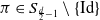


























Corollary 5.5.
For $\kappa \geq 2$
,
$\kappa \geq 2$
, $L_{2 \kappa + 1}, L_{2 \kappa + 2} \subseteq \gamma _{\kappa + 1}(A)$
.
$L_{2 \kappa + 1}, L_{2 \kappa + 2} \subseteq \gamma _{\kappa + 1}(A)$
.
Proof.
By Proposition 5.4 (2), we have $L_{2 \kappa + 1} \subseteq P_{2 \kappa }$
and
$L_{2 \kappa + 1} \subseteq P_{2 \kappa }$
and $P_{2 \kappa + 2} \subseteq P_{2 \kappa + 1}$
. But
$P_{2 \kappa + 2} \subseteq P_{2 \kappa + 1}$
. But $P_{2 \kappa } = \left \langle \gamma _{2 \kappa }(A), \Gamma _{2 \kappa -i,i}(A,X)\,:\, i \in \{1, \ldots, \kappa - 1\} \right \rangle$
and
$P_{2 \kappa } = \left \langle \gamma _{2 \kappa }(A), \Gamma _{2 \kappa -i,i}(A,X)\,:\, i \in \{1, \ldots, \kappa - 1\} \right \rangle$
and $P_{2 \kappa + 1} = \left \langle \gamma _{2 \kappa +1}(A), \Gamma _{2 \kappa + 1 -i,i}(A,X), \gamma _{\kappa + 1}(X)\,:\, i \in\right. \left. \{1, \ldots, \kappa - 1\} \right \rangle .$
For
$P_{2 \kappa + 1} = \left \langle \gamma _{2 \kappa +1}(A), \Gamma _{2 \kappa + 1 -i,i}(A,X), \gamma _{\kappa + 1}(X)\,:\, i \in\right. \left. \{1, \ldots, \kappa - 1\} \right \rangle .$
For $i = \kappa - 1$
,
$i = \kappa - 1$
, $\Gamma _{\kappa + 1, \kappa - 1}(A,X) = [A,X, \,_{\kappa - 1}X]$
. Since
$\Gamma _{\kappa + 1, \kappa - 1}(A,X) = [A,X, \,_{\kappa - 1}X]$
. Since $\Gamma _{\kappa + 1, \kappa - 1}(A,X) \subseteq \gamma _{\kappa + 1}(A)$
and
$\Gamma _{\kappa + 1, \kappa - 1}(A,X) \subseteq \gamma _{\kappa + 1}(A)$
and $X \subseteq A$
, we obtain the required result.
$X \subseteq A$
, we obtain the required result.
Corollary 5.6. $\bigcap _{d \geq 1} L_{d} = \{1\}$
.
$\bigcap _{d \geq 1} L_{d} = \{1\}$
.
Proof.
Since $A$
is residually nilpotent, we obtain from Lemma 5.3 and Corollary 5.5 the desired result.
$A$
is residually nilpotent, we obtain from Lemma 5.3 and Corollary 5.5 the desired result.
Theorem 5.7.
Let $G = A \rtimes _{\varphi } C$
be the split extension of groups as above. Then
$G = A \rtimes _{\varphi } C$
be the split extension of groups as above. Then $G$
is residually nilpotent.
$G$
is residually nilpotent.
Proof.
Let $g \in G \setminus \{1\}$
. We need to find a normal subgroup
$g \in G \setminus \{1\}$
. We need to find a normal subgroup $N_{g}$
of
$N_{g}$
of $G$
such that
$G$
such that $g \notin N_{g}$
and
$g \notin N_{g}$
and $G/N_{g}$
is nilpotent. First, we assume that
$G/N_{g}$
is nilpotent. First, we assume that $g \notin A$
. Since
$g \notin A$
. Since $G/A \cong C$
and
$G/A \cong C$
and $C$
is residually nilpotent, there exists a normal subgroup
$C$
is residually nilpotent, there exists a normal subgroup $M_{g}$
containing
$M_{g}$
containing $A$
such that
$A$
such that $g \notin M_{g}$
and
$g \notin M_{g}$
and $G/M_{g}$
is nilpotent. Thus, we may assume that
$G/M_{g}$
is nilpotent. Thus, we may assume that $g \in A$
. By Corollary 5.6, there exists a positive integer
$g \in A$
. By Corollary 5.6, there exists a positive integer $d$
such that
$d$
such that $g \in L_{d} \setminus L_{d+1}$
. By a result of Guaschi and Pereiro [Reference Guaschi and Pereiro10, Theorem 1.1],
$g \in L_{d} \setminus L_{d+1}$
. By a result of Guaschi and Pereiro [Reference Guaschi and Pereiro10, Theorem 1.1], $\gamma _{r}(G) = L_{r} \rtimes \gamma _{r}(C)$
for all
$\gamma _{r}(G) = L_{r} \rtimes \gamma _{r}(C)$
for all $r \geq 1$
. We claim that
$r \geq 1$
. We claim that $g \notin \gamma _{d+1}(G)$
. To get a contradiction, we assume that
$g \notin \gamma _{d+1}(G)$
. To get a contradiction, we assume that $g \in \gamma _{d+1}(G)$
. Since
$g \in \gamma _{d+1}(G)$
. Since $\gamma _{d+1}(G) = L_{d+1} \rtimes \gamma _{d+1}(C)$
, we get
$\gamma _{d+1}(G) = L_{d+1} \rtimes \gamma _{d+1}(C)$
, we get $g \in L_{d+1}$
which is a contradiction. Since
$g \in L_{d+1}$
which is a contradiction. Since $G/\gamma _{d+1}(G)$
is nilpotent, we obtain the desired result.
$G/\gamma _{d+1}(G)$
is nilpotent, we obtain the desired result.
Corollary 5.8.
Let $\textrm {FP}(G)$
be the Formanek-Procesi group with
$\textrm {FP}(G)$
be the Formanek-Procesi group with $G$
a finitely generated residually finite
$G$
a finitely generated residually finite $p$
-group. Then
$p$
-group. Then $\textrm { FP}(G)$
is residually nilpotent.
$\textrm { FP}(G)$
is residually nilpotent.
Proof.
Let $G_1,G_2$
be two copies of
$G_1,G_2$
be two copies of $G$
with generating sets
$G$
with generating sets $\{a_{1,1},\ldots, a_{1,n}\}$
and
$\{a_{1,1},\ldots, a_{1,n}\}$
and $\{a_{2,k},\ldots, a_{2,n}\}$
, respectively. Then
$\{a_{2,k},\ldots, a_{2,n}\}$
, respectively. Then $\textrm {FP}(G)$
admits a presentation with generating set
$\textrm {FP}(G)$
admits a presentation with generating set $b, a_{1,1},\ldots, a_{1,n}$
,
$b, a_{1,1},\ldots, a_{1,n}$
, $a_{2,1},\ldots, $ $a_{2,n}$
and defining relations the defining relations of
$a_{2,n}$
and defining relations the defining relations of $G_1$
and
$G_1$
and $G_2$
together with
$G_2$
together with
 \begin{equation*} ba_{1,k}a_{2,k}b^{-1}=a_{2,k}, \ \ k\in \{1,\ldots, n\}, \end{equation*}
 \begin{equation*} [a_{1,k},a_{2,l}]=1, \ \ k,l\in \{1,\ldots, n\} \end{equation*}
By rearranging the above, we get ${\textrm {FP}}(G)=A\rtimes C$
with
${\textrm {FP}}(G)=A\rtimes C$
with $A=\langle b\rangle * G_1 =\langle b, a_{1,i}, i=1,\ldots, n\rangle$
and
$A=\langle b\rangle * G_1 =\langle b, a_{1,i}, i=1,\ldots, n\rangle$
and $G_2=C=\langle a_{2,i}, i=1,\ldots, n\rangle$
. The action of
$G_2=C=\langle a_{2,i}, i=1,\ldots, n\rangle$
. The action of $C$
on
$C$
on $A$
is described by the relations
$A$
is described by the relations $a_{2,i}ba_{2,i}^{-1} =ba_{1,i}$
for
$a_{2,i}ba_{2,i}^{-1} =ba_{1,i}$
for $i=1,\ldots, k$
and
$i=1,\ldots, k$
and $a_{2,i}a_{1,j}a_{2,i}^{-1}=a_{1,j}$
for all
$a_{2,i}a_{1,j}a_{2,i}^{-1}=a_{1,j}$
for all $i,j\in \{1,\ldots, n\}$
. Hence, by Theorem5.7, it follows that
$i,j\in \{1,\ldots, n\}$
. Hence, by Theorem5.7, it follows that $\textrm {FP}(G)$
is residually nilpotent.
$\textrm {FP}(G)$
is residually nilpotent.
Corollary 5.9.
The group $\textrm {FP}(A_{\Gamma })$
, with
$\textrm {FP}(A_{\Gamma })$
, with $A_{\Gamma }$
a raag, is a finitely generated residually torsion-free nilpotent group.
$A_{\Gamma }$
a raag, is a finitely generated residually torsion-free nilpotent group.
Proof.
Let $A_{\Gamma }$
be a raag. As shown by Droms [Reference Droms5] (see also [Reference Duchamp and Krob7] and [Reference Wade19])
$A_{\Gamma }$
be a raag. As shown by Droms [Reference Droms5] (see also [Reference Duchamp and Krob7] and [Reference Wade19]) $A_{\Gamma }$
is residually torsion-free nilpotent and so, by Theorem2.1 of Gruenberg [Reference Gruenberg9],
$A_{\Gamma }$
is residually torsion-free nilpotent and so, by Theorem2.1 of Gruenberg [Reference Gruenberg9], $A_{\Gamma }$
is residually a finite
$A_{\Gamma }$
is residually a finite $p$
-group for every prime
$p$
-group for every prime $p$
. By Corollary 5.8,
$p$
. By Corollary 5.8, $\textrm {FP}(A_{\Gamma })$
is residually nilpotent. Let
$\textrm {FP}(A_{\Gamma })$
is residually nilpotent. Let $g \in {\textrm {FP}(A_{\Gamma })} \setminus \{1\}$
. Then there exists a positive integer
$g \in {\textrm {FP}(A_{\Gamma })} \setminus \{1\}$
. Then there exists a positive integer $c$
such that
$c$
such that $g \notin \gamma _{c+1}({\textrm {FP}(A_{\Gamma })})$
. By Corollary 4.13,
$g \notin \gamma _{c+1}({\textrm {FP}(A_{\Gamma })})$
. By Corollary 4.13, ${\textrm {FP}(A_{\Gamma })}/\gamma _{c+1}({\textrm {FP}(A_{\Gamma })})$
is a finitely generated torsion-free nilpotent group. Thus,
${\textrm {FP}(A_{\Gamma })}/\gamma _{c+1}({\textrm {FP}(A_{\Gamma })})$
is a finitely generated torsion-free nilpotent group. Thus, $\textrm {FP}(A_{\Gamma })$
is a finitely generated residually torsion-free nilpotent group.
$\textrm {FP}(A_{\Gamma })$
is a finitely generated residually torsion-free nilpotent group.
Competing interests
The authors declare none.

 Open access

