








1. Introduction and main results
In 1637, Fermat [Reference Dickson12] stated the conjecture (which is known as Fermat’s last theorem) that the equation $x^m + y^m =1$
cannot admit positive rational solutions if
$x^m + y^m =1$
cannot admit positive rational solutions if $m>2$
. Since then, the equation has been the subject of intense and often heated discussions. In 1995, Wiles [Reference Taylor and Wiles41], [Reference Wiles43] proved the profound conjecture.
$m>2$
. Since then, the equation has been the subject of intense and often heated discussions. In 1995, Wiles [Reference Taylor and Wiles41], [Reference Wiles43] proved the profound conjecture.
In 1927, Montel in [Reference Montel38] initially considered the functional equation
 $$ \begin{align} f^m(z)+g^m(z)=1, \end{align} $$
which can be regarded as an analog of Fermat diophantine equation $x^m + y^m =1$
over function fields. He showed that all the entire solutions
$x^m + y^m =1$
over function fields. He showed that all the entire solutions $f(z)$
and
$f(z)$
and $g(z)$
of (1) must be constant if
$g(z)$
of (1) must be constant if $m\geq 3$
(see also Jategaonka [Reference Jategaonkar25]). Subsequent investigations were carried out by Baker in [Reference Baker1] and Gross in [Reference Gross16], respectively, they generalized Montel’s result by proving that (1) does not have nonconstant meromorphic solutions when
$m\geq 3$
(see also Jategaonka [Reference Jategaonkar25]). Subsequent investigations were carried out by Baker in [Reference Baker1] and Gross in [Reference Gross16], respectively, they generalized Montel’s result by proving that (1) does not have nonconstant meromorphic solutions when $m>4$
and described nonconstant meromorphic solutions for
$m>4$
and described nonconstant meromorphic solutions for $m=2,~3$
. In 1970, Yang [Reference Yang46] considered more general functional equation
$m=2,~3$
. In 1970, Yang [Reference Yang46] considered more general functional equation
 $$ \begin{align} f^n(z)+g^m(z)=1 \end{align} $$
and derived that this equation does not admit nonconstant meromorphic solutions if $\frac {1}{n}+\frac {2}{m}<1$
. From then on, (2) has been studied in various settings (see [Reference Green14], [Reference Li29], [Reference Li30], [Reference Yang46]). For convenience, some results can be stated as follows (see, e.g., [Reference Chen, Han and Liu8, Proposition 1], [Reference Baker1], [Reference Gross15], [Reference Yanagihara45]).
$\frac {1}{n}+\frac {2}{m}<1$
. From then on, (2) has been studied in various settings (see [Reference Green14], [Reference Li29], [Reference Li30], [Reference Yang46]). For convenience, some results can be stated as follows (see, e.g., [Reference Chen, Han and Liu8, Proposition 1], [Reference Baker1], [Reference Gross15], [Reference Yanagihara45]).
Theorem A. Suppose that $f(z)$
and
$f(z)$
and $g(z)$
are nonconstant meromorphic solutions of the functional equation (2).
$g(z)$
are nonconstant meromorphic solutions of the functional equation (2).
(i) If $n=m=3$
, then
$n=m=3$
, then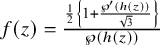 $f(z)=\frac {\frac {1}{2}\left \{1+\frac {\wp ^{\prime }(h(z))}{\sqrt {3}}\right \}}{\wp (h(z))}$
and
$f(z)=\frac {\frac {1}{2}\left \{1+\frac {\wp ^{\prime }(h(z))}{\sqrt {3}}\right \}}{\wp (h(z))}$
and $g(z)=\frac {\frac {\eta }{2}\left \{1-\frac {\wp ^{\prime }(h(z))}{\sqrt {3}}\right \}}{\wp (h(z))}$
for any nonconstant entire function h, where
$g(z)=\frac {\frac {\eta }{2}\left \{1-\frac {\wp ^{\prime }(h(z))}{\sqrt {3}}\right \}}{\wp (h(z))}$
for any nonconstant entire function h, where $\eta ^{3}=1$
and
$\eta ^{3}=1$
and $\wp $
is the Weierstrass
$\wp $
is the Weierstrass $\wp $
-function satisfying
$\wp $
-function satisfying $(\wp ')^2\equiv 4\wp ^3-1$
after appropriately choosing its periods.
$(\wp ')^2\equiv 4\wp ^3-1$
after appropriately choosing its periods.
(ii) If $n = 2$
and
$n = 2$
and $m=3$
, then
$m=3$
, then $f(z) = i\wp '(h(z))$
and
$f(z) = i\wp '(h(z))$
and $g(z) = \eta \sqrt [3]{4}\wp (h(z)),$
where
$g(z) = \eta \sqrt [3]{4}\wp (h(z)),$
where $h(z)$
is any nonconstant entire function.
$h(z)$
is any nonconstant entire function.
(iii)If $m=2$
and
$m=2$
and $n=4$
, then
$n=4$
, then $f(z)=sn'(h(z))$
and
$f(z)=sn'(h(z))$
and $g(z)= sn(h(z))$
, where
$g(z)= sn(h(z))$
, where $h(z)$
is any nonconstant entire function, and
$h(z)$
is any nonconstant entire function, and $sn$
is the Jacobi elliptic function satisfying
$sn$
is the Jacobi elliptic function satisfying ${sn'}^2=1- sn^4$
.
${sn'}^2=1- sn^4$
.
In 1989, Yanagihara [Reference Yanagihara45] established the existence of meromorphic solutions to the Fermat-type functional equation in another direction. In fact, Yanagihara proved that $f^3(z)+f^3(z+c)=1$
does not admit nonconstant meromorphic functions of finite order. Some related results were obtained by Nakamura and Yanagihara in [Reference Nakamura and Yanagihara39]. The above result due to Yanagihara was also independently derived by Lü–Han in [Reference Han and Lü22] by employing the difference analog of the logarithmic derivative lemma of finite-order meromorphic functions, which was established by Chiang and Feng [Reference Chiang and Feng9] and Halburd and Korhonen [Reference Halburd and Korhonen19], independently. In 2014, this difference analog was further improved by Halburdet al. [Reference Halburd, Korhonen and Tohge21] to meromorphic functions of hyper-order strictly less than 1. Here, the order and hyper-order of a meromorphic function f are defined as
$f^3(z)+f^3(z+c)=1$
does not admit nonconstant meromorphic functions of finite order. Some related results were obtained by Nakamura and Yanagihara in [Reference Nakamura and Yanagihara39]. The above result due to Yanagihara was also independently derived by Lü–Han in [Reference Han and Lü22] by employing the difference analog of the logarithmic derivative lemma of finite-order meromorphic functions, which was established by Chiang and Feng [Reference Chiang and Feng9] and Halburd and Korhonen [Reference Halburd and Korhonen19], independently. In 2014, this difference analog was further improved by Halburdet al. [Reference Halburd, Korhonen and Tohge21] to meromorphic functions of hyper-order strictly less than 1. Here, the order and hyper-order of a meromorphic function f are defined as
 $$ \begin{align*}\rho(f):=\limsup\limits_{r\to+\infty}\frac{\log T(r,f)}{\log r},~~\rho_{2}(f)={\limsup_{r\to +\infty}}\frac{\log\log T(r,f)}{\log r}, \end{align*} $$
where $T(r,f)$
denotes the Nevanlinna characteristic function of f.
$T(r,f)$
denotes the Nevanlinna characteristic function of f.
By means of these results, Korhonen and Zhang in [Reference Korhonen and Zhang27] generalized Yanagihara’s theorem to meromorphic solutions of hyper-order strictly less than 1 as follows.
Theorem B. The functional equation
 $$ \begin{align*}f^3(z)+f^3(z+c)=1 \end{align*} $$
does not admit nonconstant meromorphic solutions of hyper-order strictly less than 1.
Recently, Lü and his co-workers [Reference Bi and Lü7], [Reference Han and Lü22], [Reference Lü and Guo36] also considered this type of problem, and their results can be stated as follows.
Theorem C. Let $P(z)$
be a polynomial and
$P(z)$
be a polynomial and $f(z)$
be a nonconstant meromorphic function of hyper-order strictly less than 1. If
$f(z)$
be a nonconstant meromorphic function of hyper-order strictly less than 1. If $f(z)$
is a solution of
$f(z)$
is a solution of
 $$ \begin{align} f^3(z)+f^3(z+c)=e^{P(z)}, \end{align} $$
then, $P(z)=\alpha z+\beta $
and
$P(z)=\alpha z+\beta $
and $f(z)=de^{\frac {\alpha z+\beta }{3}}$
, where
$f(z)=de^{\frac {\alpha z+\beta }{3}}$
, where $d(\neq 0)$
is constant and
$d(\neq 0)$
is constant and $d^3(1+e^{\alpha c})=1$
.
$d^3(1+e^{\alpha c})=1$
.
In recent years, Fermat-type difference equations, together with differential–difference equations, have been the subject of extensive research. Consequently, numerous subsequent investigations have been conducted by scholars in this direction (see, e.g., [Reference Liu, Cao and Cao33], [Reference Liu and Yang35]). We note that most of the above results, including Theorems B and C, were derived under the condition that the solutions are of hyper-order strictly less than 1, since the difference analog of the logarithmic derivative lemma is required in the proofs of these results. So, it is natural to ask what will happen if the hyper-order condition is omitted. However, it is found that the conclusions of some previous theorems may not hold, as shown by the following example offered by Han in [Reference Han and Lü22].
Example 1. Let $c=\pi i$
and
$c=\pi i$
and $\alpha , \beta $
be fixed constants satisfying
$\alpha , \beta $
be fixed constants satisfying $e^{\alpha c}=1$
. Consider
$e^{\alpha c}=1$
. Consider $f(z)=\frac {1}{2}\frac {1+\frac {\wp '(h(z))}{\sqrt {3}}}{\wp (h(z))}e^{\frac {\alpha z+\beta }{3}}$
with
$f(z)=\frac {1}{2}\frac {1+\frac {\wp '(h(z))}{\sqrt {3}}}{\wp (h(z))}e^{\frac {\alpha z+\beta }{3}}$
with $h(z)=e^z$
. Then, a routine computation yields
$h(z)=e^z$
. Then, a routine computation yields $ f(z+c)=\frac {\eta }{2}\frac {1-\frac {\wp '(h(z))}{\sqrt {3}}}{\wp (h(z))}e^{\frac {\alpha z+\beta }{3}}$
, where
$ f(z+c)=\frac {\eta }{2}\frac {1-\frac {\wp '(h(z))}{\sqrt {3}}}{\wp (h(z))}e^{\frac {\alpha z+\beta }{3}}$
, where $\eta =e^{\frac {\alpha c}{3}}$
. Furthermore,
$\eta =e^{\frac {\alpha c}{3}}$
. Furthermore,
 $$ \begin{align*}f^3(z)+f^3(z+c)=e^{\alpha z+\beta}, \end{align*} $$
which implies that the above equation admits the meromorphic solution $f(z)$
. Obviously,
$f(z)$
. Obviously, $f(z)$
is not the form
$f(z)$
is not the form $de^{\frac {\alpha z+\beta }{3}}$
and the hyper-order of f is
$de^{\frac {\alpha z+\beta }{3}}$
and the hyper-order of f is $\rho _2(f)=1$
.
$\rho _2(f)=1$
.
Therefore, if the hyper-order condition is omitted, the Fermat-type difference equation may admit other types of meromorphic solutions. In this article, we focus on characterizing these solutions. By utilizing the properties of elliptic functions, we describe the forms of all meromorphic solutions to some Fermat-type difference equations.
Before giving the main results, we introduce the Weierstrass $\wp $
-function.
$\wp $
-function.
The Weierstrass $\wp $
-function is an elliptic (also doubly periodic) function with periods
$\wp $
-function is an elliptic (also doubly periodic) function with periods $\omega _{1}$
and
$\omega _{1}$
and $\omega _{2}$
(
$\omega _{2}$
( $\mathsf { Im}\frac {\omega _{1}}{\omega _{2}}\neq 0$
), defined as follows:
$\mathsf { Im}\frac {\omega _{1}}{\omega _{2}}\neq 0$
), defined as follows:
 $$ \begin{align*}\wp(z)=\wp\left(z; \omega_{1}, \omega_{2}\right):=\frac{1}{z^{2}}+\sum_{\mu, \nu \in \mathbf{Z}; \mu^{2}+\nu^{2} \neq 0}\left\{\frac{1}{\left(z+\mu \omega_{1}+\nu \omega_{2}\right)^{2}}-\frac{1}{\left(\mu \omega_{1}+\nu \omega_{2}\right)^{2}}\right\} \end{align*} $$
and satisfies, after appropriately choosing $\omega _{1}$
and
$\omega _{1}$
and $\omega _{2}$
,
$\omega _{2}$
,
 $$ \begin{align*}\left(\wp^{\prime}\right)^{2}=4 \wp^{3}-1. \end{align*} $$
The periods of $\wp $
span the lattice
$\wp $
span the lattice $\mathbb {L}=\omega _{1}\mathbb {Z}\oplus \omega _{2}\mathbb {Z}$
. Denote
$\mathbb {L}=\omega _{1}\mathbb {Z}\oplus \omega _{2}\mathbb {Z}$
. Denote $\mathbb {L}$
as
$\mathbb {L}$
as
 $$ \begin{align*}\mathbb{L}=\{\mu \omega_{1}+\nu \omega_{2}:~~ \mu,~\nu=0,\pm1, \pm2,\ldots\}. \end{align*} $$
Obviously, all the points in $\mathbb {L}$
are the poles and periods of
$\mathbb {L}$
are the poles and periods of $\wp $
. Suppose that D is the parallelogram with vertices at 0,
$\wp $
. Suppose that D is the parallelogram with vertices at 0, $\omega _1$
,
$\omega _1$
, $\omega _2$
,
$\omega _2$
, $\omega _1+\omega _2$
. Note that the order of
$\omega _1+\omega _2$
. Note that the order of $\wp $
is 2. Here, the order is the number of poles of
$\wp $
is 2. Here, the order is the number of poles of $\wp $
or the number of zeros of
$\wp $
or the number of zeros of $\wp -a$
(
$\wp -a$
( $a\in \mathbb {C}$
) in the parallelogram. Together with
$a\in \mathbb {C}$
) in the parallelogram. Together with $(\wp ')^2=4 \wp ^{3}-1$
, we derive that
$(\wp ')^2=4 \wp ^{3}-1$
, we derive that $\wp $
has two distinct zeros in D, say
$\wp $
has two distinct zeros in D, say $\theta _1$
and
$\theta _1$
and $\theta _2$
. In view of
$\theta _2$
. In view of $\wp (z)=0 \Leftrightarrow \wp '(z)=\pm i$
, without loss of generality, throughout the article, we assume that
$\wp (z)=0 \Leftrightarrow \wp '(z)=\pm i$
, without loss of generality, throughout the article, we assume that $\wp '(\theta _1)=-i$
and
$\wp '(\theta _1)=-i$
and $\wp '(\theta _2)=i$
.
$\wp '(\theta _2)=i$
.
Here, for two meromorphic functions $f,~g$
and two points
$f,~g$
and two points $a,~b\in \mathbb {C}\cup \{\infty \}$
, the notation
$a,~b\in \mathbb {C}\cup \{\infty \}$
, the notation $f(z)-a=0\Rightarrow g(z)-b=0$
means that all the zeros of
$f(z)-a=0\Rightarrow g(z)-b=0$
means that all the zeros of $f-a$
are zeros of
$f-a$
are zeros of $g(z)-b$
. And the notation
$g(z)-b$
. And the notation $f(z)-a=0\Leftrightarrow g(z)-b=0$
means that
$f(z)-a=0\Leftrightarrow g(z)-b=0$
means that $f-a$
and
$f-a$
and $g-b$
have the same zeros.
$g-b$
have the same zeros.
More generally, in the present article, we characterize the meromorphic solutions to Fermat-type functional equations as follows.
Proposition 1. Suppose that $L(z)$
is a nonconstant entire function. Then, the nonconstant meromorphic function
$L(z)$
is a nonconstant entire function. Then, the nonconstant meromorphic function $f(z)$
is a solution of
$f(z)$
is a solution of
 $$ \begin{align} f^3(z)+f^3(L(z))=1 \end{align} $$
if and only if $L(z)=qz+c$
is a linear function with
$L(z)=qz+c$
is a linear function with $|q|=1$
, and
$|q|=1$
, and $f(z)=\frac {1}{2}\left \{1+\frac {\wp ^{\prime }(h(z))}{\sqrt {3}}\right \} / \wp (h(z))$
, where
$f(z)=\frac {1}{2}\left \{1+\frac {\wp ^{\prime }(h(z))}{\sqrt {3}}\right \} / \wp (h(z))$
, where $h(z)$
is a nonconstant entire function satisfying one of the following equations:
$h(z)$
is a nonconstant entire function satisfying one of the following equations:
-
(1) $h(L(z))=Ah(z)+\theta _1+\tau _1$
with
$\tau _1\in \mathbb {L}$
;
$h(L(z))=Ah(z)+\theta _1+\tau _1$
with
$\tau _1\in \mathbb {L}$
; -
(2)
$h(L(z))=Ah(z)+\theta _2+\tau _2$
with
$\tau _2\in \mathbb {L}$
; -
(3)
$h(L(z))=Ah(z)+\tau _3$
with
$\tau _3\in \mathbb {L}$
, where A is a constant with
$A^3=-1$
and
$A\tau \in \mathbb {L}$
for any period
$\tau $
of
$\wp (z)$
.


Proposition 2. Suppose that $L(z)$
is a nonconstant entire function, suppose that
$L(z)$
is a nonconstant entire function, suppose that $g(z)$
is an entire function and
$g(z)$
is an entire function and $f(z)$
is a nonconstant meromorphic function, and suppose that
$f(z)$
is a nonconstant meromorphic function, and suppose that $n(\geq 2)$
,
$n(\geq 2)$
, $m(\geq 3)$
are two integers such that
$m(\geq 3)$
are two integers such that $(n,m)\neq (3,3)$
. Then,
$(n,m)\neq (3,3)$
. Then, $f(z)$
is a solution of
$f(z)$
is a solution of
 $$ \begin{align} f^n(z)+f^m(L(z))=e^{g(z)} \end{align} $$
if and only if $L(z)=qz+c$
is a linear function,
$L(z)=qz+c$
is a linear function, $f(z)=Ae^{\frac {g(z)}{n}}$
and
$f(z)=Ae^{\frac {g(z)}{n}}$
and
 $$ \begin{align} g(L(z))=\frac{n}{m}g(z)+nLn \frac{B}{A}, \end{align} $$
where $A,~B$
are two nonzero constants with
$A,~B$
are two nonzero constants with $A^n+B^m=1$
and
$A^n+B^m=1$
and $Ln \frac {B}{A}=\log \frac {B}{A}+2k_0\pi i$
with any fixed integer
$Ln \frac {B}{A}=\log \frac {B}{A}+2k_0\pi i$
with any fixed integer $k_0$
. In particular, if
$k_0$
. In particular, if $m=n$
, then
$m=n$
, then $|q|=1$
. As usual,
$|q|=1$
. As usual, $\log \frac {B}{A}$
denotes the principal value of
$\log \frac {B}{A}$
denotes the principal value of $Ln \frac {B}{A}$
.
$Ln \frac {B}{A}$
.
It is pointed out that if $m\neq n$
in Proposition 2, the conclusion
$m\neq n$
in Proposition 2, the conclusion $|q|=1$
may be invalid, as shown by the following example. Suppose
$|q|=1$
may be invalid, as shown by the following example. Suppose $m\neq n$
and
$m\neq n$
and $q^2=\frac {m}{n}$
. Consider
$q^2=\frac {m}{n}$
. Consider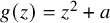 $g(z)=z^2+a$
with a constant a satisfying
$g(z)=z^2+a$
with a constant a satisfying $(1-\frac {m}{n})a=nLn \frac {B}{A}$
. Then, a calculation yields that
$(1-\frac {m}{n})a=nLn \frac {B}{A}$
. Then, a calculation yields that $g(qz)=\frac {m}{n}g(z)+nLn \frac {B}{A}$
and
$g(qz)=\frac {m}{n}g(z)+nLn \frac {B}{A}$
and $f(z)=Ae^{\frac {g(z)}{n}}$
is a solution of (5). However,
$f(z)=Ae^{\frac {g(z)}{n}}$
is a solution of (5). However, $|q|\neq 1$
.
$|q|\neq 1$
.
Let’s turn back to the Fermat-type difference equations. Suppose $L(z)=z+c$
with
$L(z)=z+c$
with $c\neq 0$
. Then, Theorem 1 follows immediately from Proposition 1.
$c\neq 0$
. Then, Theorem 1 follows immediately from Proposition 1.
Theorem 1. The nonconstant meromorphic function $f(z)$
is a solution of
$f(z)$
is a solution of
 $$ \begin{align} f^3(z)+f^3(z+c)=1 \end{align} $$
if and only if $f(z)=\frac {1}{2}\left \{1+\frac {\wp ^{\prime }(h(z))}{\sqrt {3}}\right \} / \wp (h(z))$
, where
$f(z)=\frac {1}{2}\left \{1+\frac {\wp ^{\prime }(h(z))}{\sqrt {3}}\right \} / \wp (h(z))$
, where $h(z)$
is a nonconstant entire function satisfying one of the following equations:
$h(z)$
is a nonconstant entire function satisfying one of the following equations:
-
(1)
$h(z+c)=Ah(z)+\theta _1+\tau _1$
with
$\tau _1\in \mathbb {L}$
; -
(2)
$h(z+c)=Ah(z)+\theta _2+\tau _2$
with
$\tau _2\in \mathbb {L}$
; -
(3)
$h(z+c)=Ah(z)+\tau _3$
with
$\tau _3\in \mathbb {L}$
, where A is a constant with
$A^3=-1$
and
$A\tau \in \mathbb {L}$
for any period
$\tau $
of
$\wp (z)$
.





Remark 1. It is known that if $h(z)$
satisfies one of (1)–(3) in Theorem 1, then the order
$h(z)$
satisfies one of (1)–(3) in Theorem 1, then the order $\rho (h(z))\geq 1$
and hyper-order
$\rho (h(z))\geq 1$
and hyper-order $\rho _2(f)\geq 1$
. (This fact can be found in [Reference Green14].) So, if
$\rho _2(f)\geq 1$
. (This fact can be found in [Reference Green14].) So, if $\rho _2(f)<1$
, then (4) does not admit nonconstant meromorphic solutions. This is the conclusion of Theorem B. Below, we present an example to show that there exists an entire function
$\rho _2(f)<1$
, then (4) does not admit nonconstant meromorphic solutions. This is the conclusion of Theorem B. Below, we present an example to show that there exists an entire function $h(z)$
with arbitrary order
$h(z)$
with arbitrary order $\rho (h(z))(\geq 1)$
satisfying one of (1)–(3).
$\rho (h(z))(\geq 1)$
satisfying one of (1)–(3).
Example 2. In [Reference Ozawa40, Theorem 3], Ozawa derived that there exists a periodic entire function of arbitrary order $\sigma (\geq 1)$
. So, there exists an entire function
$\sigma (\geq 1)$
. So, there exists an entire function $g(z)$
such that
$g(z)$
such that $\rho (g(z))=\sigma $
and
$\rho (g(z))=\sigma $
and $g(z+c)=g(z)$
. Set
$g(z+c)=g(z)$
. Set $h(z)=e^{az}g(z)+b$
, where a, b are constants with
$h(z)=e^{az}g(z)+b$
, where a, b are constants with $e^{ac}=A$
and
$e^{ac}=A$
and $(1-A)b=\theta _1+\tau _1$
or
$(1-A)b=\theta _1+\tau _1$
or $\theta _2+\tau _2$
or
$\theta _2+\tau _2$
or $\tau _3$
with
$\tau _3$
with $A^3=-1$
. Then,
$A^3=-1$
. Then, $\rho (h(z))=\rho (g(z))=\sigma $
and a calculation yields that
$\rho (h(z))=\rho (g(z))=\sigma $
and a calculation yields that
 $$ \begin{align*}h(z+c)=Ah(z)+(1-A)b. \end{align*} $$
Thus, $h(z)$
satisfies one of (1)–(3) in Theorem 1.
$h(z)$
satisfies one of (1)–(3) in Theorem 1.
By Theorems 1 and C, we can get the following result.
Theorem 2. Suppose that $f(z)$
is a nonconstant meromorphic function and
$f(z)$
is a nonconstant meromorphic function and $P(z)$
is a polynomial. Then
$P(z)$
is a polynomial. Then $f(z)$
is a solution of the functional equation
$f(z)$
is a solution of the functional equation
 $$ \begin{align} f^3(z)+f^3(z+c)=e^{P(z)} \end{align} $$
if and only if $P(z)=\alpha z+\beta $
with two constants
$P(z)=\alpha z+\beta $
with two constants $\alpha ,~\beta $
, and
$\alpha ,~\beta $
, and $f(z)$
satisfies one of the following cases:
$f(z)$
satisfies one of the following cases:
-
(a)
$f(z)=de^{\frac {\alpha z+\beta }{3}}$
, where d is a nonzero constant and
$d^3(1+e^{\alpha c})=1$
; -
(b)
$f(z)=e^{\frac {\alpha z+\beta }{3}}\frac {1}{2}\left \{1+\frac {\wp ^{\prime }(h(z))}{\sqrt {3}}\right \} / \wp (h(z))$
, where
$e^{\alpha c}=1$
and
$h(z)$
is a nonconstant entire function satisfying one of (1)–(3) in Theorem 1.


With Proposition 2, we derive a theorem as follows.
Theorem 3. Suppose that $g(z)$
is an entire function and
$g(z)$
is an entire function and $f(z)$
is a nonconstant meromorphic function. Suppose that
$f(z)$
is a nonconstant meromorphic function. Suppose that $n(\geq 2)$
and
$n(\geq 2)$
and $m(\geq 3)$
are two integers such that
$m(\geq 3)$
are two integers such that $(n,m)\neq (3,3)$
. Then,
$(n,m)\neq (3,3)$
. Then, $f(z)$
is a solution of
$f(z)$
is a solution of
 $$ \begin{align} f^n(z)+f^m(z+c)=e^{g(z)} \end{align} $$
if and only if $f(z)=Ae^{\frac {g(z)}{n}}$
and
$f(z)=Ae^{\frac {g(z)}{n}}$
and $g(z+c)=\frac {n}{m}g(z)+nLn \frac {B}{A}$
, where
$g(z+c)=\frac {n}{m}g(z)+nLn \frac {B}{A}$
, where $A,~B$
are two nonzero constants with
$A,~B$
are two nonzero constants with $A^n+B^m=1$
. In particular, if the order of
$A^n+B^m=1$
. In particular, if the order of $g(z)$
is less than 1, then (9) admits nonconstant meromorphic solutions if and only if
$g(z)$
is less than 1, then (9) admits nonconstant meromorphic solutions if and only if $n=m$
and
$n=m$
and $g(z)=\alpha z+\beta $
,
$g(z)=\alpha z+\beta $
, $f(z)=Ae^{\frac {\alpha z+\beta }{n}}$
with a constant
$f(z)=Ae^{\frac {\alpha z+\beta }{n}}$
with a constant $\alpha (\neq 0)$
such that
$\alpha (\neq 0)$
such that $A^n(1+e^{\alpha c})=1$
.
$A^n(1+e^{\alpha c})=1$
.
Remark 2. We point out that (9) may admit nonconstant meromorphic functions if $\rho (g(z))\geq 1$
, as shown by the following examples.
$\rho (g(z))\geq 1$
, as shown by the following examples.
Example 3. Suppose that $m\neq n$
,
$m\neq n$
, $g(z)=e^{\alpha z+\beta }+a$
with constants
$g(z)=e^{\alpha z+\beta }+a$
with constants $\alpha (\neq 0),~\beta ,~a$
. Consider
$\alpha (\neq 0),~\beta ,~a$
. Consider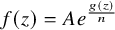 $f(z)=Ae^{\frac {g(z)}{n}}$
with
$f(z)=Ae^{\frac {g(z)}{n}}$
with $e^{\alpha c}=\frac {n}{m}$
and
$e^{\alpha c}=\frac {n}{m}$
and $(1-\frac {n}{m})a=n Ln \frac {B}{A}$
, where
$(1-\frac {n}{m})a=n Ln \frac {B}{A}$
, where $A,~B$
are nonzero constants with
$A,~B$
are nonzero constants with $A^n+B^m=1$
. By a calculation, one gets that
$A^n+B^m=1$
. By a calculation, one gets that $g(z+c)=\frac {n g(z)}{m}+n Ln \frac {B}{A}$
and
$g(z+c)=\frac {n g(z)}{m}+n Ln \frac {B}{A}$
and
 $$ \begin{align*}f^n(z)+f^m(z+c)=e^{g(z)}. \end{align*} $$
Obviously, $\rho (g(z))=1$
.
$\rho (g(z))=1$
.
Example 4. Suppose that $m=n$
, and h is any nonconstant entire periodic function with period c. Let
$m=n$
, and h is any nonconstant entire periodic function with period c. Let $g(z)= h(z)+az$
with
$g(z)= h(z)+az$
with $ac=nLn\frac {B}{A}$
, where
$ac=nLn\frac {B}{A}$
, where $A,~B$
are nonzero constants with
$A,~B$
are nonzero constants with $A^n+B^n=1$
. Then,
$A^n+B^n=1$
. Then, $g(z+c)=g(z)+nLn\frac {B}{A}$
, and
$g(z+c)=g(z)+nLn\frac {B}{A}$
, and $f(z)=Ae^{\frac {g(z)}{n}}$
is a nonconstant meromorphic solution of
$f(z)=Ae^{\frac {g(z)}{n}}$
is a nonconstant meromorphic solution of
 $$ \begin{align*}f^n(z)+f^n(z+c)=e^{g(z)}. \end{align*} $$
Obviously, $\rho (g(z))\geq 1$
.
$\rho (g(z))\geq 1$
.
Remark 3. From Theorem 3, we see that (9) does not admit meromorphic solutions with poles. It is pointed out that the same argument as in Theorem 3 can deal with the Fermat-type difference equation $f^m(z)+f^n(z+c)=e^{g(z)}$
with
$f^m(z)+f^n(z+c)=e^{g(z)}$
with $n(\geq 2),~m(\geq 3)$
, and
$n(\geq 2),~m(\geq 3)$
, and $(m,n)\neq (3,3)$
, we omit the details here.
$(m,n)\neq (3,3)$
, we omit the details here.
The following corollary follows immediately from Theorem 3.
Corollary 1. Suppose that $P(z)$
is a polynomial and
$P(z)$
is a polynomial and $f(z)$
is a nonconstant meromorphic function. Suppose that
$f(z)$
is a nonconstant meromorphic function. Suppose that $n(\geq 2)$
and
$n(\geq 2)$
and $m(\geq 2)$
are two integers with
$m(\geq 2)$
are two integers with $m+n\geq 5$
and
$m+n\geq 5$
and $(n,m)\neq (3,3)$
. Then,
$(n,m)\neq (3,3)$
. Then, $f(z)$
is a solution of
$f(z)$
is a solution of
 $$ \begin{align} f^n(z)+f^m(z+c)=e^{P(z)} \end{align} $$
if and only if $n=m$
,
$n=m$
, $f(z)=Ae^{\frac {P(z)}{n}}$
and
$f(z)=Ae^{\frac {P(z)}{n}}$
and $P(z)=\alpha z+\beta $
with two constants
$P(z)=\alpha z+\beta $
with two constants $\alpha (\neq 0),~\beta $
.
$\alpha (\neq 0),~\beta $
.
From Theorem 3 and Corollary 1, one can easily get the following result.
Corollary 2. Suppose that $f(z)$
is a nonconstant meromorphic function, and
$f(z)$
is a nonconstant meromorphic function, and $n(\geq 2)$
and
$n(\geq 2)$
and $m(\geq 2)$
are two integers with
$m(\geq 2)$
are two integers with $m+n\geq 5$
. Then,
$m+n\geq 5$
. Then, $f(z)$
is a solution of
$f(z)$
is a solution of
 $$ \begin{align} f^n(z)+f^m(z+c)=1 \end{align} $$
if and only if $n=m=3$
.
$n=m=3$
.
Finally, as applications of Propositions 1 and 2, we consider the meromorphic solutions of Fermat-type q-difference functional equations. As early as 1952, Valiron in [Reference Valiron42] showed that the non-autonomous Schröder q-difference equation
 $$ \begin{align} f(qz)=R(z,f(z)), \end{align} $$
where $R(z, f(z))$
is rational in both arguments, admits one parameter family of meromorphic solutions, provided that
$R(z, f(z))$
is rational in both arguments, admits one parameter family of meromorphic solutions, provided that $q\in \mathbb {C}$
is chosen appropriately. Later, Gundersen et al. [Reference Gundersen, Heittokangas, Laine, Rieppo and Yang18] proved that if
$q\in \mathbb {C}$
is chosen appropriately. Later, Gundersen et al. [Reference Gundersen, Heittokangas, Laine, Rieppo and Yang18] proved that if $|q|>1$
and the q-difference equation (12) admits a meromorphic solution of order zero, then (12) reduces to a q-difference Riccati equation, that is,
$|q|>1$
and the q-difference equation (12) admits a meromorphic solution of order zero, then (12) reduces to a q-difference Riccati equation, that is, $\deg _f R = 1$
. Some scholars, such as Bergweiler–Hayman [Reference Bergweiler and Hayman5], Bergweiler–Ishizaki–Yanagihara [Reference Bergweiler, Ishizaki and Yanagihara6], Eremenko–Sodin [Reference Eremenko and Sodin13], and Ishizaki–Yanagihara [Reference Ishizaki and Yanagihara24], also made contributions to meromorphic solutions of q-difference functional equations. In 2007, Barneet–Halburd–Korhonen–Morgan in [Reference Barnett, Halburd, Korhonen and Morgan3] derived the q-difference analog of some well-known results in Nevanlinna theory, including the lemma of the logarithmic derivative, the Clunie’s lemma, and the second main theorem. By means of these results, meromorphic solutions to the q-difference functional equations have been further studied (see [Reference Korhonen and Wen26], [Reference Liu and Cao32]).
$\deg _f R = 1$
. Some scholars, such as Bergweiler–Hayman [Reference Bergweiler and Hayman5], Bergweiler–Ishizaki–Yanagihara [Reference Bergweiler, Ishizaki and Yanagihara6], Eremenko–Sodin [Reference Eremenko and Sodin13], and Ishizaki–Yanagihara [Reference Ishizaki and Yanagihara24], also made contributions to meromorphic solutions of q-difference functional equations. In 2007, Barneet–Halburd–Korhonen–Morgan in [Reference Barnett, Halburd, Korhonen and Morgan3] derived the q-difference analog of some well-known results in Nevanlinna theory, including the lemma of the logarithmic derivative, the Clunie’s lemma, and the second main theorem. By means of these results, meromorphic solutions to the q-difference functional equations have been further studied (see [Reference Korhonen and Wen26], [Reference Liu and Cao32]).
Observe that in Propositions 1 and 2, $L(z)$
reduces to a linear function, say
$L(z)$
reduces to a linear function, say $qz+c$
with
$qz+c$
with ${q\neq 0}$
. Therefore, we have described the meromorphic solutions of Fermat-type q-difference functional equations
${q\neq 0}$
. Therefore, we have described the meromorphic solutions of Fermat-type q-difference functional equations $f^3(z)+f^3(qz+c)=1$
and
$f^3(z)+f^3(qz+c)=1$
and $f^n(z)+f^m(qz+c)=e^{g(z)}$
, where n and m satisfy some certain conditions, and
$f^n(z)+f^m(qz+c)=e^{g(z)}$
, where n and m satisfy some certain conditions, and $g(z)$
is an entire function.
$g(z)$
is an entire function.
Remark 4. From the above theorems, we see that the cases $(1,n),~(m,1)$
, and
$(1,n),~(m,1)$
, and $(2,2)$
are left. Unfortunately, we cannot deal with these cases and thus leave them for further study.
$(2,2)$
are left. Unfortunately, we cannot deal with these cases and thus leave them for further study.
For the proofs, we will assume that the reader is familiar with basic elements in Nevanlinna theory of meromorphic functions in $\mathbb {C}$
(see, e.g., [Reference Halburd, Korhonen and Tohge21], [Reference Hayman23], [Reference Laine28], [Reference Yang and Yi47]), such as the first and second main theorems, the characteristic function
$\mathbb {C}$
(see, e.g., [Reference Halburd, Korhonen and Tohge21], [Reference Hayman23], [Reference Laine28], [Reference Yang and Yi47]), such as the first and second main theorems, the characteristic function $T(r,f)$
, the proximity function
$T(r,f)$
, the proximity function $m(r,f)$
, the counting function
$m(r,f)$
, the counting function $N(r,f)$
, and the reduced counting function
$N(r,f)$
, and the reduced counting function $\overline {N}(r,f)$
. We also need the following notation.
$\overline {N}(r,f)$
. We also need the following notation.
The lower order of a meromorphic function f is defined as
 $$ \begin{align*}\mu(f):=\liminf\limits_{r\to+\infty}\frac{\log T(r,f)}{\log r}. \end{align*} $$
2. Proofs of main results
In this section, we firstly give the proof of Proposition 1.
Proof of Proposition 1.
Firstly, we will prove the necessity. Assume that $h(z)$
satisfies one of (1)–(3), we will prove that
$h(z)$
satisfies one of (1)–(3), we will prove that $f(z)$
is a meromorphic solution of (4). Suppose that
$f(z)$
is a meromorphic solution of (4). Suppose that $h(z)$
satisfies (1). Then
$h(z)$
satisfies (1). Then $h(L(z))=Ah(z)+\theta _1+\tau _1$
with
$h(L(z))=Ah(z)+\theta _1+\tau _1$
with $\tau _1\in \mathbb {L}$
. Observe that
$\tau _1\in \mathbb {L}$
. Observe that $A^3=-1$
,
$A^3=-1$
, $A\tau \in \mathbb {L}$
for any period
$A\tau \in \mathbb {L}$
for any period $\tau $
of
$\tau $
of $\wp (z)$
and the definition of
$\wp (z)$
and the definition of $\wp (z)$
as follows:
$\wp (z)$
as follows:
 $$ \begin{align*}\wp(z)=\wp\left(z; \omega_{1}, \omega_{2}\right):=\frac{1}{z^{2}}+\sum_{\mu, \nu \in \mathbf{Z}; \mu^{2}+\nu^{2} \neq 0}\left\{\frac{1}{\left(z+\mu \omega_{1}+\nu \omega_{2}\right)^{2}}-\frac{1}{\left(\mu \omega_{1}+\nu \omega_{2}\right)^{2}}\right\}.\\[-42pt] \end{align*} $$
A calculation yields
 $$ \begin{align} \begin{aligned} \wp(Az)&=\frac{1}{(Az)^{2}}+\sum_{\mu, \nu \in \mathbf{Z}; \mu^{2}+\nu^{2} \neq 0}\left\{\frac{1}{\left(Az+\mu \omega_{1}+\nu \omega_{2}\right)^{2}}-\frac{1}{\left(\mu \omega_{1}+\nu \omega_{2}\right)^{2}}\right\}\\ &=\frac{1}{A^2}\left\{\frac{1}{z^{2}}+\sum_{\mu, \nu \in \mathbf{Z}; \mu^{2}+\nu^{2} \neq 0}\left\{\frac{1}{\left(z+\frac{1}{A}(\mu \omega_{1}+\nu \omega_{2})\right)^{2}}-\frac{1}{\left(\frac{1}{A}(\mu \omega_{1}+\nu \omega_{2})\right)^{2}}\right\}\right\}\\ &=-A\left\{\frac{1}{z^{2}}+\sum_{\mu, \nu \in \mathbf{Z}; \mu^{2}+\nu^{2} \neq 0}\left\{\frac{1}{\{z-A^2(\mu \omega_{1}+\nu \omega_{2})\}^{2}}-\frac{1}{\{-A^2(\mu \omega_{1}+\nu \omega_{2})\}^{2}}\right\}\right\}\\ &=-A\left\{\frac{1}{z^{2}}+\sum_{\mu, \nu \in \mathbf{Z}; \mu^{2}+\nu^{2} \neq 0}\left\{\frac{1}{\left(z+\mu \omega_{1}+\nu \omega_{2}\right)^{2}}-\frac{1}{\left(\mu \omega_{1}+\nu \omega_{2}\right)^{2}}\right\}\right\}\\ &=-A\wp(z), \end{aligned} \end{align} $$
which implies that $\wp '(Az)=-\wp '(z)$
. It is well known that
$\wp '(Az)=-\wp '(z)$
. It is well known that
 $$ \begin{align*}\wp(w+c)=\frac{1}{4}[\frac{\wp'(w)-\wp'(c)}{\wp(w)-\wp(c)}]^2-\wp(w)-\wp(c) \end{align*} $$
for any w and c. Thus,
 $$ \begin{align} \begin{aligned} \wp(Aw+\theta_1)&=\frac{1}{4}[\frac{\wp'(Aw)-\wp'(\theta_1)}{\wp(Aw)-\wp(\theta_1)}]^2-\wp(Aw)-\wp(\theta_1)=\frac{1}{4}[\frac{\wp'(Aw)+i}{\wp(Aw)}]^2-\wp(Aw)\\ &=\frac{1}{4}\frac{(\wp'(Aw)+i)^2\wp(Aw)}{\wp(Aw)^3}-\wp(Aw)=\frac{(\wp'(Aw)+i)^2\wp(Aw)}{\wp'(Aw)^2+1}-\wp(Aw)\\ &=\frac{(\wp'(Aw)+i)^2\wp(Aw)}{(\wp'(Aw)+i)(\wp'(Aw)-i)}-\wp(Aw)=\frac{2i\wp(Aw)}{\wp'(Aw)-i}\\ &=\frac{-A2i\wp(w)}{-\wp'(w)-i}=\frac{A2i\wp(w)}{\wp'(w)+i}.\\ \end{aligned} \end{align} $$
 $$ \begin{align} \begin{aligned} \wp'(Aw+\theta_1)&=(\frac{2i\wp(w)}{\wp'(w)+i})'=2i\frac{\wp'(w)(\wp'(w)+i)-\wp(w)\wp"(w)}{(\wp'(w)+i)^2}\\ &=2i\frac{\wp'(w)^2+i\wp'(w)-\wp(w)\wp"(w)}{(\wp'(w)+i)^2}=2i\frac{\wp'(w)^2+i\wp'(w)-\frac{3}{2}(\wp'(w)^2+1)}{(\wp'(w)+i)^2}\\ &=-i\frac{\wp'(w)-3i}{\wp'(w)+i}. \end{aligned} \end{align} $$
Set $h(z)=\omega $
. Then
$h(z)=\omega $
. Then $h(L(z))=Ah(z)+\theta _1+\tau _1=Aw+\theta _1+\tau _1$
. Note that both
$h(L(z))=Ah(z)+\theta _1+\tau _1=Aw+\theta _1+\tau _1$
. Note that both $\wp $
and
$\wp $
and $\wp '$
are elliptic functions with periods
$\wp '$
are elliptic functions with periods $\omega _{1}$
and
$\omega _{1}$
and $\omega _{2}$
, we have
$\omega _{2}$
, we have
 $$ \begin{align*}\wp(h(L(z)))&=\wp(Aw+\theta_1+\tau_1)=\wp(Aw+\theta_1),\\ \wp'(h(L(z)))&=\wp'(Aw+\theta_1+\tau_1)=\wp'(Aw+\theta_1). \end{align*} $$
Observe that $f(z)=\frac {1}{2}\frac {1+\frac {\wp '(h(z))}{\sqrt {3}}}{\wp (h(z))}$
. So
$f(z)=\frac {1}{2}\frac {1+\frac {\wp '(h(z))}{\sqrt {3}}}{\wp (h(z))}$
. So
 $$ \begin{align} \begin{aligned} f(L(z))&=\frac{1}{2}\frac{1+\frac{\wp'(h(L(z)))}{\sqrt{3}}}{\wp(h(L(z)))}=\frac{1}{2}\frac{1+\frac{\wp'(Aw+\theta_1)}{\sqrt{3}}}{\wp(Aw+\theta_1)}=\frac{1}{2}\frac{1-\frac{1}{\sqrt{3}}i\frac{\wp'(w)-3i}{\wp'(w)+i}}{\frac{A2i\wp(w)}{\wp'(w)+i}}\\ &=\frac{1}{2}\frac{(\wp'(w)+i)-\frac{1}{\sqrt{3}}i(\wp'(w)-3i)}{A2i\wp(w)} =\frac{1}{2}\frac{-1-\sqrt{3}i}{2}\frac{1}{-A}\frac{1-\frac{\wp'(w)}{\sqrt{3}}}{\wp(w)}=\frac{1}{-A}\frac{\eta}{2}\frac{1-\frac{\wp'(w)}{\sqrt{3}}}{\wp(w)},\\ \end{aligned} \end{align} $$
where $\eta =\frac {-1-\sqrt {3}i}{2}$
and
$\eta =\frac {-1-\sqrt {3}i}{2}$
and $\eta ^3=1$
. Thus, by (i) of Theorem A, one can easily derive that
$\eta ^3=1$
. Thus, by (i) of Theorem A, one can easily derive that $f(z)^3+f(L(z))^3=1$
and
$f(z)^3+f(L(z))^3=1$
and $f(z)$
is a solution of (4). If
$f(z)$
is a solution of (4). If $h(z)$
satisfies (2) or (3), then the same reasoning yields that
$h(z)$
satisfies (2) or (3), then the same reasoning yields that $f(z)$
is also a solution of (4).
$f(z)$
is also a solution of (4).
Next, we will prove the sufficiency. For convenience, we denote $L(z)$
by
$L(z)$
by $\overline {z}$
, which means that
$\overline {z}$
, which means that ${\overline {z}=L(z)}$
and a point
${\overline {z}=L(z)}$
and a point $\overline {a}=L(a)$
.
$\overline {a}=L(a)$
.
Suppose that $f(z)$
is a nonconstant meromorphic solution of (4). Then, Via (i) of Theorem A, one has
$f(z)$
is a nonconstant meromorphic solution of (4). Then, Via (i) of Theorem A, one has
 $$ \begin{align} f(z)=\frac{1}{2}\frac{1+\frac{\wp'(h(z))}{\sqrt{3}}}{\wp(h(z))} \qquad and \qquad f(\overline{z})=\frac{\eta}{2}\frac{1-\frac{\wp'(h(z))}{\sqrt{3}}}{\wp(h(z))}, \end{align} $$
where $h(z)$
is a nonconstant entire function. Below, we prove that
$h(z)$
is a nonconstant entire function. Below, we prove that $h(z)$
satisfies one of (1)–(3).
$h(z)$
satisfies one of (1)–(3).
Obviously, $T(r,f(z))=T(r,f(\overline {z}))+S(r,f)$
. Rewrite the form of
$T(r,f(z))=T(r,f(\overline {z}))+S(r,f)$
. Rewrite the form of $f(z)$
as
$f(z)$
as
 $$ \begin{align*}2f(z)\wp(h(z))-1=\frac{\wp'(h(z))}{\sqrt{3}}. \end{align*} $$
Then,
 $$ \begin{align} [2f(z)\wp(h(z))-1]^2=(\frac{\wp'(h(z))}{\sqrt{3}})^2=\frac{1}{3}[4\wp(h(z))^3-1], \end{align} $$
We rewrite (18) as
 $$ \begin{align} f(z)[f(z)\wp(h(z))-1]=\frac{1}{3}\frac{[\wp(h(z))^3-1]}{\wp(h(z))}, \end{align} $$
which implies that
 $$ \begin{align*}\begin{aligned} 3T(r,\wp(h(z)))&=T(r, \frac{1}{3}\frac{[\wp(h(z))^3-1]}{\wp(h(z))})+O(1)=T(r,f(z)[f(z)\wp(h(z))-1])+O(1)\\[5pt] &\leq T(r,f(z))+T(r,f(z)\wp(h(z)))+O(1)\\[5pt] &\leq 2T(r,f(z))+T(r,\wp(h(z)))+O(1). \end{aligned} \end{align*} $$
So,
 $$ \begin{align} T(r,\wp(h(z)))\leq T(r,f(z))+O(1). \end{align} $$
The form of $f(z)$
yields
$f(z)$
yields $f(\overline {z})=\frac {1}{2}\frac {1+\frac {\wp '(h(\overline {z}))}{\sqrt {3}}}{\wp (h(\overline {z}))}$
. Then, the same argument leads to
$f(\overline {z})=\frac {1}{2}\frac {1+\frac {\wp '(h(\overline {z}))}{\sqrt {3}}}{\wp (h(\overline {z}))}$
. Then, the same argument leads to
 $$ \begin{align} T(r,\wp(h(\overline{z})))\leq T(r,f(\overline{z}))+O(1). \end{align} $$
Rewrite (4) as $f(\overline {z})^3=-[f(z)^3-1]=-(f(z)-1)(f(z)-\varsigma )(f(z)-\varsigma ^{2}), ~(\varsigma \neq 1,~\varsigma ^3=1)$
, which implies that the zeros of
$f(\overline {z})^3=-[f(z)^3-1]=-(f(z)-1)(f(z)-\varsigma )(f(z)-\varsigma ^{2}), ~(\varsigma \neq 1,~\varsigma ^3=1)$
, which implies that the zeros of $f(z)-1$
,
$f(z)-1$
, $f(z)-\varsigma $
, and
$f(z)-\varsigma $
, and $f(z)-\varsigma ^{2}$
are of multiplicities at least 3. Applying Nevanlinna’s first and second theorems to
$f(z)-\varsigma ^{2}$
are of multiplicities at least 3. Applying Nevanlinna’s first and second theorems to $f(z)$
yields that
$f(z)$
yields that
 $$ \begin{align*}\begin{aligned} &2T(r,f(z))\leq\sum_{m=0}^{2}\overline{N}(r,\frac{1}{f(z)-\varsigma^{m}})+\overline{N}(r,f(z))+S(r,f(z)),\\[5pt] &\leq\frac{1}{3}\sum_{m=0}^{2} N(r,\frac{1}{f(z)-\varsigma^{m}})+N(r,f(z))+S(r,f(z))\\[5pt] &\leq2T(r,f(z))+S(r,f(z)). \end{aligned} \end{align*} $$
Therefore,
 $$ \begin{align} T(r,f(z))=\overline{N}(r,f(z))+S(r,f(z))=N(r,f(z))+S(r,f(z)). \end{align} $$
Further, in view of the fact that $f(z)=\frac {1}{2}\frac {1+\frac {\wp '(h(z))}{\sqrt {3}}}{\wp (h(z))}$
and
$f(z)=\frac {1}{2}\frac {1+\frac {\wp '(h(z))}{\sqrt {3}}}{\wp (h(z))}$
and $\wp $
has only multiple poles, one derives that
$\wp $
has only multiple poles, one derives that
 $$ \begin{align} \begin{aligned} T(r,f(z))&=\overline{N}(r,f(z))+S(r,f(z))=\overline{N}(r,\frac{1}{2}\frac{1+\frac{\wp'(h(z))}{\sqrt{3}}}{\wp(h(z))})+S(r,f(z))\\ &\leq \overline{N}(r,\frac{1}{\wp(h(z))})+\overline{N}(r,\wp(h(z)))+S(r,f(z))\\ &\leq \overline{N}(r,\frac{1}{\wp(h(z))})+\frac{1}{2}N(r,\wp(h(z)))+S(r,f(z))\\ &\leq \frac{3}{2}T(r,\wp(h(z)))+S(r,f(z)). \end{aligned} \end{align} $$
The equation $f(z)^3+f(\overline {z})^3=1$
implies that
$f(z)^3+f(\overline {z})^3=1$
implies that $\overline {N}(r,f(\overline {z}))=\overline {N}(r,f(z))$
. By (22), one has
$\overline {N}(r,f(\overline {z}))=\overline {N}(r,f(z))$
. By (22), one has
 $$ \begin{align} \begin{aligned} T(r,f(\overline{z}))&=T(r,f(z))+S(r,f(z))=\overline{N}(r,f(z))+S(r,f(z))\\ &=\overline{N}(r,f(\overline{z}))+S(r,f(z)). \end{aligned} \end{align} $$
The same argument as in (23) yields
 $$ \begin{align} T(r,f(\overline{z}))\leq \frac{3}{2}T(r,\wp(h(\overline{z})))+S(r,f(z)). \end{align} $$
All the above discussions yield
 $$ \begin{align*}S(r,f(z))=S(r,f(\overline{z}))=S(r,\wp(h(z)))=S(r,\wp(h(\overline{z}))).\end{align*} $$
For simplicity, we write
 $$ \begin{align*}S(r)=S(r,f(z))=S(r,f(\overline{z}))=S(r,\wp(h(z)))=S(r,\wp(h(\overline{z}))).\end{align*} $$
By (17) and a routine computation, we get
 $$ \begin{align} \eta(1-\frac{\wp'(h(z))}{\sqrt{3}})\wp(h(\overline{z}))=(1+\frac{\wp'(h(\overline{z}))}{\sqrt{3}})\wp(h(z)). \end{align} $$
We employ the method in [Reference Han and Lü22], [Reference Lü and Han37], [Reference Wu, He, Lü and Lü44] to prove this theorem. For a set G, define the counting function $N(r, G)$
as
$N(r, G)$
as
 $$ \begin{align*}N(r, G)=\int_{0}^r\frac{n(t,G)-n(0,G)}{t}dt+n(0,G)\log r, \end{align*} $$
where the notation $n(r, G)$
is the number of points in
$n(r, G)$
is the number of points in $G\cap \{|z|<r\}$
, ignoring multiplicities. We define a set
$G\cap \{|z|<r\}$
, ignoring multiplicities. We define a set $S_1$
as
$S_1$
as
 $$ \begin{align*}S_1=\{z|\wp(h(z))=0~~and~~\wp(h(\overline{z}))=0\}. \end{align*} $$
Arrange $S_1$
as
$S_1$
as $S_1=\{a_{s}\}_{s=1}^{\infty }$
and
$S_1=\{a_{s}\}_{s=1}^{\infty }$
and $a_{s}\rightarrow \infty $
as
$a_{s}\rightarrow \infty $
as $s\rightarrow \infty $
. Notice, when
$s\rightarrow \infty $
. Notice, when $\wp (h(a_s))=0$
, then
$\wp (h(a_s))=0$
, then $[\wp '(h(a_s))]^{2}=-1$
. Further, when
$[\wp '(h(a_s))]^{2}=-1$
. Further, when $\wp (h(\overline {a_s}))=0$
, then
$\wp (h(\overline {a_s}))=0$
, then $[\wp '(h(\overline {a_s}))]^{2}=-1$
. Differentiate (26) and apply substitution to observe that
$[\wp '(h(\overline {a_s}))]^{2}=-1$
. Differentiate (26) and apply substitution to observe that
 $$ \begin{align*}\begin{aligned} \begin{aligned} &\quad\eta (1-\frac{\wp'(h(a_s))}{\sqrt{3}})\wp'(h(\overline{a_s}))[h(\overline{z})]'(a_s)\\ &=(1+\frac{\wp'(h(\overline{a_s}))}{\sqrt{3}})\wp'(h(a_s)))h'(a_s). \end{aligned} \end{aligned} \end{align*} $$
From which we have that one and the only one of the following situations occurs:
 $$ \begin{align*}\left\{ \begin{aligned} &g_1(a_s)=\eta(1-i\frac{\sqrt{3}}{3})[h(\overline{z})]'(a_s)-(1+i\frac{\sqrt{3}}{3})h'(a_s)=0, \\ &g_2(a_s)=\eta [h(\overline{z})]'(a_s)+h'(a_s)=0,\\ &g_3(a_s)=\eta(1+i\frac{\sqrt{3}}{3})[h(\overline{z})]'(a_s)-(1-i\frac{\sqrt{3}}{3})h'(a_s)=0. \end{aligned} \right. \end{align*} $$
Below, we consider two cases.
Case 1: $g_i(z)\not \equiv 0$
for any
$g_i(z)\not \equiv 0$
for any $i=1,~2,~3$
.
$i=1,~2,~3$
.
Here, we employ the result of Clunie [Reference Clunie11], which can be stated as follows.
Lemma 1. Let f be a nonconstant entire function, and let g be a transcendental meromorphic function in the complex plane, then $T(r, f) = S(r, g(f)))$
as
$T(r, f) = S(r, g(f)))$
as $r\rightarrow \infty $
.
$r\rightarrow \infty $
.
Note that $\wp $
is transcendental. By Lemma 1, we have
$\wp $
is transcendental. By Lemma 1, we have $T(r,h(z))=S(r, \wp (h(z)))=S(r)$
and
$T(r,h(z))=S(r, \wp (h(z)))=S(r)$
and $T(r, h(\overline {z}))=S(r, \wp (h(\overline {z})))=S(r)$
. We also have
$T(r, h(\overline {z}))=S(r, \wp (h(\overline {z})))=S(r)$
. We also have
 $$ \begin{align*}T(r,h'(z))=O(T(r, h(z))=S(r),~~T(r,[h(\overline{z})]')=O(T(r, h(\overline{z})))=S(r).\end{align*} $$
So, $T(r,g_i)=S(r)$
. Furthermore,
$T(r,g_i)=S(r)$
. Furthermore,
 $$ \begin{align} \begin{aligned} N(r, S_1)&\leq \sum_i N(r, \frac{1}{g_i})\leq \sum_i T(r, \frac{1}{g_i})\\ &=\sum_i T(r, g_i)+O(1)=S(r). \end{aligned} \end{align} $$
Assume that E is the set of all zeros of $\wp (h)$
, that is,
$\wp (h)$
, that is, $E=\{z|\wp (h(z))=0\}$
. Obviously,
$E=\{z|\wp (h(z))=0\}$
. Obviously, $S_1\subseteq E$
. Put
$S_1\subseteq E$
. Put $S_2=E\backslash S_1$
. For any
$S_2=E\backslash S_1$
. For any $b\in S_2$
, we see that
$b\in S_2$
, we see that $\wp (h(b))=0$
and
$\wp (h(b))=0$
and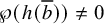 $\wp (h(\overline {b}))\neq 0$
. In view of
$\wp (h(\overline {b}))\neq 0$
. In view of $[\wp '(h(b))]^{2}=-1$
and (26), one has
$[\wp '(h(b))]^{2}=-1$
and (26), one has $\wp (h(\overline {b}))=\infty $
. All the above discussions yield
$\wp (h(\overline {b}))=\infty $
. All the above discussions yield
 $$ \begin{align} \begin{aligned} \overline{N}(r,\frac{1}{\wp(h(z))})&=N(r,E)=N(r,S_1)+N(r,S_2)\\ &\leq\overline{N}(r,\wp(h(\overline{z})))+S(r). \end{aligned} \end{align} $$
Suppose that $z_0$
is a zero of
$z_0$
is a zero of $\wp (h(z))$
with multiplicity p. Then
$\wp (h(z))$
with multiplicity p. Then $z_0$
is a zero of
$z_0$
is a zero of $(\wp (h(z)))'=\wp '(h(z))h'(z)$
with multiplicity
$(\wp (h(z)))'=\wp '(h(z))h'(z)$
with multiplicity $p-1$
. The fact that
$p-1$
. The fact that $\wp '(h(z_0))=\pm i$
yields that
$\wp '(h(z_0))=\pm i$
yields that $z_0$
is a zero of
$z_0$
is a zero of $h'$
with multiplicity
$h'$
with multiplicity $p-1$
. Thus,
$p-1$
. Thus,
 $$ \begin{align} N(r,\frac{1}{\wp(h(z))})=\overline{N}(r,\frac{1}{\wp(h(z))})+N(r,\frac{1}{h'(z)})=\overline{N}(r,\frac{1}{\wp(h(z))})+S(r). \end{align} $$
Equation (22) implies that $m(r,f(z))=S(r)$
, since
$m(r,f(z))=S(r)$
, since $T(r,f(z))=m(r,f(z))+N(r,f(z))$
. Rewrite the form of
$T(r,f(z))=m(r,f(z))+N(r,f(z))$
. Rewrite the form of $f(z)$
as
$f(z)$
as
 $$ \begin{align*}\frac{1}{\wp(h(z))}=2f(z)-\frac{\frac{\wp'(h(z))}{\sqrt{3}}}{\wp(h(z))}=2f(z)-\frac{\frac{\wp'(h(z))h'(z)}{\sqrt{3}}}{\wp(h(z))}\frac{1}{h'(z)}. \end{align*} $$
Then, applying the logarithmic derivative lemma, we have
 $$ \begin{align} \begin{aligned} m(r, \frac{1}{\wp(h(z))})&\leq m(r, f(z))+m (r, \frac{(\wp(h(z)))'}{\wp(h(z))})+m(r, \frac{1}{h'(z)})+O(1)\\ &\leq S(r)+S(r, \wp(h(z)))+S(r)=S(r). \end{aligned} \end{align} $$
Combining (29) and (30) yields
 $$ \begin{align} \begin{aligned} T(r, \wp(h(z)))&=T(r,\frac{1}{\wp(h(z))})+O(1)=N(r,\frac{1}{\wp(h(z))})+m(r, \frac{1}{\wp(h(z))})+O(1)\\ &=\overline{N}(r,\frac{1}{\wp(h(z))})+m(r, \frac{1}{\wp(h(z))})+O(1)\\ &=\overline{N}(r,\frac{1}{\wp(h(z))})+S(r). \end{aligned} \end{align} $$
We also know that $[\wp '(h(\overline {z}))]^2=4\wp (h(\overline {z}))^3-1$
. Then,
$[\wp '(h(\overline {z}))]^2=4\wp (h(\overline {z}))^3-1$
. Then,
 $$ \begin{align*}[\wp(h(\overline{z}))]^{\prime2}=[h(\overline{z})]^{\prime2}\wp'(h(\overline{z}))^2=4[h(\overline{z})]^{\prime2}\wp(h(\overline{z}))^3-[h(\overline{z})]^{\prime2}.\end{align*} $$
Rewrite it as
 $$ \begin{align*}\wp(h(\overline{z}))^2 \wp(h(\overline{z}))=\wp(h(\overline{z}))^3=\frac{1}{4[h(\overline{z})]^{\prime2}} [\wp(h(\overline{z}))]^{\prime2}-\frac{1}{4}. \end{align*} $$
By $T(r, \frac {1}{4[h(\overline {z})]^{\prime 2}})=S(r)$
and Clunie’s lemma (see [Reference Clunie10]), we get that
$T(r, \frac {1}{4[h(\overline {z})]^{\prime 2}})=S(r)$
and Clunie’s lemma (see [Reference Clunie10]), we get that $m(r,\wp (h(\overline {z})))=S(r)$
and
$m(r,\wp (h(\overline {z})))=S(r)$
and
 $$ \begin{align} T(r,\wp(h(\overline{z})))=m(r,\wp(h(\overline{z})))+N(r,\wp(h(\overline{z})))=N(r,\wp(h(\overline{z})))+S(r). \end{align} $$
Note that $\wp (h(\overline {z}))$
has only multiple poles. So,
$\wp (h(\overline {z}))$
has only multiple poles. So, $\overline {N}(r,\wp (h(\overline {z})))\leq \frac {1}{2}N(r,\wp (h(\overline {z})))$
. Further, combining (21), (23), (25), (28), (31), and (32), we have that
$\overline {N}(r,\wp (h(\overline {z})))\leq \frac {1}{2}N(r,\wp (h(\overline {z})))$
. Further, combining (21), (23), (25), (28), (31), and (32), we have that
 $$ \begin{align} \begin{aligned} \frac{2}{3}T(r,f(z))&\leq T(r, \wp(h(z)))+S(r)=\overline{N}(r,\frac{1}{\wp(h(z))})+S(r)\leq\overline{N}(r,\wp(h(\overline{z})))+S(r)\\ &\leq \frac{1}{2}N(r,\wp(h(\overline{z})))+S(r)\leq \frac{1}{2}T(r,\wp(h(\overline{z})))+S(r)\\ &\leq \frac{1}{2}T(r,f(\overline{z}))+S(r)=\frac{1}{2}T(r,f(z))+S(r), \end{aligned} \end{align} $$
which is a contradiction. Thus, the case cannot occur.
Case 2: $g_i(z)\equiv 0$
, for some
$g_i(z)\equiv 0$
, for some $i\in \{1,2, 3\}$
.
$i\in \{1,2, 3\}$
.
Firstly, we assume that $g_1(z)\equiv 0$
. Then,
$g_1(z)\equiv 0$
. Then, $[h(\overline {z})]'=Ah'(z)$
, where
$[h(\overline {z})]'=Ah'(z)$
, where $A=\frac {(1+i\frac {\sqrt {3}}{3})}{\eta (1-i\frac {\sqrt {3}}{3})}$
. Integrating this equation yields
$A=\frac {(1+i\frac {\sqrt {3}}{3})}{\eta (1-i\frac {\sqrt {3}}{3})}$
. Integrating this equation yields $h(\overline {z})=Ah(z)+B$
, where B is a fixed constant.
$h(\overline {z})=Ah(z)+B$
, where B is a fixed constant.
We know that $\wp (h(z))$
has infinitely many poles. Suppose that
$\wp (h(z))$
has infinitely many poles. Suppose that $\wp (h(b_0))=\infty $
. Equation (26) yields that
$\wp (h(b_0))=\infty $
. Equation (26) yields that $\wp (h(\overline {b_0}))=0$
or
$\wp (h(\overline {b_0}))=0$
or $\wp (h(\overline {b_0}))=\infty $
. Assume
$\wp (h(\overline {b_0}))=\infty $
. Assume $\wp (h(\overline {b_0}))=\infty $
. Rewrite (26) as
$\wp (h(\overline {b_0}))=\infty $
. Rewrite (26) as
 $$ \begin{align} \frac{1+\frac{\wp'(h(\overline{z}))}{\sqrt{3}}}{\wp(h(\overline{z}))}[h(\overline{z})]' =\frac{\eta(1-\frac{\wp'(h(z))}{\sqrt{3}})}{\wp(h(z))}[h(\overline{z})]' =\frac{\eta(1-\frac{\wp'(h(z))}{\sqrt{3}})}{\wp(h(z))}Ah'(z). \end{align} $$
Further, we rewrite (34) as
 $$ \begin{align} \begin{aligned} \frac{[h(\overline{z})]' }{\wp(h(\overline{z}))}+\frac{1}{\sqrt{3}}\frac{[\wp(h(\overline{z}))]'}{\wp(h(\overline{z}))}=A\eta [\frac{h'(z)}{\wp(h(z))}-\frac{1}{\sqrt{3}} \frac{[\wp(h(z))]'}{\wp(h(z))}].\\ \end{aligned} \end{align} $$
Note that $\wp (h(z))$
has only multiple poles. Assume that
$\wp (h(z))$
has only multiple poles. Assume that $b_0$
is a pole of
$b_0$
is a pole of $\wp (h(z))$
and
$\wp (h(z))$
and $\wp (h(\overline {z}))$
with multiplicities
$\wp (h(\overline {z}))$
with multiplicities $m(\geq 2)$
and
$m(\geq 2)$
and $k(\geq 2)$
, respectively. Taking the residue of both sides of (35) at
$k(\geq 2)$
, respectively. Taking the residue of both sides of (35) at $b_0$
, we have
$b_0$
, we have
 $$ \begin{align*}-k\frac{1}{\sqrt{3}}=A\eta\frac{m}{\sqrt{3}}, \end{align*} $$
which implies that $A\eta =-\frac {k}{m}$
. It contradicts
$A\eta =-\frac {k}{m}$
. It contradicts $A\eta =\frac {1+i\frac {\sqrt {3}}{3}}{(1-i\frac {\sqrt {3}}{3})}=\frac {\sqrt {3}+i}{(\sqrt {3}-i)}$
.
$A\eta =\frac {1+i\frac {\sqrt {3}}{3}}{(1-i\frac {\sqrt {3}}{3})}=\frac {\sqrt {3}+i}{(\sqrt {3}-i)}$
.
So, $\wp (h(\overline {b_0}))=0$
and
$\wp (h(\overline {b_0}))=0$
and $\wp '(h(\overline {b_0}))=\pm i$
. Suppose that
$\wp '(h(\overline {b_0}))=\pm i$
. Suppose that $\wp '(h(\overline {b_0}))=i$
. Assume that
$\wp '(h(\overline {b_0}))=i$
. Assume that $b_0$
is a zero of
$b_0$
is a zero of $\wp (h(\overline {z}))$
with multiplicity s. We rewrite (35) as
$\wp (h(\overline {z}))$
with multiplicity s. We rewrite (35) as
 $$ \begin{align} \begin{aligned} \frac{1}{\wp'(h(\overline{z}))}\frac{[\wp(h(\overline{z}))]'}{\wp(h(\overline{z}))}+\frac{1}{\sqrt{3}}\frac{[\wp(h(\overline{z}))]'}{\wp(h(\overline{z}))} &=\frac{[h(\overline{z})]'}{\wp(h(\overline{z}))}+\frac{1}{\sqrt{3}}\frac{[\wp(h(\overline{z}))]'}{\wp(h(\overline{z}))}\\ &=A\eta [\frac{h'(z)}{\wp(h(z))}-\frac{1}{\sqrt{3}} \frac{[\wp(h(z))]'}{\wp(h(z))}].\\ \end{aligned} \end{align} $$
Taking the residue of both sides of (36) again at $b_0$
, we have
$b_0$
, we have
 $$ \begin{align*}s[\frac{1}{i}+\frac{1}{\sqrt{3}}]=A\eta\frac{m}{\sqrt{3}}, \end{align*} $$
which implies that $A\eta =\frac {s}{m}(1-i\sqrt {3})$
. Combining
$A\eta =\frac {s}{m}(1-i\sqrt {3})$
. Combining $A\eta =\frac {\sqrt {3}+i}{(\sqrt {3}-i)}$
yields that
$A\eta =\frac {\sqrt {3}+i}{(\sqrt {3}-i)}$
yields that
 $$ \begin{align*}\frac{s}{m}=\frac{\sqrt{3}+i}{(\sqrt{3}-i)(1-i\sqrt{3})}=\frac{-1+\sqrt{3}i}{4}, \end{align*} $$
which is a contradiction. Therefore, $\wp '(h(\overline {b_0}))=-i$
and all the poles of
$\wp '(h(\overline {b_0}))=-i$
and all the poles of $\wp (h(z))$
must be the zero of
$\wp (h(z))$
must be the zero of $\wp '(h(\overline {z}))+i$
. Suppose that
$\wp '(h(\overline {z}))+i$
. Suppose that $\wp (h(z_0))=0$
and
$\wp (h(z_0))=0$
and $\wp '(h(z_0))=i$
. The same argument also yields
$\wp '(h(z_0))=i$
. The same argument also yields $\wp (h(\overline {z_0}))=0$
and
$\wp (h(\overline {z_0}))=0$
and $\wp '(h(\overline {z_0}))=i$
, which means that all the zeros
$\wp '(h(\overline {z_0}))=i$
, which means that all the zeros $\wp '(h(z))-i$
must be the zero of
$\wp '(h(z))-i$
must be the zero of $\wp '(h(\overline {z}))-i$
. We denote these facts as follows:
$\wp '(h(\overline {z}))-i$
. We denote these facts as follows:
 $$ \begin{align} \wp(h(z))=\infty\Rightarrow \wp'(h(\overline{z}))+i=0,~~\wp'(h(z))-i=0\Rightarrow \wp'(h(\overline{z}))-i=0. \end{align} $$
Suppose that 0 is a Picard exceptional value of $h(z)$
. Then, we can assume that
$h(z)$
. Then, we can assume that $h(z)=e^{\alpha (z)}$
, where
$h(z)=e^{\alpha (z)}$
, where $\alpha (z)$
is an entire function. The equation
$\alpha (z)$
is an entire function. The equation $h(\overline {z})=Ah(z)+B$
yields
$h(\overline {z})=Ah(z)+B$
yields $e^{\alpha (\overline {z})}=Ae^{\alpha (z)}+B=A[e^{\alpha (z)}-(-\frac {B}{A})]$
. So,
$e^{\alpha (\overline {z})}=Ae^{\alpha (z)}+B=A[e^{\alpha (z)}-(-\frac {B}{A})]$
. So, $-\frac {B}{A}$
is also a Picard exceptional value of
$-\frac {B}{A}$
is also a Picard exceptional value of $h(z)=e^{\alpha (z)}$
, and Picard’s little theorem tells us
$h(z)=e^{\alpha (z)}$
, and Picard’s little theorem tells us $B=0$
. Thus,
$B=0$
. Thus, $h(\overline {z})=Ah(z)$
.
$h(\overline {z})=Ah(z)$
.
Suppose that $\tau (\neq 0)\in \mathbb {L}$
, which means that
$\tau (\neq 0)\in \mathbb {L}$
, which means that $\tau $
is any fixed period of
$\tau $
is any fixed period of $\wp $
. Observe that
$\wp $
. Observe that $\tau $
is not Picard exceptional value of
$\tau $
is not Picard exceptional value of $h(z)$
. Assume that
$h(z)$
. Assume that $h(u_0)=\tau $
. Then,
$h(u_0)=\tau $
. Then, $\wp (h(u_0))=\wp (\tau )=\infty $
. From (37), one has
$\wp (h(u_0))=\wp (\tau )=\infty $
. From (37), one has $\wp (h(\overline {u_0}))=0$
and
$\wp (h(\overline {u_0}))=0$
and $\wp '(h(\overline {u_0}))=-i$
. Without loss of generality, we assume that
$\wp '(h(\overline {u_0}))=-i$
. Without loss of generality, we assume that
 $$ \begin{align} h(\overline{u_0})=Ah(u_0)=A\tau=\theta_1+\xi_1, \end{align} $$
where $\xi _1\in \mathbb {L}$
. Note that
$\xi _1\in \mathbb {L}$
. Note that $\theta _2$
is not a Picard exceptional value of
$\theta _2$
is not a Picard exceptional value of $h(z)$
. Assume
$h(z)$
. Assume $h(e_0)=\theta _2$
. Thus,
$h(e_0)=\theta _2$
. Thus, $\wp (h(e_0))=\wp (\theta _2)=0$
and
$\wp (h(e_0))=\wp (\theta _2)=0$
and $\wp '(h(e_0))=\wp '(\theta _2)=i$
. Then, (37) yields
$\wp '(h(e_0))=\wp '(\theta _2)=i$
. Then, (37) yields $\wp (h(\overline {e_0}))=0$
and
$\wp (h(\overline {e_0}))=0$
and $\wp '(h(\overline {e_0}))=i$
. Without loss of generality, assume that
$\wp '(h(\overline {e_0}))=i$
. Without loss of generality, assume that
 $$ \begin{align} h(\overline{e_0})=Ah(e_0)=A\theta_2=\theta_2+\xi_2, \end{align} $$
where $\xi _2\in \mathbb {L}$
. Clearly,
$\xi _2\in \mathbb {L}$
. Clearly, $\theta _2+\tau $
is also not a Picard exceptional value of
$\theta _2+\tau $
is also not a Picard exceptional value of $h(z)$
. Assume
$h(z)$
. Assume $h(t_0)=\theta _2+\tau $
. Then,
$h(t_0)=\theta _2+\tau $
. Then, $\wp (h(t_0))=\wp (\theta _2+\tau )=0$
and
$\wp (h(t_0))=\wp (\theta _2+\tau )=0$
and $\wp '(h(t_0))=\wp '(\theta _2+\tau )=i$
. The same argument as above yields
$\wp '(h(t_0))=\wp '(\theta _2+\tau )=i$
. The same argument as above yields
 $$ \begin{align} h(\overline{t_0})=Ah(t_0)=A(\theta_2+\tau)=\theta_2+\xi_3, \end{align} $$
where $\xi _3\in \mathbb {L}$
. Combining (39) and (40) leads to
$\xi _3\in \mathbb {L}$
. Combining (39) and (40) leads to $A\tau =\xi _3-\xi _2\in \mathbb {L}$
. Together with (38), we derive that
$A\tau =\xi _3-\xi _2\in \mathbb {L}$
. Together with (38), we derive that $\theta _1\in \mathbb {L}$
is a period of
$\theta _1\in \mathbb {L}$
is a period of $\wp $
, a contradiction. Thus,
$\wp $
, a contradiction. Thus, $0$
is not a Picard exceptional value of
$0$
is not a Picard exceptional value of $h(z)$
.
$h(z)$
.
Below, for any period $\tau $
of
$\tau $
of $\wp $
, we prove that
$\wp $
, we prove that $A\tau \in \mathbb {L}$
, which means that
$A\tau \in \mathbb {L}$
, which means that $A\tau $
is also a period of
$A\tau $
is also a period of $\wp $
.
$\wp $
.
Observe that $0$
is not a Picard exceptional value of
$0$
is not a Picard exceptional value of $h(z)$
. Assume
$h(z)$
. Assume $h(d_0)=0$
. Thus,
$h(d_0)=0$
. Thus, $\wp (h(d_0))=\wp (0)=\infty $
. Then, (37) yields
$\wp (h(d_0))=\wp (0)=\infty $
. Then, (37) yields $\wp (h(\overline {d_0}))=0$
and
$\wp (h(\overline {d_0}))=0$
and $\wp '(h(\overline {d_0}))=-i$
. Without loss of generality, we assume that
$\wp '(h(\overline {d_0}))=-i$
. Without loss of generality, we assume that
 $$ \begin{align} h(\overline{d_0})=Ah(d_0)+B=B=\theta_1+\xi_5, \end{align} $$
where $\xi _5\in \mathbb {L}$
. In view of the fact that
$\xi _5\in \mathbb {L}$
. In view of the fact that $h(z)$
has at most one finite Picard exceptional value, so one of
$h(z)$
has at most one finite Picard exceptional value, so one of $\omega _1$
and
$\omega _1$
and $\omega _2$
is not a Picard exceptional value of
$\omega _2$
is not a Picard exceptional value of $h(z)$
. Without loss of generality, assume that
$h(z)$
. Without loss of generality, assume that $\omega _1$
is not a Picard exceptional value of
$\omega _1$
is not a Picard exceptional value of $h(z)$
and
$h(z)$
and $h(c_0)=\omega _1$
. Then,
$h(c_0)=\omega _1$
. Then, $\wp (h(c_0))=\wp (\omega _1)=\wp (0)=\infty $
, which plus (37) implies that
$\wp (h(c_0))=\wp (\omega _1)=\wp (0)=\infty $
, which plus (37) implies that $\wp (h(\overline {c_0}))=0$
and
$\wp (h(\overline {c_0}))=0$
and $\wp '(h(\overline {c_0}))=-i$
. So, we can set
$\wp '(h(\overline {c_0}))=-i$
. So, we can set $h(\overline {c_0})=\theta _1+\xi _6$
with
$h(\overline {c_0})=\theta _1+\xi _6$
with $\xi _6\in \mathbb {L}$
. Further,
$\xi _6\in \mathbb {L}$
. Further,
 $$ \begin{align} h(\overline{c_0})=Ah(c_0)+B=Ah(c_0)+\theta_1+\xi_5=A\omega_1+\theta_1+\xi_5= \theta_1+\xi_6, \end{align} $$
which implies that $A\omega _1=\xi _6-\xi _5\in \mathbb {L}$
.
$A\omega _1=\xi _6-\xi _5\in \mathbb {L}$
.
Clearly, there exists an integer N such that $N\omega _1+\tau $
is not a Picard exceptional value of
$N\omega _1+\tau $
is not a Picard exceptional value of $h(z)$
. Suppose that
$h(z)$
. Suppose that $h(t_1)=N\omega _1+\tau $
. Then,
$h(t_1)=N\omega _1+\tau $
. Then, $\wp (h(t_1))=\wp (N\omega _1+\tau )=\wp (0)=\infty $
, which plus (37) implies that
$\wp (h(t_1))=\wp (N\omega _1+\tau )=\wp (0)=\infty $
, which plus (37) implies that $\wp (h(\overline {t_1}))=0$
and
$\wp (h(\overline {t_1}))=0$
and $\wp '(h(\overline {t_1}))=-i$
. And we can set
$\wp '(h(\overline {t_1}))=-i$
. And we can set $h(\overline {t_1})=\theta _1+\xi _7$
with
$h(\overline {t_1})=\theta _1+\xi _7$
with $\xi _7\in \mathbb {L}$
. Further,
$\xi _7\in \mathbb {L}$
. Further,
 $$ \begin{align} h(\overline{c_1})=Ah(c_1)+\theta_1+\xi_5=A(N\omega_1+\tau)+\theta_1+\xi_5 =\theta_1+\xi_7, \end{align} $$
which leads to
 $$ \begin{align*}A\tau=\xi_7 -\xi_5-NA\omega_1\in\mathbb{L}. \end{align*} $$
Thus, we prove that $A\tau $
is also a period of
$A\tau $
is also a period of $\wp $
.
$\wp $
.
Observe that $A=\frac {(1+i\frac {\sqrt {3}}{3})}{\eta (1-i\frac {\sqrt {3}}{3})}$
and
$A=\frac {(1+i\frac {\sqrt {3}}{3})}{\eta (1-i\frac {\sqrt {3}}{3})}$
and $\eta ^3=1$
. A calculation yields
$\eta ^3=1$
. A calculation yields $A^3=-1$
and
$A^3=-1$
and
 $$ \begin{align*}A=\frac{1}{2}+\frac{\sqrt{3}}{2}i=e^{\frac{\pi}{3}i},~~or~~\frac{1}{2}-\frac{\sqrt{3}}{2}i=e^{-\frac{\pi}{3}i},~~or~~-1. \end{align*} $$
Meanwhile, (41) implies that
 $$ \begin{align*}h(\overline{z})=Ah(z)+B=Ah(z)+\theta_1+\xi_5, \end{align*} $$
which is (1) with $\tau _1=\xi _5$
.
$\tau _1=\xi _5$
.
Suppose that $A=\frac {1}{2}+\frac {\sqrt {3}}{2}i=e^{\frac {\pi }{3}i}$
. Among all the periods of
$A=\frac {1}{2}+\frac {\sqrt {3}}{2}i=e^{\frac {\pi }{3}i}$
. Among all the periods of $\wp (\omega )$
, we list the periods which may take the smallest modulus as follows:
$\wp (\omega )$
, we list the periods which may take the smallest modulus as follows: $\omega _1$
,
$\omega _1$
, $\omega _1+\omega _2$
,
$\omega _1+\omega _2$
, $\omega _2$
,
$\omega _2$
, $\omega _2-\omega _1$
,
$\omega _2-\omega _1$
, $-\omega _1$
,
$-\omega _1$
, $-\omega _2-\omega _1$
,
$-\omega _2-\omega _1$
, $-\omega _2$
, and
$-\omega _2$
, and $\omega _1-\omega _2$
. Then, in view of the fact that
$\omega _1-\omega _2$
. Then, in view of the fact that $A\tau =\tau e^{\frac {\pi }{3}i}$
is also a period of
$A\tau =\tau e^{\frac {\pi }{3}i}$
is also a period of $\wp $
, we illuminate two possible subcases (see Figures 1 and 2).
$\wp $
, we illuminate two possible subcases (see Figures 1 and 2).
Subcase 2.1.

Subcase 2.2.
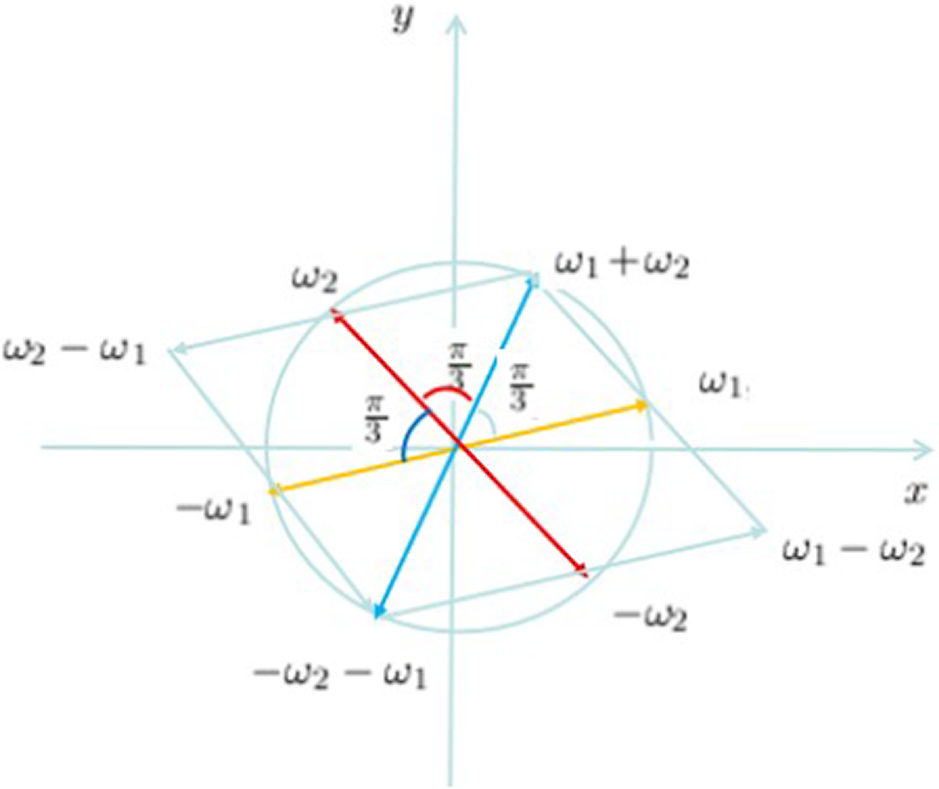
Subcase 2.1: $A\omega _1=\omega _2$
and
$A\omega _1=\omega _2$
and $A\omega _2=\omega _2-\omega _1$
and
$A\omega _2=\omega _2-\omega _1$
and $A(\omega _2-\omega _1)=-\omega _1$
.
$A(\omega _2-\omega _1)=-\omega _1$
.
Subcase 2.2: $A\omega _1=\omega _1+\omega _2$
and
$A\omega _1=\omega _1+\omega _2$
and $A(\omega _1+\omega _2)=\omega _2$
and
$A(\omega _1+\omega _2)=\omega _2$
and $A\omega _2=-\omega _1$
.
$A\omega _2=-\omega _1$
.
For $A=\frac {1}{2}-\frac {\sqrt {3}}{2}i$
or
$A=\frac {1}{2}-\frac {\sqrt {3}}{2}i$
or $A=-1$
, analogous subcases can also be obtained as above.
$A=-1$
, analogous subcases can also be obtained as above.
Next, we consider $g_3(z)\equiv 0$
or
$g_3(z)\equiv 0$
or $g_2(z)\equiv 0$
.
$g_2(z)\equiv 0$
.
If $g_3(z)\equiv 0$
, on the basis of the above discussion, we can derive that
$g_3(z)\equiv 0$
, on the basis of the above discussion, we can derive that
 $$ \begin{align*}\wp(h(z))=\infty\Rightarrow \wp'(h(\overline{z}))-i=0,~~\wp'(h(z))+i=0\Rightarrow \wp'(h(\overline{z}))+i=0. \end{align*} $$
If $g_2(z)\equiv 0$
, on the basis of the above discussion, we can derive that
$g_2(z)\equiv 0$
, on the basis of the above discussion, we can derive that
 $$ \begin{align*}\wp(h(z))=\infty\Rightarrow \wp(h(\overline{z}))=\infty,~~\wp'(h(z))-i=0\Rightarrow \wp'(h(\overline{z}))+i=0. \end{align*} $$
Furthermore, with the same argument, we can obtain conclusions (2) and (3) when $g_3(z)\equiv 0$
and
$g_3(z)\equiv 0$
and $g_2(z)\equiv 0$
, respectively. Here, we omit the details.
$g_2(z)\equiv 0$
, respectively. Here, we omit the details.
Next, we will prove that $L(z)$
is a linear function. Without loss of generality, assume that
$L(z)$
is a linear function. Without loss of generality, assume that
 $$ \begin{align} h(L(z))=Ah(z)+C, \end{align} $$
where $A^3=-1$
and C is a constant. Suppose that h is transcendental. We recall the following result (see [Reference Clunie11, Theorem 2] or [Reference Gross and Yang17, p. 370]).
$A^3=-1$
and C is a constant. Suppose that h is transcendental. We recall the following result (see [Reference Clunie11, Theorem 2] or [Reference Gross and Yang17, p. 370]).
Lemma 2. If f (meromorphic) and g (entire) are transcendental, then
 $$ \begin{align*}\limsup_{r\not\in E,~r\rightarrow\infty}\frac{T (r, f (g))}{T (r, f )}=\infty, \end{align*} $$
where E is a set of finite Lebesgue measure.
If L is transcendental, then Lemma 2 implies that
 $$ \begin{align*}\infty=\limsup_{r\not\in E,~r\rightarrow\infty}\frac{T(r,h(L(z)))}{T(r,h(z))}=\limsup_{r\not\in E,~r\rightarrow\infty}\frac{T(r,Ah(z)+C)}{T(r,h(z))}=1, \end{align*} $$
a contradiction. Thus, L is a polynomial. Without loss of generality, assume $L(z)=a_{m}z^{m}+\cdots +a_{1}z+a_{0}$
with
$L(z)=a_{m}z^{m}+\cdots +a_{1}z+a_{0}$
with $m\geq 1$
and
$m\geq 1$
and $a_m\neq 0$
. We employ the following result, which can be seen in [Reference Gross and Yang17, Inequality (19)] and [Reference Li and Saleeby31, Inequality (2.7)], respectively.
$a_m\neq 0$
. We employ the following result, which can be seen in [Reference Gross and Yang17, Inequality (19)] and [Reference Li and Saleeby31, Inequality (2.7)], respectively.
Lemma 3. Suppose that $g(z) = a_m z^m+ a_{m_1}z^{m-1}+ \cdots + a_1 z + a_0$
(
$g(z) = a_m z^m+ a_{m_1}z^{m-1}+ \cdots + a_1 z + a_0$
( $a_m\neq 0$
) is a nonconstant polynomial, then for any
$a_m\neq 0$
) is a nonconstant polynomial, then for any $\epsilon _1> 0$
and
$\epsilon _1> 0$
and $\epsilon _2> 0$
,
$\epsilon _2> 0$
,
 $$ \begin{align*}T (r, f (g))\geq (1 -\epsilon_2 )T(\frac{a_m}{2}r^m, f), \end{align*} $$
 $$ \begin{align*}\qquad T (r, f)\leq \frac{1}{m}(1+\epsilon_1)T(\frac{a_m}{2}r^m, f), \end{align*} $$
for large r outside possibly a set of finite Lebesgue measure.
Applying Lemma 3 to the function $h(L(z))$
, we obtain
$h(L(z))$
, we obtain
 $$ \begin{align} \begin{aligned} T(r,h(z))&\leq \frac{1}{m}(1+\epsilon_1)T(\frac{a_m}{2}r^m, h(z))\leq \frac{1}{m}\frac{1+\epsilon_1}{1 -\epsilon_2 }T (r, h(L(z)))\\ &= \frac{1}{m}\frac{1+\epsilon_1}{1 -\epsilon_2 }T (r, Ah(z)+C))= \frac{1}{m}\frac{1+\epsilon_1}{1 -\epsilon_2 }T (r, h(z))+O(1), \end{aligned} \end{align} $$
which implies that $m=1$
, since
$m=1$
, since $\epsilon _1$
and
$\epsilon _1$
and $\epsilon _2$
can be chosen small enough. Thus,
$\epsilon _2$
can be chosen small enough. Thus, $L(z)$
is a linear function.
$L(z)$
is a linear function.
Suppose that h is a polynomial of degree n. Then, (44) implies that $h(L(z))$
is also a polynomial, which implies that
$h(L(z))$
is also a polynomial, which implies that $L(z)$
is also a polynomial. Furthermore, (44) leads to the conclusion that
$L(z)$
is also a polynomial. Furthermore, (44) leads to the conclusion that $L(z)$
is a linear function.
$L(z)$
is a linear function.
So, the above discussions yield that $L(z)=qz+c$
with
$L(z)=qz+c$
with $q\neq 0$
and c is a constant. Then,
$q\neq 0$
and c is a constant. Then, $h(qz+c)=Ah(z)+C$
, where C is a constant.
$h(qz+c)=Ah(z)+C$
, where C is a constant.
At the end, we will prove $|q|=1$
by an elementary method. Differentiating the above equation leads to
$|q|=1$
by an elementary method. Differentiating the above equation leads to
 $$ \begin{align} qh'(qz+c)=Ah'(z). \end{align} $$
If $h'(z)$
is a constant, then,
$h'(z)$
is a constant, then, $q=A$
and
$q=A$
and $|q|=|A|=1$
. Next, assume that
$|q|=|A|=1$
. Next, assume that $h'(z)$
is nonconstant. Suppose that
$h'(z)$
is nonconstant. Suppose that $|q|<1$
. For each
$|q|<1$
. For each $t^*\in \mathbb {C}$
, by (46), we get that
$t^*\in \mathbb {C}$
, by (46), we get that
 $$ \begin{align*}h'(t^*)=\frac{q}{A}h'(qt^*+c)=(\frac{q}{A})^2h'[q(qt^*+c)+c]=\cdots=(\frac{q}{A})^nh'[q^n t^*+c\sum_{k=0}^{n-1}q^{k}]. \end{align*} $$
Note that $|q|<1$
and
$|q|<1$
and $q^n t^*+c\sum _{k=0}^{n-1}q^{k}\rightarrow c\frac {1}{1-q}$
as
$q^n t^*+c\sum _{k=0}^{n-1}q^{k}\rightarrow c\frac {1}{1-q}$
as $n\rightarrow \infty $
. Then, let
$n\rightarrow \infty $
. Then, let $n\rightarrow \infty $
, one has that
$n\rightarrow \infty $
, one has that
 $$ \begin{align*}h'(t^*)=h'(c\frac{1}{1-q})\lim_{n\rightarrow\infty}(\frac{q}{A})^n=0, \end{align*} $$
which means that $h'(z)\equiv 0$
, a contradiction. If
$h'(z)\equiv 0$
, a contradiction. If $|q|> 1$
, then we rewrite (46) as
$|q|> 1$
, then we rewrite (46) as $h'(z)=Aph'(pz+c')$
with
$h'(z)=Aph'(pz+c')$
with $p=\frac {1}{q}$
and
$p=\frac {1}{q}$
and $c'=-\frac {c}{q}$
. Note that
$c'=-\frac {c}{q}$
. Note that $|p|=|\frac {1}{q}|<1$
. The same argument as above yields a contradiction. So, we obtain
$|p|=|\frac {1}{q}|<1$
. The same argument as above yields a contradiction. So, we obtain $|q|=1$
.
$|q|=1$
.
Therefore, we finish the proof of Proposition 1.
Proof of Proposition 2.
The necessity is obvious. Below, we prove the sufficiency. Rewrite (5) as
 $$ \begin{align*}[\frac{f(z)}{e^{\frac{g(z)}{n}}}]^n+[\frac{f(L(z))}{e^{\frac{g(z)}{m}}}]^m=1.\end{align*} $$
We will prove that both $\frac {f(z)}{e^{\frac {g(z)}{n}}}$
and
$\frac {f(z)}{e^{\frac {g(z)}{n}}}$
and $\frac {f(L(z))}{e^{\frac {g(z)}{m}}}$
are constants.
$\frac {f(L(z))}{e^{\frac {g(z)}{m}}}$
are constants.
Yang’s theorem yields that both $\frac {f(z)}{e^{\frac {g(z)}{n}}}$
and
$\frac {f(z)}{e^{\frac {g(z)}{n}}}$
and $\frac {f(L(z))}{e^{\frac {g(z)}{m}}}$
are constants if
$\frac {f(L(z))}{e^{\frac {g(z)}{m}}}$
are constants if $\frac {1}{n}+\frac {2}{m}<1$
. Therefore, it suffices to consider the cases
$\frac {1}{n}+\frac {2}{m}<1$
. Therefore, it suffices to consider the cases $(n,m)=(2,3)$
and
$(n,m)=(2,3)$
and $(2,4)$
.
$(2,4)$
.
Case 1: $(n,m)=(2,3)$
.
$(n,m)=(2,3)$
.
Suppose that one of $\frac {f(z)}{e^{\frac {g(z)}{2}}}$
and
$\frac {f(z)}{e^{\frac {g(z)}{2}}}$
and $\frac {f(L(z))}{e^{\frac {g(z)}{3}}}$
is not constant. Then neither of them is constant. Via (ii) of Theorem A, we have that
$\frac {f(L(z))}{e^{\frac {g(z)}{3}}}$
is not constant. Then neither of them is constant. Via (ii) of Theorem A, we have that $\frac {f(z)}{e^{\frac {g(z)}{2}}} = i\wp '(h(z))$
and
$\frac {f(z)}{e^{\frac {g(z)}{2}}} = i\wp '(h(z))$
and $\frac {f(L(z))}{e^{\frac {g(z)}{3}}} = \eta \sqrt [3]{4}\wp (h(z))$
, where
$\frac {f(L(z))}{e^{\frac {g(z)}{3}}} = \eta \sqrt [3]{4}\wp (h(z))$
, where $h(z)$
is any nonconstant entire function. So,
$h(z)$
is any nonconstant entire function. So,
 $$ \begin{align} f(L(z)) =i\wp'(h(L(z)))e^{\frac{g(L(z))}{2}}= \eta\sqrt[3]{4}\wp(h(z))e^{\frac{g(z)}{3}}. \end{align} $$
Note that $w_n=n\omega _1 (n=0, ~1,~2,\ldots )$
is a pole of
$w_n=n\omega _1 (n=0, ~1,~2,\ldots )$
is a pole of $\wp (z)$
with multiplicity 2. It is known that a nonconstant meromorphic function has four complete multiple values at most. (Here, the constant a is a complete multiple value of f if
$\wp (z)$
with multiplicity 2. It is known that a nonconstant meromorphic function has four complete multiple values at most. (Here, the constant a is a complete multiple value of f if $f-a$
has only multiple zeros.) So, there exists a point
$f-a$
has only multiple zeros.) So, there exists a point $w_N$
such that
$w_N$
such that $h(z)-w_N$
has a simple zero, say
$h(z)-w_N$
has a simple zero, say $z_0$
. Then,
$z_0$
. Then, $h(z_0)=w_N$
and
$h(z_0)=w_N$
and $z_0$
is a pole of
$z_0$
is a pole of $\eta \sqrt [3]{4}\wp (h(z))e^{\frac {g(z)}{3}}$
with multiplicity 2. On the other hand, since that the multiplicity of any pole of
$\eta \sqrt [3]{4}\wp (h(z))e^{\frac {g(z)}{3}}$
with multiplicity 2. On the other hand, since that the multiplicity of any pole of $\wp '(w)$
is 3, we derive that
$\wp '(w)$
is 3, we derive that $z_0$
is a pole of
$z_0$
is a pole of $i\wp '(h(L(z)))e^{\frac {g(L(z))}{2}}$
with multiplicity at least 3, or
$i\wp '(h(L(z)))e^{\frac {g(L(z))}{2}}$
with multiplicity at least 3, or $z_0$
is not a pole of this function. Comparing the multiplicities of both sides of (47) at pole-point
$z_0$
is not a pole of this function. Comparing the multiplicities of both sides of (47) at pole-point $z_0$
, we thereby arrive at a contradiction.
$z_0$
, we thereby arrive at a contradiction.
Case 2: $(n,m)=(2,4)$
.
$(n,m)=(2,4)$
.
Assume that one of $\frac {f(z)}{e^{\frac {g(z)}{2}}}$
and
$\frac {f(z)}{e^{\frac {g(z)}{2}}}$
and $\frac {f(L(z))}{e^{\frac {g(z)}{4}}}$
is not a constant. Via (iii) of Theorem A, we have that
$\frac {f(L(z))}{e^{\frac {g(z)}{4}}}$
is not a constant. Via (iii) of Theorem A, we have that $\frac {f(z)}{e^{\frac {g(z)}{2}}} = sn'(h(z))$
and
$\frac {f(z)}{e^{\frac {g(z)}{2}}} = sn'(h(z))$
and $\frac {f(L(z))}{e^{\frac {g(z)}{4}}} = sn(h(z))$
, where
$\frac {f(L(z))}{e^{\frac {g(z)}{4}}} = sn(h(z))$
, where $h(z)$
is any nonconstant entire function and
$h(z)$
is any nonconstant entire function and $sn$
is the Jacobi elliptic function satisfying
$sn$
is the Jacobi elliptic function satisfying ${sn'}^2=1- sn^4$
. So,
${sn'}^2=1- sn^4$
. So,
 $$ \begin{align} f(L(z)) =sn'(h(L(z)))e^{\frac{g(L(z))}{2}}= sn(h(z))e^{\frac{g(z)}{4}}. \end{align} $$
Suppose that $w_n (n=0, ~1,~2,\ldots )$
is a simple pole of
$w_n (n=0, ~1,~2,\ldots )$
is a simple pole of $sn(z)$
. As in Case 1, there exists a point
$sn(z)$
. As in Case 1, there exists a point $w_N$
such that
$w_N$
such that $h(z)-w_N$
has a simple zero, say
$h(z)-w_N$
has a simple zero, say $z_1$
. Then,
$z_1$
. Then, $h(z_1)=w_N$
and
$h(z_1)=w_N$
and $z_1$
is a pole of
$z_1$
is a pole of $sn(h(z))e^{\frac {g(z)}{4}}$
with multiplicity 1. On the other hand, in view of the fact that the multiplicity of any pole of
$sn(h(z))e^{\frac {g(z)}{4}}$
with multiplicity 1. On the other hand, in view of the fact that the multiplicity of any pole of $sn'(w)$
is 2, we get that
$sn'(w)$
is 2, we get that $z_1$
is a pole of
$z_1$
is a pole of $sn'(h(z))e^{\frac {g(L(z))}{2}}$
with multiplicity at least 2, or
$sn'(h(z))e^{\frac {g(L(z))}{2}}$
with multiplicity at least 2, or $z_1$
is not a pole of this function. Comparing the multiplicities of both sides of (48) at pole-point
$z_1$
is not a pole of this function. Comparing the multiplicities of both sides of (48) at pole-point $z_1$
, we have a contradiction.
$z_1$
, we have a contradiction.
Therefore, we derive that both $\frac {f(z)}{e^{\frac {g(z)}{n}}}$
and
$\frac {f(z)}{e^{\frac {g(z)}{n}}}$
and $\frac {f(L(z))}{e^{\frac {g(z)}{m}}}$
are nonzero constants, say A and B with
$\frac {f(L(z))}{e^{\frac {g(z)}{m}}}$
are nonzero constants, say A and B with ${A^n+B^m=1}$
. Thus,
${A^n+B^m=1}$
. Thus, $f(z)=Ae^{\frac {g(z)}{n}}$
and
$f(z)=Ae^{\frac {g(z)}{n}}$
and
 $$ \begin{align*}f(L(z))=Be^{\frac{g(z)}{m}}=Ae^{\frac{g(L(z))}{n}}, \end{align*} $$
which implies that
 $$ \begin{align} g(L(z))=\frac{n}{m}g(z)+nLn\frac{B}{A}. \end{align} $$
With the same argument as in Proposition 1, we can derive that $L(z)$
is a linear function, say
$L(z)$
is a linear function, say $L(z)=qz+c$
with constants
$L(z)=qz+c$
with constants $q(\neq 0)$
, c.
$q(\neq 0)$
, c.
If $m=n$
, then (49) reduces to
$m=n$
, then (49) reduces to $g(qz+c)=g(z)+nLn\frac {B}{A}$
. The same discussion as in Proposition 1 yields
$g(qz+c)=g(z)+nLn\frac {B}{A}$
. The same discussion as in Proposition 1 yields $|q|=1$
.
$|q|=1$
.
Therefore, we finish the proof of Proposition 2.
The proof of Theorem 2 is now given as follows.
Proof of Theorem 2.
The necessity is obvious. Below, we prove the sufficiency. Suppose that the hyper-order of $f(z)$
is less than 1. Then the conclusion (a) follows immediately from Theorem B. Next, we assume that the hyper-order
$f(z)$
is less than 1. Then the conclusion (a) follows immediately from Theorem B. Next, we assume that the hyper-order $\rho _{2}(f)\geq 1$
. Rewrite (8) as
$\rho _{2}(f)\geq 1$
. Rewrite (8) as
 $$ \begin{align*}(\frac{f(z+c)}{e^{\frac{P(z)}{3}}})^3+(\frac{f(z)}{e^{\frac{P(z)}{3}}})^3=1. \end{align*} $$
Via (i) of Theorem A, we have
 $$ \begin{align} f(z)=\frac{1}{2}\frac{1+\frac{\wp'(h(z))}{\sqrt{3}}}{\wp(h(z))}e^{P(z)/3}, \end{align} $$
where $h(z)$
is an entire function. The fact
$h(z)$
is an entire function. The fact $\rho _{2}(f)\geq 1$
and (50) yields that h is transcendental. Here, we employ the result of Bergweiler in [Reference Bergweiler4, Lemma 1].
$\rho _{2}(f)\geq 1$
and (50) yields that h is transcendental. Here, we employ the result of Bergweiler in [Reference Bergweiler4, Lemma 1].
Lemma 4. Let f be meromorphic and let g be entire and transcendental. If the lower order $\mu (f \circ g)<\infty ,$
then
$\mu (f \circ g)<\infty ,$
then $\mu (f)=0$
.
$\mu (f)=0$
.
Note that $\rho (\wp )=\mu (\wp )=2$
(see [Reference Bank and Langley2]. It follows from Lemma 3 that
$\rho (\wp )=\mu (\wp )=2$
(see [Reference Bank and Langley2]. It follows from Lemma 3 that $\mu [\frac {1}{2}\frac {1+\frac {\wp '(h(z))}{\sqrt {3}}}{\wp (h(z))}]=\infty $
, so is
$\mu [\frac {1}{2}\frac {1+\frac {\wp '(h(z))}{\sqrt {3}}}{\wp (h(z))}]=\infty $
, so is $\mu (f)$
. Thus,
$\mu (f)$
. Thus, $e^P$
is a small function of
$e^P$
is a small function of $f(z)$
and
$f(z)$
and $T(r,e^P)=S(r,f)$
. Based on the idea of Liu and Ma in [Reference Liu and Ma34], we will obtain the desired result.
$T(r,e^P)=S(r,f)$
. Based on the idea of Liu and Ma in [Reference Liu and Ma34], we will obtain the desired result.
Set $a(z)=e^{P(z)}$
and rewrite (8) as
$a(z)=e^{P(z)}$
and rewrite (8) as $f^{3}(z+c)=-(f^{3}(z)-a(z))$
, which implies that the multiplicities of the zeros of
$f^{3}(z+c)=-(f^{3}(z)-a(z))$
, which implies that the multiplicities of the zeros of $f^{3}(z)-a(z)$
are at least 3. Rewrite (8) as
$f^{3}(z)-a(z)$
are at least 3. Rewrite (8) as $f^{3}(z)=-(f^{3}(z+c)-a(z))$
, which implies that the multiplicities of the zeros of
$f^{3}(z)=-(f^{3}(z+c)-a(z))$
, which implies that the multiplicities of the zeros of $f^{3}(z+c)-a(z)$
are at least 3. So, the zeros of
$f^{3}(z+c)-a(z)$
are at least 3. So, the zeros of $f^{3}(z)-a(z-c)$
are of multiplicities at least 3. Set
$f^{3}(z)-a(z-c)$
are of multiplicities at least 3. Set $G(z)=f^{3}(z)$
. Assume that the functions
$G(z)=f^{3}(z)$
. Assume that the functions $a(z-c)$
and
$a(z-c)$
and $a(z)$
are distinct from each other. Then, applying the second main theorem of Nevanlinna to G, one gets that
$a(z)$
are distinct from each other. Then, applying the second main theorem of Nevanlinna to G, one gets that
 $$ \begin{align*} 2T(r,G)&\leq \overline{N}(r,\frac{1}{G(z)-a(z-c)})+\overline{N}(r,\frac{1}{G(z)-a(z)})+\overline{N}(r,G)+\overline{N}(r,\frac{1}{G})\\ &\quad+S(r,G)\leq\frac{1}{3}[N(r,\frac{1}{G(z)-a(z-c)})+N(r,\frac{1}{G(z)-a(z)})+N(r,G)\\ &\quad+N(r,\frac{1}{G})]+S(r,G)\leq \frac{4}{3}T(r,G)+S(r,G), \end{align*} $$
which is a contradiction. Thus, $a(z)=a(z-c)$
, which implies that
$a(z)=a(z-c)$
, which implies that $e^{P(z+c)}=e^{P(z)}$
and
$e^{P(z+c)}=e^{P(z)}$
and ${e^{P(z+c)-P(z)}=1}$
. In view of the fact that
${e^{P(z+c)-P(z)}=1}$
. In view of the fact that $P(z)$
is a polynomial, we derive that
$P(z)$
is a polynomial, we derive that $P(z)=\alpha z+\beta $
with two constants
$P(z)=\alpha z+\beta $
with two constants $\alpha , ~\beta $
and
$\alpha , ~\beta $
and $e^{\alpha c}=1$
. Therefore, we can rewrite (8) as
$e^{\alpha c}=1$
. Therefore, we can rewrite (8) as
 $$ \begin{align*}1=[\frac{f(z)}{e^{\frac{P(z)}{3}}}]^3+[\frac{f(z+c)}{e^{\frac{P(z)}{3}}}]^3=[\frac{f(z)}{e^{\frac{P(z)}{3}}}]^3+[\frac{f(z)}{e^{\frac{P(z+c)}{3}}}]^3. \end{align*} $$
Set $F(z)=\frac {f(z)}{e^{\frac {P(z)}{3}}}$
. Then,
$F(z)=\frac {f(z)}{e^{\frac {P(z)}{3}}}$
. Then, $F(z)^3+F(z+c)^3=1$
. By Theorem 1, we arrive at the desired conclusion (b).
$F(z)^3+F(z+c)^3=1$
. By Theorem 1, we arrive at the desired conclusion (b).
Therefore, we finish the proof of Theorem 2.
At the end of this section, we give the proof of Theorem 3.
Proof of Theorem 3.
From Proposition 2, it suffices to consider the case $\rho (g(z))<1$
. Suppose that f is a nonconstant meromorphic solution of (9), then g is nonconstant, since
$\rho (g(z))<1$
. Suppose that f is a nonconstant meromorphic solution of (9), then g is nonconstant, since $f(z)=Ae^{\frac {g(z)}{n}}$
. Differentiating the equation
$f(z)=Ae^{\frac {g(z)}{n}}$
. Differentiating the equation $g(z+c)=\frac {n}{m}g(z)+nLn\frac {B}{A}$
yields that
$g(z+c)=\frac {n}{m}g(z)+nLn\frac {B}{A}$
yields that
 $$ \begin{align} g'(z+c)=\frac{n}{m}g'(z). \end{align} $$
Assume that $g'(z)$
is not a constant. If 0 is a Picard exceptional value of
$g'(z)$
is not a constant. If 0 is a Picard exceptional value of $g'(z)$
, then
$g'(z)$
, then $g'(z)=e^{h(z)}$
, where
$g'(z)=e^{h(z)}$
, where $h(z)$
is a nonconstant entire function. So, the order
$h(z)$
is a nonconstant entire function. So, the order $\rho (g(z))=\rho (g'(z))=\rho (e^{h(z)})\geq 1$
, a contradiction. Therefore, there exists a point
$\rho (g(z))=\rho (g'(z))=\rho (e^{h(z)})\geq 1$
, a contradiction. Therefore, there exists a point $z_2$
such that
$z_2$
such that $g'(z_2)=0$
. Equation (51) yields that
$g'(z_2)=0$
. Equation (51) yields that $z_2+nc$
is also a zero of
$z_2+nc$
is also a zero of $g'$
. So,
$g'$
. So, $n(d|c|+|z_2|,g')\geq d$
for any
$n(d|c|+|z_2|,g')\geq d$
for any $d\in \mathbb {N}$
, where
$d\in \mathbb {N}$
, where $n(r,g')$
denotes the number of zeros of
$n(r,g')$
denotes the number of zeros of $g'$
in
$g'$
in $\{z:|z|<r\}$
. Based on the method in [Reference Halburd and Korhonen20, Lemma 3.2], we will derive a contradiction as follows:
$\{z:|z|<r\}$
. Based on the method in [Reference Halburd and Korhonen20, Lemma 3.2], we will derive a contradiction as follows:
 $$ \begin{align*}\begin{aligned} \rho(g(z))&=\rho(g'(z))\geq \limsup _{r \rightarrow \infty} \frac{\log n(r, g')}{\log r}\geq \limsup _{d \rightarrow \infty} \frac{\log n(d|c|+|z_2|, g')}{\log (d|c|+|z_2|)}\\ &\geq \limsup _{d \rightarrow \infty} \frac{\log d}{\log (d|c|+|z_2|)}=1 , \end{aligned} \end{align*} $$
a contradiction. Thus, $g'(z)$
is a nonzero constant and (51) yields
$g'(z)$
is a nonzero constant and (51) yields $m=n$
. Furthermore,
$m=n$
. Furthermore, $g(z)=\alpha z+\beta $
, and
$g(z)=\alpha z+\beta $
, and $f(z)=Ae^{\frac {\alpha z+\beta }{n}}$
with
$f(z)=Ae^{\frac {\alpha z+\beta }{n}}$
with $A^n(1+e^{\alpha c})=1$
.
$A^n(1+e^{\alpha c})=1$
.
Therefore, we finish the proof of Theorem 3.
Acknowledgements
The author is grateful to the reviewer for the valuable suggestions and comments.





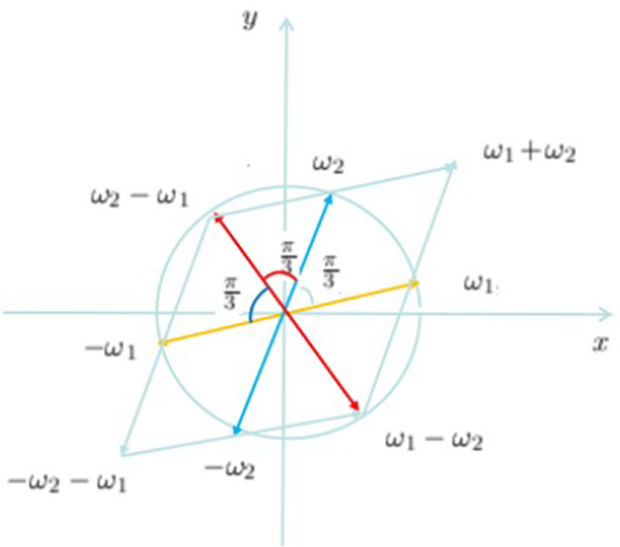
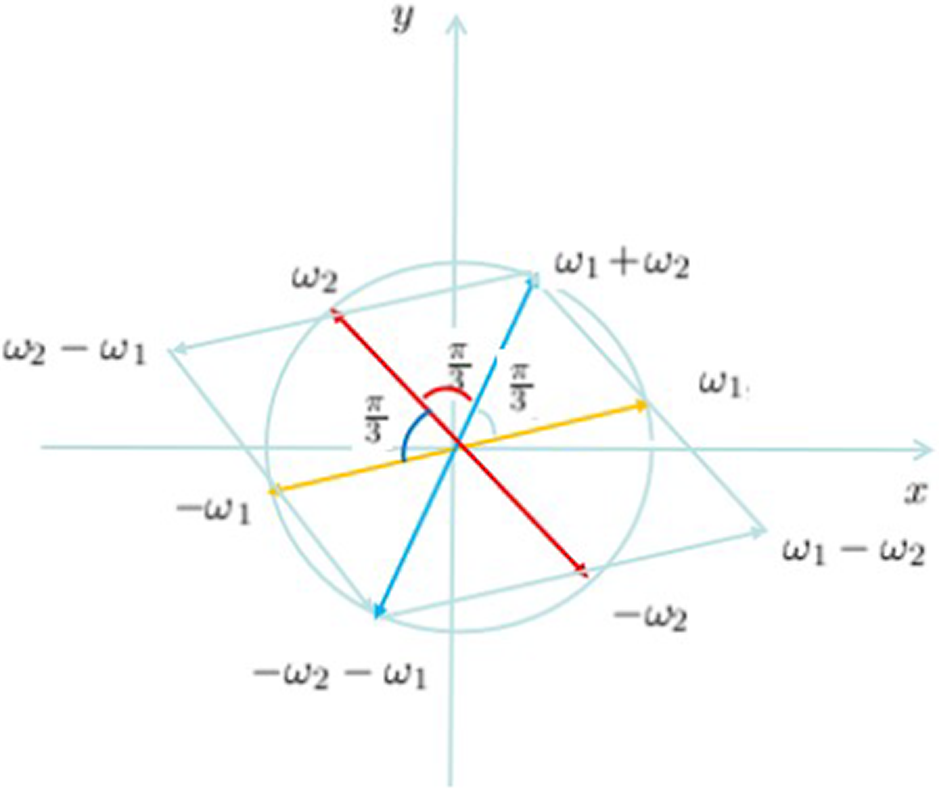

 Open access

