





1. Introduction
Older person care in many countries in the Global North is increasingly attracting private investment from institutional investors, eg. pension funds, insurance companies, banks and endowments, and from high-net-worth individuals. Both engage in what are relatively novel investment strategies for the sector (at least in countries outside the US), including private capital, growth capital and real-estate investment trusts (Borsa et al., Reference Borsa, Bejarano, Ellen and Bruch2023). While this development is lauded by some as necessary and investment and financial innovation are welcome in a sector that is putting an ever-greater strain on public finances (World Bank and IMF, 2015), there is growing concern about the implications for the equity, accessibility and quality of older person care (Appelbaum and Batt, Reference Appelbaum and Batt2020; Aveline-Dubach, Reference Aveline-Dubach2022; Gupta et al., Reference Gupta, Howell, Yannelis and Gupta2021; Walker et al., Reference Walker, Kotecha, Druckman and Jackson2022). This concern has been fuelled by reports of abysmal care delivered by private for-profit providers and claims regarding the detrimental implications of profit-seeking for quality of care in this sector (Braun et al., Reference Braun, Jung, Casalino, Myslinski and Unruh2021; Castanet, Reference Castanet2022; Grabowski et al., Reference Grabowski, Feng, Hirth, Rahman and Mor2013).
Private investors at times pressure facilities to maximise profits and/or the value of assets (such as real estate) (Hart et al., Reference Hart, Shleifer and Vishny1997), compelling them to increase revenue and reduce operational costs (Ellis and McGuire, Reference Ellis and McGuire1986), eg. by raising service charges, increasing the provider-client ratio and hiring cheaper, less-trained personnel (Appelbaum and Batt, Reference Appelbaum and Batt2020; Comondore et al., Reference Comondore, Devereaux, Zhou, Stone, Busse, Ravindran, Burns, Haines, Stringer, Cook, Walter, Sullivan, Berwanger, Bhandari, Banglawala, Lavis, Petrisor, Schunemann, Walsh, Bhatnager and Guyatt2009; Walker et al., Reference Walker, Kotecha, Druckman and Jackson2022). Other scholars have shown that the growth of private investment and the concomitant financial strategies often decrease the accessibility of services and concentrate facilities geographically, resulting in increased travel times to and from care provision (Aveline-Dubach, Reference Aveline-Dubach2022). Yet others point out that private investment is detrimental to equity in care, as it is generally funnelled to facilities catering for better-endowed patients who can pay the premium charged for such services, leading to greater health and social care disparities between the haves and have-nots in society (Gupta et al., Reference Gupta, Howell, Yannelis and Gupta2021).
Yet while evidence accumulates concerning the pros and cons of private investment in long-term care, we know little about how policymakers and regulators are addressing (or ignoring) this issue. One notable exception is Tracey et al. (Reference Tracey, Schulmann, Tille, Rice, Mercille, Timans, Allin, Dottim, Syrjälä, Sotamaa, Keskimäki and Rechel2025), who have analysed how various countries in the Global North regulate private equity in healthcare at large. There is a pressing need to better understand the policies and regulations addressing private investment and concomitant financial strategies in residential long-term care, given that many countries increasingly rely on the private sector to finance long-term care facilities (Bayless, Reference Bayliss2016; Mercille, Reference Mercille2024). In this study, we have three major aims. First, we want to document the manifestations and evolution of private investment, profit-making and the use of innovative financial strategies within the residential long-term sector as well as the polices prompting this development. Second, we analyse the perceived and demonstrated regulatory challenges prompted by private investment, profit-making and financial innovation in four constituencies: Ontario, Lombardy, England and the Netherlands. Third, we want to show how in response to these challenges some regulatory measures have been taken. The research question we pose is: ‘what regulatory challenges have emerged from private investment in residential long-term care and how are these addressed by regulators and policy makers in Ontario, Lombardy, England and the Netherlands?’.
We draw on a political-economic analysis framework and the concept of financialisation to analyse the evolution of private investment in residential long-term care facilities (Mercille, Reference Mercille2024). In this paper, financialisation refers to the processes through which large private investors change the institutional logic and inner workings of economic sectors within society (Davis and Kim, 2025; van der Zwan, Reference van der Zwan2014). The political-economic framework we apply allows us to consider the mechanisms through which private investment finds its way to residential long-term care in different institutional frameworks, as well as any emerging power struggles and controversies between asset holders and other stakeholders in long-term care, such as care professionals, clients and regulators. We also show how policymakers and regulators at times respond to these emerging controversies with new regulatory frameworks and legislation.
2. Financialisation in healthcare
Financialisation refers to a distinct economic modality, ‘the increasing role of financial motives, financial markets, financial actors and financial institutions in the operation of the domestic and international economies’ (Epstein, Reference Epstein and Epstein2005, p. 3). Financialisation has been spurred by macro-economic changes, such as the rise of institutional investors (eg. pension funds, insurers, endowments), the deregulation of the financial sector, austerity measures, limited public investment and the purchasing of social provisions from market parties, as well as advances in financial strategies, such as private equity investment, growth and venture capital and novel financial products (Davis and Kim, Reference Davis and Kim2015; Vural, Reference Vural2017). In the era of financialisation, the focus is not solely on selling services and products for-profit; rather, financial engineering, defined as the development of novel financial strategies and financial products, is quintessential to the accumulation of economic value (Hoppania et al., Reference Hoppania, Karsio, Näre, Vaittinen and Zechner2024). Financialisation has changed the organisation of healthcare; new financial actors have entered the field and use novel financial strategies to accumulate wealth. Scholars have, for instance, described how long-term care facilities and hospitals in various countries were transformed into tradeable financial assets (Horton, Reference Horton2021; Vural, Reference Vural2017).
A distinct characteristic of financialisation is the focus on maximising value for asset holders across the economies (Davis and Kim, Reference Davis and Kim2015). This can take the form of maximising shareholder value in a publicly listed company, or maximising ‘membership interests’ in a limited liability organisation. The goal of optimising value for asset holders acts as an incentive for financial engineering, unrestricted company growth and efforts to improve cash flow (Davis and Kim, Reference Davis and Kim2015; Hoppania et al., Reference Hoppania, Karsio, Näre, Vaittinen and Zechner2024). One potential implication of this economic rationale is that interests of assets holders are prioritised above those of other stakeholders (eg. customers, employees or the community at large). Hence, financialisation leverages a distinct economic rationale that transforms the way organisations operate (Bryan and Rafferty, Reference Bryan and Rafferty2014; van der Zwan, Reference van der Zwan2014; Vural, Reference Vural2017). Scholars have, for instance, shown that the financialisation of real-estate results in more aggressive efforts to increase tenant turnover and raise rents, often causing living conditions to deteriorate (White, Reference White2024). Scholars drawing on financialisation literature are interested in how processes of wealth accumulation affect the everyday life of people in terms of health and social care and what the consequences are for other stakeholders (Davis and Kim, Reference Davis and Kim2015; van der Zwan, Reference van der Zwan2014).
Political-economic analyses of financialisation emphasise that the state is often compliant with corporate financial power (Pagliari and Young, Reference Pagliari, Young, Mader, Mertens and van der Zwan2020). Reforms and policy changes, including the deregulation of the financial sector, have facilitated the growth of the corporate financial sector and its instruments in domains traditionally covered by public services (Kripper, Reference Krippner2012), although the state occasionally takes action that foregrounds the interests of other social groups (Dow, Reference Dow, Mader, Mertens and van der Zwan2020). Nevertheless, the common trend in most countries in recent decades has been one of neo-liberal reform spurring financialisation. This process is highly ideological, structuring beliefs that legitimise particular configurations of power (McGregor, Reference McGregor2001; Rotarou and Sakellariou, Reference Rotarou and Sakellariou2017). Political-economic analyses of financialisation show that ideologies – eg. maximising value for the asset holder and the need for austerity measures and market parties in the provision of public goods – legitimise the power of financial actors vis-à-vis other social groups in society.
Ideologies of financialisation may be contested, at times in the political arena and at other times by those bearing the brunt of the increasing economic power of financial corporate elites (Laskaridis et al., Reference Laskaridis, Legrand, Toussaint, Mader, Mertens and van der Zwan2020). Political-economic analyses consider the operation of power and the concomitant power struggles between asset holders and other social groups within particular domains (Mercille, Reference Mercille2024). In long-term care, these power struggles arise between providers of capital and not-for-profit healthcare organisations (struggles for a public versus a private system), regulators (tensions between maximising profit and adhering to regulations), care workers (struggles about wages and working conditions) and clients (struggles over quality and cost of care). In this paper, we examine how regulators and policy makers respond to the power struggles between asset holders and other stakeholders in long-term care.
3. Methods
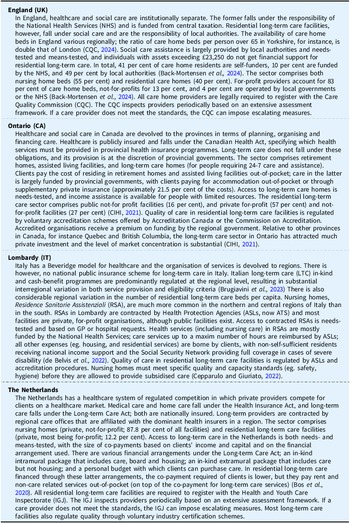
We selected constituencies based on different institutional arrangements of long-term care (Table 1). In the Netherlands, long-term care is nationally insured and all nationals requiring 24-7 care and assistance are entitled to long-term care. In Canada, Italy and England, long-term care is not nationally insured and is subject to differing institutional governance structures. In Italy and Canada, the responsibility for organising and regulating residential long-term care lies with the regions (Italy) and provinces (Canada), with pronounced interregional or provincial variation in per-capita bed supply, ownership structure and regulatory policy. Accordingly, this policy comparison centres on Lombardy (northern Italy) and Ontario (Canada), although we do contextualise the unique characteristics of these regions. We do not pretend in this analysis that Lombardy or Ontario are representative of the situation regarding long-term care in their respective country. We use both subnational jurisdictions to reveal aspects of the emergence, impact and regulatory responses to private investment and profit making within the context of highly decentralised health systems.
Institutional arrangements for residential long-term care in selected countries

In our research, we adapted the political-economic framework developed by Mercille (Reference Mercille2024), which conceptualises various dimensions of long-term care in which power struggles emerge between asset holders and other relevant actors in healthcare. We focused in particular on the dimensions characteristic of power struggles with regulators, such as private investment and the dimension of ownership structures, policies facilitating private investment and profit-making, controversies emerging from private investment and profit-making and the concomitant responses of regulators. Based on these dimensions, we formulated research questions to guide data collection. We then searched for white papers, grey literature and academic papers to answer these questions and supplemented our corpus with documents cited in the materials retrieved through the initial queries. The second, third, fourth and fifth authors then created constituency-specific reports, answering the various research questions formulated on the basis of our analytic framework.
The data analysis progressed iteratively, moving back and forth between theory and data and developing emerging analytical themes. It proceeded through various analytical steps, modelled on the thematic analysis by Clarke and Braun (Reference Clarke and Braun2017). First, all authors read the country-specific reports to familiarise themselves with the data. Second, the authors went through various rounds of coding the data. The first author coded the data in vivo and then proceeded with focused coding, selecting those codes that provided answers to our formulated research questions. This initial focused coding was discussed in the research team and the second, third, fourth and fifth authors revisited their country-specific reports and looked for ill-fitting data (data that contrasted with the emerging themes). These ill-fitting fragments of data were then discussed in the research team and the emerging themes were adjusted to explain these contrasting findings. Finally, the first author developed a narrative connecting the various emerging themes, which was then discussed in the research team.
4. Results
The empirical section is structured along three axes: (1) policies driving private investment and profit-making in residential long-term care, (2) the presence of private investment and profit-making in residential long-term care, and (3) novel financial strategies, power struggles, controversies and new regulation.
4.1. Policies driving private investment and profit-making in residential long-term care
Neoliberal policy reforms, legitimised through austerity and market efficiency discourse, have paved the way for private investment in residential long-term care in all four constituencies. In Ontario, the growth of private investment in long-term care was prompted by the introduction of a competitive bidding process in which both private and public long-term care providers submitted tenders for nursing-home beds. This resulted in a large influx of private investment in long-term care and market concentration, with a small number of globally operating chains acquiring an increasing number of long-term care facilities (Armstrong, Reference Armstrong, Armstrong and Braedley2023). Similar market-oriented reforms occurred in Italy’s Lombardy region and in England. In Lombardy, the 31/1997 law separated planning, purchasing and oversight from the actual provision of care. These functions were delegated to ASLs (health protection agencies), which purchase care from and manage contracts with both public and private healthcare providers. Large private healthcare groups and real-estate finance firms began investing in long-term care (LTC) facilities in the early 2000s (Garattini et al., Reference Garattini, Badinella Martini and Nobili2021). Since 1990, England has likewise outsourced long-term care primarily to private for-profit providers. In these constituencies, the institutional changes described above created a market for long-term care facilities and new affordances for private investment in the sector.
The size of private investment in long-term care differs by region in Canada and Italy, largely because long-term care in these countries is organised by provincial/regional governments and regional policies vary in the extent to which they allow for-profit operators to provide services. In Italy’s southern regions, long-term care facilities are generally sparse and even fewer are run by globally operating corporations. Lombardy, however, situated in northern Italy, has a relatively large private-sector of long-term care facilities (Garda, Reference Garda, Casti, Adobati and Negri2021). Canada displays similar, albeit narrower, variation in the extent to which residential long-term care facilities attract private investment, depending largely on whether provincial governments have implemented policy instruments that spur the growth of the for-profit sector (such as competitive bidding in tenders for nursing home beds). Quebec, for instance, has a largely publicly-owned long-term sector, and the share accounted for by public long-term care facilities has risen over the last two decades (Bravo et al., Reference Bravo, Dubois, Demers, Dubuc, Blanchette, Painter and Corbin2014). By contrast, Ontario has long had a substantial for-profit residential long-term care sector, including large internationally operating chains. Competitive licencing of new beds, capital construction subsidies and long operating licences have facilitated private investment and consolidation in this province. Recent bed-expansion and licence-renewal rounds have further spurred the growth of the for-profit sector (CIHI, 2021; Ministry of Long-term Care, 2025).
In the Netherlands, the influx of private investment in residential long-term care followed a different route. Before 2007, nursing home care was funded through lump-sum, in-kind intramural packages that banned profit distribution to third parties, making the sector de facto non-profit. In 2007, extramural packages were introduced that fund care (eg. medical care, pharmaceuticals) but not accommodation, while the profit ban on conventional intramural care remained (De Brabandere et al., Reference De Brabandere, Schuurmans, van der Woerd, Bal and Wallenburg2025; Bos et al., Reference Bos, Kruse and Jeurissen2020). Residential facilities financed via extramural packages and personal budgets are exempt from the ban, creating a new market for for-profit providers.
Besides opening up the long-term sector for private investment, other adjacent neo-liberal policies benefitted asset holders in this sector. In Canada, for instance, the deregulation of rent control and vacancy control has made it easier to evict people from homes and to increase rents. This has spurred investment in retirement living properties, as these reforms increased profit-making opportunities in these facilities (August, Reference August2022). In the Netherlands, growth was spurred in the for-profit residential LTC sector owing to a cap on the number of beds in conventional nursing homes, even as demand has risen due to the growing number of older persons requiring 24-7 care and assistance. At the same time, co-payments are means-tested, with higher income groups paying significantly more for care in conventional nursing homes than in long-term care financed from extramural packages (Bos et al., Reference Bos, Kruse and Jeurissen2020). As a result, people with highly complex care needs often enter the conventional nursing home sector while those with less complex care needs and the financially better-endowed tend to flock to small residential long-term care facilities, a large proportion of which are financed by private investors.
4.2. The presence of private investment and profit making in residential long-term care
The share of for-profit providers in the residential LTC sector varies widely across jurisdictions. Italy’s Lombardy region had 729 nursing homes (RSAs) operating in 2024 (CISL DEI LAGHI, 2025); 92.5 per cent are private, with 46 per cent of these being owned by a large chain providing various healthcare services and 14 per cent by limited liability companies (Garda, Reference Garda, Casti, Adobati and Negri2021). In England, for-profit providers account for 83 per cent of care home beds, the voluntary sector for 13 per cent, and the remainder (4 per cent) are run by local-government or the NHS (Competition and Markets Authority, 2017). In Canada, long-term care is not covered by the Canadian Health Act with the implication that each subnational jurisdictions (provinces) have under their responsibility to plan and support financially this sector. In Canada, there are 2,076 LTC homes nationally, with the ownership split being 29 per cent private for-profit, 23 per cent private not-for-profit, and 46 per cent public; Ontario has 627 LTC homes, with 57 per cent private for-profit, 27 per cent private not-for-profit, and 16 per cent public (CIHI, 2021). British Columbia has a total of 308 long-term care homes with as much facilities that are owned by the government than by the private for profit sector. All residential care facilities in New-Brunswick, a smaller province, are owned by private for-profit groups. In this analysis, we focus on Ontario as one jurisdiction to probe empirically the development and impact of the growth of private investments in the long-term care sector without assuming that provinces with much less private financing, Quebec for example, do not face their own challenges. In the Netherlands, the number of for-profit nursing-home locations expanded from roughly 120 in 2014 to 291 in 2018 and about 550 in 2023, still modest compared to the approximately 2,355 non-profit residential locations (19 per cent of the total number of residential LTC facilities are for-profit), reflecting a gradual but notable shift in market composition (Krabbe-Alkemade et al., Reference Krabbe-Alkemade, Makai, Portrait, Kemp and Canoy2025).
Due to the specific institutional structure in the Netherlands, conventional nursing homes offering 24-7 care and assistance are largely non-profit and cater for individuals with the most complex care needs. In Ontario, Lombardy and England, where profit-making and profit distribution to shareholders are permitted in intramural long-term care, private investment also extends to conventional nursing homes that provide 24-7 care for all clients with complex needs.
In all respective constituencies in this analysis, private investors and for-profit facilities are gaining a larger presence in the residential long-term care sector, albeit with noticeable differences in pace and scale. Broadly speaking, constituencies with older markets for long-term care facilities also have a higher proportion of for-profit facilities in this sector, as well as a greater concentration of market power by internationally operating corporations. Path dependencies in the institutional arrangement of long-term care also persist. The Netherlands and, to a lesser extent, England and Ontario (and Canada at large) traditionally have institutionalised long-term care in residential facilities, whereas in Italy long-term care is often provided at home by informal caregivers (albeit with major regional differences).
Private investment in care tends to focus on services amenable to standardisation and replication, thereby lowering operational costs and widening profit margins (White, Reference White2024; De Brabandere et al., Reference De Brabandere, Schuurmans, van der Woerd, Bal and Wallenburg2025). Private investment is most common in high-margin care segments, eg. early-onset dementia care, because these client groups often require less qualified (and less paid) personnel. These ‘cream-skimming’ practices (selecting patients with relatively uncomplicated care needs) are reflected in the admission criteria of for-profit long-term care facilities. In the Netherlands, for instance, a chain of long-term care residential facilities offers dementia care, but generally excludes individuals with ‘Korsakoff syndrome, frontotemporal dementia, or Lewy body dementia, as these conditions are psychogeriatric in nature and demand specific expertise – requiring high-intensity labour and specialised knowledge associated with higher costs (De Brabandere et al., Reference De Brabandere, Schuurmans, van der Woerd, Bal and Wallenburg2025). Similar dynamics can be found in England, where market pressure creates strong incentives to attract self-funders and lower-complexity residents (CMA, 2017). In Lombardy, service charters of for-profit providers explicitly list exclusion criteria (eg. acute delirium, certain psychiatric conditions) and route people with more complex care needs to specific facilities (PAT, 2025). It is unclear whether cream-skimming practices are a feature of the for-profit residential LTC sector in Ontario, although the existence of specialised behavioural units suggests that many residential LTC facilities are not equipped to care for patients with the most complex care needs (Ontario Health atHome, 2024).
4.3. Novel financial strategies, power struggles, controversies and new regulation
The mechanisms through which private investment flows into the long-term care sector in the respective constituencies, and the resulting consequences for clients, care professionals and other healthcare providers, shape specific power struggles. Private investment and profit-making in nursing home care in Ontario, Lombardy and England drive cost-cutting practices in an already underfunded long-term care system this shift the burden onto care workers and residents. As a result, controversies over quality of care arise, and power struggles surface in disputes. In the Netherlands, where for-profit nursing homes mainly serve well-off residents and have emerged in a landscape largely dominated by not-for-profit providers, power struggles play out in disputes between professional groups (such as general practitioners and elderly-care physicians) and between for-profit and not-for profit care home organisations, culminating in controversies over access to care. Regulatory responses to the aforementioned controversies are reactive, fragmented and often symbolic, highlighting the limited political capacity, or will -as we will illustrate later-, to confront asset holders’ interests. In the respective constituencies in our study, (new) regulation serves to address some, but definitely not all, of the adverse effects of private investment and profit-making in the long-term care sector. However, most approaches are soft, hidden, and at times exploratory – evidence of a broader hesitation among policymakers to regulate private investment in residential long-term care and to rein in its more damaging effects.
In all respective constituencies in our analysis, the global mobility of financial capital enables for-profit care providers to engage in regulatory arbitrage, exploiting fragmented national tax systems to maximise profits. They do so by establishing subsidiaries in well-known tax-havens, such as Luxemburg and Jersey (CICTAR, 2023; Pena and Rico, Reference Pena and Rico2021). International nursing-home chains such as Revera and Domus Vi, which operate facilities in England, Ontario and the Netherlands, have faced fierce criticism for their aggressive tax-avoidance strategies (CICTAR, 2023; Cochrane and Sanger, Reference Cochrane and Sanger2022). Beyond routing profits to tax havens, long-term care providers have used various ‘financial innovations’ to exploit regulatory and tax ambiguities so as to boost returns for asset holders, including REIT structures, in which a real-estate entity owns facilities and leases them to care providers (Cordilha, Reference Cordilha2021). REITs can lower investors’ tax burdens while enabling providers to raise capital, expand capacity and grow their businesses (Lewis, Reference Lewis2022). In the constituencies in this analysis this is controversial, because of public discourses placing a greater moral scrutiny on care organisations vis-à-vis other commercial enterprises, underpinned by an assumption that care organisations should prioritise the common good above the interests of shareholders.
Yet another financial strategy used by financial actors in the residential long-term care sector to accumulate wealth for asset holders is debt leverage, the financing of a company’s growth primarily with loans. As a result, much of the company’s cash flow often goes to servicing debt (interest, fees, covenants) rather than to supporting or improving care operations. This strategy is often used by private equity (PE) funds to acquire other care providers, allowing owners to extract value through dividends, fees and asset deals while shifting heightened insolvency and operational risks onto the firm (van der Zwan, Reference van der Zwan2014). The use of debt financing shows in the ratio of paid interest per bed. The largest not-for-profit care home providers in England, for instance, pay £19 per bed per week in interest, whereas the largest for-profit PE-financed care homes pay interest costs of £102 per bed per week. Debt financing by private equity firms often goes hand-in-hand with an increase in payouts to the owners, often a PE company. Bayliss and Gideon (Reference Bayliss and Gideon2020) show that a nursing home owned by a private equity fund paid around 48.5 million pounds in dividends, despite declaring operational losses for years. Similar patterns appear elsewhere: in Ontario, major for-profit operators disclose sizeable quarterly interest charges (order of magnitude translating to roughly C$75–130 per bed per week, depending on how beds are counted) (Sienna Senior Living, 2025).
Proponents of debt leverage argue that it imposes market discipline and therefore incentivises efficient organisation of care (Palepu, Reference Palepu1990). The drive for efficiency often translates into pressure to cut operational costs, however, eg. by reducing staffing ratios and by hiring cheaper and less-qualified staff. In England, the use of debt financing and the resulting rise in interest payments, combined with prolonged local-government austerity, has sparked major controversies. Prime examples are the failures of two large for-profit nursing home chains, Southern Cross Healthcare and Four Seasons, which affected tens of thousands of residents and triggered sector-wide restructuring. This controversy prompted policy debates about the risks of financial mismanagement of organisations that are ‘too large to fail’. As a results, policy makers sought new levers to regulate the financial position of large care organisations. This resulted into the development of a ‘market oversight regime’, in which the Care Quality Commission (CQC) has the mandate to monitor finances of large care organisations. A heatedly debated issue during the development of the market oversight regime concerned the breadth and depth of the intervening powers of the CQC in instances of severe and enduring financial turmoil. Questions were posed whether the CQC, as a last resort, should have the mandate to intervene in the ‘commercial processes to support continuity of care’ of providers (DHSC, 2013, p.18). However, many of the consulted parties (eg. care providers, banks, consultancy firms, interest groups, local authorities) felt that this mandate would impinge too greatly on freedom of enterprise. As a results, it was decided that the final step in the escalation ladder of the market oversight regime was an independent review of the provider’s financial sustainability, but without the mandate to enforce compliance with this plan. What this discussion shows is the vested belief among actors in the policy making process that only ‘light’ regulation on commercial processes is needed to address financial risks of debt accumulation.
Cost-cutting pressures imposed by asset holders often create tensions among owners, asset holders, management and workers (especially nurses). Unions in Italy, the UK and Canada have advocated for better worker rights and improved labour conditions in for-profit care homes (CFNU, 2024; Ciarini and Neri, Reference Ciarini and Neri2021; GMB Union, 2023). Unions and advocacy groups in Canada have also called for the phasing out of for-profit ownership to protect care quality (Braedley, Reference Braedley2024; Cochrane and Sanger, Reference Cochrane and Sanger2022; Proactive Investors, 2020). The degree to which these union demands have been heeded differs across the constituencies covered in this analysis. In Lombardy (and Italy more broadly), they led to the renewal of a collective labour agreement for private sector care workers (Ciarini and Neri, Reference Ciarini and Neri2021). In Ontario, the government has not yet accommodated these demands, but they have allocated additional funds to nursing homes to address low staffing levels and related quality concerns (Armstrong, Reference Armstrong, Armstrong and Braedley2023).
In Ontario, England and Lombardy, efforts to maximise value for asset holders put pressure on long-term care facilities to reduce operational costs, generally leading to worsening labour conditions and lower quality of care (August, Reference August2022; Ciarini and Neri, Reference Ciarini and Neri2021; Yalnizyan, Reference Yalnizyan2024). In England, research shows that for-profit care homes receive significantly lower overall quality ratings than not-for-profit providers; among for-profit models, private equity-financed homes are more likely to have lower scores for safety and person-centred care (Patwardhan et al., Reference Patwardhan, Sutton and Morciano2022).
Other scholars have shown that care homes in England subject to involuntary closure by the CQC for severe quality issues are mainly for-profit homes. The indication is that inadequate funding pushes not-for-profits out of business, whereas for-profit care homes simply reduce their expenditure on care (Bach-Mortensen et al., Reference Bach-Mortensen, Goodair and Degli Esposti2024). Concerns about safety also surfaced during the Covid-19 pandemic, with for-profit long-term care facilities in Ontario and Lombardy reporting higher mortality rates than not-for-profit providers (Ciarini and Neri, Reference Ciarini and Neri2021; Yalnizyan, Reference Yalnizyan2024). As a result, Ontario introduced enhanced reporting requirements on operational standards for long-term care facilities (Raza and Palmer, Reference Raza and Palmer2024). In Lombardy, by contrast, this did not lead to stricter quality regulations. It is worth noting, however, that severe quality issues and high mortality rates also occurred in Quebec, a Canadian province where residential long-term care is predominantly publicly-owned. Such mixed evidence for the effects of private investment and profit-making on care quality suggests that outcomes are shaped not only by ownership and financing models, but also by governments’ willingness to fund care adequately.
To date, the influx of private investment and for-profit long-term care facilities in the Netherlands has not sparked major controversies over poor quality, rather controversies have emerged over accessibility of care. Limited research on the subject suggests no differences in quality of care between for-profit and not-for-profit providers (Bos et al., Reference Bos, Kruse and Jeurissen2020; Krabbe-Alkemade et al., Reference Krabbe-Alkemade, Makai, Portrait, Kemp and Canoy2025). This likely reflects institutional arrangements in which these facilities primarily serve financially better-off residents as well as the relatively generous public funding available for extramural care packages. Instead, controversies in the Netherlands centre on who is responsible for providing medical care in these new facilities. Under the Health Insurance Act, GPs are responsible for basic medical care in extramural long-term care packages, which many for-profit facilities use. By contrast, medical care in conventional nursing homes falls under the Long-term Care Act and is provided by elderly care physicians (a distinct professional group), typically employed by large, not-for-profit providers. In the not-for profit nursing home sector the task distribution between different professional groups was settled, however the growth of the for-profit sector prompted questions about who is responsible for medical care in these facilities. Decades of policy changes that moved care from hospitals to primary care have already overburdened GP practices; the rapid growth of for-profit facilities adds further pressure, as GPs are pushed to care for more older people with long-term needs. Consequently, a significant percentage of GPs refuse to provide basic medical care to residents financed via extramural packages (Schuurmans et al., Reference Schuurmans, Stalenhoef, Bal and Wallenburg2023), and their professional organisation has repeatedly stated that this type of care should be provided by elderly-care physicians. At the same time, not-for-profit providers and elderly-care physicians are reluctant to cover these new, capital-financed facilities, mainly because of large personnel shortages of medically trained professionals in the not-for-profit sector, leaving some for-profit homes unable to secure medical care and therefore partially or entirely unoccupied.
These issues have prompted a search for new instruments to regulate the accessibility of medical care in the Netherlands’ highly decentralised and corporatist healthcare system. One such new regulatory instrument is a covenant between professional organisations (eg. between GPs and elderly-care physicians, industry associations and health insurers) specifying the tasks and responsibility of the different medical professionals and the organisational prerequisites for providing medical care in these facilities (eg. a triage system, skilled care teams, and 24-7 availability of specialist geriatric expertise). Alongside this covenant, other local, and more informal, regulatory instruments have been introduced to regulate the admission of new for-profit long-term care facilities. In several regions, care offices have acted in concert with municipal authorities, local GP associations and conventional nursing homes to develop roadmaps for new parties in the long-term care market. The roadmaps specify the care provisions that must be in place before a facility can open as well as the zoning regulations, indicating that failure to comply may result in the municipal authorities refusing to issue building permits. Parties use the roadmaps to enforce the care provisions, although the legal status of this instrument is debated.
5. Discussion
In this paper, we have built on calls to explore regulatory responses to private investment and profit-making in the long-term care sector (Mercille, Reference Mercille2024). We drew on theories of financialisation conceptualizing how this economic epoch is characterised by a push to maximise value for asset holders through various financial strategies. We also drew on a political-economic framework highlighting the power struggles (conflicts about who gets what) emerging from the growth of private investment in residential long-term care. Private investment and profit making in residential long-term care is growing in all respective constituencies in this analysis, but the trajectories and manifestations of this process are shaped by national and regional institutional contexts and policy choices, prompting path dependencies in power struggles, controversies and regulatory responses. In Ontario, Lombardy and England, the prioritising of asset holder value in residential long-term care often resulted in pressure to cut operational costs by concluding flexible labour agreements, hiring cheaper and less qualified personnel and increasing patient-to-staff ratios. In these constituencies, private investment and profit making resulted in labour conflicts between management and staff and in controversies related to the quality of care. Where regulators responded at all, they addressed these quality-of-care controversies. We are not saying that problems of quality of care in publicly owned facilities and tensions between payors, managers and workers cannot develop. Our analysis suggests that, to compensate persisting problems within the long-term sector in numerous jurisdictions, the reliance on private investments and privately owned facilities has its own limitations and may bring benefits only under very specific circumstances. In the Netherlands, the influx of private investment in residential LTC emerged relatively late in a sector dominated largely by not-for-profit nursing homes. These new facilities mainly cater for financially better-endowed individuals. This has so far not resulted in a drastic reduction in operational costs that would jeopardise quality of care. Rather, in this institutional context tensions emerged between for-profit care facilities, professional organisations and conventional not-for-profit nursing homes around accessibility of care. Regulatory responses in the Netherlands thus far mainly address accessibility issues in long-term residential care. What this analysis shows is that regulators and policy makers in each of the constituencies in this analysis have responded reactively to emerging controversies stemming from private investment and profit-making in residential long-term care, rather than proactively anticipating unwanted effects.
Various scholars have analysed the influx of private equity in long-term care and its implications for quality, affordability and accessibility (Bos and Harrington, Reference Bos and Harrington2017; Gupta et al., Reference Gupta, Howell, Yannelis and Gupta2021; Ronald et al., Reference Ronald, McGregor, Harrington, Pollock and Lexchin2016). While taking a particular type of ownership structure as the unit of analyses has benefits in that it is relatively easy to delineate compared to the somewhat abstract and opaque concept of ‘financialisation’, we believe focusing solely on private equity misses operational dynamics that span different ownership types. For example, debt financing of real-estate through REIT models (with the affiliated high interest payments) is common practice for many for-profit nursing homes (whether PE, partnership models or publicly listed companies) and at times even for not-for-profit facilities (Horton, Reference Horton2021; Walker et al., Reference Walker, Kotecha, Druckman and Jackson2022). Similarly, cutting operational costs and opting for market differentiation and specialisation are strategies used across the board in the for-profit care home sector (Bos and Harrington, Reference Bos and Harrington2017). What these findings show is that a narrow focus on ownership types as a unit of analysis fails to uncover the depth and breadth of financial strategies and financial instruments used in the residential long-term care sector. In our view, financialisation – understood as the strategies used to maximise value for asset holders – offers a more astute conceptualisation of the pronounced structural changes taking place in the long-term care sector and their impact on quality of care and accessibility.
While our analysis shows that controversies in the for-profit residential long-term care sector in England, Lombardy and Ontario tend to be about quality of care, we are hesitant to make a direct causal connection between quality concerns and the surge in private investment, profit-making and the prioritising of value for asset holders. In the Netherlands, preliminary evidence does not indicate that the for-profit residential LTC sector is underperforming in terms of care quality (Bos et al., Reference Bos, Kruse and Jeurissen2020; Krabbe-Alkemade et al., Reference Krabbe-Alkemade, Makai, Portrait, Kemp and Canoy2025). Rather, the issue here is that the extramural care packages (the funding source of for-profit care homes) are relatively generous, and that the for-profit sector in the Netherlands mainly serves the financially better-off echelons of society, who are willing to pay the premium that such facilities charge. Likewise, quality concerns in the residential LTC sector in Quebec, which is largely a not-for-profit sector, indicate that the main driver for low quality of care in this jurisdiction is primarily inadequate public funding for people requiring 24-7 care and assistance, and not profit-making and innovative financial strategies per se. Nevertheless, research shows that in a context of severe underfunding, for-profit facilities have a greater propensity than their not-for profit counterparts to compromise on care quality in order to maintain or enhance value for asset holders (Bach-Mortensen et al., Reference Bach-Mortensen, Goodair and Degli Esposti2024; Ronald et al., Reference Ronald, McGregor, Harrington, Pollock and Lexchin2016). The for-profit sector is also heterogeneous, however, comprising small owner-operated businesses, publicly listed companies and private equity-backed care providers. Mounting research shows that it is the latter in particular that tend to compromise on care quality (Orewa et al., Reference Orewa, Karabukayeva, Pradhan, Jimoh and Weech-Maldonado2025; Patwardhan et al., Reference Patwardhan, Sutton and Morciano2022). The likely issue here is that private equity-financed residential LTC operators are primed to short-term value gains for asset holders and are organised in such a way that internal countervailing forces, eg. supervisory boards, worker and client councils and shareholders, are limited compared to other ownership types.
Private investment and profit-making have some negative consequences in long-term care but also much to offer. As our results show, in residential LTC in a context of severe underfunding, they can result in care quality being compromised in favour of generating value for asset holders. Still, as the rapid expansion of for-profit care facilities by large operators in the Netherlands shows, private investment and the concomitant financial strategies can also drive the upscaling and development of new care facilities at a pace that is likely to be impossible for publicly funded care systems. Furthermore, the residential long-term care sector is heavily reliant on infrastructures built and maintained by for-profit providers, think for instance about medical and care supplies, electronic patient records, recruitment agencies and workforce training organisations. Private investment and profit making are quintessential to a well-functioning long-term care sector. In addition, private investment and profit-making likely have much to offer in other healthcare sectors. Examples include specialised medical clinics that offer care at lower cost and greater convenience (Robbins et al., Reference Robbins, Rudsenske and Vaughan2008) and innovative and effective pharmaceuticals (de Vrueh and Crommelin, Reference de Vrueh and Crommelin2017).
The trend towards private investment and profit-making in the residential long-term care sector is unmistakeable and gaining momentum, not only in the constituencies included in this analysis, but also in most countries in the Global North (Aveline-Dubach, Reference Aveline-Dubach2022; Cordilha, Reference Cordilha2021; Gupta, et al., Reference Gupta, Howell, Yannelis and Gupta2021). Given the growing demand for long-term care services as well as the increasing pressure on public finances, we expect this trend to continue apace and the amount of private investment in the residential LTC sector to grow rapidly in concert with market concentration, as we have seen in Ontario, England and Lombardy. What is required in this context is the development of an institutional context that can ameliorate the adverse effects of private investment and profit making in the residential LTC sector. Our analysis provides various levers for thinking through potential policy and regulatory measures. First and foremost, funding for people requiring 24-7 care and assistance should align with the actual cost of care. Our analysis has shown that quality-of-care controversies emerge when the long-term care sector is underfunded. Second, current quality regulations should be reinforced, eg. by giving national quality regulators the resources needed to build extensive assessment frameworks and inspection capacity, as well as the legal mandate to enforce operational quality improvements. The care process in residential long-term care is subject to a regulatory regime of this kind in England and the Netherlands, and other constituencies would benefit from such an approach. While research indicates that even the far-reaching regulation of quality as it exists in England is not enough to address the risks of profit-making in a context of severe austerity (Bach-Mortensen et al., Reference Bach-Mortensen, Goodair and Degli Esposti2024), administrators have other levers to work with besides the aforementioned. Evidence shows that systems combining not-for-profit and for-profit residential LTC providers, with the former as the dominant provider type, have the best outcome in terms of care quality (Ronald et al., Reference Ronald, McGregor, Harrington, Pollock and Lexchin2016). As our analysis shows, one of the strengths of the Dutch long-term care system is the large not-for-profit nursing home sector, which mainly serves patients with more complex needs and less financially endowed individuals. Public investment in many constituencies should be aimed at developing a substantial not-for-profit residential long-term care sector that caters specifically for people with complex care needs as well as the less financially privileged. Administrators could also develop policies restricting profit-making in the primary care process, eg. by earmarking funds for direct patient care and banning creaming off revenues from the primary care process and channelling these as profits to asset holders (Ronalt et al., Reference Ronald, McGregor, Harrington, Pollock and Lexchin2016). If these measures are taken in a context of a deregulated housing market, where property owners can set rents, then the profits from rents may be substantial enough to continue attracting private investment in the residential LTC sector.
Acknowledgements
We would like to thank the participants of the EHPG European-Americas meeting for their critical, engaging and thoughtful discussion. We especially like to thank professor Joseph White and Kor Grit for their comments on an earlier draft.
Financial support
The authors received no specific funding for this work. Open access funding provided by Erasmus University Rotterdam.
Competing interests
The authors declare that they have no conflicts of interest to disclose.

 Open access

