




Teotihuacan, the largest city in Classic Mesoamerica, flourished between a.d. 100 and 550 in the Basin of Mexico, with a population that went from up to approximately 40,000 people at the start of this period to about 125,000 during most of it, and that resided in over 2,300 compounds (Cowgill Reference Cowgill1997:152; Reference Cowgill2015:79, 140–143; Millon Reference Millon, Berrin and Pasztory1993:28) (Figure 1). Agriculture depended on a summer rainy season exposed to a midsummer drought and was supplemented with spring-fed irrigation systems (Maurer et al. Reference Maurer, Stewart, Kenneth and Hidalgo2022:1428; Nichols et al. Reference Nichols, Spence and Borland1991:119). Governance was likely exercised by oligarchic, kinship-based groups controlling an army that secured interregional trade corridors across Mesoamerica and that mobilized the human and material resources for the city's massive temple-building program (Carballo Reference Carballo, Hirth, Carballo and Arroyo2020:82; Cowgill Reference Cowgill1997:52). Rulers were likely supported by a religious ideology socialized through a mural tradition that made of Teotihuacan a “painted city” (Millon Reference Millon and de Antropología1972). The mural iconography integrated the temples and residential compounds on which it was displayed with the mountains, caves, and rivers in its surroundings and with the lands and the seas beyond (Vidarte Reference Vidarte1968:138).
Location of Teotihuacan residential compounds, temples, and plazas cited in this article. Drawing by the author based on Millon Reference Millon, Berrin and Pasztory1993:19, Figure 3.

A cult to water, humidity, and fertility (Nicholson Reference Nicholson, Wauchope, Elkholm and Bernal1971:408) included a female deity frequently depicted in prominent positions in murals and in monumental sculptures, leading von Winning (Reference von Winning1987:vol. 1:138) to label her as the “Great Goddess.” Her diagnostics are a frame headdress with a bird, a face or eye mask, a spider nose ornament, yellow body color, bestowing hands, a mountain-temple platform, and a cosmic tree (Paulinyi Reference Paulinyi2006:6). The cult also included a male deity with diagnostic ringed eyes, raised upper lip, a water lily on its mouth, and a thunderbolt as a lance, and was labeled as the Storm God to differentiate it from the similar Postclassic god Tlaloc (Pasztory Reference Pasztory1974:5).
The identification of Teotihuacan water and fertility deities remains problematic. The Great Goddess is often depicted with Storm God–like traits, such as ringed eyes and lance, raising questions as to her gender and identity (Mandell Reference Mandell2015:46; Pasztory Reference Pasztory and Berlo1992:310). Furthermore, scholars have identified deities with Great Goddess traits juxtaposed with other prominent traits and have labeled them as a Butterfly Goddess (Berlo Reference Berlo and Berlo1992:136) or a Bird-Butterfly God (Paulinyi Reference Paulinyi2014:30-31). Figures with partial Great Goddess or Storm God iconography can also bear torches, staffs, armor, or name glyphs, pointing to them as rulers or warriors rather than as deities (Carballo Reference Carballo, Hirth, Carballo and Arroyo2020:69; Cowgill Reference Cowgill1997:149; Millon Reference Millon and Berrin1988:115–116).
The quest for a Teotihuacan pantheon with distinct deities inhabiting a sacred realm clearly separated from that of the profane may be unfounded if religion in Teotihuacan was pantheistic and process oriented, as proposed for the Postclassic Mexica and for contemporary Mesoamerica (Maffie Reference Maffie2014:79). There is evidence for a pantheistic cosmology of water and fertility with transforming deities closely associated with priest-rulers at least since the Middle Formative period. The bas-relief of El Rey, sculpted on the cliffs of the Highland mount of Chalcatzingo, depicts a deity with a twisting plant over its head, who is sitting in a cave from which a smoke-like mist transforms into rain (Grove Reference Grove and Clark1994:169). Reilly (Reference Reilly and Clark1994:239, 249) interprets the El Rey bas-relief together with compound creatures on the face of the cliff as the depiction of portals along an axis mundi that were ritually crossed by priest-rulers, invoking the union of the planes of the cosmos to secure rain and fertility. Classic Teotihuacan iconography depicted mountains filled with water (Angulo Villaseñor Reference Angulo Villaseñor and de la Fuente1995:74), whereas the oldest stratum of the Tlaloc shrine on the summit of Mount Tlaloc contains Classic Teotihuacan sherds likely associated with a rain ritual (Townsend Reference Townsend and Carrasco1991:27). The Mexica believed that rainwater originated in the sea and transited through mountains to be charged into clouds (Broda Reference Broda1971:254; Contel Reference Contel2016:2). Attesting to this belief, Durán (Reference Durán1995:vol. 2:100) tells of a legendary experiment where a marked pumpkin was released in the coast and retrieved in the highland lake of Tenochtitlan. Chiefs clad with quetzal feather headdresses enacted a rain ritual atop Mount Tlaloc just before the rainy season that included the sacrifice of crying children, burning incense, and melting of the Mesoamerican rubber olli over seeds placed on top of a Tlaloc effigy (Broda Reference Broda1971:272; Durán Reference Durán1995:vol. 2: pp. 90–93).
Mesoamerican cosmology of water and fertility was associated with quetzal feather headdresses, greenstone jewels, olli, and mirrors that were likely conceived as autonomous agents with the power to invoke deities given their highly skillful manufacture using scarce raw materials, their trading as luxury goods across the region, and their inheritance through the generations (Gallaga Reference Gallaga, Gallaga M. and Blainey2016:44; Melgar et al. Reference Melgar, Gallaga M., Solis, Gallaga M. and Blainey2016:66; D. Miller Reference Miller and Miller2005:11; Taube Reference Taube, Clark and Pye2000a:3). It is likely that the highly crafted murals in Teotihuacan were not just mythological depictions but instruments endowed with autonomy for the passage of deities in rituals to empower the priest-rulers that were born and raised within the residential compounds in which they were painted.
The objective of this article is to explore the identity and relationship between the Great Goddess and the Storm God and the significance of this relationship for rituals of rulership. Three hypothesis are tested:
(1) Water and fertility deities were represented in passage from the underworld to mountains and clouds, transiting through portals constituted by plants, animals, artifacts, and human organs that symbolized water and fertility in their various, culturally defined forms.
(2) The Great Goddess initiated her passage in the dry season and was associated with the transit of water from the sea to the mountains and to a primordial cloud. The goddess was transformed into the Storm God at the acme of the axis mundi to fight drought, spread fertility, regreen the world, and reinvigorate humankind.
(3) Rituals of rulership used the symbolism of transformation across deities to empower priest-rulers and warriors for the invocation of rain and fertility.
These hypotheses are explored by analyzing murals across residential compounds, complemented with the analysis of polychromes and artifacts. The study focuses on murals with robust Great Goddess identification, and her attribution is validated for controversial murals (Paulinyi Reference Paulinyi2006:6). Iconography is read as semasiographic writing of signs and symbols expressing ideas and metaphysical beliefs (Colas Reference Colas2011:14). Iconography is decoded by analyzing the relationship between the signifiers that were portrayed—such as the animal and plant species—and the meaning they could have signified for the cosmology of water and fertility. Cosmological notions are further inferred by analyzing the transformations across natural indexes, metonymic signs, and symbols that could have been effected through prayer and the ritual manipulation of iconography (Leach Reference Leach1976:25, 51) (Figure 2). The meaning of arbitrary symbols is validated by establishing their possible transformation from indexes or signs with well-established meanings.
The Communication dyad. Modified from diagram by Leach Reference Leach1976:12, Figure 1.

The symbolism of portals is decoded based on validated studies of Teotihuacan iconography and by analyzing iconography in the context of (1) the natural habitat and physiology of animals and plants, (2) the material properties of minerals and meteorological phenomena, and (3) the anatomy and physiology of human organs and gestures. Analyses are supported by reference to Mesoamerican iconography, mythology, and cosmology.
Murals were inspected in situ whenever possible or were analyzed in photographs. The identification of animals and plants species and of their symbolic traits was based on literature review, field and laboratory inspections, interviews with farmers in tropical and highland Mesoamerica involved with plant cultivation and processing, and discussion with experts on ancient Mesoamerican zoology and botany (see Acknowledgments).
The article first explores the passage of the Great Goddess as water from the underworld into the sea and into the mountains to be charged into primordial clouds. Her passage through the axis mundi and her transformation into the Storm God are then explored, followed by his passage into caves and into symbolic clouds of water and fertility. Findings are then applied first to interpret the iconography of rulers and warriors as a depiction of passage rituals that imbue them with the powers of water and fertility deities and then to propose a model of the passage of deities through mirrors. The findings are discussed for the identity and gender of the Great Goddess, the interpretation of Teotihuacan iconography, and the understanding of Teotihuacan religion and cosmology.
The passages of the Great Goddess
From the underworld to the sea
A mural in Portico 2 of the Tepantitla residential compound depicts the Great Goddess as a mountain rising over a sea of red and blue volutes (Figure 3). Clams and quadruped clams with algae clinging to their shells (Angulo Villaseñor Reference Angulo Villaseñor and de la Fuente1995:78) dwell in the red volutes and starfish in the blue ones. The clams have their syphons curled, whereas the mouths of starfish are depicted by a circle (von Winning Reference von Winning1987:vol. 2:9, Figure 9c). In nature, clams dig under the sand with their foot and project a pair of syphons out to circulate water, whereas starfish crawl over sand, extruding their stomach through their mouth to engulf pray within or over the sand (Figure 4a). Clams and starfish bridge the sand with seawater, and they were likely selected as metonyms of the underworld to signify portals for the passage of the Great Goddess to the sea (Figure 2). This idea is supported by the depiction of the Circle Triplet icon that symbolizes water deities (Langley Reference Langley and Berlo1988:253, Figures 5–8) flowing off clam syphons in censer adornos and off the mouth of a starfish painted on the Great Goddess's robe (quechquemitl) in a mural in Casa Barrios (von Winning Reference von Winning1987:vol. 2:Figures 10a and 9l) (Figure 4b). The passage of the goddess as water through animal portals is signed in Tepantitla by the algae shaped like a quetzal-feathered headdress clinging from clams, a sign that can also be read in the rays of starfish.
Great Goddess. Portico 2, Tablero 3, Tepantitla. Hands are depicted dorsally with thumbs up, representing the goddess from her back. Volutes at bottom represent the sea with clams and clam-dogs, starfish, snails, and algae. At middle left, volute of incense with rising Great Goddess metonyms and reciprocating volute with falling seeds. At top center, spider descending from tree, and spiders and butterfly within tree branches. Photograph by the author.
Animals symbolizing the passage of the Great Goddess: (a) Clam in Tepantitla and Veneridae in nature. Note clam (above) with curled syphons and clam-dog (below) with anterior legs as syphons, tail as foot, and algae as tassel of quetzal feathers. Drawing by Floericke (Reference Floericke1920:67). (b) Clam in a censer adorno and starfish painted on Great Goddess quechquemitl in Casa Barrios mural. Note Triple Droplet icon flowing from syphons and from mouth of starfish. Drawing and rendering by Natalia Nájera, based on von Winning (Reference von Winning1987:vol. 2:Figure 10a) (adorno) and Gamio (Reference Gamio2017:vol. 1:330, Plate 35) (starfish). (c) Snail in Tepantitla and Triplofusus giganteus in nature. Note trumpet mouthpiece as the conch's spire, Circle Triplet icon as spire spines, and algae as feather tassel. Drawing by George Sowerby (Reference Sowerby1847:vol. 5:Plate IV). (d) Butterfly in Tepantitla and Papilio multicaudatus in nature. Note tails wings as streams of liquid. Drawing by Carlos Beutelspacher (Reference Beutelspacher1988:21, Figure 27; 44, Figure 81). (e) Moth in Descending Deity mural (see Figure 11) and Rothschildia orizaba in nature. Note arrow point markings. Drawing by Carlos Beutelspacher (Reference Beutelspacher1988:21, Figure 27; 44, Figure 81). (f) Monarch butterfly in mural in Tepantitla (see Figure 19) and monarch (Danaus Plexippus) in nature. Note dots and bands on wing borders. Photograph by Lightsource. (g) Trapdoor spider in Tetitla (see Figure 7) and Halonoproctidae in nature. Note silk lined tube. Photograph by Jiangyou, iNaturalist. (h) White pelican in Descending Deity mural (see Figure 11) and Pelecanus erythrorhynchos in nature. Photograph by José María Arguijo Núñez, Natusfera. (i) Quetzal in mural fragment at Museo Nacional de Antropología and Pharomachrus mocinno in nature. Note shield in mural formed by extended wing covert feathers; note bird perching with two frontal digits, and iridescent tail feathers changing color. Photograph of perching quetzal by PantherMediaSeller. Photograph of quetzal in flight by OndrejProsicky. All other photographs by the author.

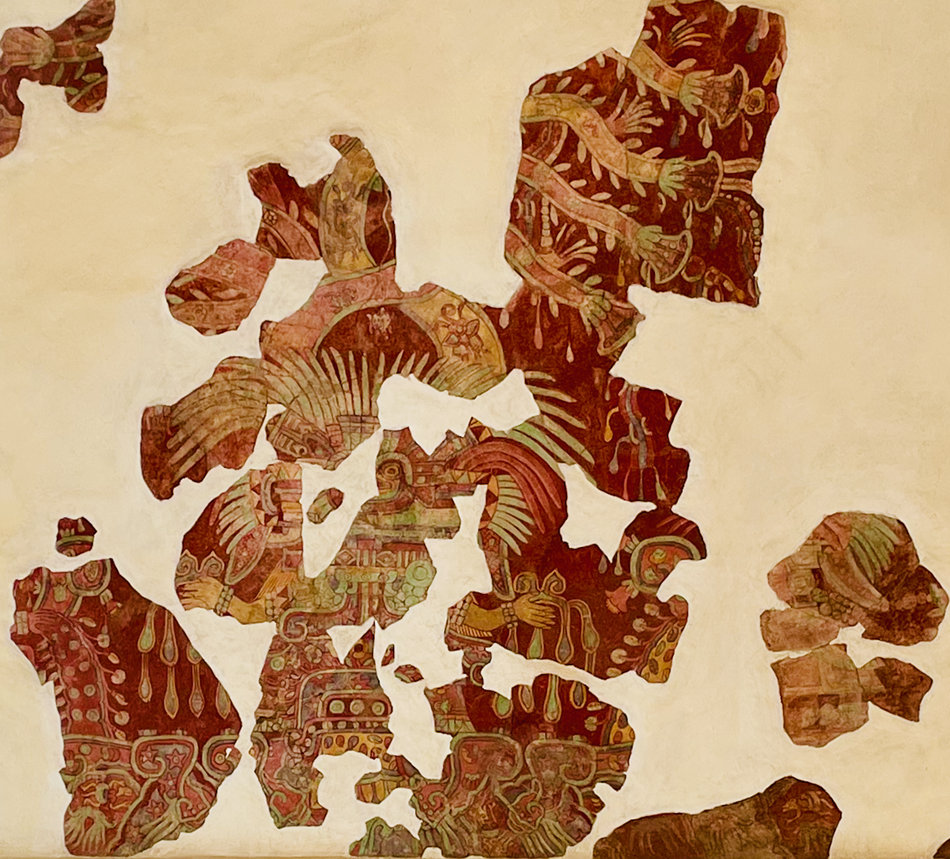
In a mural from the Palace of the Sun (Figure 5) the goddess's diagnostic hands and bracelets are associated with a clam framed by a radiant scallop with a half-star icon at its center and with an upside-down dog projecting from the clam (A. Miller Reference Miller1973:84, Figure 126). The clam-dog icon bears tassels of algae resembling quetzal feathers (compare with Figures 4a and 4c) as a symbol of the Great Goddess's headdress. The dog's paws and head form an icon reminiscent of the Circle Triplet flowing from the clam's syphons, while the dog's paws and the goddess's hands touch a stream surrounding the scallop. In Mesoamerican cosmology, the dog and the half star represented Venus (Kelly Reference Kelly1980:24), whereas the disappearance of the planet from the night sky, and its reappearance in the morning symbolized its transit to and from the underworld (Reilly 1996:31; Sprajc Reference Sprajc1993:17). The clam-dog icon can therefore be read as a portal uniting the underworld with the sea for the passage of the goddess as sacred water.
Great Goddess emerging as clam-dog from a star-like scallop. Detail. Note meandering clams next to volutes at left. Zone 5-A, room 18, Teotihuacan. Photograph by the author, Beatriz de la Fuente Museum of Murals, Teotihuacan.

From the sea to the cave-womb
The Tepantitla mural of the Great Goddess depicts four snails nestled between the red and blue sea volutes at the base of the mountain, and this can be read as their opening a cave by pressing the seafloor with their foot, which is in fact a ceramic trumpet mouthpiece (Both Reference Both2021:510, Figure 3) (Figure 4c). The shells’ lips are tasseled with algae, and their spire spines are substituted with Circle Triplet icons. Paulinyi (Reference Paulinyi2007:261) interprets the four snails as directional markers placing the Great Goddess at the center of the cosmos and opening the cave with their trumpet sound. The tasseled, trumpeting snails can therefore be read as a portal for the passage of the Great Goddess from the sea into the mountain cave.
The mountain-cave roof is formed by layered, icon-filled semicircles, and its walls by flower stems (Figure 6a). Millbrath (Reference Millbrath1995:61) interprets this as a womb, based on the semicircles with flowing waters and seeds of fertility resembling the Postclassic lunar insignia—the yacameztli—that was worn on the nose by female goddesses associated with procreation and menstrual blood. The iconography can be read as the passage of seawater through the womb's perimetrium, which is depicted by the upper layer of the cave with starfish, followed by its passage into the endometrium as the middle layer, with the Circle Triplet icon signifying fertilized, sacred water (Figure 6b). The bottom layer of the cave's ceiling depicts a row of greenstones that can be read as sacred water streaming within the horns of the uterus, which connect to the fallopian tubes, signified by the two upside-down flowers hanging on either side of the cave's ceiling. The space of the cave is filled with icons of seeds and the cave's floor is drawn with a scalloping icon of flowing water from which icons of dripping water hang (von Winning Reference von Winning1987:vol. 2:Figure 8b). This iconography can be read as the breaking of the womb's membrane to give birth to fertilized water signified by the seeds.
The reading of the cave as a womb and of greenstones as fertilized water is supported in Mesoamerican cosmology: caves were revered as life-giving birth waters emanating from maternal wombs (Heyden Reference Heyden, Carrasco, Jones and Sessions2000:170, 175), whereas the most precious stones were believed to rain from heaven and to grow within coffer-like caves. As Sahagún's (Reference Sahagún, Dibble and Anderson1963) informants narrate, [W]hen it thunders, there in the forest, in the mountains…the…stone penetrates into the earth there. It is still very small when it falls; year by year it enlarges, it grows bigger….And those of experience, the advised, these look for it. In this manner [they see], they know where it is: they can see that it is breathing, [smoking], giving off vapor…then they dig. There they see, there they find the precious stone, perhaps already well formed, perhaps already burnished…buried there either in stone, or in a stone bowl, or in a stone chest; perhaps it is filled with precious stones [Sahagún Reference Sahagún, Dibble and Anderson1963:vol. 11, 188 & 221].
Great Goddess's cave-womb and mirror-vessel assembly: (a) Tepantitla Portico 2 detail. (b) Diagram of a human womb. The cave is also a womb and a mirror on top of a downturned vessel. The mirror's frame with starfish is also the perimetrium and myometrium of the fundus of the uterus (red dome in diagram at right), and the mirror's reflective surface with the Circle Triplet icon is also the endometrium (pink dome in diagram). The bottom of the vessel is also the uterine horns connecting the uterus to the fallopian tubes, signified by two blue flower corollas and red stems hanging from the cave ceiling. Photograph by the author. Diagram by MatoomMi.

From the cave-womb to the primordial cloud
The Great Goddesses in Tepantitla and in the residential compound of Tetitla wear greenstone earspools, necklace, and a spider nose bar (Taube Reference Taube1983:109) (Figures 7 and 8). The necklace falls from the earspools, and the spider's pedipalps touch it, and the spider's abdomen is emblazoned with the Circle Triplet icon. This greenstone ensemble can be read as a spider weaving a greenstone web anchored to the earspools to create a portal for the continued passage of the goddess. This idea is supported in Mesoamerican cosmology in that the power of greenstone to attract water is combined with the transformative force associated with spiderwebs as symbols of Ollin, the sign of transformation whose root is “something round, that spins and bounces like a ball” (Taube Reference Taube1983:111–113). Furthermore, Ollin symbolized the vertical movement of sacred spirits (Maffie Reference Maffie2014:186–187).
Great Goddess. Portico 14, North Panel, Tetitla. The hands are depicted dorsally with the thumbs up, connoting the representation of the goddess from her back. Her bust emerges from a fuming mirror framed by quincunxes. The mirror is placed over a disk of ash traversed by rays penetrating the vessel below. Falling, fuming panels of greenstone icons emerge from the goddess's hands flanked by trapdoor spiders within their silk-lined hole. Photograph by the author.

Great Goddess, Tablero 3, Portico 2, Tepantitla, mid-section detail. A cascade flows from the mouth. The pedipalps of the spider nose mask touch the greenstone necklace. Breadth spirit icons hang from the earspools. A yellow band between the nose mask and the eyes possibly represents rising humidity. Feathers hanging from the headdress with drops are possibly icons of iridescence. Photograph by the author.

The passage of the Great Goddess as water through the mountain can be read in two directions: downward as a spring gushing from her mouth, as depicted in Tepantitla (Pasztory Reference Pasztory1976:174); and upward into her head-summit, as depicted in Tetitla and Tepantitla (Figures 3 and 7). In Tetitla, the upward movement is depicted as yellow droplets around the mouth mask, whereas in Tepantitla, the flowing water is suggested by the yellow bar above the nosebar, possibly signifying mist. The water rising as humidity or mist transforms the mountain summit-heads into semi-transparent clouds, as seen in Tetitla by the yellow droplets set against the red background and, in both murals, by the depiction of the goddesses’ face masks—although they are standing on their backs, with their arms and hands in a dorsal position, their thumbs up, and their nails toward the viewer (A. Miller Reference Miller1973:146).
The frame headdress originated in Teotihuacan (Pasztory Reference Pasztory, Berrin and Pasztory1993:53) and can be read as symbolic of the Great Goddess's transformation into a mist and of the need to support the headdress on her shoulders with columns. This idea is also shown in the structurally similar Teotihuacan theater-type censers where the goddess's head appears hidden within their recesses (Berlo Reference Berlo1984:29; Pasztory Reference Pasztory, Berrin, Millon, Millon, Pasztory and Seligman1988:63, Reference Pasztory and Berlo1992:310). Further support to the idea of transformation of the head-summit into a cloud comes from the Water Talud mural in Tepantitla, which is just below the Great Goddess, in which the conical mountain summit is rendered as a mist of yellow dots over a blue background (Figure 19).
In Tetitla, three enlarged droplets contact the spider's Circle Triplet icon below her nose and can be read as the transformation of water into a mist through her breath, as is suggested by Classic Maya cloud-and-rain breath-spirit icons (Taube Reference Taube2005:23, 35), and also depicted in the goddess in Tepantitla as the elements hanging from the earspools. In Tepantitla, the goddess's eyes are depicted with the Diamond-and-Bar icon of burning incense, sacred fire, and brilliance (Pasztory Reference Pasztory1976:172; von Winning Reference von Winning1977:14, Figure 2). The context of a rising mist over the face of the goddess enables the reading of the diamonds as squinting and of the green and red bars flanking them as tearing and bloody eyes, respectively. Diamond-and-Bar eye icons were associated with crying, as indicated in molded plaques of tearing faces accompanied by rising icons of stones and prickly pears as symbols of the symptoms of eye irritation (Figure 9). Likewise, a mural in Techinantitla, Teotihuacan, depicts tears falling from a serpent's feather-crested red eye as a symbol of the celestial rain bringer (Taube Reference Taube and Coe1995:87). The transformation of the head of the goddess into a mist can therefore be read as occurring not only through breathing but through eye irritation and crying caused by incense smoke.
Molded plaque with diamond-and-bar eye face as burning incense. Stone and prickly pear icons are possibly signs of smoke blow associated with tears streaming from the eyes. Drawings by von Winning (Reference von Winning1977:Figure 4e).

The primordial cloud produced by the transformation of the goddess was likely represented as the cloud hugging the surface of mountains in the Triple Mountain icon that signifies water and fertility (von Winning Reference von Winning1987:vol. 2:12, Figure 14i) (Figure 19, shown on top of a speech scroll at the bottom right). The Mexica referred to a similar cloud as the house of Tlaloc or Poyauhtlan, and they described it as “a mist next to a mountain that looks like smoke” (Contel Reference Contel and Olivier2008a:348). The primordial clouds in Teotihuacan and Poyauhtlan among the Mexica were likely signified by the lenticular clouds forming over high mountain summits that are the most common source of cumulus storm clouds forming above them (Dent-Jones Reference Dent-Jones2013:6; Millar and Oakley Reference Millar and Oakley2013:48–49).
Passage through quetzal feathers
The axis mundi rising above the Great Goddess's head in Tepantitla drips water from its branches and points to the passage of the goddess into storm clouds. The headdress's fan of quetzal feathers mediates between the summit-head primordial cloud and the storm clouds, and can be interpreted as a portal for the continued passage of the goddess. The passage of water was likely symbolized by the waving feathers’ streaming of iridescence (Schultz and Thiemer-Strasse Reference Schultz and Thiemer-Sachse2021:35, 82, Figure 27) (Figure 4i). Quetzal feathers symbolized water and the regreening of nature in Mesoamerican cosmology (Taube Reference Taube and Coe1995:99, Reference Taube, Clark and Pye2000a:297, 310, Figure 13). In the postcontact Maya sacred books of Chilam Balam, quetzals are always mentioned in relation to sacred water, and the bird's tail always symbolizes streams of the sacred liquid (Barrera Vázquez and Rendón Reference Barrera Vázquez and Rendón1969:161; Barrera Vázquez and Rendón Reference Barrera Vázquez and Rendón1989:95, 101–102).
The passage of water as iridescence is possibly signified in Tepantitla by the enlarged, hatched feathers hanging from the headdress and flanking the goddess's head with four drops aligned over their vanes (Figure 8). In the Water Talud mural, a waving feather with its edges and rachis vibrating is depicted amid the droplets on top of the water-filled cave, and this can be read as iridescence streaming the humidity upward (Figure 19). The idea of iridescence as streaming water is further supported by a postcontact Mexica holy chant referring to “quetzal feather dew” (Cowgill Reference Cowgill and Berlo1988:236).
The feathers crowning the headdresses in Tepantitla and Tetitla surge from triangular icons at their base signifying radiant heat (von Winning Reference von Winning1977:14, Figures 1b and 1c), and in this context, they could signify the invocation of water in May when the central Highlands experience peak temperatures.
The axis mundi in the passage of the Great Goddess
The frond above the headdress of the goddess in Tepantitla can be read as an axis mundi uniting the three levels of the cosmos (Schele Reference Schele and Coe1996:110) (Figure 3). It is formed by two tree trunks rising from the head of the goddess to form an X-shape, from which the branches twine like vines into a layered structure. Pasztory (Reference Pasztory, Collins and Stern1977:87) interprets the frond as a symbolic cross between a tree and a vine, with hollow branches filled with icons of butterflies, spiders, sacred water, and an enigmatic spongy icon (Angulo Villaseñor Reference Angulo Villaseñor and de la Fuente1995:76). The latter is not visible on the deteriorated mural, but it is apparent on the tree-vine branches replicated on the Portico 2 west-door border (Figure 10). Taube (Reference Taube1983:126) interprets the twining vegetation as a reference to the Ollin sign of transformation based on a Mexica legend of a pair of trees rising to the heavens at the time of creation of the Fifth Sun, 4-Ollin.
Storm God and tree-vine branches on east doorway borders of Portico 2, Tepantitla. Water streams emerge from mirrors on the Storm God's head. C. elastica drupe icons flow within the tree-vine branches. Photograph by the author, rotated counterclockwise at 60o.

The creation of the axis mundi
The mural of the Winged Descending Deity in the Palace of the Sun depicts the Great Goddess dressed in a bird suit and baring her teeth as a symbol of her maleficent aspect (Pasztory Reference Pasztory, Collins and Stern1977:93) (Figure 11). The goddess is shown passing through a mirror, about to perch on a tree with her prodigal hands. This is indicated by her legs, which are behind the mirror, and her upper body, which is in front of it. The deity's teeth and eyes are each framed by a differently shaded and bordered greenstone plaque. Behind the goddess, an axis mundi blooms with darts, incense pouches, loincloths, headdresses, and a pulque jar—the icons of civilization (Helmke and Nielsen Reference Helmke and Nielsen2015:29).
Winged descending Great Goddess in a mural fragment of the Palace of the Sun, Zone 5-A, Room 13. The bird's legs are placed behind a mirror. C. elastica drupe icons are placed both on the branches of the twisting tree on which the bird is about to perch and inside the branches of the axis mundi on the background. Photograph by the author, Beatriz de la Fuente Museum of Murals, Teotihuacan.

Helmke and Nielsen (Reference Helmke and Nielsen2015:29–32) interpret the Winged Descending Deity mural as a pictorial description of the myth of the Downfall of the Great Bird, a Mesoamerican myth that is depicted across cultures and media and that has its most detailed written expression in the Postclassic Maya Popol Vuh. The structural analysis of the myth (Levi-Strauss Reference Lévi-Strauss1963:210–213) reveals the hidden meaning of the perching of a bird deity for the creation of the axis mundi and for the invocation of rain.
In the myth, Lord Seven Macaw boasts, “I am great. My eyes sparkle with glittering blue/green jewels. My teeth as well are jade stones…When I go forth from my throne, I brighten the face of the earth. Thus I am the sun” (Popol Vuh Reference Allen2007:77). The listener is forewarned that Seven Macaw is not really the sun, given that he “only puffed himself up in this way because of his plumage and his gold and silver” because “he desired only greatness and transcendence before the light of the sun and moon were revealed in their clarity (Popol Vuh Reference Allen2007:78).” The hero twins realize that “good shall never come of this. People will never be able to live here on the face of the earth. Thus we will try to shoot him with our blowguns” (Popol Vuh Reference Allen2007:80). They strike Seven Macaw on the jaw as he perches on a nance tree, dislocating his jaw. As he falls, one of the twins tries to grab him, but Seven Macaw wrenches his arm out and, holding his jaw in his palms, he regains his perch to hang the arm “over the fire” and waits in pain and hunger for the return of the twins. Meanwhile, the twins seek help from their crouching, white-haired grandparents to regain the lost arm by posing as healers in charge of orphaned, innocent children as they approach Seven Macaw. The healers offer to replace his teeth with ground bone, an offer he reluctantly accepts, saying, “it is only because of them that I am lord” (Popol Vuh Reference Allen2007:85). Instead, however, the healers pluck out his eyes and replace his greenstone teeth with white, shiny grains of maize. With “the basis for his pride completely taken away,” Seven Macaw dies, the healers take his riches, and the twin implants his arm back into its socket (Popol Vuh Reference Allen2007:86).
The myth and its mural depiction share key actors and mythemes. Both Seven Macaw and the Descending Deity are humans dressed as birds, as inferred from the fact that birds have neither teeth nor hands. In both stories, the jaw, the teeth, and the eyes are at the center. In the myth, the bird holds his jaw with his palms, whereas in the mural, the plaques can be understood as splints holding his jaw and eyes in place after the mythical blowgun shot while framing their greenstone beauty. In the myth, the greenstone teeth are replaced with shining white grains of maize after tricking the deity with the offer of a false set of teeth. Greenstone symbolized divine water in Mesoamerican cosmology, whereas water signaled the germination of maize. In this context, the liberation of greenstone from the deity's body and its substitution with maize followed by her death can be read as her sacrificial release of rainwater for the germination of maize. In the myth, this is followed by the restoration of the integrity of the Twin and possibly by the revitalization of the withering grandparents, whereas in the mural; the triumph is signified by the blooming of the axis mundi.
The sacrifice of the Great Goddess is likely signified in Tepantitla and Tetitla by the sacrificial knives with blood trilobes inserted diagonally amid the fan of quetzal feathers (Schele Reference Schele and Coe1996:110). Sacrifice is possibly also signified by the head of the bird, which Séjourné (Reference Séjourné1965:148, 156) interprets as a death-associated owl formed by conjoint quetzal heads in profile (Figures 8 and 9). The owl-quetzal symbol produces a cognitive shift that can be read as the resolution of the duality of the prodigal yet covetous bird deity through sacrifice. Duality is further signified in the double perching of the birds: in the myth, the bird perches both as it is struck by the twins and when it regains the perch with the arm, whereas in the mural, the deity is about to perch on the tree below her and is descending from the axis mundi behind, likely depicting her in her sacrificial fall. Sacrifice is also symbolized by the nocturnal Rothschildia orizaba moths, depicted in the Descending Deity mural, whose X-shaped knifepoint wing markings form the Olli sign of sacrifice and transformation (Beutelspacher Reference Beutelspacher1988:42) as well as the X-shaped arbitrary symbol for the axis mundi (Figures 4e and 11).
The creation, development, and eventual transformation of the axis mundi into rain is likely symbolized in the myth by the dismemberment of the twin's arm, its hanging like a tree branch “over fire,” and its replacement on the twin's body. Helmke and Nielsen (Reference Helmke and Nielsen2015:34) interpret Mural 1 in the residential complex of Atetelco as depicting the mythical bird deity holding the bleeding arm on its beak; furthermore, the deity bears a pectoral Reptile-Eye icon signifying “Earth” and “Abundance” (Kubler Reference Kubler1967:7). The severing of the twin's arm as he tries to grab the bird can be read as a sacrifice that transforms the bleeding arm into a branch that bleeds copal resin—the blood of trees in Mesoamerica—whereas its placement “over fire” can be understood as the burning of copal in a rainmaking ritual (Montufar López Reference Montufar López2016:50) to create the axis mundi.
The Descending Deity mural can be read as the creation of the axis mundi, as evidenced by the transformation of the tree on which the goddess is about to perch into the tree in the background from which she is falling. In the former, the branches are solid, and spongy icons are placed on their surface; in the latter, the branches are hollow, and the spongy icons flow within them. The depiction of a white pelican in the Winged Descending Deity mural likely suggests that the timing of the creation of the axis mundi is late in the dry season (Figure 4h). The large migratory bird visits highland lakes in winter, and it fishes by dipping its beak into the water while floating (Van Perlo Reference Perlo2006:237, Figure 8.1). These are habits that can be read as symbols for the bridging of the underworld and the heavens, leading to abundant water.
The creation of the axis mundi by the perching Great Goddess can also be interpreted as the main theme of a mural in Tetitla Portico 1 (Pasztory Reference Pasztory, Collins and Stern1977:88, Figure 10) (Figure 12). She is depicted as a human-bird by her feathered-cuffed hands perching on the branches of the axis mundi, which can be identified by its X-shape, by its hollow branches, and by the spongy icons flowing within them. The goddess is depicted only by her frame headdress and her disembodied, prodigal hands, likely signifying her sacrificial transformation.
Great Goddess in Tetitla Portico 1, mural 1. C. elastica drupe icons flow inside crossbanded tree-vine branches. Feathered cuffs connote the disembodied hands of the goddess as a perching quetzal. Falling panels with seeds flow from the axis mundi. Rendering by Felipe Dávalos in Miller Reference Miller1973:120, Figure 231.

The species and symbolism of plants forming the axis mundi
Furst (Reference Furst and Hammond1974:193) identifies the vine of the axis mundi in Tepantitla as Ipomoea corymbosa, given the fused petals and seedpods that are diagnostic of the genus (Furst Reference Furst and Hammond1974:208). This plant is a natural index of water because it flowers in the rainy season in humid habitats close to rivers. Furst identifies I. corymbosa among other species in the genus based on the use of the plant by the contemporary Nahua in rituals in which the Mother Goddess of Seeds is invoked through a trance produced by the hallucinogens it contains. However, there is no evidence for the use of hallucinogens in Teotihuacan. In addition, two anatomical traits rule out I. corymbosa and point to I. alba instead, the vine whose sap was mixed with rubber latex to make bouncing olli balls (Austin Reference Austin2013:253). First, the sexual organs of I. alba grow out from their corollas but are hidden in I. corymbosa, and these organs are clearly shown protruding from the axis mundi flowers in Tepantitla (Figures 13a and 13b). Second, the floral tube of I. corymbosa is short and bulbous, whereas that of I. alba is long, wavy, and cylindrical, as depicted in Tepantitla (Figures 13a and 13c). Furthermore, I. alba flowers at night and withers in the morning, a trait associating the plant with the moon—a celestial body that was associated with water deities in Teotihuacan (Cowgill Reference Cowgill1997:151).
Axis mundi branches and flowers in Tepantitla mural and Ipomoea alba in nature: (a) Axis mundi branches and flowers. Photograph by the author. (b) I. alba corolla. Photograph by Luis Humberto Vicente Rivera. (c) I. alba floral tube. Photograph by Mariano Gorostiza, demca.mesolex.org. (d) I. alba seedpods. Photograph by José F. Pensiero, Universidad Nacional del Litoral. (e) I. alba smothering a tree. Photograph by Don MacCulley. Axis mundi flowers are like those of I. alba, with fused petals, stigma, and stamens projecting from corolla. Axis mundi branches are like the elongated I. alba floral tubes. Seed pods change color from whitish brown to blackish brown as they mature.

The species of tree constituting the axis mundi can be identified as Castilla elastica, the main source of latex for the manufacture of olli (Hosler et al. Reference Hosler, Burkett and Tarkanian1999:1989). The spongy icons that flow within the branches of the tree-vine (Figure 10) can be read as an iconic symbol of the drupes of C. elastica (Figures 14a and 14a). C. elastica produces green drupes with the first rains, which turn orange as the season progresses (Pennington and Saruhkán Reference Pennington and Saruhkán2005:140). The drupes are 4–5 cm in diameter, oblong-lanceolate in shape and velvety in texture, and they grow aligned and alternating on opposite sides of branches. Each drupe includes 10 to 45 cone-shaped fruits with one or two dot-like seeds (Custodio-Rodríguez et al. Reference Custodio-Rodríguez, Vargas-Simón and Contreras-Sánchez2022:3). The icons on the tree-vine have the same color, shape, texture, and alternating alignment as the drupes of C. elastica, with the only differences being that icons are placed within the branches of the tree-vine alternating with elongated eye icons that symbolize flowing water (von Winning Reference von Winning1987:8, Figure 7b).
Mesoamerican rubber tree Castilla elastica: (a) Drupe; (b) Drupes on branch; (c) Tree. Drupes mature from green to orange and grow into a semiconvex, dotted shapes aligned along opposite sides of the branch in alternation. Photographs (a) and (c) by Carlos Beutelspacher. Photograph (b) by Rosa Vázquez, iNaturalist.

The internalization of the drupes into the branches of the tree and their alternation with icons of flowing water can be read as the symbolic creation of the axis mundi, with the drupe icons transformed into a symbol of Blood of the Earth flowing together with Sacred Water in the twisting, hollow branches of a fused tree-vine (Figure 10). The idea of vegetable blood is supported by Carreón-Blaine's (Reference Carreón-Blaine2004:32, Reference Carreón-Blaine, Rubí and Blaine2014:263) interpretation of angular drop icons on paper offerings in Teotihuacan murals as blood of vegetable origin, an idea that is in line with the Mexica conception of tree resin as blood (Montufar López Reference Montufar López2016:50) and of human blood as clay (Graulich Reference Graulich2016:172).
The creation of the axis mundi as a sacred tree-vine can also be read as the symbolic manufacture of bouncing olli balls by mixing latex with vine sap to create the sacred symbol of Water That Burns. The internalization of the drupes as Blood of the Earth opposes the bleeding of the white, viscous, and combustible latex of the rubber tree, whereas the mixing of the Blood of the Earth with Sacred Water produces the sacred olli balls symbolized by the vine's seed pods. This reading is supported in the interpretation by Séjourné (Reference Séjourné1956:102) of the juxtaposition of the fiery eyes and flowing water in the depiction of the Great Goddess in Tepantitla as a symbol of Water That Burns.
The creation of the axis mundi can be read as a sacred, paradoxical transformation of nature to enable the production of Water That Burns. The thick, straight, and woody C. elastica tree (Figure 14c) together with the spiders and butterflies in its habitat are engulfed by the thin, winding, and watery I. alba vine (Figure 13c). This idea is supported by observing that C. elastica hosts a wide range of climbers and that I. alba, among them, tends to smother its branches in the rainy season (Rojas Reference Rojas2016) (Figure 13e). The engulfment of the tree by the vine could have been conceived as a symbolic, extreme smothering of the tree triggered by the perching of the Great Goddess with her spider nosebar, empowering the vine to trap and wrap the tree while engulfing the spiders and butterflies in the microhabitat. The engulfed butterflies and spiders can be also read as the integration of the social roles they symbolized. In Mexica cosmology, butterflies signified the souls of sacrificial warriors, and spiders signified women as weavers, with their confluence within the branches likely symbolizing gender integration (Schele Reference Schele and Coe1996:111).
The identification I. alba and C. elastica as the signifiers of Blood of the Earth and Sacred Water icons is supported in the use of these species for the manufacture of olli balls in Mesoamerica (Austin Reference Austin2013:253; Hosler et al. Reference Hosler, Burkett and Tarkanian1999:1989) and in the ritual use of olli in Teotihuacan, as is evidenced in the Mural of Agriculture, where olli balls are depicted as offerings to the Great Goddess (Carreón-Blaine Reference Carreón-Blaine2004:28, Figure 3; Pasztory Reference Pasztory, Collins and Stern1977:89), and in the Water Talud mural of Tepantitla, where bouncing olli balls are depicted at play (Figure 19, top center).
The passage of the Great Goddess through the axis mundi
The flow of the Blood of the Earth and Sacred Water icons within the axis mundi can be read as the passage of the Great Goddess transforming herself into olli balls as Water that Burns with the support of butterflies and spiders. The butterflies can be identified as Papilio multicaudatus, and their wing tails suggest a flowing liquid (Figure 4d). They swim within the branches, with their antennas toward the flowers, suggesting they push the Blood of the Earth and Sacred Water icons toward them. This behavior opposes their hovering over flowers to suck their nectar, and it can be read as symbolizing the integration of the cosmos. Likewise, spiders spin their webs between the inner walls of the branches, whereas in nature; they weave them between branches. In nature, the thin spider silk forms strong and elastic webs, suggesting that those within the branches infect the icons with these properties to make olli bounce. This idea is supported in the meaning of spider webs as Ollin signs of transformation (Taube Reference Taube1983:111).
The flowers at the tips of the branches are adorned with Circle Triplet or Doublet icons and elongated eyes (Figure 15), whereas the seedpods that are produced by I. alba are depicted with tassels (Figure 15a), pointing to their conception as portals where the Great Goddess flowed as fully formed olli balls. The synonymy of seedpods and olli balls is made evident with their alternate depiction as a viscous, stringed liquid streaming from the flowers as melting olli balls (Figure 15b). The maturation of I. alba seedpods could have been read as a metaphor for the manufacture of olli, given that the white fruits dry into brown or black balls (Figure 13d). Olli ball pods can be understood as being delivered to the goddess and the priestesses below them. The pods are attached to red and blue bands with elongated eyes flowing within them, suggesting iridescent quetzal feathers as streams of sacred water (Figures 3 and 13a).
Axis mundi branches and flowers in Tepantitla doorway borders: (a) Flowers with tasseled seedpods associated with the Great Goddess. Detail of East Doorway border, Portico 2; (b) Flowers with seedpods represented as resinous olli drops. Detail of West Doorway, Portico 2; (c) Flower with mirror below its sepals. Detail of entrance corridor to Portico 2. Circle Triplet or Doublet icons and elongated eyes are represented in the corollas. Photograph by the author, with (a) and (b) rotated counterclockwise at 60o.

The transformation of the Great Goddess into the Storm God
The metamorphic powers of the goddess's prodigal hands
The hands of the goddess in Tepantitla, from which a liquid flows (Figure 16), are interpreted by Caso (Reference Caso and de Antropología1967:252), Kubler (Reference Kubler1967:7), and Séjourné (Reference Séjourné1962:63) as signs of completion and delivery of the vital energy to the world. The hands of the goddess can be read as bringing about her transformation into the Storm God through a sacrificial process associated with the powers of olli and butterflies.
Great Goddess's hand melting and fuming olli. Detail of Tablero 3, Portico 2, Tepantitla. Melting olli projects from greenstone thumb extension. Photograph by the author.

The mural fragment of a descending, ringed-eye deity as a butterfly (Figure 17) depicts the goddess's diagnostic hand as a butterfly's abdomen producing two drops of a liquid that can be read as olli by its dark blue color and its viscosity. Melting olli is sticky and can be interpreted as hinging the butterfly's wings to the goddess's abdomen-hand. As olli melts when heated it producess dense, wispy fumes which in the mural are shaped like antennas. The greenstone bracelet has an adjacent drop of the same material, and olli also drips from it. These depictions can be read as the manifestation of the power of olli to transform greenstone into sacred water. The same transformations can be seen in Tepantitla (Figure 16), where the goddess's thumbs are enlarged by greenstone distal and proximal phalange bones, and molten olli flows from their tips. Olli also drips from her palms and from her greenstone bracelets while antenna-like wisps of olli fume from the greenstone thumb. The greenstone thumb extensions suggest that the Great Goddess is empowered by olli to transform mountain rock into greenstone—which, in turn, transforms into sacred water—in line with her transformation from the rock mountain summit-head into a mist cloud.
Mural fragment of descending deity as quetzal-butterfly, Palace of the Sun. Upper wings are also the deity's upside-down legs. The butterfly's abdomen is also the deity's hand fuming and oozing olli. The lower wings are also quetzal wings. Photograph by the author, Beatriz de la Fuente Museum of Murals, Teotihuacan.

The transformation of the goddess's hands into butterflies through the action of olli can be read as an intermediate step in her transformation into the Storm God. The antenna-like wisps of fumes in Figure 17 are also shaped like the ringed eyes of the butterfly above them, identifying the butterfly as the Storm God (Miller Reference Miller1973:118). Following this cognitive shift, the two drops of melting olli hinging the wings and the drop of olli off the greenstone bracelet now configure the diagnostic Storm God waterlily buds (Figure 18), and the phalanges of the goddess's hand become the Storm God's teeth. The promise of a bountiful harvest symbolized by the greenstone-maize teeth of the Descending Deity can now be read as being fulfilled by the olli empowered Storm God.
Border of Talud 2, Portico 2, Tepantitla, with frontal and profile Storm Gods. Blue and red water streams surge from the frontal Storm God's head and are continued as interlaced red and blue streams along the border. Waterlily drops emerge from the Storm God in profile at left and drips water from its neck into the blue stream. Photograph by the author.

The symbolism of deity transformation is also apparent in Tepantitla (Figure 3). A pair of reciprocating panels flow from the palms of the censer-bearing goddess impersonators flanking the Great Goddess. The rising panels project toward the goddess and can be read as fumes filled with greenstone shell and chalchuite icons bordered by tree-vine flowers, both metonyms of the goddess. The falling panels contain streams of chalchuites and seeds—signifying water and fertility, respectively—and are bordered by water lilies diagnostic of the Storm God. The ritual being performed points to a reciprocal relationship between the two deities to produce rainwater and fertility through the transformation of greenstone into water.
The Great Goddess in Tetitla is depicted as the image of a mirror, as suggested by the rounded quechquemitl robe modifying its usual triangular shape (Taube Reference Taube1983:109) bordered with quincunxes, a design consisting of five circles symbolizing the delivery of precious water in all cardinal directions (Anderson and Helmke Reference Anderson and Helmke2013:170; Langley Reference Langley1986:279) (Figure 7). The palms of the goddess produce falling panels filled with round, drop-like icons colored as greenstone and shaped as hands, nose masks, heads, vessels, shells and chalchuites (Miller Reference Miller1973:148, Figures 307–314). Colas (Reference Colas2011:15, 21) reads these icons as signifying the vital force of fertility with the power to energize people, animals, and objects alike. The panels are bordered by smoke volutes (von Winning Reference von Winning1977:28, Figures 4e, 9c, 9q) and can be read as melting olli with the power to transform greenstone into sacred water. The goddess is replicated in six side-by-side murals in Portico 14. These are identical except for the falling panels, which have different sets of icons (Langley Reference Langley1991:293), suggesting the multiplication of the Storm God as clouds beyond the mountains.
The portico doorway borders in Tepantitla depict Storm God busts next to tree-vine branches, a juxtaposition that Pasztory (Reference Pasztory, Collins and Stern1977:83) interprets as the god's association with the Great Goddess through fertility (Figure 10). Angulo Villaseñor (Reference Angulo Villaseñor and de la Fuente1995:76) notes that the branches source water from the sea below them and return it as sacred water, and he interprets them as representing the water cycle. Likewise, streams of water surge from the Storm God's head and flow downward to the sea. The two sets of water cycle representations can be read as the paired action of the Great Goddess and the Storm God for the completion of the water cycle.
The Tepantitla murals as a liturgy of passage
The Great Goddess tablero murals in Tepantitla Portico 2 are painted above inclined talud murals depicting humans in sacrifice and play, each characterized by what Pasztory (Reference Pasztory1976:62) interprets as water, ballgame, medicine, and feline themes. The taluds contrast with the tableros in content and style, with the former depicting a multiplicity of lively seminaked—that is, fully visible—gravity-defying humans, whereas the latter depict a rigid, semihidden and earth-bound deity (Headrick Reference Headrick2007:147; La Gamma Reference La Gamma1991:280). Schele (Reference Schele and Coe1996:110) interprets the difference in style and content as that of an act of creation in the tableros as against the materialization of this act on earth in the taluds. Following the preceding interpretation, the contrast between the tableros and taluds can now be read as that between the passage of the goddess from the underworld to fill the mountain with water, form the axis mundi and create the primordial cloud in the former, and, in the latter, her transformation into the Storm God to create and disperse rain clouds, heal the sick, and reinvigorate the land.
The borders between the tableros and taluds depict frontal and profile Storm God busts associated with streaming and twining red and blue bands (Figure 18). Kubler (Reference Kubler1967:8) interprets Teotihuacan mural borders as qualifying the main theme depicted in the mural while specifying the liturgical order of the various themes depicted. Following his approach, the Storm Gods can be interpreted as qualifying the humans in the taluds with their powers, which makes it possible to read them as Storm God helpers. Furthermore, the streams running along the borders can be interpreted in association with the axis mundi in the tableros and can qualify the icons of butterflies and seeds in the taluds as symbolic clouds of fertility.
The Storm God's passage into the cave
The frontal Storm Gods wear frame headdresses like those of the Great Goddess, with the bird substituted with quincunx icons that can be read as water distributed across all cardinal directions (Anderson and Helmke Reference Anderson and Helmke2013:170). The gods hold scepters decorated with Storm God busts and with rainclouds and smoke volutes emerging from their heads (Caso Reference Caso and de Antropología1967:253). The gods in profile wear the usual Storm God head-supported headdress adorned with greenstone circles (Millon Reference Millon and Berrin1988:116, Figure V.3). Paulinyi (Reference Paulinyi2007:257) interprets the frame headdress as the god's cave abode, an idea that is in line with the hollowed-out summit created by the head-summit's transformation into mist while pointing to the borders as cave walls.
The frontal gods’ eyebrows are depicted by vertical red and blue bands and can be read as flowing from their ringed eyes, continuing as same-colored hair streams with bubble icons and then as the same-colored, entwined streams joined behind the scepters and flowing along the border. The gods in profile drip water from their necks and feed it into the blue band, an iconography that Uriarte (Reference Uriarte and de la Fuente1996:252) interprets as a possible allusion to decapitation. Heyden (Reference Heyden, Carrasco, Jones and Sessions2000:177) notes the similarity of the twining red and blue bands to the yellow and blue streams of light that flowed from cave walls in the mythical Mexica caves of origin, which Séjourné (Reference Séjourné1956:110) interprets as the union of fire and water. Following these ideas, the streams projecting from the gods’ eyes can be read as rays of watery light emerging from the gods’ ringed eyes and which Taube (Reference Taube1992a:213–214, Figure 11) interprets as mirrors. The gods depicted on the Portico 2 doorway borders wear mirror pectorals and project streams as hair from mirrors attached to their headdresses (Figure 10).
The diagnostic Storm God's raised upper lip, with its edges downturned to expose the upper gum, can be read as a crying rictus that tenses the facial muscles to provoke salivation and tearing as sacred rainwater. Water-lily buds emerge from his mouth and touch their round leaves (Figures 10 and 18). Pasztory (Reference Pasztory1997:215) interprets the plant as sacred water, but it can be understood better as denoting the sacredness of the gods’ secretions. Lilies grow in the still water of ponds, and their flower buds emerge from the water, open their petals in the early morning, and close them at night, a behavior that Uriarte (Reference Uriarte2006:29–30) interprets as the god following the sun from the underworld. Ponds symbolized mirrors in Mesoamerican cosmology (Taube Reference Taube1983:113), and the god's lily buds coming off his mouth touch his pectoral mirror, pointing to his connection with the underworld (Figure 10).
The lily as a symbol of the Storm God's connection with the underworld transforms the god's crying rictus from a natural index of rage into a symbol of a fearful and powerful voice from the underworld. This connection is also signified by the god's fangs as a serpent's metonyms, and its poisonous bite is symbolized by the lighting rod he bears as a serpentine lance in other depictions (Pasztory Reference Pasztory1974:4, Figure 3). The crying rictus as an expression of the underworld also exposes and wets the god's teeth, which can be read as symbols a bountiful harvest—an idea in line with the transformation of the teeth of the Great Goddess into grains of maize.
The scepters that have the Storm God's likeness and that issue smoke volutes and clouds can be read as a pair of subordinated helpers involved in cloud formation. The scepters touch the streams as they project along the cave's wall, and these can be interpreted as modulating the Storm God's signals to helpers fulfilling rain orders in the world.
The replication of the Storm God through his helpers
The Talud 3 mural in Tepantitla depicts a water stream flowing from a spring along fields and into a mountain filled with and surrounded by seminaked humans swimming, playing games, and sacrificing (Figure 19). Caso (Reference Caso1942:131), following the myth of the Tlalocan paradise expounded by Sahagún (Reference Sahagún1977:vol. 2:297), interprets the humans as Tlaloc helpers reborn from the humans who met a watery death. Taube (Reference Taube1983:136), rejecting the notions of paradise, interprets the humans as ancestors in a historical context, which is supported by the possibility that some icons are place names. Both Caso and Taube can be correct, given that helpers could have been historical figures who drowned or died by water-related diseases.
Detail of Talud 3, Portico 2, Tepantitla. The mountain summit is depicted with cream-colored dots of mist over a blue background. An undulating and vibrating quetzal feather projects from the cave into the mist. The stream carries entombed fish-men into the cave. The stream is also a snake, bending upward to transform into the quetzal feather and bending back into the cave. Figures within the cave are possibly fish-men transforming into Storm God helpers, who dive upward and wade out of the cave. The crying man standing on the spring emits a speech virgule bearing a Triple Mountain icon covered with a lenticular cloud. The game of machincuepa is played by rolling figures at the middle center, and a game of circling humans with a bone, leg, and fume icon is played below it. Photograph by the author.

Pasztory (Reference Pasztory1976:189) interprets the nakedness of the humans as a sign that they are devoid of rank. The naked humans could also be symbolizing skin as their origin from olli in their transformation of the Storm God. This idea is supported by the resemblance of the humans to the figurines used for rain rituals by contemporary Lacandon (Palka Reference Palka, del Carpio Penagos, Hernández and Castillo2017: 254, Figure 6) and whose supple skin was likely symbolized by the elasticity of olli (Carreón-Blaine (Reference Carreón-Blaine, Rubí and Blaine2014:259–260).
Devoid of rank and associated with olli, the naked figures can be read as humans who died by water or in sacrifice and that were transformed into Storm God helpers engaged in games symbolizing the creation and control of diverse clouds and weather phenomena. Rolling cloud and thundercloud games can be read as examples, with the former signified by a scene that Angulo Villaseñor interprets as the Mesoamerican game of machincuepa, where children summersault forward holding hands (top center in Figure 19), and whose Nahuatl translation Angulo Villaseñor cites as “a volute or thing that doubles, returns or comes back over itself to arrive to its prior position” (Reference Angulo Villaseñor2016:1–3). The thundercloud game can be interpreted as a group of four humans circling a fifth (center in Figure 19). The game is accompanied by a speech-scroll compound icon of a bone, a leg, and a fume of smoke. Taube (Reference Taube2000b:32) suggests that this and other speech scroll icons in the talud can be read as game names, and this one points to lightning producing fire and dismemberment following the queue of the depiction of the Mexica God of Thunder by a one-legged figure (Olivier Reference Olivier1998:130).
The floating anthropomorphic clouds qualify the humans on the ground as helpers directing ground water phenomena as they touch leaves and flowers or sit next to trees. This symbolic transitivity is found in other murals in Teotihuacan where the theme that is asserted in the borders is reasserted across thematic layers in the main panels (La Gamma Reference La Gamma1991:279–280).
The helpers’ origin in humans who died by water is suggested by the fish flowing within the stream encased within rectangles (bottom of Figure 19). Taube (Reference Taube1986:53) interprets them as mythical fish-men survivors of the destruction of the Fourth Water Sun era in transit to becoming the humans of the Fifth Sun era. Storm God helpers in passage from the dead were likely conceived as impersonating deities associated with epochal transition as a metaphor for the regreening of nature after the dry season. This idea is supported by the Sacred Fire icon, which signifies epochal transition as a part in the Four Element icon, which signifies a water prayer (von Winning Reference von Winning1977:12, Figure 29) (Figure 24b). Furthermore, Vidarte (Reference Vidarte1968:142) interprets the crying human (bottom right in Figure 19) as Nanahuatzin, a deity who was afflicted by Tlaloc with buboes and who threw himself into the sacred fire to create the Fifth Sun after bathing in a spring and penancing with a branch of fir. The human emits a quadruple speech scroll with Triple Mountain and butterfly icons, possibly naming the talud mural as a sun creation metaphor for the regreening of nature.
The fish-men flowing along the stream and into the water-filled cave can be read as the passage of the spirit of the dead through the water that sealed their fate and into a cave-womb that transforms them into diving Storm God helpers seeking their way back out into the world. The stream can be read also as a wriggling snake pushing the fish-men together with the water into the mountain cave. The snake bends up to exit the cave and bends down to renter it while transforming its bent middle section into a vibrating quetzal feather (Figure 19).
Quetzalcoatl, the mythical snake-bird associated with lightning and storms (Taube:Reference Taube1992b:175, 177, 181), is depicted in the bas reliefs of the temple of Quetzalcoatl, meandering within the constrained space of the temple's taluds and pushing along—within its meanders—snails and clams as symbols of water. The Ch'ortí from Honduras tell of water snakes moving into mountains in the dry season in search of water and moving back into the swelling rivers when rain arrives, pushing water upward with their forceful movement (Broda Reference Broda, Broda, Iwaniszewski and Maupomé1991:484). In a myth recorded by the author among the Wixarika of northern Mexico, water snakes are born in the dry season and become constrained as they grow within the trickling streams. With the first storm, they move into mountain caves where they grow wings to engage in a mortal battle with shooting stars, as is demonstrated by the skin they leave behind.
The passage of the Storm God into clouds of fertility
The Water Talud mural depicts two species of butterflies: Danaus plexippus (monarch) and Papilio multicaudatus (two-tailed swallowtail; Figures 4d and 4f). The two-tailed swallowtail resides throughout the year in the Highlands, whereas the monarch is a migratory species and is found in winter swarming in the forests of fir above 2,800 m. Mount Tlaloc is the closest to Teotihuacan with this elevation (Giménez de Azcárate Reference Giménez de Azcárate2009:111; Reppert and de Rood Reference Reppert and de Roode2018:1010) (Figures 4f and 19).
Two icons can be identified interspersed with the butterflies as the seed scales of fir, with the seed wings attached in a symbolic arrangement, and as the seeds detached from their wings (Guzmán Vázquez et al. Reference Guzmán-Vázquez, Francisco and Leopoldo2023:3) (Figure 20). Fir trees are the tallest in the Highlands, reaching 60 m, and their seed scales explode from cones in the winter to produce clouds of winged seeds that fly spiraling with the wind. The swarming of monarchs coincides with the explosion of fir seed cones and can be observed as intermingling clouds. The symbolic depiction of the fir seed wings attached to the seed scales can be read as symbolizing the monarchs, with the scales as their abdomen and wings, and the seed wings as their antennas (Figure 20a–b). Fir seeds are not depicted on the ground, where they would come to rest, but rather as a cloud of multifaceted, stone-like icons.
Comparison of icons in Talud 3, Portico 2, Tepantitla (a and c) and fir (Abies religiosa) winged seed scales and seeds (b and d). The seed scales in the mural are depicted with the winged seeds still attached, as are found in the cone prior to its explosion. The detached winged seeds are depicted on top of the scale as butterfly antennas. This arrangement is reproduced in (b). In the mural, the minute, multifaceted fir seeds are depicted after their wings are detached, as shown in (d). Photographs by the author.

Fir was likely a metonym of the Storm God, given that it grows in the highest mountain ranges where rainclouds transformed from primordial clouds associated with the god's creation. Fir seedlings sprout from tiny, winged, drop-like seeds, yet they are edged like a weapon and grow into the tallest trees in the Highlands. Fir could have been conceived specifically as a metonym of the weapons associated with the Storm God, as was the case among the Mexica. They carved fir branches into Tlaloc lightning rods (Contel Reference Contel2016:21) and into batons planted on the ground in ritual games during Tlaloc festivities (Sahagún Reference Sahagún1977:vol 1:166). Fir was also likely the species of the “tallest and most beautiful tree” placed in Templo Mayor as an axis mundi during the Huey Tozoztli rain ritual (Durán Reference Durán1995:vol. 2:95), and in the myth of Nanahuatzin's creation of the Fifth Sun, he flayed himself with branches of fir (Vidarte Reference Vidarte1968:142)
Passage and rulership
Pasztory (Reference Pasztory and Berlo1992:283, Figure 1) identifies a human figure on a frieze in the Avenue of the Dead as the Great Goddess due to her spider nose mask and headdress with birds. However, her hands are not bestowing riches but holding flaming torches, which in Teotihuacan are associated with rulers. Therefore, Cowgill (Reference Cowgill1997:149; Reference Cowgill2015:228) proposes that the figure does not depict a deity but a ruler, although he or she could be associated with the Great Goddess possibly in name. However, in Tetitla Room 17, a mural framing the clam-dog icon is bordered with twining streams filled with clams, and the bands support flaming torches (A. Miller Reference Miller1973:144, Figure 296). This iconography can be read as the involvement of torches in the passage of the Great Goddess from the underworld to the sea, possibly as signs of the fire with which she is associated or as metaphors of passage in the dry season when fields were burnt to prepare them for planting. The sign of the torch was likely a metonym of rulers carrying them in passage rituals that imbued them with the mystical power of the Storm God derived from his transformation from the Great Goddess.
The idea of rulers in passage associated with the Great Goddess is supported by the looted murals of the Warner Collection, possibly from the Techinantitla residential compound, depicting a procession of almost identical male ringed-eye rulers or military leaders, each differentiated by a name glyph (Figure 21a). The rulers wear body armor and Storm God–tasseled headdresses with dart points, and produce from their hands reciprocating panels of riches and seeds (Millon Reference Millon and Berrin1988:115–116, 124), much like those associated with the Great Goddess. A mural of a coyote that was likely placed above them and that Millon interprets as an ensemble is bordered by a band with flowing Blood of the Earth icons ending in a Great Goddess disembodied hand that can be read as pointing to her demise. A mural in Portico 2 of the Atetelco White Patio residential compound depicts a repeating figure of a ruler or a priest-rulers identified by a staff and a hanging mirror in his left hand (Carballo Reference Carballo, Hirth, Carballo and Arroyo2020:69, Figure 3.6) (Figure 21b). The ruler wears a headdress and fanged nose bar and holds a snail trumpet adorned with the Circle Triplet icon. Scrolls with dripping water icons emanate from each hand; the one holding the snail suggests a trumpeting sound reminiscent of the snail portal at Tepantitla. The repeating figures are enclosed in a net formed by twining bands with flowing circle and oval icons like those embroidered with quincunxes on the Tetitla Great Goddess's quechquemitl (Figure 7).
Murals of rulers and warriors: (a) Ruler with tasseled headdress, Techinantitla. Rising panels with icons are reciprocated by falling panels with dot-like seeds. Darts fall from the headdress suggesting rain; (b) Ruler bearing staff and snail with water scrolls enclosed by net formed by hollow bands with flowing circles and ovals possibly representing C. elastica drupes and sacred water within axis mundi. Atetelco White Patio Portico 2; (c) Armed coyote warriors enclosed by net with fir seed scales and seeds flowing within bands joined by mirrors with emerging coyotes. Atetelco White Patio Portico 1. Photograph (a) by The St Louis Art Museum, Gift of Morton D. May, 237:1978. Photograph (b) by Carballo Reference Carballo, Hirth, Carballo and Arroyo2020:69, Figure 3.6. Photograph (c) by the author from a reproduction at the Museo Nacional de Antropología.

The X-shaped net in Atetelco can be read as a woven axis mundi, with sacred water and Blood of the Earth icons flowing within them. This reading is supported by von Winning's (Reference von Winning1987:vol. 1:102) interpretation of nets such as those in Atetelco as symbols of greenstone and rain that are associated with quincunxes and that carried into the Postclassic period in the netted ayauhxicolli vests worn by Tlaloc priests. Based on this evidence, the murals in Techinantitla and Atetelco can be read as rulers and military leaders in their passage through mirrors under or amid the axis mundi as a net woven by the Great Goddess and empowered by her transformation into the Storm God, which enabled them to produce water and fertility.
Various murals in Teotihuacan depict rulers in procession as netted jaguars, symbolizing water and fertility (von Winning Reference von Winning1987:vol. 1:102, Figure 8f), or as coyotes, likely signifying their powers to fight drought. The murals on the upper wall of the Warner Collection, bordered by the band as an axis mundi, depicts coyotes with sacrificial knives who are tearing out the heart of a deer with blood or water trilobes (C. Millon Reference Millon and Berrin1988:Figure V.12). In a mural in the White Patio Portico 1 of Atetelco, repeating coyote warriors are enclosed within a net, with fir seed scales and seed icons flowing within them (A. Miller Reference Miller1973:160, Figure 336) (Figures 20 and 21c). The joints of the net are covered by coyote heads enclosed by concentric circles traversed by rays, which can be read as mirrors. The murals suggest a battle formation against drought, an idea supported in Mexica cosmology: deer symbolized drought and were ritually hunted and sacrificed in the dry season to honor the militaristic hunter god Mixcoatl (Contel Reference Contel2008b:177; Sahagún Reference Sahagún1977:vol. 1:126).
This evidence points to Teotihuacan rituals of passage of warriors into animal avatars with powers over rain, paired with the symbolism of the transformation of the Great Goddess into the Storm God. The netted axis mundi likely symbolized a protective shield enveloping warriors—as is portrayed in the Water Talud or Tepantitla by the integrated set of clouds—conferring them with powers to fight drought or to cause a calamity on their enemies. Headdresses depict these powers with the row of circles and ovals (Figure 21b) and the Circle Triplet icon (Figure 21a and 21c) at their base as flowing water, and the tassel headdress (Figure 21c) can be read as rain transforming into a weapon—dart points—with its passage through mirrors associated with sacred fire (see below).
Mirrors were likely used in military ritual as personal items displayed on the backs of leaders (Taube Reference Taube1992a:207, Figure 3), conferring them with power, as attested by the burial of over 40 bodies with military regalia, mirrors, and knife points in the Temple of the Feathered Serpent (C. Millon Reference Millon and Berrin1988:124). The understanding of their use of mirrors can shed light on the rituals of passage associated with water deities.
The symbolism of mirror portals
Mirrors underwent highly skilled, lengthy manufacturing processes, whereby ultrathin, polished iron pyrite tesserae were glued to thin, etched slate backs (Blainey Reference Blainey2007:70–71, Figures 12–13; Gallaga Reference Gallaga, Gallaga M. and Blainey2016:44; Melgar et al. Reference Melgar, Gallaga M., Solis, Gallaga M. and Blainey2016:66). The feat of manufactured thinness likely imbued mirrors with symbolism as autonomous agents empowered to bring about the passage of deities (D. Miller Reference Miller and Miller2005:11). Furthermore, pyrite tesserae and their bouncing reflections resemble spider webs associated with the netted Ollin icons of transformation (Taube Reference Taube1983:113, Reference Taube1992a:218).
The cave-womb in Tepantitla can be read as a polysemic compound icon signifying a mirror in a seed casting ritual, where the mirror is placed en face in a three-quarter view on top of an overturned vessel (Taube Reference Taube1983:113, 118) (Figure 6). The mirror is bordered with starfish and depicts the Circle Triplet icon at its center as an arbitrary symbol of the goddess. In Tetitla, the head of the Great Goddess can be read as the image of a mirror placed en face over a vessel, with half of the mirror frame depicted as a pectoral with five quincunxes (Figure 7). The circular image of the quechquemitl further points to a mirror image, given that the garment is usually depicted with its triangular shape (Gamio Reference Gamio2017:vol. 1:Plate 35; Taube Reference Taube1983:109).
Nocturnal spiders and moths flank the Great Goddess in passage through mirrors—species that are characterized by peculiar movements or markings symbolizing the passage from the underworld. In Tepantitla, spiders are depicted in their webs, where they hang from silk anchored to the two trunks of the tree-vine of the axis mundi—signs that Taube (Reference Taube1983:110–111) interprets as her primary attributes (Figure 3). In Tetitla, two nocturnal trapdoor spiders flank the mirror, a species identified by its silk-lined tube and its legs constrained forward and backward (de Luna et al. Reference De Luna, Carlos, Roberto and Millan2021:91; Valdez Mondragón and Cortez-Roldán Reference Valdez Mondragón and Cortez-Roldán2016: Figures 1–4) (Figures 4g and 7). The tubes are touching the smoke volutes rising from the vessel, and the hands of the goddess can be read as the tube's trapdoors. Rothschildia orizaba moths flank the goddess in the Winged Descending Deity mural, a species that for the Mexica symbolized not only the goddess of sacrifice but also the protector of travelers (Beutelspacher Reference Beutelspacher1988:42).
Two Teotihuacan-style Classic Maya slate and pyrite mirrors depict the Great Goddess or the Storm God as an iconic symbol etched on their backs (Figures 22a–b). In Figure 22a, the Storm God as a ruler can be identified by his tasseled headdress, torch-bearing hands, and ringed eyes (Cowgill Reference Cowgill2015:228, Figure 8.19). In Figure 22b, the mirror depicts the goddess as a mountain over the sea. She has a butterfly headdress, bird wings hang from her arms, and she holds hands with what could be jaguar-officiants with speech scrolls. The iconic symbols depict at their center a mirror with the goddess's arbitrary Circle Triplet symbol as their reflection, suggesting that in mirror 22a, the Storm God is both transiting and transforming from the goddess. The mirror backs are framed with etchings of elongated eyes symbolizing reflecting and flowing water or with starfish and streams of smoke, and they can be read as metonyms signifying the mirrors as passage portals from the underworld. The iconic symbol of the deities etched on the slate mirror backs can be read as the image expected to appear on the polished surface when the mirror was scried (Taube Reference Taube1992a:213). The deity's Triple Circlet on the etched mirror can therefore be read as contacting the image on the polished surface across the ultrathin pyrite tesserae to establish a portal for passage.
Teotihuacan-style Maya mirror backs with Great Goddess etchings: (a) Kaminaljuyu; (b) Escuintla. Note the two pairs of holes at either side of both mirrors. Drawing (a) by Taube (Reference Taube1992a:206, Figure 1 from Kidder et al. Reference Kidder, Jennings and Shook1946:Figure 175a). Photograph (b) by the Cleveland Museum of Art.

Mirrors are depicted in changing assemblies with vessels and placed against the bodies of priests, as shown in a Classic Maya polychrome of a palace scene with a ruler sitting in front of a priest manipulating a mirror (Figure 23). Mirrors are depicted in relation to vessels either with their polished surface upright and the mirror placed loosely inside it (Figure 22a) or downturned with the mirror attached to the vessel bottom (Figure 22b). The mirrors have two pairs of holes used likely to attach them to vessels with string or by pins, as shown in the Classic Maya polychrome (Blainey Reference Blainey2007:127–128; Gazzola et al. Reference Gazzola, Chávez, Calligaro, Gallaga M. and Blainey2016:116, Figure 5.5; Taube Reference Taube1983:170, Figure 21b, Reference Taube1992a:206). The depiction of the pins in the polychrome suggests they played a critical symbolic role, not only to secure the mirror and vessel together but likely to symbolize the creation of a seamless channel for the passage of the deity, much like the symbolic attachment of the tesserae to the slate.
Classic Maya polychrome of ruler gazing at mirror-vessel assembly held by a priest. Mirror is placed against the priest's abdomen over a sacred cloth, and the mirror is clamped against the vessel's back with its polished surface “sandwiched” between the mirror back and the vessel bottom. Drawing by Natalia Nájera based on Kerr Reference Kerr2006:K4338.

An evidence-based, two-stage model of symbolic transformations can be proposed, whereby officiants enacted the passage of deities from the underworld. In the first stage, the mirror would be primed by placing it inside a vessel with fuming incense in preparation for its assembly with the vessel. In the second stage, the mirror would be attached to the vessel's back and placed against the body of an officiant to bring about passage. The priming of the mirror would involve two simultaneous actions: scrying it to produce a preliminary image of the deity on the polished surface and stamping the etched iconic symbol of the goddess on the mirror back as a seal on the inside of the vessel's bottom to prepare it to produce a secondary image, turning the vessel's bottom into a seamless border when attached to the mirror.
The scrying of mirrors was associated with fire (Taube Reference Taube1983:115), and in Tetitla, smoke volutes line the vessel bottom while a flue of smoke flows over the polished surface of the mirror below the goddess's head (Figure 7). Likewise, the upturned vessel in the slate-backed mirror shows scratch lines of radiant heat within it (von Winning Reference von Winning1977:Figures 1b and 1c) (Figure 22a). The polished surface of mirrors produced a hazy reflection of the priest, as attested by experiments (Gallaga Reference Gallaga, Gallaga M. and Blainey2016:5, Figure 1.1). The smoke would likely shift the image so that it would be perceived not as the face of the priest but as the image of the deity in passage.
The perception of the goddess in passage can be modeled as a chain of symbolic transformations like that used by sorcerers to attain action at a distance (Leach Reference Leach1976:25, 31). The officiant would gaze at the mirror back and pray to represent its iconography in his mind with transformed symbolic structures signifying passage, after which he would place the mirror on the incense-filled vessel for scrying. While gazing at the mirror back, the officiant would perceive, in sequence, the following:
(a) the Circle Triplet arbitrary symbol that reflects the goddess on the etched mirror transforming into a natural index of her—that is, into a reflection inextricably linked to the goddess in a mirror in front of her and, hence, behind her torso;
(b) the iconic symbol of the goddess transforming into a metonym of herself, focused on the prominent greenstone earplugs and necklace metonyms; and
(c) the metonyms of the goddess transforming into their natural index of sacred water (as believed in cosmology) flowing through the tunnel created by the goddess's reflecting mirror in front of her and touching the polished surface.
The officiant would then place the mirror within the smoking vessel and scry its polished surface to confirm the passage of the goddess.
The stamping of an iconic symbol of the Great Goddess to prime it for a seamless attachment is suggested in the Tetitla mural (figure 7). A bar is depicted over the bottom of the vessel hatched with the Comb-and-Bar icon of sacred fire (von Winning Reference von Winning1977:12, 16, Figures 9, 18, 29). The vessel bottom is encrusted with a row of circles that can be read as greenstones symbolizing the Great Goddess, identical to those encrusted in the vessel in Tepantitla (Figure 6). A bundle of rays projects from the back of the mirror downward onto the disk of ash and continues below shaped like a trapeze to penetrate the vessel's bottom, integrating itself with the greenstones. This iconography is interpreted by Pasztory (Reference Pasztory, Berrin, Millon, Millon, Pasztory and Seligman1988:195, Figure 40) as the skirt of the goddess, yet it recurs as a compound icon associated with vessel-mirror assemblies and with the Great Goddess or Storm God in other murals and vessels (Colas Reference Colas2011:Figure 5; Séjourné Reference Séjourné2002:150, 157, Figures V.101, V.112; Taube Reference Taube1983:156, Figure 6). The compound Trapeze Ray and Comb-and-Bar icon can be read as the stamping of the Great Goddess iconic symbol etched on mirror backs onto a disk of ash over the vessel bottom to symbolically encrust the Great Goddess into the vessel's clay matrix. This would likely have been perceived as the priming of the mirror-vessel assembly into a continuous portal for passage. The Trapeze Ray and Comb-and-Bar icons are depicted as the tassels in the headdress of the deity-ruler in the mirror in Figure 22a, pointing to the symbolism of passage through mirrors.
The second stage of passage can be inferred from the palace scene polychrome where the priest places the mirror-vessel assembly against a sacred cloth over his abdomen and gazes up, possibly looking at a mural to invoke the transit of the deity from the underworld (Figure 23). The sacred cloth was likely semitransparent and woven with ultrathin cotton thread representing a feat of manufactured thinness that, like mirrors, symbolized borderless contact between the polished surface and the skin. This idea is supported in contemporary Maya mythology, where sacred cloths symbolize spirits as “pure essence” in the world (Stanzione Reference Stanzione2003:41). The priest touches the mirror back with his forearm and touches the vessel back with his index finger to transform the palimpsest of iconic symbols overlaid along the abdomen-vessel-mirror portal into a metonymic chain of flowing signs. The ruler scries the vessel to attract and trap the flowing signs of the deity, likely proceeding with rituals so as to appropriate its mystical powers.
Discussion
Prominence and identity of the Great Goddess
Pasztory (Reference Pasztory, Collins and Stern1977:93) proposes that the Great Goddess has a dual aspect, either associated with fertility, as in Tepantitla and in Portico 14 of Tetitla (Figures 3 and 7)—or with destruction, as in the cases of the Winged Descending Deity (Figure 11), in the Palace of the Jaguars (Figure 24a), and in a mural fragment (Figure 24b) where she is depicted with a set of voracious teeth and accompanied by skulls. Pasztory also identifies the goddess only by her association with effigies flanked by the Four Element compound icon or where an X-and-circle design is prominent (Figure 24). Paulinyi (Reference Paulinyi2006:2–6) refutes these signs as insufficient and suggests that they point to different yet unidentified deities.
Controversial Great Goddess murals: (a) Palace of the Jaguars; (b) Portico 1, mural 3, Tetitla. Note in (b) four-element water prayer bands crossing the chalchihuite. Renderings by Felipe Dávalos in A. Miller Reference Miller1973:Figures 47 and 235.

The X-shape iconography is prominent in the depiction of the axis mundi and is closely associated with the Great Goddess (Figures 3, 12, and 21), and in the questioned Palace of the Jaguars iconography (Figure 24a), the X-shape is complemented with flowing starfish and clams around a circle of radiant heat icons. The X-shaped iconography can be interpreted as an arbitrary symbol of the axis mundi—an iconic symbol of planned resemblance (Figure 2)—to locate the source of transformation in a sacred place of utmost ambiguity. This symbol corresponds to the revered X-shape of the Mexica that signified Tamoanchan, the place where the celestial forces and those of the underworld were superimposed nine times (López Austin Reference López-Austin1994:88–91).
The Four-Element compound icon is interpreted by von Winning (Reference von Winning1977:Figure 29) as four bands depicting rain, water, the Diamond icon of burning incense, and the Comb-and-Bar icon of the tied firewood bundle, signifying epochal transition. In Figure 24c, the compound icon is depicted as two crossing bands with a chalchuite at their center, symbolizing sacred water, and is, therefore, closely associated with the X-shaped axis mundi icon. The icons of flowing water are drawn as alternating semicircles against the walls of the band and can be read as Blood of the Earth icons flowing within the axis mundi.
The toothed mouth of the goddess can be read as a symbol for the threat of drought associated with a covetous goddess withholding the primordial cloud and requiring her sacrifice and transformation into the Storm God for its release. Pairs of deities in a complementary yet antagonistic relationship would form an unstable unity to bring about change, as López Austin (Reference López-Austin1994:178) and Maffie (Reference Maffie2014:137) observe is the case for rain deities in Mexica cosmology.
The goddess depicted in the Palace of the Jaguars bears what Pasztory interprets as skulls at the center of her body, on her headdress, and on the mural's border (Figure 24b) and can be read as a mirror-associated transformation of her diagnostic icon of the owl's head formed by two bird heads in profile. The skull would therefore correspond to the idea of sacrifice behind the transformation of the Great Goddess into the Storm God.
Our analysis sheds further light on the gender attribution of the Great Goddess. In Tepantitla, her womb is depicted in detail in the absence of male traits, pointing strongly to a female deity. The Storm God, on the other hand, can be depicted with lightning rods, and his helpers wear loincloths, pointing to a male deity. However, the representation of the Great Goddess with ringed eyes and bearing the lightning rod does suggest that the two deities were integrated to signify a specific moment of sacred space-time of the transformation of one into the other. This idea is in line with Mandell's (Reference Mandell2015:46) suggestion that the representation of deities of mixed gender could have played a role to empower the mediation of the supernatural and natural realms.
Iconography as cognitive shifts
The reading of Teotihuacan mural iconography as a set of symbolic transformations following Leach (Reference Leach1976:25), expressed within a semasiographic writing system (Colas Reference Colas2011:14), enabled the reconstruction of the passage of the Great Goddess from the underworld at the border between the dry and rainy seasons, fertilizing water in this transit, and transforming into the Storm God to produce and distribute rain across the land. Teotihuacan mural and polychrome iconography can be understood as an autonomous, agentic system producing cognitive shifts as the manifestation of the passage of deities.
Kubler (Reference Kubler1967:5–9) proposed that the Teotihuacan mural was based on the principles of repetition, enlargement, compounding, and clustering. These can be understood as the application of what today are known as the Gestalt principles of design, applied in religious art at least since the Middle Ages in Europe (Lee-Niinioja Reference Lee-Niinioja2017:6). These principles are attested in Postclassic Mexica art, where they convey the flow of teotl as a cosmic force (Maffie Reference Maffie2014:163, Figure 3.6). Lee-Niinioja (Reference Lee-Niinioja2017:6) shows that Gestalt design principles enhance the regular, orderly, symmetrical, and simple—yet powerful and emotional—perception of religious images by exploiting graphical similarities across culturally defined icons in proximity to create cognitive shifts in spectators.
We demonstrated five polysemic compound icons encoding a triple cognitive shift: the Cave-Womb-Mirror, the Summit-Head-Mist, the Goddess-Butterfly-God, the Eyebrow-Hair-Stream, and the Serpent-River-Feather (Figures 6a, 7, 17–19). Cognitive shifts can be explained by the four Gestalt principles of closure, good continuity, similarity, and proximity (Lee-Niinioja Reference Lee-Niinioja2017:7). Applying closure, viewers fill in the blanks between clustered icons to perceive deities or sacred places radiating toward them in alternation. These shifts were likely perceived as the proof of passage and transformation of deities within a special time and a sacred space of temples and shrines, as well as proof of the agentic powers of murals (D. Miller Reference Miller and Miller2005:11). The principles of proximity and of similarity can be seen at play in the Tepantitla mural border (Figure 18) in the clustering of three increasingly enlarged red and blue lines to create the cognitive shift of their projection of a single line from the Storm God's ringed eyes toward the cave's walls. The principle of good continuity is demonstrated when the spectator perceives the joining of the different lines despite being intersected by the Storm God's scepters (Barnhart Reference Barnhart2010:1286).
The cognitive shifts of polysemic iconography can be read either as the facets of a single, higher-order concept or as radiating from a central denotator (Valera Reference Valera2020:16). The first reading would communicate the truth regarding a single, all-encompassing life force unfolding through diverse portals, much as Maffie (Reference Maffie2014:21) posits the Mexica perceived the force of teotl. The second reading would likely pose the Great Goddess, the Storm God, or the Feathered-Serpent as the central denotators transiting across portals and transforming into their avatars.
Passage in pantheistic cosmology
Our analysis supports the hypothesis that a Teotihuacan cult theme of rain, moisture, and fertility was conceived within a pantheistic framework where water and fertility deities transited through portals from the underworld to mountains and clouds. This animistic, process metaphysics points to the belief in a single energy in movement, change, and transformation defining closely related and mutually transforming deities, much as the Postclassic Mexica's belief in the unfolding of teotl (Maffie Reference Maffie2014:21–22, 114) and its manifestation in the transformation of water and fertility deities (López Austin Reference López-Austin1994:178). Based on this metaphysics, Teotihuacan rulers and military leaders could have contacted deities through mirrors to become their avatars imbued with powers over water and fertility.
Cosmic transformation in Teotihuacan may have been conceived as the combination of the three patterns of motion-change that Maffie (Reference Maffie2014:185, 261, 355) identifies for the unfolding of teotl. Ollin, as a curving, pulsating, and centering motion change, is exemplified as the power behind the rising and falling olli fumes and drops associated with the transformation of the Great Goddess into the Storm God and behind the games his helpers play. Malinalli, as the spinning, gyrating, coiling, and spiraling motion change, is exemplified as the power behind passage portals such as the curling clam syphons, coiling snail shells, rounding flues of smoke, iridizing feathers, and blooming flowers. Nepantla, as the middling, mixing, interlacing, and reciprocating motion change is exemplified as the power behind the mixed, polysemic iconography of deities; the interlacing of pairs of symbols along mural borders; and the reciprocating panels of greenstone icons and seed coming off the hands of the Great Goddess as the transformation of water and fertility.
Time and space were also likely conceived within a pantheistic framework as a single, seamless unity (Maffie Reference Maffie2014:452). The preceeding analysis suggests that the longer cycles of time narrated in creation myths were metaphors for the special time separating the dry and rainy seasons (Leach Reference Leach1976:34) and were transformed into signals through rituals in sacred places to usher the rainy season in or out. Headrick (Reference Headrick2002:97) finds evidence for the seasonal recreation of the axis mundi through a tree-raising ritual in the Plaza of the Moon associated with the sun's equinoxes, likely marking auspicious moments in time-space to invoke rain and fertility deities.
Conclusions
The semasiographic reading and decoding of Teotihuacan mural iconography uncovered a myth of passage and transformation of water and fertility deities across portals uniting the planes of the cosmos. Iconographic elements were read as part of longer chains, and new icons and relationships were uncovered. The approach and findings must be validated and tested within Teotihuacan and through comparative Mesoamerican cosmology research.
The evidence points to the mythology of the Great Goddesses in passage from the underworld to the sea, to mountain caves, to summits, and to a primordial cloud through clam, starfish, snail, cave, greenstone, and rock portals. The climax of her passage was marked by the creation of an axis mundi through the symbolic integration of the Mesoamerican rubber tree and the vine used to produce bouncing olli, thereby creating the symbols of Blood of the Earth and Sacred Water and their integration into symbolic olli as Water That Burns. The Great Goddess produced reciprocating panels or scrolls filled with greenstone and fertility icons as symbols of her sacrifice in her transformation into the Storm God to make rain possible. This was likely the most sacred moment in her passage in space-time between the dry and rainy seasons atop mountains and temples, mediated by melting and fuming olli and by the transformation of greenstone into water under the metamorphic powers of butterflies. The Storm God occupied a cave from which he signaled the transformation of the axis mundi into clouds of olli-associated helpers and symbolic clouds of fertility to produce rain.
Priest-rulers and warriors accessed the axis mundi through autonomous, agentic mirror portals that empowered them to command rain and fertility. Murals, too, were likely conceived with autonomous powers to bring about passage through the cognitive shifts they produced in the spectators’ minds. Framed by monumental temples, the murals depicting the passage of water and fertility deities, and the rituals of passage enacted within residential complexes and palaces, likely had a powerful influence beyond the city to regulate civil life and assure the city of the resources required for its massive building program.
Acknowledgments
This article is dedicated to Charly González. Luis Humberto Vicente helped with the identification of plants species. Carlos Beutelspacher helped with the identification of arthropod species. I thank the three anonymous reviewers for their valuable comments.


 Open access

