


Introduction
In vivo anthelmintic assay models are essential tools for evaluating the efficacy of candidate compounds as potential anthelmintic agents in target animal species. These models also play an important role in investigating the global emergence of anthelmintic resistance among various parasitic nematode species (Gottstein Reference Gottstein, Schmidt and Weber2001). In vivo infection models conducted between the 1950s and 1980s, primarily involving laboratory animals, were used to identify most anthelmintic drugs available on the market today (Conder et al. Reference Conder, Johnson, Nowakowski, Blake, Dutton, Nelson, Thomas, Davis and Thompson1995; Zamanian and Chan Reference Zamanian and Chan2021). While evaluating compounds in natural hosts of target parasites is ideal (Gration et al. Reference Gration, Bishop, Martin-Short and Herbert1992), laboratory rodent models have gained favour due to their cost-effectiveness, shorter experimental timelines, and reproducibility (Frankhauser et al. Reference Frankhauser, Cozzie, Nare, Powell, Slider, Hammerland and Seltzer2012).
Rodent-helminth models have been developed as laboratory assays to assess the efficacy of candidate anthelmintic compounds. Natural rodent infections, such as Nippostrongylus brasiliensis in rats and Nematospiroides dubius in mice, have been widely used in early in vivo evaluation of potential therapeutic agents (Gration et al. Reference Gration, Bishop, Martin-Short and Herbert1992). The mouse-N. dubius model proved to be a successful screening system; for example, eight compounds demonstrated efficacy against N. dubius (Brody and Elward Reference Brody and Elward1971). Similarly, the rat-N. brasiliensis model has been effective in identifying broad-spectrum anthelmintics (Court and Lees Reference Court and Lees1985). However, despite their utility, these models are limited in that neither reliably predicts the efficacy of compounds against ruminant trichostrongyles (Gration et al. Reference Gration, Bishop, Martin-Short and Herbert1992).
Trichostrongylus colubriformis, a gastrointestinal nematode of major importance in small ruminants such as sheep and goats, has been evaluated in several non-target host models for the purpose of anthelmintic screening (Conder et al. Reference Conder, Johnson, Guimond, Cox and Lee1991; Gration et al. Reference Gration, Bishop, Martin-Short and Herbert1992; Ostlind et al. Reference Ostlind, Cifelli, Mickle, Smith, Ewanciw, Rafalko, Felcetto and Misua2006). For example, a rabbit-T. colubriformis model was developed in which various benzimidazole compounds were tested against 3- and 10-day prepatent infections (Herlich Reference Herlich1976). These compounds were administered at dosages known to be effective against 28-day-old patent infections in ruminants. Unexpectedly, efficacy results contrasted with the well-established high efficacy of benzimidazoles against T. colubriformis in their natural ruminant hosts, thereby raising predictive accuracy concerns of the model for evaluating anthelmintics intended for use in ruminants. In contrast, a gerbil-T. colubriformis model provided more accurate outcomes (Conder et al. Reference Conder, Johnson, Guimond, Cox and Lee1991; Court and Lees Reference Court and Lees1985; Ostlind et al. Reference Ostlind, Cifelli, Mickle, Smith, Ewanciw, Rafalko, Felcetto and Misua2006). Among various rodent models evaluated, only the gerbil system consistently reflected the relative efficacy of benzimidazoles against strongyle infections in target hosts, outperforming even the commonly used rat-N. brasiliensis model (Court and Lees Reference Court and Lees1985). However, the use of the gerbil model remains restricted by limited access to inbred gerbil strains and their excessive maintenance costs.
A more accessible, cost-effective rat-T. colubriformis model has also been developed, and its utility as a novel system for anthelmintic screening has been demonstrated (Gration et al. Reference Gration, Bishop, Martin-Short and Herbert1992). In this model, Cobb-Wistar rats are immunosuppressed through administration of a 60 ppm hydrocortisone acetate (HCA) rodent diet prior to infection with T. colubriformis. Attempts to establish adult, patent infections in non-immunosuppressed rats were unsuccessful, but immunosuppressed rats supported high levels of infection, enabling the successful development of a patent adult worm burden (Gration et al. Reference Gration, Bishop, Martin-Short and Herbert1992). This approach laid the foundation for a new in vivo screening model that allows for the evaluation of candidate anthelmintics against T. colubriformis in a controlled, reproducible laboratory setting. Given the limited availability of Cobb-Wistar rats, the development of an alternative model using a more widely accessible rat strain represents a valuable opportunity for advancing in vivo screening of anthelmintics.
Artificial infection of non-natural hosts such as laboratory rats with T. colubriformis is challenging, as parasite establishment is influenced by multiple factors. This difficulty arises as T. colubriformis exhibits a high degree of host specificity, naturally infecting small ruminant hosts such as sheep and goats (Roeber et al. Reference Roeber, Jex and Gasser2013). Consequently, successful artificial infection in rats has only been achieved under immunosuppression. The effectiveness of immunosuppression depends not only on the active ingredient, its concentration, and its mode of administration, but also on the strain, age, and body weight of the rat (Ghasemi et al. Reference Ghasemi, Jeddi and Kashfi2021; Jenkins Reference Jenkins1974; Refinetti Reference Refinetti1989; Stoddart et al. Reference Stoddart, Crompton and Walters1991; Vellayan and Syazwani Reference Vellayan and Syazwani2021; Williams et al. Reference Williams, Shearer and Ravitch1981). For example, Wistar rats are generally the most susceptible strain, while Sprague-Dawley rats are moderately susceptible (Vellayan and Syazwani Reference Vellayan and Syazwani2021). Age is another critical factor influencing host susceptibility, as younger animals with immature immune systems are generally more susceptible to parasite establishment (Jenkins Reference Jenkins1974; Stoddart et al. Reference Stoddart, Crompton and Walters1991). Closely associated with age, body weight serves as an additional indicator of developmental and metabolic maturity. A broader weight range suggests greater physiological variability among individuals, which may lead to inconsistent drug absorption and distribution, which could result in inconsistent helminth infection success (Refinetti Reference Refinetti1989).
The aim of this study was to investigate a Sprague-Dawley rat-T. colubriformis assay model that could be used to screen novel anthelmintic drugs. We used Sprague-Dawley rats because the strain is susceptible to helminth infection while also being widely available (Vellayan and Syazwani Reference Vellayan and Syazwani2021). The objective was to determine which immunosuppressive treatment yielded the highest and most consistent worm counts in rats. Gration et al. (Reference Gration, Bishop, Martin-Short and Herbert1992) incorporated the lowest HCA dose (60 ppm) into the diets of rats to establish T. colubriformis infection, while Mills et al. (Reference Mills, McTier, Knauer and Woods2020) fed rats the highest HCA dose (200 ppm for 8 days prior to infection and 13 days post-inoculation; 50 ppm for 60 to 70 days for maintenance) to establish Dirofilaria immitis infection. We therefore fed rats diets at 60 ppm, 80 ppm, as well as 200 ppm prior to and post-inoculation, followed by maintenance at 60 ppm HCA, predicting that there would be an increase in helminth establishment with increasing starting dose. Given that injections deliver a more precise dose and that administering methylprednisolone acetate (MPA) at a dose of 0.5 mg/kg at weekly intervals could lead to successful immunosuppression in rats (Hong et al. Reference Hong, Jian, Wang, Wang, Xing and Qiao2022), we predicted that rats receiving MPA would have greater and more consistent worm establishment than those receiving HCA.
Methods
Animals
Male and female Sprague-Dawley rats (Rattus norvegicus), purpose-bred for research, were used in this study. A total of 68 rats were initially enrolled. Of these, 60 rats that had undergone a minimum 14-day acclimatisation period were included in the study. Inclusion criteria required that animals be clinically healthy, as confirmed by a veterinarian on Day −14, aged between 3 and 5 weeks, and with a weight range between 37 g and 90 g on Day 14.
Rats were housed in groups of three individuals per cage (to comply with ethical standards for animal welfare), with groupings determined by sex, age, or body weight (body weight was recorded when they arrived at Clinvet), and all conditions in accordance with the South African National Standard SANS 10386 guidelines for the care and use of animals for scientific purposes. The rats were fed a standard commercially available diet (Epol Mice Cubes Reg. No. Act 36/1947: V1787), formulated to meet their nutritional requirements, and provided in food hoppers ad libitum. Potable water, supplied by the local municipality, was provided ad libitum through water bottles.
Experimental design
Thirty-four rats were initially enrolled. Of these, 30 rats were assigned to five groups, each group containing three males and three females, and each group comprising individuals of a similar body weight range (as determined by body mass at Day −7). The sample size per treatment (n = 6) was deemed sufficient for hypothesis testing based on results of previous studies, and on a simulation-based power study. For the former, we subjected mean and SD of worm counts reported in Gration et al. (Reference Gration, Bishop, Martin-Short and Herbert1992) to formulae proposed by Charan and Kantharia (Reference Charan and Kantharia2013). This yielded a sample size estimate of 6.6 (a slightly lower estimate of 4.8 was found using results of a recent unpublished study conducted by us). For the power analysis, we performed a simulation-based power analysis using negative binomial generalised linear models (GLMs) implemented in the MASS package (Venables and Ripley Reference Venables and Ripley2002) in R to estimate sample sizes required to detect differences between groups. Count data were simulated 1000 times for sample size ranging from 2 to 100 rats per group. Expected means were derived from Gration et al. (Reference Gration, Bishop, Martin-Short and Herbert1992) and an overdispersion parameter (θ = 2), with power estimated as the proportion of simulations yielding a significant treatment (p < 0.05). The simulation-based power analysis indicated that statistical power increased rapidly and reached 100% power at a sample size of 4 animals per group (Supplementary Figure S1).
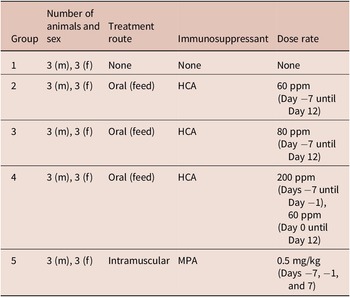
The five treatments applied in this study were as follows. Group 1 served as the negative control and did not receive any immunosuppressive treatment (Table 1). Groups 2 to 4 received immunosuppression through dietary administration of HCA. Group 2 was administered 60 ppm HCA, Group 3 received 80 ppm, and Group 4 received 200 ppm for the initial 7 days, followed by 60 ppm for the remainder of the study (Table 1). Group 5 was immunosuppressed by means of intramuscular injections of MPA, containing the active ingredient methylprednisolone, at a dose rate of 0.5 mg/kg on Days −7, −1, and 7.
Summary of the experimental groups and immunosuppressive treatments administered to rats

Table 1. Long description
The table consists of five columns: Group, Number of animals and sex, Treatment route, Immunosuppressant, and Dose rate.
* Group 1: 3 m and 3 f. Treatment route, Immunosuppressant, and Dose rate are all listed as None.
* Group 2: 3 m and 3 f. Treatment route is Oral feed. Immunosuppressant is H C A. Dose rate is 60 p p m from Day minus 7 until Day 12.
* Group 3: 3 m and 3 f. Treatment route is Oral feed. Immunosuppressant is H C A. Dose rate is 80 p p m from Day minus 7 until Day 12.
* Group 4: 3 m and 3 f. Treatment route is Oral feed. Immunosuppressant is H C A. Dose rate is 200 p p m from Days minus 7 until Day minus 1, then 60 p p m from Day 0 until Day 12.
* Group 5: 3 m and 3 f. Treatment route is Intramuscular. Immunosuppressant is M P A. Dose rate is 0.5 m g / k g on Days minus 7, minus 1, and 7.
Footnotes define m as male, f as female, H C A as hydrocortisone acetate, M P A as methylprednisolone acetate, and m g / k g as milligrams per kilogram of body weight.
m, male, f, female, HCA, hydrocortisone acetate, MPA, methylprednisolone acetate, mg/kg, milligrams per kilogram of body weight
Experimental infection of rats with Trichostrongylus colubriformis
The T. colubriformis isolate was obtained in 2016 and maintained in dewormed donor sheep confirmed free of infection with T. colubriformis prior to inoculation. Third-stage larvae (L3) were sourced from faecal cultures of infected sheep. Fresh faeces containing eggs were mixed with vermiculite and incubated in glass jars at 27 to 28°C and a relative humidity of 75%. After 4 to 5 days, larvae emerged and were harvested daily by allowing them to migrate to the top of the jar, followed by rinsing with distilled water into a culture flask. Harvesting continued until no more larvae were observed. The collected L3 larvae were stored at 2 to 8°C for approximately one hour until inoculation of the rats.
The required number of viable T. colubriformis L3 larvae was calculated one day before inoculation. This procedure involved transferring the larval suspension into a 100 mL glass beaker. The suspension was continuously stirred by means of a glass Pasteur pipette connected to an air pumping tube. Using a precision micropipette, twelve 0.1 mL aliquots were dispensed into a Petri dish. Each droplet was examined under a stereomicroscope, and only motile larvae displaying a coiled posture were counted. Outliers were excluded, and the mean number of larvae per 0.1 mL was determined using counts from the remaining replicates. While stirring the suspension, the necessary volume was aspirated using sterile 1 mL syringes (one per rat). Syringes were stored in a dark container at 2 to 8°C until use. On the day of infection, larval viability was reconfirmed under a dissection microscope. Each rat was inoculated with approximately 2000 T. colubriformis L3 larvae in 0.5 mL distilled water by means of oral gavage using a sterile tube. Proper placement was verified prior to administration. Animals were monitored before, immediately after, and 24 hours post-inoculation for adverse effects.
Daily health observations, clinical examinations, and body weight measurements
Rats were monitored daily for general health throughout the study. Body weights were recorded for all animals on Days −14, −7, 1, 8, and 12. On Days −2 and 6, only the rats in Group 5 were weighed for dose calculation purposes. Clinical examinations were performed on Days −14, −7, and −1.
Immunosuppressant preparation and administration
Epol® mice cubes (Reg. No. Act 36/1947: V1787) were ground to a powder-like consistency, and serial dilutions were used to prepare different concentrations of HCA. To create the serial dilutions, the whole amount of HCA for each group (108 mg (Group 2), 144 mg (Group 3), and 360 mg (Group 4)) was initially mixed with a small portion of the feed (100 g). Once thoroughly mixed, additional feed was gradually added, and the mixture was blended again until homogeneous. This process was repeated until all the feed (1.8 kg) was fully incorporated with the HCA. Either the HCA medicated or unmedicated feed was provided in small glass bowls. Given that the rats were housed three individuals per cage, three bowls were placed in each cage every morning. The bowls were inspected each afternoon, and feed was replenished, as necessary.
A stock solution of MPA was formulated by mixing 1.0 mL Depo-Medrol® (40 mg/mL MPA) with 39.0 mL sterile water. Each rat was injected by taking the volume out of the stock solution needed to achieve a 0.5 mg/kg MPA dose rate, based on the animal’s body weight.
Faecal collections and faecal larval counts
Faecal larval counts were conducted to determine if any of the larvae were expelled immediately after inoculation, and to determine if this could be associated with final worm counts at necropsy. Faecal samples were collected from each rat daily from Day 0 to 6. Rats were individually housed and placed on wire-bottom trays for approximately 6 hours, beginning 3 hours post-inoculation. Samples were collected in individual, clearly labelled containers (including animal ID, date, and study day), and stored at 4°C overnight. Larval recovery was performed the following morning.
The L3 larvae were recovered from the faeces using a modified version of the method described by Knapp-Lawitzke et al. (Reference Knapp-Lawitzke, von Samson-Himmelstjerna and Demeler2014). Each sample was thoroughly homogenised and passed through a 200 μm sieve stacked above a 25 μm sieve, using tap water to facilitate filtration. Larvae retained on the 25 μm sieve were collected into 15 mL centrifuge tubes. Samples were vigorously shaken and centrifuged at 1800 × g for 5 minutes. The supernatant was reduced to 5 to 10 mL above the pellet. Saturated sugar solution was added, mixed, and centrifuged again at 1800 × g for 5 minutes. The supernatant containing floating L3 larvae was decanted onto a clean 25 μm sieve to remove residual sugar solution. The retained larvae were rinsed thoroughly (three times) with water into a counting chamber. Larval counts were performed microscopically and recorded.
Necropsy and worm counts
Food was withheld for at least five hours before necropsy to reduce intestinal content volume. On Day 13, rats were euthanised with a lethal dose of sodium pentobarbital, administered intraperitoneally and intracardially (1 mL/kg). Necropsies were conducted, and the stomach to rectum was removed and divided into four equal sections. Contents and scrapings (scraped using a microscope slide) were incubated in 40 mL of pepsin digest solution prepared from 50 mL hydrochloric acid (HCl, 32%), 40 g pepsin, and distilled water added to a final volume of 1 L at 37°C (± 5°C) for 4 hours (± 30 minutes).
After incubation, the contents were washed over a 25 μm sieve with a high-pressure spray. Retained worms were collected into fresh containers, preserved in a 5% glycerine alcohol solution (95 mL 70% ethanol + 5 mL glycerol), and labelled with animal ID, date, and group. Iodine/potassium iodide solution was added to stain worms. Worms were identified and counted using a stereomicroscope.
Data analysis
All statistical analyses were conducted using R version 4.2 (R Core Team 2022). Data exploration and visualisation were performed using base R functions and the ggplot2 package (Wickham Reference Wickham2016). Generalised linear mixed models (GLMMs) were used to test the effect of group on larval or worm counts, using the glmmTMB package (Brooks et al. Reference Brooks, Kristensen, van Benthem, Magnusson, Berg, Nielsen, Skaug, Maechler and Bolker2017). Model assumptions and fit were evaluated using simulation-based residual diagnostics implemented in the DHARMa package (Hartig Reference Hartig2022). A negative binomial error distribution was specified to account for overdispersion in count data. Treatment group was included as a fixed effect, while cage ID was included as a random effect to account for the presence of three individuals, and thus potential non-independence of observations, within cages. Two models were specified: (1) the ‘complete’ model, including group as a fixed effect and cage ID as random effect, and (2) a ‘comparison’ model excluding the fixed effect group. Analysis of Variance (ANOVA) was used to compare the two models, and hence to determine if group had an effect on larval or worm counts. If significance in the fixed effect was found, pairwise comparisons between groups were conducted using estimated marginal means implemented with the emmeans package (Lenth Reference Lenth2024).
Results
Health, sex, age, and body weight of rats
None of the animals displayed any adverse health effects due to artificial helminth infection or immunosuppression during the study. Supplementary Table S1 shows that each group had equal numbers of males and females, with similar age and body weight ranges at inclusion.
Faecal larval counts post-inoculation
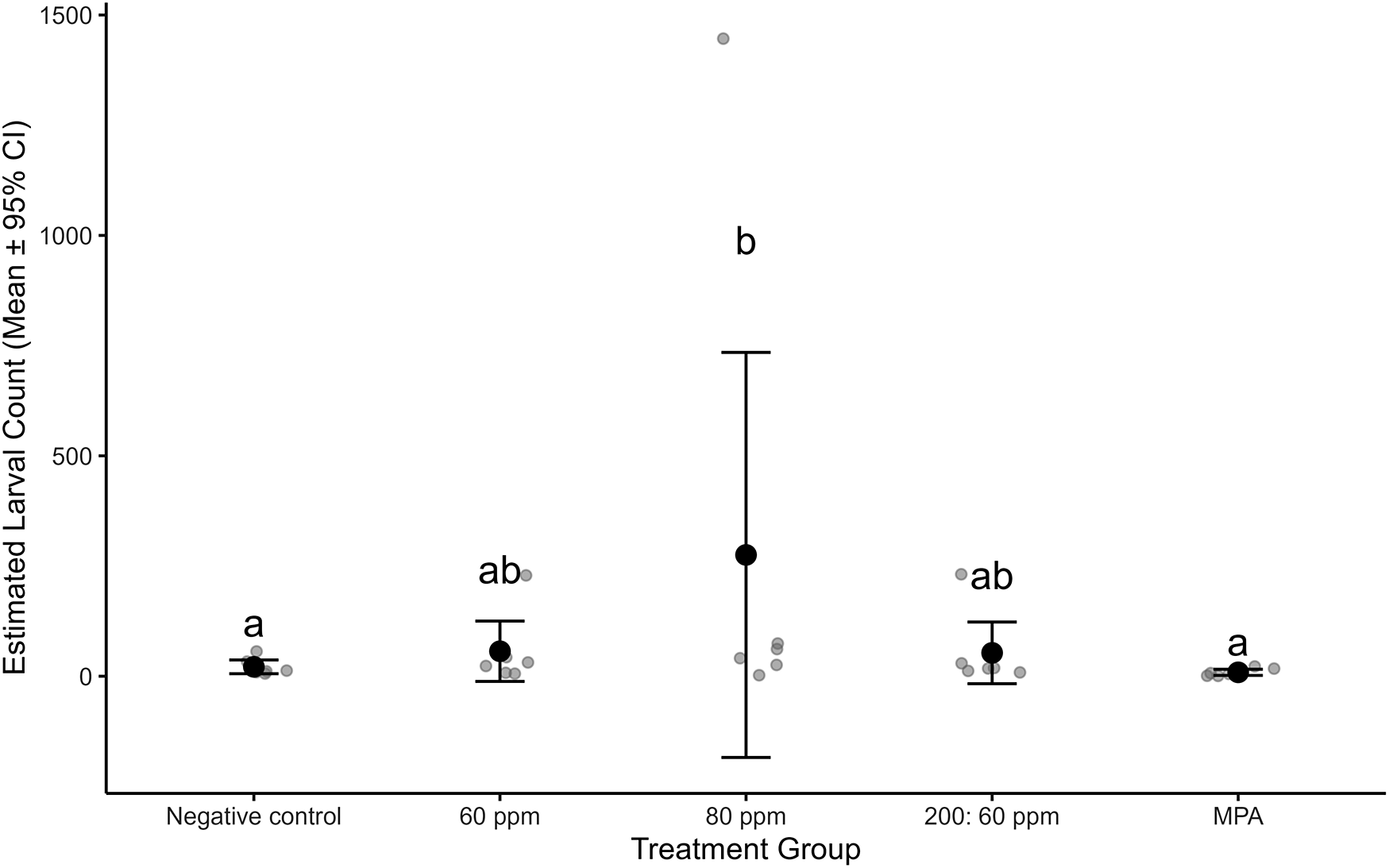
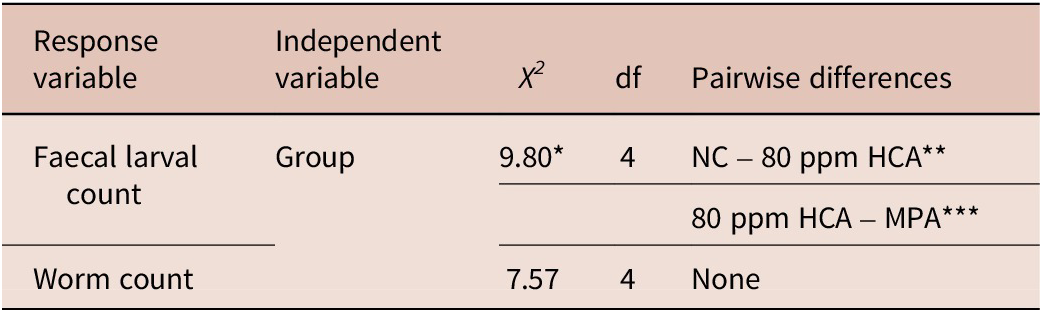
Treatment had a significant effect on faecal larval counts after inoculation (X 2 = 9.80, p < 0.05; Fig. 1, Table 2). Rats had a higher estimated faecal larval count (mean, 95% CI) in the 80 ppm HCA group (275.17, 80.39–941.90) compared to those in the negative control group (21.33, 6.11–74.44). Within the immunosuppression-treated groups, estimated faecal larval counts (mean, 95% CI) were significantly higher in the 80 ppm HCA group (275.17, 80.39–941.90) compared with the MPA group (8.83, 2.46–31.72) (Fig. 1; Table 2).
Estimated larval count (mean ± 95% CI) across treatment groups. Jittered grey points represent individual observations. Letters indicate homogeneous subsets identified from post hoc tests.

Figure 1. Long description
A dot plot displays data across five categories on the x-axis labeled Treatment Group. The y-axis is labeled Estimated Larval Count (Mean plus or minus 95 percent C I) with a scale from 0 to 1500. Each group features a central black dot for the mean, vertical error bars for the confidence interval, and jittered grey points for raw observations.
* Negative control: Mean is near zero with a very small confidence interval. Labeled with the letter a.
* 60 p p m: Mean is slightly higher than the control with a wider confidence interval. Labeled with the letters a b.
* 80 p p m: Shows the highest mean, approximately 300, and the largest confidence interval extending from below zero to nearly 750. A single outlier observation is visible near 1450. Labeled with the letter b.
* 200 colon 60 p p m: Mean and confidence interval are similar to the 60 p p m group. Labeled with the letters a b.
* M P A: Mean is near zero with the smallest confidence interval. Labeled with the letter a.
Results of generalised linear mixed model investigating faecal larval count and worm counts at necropsy among the five treatment groups. Cage ID was included as random effect in each model

Table 2. Long description
The table consists of five columns: Response variable, Independent variable, X super 2, d f, and Pairwise differences.
Row 1: Response variable is Faecal larval count. Independent variable is Group. X super 2 is 9.80 with a single asterisk. d f is 4. Pairwise differences are N C minus 80 p p m H C A with two asterisks.
Row 2: This row continues the Faecal larval count data. Pairwise differences are 800 p p m H C A minus M P A with three asterisks.
Row 3: Response variable is Worm count. Independent variable is Group. X super 2 is 7.57. d f is 4. Pairwise differences are None.
Footnotes define the following:
* One asterisk: p is less than 0.05.
* Two asterisks: p is less than 0.01.
* Three asterisks: p is less than 0.001.
* p p m: parts per million.
* N C: negative control.
* H C A: hydrocortisone acetate.
* M P A: methylprednisolone acetate.
* d f: degrees of freedom.
*, p < 0.05; **, p < 0.01; ***, p < 0.001
ppm, parts per million, NC, negative control, HCA, hydrocortisone acetate, MPA, methylprednisolone acetate, df, degrees of freedom
Worm counts post-necropsy
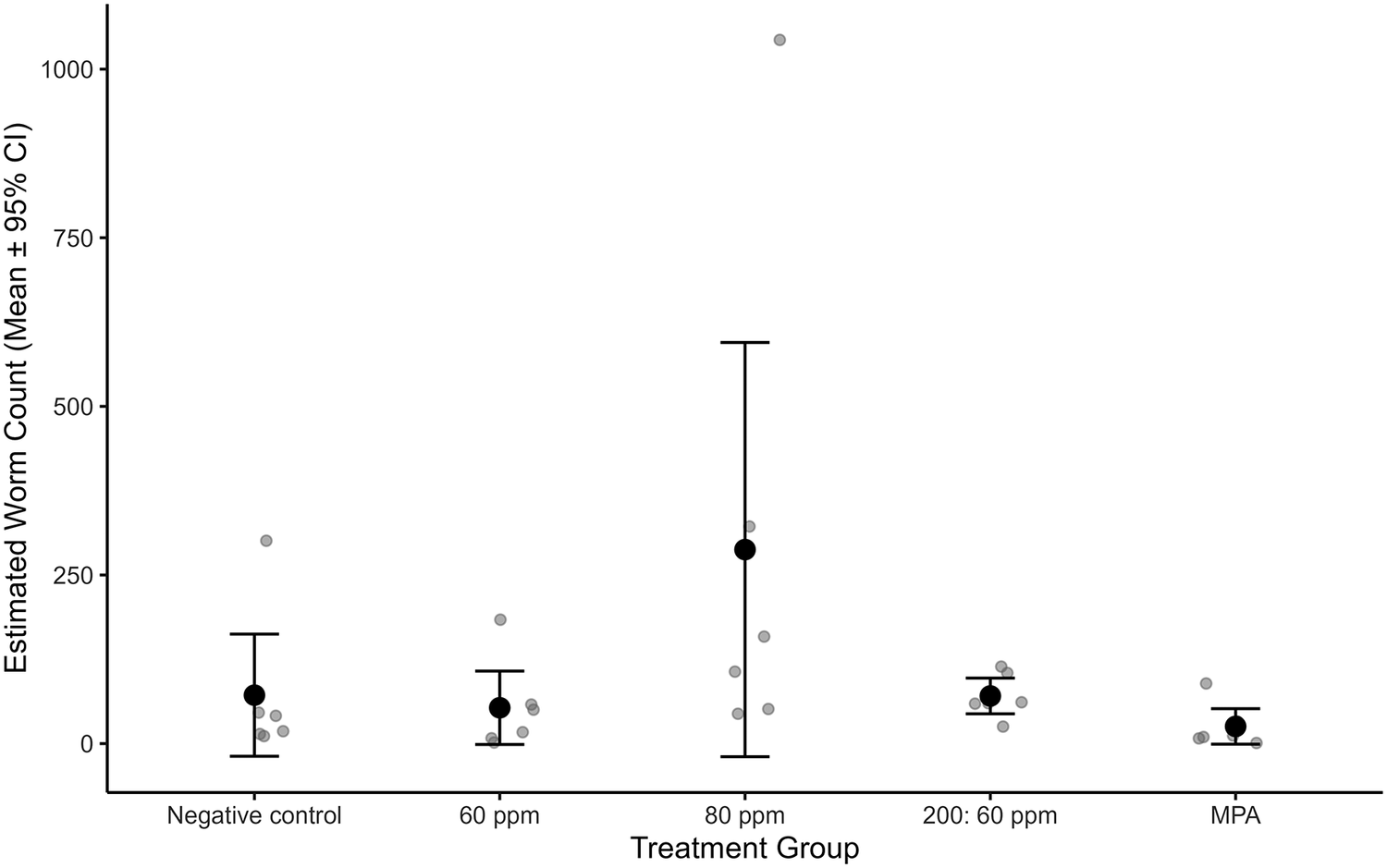
Treatment had no effect on necropsy worm counts (X 2 = 7.57, p > 0.05; Fig. 2, Table 2). Nonetheless, there were differences in variability across the immunosuppression treatments that are worth noting; the 80 ppm HCA group exhibited the highest within-group variance with a coefficient of variation (CV) of 133.4%, whereas the 200: 60 ppm HCA regimen showed substantially lower variability (CV = 46.7%).
Estimated worm counts (mean ± 95% CI) recovered after necropsy across treatment groups. Jittered grey points represent individual observations.

Figure 2. Long description
A dot plot displays data on a vertical Y axis labeled Estimated Worm Count Mean plus or minus 95 percent C I, ranging from 0 to 1000. The horizontal X axis is labeled Treatment Group and contains five categories. Each category features a large black central dot representing the mean, vertical error bars for the confidence interval, and jittered grey dots for individual observations.
* Negative control. Mean is approximately 75 with a confidence interval from 0 to 160. Individual observations are clustered below 50 with one outlier near 300.
* 60 p p m. Mean is approximately 50 with a confidence interval from 0 to 110. Observations are tightly clustered below 100 with one outlier near 200.
* 80 p p m. Mean is the highest at approximately 290 with the widest confidence interval extending from 0 to 600. One extreme outlier is visible above 1000.
* 200 forward slash 60 p p m. Mean is approximately 70 with a narrow confidence interval from 40 to 100. Observations are tightly grouped.
* M P A. Mean is the lowest at approximately 25 with a narrow confidence interval from 0 to 50. Observations are clustered near the baseline.
Discussion
Our prediction that rats receiving MPA would have greater and more consistent worm establishment compared to those receiving HCA was not supported. Treatment group had no effect on estimated necropsy worm counts. Furthermore, we did not observe an increase in worm counts with an increase in HCA starting concentration. Contrary to our expectations, the HCA group at 80 ppm had the highest estimated mean worm count, followed by the 200: 60 ppm group, while the MPA group had the lowest count. Nevertheless, the 80 ppm HCA group exhibited the greatest variability in counts, while the 200: 60 ppm group demonstrated the least variance. Surprisingly, the MPA group showed the lowest worm count of all immunosuppressed groups, albeit with the least amount of variation.
There was no increase in the number of worms recovered from an HCA immunosuppressed group with an increase in starting concentration. This contrasts with the findings of Gration et al. (Reference Gration, Bishop, Martin-Short and Herbert1992), who reported substantially higher T. colubriformis worm burdens (a mean of 775 worms) in Cobb-Wistar rats immunosuppressed with 60 ppm HCA. In comparison, the mean worm burden observed in our study for the corresponding group was markedly lower, at 53.17 worms. Strain-related differences in rats are especially important, as different strains can exhibit distinct physiological, immunological, and metabolic profiles, which influence their susceptibility to parasitic infections (Williams et al. Reference Williams, Shearer and Ravitch1981). For example, Wistar rats are generally the most susceptible strain, while Sprague-Dawley rats are moderately susceptible (Vellayan and Syazwani Reference Vellayan and Syazwani2021). However, as a similar model conducted in our laboratory using Wistar rats was also unsuccessful (unpublished data), it appears that the immunosuppressive treatment may be the main contributing factor. As previously mentioned, artificial infection in rats can only be achieved if an immunosuppressant is used. For example, the precise composition and procedure used to prepare the immunosuppressive diet by Gration et al. (Reference Gration, Bishop, Martin-Short and Herbert1992) is not described, making it difficult to determine whether comparable levels of immune suppression were achieved in our study. If the procedure of preparing the diet used in this study differed from Gration et al. (Reference Gration, Bishop, Martin-Short and Herbert1992), it could have led to unequal distribution of the immunosuppressant in the diet stock. This could have resulted in either insufficient or excessive immunosuppression, thereby influencing the ability of helminths to establish a successful infection.
That rats receiving MPA did not exhibit greater or more consistent worm counts than those receiving HCA requires some interrogation. Interestingly, despite its higher immunosuppressive potency and longer biological half-life, MPA (Hazra et al. Reference Hazra, Pyszczynski, DuBois, Almon and Jusko2007; Maddison et al. Reference Maddison, Page and Church2008) supported lower worm establishment compared to all HCA groups. This finding aligns with previous reports in which MPA-treated gerbils showed similarly low worm recovery rates (6.0% for T. colubriformis and 2.2% for H. contortus) (Machado et al. Reference Machado, Gomes, Oliveira, Fiuza and Detmann2006). By contrast, the 80 ppm HCA group in our study yielded the highest mean worm count across all treatments, highlighting the potential of this dosage for promoting T. colubriformis establishment in rodents. These results hold important implications for parasitology and anthelmintic screening, as achieving high and consistent worm burdens is essential for reliable drug efficacy evaluation (Coles et al. Reference Coles, Bauer, Borgsteede, Geerts, Klei, Taylor and Waller1992). The evidence from this study suggests that MPA, even when adjusted for dosage and applied across different rodent species, may be less effective as an immunosuppressive agent for gastrointestinal nematode establishment, whereas refinement of HCA dosing strategies may improve reproducibility in rodent models.
Comparable worm burdens of H. contortus have been reported in gerbils receiving a 200 ppm HCA diet, with counts averaging around 108 (Conder et al. Reference Conder, Johnson, Guimond, Cox and Lee1991, Reference Conder, Johnson, Hall, Fleming, Mills and Guimond1992). In contrast, our combination group (200: 60 ppm) exhibited slightly lower worm counts, averaging 70.6. Although different worm species were used, this difference may reflect variation in host susceptibility, as gerbils are generally considered a reliable model with high and consistent recovery rates (Court and Lees Reference Court and Lees1985). Alternatively, fluctuations in host metabolism or physiological status under varying levels of immunosuppression may have influenced parasite development and infection efficiency (Shea-Donohue et al. Reference Shea-Donohue, Qin and Smith2017). The immediate reduction of dietary HCA concentration from 200 to 60 ppm could also have allowed partial restoration of host immune function during a critical window for larval establishment, thereby impairing parasite survival (Evering and Weiss Reference Evering and Weiss2006). Indeed, Mills et al. (Reference Mills, McTier, Knauer and Woods2020) demonstrated that longer exposure to 200 ppm HCA prior to dose reduction significantly increased worm burdens. While not achieving a high infection rate, the 200: 60 ppm group demonstrated relative consistency, suggesting potential as a more stable and predictable model for controlled infections.
We were unable to replicate the results of Gration et al. (Reference Gration, Bishop, Martin-Short and Herbert1992). Possible reasons for this could include differences in: 1) the rat strain (Cobb-Wistar vs Sprague-Dawley); 2) rat age (3 to 4 weeks vs 3 to 5 weeks); 3) rat size (40 to 50 g vs 37 to 90 g); 4) worm count procedures (Aliquot vs total); and 5) immunosuppression composition and procedure. As already mentioned, different strains can exhibit distinct physiological, immunological, and metabolic profiles, which influence their susceptibility to parasitic infections (Williams et al. Reference Williams, Shearer and Ravitch1981). For example, Cobb-Wistar rats have been shown to be more susceptible to parasitic infection than the Sprague-Dawley rats used in our study (Vellayan and Syazwani Reference Vellayan and Syazwani2021). Additionally, the broader age and body weight range of rats in this study likely influenced immune responsiveness and drug metabolism, contributing further to variability in worm establishment, as was found by Jenkins (Reference Jenkins1974), Stoddart et al. (Reference Stoddart, Crompton and Walters1991), and Ghasemi et al. (Reference Ghasemi, Jeddi and Kashfi2021). Furthermore, total worm counts were conducted in this study instead of counting aliquots. Counting in aliquots can provide inaccurate results, especially when the sample is not adequately homogenised (Refinetti Reference Refinetti1989). Lastly, as previously mentioned, artificial infection in rats can only be achieved if an immunosuppressant is used. If our procedure of preparing the diet differed from Gration et al. (Reference Gration, Bishop, Martin-Short and Herbert1992), it could have led to unequal distribution of the immunosuppressant in the diet stock. The precise composition and procedure used to prepare the immunosuppressive diet by Gration et al. (Reference Gration, Bishop, Martin-Short and Herbert1992) is not described, making it difficult to replicate. This could have resulted in either insufficient or excessive immunosuppression, thereby influencing the ability of helminths to establish infection. Considering that the attempt to replicate a comparable infection model in Wistar rats was also previously unsuccessful (unpublished data), it is plausible that the immunosuppressive treatment was a primary factor contributing to the reduced parasite establishment.
Faecal larval counts were not a reliable indicator of larval expulsion after inoculation. Faecal larval counts confirmed that some worms were excreted after inoculation, indicating a failure to establish infection. Further, faecal larval counts were not a reliable indicator of actual worm burdens, as low larval output did not consistently correlate with high worm recovery at necropsy. For example, Group 5 had both low larval output and low worm recovery. This lack of correlation suggests that faecal larval counts cannot be used as an accurate measure of worm burden in this model. One possible explanation may relate to the standardised timing and duration of faecal collection, which was restricted to a specific 6-hour window each day during the post-inoculation period. This limited collection window may have missed peak larval shedding times or introduced sampling inconsistencies between animals, potentially explaining the weak correlation observed between faecal larval counts and actual worm burdens. However, to our knowledge these assertions have not been studied to date.
The study had limitations, such as the high degree of individual variability (including body weight and age), which possibly led to the individual variability observed in worm burdens within all treatment groups. We did, however, rank the animals according to individual body weight prior to inoculation to ensure equal distribution among groups. Nonetheless, this variability may indicate that host-level differences influenced outcomes more than the treatments themselves. Furthermore, we could not verify that intake was equal across all individuals, but our analysis did account for at least some of this potential variation by including cage ID as a random effect. Also, the dosing accuracy of rats in the MPA group could have been slightly inconsistent. The lowest available commercial concentration (40 mg/mL) was unsuitable for the rats’ small body weights and required dilution to achieve the target dose of 0.5 mg/kg. Inadequate homogenisation of the stock solution may have resulted in inconsistent dosing across animals. However, the MPA stock solution was inverted prior to administration to homogenise the solution. Lastly, we used an ovine-derived, instead of a rat-derived, T. colubriformis strain (due to the shorter experimental timelines and reduced labour requirements), which could partly explain the lower overall worm counts compared to some other studies. Previous studies show that helminth establishment in novel hosts improves with prior host passage; in a comparative analysis of 127 species, recovery rates rose from 11% in the first host to 46% in the subsequent host (Froelick et al. Reference Froelick, Gramolini and Benesh2021). In the context of the present study, it is therefore possible that the inconsistent worm burdens observed may in part reflect the lack of prior adaptation of T. colubriformis to the rat host, and that repeated passage could improve infection success and reproducibility.
Conclusion
Although results of this study are not, on their own, sufficient to validate the Sprague-Dawley rat-T. colubriformis model, the data do imply that further investigation and development are warranted. For example, the difference in variance in worm burdens across treatments implies that successful immunosuppression is achievable under certain treatments provided tighter experimental constraints on demographic and body weight variance can be applied. Future studies should explore alternative immunosuppressive combinations and dosing strategies to enhance T. colubriformis infection models. A 200: 80 ppm HCA combination may increase worm burdens while reducing variability. Prolonged or continuous exposure to 200 ppm HCA could also reduce the negative effects of sudden immunosuppression withdrawal. Additionally, stricter inclusion criteria and more homogeneous cohorts may improve consistency across experiments.
Supplementary material
The supplementary material for this article can be found at http://doi.org/10.1017/S0022149X26101679.
Acknowledgements
We are thankful to Clinvet International and the University of the Free State for providing the necessary resources and infrastructure for this study. We are also grateful to all the employees at Clinvet for assisting with the project.
Financial support
This study was funded by Clinvet International, Uitzich Road, Bainsvlei, Bloemfontein, 9338, South Africa.
Competing interests
No competing interests to declare.
Ethical standard
The study was approved by the independent contract research organisation Clinvet International Institutional Animal Care and Use Committee, South Africa (CG1488-CVSA23/308) and by the Animal Research Ethics Committee of the University of the Free State (UFS-AED2024/0040) and conducted under Section 20 permit number 12/11/1/4/1/6332(HP).


 Open access

