


Since the seminal work of Philip Converse (Reference Converse2006 [1964]), the study of individual belief systems has been fundamental to political psychology and behavior. A belief system is a collection of attitudes that is constrained, or bound together, through interconnections and dependencies. Value orientations are attitudes about values, which Rokeach (Reference Rokeach1973, 5) influentially saw as a hierarchy: ‘terminal values’ that capture ‘desired end-states’ – like equality and freedom – are of a higher order than ‘instrumental values’ relating to the ‘modes of conduct’ that one thinks ought to govern how those ends are reached. Political scientists have explored the role of this hierarchy explicitly (for example, Jacoby Reference Jacoby2006). They have also studied more generally how core political value orientations are stable and relate to lower-order issue positions (cf. Feldman Reference Feldman1988; Hurwitz and Peffley Reference Hurwitz and Peffley1987; Jenkins-Smith et al. Reference Jenkins-Smith, Mitchell and Herron2004; McCann Reference McCann1997). Studies have examined how core political values relate to partisan identification and to party policy positions (cf. Evans and Neundorf Reference Evans and Neundorf2020; Goren Reference Goren2005; Goren et al. Reference Goren, Federico and Kittilson2009; Keele and Wolak Reference Keele and Wolak2006). While mass attitudes towards values that drive the ‘modes of conduct’ in policy implementation and public administration are crucial to democratic governance, we know little about how they fit within belief systems (see, for example, Piotrowski and Van Ryzin Reference Piotrowski and Van Ryzin2007). This is our focus: we examine whether and how attitudes about normative principles of good governance are constrained within belief systems.
We argue that values of democratic governance that are widely recognized as guides to institutional practice fit neatly into Rokeach’s (Reference Rokeach1973) distinction between values pertinent to the means and those that concern the ends of public policy making. They govern the means of implementing public policies. We study the following: accountability to the people through their elected representatives; impartiality when dealing with individuals; efficiency in allocating public resources; transparency in decisions regarding the implementation of public policies; legality in the sense of avoiding legally unauthorized discretionary actions; and maintaining the collective integrity of the foregoing principles. From a strictly administrative perspective, these governance values are procedural: they are embedded in processes and methods of conduct. Our theoretical argument is that they serve higher-order purposes, functioning as means to achieve important social ends. Consequently, we contend that attitudes about the foregoing are attitudes about instrumental values in mass belief systems, and we call these attitudes governance value orientations. Theorizing that governance values are instrumental values bridges the institutional importance of those values with a psychological theory of how attitudes towards those values are embedded within mass belief systems.
To empirically examine the claim that governance values are instrumental values for the mass public, we build on a growing literature that models belief systems and other cognitive processes as networks of attitudes (Brandt Reference Brandt2020; Dalege et al. Reference Dalege, Borsboom, van Harreveld and van der Maas2017). This network approach has been applied to political belief systems (Fishman and Davis Reference Fishman and Davis2022; Boutyline and Vaisey Reference Boutyline and Vaisey2017; Brandt et al. Reference Brandt, Sibley and Osborne2019; Brandt and Sleegers Reference Brandt and Sleegers2021; Turner-Zwinkels et al. Reference Turner-Zwinkels, Johnson, Sibley and Brandt2020), and it allows us to examine both the structure of belief systems and the conditions under which that structure might change. This approach also gives us access to quantitative means for examining constraint within belief systems, capturing both how attitudes relate to one another and how changes in some attitudes can influence others. We are interested in both the static interdependence among the governance value orientations and the dynamic influence of other values on them. In other words, our empirical approach reveals how governance value orientations are structured in relation to different terminal value orientations and other attitudes.
We implement this network approach using data from two original surveys,Footnote 1 one each in Italy and the United Kingdom, that were fielded between December 2023 and January 2024. Italy and the UK have different electoral systems, legal systems, and governance arrangements. Scholars of administrative traditions argue that the UK embodies a managerial governance style; generalist officials are placed wherever needed, judged on performance, and legality is maintained through judicial review (cf. Jugl Reference Jugl2025; Hood and Lodge Reference Hood and Lodge2006; Painter and Peters Reference Painter and Peters2010; Peters Reference Peters2021; Pierre and Peters Reference Pierre and Peters2000). In contrast, they characterize Italy’s governance logic as legalistic, marked by a status-protected civil service guided by rules and hierarchy (Mele Reference Mele2010; Ongaro Reference Ongaro2009; Painter and Peters Reference Painter and Peters2010; Peters Reference Peters2021), and by the oversight of specialized administrative courts (Ongaro Reference Ongaro2009; Ongaro et al. Reference Ongaro, Di Mascio, Melis, Natalini and Goldfinch2023; Painter and Peters Reference Painter and Peters2010; Pierre and Peters Reference Pierre and Peters2000). Institutional and political context has been shown to yield differences in the influence of core political values on political attitudes (compare Evans and Neundorf Reference Evans and Neundorf2020; Goren et al. Reference Goren, Federico and Kittilson2009), but underlying human and social value orientations are more widely shared across national contexts (Schwartz et al. Reference Schwartz, Caprara, Vecchione, Bain, Bianchi, Caprara, Cieciuch, Kirmanoglu, Baslevent, Lönnqvist, Mamali, Manzi, Pavlopoulos, Posnova, Schoen, Silvester, Tabernero, Torres, Verkasalo and Zaleski2014). Moreover, Goren (Reference Goren2020, 2) argues inter alia that ‘human’ values should be the focus of political belief system studies because they ‘are defined more precisely and with greater depth and breadth than political values’. Our surveys are constituted of a variety of human, social, and political values questions that allow us to consider their contribution to the structure of the belief systems we uncover and their influence over the governance value orientations we introduce. Finally, our surveys permit a distinction between respondents who report having ever been and those who report having never been public employees. Because we argue that the governance values that we study are higher-order (in the abovementioned sense) and also embedded broadly in the institutional arrangements of governance (for example, Bertelli Reference Bertelli2021), respondents’ orientations towards those values should not be different for those respondents with experience in a public governance role. This runs counter to the expectations of a large public administration literature (see Ritz et al. Reference Ritz, Brewer and Neumann2016).
With transparency as the sole exception, we find that governance values occupy their own community within the belief systems we explored. Transparency belongs to a community constituted of moral foundations in Italy, and democracy in the UK, providing evidence that it is a higher-order value. The members of the primary governance community – accountability, impartiality, legality, efficiency, and integrity – display a strong degree of a type of clustering that we identify through a low integration ratio: their interdependence with each other is overwhelmingly greater than their dependence on any other value orientations or attitudes (nodes) in the belief system network. They exhibit a greater tendency towards this type of clustering than any other combination of five nodes in the belief systems we study. Respondents’ employment experience in public administration neither alters the internal integration of these values nor changes their relationship with the larger belief system. Using an Ising (Reference Ising1925) model and simulation methods (Dalege et al. Reference Dalege, Borsboom, van Harreveld, van den Berg, Conner and van der Maas2016, Reference Dalege, Borsboom, van Harreveld and van der Maas2017; Turner-Zwinkels and Brandt Reference Turner-Zwinkels and Brandt2022), we observe low levels of dynamic constraint for the governance value orientations. Even transparency is relatively unconstrained, though it is significantly more constrained than the five remaining governance values. Moreover, although dynamic constraint is low, shifts in higher-order values account for the greatest influence over governance values. Governance values are strikingly unconstrained in the UK and only moderately more constrained in Italy.Footnote 2
Our argument and findings make several contributions. We use a methodological approach of increasing importance in a novel way to introduce the literature on political belief systems to the unique role that governance value orientations play within those systems. In doing so, we address a growing need for the systematic analysis of citizens’ perspectives on governance, particularly in comparative contexts, which are the subject of significant reform efforts (Bouckaert et al. Reference Bouckaert, Van De Walle and Kampen2005). Our study adds to various literatures about public governance by showing that weak dynamic constraint makes governance value orientations difficult to change, even as other attitudes in the mass belief system change. When citizens possess constrained belief systems, ‘new political events have more meaning, retention of political information from the past is far superior, and political leaders are held to more consistent standards’ (Converse Reference Converse2006 [1964], 30). Citizens with coherent governance value orientations should be better able to evaluate administrative performance and to hold public officials accountable for procedural standards. Because our evidence suggests that public administration experience does not substantially enhance this equipment, this finding of coherence is that much more powerful because it is widespread. More research into governance values as components of mass belief systems will help to bridge political psychology, theory, and public administration literatures and to create new theoretical opportunities. We plant seeds for such research in the conclusion.
Governance Values in the UK and Italy
What constitutes ‘good’ governance from a procedural perspective is based on values. Selznick (Reference Selznick1994, 277, 279) argued that even classic accounts of bureaucracy are centered in ‘values associated with correct procedure and fidelity to rules’ and that ‘the fate of other, more substantive, values may also depend on bureaucratic organization and commitment’. Bertelli et al. (Reference Bertelli, Falletti and Cannas2025) take a practice-based approach, distilling six ‘essential’ values from sources of hard and soft law, and reveal their grounding in the values of representative democracy. These are the governance values that we presently study, though we hasten to note that our approach can (and should) be used to explore other conceptions.Footnote 3 Our choice of values was for two reasons. First, Bertelli et al. (Reference Bertelli, Falletti and Cannas2025) build broadly on scholarship spanning constitutional law, administrative practice, and democratic theory, synthesizing an extensive literature on the rule of law, accountability mechanisms, and procedural justice. Second, the core ideas underlying these principles are contained in legal documents adopted in both the UK and Italy, which, despite institutional differences between the two countries, use similar language to refer to these essentials. Given the vast array of principles we could have measured, focusing on this limited set seemed both conservative and theoretically and contextually informed.
The interdependencies among governance values are crucial to our argument about their place in mass belief systems. Bertelli et al. (Reference Bertelli, Falletti and Cannas2025) argue that these principles are independent from political attitudes, not just because they are evident in institutional practice, but because they collectively define a theoretical role for governance in representative democracy. Social scientists and philosophers contend that the rule of law has both a procedural component, assuring that laws are clear and not applied arbitrarily, and a substantive component, which is meant to maintain justice and to protect fundamental rights (cf. Habermas Reference Habermas1996; Selznick Reference Selznick1994). Legality requires that public officials attend to substantive considerations whenever they have the authority to act, but substantive considerations alone do not justify action that is not legally authorized. Officials cannot exceed their legal authority to act.
For unelected public officials doing the work of governance, popular accountability in representative democracies flows through the elected representatives of the people. Consequently, the authority for lawmaking by representatives is of greater breadth and depth than the authority that public officials have to implement the laws representatives make. Representatives collectively enjoy more authority than any official for this reason.
In a given context, impartiality requires that whenever a public official encounters individuals – through personal interaction, case documents, or otherwise – that official must treat people alike without regard for relationships or proclivities. They should not favor some individuals or groups over others.
Efficiency requires public officials to give precedence to public interests without squandering resources. It requires that the expenditure of funds be no more than necessary to perform an authorized function.
Transparency relates both to a democratic right to know what government is doing in the name of the people and to an individual right to know how the government acts in individual cases. Officials must provide the reasons for their decisions.Footnote 4
Finally, integrity binds all the governance values together, requiring officials to balance the foregoing principles without guidance from their own attitudes or beliefs. Like that of Kirby (Reference Kirby2021), this view of integrity is institutional, rather than individual (see Bertelli and Falletti Reference Bertelli and Falletti2025). The integrity of governance in a jurisdiction is not simply a cumulation of the integrity of individuals who implement public policies in that jurisdiction. It is achieved through adherence to the other essential values.
While versions of these principles are deeply rooted in statutory and decisional law in both Italy and the UK, a cross-national consensus has emerged. Official actions must be within the legal bounds of discretion; must employ means that are rational and necessary for achieving a legitimate aim; and must preserve individual rights (Cohen-Eliya and Porat Reference Cohen-Eliya, Porat, Tushnet and Jackson2017). But perhaps most importantly for our purposes, these values are abstract conceptions of what (collectively) constitutes a ‘good’ way of conducting governance and policy implementation, which makes them appropriate to consider collectively alongside important moral, social, and political values.
We contend that accountability, impartiality, transparency, efficiency, legality, and integrity do not possess intrinsic value. Their normative force derives from their contribution to good governance and, consequently, to the achievement of democratic values (Bertelli et al. Reference Bertelli, Falletti and Cannas2025). They authorize governance practices that align with democratic values, rather than represent terminal ends in themselves.
Theory and Hypotheses
Both terminal and instrumental values are essential to political belief systems (Rokeach Reference Rokeach1973). The governance values we have just described are instrumental: they are ‘modes of conduct’ that apply to governance and policy making generally to ensure that terminal values can be achieved in society. We contend that the instrumental nature of these values is derived from the institutions of governance in a society, and it is reflected in the positioning of the orientations towards them in mass belief systems. In those systems, the intrinsic importance of terminal values is conceptually represented in a value hierarchy. Governance value orientations are thus of a higher order than political attitudes, but of a lower order than terminal value orientations (Kluckhohn Reference Kluckhohn, Parsons and Shils1951, 395). From a sociological standpoint, Rokeach (Reference Rokeach1979, 52) argued that the hierarchical place of instrumental values comes from the outcome of competition among social institutions (including institutions of public governance) ‘for influence and control over individuals’, resulting in ‘hierarchically organized individual value systems’ (54). These can be detected ‘by measuring the perceived values of a given social institution, as perceived by virtually anyone within a society who can be regarded as the “target” or “general client” of the institution’ (54). This motivates our general-population, survey-based approach.
If governance values occupy the position of instrumental values in mass belief systems, several claims follow, and we empirically assess each of them. Brandt and Sleegers (Reference Brandt and Sleegers2021, 2) note three necessary conditions for a theory of belief system dynamics: (1) elements of belief systems must be connected for at least some people; (2) an element must be able to causally influence the state of a connected element; and (3) exogenous influence on the entire belief system must be possible. They show that a network in which value orientations and relevant attitudes are nodes meets these conditions (2–4). Edges are connections between the nodes and can capture both the magnitude and the direction of the influence of one node on another to which it is connected. Moreover, exogenous influences on one or more nodes can potentially show patterns of influence on all nodes in the network. Because we examine mass belief systems as networks of attitudes (Brandt Reference Brandt2020; Dalege et al. Reference Dalege, Borsboom, van Harreveld and van der Maas2017), we must also consider these claims in terms of the network characteristics that we expect to observe if they are in evidence.
We have argued that orientations towards governance values are interrelated attitudes about ‘modes of conduct’ that the mass public believes ought to hold when public officials act. Because of their importance to implementing policies in representative democracies, all governance values are likely to be valued positively by the mass public (Alvarez and Brehm Reference Alvarez and Brehm2002; Zaller Reference Zaller1992).Footnote 5 Moreover, because of the importance these values have for implementing policies across the entire range of policy domains, we expect attitudes towards them to display the coherence of a system of core beliefs (Schwartz et al. Reference Schwartz, Caprara, Vecchione, Bain, Bianchi, Caprara, Cieciuch, Kirmanoglu, Baslevent, Lönnqvist, Mamali, Manzi, Pavlopoulos, Posnova, Schoen, Silvester, Tabernero, Torres, Verkasalo and Zaleski2014), with orientations unconditioned by specific policy attitudes or issue areas.
Governance value orientations should thus be highly interdependent with one another but not be constrained by the larger belief system. In the language of network analysis, we expect that governance values would form their own community within the belief system networks we observe, and the value orientations in this community should display a high degree of interconnectedness with each other (internal integration), but not with the rest of the nodes in the network (external integration). We test the following claims.Footnote 6
H1 (Community): A compact set of governance value orientations forms a distinct community.
H2 (Local Interdependence): For that compact set of governance values, the ratio of external integration to internal integration is less than one.
If governance values are indeed instrumental values, they should not require tailored experiences to appreciate their utility or appropriateness. That is, we claim that the general population should believe them to be appropriate norms for the conduct of governance, and individuals with public employment experience should have a similar community structure and display local interdependence of governance values when compared with those who have no such experience.
Our argument would face a significant challenge from the extensive literature on public service motivation. Research by Moynihan and Pandey (Reference Moynihan and Pandey2007), for instance, contends that organizational experiences fundamentally shape attitudes that are important to the practice of governance. And a systematic review by Ritz et al. (Reference Ritz, Brewer and Neumann2016) shows that public employment experience is expected to alter motivational orientations. Consistent with our argument, we test the following hypothesis.
H3 (Experiential Invariance): Belief systems for groups of individuals with and without public employment experience have governance value orientations with similar community (H1) and local interdependence (H2) structural characteristics.
A second set of claims is implied by the anterior position of terminal values in the value-system hierarchy (Rokeach Reference Rokeach1973). Our hypothesis that a compact set of governance value orientations displays a low integration ratio (H2) means that they are only minimally constrained by the rest of the belief system, on average. To the extent any particular node in the belief system can exert influence over the governance value orientations, a change in one or more terminal value orientations should be more impactful because of the place of those values atop the hierarchy: ‘resistance to change is strongest for beliefs and values that are most important’ (Williams Reference Williams and Rokeach1979, 33). Terminal values have been studied through validated instruments (for example, Haidt and Graham Reference Haidt and Graham2007; Haidt and Joseph Reference Haidt and Joseph2004; Schwartz Reference Schwartz and Zanna1992; Schwartz et al. Reference Schwartz, Cieciuch, Vecchione, Davidov, Fischer, Beierlein, Ramos, Verkasalo, Lönnqvist, Demirutku, Dirilen-Gumus and Konty2012). Empirical researchers consider terminal values to be important to the organization of a belief system, giving them high betweenness centrality (Dalege et al. Reference Dalege, Borsboom, van Harreveld, van den Berg, Conner and van der Maas2016, Reference Dalege, Borsboom, van Harreveld and van der Maas2017). We test the following claims as they apply to all six governance values described in the last section.
H4 (Weak Constraint): A substantial increase in the propensity of all respondents to endorse any non-governance value has little influence on the share of respondents endorsing governance values.
H5 (Hierarchical Constraint): A substantial increase in the propensity of all respondents to endorse a terminal (non-terminal) non-governance value has a greater (lesser) influence on the share of respondents endorsing governance values.
We use the phrase ‘all respondents’ to reflect an expectation based on simulation methods that we will describe forthwith. When the universe of hypothetical (or simulated) respondents changes its orientation towards values, we anticipate the observed changes in the share of hypothetical respondents endorsing governance values to follow the patterns described in H4 and H5.
Data and Methods
We model belief systems using survey data collected from adult residents of both the UK and Italy to provide variation in the administrative and political context. Our questionnaires, presented in full in Sections B (UK) and C (Italy) of the Supplement, include a standard battery of demographic and political attitude and value questions taken from the British Social Attitudes survey (National Centre for Social Research 2025), the British Election Study (Fieldhouse et al. Reference Fieldhouse, Green, Evans, Prosser, de Geus, Bailey, Schmitt, van der Eijk and Mellon2022), and the European Values Study (EVS 2022). In some cases, these questions were mildly adapted to the appropriate country context.Footnote 7 We capture attitudes about state intervention, taxation, and redistribution; animosity towards subpopulations including women, members of the LGBTQ+ community, racial or ethnic minorities, and immigrants; beliefs about climate change; attitudes towards European integration; perceptions of discrimination and external political efficacy; a scale of self-reported left–right ideology; trust in various public institutions; and democratic and authoritarian values.
Our questionnaire also included items capturing terminal values taken from the Moral Foundations Questionnaire (MFQ) (Haidt and Joseph Reference Haidt and Joseph2004; Haidt and Graham Reference Haidt and Graham2007) and the Schwartz Values Survey (SVS) (Schwartz Reference Schwartz and Zanna1992; Schwartz et al. Reference Schwartz, Cieciuch, Vecchione, Davidov, Fischer, Beierlein, Ramos, Verkasalo, Lönnqvist, Demirutku, Dirilen-Gumus and Konty2012). Both are well-regarded and widely employed for this purpose in psychological studies of attitudes and values. The hierarchical nature of value systems means that terminal values help to organize attitudes in belief systems (Homer and Kahle Reference Homer and Kahle1988). Consequently, the MFQ has been used in political applications, for example, to study differences between liberals and conservatives (Graham et al. Reference Graham, Haidt and Nosek2009; Weber and Federico Reference Weber and Federico2012). From the twenty-question MFQ, we selected only those beliefs that were not already present in standard batteries of political questions (such as authoritarian values) to avoid duplication. We also prioritized the selection of items related to notions of fairness because, in theory, fairness is a terminal value that clearly relates to each of the procedural governance values we study (see Nelson Reference Nelson1980). From the lengthy SVS, we selected a subset of items to measure values of individualism, group conformity, social power, security, altruism, and universalism.
We then added an original battery of questions to measure valuations of the six principles of governance described above. These values are not captured by the standard set of political attitude or moral value questions, and we are not aware of any surveys that systematically operationalize this complete set of values. The wording of our original questions was classroom-tested with lower-division undergraduates, and open-ended follow-up questions helped us to evaluate concept validity. Pilot studies of respondents on the Prolific platform in the UK and in Italy helped us to ensure meaningful variation in responses.
An original additive scale of institutional and civic knowledge is also included in our questionnaire, informed by questions from standard civics and naturalization texts (Faenza Reference Faenza2025; Sweeney Reference Sweeney2023), and constructed in the same fashion as commonly used additive scales of political knowledge. A larger set of institutional knowledge questions was included in our pilot surveys. We selected six questions for each country that maximized meaningful variation among participants.
We also included a novel additive scale of respondents’ frequency of engagement in routine public encounters, or interactions between clients and public officials (Bartels Reference Bartels2013). These included matters such as reporting crimes, applying for social benefits, and giving notice of marriage, civil partnership, or residence changes.
Qualtrics recruited respondents and administered our questionnaires to a sample of 1,304 residents of England, Scotland, and Wales and to 1,302 residents of all regions of Italy. Because respondents self-selected into the survey through a process managed by Qualtrics, we established quotas for region (the three nations of England, Scotland, and Wales in the UK and three macro-regions of Northern Italy, Central Italy, and the South and Islands), age, sex, income, and education, proportional to the size of the corresponding subpopulation in each country. The Supplement provides quota breakdowns (Section A) and the full survey instruments in English (Section B) and Italian (Section C), as well as scale construction (Section E) and descriptive statistics (Section A) on all questions employed in our analysis.
Belief System Estimation
The value orientations and attitudes described above and captured by our questionnaires constitute the fifty-two nodes of the belief system network for each country. The strength of ties (edge weight) between each node captures the degree to which two attitudes relate to one another. We follow others in estimating each of these relationships while controlling for respondents’ positions on all other beliefs, attitudes, and value orientations in the network (Dalege et al. Reference Dalege, Borsboom, van Harreveld, van den Berg, Conner and van der Maas2016, Reference Dalege, Borsboom, van Harreveld and van der Maas2017; Turner-Zwinkels and Brandt Reference Turner-Zwinkels and Brandt2022). We further describe this estimation procedure below. In our analysis, we also control for responses to four demographic questions (age, sex, income, and education).Footnote 8 Using this strategy, we produce a weight-adjacency matrix of the strength of all dyadic ties.
A weight-adjacency matrix for ordinal survey data typically includes estimates of partial polychoric correlationsFootnote 9 and, based on an assumption of network sparsity, a graphical lasso procedure that constrains very weak node-tie estimates to zero. We adopt a very similar approach used by Dalege et al. (Reference Dalege, Borsboom, van Harreveld and van der Maas2017) and Turner-Zwinkels and Brandt (Reference Turner-Zwinkels and Brandt2022), which first dichotomizes survey responses and then uses logistic regression along with a graphical lasso procedure to estimate edge weights (the strength of ties between nodes).Footnote 10 We create binary response variables by splitting responses at their median values.Footnote 11 We opt for the binary approach because a two-state network is compatible with the Ising model of thermodynamics (Ising Reference Ising1925).Footnote 12 The Ising model, which we will discuss momentarily, has been used to simulate dynamic constraint in attitudinal networks (Dalege et al. Reference Dalege, Borsboom, van Harreveld, van den Berg, Conner and van der Maas2016, Reference Dalege, Borsboom, van Harreveld and van der Maas2017).
Community Detection and the Integration Ratio
Having estimated the strength of ties between attitudes, we can examine how governance value orientations interact with the rest of the belief system. We use several strategies to do this.
One common approach to identifying node (attitude and value orientation) clusters in correlational networks is algorithmic community detection. This data-driven approach uncovers clustered relationships within a set of nodes. Partitions that distinguish the communities (clusters) of nodes are revealed when the nodes within the partition (members of the community) are more connected to each other and less connected to other parts of the belief system. We use the ‘walktrap’ algorithm designed by Pons and Latapy (Reference Pons and Latapy2006), which has been used for belief system networks by Dalege et al. (Reference Dalege, Borsboom, van Harreveld and van der Maas2017) and Turner-Zwinkels et al. (Reference Turner-Zwinkels, Johnson, Sibley and Brandt2020), to calculate community partitions via the ‘igraph’ package in the R statistical computing environment. Walktrap uses a random-walk model to compute distances between nodes: random walks tend to get ‘trapped’ in more dense areas of a network, thereby increasing the number of steps required to reach less densely connected parts of the network. It is efficient to estimate and performs as well as other community-detection algorithms (Pons and Latapy Reference Pons and Latapy2006).
The number of communities detected and the location of partitions vary somewhat across our country contexts. We will show that five of the six governance value orientations (impartiality, accountability, efficiency, legality, and integrity) are consistently isolated in one cluster, while transparency is just as consistently placed elsewhere. To understand the relative affinity of the five governance value orientations (excepting transparency) that are members of a distinct community and their relative insulation from the remainder of the nodes in the belief system, we define and measure two concepts.
Internal integration refers to the affinity of the members of some specific community with one another (local density). We measure it by first computing the mean strength of each of the five principles with respect to each of the other four and then computing the average mean strength across the five principles.Footnote 13 Formally, for the nodes in a community c, internal integration is captured as follows: $\theta ={\sum _{i \in c}\sum _{j\neq i \in c }\left| w_{ij}\right| \over N_{c}\left(N_{c}-1\right)}$
where i is a node in c, w ij is the edge weight of the tie between i and another node j, also in c, and N c is the number of nodes in c (in our case, N c = 5).
External integration connotes the affinity for members of some specific community with all other nodes in a network. To capture this in our case, we first compute the mean strength of each of the five principles with respect to each of the forty-seven nodes in the belief system that are not part of the community that includes impartiality, accountability, efficiency, legality, and integrity. We then take the average mean strength across the five principles. Formally, then, external integration is given by the following: $\delta ={\sum _{i\in c}\sum _{j \in \tilde{c} }\left| w_{ij}\right| \over N_{c}N_{\tilde{c}}}$
where ${\tilde{c}}$
is the set of nodes that are not in the community c, and N
${\tilde{c}}$
is the set of nodes that are not in the community c, and N $_{\tilde{c}}$
is the number of nodes in
$_{\tilde{c}}$
is the number of nodes in ${\tilde{c}}$
(in our case, N
${\tilde{c}}$
(in our case, N $_{\tilde{c}}$
= 47).
$_{\tilde{c}}$
= 47).
Our statistic of interest is the integration ratio, the ratio of external to internal integration, or ${\delta \over \theta } \in \left[0,\infty \right]$
. When the integration ratio takes a value of one, nodes within community c are just as internally as they are externally integrated. As it moves closer to zero, the external density of ties decreases relative to the internal density.Footnote
14
We estimate confidence intervals for the integration ratio via bootstrap using the ‘boot’ package in R.Footnote
15
Recent literature notes the importance of accounting for network-formation dynamics. Some clustering can result from the intrinsic properties of a network rather than true affinity among nodes or sets of nodes (Schmid et al. Reference Schmid, Chen and Desmarais2022). To address this, we calculate the integration ratio for all randomly drawn combinations of five nodes and compare the pattern displayed by the community including impartiality, accountability, efficiency, legality, and integrity with the others. If the pattern displayed by this community of governance value orientations is unique, we can be more confident that their affinity is not due to stochastic or other dynamics in the formation of the belief system networks we observe.
${\delta \over \theta } \in \left[0,\infty \right]$
. When the integration ratio takes a value of one, nodes within community c are just as internally as they are externally integrated. As it moves closer to zero, the external density of ties decreases relative to the internal density.Footnote
14
We estimate confidence intervals for the integration ratio via bootstrap using the ‘boot’ package in R.Footnote
15
Recent literature notes the importance of accounting for network-formation dynamics. Some clustering can result from the intrinsic properties of a network rather than true affinity among nodes or sets of nodes (Schmid et al. Reference Schmid, Chen and Desmarais2022). To address this, we calculate the integration ratio for all randomly drawn combinations of five nodes and compare the pattern displayed by the community including impartiality, accountability, efficiency, legality, and integrity with the others. If the pattern displayed by this community of governance value orientations is unique, we can be more confident that their affinity is not due to stochastic or other dynamics in the formation of the belief system networks we observe.
Public Employment Experience
Political belief systems of elites exhibit greater degrees of constraint than the general population (Converse Reference Converse2006 [1964]), but whether this extends to public employees or to their governance value orientations has not been systematically explored by political scientists.Footnote 16 To test our experiential invariance hypothesis (H5), we split our samples on the basis of self-reported current or past experience as public employees: government at all levels, public services like health and education, or state-owned enterprises. In our samples, 47.5 per cent of UK respondents (620 out of 1,304) and 39.8 per cent of Italian respondents (518 out of 1,302) reported current or past experience as public employees. In each of the public sector settings mentioned above, governance principles are a part of the workplace (see, for example, Bertelli Reference Bertelli2021, 6). We perform community detection and estimate integration ratios for the self-reported ever and never public employment groups to test our expectations. The calculation of edge weights is once again conditioned on the control variables mentioned above.
Dynamic Constraint
The estimated strength of ties between nodes (value orientations and attitudes) is an indicator of constraint. To examine dynamic constraint, we simulate how a change in one node influences simulated respondents’ governance value orientations.Footnote 17 In this analysis, we consider all six governance values, including transparency. Our simulation approach employs the Ising model of thermodynamics, which can be used to model change in networks where nodes can only be in one of two possible states, for example, ‘on’ or ‘off’ (Dalege et al. Reference Dalege, Borsboom, van Harreveld, van den Berg, Conner and van der Maas2016, Reference Dalege, Borsboom, van Harreveld and van der Maas2017; Turner-Zwinkels and Brandt Reference Turner-Zwinkels and Brandt2022). As noted above, we split our responses at the median of the response set to reflect two positions for this reason. In our attitudinal networks, the possible states are favorable (above the median) or unfavorable (at or below the median) assessment. As in the Ising model, the probability that a given node is in the favorable state is determined jointly by some underlying disposition towards favorable assessment as well as pressure from neighboring nodes to be in a consonant or dissonant state with them (Ising Reference Ising1925).
To grasp the logic of the Ising model, consider just two nodes in an attitudinal network, A and B. When we increase the disposition for node A to adopt the favorable state, we also exert pressure on node B to adopt a particular state as well. If A and B are connected by a positively weighted (correlated) edge, B’s influence is for A to be in a consonant state (favorable in our example). But if the edge weight between A and B is negative, the force exerted by B is to adopt a dissonant state (unfavorable in our example). Moreover, the pressure on B is in proportion to the estimated strength of the tie (magnitude of the correlation) between A and B. In this way, a shift in disposition towards a single attitude or value orientation can reverberate throughout the belief system through the weighted edges of the network. This also means that our influence over node A in this example will have no effect on the state of nodes that are completely isolated (have no ties to A), and it will have the strongest effect on neighboring nodes with strong (highly weighted) ties. And if A’s neighboring node B has few strong ties of its own, our induced change in A will exert less influence over the belief system than if B had many strong ties.
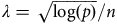
Coppock and Green (Reference Coppock and Green2021, 727) cleverly describe the measurement problem the foregoing approach addresses: ‘dynamic constraint must be detected by tracing the ripples of some exogenous source of opinion change’. The ability of the Ising simulations to capture dynamic constraint comes from the influence that our induced (exogenous) shift in A has as it ‘ripples’ throughout the network through the weighted connections among all the attitudes and value orientations in the belief system network. Crucially, the simulation approach allows us to examine how exogenous changes in any value influence the governance value orientations in which we have principal interest. To this end, we increase the disposition of 1,000 simulated respondents towards one of the 46 non-governance value nodesFootnote 18 while holding all other dispositions constant to observe any influence on the state distribution (of binary favorable or unfavorable assessments) of the six governance value orientation nodes.
Results
Our community hypothesis (H1) anticipates that the governance value orientations form a distinct community within the belief systems we uncover. Figure 1 depicts the belief system network for the UK and Figure 2 does the same for Italy. Both figures confirm what we have noted above: five of the six administrative principles (impartiality, accountability, efficiency, legality, and integrity) are isolated in a single community. Only transparency belongs to another community. In the UK, transparency is consistently clustered with a broad set of democratic value orientations in addition to attitudes towards several MFQ items. In Italy, transparency is clustered with a similar set of MFQ values but is not in the same community as the set of democratic values.Footnote 19
UK community partitions.
Note: the dark bolded nodes indicate the attitudes towards governance values.

Italy community partitions.
Note: the dark bolded nodes indicate the attitudes towards governance values.

In the UK belief system, the five clustered governance values form the community depicted in light purple at the bottom of Figure 1. Nodes sharing a color form a community; the width of edges is greater as the edge weight increases, indicating stronger ties between nodes. Transparency belongs to the red community at the top right of the graph, along with fairness of the laws and justice, and a host of values related to democracy, such as freedom and minority rights. The light purple nodes at the bottom of Figure 2 depict the same five governance values as a distinct community in the Italian belief system. As in the UK, transparency joins a separate community, depicted in red, which includes fairness of the laws, justice, and compassion. But in Italy, the community also includes attitudes of animosity towards women and LGBTQ+ individuals because of their strong negative relationships (negatively weighted edges) with the other values in the community. In both countries, transparency keeps company with higher-level values.Footnote 20
The patterns in Figures 1 and 2 largely support H1, which satisfies a threshold condition for examining our local interdependence hypothesis (H2).Footnote 21 The compact set of five principles – impartiality, accountability, efficiency, legality, and transparency – that forms the light purple-colored community in both figures can be evaluated in terms of its integration ratio (δ/θ). In the UK, the ratio is 0.029 [0.018–0.042]. The bootstrapped 95 per cent confidence interval in brackets shows that this integration ratio is significantly less than one, as expected. Internal integration (θ) is estimated at 0.591 [0.526–0.654], while external integration (δ) is just 0.017 [0.010–0.026]. For reference, the mean absolute edge weight of the full UK network is 0.066 [0.061–0.071], suggesting the set of five governance value orientations is much more dense (internally integrated) than is the network as a whole, and that these five orientations also tend to have much weaker ties to other (non-governance) nodes, on average, than the average tie strength in the full network. In Italy, the integration ratio is 0.038 [0.027–0.050], which also supports H2. Here, again, the internal integration for the Italian community of five governance value orientations (0.641 [0.584–0.699]) is significantly greater than the average tie strength of the full network (0.068 [0.064–0.074]), while external integration (0.024 [0.018–0.032]) is significantly lower than this overall network density. In sum, the five governance values display a very high level of local constraint but a very low level of global constraint when compared to the network’s overall density.Footnote 22
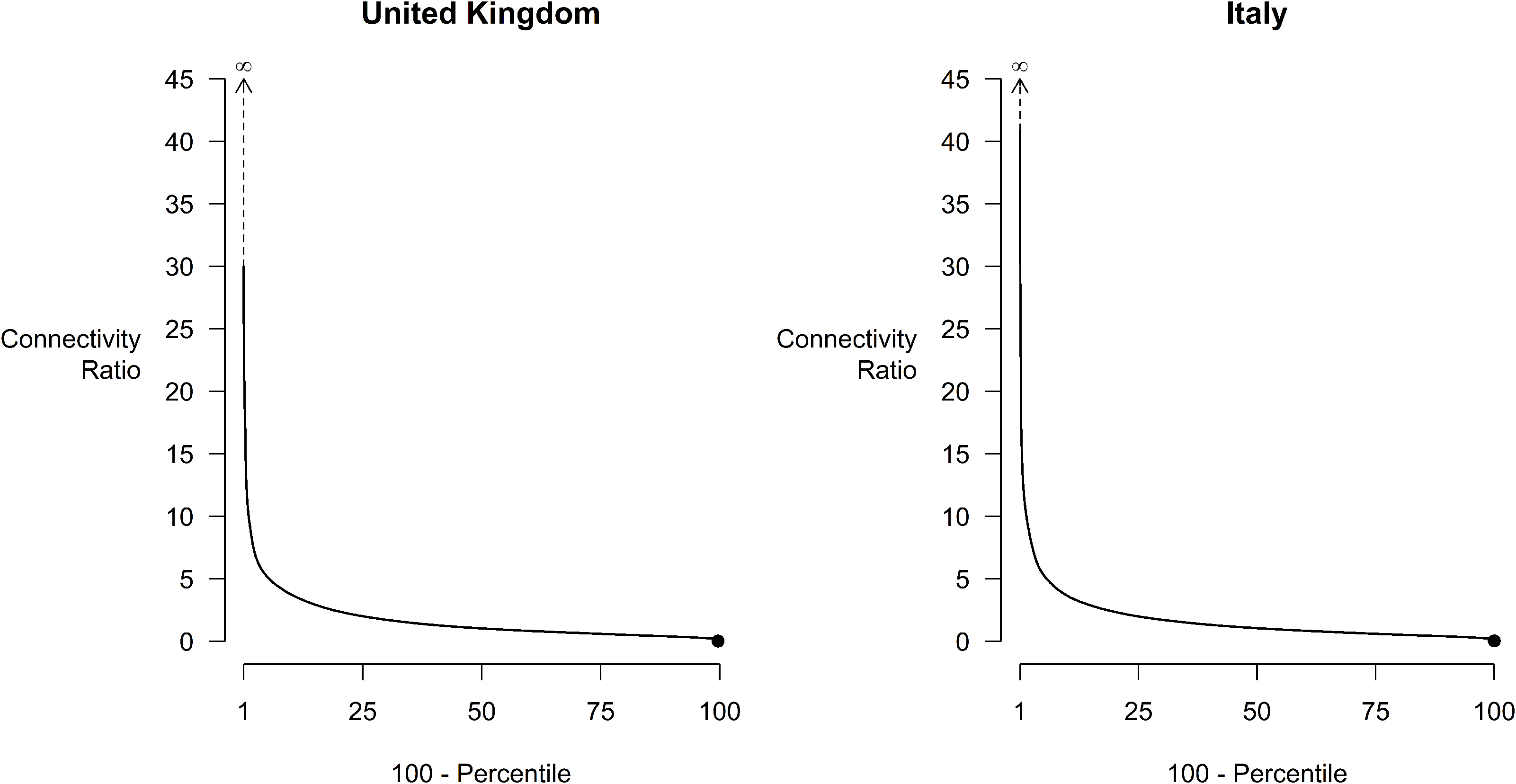
The low integration ratio for this community of governance values is extreme when compared with the integration of other clusters of nodes in the networks for each country. Figure 3 compares the integration ratio of the five-member community of governance principles to that of all combinations of five nodes in the belief system networks. In both countries, the governance community has the smallest integration ratio of any combination of five nodes. These governance value orientations (excepting transparency) provide the most significant contrast between low external and high internal constraint of any five-member group of attitudes and value orientations. And this includes groups where four of the five governance values in question are paired with another node. The local interdependence of governance value orientations, excepting transparency, is strongly in evidence.
Integration ratios for all combinations of five nodes.

The experiential invariance hypothesis (H3) expects that the patterns we have observed do not differ between respondents who have and have not had public employment experience. Grouped community-partitioned graphs similar to Figures 1 and 2 appear in Section K of the Supplement and exhibit the same patterns we describe above. In both countries and for both public employment groups, impartiality, accountability, efficiency, legality, and integrity form a distinct, five-node community, while transparency joins a separate community that includes higher-level moral and democratic values. Within each country, integration ratios are statistically identical for ever, 0.005 [0.000–0.013] in the UK and 0.012 [0.003–0.024] in Italy, and never public employees, 0.005 [0.000–0.014] in the UK and 0.009 [0.003–0.015] in Italy.Footnote 23 We uncover no evidence that public employment experience changes the internal coherence of the five-member governance value community, nor their role in the greater belief system.
A further test of the role of experience comes from the position of our measure of routine public encounters in the pooled sample. In the UK, the estimated edge weights between the encounters node and each of the five clustered governance values are zero. There is a moderate tie between the encounters node and transparency at 0.11, which is slightly less than double the size of the average tie in the whole network. In Italy, the edge weights between all governance principles (including transparency) are zero. This test offers evidence that quotidian experience with bureaucracy as a client has little impact on the role of governance values in the belief system, with the possible exception of transparency.
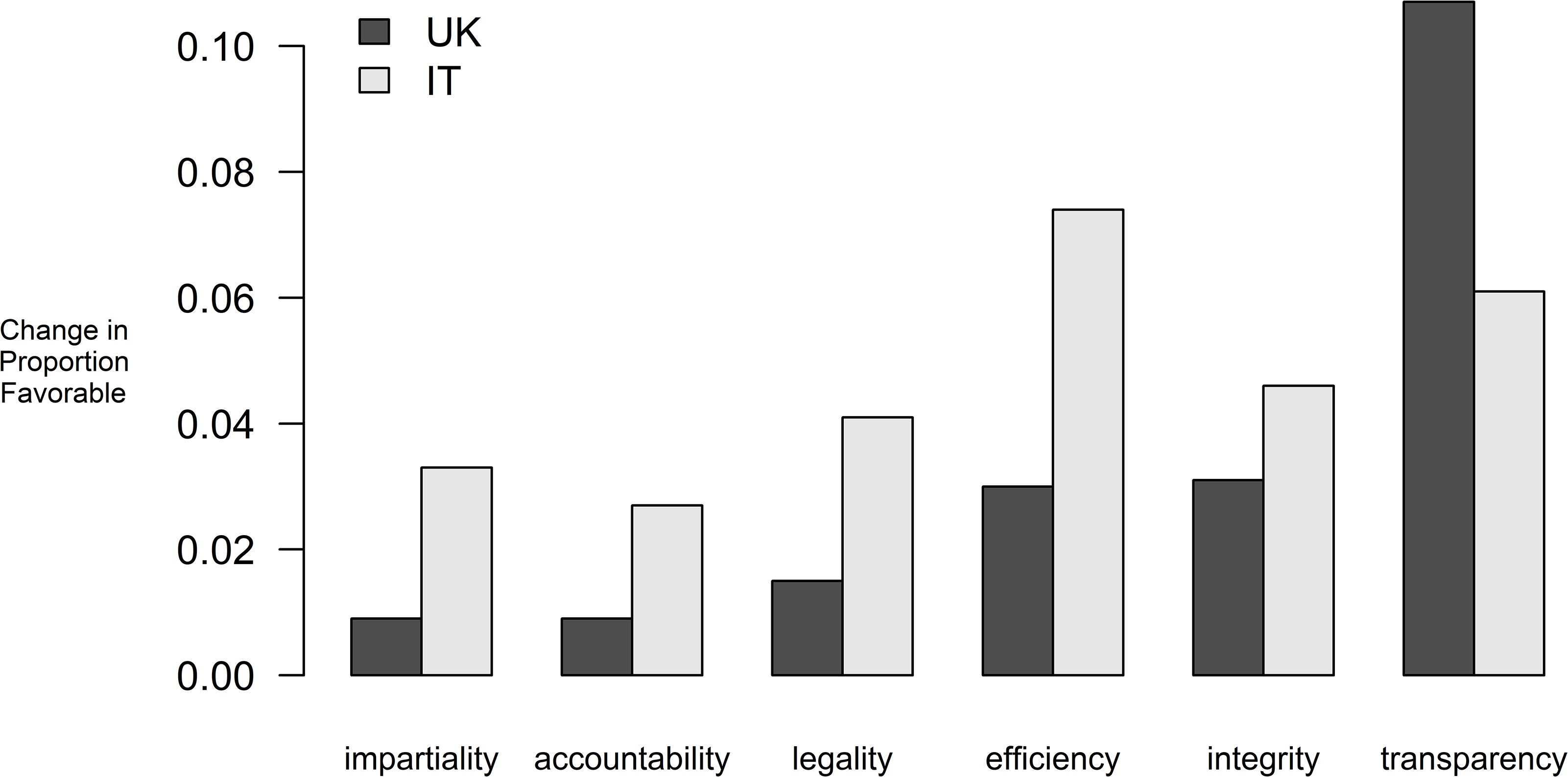
We now test our claims regarding dynamic constraint. The weak constraint hypothesis (H4) anticipates that a significant shift in the propensity to adopt any non-governance attitude or value orientation has little influence over the governance value orientations we are studying. Our Ising simulations induce a shift in the propensity to favorably assess a given non-governance attitude or value from 50 per cent (favorable by chance) to roughly 88 per cent in the simulated population.Footnote 24 Through dynamic constraint, these shifts can impact the endorsement of governance values in the simulated population. Figure 4 shows the greatest change in the simulated share of favorable endorsements that can be exerted by any change on each governance value, which we call maximum dynamic constraint. The height of each bar represents the proportion of the maximum possible change in endorsement rates, with paired bars comparing the constraint effects across the two countries for each governance value. In both countries, our simulations suggest modest, albeit somewhat varied, values for different governance value orientations. In the UK, maximum dynamic constraint is considerably greater for transparency (10.7 per cent) than for any other administrative principle; the second-largest value is for integrity (2.2 per cent). In Italy, both transparency and efficiency have greater values of maximum dynamic constraint than the remaining principles, 6.1 and 7.4 per cent, respectively. Moreover, the difference in maximum dynamic constraint across principles is less pronounced than in the UK. Taken together, the values in Figure 4 show substantial support for H5; governance values have weak dynamic constraint.
Maximum dynamic constraint.

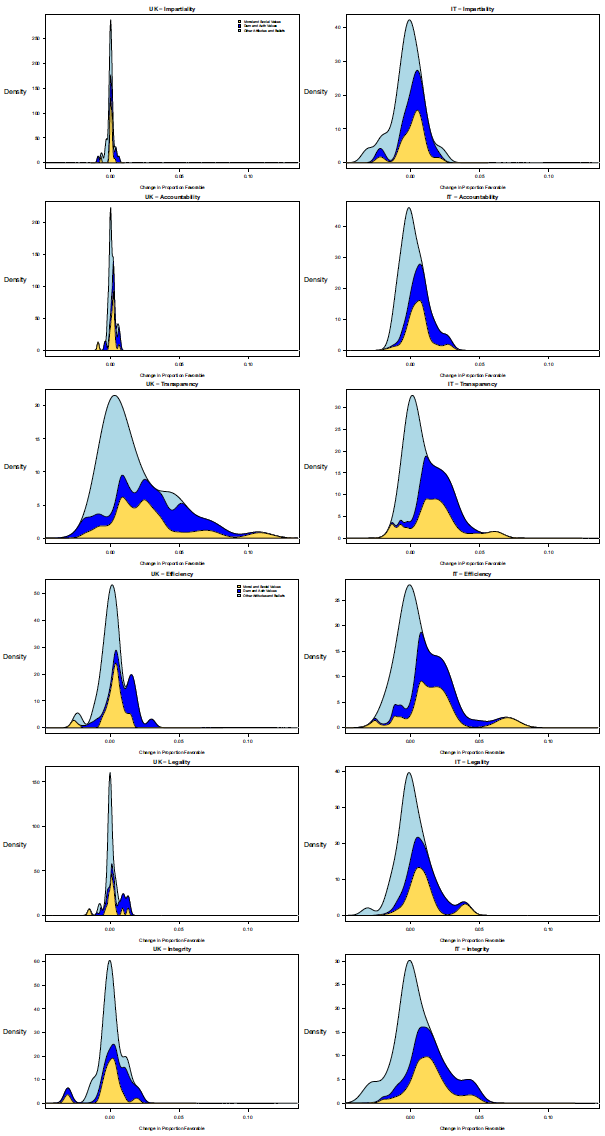
Our final hypothesis (H5) anticipates that what influence on governance value orientations is observable comes more from terminal values in the belief system. To assess the claim, as before, we examine the influence of a shift in predisposition towards all other attitudes and value orientationsFootnote 25 from chance adoption of the favorable state (50 per cent) to a high disposition towards endorsement (88 per cent). However, in this case, we examine the full distributions of our simulations based on the Ising model to understand the influence of three categories of attitudes and value orientations. Figure 5 presents these distributions with moral and social values in yellow, democratic and authoritarian values in dark blue, and all other attitudes in light blue. The horizontal axis plots the change in proportion of simulated respondents with a favorable orientation towards each governance value resulting from the simulated shift in each other value. For instance, simulating a shift in value orientation towards fairness in the UK affects simulated respondents’ orientation towards impartiality. This effect, measured as the change in the share of respondents who endorse the favorable position towards impartiality, is represented on the x-axis of the graph in the first panel of Figure 5. The corresponding y-coordinate is proportional to the share of other attitude shifts that produce an effect of a similar magnitude on respondents’ orientation towards impartiality.
Dynamic constraint by value type.

This graphical portrait shows, in the UK, that transparency is the only governance value orientation dynamically constrained even modestly by simulated attitude change in some other node. All other governance value orientations show less than a 5-percentage-point increase or decrease in the favorable state proportion. In Italy, however, transparency, efficiency, and integrity all surpass this 5 per cent threshold, exhibiting modest levels of constraint. Moreover, to the degree that any node exhibits dynamic constraint with respect to governance value orientations, moral and social values and democratic and authoritarian values tend to account for the greatest shifts.Footnote 26 The single possible exception to this pattern occurs in Italy, where the top-right panel in Figure 5 shows that other attitudes account for the largest shifts in impartiality. However, the combined influence of those attitudes is still quite small.
Prior literature has employed betweenness centrality – the number of the shortest paths between each pair of nodes in the network that pass through a given node – as a measure of higher-level values in a hierarchy of beliefs (Boutyline and Vaisey Reference Boutyline and Vaisey2017). We calculated the average betweenness centrality for each group of values depicted in Figure 5. For reference, betweenness centrality ranges from zero to 226 across nodes in the UK, and from zero to 291 in Italy. In the UK, the highest average betweenness centrality by far is observed for democratic and authoritarian values (96.4), followed by the moral and social values (43.8), and then by all other attitudes (41.8). In Italy, the hierarchy is topped by moral and social values (62.1), followed by democratic and authoritarian values (49.8), and ultimately by the group of all other attitudes (32.4). We also examined how betweenness centrality correlates with the dynamic constraint of governance value orientations. To do so, we correlated betweenness centrality for all non-governance nodes with the simulated proportionate change in each governance value orientation associated with each of those nodes. In the UK, betweenness centrality is a poor predictor of dynamic constraint for all governance value orientations except transparency (still just 0.186).Footnote 27 This is consistent with the message conveyed by Figure 5: governance value orientations are largely free of dynamic constraint in the UK. By contrast, Figure 5 shows modest dynamic constraint in Italy, and this is further revealed through our correlational analysis. Simulated respondents’ favorable assessment of impartiality was the least correlated with betweenness centrality at 0.276, while efficiency showed the strongest relationship (0.691). Other values displayed moderate associations.Footnote 28 Overall, this evidence shows substantial support for our hierarchical constraint hypothesis (H5). Terminal values provide the primary locus of dynamic constraint over the instrumental governance values we have studied.
Conclusion
Our evidence suggests that governance value orientations occupy a relatively unconstrained position in social and political belief systems. Apart from transparency, our governance value orientations form their own, internally integrated community that is invariant to experience working in public employment, where these values operate as a part of official roles. Governance value orientations are weakly dynamically constrained in the UK, but somewhat more constrained in Italy.
These findings sensibly connect with literatures that distinguish substantive and procedural values. For instance, Tyler and Lind (Reference Tyler and Lind1992) contend that individuals emphasize procedural fairness, which is served by governance values, because it communicates respect and value towards individuals within a community and who share an identity (see Tyler and Blader Reference Tyler and Blader2003). Tyler (Reference Tyler2006) shows evidence that procedural fairness generates legitimacy even when outcomes are unfavorable. Our evidence reveals a psychological architecture that makes this possible: governance values are instrumental values that citizens use to evaluate administrative performance independent of policy outcomes. Hibbing and Thiess-Morse (Reference Hibbing and Theiss-Morse2002) argue that citizens’ preferences about how democracy should operate are complex and layered, reflecting multiple and sometimes conflicting considerations that can shift depending on context. Our analysis reveals that in the social and political belief systems we have studied, governance value orientations are highly structured in mass belief systems. This value structure, when interacting with practical realities, may be responsible for some of the nuance. How these values react to different types of exogenous influence can be easily studied with our approach, providing a fruitful path for future study.
Our work also has important implications for public administration scholarship. It adds nuance to discussions of administrative doctrine. Hood (Reference Hood1998) anticipates that orientations towards values are layered and conflicted. He describes tension between efficiency-oriented ‘sigma’ and ‘theta’ values of ‘good’ procedure and argues that context or rhetorical framing can shift which value cluster dominates. The structure of public beliefs about governance values we observe does not indicate such tensions in mass belief systems. By contrast, our argument and findings strengthen the claim that impartiality is both a procedural ideal and an instrumental condition for good governance outcomes (Rothstein and Teorell, Reference Rothstein and Teorell2008). But the clustering of governance values within belief systems suggests that all six of the values that we study contribute to the foundation of good governance for citizens. One significant contribution of our work is to provide evidence that, whatever contestation of governance values occurs at the elite level, coherent, stable value orientations are observed at the mass level.
Our research reveals counterintuitive patterns that contradict conventional assumptions about governance values being stable, unchanging elements of institutions. First, transparency, which is widely studied in the context of governance (Cucciniello et al. Reference Cucciniello, Porumbescu and Grimmelikhuijsen2017) and is the subject of policy making worldwide (Gaventa and McGee Reference Gaventa and McGee2013), exhibits a unique role as a conduit between governance and other fundamental value orientations in political and social life. It consistently clusters with democratic and moral values rather than remaining within the governance community. Bertelli et al., (Reference Bertelli, Falletti and Cannas2025, 7) argue that transparency has democratic value because it ensures accountability in representative democracy, enables citizens to evaluate their representatives’ performance by providing access to information, and is intrinsically connected to fundamental democratic values like freedom of information and expression (cf. Gutmann and Thompson Reference Gutmann and Thompson1996; Kant 1975 [Reference Kant and Reiss1991]; Manin et al., Reference Manin, Przeworski, Stokes, Przeworski, Stokes and Manin1999). This tripartite connection may help to explain why transparency’s positioning in mass belief systems shows greater dynamic constraint: it simultaneously connects to various fundamental democratic commitments.
Second, literatures on administrative traditions see governance in the two countries we study quite differently. The low integration ratios that we observe in the community of governance value orientations in both countries suggest that the public sees governance values as collectively important as normative guidance for implementing all kinds of public policies. In other words, these values provide mortar for the foundation of a legitimate governance process. Still, governance value orientations show weak dynamic constraint in the UK but moderate constraint in Italy, counterintuitively suggesting that the legalistic environment of governance draws citizens’ value orientations about how it ought to be conducted into the shifting sands of political life.
Third, our finding that the place of governance values within belief systems is invariant to public administration experience is at odds with a large literature suggesting that organizational experiences fundamentally shape motivational orientations. This result further supports our conceptualization of governance values as instrumental values that do not require tailored experiences to be appreciated. Constraint in belief systems enhances democratic capacity by providing citizens with organized frameworks for evaluating political events (Converse Reference Converse2006 [1964]). Following this logic, localized constraint among governance orientations equips citizens to evaluate administrative performance and to hold officials accountable for procedural standards. Our findings suggest this democratic capacity is not restricted to administrative elites, making the reinforcement of those values in the institutions and processes of governance (somewhat) less challenging. Moreover, Van Ryzin (Reference Van Ryzin2011) finds that process factors have substantially larger effects on trust than outcomes. Reading our study together with his suggests that procedural values are central to the public evaluation of governance, providing an important non-institutional mechanism that connects institutional values in governance with mass beliefs.
Our work has important policy implications. Governance reforms often assume that public support for procedural improvements will translate into broader political support. Our findings suggest this assumption may be weakly founded because the insulation of governance values suggests that administrative reforms may have limited spillover effects on broader government approval or trust. Reformers may consider tempering their expectations about the broader political benefits of administrative improvements, while recognizing transparency’s unique potential to engage fundamental democratic commitments. More generally, institutional designers who assume that governance values operate only at elite levels, or who ignore their integration into mass belief systems, risk designing systems that lack a psychological foundation or that contradict the structure of mass beliefs.
We hope that our work will stimulate further study into the role of governance values in mass and elite belief systems. One may reasonably argue that the six governance values that we study are, in theory, ‘essentially contested’ concepts (Gallie Reference Gallie1956). Empirically, they are psychologically embedded as instrumental values in mass belief systems. One reason that they remain contested may be their stable foundation in the hierarchy of mass beliefs, rather than elite beliefs or institutional practices. Our evidence shows that these six values provide a theoretical apparatus for scholars to understand when and how this embedding occurs. But their essentially contested nature demands that other governance values, as well as different conceptions of those we study, are crucial to enhancing our understanding of how they fit within belief systems. Broader cross-national studies in countries beyond Western Europe would also be very fruitful, as would comparative work in subnational settings within countries.
While we examined dynamic constraint in a structural framework, it has long been studied through the stability of attitudes and beliefs over time. Understanding the difference between the structural and temporal dynamics of governance value orientations would add significantly to our understanding of these important constructs. Future research with multiwave panel designs and controlled manipulations can empirically verify these simulation-based inferences.
We would also benefit from more theory about what binds groups of values together. In the set of values that we have explored, the glue seems to come from the fundamentals of liberal, representative democracy that can influence governance values. In Rawls’s political liberalism, for example, political principles ‘can be worked out from fundamental ideas seen as implicit in the public political culture of a constitutional regime, such as the conceptions of citizens as free and equal persons, and of society as a fair system of cooperation’ (Rawls Reference Rawls1997, 776). Yet much can be learned from studies of organizational processes, culture, and individual self-conceptions as they relate to orientations towards ‘modes of conduct’ in governance.
Supplementary material
The supplementary material for this article can be found at https://doi.org/10.1017/S0007123426101355.
Data availability statement
Replication data for this article can be found in Harvard Dataverse at: https://doi.org/10.7910/DVN/ISU6UB.
Acknowledgements
We acknowledge the support of an Advanced Grant from the European Research Council (grant agreement no. 101020966). Iker Uriarte and Vincenza Falletti provided excellent research assistance. We thank David Lazer, Christian Grose, Bruce Desmarais, Adrian Blau, Peter John, Ben Jones, Jud Mathews, Perri 6, Jonathan Leader Maynard, Barbara Piotrowska, Piero Stanig, Alberto Vesperoni, Francesca Pia Vantaggiato, and Andrew Whitford for helpful comments. An earlier version of this manuscript was presented at the Annual Meeting of the American Political Science Association, Philadelphia, PA, 5 September 2024. Our data, replication instructions, and the codebook for those data can be found at https://doi.org/10.7910/DVN/ISU6UB.
Financial support
Support for this research was provided by the European Research Council, Advanced Grant, grant agreement no. 101020966.
Competing interests
The authors declare none.




 Open access

