


In April 1740, the Saint-Malo merchant Françoise Datour wrote to her correspondent in Marseille: “[the ship] La Reine des Anges will leave within four days for the Grande Baye,” and added that she was working on fitting out another ship to send to the Petit Nord .Footnote 2 Thereby, she notified her addressee of the vessel she planned to send across the Atlantic for the following fishing season. Such references to the future are typical in the correspondence of merchants, such as Datour, involved in long-distance trade. The uncertain aspects of overseas merchants’ business in the early modern period are often emphasized. Dangers at sea, military conflicts, or the quality of the harvests are only a few examples of what could generate uncertainty for merchants’ future activities. However, historians have not yet examined how merchants themselves discursively expressed the future. Was uncertainty also present in merchants’ own writings? How did merchants discuss future events with their business correspondents? So far, future thinking during the early modern period has essentially been analyzed theoretically or through the works of the intellectual elite, such as the enlightened philosophers.Footnote 3 In this article, I explore the language merchants used to write about the future in their business letters.
When studying the future, we must draw on Peter Burke’s distinction between “a general vision of a distant future” and a “practical sense of a near future.”Footnote 4 While Reinhart Koselleck, the leading scholar who conceptualized the history of the future, focused on a distant future,Footnote 5 I am primarily interested in Burke’s notion of a pragmatic near future. The organization of pre-modern long-distance trade required careful planning and investments on the expectation of future returns.Footnote 6 Burke cites commerce as one of the practical domains of activity in which the near future was, to some extent, subject to human control in the early modern period.Footnote 7 It is not my intention, however, to re-study the organization of long-distance trade itself; instead, I will exclusively focus on merchants’ discourse when they planned their future activities.
Everyday expressions of the future are often considered too obvious to warrant the attention of historians, as they focus on pragmatic near futures rather than discourses on the end of time, utopian narratives set in the distant future, or innovative technological developments. However, focusing on discursive practices sheds light on both the routine and the extraordinary.Footnote 8 By showing what is usual and repetitive, we get an understanding of what was ordinary as well as what can be considered out of the ordinary in merchants’ references to the future. Quotidian references directly expressed by actors can give an insight into how merchants of the eighteenth century conveyed the future to their correspondents, thereby complementing our understanding of the future in the early modern period.
This article contributes to business history by examining how merchants envisioned the future of their trade and how they wrote about future events related to their business activities. When discussing “entrepreneurial imaginaries,” Daniel Wadhwani wrote, “we are constantly imagining, guessing and updating our images of the future to make our way in an uncertain world.”Footnote 9 According to him, analyzing how the people we study imagined the future of their businesses allows us to look differently at specific historical sources left by these economic actors and include different perspectives, such as everyday history and the lived experience of individuals.Footnote 10 This is what I intend to do by analyzing business correspondence afresh and focusing on the language used by merchants in their writings about future events.
An essential parameter in the analysis of expressions of “pragmatic near future” among merchants’ writings is the concept of uncertainty. The future, by definition, is unknown; however, it does not have to be entirely uncertain. As Frank Knight’s classic distinction between uncertainty and risk showed, some uncertainty can be accurately calculated, thereby becoming a risk rather than an uncertainty.Footnote 11 In addition, the way individuals, in our case, merchants, wrote about the future in their discourse could convey certainty. This does not mean that the context of early modern long-distance trade was devoid of uncertainty, and even if it could be mitigated by calculating risks, merchants could not account for all possible uncertainties.Footnote 12 However, the question asked in this study is not whether or not there was uncertainty, but whether merchants wrote about this (un)certainty in their references to the future. Uncertainty is largely present in the literature on long-distance trade; however, historians have so far examined it without a close analysis of the language in which it was articulated in business letters.Footnote 13
Studying merchants’ correspondence offers an incredible lens into how individuals who did not belong to the intellectual elite of their time wrote about the future. Merchants can be considered experts of the future. As demonstrated by Nick Baker in his work on sixteenth-century Italian merchants, “the practice of commerce in sixteenth-century Italy consisted in the assertion of a particular expertise in futurity.”Footnote 14 Similarly, eighteenth-century merchants had to constantly think ahead to organize their trade and adapt to possible obstacles. Most importantly, merchants left many of their letters, which allows us to study their discursive expressions about the future over multiple years and in different sectors of activity. Indeed, business correspondence is available in large quantities and provides a direct window into merchants’ discursive expressions.Footnote 15 Despite the rise of other means of communication during the eighteenth century, private business correspondence remained a central tool to circulate information among merchants.Footnote 16 By the eighteenth century, many merchants involved in long-distance trade relied on commission agents to take care of their business in various geographical places where they were active.Footnote 17 In this type of merchant organization, the main way to communicate with one’s commission agents was through regular business correspondence. In their business letters, individuals explicitly formulated their expectations, fears, predictions, and the anticipated (un)certainties.
Additionally, merchants’ letters are an excellent way to delve into the everyday future of a more socially diverse group of individuals than is usually studied, as they include both women and men who do not belong to the nobility or the intellectual elite. Indeed, the ways individuals think about the future are culturally and socially dependent; future expectations and the ability to imagine future possibilities vary according to social and economic status.Footnote 18 The merchants studied here belonged to the same social group of overseas merchants also called “négociants”; they were literate individuals of a certain wealth with access to some privileges, but there were still economic and social differences between them.
Merchants’ correspondence as a source also has limitations. Business letters do not provide direct insight into how authors viewed the future in general, but only in the discursive expressions related to the future. Furthermore, the straightforward and simple style of the letters studied in this article is recognizable in eighteenth-century business letters present in etiquette books.Footnote 19 Merchants under study followed the codes of business letter writing; for example, they often started their letter by mentioning the last letters they received from their correspondents. References to the future in business letters are inevitably constrained by the narrative conventions of the genre of business letters.Footnote 20 In addition, merchants’ correspondence was always written to a specific addressee with a particular purpose. Merchants wrote to inform and convince, and they could purposely alter, withdraw, or exaggerate information. Therefore, business correspondence is often filled with rhetorical devices designed to persuade, evoke sympathy, or inspire trust.Footnote 21 Nevertheless, business correspondence remains a highly relevant source for exploring merchants’ expressions of everyday pragmatic near futures.
Merchants’ Correspondence and Future Events
The merchants selected in this article were all active in long-distance trade across the Atlantic Ocean during the mid-eighteenth century. Trans-Atlantic trade serves as a laboratory to study writings about the future, as it implied uncertainty due to dangers at sea, military events, and required a high level of coordination to connect different sections of the trade. In the eighteenth century, commerce still followed distinct cycles depending on the nature of the trade, and merchants relied on seasonal fluctuations and yearly rhythms. The seasonality of pre-industrial trade has been a crucial topic in the study of merchants, and it provides a relevant context in which to explore references to the future.Footnote 22 While a form of routine and experience was established, reasonable expectations could easily be disrupted by natural, military, or other factors outside merchants’ control. Long-distance trade involved planning several months in advance and implied a reliance on other actors such as agents or captains, together with their own uncertainties.Footnote 23 All these aspects had the potential of increasing possible obstacles in the transoceanic trade and influenced the ways merchants wrote about future events.
To study the way merchants wrote about the future in their letters, I selected three correspondences from the same merchant archive, that of Jean-Baptiste and Pierre-Honoré Roux of Marseille.Footnote 24 The incoming letters of the Roux brothers contain an extremely rich set of incoming letters—around 900 correspondents, which are well preserved. This is the case because the Roux merchant house went bankrupt at the beginning of the nineteenth century, and their passive correspondence was seized by the Chamber of Commerce of Marseille. Selecting correspondents from the same merchant archive means that all authors wrote to the same addressee (the Roux brothers) during the same timeframe (the mid-eighteenth century), which allows for some points of reference. The Roux brothers took over the merchant house from their uncle in 1728 and were involved in a wide range of activities, including commodity trade, maritime insurance, and banking.Footnote 25 They operated in the Atlantic in sugar, coffee, and indigo trade, among others, and in the Mediterranean by selling linen from Languedoc to the Levant in their own name and in partnerships with other merchants. They acted as intermediaries and commissionaires-banquiers for other merchants.Footnote 26 Within their archive, I chose three of their correspondents who were involved in long-distance trade and have a reasonable number of letters to conduct the analysis (between 80 and 90 letters). The selected correspondences account for diversity in trades, in geographical regions, and gender.
The first correspondence concerns Françoise Datour, a codfish merchant ( négociante ) based in Saint-Malo. She took over the merchant house after her husband’s death in 1739. Her main trade was codfish from the coasts of Canada and sugar from the French West Indies.Footnote 27 The Roux brothers handled her trade in Marseille in exchange for a commission. I consulted the first bundle of Datour’s letters in the archives of the Roux brothers, comprising 93 letters from 1739 to 1740. To complement Françoise Datour’s correspondence, I selected the letters of her late husband, Jean-Baptiste La Fontaine Le Bonhomme, to the same addressee. Just like his wife, he was a codfish merchant based in Saint-Malo who used the Roux brothers as commissionaires. I consulted 101 of his letters to the Roux brothers between 1735 and 1739.
For the third correspondence, I chose a merchant active in another sector of the long-distance trade within the Roux archive, the Spanish American trade. The Verduc & Vincent merchant house, based in Cadiz, was the spearhead of Spanish American trade during the eighteenth century. After the War of Spanish Succession, Cadiz regained its monopoly over the Spanish colonial trade. The different institutions controlling colonial trade, such as the Carrera de Indias, were transferred to Cadiz.Footnote 28 The city benefited fully from the colonial economic growth of the eighteenth century. The Verduc & Vincent merchant house was one of the many French merchants established in Cadiz to capitalize on the opportunities afforded by the city’s access to Spanish American precious metals. Verduc & Vincent’s main trade consisted of buying piasters in Cadiz and sending them to Marseille, where they were in high demand. The Roux brothers could sell them advantageously and pay Verduc & Vincent in bills of exchange.Footnote 29 In addition, Verduc & Vincent took care of the business of the Roux brothers in Cadiz. I selected the first bundle of their letters to the Roux brothers: 78 letters between 1737 and 1740.
All letters were business letters sent from merchants to the Roux merchant house in Marseille. However, the relationship between the writers of the letters and the addressee differed depending on the type of trade the merchants were engaged in. This is important as it had an impact on how merchants discussed future events with their addressee. The codfish merchants, Datour and her husband, La Fontaine Le Bonhomme, before her, needed the Roux brothers as their intermediary in Marseille. The Roux merchant house was a crucial link in their long-distance trade, handling the sale of North Atlantic codfish in the Mediterranean market and purchasing goods for the voyage back to France. For Verduc & Vincent, the opposite was true. They received the goods from Spanish America, primarily precious metals, and transferred them further to the Roux brothers in Marseille. They played the role of intermediaries for the Roux brothers.
In this analysis, the emphasis is on the rhetorical modes of expression of the future in the letters. To analyze the different letters, I combined two methods. First, I conducted a systematic analysis of all explicit references to the future in a sample of the first 30 letters of each correspondence.Footnote 30 I decided to make a sample of consecutive letters (as opposed to a sample of a letter every few months or years) to be able to follow different future events and themes from one letter to another. 30 letters were enough to have information over a year or two and see the seasonal rhythms of a trade. From these letters, I extracted all references to the future, which I refer to as “future statements.” A future statement is a sentence or a group of words explicitly referring to the future. In many cases, the French verb conjugation future simple was a good indicator of the future orientation of the sentence or the group of words. For instance: “vous chercherez à nous remettre même au delà de ce qui nous est du” (you will remit us more than what you are due). However, the future orientation of a group of words is also expressed through verbs in the present; typically, requests such as “nous vous prions de remettre” (we ask you to remit) are future-oriented and have therefore been included as future statements.
Table 1 provides an overview of the different correspondences and the number of future statements analyzed in this article. While Verduc & Vincent have fewer letters, they wrote more future statements than the other two merchants because their letters were longer. However, we see that the three merchants referred to the future in their letters with similar frequency, with between 172 and 183 references per 10,000 words in the annotated letters.
Overview of the correspondences and the number of future statements

Table 1. Long description
The table has five columns. The first column lists merchants: Datour, La Fontaine Le Bonhomme, and Verduc and Vincent. The second column shows periods: 1739 to 1740 for Datour, 1735 to 1739 for La Fontaine Le Bonhomme, and 1737 to 1740 for Verduc and Vincent. The third column gives total number of letters: 93 for Datour, 101 for La Fontaine Le Bonhomme, and 78 for Verduc and Vincent. The fourth column shows future statements in the first 30 letters: 169 for Datour, 182 for La Fontaine Le Bonhomme, and 280 for Verduc and Vincent. The fifth column lists future statements in the first 30 letters per 10,000 words: 175 for Datour, 172 for La Fontaine Le Bonhomme, and 183 for Verduc and Vincent.
After systematically selecting all future statements in the first 30 letters of each correspondence, I further divided them into different types of references to the future according to two main variables: the degree of certainty that a future event will happen and the degree of control writers conveyed over future events (see Table 2). This division into types enabled me to observe how frequently merchants conveyed control or not, as well as (un)certainty. Among the types conveying high uncertainty, future statements such as “I worry that the war will be declared soon” denote low control over the future events described and are included in the “hopes and fears” type. The opinion types typically contain the verb “to think,” such as “I think the ship might come to Marseille,” where the writer openly states the uncertainty of their statement and the lack of control over the future event. Lastly, I have included, under the type “decision making,” future statements that denote a higher power over future events than opinions by providing multiple possible scenarios and plans for action.
Types of references to the future classified by uncertainty and control

Table 2. Long description
The table is structured as a 2 by 2 matrix. The top row labels columns as low uncertainty and high uncertainty. The leftmost column labels rows as low control and high control. In the cell at the intersection of low control and low uncertainty is Predictions. At low control and high uncertainty are Hopes and fears and Opinion. At high control and low uncertainty are Notification of plans, Instructions, and Requests. At high control and high uncertainty is Decision making.
Let us now turn to the types conveying low uncertainty. Statements such as “I will fit out the ships” or “you will unload the ship” are instances where the writer conveys that they or their addressee has control over the future event; they are respectively categorized in the type “notification of plans” and “instructions.” A distinction is further made between “instructions” and “requests” because, in the instructions, the writer is giving an order. The author conveys the notion that they know more than the addressee, and the latter should follow the orders. In the requests, however, the author is asking the addressee to act more politely, and in some cases, the addressee has more information about the course of action. For example, the author can ask the addressee, “Please take care of my interests.” Lastly, predictions are future statements in which authors convey high certainty, even though they have limited control over future events. For instance, the letter writer could say to their addressee, “This ship will make losses.” It does not mean that predictions are specific, but rather that in their discourse, the authors convey the idea that the future event is likely to occur. It is close to the “opinion” types but confers a higher degree of certainty in the discourse.
To complement this systematic analysis of all references to the future in the first 30 letters of each correspondence, I closely read all correspondences in their entirety. When reading the letters, I selected instances where merchants discussed future events that were absent from the systematic analysis. The combination of a close reading method and systematic annotation allows me to consider all the ways merchants wrote about the future, particularly mundane references that would otherwise not be analyzed. Most importantly, it prevents overemphasizing striking but exceptional references to the future, which are often highly emotionally charged. While merchants indeed wrote about their hopes or fears for the future, these references should be placed in the much wider and diverse array of references to the future present in letters.
Highly Uncertain Futures
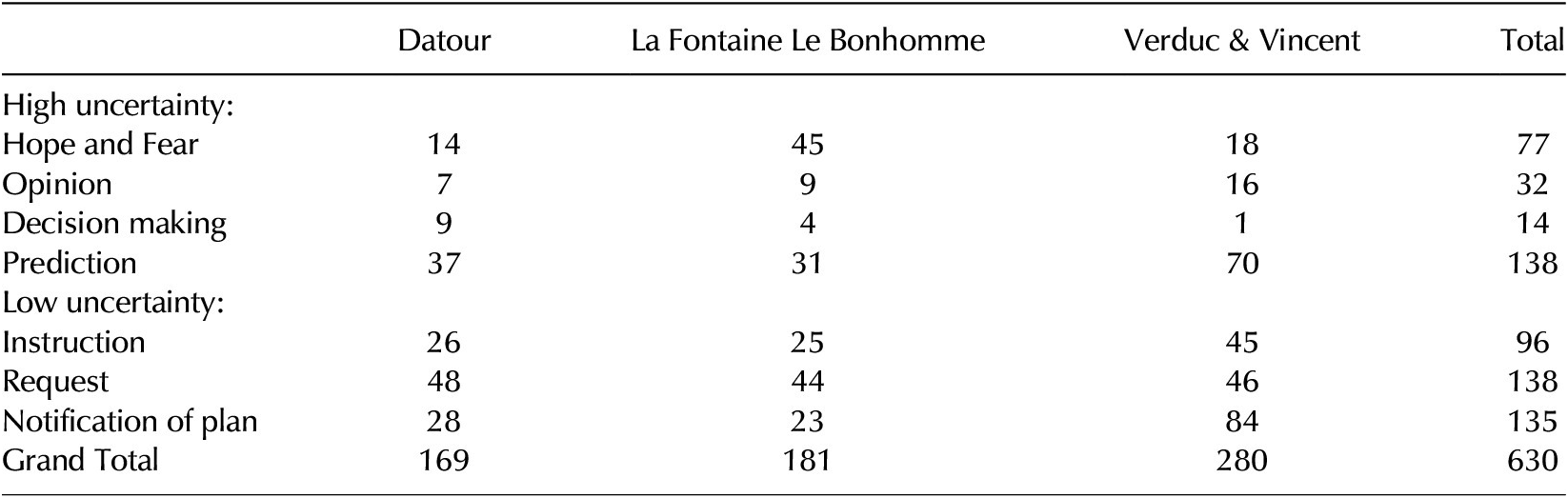
Emotional expressions of the future often catch the historian’s eye. Questions such as whether merchants were optimistic or pessimistic about their future, or what they hoped for or feared, quickly come to mind when trying to establish how people of the past thought about the future. Interestingly, instances where merchants described their hopes and fears account for only slightly more than 10% of the annotated future statements (see Table 3). Despite their scarcity, these statements can be instructive. Authors shared hopes and fears about the future when they expressed that they had little control over a future event and were open about the uncertainty of its outcome to their correspondent. These instances were mainly related to possible disruptions of the trade cycles in which merchants were involved.
Future statements in the annotated correspondences classified into types

Table 3. Long description
The table is organized with statement types as rows and three correspondences—Datour, La Fontaine Le Bonhomme, Verduc and Vincent—as columns, plus a total column. The first section, high uncertainty, includes Hope and Fear with 14 for Datour, 45 for La Fontaine Le Bonhomme, 18 for Verduc and Vincent, total 77; Opinion with 7, 9, 16, total 32; Decision making with 9, 4, 1, total 14; Prediction with 37, 31, 70, total 138. The next section, low uncertainty, includes Instruction with 26, 25, 45, total 96; Request with 48, 44, 46, total 138; Notification of plan with 28, 23, 84, total 135. The grand total row shows 169 for Datour, 181 for La Fontaine Le Bonhomme, 280 for Verduc and Vincent, and 630 overall. High uncertainty categories are listed first, followed by low uncertainty, with all values aligned by correspondence and summed in the final column.
Uncontrollable and Uncertain Futures: Emotions and Opinions
In her letters, the codfish merchant Françoise Datour shared her hopes and fears with her correspondents with terms such as “j’ai bien peur” (I am afraid), “je crains” (I fear), “nous craignons” (we fear), “je souhaite” (I wish), “j’espère” (I hope), and references to God: “Dieu veuille” (May God). These future statements were closely related to the codfish trade cycles. As historians of codfish merchants have shown, the codfish trade, like many other overseas trades, was highly seasonally bound.Footnote 31 The fishing season in the North Atlantic was short, as the ships had to wait for the ice to melt to access the fishing areas around Newfoundland. French codfish merchants often had to coordinate two trade cycles: fishing in the North Atlantic and selling codfish in the Mediterranean. After the fishing season, which started in June or July, the ships sailed to Marseille to sell codfish between November and December for the Mediterranean market. To maximize their voyage, captains loaded Mediterranean products, such as oils, cotton, or soap, as freight from Marseille to Saint-Malo. However, finding freight back took time and could not always happen before ships had to return to Saint-Malo to prepare, hire crews, and fit out the ships for the following fishing season. The seasonal character of the cod fishing in the North Atlantic and the shortness of the season increased the time pressure within the cycle. What generated the most worry in Datour’s letters was the connection between the different stages of her trade.
Each autumn, Datour was concerned about the late arrival of her ships in Marseille. At the beginning of December 1740, when her ships had still not arrived in Marseille, she worried they would not be back in Saint-Malo for the following fishing season in the “Grande Baye.” To fish in the “Grande Baye,” between the west coast of Newfoundland and the coast of Labrador, ships had to leave approximately a month earlier than those fishing in the “Petit Nord,” the north coast of Newfoundland between the cap Dégrat and cap de Bonavista (see Map 1).Footnote 32 The success of a fishing season depended on natural factors such as the movements of codfish and their reproduction.
Typical routes of Saint-Malo codfish sailing ships in the mid-eighteenth century.

Map 1. Long description
Starting in the northeast, Saint-Malo is marked in France, with a green arrow heading west across the Atlantic to Newfoundland. An inset at the northwest shows a magnified view of Newfoundland, pinpointing Cap Dégrat in the north and Cap Bonavista in the east. From Newfoundland, a red arrow curves southeast to Cadiz in southern Spain. Blue arrows loop from Cadiz east to Marseille in southern France and back west to Cadiz, forming a circular route. All ports are labeled with red markers. The map emphasizes the transatlantic and Mediterranean connections of codfish trade routes in the mid-eighteenth century.
To avoid a bad fishing season, codfish merchants sent their ships to different locations in the North Atlantic. The most common combination was to send one or more boats to “Petit Nord” and one or more to the “Grande Baye.” According to Datour’s own estimates, the ships set for the latter should depart from Saint-Malo on 4 or 5 April.Footnote 33 It is therefore understandable that, by mid-January 1741, when her ship had still not arrived in Marseille, Datour wrote: “I’m afraid the ship will be too late to go to the ‘Grande Baye’ which is her destination.”Footnote 34 A month later, Datour expressed her somewhat desperate hope that “this letter will not find the Reine des Anges in Marseille, I wish it.”Footnote 35 However, the letter did find her ship in Marseille as the loading had just begun, and it was clear then that the ship might only just make it to the “Petit Nord.”Footnote 36 Mentions of hopeful terms, such as “I hope” or “I wish,” did not necessarily convey a positive perspective on future events but often revealed merchants’ fears and worries. Indeed, mentions of hope usually carry with them opposite emotions such as fear or anxiety.Footnote 37
Before her, Jean-Baptiste La Fontaine Le Bonhomme, her late husband, shared similar hopes and fears. He used similar words, such as “j’espère” (I hope), “je souhaite” (I wish), “Dieu veuille” (God willing), or “je crains” (I fear), to communicate (primarily) his worries about future events. For instance, when he sent his ship to the North Atlantic in March 1739, he had already written about the next voyage the following season: “May God give her [the ship] a prompt navigation to be able to send her again to Newfoundland.”Footnote 38 In both Datour and La Fontaine Le Bonhomme’s correspondence to the Roux brothers, hopes and fears about future events were nearly exclusively related to relatively short-term or middle-term shipping, fishing, or sales, and not about long-term future philosophical or religious hopes or about more personal emotional content.
Many of the terms related to hopes and fears in codfish merchants’ correspondence are also present in the letters of Verduc & Vincent to the Roux brothers. They wrote, for instance: “nous craignons” (we fear), “y a tout à craindre” (there is everything to fear), “nous espérons” (we hope), “Dieu veuille” (God willing), “nous souhaitons” (we wish). Here too, fears and hopes were closely tied to the trade cycle of their main business: the trade of precious metals from Spanish America. In the eighteenth century, between 80% and 90% of silver was produced in Potosi, in the Vice-Royalty of Peru (current-day Bolivia), and in New Spain (current-day northern Mexico).Footnote 39 The silver trade was, in theory, under the monopoly of the Spanish crown: silver had to be sent to the capital of New Spain to be coined and traded there. On the European side, the only place where the silver could then be shipped was Cadiz, where privileged local merchants traded it for European goods, such as linen and wool, to be sent back to the colonial market.Footnote 40 These products were provided by European merchants based in Cadiz, including Verduc & Vincent. A large part of their business was based on silver transported from Spanish America through the yearly official channel of the assogues or Spanish bullion. While there was less time pressure in the silver trade cycle than in the codfish trade, Verduc & Vincent’s business was punctuated by the arrival of silver in Cadiz, the value of silver and bills of exchange fluctuating according to the silver input.
Verduc & Vincent’s written expression of hopes and fears often concerned the transport of silver and the Spanish fleet: “We are expecting the assogues [ships of the Spanish fleet] next month, may God bring them safely.”Footnote 41 This mention of safety suggested possible disruptions of the routine by military events. Verduc & Vincent were writing in June 1739, a few months before the start of the War of Jenkins’ Ear (1739–1748), opposing Spain to Great Britain in the Atlantic and in particular in the Caribbean Sea, and closely related to the War of the Austrian Succession (1740–1748), which was declared the following year. When Verduc & Vincent mentioned their hopes related to that conflict, they unveiled, in reality, their worries: “The fleet is being loaded, we do not know when it will leave as the English squadron in Gibraltar is threatening the Crown, who armed all the ships that are here, may God prevent any hassle which would trouble commerce.”Footnote 42 In July, they relayed the “extraordinary fear” present among the merchants of Cadiz about the fleet and the risk of attack by the English and in August a similar worry: “We fear a rupture with the English and a delay in the departure of the fleet.”Footnote 43 Delays in the silver fleet put part of Verduc & Vincent’s trade on hold.
Interestingly, the very same conflict generated the opposite reaction in Datour’s letters. The conflict between Spain and Great Britain played in her favor, as it was forbidden to bring English codfish to Spain, and the conflict further decreased the number of English ships in the Mediterranean market. She wished this situation would generate “great demand and consequently good price.”Footnote 44 The competition was tough as most of the Saint-Malo morutiers (codfish ships) traded in Marseille, and the presence of English ships increased in the Mediterranean during the eighteenth century, intensifying the competition.Footnote 45 Datour therefore welcomed the start of the war—at least discursively—as she expressed her hope that it would lower the English competition, even though it also meant heightened possible attacks across the Atlantic Ocean.
For Verduc and Vincent, Marseille was an essential link in their trade. After arriving in Cadiz, silver and other American goods, such as cochineal or coffee, were sent to Europe and the Levant. Marseille was the primary destination of ships from Cadiz bound for France. Silver, arriving in Marseille, would then travel further to Paris, Lyon, Milan, and Genoa.Footnote 46 While the silver trade was well-known to the Roux brothers, volatile prices led Verduc & Vincent to hope the Roux brothers would manage “to get the most of it.”Footnote 47 Silver trade implied a form of remittance of money back to Cadiz, often in the form of bills of exchange, which were not always profitable; Verduc & Vincent shared their fear that the remittances would “only be disadvantageous.”Footnote 48 When the prices of coffee were low, they expressed their “hope that the price will be more favorable” and left it for the Roux brothers to decide when to sell.Footnote 49
Merchants relayed general fears and worries impacting the local conjuncture of their place of business, often formulated with the impersonal form “il y a tout à craindre” (there is everything to fear that) or in the future tense “il y aura beaucoup à craindre” (there is much to fear that). A relevant example is grain production and the impact of weather conditions on harvests. While silver and American goods were more profitable commodities, Verduc & Vincent were also involved in the grain trade, primarily wheat, between Cadiz and Marseille.Footnote 50 They kept their correspondent in Marseille up to date with the latest news about harvests in Andalusia, how it would impact the prices, and whether it would be profitable to import or export wheat.Footnote 51 So when they wrote in March 1739 that “if it does not rain in the next 8 to 15 days, there is everything to fear that the wheat and barley will be lost in this province,”Footnote 52 they did not refer to their own fear but that of local producers and consumers. Two weeks later, they reiterated that “the draught is continuing, and if it lasts another 15 days, there is much to fear that the harvest will be lost.”Footnote 53 Harvest and wheat prices were uncertain and beyond human control, and by relaying the local worry that harvests would be lost, Verduc & Vincent intended to take advantage of possible high prices generated by the scarcity of grains. However, in early April, they notified their correspondents that it had rained heavily in the region and that the harvest might end up being one of the best in a long time. Consequently, there would be no profit to be made on the import of foreign grains.Footnote 54 Instances of (attempts to) speculative operations with uncertain and uncontrollable outcomes, such as this one, are rare in the correspondences and only appear in the letters of Verduc & Vincent. Most of the references to “fears” or “hopes” about prices were related to the prices of the goods merchants were sending to the Roux brothers to sell in the markets they had access to.
Despite the small number of hopes and fears expressed in merchants’ statements about the future, they are informative about what preoccupied merchants and what they expressed was uncertain and beyond their control. While not all hopes and fears were automatically linked to negative future expectations or pessimistic visions of the future, most were negative, as the authors seemed to share their worries rather than their optimism with their business correspondents. The topic of their preoccupations can be divided into two broad categories: on the one hand, the disruption of established trade cycles by war, natural conditions (such as weather, fish, or other factors), or delays, and on the other hand, the prices their agents could sell their goods for and the general market conditions. Business letters were by no means a direct access to merchants’ overall perception of the future, but rather snippets of information about how they wrote about the future to a specific addressee. It appears that, within the context of business correspondence, hopes and fears were more a means of communicating eventual commercial issues that may arise, rather than their personal emotional vision of the future.
Uncertain and uncontrollable futures were not only expressed through worries or hopes, but they also did not necessarily carry positive or negative connotations; they could be neutral. Merchants openly wrote about uncertain future events to provide their addressee with the most accurate information about the situation. Verduc & Vincent gave regular indications of the uncertainty of events when they shared information about the context in the Spanish Atlantic using the terms “nous croyons” (we believe), for instance: “we think he [the captain of the ship] will sell in Malaga”Footnote 55 or “we think that [the captain] went to look for the Assogues and that he will take them to Havana, where they must await orders.”Footnote 56 However, merchants were not only passively describing uncertainty or invoking hopes or fears to cope with high uncertainty, but they also attempted to devise alternative future scenarios.
Trying to Gain Control: Decisions and Strategies
Being open about uncertainty in their letters allowed merchants to explain their plans and communicate upfront about the anticipated scenarios and options. Their business letters explicitly outlined the necessary adjustments to adapt to changing circumstances, shedding light on their decision-making process. While the situation was uncertain, merchants attempted to acquire some control over the future through different plans. Letters explicitly relating the decision-making process of the author are rare in our sample data and are mostly present in Datour’s letters. In one instance, she encouraged the Roux brothers to send her ship to the Levant because she thought her ship could trade there “in a time of crisis like this one.”Footnote 57 By using the term “crisis,” Datour emphasized the uncertainty of the situation and the necessity to take the decision to trade in the Levant. In April 1740, when she was thinking about where to send her ships for the next sailing season, she initially envisioned sending them to Martinique. However, she then decided against it for fear that the return in sugar would not be lucrative enough, stating that it was a danger she could not afford to take: “ce quon ne peut hazardé.”Footnote 58 This statement is one of the rare instances of the explicit mention of the verb “hazarder” and testifies to how actors carefully weighed the pros and cons of undertaking a specific activity. This example shows that business letters inform us about plans that were made but did not take place, as well as how the decision was made.
During that same year, Datour was also planning a privateering expedition off the coasts of Spanish America.Footnote 59 While the Spanish American market was theoretically under the monopoly of the Spanish crown, many illicit trading circuits existed connecting Spanish America to other European colonies and metropoles. During wartime, ships belonging to Spain’s enemies took advantage of the conflict to engage in privateering activities against Spanish ships transporting goods and precious metals. While privateering is uncommon in Datour’s trading activities, it was not the case in the larger Saint-Malo merchant community. French merchants in Saint-Malo had a long history of privateering in the South Sea during wartime, and these voyages were known to be particularly profitable.Footnote 60 Trade to the West Indies was a typical strategy to diversify Saint-Malo merchants’ activities, which were more traditionally oriented toward the North Atlantic fisheries.Footnote 61 Datour insisted on keeping the project secret because other merchants were setting out to undertake a similar design, which would increase the price of the goods needed for outfitting her ships.Footnote 62 However, at the end of the month, she wrote to the Roux brothers that, due to the competition from other merchants, she could not afford the privateering venture after all. She changed the plan: “It prevents us from carrying out our project, so we are reduced to our first project, which is to send the ship to Cadiz.”Footnote 63 This is one of the only explicit mentions of the term “project” in Datour’s letters, and it was used in the sense of a planned voyage. Although the privateering “project” was not implemented, the letters indicate that such a plan was within her realm of possibility. The fact that she explicitly mentioned reverting to her “first project” (sending the ship to Cadiz) shows how she created different future scenarios.
The strategy in an uncertain future could also be to wait until the situation was more certain: “We have to stay patient until we see how the affairs turn out.”Footnote 64 Patience was key to making the right decision. However, it was not always possible to wait, and in these cases, merchants imagined alternative scenarios or adapted and abandoned their initial plans. The uncertainty of the situation did not decrease, but merchants attempted to gain more control over future events.
References to the future that convey merchants’ lack of control and uncertainty are important clues to understanding merchants’ worries about future business activities, what they perceived as possible problems, and how they adapt to them. Merchants discursively approached these rare instances of high uncertainty in different ways: (1) by being open about the uncertainty and discussing different plans to reduce the uncertainty, (2) by using rhetorical devices related to emotions such as “hope” and “fear,” or (3) by communicating openly about the uncertainty. However, the importance of references to uncertain and uncontrollable future events should not be exaggerated. By focusing exclusively on moments of uncertainty and lack of control, we risk dramatizing merchants’ expressions of the future. The results of our analysis largely show that most future statements expressed by merchants were related to a form of certainty.
Decreasing the Uncertainty
Under Control: Requests, Instructions, and Notifications of Plans
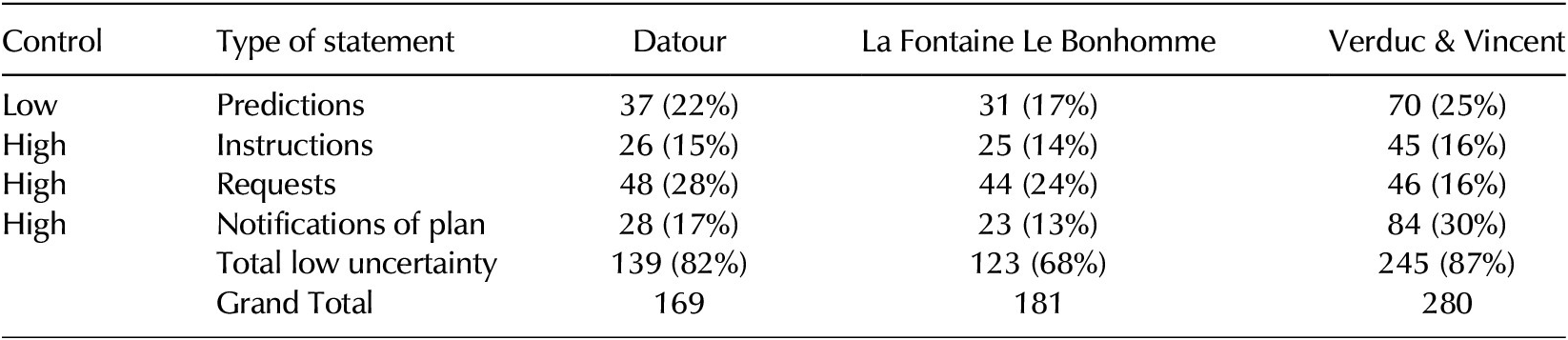
Merchants tended to write with a high degree of certainty about future events. As shown in Table 4, between 70% and 90% of future statements conveyed low uncertainty. Among the statements conveying a high degree of certainty in most cases, merchants also expressed that they or their correspondents were in control of future events or actions. As explained above, I have divided these high certainty and high control statements into three types (requests, instructions, and notifications of plans) to facilitate the analysis of this large category.
Types of future statements conveying low uncertainty in the annotated letters

Table 4. Long description
The table has five columns. The first column lists Control (Low or High). The second column lists Type of statement: Predictions, Instructions, Requests, Notifications of plan, then Total low uncertainty and Grand Total. The next three columns are Datour, La Fontaine Le Bonhomme, and Verduc and Vincent. For Predictions, Datour has 37 (22 percent), La Fontaine Le Bonhomme 31 (17 percent), Verduc and Vincent 70 (25 percent). For Instructions, Datour 26 (15 percent), La Fontaine Le Bonhomme 25 (14 percent), Verduc and Vincent 45 (16 percent). For Requests, Datour 48 (28 percent), La Fontaine Le Bonhomme 44 (24 percent), Verduc and Vincent 46 (16 percent). For Notifications of plan, Datour 28 (17 percent), La Fontaine Le Bonhomme 23 (13 percent), Verduc and Vincent 84 (30 percent). Total low uncertainty is 139 (82 percent) for Datour, 123 (68 percent) for La Fontaine Le Bonhomme, and 245 (87 percent) for Verduc and Vincent. Grand Total is 169 for Datour, 181 for La Fontaine Le Bonhomme, and 280 for Verduc and Vincent.
The most common way of writing about the future in Datour’s letters to the Roux brothers was through requests (28%). Datour’s requests about future actions or events followed a similar structure. Typically, it would take the form of polite orders such as “Je vous prie” (I beg you), “vous aurez la bonté de” (you will be kind enough to), “je vous serais obligée de” (I would be obliged to you), “vous me ferez le plaisir de” (you will do me the favor of). At the beginning of her correspondence, when she took over her husband’s business in 1739, she asked the Roux brothers to look after her affairs in Marseille: “I recommend that you look after my interests and, as you are on the spot, do everything that will be to my advantage.”Footnote 65 As Datour’s commission agents in Marseille, the Roux brothers handled the sale of the Newfoundland codfish on the Mediterranean market and the return freight to Saint-Malo. This position gave the Roux brothers a central role in Datour’s trade and put her in a situation of dependency toward them. For instance, in September 1739, when her ship arrived in Marseille, she wrote to the Roux: “I beg you to provide her all the services that depend on you and to sell her cargo to my advantage and in the shortest time you can.”Footnote 66 The pressure of time is once again noticeable in Datour’s future statement.
In addition to overseeing sales in Marseille, Datour asked the Roux brothers to engage in commercial activities with Verduc & Vincent, based in Cadiz, on her behalf to acquire piastres.Footnote 67 The role of intermediary between Datour and Verduc & Vincent reinforced the centrality of the Roux brothers in different aspects of Datour’s trade. This situation is apparent when Datour shows signs of disappointment in her correspondents: “I beg you, gentlemen, to look after my interests more closely, as you can see that I place them in your hands with confidence”Footnote 68 or when she expressed dissatisfaction in the way they handled previous sales: “you will be good enough gentlemen not to rush into the sale of this cargo as you did with that of the Sauveur.”Footnote 69 While the requests conveyed a sense of certainty in the statement, the lack of trust in her correspondent denotes her doubts that her instructions will be implemented. This is particularly true when she framed her request as a hope: “I hope misters that you will be more attentive to my interests.”Footnote 70 From these statements it appears that the language used to refer to future events varied depending on the relationship between the author and the addressee.
The relationship of dependency toward merchants in Marseille, in this case the Roux brothers, is typical of the codfish merchants based in Saint-Malo. Because Marseille and the Mediterranean were the primary market for codfish in Newfoundland, Saint-Malo merchants, who were nearly exclusively active in codfish, found themselves relying on Marseille-based merchants. The Roux brothers were large merchants who acted as their commission agents, selling their cargo and receiving freight in return, but also served as their bankers, lending them substantial funds. Another codfish merchant based in Saint-Malo, Baillon, also used the Roux brothers as commission agents and showed a similar dependency toward them as Datour, writing to them: “you are the masters.”Footnote 71 Just as for Datour, the Roux brothers were in a position to require that all of Baillon’s ships should sell their cargo in Marseille through them.
The terms used for their requests are not dissimilar to those of Verduc & Vincent: “nous vous prions” (we beg you), “nous serons bien aise” (we will be happy if), “il vous plaira de” (please do this), nous serons charmé d’apprendre (we would be charmed to learn that). But they are much less frequent in the case of Verduc & Vincent (16%) than in Datour and La Fontaine Le Bonhomme’s letters. Verduc & Vincent benefited from a more balanced relationship with the Roux brothers. Verduc & Vincent were the commission agents of the Roux brothers in Cadiz, and they handled each other’s business. The content of their requests about future actions reflected this horizontal power dynamic. They would ask the Roux brothers to pay them what they were due or provide them with orders regarding specific cargoes in the next five months.Footnote 72 They also asked the Roux brothers to update other people on the silver trade and the frequent delays: “we beg you to inform him of the delays of the assogues and the uncertainty in which we are about the time they will take to arrive.”Footnote 73 Verduc & Vincent, unlike Datour, seldom complained or showed their disappointment to the Roux brothers. When they use hope as an indirect request, it was to pressure the Roux to finish a deal and pay them back: “we hope to learn in your answer that this is a closed deal.”Footnote 74
Datour wrote instructions to the Roux brothers, albeit less frequently than requests. In her orders, she typically used the imperative form: “vous agirez” (you will act), “tachez de” (try to), “il faut que vous” (you must). For instance, she instructed the Roux to send her ship to Alicante as soon as it arrived with the big fish in OctoberFootnote 75 or to get freight for her ship, Le Joseph. Footnote 76 The pressure of time is visible in both her instructions about future business operations. Datour wrote: “As soon as the ship arrives you must unload her and load what is destined for here [Saint-Malo].”Footnote 77 While active in a different type of long-distance trade, Verduc & Vincent used similar terms to write their instructions: “continuez de” (continue to), “tachez de” (try to). However, contrary to Datour’s relationship with the Roux brothers, the balance of trade was in favor of Verduc & Vincent. With silver coming from Cadiz to Marseille, the Roux brothers accumulated debts toward Verduc & Vincent rather than the other way around. This situation prompted Verduc & Vincent to exert pressure on the Roux brothers in their instructions: “Make sure to take advantage of our metals and to remit us the money as soon as you can because our advances towards you increase continuously.”Footnote 78 The (in)equality of the relationship had a strong impact on the way authors wrote requests because of who was perceived to be in control of future events.
Overall, requests and instructions concerned events or actions either in the short-term future or in an open-ended future. An open-ended request or instructions did not mention a specific time frame. In some rare cases, authors would insist on the open-endedness by using the term “à l’avenir” (in the future) in the sense of “from now on.” This expression appears only three times in Verduc & Vincent’s correspondence. For instance, they warned their addressee of the bad quality of some of the cochineal arriving from South America, writing to them that “in the future, one will have to redouble attention when buying this grain.”Footnote 79 Datour used the expression only once in her requests and instructions in a similar way to Verduc & Vincent. The mention of the term “à l’avenir” in their instructions and requests did not imply a specific understanding of the long-term future; rather, it was a way to communicate instructions from that point onwards.
With requests and instructions, authors expressed that their correspondents were in control of future events or actions. However, in a large number of future statements, the author gave a sense that they were themselves in control of these future events and actions. In such cases, merchants notified their correspondents of their intentions in the short-term future. Datour would usually write that she was preparing a ship: “here I am working to fit out [my ship] to send it to the Petit Nord ”Footnote 80 or that she would do what was necessary to repay the Roux brothers.Footnote 81 La Fontaine Le Bonhomme likewise described to his correspondents what he planned to do: “as there is a ship going straight from here to Marseille, I will load two barrels of beef for you,” or “I will examine the accounts and will undoubtedly find them right and will sign them.”Footnote 82 However, because the majority of Datour and La Fontaine Le Bonhomme’s future statements were requests, notifications of their own plans constituted only 17% and 13%, respectively. This continues to reflect that despite having the same correspondents, Verduc & Vincent and the two codfish merchants had a different relationship with the Roux brothers.
Verduc & Vincent gave nearly as many instructions or requests as notifications about their own actions to the Roux brothers. As business partners and commission agents of the Roux brothers, Verduc & Vincent had a duty to keep the Roux brothers informed of their affairs in Cadiz. For instance, Verduc & Vincent notified them in detail when they sent goods from America to Marseille: “We will send you leather.”Footnote 83 However, the vast majority of these notifications concerned money transfers between Cadiz and Marseille, typically via bills of exchange.Footnote 84 The circulation of money between Cadiz and other places depended on the annual influx of precious metals from America, happening at a specific moment of the year, as Verduc & Vincent notify their correspondent: “We will only be able to draw a bill of exchange on the arrival of some treasure from the Indies.”Footnote 85 While their trade was dependent on the cyclical nature of the influx of precious metals, they conveyed the certainty to their correspondent that they would eventually draw the bill of exchange.
Looking after the Roux brothers’ business meant handling the business of their other correspondents, such as Datour. In 1739, Verduc & Vincent explicitly mentioned taking care of Datour’s ship Le Salutaire in Cadiz: “When the vessel Le Salutaire will be here, we will see if we can get him some freight for St Malo, but so far we cannot see any sign of it.”Footnote 86 The ship had probably been sent by the Roux brothers to Verduc & Vincent to find better freight than in Marseille. In this quote, Verduc & Vincent already warned the Roux brothers that there is little chance of freight in Cadiz, but that they will do their best. The transmission of sound information was key in business correspondence. Verduc & Vincent not only notified their correspondent that they would keep them informed, “we will inform you of what will happen there,”Footnote 87 but also that they would inform someone else about the situation: “we will inform Mr Jeard directly about what he can expect here for his cargo.”Footnote 88 With instructions, requests, or notifications of plans, future events, or actions, the writer or the addressee was in control. Whether the future event or action would actually happen was more a matter of the writer’s credibility and the relationship between the two correspondents. They could be clues and signs of what preoccupied merchants, as repetitive and frequent instructions reveal what generated concern or disappointment.
Predicting
Even in moments when merchants had no control over future events or actions, they tried to convey a sense of certainty in their discourse to their correspondents. They did so through discussing events they could not control but were highly certain would take place. The interesting aspect of predictions is precisely the seeming contradiction between the high certainty they convey and the uncontrollability of the future in question. Because future events described in predictions were beyond their authors’ control, they allowed merchants to demonstrate their skills. By predicting future events and actions, merchants showed their ability to assess probable outcomes based on their experience and the information available at a particular point in time. In addition, predictions provide clues as to what futures the authors wanted to convey a sense of certainty about to their correspondents.
Predictions are not an insignificant way of writing about the future, and they account for between 17% and 25% of all future statements in the studied correspondences (see Table 4). For instance, in January 1737, Verduc & Vincent predicted that there would be no soda before July or August.Footnote 89 In April 1739, they also wrote about the upcoming harvest, saying that: “It will be one of the best in a long time.”Footnote 90 However, the main topic of Verduc & Vincent’s predictions was related to the silver trade and, in particular, its price fluctuation. In February 1739, they predicted that the delay of the assogues “will be negative for commerce” and that it “will continue to keep the exchange rate high since silver will be rare.”Footnote 91 Based on information they had about the movement of silver, they could make assumptions about prices and write them to the Roux. While this prediction does not specify a particular time frame, it remains relatively short-term, as it would remain valid until the arrival of the ships from Spanish America.
Datour also made predictions about the sales and prices of her goods (codfish or sugar) in Marseille. In August 1739, two months before the outbreak of the War of Jenkins’ Ear, opposing England and Spain in the Caribbean, Datour estimated that there would be just enough time to sell her sugar in Europe before a possible declaration of war.Footnote 92 As she explained to the Roux brothers, since Verduc & Vincent “do not expect any other ships from America, it can be presumed that the sugars will be sold there advantageously.”Footnote 93 Following up on the price of sugar, she wrote in October of the same year that she had observed the increase in sugar prices in Marseille and that her correspondent would be able to enjoy it.Footnote 94 Probably based on information she had about the forthcoming war, she also predicted that codfish would increase in price that autumn as the English would not bring any to Spain and would only do so with great difficulty in Italy.Footnote 95 We do not have the data to confirm the accuracy of these price predictions, but prices are an excellent illustration of future events that merchants could not control but still conveyed certainty about in their letters.
Datour was more pessimistic in her predicting when discussing the costs of fitting out or freight back from the Mediterranean to Saint-Malo. In the spring of 1740, when preparing for the following fishing voyages, she explained, “We have an infinite difficulty to find crew members.” She predicted that “many ships will fail their year,” adding that the price of Irish beef, which was an important part of the supply for crews, would be high.Footnote 96 Likewise, she pessimistically predicted that her ship would make a poor freight back, reducing the profits or even generating losses, or that the freight would take so long to acquire that its profit would instantly be used to pay the crews or other costs.Footnote 97 Datour was in a situation where she needed her ships to return with freight or expenses as low as possible; the small scale of her trade meant that she relied almost entirely on codfish sales.
Predictions analyzed in the correspondences extended to the following season or the upcoming sale and did not refer to long-term futures. Many instances were related to market movements (prices or exchange rates in a given place), showing that these movements were relatively predictable for merchants. These predictions indicate that merchants wanted to demonstrate their knowledge and skills about these market movements to their correspondents.
Conclusion
Our analysis of these three correspondences reveals that eighteenth-century merchants tended to write about future events with certainty. The three sets of sources, written by merchants of different genders, active in two distinct areas of trade, based in two different locations, and with varying relationships to the addressee, all share a high rate of future statements with low uncertainty. The fact that, despite their differences, these three merchants also wrote about the future with a high degree of certainty is an important contribution to our understanding of early modern merchants’ long-distance activities and their correspondence.
Most importantly, these results provide a different and complementary perspective on the ways eighteenth-century merchants expressed the future. Unlike what is often traditionally depicted, the merchants studied in this article were not perpetually uncertain about the future, and when they were uncertain, they did not want to convey that impression to their addressees. It appears that in the daily reality of letter writing, expressing uncontrollability and uncertainty about the future is unusual. In addition, uncertainty did not exclusively come from outside events, such as war, weather conditions, or the dangers of the sea. The source of uncertainty also came from power relations among merchants and whether the author or the addressee would behave as expected.
Lastly, closely analyzing the language used by merchants in their writings about the future crucially contributes to our understanding of early modern business correspondence. Business correspondence was a means for merchants to convey a credible framework for their addressees to work with and make their own plans. To do so, their writings remained closely tied to a practical sense of the near future, rarely extending further than the next trading season. To coordinate their long-distance trade, they attempted to create a future of certainties, if only discursively. Whether merchants thought about the distant future with as much certainty, however, remains to be seen.




 Open access

